AIS Electronic Library (AISeL)
PACIS 2018 Proceedings
Pacific Asia Conference on Information Systems
(PACIS)
6-26-2018
A Temporal Usage Pattern-based Tag
Recommendation Approach
Yen-Hsien Lee
National Chiayi University, [email protected]
Yu-Chi Cheng
National Chiayi University, [email protected]
Tsai-Hsin Chu
National Chiayi University, [email protected]
Follow this and additional works at:
https://aisel.aisnet.org/pacis2018
This material is brought to you by the Pacific Asia Conference on Information Systems (PACIS) at AIS Electronic Library (AISeL). It has been accepted for inclusion in PACIS 2018 Proceedings by an authorized administrator of AIS Electronic Library (AISeL). For more information, please [email protected].
Recommended Citation
Lee, Yen-Hsien; Cheng, Yu-Chi; and Chu, Tsai-Hsin, "A Temporal Usage Pattern-based Tag Recommendation Approach" (2018). PACIS 2018 Proceedings. 221.
A Temporal Usage Pattern-based Tag
Recommendation Approach
Research-in-Progress
Yen-Hsien Lee
Department of Management Information
Systems
National Chiayi University
Chiayi, Taiwan
[email protected]
Yu-Chi Cheng
Department of Management Information
Systems
National Chiayi University
Chiayi, Taiwan
[email protected]
Tsai-Hsin Chu
Department of E-learning Design and Management
National Chiayi University
Chiayi, Taiwan
[email protected]
Abstract
While social tagging can benefit Internet users managing their resources, it suffers the problems such as diverse and/or unchecked vocabulary and unwillingness to tag. Use of freely new tags and/or reuse of frequent tags have degraded coherence of corresponding resources of each tag that further frustrates people in retrieving information due to cognitive dissonance. Tag recommender systems can recommend users the most relevant tags to the resource they intend to annotate, and drastically transfer the tagging process from generation to recognition to reduce user’s cognitive effort and time. Prior research on tag recommendation has addressed the time-dependence issues of tags by applying a time decaying measure to determine the recurrence probability of a tag according to its recency instead of its usage pattern. In response, this study intends to propose the temporal usage pattern-based tag recommendation technique to consider the usage patterns and temporal characteristic of tags for making recommendations.
Keywords: Tag Recommender Systems, Personalized Tag Recommendation, Tagging Systems, Temporal Usage Patterns
Introduction
Flourishing WEB services that allow people to interact and/or collaborate with each other have facilitated the information creation and sharing; however, people have in turn got overwhelmed by the sheer volumes of user-generated contents (Lee and Lee 2004). To relieve information overload suffered by Internet users, some WEB service providers, like social bookmarking websites, developed tagging mechanism which enables users to properly organize resources on the Internet (e.g., websites, articles, photos, videos, music, and etc.) by giving annotations to them (Benz et al. 2010). For example, Bibsonomy enables individuals to bookmark any URLs on the World Wide Web and to retrieve URLs via their annotated tags afterward. Users on such websites can freely annotate resources with keywords they prefer, which in turn becomes the keys to retrieving their bookmarking resources in the future (Krestel and Fankhauser 2012).
Tagging allows users to easily organize and share resources online (Yu et al. 2017; Zoller et al. 2017) and benefits them managing and later retrieving their resources. From another perspective, use of tags
allows resources to be categorized in the way the users prefer to and therefore are considered as a substitute for taxonomies. The tags used by an individual user represent his or her personal preference that might improve the effectiveness of personalized services, like personalized recommender systems (De Caro et al. 2016) or personalized search (Helic et al. 2011; Trattner et al. 2012) if properly utilized (Yang and Chen 2014; Zhang et al. 2012a). Though users’ resource tags could be useful to enhance personalized services, the tagging systems usually encountered problems such as the wide use of diverse and/or unchecked vocabularies and the users’ unwillingness to assign tags (Bischoff et al. 2008; Hu et al. 2012; Marinho et al. 2011). Prior study suggested that people are used to annotating resources with the frequent, recent, and semantic context-relevant tags (Kowald and Lex 2016), which may attribute to forgetfulness (Ebbinghaus 1885) and bounded rationality (Simon 1997). However, similar type of resources would receive different tags and different types of resources would be assigned the identical tag. Both of which would frustrate users in retrieving resources due to the cognitive dissonance. To address the tagging problem, an array of studies has shifted focus on tag recommender systems to assist users in tagging resources and converge the tags annotated. Different to traditional recommender systems, tag recommender systems target to identify a set of tags that are considered relevant to a resource (e.g., documents, music, movie, website, and etc.) by the focal user. Tag recommendation may drastically transfer the tagging process from generation to recognition which reduces user’s cognitive effort and time (Sood et al. 2007). It thus can increase the chances of getting a resource annotated; remind users what a resource about; and consolidate the vocabularies used across the users (Kowald et al. 2015; Marinho et al. 2011). Some bookmarking websites such as Del.icio.us, BibSonomy, and Last.fm have provided tag recommendation service, which implies the needs in real-world situation. Prior research has proposed a pipe of recommendation approaches which could be thoroughly divided into four categories, including collaborative filtering, content-based, graph-based, and hybrid approaches (Yu et al. 2017; Zhang et al. 2012a; Zoller et al. 2017). Though the proposed tag recommendation approaches have shown their effectiveness in making tag recommendations, seldom studies consider the temporal characteristics of tags and their usage patterns. In fact, the tags that people use to annotate resources might change or evolve over time. As mentioned, memory retention declines sharply in a short period of time without frequent reviews. As a result, tags that receives less notices will be left behind and that people use to annotate resources recently and frequently may get more chances of reuse. Prior research addressed the time-dependence issues of tags by applying a time decaying measure to determine the recurrence probability of a tag according to its recency. For example, Trattner et al. (2016) proposed the Base-Level Learning (BLL) to score a tag based on the time that has passed since its last used (Trattner et al. 2016). Though the experimental results suggest its outperformance over most-popularity-based approaches, such approaches may have the tendency toward recommending recently used or newly tags. However, the time-decaying-based approach tends to recommend newly tags and to some degree, diversify user’s tagging.
To address the research gaps existing in tag recommender systems, this study intends to improve the tag recommendation approaches by incorporating the temporal characteristics of tags into the tag assessment. Rationally, a tag should be considered as important if it was used to annotate resources frequently and continuously regardless of its temporal distance to present. As a result, this study will propose a temporal usage pattern-based (TUP) tag recommendation technique to support the personalized tag recommendation. Specifically, our study will develop a measure to evaluate the importance of a tag by assessing its temporal closeness and temporal distance in the sequence of annotated resources. The remainder of this article is organized as follows: In Section 2, we review previous research on tag recommendations and discuss the research gaps to be address, followed by the overall process of the proposed TUP technique in Section 3. Finally, we describe our expected results and contributions in Section 4.
Related Works
In this section, we briefly review the tag recommendation approaches and discuss the research gaps addressed in this study. Tagging allows users to easily organize and share resources online (Yu et al. 2017; Zoller et al. 2017). Tagging can benefit Internet users managing and retrieving their resources;
on the other hand, the tags used by a user represent his or her personal preference that might improve the effectiveness of personalized services, like personalized recommender systems (De Caro et al. 2016) or personalized search (Helic et al. 2011; Trattner et al. 2012) if properly utilized (Yang and Chen 2014; Zhang et al. 2012a). In this line, use of tags allows resources to be categorized in the way the users prefer to and therefore are considered as a substitute for taxonomies. Though users’ resource tags could be useful to enhance personalized services, the tagging systems usually encountered problems such as the wide use of diverse and/or unchecked vocabularies and the users’ unwillingness to tag (Bischoff et al. 2008; Hu et al. 2012; Marinho et al. 2011). Prior study suggested that people are used to annotating resources with the frequent, recent, and semantic context-relevant tags (Kowald and Lex 2016), which may attribute to forgetfulness and bounded rationality. Ebbinghaus (1885) hypothesized the memory retention declines over time. He proposed the forgetting curve to demonstrate that the information loss is about 70% for people who received information two days ago but had no attempt on retention. The information loss can be mitigated by constant recall, but continued without frequent review (García et al. 2007). However, the bounded rationality may hinder people from recalling the tags they have used (Simon 1997). As a result, similar type of resources would receive different tags and different types of resources would be assigned the identical tag. Both of which might frustrate users in retrieving resources due to the cognitive dissonance.
To address the tagging problem, an array of studies has shifted focus on tag recommender systems to assist users in tagging resources and converge the tags annotated (De Caro et al. 2016; Gueye et al. 2013; Gueye et al. 2014; Hmimida and Kanawati 2016; Hu et al. 2012; Kowald et al. 2015; Krestel and Fankhauser 2012; Liu et al. 2011; Lu et al. 2011; Ma et al. 2015; Seitlinger et al. 2013; Symeonidis et al. 2008; Trattner et al. 2016; Wang et al. 2013; Yu et al. 2017; Zhang et al. 2012a; Zoller et al. 2017). Tag recommender is one kind of recommender systems. Instead of recommending objects such as books, music, or movies, the purpose of tag recommender is to suggest appropriate tags to users who are annotating objects in the social media; especially social bookmarking and media sharing websites like CiteULike, and YouTube. Different to traditional recommender systems, tag recommender systems target to identify a set of tags that are considered relevant to a resource (e.g., documents, music, movie, website, and etc.) by the focal user. Specifically, given a user u and a resource r, the task of traditional recommender systems is to predict preference(u, r) whether or how user u will like a resource r; while that of tag recommender systems is to predict a set of relevant tags(u, r) that user u will annotate a resource r (Marinho et al. 2011). The output of preference(u, r) can be either a binary decision or a preference score; while tags(u, r) usually returns a (ordered) subset of preferred tags. Tag recommendation may drastically transfer the tagging process from generation to recognition which reduces user’s cognitive effort and time (Sood et al. 2007). It thus can increase the chances of getting a resource annotated; remind users what a resource about; consolidate the vocabularies used across the users (Kowald et al. 2015; Marinho et al. 2011).
Prior research on tag recommender systems has proposed a pipe of recommendation approaches which could be thoroughly divided into four categories, including collaborative filtering (CF), content-based, graph-based (or ranking-based), and hybrid approaches (Marinho et al. 2011; Yu et al. 2017; Zhang et al. 2012a; Zoller et al. 2017). Research followed CF methods considers neighbor users’ usage behaviors or tag preferences to develop tag recommendation approaches (Liu et al. 2011; Lu et al. 2011; Ma et al. 2015; Wang et al. 2013). Usually, the ternary relationships among users, resources, and tags need to be reduced to multiple binary ones before the traditional CF methods could be applied to tag recommendations. For example, some research followed the user-based CF methods to develop tag recommendation approaches. Specifically, it identifies the users who have used similar tags or have annotated similar resources to the targeted user and then suggest the tags used by the users or by the resources to the annotating resource (Marinho and Schmidt-Thieme 2008). However, some research tried to identify the resources that share similar content with the focal resource and recommended the top-ranked tags used by the similar resources to the user (Gilad Mishne 2006; Sood et al. 2007). On the other hand, the content-based approaches analyze the content of resources to make tag recommendations. Some intended to construct a classification model based the contents of resources (that share similar features with the focal resource) to make recommendation decisions; while others tried to analyze the relationship between tags and their annotated resources of the focal user and
accordingly recommend tags for a new resource (Feng and Wang 2012; Kowald et al. 2015; Krestel and Fankhauser 2012; Seitlinger et al. 2013; Wu et al. 2016; Zhang et al. 2012b). For example, Kowald et al. (2015) estimated a tag’s reuse probability based on the theory of human memory, implemented as a function of usage frequency and recency of the tag in the focal user’s past. The probability function is further refined by considering the semantic context of tagging situation; Seitlinger et al. (2013) used the semantic features of a user-specific resource and its associated tags to train a simple three-layers connectionist model; Chen and Shin (2013) proposed several textual features and social features for each tag used by a focal user as the basis to construct a classifier to predict the tags for that he or she will prefer to annotate the new resource; Heymann et al. (2008) considered tag recommendation as a multi-label classification problem that targets on classifying one object into more than one categories. However, Yu et al. (2017) analyze the probability distribution of tags attached to the resources of a focal user to determine his/her tagging status and based on which to make tag recommendations.
The graph-based (or ranking-based) approaches, inspired from the Web ranking, aim to make tag recommendations by analyzing the constructed graph, where vertices represent users, resources, and tags, and edges show the relationships among them (Cai et al. 2016; Gueye et al. 2013; Ramezani 2011; Rawashdeh et al. 2013). For example, Hmimida and Kanawati (2016) proposed a graph-coarsening approach, which employed a community detection algorithm to coarsen the hypergraph of folksonomy to shorten the time cost of graph-based tag recommenders; Gueye et al. (2013) proposed STRec, which applied bounded search to find good neighbors and made network-aware recommendations based on proximity measures. Some studies focused on the ranking score derived from the spectral attributes extracted from the underlying folksonomy data structure (i.e., the 3-way relationship among users, resources, tags); for example, Hotho et al. (2006) proposed FolkRank algorithm and the notion behind which is that a resource becomes important itself if it is tagged by important tags from important users and the same situation holds for tags and users. Finally, the hybrid approaches generally combine two or more methods or algorithms to make tag recommendations; for example, Kim and Kim (2014) integrated association rules, bigram, tag expansion, and implicit trust relationships to make tag and item recommendations; Gueye et al. (2014) proposed FasTag algorithm that assumes users are organized in a weighted graph and evaluate the relevance of tags based their popularity and opinions of neighbor users.
Overall, the literature reviewed suggests that prior studies have developed numbers of tag recommendation approaches and most of them focused on analyzing and/or discovering the relationships between users, resources, and tags. Some studies have noticed the time-dependence of user tagging (Kowald and Lex 2016); that is, outdated tags should be weighted less for recommendation. For example, Iofciu and Demartini (2009) proposed a time decaying function to degrade the scores of tags; Trattner et al. (2016) did the similar works by proposing a Base-Level Learning (BLL) equation to lower the importance of a tag by its temporal distance to present; Zhang et al. (2012a) considered the temporal distance between the first-time and last-time usage of tags into the designed relevance measure. To the best of our knowledge, most approaches considered either the first-time usage or the last-time usage of a tag, the complete usage patterns of tags seem not to be modeled. Rationally, a tag should be weighted more if it was used frequently and continuously for a time because such tag might be an important notion or concrete concept to the focal user during that period. Thus, our study will intend to propose temporal usage-pattern-based tag recommendation technique in response to these issues.
Design of Temporal Usage Pattern-Based Tag Recommendation Technique
In response, this study follows the content-based method and develops a temporal usage pattern-based (TUP) tag recommendation technique, in which we intend to formulate user’s tag usage pattern to score the tag candidates. Besides, we also consider the temporal characteristics of tags by incorporating it into the scoring function for tag ranking.
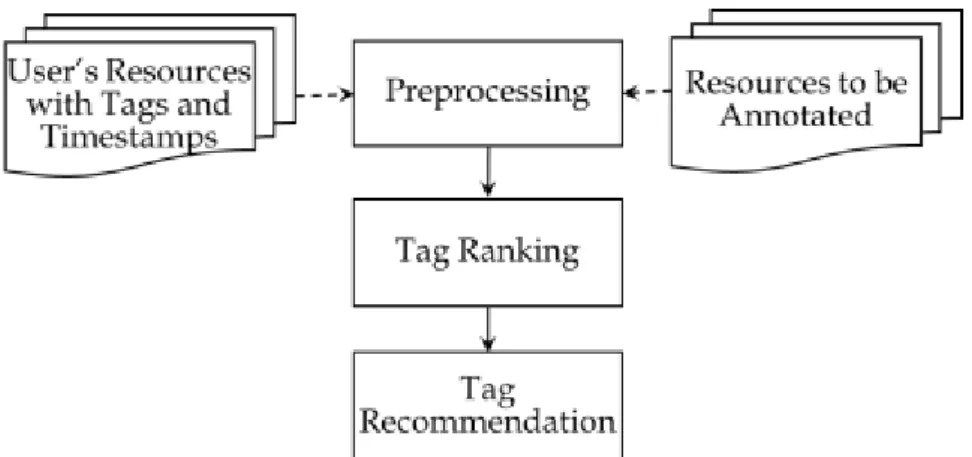
Figure 1: Overall Process of Temporal Usage Pattern-Based Tag Recommendation Technique
As shown in Figure 1, the overall process of the TUP comprises three phases, including preprocessing, tag ranking, and tag recommendation. The TUP technique takes as inputs a focal user’s resource profile (i.e., annotated resources, tags, and their timestamps) and the resources to be annotated and produces a list of tag candidates. Each tag candidate’s usage pattern and temporal characteristic will be taken into consideration collectively to weight its importance at the phase of tag ranking. Finally, the recommendations will be made at the phase of tag recommendation. In the following, we describe the preliminary design of each phase in the TUP technique.
Preprocessing
The main purpose of preprocessing phase is to form the list of tag candidates to be recommended from those tags that have been used to annotate resources by the focal user. Before identifying tag candidates, the TUP technique preprocesses the resource contents, i.e., to extract from the resource documents a set of representative features (i.e., nouns and noun phrases) that will be used for representing the resources themselves. In the following, the annotated resources that are similar with the resource to be annotated are identified and taken their annotations as the tag candidates. To measure the similarity between two resources, we adopted Cosine similarity defined as sim(ra, rb) = ||wwa.wb
a||.||wb||, where wa and wb are the
feature vectors of resource ra and rb respectively. Finally, a list of tag candidates was formed, in which
each tag candidate would be assessed in the next phase.
Tag Ranking
The tag ranking phase is to weight the importance of each tag candidate. In this study, we intend to develop a measure to assess the appropriateness of each tag candidate. Our developed measure considers the frequency, the usage pattern, and the temporal distance of each tag candidate collectively. As mentioned, prior research has suggested the influence of frequency and recency to the reuse of tags (Kowald and Lex 2016). However, we also consider a tag as important if it appeared frequently and continuously for a period. Assume a sequence of resources R annotated by the focal user, ordered by their annotated time, we propose a temporal density function that consider both frequency and usage pattern to weight the tag candidate. The temporal density function is defined as:
Density(ti) = log
1+
j=2 R(ti) 1 log2(
xj−xj-1 + 1)
where R(ti) is the number of tag ti appearing in R, and xj is the order of the resource that tag ti is
annotated for the j-th times in R.
For example, assume that the sequence R consisted of 10 resources. Suppose ti appears in r1, r4, and r7
in R. Then, Density(ti) is calculated as log
1+ 1 log2(
4−1+1)
+ 1log2
(
7−4+1)
= 1. Furthermore, letlog
1+ 1 log2(
2−1+1)
+ 1 log2(
3−2+1)
= log( )
3 = 1.585.On the other hand, we also propose a temporal distance function that consider the recency of a tag candidate based on its tagging history. The temporal distance function is defined as:
Distance(ti) = e-(
xp-xl
xp-xf)
where xp is the total number of resources in R, xl is the order of the latest resource that tag ti is
annotated in R, and xf is the order of the first resource that tag ti is annotated in R.
Let’s continue the above example. The temporal distance score of tag ti is calculated as e-(
10-7 10-1) = 0.716 and that of tag th is calculated as e-(
10-3
10-1) = 0.459. We finally evaluate the weight of a tag candidate by the product of the temporal density and the temporal distance. Thus, we can derive the weight of tag ti as 1x0.716=0.716 and tag th as 1.585*0.459=0.727. It shows that the tag th shall get
higher rank than tag ti in this case.
Tag Recommendation
The final phase of the TUP technique is to sort the list of tag candidates according to their attained scores and make tag recommendations.
Expected Results and Contributions
We will perform the comparative evaluation on the proposed TUP technique, using tag recommender developed by prior studies that also addressed the issues of temporal characteristic of tags, as performance benchmarks. We first collect the experimental dataset before carrying out the empirical evaluation. The underlying assumption of our study is to make tag recommendations on the basis of users’ tagging histories; therefore, real and complete tagging history of users are required for our evaluation. We accordingly collect the experimental datasets from the social bookmarking websites, such as Del.icio.us, BibSonomy, CiteULike, and Last.fm, for the real-world datasets. In this study, we may adopt the leave-one-out cross validation to evaluate our proposed techniques and the benchmarks. We take the tags annotated to the latest resource in the focal user’s profile as testing set and the remaining annotated resources and their corresponding tags as training set. we repeat the experiment for every user in the dataset to cross validate the experimental results. Finally, this study will adopt prediction accuracy, precision, and recall as the evaluation metrics. Overall, this study addresses an important research issue, i.e., personalized tag recommendations. Though existing tag recommendation techniques considered temporal characteristics of tags, they ignore their usage patterns. We attempt to fill these gaps by proposing a temporal usage pattern-based tag recommendation technique, which considers the temporal distance and usage pattern of used tags when making recommendations. The TUP technique is expected to support Internet users to well-organized their resources by recommending appropriate tags to facilitate organizing and accessing users’ annotated resources in the future. The effective management of resources will in turn benefit the other application research, such as information retrieval, document clustering, text classification.
References
Benz, D., Hotho, A., Jäschke, R., Krause, B., Mitzlaff, F., Schmitz, C., and Stumme, G. 2010. "The Social Bookmark and Publication Management System Bibsonomy," The VLDB Journal—The International Journal on Very Large Data Bases (19:6), pp. 849-875.
Bischoff, K., Firan, C. S., Nejdl, W., and Paiu, R. 2008. "Can All Tags Be Used for Search?," in: the 17th ACM Conference on Information and Knowledge Management. pp. 193–202.
Cai, X., Zhu, J., Shen, B., and Chen, Y. 2016. "Greta: Graph-Based Tag Assignment for Github Repositories," The IEEE 40th annual computer software and applications conference, pp. 63–
72.
Chen, X., and Shin, H. 2013. "Tag Recommendation by Machine Learning with Textual and Social Features," Journal of Intelligent Information Systems (40:2), pp. 261-282.
De Caro, P., Pini, M. S., and Sambo, F. 2016. "A Tag-Based Recommender System," The 13th International Conference on Intelligent Autonomous Systems, E. Menegatti, N. Michael, K. Berns and H. Yamaguchi (eds.), Padua, Italy: Springer International Publishing, pp. 1049-1061. Ebbinghaus, H. 1885. Memory: A Contribution to Experimental Psychology. New York: Columbia
University.
Feng, W., and Wang, J. 2012. "Incorporating Heterogeneous Information for Personalized Tag Recommendation in Social Tagging Systems," The 18th ACM SIGKDD international conference on knowledge discovery and data mining, pp. 1276–1284.
García, R. R., Quirós, J. S., Santos, R. G., González, S. M., and Fernanz, S. M. 2007. "Interactive Multimedia Animation with Macromedia Flash in Descriptive Geometry Teaching," Computers & Education (49), pp. 615-639.
Gilad Mishne, G. 2006. "Autotag: A Collaborative Approach to Automated Tag Assignment for Weblog Posts," The 15th International Conference on World Wide Web: ACM Press, pp. 953-954. Gueye, M., Abdessalem, T., and Naacke, H. 2013. "Strec: An Improved Graph-Based Tag
Recommender," The 5th ACM RecSys Workshop on Recommender Systems and The Social Web,
B. Mobasher, D. Jannach and W. Geyer (eds.), Hong Kong, China: ACM.
Gueye, M., Abdessalem, T., and Nacke, H. 2014. "A Social and Popularity-Based Tag Recommender,"
IEEE Fourth International Conference on Big Data and Cloud Computing (BdCloud): IEEE, pp. 318-325.
Helic, D., Trattner, C., Strohmaier, M., and Andrews, K. 2011. "Are Tag Clouds Useful for Navigation? A Network-Theoretic Analysis," International Journal of Social Computing Cyber-Physical Systems (1:1), pp. 33-55.
Heymann, P., Ramage, D., and Garcia-Molina, H. 2008. "Social Tag Prediction," The 31st Annual International ACM SIGIR Conference on Research and Development in Information Retrieval, pp. 531–538.
Hmimida, M., and Kanawati, R. 2016. "A Graph-Based Meta-Approach for Tag Recommendation," in:
The 5th International Workshop on Complex Networks and Their Applications, H. Cherifi, S. Gaito, W. Quattrociocchi and A. Sala (eds.). Milan, Italy: Springer, Cham, pp. 309-320. Hotho, A., Jäschke, R., Schmitz, C., and Stumme, G. 2006. "Information Retrieval in Folksonomies:
Search and Ranking," The 3rd European Semantic Web Conference, Y. Sure and J. Domingue (eds.), Budva, Montenegro: Springer, pp. 411–426.
Hu, J., Wang, B., Liu, Y., and Li, D. 2012. "Personalized Tag Recommendation Using Social Influence,"
Journal of Computer Science and Technology (27:3), pp. 527-540.
Iofciu, T., and Demartini, G. 2009. "Time Based Tag Recommendation Using Direct and Extended Users Sets," European Conference on Machine Learning and Principles and Practice of Knowledge Discovery in Databases, Discovery Challenge 2009, F. Eisterlehner, A. Hotho and R. Jäschke (eds.), Bled, Slovenia, pp. 99-107.
Kim, H., and Kim, H. J. 2014. "A Framework for Tag-Aware Recommender Systems," Expert Systems with Applications (41), pp. 4000–4009.
Kowald, D., Kopeinik, S., Seitlinger, P., Ley, T., Albert, D., and Trattner, C. 2015. "Refining Frequency-Based Tag Reuse Predictions by Means of Time and Semantic Context," 4th International Workshop on Modeling Social Media: Mining, Modeling and Recommending 'Things' in Social Media, M. Atzmueller, A. Chin, C. Scholz and C. Trattner (eds.), Paris, France: Springer, pp. 55-74.
Kowald, D., and Lex, E. 2016. "The Influence of Frequency, Recency and Semantic Context on the Reuse of Tags in Social Tagging Systems," 27th ACM Conference on Hypertext and Social Media, J. Blustein and E. Herder (eds.), Halifax, Nova Scotia, Canada: ACM, pp. 237-242. Krestel, R., and Fankhauser, P. 2012. "Personalized Topic-Based Tag Recommendation,"
Neurocomputing (76:1), pp. 61-70.
Lee, B. K., and Lee, W. N. 2004. "The Effect of Information Overload on Consumer Choice Quality in an on-Line Environment," Psychology & Marketing (21:3), pp. 159-183.
Recommendation in Social Tagging Systems," IEICE Transactions on Information and Systems
(94-D:3), pp. 542–551.
Lu, C., Hu, X., Park, J., and Jia, H. 2011. "Post-Based Collaborative Filtering for Personalized Tag Recommendation," The 2011 iConference, pp. 561–568.
Ma, T., Zhou, J., Tang, M., Tian, Y., Al-Dhelaan, A., Al-Rodhaan, M., and Lee, S. 2015. "Social Network and Tag Sources Based Augmenting Collaborative Recommender System," IEICE Transactions on Information and Systems (98:4), pp. 902–910.
Marinho, L. B., Nanopoulos, A., Schmidt-Thieme, L., Jaschke, R., Hotho, A., Stumme, G., and Symeonidis, P. 2011. "Social Tagging Recommender Systems," in Recommender Systems Handbook, F. Ricci, L. Rokach, B. Shapira and P.B. Kantor (eds.). Springer Science+Business Media LLC, pp. 615-644.
Marinho, L. B., and Schmidt-Thieme, L. 2008. "Collaborative Tag Recommendations," The 36th Annual Conference of the German Classification Society on Data Analysis, Machine Learning and Applications, C. Preisach, H. Burkhardt, L. Schmidt-Thieme and R. Decker (eds.), University of Hildesheim, Germany, pp. 533-540.
Ramezani, M. 2011. "Improving Graph-Based Approaches for Personalized Tag Recommendation,"
Journal of Emerging Technologies in Web Intelligence (3:2), pp. 168-176.
Rawashdeh, M., Kim, H. N., Alja’am, J. M., and Saddik, A. E. 2013. "Folksonomy Link Prediction Based on a Tripartite Graph for Tag Recommendation," Journal of Intelligent Information Systems (40), pp. 307–325.
Seitlinger, P., Kowald, D., Trattner, C., and Ley, T. 2013. "Recommending Tags with a Model of Human Categorization," The 22nd ACM international conference on Conference on information & knowledge management, Q. He and A. Iyengar (eds.), San Francisco, CA, USA: ACM, pp. 2381-2386.
Simon, H. A. 1997. Models of Bounded Rationality. Cambridge, MA: MIT Press.
Sood, S., Owsley, S., Hammond, K., and Birnbaum, L. 2007. "Tagassist: Automatic Tag Suggestion for Blog Posts," The International Conference on Weblogs and Social Media.
Symeonidis, P., Nanopoulos, A., and Manolopoulos, Y. 2008. "Tag Recommendations Based on Tensor Dimensionality Reduction," The 2008 ACM Conference on Recommender Systems: ACM, pp. 43–50.
Trattner, C., Kowald, D., Seitlinger, P., Ley, T., and Kopeinik, S. 2016. "Modeling Activation Processes in Human Memory to Predict the Use of Tags in Social Bookmarking Systems," Journal of Web Science (2:1), pp. 1-16.
Trattner, C., Lin, Y. L., Parra, D., Yue, Z., Real, W., and Brusilovsky, P. 2012. "Evaluating Tag-Based Information Access in Image Collections," The 23rd ACM Conference on Hypertext and Social Media, pp. 113-122.
Wang, H., Chen, B., and Li, W. J. 2013. "Collaborative Topic Regression with Social Regularization for Tag Recommendation," The Twenty-Third international joint conference on Artificial Intelligence, pp. 2719-2725.
Wu, Y., Yao, Y., Xu, F., Tong, H., and Lu, J. 2016. "Tag2word: Using Tags to Generate Words for Content Based Tag Recommendation," The 25th ACM international on conference on information and knowledge management, pp. 2287-2292.
Yang, C. S., and Chen, L. C. 2014. "Personalized Recommendation in Social Media: A Profile Expansion Approach," The 18th Pacific Asia Conference on Information Systems.
Yu, H., Zhou, B., Deng, M., and Hu, F. 2017. "Tag Recommendation Method in Folksonomy Based on User Tagging Status," Journal of Intelligent Information Systems), pp. 1-22.
Zhang, L., Tang, J., and Zhang, M. 2012a. "Integrating Temporal Usage Pattern into Personalized Tag Prediction," 14th Asia-Pacific Web Conference on Web Technologies and Applications, Q.Z. Sheng, G. Wang, C.S. Jensen and G. Xu (eds.), Kunming, China: Springer Berlin Heidelberg, pp. 354-365.
Zhang, Y., Zhang, B., Gao, K., Guo, P., and Sun, D. 2012b. "Combining Content and Relation Analysis for Recommendation in Social Tagging Systems," Physica A: Statistical Mechanics and its Applications (391:22), pp. 5759–5768.
Zoller, D., Doerfel, S., Pölitz, C., and Hotho, A. 2017. "Leveraging User-Interactions for Time-Aware Tag Recommendations," in: 11th ACM Conference on Recommender Systems. Como, Italy.