Design of Context Dependent Blending (CDB) in
Behaviour Based Robot Using Particle Swarm Fuzzy
Controller (PSFC)
Andi Adriansyah
Department of Electrical Engineering, Faculty of Engineering Universitas Mercu Buana Meruya Selatan, Kembangan, Jakarta Barat, 11650, Indonesia
[email protected] Abstract
—
Behaviour-based control architecture has successfullydemonstrated their competence in mobile robot development. One key issue in behaviour-based design is the action selection problems. In behaviour-based system, a composite behaviour is implemented as a system using Context Dependent Blending (CDB) that activates the
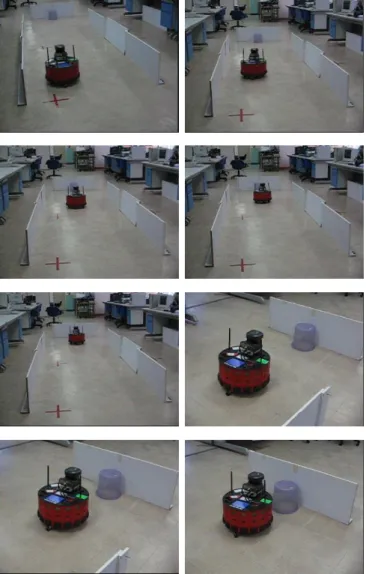
underlying individual behaviours according to the current robot’s
context in a certain degree. However, the compromises of conflicting behaviours decision might be sub-optimal or even worse than any of the individual commands. It is caused by using the un-optimized fuzzy context rules. Therefore, most of the works in the field generate a certain interest for the study of fuzzy systems with added learning capabilities for best fuzzy context rules. This paper presents the development of CDB with Flexible Fuzzy Context Rules (FFCR) using Particle Swarm Optimization (PSO) called as Particle Swarm Fuzzy Controller (PSFC). Several experiments with MagellanPro mobile robot have been performed to analyse the performance of the algorithm. A set of Fuzzy Context Rules, called as Single Fuzzy Context Rules (SFCR) are used as comparison. The promising results have proved that the proposed control architecture for mobile robot has better capability to accomplish special task in office-like environment.
Keywords
—
Behaviour Based Robot, Context Dependent Blending, Particle Swarm Optimization, Fuzzy LogicI. INTRODUCTION
Designing a mobile robot is a challenging task. Generally, the mobile robot should face complex environment, perceive imprecise sensor and act with imperfect actuator in fast response. Behaviour-based control architecture is an alternative approach suitable to address these problems. The architecture is able to act with fast real-time response, provides for higher-level deliberation and has demonstrated its reliable performance in standard robotic activities.
However, a kind of soft computing is needed to perform a key issue in behaviour-based systems named as Action Selection Problem [1] or Behaviour Coordination Problem. The problem arises here because it is necessary to decide which behaviour(s) should control the mobile robot at any given time to select the action that most satisfied the system goal. Several researchers have proposed various schemes to solve the problem.
Fuzzy logic system offers useful mechanism to address the behaviour coordination problem. The most general form of fuzzy behaviour coordination that realized using fuzzy logic is obtained by using both fuzzy context rules to represent the arbitration policy and fuzzy combination to perform command fusion [2]. This form of combination is initially suggested by Ruspini [3], then fully spelled by [4] and called as Context Dependent Blending (CDB). In CDB, preferences are
represented by fuzzy set of controls, generated by fuzzy controllers. The contexts are represented by formulas in fuzzy logic, which serve as the antecedent in the fuzzy arbitration rules. Fusion and choice are respectively performed by a fuzzy combination operator and by defuzzification.
However, the compromises of conflicting behaviours decision might be sub-optimal or even worse than any of the individual commands. It is caused by using the un-optimized fuzzy context rules. Therefore, most of the works in the field generate a certain interest for the study of fuzzy systems with added learning capabilities for best fuzzy context rules.
This paper presents a new behaviour coordination algorithm that coordinates predefined individual behaviours. The method will identify the preference context for each of them and then execute the optimized rules using Particle Swarm Fuzzy Controller (PSFC), a fuzzy system that its parameters are tuned automatically using Particle Swarm Optimization (PSO). The overview of behaviours interaction in fuzzy context rules is initially explained. Then, the block diagram of the proposed behaviour coordination algorithm is described and designed in the next sections. Several experiments will be run to determine the fuzzy context rules, to test the performance of the proposed algorithm and to be compared with other techniques.
II. DESIGN METHODOLOGY
A. Behaviour Based Robot
The analysis of behaviour is an important part. The main goal of the mobile robot must be investigated in detail. It is a top-down approach that involves decomposing the main objective into smaller ones; in such way that main objective is achieved as a result from the execution of simpler behaviours and from their interaction.
Based on the robot’s target behaviour, the proposed approach decomposed the task of robot into four behaviours, namely: goal seeking behaviour (goal), left wall following behaviour (lwall), right wall following behaviour (rwall), and obstacle avoiding behaviour (obs). Goal seeking behaviour steers and moves the robot to the right direction and reach the goal effectively. The mobile robot movement towards the goal is according to the distance and angle between the current position of the mobile robot and the goal position. Furthermore, wall following behaviours navigate the robot to follow wall in order to help goal completion. Based on some
distances measured between the mobile robot and the walls, the mobile robot would maintain some fixed distance between both robot and the wall even at edges. Moreover, obstacle avoiding behaviour is responsible to control the robot from colliding with objects in the environment. Actually, the obstacle avoiding is a complex behaviour. The mobile robot has to detect first whether there is any obstacles or not. Then, the direction should be determined to avoid the obstacles. Some distances between the mobile robot and obstacles should be measured to complete the task of this behaviour. Each of behaviour generated two control actions that are linear velocity, v, and angular velocity, ω, as outputs. Two types of sensors, odometer and sonar, are used to determine the current situation of the mobile robot. The mathematical model of the mobile robot and fuzzy system parameters applied here are based on our previous work [5].
Once the individual behaviours have been singled out, their interactions can, and must, be completely defined. According to Colombetti et al. [6], there are types of interactions among behaviours that should be taken into account. Those interactions are: independent sum, combination, suppression, and sequence. Ability to determine the appropriate behaviours interaction will result in a mobile robot that can perform tasks optimally, according to the shortest path and the fastest time.
The outputs of each behaviour in CDB are fused according to fuzzy meta rules or fuzzy context rules. The fusion process defines how outputs from different behaviours are mixed together in a fuzzy way to give a coherent output. The fuzzy context rules determine which behaviours are fired, and to what degree. Different types of behaviours interaction as described above can be expressed using fuzzy context rules based on different fuzzy operators. Mostly, fuzzy context rules designed by user as a planner for a certain environment are obtained by learning process or applying the available one. However, all fuzzy context rules are implemented in CDB as single rules.
A flexible fuzzy context rule (FFCR) is proposed in this work to obtain the best arbitration strategies corresponding to behaviours interaction required in any situation. Inspired by Saffiotti [6] that a mobile robot can perform a task in complex environment using a modular logical format of fuzzy context rules, a schema that has several different formats of fuzzy context rules is proposed in this work. These formats are used for the control rules and the arbitration rules according to behaviours interaction required in particular situation. The number of modules for fuzzy context rules corresponds to the number of behaviours coordination occurring in the mobile robot.
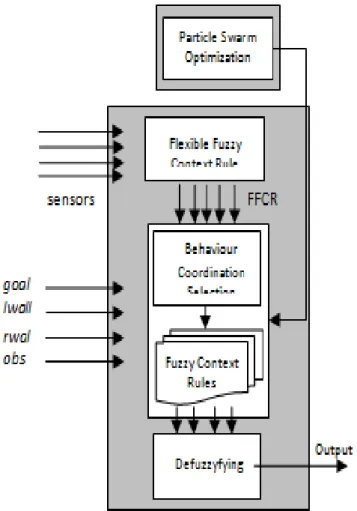
The FFCR block interprets each environment situation as an agent expressing preferences. These degrees of preferences are calculated by a fuzzy systems based on some parameters from sensors accordingly. Afterward, the behaviour coordination selection block will determine which behaviours are active in a particularly time from the degrees of preferences values. Then, based on fuzzy context rules corresponding to active behaviours, the degrees of preferences are combined into a collective preference as Behaviour Weight, BW, respectively. These behaviour weights
determine which behaviour is fired and to what degree. Lastly, a final action as output of CDB will be generated by a defuzzyfying process based on the collective preference values obtained and the control action from behaviours, respectively. Fig. 1 provides a block diagram of CDB with FFCR.
Fig. 1 Block Diagram of CDB with Flexible Fuzzy Context Rules
There are a number of fuzzy context rules in FFCR block according to the number of basic behaviours combination. In order to find the appropriate fuzzy context rules, the Particle Swarm Fuzzy Controller (PSFC), a fuzzy system that its parameters are tuned automatically using Particle Swarm Optimization (PSO), is used. Some PSO processes are run according to basic behaviours combination required and certain fitness function, respectively.
B. Flexible Fuzzy Context Rules (FFCR)
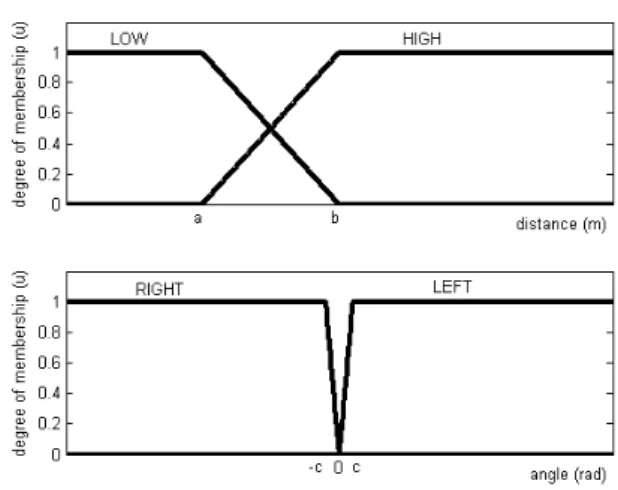
In FFCR several parameters must be calculated in the fuzzy system. These parameters are the minimum distance of the front zone sensors, dfront, the minimum distance of the left zone sensors, dleft, the minimum distance of the right zone sensors, dright, the minimum distance of the target, dgoal, and the angle of the target, δgoal.
The set of fuzzy Membership Functions and linguistic terms for those parameters are shown in Fig. 2. The values of a, b, and c that are used in this work for the minimum distances are listed in Table 1. For the target angle, the value of cis chosen as π/16.
Fig. 2 Membership functions of minimum distances and target angle TABLEI
MEMBERSHIP FUNCTION VALUES OF MINIMUM DISTANCES
a b
dfront 0.8 1.2
dleft 0.4 0.8
dright 0.4 0.8
dgoal 0.8 1.2
Each degree of membership value of those parameters determines the degree of preference. This value corresponds to the behaviours that active at a particularly time. These values are provided to FFCR block. Since there are four behaviours in this work and goal seeking behaviour, goal, is considered as a variable, the rests are concatenated as
obs. lwall. rwall (1)
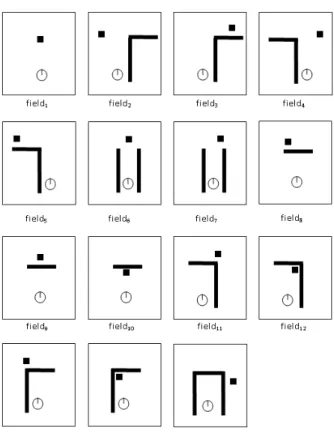
where the value of obs, lwall, and rwall are corresponding to the degree of preferences of them, respectively,. The value for the degree of preferences is from zero to one, [0 , 1]. The possible combinations based are depicted in Fig. 3. For example, the bbc2 means there are combination between left
wall following behaviour, lwall, and goal seeking behaviour, goal.
Fig. 3 Basic behaviours combinations
The fuzzy context rules are designed as fuzzy set rules with conjunctions and negations structures. This form is chosen because it needs only one linguistic term of each fuzzy membership function and reduces the number of the rules required. The fuzzy context rules have the following form:
im im i in in in i i i IFX A X ATHEN Y B Y B RB 1 1 1 (2)
where Xi1… Xin are the n input variables, Yi1… Yim are the m output variables, and Ai1 … Ain, Bi1 … Bim are degree of memberships from trapezoidal fuzzy sets. The input variables, n = 5, are arranged as, dfront, dleft, dright, dgoal and λgoal. On the other hand, the output variables, m = 4, are arranged as obs, lwall, rwall and goal. Equation (2) is consequent with the initial fuzzy context rules [2]-[4] that have a basic form as:
behavior THEN
context
IF (3)
A PSFC is applied in this part. A modified PSO is used to search the optimized fuzzy context rules for every basic behaviours combination effectively.
Because of a PSO deal with coded parameters, the new schema of encoded strings is proposed to form a complete particle of possible fuzzy context rules. A complete particle of possible rules is concatenated as
Particle |r11|, .…|r1n| … |r41|, … |r4n|
Parameter | context1 | … | context4 | (4)
where rkn is the k-th of fuzzy context rules code for n-th context. The value of rkn is corresponding to behaviours interaction required at a particular state and encoded into integer codes that are based on fuzzy interaction. For fuzzy
interaction, ‘-1’, ‘0’, and ‘1’ means fuzzy with negations, no fuzzy interaction, and fuzzy with conjunctions, respectively. For the example, since particle, r = [00000 00000 00000 -1-1-1-00], obs, lwall, and rwall have zero BW and thus there are no obstacles and walls around the mobile robot. In this case the fuzzy goal seeking behaviour, (goal), has a high BW.
However, in order to reduce the size of particle used in PSO process, the result of behaviour coordination selection is also applied to select the consequent context. Therefore, PSO searches for different size of particles depending on the basic behaviour coordination. For example, PSO searches 10 sizes in a particle for bbc1 but PSO needs 20 sizes in a particle for
bbc7.
The PSO process for fuzzy context rules also starts with randomly generated initial populations. Afterward, all populations of particles are evaluated and associated based on fitness function to determine the pbest and gbest. The fitness function has to measure how good each basic behaviours combination is, which actually affect the performance of the mobile robot.
Based on several initial investigations, the general fitness function for fuzzy context rules can be obtained as
) . . . . ( 0 4 3 2 1
I icr c Time c Way c Coll c DeltaWallSq
f (5)
where I is the number of iterations corresponding to the number of target positions, Time is the percentage of the number simulation steps performed from the total time provided, Way is the percentage of the distance left from the start position to the target position in the current stage, Coll is the number of the mobile robot collisions with obstacles or walls, and DeltaWallSq is the sum of square of difference between the left distance and the right distance. The fitness function thus defined tries to take into account the different aspects relevant to a good robot performance: rewarding low execution times (Time) and the degree of completion of the task (Way), punishing collisions with the obstacles or walls (Coll), and maintaining the mobile robot movement in centre of the corridor (DeltaWallSq).
The determination of the fitness function in Equation (5) above depends on the basic behaviours combination mission and is stated as the value of ci. For example in the case of corridor situation, bbc3, aligning to the centre line can be
obtained by minimizing the difference between the left distance and the right distance and gives a high value for c4.
In another side, in conflict between obstacle and target situation case, bbc4, the value of c3 is set high but the value of
c4 is set zero.
Finally, as shown in Figure 1, four behaviour weights are generated as outputs of FFCR block. The number of behaviour weight is consequent to the number of behaviours applied in this mobile robot system.
C. Defuzzyfying
Once the behaviour weight of each of behaviour has been singled out, their fusion must be completely defined. Saffiotti [11] gave a centre of gravitation defuzzyfying formula for fusion the command preferences, as follows
i i i i i BW Y BW Y ) * ( (6)where Y is the final control action, i represents the active behaviour activated by rules, BWi is the behaviour weight preferences and Yi is the behaviour command output.
III.RESULTS AND DISCUSSIONS
Several experiments have been performed to demonstrate the performance of the designed algorithm. A MagellanPro mobile robot is used for verification and performance analysis of the proposed algorithm. The MagellanPro is a circular mobile robot from iRobot, Real World Interface (RWI), the acknowledged industry leader in the exciting field of cutting-edge mobile robotic [8]-[9]. Fig. 4 shows the physical structure of MagellanPro mobile robot.
Fig. 4 The MagellanPro mobile robot
An office-room scenario that has 10 by 10 meters spaces was also used for testing the mobile robot movement in basic behaviours combination and in complex environment. Several simulation fields as shown in Fig. 5 were designed to test the performance of the mobile robot in basic behaviours combination. Generally, each field contains obstacles, a start and a target position. Several conflict scenarios between obstacles, walls and target point, corridor-like environment and dead end condition were included in the fields to test the ability of the proposed algorithm. The fitness values are used to analyse the performance of this proposed algorithm. A single fuzzy context rules (SFCR) applied by Hagras et al. [7] is used as a comparison. The fitness values of each simulation field are listed in Table II.
Fig. 5 A set of simulation fields
The minimum fitness value was also used to analyse the performance of each field. Generally, according to Table 3, the fitness value of FFCR is better than the fitness value of SFCR. However, for some fields, such as field1, field5, field8,
To analyse the performance of both algorithms, the behaviour activation was used here beside the mobile robot movement. Behaviour activation displays the value of degree of preferences each of behaviour after coordination process, respectively. The higher the value of behaviour activation means higher the individual behaviour is considering in behaviour coordination.
As an example, in field2 there was a conflict between goal
seeking behaviour, goal, and right wall following behaviours, lwall in field2. The mobile robot should follow the right wall
and approach the target but in shortest path and time. The fitness values in this field show that the FFCR is better than SFCR. Fig. 6 illustrated the mobile robot movement and the behaviour activation in field2. In the beginning, the mobile
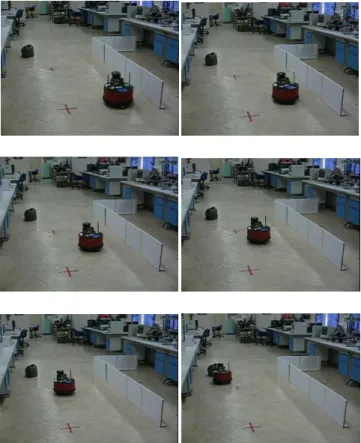
robot has detected the target and the wall in the environment. However, in FFCR, the target is not assumed as a conflict with the wall. Therefore, the goal seeking behaviour, goal, inhibits the right wall following behaviour, rwall. It was shown in Fig. 6(a) that the degree of activation of the goal seeking behaviour is always 1 while the degree of activation of the right following behaviour is always 0. Consequently, the mobile robot moved to the target directly. Nevertheless, the mobile robot should follow the wall in advance and then go to the target in SFCR. It was demonstrated in Fig. 6(b) that the degree of activation of the goal seeking is zero in the first path while the degree of activation of the right wall following is one. After finishing in following the wall, the degrees of activations were changed. The degree of activation of the goal seeking behaviour was going to one while the degree of activation of the left wall following was going to zero. Fig. 7 shows the photograph of MagellanPro robot movement.
TABLEII
FITNESS VALUE COMPARISON BETWEEN FFCR AND SFCR
Field FFCR SFCR Field1 1.2304 1.2304 Field2 1.7630 3.1377 Field3 1.7461 2.1140 Field4 1.6900 2.1821 Field5 4.0754 4.0754 Field6 5.9507 7.6691 Field7 6.4720 8.6753 Field8 1.8302 1.8302 Field9 4.5515 4.5515 Field10 0.8715 6.1038 Field11 8.5668 8.5251 Field12 3.4522 7.3865 Field13 6.2967 6.2967 Field14 5.9814 11.9814 Field15 69.1019 979.4689
Fig. 6 Mobile robot movements and behaviour activations for simulation field2: (a) FFCR and (b) SFCR
Fig. 7 Photographs of Mobile Robot Movements in field2 Another experiment was performed to investigate the movement of the mobile robot in field6. The robot started
from (2.5, 1.25, π/2), moved in 1.5 m wide corridor and went
to the target at (3, 4.75, 0) located after the end of the corridor and in front of a line obstacle. The MagellanPro mobile robot movement was depicted in Fig. 8.
Fig. 8 Photographs of the mobile robot movement in field6
Actually, the mobile robot has detected the target and two walls as a corridor in the environment. The mobile robot has awareness about the target location, but it should handle the faced environment. Based on the FFCR process, the CDB generate set of behaviour preferences in certain degrees as shown in behaviour activation. It is noted that the robot movement can be divided into some stages: (i) the robot starts to move in following the left wall, (ii) the robot moves in to the centre of the corridor, (iii) the robot travels in the centre of corridor, (iv) the robot goes out from the corridor, and (v) the robot reaches the target without colliding with the obstacle.
It can be noted that, generally, the mobile robot was able to accomplish the task effectively although running in unplanned environment with incomplete and imprecision sensors, and imperfect actuators.
V. CONCLUSION
The paper highlighted the development of behaviour coordination algorithm with flexible fuzzy context rules. In FFCR, the fuzzy context rule is decomposed in several basic behaviours combination rules. A PSFC process has been applied to obtain the optimized fuzzy context rules for each of basic behaviours combination. Several experiments have been performed to investigate the performance of the
algorithm. It is noted that the mobile robot is able to deal with conflicts of behaviours problems and generates the good behaviours interaction, that are more smooth response between behaviours, moves in the centre-line in tight corridor, more robust path in avoiding obstacle and reaching the target, and goes out from the trap and escapes from the dead end situation.
ACKNOWLEDGMENT
This research was funded by Directorate General of Higher Education, Ministry of Education and Culture, Republic of Indonesia, under scheme of Fundamental Research in 2014.
REFERENCES
[1] Maes, P. “How to Do the Right Thing”. Technical Report NE 43-836, AI-Laboratory, MIT, Cambridge. 1989.
[2] A. Saffiotti, “The uses of fuzzy logic in autonomous robot navigation”,
Soft Computing, 1997, 1, pp. 180-197.
[3] E.H. Ruspini, “Truth as utility: A conceptual synthesis.”, Proceeding of the 7th Conference on Uncertainty in Artificial Intelligence. Washington, DC, 1991, pp. 317-324.
[4] A. Saffiotti, E.H. Ruspini, and K. Konolige, “Blending reactivity and goal-directedness in a fuzzy controller”, Proceeding of the 2nd Fuzzy
IEEE Conference. San Francisco, California, 1993, pp. 134-139. [5] S.H.M. Amin and A. Adriansyah, “Particle Swarm Fuzzy Controller
for Behaviour-based Mobile Robot”, Proceeding of 9th International
Conference of Control, Automation, Robotics and Vision, Singapore, 2006, pp. 1508-1513.
[6] M. Colombetti, M. Dorigo, and G. Borghi, “Behaviour Analysis and Training – A Methodology for Behaviour Engineering”, IEEE Transaction on Systems, Man, and Cybernetics, 1996, 26(3), pp. 365-380.
[7] H. Hagras, V. Callaghan, M. Colley, and M.A. Carr-West, “Behaviour based Hierarchical Fuzzy Control Architecture for Agricultural
Autonomous Mobile Robots”, Proceeding of International Conference on Computational Intelligence for Modeling, Control, and Automation. Vienna, Austria, 1999, pp. 166-171.
[8] iRobot Corporation. (2001). Magellan Pro Compact Mobile Robot User’s Guide, Part Number: 3625, Rev.4, NH 03452, USA.
[9] iRobot Corporation. (2001). Mobility Robot Integration Software User’s Guide, Part Number: 2841, Rev.5, NH 03452, USA.