Behavioral Mimicry Covert
Communication
by
Seyed Ali Ahmadzadeh
A thesis
presented to the University of Waterloo in fulfillment of the
thesis requirement for the degree of Doctor of Philosophy
in
Electrical and Computer Engineering
Waterloo, Ontario, Canada, 2013
Declaration
I hereby declare that I am the sole author of this thesis. This is a true copy of the thesis, including any required final revisions, as accepted by my examiners.
I understand that my thesis may be made electronically available to the public. Seyed Ali Ahmadzadeh
Abstract
Covert communication refers to the process of communicating data through a channel that is neither designed, nor intended to transfer information. Traditionally, covert chan-nels are considered as security threats in computer systems and a great deal of attention has been given to countermeasures for covert communication schemes. The evolution of computer networks led the communication community to revisit the concept of covert com-munication not only as a security threat but also as an alternative way of providing security and privacy to communication networks. In fact, the heterogeneous structure of computer networks and the diversity of communication protocols provide an appealing setting for covert channels. This dissertation is an exploration on a novel design methodology for
undetectable and robust covert channels in communication networks.
Our new design methodology is based on the concept of behavioral mimicry in computer systems. The objective is to design a covert transmitter that has enough degrees of freedom to behave like an ordinary transmitter and react normally to unpredictable network events, yet it has the ability to modulate a covert message over its behavioral fingerprints in the network. To this end, we argue that the inherent randomness in communication protocols and network environments is the key in finding the proper medium for network covert channels. We present a few examples on how random behaviors in communication protocols lead to discovery of suitable shared resources for covert channels.
The proposed design methodology is tested on two new covert communication schemes, one is designed for wireless networks and the other one is optimized for public communi-cation networks (e.g., Internet). Each design is accompanied by a comprehensive analysis from undetectability, achievable covert rate and reliability perspectives. In particular, we introduced turbo covert channels, a family of extremely robust model-based timing covert channels that achieve provable polynomial undetectability in public communication net-works. This means that the covert channel is undetectable against any polynomial-time statistical test that analyzes samples of the covert traffic and the legitimate traffic of the network. Target applications for the proposed covert communication schemes are discussed including detailed practical scenarios in which the proposed channels can be implemented.
Acknowledgements
I would like to thank my advisor, Professor Gordon Agnew, for all his support and guidance throughout my study and the development of this dissertation. His invaluable insight, broad vision, and continuous support helped me pass through difficulties and obstacles in my doctoral program. He has always seen merit in my work, and encouraged me to challenge myself by exploring new ideas in my research. He showed me how a great teacher can positively influence his students and taught me to be objective and constructive at the same time. I am truly honored to work with him, and I do appreciate all that he has done for me.
I also offer my sincere gratitude to the members of my thesis examination committee, Prof. Otman Basir, Prof. Mohamed Oussama Damen, and Prof. Eihab Abdel-Rahman for their kind advice and support. Indeed, it is my pleasure to acknowledge my external ex-aminer, Prof. Scott Knight, for his comments on my PhD dissertation and his outstanding contributions to covert communication that inspired me during this project.
I had the privilege to be motivated by exceptionally talented colleagues, in particular members of the high speed and secure communication lab, Saad Alaboodi, Abdel Maguid Tawakol, Daniel Miller, Michal Skiba, and Jeffrey Woo. Thank you my friends for your companionship and the abundantly helpful discussions.
A big thank you goes to my family, specially my father, Seyed Ahmad Ahmadzadeh, and my mother, Bibi Ozra Nabavi, who have always valued education, and taught me perseverance, honesty, and integrity. I am grateful for your unconditional love, and it gives me great pleasure to present my finest work to you.
Last and foremost, I would like to express my deepest gratitude beyond words to my beautiful wife, Azin Ashkan, who stood by my side throughout this journey, and made me believe there is nothing I can’t reach. Azin, you are my inspiration, and I cherish every moment spent with you. Without you, none of this would be possible.
Dedication
To
Azin
Table of Contents
List of Tables xv
List of Figures xvii
1 Introduction 1
1.1 Overview . . . 3
1.2 Motivation and Research Objectives . . . 4
1.2.1 Covert Channel Design Methodology . . . 6
1.2.2 Wireless Covert Channel . . . 7
1.2.3 Turbo Covert Channel . . . 8
1.3 Dissertation Outline . . . 9
2 Background and Related Work 11 2.1 Covert Communication . . . 13
2.1.1 Covert Channel Definition . . . 14
2.2 Covert Channel Classification . . . 15
2.2.1 Storage and Timing Covert Channels . . . 17
2.2.3 Covert Channels in Computer Networks . . . 21
2.2.4 Wireless Covert Channels . . . 28
2.3 Covert Channel Countermeasures . . . 31
2.3.1 Eliminating Covert Channels . . . 32
2.3.2 Limiting the Capacity of Covert Channels . . . 33
2.3.3 Detecting Covert Channels: . . . 36
2.4 Chapter Summary . . . 41
3 Covert Channel Design Methodology 43 3.1 Behavioral Mimicry Covert Communication . . . 45
3.2 Randomness in Communication Protocols . . . 46
3.2.1 Sources of Randomness in Communication Systems . . . 47
3.2.2 Exploiting Randomness . . . 50 3.3 System Model . . . 54 3.3.1 Channel Model . . . 54 3.3.2 Adversary Model . . . 56 3.3.3 Undetectability . . . 56 3.4 Chapter Summary . . . 59
4 Wireless Covert Communication 61 4.1 Introduction . . . 61
4.2 Preliminaries and System Model . . . 62
4.2.1 Shared Medium and Multiple Access Protocols . . . 62
4.3 Fixed Rate Covert Channel (FRCC) . . . 65
4.3.1 Covert Clock . . . 65
4.3.2 FRCC Channel Design . . . 66
4.3.3 Design Parameters . . . 72
4.4 Adaptive Rate Covert Channel (ARCC) . . . 81
4.5 Performance Analysis . . . 84
4.5.1 Stealthiness of the Covert Channel . . . 86
4.5.2 Robustness Analysis . . . 91
4.5.3 Covert Rate Analysis . . . 97
4.6 Target Applications . . . 99
4.7 Chapter Summary . . . 101
5 Turbo Covert Channel 103 5.1 TCP/IP Timing Covert Channels . . . 105
5.2 System Model . . . 108
5.3 Turbo Covert Channel . . . 109
5.3.1 Covert Transmitter . . . 109 5.3.2 Covert Receiver . . . 115 5.3.3 Iterative Demodulation/Decoding . . . 120 5.3.4 Guard Band . . . 123 5.4 Performance Analysis . . . 127 5.4.1 Undetectability Analysis . . . 127
5.4.2 Covert Rate Analysis . . . 131
5.5 Target Applications . . . 139 5.6 Chapter Summary . . . 140
6 Conclusion and Future Work 143
6.1 Future Directions . . . 148
List of Tables
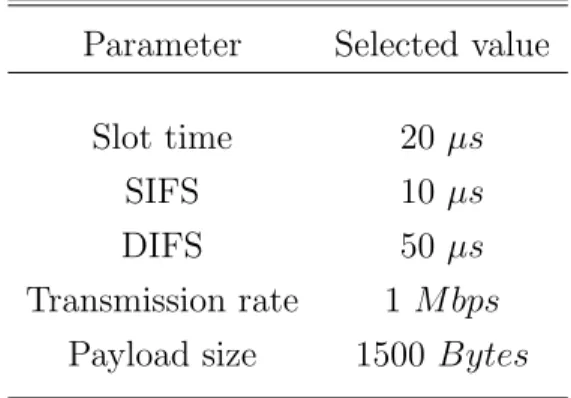
4.1 Wireless network parameters. . . 85 4.2 Design parameters for different simulation scenarios. . . 86 5.1 Performance analysis system configuration parameters . . . 133
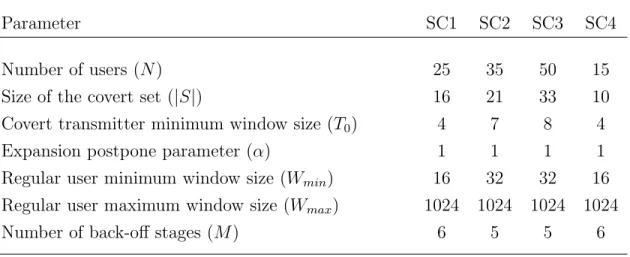
List of Figures
2.1 The prisoner’s problem and covert channels [1]. . . 15
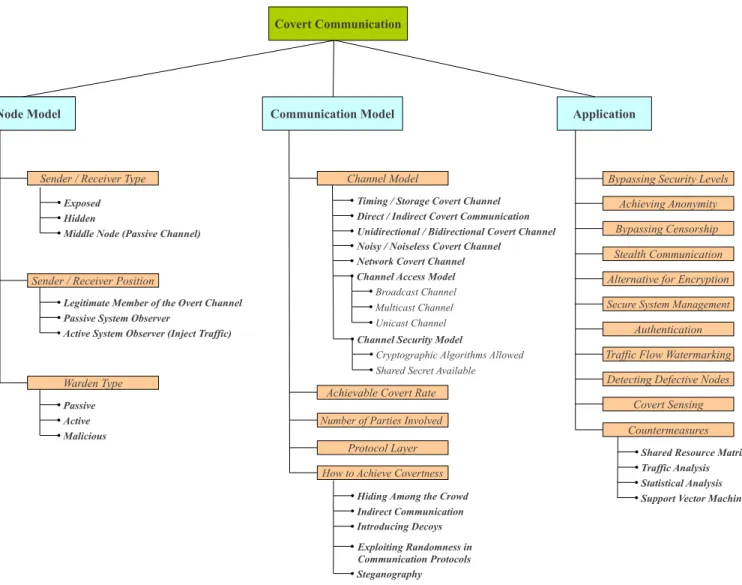
2.2 A sample classification of covert channels. . . 16
2.3 The simple PUMP architecture [1]. . . 36
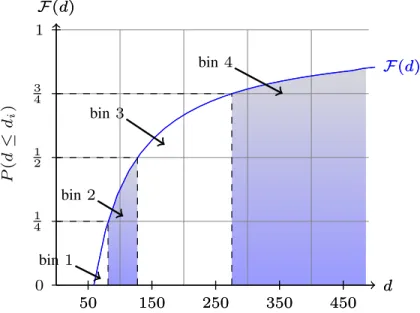
2.4 Equiprobable bins of inter-packet delays for Q= 4. . . 40
4.1 The CSMA/CA and the binary backoff algorithm. In each stage Wi is the size of the contention window, where Wi = 2iWmin and p is the probability of unsuccessful transmission attempt [2]. . . 64
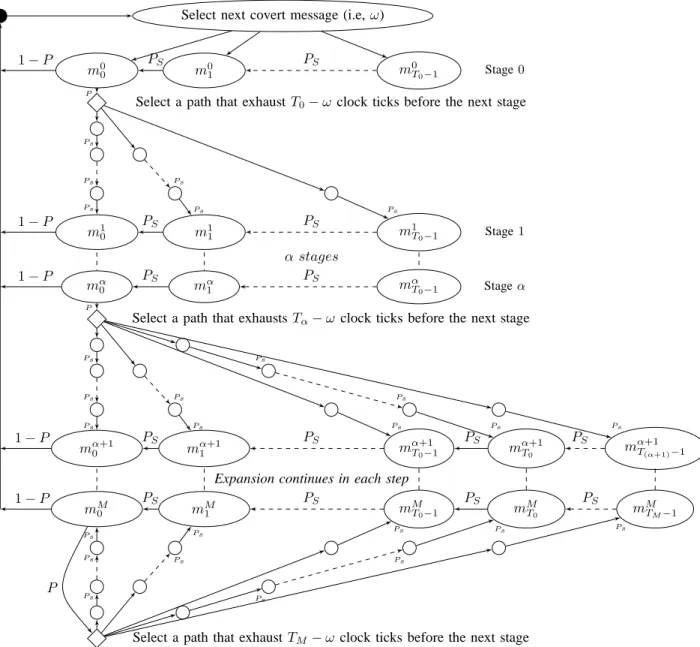
4.2 Covert message transmission. PS is the probability of a successful transmis-sion by members of the covert set. . . 68
4.3 Kolmogorov-Smirnov shape test for different simulation scenarios. . . 88
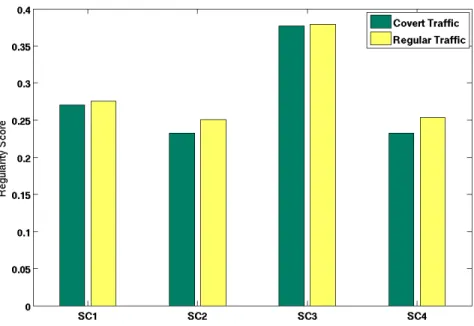
4.4 Regularity test for different simulation scenarios. . . 90
4.5 Covert channel BER versus the packet loss ratio for the packets from mem-bers of the covert set. The plots are according to the first scenario in Table 4.2. Packets from the covert transmitter are assumed to be always detected at the covert receiver. . . 95
4.6 Covert channel bit error rate due to the loss of the covert transmitter’s packets at the covert receiver. Packets from members of the covert set are subject to error with packet loss rate equal to 0 for dotted lines, 0.1 for solid lines, and 0.2 for dashed lines. The plots are according to the first scenario
in Table 4.2. . . 96
4.7 Overt communication rate of the covert transmitter and normal network nodes. . . 98
4.8 Achievable covert rate of the proposed covert channel. Dashed lines depict the additional capacity (advantage) that can be achieved using the ARCC scheme. . . 99
5.1 A simple timing covert channel. The covert information are modulated over IPDs of the covert traffic (50msdelay for covert bit-0, and 100ms delay for covert bit-1). . . 106
5.2 High level system model of the turbo covert channel. . . 110
5.3 Modulating the covert messageu = (0,1) given the random sequence vector v= (0.33,0.18). . . 113
5.4 Modulation trellis with the branch indicator parameter for each branch. . . 114
5.5 Demodulation trellis with branch transition weights. . . 118
5.6 Covert receiver block diagram with iterative demodulation/decoding. . . . 121
5.7 Model-based covert modulation with guard band. . . 124
5.8 BER performance of the TCC scheme with no guard band. . . 134
5.9 BER performance of the TCC scheme with guard band in place. . . 136
Chapter 1
Introduction
Computer systems and the digital revolution undoubtedly have changed modern history. Computer networks, distributed systems, and cloud computing are symbols of an era in which instant access to information and the ability to process, store, and share huge vol-ume of data are no longer optional properties for modern computer systems. However, such enormous flow of information requires extra attention to data security and privacy preserving technologies.
It is often believed that using encryption can provide security in computer systems. However, encryption only limits the access to the content and in turn gives away the fact that there exist some sensitive data that needs to be protected. In some cases, just a mere hint about the existence of information or a communication channel is enough to raise suspicion or trigger adversarial actions. Hence, consideration should be made in order to protect data by hiding signs of existence of sensitive information or communication channels.
The art of information hiding is about concealing the very existence of a message or a communication channel in order to protect data and prevent being detected by possible system observers. As an example, one can consider the application of spread spectrum techniques in military radio communications. The objective in such applications is to prevent the enemy to identify and locate the transmitter as it may direct attack towards
the signal source. Steganography and digital watermarking are other examples of informa-tion hiding techniques that are used in particular in multimedia and copy-write protecinforma-tion applications. In this way, the message that is intended to be hidden (e.g., sensitive in-formation, or copy-write data) is embedded within contents of an innocent message often called cover-data. Thus, as long as the adversarial entity or the system observer (e.g., a censorship authority) does not have the key that is used in the embedding process, no information on the hidden message can be gained from the knowledge on the cover-data and the embedding process.
Another important sub-discipline of information hiding is covert channels. Covert com-munication often refers to the process of communicating data through a channel that is neither designed, nor intended to transfer information. In other words, a covert channel
is a communication channel that violates the normal specifications of a system by using a shared resource or a communication algorithm in such a way that is not initially designed for data transfer purposes. Thus, the channel can evade detection since it uses resources that are not intended for data transmission and it should not exist in the first place. These channels are of a particular importance in evaluating the security of computer systems. In fact, covert channels have been traditionally used to leak sensitive information from processes with high access privileges (i.e., high process) to unauthorized recipients that normally do not have security clearance to access such information (i.e., low process).
Consider Alice and Bob to be two users of a multi-level secure (i.e., MLS) system. In a multi-level secure structure, the access privileges of each user are thoroughly specified by a security architecture. Hence, users with low access privileges (e.g., Bob) can not access data or services that are marked only for users with high clearance (e.g., Alice). Any attempt to access high level data by low processes will be monitored and blocked by the access control mechanism. In addition, Alice can not send high level information directly to Bob as such action is clearly against the access policy of the system. However, if the reverse case is not prohibited by the access control policies (i.e., if the low process is allowed to send messages to the high process), Alice can leak sensitive information to the low process (i.e., Bob) through the delay between consecutive acknowledgments that it sends to confirm the correct reception of Bob’s messages. In this way, a long delay between
Ack messages represents covert bit-1, and a short delay denotes covert bit-0. Thus, a covert channel is formed in a direction that was initially disallowed by the access policy of the system.
It is worth noting that in contrast to the cryptographic games in which the ethical position of players is usually straightforward i.e., the “good” guys want to protect the data from “bad” eavesdroppers or adversarial entities, the situation is not as clear when it comes to covert channels. In more detail, while in some cases a user wants to detect and eliminate covert channels in order to prevent unauthorized information leakage in the system, there are cases in which hiding the communication channel can be used in order to improve user privacy, or to reduce the risk of adversarial attacks against sensitive information. It is even suggested to trace back attackers or malicious users of a system by secretly marking traffic flows in and out of the system using covert channels
1.1
Overview
Covert channels are usually created by exploiting weaknesses in conventional computer systems or communication protocols. A crucial step in designing a covert channel is to identify a resource that is (i) shared between the covert transmitter and the covert receiver, and (ii) can be modified by the covert transmitter in order to modulate the covert message. The shared resource should also play a major role in normal operation of the original system (e.g., randomness in resource sharing protocols). Thus, the access control mechanism should not be able to remove or strictly control the shared resource that is used for covert communication, without imposing drastic performance degradation on the system.
In general, two major forms of covert channels are defined based on the type of the shared resource, and how the transmitter uses that resource for covert communication. One category involves direct or indirect storage of the covert message (i.e., storage channels). The file-lock covert channel is a typical example of a storage covert channel in which the covert transmitter operates on a shared file in the system and changes the file access status to locked/released in order to modulate the covert bit-0 / bit-1, respectively. The
other category (i.e. timing channels), targets typical time-based properties of the system. These channels often exploit the resource consumption pattern of a user or a process in the system in such a way that the covert receiver interprets the covert message by analyzing the covert transmitter behavior. For instance, a simple timing covert channel can be formed by congesting the memory access bus with a burst of access requests in a known period of time to modulate covert bit-1 or leave the bus open by remaining idle to modulate the covert-bit0. It is noted that splitting covert channels into timing and storage channels is not a clear cut classification and can be extended by identifying new channels (e.g.,
counting channels) in which the count, the frequency, or the ordering of system events are used to embed the covert message into the overt channel.
The importance of covert channels becomes more noticeable when they are extended into computer networks. Modern communication networks benefit from relatively high data rate and cover a wide range of users that may be geographically spread across the globe. The large number of users, the diversity of services and the huge volume of network traffic make it relatively difficult for system observers to effectively monitor and process all communication channels in computer networks. In fact, the heterogeneous structure of communication networks and the diversity of communication protocols that are used in such systems provides an appealing setting for covert channels. This dissertation is an exploration of a novel methodology that is suitable to design undetectable,robust and high rate covert channels over public communication networks.
1.2
Motivation and Research Objectives
In traditional covert communication schemes (e.g., the file-lock channel) the undetectability of the channel mostly relies on the obscurity of the shared resource that is used as the medium for covert communication. For instance, in the file-lock covert channel, the channel is undetectable as long as the system observer does not consider the status of shared files as a potential medium for information leakage. However, if the shared medium between covert transmitter and the covert receiver is identified by the access control mechanism,
the channel may be compromised and it can be removed from the system. The situation is more critical in network covert channels, where the shared medium (i.e., the network traffic) is clearly used for communication purposes. Network traffic is easily accessible by monitoring entities that may record, process or even modify the traffic in order to thwart covert channels. In fact, there are numerous methods that are designed to detect, eliminate or limit the capacity of network covert channels. Therefore, undetectability becomes one of the main requirements of covert channels over communication networks.
Channel robustness is another important feature of a covert communication scheme, specifically for network covert channels. In communication networks, the covert channel shares network resources with many different traffic sources. Resource sharing is a key element in distributed systems (e.g., computer networks) in order to spread system re-sources in an efficient and fair manner to all users and services in the system. However, contention over the same resources may produce a temporal resource shortage that would turn into transient performance degradation of the system. Such unpredictable events change network characteristics and potentially affect the shared medium that is used for covert communication. For instance, it is known that the TCP/IP connections over the Internet are served with best-effort quality of service. It means that the network does its best to deliver the traffic to the destination, however it does not provide any guarantee on its service level. Hence, data packets may be delivered out-of order, in delay, or they may not be delivered at all. Now consider a covert transmitter that modulates the covert information over inter-packet delays (i.e., IPD) of its traffic over the Internet. Thus, any variation in the IPDs of the covert traffic can potentially force the covert receiver to an erroneous detection of the covert message. Furthermore, active adversarial entities may attempt to disrupt the channel by introducing jamming noise into the channel. In fact, it is shown that adding random delays into inter-packet delays of the covert traffic can effectively diminish the throughput of timing covert channels in communication networks. The goal in designing a robust covert channel is to deal with the inherent network noise (e.g., network jitter), and prevent active adversaries from disrupting the covert channel by introducing additional noise into the channel (i.e., jamming).
im-portance in evaluating the effectiveness of covert channels. In fact, the reason to establish a covert channel is to exchange information without being detected. Thus, if the channel can not handle enough throughput to the covert receiver, even with high levels of undetectabil-ity and robustness, it can be hardly beneficial. However, little emphasis has been given to the covert rate and even robustness of covert channels. On the contrary, these properties are often scarified in order to achieve higher levels of stealthiness for covert channels.
Our research is inspired by the challenges that exist in designing robust, undetectable, and high rate covert channels in communication networks. To this end, the process of se-lecting shared resources and means of exploiting such resources to establish covert channels are studied. Then, novel design strategies for covert channels over public communication networks and wireless environment are explored. Each design is accompanied by a com-prehensive analysis from different perspectives including undetectability, achievable covert rate and reliability of the covert channel. Target applications for the proposed covert communication schemes are presented including detailed scenarios for practical implemen-tation of the proposed channels. In what follows, a more detailed introduction of each contribution of the thesis is presented.
1.2.1
Covert Channel Design Methodology
In this dissertation we explore a novel design methodology for covert channels over com-munication networks. Our methodology is based on the concept of behavioral mimicry covert communication in which the covert transmitter is expected to mimic the behavioral characteristics of a normal transmitter. The challenge is to design a covert transmitter that has enough degrees of freedom to behave like an ordinary transmitter in the system and react normally to unpredictable network events, yet it has the ability to modulate a covert message over its behavioral fingerprints in the network. To this end, we first highlight the requirements of a proper resource that can be used for covert communication, and describe our approach on how to find such resources in computer systems. In fact, we have identi-fied the inherent randomness in communication protocols and network environments to be the key element in finding and exploiting the proper medium for covert channels in
com-munication systems. It is noted that randomness is used in the design of comcom-munication protocols in order to achieve fairness, stability, and scalability. Such sources of random behavior in communication systems can be exploited for covert communication in order to facilitate the modulation of the covert message over the behavioral characteristics of the covert transmitter. We have identified several sources of randomness in communication protocols (e.g., random elements in cryptographic algorithms), and provided a step-by-step approach on how to design a covert communication scheme according to the proposed design methodology.
1.2.2
Wireless Covert Channel
The emergence of mobile devices and wireless networks urges extra attention to the se-curity of wireless communication. Wireless covert channels are rapidly gaining attention both as security threats and also as means of protecting sensitive information in wireless environment. It is noted that the wireless channel is broadcast in nature, hence all activ-ities over the wireless channel can be monitored by receivers that are in the range of the transmitter’s radio. In this way, covert channels have found applications in privacy pre-serving, and improving the reliability of the channel by hiding the communication channel from possible adversarial entities that would disrupt the channel otherwise. As an example consider implanted medical devices that use wireless channels to communicate information with outside world. Due to the critical role of such devices, they may be subject to ad-versarial attacks if their presence are revealed to the adversary. Covert channels can be a valuable tool in fortifying the defenses of such vital devices against security threats.
In this thesis we present a new wireless covert communication scheme according to the concept of behavioral mimicry and the proposed design methodology for undetectable, robust and high rate wireless covert channels. The objective is to adopt the medium access control protocol (i.e., CSMA protocol) of a normal wireless transmitter, and modify it in such a way that gives the covert transmitter enough freedom to embed a covert message into its overt traffic. The proposed covert channel is basically a timing covert channel that benefits from other user’s activities in the system in order to transmit the covert message.
Since the packet transmission mechanism of the covert transmitter is influenced by channel activities of other elements in the system, the covert transmitter mimics not only the long term characteristics of a legitimate node, but also it reacts to the temporal changes in the system similar to a typical network transmitter. Thus, the covert channel remains hidden due to the indistinguishable packet transmission pattern of the covert transmitter as compared to any other node in the network. A salient feature of the proposed wireless covet communication scheme is that it can sustain relatively high covert rate that is scaled linearly with the overt rate of the communication channel.
1.2.3
Turbo Covert Channel
Timing covert channels over public communication networks (e.g., Internet) have also at-tracted significant interest recently. The enormous volume of information over the Internet, and the diversity of protocols and services make the Internet an ideal framework for covert channels. On the other hand, the unpredictable nature of public communication networks necessitates robust and reliable covert channel designs that are accustomed to dealing with extremely high level of network noise and adversarial disruptions. In this dissertation, a novel design approach for robust and undetectable covert channels over public communi-cation networks is investigated. The proposed framework is based on modeling the timing covert channel as a differential communication channel and using the new communica-tion model in order to derive the formulacommunica-tion for modulacommunica-tion/demodulacommunica-tion processes of the channel. The key element in this design strategy is the use of a trellis structure in modulating the covert message over inter-packet delays of the covert traffic. The trellis structure also enables the covert receiver to perform iterative demodulation and decoding of the covert message, and form a turbo covert channel that significantly improves the reliability of the channel.
Further analysis of the proposed turbo covert channel leads to introduction of an adap-tive modulation strategy that improves the channel robustness even further. To this end, the covert transmitter takes advantage of the error-resistant portion of the IPD spectrum in modulating the covert message. However, in order to keep the hidden status of the
covert channel, the modulation scheme is designed such that it does not force the pattern of IPDs of the covert traffic to deviate from the traffic pattern of the legitimate traffic of the channel. Thus, the channel achieves provable undetectability which means that the covert channel is undetectable against any efficiently computable statistical test. The aforemen-tioned modulation strategy combined with the proposed trellis structure gives the covert channel considerable flexibility to achieve a wide range of covert rates with extremely low decoding error rate at the covert receiver. In fact, the performance analysis of the channel reveals that the proposed covert communication scheme withstands extremely high levels of channel noise and adversarial disruption, while it maintains an excellent undetectability level and high covert rate.
1.3
Dissertation Outline
The rest of this dissertation is organized as follows: Chapter 2 pretenses a detailed back-ground on covert communication, the state of the art in covert channel design, and counter-measures for covert channels. The proposed design methodology for covert communication schemes is described in Chapter 3. The chapter also includes theorems and definitions that are used in this dissertation. Chapter 4 is dedicated to the design of a wireless covert channel. In this chapter a new wireless covert communication scheme is introduced and an-alyzed from robustness, stealthiness, and achievable covert rate perspectives. The chapter also includes a discussion on target applications for wireless covert channels in communica-tion networks. The turbo covert channel design is detailed in Chapter 5. Finally, Chapter 6 concludes the dissertation and provides insights for future directions one could take to continue the contributions of this thesis.
Chapter 2
Background and Related Work
Computer systems depend on resources which are extremely limited when compared to the growing demands of users. Therefore, it is often suggested to implement resource sharing mechanisms in order to maximize resource utilization and efficiency of the system. In this way, computer systems have evolved into complex structures that share same resources among various users and services with different privileges and sensitivity levels. A very simple example of such systems can be found in a single CPU computer architecture in which different users (with different permission levels) share the same processing unit for their individual tasks. However, sharing resources enables users to open unauthorized communication channels (e.g., covert channels) in order to exchange information without proper supervision of the system. Hence, sensitive information could be leaked from a high level process or user into lower levels that are not authorized to access such information. Through the rest of this dissertation, it is always assumed that ahigh level user has higher clearance level than a low level user. This means a low level user is not allowed to access high level information.
Since the majority of applications of covert channels are of a malicious nature (e.g., leaking information, Botnet command and control channels), these channels are often con-sidered as security threats in computer systems. To avoid such security threats, one can simply move to a totally isolated system and disallow the sharing of all resources between
different security levels [3]. However, this solution is simply too costly and inefficient for advanced computer systems. Alternatively, one can develop a controlled resource sharing mechanism like multi-level secure systems (i.e., MLS), in which the transactions between different security levels are well-defined and monitored [3]. In MLS systems classification labels are assigned to all objects (e.g., files) in the system and clearance levels are defined for all subjects that operate on system objects (e.g., users or processes). When a subject tries to access an object, it is granted access if and only if the clearance level of the subject supersedes the label of the target object. Such multilevel secure system is used by Bell and Lapadula [4] as an example for access control mechanisms.
The goal of access control systems is toconfine users to their security levels and control user interactions with other users and processes. This problem is first stated by Lampson as confinement problem which is defined as the problem of preventing a service leaking information when it is serving a legitimate client of the system [5]. Lampson presented several examples of such information leakage scenarios and classified them into three gen-eral categories i.e., legitimate channels, storage channels, and covert channels. Linper [6] showed that information leakage through the storage and legitimate channels can be effec-tively countered by access control mechanisms in which access to the system resources are carefully evaluated and enforced. However, thwarting covert channels may be costly as it moves the system toward the total isolation strategy (e.g., one CPU should be dedicated to each service). In fact, many different solutions to the confinement problem, including
virtualization [7] or sand-boxing [8], are practically simulations of totally isolated systems as they attempt to restrict the direct access between users of different security levels. Nev-ertheless, these methods lack the protection against indirect communication methods (e.g., covert channels) that may exists between different users in different security levels.
In practice, resource sharing mechanisms are the main target for covert channels. As an example, consider thebus contention channel [9], a covert channel that is created when multiple processes share a same memory bus to access a shared memory bank. Consider two processes with a high and low security levels that are running concurrently on two distinct processing units. It is noted that the access control mechanism prevents the low level process to directly access the high level process data even though they share the same
memory bank module. Despite the existence of the access control mechanism, the high level process can leak information to the low level process through the following process.
Bus Contention Covert Channel: In this design the time domain is sliced into
intervals of length t milliseconds. During each time period, the high level process floods the bus contention system with access requests in order to transmit covert-bit 0, or it leaves the bus open with no access request in order to modulate the covert-bit 1. The low level process, simply generates a constant number of bus access requests and monitors how many of its requests are actually serviced by the system during each period. If the number of serviced requests are small/large, the receiver gleans the covert-bit 0/1 according to the known behavior of the high process thread. In this way, high level data can be send to the low level process with relatively high rates (i.e., 1/t kbps).
2.1
Covert Communication
It is often believed that encryption is sufficient to secure a communication channel. How-ever, encryption only prevents unauthorized access to the channel content. In many cases, the existence of a communication channel, or even sudden changes in the traffic volume of the channel are enough to signal an event or raise suspicion. On the other hand, the art of information hiding and in particular steganography is about concealing the very ex-istence of a message by means of hiding the sensitive information in the context of other information [10]. In fact, steganographic techniques usually aim to hide information within resources that are directly accessible by the receiver. Covert channels are also considered as an alternative form of information hiding methods, however they are different from steganographic techniques in the sense that they are usually used in systems where direct access to the actual resource (e.g., file content, or packet payload) is disallowed or at least controlled by access control mechanisms.
2.1.1
Covert Channel Definition
Covert communication refers tothe process of communicating data through a channel that is neither designed, nor intended to transfer information [3]. Alternatively, the Orange book [11] defines the covert channel as any communication channel that can be exploited by a process to transfer information in a manner that violates the systems security pol-icy. The domain of this dissertation however, is focused on covert channels that exists in communication networks, where two distant nodes attempt to communicate covertly by modifying the communication protocols or node behaviors.
An overt channel is an authorized communication channel that transfers information according to a legitimate communication protocol (e.g., TCP/IP over the Internet). An overt channel may contain an embedded covert message (i.e., covert channel), or it may carry no covert message (i.e., legitimate channel). Figure 2.1 depicts theprisoner’s problem
that is proposed by Simmons [12]. This model is widely considered as the de-facto model for covert channel in communication networks. In brief, the prisoner’s problem is defined as the challenge in front of Alice and Bob, two prisoners, who try to negotiate an scape plan. However, all communication between prisoners has to go through the warden (i.e., Wendy) that puts the prisoners into solitary confinement if she detects any suspicious behavior. The solution is for Alice and Bob to begin an overt communication channel with innocuous contents while a covert message is embedded into the overt traffic. In this way, the covert message could be carried to the receiver if the warden does not notice the existence of the covert message and forward the overt traffic to the receiver.
This model later was extended to communication networks in which Alice and Bob could be two, possibly distant, computer nodes in a public communication network (e.g., Internet) [13]. To this end, Alice and Bob use common network protocols (e.g., TCP/IP) in order to establish the overt channel and then modify some characteristics of the overt traffic (e.g., inter-packet delays) in order to modulate a covert message over the overt traffic. In practice, it is often assumed that Alice and Bob share a secret which is used in defining the covert channel parameters, and perhaps encrypting/authenticating the covert message.
Figure 2.1: The prisoner’s problem and covert channels [1].
2.2
Covert Channel Classification
Covert channels can be characterized based on many different features of the channel in-cluding shared medium that is used for the channel (e.g., Internet, or wireless channel), warden type (e.g., active or passive), or the type of resource that is used for covert com-munication (e.g., timing or storage channels). Figure 2.2 depicts a few possible parameters that may be used for covert channel classification.
Kemmerer [14] identified three necessary conditions for existence of a covert channel in a computer system. These conditions cover a wide variety of covert channels from those that exist in single host computer systems to more advanced covert channels in communication networks. In brief, these conditions can be described as follows:
Kemmerer Principle: A covert channel can exist between a covert transmitter and
a covert receiver if the following conditions are met:
1. There exist a global resource that is shared between the covert transmitter and the covert receiver.
For instance, the wireless medium is broadcast in nature and all the nodes in the wireless channel can intercept transmitted packets. Memory bus is also another resource that is shared among users of the same system.
Covert Communication
Node Model
Sender / Receiver Type Sender / Receiver Position
Warden Type
Exposed Hidden
Middle Node (Passive Channel)
Passive Active Malicious
Node Model Communication Model Application
Channel Model Bypassing Security Levels Achieving Anonymity
Authentication Secure System Management Alternative for Encryption Achievable Covert Rate
Direct / Indirect Covert Communication Timing / Storage Covert Channel
Channel Access Model Broadcast Channel Multicast Channel Unicast Channel Channel Security Model
Cryptographic Algorithms Allowed Shared Secret Available
Indirect Communication Exploiting Randomness in Communication Protocols Steganography
Number of Parties Involved Protocol Layer How to Achieve Covertness
Hiding Among the Crowd Introducing Decoys Passive System Observer
Legitimate Member of the Overt Channel Active System Observer (Inject Traffic)
Unidirectional / Bidirectional Covert Channel Network Covert Channel
Noisy / Noiseless Covert Channel
Countermeasures
Statistical Analysis Traffic Analysis Shared Resource Matrix
Support Vector Machine
Stealth Communication Bypassing Censorship
Traffic Flow Watermarking Covert Sensing Detecting Defective Nodes
2. Covert transmitter should be able to modify the shared resource such that the covert receiver can detect and identify such modifications.
As an example, a wireless capable node can transmit packets into the wireless channel and modify the state of the channel from idle to occupied. The header part of packets in communication networks (e.g., IP header) is also another resource that can be modified by the covert transmitter in order to transmit covert messages.
3. The covert transmitter and the covert receiver need to have a method to achieve synchronization in order to communicate covertly.
The synchronization criterion covers the ability of the covert transmitter and the covert receiver to initiate the covert communication, and remain in synchronization state during the communication period. This also includes the ability to determine how long it takes for each bit of information to be transmitted from the covert transmitter to the covert receiver.
Using the Kemmerer’s principle, one can classify covert channels based on how each channel design satisfies the aforementioned requirements for covert channels. In what follows, a few common examples of such classes of covert channels are presented.
2.2.1
Storage and Timing Covert Channels
It is a common classification approach to divide covert channels into storage and timing channels [1]. This classification is based on how the covert transmitter modifies the shared resource in order to embed the covert message into the overt channel. Storage covert channels often involve direct or indirect storage of the covert message into certain portion of the overt traffic (e.g., modify the header of an IP packet) [13]. The receiver look for the same section of the overt traffic in order to read the transmitter’s fingerprint and decode the covert message. On the other hand, atiming covert channel targets typical time-based properties of the system, that are visible to the covert receiver (e.g., inter-packet delays, CPU usage), in order to modulate the covert message. The covert receiver decodes the
covert message by observing the behavioral fingerprints of the covert transmitter and its resource consumption pattern [15].
Dividing covert channels into storage and timing channels is not a clear cut classification and different definitions exist in the literature. However, this classification highlights two distinct approaches on achieving synchronization according to the Kemmerer’s principle. In other words, timing covert channels, such as the bus contention channel, require a
reference clock in order to measure time and define the pattern of resource consumption by the covert transmitter. However, storage timing channels overcome this obstacle by forcing a writable property of the system to change and remain constant until the covert receiver observes the modification.
The domain of storage covert channels is extensive. One of the earliest known storage channel in a single host computer system is called file-lock channel [16]. In this design the covert transmitter locks a shared file to transmit the covert-bit 1, and releases the file to send the covert-bit 0. Hence, the shared medium is actually the file, and the covert transmitter stores the covert message in the access flag of the shared file. The receiver, decodes the covert message by initiating an access request for the file and records if its request is granted/denied to access the file. In communication networks, storage covert channels can be established by modifying unused header bits of data packets such as reserved bits of IP header [13]. Other designs suggest to use parts of the overt traffic that does not have standard initial values. For instance, the don’t fragment bit (DF) of the IP header [17], unused code fields of the internet control message protocol (ICMP) [18], IP identification (ID) field [19], or initial sequence number (ISN) field of TCP packets [20] are used as storage mediums for covert communication. A comprehensive list of such channels can be found in [1]. However, storage covert channels suffer from a fundamental design flaw as they systematically change the normal format of the overt traffic (e.g., header fields). Such sever modifications enable access control authorities to detect or at least limit the capacity of storage covert channels. In fact, in [21] it is suggested that using pattern recognition methods, a majority of storage covert channels in communication networks can be detected and removed from the system.
Timing covert channels on the other hand, are created by modulating the covert message over the timing of a sequence of events that are observable at the covert receiver. The bus contention covert channel is an example of timing covert channels in which the covert message is embedded in the state of the shared memory bus during fixed periods of time. Wray observed that timing channels crucially depend on the existence of a reference clock in order to achieve synchronization between the covert transmitter and the covert receiver [22]. It is noted that any sequence of events can be used to form a reference clock. For instance, a reference clock can be created by monitoring the instructions that are generated by the system CPU and consider each instruction as an event that increments the clock (i.e., clock ticks) [22]. Another example is to build a reference clock using an asynchronous disk controller. To this end, a large volume of access requests are issued to the disk controller in such a way that the I/O completion interrupts arrive at a regular pace to the issuing process. These interrupts can be used as clock ticks in order to form a reference clock for a timing covert channel [9].
With the reference clock in place, a timing covert channel needs a secondary sequence of events whose timing contains the covert message. This sequence of events is called the
signaling event stream. For example, in the bus contention covert channel, the signaling events are the bus access response times at the covert receiver (i.e., low process). It is noted that the covert transmitter (i.e., the high process) controls the signaling events by flooding the bus with its requests (i.e., covert-bit 0) or remaining idle (i.e., covert-bit 1). Gray identified two classes of timing channels according to the relation between the reference clock and the signaling event stream [9]. The first class consists of a reference clock which has a much higher rate as compared to the signaling events. In this way, due to the high accuracy of the reference clock each signaling event can be individually timed. Therefore, covert information can be modulated on each individual event in the signaling event stream. A timing covert channel that encodes covert messages directly into inter-packet delays of an IP traffic flow is an example of such timing channels [23].
In the second class, the signaling event stream has a much higher rate than the reference clock. Hence, the timing of individual signaling events can not be measured accurately. In such cases the channel is exploited by counting the number of signaling events that
are observed during a known period of time according to the reference clock. In this way, the covert transmitter can modulate its covert message by controlling the number of signaling events that happens during each interval. These channels are calledcounting covert channels [9]. An on/off network covert timing channel [15] is an example of such class of covert channels in which the transmitter either transmits packets or remains silent in each time interval in order to transmit the covert message. The receiver counts the number of observed packets in each interval and records covert-bit 0 if its packet count is zero and records covert-bit 1 otherwise.
As a final remark, it is worth mentioning another variant of timing covert channels called
sorting channels [19]. In this design the covert information is embedded in the ordering of the received signaling events during one or multiple timing intervals. Consequently, if the receiver can observe n different event during a given time interval, it has a message space ofn! depending on the ordering that these events are observed.
2.2.2
Noiseless and Noisy Covert Channels:
A covert channel is noiseless if the shared medium is dedicated to the covert transmitter and the covert receiver. Hence, there is no interference from other parties on the covert channel. In contrast, if the shared medium is accessible by other legitimate users or access control mechanisms, the covert channel is noisy meaning that there is a chance that the covert receiver decodes a message other than the covert message that is intended by the covert transmitter. For instance, in a file-lock covert channel, if another process can access the file that is used as the shared medium for the covert channel, it may toggle the state of the file forcing the covert receiver to record a wrong covert-bit.
It is noted that the noise described here (i.e., the covert noise) is different from signal noise of the communication channel. In more detail, the covert noise is generated based on other user’s contention to access the shared resource or by an active adversarial entity who deliberately injects noise into the system in order to cause errornous detection of the covert message at the covert receiver. As another example, in the bus contention covert channel, memory access requests of other processors in the system may reduce the response time
at the covert receiver despite the fact that the covert transmitter is trying to keep the bus open by remaining idle.
The effect of covert noise on the capacity of covert channels has been vigorously stud-ied in the literature [24]. In [24] the authors discussed the effect of jamming noise on the capacity of timing covert channels. They also proposed noise generating strategies accord-ing to a game theoretic analysis of the timaccord-ing covert channels that significantly reduces the available bandwidth of the channel. Another example of using noise to control timing covert channels is an approach calledfuzzy time [25]. In this approach, the jamming noise is introduced to the reference clock by means of random interrupt requests in different security levels. Random interrupts cause random clock shifts that disrupt the system clock in different security levels. Thus, the synchronization between the covert transmitter and the covert receiver is lost which makes the covert channel unreliable and extremely noisy.
2.2.3
Covert Channels in Computer Networks
The file-lock covert channel or the bus contention channel are examples of covert com-munication schemes in single host systems. However, the importance of covert channels becomes more noticeable when these channels are extended beyond the limited scope of a single host environment and into computer networks. The diversity of existing network protocols, the variety in resource sharing algorithms, and the high data rate of communi-cation networks make them an appealing setting for covert channels. In fact, the scale of the shared medium (i.e., the network) makes it extremely difficult to have a global access control mechanism in the system. More importantly, the enormous number of users and services in communication networks necessitates the existence of resource sharing algo-rithms in order to efficiently allocate system resources to all network users. Thus, there is more possibility to create covert channels while the risk of being detected or denied by a global access control mechanism is significantly reduced. The majority of the contributions of this dissertation are focused on network covert channels.
In communication networks, information are often transmitted in data packets. A packet is a sequence of information bits (i.e., packet payload) that is augmented by one or
multiple protocol headers. The information in protocol headers are used to deliver each packet to its destination in the network. Hiding information in the packet payload is often regarded as a subset of information hiding through steganography which is out of the scope of this thesis. Designing storage covert channels using unused or uninitialized portions of protocol headers also received significant attention in the literature [1,13,26–28]. However, as suggested by Murdoch, the majority of these channels are vulnerable to the pattern analysis detection schemes [21]. Furthermore, the network routers and firewalls are usually configured to overwrite unused and reserved fields of packet headers in order to prevent covert channels.
To bypass these countermeasures, it is suggested to use the variable fields of IP or TCP headers that change from one connection to another. To this end, Rowland proposed to use IP identification fields or TCP initial sequence number fields as the medium for covert communication [29]. A more advanced version of such network covert channels benefits from a bounce back strategy in which the covert transmitter uses a middle, a bounce proxy, to communicate to the covert receiver. In this way, the transmitter generates a TCP SYN packet with an spoofed source IP address field that contains the address of the covert receiver. The ISN field in the packet header is set according to the value of the covert message and the packet is sent to the bounce proxy. Upon reception of the SYN packet, the bounce proxy sends a SYN/ACK or SYN/RST message to the covert receiver. The receiver simply decrements the value of the ISN field of the acknowledgment packet by one unit and decodes the covert message. Rutkowska [20] proposed to use encrypted covert messages in order to generate ISN fields with uniformly distributed values. Nevertheless, it is shown that the distribution of initial sequence numbers that are generated according to the encryption approach is notably different from the distribution of sequence numbers that a real operating system generates [21]. To tackle this problem, in [21] an implementation of an ISN based covert channel calledLathera is presented in which the distribution of the ISN header fields of the covert traffic mimics the same distribution as the traffic that is generated by a normal operating system (i.e., Linux open BSD).
Checksum fields and in general message integrity protection headers are also considered as possible medium for network storage covert channels. In fact, since the Checksum field
is calculated based on the packet payload, its contents can be considered random with no particular initialization value. Hence, it is a suitable field for storage covert channels as it can not be reset at the middle nodes in the network (e.g., routers and switches). Abad described how IP header Checksum fields can be used for covert communication [30]. In this approach, the header of IP packets are extended using IP header extension fields such that the calculated code redundancy check (i.e., CRC) of the header matches the value that corresponds to the covert message. The same technique is applicable to the TCP header Checksum. Rivest extended this idea to the message authentication codes by introducing
chaffing and winnowing [31]. In this model, the transmitter and the receiver share a secret key that is used to generate keyed-hash digests of packet payloads. The transmitter can choose to send a packet with a matching hash digest or just generate a packet with random bits. The receiver verifies the hash-digest of each packet and drop all packets except those with matching hash digests. Although the original application for this scheme was to achieve confidentiality without encryption, this scheme can be modified to form a network covert channel. To this end, the covert transmitter appends the matching hash digest to its data packet in order to modulate the covert-bit 1, or it sends a packet (random or data packet) with a random hash digest to represent covert-bit 0. It is noted that as long as the shared secret remains secure, given the collision-resistant property of the hash function in use [32], there exist no system observer that can distinguish between a matching hash digest and a random bit stream. Hence, the covert channel remains undetected.
The potential of timing covert channel for stealth communication over data networks is known for more than three decades [15, 33]. Early timing covert channels were based on a simple idea in which the transmitter either transmits a packet or remains silent during a known period of time in order to communicate covert-bit 1 or bit 0, respectively [33]. An implementation of such timing covert channel was demonstrated by Cabuk [34] in which the synchronization between the covert transmitter and the covert receiver is achieved using a special preamble sequence at the start of each transmission period. However, the author explained that the simple on-off strategy is extremely sensitive to the accuracy of the reference clock and the synchronization between the covert transmitter and the covert receiver. More importantly, it was shown that due to the radical changes in the packet
transmission pattern of the covert transmitter, an on-off timing channel can be easily detected by a system observer.
Girling proposed to encode the covert message directly into the inter-packet delays (i.e., IPD) of the overt traffic in a LAN environment [15]. He also suggested to increase the inter-packet delays in order to mitigate the effect of network noise on the error rate of the covert receiver. Although this strategy can improve the channel robustness, it is mentioned that the capacity of the channel is inversely linked to the length of traffic inter-packet delays. Hence, there exists a tradeoff between the capacity and reliability of the channel. A salient feature of encoding covert information into the IPDs of the overt traffic is that it does not require accurate synchronization between the covert transmitter and the covert receiver. In fact, as long as the receiver can distinguish between long delays and short delays that are intended to modulate different covert bits, the channel operates normally. Berk et al. designed a variant of this strategy in which multiple delays can be used in order to modulate more information bits in each packet transmission interval [23]. They also proposed a mechanism in which the transmitter can pick the optimal encoding strategy based on properties of the channel (e.g., noise level, adversary model, packet transmission rate) in order to maximize the covert channel data rate.
Network timing covert channels are usually implemented in public communication net-works such as the Internet. Hence, these channels should be designed based on the assump-tion that there exists a system observer with access to the covert traffic and also samples of the legitimate traffic of the same network. Based on such assumptions, in advanced tim-ing covert channels the covert transmitter is designed to mimic the normal transmission pattern of a legitimate node of the network. Therefore, it would be less likely that the existence of the covert channel be detected due to the difference between the behavior of the covert transmitter and the ordinary elements of the system. Such design methodology is used by Cabuk [35]. To this end, a covert channel is designed in which the empirical distribution that characterizes the IPDs of the legitimate traffic is split into small delay
and large delay halves. Then, the transmitter generates its covert traffic according to the large delay/small delay patterns in order to transmit the covert-bit 1/0, respectively. The keyboard Jitter Bug [36] uses a similar technique to leak the information entered through
the keyboard into a third party receiver over a public network such as the Internet. Com-pared to the simple on-off strategy of the elementary timing channels, these designs provide much higher level of stealthiness. Nevertheless, modulating the covert message over the IPDs of the overt traffic, affects key statistical attributes of the overt traffic such as dis-tribution [35], entropy [37], and temporal characteristics of the covert traffic [38]. Such changes can be used in order to detect the covert channel.
To prevent detection, model-based covert channels were designed that aim to mimic the statistical behaviors of the legitimate traffic [39, 40]. In this way, the transmitter estimates a model that fits the pattern of IPDs of the legitimate traffic and uses this model to generate the covert traffic. The design in [40] incorporates a linear modulation scheme in which the parameters of the modulation formula are calculated based on the distribution of the inter-packet delays of the legitimate traffic of the channel. Hence, the covert transmitter can mimic the first order statistical behaviors (e.g., distribution shape) of the legitimate transmitter of the channel. The channel also benefits from a shared secret between the covert transmitter and the covert receiver that enables them to dynamically update the modulation parameters. In this way, the transmitter can influence higher order statistical properties of the covert traffic (e.g., traffic correlation) and blend itself among the legitimate users of the network. To achieve robustness against network noise and adversarial disruptions, channel coding (i.e., spreading code) is applied to the covert message prior to modulating the message over inter-packet delays of the covert traffic. However, in order to best fit a non-stationary traffic model of the legitimate traffic, this approach requires periodic updates of the model parameters between the covert transmitter and the covert receiver that may reduce the achievable rate and channel robustness.
In [41] a network timing covert channel calledliquid is proposed. In this approach, the IPDs of the covert traffic are split in two parts. The first part is used to modulate the covert message in a similar approach as Jitter Bug [36]. The rest of the inter-packet delays (i.e., shaping IPDs) are used to mimic the statical behavior of the legitimate traffic according to the estimated model of the normal traffic of the channel. However, liquid is capable of exploiting only a fraction of the channel capacity as the shaping IPDs can not carry covert information. To tackle the shortcomings ofliquid, Kothari [42] suggested to use a regularity
tree structure in order to control the correlation among inter-packet delays of the covert traffic in combination with a shape enforcing module. The shaping module forces the distribution of the covert traffic to mimic the statistical behavior of the legitimate traffic. Meanwhile, the regularity tree sets constraints on the acceptable sequences of inter-packet delays that the covert transmitter is allowed to use in modulating the covert message. In this way, the channel can evade detection by covert channel detection schemes that are based on the average conditional entropy of the covert traffic [37].
Recently, the focus of model-based covert channels has shifted towards designs with
provable undetectability. This means that the covert channel should be undetectable against any efficiently computable statistical test that has access to samples of the legitimate traffic and covert traffic in the network. Sellke et al. [43] pioneered this design methodology and introduced a covert channel that is provably undetectable against any polynomial-time statistical test, assuming that the inter-packet delays of the legitimate traffic are independent and identically distributed (i.i.d.) random variables. The main idea is to use the output of a cryptographically secure pseudo random number generator (i.e., CSPRNG) and feed the result to the Quantile function of the distribution of the legitimate traffic. The result is a sequence of inter-packet delays that has a similar probability distribution function as the normal traffic of the network. In order to increase the achievable rate of the channel, geometric codes were designed that maximize the covert rate of the channel. However, such improvement is only possible under the strong assumption that the channel noise (i.e., network jitter) is bounded.
A high portion of the Internet traffic is made of HTTP traffic that reflects long range dependent (LRD) characteristics. In [44] a covert channel was presented that aims to mimic not only the marginal distribution of the legitimate traffic but also the long range dependency and correlation of the traffic samples. The design is based on modeling the web traffic connection start times using Fractional Auto-Regressive Integrated Moving Average (FARIMA) time series. The FARIMA model enables the covert traffic to achieve desirable LRD characteristics without disturbing the shape of the marginal distribution of the inter-packet delays of the covert traffic. However, due to the implementation of
connections that carry HTTP traffic last much longer than before. Hence, the rate of the new connection request packets in HTTP traffic has reduced significantly which in turn diminishes the achievable covert rate of the aforementioned covert channel.
Achieving robustness and high covert rate along with high levels of undetectability has been proved to be a challenge in designing covert channels [45]. In fact, in many covert channel designs there exists a tradeoff between the level of stealthiness and the effect of network noise on the robustness of the covert channel. In [46] the effect of different channel codes (e.g., convoloutional codes, linear codes) on the reliability of covert channels is analyzed. The same analysis using fountain codes and LDPC codes are presented in [47] and [48], respectively. However, the aforementioned schemes trade channel undetectability in favor of robustness which is undesirable in network covert channels. The design in [49] incorporates spreading codes in order to thwart the effect of the channel noise while maintaining provable polynomial undetectability. Nevertheless, this scheme requires a very strong channel code that significantly reduces the covert rate of the channel.
Smith and Knight [50] studied the application of convoloutional codes, a very well known family of channel codes [51], for improving the reliability of covert communication schemes. They argued that the traditional implementations of convoloutional codes may lack enough resistance against some of the error events that could occur in covert channels. In particular, they observed that the symbol insertion error event i.e., the error event in which a symbol that is exploited as a covert channel signaling element occurs due to the natural operation of the channel, can push the decoder at the covert receiver into a wrong path. Such an error event may cause loss of synchronization between the covert transmitter and the covert receiver that would eventually turn into high message decoding error rates at the receiver. To tackle this challenge, in [50] the authors proposed toroidal codes, a family of trellis codes based on a ring structure. In this way, the encoder state remains within a local ring if the next input bit is 0, and it jumps to an outer ring if the input to the encoder is a bit 1. This coding scheme is much more efficient in dealing with symbol insertion error events as compared to the traditional implementations of convoloutional codes. However, this approach is mostly effective for covert communication schemes that are vulnerable to symbol insertion errors (i.e., passive covert channels). An example of
such covert channels can be constructed by injecting a subset of naturally occurring events of the legitimate traffic (i.e., signal events) in order to modulate the covert message over the overt traffic of the network.
2.2.4
Wireless Covert Channels
Covert channels can also exist in wireless networks as the wireless medium offers unique properties for covert communication. In fact, the wireless environment satisfies all neces-sary conditions for existence of a covert channel according to the Kemmerer’s principle. The wireless channel is broadcast in nature, meaning that the covert transmitter and the covert receiver can both detect channel activities that happen within their radio ranges. Thus, the wireless medium can be used as the shared medium for the covert channel. More-over, the transmitter can change the state of the channel from idle to occupied simply by accessing the channel for packet transmission or jamming. Such modifications are notice-able at the covert receiver which monitors the status of the wireless channel. The broadcast nature of the wireless medium also enables the covert transmitter and the covert receiver to observe a wide variety of events (e.g., activities of other nodes in the network), and use those events as clock ticks in order to create a reference clock and achieve synchronization. Given such desirable properties, and with unprecedented growth in the number of wireless users and devices, designing wireless covert channels has attracted a lot of attention in the literature [52–54].
On the other hand, the same characteristics that make the wireless medium such a per-fect environment for covert communication impose unique challenges in designing stealthy communication channels. For instance, the broadcast nature of the wireless channel en-ables a system observer to monitor all channel activities of the transmitters in the network. Therefore, detecting a covert transmitter based on its abnormal communication behaviors is much easier in wireless networks. The noise level in wireless channels is higher as com-pared to wired communication networks. Hence, consideration should be made in order to compensate for the error-prone nature of the shared medium in wireless covert channels. Finally, since the channel is easily accessible to other nodes in the network, performing
![Figure 2.1: The prisoner’s problem and covert channels [1].](https://thumb-us.123doks.com/thumbv2/123dok_us/10972485.2985315/33.918.199.744.195.394/figure-prisoner-s-problem-covert-channels.webp)
![Figure 2.3: The simple PUMP architecture [1].](https://thumb-us.123doks.com/thumbv2/123dok_us/10972485.2985315/54.918.158.773.187.416/figure-the-simple-pump-architecture.webp)
![Figure 4.1: The CSMA/CA and the binary backoff algorithm. In each stage W i is the size of the contention window, where W i = 2 i W min and p is the probability of unsuccessful transmission attempt [2].](https://thumb-us.123doks.com/thumbv2/123dok_us/10972485.2985315/82.918.194.741.195.582/figure-backoff-algorithm-contention-probability-unsuccessful-transmission-attempt.webp)