Vol. 1, No. 2, September 2017, pp. 121-134
P-ISSN: 2549-4996, E-ISSN: 2548-5806, DOI: http://dx.doi.org/10.12928/ijeme.v1i2.5541
Learning 2-Dimensional and 3-Dimensional Geometry with
Geogebra: Which Would Students Do Better?
1Zaleha Ismail, 2Syairatul Nadiah Abd Rahman1,2 Univesiti Teknologi Malaysia, Department of Educational Science, Mathematics and Creative Multimedia
e-mail: [email protected] Abstrak
Tujuan dari penelitian ini adalah untuk menguji pemikiran geometris dari anak-anak yang bekerja dengan GeoGebra untuk belajar geometri dua dimensi (2-D) dan tiga dimensi (3-D). GeoGebra adalah bersumber software matematika dinamis terbuka yang berlaku untuk belajar matematika dari sekolah dasar sampai sekolah menengah dan pendidikan tinggi. Tiga puluh murid belajar di kelas dua (Tahun 2) di sekolah yang terletak di Pontian, sebuah distrik di salah satu negara Malaysia berpartisipasi dalam studi. Mereka menghadiri sesi GeoGebra untuk membangun dan menganalisis dinamika geometri dua dimensi dan tiga dimensi setelah belajar topik ini dalam pengaturan konvensional. Pretest dan posttest pada kemampuan spasial dua dimensi dan tiga dimensi berdasarkan Van tingkat Hiele berpikir geometrik diberikan kepada siswa. Perbandingan antara pretest dan posttest menunjukkan peningkatan hasil yang signifikan dalam visualisasi dan deduksi informal yang baik untuk 2-D dan 3-D geometri. Selain itu dari intervensi, yang paling siswa manfaat dalam menganalisis 3-D dan memvisualisasikan 2-D geometri. Menariknya, keterampilan dan pengetahuan yang diperoleh melalui kegiatan menggunakan GeoGebra di lingkungan belajar yang berpusat pada siswa bisa berhasil dipindahkan ke kertas dan pensil menguji.
Kata kunci: pemikiran geometris, GeoGebra, Van Hiele Abstract
The purpose of this study is to examine the geometric thinking of young children who worked with GeoGebra to learn two-dimensional (2-D) and three-dimensional (3-D) geometry. GeoGebra is an open sourced dynamic mathematics software which is applicable for learning mathematics from primary school to secondary school and to higher education. Thirty pupils studying in second grade (Year 2) at a school located in Pontian, a district in one of the Malaysian state participated in the study. They attended GeoGebra sessions to construct and analyze dynamics of two-dimensional and three-dimensional geometry after learning these topics in the conventional setting. Pretest and posttest on two-dimensional and three-dimensional spatial ability based on Van Hiele level of geometric thinking were administered to the pupils. The comparison between pretest and posttest results demonstrate significant enhancement in visualization and informal deduction for both 2-D and 3-D geometry. Moreover from the intervention, the students benefit most in analyzing 3-D and visualizing 2-D geometry. Interestingly, skills and knowledge acquired through activities using GeoGebra in student-centered learning environment could be successfully transferred to paper and pencil test.
Keywords: geometrical thinking, GeoGebra, Van Hiele
How to Cite: Ismail, Z., & Rahman, S.N.A. (2017). Learning 2-Dimensional and 3-Dimensional geometry with Geogebra: Which would students do better?. International Journal on Emerging Mathematics Education, 1(2), 121-134. http://dx.doi.org/10.12928/ijeme.v1i2.5541
INTRODUCTION
The teaching and learning of geometrical thinking in the last decade emphasize the importance of geometrical thinking. Contexts of geometrical thinking comprise (a)
IJEME, Vol. 1, No. 2, September 2017, 121-134
students’ reasoning about fundamental geometric objects and their definitions (b) students’ ability to construct and understand proofs and (c) students’ ability to reason about alternative axiomatic systems (Battista, 2003). The most popular way to explain students’ geometrical thinking is by using Van Hiele Model (Abdul and Mohini, 2008; Ismail and Kasmin, 2007) which explains on how students learn geometry hierarchically. There are five levels of Van Hiele model which is visualization, analysis, informal deduction, formal deduction and rigor (Van Hiele, 1986). The first level which is visualization begins with nonverbal thinking. Students will be naming the shapes of what they see and there’s no explanation about it. At level 2 which is analysis, students can recognize and describe the parts of shape. They also need to develop suitable language to learn new concepts. However, at this level, students still are not being able to associate a logical sequence and their relevance.
At the third level which is informal deduction, students can relate the sequence of logical forms. They are able to see that there are relationships with each other in one form. They are also able to apply and explain the relationship between the forms and proceed to express definitions. At level 4 which is formal deduction, students understand the importance of proof and capable of doing their own verification. At the last level which is rigor, students are capable to learn non – Euclidean geometry by making verification of concepts which are interdependent with each other to form a structure which is known as the geometry.
Many researchers show that students’ geometric thinking can be facilitated with appropriate use of dynamics software (Ismail and Kasmin, 2007; Idris, 2009; Tutkun and Ozturk, 2013; Fathurrohman, Porter, and Worthy, 2017). Majority of them focus on the use of a specialized, commercialized software in particular Geometer’s Sketchpad. GeoGebra on the other hand is an open source coded dynamic Math software which is applicable for learning mathematics from primary school to secondary school and to higher education. Being a multi-purpose software, GeoGebra can support the learning of algebra, geometry, calculus and statistics. The main characteristic that distinguishes GeoGebra from others software of mathematics is that it can be considered as a computer algebra system (CAS) in one side and on the other side as dynamic geometry software (DGS) (Tutkun and Ozturk, 2013). It is the interest of this study to examine the development of geometric thinking as young children engaged in GeoGebra lessons to learn two-dimensional and three-dimensional geometry based on Van Hiele model.
In this research, the effectiveness of GeoGebra to support the development of geometric thinking will be investigated to answer the following research questions: (i) Is there a change in visualizing 2-D shapes after Year 2 pupils experienced learning with GeoGebra? (ii) Is there a change in analyzing 2-D shapes after Year 2 pupils experienced learning with GeoGebra? (iii) Is there a change in making informal deduction for 2-D shapes after Year 2 pupils experienced learning with GeoGebra? (iv) Is there a change in visualizing 3-D shapes after Year 2 pupils experienced learning with GeoGebra? (v) Is there a change in analyzing 3-D shapes after Year 2 pupils experienced learning with GeoGebra? (vi) Is there a change in making informal deduction for 3-D shapes after Year 2 pupils experienced learning with GeoGebra? (vii) Is there a significant difference between visualizing 2-D and 3-D shapes after Year 2 students experienced learning with GeoGebra? (viii) Is there a significant difference between analyzing 2-D and 3-D shapes after Year 2 students experienced learning with GeoGebra? (ix) Is there a significant difference between making
Learning 2-Dimensional and 3-Dimensional Geometry with Geogebra: Which Would ... informal deduction for 2-D and 3-D shapes after Year 2 students experienced learning with GeoGebra?
RESEARCH METHOD
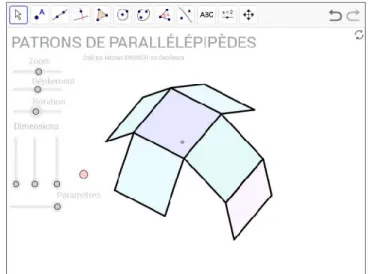
The sample is made up of 30 pupils studying in second grade (Year 2) at a school located in the district of Pontian in the Malaysian state of Johor. The pupils are purposely chosen from an intact mixed ability classroom. A single group pretest and posttest quasi experimental research design was employed in this study with intervention as described in Table 1. In Week 1 and 2, the students learnt both 2-D and 3-D in the conventional setting without technology intervention. At the end of the second week, they sat for one hour pre-test. During the third week, they were introduced to GeoGebra for the first time. They explored 2-D and 3-D shapes using some applets downloaded by the teacher from GeoGebratube at http://tube.GeoGebra.org. These powerful dynamic worksheets like the one displayed in Figure 1 allow learners to explore and investigate some geometrical ideas by changing the dimensions and orientation of various 2-D and 3-D shapes. Finally in Week 4, they sat for the post-test for one hour.
Figure 1. A GeoGebra applet on the net of a rectangular prism
The only instrument in the study is the pre/posttest which measures the first 3 levels of geometric thinking. The test as attached in the appendix was designed with 6 subjective items corresponding to visualization, analysis, and informal deduction of Van Hiele model. This one hour test was used as pretest and posttest to determine geometric thinking in 2-D and 3-D geometry (Table 1).
Table 1. The Intervention
Week Activity Time
Duration 1 Learning 2-D shapes without
technology 2 hours 2
Learning 3-D shapes without
technology 2 hours Pre-test 1 hour 3 Learning 2-D shapes with GeoGebra 1 .5 hour
IJEME, Vol. 1, No. 2, September 2017, 121-134
Learning 3-D shapes with GeoGebra 1.5 hour
4 Post-test 1 hour
The test items were designed for students to identify, classify, construct and analyze various 2-D and 3-D shapes as explained in Table 2.
Table 2. The design of pre/post test Van Hiele
Level Item Description
Visualization
i. Complete the
information about 3-D shapes
ii. Draw 2D shapes
Shapes are perceived as one compare to combination of many shapes. Students will be able to recognize different shapes.
Analysis
i. Draw the net for the given 3D shapes. ii. Match the correct 2-D
shapes.
Students will be able to identify properties of different shapes as well as recognizing the transformation of 3D to 2D shapes.
Informal Deduction
i. Draw a 3D model using various shapes.
ii. Draw a vehicle that you like. Use different 2D shapes
At this stage, students can link the logical flow of shapes. They can see the relationship between shapes in a single design.They are also able to apply and explain the use of different shapes.
RESULTS AND DISCUSSION
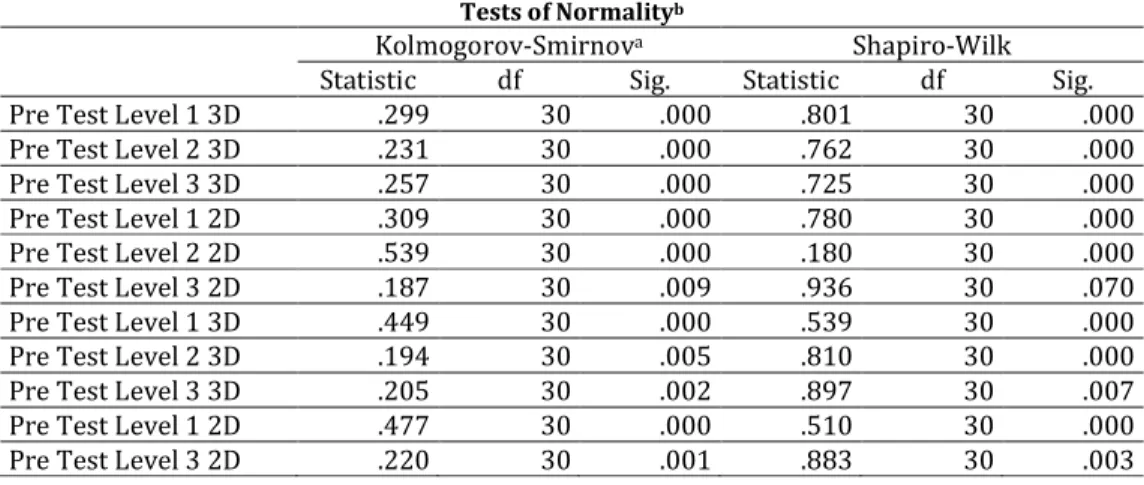
Normal distribution tests conducted as to determine whether to use parametric or non-parametric analysis (Pallant, 2010). Table 3, indicates the p value for normal test for all variables. The value shows (0.000) that is less than α = 0.05. It shows the distribution is not normal and have to use non-parametric analysis of Wilcoxon Signed Rank test.
Table 3. Test Analysis of Normal Distribution
Tests of Normalityb
Kolmogorov-Smirnova Shapiro-Wilk Statistic df Sig. Statistic df Sig. Pre Test Level 1 3D .299 30 .000 .801 30 .000 Pre Test Level 2 3D .231 30 .000 .762 30 .000 Pre Test Level 3 3D .257 30 .000 .725 30 .000 Pre Test Level 1 2D .309 30 .000 .780 30 .000 Pre Test Level 2 2D .539 30 .000 .180 30 .000 Pre Test Level 3 2D .187 30 .009 .936 30 .070 Pre Test Level 1 3D .449 30 .000 .539 30 .000 Pre Test Level 2 3D .194 30 .005 .810 30 .000 Pre Test Level 3 3D .205 30 .002 .897 30 .007 Pre Test Level 1 2D .477 30 .000 .510 30 .000 Pre Test Level 3 2D .220 30 .001 .883 30 .003 a. Lilliefors Significance Correction
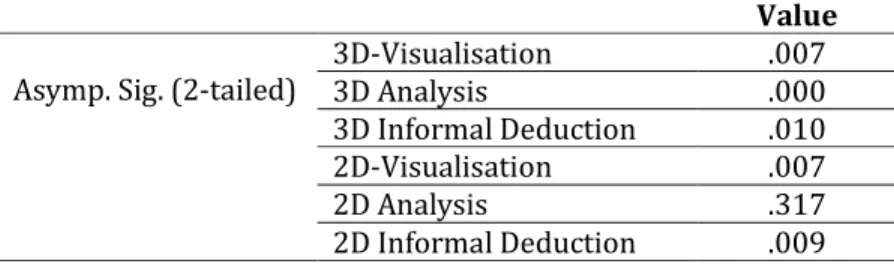
Learning 2-Dimensional and 3-Dimensional Geometry with Geogebra: Which Would ... According to the Wilcoxon Signed Rank Test in Table 4, for 3D visualisation, 3D analysis and 3D informal deduction, McNemar value are less than (α = 0.05) where each value is 0.007, 0.000 and 0.010. This suggests that there is a positive change to year 2 student before and after answering test question level 1 (visualization), level 2 (analysis) and level 3 (informal deduction) 3D.
For 2D visualisation and 2D informal deduction of 0.007 and 0.009, it shows the McNemar are less than (α = 0.05). This also shows that there are changes in the students before and after answering questions test level 1 (visualization) and level 3 (informal deduction) 2D but the value for 2D analysis, the McNemar value is 0.317 which is more than α = 0.05 and it indicate that there was no significant change in the proportion of students before and after answering questions test level 2 (analysis) for 2D design.
Table 4. Wilcoxon Signed Rank Test
Value Asymp. Sig. (2-tailed)
3D-Visualisation .007 3D Analysis .000 3D Informal Deduction .010 2D-Visualisation .007 2D Analysis .317 2D Informal Deduction .009
The results in Figure 2 showed the comparison between pretest and posttest marks for the first three level of thinking process of Van Hiele’s geometric model. The original marks were converted to percentages. The blue bars represent the mean percentage scores for pretest while the red bars represent the mean percentage scores for posttest. Obviously the mean scores in the posttest for every aspect that were tested are higher compare to the mean scores for the pretest. The pretest results show that the highest score for 3D geometry is at the visualization level (81%) while the highest score for 2D geometry is at the analysis level (81%).Particularly, the pupils’ initial van Hiele levels were predominantly at visualization for 3-D geometry and analysis for 2-D geometry. Meanwhile the results of the posttest exposed that the pupils’ geometrical thinking after the intervention were maintained highest at visualization for 3-D geometry and analysis for 2-D geometry. Overall, most of the students showed improvement in geometrical thinking after using the GeoGebra software. To identify the impact of the intervention more objectively, discussion of the results will specifically address all the 9 research questions.
IJEME, Vol. 1, No. 2, September 2017, 121-134
Figure 2. Pretest and posttest geometrical thinking levels
Research Question 1
Is there a change in visualizing 2-D shapes after Year 2 pupils experienced learning with GeoGebra?
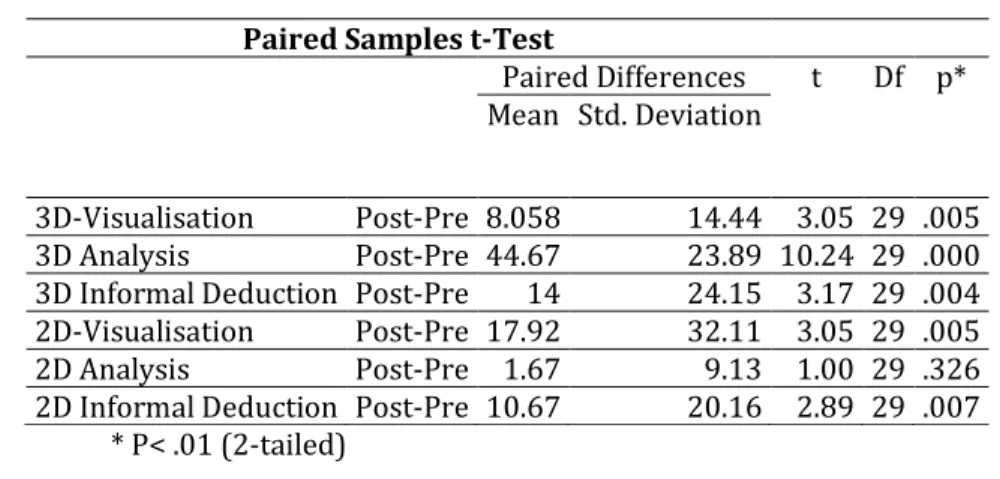
Figure 2 shows that mean score for visualization in 2D geometry increased from 75% before intervention to 93% after intervention. The results of paired samples t-test displayed in Table 5 also indicated that there was a significant difference in the mean score of students between pretest and posttest (mean difference=17.92), for t (29) = 3.05, p*=0.005 with respect to 2-D visualization.
Research Question 2
Is there a change in analyzing 2-D shapes after Year 2 pupils experienced learning with GeoGebra?
Figure 2 shows that mean score for analysis in 2D geometry increased from 98% before intervention to 100% after intervention. The results of paired samples t-test displayed in Table 5 indicated that there was no significant difference in the mean score of students between pretest and posttest (mean difference=1.67) for t (29) = 1, p*=0.326 with respect to 2-D analysis.
Research Question 3
Is there a change in making informal deduction for 2-D shapes after Year 2 pupils experienced learning with GeoGebra?
Figure 2 shows that mean score for informal deduction in 2D geometry increased from 55% before intervention to 83% after intervention. The results of paired samples t-test displayed in Table 5 indicated that there was significant difference in the mean score of students between pretest and posttest (mean difference=10.67) for t (29) = 2.89, p*=0.004 with respect to 2-D informal deduction.
Research Question 4
Is there a change in visualizing 3-D shapes after Year 2 pupils experienced learning with GeoGebra?
Figure 2 shows that mean score for visualization in 3D geometry increased from 81% before intervention to 89% after intervention. The results of paired samples t-test displayed in Table 5 indicated that there was significant difference in the mean score of students between pretest and posttest (mean difference=8.059) for t (29) = 3.05, p*=0.007 with respect to 3-D visualization.
Research Question 5
Is there a change in analyzing 3-D shapes after Year 2 pupils experienced learning with GeoGebra?
Learning 2-Dimensional and 3-Dimensional Geometry with Geogebra: Which Would ... Figure 2 shows that mean score for analysis in 3D geometry increased from 32% before intervention to 77% after intervention. The results of paired samples t-test displayed in Table 5 also indicated that there was significant difference in the mean score of students between pretest and posttest (mean difference=44.67) for t (29) = 10.24, p*=0.000 with respect to 3-D analysis.
Research Question 6
Is there a change in making informal deduction for 3-D shapes after Year 2 pupils experienced learning with GeoGebra?
Figure 2 shows that mean score for informal deduction in 3D geometry increased from 19% before intervention to 33% after intervention. The results of paired samples t-test displayed in Table 5 also indicated that there was significant difference in the mean score of students between pretest and posttest (mean difference=14) for t (29) = 3.17, p*=004 with respect to 3-D informal deduction.
Research Question 7
Is there a significant different in visualizing 2-D and 3-D shapes after Year 2 students experienced learning with GeoGebra?
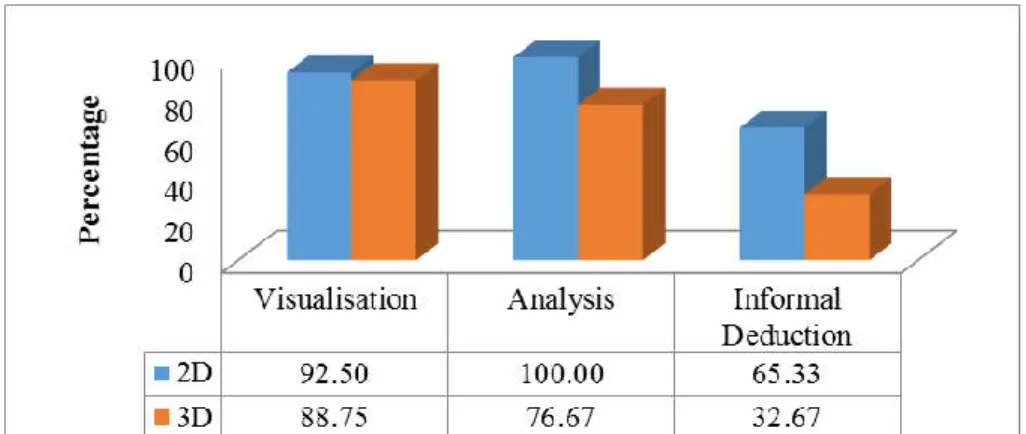
Figure 3 shows that in the post-test, mean score for visualizing 3-D shapes is 88.75%...while the mean score for 2-D shapes is 92.5% indicating that students did better in visualizing 2-D shapes compared to 3-D shapes. The results of paired samples t-test displayed in Table 6 indicated that there was no significant difference between the mean scores of 2-D and 3-D visualization (mean difference=-3.75) for t (29) = -1.1, p*=0.282 for post test scores.
Figure 3. Posttest geometrical thinking mean levels for 2D and 3D shapes
Research Question 8
Is there a significant different between analyzing 2-D and 3-D shapes after Year 2 students experienced learning with GeoGebra?
Figure 3 shows that in the post-test, mean score for analyzing 3-D shapes is.76.7%..while the mean score for 2-D shapes is 100% indicating that students did better in analyzing 2-D shapes compared to 3-D shapes. The results of paired samples t-test displayed in Table 6 also indicated that there was significant difference between the mean scores of 2-D and 3-D analyzing (mean difference=-23.3) for t (29) = -5.178, p*=0 for post test scores.
IJEME, Vol. 1, No. 2, September 2017, 121-134
Table 5. Comparing pretest and post test scores Paired Samples t-Test
Paired Differences t Df p* Mean Std. Deviation
3D-Visualisation Post-Pre 8.058 14.44 3.05 29 .005 3D Analysis Post-Pre 44.67 23.89 10.24 29 .000 3D Informal Deduction Post-Pre 14 24.15 3.17 29 .004 2D-Visualisation Post-Pre 17.92 32.11 3.05 29 .005 2D Analysis Post-Pre 1.67 9.13 1.00 29 .326 2D Informal Deduction Post-Pre 10.67 20.16 2.89 29 .007
* P< .01 (2-tailed)
Research Question 9
Is there a significant different in making informal deduction for 2-D and 3-D shapes after Year 2 students experienced learning with GeoGebra?
Figure 3 shows that in the post-test, mean score making informal deduction for 2-D shapes is 65.3 % while the mean score for 3-D shapes is 33.3% indicating that students did better in making informal deduction for 2-D shapes compared to 3-D shapes. The results of paired samples t-test displayed in Table 6 also indicated that there was significant difference between the mean scores of 2-D and 3-D in making informal deduction for (mean difference=-32.7) for t (29) = -7.35 , p*=0 for post test scores.
Table 6. Comparing 2-D and 3-D post test scores Paired Samples Test
Paired Differences t df p (2-tailed) Mean Std.
Visualisation 3D post – 2D post -3.74800 18.74207 -1.095 29 .282 Analysis 3D post – 2D post -23.33333 24.68188 -5.178 29 .000 Informal Deduction 3D post – 2D post -32.66667 24.34427 -7.350 29 .000
The overall results demonstrate an enhancement in pupils’ geometric thinking of second grade (Year 2) after the intervention which concurs with the findings of previous studies conducted in Malaysia (Rajagopal, et al. 2015; Tay, 2003; Meng and Idris, 2012). The students who took the pretest have studied the 3-D and 2-D shapes in a conventional setting. Their scores in all three geometric thinking for both 3-D and 2-D increased after the intervention. This suggests that learning with Geogebra as a supplementary to conventional teaching is an effective strategy. It also mean that the computer activities do not need to consume all the time for teaching and learning activities. Some considerable amount of time working with Geogebra is sufficient to improve students’ visualization, analysis and informal deduction. However more attention is needed to help students with difficult aspect of geometry in particular 3-D informal deduction. This phenomena might suggest for further research to understand proper tasks both for computer and non-computer activities that can help to enhance informal deduction in 3-D geometry.
Learning 2-Dimensional and 3-Dimensional Geometry with Geogebra: Which Would ... Another point of interest in this research is to determine whether learning with Geogebra support students geometric thinking better for 3-D or 2-D geometry. 3-D objects are familiar to young students as they are seen around them compare to 2-D objects. However the nature and properties of 3-D are more complex to those of 2-D. In this research it is found that students did better in 2-D compared to 3-D in all levels of Van Hiele geometric thinking. They predominantly outperform in analysis and informal deduction of 2-D shapes but not so much on visualization of 2-D shapes. The situation suggests that the learning of 3-D shapes need extra maturity in thinking and therefore require more effort to be developed with Geogebra. The dynamic applets can provide means of investigating and communicating mathematically. Moreover, drawing, sketching, classifying, recognizing, constructing and reasoning can be among the processes that learners get engaged. Based on Van Hiele, every single learning phase develop pupils’ thought of progressing level. The meaningful learning takes place when pupils aggressively experience with the usage of software in suitable areas of geometrical thinking.
CONCLUSION
One common argument that make teachers resist to technology is associated with assessment. In spite of teachers being encouraged to adopt technology, assessment is still widely practised in the form of paper and pencil test. Therefore teachers assumed that technology might not help students to do well in paper and pencil tests. Interestingly this research has proven this claim wrong as the results show that the geometric thinking of the students were excellent in spite of being assessed through paper and pencil test.
The significant increase of learning geometry has taken into account the Van Hiele-based instructional model and the pupils’ engagement in GeoGebra activities. Results of this study imply that students and teachers should take advantage of Geogebra that can provide more interesting, engaging and fun learning as well as enhancing geometric thinking. Being a free open source software, there is no doubt Geogebra is practical in contributing towards the implementing twenty first century education.
ACKNOWLEDGMENT
We are grateful to Universiti Teknologi Malaysia and Malaysian Ministry of Higher Education for providing the grant (14 H17) that enables this study to be carried out. REFERENCES
Abdullah, A.H., & Mohini, M. (2008). The Use of Circle Learning Module, based on KDE
Interactive Geometry (KIG) Software on Student’s Geometrical Thinking Level. In:
International Conference on Education Innovation (ICEI 2008), 2008, Legend Hotel, Kuala Lumpur.
Battista, M. T. (2003). Shape Makers. Emeryville. CA: Key Curriculum Press.
Fathurrohman, M., Porter, A.L., & Worthy, A.L. (2017). Teachers’ real and perceived of ICT supported-situation for mathematics teaching and learning. International
Journal on Emerging Mathematics Education, 1(1), 11-24.
Idris, N. (2009). Enhancing students’ understanding in calculus trough writing.
IJEME, Vol. 1, No. 2, September 2017, 121-134
Ismail, Z., & Kasmin, M. (2007). Creating Islamic art with interactive geometry software. Smart Teaching & Learning: Re-engineering ID, Utilization and
Innovation of Technology, 2, 1214-1220.
Meng, C.C., & Idris, N. (2012). Enhancing students' geometric thinking and achievement in solid geometry. Journal of Mathematics Education, 5(1), 15-33. Pallant, J. (2010). SPSS survival manual: A step by step guide to data analysis using SPSS.
Maidenhead.
Rajagopal, S., Ismail, Z., Ali, M., & Sulaiman, N. (2015). Attitude of secondary students
towards the use of GeoGebra in learning loci in two dimensions. International
Education Studies, 8(13), 27.
Tay, B.L. (2003). A van Hiele-based instruction and its impact on the geometry achievement of Form One students. Unpublished master’s dissertation. Malaysia: University of Malaya.
Tutkun, O.F., & Ozturk, B. (2013). The effect of GeoGebra mathematical software to the academic success and the level of Van Hiele geometrical thinking. International
Journal of Academic Research, 5(4), 22-28.
Van Hiele, P.M. (1986). Structure and Insights: A Theory of Mathematics Education. Orlando: Academic Press.
Learning 2-Dimensional and 3-Dimensional Geometry with Geogebra: Which Would ... APPENDIX
Pre Test/ Post Test 1. Complete the given table
Shape Number of flat surface Number of curved surface Number of sides Number of vertex / 24 marks
IJEME, Vol. 1, No. 2, September 2017, 121-134 2. Draw the net of each shape.
Shape Net
3. Draw a model using 3D shapes and explain your model. Name your model. / 10 marks
Learning 2-Dimensional and 3-Dimensional Geometry with Geogebra: Which Would ... 4. Draw the given 2-D shapes.
5. Match the 2-D shapes with the correct information.
Circle Rectangle
Triangle Square
/ 8 marks
I have four vertex. All my sides are of equal length. Who am I?
I only have curved sides. My face are circles. Who am I?
I have straight sides. All my sides are equal length. I also have three vertex. Who am I?
I have four straight sides. Two of my sides are short and the other
two are long. Who am I?
IJEME, Vol. 1, No. 2, September 2017, 121-134
6. Draw a vehicle that you like. Use different 2-D shapes.
/ 5 marks