
University Degree in Computer Science and Engineering
2018-2019
Bachelor Thesis
“Development of customized
conversational interfaces with Deep
Learning techniques”
Pablo Cañas Castellanos
Tutor: David Griol Barres
Co-Tutor: Juan Manuel Alonso Webber
Leganés, June 2019
This work is licensed under Creative Commons Attribution – Non Commercial – Non Derivatives
SUMMARY
This Bachelor’s thesis will cover the end-to-end process of developing a personalized conversational interface for a specific domain, using Deep Learning techniques. In par-ticular, it will focus on the study of the Dialog Manager module, which is in charge of deciding the next system response based on the current dialog state.
Although there is plenty of literature about Machine Learning applied to the construc-tion of dialog management models, there is very little reference to the utilizaconstruc-tion of Deep Learning for such task. As a result, this work analyzes the improvement that deep neural networks can bring to accuracy. Several models are created with TensorFlow, and com-parisons are made with traditional Machine Learning solutions. Results show that Deep Learning is not the most recommended approach for this type of problems, yet further research is suggested for more complex datasets.
After this, one of the Deep Learning models, based on a train scheduling domain, is used for the implementation of the dialog manager inside a real spoken dialog system. To integrate the rest of required components of such technology (automatic speech rec-ognizer, natural language understanding module and text-to-speech service), a modern framework is used: DialogFlow. With this platform, a complete chatbot is built in the form of an assistant in the train scheduling domain.
Evaluation of the spoken dialog system with real users generates a very positive feed-back, demonstrating that a Deep Learning based dialog manager is a valid solution in commercial conversational interfaces.
Keywords: Conversational Interfaces, Spoken Dialog Systems, Machine learning, DialogFlow, Deep Learning, TensorFlow
DEDICATION
This thesis is the culmination of the greatest educational experience of my life. Not only I have learnt to become a competent Computer Science professional, but I have also grown up to a person that I can feel proud of and that is living accordingly to his major interests and principles.
I would like to dedicate my work to every person that has accompanied me during this wonderful journey. In special, I would like to thank my parents, María Jesús and Pedro, for supporting me in every decision that I took, shedding light on every problem that I encountered, and teaching me correct moral values; and my brothers, Jorge and Sergio, for being direct authors of the joy in my life.
The deepest gratitude goes to every relative, friend and person that brings me back to happy memories. There have been innumerable lifetime experiences that I will carry with me forever and that have shown me that the most important thing in life is the people whom you share your path with. There are way too many people to mention them all, but those include friends from my neighbourhood, university (LaVendiciónDevs), Ruta Quetzal, Ruta Inti, San Diego, CERN, travelling mates, and a large et cetera.
Finally, I would like to thank my tutors, David and Juan, for helping me with the construction of this project.
CONTENTS
1. INTRODUCTION. . . 1
1.1. Motivation of Work . . . 1
1.2. Goals . . . 4
1.3. Document Structure . . . 4
2. STATE OF THE ART . . . 6
2.1. Prior Background . . . 6
2.1.1. Machine Learning . . . 6
2.1.2. Artificial Neural Networks . . . 9
2.1.3. Deep Learning . . . 13
2.2. Conversational Interfaces . . . 18
2.2.1. Introduction. . . 18
2.2.2. Automatic Speech Recognition . . . 20
2.2.3. Natural Language Understanding. . . 21
2.2.4. Dialog Management . . . 23
2.3. Tools Analysis . . . 24
2.3.1. Tools for Machine Learning . . . 25
2.3.2. Tools for Deep Learning. . . 27
2.3.3. Tools for SDS implementation . . . 29
3. DEEP LEARNING ANALYSIS APPLIED TO CUI DIALOG MANAGER . . . 31
3.1. Analysis for pizza ordering domain . . . 31
3.2. Analysis for train scheduling domain. . . 42
3.3. Conclusions. . . 55
4. IMPLEMENTATION OF THE CONVERSATIONAL AGENT . . . 56
4.1. DialogFlow Basic Elements . . . 56
4.1.1. Intents . . . 56
4.1.2. Entities . . . 61
4.2. DialogFlow Fulfillment . . . 64
4.2.1. Model Creation and Integration . . . 65
4.2.2. Handling User Intents . . . 67
4.2.3. Conversational Interface Deployment . . . 71
5. EVALUATION OF THE CONVERSATIONAL AGENT . . . 73
5.1. Evaluation Methodology . . . 73 5.2. Objective Evaluation . . . 74 5.3. Subjective Evaluation . . . 79 6. REGULATORY FRAMEWORK . . . 81 6.1. Applicable Regulations . . . 81 6.2. Technical Standards . . . 82 6.3. Intellectual Property . . . 83 7. SOCIO-ECONOMIC ENVIRONMENT . . . 84 7.1. Socio-economic impact . . . 84 7.2. Planning. . . 86 7.3. Budgeting . . . 89 8. CONCLUSIONS . . . 93 8.1. Main conclusions. . . 93
8.2. Future research lines . . . 95
LIST OF FIGURES
1.1 An example of user interaction with Google Now VPA . . . 1
1.2 Result to weather request from Google Now . . . 2
1.3 An example of user request with Google Now VPA . . . 2
1.4 Result to calling request from Google Now . . . 3
2.1 Machine Learning typical working flow [7] . . . 8
2.2 Representation of a neuron . . . 10
2.3 Representation of how Gradient Descent works . . . 11
2.4 Representation of a MLP [23] . . . 12
2.5 Milestones in the Development of Neural Networks (Source: Andrew L. Beam [25]) . . . 13
2.6 Schema of an autoencoder (Author: Chervinskii [28]) . . . 14
2.7 Dropout method: with a probabilitypwe remove a neuron from the net-work, both its incoming and outgoing connections. This helps to build more robust neurons, as they cannot always rely on receiving all the pa-rameters. In the end, it helps to generalize better, preventing overfitting (Source: Srivastava, Hinton, Krizhevsky, Sutskever and Salakhutdinov [30]). . . 15
2.8 Architecture of a Convolutional Neural Network (Credits to Clarifai [33]) 16 2.9 Prototype of how a self-driving car will identify other objects in the road (Credits to NVidia [36]) . . . 17
2.10 Person Blocker example (Author: Max Woolf [38]). . . 17
2.11 The components of a spoken language conversational interface [2] . . . . 20
2.12 Learning Dialog Strategies with a Simulated User (Source: [69]) . . . 23
3.1 Example of interaction between the user and the CUI within the pizza ordering domain (Ref: [2]) . . . 32
3.2 Representation of a 5-fold cross validation . . . 35
3.3 Pizza Domain model M.T1 accuracy evolution (Fold 1) . . . 36
3.4 Pizza Domain model M.T1 accuracy evolution (Fold 2) . . . 37
3.6 Pizza Domain model M.T7 accuracy evolution (Fold 1) . . . 39
3.7 Pizza Domain model M.T7 accuracy evolution (Fold 4) . . . 40
3.8 Representation of a majority-vote ensemble (Source: [88]) . . . 41
3.9 Example of interaction between the user and the CUI within the train scheduling domain (Source: [77]) . . . 45
3.10 Train Domain model M.T1 accuracy evolution (Fold 1) . . . 49
3.11 Train Domain model M.T1 accuracy evolution (Fold 2) . . . 49
3.12 Train Domain model M.T1 accuracy evolution (Fold 4) . . . 50
3.13 Train Domain model M.T10 accuracy evolution (Fold 4) . . . 52
3.14 Train Domain model M.T8 accuracy evolution (Fold 1) . . . 53
3.15 Train Domain model M.T8 accuracy evolution (Fold 3) . . . 53
4.1 Dialog Manager Architecture for the proposed SDS implementation . . . 65
4.2 Example of interaction with a web service integration . . . 71
4.3 Example of interaction with a Google Assistant integration . . . 72
5.1 An example of the most common dialog extracted from the evaluation experiments, along with its translation to English . . . 75
5.2 An example of a failed dialog extracted from the evaluation experiments, along with its translation to English . . . 77
5.3 An example of a successful dialog extracted from the evaluation experi-ments, along with its translation to English . . . 78
7.1 Gantt Diagram for the planning of the thesis . . . 88
LIST OF TABLES
3.1 Pizza Domain TensorFlow Multilayer Perceptron Models . . . 34
3.2 Pizza Domain TensorFlow CNN Models . . . 34
3.3 Pizza Domain Traditional Models Results . . . 35
3.4 Pizza Domain model M.T1 confusion matrix (Fold 2) . . . 38
3.5 Pizza Domain model M.T1 confusion matrix (Fold 3) . . . 38
3.6 Pizza Domain CNN Models Results . . . 39
3.7 Pizza Domain model M.T7 confusion matrix (Fold 1) . . . 40
3.8 Pizza Domain Ensemble Model Results . . . 41
3.9 Pizza Domain model M.Ensemble confusion matrix (Fold 3) . . . 42
3.10 Train Domain TensorFlow Multilayer Perceptron Models . . . 47
3.11 Train Domain TensorFlow CNN Models . . . 47
3.12 Train Domain Traditional Models Results . . . 48
3.13 Train Domain model M.T1 confusion matrix (Fold 4) . . . 51
3.14 Train Domain model M.T1 confusion matrix (Fold 5) . . . 51
3.15 Train Domain CNN Models Results . . . 52
3.16 Train Domain model M.T8 confusion matrix (Fold 1) . . . 54
3.17 Train Domain Ensemble Model Results . . . 54
4.1 Intents defined for the train scheduling SDS, along with their correspond-ing translation to English . . . 60
4.2 Entities defined for the train scheduling SDS, along with their correspond-ing translation to English . . . 62
4.3 Parameters defined for the train scheduling SDS . . . 62
5.1 Objective evaluation results after 20 experiments . . . 74
5.2 Objective evaluation results after 20 experiments . . . 79
7.1 Human resources costs . . . 89
7.2 Hardware equipment costs . . . 90
7.4 Information gathering costs . . . 91
1. INTRODUCTION
1.1. Motivation of Work
Conversational Interfaces (CUI) are systems that simulate interactive conversations with humans [1]. These platforms are meant to display human-like characteristics and sup-port the use of spontaneous natural language in order to make interactions with different purposes, such as performing transactions, responding to questions, or simply to chat [2].
Conversational interfaces have become a key research subject for many companies, as they have understood the potential revenue of introducing these devices in society’s main-stream. Virtual Personal Assistants (VPAs), such as Google Now, Apple’s Siri, Amazon’s Alexa or Microsoft’s Cortana, are the clearest examples of this. These VPAs are used for a wide variety of tasks, from setting an alarm to updating the calendar, passing through getting directions, finding nearest restaurants or stores, or even recipe planning and re-porting the news. But personal assistants are not the only application of conversational interfaces. Companies can use CUIs to enhance their services and increase customers’ satisfaction. They are currently being used for making appointments and reservations, secretarial work, and support service, saving companies the cost related to human labour and being even more efficient than humans in solving such issues.
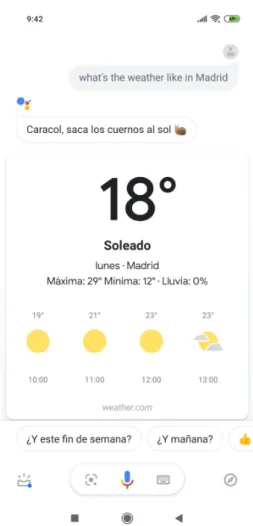
Interactions with conversational interfaces are designed to be really simple. Figure 1.1 shows an example from an interaction with Google Now personal assistant, which can be activated from any Android smartphone by pronouncing the words "Ok Google".
User:What is the weather like in Madrid today?
Google Now: The weather in Madrid is 18 degrees and sunny.
Fig. 1.1. An example of user interaction with Google Now VPA
Figure 1.3 shows an example of a user requesting information about the weather in Madrid. As it can be observed, the assistant responds with the updated information about the weather. In addition to the spoken response, there is also a visual display of the recognized question, a visual representation of the weather forecast, and other related questions that could be asked (Figure 1.2).
Fig. 1.2. Result to weather request from Google Now
But not only virtual personal assistants can retrieve the information that is being asked. Besides, they can make several actions, such as buying a product or making an appoint-ment in the calendar. Figure 1.3 displays an example of an interaction were the user is asking Google Now to call the contact ’Mom’. Together with the response, that confirms the understanding of the query, the smartphone automatically calls the contact, as it can be observed in Figure 1.4.
User:Call Mom
Google Now: Calling to Mom’s mobile...
Fig. 1.4. Result to calling request from Google Now
On the other hand, we find a recently developed field in Artificial Intelligence (AI) named Deep Learning (DL) [3]. This area began to grow in the beginning of the decade as an alternative solution to tasks where traditional Machine Learning algorithms were reaching a saturation point. In particular, it had to deal with the treatment of large amounts of data. As a result, Deep Learning has become part of many of the current intelligent systems, such as video surveillance or biological data classifiers. It has also become very popular in the media due to its advantages for the development of self-driving cars. Since its rise, all the industry is strived towards the evolution of this technology, and it seems to keep offering plenty of potential for the future.
The merge of these two technologies is something inevitable and that is going to bring millions of euros in revenues in the years to come. For this reason, there will be a huge industry generated around it, with hundreds of research groups investigating in the area and thousands of jobs created. This is the main motivation of my Bachelor’s thesis, to get in touch with the technical background required to understand the topic, and to make a small contribution to this exciting field.
1.2. Goals
The main goal of this bachelor project is to show the whole process of the development of a spoken dialog system with Deep Learning techniques. This process goes from the experimentation with different DL architectures and the analysis of performance for each model, to the implementation and evaluation of a commercial conversational interface solution.
In particular, the objectives of the thesis are:
• To make an study of the importance Deep Learning has for developing a modern conversational interface with respect to traditional Machine Learning techniques, using several domains.
• To learn a reliable approximation of a dialog manager for a specific domain, using Deep Learning techniques.
• To integrate such dialog manager with the rest of the components of a conversa-tional interface.
• To implement a conversational interface as a commercial application that people could use from their devices.
• To evaluate and validate such application by executing a test plan with real users.
1.3. Document Structure
The content of each of the chapters of the report is now exposed, with the objective of showing the organization of the document:
• Chapter 1: Introduction. This chapter describes the main motivation behind the project, as well as the main goals pursued by the author. It will also make a brief description of the document structure.
• Chapter 2: State of the Art. This chapter makes a review of the literature and the concepts surrounding the development of the thesis. As such, it explains what a conversational interface is and its history, reviews the terms of Machine Learning, Artificial Neural Networks, Deep Learning, Automatic Speech Recognition, Natu-ral Language Processing and Dialog Management, and shows the current tools and frameworks used for the development of such systems.
• Chapter 3: Deep Learning analysis applied to CUI Dialog Manager. In this chapter, the experimentation phase of the thesis is presented. Different validated datasets are taken, preprocessed and trained with a variety of Machine Learning and Deep Learning algorithms. Results will be compared and commented, hence
obtaining overall conclusions of the utility of Deep Learning methodologies for dialog management modelling.
• Chapter 4: Implementation of the Conversational Agent. This chapter describes the complete conversational agent implementation process. After choosing one of the models created in Chapter 3, the necessary parts for a basic spoken dialog sys-tem will be assembled, and a functional conversational agent will be created.
• Chapter 5: Evaluation of the Conversational Agent. In this chapter, the previ-ously created system is validated with real experimentation. As a result, the system will be presented to the users for external assessment. Based on the results, an ob-jective will be made, whereas users will also provide subob-jective feedback from their experience.
• Chapter 6: Regulatory Framework. This chapter approaches the thesis from the legal point of view. As a result, it makes an overview of the applicable regulations, as well as the possible issues concerning intellectual property. It also enumerates the technical standards of the project.
• Chapter 7: Socio-economic Environment. In this chapter, a detailed analysis of the socio-economic impact derived from the project will be crafted, as well as a justification for the planning and budgeting of the work.
• Chapter 8: Conclusions. This chapter will list the main ideas and conclusions extracted from the development of the thesis. It also analyses the future lines of investigation that could be followed from such work.
• Bibliography.This chapter is dedicated to the list the online resources, documents, papers and books reviewed and referenced for the development of the thesis.
• Annexes. This final chapter lists a glossary of common and technical abbreviations with the objective of facilitating the reading.
2. STATE OF THE ART
This thesis touches many different areas of Computer Science (CS) and Artificial In-telligence, as well as several toolkits and techniques that are commonly used for the de-velopment of conversational interfaces. As a result, this section provides an overview of all the concepts and tools used in the project, together with previous work done by other authors, in order to get a better understanding on the context of the thesis.
2.1. Prior Background
The main subject in which this project is based is Machine Learning (ML). Therefore, a small introduction to the topic is made so as to understand the basic aspects and objec-tives of ML algorithms. After this, Artificial Neural Networks (ANN) algorithm will be explained, as it is the main predecessor of Deep Learning. Finally, the major concepts and related work behind Deep Learning will be exposed.
2.1.1. Machine Learning
Machine Learning is a term that is extremely popular nowadays. We can always find news about several novel applications of this technique, and new ways about how it is improving people’s lives. But, what is exactly Machine Learning?
According to Arthur Samuel [4], Machine Learning is the subset of Artificial Intelli-gence that studies the algorithms and statistical models which computer systems use to effectively perform a specific task without being explicit programmed. Instead, Machine Learning algorithms build mathematical models that are then used to solve a wide variety of tasks relying on patterns and inference [5].
Machine Learning paradigms are classified in three main groups [6]:
• Supervised Learning: based on training a model from data source with correct output already assigned. This can be divided in two types of tasks: classification, in which the output variable is a category (e.g. deciding whether to give a credit to an individual or not, detecting if an image is a dog or a cat...), and regression, in which the output variable is a real number (e.g. predicting the price of a house based on its characteristics, predicting the temperature for the next week...).
• Unsupervised Learning: based on training a model to identify hidden patterns from unlabelled input data. We can as well divide this group into two categories of algorithms: clustering, which tries to discover the inherent groups in data (e.g. grouping clients by purchasing behaviour), and association, which tries to find rules
that describe large proportions of your data (e.g. people who watch movie X may like also movie Y).
• Reinforcement Learning (RL): based on training a model by maximizing the re-ward along a particular dimension over many steps. It differs from supervised or unsupervised learning methods in the learning process: while the others try to iden-tify patterns or approximate functions in the data, reinforcement algorithms are goal-oriented, and focus on maximizing the reward. As a result, a reinforcement problem consists of an agent that has several actions to transit between states with an associated reward, and the objective is to arrive to a final state with the max-imum possible reward. An example of application of this methodology is traffic light control in a smart city.
A typical Machine Learning work cycle involves the following subtasks:
1. Generate example data: in order to build a model, one needs to provide training examples so that the system identifies and learns patterns from them. Therefore, an appropriate sized training set must be collected to build an effective algorithm. This also includes the cleaning and preprocessing of data, so that the relevant information is optimized as much as possible.
2. Train the model: once the dataset is ready, the model is trained using a specific ML algorithm. The idea is to use a subset for training and another subset for evaluating the model. Therefore, this is an iterative process in which one tries several algo-rithms and configurations and keep refining the learning outcome until you manage to achieve the best possible result.
3. Deploy the model: this includes the implementation of the ML algorithm in the system for which it was created, and the validation of such product by results mon-itoring and data analytics.
Fig. 2.1. Machine Learning typical working flow [7]
Machine Learning is currently used in a wide variety of areas, going from predicting the next value of a financial asset in the Stock Exchange Market (SEM) to Outer Space exploration [8]. Some of the most common applications from day-to-day life include [9]:
• Malware filtering: malicious software has always been a very important concern since the beginning of the digital era. Being affected by a virus could entail the public exposure of people’s private data (as we have recently seen with various celebrities [10]) or a loss of billions of dollars for a company [11]. Fortunately, every new malware that is created has a high percentage of similarity with its previ-ous versions, and thus there exists a pattern that a Machine Learning algorithm can learn to prevent those situations.
• Online customer support: lately, it has become extremely common for services that were traditionally provided physically to be used through an online platform. As a result, many of these websites offer the possibility to chat with a customer support representative in order to solve any issue that the client may have. However, it has been shown that using a chatbot for such functionality can multiply your investment return and increase the degree of customer satisfaction [12].
• Product recommendations: keeping the fidelity of customers in e-commerce sites is vital for the success of those business. Therefore, making predictions on the products that a user may like based on their previous purchases or searches has become a topic of great interest for every multinational company. It is considered to be a task of such importance that Netflix offered a prize of 1 million dollars to the team that improved their movie recommendation system by a 10% accuracy [13].
• Videos surveillance: security is one of the main concerns of society. Imagine a single person monitoring multiple cameras at the same time, trying to find suspi-cious movements from normality, for several hours. Certainly, it is a very difficult job to perform. On the other hand, thanks to new Machine Learning techniques like Convolutional Neural Networks (CNN), processing data from images has be-come a feasible task. Therefore, such technology is used to improve surveillance services, tracking unusual behaviour, recognizing faces, and ultimately detecting a crime before it happens.
• Online fraud detection: Machine Learning is also contributing to build a secure cyberspace for even the most delicate operations, such as online monetary transac-tion. For example, Paypal is using ML to detect money laundering (see [14]), and traditional banks are blocking credit cards when they spot irregular transactions in a small period of time.
• Virtual personal assistants: current birthday gift par excellence, Alexa, Siri or Google Now are some of the most popular virtual personal assistants in the market. They perform a wide variety of tasks, from setting an alarm to ordering a pizza, when asked over voice. These devices use ML to understand what the user is re-questing, and they have a high level of accuracy.
Once we have had a brief overview of what Machine Learning is, let’s move on to more specific concepts that are closely related to the main work of the thesis.
2.1.2. Artificial Neural Networks
The ML technique that is most commonly use nowadays is artificial neural networks. Haykin [15] describes ANN as a massively parallel combination of simple processing units which can acquire knowledge from environment through a learning process and store the knowledge in its connections.
Artificial neural networks design is inspired by the biological neural networks that constitute animal brains. Each connection, like the synapses in a biological brain, can transmit a signal from one artificial neuron to another. An artificial neuron that receives a signal can process it and then signal additional artificial neurons connected to it [16].
The first studies related to the area were made by McCulloch and Pitts in 1943 [17]. They were seeing neurons as units that, depending on the connected inputs attached to them, will activate according to a threshold value. They only theorized about the archi-tecture, with no mention to the learning process. However, in 1949 Donald Hebb appeared to introduce Hebbian learning [18]. He proposed that, when two neurons fire together, the connection between them is strengthened. As a result, this activity is one of the funda-mental operations necessary for learning.
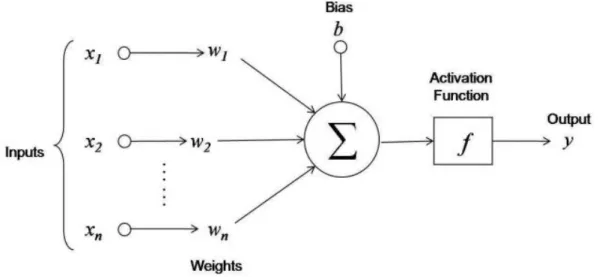
Some authors used these ideas to create the first known neural networks. Frank Rosen-blatt introduced thePerceptronin 1958 [19], and Bernard Widrow theAdaptative Lin-ear Element (ADALINE)in 1960 [20]. The basic architecture of their neuron is shown in figure 2.2.
Fig. 2.2. Representation of a neuron
As we can observe, a neuron is essentially a mathematical function. It receives several inputs, and some weights that are associated to the connections between those inputs and the neuron. All these, together with a bias variable, are added up, in order to produce and output. The mathematical equation for the output is the following:
y= f(b+ n
∑
i=1
xiwi) (2.1)
The main difference between the two models is actually the activation function. The Perceptron uses a threshold function (2.2), while ADALINE uses the real sum of inputs (2.3). This is a big difference, as Perceptron can only be used for classification tasks, while ADALINE can also be used for linear regression problems.
f(x)= ⎧ ⎪ ⎪ ⎪ ⎨ ⎪ ⎪ ⎪ ⎩ 1 if> 0 −1 if≤ 0 (2.2) f(x)= x (2.3)
The objective of ADALINE is to minimize the error derived from the output. The error function specified for this neural network is the Mean Square Error (MSE):
E = 1 m m ∑ p=1 Ep = 1 2m m ∑ p=1 (dp−yp)2 (2.4) where m is the total number of examples,dp is the desired output of examplep, andypis the real output of such pattern.
The learning process of ADALINE implies iteratively updating the weights of the connections between neurons in order to minimize the error function of the output. The learning rule used for such update is the Delta Rule, which tries to minimize the error of each individual example using a technique called Gradient Descent, summarized in equation 2.5.
w(t)= w(t−1)−α∂E p
∂w (2.5)
Not entering into deeper mathematics, the idea of gradient descent method is to sub-tract the derivative of the error function. If we think of the error function as a n-dimensional surface, subtracting its derivative is equivalent to descending in that surface, until a min-imum is found. As a result, we are reducing the error in each iteration. Figure 2.3 shows a representation of such logic in a 2-dimensional space, for a better understanding.
Fig. 2.3. Representation of how Gradient Descent works
These two neural network architectures became very popular for a few years and were the first indicator of what learning algorithms could achieve in the future. However, they had a huge drawback: they only were able to solve linear tasks. In the other hand, most of the problems that we find in the real world have a non-linear behaviour, for which current networks could not deal with.
In this context we arrive to the late 60s, in which the Artificial Intelligence field suf-fered from a huge depression in the research community. The lack of new advancements made many researchers think that eventually AI would only be a topic for science fiction, and investigation was paused by different groups. Artificial neural networks were knocked by a paper from M. Minsky and S. Papert, in which they proved that the Perceptron was not even able to learn an XOR function [21].
No progress was made until 1986, year in which Rumelhart et al. presented the Gen-eralized Delta Rule [22]. Also named Backpropagation Rule, it consisted of updating the weights by distributing errors backwards throughout the network’s layers. This al-lowed the creation of multiple layers of neurons, in which the output of one neuron could be connected to the input of another neuron, in order to build up a network that passes information from one neuron to another. All this idea was also based in gradient descent, and the objective was exactly the same: minimizing the error of the examples. However, with this new approach, non-linear problems were also solvable.
Together with backpropagation, a new ANN was introduced: theMultilayer Percep-tron (MLP). It consists of at least three layers of nodes: an input layer, a hidden layer and an output layer, but it may contain several hidden layers.
The most common activation function for the MLP is the sigmoid function, which is what inserts non-linearity into de algorithm. Its equation is the following:
f(x)= 1
1+e−x (2.6)
The architecture of the MLP is pictured in figure 2.4.
Around the same time, it was shown that the MLP has the ability to approximate any function. For this reason, it became go to Machine Learning algorithm for every research lab. Unfortunately, this network was computationally expensive to use and, when more complex problems emerged, such as image recognition, MLP did not scale correctly. For this reason, they were eventually substituted by other learning algorithms, such as Support Vector Machines (SVM), leading to another cold period around the 2000s.
This second crisis was solved with the appearance of Deep Learning, main concept of this thesis, that will be explained in depth in the following section. Deep Learning is such important nowadays that recently the Association for Computer Machine (ACM) has awarded with the Turing Award to the main promoters of this revolutionary technol-ogy: Yoshua Bengio, Yann LeCun and Geoffrey E Hinton [24]. The Turing Award is considered to be the most prestigious honor in the field of Computer Science.
A brief summary of the history of artificial neural networks is shown in figure 2.5.
Fig. 2.5. Milestones in the Development of Neural Networks (Source: Andrew L. Beam [25])
2.1.3. Deep Learning
Deep Learning is a subset of the family of artificial neural networks algorithms, which consists of ANN with several hidden layers and neurons [26]. But, why is it important to add more hidden layers if one-hidden-layered networks work quite decently? There exist two ideas: on the theoretical side, it has been proven that some problems can be generalized better when increasing the number of hidden layers [27]. On the empirical
side, information processing in the brain works in a similar way, from the simpler ideas to the abstract concepts, and researchers believe in creating a mathematical model that emulates this.
Besides, as we previously studied, there existed an acceptable number of problems for which traditional neural network algorithms could not handle with successful results. Many of these issues were related to image processing, as the number of inputs (pixels) was so huge that parameters had been reduced to just a variety of image characteristics. This was not an effective approach anymore, and it was one of the main reasons why ANN lost popularity during the 2000s. However, with the appearance of Deep Neural Networks, the area enjoyed a new rise that continues in our days.
The first reference to the Deep Learning concept dates back to 2006, when Geoffrey E. Hinton introduced the idea of Deep Belief Networks (DBN) during his NIPS 2010 workshop: Deep Learning and Unsupervised Feature Learning. The idea was to use a composition of autoencoders, where each sub-network’s hidden layer served as the visible layer for the next (see Figure 2.6). With this procedure, one could make an unsupervised pretraining of the parameters, and this would be used as an initialization of the parameters of a traditional neural network.
Fig. 2.6. Schema of an autoencoder (Author: Chervinskii [28])
After this first concept of DBN, interest was renewed and many neural networks re-search groups were publishing more and more papers on the area. However, the break-through did not arrive until 2012, when Alex Krizhevsky, Ilya Sutskever, and Geoff Hin-ton, propose theImageNet[29], a novel architecture that included three main improve-ments: the use of GPUs to train the model, the use of Rectified Linear Unit (ReLU) as
activation function, and the use of a method to reduce overfitting named dropout (see Fig-ure 2.7) . From that moment, those innovations became mainstays in subsequent Deep Learning investigations.
ReLU function has the following equation:
f(x)= max(0,x) (2.7)
Fig. 2.7. Dropout method: with a probabilitypwe remove a neuron from the network, both its in-coming and outgoing connections. This helps to build more robust neurons, as they can-not always rely on receiving all the parameters. In the end, it helps to generalize better, preventing overfitting (Source: Srivastava, Hinton, Krizhevsky, Sutskever and Salakhut-dinov [30]).
The most typical architecture used nowadays for Deep Learning isconvolutional neu-ral networks. They were first proposed in 1995 by Yann LeCun and Yoshua Bengio [31], but it was not until the previously commented improvements when they became a very effective learning algorithm.
CNNs unsupervised learning process consists of the combination of two types of lay-ers: convolutional layers and pooling layers. Units in a convolutional layer are organized in feature maps, which will gather up the characteristics of each group of units. The reason why this is effective is that, in array data, such as images, local groups of values are often highly correlated, forming distinctive local motifs that are easily detected [32]. The role of the pooling layer is to merge semantically similar features into one. This is typically done by computing the maximum of a local patch of units in one feature map.
The result of this is that the dimension of the representation is reduced without losing important characteristics from the feature maps.
A CNN consists then of a series of stacked convolutional and pooling layers that are finally connected to a regular ANN (see Figure 2.8). Backpropagation through a CNN is as easy as through a regular neural network, making the learning process simple.
Fig. 2.8. Architecture of a Convolutional Neural Network (Credits to Clarifai [33])
The most direct beneficiary from convolutional neural networks has been image recog-nition. There are tens of applications for this technology in a wide variety of subjects, going from computer vision in videogames to segmentation of biological images [34]. Two very interesting examples of projects made with CNN include the following:
• Self-driving cars AI platform. Nobody doubts that self-driving cars is the future of automotive industry, and many companies are racing to be the first to build a fully automatic vehicle for the economic revenue that the achievement will mean. Nvidia is one of these companies, but they are going one step ahead: they have created a platform that helps other manufacturers make autonomous driving a reality. They have achieved this combining its excellent hardware (Nvidia’s main industry is the design of GPUs) with a software that uses Deep Learning to identify elements in the road. Their solution has such potential that even Toyota, the world’s largest vehicle manufacturer, has partnered with Nvidia for this venture [35].
Fig. 2.9. Prototype of how a self-driving car will identify other objects in the road (Credits to NVidia [36])
• Person Blocker. Remember TV series Black Mirror’s episode White Christmas, in which a new technology able to block people from your life was presented? Data scientist Max Woolf brought this vision to reality with the help of convolu-tional neural networks [37]. This software receives an image and it will produce the blocking effect on the elements specified by the user (see Figure 2.10). With the Person Blocker you cannot only block people, but also a wide variety of objects: animals, food, vehicles, or other domestic utensils. It is a very nice example of how accurate image recognition is.
Besides image recognition related solutions, Deep Learning has also become a fun-damental pillar in areas such as Automatic Speech Recognition (ASR) and Natural Lan-guage Understanding (NLU). These two subjects are closely related with the system that we are going to build for this thesis, so we will make a brief overview of them in the following sections.
2.2. Conversational Interfaces
Conversational Interfaces are the main focus of this thesis. As a result, a whole section is given to study the history of the field, as well as the evolution of each of its main components (automatic speech recognizer, natural language understanding module, and dialog manager) through the work done by preceding authors.
2.2.1. Introduction
Since the 1980s, the idea of a conversational interface with which humans could interact for different purposes has been a focus of study for a wide variety of research groups and communities, that largely worked to make this technology come to reality, and not just an utopia of contemporary science fiction films and books, such as Star Wars or Blade Runner. Up to this point, conversational interfaces had taken the form of either text-based dialog systems, where the main emphasis was on applying techniques from linguistics, or chatbots, that simulated conversation using simple pattern-matching techniques.
Major advances in automatic speech recognition technology made it possible to rec-ognize user’s spoken input with a reasonably high degree of accuracy [39]. This led to the development of Spoken Dialog Systems (SDS), which tried to go one step ahead in the simulation of "intelligence" that previous dialog systems had. Areas of Artificial Intelli-gence such as user modelling [40] and planning [41] were being used in order to deal with problematic aspects of communication and recognize intentions behind user’s statements. The results were ATIS [42] and SUNDIAL [43], considered to be the first SDS projects.
On the other hand, we haveVoice-User Interfaces (VUI), which began around the 1990s with the realization that speech could be used to automate self-service tasks, such as call routing, directory assistance and information enquiries. Although they used the same spoken language technologies as SDS, VUI development was oriented towards business needs, such as return on investment, usability and user satisfaction. This technology was early adopted by telecommunications companies such as AT&T [44][45] to address the task of call routing, and it is still widely used in our days.
The last precursor that we are going to talk about are chatbots. The main aim of these systems is to fool the user into thinking that they are conversing with another human. However, the interaction with chatbots is not oriented towards task solving as in SDSs and VUIs, but to generate small conversations. As a result, chatbots do not usually take
the initiative in conversations and they are limited to react to user’s input. Chatbots have their origins in ELIZA [46], which simulates a Rogerian psychotherapist, and has been used until our days in areas such as education, e-commerce and information retrieval.
Some of the key technologies that made conversational interfaces a reality are the following:
• Artificial Intelligence: Since Alan Turing first proposed in 1950 a kind of sys-tem capable of learning [47], researchers have worked towards creating computers capable of demonstrating intelligent behaviour. At first, it was thought that intel-ligent behaviour could be extracted based on rules, and knowledge-based systems achieved spectacular results such as chess playing computer Deep Blue, which de-feated the human world champion in 1996 [48]. However, other aspects of intelli-gent learning, such as image recognition or speech recognition, could not be solved using these methods and required inference-based knowledge in order to extract appropriate patterns in data. The field got stuck for a while until GPUs started to be used for computing purposes, allowing process vast amounts of data (Big Data). New algorithms like Deep Learning also contributed to improve the efficacy of AI systems.
• Language technologies: language understanding has enormously benefited from the newer Machine Learning advancements. Besides, the field has such an interest for big tech companies like Google, Apple, Amazon or Facebook, that they have promoted the research in various areas of speech and language technology, includ-ing speech recognition, text-to-speech synthesis, spoken dialog management, and natural language learning.
• Semantic Web: in 2001, Berners-Lee and colleagues [49] put forward a vision for a Web in which all the content will be structured and machine-readable, so that different agents could easily perform tasks such as checking calendars, making ap-pointments, and finding locations. They called it Semantic Web. This research has enabled to better interpret the semantics of a user’s query and to return structured responses to that query.
• Device technologies: smartphones have incorporated such powerful processors that they have the same computing power as large personal computers. This, combined with appearance of cloud computing, has enabled that resource-intensive operations such as speech recognition can be handled faster. Furthermore, smartphones’ access to user’s location, contacts or calendar, has enabled the increasing of customization of virtual personal assistants for each user.
Current conversational interfaces are made up of some basic components, represented in Figure 2.11. Those are the following:
• Automatic speech recognition: obtains the sequence of words uttered by a speaker. It is actually a very complex task, and has been a matter of research (see [50][51]) in order to overcome the issues of linguistics, transmission channel or interaction context.
• Spoken Language Understanding (SLU): obtains the semantics from the recog-nized sentence. It involves morpholigical, lexical and syntactical analysis [52].
• Dialog Management (DM): decides the next action of the system, interpreting the incoming semantic representation of the user input in the context of the dialog [53].
• Natural Language Generation (NLG): usually considered part of the dialog man-ager, obtains sentences in natural language from internal representation of informa-tion handled by the dialog system [54].
• Text-To-Speech Synthesis (TTS): transforms the generated sentences into synthe-sized speech [55].
Fig. 2.11. The components of a spoken language conversational interface [2]
2.2.2. Automatic Speech Recognition
Speech recognition is the discipline that develops technologies to automatically recognize spoken language and translate that spoken input into text. It is the first main component that we find in a conversational interface, as the first interaction with the user is listening to what the user is saying to later understand it.
This task has an enormous complexity and requires a great amount of training, as the number of variables affecting the speech recognition is huge. A speech recognizer should know how to deal with differences in tone, volume or pitch; with possible speech disorders such as stuttering; or with environment sound and noise. It also requires an in-depth research in linguistics, in order to understand the sentence structure and to correct possible mistakes from the user.
In its early stages, speech recognition was an exercise of pattern recognition based on templates and the spectral distance of the sound that was recorded. The first system able to recognize speech was developed at Bell Laboratories in 1952. Scientists S. Balashek, R. Biddulph, and K. H. Davis, built’Audrey’[56], which was able to recognize numer-ical digits. In the following years, improvements to that system were made, including arithmetic operations, vowels and consonants recognition.
The U.S. government centered its interest in ASR, probably due to the advantage that they would obtain for their intelligence operations. As a result, U.S. Department of De-fense’s invested in the technology, driving considerable improvements in the field. The most remarkable system was Carnegie Mellon University’sHarpy, which could recog-nize just over 1,000 words by 1976 [57].
In the mid 80s, the field was revolutionized with the popularization ofHidden Markov Models (HMMs). This approach represented a shift towards a statistical method for speech processing, and meant a great improvement of accuracy. By the end of the decade, there were various companies competing for the best ASR system, and the 90s intro-duced consumers to speech recognition with the Dragon, a system that could identify over 80,000 words.
By the 2000s, speech recognition was still dominated by traditional approaches such as HMMs and ANNs, and funding was mainly coming from U.S. government initiatives. However, that changed soon, when companies with vast financial resources such as Mi-crosoft, Apple and Google foresaw the potential of the technology in the future. Soon, they began to hire experts in the field to develop their own ASR systems.
Most recently, the field has benefited from advances in the Deep Learning area. The appearance of a DL method calledLong Short-Term Memory (LSTM)marked the be-ginning of the ASR systems that we know today. Besides, there is a increasing interest from companies and institutions in speech recognition research, for all the applications that it has. Some examples of recent publications include Deep Learning applied to Audio-Visual Speech Recognition [58] or Distributed Deep Learning strategies applied to ASR [59].
2.2.3. Natural Language Understanding
Natural language understanding is the discipline that develops technologies to deal with machine reading comprehension. It is the conversational interface component that comes
after ASR, and its job is to use the context of the conversation and the ASR input to match the sentence with a previously learned series of options. These options, which are specific of each problem and represent the different intentions of the user, are called intents, and are the main concept of NLU systems. As a result, the component has an ontology around the product that is used to calculate the probability of some intent.
One of the earliest softwares developed for natural-language understanding dates from 1964. Daniel Brobow wrote the program STUDENT [60], which could solve simple algebra word problems. It was the first demonstration of how a computer could understand natural language input.
However, the greatest advancement came a year later with the creation ofELIZA[46] which, as previously mentioned, simulated a Rogerian psychotherapist. The system used simple parsing, grammar rules and substitution of keywords to understand phrases. It is the precursor of current commercial chatbots.
After several approaches of how to represent natural language input, in 1971 T. Wino-grad presentedSHRDLU[61], a system aimed to direct a robotic arm to move objects. The system could only understand very simple English structures and had a very restricted vocabulary, but worked quite well, and served as a major influence for research undertaken at the time.
In the following years, various attempts for commercial NLU systems were made in from different authors. Some examples of those are Jabberwacky, a friendly and enter-taining chatbot proposed with the objective of passing the Turing Test [62], and BORIS, an experimental story understanding and question answering system [63].
Nonetheless, the greatest advancements went hand in hand with the successes achieved with Machine Learning in the early 2000s. As a result, a new approach was taken, using Machine Learning for text classification. One of the most renowned examples is IBM’s
Watson, which is a question answering software powered by ML. In 2011, it participated in the famous American TV show Jeopardy! against the all-time best players, beating them [64]. In a more serious context, it is also used as a guidance in healthcare decisions, such as lung cancer treatment in the Memorial Sloan Kettering Cancer Center in New York City [65].
Lately, the appearance ofLSTMshelped to improve language modeling and to refine the NLU systems. Currently these Deep Learning architectures are the ones that produce best results for natural-language understanding. There is a very high interest in the area due to its multiple applications, including automated reasoning, question answering, and large-scale content analysis. Hu et al. [66] proposed several CNN for the NLU task, and Narasimhan et al. [67] used Deep Learning for language understanding in videogames.
2.2.4. Dialog Management
The dialog manager is the main object of study in this thesis. It corresponds to the third process in the cycle of conversational interfaces, and it is in charge of analysing the in-formation given by the NLU module (user intent, sentence keywords) in order to make a response. Therefore, we will revise the literature on the topic to understand previous work and current concerns on the field.
One widespread methodology to implement dialog management systems is applying
Reinforcement Learning. The reason for this is that the main issue current learning ap-proaches to dialog management face is related to the vast space of possible dialog states and strategies. As we know, Machine Learning algorithms learn from trial and error, so they need a sufficiently big corpus of data to achieve a valid training. Getting such in-formation from dialogs between real users and the system is unfeasible, due to the high volume of resources needed to do so (money and time). To solve this issue, some re-searchers proposed to train a statistical user model that will simulate real user responses. This could then be used to learn the dialog strategy between interactions with the sim-ulated user [68]. As a result, a large number of investigations are being carried out on user modelling with statistical approaches, and it is a very common technique for the development of dialog managers.
Fig. 2.12. Learning Dialog Strategies with a Simulated User (Source: [69])
The process will work as illustrated in Figure 2.12. First, the user model is trained with the real dialog corpus in order to learn what to respond to a given dialog state. During the second phase, the simulated user is used to interact with the dialog manager so that it optimizes dialog strategy based on the feedback given. This allows automatic training with simulated dialogs, and it even enables the exploration of dialog strategies that were not present in the original dialog corpus.
Early models for dialog strategies learning were implemented withMarkov Decision Processes (MDPs). MDPs allow forward planning and hence were used as statistical framework for dialog policy optimization by several authors, such Levin et al [70]. How-ever, MDPs assume that the entire space of states is observable, and it does not work when
uncertainty is introduced in the system.
As a result, S. Young et al. proposed a new dialog system based onPartially Observ-able Markov Decision Processes (POMDPs), which could account for uncertainty [71]. The idea is to retain a full and rich state representation but only maintain probability esti-mates over the most likely states. Results were really powerful, concluding that POMDPs build more robust spoken dialog systems.
In recent years, new proposals have appeared using what is called Reinforcement Deep Learning (RDL). This technology merges Deep Learning with Reinforcement Learning algorithms in order to create more efficient solutions to current problems. A small amount of publications have reported good results [72][73], but it is not a standard-ized technique yet.
In 2013, Microsoft created the Dialog State Tracking Challenge (DSTC) [74]. It consists of a series of dialog state tracking tasks, designed for the research community so that they can investigate their new models and methodologies within the dialog man-agement field. Each year, they publish a corpus of over 15k human-computer labelled dialogs, which is a dataset very difficult to build individually, in order to enhance research on the area.
Besides RL techniques, other authors have researched on alternative learning algo-rithms for dialog management generation. D. Griol et al. evaluated up to six different classifier: multinomial naive Bayes, n-grams, decision trees, support vector machines, grammatical inference and artificial neural networks [75][76][77]. Best results were ob-tained using the MLP, and a highly accurate dialog management system was developed using this ANN.
There is, however, very little reference in the literature of dialog management systems based on deep neural networks. For this reason, this thesis aim is to experiment with different configurations of Deep Learning architectures in the search of improvements from other ANN approaches. As a result, this work is considered to be a novel research in the area, and it is meant to serve as a reference for future research.
2.3. Tools Analysis
There exist a wide variety of tools and frameworks to develop Machine Learning al-gorithms, perform models analysis, and create spoken dialog systems. As a result, an overview of the most relevant ones has been made, arguing their advantages and draw-backs so as to conclude which is the best option. Note that not all the available tools are going to be listed, but only the ones that we have been considered and evaluated.
2.3.1. Tools for Machine Learning
Before getting into the Deep Learning analysis, the first part of the project involves per-forming supervised learning in the corpora, so that valuable comparisons can be made between traditional models and the proposed ones. Although it is not difficult to manually implement the basic supervised learning algorithms, we have decided to use a platform in order to save time in this task, as it is not the main one for the research.
Weka
Weka is a suite of Machine Learning software developed at the University of Waikato, New Zealand [78]. It contains a collection of visualization tools and algorithms for data analysis and predictive modeling, together with graphical user interfaces for easy access to these functions. Weka supports several standard tasks, such as data preprocessing, clustering, classification, regression, visualization, and feature selection.
The main advantages that found to use this software were:
• Model portability, as you can download any model and export it to any other plat-form.
• Contains an extensive collection of data preprocessing and modeling techniques.
• No learning curve. You can implement your first models in minutes.
• Simplicity in the analysis, thanks to its graphical user interfaces.
• Contains a broad community of users and documentation to reference to.
• Contains a wide variety of add-on tools that increases empowers the platform.
On the other hand, Weka has two important disadvantages:
• Consumes a large amount of resources, making it unfeasible for large datasets.
• Complex algorithms can take days to execute.
BigML
BigML is a company that provides a selection of robust Machine Learning algorithms to solve real-world problems [79]. It includes supervised learning algorithms, such as trees or neural networks, and unsupervised ones, like clustering, anomaly detection or association discovery.
BigML main advantages include the following:
• Contains a wide collection of modeling techniques.
• Very easy to interpret results, several plot-charts and analysis are shown after every prediction.
However, it has great disadvantages that led to dismiss the platform:
• One does not really control the parameters of the different algorithms to try out. The platform assumes little knowledge on the area, and does much of the configuration automatically, so it is hard to understand what you are trying out.
• The platform does not come free of charge. Although there is a trial version, it does not contain full potential of the Machine Learning software.
• It does not have an extended documentation or a community of users in the internet to solve your doubts.
RapidMiner
RapidMiner is a commercial data science software platform that provides an integrated environment for data preparation, Machine Learning, text mining, and predictive analytics [80]. It has more than 500 operators oriented towards data analysis, including information preprocessing and visualization. It contains very similar characteristics to Weka software, so we could put them in the same level. However, RapidMiner offers some upgrades:
• RapidMiner offers the vast majority of Weka algorithms for Machine Learning, and it provides the necessary tools to integrate Weka models in their platform. As a result, we could define RapidMiner as an evolution of Weka, with Data Science methodologies.
• The community of users around the platform is growing faster than their competi-tors, with all that this implies: larger and better documentation, more add-on tools are developed for RapidMiner, and more authors include the software in their re-searches.
On the other hand, it may be a bit more difficult to learn the foundations of the plat-form. As a result, it requires time to get used to the user interface, and to search for the necessary operators to achieve the desired results. Besides, interpretation of output is a bit more complex yet it provides more complete insights.
TensorFlow
TensorFlow is the most popular open-source library for Machine Learning applications [81]. It was developed by the Google Brain team, and it is actively used for research
and production in Google, sign of the tremendous power of the framework. It has stable APIs for Python and C languages, but it has lately released versions for Java, JavaScript or Swift.
The main advantages of using TensorFlow are:
• It focuses on the design of neural networks, providing a broad variety of layer types with many configurable parameters.
• It has a great computational power even for complex networks or large datasets.
• It has a vast community of developers and companies supporting it, with a well defined documentation and forums to solve any issue concerning the framework.
• It has a very nice network visualization tool integrated.
Nonetheless, this amount of power and control for the developer comes with a series of drawbacks:
• Greater curve of learning. Indeed, it is hard to first understand what is happening or how to program the network. Also, such large configuration set is a bit confusing at the beginning.
• Preprocessing has to be done in an earlier stage by the user. This feature is not incorporated in the framework, so the scientist must manually treat the data or use another software before passing it to TensorFlow.
• It does not include advanced analysis tools. To give a very clear example, confusion matrices are not included, and must be programmed separately. That increases the level of uncertainty and the development time.
Based on the former analysis, it has been decided to use the following tools: Weka and TensorFlow. Although RapidMiner is a more complete software than Weka, the extra functionalities that it provides are related to data science and are not really needed for this project. As a result, authors’ prior experience in several projects with Weka makes them feel more comfortable, accounting that results will be very similar, if not the same. As Weka has difficulty when it comes with large datasets, the power of TensorFlow will be used in those situations. Regarding TensorFlow, despite its harsh curve of learning, it will also be used for Deep Learning as it is explained below, so it does not involve an extra time to use the library for simpler neural networks too.
2.3.2. Tools for Deep Learning
After the first simple models, Deep Neural Networks will be created to evaluate the suit-ability of such algorithm to dialog manager implementations. As a result, specialized
tools are needed to implement Deep Learning models. The main ones scrutinized are the following:
Keras
Keras is an open-source neural-network library written in Python [82]. It focuses on being user-friendly, modular, and extensible. This is achieved by offering a more intuitive set of abstractions that make it easy to develop DL models regardless of the computational backend used.
As a result, Keras is more of a high-level interface than a proper tool for complex Deep Learning analysis, where it becomes more limited. Therefore, we will study if any of the studied frameworks provides support for Keras.
TensorFlow
Besides simple neural networks, TensorFlow is capable of building any Deep Learning based neural network, thanks to its simple layering system. As a result, once you know how to use the library, it is very fast to implement more complex networks and test the results.
The biggest drawback for TensorFlow has to do with programming the exact desired algorithm, because it can become really complicated to write the code for a specific con-figuration. For this reason Google incorporated Keras in the library, making it extremely simple to adjust to the developer necessities while keeping the powerful TensorFlow back-end.
PyTorch
PyTorch is an open-source Machine Learning library for Python, with a high-level inter-face for deep neural networks [83]. It is supported by top tech companies like Facebook, and it is a very popular tool for natural language processing.
PyTorch’s main advantage is that it is a dynamic computational graph, that is, the con-figuration and architecture of the network can be adjusted in every iteration. This provides a great flexibility to implement fairly complex designs. Besides, PyTorch merged with the popular framework Caffe2, hence supporting complex deep neural network architectures such as CNNs, recurrent CNNs or LSTMs.
When it comes to compare PyTorch with TensorFlow, there are slight differences. On the one hand, building ML models with PyTorch building more intuitive and straight-forward. On the other hand, it is a relatively less known framework. it has a smaller community, not many integrations and less papers referencing PyTorch implementations. Moreover, with TensorFlow you can visualize your ML models directly, whereas for Py-Torch you need an external tool.
As anticipated before, it has been decided to use the following framework: TensorFlow + Keras. Although PyTorch seems to have a less steep curve of learning, we consider that TensorFlow saves this drawback by incorporating Keras interface. In addition to this, PyTorch’s dynamic modeling feature is not necessary for this project, and TensorFlow offers a much powerful backend. Besides, documentation and community is larger for TensorFlow, fact that was also valued for the decision.
2.3.3. Tools for SDS implementation
Once the dialog management system has been modelled, we will have to integrate it with the other components to form a spoken dialog system that we can test on real users. There are some platforms that facilitate this task by providing pre-built components.
Nearly ten leading tools for SDS implementation were evaluated, including: Chatfuel, the leading chatbot platform for Facebook Messenger; Twilio, a commercial platform that enables real-time AI SMS text, email, WhatsApp or chat; and Business Chat, Apple’s bot framework for conversational interfaces in their devices. However, the ones assessed as more complete were the following:
DialogFlow
DialogFlow is the human-computer interaction technology developed by Google to cre-ate natural language conversations [84]. It sets the foundation for some of the Google products, such as Google Assistant or Google Home.
DialogFlow provides a framework to implement conversational interfaces really eas-ily. Both the speech-to-text and text-to-speech modules are implemented using their tech-nology. The NLU component can be easily implemented, as the developer only needs to define the different possible inputs for each user intent, and their pre-trained algorithms will easily identify the intent. The dialog manager can also be implemented with prede-fined answers to each of the intents, but it also provides a method to add your own trained system.
DialogFlow also supports more than 14 languages (including the main spoken ones), can be integrated in wearables, cars, smart devices, web applications or any other mobile application, and has a considerable community supporting the product.
Amazon Lex
Amazon Lex is a service for building conversational interfaces into any application using voice and text, developed by Amazon [85]. It is the system powering Alexa, Amazon’s VPA.
utilizing Amazon’s Deep Learning technologies, and the NLU component uses the same intent identification idea. This allows us to focus on designing the dialog manager re-sponse. Besides, it supports easy deployment of the chatbot into mobile applications and other messaging services such as Facebook Messenger or Slack.
A very nice feature is that responses for the CUI can be defined directly from the Amazon Web Services (AWS) console, allowing a very simple integration of the dialog management system into the SDS.
The two downsides found for this technology is that there is no free version (only trial version), and that the community is not as extended as with DialogFlow.
Microsoft LUIS
Acronym for Language Understanding Intelligent Service, LUIS is Microsoft’s Machine Learning-based service to build natural language into apps, bots, and IoT devices [86]. It is used by big multinational companies such as UPS or the actual Microsoft team, for their internal and external interactions.
As well as its competitors, it allows the developer to define user intents in any of the top 15 spoken languages, and it has a pre-defined Machine Learning algorithm that predicts very accurately the user response. It also identifies entities, and other context variables.
There is, however, a huge drawback: LUIS only contains the NLU component of a Dialog System, so we would need to integrate it with other frameworks to provide the full spoken conversational experience. For that reason, this alternative was dismissed.
After considering these options, the conclusion was that Amazon Lex and DialogFlow offered very similar solutions, and both could be used. Finally, it was decided to use DialogFlow for the following reasons:
• It has a free version of the product for non-commercial solutions.
• It has a greater community and more extended documentation, facilitating the de-velopment of the CUI.
• We are also using other Google’s solution for the Deep Learning model prototyping, TensorFlow, so we predict that we will have less issues integrating the model with DialogFlow. Besides, we will probably use Firebase (another Google product) to host the model in a server, and there is plenty of documentation on how to work with DialogFlow and Firebase together.
3. DEEP LEARNING ANALYSIS APPLIED TO CUI DIALOG
MANAGER
This section discusses the work done to generate a Deep Learning model for a con-versational interface dialog manager implementation. As we anticipated before, the main objective of this part of the thesis is to provide some reference work for future research, as there is very little reference of Deep Learning applied to dialog management models.
For this reason, traditional Machine Learning models (neural networks, decision trees, bayesian networks and k-nearest neighbors) will be compared with several Deep Learning architectures, to study if there is any improvement in the accuracy of the model. Weka will be used to analyse the traditional Machine Learning results, while TensorFlow is accounted for the Deep Learning task.
3.1. Analysis for pizza ordering domain
The first corpus that was evaluated is based in the pizza ordering domain, in which users would ask the conversational interface about their requests and orders, and the system will process the order. It was extracted from M. McTear et al.’s book [2], and it is an extremely simple corpus that was used a first contact with the analysis tools and models.
The corpus consists of 968 training examples labelled with each of the actions that the conversational interface should retrieve to the inputs. Those are the following:
1. Opening.
2. Ask the type of order. 3. Ask the number of pizzas. 4. Ask the types of pizzas. 5. Ask the sizes of pizzas. 6. Ask the types of dough. 7. Ask the drinks.
8. Ask to confirm the type of order. 9. Ask to confirm the number of pizzas. 10. Ask to confirm the types of pizza. 11. Ask to confirm the sizes of pizzas. 12. Ask to confirm the types of dough. 13. Ask to confirm the drinks.
14. Closing.
• PREV_SYSTEM_ACTION, which stores the previous action taken by the system, as a context.
• Six task-dependent attributes, which will be codified with the values 0, 1, 2 accord-ing to the followaccord-ing criteria: 0, if the value of the slot is unknown; 1, if the value is known with a high confidence; and 2, if the value is known with a low confidence and needs confirmation from the user. These attributes are:
1. Type of order. 2. Number of pizzas. 3. Types of pizzas.
4. Sizes of pizzas. 5. Types of pizza dough. 6. Drinks.
• Three task-independent attributes, which will be codified with the same criteria as before, and will provide important information to build a more complete system. The slots are:
1. Acceptance: if the user has confirmed some information. 2. Rejection: if the user has denied some information.
3. Not-understood: if the system has not identified the user’s input.
An example of interaction is shown in figure 3.1:
Fig. 3.1. Example of interaction between the user and the CUI within the pizza ordering domain (Ref: [2])

![Fig. 2.1. Machine Learning typical working flow [7]](https://thumb-us.123doks.com/thumbv2/123dok_us/11004821.2987940/23.892.174.717.128.517/fig-machine-learning-typical-working-flow.webp)
![Fig. 2.5. Milestones in the Development of Neural Networks (Source: Andrew L. Beam [25])](https://thumb-us.123doks.com/thumbv2/123dok_us/11004821.2987940/28.892.35.864.475.898/fig-milestones-development-neural-networks-source-andrew-beam.webp)
![Fig. 2.6. Schema of an autoencoder (Author: Chervinskii [28])](https://thumb-us.123doks.com/thumbv2/123dok_us/11004821.2987940/29.892.215.682.600.907/fig-schema-autoencoder-author-chervinskii.webp)
![Fig. 2.9. Prototype of how a self-driving car will identify other objects in the road (Credits to NVidia [36])](https://thumb-us.123doks.com/thumbv2/123dok_us/11004821.2987940/32.892.136.762.113.406/fig-prototype-self-driving-identify-objects-credits-nvidia.webp)
![Fig. 2.11. The components of a spoken language conversational interface [2]](https://thumb-us.123doks.com/thumbv2/123dok_us/11004821.2987940/35.892.151.748.538.922/fig-components-spoken-language-conversational-interface.webp)
![Fig. 2.12. Learning Dialog Strategies with a Simulated User (Source: [69])](https://thumb-us.123doks.com/thumbv2/123dok_us/11004821.2987940/38.892.209.690.616.811/fig-learning-dialog-strategies-simulated-user-source.webp)
![Fig. 3.1. Example of interaction between the user and the CUI within the pizza ordering domain (Ref: [2])](https://thumb-us.123doks.com/thumbv2/123dok_us/11004821.2987940/47.892.139.752.832.1074/fig-example-interaction-user-cui-pizza-ordering-domain.webp)
