Science and Mathematics Education Centre
Students’ Difficulties, Conceptions and Attitudes
Towards Learning Algebra: An Intervention Study to
Improve Teaching and Learning
Tuck-Choy Francis Chow
The thesis is presented for the Degree of Doctor of Mathematics Education
of Curtin University
DECLARATION
To the best of my knowledge and belief this thesis contains no material previously published by any other person except where due acknowledgement has been made.
This thesis contains no material which has been accepted for award of any other degree or diploma in any university.
iii ABSTRACT
The skills necessary to identify and analyse errors and misconceptions made by students are needed by teachers of all levels especially at the lower secondary school level in Malaysia. If students are to be successful in tackling mathematical problems later in their schooling, the one prerequisite is the mastery of basic concepts in algebra. Despite the best efforts of the teachers, students still develop algebra misconceptions. Is it possible to reduce or eliminate these misconceptions? The research involved a survey of 14 year-old students in Form 2 (Grade 8) in the Penampang district of Sabah, East Malaysia. The focus of this study lies in students’ difficulties, conceptions and attitudes towards learning algebra in the framework of conceptual change. A possible way to help students overcome their learning difficulties and misconceptions is by implementing diagnostic teaching involving conflict to foster conceptual change. The study involved evaluating the efficacy of a conceptual change instructional programme involving cognitive conflict in (1) facilitating Form 2 students’ understanding of algebra concepts, and (2) assessing changes in students’ attitudes towards learning mathematics, in a mixed quantitative-qualitative research design.
A 24-item Algebra Diagnostic Test and a 20-item Test of Mathematics-Related Attitudes (TOMRA) questionnaire were administered as a pretest and a posttest to 39 students in each of a heterogeneous high-achieving class and a below-average achieving class. In addition 9 students were purposefully selected to participate in the interview.
The results of the study indicated that students’ difficulties and misconceptions from both classes fell into five broad areas: (1) basic understanding of letters and their place in mathematics, (2) manipulation of these letters or variables, (3) use of rules of manipulation to solve equations, (4) use of knowledge of algebraic structure and syntax to form equations, and (5) generalisation of rule for repetitive patterns or sequences of shapes.
The results also showed that there was significant improvement in students’ achievement in mathematics. Further, students’ attitude towards inquiry of
iv
mathematics lessons showed significant positive improvement. Enjoyment remained high even though enjoyment of mathematics lesson showed no change. Also, changes in students’ understanding (from unintelligible to intelligible, intelligible to plausible, plausible to fruitful) illustrated the extent of changes in their conceptions.
Different pedagogies can affect how conceptual change and challenge of misconceptions occurs. Therefore, knowledge of the origin of different types of misconceptions can be useful in selecting more effective pedagogical techniques for challenging particular misconceptions. Also, for teachers to create an effective learning experience they should be aware of and acknowledge students’ prior knowledge acquired from academic settings and from everyday previous personal experiences. Since all learning involves transfer from prior knowledge and previous experiences, an awareness and understanding of a student’s initial conceptual framework and/or topic can be used to formulate more effective teaching strategies. If this idea is taken a step further, it could be said that, because misconceptions comprise part of a conceptual framework, then understanding origins of misconceptions would further facilitate development of effective teaching strategies.
Further research is needed to help teachers to understand how students experience conflict, how students feel when they experience conflict, and how these experiences are related to their final responses because cognitive conflict has both constructive and destructive potential. Thus, by being able to interpret, recognise and manage cognitive conflict, a teacher can then successfully interpret his/her students’ cognitive conflict and be able to make conceptual change more likely or help students to have meaningful learning experiences in secondary school algebra.
v
ACKNOWLEDGEMENTS
I would like to express my sincere thanks and appreciation to my former principal, colleagues and the students for their participation and cooperation. My special thanks to them who have inspired me to understand the complex process of teaching and learning in mathematics education.
I would like to extend my appreciation, gratitude and thanks to Professor David F. Treagust for his encouragement, guidance, and resourceful input. I am honoured to work with him and extremely grateful that he allowed me to pursue my interest without any encumbrances. I was able to draw on his vast repertoire of knowledge and experience. His passion and commitment for excellence in quality research outcome has been a great inspiration to me. Despite his demanding schedule, he was always available to read, advise, motivate, discuss and mentor me through the completion of the thesis.
I would also like to thank Pauline Howat and Petrina Beeton for their contributions towards formatting and the completion of the thesis.
Special thanks to my wife for her unwavering support, sacrifice and encouragement as I worked towards the completion of the thesis. No one understands the journey more than you do.
vi TABLE OF CONTENTS DECLARATION ii ABSTRACT iii ACKNOWLEDGEMENTS v LIST OF APPENDICES LIST OF TABLES x xi
LIST OF FIGURES xii
CHAPTER 1: RATIONALE OF THE STUDY 1
1.0 Introduction 1
1.1 Background of the Study 5
1.2 Rationale of the Study 9
1.3 Research Questions 15
1.4 Significance 15
1.5 Summary 16
CHAPTER 2: LITERATURE REVIEW 18
2.0 Introduction 18
2.1 Students’ Conceptions and Nature of Alternative Conceptions 18 2.1.1 Nature and Significance of Students’ Conceptions 22 2.1.2 Genesis of Students’ Alternative Conceptions 24 2.2 Students’ Difficulties and Misconceptions of Algebra Concepts 29
2.2.1 Typical Students’ Learning Difficulties 29
2.2.1.1 Abstract reasoning and different approach to problem
solving 31
2.2.1.2 Difficulty in understanding algebra language, letters and meanings given to symbols
vii
2.2.1.3 Change from arithmetic to algebraic convention 38 2.2.1.4 Nature of algebra concepts – abstract, algebraic structure
and process-object duality 42
2.2.1.5 Teaching methods – formal representations 48 2.2.2 Students’ Misconceptions of Algebra Concepts 49 2.2.2.1 Misconceptions in relation to the use of literal symbols 50 2.2.2.2 Misconceptions of over-generalisation – rules and/or
operations 53
2.2.2.3 Misconceptions of translation 56
2.3 Research Relating to Attitudes in Mathematics Learning 59
2.3.1 Attitudes towards Mathematics 61
2.3.2 Relationship of Attitude to Achievement in Mathematics 64 2.3.3 Instruments and Scales for Evaluation of Student Attitudes 68 2.4 Conceptual Change Approach to Mathematics Teaching and Learning 73
2.4.1 Teaching for Conceptual Change 75
2.4.2 Conceptual Change and Mathematics Learning 78 2.5 Diagnostic (Conflict) Teaching as a Teaching and Learning Strategy Aimed
at Conceptual Change 82
2.6 Combining Qualitative and Quantitative Research 89
2.7 Summary 90
CHAPTER 3: METHODOLOGY 93
3.0 Introduction 93
3.1 Students/Subjects 94
3.2 Diagnostic Teaching Methodology 95
3.3 Instrumentation and Data Collection Procedures 101
viii
3.3.1.1 The test administration 103
3.3.2 Test of Mathematics-Related Attitudes (TOMRA) 104
3.4 Data Analysis Procedures 105
3.4.1 Validity and Reliability 106
3.4.2 Qualitative Data 107
3.4.3 Quantitative Data 108
3.5 Summary 109
CHAPTER 4: FINDINGS AND DISCUSSION 110
4.0 Introduction 110
4.1 Response to Research Question 1 110
4.2 Response to Research Question 2 118
4.2.1 Interpretation of Literal Symbols as Variables in Algebra 120 4.2.1.1 Different letters have different values 120 4.2.1.2 Letters represent labels for objects rather than numbers 121
4.2.1.3 Letters have no meaning 122
4.2.1.4 A letter standing alone equals 1 123 4.2.1.5 Letters are sequential and represent numerical position in
the alphabet
123
4.2.2 Manipulation of Operator Symbols in Algebra 124 4.2.2.1 An answer should not contain an operator symbol 125 4.2.2.2 An equal sign is a sign connecting the answer to the
problem 125
4.2.2.3 Numbers, signs and variables are detached 126 4.2.3 Use of Rules of Algebraic Manipulation to Solve Equations 127 4.2.3.1 Order of operation is unimportant 127
ix
4.2.3.3 Over-generalisation of mathematical rules 129 4.2.4 Formulation of Algebraic Expression or Equation from Information
Presented in Words 130
4.2.4.1 Words and letters are matched from left to right 131 4.2.5 Use of Standard Algebraic Symbolism to Express Generality 131
4.3 Response to Research Question 3 134
4.3.1 Classifying the Status of Students’ Conceptions 135
4.4 Response to Research Question 4 143
4.5 Summary 146
CHAPTER 5: CONCLUSIONS 147
5.1 Introduction 147
5.2 Overview of the Scope of the Thesis 147
5.3 Major Findings of the Study 149
5.3.1 Student Learning Gain or Achievement 149
5.3.2 Student Algebraic Conceptual Difficulties and Misconceptions 150
5.3.3 Student Conceptual Change 151
5.3.4 Student Attitude 152
5.4 Implications of the Study 153
5.5 Limitations 155
5.6 Suggestions for Future Research 155
5.7 Summary of the Thesis 157
x
LIST OF APPENDICIES
Appendix A Test of Mathematics-Related Attitudes (TOMRA) 208 Appendix B Source of Algebra Diagnostic Test items 211
Appendix C Algebra Diagnostic Test 212
Appendix D Algebra Diagnostic Test – Item Descriptors 219
xi
LIST OF TABLES
Table Page
1 Sample Item and Scale Description for Each Scale of the Original Test of Science-Related Attitudes (TOSRA)
71
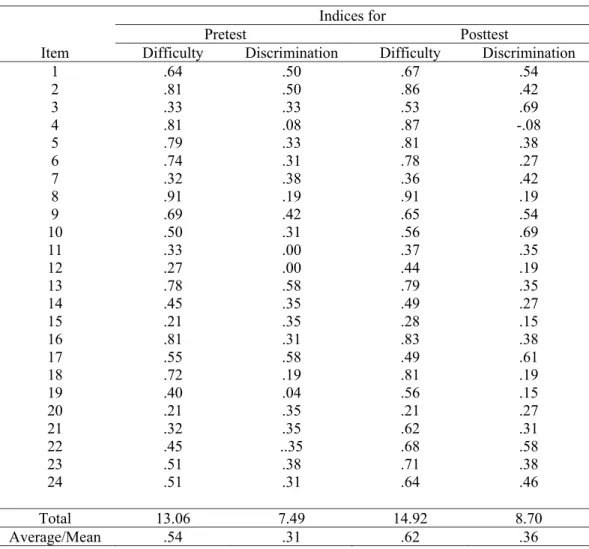
2 Difficulty and discrimination indices for the items in the pretest and posttest of the Algebra Diagnostic Test (N=78)
112
3 Mean, standard deviation and Cronbach Alpha Reliability for pretest
and posttest of the Algebra Diagnostic Test (N=78) 113 4 Descriptive statistics and comparison of mean scores, pretest and
posttest responses and gain score on the Algebra Diagnostic Test
113
5 Results of questions: Number and corresponding percentage of
students selecting response or option, A, B, C, or D (N=78) 118 6 Classification of difficulties and misconceptions 120
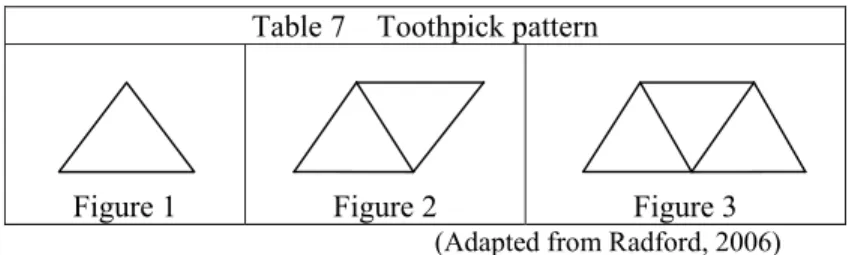
7 Toothpick pattern 132
8 Speed, time and distance travelled 136
9 Cronbach Alpha Reliability of scales for the pretest and posttest of
Mathematics-Related Attitudes (TOMRA) 144
10 Descriptive statistics and a comparison of students’ pretest and posttest responses on TOMRA scales after teaching intervention (N=78)
xii
LIST OF FIGURES
Figure Page
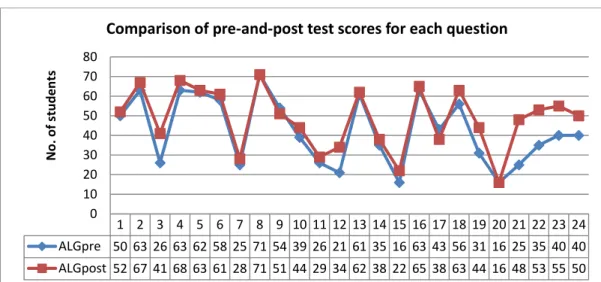
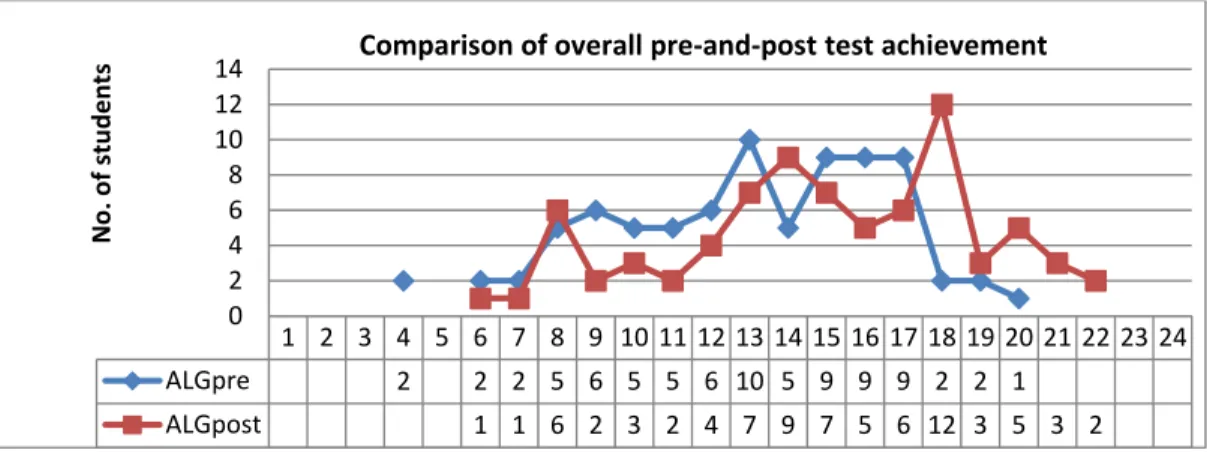
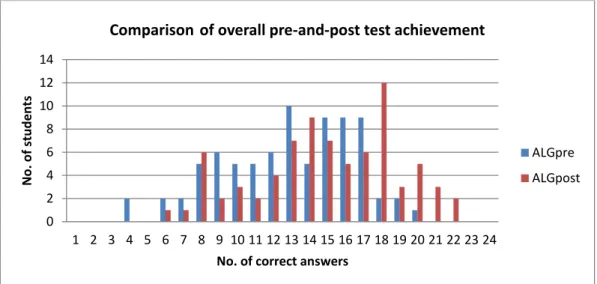
1 Comparison of pre-and-post test scores for each question 114 2 Comparison of overall pre-and-post test achievement 115 3 Comparison of overall pre-and-post test achievement 116 4 Comparison of pre-and-post test scores for each individual student 117 5 The conditions that have to be met for conceptual change to occur 136 6 Comparison of mean score for pre-and-post attitude to mathematics
inquiry 145
7 Comparison of mean score for pre-and-post enjoyment to mathematics lessons
1
Chapter 1
Rationale of the Study
1.0 Introduction
Mathematics arises from the attempt to organise and explain the phenomena of our environment and experience (Bell, 1993). It has been expressed thus: “Mathematics is ... an activity of organising fields of experience” (Freudenthal, 1973, p. 123); and “Mathematics concerns the properties of the operations by which individual orders, organises and controls his environment” (Peel, 1971, p. 157). These descriptions are somewhat non-specific, though Peel is clearly referring to basic mental operations such as classifying, comparing, combining, and representing. A more specific characterisation of mathematics is given by Gattegno (1963):
To do mathematics is to adopt a particular attitude of mind in which what we term relationships per se are of interest. One can be considered a mathematician when one can isolate relationships from real and complex situations and later on when relationships can be used to create new situations in order to discover further relationships. Teaching mathematics means helping one’s pupils to become aware of their relational thought, of the freedom of mind in its creation of relationship; it means encouraging them to develop a liking for such an attitude and to consider it as a human richness increasing the power of intellect in its dialogue with the universe” (p. 55).
Other authors have offered more descriptions which emphasise the logical aspects. Kaput and Roschelle (1998) regard “mathematics as a culturally shared study of patterns and languages that is applied and extended through systematic forms of reasoning and argument” (p. 155). Accordingly, it is both an object of understanding and a means of understanding. They reiterate that these patterns and languages are an essential way of understanding the worlds we experience – physical, social, and even
2
mathematical. While our universe of experience can be comprehended and organised in many ways – through the arts, humanities, the physical and social sciences (Kaput & Rochelle, 1998) – important aspects include those that are subject to measure and quantification, that embody quantifiable change and variation, that the world we inhabit and construct, and that involve algorithms and more abstract structures (Kaput & Rochelle, 1998). In addition, “mathematics embodies languages for expressing, communicating, reasoning, computing, abstracting, generalising and formalising” (p. 155) – all extending the limited powers of the human mind. The authors conclude that mathematics embodies systematic forms of reasoning and argument to help establish the certainty, generality, and the reliability of our mathematical assertion.
Battista (1999), however, opines that “mathematics is a form of reasoning”. Thinking mathematically consists of thinking in a logical manner, formulating and testing conjectures, making sense of things, and forming and justifying judgments, inferences, and conclusions. Research has shown that mathematical behaviour is demonstrated by being able to recognise and describe patterns, construct physical and conceptual models of phenomena, create symbol systems to help in representing, manipulating, and reflecting on ideas, and inventing procedures to solve problems (Battista, 1999). Mathematics is also known as a language of science (Jaworski, 2006), an ideal tool for modelling scientific theories, deriving qualitative consequences from them and forecasting events. Mathematics is used in areas as diverse as space research, weather forecasting, geological exploration, and high finance. Mathematics is also a language (Jaworski, 2006) for everyday life, a central part of human communication, and a means of articulating patterns, relationships, rationality and aesthetic.
Meanwhile Bramall and White (2000) add that mathematics is a science related to life that has been used and valued by people ever since the emergence of civilisation or even before then, in many known and unknown ways. Ernest (2000) suggests that we understand our lives through the conceptual meshes of the clock, calendar, working timetables, travel planning and timetables, finance and currencies, insurances, pensions, tax, measurements of weight, length, area and volume, graphical and geometric representations, etc. To Skemp (1985) “mathematics is one
3
of the most powerful and adaptable mental tools which the intelligence of man has constructed for his own use cooperatively over the centuries. Hence, its importance in today’s world of rapidly advancing science, technology, manufacturing, and commerce” (p. 447). These tools include logical reasoning, problem solving skills, and the ability to think in abstract ways. Mathematics therefore, is important in everyday life and the subject transcends cultural boundaries where its importance is universally recognised.
For all these reasons, mathematics is a central subject in the school curriculum for students at all levels and lends itself as a tool and a way of thinking to many other subjects. The government of Malaysia for the past decades has put great emphasis on the learning of mathematics, science and technology in education (MOE, 2006) encouraging that students should learn not only to use and apply mathematics rules, processes and formulae, but also develop principled understandings of mathematics, ways of thinking mathematically and ways of tackling a wide range of problems using mathematics (Mason, Burton, & Stacey, 1982).
Yet despite great effort or emphasis given to the teaching and learning of mathematics in the classrooms, the level of achievement of mathematics is still not promising. Mathematics achievement in Malaysia is not as strong as educators or society in general would like to see. This view is reflected in both international and national studies such as Trends in International Mathematics and Science Study (TIMSS) and Sijil Pelajaran Malaysia (SPM - Form Five public examination) evaluation. Looking at the performance of Malaysian students in comparisons to students from 44 countries participating in the TIMSS assessment (Mullis, Martin, Gonzalez, & Chrostowski, 2004) in 2003, Malaysian Form Two students scored 504, on the average, in mathematics. Although this average score exceeded the international average, the Malaysian students were out-performed by students from five Asian countries (Singapore, Republic of Korea, Hong Kong, Chinese-Taipei, and Japan), four European countries (Belgium-Flemish, Netherlands, Estonia and Hungary) and Australia. Malaysia was placed 18th overall and had rankings of 10 and 21 in mathematics and science respectively, in the Trends in International Mathematics and Science Study (TIMSS, 2003). Students in schools are achieving just above the international averages. National studies show many areas of
4
mathematics to be problematic for students (MOE, 2006) and evidence abounds that students’ performance and achievement was (and is still) low, and has consequently affected students’ attitudes and perceptions towards mathematics.
Students’ attitudes towards mathematics as a school subject, including both the subject itself and the learning of the subject, and their implications for mathematics instructions have long received considerable attention from the mathematics education community. In particular, the relationship between attitudes towards mathematics and achievement in mathematics had traditionally been a major concern in mathematics education research (Ma & Kishor, 1997). For example, Neale (1969) described the relationship between the two as one of a reciprocal influence, that is, attitudes affect performance and performance in turn affects attitudes. In addition, there is research reporting that the relationship is not statistically significant (e.g., Ng-Gan, 1987; Papanastasiou, 2002). There is also research evidence showing that students’ high performance in mathematics is not necessarily positively associated with their attitudes about mathematics and mathematics learning. For instance, the results of the Third International Mathematics and Science Study (TIMSS) revealed that while Japanese students outperformed students from many other countries in mathematics, they displayed relatively negative attitudes towards mathematics (Mullis et al., 2000).
Although the above evidence indicates that there are no consistent results in the relationship between students’ attitudes towards mathematics and their mathematics achievement, fostering positive attitudes in students towards mathematics is still highly recognised as one crucial component in developing students’ mathematical ability and understanding. In fact, many countries have set it as one of the aims of mathematics education in schools. In the case of Malaysia, the national mathematics curriculum states that “mathematics education aims to enable pupils to develop positive attitudes towards mathematics including confidence, enjoyment and perseverance” (MOE, 2003, p. 9). The challenge in education today is to effectively teach students of diverse ability and differing rates of learning in a way that enables them to learn mathematics concepts with understanding and developing positive attitudes towards mathematics learning.
5
Student attitudes to mathematics [algebra specifically] are central to this process because early failure in algebra is likely to result in passive withdrawal from further study in the area (MacGregor, 2004). Research conducted over the past two-to-three decades has shown that positive attitudes can impact on students’ inclination for further studies and careers in mathematics-related fields (Trusty, 2002). For example, a recent study using the Third International Mathematics and Science Study (TIMSS) data from Canada, Norway and the United States found that attitudes towards mathematics as the strongest predictor of student participation in advanced mathematics courses (Ercikan, McCreith, & Lapointe, 2005). Hence, algebra study may act as a filter for further study in mathematics (MacGregor, 2004; Stacey & Chick, 2004), therefore, the development of positive attitudes to the subject is essential to increase student enrolments in advanced mathematics subjects.
Researchers have noted that early educational and socialisation processes are critical to children’s learning and perceptions and subsequent participation in education (Khoon & Ainley, 2005). Student perceptions, which include their expectations of success and the value they attribute to particular tasks, have been found to correlate strongly with later participation in the study (Ethington, 1992; Wigfield & Eccles, 2000). The analysis of this relationship in the TIMSS data for Australian school students by Thompson and Fleming (2003) supports theorised connections between perceptions, participation and performance. Perceptions shape the information individuals attend to and how it is interpreted (De Bono, 2004). MacGregor (2004), Stacey and Chick (2004) attribute the decreasing participation of students in mathematics to be related to the interaction of three perceptions held by an increasing proportion of students that algebra is perceived as uninteresting; algebra is based upon symbolic manipulation with limited meaning and little relevance to everyday life; and algebra is perceived as difficult.
1.1
Background of the Study
Algebra is considered a course appropriately taken by students in the 8th grade (equivalent of Form 1) in many countries (although algebra is often not a separate course in other countries, but is integrated into the mathematics coursework). In the
6
Malaysian educational system, mathematics is a compulsory core subject in which all secondary school students must enrol, whereas, Additional Mathematics (a combination of algebra, trigonometry, geometry and pre-calculus) is an elective subject which is included in the pure science stream and the technical package. A list of algebra topics taught in Malaysian secondary schools mathematics syllabus shows much depth and breadth required in this area. Topics for Form 1 (Year 7 equivalent) are algebraic expressions 1, and patterns and sequences; topics for Form 2 (Year 8 equivalent) include algebraic expressions 2 (with two or more unknowns), linear equations 1 (with one variable), and patterns and sequences; topics for Form 3 cover algebraic formulae, linear equations 2, linear inequalities and graphs of functions; topics for Form 4 are quadratic expressions and equations, and the straight line (linear function); and topics for Form 5 include graphs of function 2, variations, and gradient and area under a graph (Ministry of Education, 2003, 2006; National Education Blue Print, 2006).
Algebra has traditionally been introduced when it was considered that students have acquired the necessary arithmetic skills. Besides, algebra has usually been developed separately from arithmetic without taking advantage of their strong link. “Usually in arithmetic (mathematics) we apply operations to numbers and obtain results after each operation; but in algebra, we usually do not start solving a problem using the given numbers, doing calculations with them, and obtaining a numeric result. In algebra, students have to identify the unknowns, variables and relations among them, and express them symbolically in order to solve the problem” (Martinez, 2002, p. 8). In its recent final report, the National Mathematics Advisory Panel (2008) in the United States outlined three fundamental elements in mathematics that students need to master in order to be fully prepared for exploring algebra. Those three critical elements are: (1) fluency with numbers, (2) fluency with fractions, and (3) particular aspects of geometry and measurement. Fluency, they said, means conceptual understanding and problem solving skills as well as computational fluency.
A fundamental requirement of algebra is an understanding that the equal sign indicates equivalence and that information can be processed in either direction (Kieran, 1981; Linchevski, 1995). It has been noted previously that many students’ understanding of equals is action indication (e.g., “makes or gives” – Stacey &
7
MacGregor, 1997, p. 113) or syntactic (showing the place where the answer should be written – Filloy & Rojano, 1989). Misconceptions relating to equal concept make it difficult for students to transform and solve equations (Kieran, 1992; Linchevski & Herscovics, 1996).
Understanding the arithmetic operational laws (commutative, associative and distributive) and the order of convention for the operations are also important in algebra (Bell, 1995; Boulton-Lewis, Cooper, Atweh, Pillay, & Wilss, 1998). For example, Kieran (1992) reported that some students read algebraic expressions from the left to right and ignored bracketing, a behaviour that indicates inability to apply the order of convention. The difficulties students who study algebra face without adequate arithmetic prerequisite knowledge can be easily seen in the following Year 9 task: “Solve for x: 2(x – 1) + 2 = (4 – 3x)”. Completing this algebra task requires understanding of the equal concept, order of convention, operational laws and directed numbers.
Traditionally, many students have found the study of algebra difficult. Algebra is an abstract system in which interactions reflect structure of arithmetic (Cooper, Williams & Baturo, 1999). Its processes are abstract schemas (Ohlsson, 1993) or structure conceptions (Sfard, 1991) of the arithmetic operations, equals, and operational laws, combined with the algebraic notion of variable (Cooper, Boulton, Lewis, Atweh, Wilss & Mutch, 1997). Arithmetic does not operate at the same level of abstraction as algebra for, although they both involve written symbols and an understanding of operations (e.g., order of operations and inverse operations – Linchevski & Herscovics, 1994), arithmetic is limited to numbers and numeral computations (Sfard & Linchevski, 1994). Arithmetic and algebra differ fundamentally in that arithmetic computational procedures are separated from the object obtained (Linchevski & Herscovics, 1996). That is, students in arithmetic are not expected to conceive of groups of numbers and symbols as objects, whereas in algebra this is necessary.
In recent years, many research projects on mathematics education have focused on learning difficulties of students related to algebra. Different research studies as well as the experience in teaching mathematics show multiple difficulties students
8
encounter in learning algebra (Molina, Ambrose, & Castro, 2004), when the complexity and cognitive demand of school mathematics seem to increase, causing students to memorise rules without meaning or sense and to lose interest in mathematics. Research suggests that solutions to the problem of students’ inability to be successful in algebra are many and frequently interconnected (Norton & Irwin, 2007). In order to overcome these difficulties and to ease transition to algebra many researchers propose an earlier introduction of algebra. They suggested some solutions which include: making explicit algebraic thinking inherent to arithmetic in children’s earlier learning (Lin & Kaput, 2004; Warren & Cooper, 2006); explicit teaching of nuances and processes of algebra in an algebraic and symbolic setting (Kirshner & Awtry, 2004; Sleeman, 1986; Stacey & MacGregor, 1997, 1999) especially in ransformational activities (Kieran & Yerushalmy, 2004; Stacey & Chick, 2004) using multiple representations including the use of technology (Kieran & Yerushalmy, 2004; Van de Walle, 2006), and recognising the importance of embedding algebra into contextual themes (Stacey & Chick, 2004). Other research has shown that students’ errors in algebra can be ascribed to fundamental differences between arithmetic and algebra. For instance, if students want to adopt an algebraic way of reasoning, they have to break away from certain arithmetical conventions and need to learn to deal with algebraic symbolism.
Understanding of algebra in school mathematics is one of the most important goals for mathematics education. On the other hand, algebra has been an obstacle and a challenge for many students. Yet we know that many students fail algebra in eighth grade, and many fail it in the ninth grade. Not only are these students unprepared for algebra, they also come to fear and dislike it (have a negative attitude towards mathematics) and to think of themselves as mathematically weak. Algebra is frequently taught as though it is unrelated to any prior mathematics that students have experienced (Carraher & Schliemann, 2007). Armstrong and Kahl (1979) concluded that one of the major reasons for students either continuing in mathematics or avoiding mathematics was their own perception about how good they are at mathematics. I have noticed that the attitudes of my students have changed as a result of this feeling of inadequacy and it is a major concern for me as an educator, researcher and mathematics teacher in particular.
9
“Despite massive effort, relatively little is accomplished by remediation programs. No one - not educators, mathematicians, or researchers – knows how to reverse a consistent early pattern of low achievement and failure” (Ball, 2003, p. 13). Thus, it is understandable why so many students give up learning mathematics if they keep on making mistakes and keep on experiencing learning difficulty. Why are students’ misconceptions of such a “simple” concept such as the use of the “equal sign” which is a basic topic in elementary mathematics so robust, or resistant to change? Researchers found that even college students had trouble understanding and using the “equal sign” (Barcellos, 2005). Is it because of the characteristics of mathematics or something else?
1.2
Rationale of the Study
Learning of mathematics starts from when we begin to learn how to count. Then, we use mathematics in our everyday lives, sometimes without even realising. In these situations, what is needed to be learned – the ‘basic numerical concepts’ (Ansari, 2004) – was nothing but a way of expressing ourselves (in a language), in order to communicate with and relate to others. Mathematical skills develop as we grow and become involved in more and more activities, for example, measuring flour while making cakes or maybe rushing to “the sale” calculating (in our head) how much money could be saved. What we need in these occasions is mostly common sense, a practical approach towards obtaining a solution and some prior experience. Everyday mathematics does not require the ‘brains’ of an academic mathematician (Ansari, 2004). Sometimes it is surprising how people even with barely any formal education can deal with calculations so quickly.
Many children have well developed informal and intuitive mathematical competence before they start formal education (Clements & Sarama, 2004; Ginsburg, 2002; Ginsburg, Inoue, & Seo, 1999; Kilpatrick, Swafford, & Findell, 2001; Pepper & Hunting, 1998; Urbanska, 1993; Young-Loveridge, 1989). Children engage in all kinds of everyday activities that involve mathematics (Anderson, 1997), and consequently develop a wide range of informal knowledge (Baroody & Wilkins, 1999; Perry & Dockett, 2004). From infancy to preschool, children develop a base of
10
skills, concepts and understanding about numbers and mathematics. Perry and Dockett (2002) noted that “much of this learning has been accomplished without the assistance of formal lessons and with the interest and excitement of the children intact. This is a result that teachers would do well to emulate in our children’s school mathematics learning” (p. 96). However, as children learn mathematics in a formal setting (the school curriculum), the sense they make of what they are presented with can differ from what the teachers might expect. The concepts can be counterintuitive and they do not understand the fundamental ideas or basic concepts covered in the mathematics class. Poincaré’s statement below captures eloquently both the inextricable relation between mathematics and understanding, and the difficulty that learning mathematics entails:
How is it that there are so many minds that are incapable of understanding mathematics? Is there not something paradoxical about this? Here is a science which appeals only to fundamental principles of logic, to the principle of contradiction, for instance, to what forms, so to speak, the skeleton of our understanding, to what we could not be deprived of without ceasing to think, and yet there are people who find it obscure, and actually they are the majority.
(Poincaré, 1914, pp. 117-118)
While learning mathematics with understanding has increasingly received attention from mathematics educators and psychologists and has progressively been elevated to one of the most important goals of the mathematical education of all students, the realisation of this goal has long been problematic (Stylianides, & Stylianides, 2007). For too many people, mathematics stopped making sense somewhere along the way. Either slowly or dramatically, they gave up on the field as hopelessly baffling and difficult (McNeill, 1988), and they grew up to be adults who – confident that others share their experience – nonchalantly announce, “Math was just not for me” or “I was never good at it” (p. 45). Usually the process is gradual, but for McNeill (1988), the turning point was clearly defined as she described how it happened to her in an article in the Journal of Mathematical Behaviour:
11
What did me in was the idea that a negative number times a negative number comes out to a positive number. This seemed (and still seems) inherently unlikely – counterintuitive, as mathematicians say. I wrestled with the idea, for what I imagine for several weeks, trying to get a sensible explanation from my teacher, my classmates, my parents, anybody. Whatever explanations they offered could not overcome my strong sense that multiplying intensifies something, and thus two negative numbers multiplied together should properly produce a very negative result... Meanwhile, the curriculum kept rolling on, ... .the book and the teacher and the general consensus of the algebra survivors of society were clearly more powerful than I was. I capitulated.
(McNeill, 1988, p. 45)
Imagine a person who has difficulty in understanding and a dislike of mathematics as described above. Somewhere in the past is a negative experience with the subject – it may have been a single event, or it may have been a series of negative events. The nature of the experience is not clear, but what is clear is the impact that it had on him as a learner of mathematics. He feels that he ‘was never good at mathematics’ or that he ‘can’t do the mathematics’. Perhaps he is even afraid of the subject, suffering anxiety at the thought of having to endure the mathematics course (Liljedahl, 2005).
Such a person is not difficult to imagine. I encounter such individuals on a regular basis. They are the students of my mathematics class over the span of my more than 20 years of teaching mathematics in secondary schools. I have noticed that many students at the school have problems with the understanding of mathematical concepts and symbols. They are able to operate with them but they cannot tell what they are doing, why they are doing certain procedures and what is the meaning with mathematical symbolism (Sierpinska, 1994; Attorps, 2003, 2005). Often students would comment to me in the mathematics lesson that algebra “is just letters isn’t it (and what those letters mean causes students confusion when they do not realise that the letters represent numbers)? They would describe themselves as either being incapable of doing mathematics [especially algebra], or having a phobia about the learning of mathematics, or both. For many of them mathematics has long been a
12
subject devoid of wonder, surprise, and discovery (Liljedahl, 2005). As a researcher I became interested in what such a population would describe themselves as incapable of doing mathematics, giving up on mathematics as hopelessly baffling and difficult and having a negative perception on mathematics. Many of the low achieving students made essentially no improvement, in spite of the fact that I paid special attention to their learning. They were still not good at solving even simple problems or understanding certain fundamental concepts. I found this a common phenomenon and with my colleagues believed that some students were born with certain innate ability in mathematics while others lacked such innate ability in mathematics and we thought that the abstractness of mathematics was the problem that causes the learning difficulties. It was when I was doing my research on difficulties and misconceptions in mathematics education that I discovered that there are other explanations for this malaise. That is, the low achieving students only memorised a few facts, formulas, and algorithms, without any deep understanding of them. The lack of understanding prevented them from applying mathematics knowledge to new contexts in a flexible way.
But, what is “understanding and how to improve mathematics understanding of the students?” Hiebert and Carpenter (1992) define understanding as making connections. To understand a new concept means to construct a relationship between the new concept and the old conceptual network and ways to achieve understanding are through reflecting and communicating, working on proper problems, or communicating with partners. Hiebert and Carpenter (1992), however, highlighted the importance and difficulties of promoting students’ understanding as “one of the widely accepted ideas within the mathematics education community is the idea that students should understand mathematics. The goal ... to promote learning with understanding. ... but designing school learning environments that successfully promote understanding has been difficult” (p. 65).
The aim of mathematics education is surely to promote understanding and the success of all students, yet it seems to be a fact of life that whilst a few students are successful in mathematics, a much greater number find mathematics difficult. However hard teachers may try, there are students who begin to struggle and who will need appropriate help to be able to pursue mathematics further. The objective of
13
any mathematics curriculum includes fostering favourable feelings towards mathematics as well as imparting cognitive knowledge. Yet, the general belief and common saying among secondary school students that only the exceptionally brilliant students can successfully learn mathematics leaves much to be desired. This is because such belief has not only affected students’ attitude towards mathematics but also their cognitive achievement or understanding in the subject. Many researchers are unanimous in the submission that secondary school students often show negative attitudes towards mathematics (Mullis et al., 2000), and that such negative attitudes often result in lack of interest in the subject, which consequently results in poor cognitive outcomes in mathematics assessment (Ma & Kishor, 1997). As a result, researchers in mathematics education have emphasised and recommended the use of diverse methods (Ansari, 2004) of teaching mathematics to promote learning with understanding and as a means of promoting positive attitudes towards the subject.
In Malaysia, there are few studies available about students’ difficulties and misconceptions in algebra concepts and attitudes towards mathematics. There is a need for scientific studies of students’ knowledge, understanding, difficulties, misconceptions and attitudes in algebra in the Malaysian context. The present research project is focussed on finding out ways in which learning can be improved, on how better learning outcomes can be achieved in algebra in secondary schools in Malaysia and on helping teachers develop relevant teaching practices.
It will be interesting to determine if the different kinds of difficulties and misconceptions (errors) are relevant to Malaysian students. Learners make mistakes (errors) for many reasons: 1) due to lapses in concentration; 2) hasty reasoning; 3) failure to notice important features of a problem; and 4) others are symptoms of more profound difficulties. According to Liu (2010), misconceptions are systematic patterns in errors in interpreting, understanding or applying mathematical concepts. These conceptual errors are responsible for students’ mistakes. Misconceptions are a result of consistent and alternative interpretation of mathematical ideas. Errors are mistakes made due to lack lapses of concentration, hasty reasoning or failure to notice important features of the problem. It is expected that the analysis used in this study would help to identify the kinds of wrong strategies that lead to incorrect
14
responses. Hopefully, such identification could provide teachers with some definite guidance for remedial education of the students when such errors occur.
The difficulties and misconceptions students have (as mentioned above) on different aspects (concepts) of algebra are widespread among my students and because of these difficulties and misconceptions I would like to investigate what they know and subsequently teach in a way that may improve their understanding of algebra. To this end, I have been developing cognitive conflict problems as tools to elicit and probe students’ understanding of algebra in an intervention strategy called diagnostic teaching. Knowledge of the common algebra errors and misconceptions of children can provide teachers with an insight into student thinking and a focus for teaching and learning (Bell, Swan, Onslow, Pratt, & Purdy, 1985; Black & William, 1988; Hart, 1981; Schmidt et al, 1996; Stigler & Hiebert, 1999). A social constructivist view of learning suggests that errors are ripe for classroom consideration; via discussion, justification, persuasion and finally even change of mind, so that it is the student who reorganises his or her own conception (Cobb, Yackel & McClain, 2000; Ryan & Williams, 2003; Tsamir & Tirosh, 2003). As Chan, Burtis, and Bereiter (1997) pointed out, “a common approach fostering conceptual change is based on a conceptual conflict strategy”. The usual cognitive paradigm involves: a) identifying students’ current state of knowledge; b) confronting students with contradictory information which is usually presented through texts and interviewers, making explicit the contradictions or only guiding the debate with the students or among peers (small groups or the whole classroom (i.e. Dreyfus, Jungwirth, & Eliovitch, 1990; Treagust, 2007), or by the teacher and new technologies; and c) evaluating the degree of change between students’ prior ideas or beliefs and a post-test measure after the instructional intervention. Often, conflict is induced by presenting information that clearly – for the experimenter or for the teacher – contradicts children’s or students’ ideas beliefs or theories. This present study intends to find out whether diagnostic teaching in the framework of conceptual change in a cooperative instructional methodology could enhance conceptual understanding, achievement and positive attitudes of lower secondary school students towards mathematics [algebra].
15
1.3 Research
Questions
The focus of this study lies in students’ difficulties, conceptions and attitudes towards learning algebra in the framework of conceptual change. In order to gain information on the relevance of these areas, the research questions that will guide this study are:
1. Are there learning gains in understanding algebra concepts evident after the six weeks intervention?
2. What conceptual difficulties and misconceptions do Form 2 Malaysian students have with algebra?
3. Is there any evidence of students’ conceptual change in algebra concepts following the teaching intervention (diagnostic teaching)?
4. Are students’ attitudes towards algebra enhanced after the six weeks intervention?
1.4 Significance
The important role that algebra plays is acknowledged by most educators and educationists, but it is a fact that the inherent nature of algebra concepts is quite complex. As already stated, most students find it difficult to understand these concepts. For many years teachers have been seeking for answers why students have misconceptions and what they can do to help them to develop mathematically correct conceptions.
In order to provide learning experiences that students can use to develop understanding of important algebra concepts, teachers must learn what students understand, and they must be sensitive to possible misconceptions held by the students. The learning experiences should allow students to confront their misconceptions and build upon knowledge they already understand. If students are unfamiliar with vocabulary, symbols, representations, or materials, the meaning students gain might differ significantly from what the teacher intends (Hiebert et al., 1997). Simply lecturing to students on a particular topic will not help most students
16
give up their misconceptions. Since students actively construct knowledge, teachers must actively help them dismantle their misconceptions. Teachers must also help students reconstruct conceptions capable of guiding their learning in the future.
The identification of students’ difficulties and misconceptions in algebra ought to be of significance for it might lead to a better understanding of the students’ thought processes and the quality of learning that takes place. By knowing students’ misconceptions or alternative conceptions of algebra, teachers can gain a greater insight into the subject matter of the topic, their teaching, and the learning process of the students. They are likely to be more receptive and willing to try or develop alternative teaching strategies if they find their present methods are inadequate in addressing students’ difficulties. The identification of algebra misconceptions can create worthwhile opportunities to enhance learning and steps can be taken by teachers to help students to remove these misconceptions and providing better understanding of algebra concepts. Knowledge of misconceptions can be employed in planning more effective teaching strategies and methods. It can also be used to present richer learning experiences to students and the researcher can assist other teachers in teaching algebra in a more effective way.
1.5 Summary
This thesis contains five chapters – Rationale of the Study, Literature Review, Methodology, Findings and Discussion, and Conclusions.
Chapter 1 has presented the different descriptions of mathematics, mathematics learning and its achievement and difficulty, and students’ attitudes to mathematics in general. Also contained in Chapter 1 is the background of this thesis, a rationale for the thesis, the statement of research questions, the significance of the study and the limitations of the study.
Chapter 2 will review literature relevant to this study. This literature will focus on previous studies that are related to the current study, and also on literature relevant to each research question proposed in Section 1.3. The literature will attempt to show
17
the relevance of the current study and to substantiate or negate information gained in previous studies.
Chapter 3 will describe the research methodology incorporated in this study. This will be determined by using both quantitative and qualitative data instruments that were adapted (developed) as a means of eliciting succinct answers to each of the research questions. As these instruments were either new or amended from previous instruments, a description of their make-up, and the criteria used in their formation will be described. Additionally, a description of the student population used in this study will be found in this chapter. Care will be given to maintaining student and school anonymity through the use of pseudonyms for students and school. Finally, this chapter will provide details of methods used to gain data and a procedural description of the data analysis.
Chapter 4 which contained the research findings will analyse the data collected and report salient findings determined from the study. The researcher will use data tables, diagrams, charts and statements to effectively present these findings.
The conclusion of the thesis addressing the four research questions is contained in Chapter 5. The first section of this chapter will give a brief overview of the background, objectives, and methodology of this study. The second section of this chapter will relate the major findings of this study by addressing each of the original research questions. Section three will address the implications of this study and will attempt to show the relevance that this study has on the improvement of mathematics teaching and learning, and specifically on teaching algebra. Section four will describe the limitations and implications of this study. Finally, section five will give suggestions for further research.
18
Chapter 2
Literature Review
In their research, mathematicians generally faced problems nobody knows how to solve (on the other hand, pupils face problems which they believe their teachers can solve). To solve their problems, mathematicians are led to create concepts as tools.
(Douady, 1985, p. 35)
2.0 Introduction
The literature review serves to provide a theoretical and methodological framework for this study on Form Two students’ difficulties, conceptions and attitudes of algebra: An intervention study to improve the teaching and learning of algebra. There are five main sections in this literature review. The first section describes students’ conceptions and the nature of alternative conceptions; the second section discusses previous research in students’ difficulties and misconceptions of algebra concepts; the third section outlines research relating to attitudes in mathematical learning; the fourth section introduces and describes the conceptual change approach to mathematics teaching and learning; and the final section discusses diagnostic (conflict) teaching using a cooperative learning methodology as an intervention strategy for conceptual change.
2.1
Students’ Conceptions and Nature of Alternative Conceptions
Ausubel, in the preface to his book, Educational Psychology: A Cognitive View, says that “If [he] had to reduce all of educational psychology to one principle, [he] would say this: The most important single factor influencing learning is what the learner already knows. Ascertain this and teach him accordingly” (Ausubel, 1968, p. vi). This widely shared principle in educational psychology stated by Ausubel (1968) posits that the most important factor to influence learning is the student’s previous
19
knowledge. The acceptance of this principle resulted in greater interest within the mathematics education research in exploring students’ conceptions (Confrey, 1990).
Since the time of Piaget, researchers have been keenly interested in how students view concepts of science and mathematics (Confrey, 1990). Interest in student conceptions surged with the emergence of constructivism (Osborne, 1996; Solomon, 1994), which brought along with it “a language with new descriptive power” (Solomon. 1994, p. 6). This language, Solomon argues, transmuted the study of common student mistakes, previously of little appeal to anyone, to something exciting and of great interest.
Essential to the constructivist view is the recognition that learning is viewed as a process of active construction which is shaped by students’ prior knowledge and conceptions. Many researchers agree that the most significant things that students bring to class are their conceptions (Ausubel, 1968, 2000; Driver & Oldham, 1986). This current cognitive structure of the students composing a set of abstract ideas, concepts and generalisation builds upon facts is the organisation of the students’ present knowledge in a subject (Confrey, 1990). The students’ previously stored knowledge or ideas play an important role when teaching new concepts (Dochy & Bouwens, 1990; Goss, 1999). During instruction students generate their own meaning based upon their experience and abilities (Nakhleh, 1992). For meaningful learning to occur, new knowledge must be related by the student to the relevant existing concepts in the students’ cognitive structure (Ausubel, 1968, 2000). Teachers can be astonished to learn that despite their best efforts, students do not understand fundamental ideas or basic concepts covered in mathematics class. Some of the students give the right answers but these are only from correctly memorised algorithms. Students are often able to use algorithms to solve numerical problems without completely understanding the mathematical concepts (West & Fensham, 1974).
Concept means in everyday life ‘a term’ or ‘a word’ (Bolton, 1972, p. 23; Nelson, 1985). Concepts are described both in older and newer sources in a similar way. For instance, it is said, that “concepts are perceived regularities or relationships within a group of objects or events and are designated by some sign or symbol” (Heinze-Fry
20
& Novak, 1990, p. 461). Concepts can be considered as ideas, objects or events that help us understand the world around us (Eggen & Kauchak, 2004). Concepts that are embedded in mental structures are defined by Cohen, Manion and Morrison as follows:
Concepts enable us to impose some sort of meaning on the world; through them reality is given sense, order and coherence. They are the means by which we are able to come to terms with our experience.
(Cohen, Manion & Morrison, 2000, p. 13)
Each student constructs and reconstructs a wide range of complex, integrated, idiosyncratic, and epistemologically legitimate conceptions on an ongoing basis as s/he negotiates his/her classroom experience (Confrey, 1990). Therefore, students’ real world conceptions play a critical role in their view of the world (Novick & Nussbaum, 1982). So, what is a conception? The term ‘conception’ itself must be explained since it is widely used in science and mathematics education but with very different meanings (Kaldrimidou & Tzekaki, 2006).
Conceptions are systems of explanation (White, 1994). Glynn and Duit (1995) viewed conceptions as learner’s mental models of an object or an event. Duit and Treagust (1995) however define conceptions as “the individual’s idiosyncratic mental representations”, while concepts are “something firmly defined or widely accepted” (p. 47). Consequently, Kattmann, Duit, Gropengieβer and Komorek (1996) define conceptions “as all cognitive constructs which students use in order to interpret their experience” (p. 182). These constructs are located on different epistemological levels of complexity, comprising for example concepts, intuitive rules, thinking forms, and local theories (Gropengieβer, 2001; Prediger, 2008).
Osborne and Wittrock (1983) summarised student conceptions succinctly in their statement that “children develop ideas about their world, develop meanings for words used in science [mathematics], and develop strategies to obtain explanations for how and why things behave as they do” (p. 491). Children develop these ideas and beliefs about the natural world through their everyday experiences. These include sensual experiences, language experiences, cultural background, peer groups,
21
mass media as well as formal instruction (Duit & Treagust, 1995). Some of these ideas and beliefs such as those about “the failure to accept the possibility of dividing a smaller by a larger number, and the assumption that multiplication always makes bigger and division smaller” (Bell, 1986, p. 26) may be similar across cultures as children have very similar personal experience with phenomena. These categories of children’s beliefs, theories, meanings, and explanations will form the basis of the use of the term student conceptions. Simply stated, “conceptions can be regarded as the learner’s internal representations constructed from the external representations of entities constructed by other people such as teachers, textbook authors or software designers” (Treagust & Duit, 2008, p. 298).
Students’ conceptions are critical to subsequent learning in formal lessons because there is interaction between the new knowledge that the students encounter in class and their existing knowledge. Research with infants has shown that the process of constructing naïve physics starts soon after birth. By the time children go to school they are deeply committed to an ontology and causality that distinguishes physical from psychological objects and which forms the basis for the knowledge acquisition process (Carey, 1985; Vosniadou, 1994; 2001). Naïve physics facilitates further learning when the new, to be acquired information is consistent with existing conceptual structures. In the learning of mathematics, students also develop a “naïve mathematics” (Vosniadou, 2001) on the basis of everyday experience, which appears to consist of certain core principles or presuppositions (such as the presupposition of discreteness in the number concept) that facilitate some kinds of mathematical learning but may inhibit others (Gelman, 2000).
Johnstone (2000) states that when a person tries to store material in long term memory and cannot find existing knowledge with which to link it, s/he may try to ‘bend’ the knowledge to fit somewhere, and this gives rise to erroneous ideas (Gilbert, Osborne & Fensham, 1982). When people place instances in sets, or concepts, different from those determined by the community of scientists, the term misconceptions (Nesher, 1987; Perkins & Simmons, 1988) is used. Other researchers use other terms for these constellations of beliefs (Confrey, 1990), including the following: alternative frameworks (Driver, 1981; Driver & Easley, 1978), student conceptions (Duit & Treagust, 1995), preconceptions (Ausubel, Novak, & Hanesian,
22
1978), alternative conceptions (Abimbola, 1988; Hewson, 1981), intuitive beliefs (McCloskey, 1983), children’s science (Osborne & Freyberg, 1985), children’s arithmetic (Ginsburg, 1977), mathematics of children (Steffe, 1988), naïve theories (Resnick, 1983), conceptual primitives (Clement, 1982) and private concepts (Sutton, 1980). Mathematics education researchers have conceptualised these conceptions as a ‘belief system’ (Frank, 1985), as a ‘network of beliefs’ (Schoenfeld, 1983), as a ‘mathematical world view’ (Silver, 1982) and as ‘conceptions of mathematics and mathematical learning’ (Confrey, 1984). Although different authors may have good reasons for preferring particular terms in the context of particular studies, there is no generally agreed usage across the literature (Taber, 2009). There is currently a large body of research literature which has been summarised in articles by Duit (2009).
2.1.1 Nature and Significance of Students’ Conceptions
Students’ existing ideas are often strongly held, resistant to traditional teaching and form coherent though mistaken conceptual structures (Driver & Easley, 1978). Rather than being momentary conjectures that are quickly discarded, misconceptions consistently appear before and after instruction (Smith, diSessa, & Roschelle, 1993). Students may undergo instruction in a particular topic, do reasonably well in a test on a topic, and yet, do not change their original ideas pertaining to the topic even if these ideas are in conflict with the concepts they were taught (Fetherstonhaugh & Treagust, 1992). Duit and Treagust (1995) attribute this to students being satisfied with their own conceptions and therefore seeing little value in the new concepts. Therefore, it is difficult for students to change their thinking. Another reason the authors proposed was that students look at the new learning material “through the lenses of their preinstructional conceptions” (p. 47) and may find it incomprehensible. Osborne and Wittrock (1983) state that students often misinterpret, modify or reject scientific viewpoints based upon the way they really think about how and why things behave, so it is not surprising that research shows that students may persist almost totally with their existing views (Treagust, Duit, & Fraser, 1996). When the students’ existing knowledge prevails, the scientific concepts are rejected or they may be misinterpretation of the concepts to fit or even support their existing knowledge.
23
As Clement (1982a) has shown in elementary algebra where college students make the same reversal error in translating multiplicative reasoning relationships into equations (e.g., translating “there are four people ordering cheesecake for every five people ordering strudel” into “4C = 5S”), whether the initial relations were stated in sentences, pictures, or data tables. In domains of multiplication (Fischbein, Deri, Nello, & Marino, 1985), probability (Shaughnessy, 1977), and algebra (Clement, 1982a; Rosnick, 1981), misconceptions continue to appear even after the correct approach has been taught. Sometimes misconceptions coexist alongside the correct approach (Clement, 1982a). Such results are compatible with the conceptual theoretical framework, which predict difficulties in learning when the new knowledge to be acquired comes in conflict with what is already known (Vosniadou, 1994). If the concepts are accepted, it may be that they are accepted as special cases, exceptions to the rule (Hashweh, 1986), or in isolation from the students’ existing knowledge, only to be used in the classroom (de Posada, 1997; Osborne & Wittrock, 1985) and regurgitated during examinations. Additional years of study can result in students acquiring more technical language but still leave the alternative conceptions unchanged (de Posada, 1997).
In the mathematics education research, there has been much evidence to show that prior knowledge about natural numbers stand in the way of understanding rational numbers. Students make use of their knowledge of whole numbers, to interpret new information about rational numbers (Moskal & Magone, 2000; Resnick, Nesher, Leonard, Magone, Omanson, & Peled, 1989; Vamvakoussi, & Vosniadou, 2004). This gives rise to numerous misconceptions pertaining to both conceptual and operation aspects of numbers. For example, properties of natural numbers such as “the more digits a number has the bigger it is” are used in the case of decimals (Stafylidou & Vosniadou, 2004). And in the context of mathematical operations, the well known misconception such as “multiplication always makes bigger” reflects the effects of prior (existing) knowledge about multiplication with natural numbers (Fischbein, Deri, Nello, & Marino, 1985).
These preconcepts are tenacious and resistant to extinction (Ausubel, 1968, 2000); deep seated and resistant to change (Clement, 1987); and consistent across individuals, very strongly held and not easily changed by classroom instruction
24
(McCloskey, 1983). Smith et al. (1993) opine that students can “doggedly hold onto mistaken ideas even after receiving instruction designed to dislodge them” (p. 121). This persistence does not necessary mean that instruction has failed completely. However, it is vital to acknowledge that misconceptions because of their strength and flawed content can interfere with learning expert concepts. Research has demonstrated the persistence of student misconceptions and the tendency for regressing to these preconceptions even after instruction to dislodge them. Mestre (1989) reports “students who overcome a misconception after ordinary instruction often return to it only a short time later” (p. 2).
2.1.2 Genesis of Students’ Alternative Conceptions
Arguably the most general source of conceptions is limited experience or exposure to limited examples - both in learning outside of school and during formal instruction (Greer, 2004). Alternative conceptions may arise when students are presented with concepts in too few contexts or when concepts presented are beyond their developmental level (Gabel, 1989). It may be that, when first introduced to a new exposition of a scientific idea, students have not yet attained as high a level of abstract thinking as the instructors assume. Perhaps instructors provide part of the concept or a more simplified concept in the belief this will lead students to better understanding, as sometimes happens when the concept is difficult or known to be troublesome. Such limited explanation, however, may prevent some students from crossing a cognitive threshold and entering through a door to a higher level of understanding (Liljedahl, 2005). Other possible explanations could be both the pace at which the algebra concepts are covered and also the formal approach often used in its presentation. It seems that many teachers and textbook authors are unaware of the serious cognitive difficulties involved in the learning of algebra. As a result, many students do not have the time to construct a good intuitive basis for the ideas of algebra or to connect these with the pre-algebraic ideas that they have developed. They fail to construct meaning for the new symbolism and are reduced to performing meaningless operations on symbols they do not understand (Herscovics & Linchevski, 1994).
25
Within the domain of algebra, Kieran (1992) contended that “one of the requirements for generating and adequately interpreting structural representations such as equations is a conception of the symmetric and transitive character of equality – sometimes referred to as the ‘left-right equivalence’ of the equal sign” (p. 398). Yet, there is abundant literature that suggests students do not view the equal sign as a symbol of equivalence (i.e., a symbol that denotes a relationship between two quantities), but rather as an announcement of the result or answer of an arithmetic operation (e.g., Falkner, Levi, & Carpenter, 1999; Molina & Ambrose, 2008). It has been suggested that this well documented (mis)conception might be due to students’ elementary school experiences (Carpenter, Franke, & Levi, 2003; Seo & Ginsburg, 2003), where the concept of equality and its symbolic instantiation are traditionally introduced during students’ early elementary school years, with little instructional time explicitly spent on the concept in the later grades and the equal sign was nearly always presented in the operations equals answer context (e.g., 2 5 __ .
Another source of confusion is the different meaning of common words in different subjects and in everyday use. This applies not only to words, but also symbols. Harrison and Treagust (1996) reported that students were confused between the nucleus of an atom and the nucleus of a cell, and that one student actually drew a cell for an atom. They also found students having alternative conceptions about electron clouds, and cautioned that teachers need to qualify the sense in which they transfer the attributes of the analog to the target. Many scientifically associated words are used differently in the vernacular (Gilbert & Watts, 1983), for example, energy has a cluster of ‘life-world’ associations that do not match its technical use (Solomon, 1992). Likewise, Tall and Thomas (1991) indicate that, in the natural language ‘and’ and ‘plus’ have similar meanings. Thus, the symbol ‘ ’ is read as ‘a and b’ and interpreted as ′ ’.
Schmidt has pointed out how linguistic cues in scientific terminology may lead to inappropriate inferences being drawn (Schmidt, 1991). In the same way, verbal cues – certain words such as ‘more’, ‘times’, reduction’ have strong associations with particular operations, and these sometimes “displace the true meanings of the phrases in which they appear” (Bell, Swan & Taylor, 1981). For example, “the milkman brought 11 bottles of milk on Sunday. That was four more than he brought on