This item was submitted to Loughborough’s Institutional Repository
(
https://dspace.lboro.ac.uk/
) by the author and is made available under the
following Creative Commons Licence conditions.
For the full text of this licence, please go to:
Algebra Teaching within University
Mathematics
by
Stephanie Thomas
A Doctoral Thesis
Submitted in partial fulfilment of the requirements for the award of Doctor of Philosophy of Loughborough University
in the
Mathematics Education Centre School of Mathematics
November, 2011
c
Declaration of Authorship
I, Stephanie Thomas, declare that this thesis titled, ‘An Activity Theory Analysis of Linear Algebra Teaching within University Mathematics’ and the work presented in it are my own. I confirm that:
This work was done wholly while in candidature for a research degree at this University.
Neither the thesis nor the original work contained therein has been submitted to this or any other institution for a degree.
Where I have consulted the published work of others, this is always clearly at-tributed.
Where I have quoted from the work of others, the source is always given. With the exception of such quotations, this thesis is entirely my own work.
I have acknowledged all main sources of help.
Signed:
Date:
An Activity Theory Analysis of Linear Algebra Teaching
within University Mathematics
by Stephanie Thomas
The focus of my research was to explore the teaching of linear algebra to a large group of mathematics undergraduates (>200). With this thesis I present a characterisation of a university mathematics teaching practice in the context of linear algebra.
The study took place over a twelve week period, one academic semester, at a UK univer-sity with a strong tradition in engineering and design technology. Two researchers work-ing closely with a mathematician, the lecturer of linear algebra, collected data in inter-views with the lecturer, and in observations of his lectures (which were audio-recorded). Students’ views were sought via two questionnaires and focus group interviews. Data analysis was largely qualitative.
Linear algebra is an introductory module in most standard first year undergraduate de-gree courses in mathematics. Research shows that students find the highly conceptual nature of linear algebra very difficult and challenging. The lecturer, a research math-ematician, had re-designed the linear algebra module based on his own experience of students’ difficulties with the topic in the previous year. He followed an inductive ap-proach to teaching instead of a more traditional DTP (definition-theorem-proof) style. He based his teaching on informal reasoning about examples that were designed to en-gage students conceptually with the material.
Through this research I gained insight into the lecturer’s motivation, intentions and strategies in relation to his teaching. In applying an activity theory analysis alongside a traditional grounded theory approach to my research, I conceptualised the lecturer’s teaching practice and presented a model of the teaching process. This takes account of the lecturer’s didactical thinking in planning and delivering the linear algebra teaching. Findings from the study give insight into the educational practice of a mathematician in his role as a teacher of university mathematics. I present some of the outcomes of the study in terms of mathematics (three linear algebra topics - subspace, linear independence and eigenvectors), in terms of the didactics of mathematics and in terms of the theoretical basis of Mathematics Education as a discipline.
Acknowledgements
.There are many people who over the last four years have helped me to complete my studies. But there are some I wish to mention by name.
I thank my supervisor, Professor Barbara Jaworski, for her sustained and unfaltering guidance. I thank Antony Edwards for his patience in explaining to me all matters technical and computing. I thank also Somali Roy who with just a few words ensured that I continued when I thought of giving up. Most of all I thank the mathematician and lecturer of linear algebra for his openness, kindness and his time without which this study would not have been possible.
Finally I thank my family and friends for their patience and affections. I could not have done this without you.
Contents
Declaration of Authorship i
Abstract ii
Acknowledgements iii
List of Figures viii
List of Tables x
1 Introduction and background to my study 1
1.1 The University and the research team . . . 3
1.2 The linear algebra module . . . 4
2 Literature Review 6 2.1 The teaching and learning of linear algebra: A historical note . . . 7
2.2 Students’ difficulties with linear algebra . . . 8
2.3 Models for teaching linear algebra . . . 10
2.3.1 Change of contract and the meta-lever . . . 11
2.3.2 A matrix-based approach and how, and what questions to ask . . . 12
2.3.3 Geometry: ‘Yes’ or ‘No’ . . . 13
2.4 Research into teaching practice . . . 14
2.5 The role of the lecture and of lecturing . . . 15
3 Methodology 18 3.1 The development of the research questions . . . 18
3.2 The design of my study . . . 20
3.3 The research paradigm . . . 20
3.4 The methods of data collection . . . 24
3.4.1 Ethical considerations in data collection . . . 25
3.4.2 The meetings data . . . 26
3.4.3 The lecture observation data . . . 28
3.4.4 The student interview data . . . 28
3.4.5 The student survey data . . . 29
3.5 The methods of data analysis . . . 31
3.5.1 The analysis of the meetings data . . . 31
3.5.2 Ethical considerations in the coding analysis . . . 33
3.5.3 The analysis of the lecture observation data . . . 34
3.5.4 The analysis of the student interview data . . . 35
3.5.5 The analysis of the student survey data . . . 35
3.6 Addressing trustworthiness in my study . . . 36
4 Theoretical perspectives 39 4.1 Vygotskian perspectives as a foundation for activity theory . . . 40
4.2 Activity theory . . . 42
4.3 The structural elements of activity . . . 44
5 A structural analysis of teaching with respect to theory 49 5.1 Course design and course structure . . . 49
5.2 Introduction to my analysis . . . 50
5.3 Activity and motive . . . 52
5.3.1 The EAG approach . . . 55
5.4 Actions and goals . . . 60
5.4.1 The goals/intentions . . . 61
5.4.2 The actions/strategies . . . 63
5.4.3 Goal 1: Engagement with mathematics . . . 65
5.4.4 Goal 2: Intuitive understanding . . . 68
5.4.5 Goal 3: Acquisition of mathematical language . . . 71
5.4.6 Goal 4: Conceptual understanding . . . 73
5.4.7 Goal 5: Mathematical competence . . . 76
5.4.8 ‘Verbalising of intentions’ . . . 78
5.4.9 A brief summary of this section . . . 81
5.5 Operations and conditions . . . 82
6 The Teaching of Linear Algebra Concepts 86 6.1 Introduction to Chapter 6 . . . 87
6.1.1 Analysing subspaces, linear independence and eigenvectors . . . . 87
6.1.2 The four aspects of analysis . . . 90
6.1.3 The reference textbooks and set of course notes . . . 92
6.1.4 Notation . . . 94
6.1.5 Assumptions and points of reference . . . 97
6.2 The concept of a subspace . . . 99
6.2.1 A mathematical account of vector spaces and subspaces . . . 99
6.2.2 The lecturer’s mathematical treatment of subspace in the course notes . . . 103
6.2.3 The lecturer’s didactical thinking in relation to the teaching of subspaces . . . 107
6.2.4 The lecturer’s teaching of subspace (to students) . . . 114
6.3 The concept of linear independence . . . 119
6.3.1 A mathematical account of linear independence . . . 119
6.3.2 The lecturer’s mathematical treatment of linear independence in the course notes . . . 123
6.3.3 The lecturer’s didactical thinking in relation to the teaching of linear independence . . . 127
6.3.4 The lecturer’s teaching of linear independence (to students) . . . . 134
vii
6.4.1 A mathematical account of eigenvectors/values . . . 142
6.4.2 The lecturer’s mathematical treatment of eigenvectors/values in the course notes . . . 152
6.4.3 The lecturer’s didactical thinking in relation to the teaching of eigenvectors . . . 159
6.4.4 The lecturer’s teaching of eigenvectors/values (to students) . . . . 168
6.5 Didactical summary . . . 172
7 Students’ views 177 8 Synthesis and Conclusions 184 8.1 On the teaching of linear algebra . . . 184
8.1.1 The lecturer’s model for teaching linear algebra . . . 185
8.1.2 Some implications of the model . . . 186
8.1.3 Cultural shifts and the devolution of learning . . . 188
8.2 Implications for the learning of linear algebra . . . 189
8.2.1 Accounting for students’ views . . . 189
8.2.2 Mathematical considerations . . . 190
8.3 The theoretical and methodological contribution of my research to the field of mathematics education . . . 192
8.3.1 Conceptualising a university mathematics teaching practice from an activity theory perspective . . . 192
8.3.2 The development of methodology in an interpretive paradigm . . . 193
8.4 Concluding remarks . . . 194
A The Focus Group Interviews 197 B Student Questionnaires 201 C Extracts from Textbooks 206 D Examples from Coding Analysis 212 E The Linear Algebra Course Notes (Student Version) 218 F The Linear Algebra Course Notes (Complete Version) 233
4.1 The Structural Elements of Activity . . . 45
5.1 The solution of Example 3.14 in the course notes . . . 58
5.2 Modelling the teaching process . . . 61
5.3 The set of nested goals . . . 62
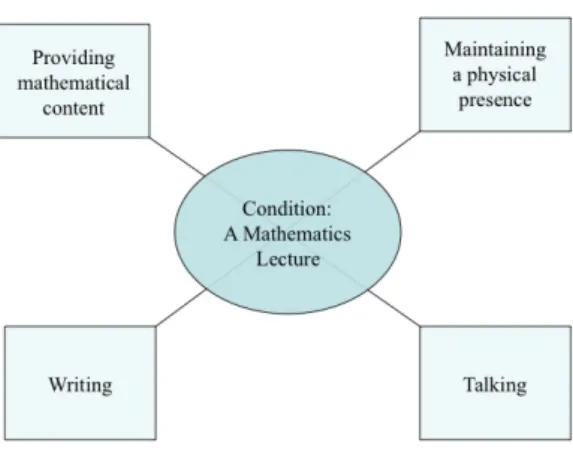
5.4 Depicting four operations under the condition of ‘a mathematics lecture’ . 83 6.1 The diagonalisation procedure (Sproston, 1995) . . . 150
A.1 Participant Information Sheet . . . 198
A.2 Consent Form . . . 199
A.3 Questions to students in the focus group interviews . . . 200
B.1 Student Questionnaire 1, page 1 . . . 202
B.2 Student Questionnaire 1, page 2 . . . 203
B.3 Student Questionnaire 2, page 1 . . . 204
B.4 Student Questionnaire 2, page 2 . . . 205
C.1 Introducing the concept of a subspace in Hoffman & Kunze (1961, p. 34) 207 C.2 Introducing the concept of a subspace in Hoffman & Kunze (1961, p. 35) 208 C.3 Introducing the concept of a subspace in Greub (1967, p. 23) . . . 209
C.4 Introducing the concept of a subspace in Poole (2006, p. 438) . . . 210
C.5 Introducing the concept of a subspace in Sproston (1995, p. 4) . . . 211
D.1 Coding analysis of document P5 . . . 213
D.2 Coding analysis of document P8 . . . 214
D.3 Coding analysis of document P12 . . . 215
D.4 Code list exported from atlas-ti . . . 216
D.5 Code list exported from atlas-ti . . . 217
E.1 Chapter 3, page 1: Subspaces (student course notes) . . . 219
E.2 Chapter 3, page 2: Subspaces . . . 220
E.3 Chapter 3, page 3: Subspaces . . . 221
E.4 Chapter 3, page 7: Linear Independence (student course notes) . . . 222
E.5 Chapter 3, page 8: Linear Independence . . . 223
E.6 Chapter 3, page 9: Linear Independence . . . 224
E.7 Chapter 3, page 12: Linear Independence . . . 225
E.8 Chapter 3, page 13: Linear Independence . . . 226
E.9 Chapter 3, page 14: Linear Independence . . . 227
E.10 Chapter 4, page 1: Eigenvectors (student course notes) . . . 228 viii
ix
E.11 Chapter 4, page 2: Eigenvectors . . . 229
E.12 Chapter 4, page 3: Eigenvectors . . . 230
E.13 Chapter 4b, page 4: Eigenvectors continued (student course notes) . . . . 231
E.14 Chapter 4b, page 5: Eigenvectors continued . . . 232
F.1 Chapter 1, page 6: Linear Equation Systems (complete course notes) . . . 234
F.2 Chapter 1, page 7: Linear Equation Systems . . . 235
F.3 Chapter 3, page 1: Subspace (complete course notes) . . . 236
F.4 Chapter 3, page 2: Subspace . . . 237
F.5 Chapter 3, page 3: Subspace . . . 238
F.6 Chapter 3, page 7: Linear Independence (complete course notes) . . . 239
F.7 Chapter 3, page 8: Linear Independence . . . 240
F.8 Chapter 3, page 9: Linear Independence . . . 241
F.9 Chapter 3, page 12: Linear Independence . . . 242
F.10 Chapter 3, page 13: Linear Independence . . . 243
F.11 Chapter 3, page 14: Linear Independence . . . 244
F.12 Chapter 4, page 1: Eigenvectors (complete course notes) . . . 245
F.13 Chapter 4, page 2: Eigenvectors . . . 246
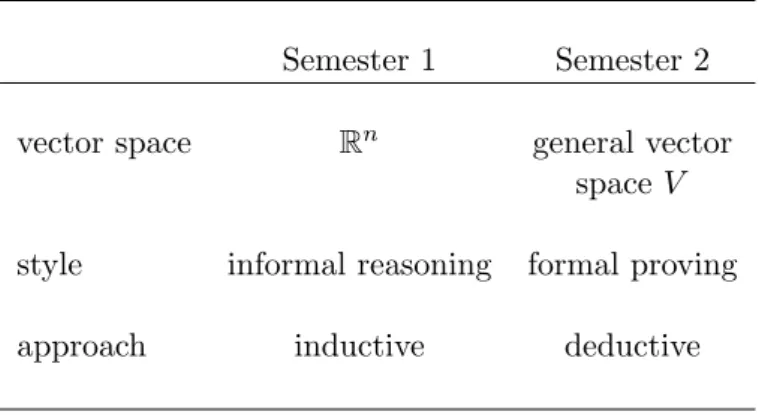
8.1 Aspects of Semester 1 and Semester 2 Teaching . . . 185
Chapter 1
Introduction and background to
my study
In my thesis I describe a teaching practice of mathematics at university level. The research is based on one lecturer’s teaching of a linear algebra module to a large group of first year undergraduate students at a UK university, a single case study. By teaching practice I mean all that the lecturer does in connection with his teaching of linear algebra: the planning, preparing and thinking about teaching in terms of structuring of material content of the module. I include the preparation of resources such as course notes for students, examples and exercises, etc. Teaching practice includes also the face-to-face teaching of students.
My aim is to capture some of the complexity of a mathematics teaching practice. I draw on Leontiev’s development of activity theory as an analytical tool as well as a theoretical tool in analysis and interpretation. My focus is the teaching of linear algebra based on a characterisation in terms of motive, actions and goals of activity. My general research questions are
What does it mean to teach mathematics at university? What does it mean to teach linear algebra at university?
My more specific research questions are
1. What are the strategies used by the lecturer in his teaching of linear algebra? 2. How and why does the lecturer use these strategies? What are his intentions for
student learning?
3. In using these strategies,
(a) what are the implications for students’ learning of linear algebra, and (b) what are the implications for the teaching of linear algebra?
In this introduction I present an overview of my thesis. I describe the background of my study, in terms of the university where the research took place, the mathematician whose teaching practice I describe and the linear algebra module that the lecturer taught and that formed the basis of my research. I introduce the research team which comprised of the lecturer/mathematician who taught the module and two researchers, my supervisor and I.
The structure of the thesis
In this first chapter, Chapter 1, I introduce my study. This includes my research ques-tions and the university and mathematics department where the research took place. In Chapter 2 I review the literature that informed and guided me in my research. In particular, I discuss the research literature into the teaching and the learning of linear algebra.
In Chapter 3 I discuss my methodological perspectives as well as the specific methods that I used in pursuit of my research questions.
In Chapter 4 I discuss my theoretical perspectives. I adopted a socio-cultural framework and Leontiev’s development of activity theory in particular in my research.
Chapter 5 is the first of three analysis chapters. In Chapter 5 I use activity theory as an analytical tool to analyse the lecturer’s didactical thinking and decision making. This is an analysis of the meetings data and relates to the lecturer’s actions and goals. In Chapter 6 I report on my analysis of three topics in linear algebra: subspaces, linear independence, and eigenvectors and eigenvalues. In my analysis and interpretation I drew on the lecturer’s comments in research meetings as well as the lecturer’s face-to-face teaching. I included an analysis of the course notes that the lecturer provided for students and used in his teaching. I analysed also how four textbook authors introduced the three topics in their writing. The analysis is comprehensive and as a result this chapter is very long.
In Chapter 7 I report on my analysis of the student questionnaires and the student focus group interviews. This is a relatively short chapter where I describe students’ experience of the teaching based on the responses that students gave.
3
In the last chapter, Chapter 8, I draw my analyses and observations to a conclusion. I discuss possible implications of an inductive approach to teaching linear algebra by drawing on students’ responses in interviews. I discuss what we have learnt about the teaching of linear algebra at university, issues for students and issues for a teacher of linear algebra. I highlight the value of my research in applying activity theory to the teaching practice of linear algebra at university. I discuss the value of theory and methodology in a qualitative study.
1.1
The University and the research team
The research was carried out at a UK medium sized university, with a strong tradition in engineering and design technology. Mathematics is taught by a department comprising of more than 50 staff.
The lecturer in my study was in his mid-thirties and at the start of the study recently newly appointed. He had started to teach the linear algebra module in the previous year and had experience of lecturing for one year in the US prior to arriving in the UK. He was enthusiastic about his subject and about his teaching. At the time when he agreed to take part in the research he was interested in taking an approach to his teaching of the module that was different from the one he had taken previously. As a result he had re-written the whole of the first semester of the linear algebra module. He had worked closely with the lecturer in the second semester, a colleague in the department who was also a young male mathematician. As well as teaching linear algebra the lecturer also taught a second module, “Communicating Mathematics”. This was mainly a project based module for second and third year students. In interviews and conversations the lecturer often referred to this module and to his intentions in respect of teaching and to his students’ reactions. Hence he often expressed his views in respect of teaching more generally and not just in relation to his teaching of linear algebra.
The study had been set up by my supervisor. I joined at a later stage at the start of my PhD. The three of us formed a research team where we, the researchers had responsibility for the research process and the lecturer for the teaching of the module. During the data collection period with the lecturer (which was in Semester 1 only) all three of us met regularly for discussions and conversations. It became clear early in the study that the lecturer had thought deeply about his teaching and had clear ideas and a vision of what he wanted to achieve.
Both researchers attended the lectures and tutorials in the first semester. I, as PhD student took responsibility for cataloguing audio-recordings and copies of field notes,
both my own and those written by my supervisor. In meetings we all contributed, both researchers asked questions or offered interpretations, the lecturer responded to questions and often offered thoughts and insights without prompting. Thus over the period of teaching in the first semester (eleven weeks) the research process was a collaborative one between the researchers and the lecturer. In meetings my supervisor had a more dominant role in asking questions since I, as a new student in mathematics education, felt unsure about the process of conducting interviews with the lecturer.
In the second semester I alone continued to attend the linear algebra lectures and tu-torials which were taught by a different lecturer. I took sole charge of organising and conducting interviews with students (also in the second semester) and began the pro-cess of analysis of the audio-recordings of the meetings and the lectures. As a result I am solely responsible for the interpretations that I offer in this thesis, for adopting an activity theory perspective and for the theoretical model of the teaching process that I present in Chapter 5. I continued my analysis of the lecturer’s teaching practice in respect of three topics in linear algebra (presented in Chapter 6). All this analytical work is my own.
As a result of the collaborations between the researchers and the lecturer we gave seminar presentations and published papers. Jaworski, Treffert-Thomas and Bartsch (2009) was one such publication that I refer to in later chapters. It came about at an early stage of analysis. It was the result of analysis conducted by my supervisor independently of me but with input by me and the lecturer during finalisation. Apart from this collaboration all analytical work in this thesis has been my own.
1.2
The linear algebra module
Research was carried out with a lecturer teaching a large group of first year undergrad-uate students (> 200). Students were either single or joint honours students. During their first year of study students took several modules from a prescribed list of modules of which some were compulsory and some were optional, depending on the students’ de-gree registration. For all students registered as mathematics students on a joint or single honours degree, linear algebra and calculus were compulsory modules. All students reg-istered for a single honours degree in mathematics also took a geometry module in the first semester. Because of this arrangement the lecturer in my study took the decision not to include any geometric reasoning in the linear algebra module.
Each student had a personal tutor who was responsible for the individual student’s general welfare and the first port of call in respect of any personal or academic difficulties.
5
The personal tutor met his or her tutees on a weekly basis in what was called the SGT, the small group tutorial, each with six to eight students. Students attended the SGTs in the first year of their undergraduate studies only. These sessions were timetabled as a mathematics tutorial and led by the personal tutor. Most members of staff in the mathematics department were personal tutors. They gave help and support in respect of students’ difficulties with first year mathematics modules and were responsible for marking coursework for the compulsory modules of linear algebra and calculus.
Students attending the linear algebra module were predominantly young (18 to 21 years old) and had completed ‘A’-level study (or equivalent) just prior to coming to university. Linear algebra was a one year long module at the university. Research took place over twelve weeks with the lecturer who taught the first semester. The lecturer had re-designed the module using an ‘inductive’ approach based on examples. He developed this approach in response to a more proof-based linear algebra module that he had taught the previous year. In his observations of students in lectures and tutorials and of his personal tutees in SGTs, he gained the impression (re-counted in research meetings) that students had great difficulties with the abstract nature of linear algebra. In re-thinking his teaching he developed an approach whereby he introduced (an) example(s) in order to motivate a definition or a theorem in linear algebra. He based his idea of using examples on an article by Frank Uhlig published in a mathematics research journal. Frank Uhlig, a research mathematician and teacher of linear algebra in the US, presented an account of his own teaching based on introducing an example and asking questions. The lecturer in my study had accessed this literature prior to any discussion about taking part in our research. This I took as an indication of the lecturers commitment to his teaching duties which also showed in the often very engaging conversations that we, the researchers, had with the lecturer in meetings. Discussions in meetings centred on mathematics (the lecturer frequently explained mathematical ideas and concepts to us, the researchers), on the teaching and learning of mathematics and on his personal experiences as a student and as a teacher and researcher. He often shared ideas about teaching with friends and colleagues in the department, most usually informally over lunch, as well as with one of his parents who was a teacher. I believe the lecturer was well-liked in the department and not representative of what one might associate with a ‘typical’ lecturer of mathematics at a UK university. His interest in education research was genuine which showed in his continual development of his teaching and his teaching resources after the research had ceased.
Literature Review
In this chapter I present a review of the literature that informed my study. The liter-ature into the teaching and learning of linear algebra was particularly relevant to my study as was the literature into the teaching of mathematics at tertiary level. A search of the first revealed literature dating back more than twenty years. Publications in both the research and professional literature dealt with curriculum development and reform, research into teaching and teaching practice, accounts of teachers’ reflections on their own practice and research into students’ difficulties with linear algebra. Research
into teaching practice, that included face-to-face teaching of students, was relatively scarce. In relation to mathematics teaching at tertiary level I reviewed literature that was concerned with approaches to mathematics teaching as well as teaching issues more generally, in particular the role of the lecture and of lecturing, all in the context of mathematics teaching and lecturing.
Before I go further I need to clarify what I mean by research literature and professional literature. “Research is systematic enquiry made public” as Stenhouse (1984) wrote. Researching the teaching or learning of linear algebra involves the use of methodology and theory in the pursuit of rigorous inquiry and leads to research publications. There are also publications, often in relation to teaching, that are the result of an individual teacher’s reflections on his or her own practice. These often take the form of accounts of good or innovative practice and are part of what I call the professional literature. Publications in the professional literature are often not peer reviewed and not based in research activity that involves for example, systematic data collection and analysis. I begin with a review of the literature in relation to linear algebra teaching and learning.
7
2.1
The teaching and learning of linear algebra: A
histor-ical note
In the US, in the 1960s and 70s the School Mathematics Study Group (SMSG), of which Guershon Harel was a member, considered curricular issues in the light of the reforms of the primary and secondary mathematics curriculum. They also considered the study of selected linear algebra topics by high school students. As part of their work the SMSG published numerous reports and materials for school use.
In January 1990, the Linear Algebra Curriculum Study Group (LACSG) was formed in response to a perceived decline in students’ ability to cope with the linear algebra cur-riculum in first year university courses. David Carlson was a member of the LACSG as were Charles Johnson, David Lay (who published an acclaimed linear algebra textbook) and A. Duane Porter, as well as Guershon Harel as member of a workshop panel. All were research mathematicians.
The task of the LACSG was to improve the undergraduate linear algebra curriculum (see Carlson, Johnson, Lay and Porter, 1993). They considered both curricular and teaching reforms, and published a list of recommendations as a result of their review which included a ‘core syllabus’ for teaching linear algebra. The LACSG welcomed responses to their proposals in order to encourage debate and further improvements. The influence of the LACSG on the development of, and subsequent research into the teaching and learning of linear algebra can be seen by the many references that were, and are still made to the group’s work (see, for example, Dorier and Sierpinska, 2001; Uhlig, 2003). Although I expected the list of topics that formed the ‘core syllabus’ to be dated it appeared in almost unaltered form as the content page in many introductory textbooks of linear algebra since. In addition, the core syllabus as formulated by the LACSG in 1993 contained the same list of concepts that the lecturer in my study highlighted as fundamental and most important.
Research into the teaching and learning of linear algebra has continued in the US, UK and France, in particular. In 2000 Jean-Luc Dorier published a textbook “On the teaching of linear algebra” (Dorier, 2000). This contained contributions by researchers active in the area of the teaching and learning of linear algebra. In 2001, the authors Jean-Luc Dorier and Anna Sierpinska published a joint article in D. Holton’s book “The teaching and learning of mathematics at university level” (Holton, 2001). Dorier and Sierpinska summarised the research in the area of the teaching and learning of linear algebra and included a detailed description and analysis of epistemologically based research. Their work is indicative of a change in focus to more didactical considerations.
In 2003 Frank Uhlig, a research mathematician, published his reflections on the teaching and learning of linear algebra (Uhlig, 2003). He made references to the work of the LACSG and to Jean-Luc Dorier and his colleagues. Frank Uhlig combined curricular and didactical considerations into a single framework for teaching linear algebra to first year undergraduates. However, his account was not research based.
2.2
Students’ difficulties with linear algebra
My review of the literature into students’ difficulties with linear algebra revealed pub-lications dating back to at least 1989. Most authors appeared to agree that students perceived linear algebra to be a difficult subject. They also seem to agree on the nature and sources of these difficulties. The three most commonly quoted areas of students’ difficulties were: the overwhelming number of new concepts and definitions in a first year linear algebra course, the high level of abstraction required in mastering the linear alge-bra concepts, and the lack of connection with students’ prior knowledge and experience, particularly with mathematics at school level.
Harel (1989) represents an early publication that highlighted students’ difficulties with the abstract nature of linear algebra. Carlson (1993) referred to “Must the fog always roll in?” (p. 29) while Hillel and Sierpinska (1994) referred to “one persistent mistake in linear algebra” (p. 65) and Dorier, Robert, Robinet and Rogalski (2000b) wrote that “many students have the feeling of landing on a new planet and are not able to find their way in this new world” (p. 28). Dorier and Sierpinska (2001) gave a useful review of the research up to that date, and the book by Jean-Luc Dorier “On the Teaching of Linear Algebra” provided a comprehensive study of students’ difficulties (Dorier, 2000). Students have particular difficulties with the highly conceptual nature of linear algebra and the many definitions that involve formal mathematical language. Rogalski (1996) cited students struggling with logic and set theory, particularly in relation to intersec-tions of subspaces. Dubinsky (1997) highlighted students’ difficulties with quantifiers. Hillel (2000) referred to the different representations and modes of description in linear algebra. Dorier and Sierpinska (2001) highlighted the fact that teachers switched be-tween different representations without alerting their students when they did, leading to student confusion and misinterpretations. Artigue (2001) made connections between students’ understanding in calculus and linear algebra and gave an overview of students’ cognitive difficulties. By far the most detailed analysis of students’ difficulties was presented by Dorier (2000). In his book he included a historical analysis of the develop-ment of linear algebra and the fundadevelop-mental problems that mathematicians encountered in creating linear algebra as a unifying theory. Unlike other areas of mathematics, linear
9
algebra did not develop as a result of solving a mathematical ‘problem’. Linear alge-bra came about as a theory that unified the tools and methods that mathematicians used in solving problems; it became a framework that simplified dealing with problems stemming from linearity. Dorier et al. (2000b) wrote, that
. . . the simplification is only visible to the specialist who can anticipate the advantage of generalization because they already know many contexts in which the new theory can be used. For the beginner, on the other hand, the simplification is not so clear . . . (Dorier et al., 2000b, p. 28).
Thus students encountered a theory without knowing of its value or power as a unifying method. Many problems that students encountered in an introductory linear algebra module such as solving systems of equations, students could solve with knowledge that they had acquired prior to coming to university, so that students failed to see a need in learning a new and cognitively demanding theory. In his work Dorier analysed in detail students’ difficulties with the linear algebra, for example with the concepts of vector spaces and subspaces, rank, bases and linear independence. In a recent review Britton and Henderson (2009) described students’ difficulties with the concept of closure and with functions as elements of a vector space.
In addition there was recent research by Stewart and Thomas (2007, 2009, 2010). They considered the role of geometry in teaching linear algebra in order to help students overcome their difficulties with linear algebra. They used APOS theory (Dubinsky, 1997) as theoretical perspective and in relation to analysis and interpretation of their data. While I acknowledge their contribution towards furthering our understanding of students’ difficulties, their research is not so relevant to my study. This is because the lecturer in my study did not use any geometry in his teaching. Nevertheless, I will refer to the work by Sepideh Stewart and Michael Thomas from time to time in my thesis. These studies all highlighted that students struggled with the conceptual nature of lin-ear algebra. All authors seem to agree that students do have great difficulties with linear algebra when they first encounter linear algebra at university while at the same time acknowledging that conceptual understanding is necessary to advance to the level of mathematical abstraction required at university. However, there appears to be less agreement on the strategies that could be used to alleviate and overcome these difficul-ties.
2.3
Models for teaching linear algebra
Holton (2001) provided an overview of the teaching and learning of mathematics at university level. Derek Holton as the editor was reporting from an ICMI study into the teaching and learning of advanced mathematics. His book included an article by Jean-Luc Dorier and Anna Sierpinska on the teaching and learning of linear algebra, and by Joel Hillel on the use of computer algebra systems in the teaching and learning of linear algebra. Artigue, Batanero and Kent (2007) gave an overview of research into mathematical thinking and learning at university level. This included a discussion of David Tall’s work on ‘advanced mathematical thinking’ (Tall, 1991, 2004) as well as the work by Dorier et al. in what they called the ‘obstacle of formalism’ in the teaching and learning of linear algebra (Dorier et al., 2000b).
Some research studies have made suggestions as to what could be included in the teach-ing of linear algebra in order to ‘make it better’, for example use of technology (Berry et al., 2008; Sierpinska, 2005), use of geometry (Gueudet-Chartier, 2004; Sierpinska, 2005; Stewart and Thomas, 2009) or journal writing (Hamdan, 2005). However, there has been very little research into the practice of teaching linear algebra. One example of such research was carried out by Jean-Luc Dorier and his colleagues in France. Not only did they chart the progress of students, which led to important insights into stu-dents difficulties with the subject, they also carried out teaching experiments lasting several years. Findings included a discussion of a ‘change of contract’, and the use of a ‘meta-lever’ (Dorier, Robert, Robinet and Rogalski, 2000a) in helping students make the transition to conceptual thinking which I discuss below.
Apart from this research there were contributions to the professional literature. Carlson (1993) and Carlson et al. (1993) were among the first to discuss curricular issues sur-rounding the study of linear algebra at university, which culminated in the publication of a list of topics to be taught. More recently the work by Frank Uhlig (2002, 2003) centred on a description of teaching linear algebra based on a matrix approach. One difficulty with professional literature was the choice of language in describing findings which often took little account of the terminology in use in the educational research literature. As a result, some of the terminology used in the professional literature was at times confusing.
I discuss here two areas of research into the teaching of linear algebra that have influenced my thinking: the work by Jean-Luc Dorier and his colleagues, and the work by Frank Uhlig. I also acknowledge recent work by Sepideh Stewart and Michael Thomas (2009) into the teaching of linear algebra with geometry. Since the lecturer in my study did
11
not use any geometry or geometric insights in his teaching, this work is less relevant to my study.
2.3.1 Change of contract and the meta-lever
The contributions of Jean-Luc Dorier and his colleagues in research in the area of teach-ing and learnteach-ing linear algebra were extensive. As early as 1990 they raised important issues in relation to students’ (mis)understandings in linear algebra, and addressed the question of how to improve the teaching of linear algebra.
Dorier and his colleagues identified ‘one massive obstacle’ that students seemed to have with linear algebra, which they called the‘obstacle of formalism’. In brief, students were unable to abstract the formal theory from examples and problems posed because they could not recognise linear algebra as a unifying theory, that is a theory for all prob-lems stemming from linearity. In students’ experience all probprob-lems that they solved in a first year linear algebra course could be solved without the need of formal theory. For example, solving linear equation systems did not require students to know matrix theory or Gaussian elimination. As a consequence Dorier and his colleagues suggested mak-ing a better connection between the elements of the formal theory and students’ prior knowledge and experience. To do this they introduced the notion of the‘meta-lever’. The meta-lever represented the use of information ABOUT mathematics. It denoted a ‘meta’ intervention by the teacher (often orally, and always deliberate) that would lead students to (actively) reflect on a problem posed, or a new concept. Students needed to engage with the activity, and not merely ‘carry out’ the activity. Thus students were asked, for example, to derive the axioms of a vector space for themselves. Using a meta-lever in these teaching situations required students to take achange of point of view. For example, students needed to be able to connect matrices to linear equation systems on the one hand, and to vectors on the other. Students needed to appreciate thechange in the didactical contract. They needed to ‘see a point’ for abstracting and formalising. Hence any teaching sequence that Dorier and his colleagues built for students included the devolution of learning to the student. They generally acknowl-edged that a change in didactic contract took students time to adjust to. Certainly, this was an issue that Dorier and his colleagues recognised, and as result designed long term teaching experiments (with first year undergraduates) lasting several years.
The crucial point was the use of a ‘meta’-level activity or instruction that promoted students to ‘get into a reflective attitude’. These activities were introduced by the teacher and required a constant underlying questioning of new possibilities by the student.
2.3.2 A matrix-based approach and how, and what questions to ask
Uhlig (2003) writes about his approach to teaching linear algebra based on making use of the “inner workings and logic of linear algebra” (p. 147), and the “forces from within” (p. 151), to lead students to conceptual understanding. He suggested working with conceptual examples (and not concrete examples as suggested by the LACSG in 1993, see Carlson et al., 1993) and intuitive exploration in order to abstract the formal theory. Part of the exploration consisted of intuitive mathematical reasoning. This was promoted by the design of a sequence of questions to the students, to which Uhlig referred as the WWHWT sequence, namely,
What happens if? Why does it happen?
How do different cases occur?
What is true here? (Uhlig, 2002, p. 338;underlined in original)
Then, based on the exploration of these questions students gained knowledge that could be assembled into “Theorems” (ibid, p. 338;underlined in original).
Uhlig stated that any topic in linear algebra was a suitable starting point but once decided, the order of topics was imposed by the logic of linear algebra. All starting points led to linear equation systems and Gaussian elimination techniques in a relatively short time. In Uhlig’s view this approach will ease students more gently into the formal ‘DTP’ (definition-theorem-proof) format of linear algebra as the former entailed no proofs but relied on “using salient point type arguments” (ibid, p. 338) as part of the exploration. Jean-Luc Dorier and his colleagues commented on Frank Uhlig’s exposition in the re-search literature (Dorier, Robert and Rogalski, 2002). Although they agreed with Uhlig that students needed a good technical level of solving linear equation systems, they were critical of Uhlig’s extensive use of ‘REF’. The abbreviation ‘REF’ stood for ‘row echelon form’ which I viewed as equivalent to the method of Gaussian elimination. Dorier et al. stated that over-reliance on REF (and on pivot counting) was hiding important ideas in linear algebra. Whereas Uhlig claimed that it provided students with an intuitive basis (exemplified, for example, by checking for linear independence using pivot counting) Dorier et al. stated that it provided a technical basis (and not a conceptual basis). Dorier et al. (2002) were not entirely critical of Uhlig’s approach. They compared Uhlig’s questioning that aimed at making students “step-aside-and-reflect” (ibid, p. 187), to their own use of the meta-lever (ibid, p. 188).
13
2.3.3 Geometry: ‘Yes’ or ‘No’
In this section I review research into the teaching of linear algebra using geometric reasoning or insights, and state my reasons for not including these in my considerations for analysis.
The role of geometry in the teaching and learning of linear algebra was discussed by Sierpinska (2005), Dorier and Sierpinska (2001), Gueudet-Chartier (2004), Berry et al. (2008) to name a few. Hillel (2000) conducted research which showed that the geo-metric language of linear algebra can lead to difficulties if students take it too literally. Gueudet-Chartier (2004) concluded that the use of geometry both helped and hindered students’ understanding while Sierpinska (2005) wrote that “the gap between successful and less successful students widened instead of shrinking” (p. 1). It appeared that weaker students were unable to make the transition from R3 to more abstract vector spaces whereas stronger students’ understanding deepened when geometric insights were provided. Gueudet-Chartier (2004) concluded that geometry “must be used very care-fully in linear algebra courses” (p. 500) while Dorier and Sierpinska (2001) wrote that linear algebra concepts should not be built “as a generalization from geometry” (p. 271). Stewart and Thomas (2009) found that students benefited greatly from teaching that involved geometrical insights. The students involved in the study were (general) mathe-matics students. The context of the articleseemed to suggest the study of linear algebra up to R3. It was unclear as to whether students were required to go beyond. This was a crucial question in relating the findings by Stewart and Thomas to previous research. In a private communication with Michael Thomas I have since learnt that students were
not required to go beyondR3 in their study of vector spaces.
Research by Sinclair and Tabaghi (2009) focussed on mathematicians’ dynamical think-ing. In an interview study they examined mathematicians’ gestures in explaining math-ematical concepts (including the concept of eigenvectors). Their research showed that mathematicians had a very strong visual representation of mathematical concepts which I see as supporting the value of geometry in relation to linear algebra.
In my study I did not consider research into teaching that included the use of geometry since the lecturer in my study had not included any geometry in his teaching. The deci-sion was one based on the overall design of the mathematics first year study programme at the university where my research took place. This meant that half of the students who took the linear algebra module also took a geometry module in the same semester. So while I acknowledge the ongoing research into the use of geometry (and visualisation) in teaching and learning linear algebra (and of interest in furthering our understanding of the issues these pose) I made the decision not to consider it further in my analysis.
2.4
Research into teaching practice
There was little research into teaching, that is face-to-face teaching of students in the context of linear algebra, or mathematics in general, at university level.
There wasvery little research that addressed theteaching practiceof mathematics at university level. Speer, Smith III and Horvath (2010) defined teaching practice as what “teachers do and think daily, in class and out, as they perform their teaching work” (p. 1). It involved researching both the teacher’s theoretical point of view, his thinking and decision-making processes, and his actual teaching of students in the lecture hall. It was an (almost) un-examined area as Speer et al. (2010) wrote, and “virtually non-existent” (p. 1). It required “researchers to move into the classrooms and offices of collegiate teachers in order to collect data that can support analyses of practice” (p. 13). Thus research into the teaching practice of lecturers of mathematics involves agreement and collaboration with mathematicians. My study, at least partially, is aiming to fill this gap, in respect of linear algebra. Petropoulou, Potari and Zachariades (2011) is a study into theteaching practice of calculus which shares methodological perspectives and research aims with my study, namely a study of the lecturer’s teaching decisions and actions. Research into teaching practice: With the exception of the work already mentioned, e.g. the teaching experiments in France (Rogalski, 2000), a search of the literature re-vealed very little collaborative ‘classroom’ research between mathematicians and math-ematics educators. Barnard and Morgan (1996) was an example as was the work of Stewart and Thomas (2009). While Barnard and Morgan (1996) conducted research that involved just one lecture, itwas research into the teaching of mathematics at university and involved a mathematician (Barnard) working with an educator (Morgan). Stewart and Thomas (2009) as mentioned already, were involved in creating more collaborative research studies at university level, and in the subject area of linear algebra. Weber (2004) worked with a mathematician by interviewing him and observing his teaching of an introductory analysis course (to a relatively small class of (16) students). Nardi, Jaworski and Hegedus (2005) worked with mathematics tutors teaching small groups of students within a university tutorial system.
At university level research with mathematicians has involved mainly interview studies (Burton, 2004; Hemmi, 2010). Here the focus was almost exclusively on mathematicians’ beliefs and intentions. Leone Burton’s interview study with 70 mathematicians provided valuable insights into research mathematicians’ thinking about mathematics, research, mathematics teaching and students’ learning of mathematics. Kirsti Hemmi (2010) explored mathematicians’ pedagogical convictions in relation to research into proof.
15
Little research existed that explored the relationship of mathematicians’ beliefs and intentions and their face-to-face teaching.
I defined teaching practice following Speer et al. (2010). In my research I defined teaching practice as all those activities and decisions the lecturer made as he prepared for and presented a lecture. This included planning and writing the course materials, thinking ahead, thinking through a lecture, choosing examples to present to students to work on either on a problem sheet or in lectures and tutorials, writing examinations, assessing students including marking examinations and coursework. Teaching practice related to the work of the lecturer asteacher, that is in the context of teaching, and not in the context of mathematical research work.
2.5
The role of the lecture and of lecturing
At university the lecture has remained as the primary medium of instruction. Research into therole of the lecturein the context of mathematics teaching was scarce, but there were many contributions to theprofessional literature, in particular mathematicians reflecting on their use of, and on the usefulness of the lecture (Millett, 2001; Pritchard, 2010; Wu, 1999). David Pritchard defined a lecture as one delivered to a class of more than 20, but in practice often more than 100 students, in which “the dominant direction of communication is from the lecturer to the student” (Pritchard, 2010, p. 2).
The role of the lecture was to encouragemathematical thinking(Holton, 1998; Mason, 2002), to engage (Millett, 2001), to enthuse (Pritchard, 2010), and to have students gain insight into mathematics (Wu, 1999) and/or the mathematicians’ world (Pritchard, 2010). These aspects were represented in what the lecturer in my study said in research meetings, and which had led him to re-design the first-year linear algebra course. A discussion about wanting to “make students think” led to considerations of conceptual versus procedural ways of learning, and to the cultural aspects present in the teaching of mathematics (for example, Holton, 1998).
The professional literature into the teaching of mathematics through the medium of the lecture is split between proponents of the traditional lecture (Wu, 1999), proponents with a desire to make changes to the lecture format or lecturing style (Krantz, 1993; Millett, 2001; Pritchard, 2010) and opponents (Uhl, 1999) who are in favour of abandoning the lecture format.
Broadly speaking, the discussions on how to teach mathematics at university could be separated into (more)teacher-centred and (more)student-centredapproaches (see Sullivan, 2008, for a definition of teacher-centred and student-centred lessons). Whereas
Pritchard (2010) talked about students “standing in awe” which resonated with treating students as an audience in the lecture, Uhl (1999) took the opposite view. Adopting a student-centred approach to teaching he abandoned the lecture altogether in favour of lab-type sessions and drop-ins. Uhl’s main concern was students’ dissatisfaction with mathematics which he did not relate to the format of the instruction. The problem, as he saw it lay in communication. As a consequence he changed his style of interaction with students, adopting an essentially more personal contact. He talked about students not forming a passive audience but becoming the professor’s apprentices. I interpreted this as a more student-centred approach to teaching which emphasised students’ own generation of strategies and discussion.
Teaching styles
Research into lecturing and the role of the lecture often included analyses of teach-ing approaches to the teachteach-ing of mathematics. For example, Weber (2004) analysed the ‘DTP’ (definition-theorem-proof) format in working collaboratively with a mathe-matician. Alsina (2001) gave an overview of differing styles including the ‘bottom-up’ approach, the ‘deductive organisation’ and the ‘inductive style’. Barnard and Morgan (1996) identified a sequence of teaching acts which consisted of ‘computational-through-descriptive-to-deductive’ modes of reasoning for students.
Mason (2002) described the actions that defined lecturing based on a working group report (Mason, 2001). From seven case studies Mason drew out the principles and as-sumptions underlying differing teaching acts, and based on this analysis defined teaching. Teaching acts when viewed as an entity formed a teaching approach.
Underlying a ‘bottom-up’ approach are a number of intentions and strategies in relation to the structuring of content and of teaching. This approach included what some researchers described asinformal, intuitive and/or inductive reasoningas a tool in bringing about student learning. (See Hemmi, 2010, for a description of formal versus intuitive approaches, drawing on Chin and Tall, 2000; Fischbein, 1987; Moore, 1994).
I define a‘bottom-up’ approachas any approach that is contrary to a more traditional ‘top-down’ approach, often referred to as a DTP (definition-theorem-proof) or DLPTPC (definition-lemma-proof-theorem-proof-corollary) style of teaching. The term ‘bottom-up’ (approach) was used by the lecturer in my study in his own interpretation of his teaching style. As part of his ‘bottom-up’ design the lecturer included elements of explorative thinking and working, based on examples that could lead to an informal understanding or appreciation of the linear algebra concepts being studied. The course
17
notes for students and the structuring and format of the lecture were designed to support this approach.
Thus identifying the lecturer’s inductive approach as a core strategy led me to a consider
the role of examples more generally in structuring teaching and learning. Research
in this area was extensive, including research carried out at university level. For exam-ple, Mason and Pimm (1984) categorised examples as specific, particular, generic and general. As an example from the professional literature, Uhlig (2003) used the terms ‘concrete’ and ‘conceptual’ to describe types of examples. However, in defining these terms the author, and other authors writing similar accounts of their own teaching in the professional literature, may be unaware of the educational research literature’s use of these terms. In presenting an example to introduce linear algebra concepts in lectures, the lecturer in my study stated explicitly that he meant the example that he had chosen to be representative of a wide class of examples. Research with students in this area suggested that students saw examples as merely illustrative and specific (see for example Bills, Dreyfus, Mason, Tsamir, Watson and Zaslavsky, 2006).
The lecturer’s intention in usinginformal reasoningwhile working within an examples-based approach was to lead studentsfirst to an intuitive understanding of the fundamen-tal concepts of linear algebra, and then to a more conceptual understanding. Whenever
concepts are referred to I used as my point of reference the recommendations of the Linear Algebra Curriculum Study Group (LACSG, Carlson et al., 1993). I follow Harel (1997) in definingconceptual understanding “as knowingboth what to do and why” (p. 109). Harel’s definition relates conceptual understanding to the ability to solve problems which resonates with statements made by the lecturer in research meetings. In my analysis I focussed on the lecturer’s strategies and intentions in teaching linear algebra, and which related to data obtained in interviews and in observations of lectures. All the areas of literature that I have mentioned contributed to my developing an un-derstanding of the issues in relation to the teaching and learning of linear algebra. As I will show in the next chapter I came to my research from a grounded approach to data collection and analysis. However, all that I had read and continued to read con-tinually informed and developed my understanding and knowledge of the field as well as my methods and my methodological understandings. This generated insights that ultimately contributed to my findings and the conclusion of my study.
Methodology
In this chapter I discuss the methodological choices that I have made in conducting my research. Methodology is more than a description of the methods that I have applied in my study. It concerns itself with the underlying reasons, the values and the beliefs that I, the researcher, have brought to the research process. As Leone Burton wrote, in distinguishing methodology frommethods,
. . . out of all the methods that could have been used, what influenced the researcher to choose to do the research in the manner described. (Burton, 2002, p. 1)
Hence, in this part of my thesis I give details of how I came to use certain research methods as well as describing the methods themselves. In particular, I discuss how my theoretical and methodological perspectives became interlinked during data analy-sis. This led to a refinement of my research questions, to further analysis, and to the development of the research process as a whole.
3.1
The development of the research questions
The purpose of my study was to explore the teaching of mathematics (and of linear algebra in particular) at the university level of education. I aimed to gain a better understanding of the issues and concerns that revolve around the teaching (and learning) of mathematics at university. To this purpose I had formulated the general research question(s):
• What does it mean to teach mathematics at university? 18
19
• What does it mean to teach linear algebra at university?
I proceeded to collect data while working closely with my supervisor. Based on the gen-eral research questions I also began to analyse data, initially using a grounded approach. As a novice researcher I was also working largelyinductively, that is, I was conducting fieldwork and analysisbefore recognising the knowledge, beliefs and assumptions that I was bringing to the research process. In particular, I did not apply a theoretical frame-work until fairly late in the research process, and until all data had been collected and analysis was well under way. By adopting an activity theory perspective, and by apply-ing Leontiev’s structural elements of activity theory to my data, my analysis developed leading to new insights.
As a result I refined my research questions. The general research question remained as:
• What does it mean to teach linear algebra at university?
The more focussed and specific research questions were as follows:
1. What are the strategies used by the lecturer in his teaching of linear algebra? 2. How and why does the lecturer use these strategies? What are his intentions for
student learning?
3. In using these strategies,
(a) what are the implications for students’ learning of linear algebra, and (b) what are the implications for the teaching of linear algebra?
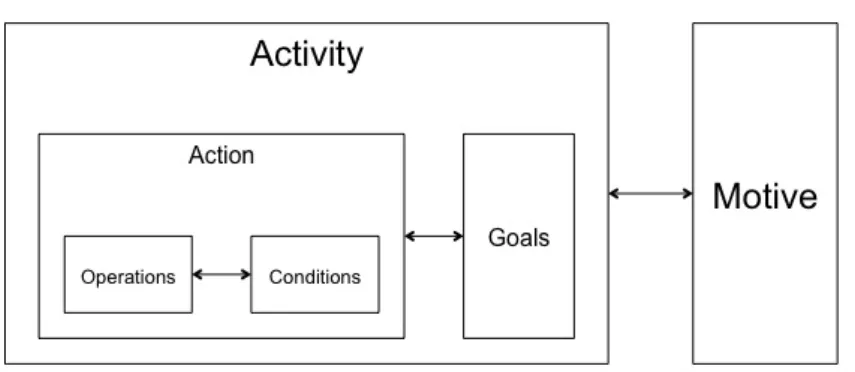
Adopting activity theory and Leontiev’s structural elements of activity theory, in par-ticular, organised my data and invigorated my data analysis. Thus activity theory was an analytical toolin my research (Simon, 2009). The three hierarchical levels of activity-motive, actions-goals and operations-conditions were suitable for ‘framing’, and explaining the lecturer’s teaching practice. My methodological choice of using activity theory as an analytical tool arose out of my data analysis, that is my observations and interpretations of the data sources. I give a rigorous account of this analysis in Chapter 5.
I used activity theory as a theoretical lens (Simon, 2009) in furthering the research process. I analysed the teaching of three particular mathematical concepts, namely sub-spaces, linear independence, and eigenvalues and eigenvectors (see Chapter 6). Findings from this analysis were used to answer the research question 3 above, and contributed to my synthesis in Chapter 8.
3.2
The design of my study
A research question drives the research and the inquiry process (Bassey, 1999). A research design, on the other hand, is a plan for getting from here to there, from a set of initial questions to a set of conclusions (Yin, 2003).
The purpose of conducting my research was to explore and to understand, and, follow-ing analyses, to be able to explain and, if applicable, raise issues in relation to the teaching (and learning) of linear algebra. To pursue my research I had formulated re-search questions that were of an explorative nature. To gain understandings of issues I, in collaboration with my supervisor, worked closely with a lecturer of mathematics, gathering data in interviews and in conversations with the lecturer and observing his teaching. The context and natural setting of the teaching and learning environment were important as well as maintaining a prolonged contact with the lecturer.
Thus my methodology could be described in three ways. Firstly, my research was a
case study as I studied a single case, that is, one lecturer’s teaching of linear algebra to first year undergraduates. Secondly, my research was anaturalistic inquiry. In the tradition of a naturalistic inquiry, researchers are‘doing what comes naturally’ (Lincoln and Guba, 1985, p. 187). To explore the lecturer’s didactical thinking involved inter-viewing as a means to gain ‘access to his thinking’ by my interpreting of what he said. To explore the lecturer’s face-to-face teaching involved entering and observing teaching in its natural setting or environment, that is the university mathematics lecture. Thirdly, my study wasethnographicin style. In an ethnographic study researchers seek to gain understandings “by entering into close and relatively prolonged interaction with people (. . . ) in their everyday lives, . . . ” (Hammersley, 1992). Methods commonly used in ethnographic studies are interviewing and participant observation (Eisenhart, 1988; Tedlock, 2000). As I said above we, the researchers, worked closely with the lecturer and had prolonged contact over one whole academic semester, a twelve week period. We used interviews and lecture observations as our main methods of data collection.
3.3
The research paradigm
To specify my research paradigm means to align myself with a community of researchers who share a common attitude towards research and the kind of knowledge that the research produces (see Carr and Kemmis, 1986, p. 72-75). A research paradigm also represents common assumptions that researchers hold in respect of the nature of the world that they investigate (see Romberg, 1992, p. 54).
21
I situated myself in an interpretive paradigm. An interpretive paradigm is compat-ible with an exploratory case study design and ethnographic and naturalistic research methodologies. As with all paradigms the interpretive paradigm has a set of under-lying assumptions concerning the nature of knowledge (ontology) and the origin of knowledge (epistemology). Denzin (1978) described the components of an interpretive paradigm as follows:
The social world of human beings is not made up of objects that have in-trinsic meaning. The meaning of objects lies in the actions that human beings take towards them. . . . Social reality as it is sensed, known, and un-derstood is a social production. Interacting individuals produce and define their own definitions of situations [and] the process of defining situations is everchanging. . . . Second, humans are . . . capable of . . . shaping and guiding their own behaviour and that of others [intentionally and unintentionally, and] humans learn . . . the definitions they attach to social objects through interactions with others. (Denzin, 1978, p. 7, cited in Eisenhart, 1988)
Thus in the interpretive paradigm the meaning that humans assign to their actions is the focus of research. Human actions are seen as social in origin and changing, as the context in which an action is carried out changes. In interactions meanings are negotiated, meanings that are liable to change and develop as the social context in which the interactions took place change and develop.
Making interpretationsof the actions of others (and one’s own) is at the heart of research within an interpretive paradigm. This raises the issue as Smetherham (1978) wrote, “that any particular set of meaning structures . . . will not necessarily be symmetrically shared either as between the researcher and respondent, nor yet between their words and actions” (ibid., p. 98).
As an interpretive researcher my aim was to explore and to observe, in order to explain
and tounderstand. I was not motivated by a search for a “truth” that could be applied to other cases or situations. The notion of “truth” implies anunderstandingthat reflects an account of a ‘single’ reality independent of the interpretations of the researcher or the participants in the study. In an interpretive paradigm multiple realities are taken to exist since the very basis of interpretive research is to explore the meanings that individuals assign to their actions. The context is implicated in the interpretations that are offered by the participant, that is in my study by the lecturer of linear algebra, as well as the interpretations that I, the researcher, made in relation to what I observed, recorded, ‘heard’ and analysed. Hence social aspects and context are contributory factors in the interpretations that both the lecturer and I made. This aspect is reflected in the notion
of intersubjectivity (see Eisenhart, 1988). Intersubjective meanings are implicit in the practices we engage in. We can come to understand each other’s interpretations only if there is a sense of shared practice, a consensus, and an acceptance of rules of engagement, for example. As Jaworski (1997) wrote,
The term intersubjectivity has been used . . . to capture a sense of common knowledge arising from group negotiation in sharing and comparing inter-pretations. Shared meanings . . . [are] central to an epistemology of the social construction of . . . knowledge. (Jaworski, 1997, p. 118)
In my study we, the researchers and the lecturer of linear algebra, engaged in negotiating meanings arising from conversations in research meetings and observations in lectures. The shared practice may be regarded as the mathematics lecture embedded in the culture of a university mathematics department to which the researchers, the lecturer and the students belonged.
Because, as Eisenhart (1988) wrote, intersubjective meanings are implicit, “the ways in which beliefs and actions make sense may only be accessible to insiders” (ibid., p. 103). Engaging in meaning-making and sharing practices implied that I, the researcher, could not stay outside the research process, and take the role of neutral observer. I was involved in communication and interactions with the lecturer, making sense of actions and hence party to the construction of knowledge. Maxwell wrote,
As observers and interpreters of the world, we are inextricably part of it; we cannot step outside our own experience to obtain some observer-independent account of what we experience. (Maxwell, 1992, p. 283)
Contexts change as a result of interactions, and so do meanings. Hence within an interpretive paradigm a study cannot be repeated and the same result obtained twice. The notion of replicability as a means of validation does not apply. That results cannot be generalised or replicated is one of the main criticisms of research within this paradigm. A second criticism relates to the assertion that results based on subjective interpretations are ‘no more than opinion’. These are criticisms levied at those engaged in exploratory case studies, ethnographic and naturalistic inquiries, and qualitative research in general. However, the question of validity is a ‘valid’ one. As Stenhouse (1984) wrote,
I define research as systematic enquiry made public. (Stenhouse, 1984, p. 77)
23
That is, research has to be made available, and accessible, in order to be approved by the ‘critical community’ (i.e. other academics in the field) and/or confirmed by the participants in the research (Carr and Kemmis, 1986, p. 91)
Lincoln and Guba (1985) argued for alternative criteria to address the ‘validity’ in qual-itative research, criteria that could take account of the nature of a qualqual-itative study. Bryman (2004, p. 273) cites Lincoln and Guba (1985) and Guba and Lincoln (1994) as proposing the criteria oftrustworthinessandauthenticityin place of generalisability and validity (where generalisability and validity are criteria that are commonly applied in empirical studies).
Trustworthiness refers to providing ‘enough evidence’ for the reader to have ‘trust’ or ’confidence’ in the inquiry, its methods, interpretations and findings. It requires the researcher to provide a detailed account of all sources that informed on analyses and interpretations, any limitations or difficulties experienced in data collection and analysis, say. The aim is for the reader to be able to build a complete picture of the research process, and to judge and ‘trust’ its findings. In respect of trustworthiness Lincoln and Guba (1985) proposed four elements that make up the criteria of trustworthiness:
credibility, dependability, confirmability andtransfer.
Authenticityrefers to authentic (i.e. truthful) and rigorous inquiry which includes the notion offairness whereby all contextual factors and all views expressed by participants should be made apparent. Authenticity also refers to the wider impact of research in relation to findings, its ‘merit’ or “truth value” (see Lincoln and Guba, 1985; Miles and Huberman, 1994). Since my study includes descriptive elements, others need to be sure that the account I give isauthentic, and includes all aspects of the context that framed the teaching practice. Questions to be answered relate to, ‘Do findings make sense and give a fair and accurate (in the sense of truthful and authentic) account of the overall study?’
Next I present my methods and methodological choices in respect of data collection and analysis. I present a detailed account with the aim of increasing confidence in my data collection and analysis. This is not to say that another researcher would have done the same as me or arrived at the same conclusions that I have, for the other person would have come with different perspectives, different questions and made different interpretations.