Comprehensive Guidelines
for
Food Recovery Programs
******************************************************************************* Developed by the Food Recovery Committee 2000 Conference for Food Protection / Council I FINAL October 3, 2000 Updated January 2004 Updated April 2006 Updated March 2007
1
TABLE of CONTENTS
About These Guidelines ... 2
Definitions ... 3
Introduction to Food Recovery... 6
Food Recovery Activities ... 6
Legal Issues... 9
Implementing a Food Recovery Program ... 10
Food Safety Procedures ... 12
Food Rescue Program Responsibilities ... 33
Guidelines for Monitoring Programs ... 34
Handling Donations of Game Animals ... 34
Planning for Food Defense ... 38
Preventive or Mitigation Strategies:... 39
APPENDIX A ... 43
Guidance Charts for Assessment of Food on Receipt ... 43
APPENDIX B ... 47
Forms to Simplify Record Keeping ... 47
APPENDIX C ... 61
Forms for Reporting Food Worker or Volunteer Illness or Symptoms ... 61
APPENDIX D ... 78
Emergency Point of Contact:... 78
REFERENCES ... 80
Publications ... 80
Web Sites ... 80
Food Defense Resources... 80
About These Guidelines
Over the years, various inquires received from regulators and others about safe food management and preparation practices in food recovery operations prompted the United States Department of Agriculture (USDA) and Food and Drug Administration (FDA) to enter into a joint project in 19971998 to develop guidelines for food recovery programs. The resulting document was presented to the 1998 Conference for Food Protection (CFP) for acceptance by Conference stakeholders (industry, consumers, academia, and federal/state/local food safety regulators). Under the auspices of Council l (its laws and regulations advisory group), the 1998 CFP formed a Food Recovery Committee to work with FDA and USDA to fully develop the food recovery guidelines.
The CFP Food Recovery Committee is composed of members of the retail and food service industry, hunger relief organizations, and federal, State, and local regulatory agencies.
The CFP Food Recovery Committee used the USDA/FDA guideline and documents from America’s Second Harvest as a base and this comprehensive guideline is the result of the Committee’s efforts to fulfill its charge. Upon acceptance by the 2000 CFP, the guideline was proposed to become an annex to the FDA Food Code.
A short description of the Guidelines can be found in the 2005 FDA Food Code in
Annex 2, References, under 3. Supporting Documents, M. Comprehensive Guidelines
3
Definitions
Active Managerial Control means the purposeful incorporation of specific actions or procedures by industry management into the operation of their business to attain control over foodborne illness risk factors. Approved Source means an acceptable supplier to the regulatory authority based on a determination of conformity with principles, practices, and generally recognizedstandards that protect public health.
Critical Control Point means a point or procedure in a specific food system where loss
of control may result in an unacceptable health risk.
Excess Food means any extra wholesome, edible food, including food that was
prepared for service, but not served or sold.
Field gleaning (gleaning) means the collection of crops from fields that have already been mechanically harvested or on fields where it is not economically profitable to
harvest.
Food defense is the collective term used by the Food and Drug Administration (FDA), United States Department of Agriculture (USDA), Department of Homeland Security (DHS), etc, to encompass activities associated with protecting the nation’s food supply from deliberate or intentional acts of contamination or tampering. This term
encompasses other similar verbiage (i.e., bioterrorism,(BT), counterterrorism (CT) etc.)
Food Distribution Organization (FDO) means the organization that accepts donated food and directly distributes it to needy consumers or, in some cases, distributes donated food to another facility (receiving facility) which will then directly distribute it to
the consumer. This FDO and the receiving facility may be one and the same.
Food Recovery means the collection of wholesome food for distribution to people in
need; sometimes referred to as food rescue.
HACCP is an acronym that stands for Hazard Analysis and Critical Control Point, a preventionbased food safety management system. HACCP systems are designed to prevent the occurrence of potential food safety problems. HACCP Plan means a written document that delineates the formal procedures for following the Hazard Analysis Critical Control Point principles developed by the National Advisory Committee on
Microbiological Criteria for Foods.
Hazard means a biological, chemical, or physical property that may cause an
unacceptable consumer health risk.
from grocery stores, produce distributors, food distributors, etc.
Prepared foods are foods of all descriptions that have been prepared but were never served. This includes cooked items, such as meats, entrees, vegetables, starches, deli
trays, and vegetable trays, for example.
Potentially Hazardous Food (Time/Temperature Control for Safety (TCS) Food). (1) "Potentially hazardous food (time/temperature control for safety (TCS) food)" means a FOOD that requires time/temperature control for safety (TCS) to
limit pathogenic microorganism growth or toxin formation. Most, but not all perishable food and prepared foods are PHF/TCS food.
(2) "Potentially hazardous food (time/temperature control for safety (TCS) food)" includes:
(a) An animal FOOD that is raw or heattreated; a plant FOOD that is heat
treated or consists of raw seed sprouts, cut melons, or garlicinoil mixtures that are not modified in a way that results in mixtures that do not support pathogenic microorganism growth or toxin formation; and
(b) Except as specified in Subparagraph (3)(d) of this definition, a food
that because of the interaction of its water activity (AW) and PH values is designated as
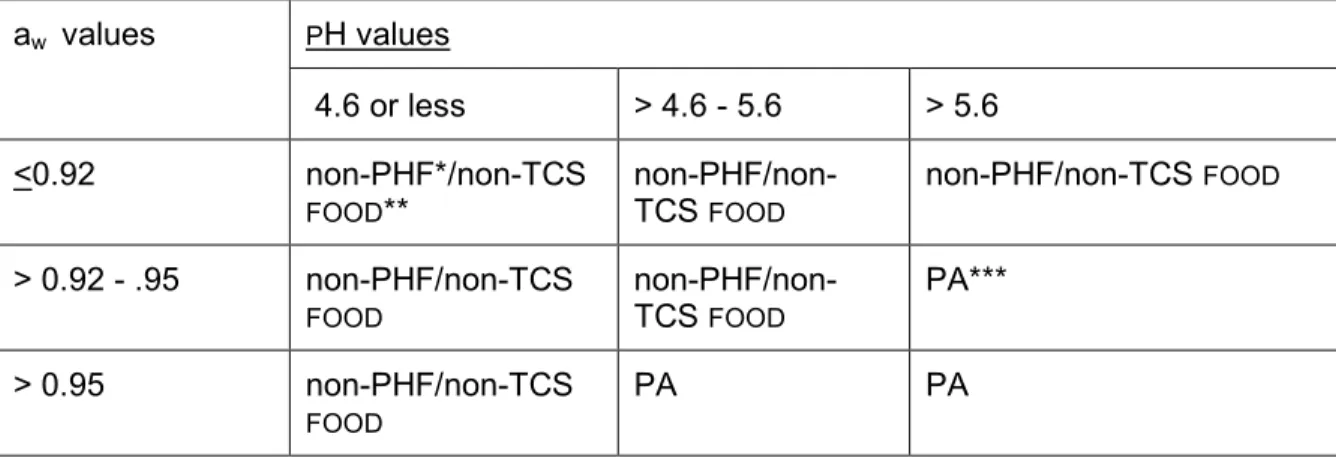
Product Assessment Required (PA) in Tables A and B from the FDA Food Code and provided at the end of the Food Safety Procedures section. 1
(3) "Potentially hazardous food (time/temperature control for safety food)" does not include:
(a) An aircooled hardboiled EGG with shell intact, or an EGG with shell
intact that is not hardboiled, but has been pasteurized to destroy all viable salmonellae;
(b) A FOOD in an unopened HERMETICALLY SEALED CONTAINER that is commercially processed to achieve and maintain commercial sterility under conditions of nonrefrigerated storage and distribution;
(c) A FOOD that because of its PH or AW value, or interaction of AW and PH
values, is designated as a nonPHF/nonTCS FOOD in Table A or B of this
definition;
1 As referenced in the 2005 Food Code, Paragraph 1201.10(B) definition of Potentially Hazardous Food (Time/Temperature Control for Safety Food 2005. U.S. Department of Health and Human Services, Public Health Service, Food and Drug Administration. 2005. Available at http://www.cfsan.fda.gov/~dms/fc05toc.html
5
(d) A FOOD that is designated as Product Assessment Required (PA) in
Table A or B of the Food Code definition and has undergone a Product Assessment showing that the growth or toxin formation of pathogenic microorganisms that are reasonably likely to occur in that FOOD Is precluded
due to:
(i) Intrinsic factors including added or natural characteristics of the FOOD
such as preservatives, antimicrobials, humectants, acidulants, or nutrients,
(ii) Extrinsic factors including environmental or operational factors that affect the FOOD such as packaging, modified atmosphere such as REDUCED OXYGEN PACKAGING, shelf life and use, or temperature range of
storage and use, or
(iii) A combination of intrinsic and extrinsic factors; or
(e) A FOOD that does not support the growth or toxin formation of pathogenic microorganisms in accordance with one of the Subparagraphs (3)(a) (3)(d) of this definition even though the FOOD may contain a pathogenic microorganism or chemical or physical contaminant at a level sufficient to cause illness or injury.
Receiving facility means the organization that accepts donated food and directly
distributes it to the consumer.
Reclamation Centers are centers operated by retail supermarket chains or wholesale distributors which collect product that will not be sold through the company’s normal distribution channels. This may include damaged product or discontinued items being
claimed for credit from the vendor/manufacturer.
Salvage, as a verb, means the act of saving any imperiled property from loss. As a noun, it means the property so saved. Food items may have been subjected to possible damage due to transportation accident, fire, flood, adverse weather, or any other similar cause, which may have rendered the food unsafe or unsuitable for human consumption. As used by food banks, the definition of salvage includes those products processed through reclamation centers. Salvaging involves evaluating the product to determine its fitness for human consumption, reconditioning it if necessary, in order to place the food back into the distribution system.
Introduction to Food Recovery
In recent years, there has been growing concern about hunger, resource conservation, and the environmental and economic costs associated with food waste. This, in turn, has accelerated public and private efforts to make better use of available food supplies by recovering safe and nutritious food that would otherwise be wasted.
A July 1997 study by the U.S. Department of Agriculture estimates that over one quarter of all food produced in this country is wasted. The study found that about 96 billion pounds were lost at the retail, food service, and consumer levels. If 5 percent of the 96 billion pounds were recovered, that quantity would feed 4 million people each day for a year.
Food recovery programs collect foods from commercial production and distribution channels and redistribute them to people in need. Prepared and processed foods are most often collected from the food service industry. Perishable produce is generally obtained from wholesale and retail sources. There are food recovery efforts carried out by public, private, and nonprofit organizations across the country. The primary goal of food recovery programs is to collect safe and wholesome food donated from commercial sources to meet the nutritional needs of the hungry.
Food recovery is one way to help reduce the problem of hunger in America. Participating in a successful food recovery program has benefits that extend beyond providing food to those who are in need. Participation benefits an establishment’s operation, its customers, its employees, and the community. It increases the visibility of a business, and helps build a more cohesive local community.
This document is intended primarily to provide guidance to retaillevel food operators that want to participate in food recovery programs and provide safe food to people in
need.
Food Recovery Activities
USDA Food Recovery Activities
In September 1997, the U.S. Department of Agriculture (USDA) joined with key non profit organizations to sponsor the first ever National Summit on Food Recovery and Gleaning, which set a goal of a 33 percent increase in the amount of food recovered nationally by the year 2000. This would provide an additional 500 million pounds of food a year to feeding organizations. The Secretary of Agriculture is Chair of the interagency working group on Food Recovery to Help the Hungry. The purpose of the working group is to fulfill the President’s directive to all Federal agencies to donate excess food to the extent practicable.
7
The USDA is working with a variety of partners to increase the amount of food
recovered to help feed the hungry. In 1996, the Department published A Citizen’s
Guide to Food Recovery (revised in 1997) and worked with the National Restaurant Association to publish a food recovery guide for restaurants. The USDA’s Cooperative State Research, Education, and Extension Service, in partnership with the Cooperative Extension System, helps agencies and community groups establish local hunger programs, administer food recovery programs, and coordinate gleaning programs. USDA has sponsored a number of food recovery activities of the AmeriCorps National Service Program, which allows volunteers to trade community service for educational awards. The Department also donates food from its Washington, D.C. headquarters to a local food recovery group, and has entered into partnerships with corporations to
promote national food recovery efforts.
Ongoing Food Recovery Activities
In the United States, it is estimated that there are 150,000 private programs helping to feed the hungry. Each program is distinct in terms of its size, organization, management, and clientele. Some programs are run by a small group of volunteers in a small facility. Other programs are larger organizations with paid staff and stateof
theart facilities. Following are some of the organizations involved in food recovery:
America’s Second Harvest – The Nation’s Food Bank Network
America’s Second Harvest was founded in 1979 and has grown to become the nation’s largest domestic hungerrelief organization. America’s Second Harvest is a national network of more than 200 regional food banks and foodrescue programs, serving all 50 states and Puerto Rico. This network distributes nearly 2.1 billion pounds (2005) of donated food and grocery products annually to approximately 50,000 local charitable agencies which operate more than 94,000 food programs, including food pantries, soup kitchens, women’s shelters, Kids Cafes, Community Kitchens, and other programs that
provide food assistance to 26 million hungry Americans.
The Chef and Child Foundation
The Chef and Child Foundation is the charitable arm of the American Culinary Foundation. Established in 1989, the Foundation’s threepart mission includes an awareness campaign every October around Childhood Hunger Day, an education program that brings nutrition information to children from preschool to fifth grade, and a
training program called Understanding Prepared Foods that educates those involved in
food rescue about food safety issues. Congressional Hunger Center Congressmen Tony Hall and Bill Emerson started the nonprofit Congressional Hunger Center (CHC) in 1993 when Congress voted to end its own Select Committee on Hunger. The mission of the CHC is to find solutions to hunger by developing leaders. Through the national Mickey Leland Hunger Fellows Program, 20 individuals perform a
year of direct community service combined with helping to formulate public policy. Through the Beyond Food Program, the CHC trains AmeriCorps volunteers. The CHC also works with leaders at the international level to improve emergency relief efforts in disaster areas. National Hunger Clearinghouse The National Hunger Clearinghouse is a program of World Hunger Year under contract with USDA. Its major emphases are gleaning and food recovery and answering the USDA Food Recovery hotline: 1800GLEANIT. The tollfree hotline provides information on how to become a volunteer, donate food, or get involved in a local gleaning or food recovery program. The Clearinghouse also provides information on hunger, food, nutrition, and agriculture issues. The database already has over 20,000
organizations listed, from soup kitchens to restaurants.
National Restaurant Association
The National Restaurant Association fulfilled a pledge made at the National Summit on
Food Recovery and Gleaning with the publication in 1997 of Food Donation: A
Restaurateur’s Guide. This comprehensive handbook encourages restaurants to
recover and donate unused food.
Share Our Strength
The mission of Share Our Strength (SOS) is to work to alleviate and prevent hunger and poverty in the United States and around the world. The organization supports food assistance, treating malnutrition and other consequences of hunger, and promoting economic independence of people in need. Founded in 1984, SOS awards grants to more than 800 organizations annually. To meet its goals, SOS enlists industries and individuals to contribute their talents to its antihunger efforts and creates community
wealth to promote lasting change.
Society of St. Andrew
The Society of St. Andrew is a nonprofit organization that uses surplus produce to feed people in need. Since 1979, the Society has gleaned 200 million pounds of fresh fruits and vegetables that were distributed to feeding agencies throughout the United States. The produce is given to food banks, soup kitchens, and food pantries free of charge.
The Society has offices in Virginia, North Carolina, Texas, and Florida.
St. Mary’s Food Bank
In the United States, organized food recovery initiatives first gained recognition in the late 1960s. In 1967, John Van Hegel founded St. Mary’s Food Bank in Phoenix, Arizona. As word of its success spread, groups from all over the country visited the Arizona facility for insight and instruction. Today, St. Mary’s Food Bank is a member of America’s Second Harvest network and is now called St. Mary’s/Westside Food Bank Alliance. The food bank now serves the northern half of Arizona and serves over 800 agencies, providing food for families in crisis, the disabled, elderly, and homeless.
9
Legal Issues
The Emerson Good Samaritan Food Donation Act
When citizens volunteer their time and resources to help feed hungry people, they are rightfully concerned that they are putting themselves at legal risk. Fortunately, recent legislation provides uniform national protection to citizens, businesses, and nonprofit organizations that act in good faith to donate, recover, and distribute excess food. Although all states have enacted Good Samaritan laws, one very important consideration for food donors is the issue of food safety and quality. Potential food donors (e.g., restaurants, caterers, cafeterias, etc.) are more likely to enter into partnership with food recovery programs if there are assurances that program personnel are trained in safe handling and storage of donated foods. Therefore, program guidance and assurances that emergency food programs operate in accordance with recognized food safety standards help encourage businesses to donate food.
The Bill Emerson Good Samaritan Food Donation Act converts Title IV of the National and Community Service Act of 1990, known as the Model Good Samaritan Food Donation Act, into permanent law, within the Child Nutrition Act of 1966. Congress passed the legislation in late September, 1996, and President Clinton signed the bill into law on October 1, 1996. The Act is designed to encourage the donation of food and grocery products to nonprofit organizations such as homeless shelters, soup kitchens, and churches for distribution to individuals in need. The full text of the Act as well as the portions of the National and Community Service Act that it amends are
presented in Appendix C in A Citizen’s Guide to Food Recovery.
The Bill Emerson Good Samaritan Food Donation Act promotes food recovery by limiting the liability of donors to instances of gross negligence or intentional misconduct. The Act further states that, absent gross negligence or intentional misconduct, persons, gleaners, and nonprofit organizations shall not be subject to civil or criminal liability arising from the nature, age, packaging, or condition of wholesome food or fit grocery products received as donations. It also establishes basic nationwide uniform definitions pertaining to donation and distribution of nutritious foods and will help ensure that donated foods meet all quality and labeling standards of Federal, State, and local laws and regulations.
Although the Bill Emerson Good Samaritan Food Donation Act takes precedence over the various State Good Samaritan statutes, it may not entirely replace such statutes. As a Federal statute, the Emerson Act creates a uniform minimum level of protection from liability for donors and gleaners nationwide. However, State Good Samaritan statutes still may provide protection for donors and gleaners above and beyond that guaranteed in the Federal statute. Therefore, local organizations should be familiar
a listing of citations for State statutes).
Further details may also be obtained by contacting the office of the attorney general for the appropriate State. In addition, the Emerson Act does not alter or interfere with State or local health regulations or workers’ compensation laws. Local organizations in each State should also be familiar with the impact upon food recovery projects of State
or local health regulations and workers’ compensation laws.
Implementing a Food Recovery Program
There are many ways to contribute to food recovery programs including donating excess prepared foods, donating produce or canned and packaged goods, fund raising, training volunteer food workers, or providing transportation for food from donor to the food distribution organizations (FDOs).
Major aspects of implementing a food recovery program include: (1) choosing a suitable FDO and (2) donor and FDO agreement on the terms of their relationship. Advice on finding a partner to receive donated foods is available from a number of reliable sources. Among them, the United States Department of Agriculture (USDA), the lead federal agency for food recovery activities, America’s Second Harvest, a national network of communitybased, hungerrelief programs; and the National Restaurant Association. To lay the foundation for a successful partnership and to minimize misunderstandings, the donor and FDO need to plan their joint policies and procedures together. The initial planning meetings should cover at least the following topics: (1) exchange of basic data such as: · names of key contacts · addresses, phone and fax numbers · anticipated frequency of donations; (2) the types of foods to be donated, for example: · raw fruits and vegetables · cold fruit and vegetable salads · hot foods of animal origin, including mixed dishes like lasagna · cold cooked foods of animal origin · hot or cold cooked vegetables · gravies, creambased soups · hot or cold grain dishes · canned and packaged goods that are not potentially hazardous in their packaged form
11
· beverages, and
· cold or frozen uncooked foods of animal origin, such as raw ground beef;
(3) the food transport arrangements including:
· who will transport food from donor to FDO’s receiving facility
· the type of vehicle(s) to be used, temperatureholding equipment (e.g., insulated
containers, refrigerated unit)
· backup or transportation contingency plan in case of vehicle breakdown or
emergency
· distance in miles between the donor and the receiving facility
· anticipated time in minutes from the donor to receiving facility
· anticipated frequency of donations, and
· times/dates for pickup of donations;
(4) the qualifications of the food manager or personincharge in the donor and receiving facilities such as training and experience; (5) the training provided to staff on hygienic and safe food preparation, food defense procedures, storage, and transporting practices; (6) preferred time, means and frequency of communication; (7) how unsatisfactory situations will be addressed; and (8) any other considerations raised by either party.
Early in the planning process, both the donor and FDO operators should familiarize themselves and their staff with the Good Samaritan laws that limit liability to gross negligence and intentional misconduct. Food workers need to fully understand that food safety training, consistent practice of hygienic food preparation practices, and regulatory inspection reports showing favorable performance histories, are factors which help to protect the participants from civil and criminal liability in the good faith donation of apparently wholesome food. Good practices help to provide legal
protection for the donor and help ensure the service of safe food to consumers.
In Appendix B of this document, there is a guide (see Initial Meeting Form) to assist
the partners in systematically developing an implementation plan for a successful
endeavor. There is also a model form (see Agreement to Participate as Food
Recovery Partners form) for formalizing the agreement between the donor and food distribution organization.
Food Safety Procedures
Introduction
Serving safe food is an essential part of all food recovery activities. In the donor’s domain and in the food distribution organization, all steps need to be taken to ensure that the consumers of the recovered food are receiving a safe product. Certain basic principles of food safety must be incorporated into the program and followed by food workers to provide the consumers protection from foodborne illness.
Food that is directed to those in need is entitled to the same protective measures as that accorded food prepared and served to paying consumers. The national food standards at the retail level, as expressed in the FDA Food Code (Food Code), do not differentiate between the protection provided to food consumed by paying consumers and to food consumed by individuals who eat at FDOs.
The Food Code is an excellent reference for minimizing the occurrence of risk factors that contribute to foodborne illness. The standards expressed in the Food Code cover such subjects as: (1) manager or person in charge knowledge requirements; (2) monitoring the health of food workers; (3) food worker training and supervision; (4) protecting food from pathogens and contaminants from hands and other sources which cause foodborne diseases; (5) time and temperature requirements; and (6) equipment design and construction and maintenance.
Procedures outlined in this section are based on wellestablished food safety principles and are set forth as guidance for planning and conducting a food recovery program. The section is divided into six parts: Food Donation, Food Workers, Food Safety,
Equipment, Maintaining Food Safety during Transportation and Emergency Readiness.
Food Donation
Types of FoodsFoods donated in a food recovery program may include excess prepared food or produce, canned food, and shelfstable packaged goods. Excess food is any extra wholesome, edible food, including food that was prepared for service, but not served or sold. The charitable donation of food may result because a donor finds itself with an excess or because there is a conscious planning to have an excess in the daily or weekly volume of food. Restaurants, grocery stores, office food drives, or community food drives are possible donation sources.
13
Receiving and Storing Food: Evaluating the Condition of the Food
The personincharge who accepts the food on behalf of the FDO should check that the food is from an approved source (i.e., one that meets food safety standards, such as those outlined in this document and the Food Code) and that its condition is sound. Examining foods at the time of receipt can be invaluable in intercepting problems that can lead to food contamination, if undetected. Check for evidence of problems, such as the following, and take appropriate action to keep products from being received in an unsatisfactory condition, consumed, or contaminating other product (see Appendix A of this document for additional guidance):
(1) Environmental conditions of transport, e.g., the vehicle is not clean, pets in the
vehicle, evidence of insects or rodents, temperature controls not in use, ready toeat foods stored so they can be contaminated by raw foods, toxic compounds are transported in a way that can contaminate food;
(2) Cans that are dented in the top or side seams or are leaking or swollen; and
(3) Insect or rodent infested food e.g. droppings, gnawings, or nesting material.
Infested foods, foods that are obviously compromised, and foods of questionable safety, should either be discarded or isolated from wholesome foods until their disposition is determined. In either case, the goal is to keep other foods wholesome and safe and physically separated so they remain in that condition.
The protective measures for prepared foods and whole produce are different from the protective measures for canned food, and shelfstable packaged goods. With whole produce and prepared foods, attention should be focused on the packaging and condition of the food and the storage condition in terms of time and temperature. Cut produce such as melons and prepared foods, including cooked entrees and refrigerated foods, need to be kept at the cold or hot holding temperatures in the Food Code. (See the Food Preparation Practices section of this document). With canned food and shelfstable packaged goods, attention should be focused on the condition of the food container.
Once accepted, foods should be stored in a manner that protects them from potential contamination such as water drippage, dust, rodents, insects, and other sources of contamination. Canned goods should be organized to prevent damage to the cans and all foods should be organized to allow for proper rotation (i.e., FIFO First In/First Out). For information on acceptability of foods based on quality, see the Second Harvest’s Salvage Manual, which describes quality criteria for the inspection of foods.
Food Workers
Good Hygienic Practices: Basic Essentials
Handwashing is key to preventing the spread of disease. An infected food worker’s poor personal hygienic habits, followed by contact with food, can result in illness when the food is eaten. Good sanitation, hand washing, and no barehand contact with raw, readytoeat (RTE) food help to prevent disease transmission.
Food workers must wash their hands and exposed portions of their arms, including surrogate prosthetic devices for hands and arms using soap and running water, vigorously rubbing the hands together to be sure soap contacts all surfaces of the hands, and rinsing under clean, running warm water. Handwashing needs to occur for at least 20 seconds total, with at least 10 to 15 seconds devoted to vigorous rubbing of the hands and arms or surrogate prosthetic devices for hands and arms. Hands and exposed portions of the arms or surrogate prosthetic devices for hands and arms must be washed: immediately before beginning food preparation; during food preparation, as often as necessary to remove soil and contamination and to prevent cross contamination when changing tasks; after using the toilet room; and after engaging in other activities that contaminate the hands. Additional information on when to wash the
hands can be found in the Food Code, Chapter 2, Section 2301.14.
Food Safety
Foodborne IllnessFoodborne illness occurs as a result of exposure of an individual to pathogenic organisms after consuming food that has been contaminated or improperly prepared. CDC estimates more than 76 million cases of foodborne illness, 325,000
hospitalizations and 5,000 deaths occur annually from foodborne illness. 2 Most
foodborne illness is caused by viruses (47%) and bacteria (32%) of those where a cause could be identified and 65% of these outbreaks had an infected person handling food.
Food safety experts have identified five foodborne pathogens that are highly infective,
easily transmitted and cause very severe illness. The “Big 5” are Norovirus,
Salmonella Typhi, Shigella spp., Enterohemorrhagic or Shigatoxin producing E. coli
and Hepatitis A. Other foodborne pathogens such as Staphylococcus aureus, other
Salmonella spp., Clostridium botulinum, Clostridium perfringens, Bacillus cereus, and treptococcus pyogenes must also be considered.
2 Mead, P.S., Slutsker, L., Dietz, V., McCraig, L.F., Bresee, J.S., Shapiro, C., Griffin, P.M., Tauxe, R.V., 1999. Foodrelated Illness and Death in the United States. Emerg. Infect. Dis. Vol. 5, No. 5, in http://www.cdc.gov/ncidod/eid/vol5no5/mead.htm.
15
Foodborne bacteria (except bacterial spores) multiply in food, provided the appropriate nutrients are present. Viruses and parasites only multiply in human beings or animals. In the case of viruses, any type of food or surface can be the vehicle to transmit the virus.
Managing Ill Food Workers and Volunteers
More than 65% of the foodborne outbreaks in 2002 – 2003 in the United States identified ill food handlers as a contributing factor. The goal of a food distribution organization and its person’s in charge of food workers and volunteers should be to prevent the transmission of bacteria and viruses from infected food workers into food. Management, food workers, and volunteers have a responsibility to be aware of the causes of foodborne illness and what their responsibility is to prevent the transmission of bacteria and viruses that cause foodborne illness. The highest level of risk to consumers occurs when food workers and volunteers have specific symptoms (vomiting, diarrhea, jaundice) and they continue to work. Risk of transmission is still present if food workers and volunteers have been diagnosed with certain foodborne illnesses, but have recovered from these symptoms or never developed symptoms and also if food workers or employees / volunteers were recently exposed to specific pathogens.
The transmission of foodborne bacteria and viruses can be prevented only when a combination approach is used:
· Restrict or exclude ill food employees / volunteers from working with food,
· Use of good hand washing procedures whenever necessary, and
· Eliminate bare hand contact with readytoeat food.
Foodborne Illness Symptoms and Diagnoses:
Vomiting, diarrhea and jaundice serve as indicators that the individual may have a fecaloral route disease and is likely excreting high levels of the infectious agent through stool or vomit. In some cases, these symptoms are indications of other non infectious conditions such as Crohn’s Disease, early stages of pregnancy, irritable bowel syndrome or some liver diseases. The food worker or volunteer may continue working if they can show through a medical or other documentation that the symptom is
from a noninfectious condition.
Reporting
Management of the food establishment must make sure that all food workers and volunteers understand the importance of reporting certain conditions. A sample form to explain foodborne illness, specific symptoms, a physician’s diagnosis to one of the Big 5 is available (SEE Form 1A in Appendix C: Reporting Food Worker or Volunteer
16
Illness or Symptoms for a sample interview form for use when selecting staff). A food worker, whether a paid staff member or a volunteer, shares a responsibility for preventing foodborne illness and is obligated to report to the person in charge if they are suffering from the listed symptoms or have been diagnosed with or exposed to one of the Big 5 foodborne pathogens. (SEE Form 1B in Appendix C: Reporting Food Worker or Volunteer Illness or Symptoms for a sample Reporting Agreement). For example, if a food worker or volunteer has an infected cut, burn or boil on his/her hands and uses a double barrier, that is, a bandage and waterproof, single use gloves, the food worker or volunteer does not have to report the infected lesion to the person in charge. However, if the food worker or volunteer does not bandage it, reporting is required. If a food worker or volunteer reports an exposure or diagnosis of any Big 5 or symptoms described above, they should stop working directly with exposed foods; clean equipment, utensils, and linens; and unwrapped singleservice and singleuse articles until management determines whether they may work or not.
In some cases, food workers or volunteers should remain away from the establishment until they are no longer showing symptoms of vomiting, diarrhea, or jaundice for a 24 hour period or provides medical documentation that the food worker is free of an infection from one of the above listed pathogens or that symptoms result from a non infectious condition. Decision Trees 1 and 2 and Tables 1a, 1b, 2, 3, and 4 of Annex 3 in the 2005 Food Code provides information on when to exclude a food worker and when to restrict (limit) a food worker’s duties. (SEE Appendix C: Reporting Food Worker or Volunteer Illness or Symptoms).
Once the person in charge receives a report of diagnosis of one of the Big 5 or jaundice from a food worker or volunteer, this information must be reported to the Regulatory Authority, the health department, for example, either directly or through a headquarters office. At this time, management must determine what to do based on this report. An additional action the person in charge can take along with necessary restrictions and/or exclusions is to refresh all food worker’s and volunteer’s training about reporting symptoms, diagnosis or exposure to foodborne illnesses, good hand washing techniques and preventing bare hand contact with readytoeat food. Report Symptoms: 1. Vomiting 2. Diarrhea 3. Jaundice 4. Sore throat with fever 5. Exposed cuts or burns with pus Report “Big 5” Diagnosis: 1. Norovirus 2. Salmonella Typhi 3. Shigella spp. 4. Enterohemorrhagic or Shigatoxin producing Escherichia coli 5. Hepatitis A Report Exposure: 1. Consuming a food that caused illness in another consumer due to infection with one of the Big 5 2. Attending an event or working in a setting where there was a known foodborne outbreak 3. Having close contact with a household member who is
17
Millions of people contract some type of foodborne illness each year. Most cases are avoidable through the use of safe food preparation practices and proper sanitation
procedures.
Especially Vulnerable Populations
Facilities that serve highly susceptible populations such as hospitals, nursing homes, nursery schools, or senior citizen centers must take extra precautions because these individuals react more severely to foodborne pathogens. Typically these facilities will not receive donated foods because of the greater risk to the vulnerable populations that are served. But when children, the elderly and people with certain medical conditions live outside of a facility setting, they may be the recipients of donated food. While healthy people have a certain resistance to foodborne illness and may only experience mild to moderate symptoms, others who are more susceptible to foodborne illness, can have severe symptoms and complications, and may die.
Among those at increased risk for certain foodborne diseases and their severe manifestations are: older adults, pregnant women, young children, those with weakened immune systems (due to conditions such as AIDS, cancer, chemotherapy treatments, diabetes, or taking steroids), persons with reduced gastric acidity, and those with liver disease.
In food recovery receiving facilities that accept excess prepared food for service to especially vulnerable consumers, extra care must be taken by both parties to ensure the use of sound food safety practices during the continuum from preparation through transportation to receiving and service. Additionally, recovery programs should consider certain precautions noted in the Food Code such as use of pasteurized juice
and eggs or egg products that apply to highly susceptible populations.
Training of food workers or volunteers
Training of food workers and volunteers in the use of the following control measures will help prevent foodborne illness.
· Cook foods thoroughly, reaching proper cooking temperatures, for the required
amount of time to kill pathogens;
· Reheat refrigerated foods properly;
· Keep raw and readytoeat foods separated;
· Maintain personal cleanliness during food preparation, including hand washing
(See Food Code Chapter 2);
· Notify food workers of the requirements for maintaining good personal hygiene,
proper food preparation practices, and the need to report symptoms of vomiting, diarrhea, jaundice, sore throat with fever, infected wounds or pustular boils. And
· Maintain a clean establishment, particularly equipment, utensils, and all other
surfaces that come into contact with food, to prevent contamination of foods (See Chapter 4 of the Food Code).
Foodborne illness is mainly caused by bacteria, viruses, or parasites. Many foodborne illnesses are a result of bacteria, which are microorganisms or germs that occur either naturally in foods or are spread as a result of poor practices such as cross contaminating readytoeat foods or improper food worker hand contact during food
preparation.
Controlling Biological Hazards Bacteria
Bacteria are present everywhere in soil and air, on the surface of fruits and vegetables, and on and within all animal bodies. Only some bacteria are harmful, but those that cause foodborne illness can result in mild to severe illness, longterm health
consequences, or death. Salmonella, Shigella spp., Listeria monocytogenes, and E.
coli O157:H7 are some pathogenic bacteria that are transmissible through food.
Bacteria multiply when four factors come together to create the right conditions for growth:
(1) Nutrients (Food): foods that nourish bacterial growth, such as high protein foods, milk and dairy products, meat, fish, poultry, and cooked pasta.
(2) Moisture: moisture in foods that is available for bacterial growth. This can be moisture that is intrinsically present or that is added to the food (e.g., milk, water, or juice).
(3) Time: bacteria need time to reproduce. Some bacteria can double in number
approximately every 20 minutes under ideal conditions (room temperature). Remember that for some bacteria, very little growth or no growth is necessary to cause illness or to produce a toxin.
19
(4) Temperature: 41°F to 135°F is called the DANGER ZONE! It is within this temperature range that the life and growth of bacteria are supported. Avoid holding foods within this temperature range to prevent bacteria from growing to levels that can cause illness or produce a toxin.
Each of these four factors can be considered a link in a foodborne illness chain. Bacteria that are present everywhere, cannot always be eliminated. NUTRIENTS and MOISTURE are constant links in certain foods. TIME and TEMPERATURE are the weakest links and are controlled by the food worker. Food workers, including paid staff
and volunteers, who prepare food should know the DANGER ZONE! and remember it
during the storage, thawing, cooking, cooling, reheating and hot or cold holding for service of foods.
The Food Code’s Chapter 3 addresses time temperature relationships as a major intervention against foodborne illness. Consult this reference for more information on timetemperature requirements for food safety when cooking, cooling, or reheating foods.
Controlling Biological Hazards – Viruses and Parasites
Foodborne illness can also occur when a person eats food contaminated with certain viruses or parasites. It is important to understand that the mere presence of the virus or parasite in the food can cause illness when the food is ingested. Viruses can be added to food by infected workers with poor personal hygiene habits who have fecal material on their hands. Viruses, when in or on a food product, do not grow, but may remain in the contaminated food for a long period of time. Hepatitis A virus and Norovirus are viruses transmissible through food that are frequently transmitted by food workers who do not adequately wash their hands after using the toilet. Chapter 2 and Annex 3 of the Food Code provide guidance for controlling the spread of Hepatitis A virus and Norovirus from food workers. The fecaloral route of pathogens can be interrupted by good hand washing and not working when ill and by eliminating bare hand contact with readytoeat food.
Parasites do not reproduce as bacteria do, nor is there a need for them to multiply in order to cause illness. Parasites require a host that serves as a source of nutrition and
a place to live. Humans serve as hosts for parasites. Cyclospora is a parasite that can
be transmitted to humans from contaminated food or water.
Controlling Chemical and Physical Hazards
Some foods may contain objects from their production environment such as stones that also could cause injury. For example, foods (such as beans) may be contaminated naturally, from the soil in which they are grown or because of harvest, storage, or transportation practices. Other foods that have undergone further processing at times, despite best efforts, subsequently become contaminated with materials that could injure
consumers of the food. Therefore, operators need to be aware of the hazards associated with different foods and handling practices and take prudent precautions to minimize risks to food recipients.
Chemical hazards can also exist at various stages of food production, transportation, storage, and preparation. Chapter 7 of the Food Code outlines provisions that target
the control of poisonous or toxic compounds in retaillevel food operations.
Food Allergens as Food Safety Hazards
Recent studies* indicate that over 11 million Americans suffer from one or more food allergies. A food allergy is caused by a naturally occurring protein in a food or a food ingredient, which is referred to as an “allergen.” For unknown reasons, certain individuals produce immunoglobulin E (IgE) antibodies specifically directed to food allergens. When these sensitive individuals ingest sufficient concentrations of foods containing these allergens, the allergenic proteins interact with IgE antibodies and elicit an abnormal immune response. A food allergic response is commonly characterized by hives or other itchy rashes, nausea, abdominal pain, vomiting and/or diarrhea, wheezing, shortness of breath, and swelling of various parts of the body. In severe cases, anaphylactic shock and death may result.
Many foods, with or without identifiable allergens, have been reported to cause food allergies. However, FDA believes there is scientific consensus that the following foods can cause a serious allergic reaction in sensitive individuals; these foods account for 90% or more of all food allergies: · Milk · Egg · Fish (such as bass, flounder, or cod) · Crustacean shellfish (such as crab, lobster, or shrimp) · Tree nuts (such as almonds, pecans, or walnuts) · Wheat · Peanuts · Soybeans.
To control the chemical hazard of food allergens, use a rigorous sanitation regime to prevent cross contact between allergenic and nonallergenic ingredients.
Consumers with food allergies rely heavily on information contained on food labels to avoid food allergens. Each year, the FDA receives reports from consumers who have experienced an adverse reaction following exposure to a food allergen. Frequently, these reactions occur either because product labeling does not inform the consumer of the presence of the allergenic ingredient in the food or because of the crosscontact of
a food with an allergenic substance not intended as an ingredient of the food during
21 processing and preparation.
In August 2004, the Food Allergen Labeling and Consumer Protection Act (Public Law 108282, Title II) was enacted, which defines the term “major food allergen.” The
definition of “major food allergen” adopted for use in the Food Code 3 is consistent with
the definition in the new law. The following requirements are included in the new law:
· For foods labeled on or after January 1, 2006, food manufacturers must identify
in plain language on the label of the food any major food allergen used as an ingredient in the food, including a coloring, flavoring, or incidental additive.
· FDA is to conduct inspections to ensure that food facilities comply with practices
to reduce or eliminate crosscontact of a food with any major food allergens that are not intentional ingredients of the food.
· Within 18 months of the date of enactment of the new law (i.e., by February 2,
2006), FDA must submit a report to Congress that analyzes the results of its food inspection findings and addresses a number of specific issues related to the production, labeling, and recall of foods that contain an undeclared major food allergen. · Within 2 years of the date of enactment of the new law (i.e., by August 2, 2006), FDA must issue a proposed rule, and within 4 years of the date of enactment of the new law (i.e., by August 2, 2008), FDA must issue a final rule to define and permit the use of the term “glutenfree” on food labeling. · FDA is to work in cooperation with the Conference for Food Protection (CFP) to
pursue revision of the Food Code to provide guidelines for preparing allergen
free foods in food establishments.
Cross Contamination
Precautions must be taken to protect food from contamination and to maintain safe food practices during preparation, transportation, storage, and service. Cross contamination is the transfer of contaminants by way of foodtofood, foodtosurfacetofood, and by employees contacting both raw foods without proper hand washing or use of suitable utensils. For example, cross contamination may occur when raw readytoeat vegetables contact a cutting board that had raw chicken on it and was not cleaned and
sanitized between uses.
3
FDA Food Code paragraph1201.10(B) "Major food allergen"means: (a) Milk, EGG, fish (such as bass, flounder, cod, and including crustacean shellfish such as crab, lobster, or shrimp), tree nuts (such as almonds, pecans, or walnuts), wheat, peanuts, and soybeans; or (b) A FOOD
ingredient that contains protein derived from one of the major food allergens. “Major food allergen"does not include: (a)Any highly refined oil derived from a FOOD specified in Subparagraph (1)(a) of this definition and any ingredient derived from such highly refined oil; or(b)Any ingredient that is exempt under the petition or notification process specified in the Food Allergen Labeling and Consumer Protection Act of 2004 (Public Law 108282).
Precautions to prevent cross contamination include the following:
· Separate raw foods from readytoeat foods;
· Wash, rinse, and sanitize cutting boards and foodcontact surfaces at work stations
between uses when working with different foods, especially when changing from working with raw foods to readytoeat foods; and
· Separating food worker tasks to eliminate simultaneous work with raw and readyto
eat foods at the same time.
Keeping the Food Safe
All food establishments should strive to integrate food safety practices and active managerial control of critical steps of food preparation into their operations. For example, Hazard Analysis Critical Control Point (HACCP) is a preventive approach to minimizing the risks from food safety hazards and can be used to ensure safer food products for consumers. The Food Code sets forth parameters (such as time temperature requirements) demonstrated scientifically to control pathogenic hazards. Annex 4 of the 2005 Food Code discusses the process HACCP approach as well as controlling the introduction of chemical and physical hazards. These parameters provide a solid foundation for developing HACCP plans for individual operations.
Two FDA documents have been developed to assist both the operator and regulator of food service and retail establishments:
(1) Managing Food Safety: A Manual for the Voluntary Use of HACCP Principles for Operators of Food Service and Retail Establishments
The Operator’s Manual:
· provides operator’s of such establishments with a stepbystep scheme for
designing and voluntarily implementing food safety management systems based on HACCP principles.
and
(2) Managing Food Safety: A Regulator’s Manual for Applying HACCP Principles to Riskbased Retail and Food Service Inspections and Evaluating Voluntary Food Safety Management Systems
The Regulator’s Manual:
· provides regulatory authorities with a stepbystep scheme for conducting risk
based inspections based on HACCP principles to assist in assessing control of foodborne illness risk factors;
23
· details intervention strategies that can be developed with the operator to reduce
the occurrence of foodborne illness risk factors; and
· provides recommendations for evaluating voluntarily implemented food safety
management systems, if asked by industry.
All of these resources can assist food recovery programs.
A HACCP system requires the personincharge of the food recovery operation to objectively examine the flow of the food, from its receipt to service. This analysis can help the personincharge identify the points at which it is critical to impose control in order to keep the food safe. Assistance in applying HACCP principles to food recovery programs is available from regulatory agencies, academia, trade associations, and consultants. Most operations fall within these three categories: (1) Food process with NO COOK step (readytoeat food); (receivestoreprepareholdserve) Examples: fresh vegetables or fruits, tuna salad, coleslaw, sliced sandwich meats (2) Food preparation for SAME DAY SERVICE; (receivestorepreparecookholdserve)
Examples: Hamburgers, hot vegetables, cooked eggs, hot
entrees for “specialoftheday” (3) Complex Processes (foods prepared in large volume or for next day service); (receivestorepreparecookcoolreheathot holdserve) Examples: Soups, gravies, sauces, large roasts, chili, taco filling, egg rolls By tracking the flow of food, critical steps in a specific operation (e.g., cooking and cold holding) and potential cross contamination points can be identified. Once the facility identifies the points in its process where food can become contaminated, and where incoming foods that are assumed to be contaminated (such as raw, animalderived foods) must be time/temperature controlled, operational procedures and monitoring can be established.
Another facet in this proactive and preventive HACCPbased strategy is to anticipate failures in the food recovery program and to predetermine corrective actions. For example, what will occur if there is a power failure for an extended period of time or the transport vehicle breaks down? Applying HACCP principles would prompt the person incharge to consider the period of time involved in the power failure, the effect it may
have on product temperatures, and whether a reheat would suffice to render a
Food Preparation Practices
Thawing: Frozen foods need to be thawed according to the Food Code, which allows 4 ways to thaw:
(1) under refrigeration of 41°F or less (preferred method);
(2) submerged under running water 70°F;
(3) through the cooking process; or
(4) in a microwave as part of the cooking process.
Cooking: The cooking process is a critical step in controlling potential hazards associated with microorganisms. To kill microorganisms, all parts of the food must reach a sufficient internal food temperature and be held at that temperature for the specified time.
There are many timetemperature combinations that can constitute an adequate cook. The minimum cooking times and temperatures given below do not preclude other time temperature combinations from being used, provided microbial lethality is achieved in the final food product. For example, in cooking a beef roast, the level of pathogen
destruction achieved at 112 minutes after it reaches 130°F is the same as if it were
cooked for 4 minutes after it reaches 145°F. In this example, either combination is
acceptable and both are allowed in the Food Code. It is imperative to scientifically confirm that the chosen timetemperature combination results in a safe food.
For simplicity, the Food Code prescribes specific times and temperatures for certain foods. Those minimum internal food temperatures and times for holding at that
temperature are: 135°F: fruits and vegetables cooked for hot holding 145°F for 15 seconds: raw eggs that are prepared for immediate consumption; solid portions of fish or meat including pork, and commercially raised game animals 155°F for 15 seconds: hamburger and other comminuted meats, fish, and game animals such as deer, elk, and rabbit; ratites; injected
meats;
and pooled, unpasteurized eggs.
165°F for 15 seconds: wild game animals; poultry; baluts, stuffed fish, meat, pasta, poultry and ratites; stuffing containing fish,
25 Microwave cooking procedures are also outlined in the Food Code and specify that raw animal foods should be: · rotated or stirred throughout or midway of cooking to distribute heat through the food; · covered to help retain moisture; · heated to at least 165°F in all parts of the food; and · allowed to stand for 2 minutes after cooking to obtain temperature equilibrium.
The cooking equipment and methods must be adjusted to achieve the desired safe cooking temperatures internally in the final product. The person preparing the food needs to know the required cooking time and temperature and what practices, such as oven temperature and placement of the food within the cooking equipment, are necessary to bring the food to the required temperature. A temperature measuring
device should always be used to determine the internal food temperature.
Cooling Methods: Cooling foods from hot temperatures should be done as rapidly as possible and must not take more than 6 hours for all parts of the food to reach the required refrigeration temperature. The recommended time frames to achieve cooling
within this 6 hour window are: 2 hours to cool foods from 135°F to 70°F and within a
total of 6 hours to cool from 135°F to 41°F. Several methods of cooling are:
(1) Placing the food in shallow pans; (2) Separating the food into smaller or thinner portions; (3) Using rapid cooling equipment; (4) Stirring the food in a container placed in an ice water bath; (5) Using containers that facilitate heat transfer, e.g. a metal pan allows food to cool faster than a plastic container and (6) Adding ice as an ingredient.
Reheating: Cooked, cooled foods must be reheated to 165°F for 15 seconds minimum if the food is to be held for hot holding. Remember, all parts of the food being reheated
must reach this temperature.
Potentially Hazardous Food (Time/Temperature Control for Safety Food)
According to the 2005 Food Code, potentially hazardous food (PHF/TCS food) is defined in terms of whether or not it requires time/temperature control for safety to limit pathogen growth or toxin formation. The term does not include foods that do not support growth but may contain a pathogenic microorganism or chemical or physical food safety hazard at a level sufficient to cause foodborne illness or injury. The progressive growth of all foodborne pathogens is considered whether slow or rapid.
The definition of PHF/TCS food takes into consideration pH, water activity (aw), pH and