Research
Publication Date: 20 August 2007 ID Number: G00150273
© 2007 Gartner, Inc. and/or its Affiliates. All Rights Reserved. Reproduction and distribution of this publication in any form without prior written permission is forbidden. The information contained herein has been obtained from sources believed to be reliable. Gartner disclaims all warranties as to the accuracy, completeness or adequacy of such information. Although Gartner's research may discuss legal issues related to the information technology business, Gartner does not provide legal advice or services and its research should not be construed or used as such. Gartner shall have no liability for errors, omissions or inadequacies in the information contained herein or for interpretations thereof. The opinions expressed herein are subject to change without notice.
Magic Quadrant for Unified Communications, 2007
Bern Elliot
Unified communications offer the ability to improve how individuals, groups and companies interact and perform tasks. Companies should review how the new generation of communication systems can improve their business operations and processes.
Publication Date: 20 August 2007/ID Number: G00150273 Page 2 of 18 © 2007 Gartner, Inc. and/or its Affiliates. All Rights Reserved.
WHAT YOU NEED TO KNOW
Unified communications (UC) offer the ability to significantly improve how individuals, groups and companies interact and perform. UC enables multiple communication channels to be coordinated. In some cases, separate servers may be consolidated, but more frequently, UC adds value to existing communication servers. Key technologies include Internet Protocol (IP)-PBX, voice over IP (VoIP), presence, e-mail, audio and Web conferencing, videoconferencing, voice mail, unified messaging and instant messaging (IM).
Another key capability of UC is that it offers a method to integrate communication functions directly with business applications; Gartner calls this capability "communications-enabled business processes."
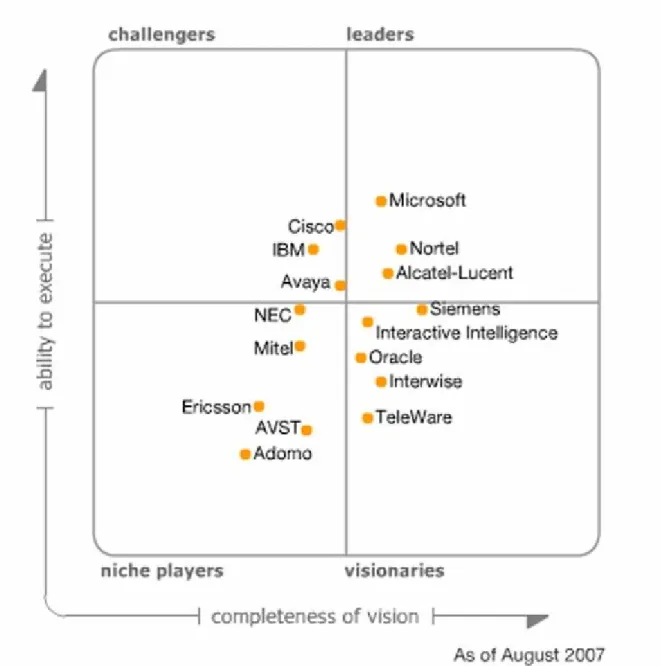
The largest single value of UC is its ability to reduce "human latency" in business processes. Although communication methods (such as voice or IM) can be used individually and separately, organizations should examine how bringing these methods together can increase synergies and efficiencies. To accomplish this, companies should review how individuals and groups use communications internally, then undertake pilots and trials that could lead to improved processes. This research reviews relevant technologies and vendor offerings that can assist in these goals (see Figure 1).
Publication Date: 20 August 2007/ID Number: G00150273 Page 3 of 18 © 2007 Gartner, Inc. and/or its Affiliates. All Rights Reserved.
MAGIC QUADRANT
Figure 1. Magic Quadrant for Unified Communications, 2007
Source: Gartner (August 2007)
Market Overview
The UC market and its technologies are maturing, but, overall, the market remains at an early stage of maturity, and the adoption of converged solutions remains slow. The slow adoption is the result of multiple technical and organizational issues, including:
Publication Date: 20 August 2007/ID Number: G00150273 Page 4 of 18 © 2007 Gartner, Inc. and/or its Affiliates. All Rights Reserved.
• Best practices around the use of UC are not well-defined or -developed.
• Many products are still at an early stage and lack functionality.
• Enterprises have large investments in existing communication infrastructures that must be preserved; this lead to a slower evolutionary approach, rather than to the faster, revolutionary "rip and replace" approach.
• Some applications and products can be complex to deploy.
• The business case frequently is based on a soft return on investment (ROI), such as productivity improvements, rather than on hard ROIs, such as cost savings.
Gartner expects many barriers to slowly be resolved and that, in 2008, UC will enter an early mainstream adoption phase globally. UC offers multiple capabilities and is useful in different ways, depending on the function and users supported. Gartner research (see "Discovering the Value of Unified Communications") suggests that enterprises define their business cases depending on the problems and audiences addressed. Some UC investments are justified in personal-productivity improvements; other investments are geared toward workgroup
improvements and should be justified at that level. Still other functions are geared toward broad enterprise workflow improvements and are justified at an enterprisewide-productivity level. UC solutions often appear to take one of three general approaches:
• One is to bundle most functionality tightly in a single solution; examples of this include Nortel's Multimedia Communication Server (MCS) 5100, Siemens' OpenScape, and Interactive Intelligence's Customer Interaction Center (CIC) products.
• A second approach is to take a broad portfolio of separate communication functions and tie them together through shared services, such as presence, administration and directories. Examples of this include Cisco and Microsoft solutions.
• A third approach is to offer a common communication framework, or middleware, that can be used by unrelated communication applications. IBM and Oracle are taking this approach.
Each approach has its strengths and weaknesses. The bundled approach makes it easier to offer a solution at a departmental or workgroup level, and is useful for pilots and trials, because the overall expense and commitment is low. The broad, established-portfolio approach is useful to companies that already have a strong commitment to a vendor, because this approach enables infrastructure investments to be leveraged. Finally, the framework approach is particularly effective when building a communication solution that fits into a broader Web-services or business-application environment.
Another important distinction among vendor solutions is the extent to which they are open to standards and to integration with third-party communication products. Some solutions are intended primarily to enhance and operate on their own IP-PBX or presence environments. Others clearly are intended to interoperate in multiple environments. Some solutions, such as those from AVST, are designed specifically as part of a broader portfolio.
However, there is no single-best approach, and no one vendor offers everything an enterprise needs for communications. Companies must make decisions by evaluating the emerging options based on current needs and how these options fit with the business' longer-term strategies. Because most enterprises will end up with communication solutions from multiple vendors, enterprises should ensure that the different products can interoperate.
Publication Date: 20 August 2007/ID Number: G00150273 Page 5 of 18 © 2007 Gartner, Inc. and/or its Affiliates. All Rights Reserved.
Market Definition/Description
UC is a direct result of the convergence of communications and applications. Differing forms of communications historically have been developed, marketed and sold as individual applications. In some cases, they even had separate networks and devices. The convergence of all
communications on IP networks and open software platforms enables a new UC paradigm and is changing how individuals, groups and organizations communicate.
Gartner defines UC products (equipment, software and services) as those that enhance individual, workgroup and organizational productivity by enabling and facilitating the control, management, integration and use of multiple enterprise communication methods. UC products achieve this through the convergence and integration of communication channels (that is, media), networks, systems and business applications, as well as through the consolidation of the controls over them. UC products may be made up of a stand-alone product suite or may be a portfolio of integrated applications and platforms.
UC products are used by employees to facilitate their personal communications, and by enterprises to support workgroup and collaborative communications. Products also may extend UC outside company boundaries to enhance communications among organizations, to support interactions among large public communities or for personal communications.
"A Framework for Unified Communications" provides a taxonomy for UC functionality. A useful way to understand the UC market is to view it in five communication product areas that are converging in the current generation of products:
1. One area comprises IP telephony and softphones, which are replacing the traditional PBX architecture.
2. Unified messaging is integrating voice mail with e-mail.
3. E-mail is evolving toward a more powerful desktop knowledge and contact management tool.
4. Separate voice, video and Web-conferencing capabilities are converging in various forms.
5. IM solutions are expanding their capabilities to incorporate presence for multiple communication methods (sometimes called rich presence) and have become an effective way from which to initiate differing forms of live conversations.
These five areas increasingly will be bundled into combined offerings. However, they also will continue to be offered as stand-alone products. In addition to these five UC product areas, Gartner has identified four emerging UC products.
1. General-purpose, communicator clients: These provide a common client for all communication functions, including voice, conferencing, presence, IM and, in some cases, e-mail.
2. Rich-presence services: As presence becomes more widely used, tools and pre-built integrations for federating and integrating presence information with location-based services (LBSs), radio frequency identification, network routers, mobile networks and other sources will be useful.
3. Intelligent assistants: These simplify and personalize contact routing, notification and access functions. They may provide limited administrative functions via phone or the Web.
Publication Date: 20 August 2007/ID Number: G00150273 Page 6 of 18 © 2007 Gartner, Inc. and/or its Affiliates. All Rights Reserved.
4. Notification services: These operate on multiple channels and have a wide range of uses. They can be personal and based on personal rules, or role-based (for example, a supervisor on call). They may have the ability to escalate, if no response is received, or to take action based on a response. As UC products mature and requirements are better-understood, new products are likely to appear.
Gartner's UC market model also defines four broader technology and market areas that are critically related to UC. These broader areas are contact centers, mobility (in various forms), business process integration and collaboration applications beyond Web conferencing. These broader areas are related to each product area defined above and to UC products. However, these four broader areas will remain markets in their own right and must be viewed as related but separate from UC.
Inclusion and Exclusion Criteria
To be included in this Magic Quadrant, solution providers must show all these capabilities:
• Significant market presence must occur in two or more core communication areas defined in Gartner's UC model.
• Market presence can be demonstrated in one of two ways — by significant market share or by differentiating innovation.
• Sufficient sales, revenue and operational presence must support market objectives.
• Providers must demonstrate enterprise premise UC portfolio/products with references.
• Vendor solutions must enable a complete portfolio, even if parts are offered via partnerships.
• There must be the ability to generate significant interest by leading client market segments.
Added
Interwise, AdomoDropped
NoneEvaluation Criteria
Ability to Execute
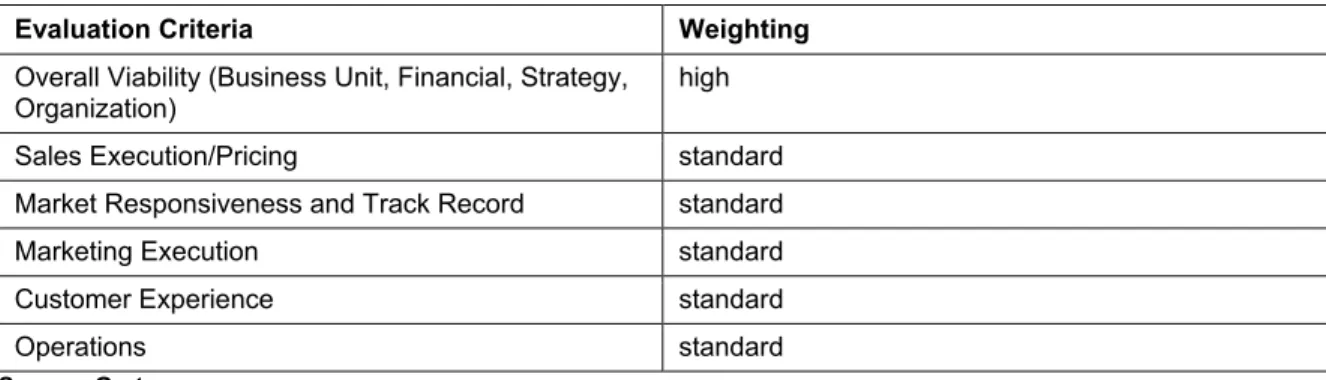
Gartner analysts evaluate UC product providers on the quality, efficacy and overall maturity of the products, systems, tools and procedures that enhance individual, group and enterprise
communications. Ultimately, UC providers are judged on their ability and success in capitalizing on their vision (see Table 1).
Table 1. Ability to Execute Evaluation Criteria
Evaluation Criteria Weighting
Publication Date: 20 August 2007/ID Number: G00150273 Page 7 of 18 © 2007 Gartner, Inc. and/or its Affiliates. All Rights Reserved.
Evaluation Criteria Weighting
Overall Viability (Business Unit, Financial, Strategy,
Organization) high
Sales Execution/Pricing standard Market Responsiveness and Track Record standard Marketing Execution standard Customer Experience standard
Operations standard
Source: Gartner
Completeness of Vision
Gartner analysts evaluate UC product providers on their ability to convincingly articulate logical statements about current and future market directions, innovations, customer needs and competitive forces, and how well these map to Gartner's overall understanding of the
marketplace. Ultimately, UC product providers are rated on their understanding of how market forces can be exploited to create opportunities for providers and their clients (see Table 2). Table 2. Completeness of Vision Evaluation Criteria
Evaluation Criteria Weighting
Market Understanding high Marketing Strategy standard Sales Strategy standard
Offering (Product) Strategy high Business Model standard
Vertical/Industry Strategy standard
Innovation standard Geographic Strategy standard
Source: Gartner
Leaders
The Leaders quadrant contains vendors selling comprehensive and integrated UC solutions that directly, or with well-defined partnerships, address the full range of market needs. These vendors have defined migration and evolution plans for their products in core UC areas and are using their solution sets to enter new clients into their client roster, and to expand their footprint in their existing client base in new function areas.
Challengers
Vendors in the Challengers quadrant offer solutions that are poised to move into leadership but have not yet done so. The reasons for this can include a solution set that covers most but not all UC functions, is full but not yet mature, or is not yet being delivered to a new client base or being adopted by new clients and is almost uniquely sold as an add-on to the installed client base.
Publication Date: 20 August 2007/ID Number: G00150273 Page 8 of 18 © 2007 Gartner, Inc. and/or its Affiliates. All Rights Reserved.
Visionaries
Vendors in the Visionaries quadrant demonstrate a clear understanding of the UC market and offer a strong and differentiating approach to one or more core areas. However, these vendors have limited ability to execute across the entire set of requirements, or have marketing and distribution limits to their ability to challenge established leaders.
Niche Players
Vendors in the Niche Players quadrant offer stand-alone components in several UC areas but do not have a comprehensive product; or they have a solution that will have limited market reach. Although these solutions often perform specific functions well, they do not represent a complete solution for the broader UC market.
Vendor Strengths and Cautions
Adomo
Strengths
• The Adomo solution provides a Linux appliance approach to unified messaging that uses Microsoft's Active Directory and Exchange servers for message storage. It does not require upgrading to Microsoft's Exchange 2007.
• Companies seeking a lower-cost, nondisruptive alternative to Microsoft UM, Cisco Unity and others should evaluate the Adomo solution.
Cautions
• Adomo is an emerging venture-backed vendor, currently with a direct distribution and support model.
Alcatel-Lucent
Strengths
• Alcatel-Lucent has a pragmatic strategy to leverage the strengths of Alcatel's current enterprise products, particularly OmniPCX and OmniTouch Unified Communication, with solutions that integrate with Lucent's and Alcatel's carrier communication products and installed bases.
• Alcatel-Lucent also has the ability to offer integrated solutions that span both carrier and enterprise environments, and will facilitate key capabilities, such as the seamless hand-over of fixed calls to Global System for Mobile Communications sessions and monitoring routing preferences across carrier and private networks.
• Enterprises that already have a commitment to Alcatel, or wish to leverage the technical abilities of the combined Alcatel-Lucent company, should evaluate the Omni family of products.
Cautions
• Alcatel-Lucent's ability to deliver solutions into the North American enterprise market is limited because the company is not well known and has limited distribution. It will need
Publication Date: 20 August 2007/ID Number: G00150273 Page 9 of 18 © 2007 Gartner, Inc. and/or its Affiliates. All Rights Reserved.
to prove that its strategy for entering this critical market and its ability to leverage Lucent's base will change its profile in the market.
• Technical and organizational challenges remain in integrating the two large vendors (Alcatel and Lucent), which came together in 2006 as a single company. In some cases, this has resulted in a lack of clarity for customers and channel partners, and in product direction. Failure to bridge the cultural, geographical and technical differences between these two former competitors risks reducing the company's ability to deliver effective solutions.
• The enterprise products group is now a small percentage of the company's overall revenue; thus, these products risk not receiving the focus needed to succeed.
Avaya
Strengths
• Experience and market presence in telephony, along with solid and widely deployed products (such as Communication Manager, Meeting Exchange and Modular
Messaging), provide a strong basis for Avaya's UC portfolio. This is combined with the company's marketing experience in delivering communication packages that match user needs, making Avaya's solutions easier to use, understand and deploy.
• Avaya has made promising acquisitions during the past two years — iSphere (now called Avaya Event Processor), Traverse Networks (provides mobile access) and Ubiquity (will provide Session Initiation Protocol solutions). Avaya has started to deploy these products to support business workflows but must advance their integration into the broader portfolio.
• Enterprises should evaluate the Avaya UC portfolio if they already have deployed Avaya infrastructure, or if they wish to leverage Avaya's enterprise telephony, conferencing, unified messaging and other contact center products.
Cautions
• Avaya has not been a leader in all emerging areas of UC but has focused instead on its strong telephony portfolio. The result is slower availability of some UC functionality.
• Avaya is in the process of privatizing via a merger with SilverLake Partners. Although Avaya indicates that there will be no significant change in direction, exercise caution until specific plans for products and markets are clarified.
• Avaya must simplify and clarify its next generation of communication solutions and must accelerate its rollout, or it will risk being left behind as the market evolves.
AVST
Strengths
• The CallExpress unified messaging solution operates with most leading IP and time division multiplexing (TDM) telephony switches and e-mail solutions. The NotifyExpress product supports multichannel notification options.
• Enterprises should evaluate this product if they are looking for a PBX-independent unified messaging solution that has an established record and a full set of features.
Publication Date: 20 August 2007/ID Number: G00150273 Page 10 of 18 © 2007 Gartner, Inc. and/or its Affiliates. All Rights Reserved.
Cautions
• The solution is focused primarily on unified messaging, notification and personal-assistant applications that interoperate with other UC components, so other providers will be needed to provide a full spectrum of UC functions.
Cisco
Strengths
• Cisco has a strong overall product portfolio, especially in two critical UC areas — live voice and conferencing. Its VoIP-related products, which are built around Unified Communications Manager, remain a particular strength for Cisco. Similarly, Unified MeetingPlace conferencing solutions, especially with the recent acquisition of WebEx and the release in 2007 of the TelePresence product, have resulted in strong solutions in this area. These will benefit from more integration across separate conferencing areas and with other portfolio components.
• Cisco has a strong channel program and global reach for data and voice
communications, coupled with good positioning with enterprise CTOs and IT personnel.
• Evaluate Cisco UC solutions if you have or plan to have Cisco for key voice and conferencing functions. However, ensure that interoperability with other vendors' communication functions will be possible.
Cautions
• Cisco's solutions are network-centric, rather than software-application-focused. This can create interdependencies between the network infrastructure and communication applications operating on the network, making it harder to integrate communications with business applications.
• Cisco must continue to expand its business application partnerships to meet the demand for vertical UC solutions and communication-enabled business applications.
• There is fragmented or unfocused product direction in certain areas, including
notification, intelligent assistance and rich presence. Other areas are strong but are not well-integrated as part of a unified solution, including Web conferencing and
TelePresence.
• Cisco relies heavily on communication infrastructure to define its value proposition, and this may make it difficult for Cisco to move to the software revenue model that UC requires.
Ericsson
Strengths
• As a leading provider of communication infrastructure to mobile operators, the Ericsson solution focuses on mobility and on a close integration between premises- and carrier-based solutions.
• Evaluate Ericsson Enterprise Multimedia and MX-ONE solutions if your organization seeks a mobile-focused product.
Publication Date: 20 August 2007/ID Number: G00150273 Page 11 of 18 © 2007 Gartner, Inc. and/or its Affiliates. All Rights Reserved.
Cautions
• Ericsson's solution creates dependencies on carrier-based, UC functions, which is useful for mobility but may reduce enterprise control and application integration options.
• The Ericsson approach is focused on telephony, both fixed and mobile, but it is limited in certain other UC areas, such as presence, IM and collaboration.
IBM
Strengths
• With its Unified Communications and Collaboration, or "UC2" portfolio, IBM has taken a clear strategy to coexist on the back end with multiple communication servers and business applications, while consolidating on the front end with a consistent user interface. In this way, IBM enables multiple vendor services to operate with its
middleware, making a broad range of servers available while allowing different types of clients to become consolidated with the Sametime client, or alternatively integrated via a common Eclipse client framework.
• IBM's extensive experience in delivering and enhancing business applications will assist the company in delivering communication as part of an application rather than as a stand-alone solution.
• The company has an extensive network of partners and the ability to deliver professional services.
• Enterprises should evaluate the UC2 solution if they already have IBM Lotus Notes and Sametime, or if IBM is a key business application partner and there are plans to advance with a WebSphere-based communication architecture.
Cautions
• The integration of telephony in IBM's portfolio will evolve throughout 2008 and 2009 as solution and partnerships mature.
• The adoption of the broader UC portfolio ties directly to the growth of Sametime and Lotus Notes. By our estimates, neither is growing seat share rapidly enough to
encourage widespread adoption, although Sametime does have a strong installed base.
• Customers should carefully review IBM's two approaches to UC and how they fit clients' needs. One approach focuses on a multivendor middleware communication solution, while the other is based on IBM's own communication application suite.
Interactive Intelligence
Strengths
• The Interactive Intelligence CIC all-in-one bundle is an integrated solution from a company that now has an established record for delivering successful products in this market.
• The flexible application program interface and architecture allow customization for vertical applications, while the all-in-one, comprehensive solution allows simpler deployment and operation.
Publication Date: 20 August 2007/ID Number: G00150273 Page 12 of 18 © 2007 Gartner, Inc. and/or its Affiliates. All Rights Reserved.
• Enterprises should evaluate the CIC solution when seeking a tightly coupled, all-in-one solution.
Cautions
• Although the company is profitable and financially secure, it has limited market reach and visibility, especially outside North America, and continues to have trouble establishing itself in a market dominated by behemoths.
• Interactive has limited experience working with corporate IT departments, because it has worked primarily with contact center and telecom groups in the past. This will reduce the company's effectiveness at delivering a broader UC product into enterprises.
• Interactive and its products have a strong focus on contact centers, resulting in terminology and marketing campaigns that can be confusing to those not familiar with the contact center. In several cases, its UC applications are simply repositioned contact center products.
Interwise
Strengths
• Interwise has complete and integrated conferencing (audio, video and Web) that can scale to the needs of large enterprises.
• The company provides seamless integration of TDM and VoIP audio that supports stand-alone voice conferencing and audio in Web meetings.
• An emerging, full UC suite is planned for Interwise Connect 8.0 that will allow tight integration of IP-PBX, softphone, IM, presence and unified-messaging-based functionality on supported, open-source software.
• Enterprises that are heavy conferencing users and are looking for an enterprisewide solution should evaluate the Interwise solution.
Cautions
• Interwise is less-known, private and of modest size. Its ability to perform sales, marketing and support is limited, as compared with larger competitors.
• The nonconferencing portions of the portfolio are new to the market and have a limited operating history.
Microsoft
Strengths
• Microsoft is a strong company with an ecosystem of partners that can deliver value-added products, professional services and wide distribution.
• The company has strategic partnerships in specific areas, such as live voice, and IP and PBX add credibility in these technology and service areas.
• Parts of IBM's UC portfolio are very mature (for instance, e-mail), and the overall portfolio is quite complete, with partnerships in weaker areas. The newer parts of the portfolio likely will get wide exposure throughout 2008 and will mature rapidly as a result.
Publication Date: 20 August 2007/ID Number: G00150273 Page 13 of 18 © 2007 Gartner, Inc. and/or its Affiliates. All Rights Reserved.
• An established base of desktop applications and experience in graphical user interface design will assist in making complex communication applications easier to use.
• Enterprises looking into UC, particularly those with Microsoft applications already in place, should understand the Microsoft portfolio because it represents a new paradigm for communication by a market leader. Microsoft's solution is comprehensive but is also the basis for a range of partner offerings.
Cautions
• The telephony functionality in OCS and in Exchange Server 2007 Unified Messaging is new to the market. Although these are promising products, telephony and other live communication functionalities, such as video, frequently take several years to mature to the desired levels of reliability, quality of voice service and scalability.
• Live communications, such as telephony and video, require solution integrators with different skills than are available from some current Microsoft channel partners. Users should ensure that their providers have demonstrated relevant experience in these areas, such as voice.
• Microsoft has massive market clout and is leveraging this effectively. However, overly optimistic marketing materials from Microsoft and its channel sometimes underestimate the challenges and difficulties involved in making live communication functions, such as video and VoIP, reliable and of high quality.
• Some new telephony functions, such as soft telephony and unified messaging, are available as mature products through other vendors.
Mitel
Strengths
• The Live Business Gateway product, which is available as a stand-alone or built into the Mitel 3300 switch, offers a tight integration with Microsoft OCS, while adding Mitel's softphone, telephony presence, mobility and conferencing. In non-Microsoft
environments, Mitel's Your Assistant provides OCS functions.
• Enterprises that already have a 3300 Mitel switch or are evaluating communication functionality to go with an OCS deployment should evaluate the Mitel UC solution.
Cautions
• The UC solution set is focused on enhancing the functionality of the 3300, so enterprises should expect this to become part of Mitel's solution.
• Mitel lacks presence in the large enterprise market and must modify its approach to successfully penetrate this segment.
NEC
Strengths
• NEC's OpenWorX Communications Portal provides Web access to NEC PBXs and IP PBXs, allowing individuals to manage communications from a single interface.
Publication Date: 20 August 2007/ID Number: G00150273 Page 14 of 18 © 2007 Gartner, Inc. and/or its Affiliates. All Rights Reserved.
• The Personal Call Assistant product enables the ability to manage the flow of calls. NEC offers several unified messaging solutions, some through partnerships. NEC also offers some limited conferencing functions. Enhanced functionality and additional Microsoft OCS integrations are planned.
• Enterprises that already have an NEC switch and want to expand communications to the desktop should consider this product.
Cautions
• Many nontelephony and newer functions, such as some included in the Univerge OW5000 product, are new to market and have had limited time to mature.
• NEC's dependence on indirect distribution may require it to develop UC specialists to support larger enterprises.
• NEC's solutions lack market awareness in certain key markets, such as North America and Europe.
Nortel
Strengths
• Nortel has a comprehensive UC solution built around the MCS 5100 and
Communication Server 1000 but has proved its ability to work as part of an integrated third-party environment, particularly with Microsoft Live Communications Server and OCS environments.
• The Nortel-Microsoft Innovative Communications Alliance provides tight integration among the complementary parts of their respective portfolios. The agreement provides Nortel with access to a new base of prospects and Microsoft with a strengthened telephony portfolio.
• Companies with Nortel deployments should include Nortel in UC evaluations.
Companies wishing to evaluate a Microsoft UC solution also should evaluate how Nortel fits into these plans and how it can enhance telephony functionality.
Cautions
• Past corporate financial problems have weakened Nortel's standing with channels and partners, as well as its overall market position.
• Although the Nortel-Microsoft ICA initiative offers advantages, it also can result in confusion about the boundary and responsibility split between these two companies and their products. The initiative also creates a mutual dependency, which at some point may be difficult (or expensive) to separate, should this become necessary.
Oracle
Strengths
• Oracle's solution is built from and leverages its established, widely deployed products: Oracle Service Delivery Platform (SDP), Oracle WebCenter and Oracle Collaboration Suite.
Publication Date: 20 August 2007/ID Number: G00150273 Page 15 of 18 © 2007 Gartner, Inc. and/or its Affiliates. All Rights Reserved.
• Oracle has significant market presence, is financially very secure, has a good vision in its Fusion Middleware and has a solid understanding of UC.
• Enterprises with a significant commitment to Oracle applications and that can accept the early stage of some functions and SDP-based telephony should evaluate the Oracle solution.
Cautions
• Although some individual components are mature, the overall solution is at an early stage, is fragmented and has not yet matured as a consolidated UC solution.
• Enterprise telephony and IM (SDP) are primarily hosted; however, premise solutions are available, although they are less deployed.
• Oracle's somewhat-disconnected approach and messaging around its communication products can result in confusion for enterprises evaluating Oracle solutions.
Siemens
Strengths
• The OpenScape product has been on the market for several years, is mature and offers a full UC feature set. The Siemens HiPath 8000 IP-PBX solution is standards-based, open and highly scalable. Additionally, the UC product has developed a strong
orientation toward communication-enabled business processes, enabling new types of business approaches to be developed.
• Key partnerships between OpenScape and vertical application providers create communication-enabled business processes.
• The integration of the HiPath 8000 and Microsoft's Office Communication Server 2007 (OCS) creates a tight overall solution for users of both.
• Evaluate the Siemens UC solution if you are looking for a full-featured and mature product in OpenScape, intend to integrate UC with business applications or wish to create a joint telephony and Microsoft OCS solution.
Cautions
• Lack of market awareness of the product, a limited marketing and sales program, and difficulty in developing a channel capable of handling this business-application-oriented product have its slowed adoption and acceptance.
• The lack of clarity regarding the parent corporation's plans for this communication subsidiary slows acceptance of its products.
TeleWare
Strengths
• The TeleWare intelligent Office suite is integrated with the original and useful concept of a Private Mobile Exchange. This approach eliminates the boundaries between mobile, carrier-based and enterprise-based communication infrastructures, resulting in seamless roaming in and out of buildings, while retaining enterprise control and a low-cost
Publication Date: 20 August 2007/ID Number: G00150273 Page 16 of 18 © 2007 Gartner, Inc. and/or its Affiliates. All Rights Reserved.
structure. Enterprises using this solution have fixed mobile convergence, one number and a presence directly through carrier and wireless enterprise networks.
• Large enterprises interested in understanding emerging communication paradigms and with a focus on Microsoft OCS can include TeleWare in their reviews.
Cautions
• Some TeleWare solutions require tight integration with a mobile operator, if the enterprise requires automatic control over mobile network selection. Network selection has certain customization requirements and to operate with a specific operator requires a customized subscriber identity module (SIM) card for the mobile phone.
• TeleWare has some key global accounts, but it has a limited market and technical presence outside the U.K.
RECOMMENDED READING
"A Framework for Unified Communications"
"Discovering the Value of Unified Communications" "Key Issues for Unified Communications"
"Q&A: How Universities Can Notify Students of a Crisis" "Three 'Killer' Business Communication Applications"
"Magic Quadrants and MarketScopes: How Gartner Evaluates Vendors Within a Market"
Vendors Added or Dropped
We review and adjust our inclusion criteria for Magic Quadrants and MarketScopes as markets change. As a result of these adjustments, the mix of vendors in any Magic Quadrant or
MarketScope may change over time. A vendor appearing in a Magic Quadrant or MarketScope one year and not the next does not necessarily indicate that we have changed our opinion of that vendor. This may be a reflection of a change in the market and, therefore, changed evaluation criteria, or a change of focus by a vendor.
Evaluation Criteria Definitions
Ability to Execute
Product/Service: Core goods and services offered by the vendor that compete in/serve the defined market. This includes current product/service capabilities, quality, feature sets, skills, and so on, whether offered natively or through OEM agreements/partnerships as defined in the market definition and detailed in the subcriteria.
Overall Viability (Business Unit, Financial, Strategy, Organization): Viability includes an assessment of the overall organization's financial health, the financial and practical success of the business unit, and the likelihood of the individual business unit to continue investing in the product, to continue offering the product and to advance the state of the art within the
Publication Date: 20 August 2007/ID Number: G00150273 Page 17 of 18 © 2007 Gartner, Inc. and/or its Affiliates. All Rights Reserved.
Sales Execution/Pricing: The vendor's capabilities in all pre-sales activities and the structure that supports them. This includes deal management, pricing and negotiation, pre-sales support and the overall effectiveness of the sales channel.
Market Responsiveness and Track Record: Ability to respond, change direction, be flexible and achieve competitive success as opportunities develop, competitors act, customer needs evolve and market dynamics change. This criterion also considers the vendor's history of responsiveness.
Marketing Execution: The clarity, quality, creativity and efficacy of programs designed to deliver the organization's message to influence the market, promote the brand and business, increase awareness of the products, and establish a positive identification with the product/brand and organization in the minds of buyers. This "mind share" can be driven by a combination of publicity, promotional, thought leadership, word-of-mouth and sales activities.
Customer Experience: Relationships, products and services/programs that enable clients to be successful with the products evaluated. Specifically, this includes the ways customers receive technical support or account support. This can also include ancillary tools, customer support programs (and the quality thereof), availability of user groups, service-level agreements, and so on
Operations: The ability of the organization to meet its goals and commitments. Factors include the quality of the organizational structure including skills, experiences, programs, systems and other vehicles that enable the organization to operate effectively and efficiently on an ongoing basis.
Completeness of Vision
Market Understanding: Ability of the vendor to understand buyers' wants and needs and to translate those into products and services. Vendors that show the highest degree of vision listen and understand buyers' wants and needs, and can shape or enhance those with their added vision.
Marketing Strategy: A clear, differentiated set of messages consistently communicated throughout the organization and externalized through the Web site, advertising, customer programs and positioning statements.
Sales Strategy: The strategy for selling product that uses the appropriate network of direct and indirect sales, marketing, service and communication affiliates that extend the scope and depth of market reach, skills, expertise, technologies, services and the customer base.
Offering (Product) Strategy: The vendor's approach to product development and delivery that emphasizes differentiation, functionality, methodology and feature set as they map to current and future requirements.
Business Model: The soundness and logic of the vendor's underlying business proposition. Vertical/Industry Strategy: The vendor's strategy to direct resources, skills and offerings to meet the specific needs of individual market segments, including verticals.
Innovation: Direct, related, complementary and synergistic layouts of resources, expertise or capital for investment, consolidation, defensive or pre-emptive purposes.
Geographic Strategy: The vendor's strategy to direct resources, skills and offerings to meet the specific needs of geographies outside the "home" or native geography, either directly or through partners, channels and subsidiaries as appropriate for that geography and market.
Publication Date: 20 August 2007/ID Number: G00150273 Page 18 of 18 © 2007 Gartner, Inc. and/or its Affiliates. All Rights Reserved.
REGIONAL HEADQUARTERS
Corporate Headquarters 56 Top Gallant Road Stamford, CT 06902-7700 U.S.A. +1 203 964 0096 European Headquarters Tamesis The Glanty Egham Surrey, TW20 9AW UNITED KINGDOM +44 1784 431611 Asia/Pacific Headquarters Gartner Australasia Pty. Ltd. Level 9, 141 Walker Street North Sydney
New South Wales 2060 AUSTRALIA +61 2 9459 4600 Japan Headquarters Gartner Japan Ltd. Aobadai Hills, 6F 7-7, Aobadai, 4-chome Meguro-ku, Tokyo 153-0042 JAPAN +81 3 3481 3670
Latin America Headquarters Gartner do Brazil
Av. das Nações Unidas, 12551 9° andar—World Trade Center 04578-903—São Paulo SP BRAZIL