• No results found

ICD-10 Procedure Coding System (ICD-10-PCS) RLM.MD ICD-10-PCS

N/A
N/A
Protected

Academic year: 2021

Share "ICD-10 Procedure Coding System (ICD-10-PCS) RLM.MD ICD-10-PCS"

Copied!
222
0
0

Loading.... (view fulltext now)

Full text

(1)

ICD-10 Procedure

Coding System

(2)

Development Background

CMS awarded a contract to 3M Health

Information Systems to develop a new

procedure coding system

The new system is intended to replace

ICD-9-CM Volume 3 for reporting

(3)

Development History

1995 - 1996:

First draft of ICD-10-PCS completed

1996 - 1997:

Training program developed

Informal testing conducted

ICD-10-PCS revised

1997 - 1998:

Independent formal testing conducted

ICD-10-PCS revised

Final draft completed

(4)

Major Development Goals

Improve accuracy and efficiency of coding

Reduce training effort

(5)

Essential Attributes

Completeness

All substantially different procedures have

a unique code

Expandability

The structure of the system allows

incorporation of new procedures as

unique codes

(6)

Essential Attributes

Standardized terminology

Includes definitions of the terminology used.

While the meaning of specific words can vary in

common usage, ICD-10-PCS defines a single

(7)

Essential Attributes

Multiaxial

The system has a multi-axial structure.

Each character has the same meaning

within a section and across sections to the

extent possible

(8)

General Principles

Diagnostic information is not included in

the code description

A ‘not elsewhere classified’ option is

allowed for new devices and substances

All substantially different procedures are

defined

(9)

General Principles

Limited NOS Option

A general body part, approach, or root

operation can be used when the level of

specificity required is not available in the

record or cannot otherwise be obtained

(10)

General Principles

Limited NOS Option

Body Part:

Example: “Liver” is used when the specific liver lobe is

not identified

Approach:

“Open”, “Percutaneous” and “Via Natural or Artificial

Opening”are used when a more specific type of

approach is not documented and cannot otherwise be

determined

Root Operation:

“Repair” is used when the procedure documentation

does not support a specific root operation and the

(11)

Code Structure

Codes are comprised of seven components.

Each component is called a “character”

All codes are seven characters long

Individual units for each character are

represented by a letter or number

Each unit is called a “value”

34 possible values for each character

Digits 0- 9

(12)

System Structure

16 Sections

Medical and Surgical

Obstetrics

Placement

Administration

Measurement and

Monitoring

Extracorporeal Assistance

and Performance

Extracorporeal Therapies

Osteopathic

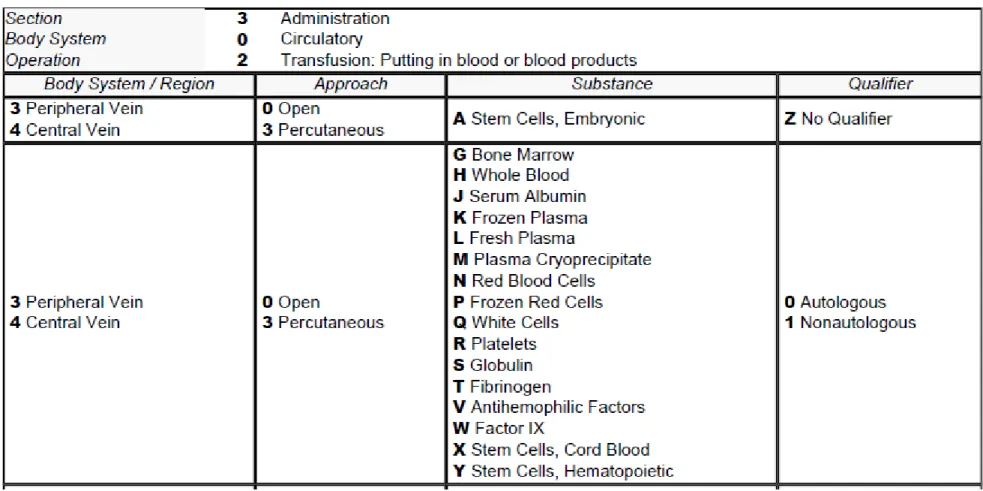
Other Procedures

Chiropractic

Imaging

Nuclear Medicine

Radiation Oncology

Physical Rehabilitation

and Diagnostic Audiology

Mental Health

Substance Abuse

Treatment

(13)

ICD-10-PCS Tables

Each table contains four columns and

varying numbers of rows

Column:

Specifies the allowable values for

characters 4-7

Row:

Specifies the valid combinations of

(14)
(15)

ICD-10-PCS Index

Provides the first three or four values of

the code

The tables must always be used to obtain

the complete code

(16)

Index Conventions

Main index term is a root operation, root

procedure type, or common procedure name

Examples

: Resection (root operation)

Fluoroscopy (root type)

Prostatectomy (common procedure name)

Secondary entries are underneath the main term

(17)

Index Entry by Body Part

Bypass

Aorta, Thoracic

021W

Aorta, Abdominal

0410

Artery, Axillary, Left

03160

Artery, Axillary, Right

03150

Artery, Brachial, Left

03180

Artery, Brachial, Right

03170

Artery, Common Carotid, Left

031J0

Artery, Common Carotid, Right

031H0

(18)

Medical and Surgical

Section

(19)

Medical and Surgical Section

Character Specification

1

st

Character = Section

2

nd

Character = Body System

3

rd

Character = Root Operation

4

th

Character = Body Part

5

th

Character = Approach

6

th

Character = Device

(20)

Medical and Surgical Section

Principles

The root operation is based on the

objective of the procedure

If multiple procedures as defined by distinct

objectives are performed, then multiple

(21)

Medical and Surgical Section

Principles

Root Operation

Value is consistent throughout the section

Approach

Value is consistent throughout the section

Body part

Value is consistent within a specific body

system

(22)

Section Character

(23)

Section

(Character 1)

Defines the general type of procedure

In the Medical and Surgical Section the first

character is always the number “0”

(24)

Body System Character

(25)

Body System

(Character 2)

Defines the general physiological system on which the

procedure is performed, or anatomical region where the

procedure is performed

Uses generally accepted anatomical or physiological

categories

Some traditional categories are subdivided into several

body systems.

Cardiovascular is subdivided into five body systems:

Heart and Great Vessels

Upper Veins

Upper Arteries

Lower Veins

Lower Arteries

(26)

Medical and Surgical Section

Body Systems

Central Nervous

Peripheral Nervous

Heart and Great Vessels

Upper Arteries

Lower Arteries

Upper Veins

Lower Veins

Lymphatic and Hemic

Eye

Ear, Nose, Sinus

Respiratory

Mouth and Throat

Gastrointestinal

Hepatobiliary and Pancreas

Endocrine

Skin and Breast

Subcutaneous Tissue and Fascia

Muscles

Tendons

Bursae and Ligaments

Head and Facial Bones

Upper Bones

Lower Bones

Upper Joints

Lower Joints

Urinary

Female Reproductive

Male Reproductive

Anatomical Regions, General

Anatomical Regions, Upper Extremities

Anatomical Regions, Lower Extremities

(27)

Root Operation

Character

(28)

Medical and Surgical Section

Root Operation

(Character 3)

Defines the objective of the procedure

31 different root operation values

Each root operation identifies a precise

(29)

Medical and Surgical Section

Root Operations

Alteration

Bypass

Change

Control

Creation

Destruction

Detachment

Dilation

Division

Drainage

Release

Removal

Repair

Replacement

Reposition

Resection

Restriction

Revision

Supplement

Transfer

Transplantation

Excision

Extirpation

Extraction

Fragmentation

Fusion

Insertion

Inspection

Map

Occlusion

Reattachment

(30)

Medical and Surgical Section

Root Operation Principles

The root operation is coded according to

the objective of the procedure actually

performed

Discontinued or modified procedures coded to

procedure actually performed

Composite terms (e.g., colonoscopy,

(31)

Medical and Surgical Section

Root Operation Principles

Combination procedures are coded

separately

Each procedure with a distinct objective during

an operative episode is coded separately

The complete or partial redo of a procedure

is coded to the root operation performed

rather than

Revision

Revision is confined to correcting a

malfunctioning or displaced device

(32)

Medical and Surgical Section

Root Operation Groups

Procedures that take out or eliminate all or a

portion of a body part

Procedures that involve putting in or on, putting

back, or moving body parts

Procedures that take out or eliminate solid

matter, fluids, or gases from a body part

Procedures that only involve examination of body

(33)

Medical and Surgical Section

Root Operation Groups

Procedures that can be performed only on tubular

body parts

Procedures that always involve devices

Procedures involving cutting or separation only

Procedures involving other repairs

(34)

Medical and Surgical Section

Root Operations

Procedures that take out or eliminate

all or a portion of a body part

»

Excision

»

Resection

»

Extraction

»

Destruction

(35)

Medical and Surgical Section

Root Operations

Excision

Definition

Cutting out or off, without

replacement, a portion of a body part

Explanation

The qualifier

Diagnostic

is used to

identify excision procedures that are

biopsies

Examples

Partial nephrectomy

Liver biopsy

(36)

Medical and Surgical Section

Root Operations

Resection

Definition

Cutting out or off, without replacement,

all of a body part

Examples

Total nephrectomy

Total lobectomy of lung

(37)

Medical and Surgical Section

Root Operations

Extraction

Definition

Pulling or stripping out or off all or a portion of

a body part by the use of force

Explanation

The qualifier

Diagnostic

is used to identify

extraction procedures that are biopsies

Examples

Dilation and curettage

(38)

Medical and Surgical Section

Root Operations

Destruction

Definition

Physical eradication of all or a portion of a

body part by the direct use of energy, force or

a destructive agent

Explanation

None of the body part is physically taken out

Examples

Fulguration of rectal polyp

(39)

Medical and Surgical Section

Root Operations

Detachment

Definition

Cutting off all or part of the upper

or lower extremities

Explanation

The body part value is the site of

the detachment, with a qualifier if

applicable to further specify the

level where the extremity was

detached

Examples

Below knee amputation

(40)

Medical and Surgical Section

Root Operations

Procedures that involve putting in or on, putting

back, or moving living body parts

»

Transplantation

»

Reattachment

»

Reposition

(41)

Medical and Surgical Section

Root Operations

Transplantation

Definition

Putting in or on all or a portion of a living body

part taken from another individual or animal to

physically take the place and/or function of all or

a portion of a similar body part

Explanation

The native body part may or may not be taken out,

and the transplanted body part may take over all

or a portion of its function

Examples

Kidney transplant

Heart transplant

(42)

Medical and Surgical Section

Root Operations

Reattachment

Definition

Putting back in or on all or a portion of a

separated body part to its normal location or

other suitable location

Explanation

Vascular circulation and nervous pathways

may or may not be reestablished

Examples

Reattachment of hand

(43)

Medical and Surgical Section

Root Operations

Reposition

Definition

Moving to its normal location or other suitable

location all or a portion of a body part

Explanation

The body part is moved to a new location from

an abnormal location, or from a normal location

where it is not functioning correctly. The body

part may or may not be cut out or off to be

moved to the new location

Examples

Reposition of undescended testicle

Fracture reduction

(44)

Medical and Surgical Section

Root Operations

Transfer

Definition

Moving, without taking out, all or a portion of

a body part to another location to take over

the function of all or a portion of a body part

Explanation

The body part transferred remains connected to

its vascular and nervous supply

Examples

Tendon transfer

(45)

Medical and Surgical Section

Root Operations

Procedures that take out or eliminate

solid matter, fluids or gases from a body part

»

Drainage

»

Extirpation

(46)

Medical and Surgical Section

Root Operations

Drainage

Definition

Taking or letting out fluids and/or

gases from a body part

Explanation The qualifier

Diagnostic

is used to

identify drainage procedures that are

biopsies

Examples

Thoracentesis

Incision and drainage

(47)

Medical and Surgical Section

Root Operations

Extirpation

Definition

Taking or cutting out solid matter from a body

part

Explanation

The solid matter may be an abnormal byproduct

of a biological function or a foreign body; it may

be imbedded in a body part or in the lumen of a

tubular body part. The solid matter may or may

not have been previously broken into pieces

Examples

Thrombectomy

(48)

Medical and Surgical Section

Root Operations

Fragmentation

Definition

Breaking solid matter in a body part into pieces

Explanation

Physical force (e.g., manual, ultrasonic) applied

directly or indirectly is used to break the solid

matter into pieces. The solid matter may be an

abnormal byproduct of a biological function or

a foreign body. The pieces of solid matter are

not taken out

Examples

Extracorporeal shockwave lithotripsy

Transurethral lithotripsy

(49)

Medical and Surgical Section

Root Operations

Procedures that only involve examination

of body parts and regions

»

Inspection

(50)

Medical and Surgical Section

Root Operations

Inspection

Definition

Visually and/or manually exploring a

body part

Explanation

Visual exploration may be performed

with or without optical instrumentation.

Manual exploration may be performed

directly or through intervening body

layers

Examples

Diagnostic arthroscopy

Exploratory laparotomy

(51)

Medical and Surgical Section

Root Operations

Map

Definition

Locating the route of passage of

electrical impulses and/or locating

functional areas in a body part

Explanation Applicable only to the cardiac

conduction mechanism and the central

nervous system

Examples

Cardiac mapping

Cortical mapping

(52)

Medical and Surgical Section

Root Operations

Procedures that can be performed only on

tubular body parts

»

Bypass

»

Dilation

»

Occlusion

(53)

Medical and Surgical Section

Root Operations

Bypass

Definition

Altering the route of passage of the contents of a tubular

body part

Explanation

Rerouting contents of a body part to a downstream area of

the normal route, to a similar route and body part, or to an

abnormal route and dissimilar body part. Includes one or

more anastomoses, with or without the use of a device

Examples

Coronary artery bypass

(54)

Medical and Surgical Section

Root Operations

Dilation

Definition

Expanding an orifice or the lumen of a tubular

body part

Explanation

The orifice can be a natural orifice or an

artificially created orifice. Accomplished by

stretching a tubular body part using intraluminal

pressure or by cutting part of the orifice or wall

of the tubular body part

Examples

Percutaneous transluminal angioplasty

Pyloromyotomy

(55)

Medical and Surgical Section

Root Operations

Occlusion

Definition

Completely closing the orifice or lumen of a

tubular body part

Explanation

The orifice can be a natural orifice or an

artificially created orifice

Example

Fallopian tube ligation

Ligation of inferior vena cava

(56)

Medical and Surgical Section

Root Operations

Restriction

Definition

Partially closing the orifice or lumen of a

tubular body part

Explanation

The orifice can be a natural orifice or an

artificially created orifice

Examples

Esophagogastric fundoplication

Cervical cerclage

(57)

Medical and Surgical Section

Root Operations

Procedures that always involve devices

»

Insertion

»

Replacement

»

Supplement

»

Removal

»

Change

»

Revision

(58)

Medical and Surgical Section

Root Operations

Insertion

Definition

Putting in a nonbiological appliance that

monitors, assists, performs or prevents a

physiological function but does not

physically take the place of a body part

Examples

Insertion of radioactive implant

(59)

Medical and Surgical Section

Root Operations

Replacement

Definition

Putting in or on biological or synthetic material that

physically takes the place and/or function of all or a portion

of a body part

Explanation

The body part may have been taken out or replaced, or may

be taken out, physically eradicated, or rendered

nonfunctional during the Replacement procedure. A

Removal procedure is coded for taking out the device used

in a previous replacement procedure

Examples

Total hip replacement, bone graft

Free skin graft

(60)

Medical and Surgical Section

Root Operations

Supplement

Definition

Putting in or on biological or synthetic material that

physically reinforces or augments the function of a body part

Explanation

The biological material is non-living, or the biological

material is living and from the same individual. The body

part may have been previously replaced. If the body part

has been previously replaced, the

Supplement

procedure is

performed to physically reinforce and/or augment the

function of the replaced body part

Examples

Herniorrhaphy using mesh, free nerve mitral valve ring

annuloplasty, put a new acetabular liner in a previous hip

replacement

(61)

Medical and Surgical Section

Root Operations

Removal

Definition

Taking out or off a device from a body part

Explanation

If a device is taken out and a similar device put in

without cutting or puncturing the skin or mucous

membrane, the procedure is coded to the root

operation

Change

. Otherwise, the procedure for

taking out a device is coded to the root operation

Removal

Examples

Drainage tube removal

Cardiac pacemaker removal

(62)

Medical and Surgical Section

Root Operations

Change

Definition

Taking out or off a device from a body

part and putting back an identical or

similar device in or on the same body

part without cutting or puncturing the

skin or a mucous membrane

Explanation All Change procedures are coded using the

approach

External

Examples

Urinary catheter change

Gastrostomy tube change

(63)

Medical and Surgical Section

Root Operation

Revision

Definition

Correcting, to the extent possible, a

malfunctioning or displaced device

Explanation

Revision can include correcting a

malfunctioning or displaced device by

taking out or putting in components of the

device such as a screw

Examples

Adjustment of position of pacemaker lead

Recementing of hip prosthesis

(64)

Medical and Surgical Section

Root Operations

Procedures involving cutting or separation

only

»

Division

(65)

Medical and Surgical Section

Root Operations

Division

Definition

Cutting into a body part without draining

fluids and/or gasses from the body part in

order to separate or transect a body part

Explanation

All or a portion of the body part is

separated into two or more portions

(66)

Medical and Surgical Section

Root Operations

Release

Definition

Freeing a body part from an abnormal

physical constraint by cutting or by use of

force

Explanation

Some of the restraining tissue may be taken

out but none of the body part is taken out

Examples

Adhesiolysis

(67)

Medical and Surgical Section

Root Operations

Procedures involving other repairs

»

Control

(68)

Medical and Surgical Section

Root Operations

Control

Definition

Stopping, or attempting to stop,

post-procedure bleeding

Explanation

The site of the bleeding is coded as an

anatomical region and not to a specific

body part

Examples

Control of post-prostatectomy

hemorrhage

(69)

Medical and Surgical Section

Root Operations

Repair

Definition

Restoring, to the extent possible, a body

part to its normal anatomic structure and

function

Explanation

Used only when the method to

accomplish the repair is not one of the

other root operations

Examples

Colostomy takedown

Suture of laceration

(70)

Medical and Surgical Section

Root Operations

Procedures with other objectives

»

Alteration

»

Creation

»

Fusion

(71)

Medical and Surgical Section

Root Operations

Alteration

Definition

Modifying the anatomical

structure of a body part without

affecting the function of the body part

Explanation Principal purpose is to improve

appearance

Examples

Face lift

Breast augmentation

(72)

Medical and Surgical Section

Root Operations

Creation

Definition

Making a new genital structure that

does not take over the function of a

body part

Explanation Used only for sex change operations

Examples

Creation of vagina in a male

(73)

Medical and Surgical Section

Root Operations

Fusion

Definition

Joining together portions of an articular

body part rendering the articular body

part immobile

Explanation The body part is joined together by

fixation device, bone graft, or other

means

Examples

Spinal fusion

(74)

Body Part Character

(75)

Medical and Surgical Section

Body Part Character

(Character 4)

Defines the specific anatomical site where the

procedure is performed

(76)

Medical and Surgical Section

Body Part Values

Hepatobiliary and Pancreas

Liver

Liver, Right Lobe

Liver, Left Lobe

Gallbladder

Hepatic Duct, Right

Hepatic Duct, Left

Cystic Duct

Common Bile Duct

Ampulla of Vater

Pancreatic Duct

Pancreatic Duct, Accessory

Pancreas

(77)

Approach Character

(78)

Medical and Surgical Section

Approach

(Character 5)

Defines the technique used to reach the site of

the procedure

(79)

Medical and Surgical Section

Approach

Approaches through the skin or mucous

membrane

Open

Percutaneous

(80)

Medical and Surgical Section

Approach Definitions

OPEN

Cutting through the skin or mucous

membrane and any other body layers

necessary to expose the site of the

procedure

(81)

Medical and Surgical Section

Approach Definitions

PERCUTANEOUS

Entry, by puncture or minor incision, of

instrumentation through the skin or mucous

membrane and any other body layers necessary

to reach the site of the procedure

(82)

Medical and Surgical Section

Approach Definitions

PERCUTANEOUS ENDOSCOPIC

Entry, by puncture or minor incision, of

instrumentation through the skin or mucous

membrane and any other body layers necessary

to reach and visualize the site of the procedure

(83)

Medical and Surgical Section

Approach

Approaches through an orifice

Via Natural or Artificial Opening

Via Natural or Artificial Opening

Endoscopic

Via Natural or Artificial Opening with

(84)

Medical and Surgical Section

Approach Definitions

VIA NATURAL OR ARTIFICIAL OPENING

Entry of instrumentation through a natural or

artificial external opening to reach the site of the

procedure

(85)

Medical and Surgical Section

Approach Definitions

VIA NATURAL OR ARTIFICIAL OPENING

ENDOSCOPIC

Entry of instrumentation through a natural or

artificial external opening to reach and visualize

the site of the procedure

(86)

Medical and Surgical Section

Approach Definitions

VIA NATURAL OR ARTIFICIAL OPENING WITH

PERCUTANEOUS ENDOSCOPIC ASSISTANCE

Entry of instrumentation through a natural or

artificial external opening and entry, by puncture or

minor incision, of instrumentation through the skin

or mucous membrane and any other body layers

necessary to aid in the performance of the

procedure

(87)

Medical and Surgical Section

Approach Definitions

EXTERNAL

Procedures performed directly on the skin or

mucous membrane and procedures performed

indirectly by the application of external force

through the skin or mucous membrane

(88)

Device Character

(89)

Medical and Surgical Section

Device Character

(Character 6)

The term “device” includes only devices that

remain after the procedure is completed

Instruments that describe how a procedure is

performed are not specified in the device

character

Instruments for visualization are specified in the

approach character

Materials incidental to a procedure such as clips

(90)

Medical and Surgical Section

Device Categories

Biological or synthetic material that takes the place

of all or a portion of a body part (e.g., skin graft,

joint prosthesis)

Biological or synthetic material that assists or

prevents a physiological function (e.g., urinary

catheter, IUD)

(91)

Medical and Surgical Section

Device Categories

Therapeutic material that is not absorbed by,

eliminated by, or incorporated into a body part (e.g.,

radioactive implant, orthopedic pins). Therapeutic

materials that are considered devices can be

removed

Mechanical or electronic appliances used to assist,

monitor, take the place of, or prevent a physiological

function (e.g., diaphragmatic pacemaker, hearing

(92)

Medical and Surgical Section

Examples of Device Values

Drainage Device

Radioactive Element

Autologous Tissue

Substitute

Extraluminal Device

Intraluminal Device

Synthetic Substitute

Nonautologous

Tissue Substitute

(93)

Qualifier

(94)

Medical and Surgical Section

Qualifier

(Character 7)

Defines an additional attribute of the procedure

performed, if applicable

May have a narrow application, to a specific root

(95)

Medical and Surgical Section

Examples of Qualifiers

Type of transplant

Second site for a bypass

(96)
(97)

Obstetrics Section

Character Specification

1

st

Character = Section

2

nd

Character = Body System

3

rd

Character = Root Operation

4

th

Character = Body Part

5

th

Character = Approach

6

th

Character = Device

(98)

Obstetrics Section

Includes only procedures performed on the

products of conception

Operations on the pregnant female are coded

in the Medical and Surgical section (e.g.,

episiotomy)

Two root operations unique to this section

Other root operations same as Medical and

(99)

Obstetrics Section

Body System

(Character 2)

Contains a single body system:

(100)

Obstetrics Section

Root Operation

(Character 3)

Abortion

: Artificially terminating a pregnancy

Delivery

:

Assisting the passage of the products of

conception from the genital canal

(101)

Obstetrics Section

Body Part

(Character 4)

Contains three different values for body part

Products of Conception

Products of Conception, Retained

(102)

Obstetrics Section

Body Part

Products of conception refers to all components

of a pregnancy, including the fetus, embryo,

amnion, umbilical cord and placenta

There is no differentiation of the products of

conception based on gestational age

(103)

Obstetrics Section

Device

(Character 6)

Some device values unique to this section

Examples:

Laminaria

Abortifacient

(104)

Obstetrics Section

Qualifier

(Character 7)

Values are dependent on the root

operation, approach, or body part

Examples (root operation dependent):

Method of extraction (e.g., low forceps,

vacuum)

Substance drained (e.g., amniotic fluid, fetal

blood)

(105)
(106)
(107)

Placement Section

Character Specification

1

st

Character = Section

2

nd

Character = Body System

3

rd

Character = Root Operation

4

th

Character = Body Region/ Orifice

5

th

Character = Approach

6

th

Character = Device

(108)

Placement Section

Body System

(Character 2)

Contains two body system values:

Anatomical Regions

(109)

Placement Section

Root Operation

(Character 3)

Five root operations unique to this section

Compression

Dressing

Immobilization

Packing

Traction

Two root operations common to other sections

Change

(110)

Placement Section

Root Operation

(Character 3)

Compression

:

Putting pressure on a body region

Dressing

:

Putting material on a body region for

protection

Immobilization

:

Limiting or preventing motion of

a body region

Packing

:

Putting material in a body region or

orifice

Traction

:

Exerting a pulling force on a body

(111)

Placement Section

Body Regions/Orifices

(Character 4)

Two types of values:

External body regions (e.g., chest wall)

(112)

Placement Section

Device

(Character 6)

Specifies the material or device in the placement

procedure (e.g., splint, bandage)

Includes casts for fractures and dislocations

Devices in the placement section are off the shelf and do

not require any extensive design, fabrication or fitting

The placement of devices that require extensive design,

fabrication or fitting are coded in the Rehabilitation

(113)

Placement Section

Table 2Y4

(114)

Administration

Section

(115)

Administration Section

Character Specification

1

st

Character = Section

2

nd

Character = Physiological System

3

rd

Character = Root Operation

4

th

Character = Body System/ Region

5

th

Character = Approach

6

th

Character = Substance

(116)

Administration Section

Body System

(Character 2)

Contains three body system values:

Physiological Systems and Anatomical Regions

Circulatory

(117)

Administration Section

Root Operation

(Character 3)

Physiological Systems and Anatomical Regions

Introduction

:

Putting in a therapeutic, diagnostic,

nutritional, physiological or

prophylactic substance except blood

or blood products

Irrigation

:

Putting in or on a cleansing

substance

(118)

Administration Section

Root Operation

(Character 3)

Circulatory System

Transfusion

:

Putting in blood or blood

products

(119)

Administration Section

Root Operation

(Character 3)

Indwelling Device

Irrigation

:

Putting in or on a cleansing

substance

(120)

Administration Section

Body Part

(Character 4)

For Introduction, the body part specifies where

the procedure occurs and not necessarily the site

where the substance introduced has an effect

For Irrigation, the body part specifies the site of

the irrigation

(121)

Administration Section

Approach

(Character 5)

Approach uses values defined in the Medical and Surgical

section

The approach value for intradermal, subcutaneous and

intramuscular introductions (i.e., injections) is

percutaneous

If a catheter is used to introduce a substance into a site

within the circulatory system, the approach value is also

percutaneous

(122)

Administration Section

Substance

(Character 6)

Substances are specified in broad

categories

(123)

Administration Section

Substance

Physiological System & Anatomical Regions

Antineoplastic

Thrombolytic

Anti-infective

Anti-inflammatory

Radioactive Substance

Nutritional Substance

Electrolytic and Water Balance

Substance

Irrigating Substance

Dialysate

Local Anesthetic

Regional Anesthetic

Inhalation Anesthetic

Gas

Contrast Agent

Fertilized Ovum

Sperm

Pigment

Platelet Inhibitor

Destructive Agent

Examples:

(124)

Administration Section

Substance

Circulatory System

Examples:

Serum Albumin

Frozen Plasma

Fresh Plasma

Plasma Cryoprecipitate

Red Blood Cells

Stem Cells, Hematopoietic

White Cells

Platelets

Globulin

Fibrinogen

Factor IX

Bone Marrow

(125)

Administration Section

Qualifier

(Character 7)

May further specify a substance

Examples:

High-dose Interleukin-2

Liquid Brachytherapy Isotope

(126)

Administration Section

(127)

Measurement and

Monitoring Section

(128)

Measurement and Monitoring Section

Character Specification

1

st

Character = Section

2

nd

Character = Physiological System

3

rd

Character = Root Operation

4

th

Character = Body System

5

th

Character = Approach

6

th

Character = Function

(129)

Measurement and Monitoring

Body System

(Character 2)

Contains a single body system value:

(130)

Measurement and Monitoring

Root Operation

(Character 3)

Measurement

: Determining the level of a

physiological or physical

function at a point in time

Monitoring

:

Determining the level of a

physiological or physical

function repetitively over a

period of time

(131)

Measurement and Monitoring

Approach

(Character 5)

Approach contains values also in the

Medical and Surgical section

Examples:

Percutaneous

Via Natural or Artificial Opening

Endoscopic

(132)

Measurement and Monitoring

Function

(Character 6)

Specifies physiological or physical

functions (e.g., nerve conductivity, cardiac

electrical activity, respiratory capacity)

(133)

Measurement and Monitoring

Table 4A1 Excerpt

(134)

Extracorporeal

Assistance and

(135)

Extracorporeal Assistance

and Performance Section

Character Specification

1

st

Character = Section

2

nd

Character = Physiological System

3

rd

Character = Root Operation

4

th

Character = Body System

5

th

Character = Duration

6

th

Character = Function

(136)

Extracorporeal Assistance

and Performance

Body System

(Character 2)

Contains a single body system value:

(137)

Extracorporeal Assistance

and Performance

Root Operation

(Character 3)

Assistance

:

Taking over a portion of a physiological

function by extracorporeal means

Performance

: Completely taking over a physiological

function by extracorporeal means

Restoration

:

Returning, or attempting to return, a

physiological function to its normal

state by extracorporeal means

(138)

Extracorporeal Assistance

and Performance

Duration

(Character 5)

Specifies whether the procedure was a single

occurrence, multiple occurrence, intermittent,

or continuous

For respiratory ventilation assistance or

performance, the range of hours is specified

(<24 hours, 24-96 hours or >96 hours)

(139)

Extracorporeal Assistance

and Performance

Function

(Character 6)

Specifies the physiological function

assisted or performed (e.g., oxygenation,

ventilation)

(140)

Extracorporeal Assistance

and Performance

Qualifier

(Character 7)

May specify equipment used in the

procedure (e.g., balloon pump)

(141)

Extracorporeal Assistance

and Performance

(142)

Extracorporeal

Therapies

(143)

Extracorporeal Therapies Section

Character Specification

1

st

Character = Section

2

nd

Character = Physiological System

3

rd

Character = Root Operation

4

th

Character = Body System

5

th

Character = Duration

6

th

Character = Qualifier

(144)

Extracorporeal Therapies

Body System

(Character 2)

Contains a single body system value:

(145)

Extracorporeal Therapies

Root Operation

(Character 3)

Contains ten root operation values:

Atmospheric Control

Pheresis

Decompression

Phototherapy

Electromagnetic Therapy

Ultrasound Therapy

Hyperthermia

Ultraviolet Light

Hypothermia

Therapy

(146)

Extracorporeal Therapies

Duration

(Character 5)

Specifies whether the procedure was a

single occurrence, multiple occurrence,

or intermittent

(147)
(148)

Osteopathic Section

Character Specification

1

st

Character = Section

2

nd

Character = Anatomical Regions

3

rd

Character = Root Operation

4

th

Character = Body Region

5

th

Character = Approach

6

th

Character = Method

(149)

Osteopathic Section

Body System

(Character 2)

Contains a single body system value:

(150)

Osteopathic Section

Root Operation

(Character 3)

Contains a single root operation value

Treatment:

Manual treatment to eliminate or alleviate

(151)

Osteopathic Section

Method

(Character 6)

Articulatory - Raising

Fascial Release

General Mobilization

High Velocity - Low Amplitude

Indirect

Low Velocity- High Amplitude

Lymphatic Pump

Muscle Energy - Isometric

Muscle Energy - Isotonic

(152)

Other Procedures

Section

(153)

Other Procedures Section

Character Specification

1

st

Character = Section

2

nd

Character = Physiological Systems/ Anatomical

Regions

3

rd

Character = Root Operation

4

th

Character = Body Region

5

th

Character = Approach

6

th

Character = Method

(154)

Other Procedures Section

Root Operation

(Character 3)

Contains a single root operation value

Other Procedures:

Methodologies which attempt to remediate or cure a

disorder or disease

(155)

Other Procedures Section

Body Region

(Character 4)

Contains physiological system and anatomical region values:

Nervous System

Circulatory System

Head and Neck Region

Integumentary System and Breast

Musculoskeletal System

Female Reproductive System

Male Reproductive System

Trunk Region

Upper Extremity

Lower Extremity

(156)

Miscellaneous Section

Method

(Character 6)

Acupuncture

Therapeutic

Massage

Collection

Computer Assisted Procedure

Robotic Assisted Procedure

Near Infrared Spectroscopy

Other Method

(157)
(158)

Chiropractic Section

Character Specification

1

st

Character = Section

2

nd

Character = Anatomical Regions

3

rd

Character = Root Operation

4

th

Character = Body Region

5

th

Character = Approach

6

th

Character = Method

(159)

Chiropractic Section

Body System

(Character 2)

Contains a single body system value:

(160)

Chiropractic Section

Root Operation

(Character 3

)

Contains a single root operation value

Manipulation:

Manual procedure that involves a directed thrust to

move a joint past the physiological range of motion,

without exceeding the anatomical limit

(161)

Chiropractic Section

Method

(Character 6)

Non-Manual

Indirect Visceral

Extra-Articular

Direct Visceral

Long Lever Specific Contact

Long and Short Lever Specific Contact

Mechanically Assisted

(162)
(163)

Imaging Section

Character Specification

1

st

Character = Section

2

nd

Character = Body System

3

rd

Character = Root Type

4

th

Character = Body Part

5

th

Character = Contrast

6

th

Character = Qualifier

(164)

Imaging Section

Contains diagnostic radiology procedures

Nuclear medicine is a separate section

Radiation Oncology is a separate section

Interventional Radiology

The intervention procedure is coded in the Medical

and Surgical section

(165)

Imaging Section

Root Type

(Character 3)

Plain Radiography

Fluoroscopy

CT Scan

MRI

Ultrasound

(166)

Imaging Section

Root Type Definitions

(167)

Imaging Section

Root Type

Plain Radiography

Planar display of an image developed

from the capture of external ionizing

radiation on photographic or

(168)

Imaging Section

Root Type

Fluoroscopy

Single plane or bi-plane real time display

of an image developed from the capture

of external ionizing radiation on a

fluorescent screen. The image may also

be stored by either digital or analog

(169)

Imaging Section

Root

Type

Computerized Tomography

(CT Scan)

Computer-reformatted digital display of

multiplanar images developed from the

capture of multiple exposures of external

ionizing radiation

(170)

Imaging Section

Root

Type

Magnetic Resonance Imaging

(MRI)

Computer-reformatted digital display of

multiplanar images developed from the

capture of radio-frequency signals emitted

by nuclei in a body site excited within a

(171)

Imaging Section

Root Type

Ultrasonography

Real time display of images of anatomy or flow

information developed from the capture of

reflected and attenuated high frequency sound

waves

(172)

Imaging Section

Contrast Material

(Character 5)

Contrast is differentiated by the

concentration of the contrast material

(e.g., high or low osmolar)

(173)

Imaging Section

Qualifier

(Character 6)

Specifies an imaging procedure without

(174)

Nuclear Medicine

Section

(175)

Nuclear Medicine

Section

Character Specification

1

st

Character = Section

2

nd

Character = Body System

3

rd

Character = Root Type

4

th

Character = Body Part

5

th

Character = Radionuclide

6

th

Character = Qualifier

(176)

Nuclear Medicine Section

Type Definitions

(177)

Nuclear Medicine

Root Type

Planar Imaging

Introduction of radioactive materials into

the body for a single plane display of

images developed from the capture of

radioactive emissions

(178)

Nuclear Medicine

Root

Type

Tomographic (Tomo) Imaging

Introduction of radioactive materials into

the body for three dimensional display of

images developed from the capture of

Figure

Table 302 Excerpt

References

Related documents

The objectives of this research are to determine estimated total costs of PCS travel to Alaska by various modes of travel; to identify which of the PCS cost drivers has the

If recombinant bone morphogenetic protein (a genetically engineered protein) is inserted to help create a bone graft substitute, assign code 3E0V3GB, Introduction of recombinant

Pharmacies should review claims on file that contain ICD-9 diagnosis codes prior to the compliance date for ICD-10 diagnosis codes. Pharmacies should attempt to

Sources: WEDI ICD-10 White Paper, 2000; ICD-10-CM and ICD-10-PCS Update, Thirteenth National HIPAA Summit, September 2006; AHIMA Web site. 1 Section Body System Root Operation

Complete ICD-10-CM/PCS coder training onsite or remote including practice coding in ICD-10- CM/PCS for Medical Coding Professionals. Coding

Annual Targets and Interim Measures must be identified for each performance indicator where the school did not meet state or federal expectations.. Identify Major

To meet the challenge, a subgroup was established in 1998 to prepare a request for tender concerning design, operation and maintenance of a web-based information service for

Brusatol also reduced viability in both cancer cell lines, while in HCT116 cells CDDO-me slightly increased cell viability in a concentration-dependent manner (Figure 3C)..