C a l i f o r n i a
E n e r g y
C o m m i s s i o n
S T A F F
R E P O R T
COMPREHENSIVE
ENERGY
EFFICIENCY
PROGRAM
FOR
EXISTING
BUILDINGS
SCOPING
REPORT
A UG US T 2012 C EC‐400‐2012‐015
CALIFORNIA
ENERGY
COMMISSION
CALIFORNIA
ENERGY
COMMISSION
Martha Brook Devorah Eden Todd Ferris Chris Graillat Helen Lam Samuel Lerman Rebecca Menten G. William Pennington Justin Regnier Keith Roberts Jenny Wu Primary Authors Christine Collopy Project Manager Pedro Gomez Office ManagerBuilding Standards Implementation Office
Dave Ashuckian
Deputy Director
Efficiency and Renewable Energy Division
Robert P. Oglesby
Executive Director
DISCLAIMER
Staff members of the California Energy Commission prepared this report. As such, it does not necessarily represent the views of the Energy Commission, its employees, or the State of California. The Energy Commission, the State of California, its employees, contractors, and subcontractors make no warrant, express or implied, and assume no legal liability for the information in this report; nor does any party represent that the uses of this information will not infringe upon privately owned rights. This report has not been approved or disapproved by the Energy Commission nor has the Commission passed upon the accuracy or adequacy of the information in this report.
ABSTRACT
This scoping report document is the first of two documents that will collectively serve as the
foundation and roadmap for implementing the Comprehensive Energy Efficiency Program for
Existing Buildings as required by Assembly Bill 758 (Skinner, Chapter 470, Statutes 2009). This report introduces the background to the AB 758 program, explores the market characterization and potential program targets, and analyzes eight market components. These market
components include financing, workforce development, residential and nonresidential ratings
and assessments, energy upgrade programs, compliance and enforcement, marketing
education, and outreach, and data. The report also investigates preliminary results from the
California Energy Commission/American Recovery and Reinvestment Act investments in the
existing building energy efficiency upgrade industry. The report finds that major needs exist within each sector to achieve the energy efficiency targets stated by the California Public Utilities Commission and the Energy Commission in the Long Term Energy Efficiency Strategic
Plan. Programs must be aimed at specific target markets and communicated with an emphasis on resonant messages and trusted messengers to find the most purchase with the marketplace. The report also finds that AB 758 program implementation must be carried out along with key agency and industry stakeholders to ensure the program design will work in the marketplace. This report will be followed by public workshops to gain stakeholder input; public comment will be incorporated into a draft action plan.
Keywords: zero net energy, renewable energy, Long Term Energy Efficiency Strategic Plan,
ARRA, green workforce, data, compliance and enforcement, HERS, whole house, whole
building, time of sale, RECO, CECO, loan loss reserve, BPI, HPwES, EPS, HEScore
Brook, Martha, Christine Collopy, Devorah Eden, Todd Ferris, Chris Graillat, Helen Lam, Samuel Lerman, Rebecca Menten, Bill Pennington, Justin Regnier, Keith Roberts, Jenny Wu. 2012. Comprehensive Energy Efficiency Program for Existing Buildings Scoping Report.
California Energy Commission, Efficiency and Renewable Energy Division. Publication
TABLE OF CONTENTS
ABSTRACT ... i
TABLE OF CONTENTS ... ii
Executive Summary ... viii
California’s Energy Upgrade Project ... viii
CHAPTER 1: Background ... 1
AB 758 Implementation ... 3
Phase I: Infrastructure Development and Implementation Plan ... 3
Phase II: Market Development and Partnerships ... 4
Phase III: Statewide Ratings and Upgrades Requirements ... 4
Role of the California Public Utilities Commission and Publicly Owned Utilities in AB 758 .... 4
CPUC ... 4
POUs ... 5
Market Characterization ... 6
Residential Market Characterization ... 7
Nonresidential Market Characterization ... 10
Program Goals ... 13
Purpose ... 17
CHAPTER 2: Investing in Energy Efficiency ... 18
California Public Utilities Commission’s Role in Energy Efficiency Financing ... 18
Market Status ... 19
Subsidized Financing ... 23
Multifamily ... 24
Rebates and Incentives ... 27
Market Needs ... 29
Targeted, Sector‐Specific Financial Products ... 29
Split‐Incentive Leasing Structures Need to Be removed as Market Barriers for Residential
and Commercial Rental Properties ... 31
Energy Improvements Are Not Integrated Into Real Estate and Appraisal Evaluation Methods ... 31
Options for Addressing Needs ... 32
CHAPTER 3: Workforce Development ... 36
Market Status ... 36
Workforce Availability ... 36
Training, Standards, and Certification ... 38
Driving Demand and Forecasting Workforce Needs ... 40
Market Needs ... 41
Stackable Credentials Offered by Key Training Programs ... 41
Support Ongoing Alignment in Workforce Planning... 42
Define Quality Standards for Energy Efficiency Work ... 43
Promote the Long‐Term Value of Certifications ... 44
Address Skill Gaps ... 44
CHAPTER 4: Energy Assessments and Ratings − Residential Buildings ... 46
The Role of Energy Assessments and Ratings in Achieving California Energy Policy Goals .. 46
Market Status of Residential Energy Assessment Programs ... 46
Energy Ratings ... 48
Market Status of Residential Energy Rating Programs ... 49
California Home Energy Rating System Program ... 49
Independent HERS Raters and Building Performance Contractors ... 51
Comparison of Simulations to Actual Energy Usage ... 52
California Energy Policy Drivers for Making Energy Calculations ... 53
California Whole‐House Rating Pilots in ARRA‐Funded Programs ... 54
Multifamily Energy Assessments and HERS Ratings ... 58
Market Needs ... 59
Trigger Events for Home Energy Ratings ... 60
Calibration of Simulations and Actual Energy Use in Energy Assessments and Ratings ... 61
Alternative Software for Energy Assessments ... 63
Potential Establishment of a California HERS Lite Option ... 64
Role of Performance Contractors/Raters in Delivering Energy Assessments and Ratings ... 66
Moving Whole Building Multifamily Programs From Pilots to Standard Practice ... 68
CHAPTER 5: Nonresidential Buildings: From Ratings to Retrofits ... 69
Market Status ... 69
Rating Systems ... 70
Disclosure of Ratings ... 74
Initial Investigations for Efficiency Opportunities ... 77
Energy Audits and EBCx Investigations ... 79
Description of EBCx Investigations ... 81
Redesign Tools... 83
Market Needs ... 84
Trusted Rating Systems That Are Valued by the Nonresidential Market ... 84
A Collaborative Approach to Developing Disclosure Policies ... 85
Robust and Inexpensive Tools to Screen for Energy Efficiency Opportunities ... 85
Cost‐Effective Energy Audits and EBCx Investigations as a Foundation for Whole‐Building Approaches to Energy Efficiency ... 85
Options for Addressing Needs ... 86
Rating Systems and Disclosure Policy ... 86
Building Assessments, Energy Audits, and EBCx ... 89
CHAPTER 6: Energy Efficiency Upgrade Programs ... 90
Market Status ... 90
Voluntary Programs ... 90
American Recovery and Reinvestment Act‐Funded State Energy Programs and Energy Efficiency and Conservation Block Grants ... 100
Residential Whole‐House Upgrade Programs ... 104
Targeted Commercial Upgrade Programs ... 109
Mandatory Energy Upgrade Programs ... 111
Market Needs ... 112
Whole Building Approach ... 113
Performance‐Based Incentives ... 114
Fewer, More Integrated Programs ... 115
Coordination Between Upgrade Programs and Complementary Programs (Marketing, Education & Outreach; Workforce, Education &Training; Financing) ... 115
Balance the Need for Quality Assurance/Quality Control (QA/QC) with the Need for a Streamlined Program ... 116
Appropriate Tools to Support Performance‐Based Programs and Persistence of Savings . 116 Learn From EM&V Efforts on the ARRA Programs ... 117
Consistent and Clearly Communicated Program Support ... 119
Support Local Government Efforts ... 119
Options for Addressing Needs ... 119
Streamlining Programs via the Energy Upgrade California Model ... 119
Coordinating Quality Assurance/Quality Control Across Entities ... 120
Allowing for an Alternative Cost‐Effectiveness Framework That Addresses Non‐Energy Benefits ... 120
Providing Funding and Tools to Support Local Governments ... 120
Challenges / Risks / Barriers ... 121
Balancing Benefits With Costs ... 121
Tool Development Is Constrained by Resources ... 121
Adopting Energy Upgrade California to a Broader Market Base Could Dilute the Brand . 122 CHAPTER 7: Compliance and Enforcement ... 123
Market Status ... 123
Current Status of Standards Compliance and Enforcement ... 123
Current Process for Designing, Building, Documenting and Inspecting a Compliant Addition or Alteration to an Existing Building ... 125
Role of the Energy Commission and Others Who Support Compliance Improvement ... 126
Needs ... 127
Simplify the Compliance Process While Retaining the Ability to Tighten the Standards and Provide Performance Standards Flexibility ... 127
Customize and Target Outreach and Standards Education From a Role‐Based Standpoint ... 128
Increase Permit Participation for Alterations Involving Energy Efficiency (HVAC Change‐ outs, Reroofs, Water Heaters, and Window Replacements) ... 129
CHAPTER 8: Reaching Property Owners and Program Awareness: Marketing, Education, and Outreach ... 131
Market Status ... 132
Market Needs ... 134
Need for a Well-Developed Statewide Marketing, Education, and Outreach Plan ... 135
Communicate Value of a Well-Designed Marketing Education and Outreach Effort ... 137
Leverage Trusted Messengers ... 137
Marketing, Education, and Outreach Should Communicate the Value of a Trained Workforce ... 138
Implement and Support Innovative and Creative Marketing, Education, and Outreach Strategies... 139
Consistent and Clearly Communicated Program Support ... 140
CHAPTER 9: Data Needs for Decision Support ... 141
Market Status ... 141
CHAPTER 10: Summary of Findings and Conclusion... 145
Major Findings of the Scoping Report by Sector ... 145
Investing in Energy Efficiency (Financing) ... 145
Workforce Development ... 145
Energy Assessments and Ratings ... 145
Residential Ratings and Assessment (Including Disclosures) ... 146
Nonresidential Ratings and Assessments (Including Benchmarking and Disclosures) ... 146
Energy Upgrade Programs ... 147
Marketing, Education, and Outreach ... 148
Data ... 149
Conclusion ... 149
GLOSSARY ... 150
Executive Summary
Assembly Bill (AB) 758 (Skinner, Chapter 470, Statutes 2009) institutes a comprehensive program to improve the energy efficiency of existing buildings. Effective implementation of AB 758 is fundamentally important to California’s energy policy: there is no realistic path to achieving the state's aggressive energy efficiency targets and carbon emissions goals without accomplishing large-scale improvements to the existing building stock.
California’s Energy Upgrade Project
California has long been a leader in improving building efficiency, both at the time of construction and upon a major remodel or equipment replacement. As a result of building codes and appliance standards, utility programs, training for the energy efficiency design compliance and enforcement communities, public outreach, and other means, California’s per capita energy use has remained roughly flat since 1980 compared to the national trend, which has been on an increasing trajectory. The jointly‐adopted California Public Utilities
Commission (CPUC) and California Energy Commission (CEC or Energy Commission) Long
Term Energy Efficiency Strategic Plan (Strategic Plan) notes that “California’s building and appliance standards have saved consumers more than $56 billion in electricity and natural gas costs since 1978 and averted building 15 large power plants.”
At the same time, existing buildings represent a particular set of challenges, in that the building stock itself is very diverse and each building occupant is unique. Many energy efficiency upgrades involve invasive procedures to a building’s shell and systems, sometimes displacing the occupants or requiring multiple interruptions. Cash resources are often limited, and accessible financing is needed to enable investment. As a result, penetration rates for building upgrade programs currently fall far short of state targets1.
The American Recovery and Reinvestment Act (ARRA) funding provided an influx of capital needed to develop and kick‐start crucial components of the market; however, project pipelines need to expand considerably. A capable and committed contractor community, a sufficiently aware population of building owners, and simple access to affordable capital are fundamental requirements for achieving scale in the state’s building upgrade activity. Most fundamentally, it is important to recognize that 1) upgrade projects will be scoped, priced, sold and built primarily by contractors, using a variety of business models that should be expected and encouraged to evolve, and 2) these projects will be delivered to customers who seek to satisfy a wide range of motivations and who are subject to various specific constraints.
Through its direction for AB 758 Program initiatives the Energy Commission will seek to characterize and shape the most critical elements needed for enabling this marketplace to grow
1 The California Long Term Energy Efficiency Strategic Plan states a target of 30 percent reduction in
existing home energy purchases of 75 percent of all existing homes by 2020. This would be 9.75 million
homes, or 1.2 million homes / year. The current whole house retrofit program has accomplished roughly
and thrive, with the goal of achieving cost‐effective upgrades of the widest possible range of California’s buildings. To facilitate success, state efforts should encourage innovation in the building upgrade industry while ensuring that it is subject to clear expectations for quality,
transparency and accountability.
The legislation itself provides thoughtful direction for approaching the building upgrade challenge. It acknowledges the multifaceted nature of such an undertaking, and calls on the Energy Commission to develop a program that addresses the many underpinnings of successful energy upgrades. In addition, the statute directs the Energy Commission to work with key stakeholders to accomplish the program goals. While the Energy Commission is identified as the primary implementing agency, AB 758 establishes specific roles for the CPUC, the investor owned utilities (IOUs), and the publicly owned utilities (POUs). The Energy Commission is called upon to consult with the Department of Real Estate, the Department of Housing and
Community Development, and to coordinate workforce development efforts with the California
Workforce Investment Board, the Employment Training Panel, and California Community
Colleges. The statute also calls on the Energy Commission to consult with a large group of industry stakeholders, with the expectation that the Energy Commission will hold at least three public hearings on the program in geographically diverse regions throughout the state.
Importance of Effective Program Design and Partnerships
Given the complex nature of building upgrades, the relationship of the benefits to the costs must be compelling enough to motivate a property owner to take action. The overall value proposition—the multiple benefits, energy‐related and otherwise, compared to the costs to the customer, including transaction costs—must be such that contractors can make a compelling case to their potential customers for the appropriate upgrades. For each market sector, indeed for each customer, this value proposition will be different. A recurring theme throughout the Scoping Report is the importance of including program components accessible to and tailored for diverse target audiences.
In a pragmatic and structural sense, it is contractors who must drive the retrofit marketplace; they must have the tools and program support to do so effectively and efficiently. At the same time, they and other actors—financing entities, training and technical assistance providers, raters, quality assurance (QA) agents, program administrators, utilities, local governments and state agencies—must be aligned and committed to the best interests of the upgrade customer. For the upgrade enterprise to be sustainable, true partnership must exist between these various actors until a scale is achieved at which the market can function with limited, targeted program support. Certainly the costs of upgrades must decline as contractors and their offerings mature; in parallel, the effort needed for contractors to comply with program requirements should be as modest as possible at the outset and should decline through time.
Specific Program Components Identified in AB 758
This report examines the major program components from a high level, and generalizes findings across residential and non‐residential buildings, where appropriate.
Investing in Energy Efficiency (Financing)
Financing is an important component of an energy upgrade program, in order to enable deeper investments in existing properties. The recession that accelerated in 2008 has greatly hampered access to capital across all market sectors. Several marketplace needs are identified to increase investment in energy efficiency. Financial products need to be designed for ease of access wherever possible, taking into consideration the impact of financing terms on the consumer value proposition. Lower interest rate and longer term lending would facilitate investment and thus increase project flow, perhaps resulting in deeper upgrades. Improved project data
collection and sharing would properly support this effort: enhanced access to project characteristics and outcomes would improve evaluation efforts and likely facilitate robust access to the secondary capital markets. Greater project flow would allow proper market segmentation and the development of more targeted financial products. The split incentive, in which the owner does not pay utility bills and therefore has no incentive to invest in improving the efficiency of the property, is a clear market barrier. To improve market awareness, the presence and value of energy improvements should be integrated with the real estate valuation process.
Workforce Development
A well‐qualified workforce is a crucial component of a successful program. Experienced and knowledgeable workers are essential to effectively and reliably delivering high‐quality upgrades; that quality guarantees long lasting savings and builds consumer confidence. The recession has hit the construction industry particularly hard. The Energy Commission and other entities across the state (Workforce Investment Boards, Employment Training Panel,
Employment Development Department, California’s Community Colleges) have been investing
in green workforce development. We know that for both contractors and trainees to benefit, workforce efforts must match marketplace needs in terms of scale, content, location,
accessibility and cost; they should be well aligned with the local and regional markets they support, and the contracting industry should actively participate in assessing workforce needs so that training can focus on bridging existing skill gaps. Apprenticeship approaches could be very appropriate and effective in the upgrade context, but have not yet been widely employed.
Energy Assessments and Ratings
Energy assessments and ratings are key components of the AB 758 program. These two activities can each determine and communicate the anticipated energy performance of a property and its opportunities for improvement. An assessment determines the specific opportunities in a particular building, in order to define an appropriate project scope. Ratings
are used to compare the efficiency of one building to others based on standard assumptions of
occupant behavior.
Residential Assessments and Ratings
A well‐conceived and appropriately comprehensive assessment is a cornerstone of the home performance approach. The applicable diagnosis of building shell, systems, and occupant needs enables both the generation of a project scope and much‐needed customer education. A variety of assessment tools exist in the marketplace, and a number of contractors have created
proprietary assessment tools in‐house for use in their project sales and development processes. Energy use estimates from building energy modeling software can be helpful during
assessment and project scoping, if utilized by qualified personnel.2 For quality control
purposes, there is a need for some standardization of testing protocols and reporting methods, and also of training and certification. The Energy Commission has a strong interest in
encouraging innovation in this arena, without relaxing expectations of installation quality, contractor accountability, or program oversight and evaluation.
The Building Performance Institute (BPI) has established an assessment approach that has gained traction in the marketplace. BPI has developed a system of training and contractor certification, which has been used as a standard for participation in many of the state’s residential whole building performance programs. BPI‐certified professionals utilize a performance approach to test and diagnose a home and its systems in order to define an appropriate work scope, and to monitor and verify the expected improvements as the job is
completed.
Another product made possible by a rigorous assessment is a home’s relative energy
performance rating. The California Home Energy Ratings System (HERS), administered by the Energy Commission, is the only recognized home rating system in the state. AB 758 calls upon the Energy Commission to evaluate the effectiveness of the HERS system in achieving the legislation’s goals. In developing a rating, a HERS rater delivers a comprehensive, whole‐ building assessment to the property owner, involving an array of testing and diagnoses that is roughly comparable to that which would be done through the BPI process. Widespread delivery of ratings would provide important information to prospective home buyers and the real estate market generally. For ratings to be effective, they need to be available at specific trigger points, such as the sale of a property, and should be supported by an infrastructure for valuing the energy improvements of a property.
As currently conceived, the HERS program results in an asset rating allowing comparison of the energy performance of a home, independent of its occupants. To the individual customer considering an upgrade project, a rating may or may not be desirable. A customer replacing a broken furnace or water heater may not see the value of a rating at that particular point in time. On the other hand, some contractors leverage HERS as a useful, state‐sanctioned tool to engage the customer and educate them on the benefits of home performance. In any case, to ensure
consistency and avoid customer confusion, software tools supporting ratings and assessments of existing homes should produce generally comparable results. In particular, tools used in home assessments for the purposes of efficiency upgrades should calibrate to actual energy bills; it is the Energy Commission’s intention to invest in HERS‐approved tools to accomplish this. Additionally, there is a need to move the application of whole building multifamily assessments and ratings from pilot phase to statewide availability.
Non‐Residential Ratings and Assessments
Energy performance ratings have evolved differently for residential and commercial buildings, both in California and the nation. While residential ratings have been “asset”‐based, focusing on the energy performance of homes that is not behavior‐dependent and therefore appropriate within a property appraisal, commercial building ratings in the U.S. have focused on the actual energy usage of buildings. There are obvious benefits to both approaches, so much so that recent commercial building rating development efforts in the U.S. and California focus on providing a commercial building asset rating approach to complement the well‐known
ENERGY STAR Portfolio Manager energy‐use rating. California will soon have the opportunity to employ both energy use and asset ratings of commercial buildings, in the hope that their availability will lead to increased demand for energy efficient buildings through rating disclosures, and thus stimulate the execution of projects to improve building energy
performance.
Commercial energy assessments tend to be much more time and labor intensive than their residential counterparts (depending on the size of the building) due to the increase in size and complexity of the lighting controls and mechanical systems in the building. Currently, there is no one methodology utilized for commercial whole building energy assessments. More typically, energy assessments for large scale facilities occur in phases, where an initial investigative audit is performed to screen out buildings with low potential for savings and more comprehensive investment grade audits are subsequently performed to prepare a project proposal for consideration. Often, the ASHRAE level I‐III protocols are relied upon to deliver
these progressive assessments.
Existing building commissioning (EBCx) includes an energy assessment, which focuses on the system‐wide performance of the mechanical equipment in a building and makes
recommendations for improvements to the facility. The EBCx process does not stop at the audit report, but continues past installation of the measures and often includes post‐installation testing of the equipment and training of the building maintenance staff to ensure persistent savings.
If disclosure policies are to be part of the AB 758 program, it is important that the Energy
Commission and other implementing agencies coordinate with stakeholders to develop new
policies through a collaborative approach. Other states are implementing policies for periodic disclosure, independent from property transfer. In addition, robust and inexpensive tools are needed to screen for potential energy efficiency opportunities to streamline program delivery and bring down costs. Similarly, cost‐effective audits and/or EBCx investigations need to be
encouraged as mechanisms to deliver whole building approaches in the commercial market. The Smart Grid infrastructure, where energy use data is available at small time steps, is one tool that should be leveraged to achieve these economies for both assessments and ratings.
Energy Upgrade Programs
Ratepayer‐funded energy efficiency incentive programs are the major source of funding for energy efficiency in the state. The CPUC, IOUs and select POUs are providing whole building programs, but these programs have encountered challenges. For the residential sector, the limited pool of approved tools can slow the sales process and introduce unhelpful complexity. Program structure has produced tension between QA processes and the need for streamlined program flow; and arms‐length QA program design misses critical opportunities for feedback to contractors. Finally, the existing IOU whole building upgrade programs are far from the cost effectiveness requirements of the CPUC, constraining the ability of these programs to scale in the near term. Existing cost‐effectiveness methodologies give no weight to non‐energy benefits such as health, safety, comfort, and productivity, which tend to be among the most important motivating points for property owners. 3
Significant lessons are being gleaned from the ARRA experiences and compared with emerging CPUC‐sponsored evaluation, monitoring, and verification reports on IOU programs. These lessons, coupled with stakeholder feedback, particularly from the contractor community, will
assist the Energy Commission in developing recommendations for improved program designs
and other market‐supporting initiatives. For the commercial and multifamily sectors, there is not yet a whole building approach, though the CPUC 2013‐14 Energy Efficiency Portfolio Guidance Decision (Guidance Decision) does encourage the IOUs to develop programs to fill this gap. 4
Utility ratepayers both fund and participate in the building upgrade endeavor, and thus are crucial stakeholders. Therefore, the CPUC, IOUs, POUs and their boards are necessarily close partners with the Energy Commission in implementing AB 758. AB 758‐inspired initiatives and timelines must align with the respective planning and implementation cycles at the CPUC and utilities. Achieving alignment while preserving any possible flexibility moving forward will
require continuous communication and coordination between the agencies.
Compliance and Enforcement
Building standards are a crucial component of California’s energy policy, which relies on them to deliver projected savings, ensure safe and healthy homes, and mitigate the impacts to peak load associated with construction and installation defects. However, compliance levels, especially for alterations and upgrades to existing buildings, are difficult to assess, in part resulting from the lack of coordinated data collection across a large group of players. Ensuring compliance with existing codes and standards is also very difficult in that there are many
3 MIG. Energy Upgrade California Market Research Report, p. 9, July 30, 2010. 4 D. 12-05-015. Available at: http://www.cpuc.ca.gov/puc/
trigger points at which the standards apply, and each actor – from contractors to local building official to utility program representatives – has a part to play.
We do know that the rate of pulling permits is very low for alterations to existing buildings, such as HVAC change‐outs. There is a need to increase the pulling of permits and to simplify compliance with the exiting standards. Education and outreach around the standards needs to be customized and targeted to the specific implementing roles (e.g., building officials,
contractors, etc.).
Marketing, Education and Outreach (ME&O)
Marketing, Education and Outreach is a very important component of any program, but it is particularly important for one that seeks to motivate behavior change over time. The value of energy efficiency must be communicated in relevant, targeted messages that motivate property owners to take action. The Energy Commission, CPUC, local governments, and stakeholders partnered through the ARRA program efforts to develop a single brand and statewide message for the residential whole house upgrade program; this approach sought to minimize market confusion that could have occurred through competing messages and brands. The CPUC voted in the Guidance Decision to extend the Energy Upgrade California brand as the single umbrella brand for residential and small commercial energy programs.5 AB 758 can provide a platform for collaboration among the CEC, CPUC and its ME&O team, the POUs and regional partners across the state to explore successful strategies and improve awareness, understanding, and
demand for energy efficiency improvements.
The AB 758 comprehensive retrofit program will require the support of a well‐researched and well developed marketing, education and outreach plan. This plan should articulate how particular program approaches are designed to reach the intended customer segments. Also, there is a need to leverage trusted messengers to communicate the value of the program. ME&O should support workforce development by communicating the value of trained, certified professionals and generating demand for these workers. The ME&O plan should consider and support innovative approaches that gain traction, particularly those identified as successful in the ARRA programs. Finally, and perhaps most importantly, there is a need to communicate the value and importance of ME&O efforts to accomplishing program goals and building consumer demand for energy efficiency.
Data
The market succeeds when data is available not only to inform program design and evaluation efforts, but also to enable contractors, investors, entrepreneurs and other essential market actors in their business decisions. California has been investing in energy efficiency for more than three decades, but the data available to market decision makers for financial risk analysis, energy upgrade opportunity evaluations, and other types of market analyses is lacking. The CPUC, the IOUs and the Energy Commission all collect valuable data related to building performance, but this data is not managed in a consolidated location, and generally is not
available for public consumption, even through anonymous formats that protect personal information. Most important, the market decision makers who will ultimately implement effective efficiency upgrade projects across our state do not have access to this market data, even for projects for which public and ratepayer funds have been provided. The Energy
Commission is developing a data warehouse to hold information from multiple sources related to the Energy Upgrade California ARRA program efforts, but this only resolves a small portion of the problem, and primarily from the program analysis and evaluation perspective. The CPUC has similarly directed the IOUs to develop a database to contain project information related to projects that are financed through IOU programs, with the intention of supporting secondary market financing efforts.
Role of the California Public Utilities Commission and Publicly Owned Utilities in AB 758
CPUC
The Energy Commission is directed to coordinate with the CPUC and to avoid duplication of existing CPUC proceedings. The statute also calls out specific roles for the CPUC related to financing. AB 758 directed the CPUC, by March 1, 2010, to open a new proceeding or amend an existing proceeding to “investigate the ability of electrical corporations and gas corporations to provide various energy efficiency financing options to their customers…” for the purposes of implementing the AB 758 program. Also, AB 758 directs the CPUC to report to the Legislature an assessment of each IOU’s implementation of the AB 758 comprehensive program. In
addition to the direct statutory responsibilities of the CPUC, the Energy Commission recognizes the considerable investment the CPUC oversees in energy efficiency through the use of
ratepayer funds. For the 2010‐2012 funding cycle, the total investment in energy efficiency equaled $3.1 billion, or $1 billion per year.
The IOUs have historically offered rebate programs that provide an incentive for the incremental cost of a specific, more efficient technology over another. Pre‐determined, set rebates are available for homeowners who wish to replace a failing water heater with a more efficient model, or for agricultural customers who change out motors for a premium, efficient motor. In 2008, the CPUC and the CEC jointly adopted the Strategic Plan; this document was updated in 2011. The Strategic Plan recognizes the IOU programs have tended to “’buy’ load reductions in easy, well packaged measures with limited market impacts.” The Strategic Plan further notes “there has been little incentive for utilities to engage in measures with a longer‐ term orientation – those very measures which produce meaningful market transformation6.” The CPUC has been working with the IOUs to introduce programs that provide incentives for these longer‐term projects. In Decision 09‐09‐047, approving the IOU applications for the 2010‐ 2012 timeframe, the CPUC called upon the IOUs to develop and implement the first
performance based incentive program for the residential sector, known as the Whole House
Performance Program (WHPP). The introduction of this new program occurred simultaneous
6 CPUC. Long Term Energy Efficiency Strategic Plan, p.4. 2011. Available online at: http://www.cpuc.ca.gov/PUC/energy/Energy+Efficiency/eesp/ (August 8, 2012.)
to the deployment of millions of dollars of ARRA funding. The Energy Commission, the CPUC, IOUs, POUs, and local government partners saw the opportunities inherent in collaborating to provide a maximum investment in an emerging residential whole building upgrade program. The results and experiences from the past two years of ARRA programs provide substantial anecdotal evidence as to what is working well and what needs further improvement in the residential building performance program design. These experiences have been identified throughout this scoping report. Still, there is a clear need for publically accessible hard data on projects, market performance and temporal trends.
The collaboration between the CPUC and the CEC over the course of the ARRA funding has laid important groundwork for ongoing AB 758 program efforts. CPUC and CEC staffs have established a close working relationship over AB 758. Given the significant investment that the CPUC makes in delivering energy efficiency financing and upgrade incentives, it is likely many of the program approaches identified in the Action Plan will rely upon CPUC and IOU
implementation, particularly in the near term when AB 758 is characterized by voluntary
program approaches and market infrastructure development.
POUs
California’s 41 publicly owned utilities operate across a very diverse set of regions, but just two of the POUs hold 64 percent of the total POU market share of reported energy savings:
Sacramento Municipal Utility District (SMUD), 37 percent of total, and Los Angeles Department of Water and Power (LADWP), 28 percent of total. POUs do not report to the CPUC, but rather are governed by locally elected boards. This puts them in a unique position to respond directly to the particular needs of their communities. In 2006, AB 2021 was signed into law requiring the locally owned utilities in California to identify achievable energy efficiency potential on three year cycles and establish targets for capturing this potential. AB 2021 further required the POUs to report on these programs to the Energy Commission. AB 758 reiterates this
requirement, directing the POUs to “be responsible for implementing an energy efficiency program that recognizes the intent of the Legislature to encourage energy savings and
greenhouse gas emissions reductions in existing residential and non‐residential buildings, while taking into consideration the effect of the program on rates, reliability, and financial resources7.” The POUs must report to the Energy Commission on the status of program implementation as well as net energy savings from improvements installed in accordance with the AB 758
program.
POUs are not accountable to a state agency but rather directly to the local governing bodies; calling upon POUs to implement the AB 758 program will require a collaborative approach
with local government partners. The Energy Commission worked with local governments
through the ARRA funded programs, and recognizes the diverse set of realities that these POUs face.
Conclusion
Developing markets for energy efficiency in existing buildings will require a long‐term,
concerted effort among myriad stakeholders. The Energy Commission intends to implement
the AB 758 program in three phases. The first phase focuses on scoping and planning for the program. The second phase will focus on voluntary approaches, partnership building, and market development, and will begin in 2013. The third phase of the program will focus on potential regulation setting and is envisioned for 2015 and beyond. The Scoping Report represents the first attempt to characterize the market needs and identify barriers to
accomplishing the goals of the legislation. During the Fall of 2012, the Energy Commission will conduct workshops to gather stakeholder input to identify potential approaches to addressing the needs and overcoming barriers the identified in the Scoping Report. The workshop process will be followed by the release of a draft action plan for public comment. Further workshops throughout the State will provide additional opportunities for input. The resulting Action Plan will serve as the initial road map for the AB 758 program.
CHAPTER 1:
Background
California has long been a leader in supporting energy‐efficient buildings through building codes, utility programs, training for the design and enforcement communities, public outreach, and other means. This has contributed to California’s per capita energy use remaining flat since 1980 while the national trend has been on an increasing trajectory.
Starting with the Energy Action Plan in 2003,8 several adopted policy documents list energy efficiency as first in the “loading order” for utilities’ plans to meet growing energy demand. The Strategic Plan (adopted 2008, updated 2011) sets specific targets for long‐term
accomplishments of utility programs, identifies some of the persistent barriers they have faced, and outlines a broad policy framework for reducing or eliminating the barriers and meeting the goals.
With an economy twice as large as any other state9 and more than two‐thirds the size of France or the United Kingdom (UK), California is also one of the world’s largest emitters of greenhouse gases (GHG). There are many reasons to believe that California may be particularly vulnerable to the negative effects of climate change, including the state’s reliance on an adequate snow pack for hydroelectric generation and agricultural and municipal water. In 2006, the
Legislature passed the Global Warming Solutions Act (AB 32 – Núñez, Chapter 488, Statutes 2006), which tasked the California Air Resources Board (ARB) to work with industry, other state agencies, and the public to reverse the increase of GHG emissions back to 1990 levels. Much of ARB’s policy work has been closely coordinated with the Energy Commission and the CPUC, in recognition that energy efficiency is the most cost‐effective option for addressing GHG
emissions.10
To a large extent, the efforts in energy efficiency fostered by the Energy Commission, CPUC, and California’s utilities have been focused on newly constructed buildings through codes and standards, design assistance and rebates. Utility programs have offered rebates for single energy efficiency measures for existing buildings and, in the most recent utility program cycle, rebates for whole house energy upgrades. The relatively low incremental cost of higher
efficiency options installed during construction has made new construction an obvious place to focus building science, code, and program attention. However, in the very best year for the
8 Energy Action Plan. Adopted by Energy Commission, CPUC, and Consumer Power and Conservation
Financing Authority (no longer exists), on May 8, 2003.
9 http://www.lao.ca.gov/reports/2011/calfacts/calfacts 010511.aspx#zzee link 2 1294170707.
10 Climate change is a “fundamental consideration in future energy planning, with a coordinated
implementation plan for state energy policies and a reiterated commitment to the loading order described
in the first EAP.” CPUC Energy Efficiency and Conservation Programs Progress Report to the Legislature, July
construction industry during the past two decades, less than 2 percent of the homes existing at the end of the year were built that year. It was clear to legislators in 2009 that the state would have to increase its focus on existing buildings if it was to meet the state’s energy efficiency and climate change goals. AB 758 was introduced and passed in 2009 to explore and address this mostly untapped opportunity. AB 758 directs the Energy Commission to “establish a
regulatory proceeding to develop a comprehensive program to achieve greater energy savings in the state’s existing residential and nonresidential building stock.”
California’s nearly 35‐year history with building and appliance standards along with efficiency programs has created resources that have, to some degree, been transferable from newly constructed buildings to retrofit and renovation work. Roughly 15 years ago, new construction
programs started emphasizing performance improvements over incentives for adopting specific
technologies (prescriptive rebates), which helps designers and owners understand how their buildings work as systems. Over the last 10 years, retrofit programs have provided that same lesson. In 1999, the state Building Energy Efficiency Standards began relying on certified third parties (HERS Raters) to verify the performance of certain measures in residential buildings. The range of measures expanded over time as did the body of trained, certified Raters. With the adoption of HERS Whole House (HERS II) regulations, this body of expertise was able to help
expand performance‐based programs for existing homes.
In 2008, the “Great Recession” hit, changing the building landscape in some important ways. First, housing construction collapsed from more than 200,000 units per year to a low in 2009 of just 36,000. The ARRA provided an infusion of funding for energy efficiency efforts through state programs, local and regional programs, workforce training organizations, financing entities, and code compliance bodies. These influences resulted in a significant increase in residential energy efficiency remodeling activity informed by professional energy assessments, and provided a considerable learning opportunity. In the commercial sector, the ARRA energy efficiency efforts resulted in the cost‐effective deployment of advanced lighting, HVAC and refrigeration control technologies that yielded significant energy savings in existing buildings. At the same time, in California and across the nation, ARRA‐supported building upgrade initiatives were conceived with the understanding that Property‐Assessed Clean Energy (PACE) financing would be a core resource for property owners to obtain attractive capital for their upgrade projects. Early in EUC program development, when PACE suffered a critical setback due to skepticism and intransigence on the part of the Federal Housing Finance Agency (FHFA), the near‐term goals that had been set for EUC became that much more challenging. Energy efficiency is a crucial element of California’s economy. The billions of dollars the state’s building and appliance standards and energy efficiency programs have saved consumers annually is a reliable resource that can be expanded – unlike traditional energy resources that are depleted when extracted, and at lower cost than most renewable generation sources. Dollars not spent on energy are dollars that foster other economic activity. Additionally, the state’s economy benefits from investment in energy efficiency and clean energy generation; while state unemployment in total rose during the recession, there was job growth in the “green
economy11.” More venture capital dollars for energy efficiency and clean energy come to (or stay in) California than any other state.
AB 758 institutes a comprehensive program to improve the energy efficiency of existing buildings. A major driver in accomplishing this mandate and achieving the aggressive energy efficiency targets of state agencies is instigating “market transformation” in the energy
efficiency industry. The CPUC defines market transformation as “long‐lasting, sustainable changes in the structure or functioning of a market achieved by reducing barriers to the adoption of energy efficiency measures to the point where continuation of the same publicly‐ funded intervention is no longer appropriate in that specific market. Market transformation includes promoting one set of efficient technologies, processes or building design approaches until they are adopted into codes and standards (or otherwise substantially adopted by the market), while also moving forward to bring the next generation of even more efficient technologies, processes or design solutions to the market12”
AB 758 acknowledges the multifaceted nature of such an undertaking and calls on the Energy Commission to develop a program that addresses the many underpinnings of a successful energy upgrade. In addition, the statute directs the Energy Commission to work with key stakeholders, including other state agencies, to accomplish the program. While the Energy Commission is identified as the key implementer, AB 758 establishes specific roles for the CPUC, the IOUs, and the POUs. The Energy Commission is called upon to consult with the
Department of Real Estate and the Department of Housing and Community Development, and
to coordinate workforce development efforts with the Workforce Investment Board, the
Employment Training Panel, and the California Community Colleges. The statute also calls on the Energy Commission to consult with a large group of industry stakeholders, with the
expectation that the Energy Commission will hold at least three public hearings on the program in geographically diverse regions throughout the state.
AB 758 Implementation
The Energy Commission intends to accomplish AB 758 implementation in three phases.
Phase I: Infrastructure Development and Implementation Plan
In 2009, the same year AB 758 was signed into law, President Barack Obama signed the American Recovery and Reinvestment Act, bringing millions of dollars into California to
11 The ‘green economy’ is a term used by the Employment Development Department to convey economic
functions which generate and store renewable energy, recycle existing materials, involve energy efficient
product manufacturing, distribution, construction, installation, and maintenance, education, compliance,
and awareness, or natural and sustainable products and manufacturing. More information is available at:
http://www.labormarketinfo.edd.ca.gov/contentpub/GreenDigest/Californias‐Draft‐Definition‐Green‐
Industries.pdf (August 21, 2012).
promote energy efficiency and renewable energy. Seeing the opportunities as they related to the objectives of AB 758, the Energy Commission committed a significant portion of ARRA funding to piloting energy efficiency upgrade programs. These pilots are now winding down, and information related to the approaches that were tried and the initial lessons learned are covered in Chapter 6 of this report.
Simultaneous to ARRA, Energy Commission staff has been working to assess the existing state of the energy efficiency market and determine what major barriers and needs exist that should be addressed through the AB 758 Action Plan. For the past two years, the Energy Commission has been gathering relevant lessons learned from ARRA, researching market conditions, and working with technical support consultants to develop an understanding of the market. This
Scoping Report is the result of this overall research effort and is intended to be a high‐level summary of major gaps and needs in the marketplace. This report will be vetted at public workshops, and the Energy Commission will utilize public comment received at the workshops and subsequently into an AB 758 Action Plan.
One part of this effort involved working with consultants to gather expert views and opinions on a specific set of questions. The results of the conversations with these industry experts informed the overall research process, and will be released in conjunction with the overall
AB 758 Action Plan development process. The Action Plan will define major goals and strategies of the AB 758 program, articulate solutions for addressing needs identified in the Scoping Report, and develop a road map for implementation of the program.
Phase II: Market Development and Partnerships
Phase II of the program will involve implementation of the near‐term activities identified in the
Action Plan, including any necessary market development to support energy efficiency programs (for example, tools, workforce development, additional market analysis, etc.) A major activity in this phase will be identifying industry and agency partners and defining and
developing collaborative relationships.
Phase III: Statewide Ratings and Upgrades Requirements
This third phase of the program will help transition voluntary program approaches and market maturity into regulations when and where identified as appropriate to accomplish the goals of the AB 758 program.
Role of the California Public Utilities Commission and Publicly Owned
Utilities in AB 758
CPUC
While the Energy Commission is directed to coordinate with the CPUC and to avoid
duplication of existing CPUC proceedings, the statute also calls out specific roles for the CPUC related to financing. AB 758 directs the CPUC, by March 1, 2010, to open a new proceeding or amend an existing proceeding to “investigate the ability of electrical corporations and gas corporations to provide various energy efficiency financing options to their customers…” for
implementing the AB 758 program. Also, AB 758 directs the CPUC to report to the Legislature an assessment of each IOU’s implementation of the AB 758 comprehensive program. In
addition to the direct statutory responsibilities of the CPUC, the Energy Commission recognizes the considerable investment the CPUC oversees in energy efficiency through the use of
ratepayer funds. For the 2010‐2012 funding cycle, the total investment in energy efficiency equaled $3.1 billion, or $1 billion per year.
The CPUC has historically offered rebate programs that provide an incentive for the incremental cost of a specific, more efficient technology over another. Predetermined, set rebates are available for homeowners who wish to replace a failing water heater with a more efficient model, or for agricultural customers who change out motors for more efficient motors. In 2008, the CPUC and the Energy Commission jointly adopted the Strategic Plan; this document has since been updated (2011). The Strategic Plan recognizes that the IOU programs have
tended to “’buy’ load reductions in easy, well packaged measures with limited market impacts.” The Strategic Plan further notes that “there has been little incentive for utilities to engage in measures with a longer –term orientation – those very measures which produce
meaningful market transformation.”13
The CPUC has been working to introduce programs that provide incentives for these longer‐ term projects. In Decision 09‐09‐047, approving the IOU applications for the 2010‐2012 timeframe, the CPUC called upon the IOUs to develop and implement the first performance‐ based incentive program for the residential sector, known as the WHPP. The introduction of this new program occurred simultaneous to the deployment of millions of dollars of ARRA funding. The Energy Commission, the CPUC, IOUs, POUs and local government partners saw the opportunities inherent in collaborating to provide a maximum investment in an emerging residential whole building program. The results and experiences from the past two years of ARRA programs provide rich, anecdotal evidence as to what is working well and what needs further improvement in the residential building performance program design. These
experiences are called upon throughout this document.
The collaboration between the CPUC and the Energy Commission over the course of the ARRA funding has laid important groundwork for ongoing AB 758 program efforts. CPUC and Energy Commission staffs have established a close working relationship over AB 758. Given the significant investment that the CPUC makes in energy efficiency financing, it is likely many of the program approaches identified in the Action Plan will rely upon CPUC and IOU
implementation, particularly in the near term when AB 758 is characterized by voluntary
program approaches and market infrastructure development.
POUs
California’s 41 publicly owned utilities operate across a very diverse set of regions. Two of the POUs hold 64 percent of the total POU market share − SMUD (37 percent of total) and LADWP (28 percent of total). POUs do not report to the CPUC but rather are governed by locally elected
13 CPUC. Long Term Energy Efficiency Strategic Plan, p.4. 2011. Available online at: http://www.cpuc.ca.gov/PUC/energy/Energy+Efficiency/eesp/ (August 8, 2012.)
boards. This governance puts them in a unique position to respond more readily to the particular needs of their communities. In 2006, AB 2021 (Levine, Chapter 734, Statutes 2006) was signed into law, requiring the locally owned utilities in California to establish achievable energy efficiency potential on three‐year cycles and establish targets for capturing this potential. AB 2021 further required the POUs to report on these programs to the Energy Commission. AB 758 reiterates this requirement, directing the POUs to “be responsible for implementing an energy efficiency program that recognizes the intent of the Legislature to encourage energy savings and greenhouse gas emissions reductions in existing residential and nonresidential buildings, while taking into consideration the effect of the program on rates, reliability, and financial resources.”14 The POUs are expected to report to the Energy Commission on the status of program implementation as well as net energy savings from improvements installed in accordance with the AB 758 program.
As POUs are not accountable to a state agency but rather directly to their local governing bodies, calling upon POUs to implement the AB 758 program will require a collaborative
approach with local government partners. The Energy Commission gained experiences
working with local governments through the ARRA‐funded programs but will need to recognize the diverse set of realities that these POUs face.
Market Characterization
A fundamental piece of market transformation is designing a program to specifically address a target market sector. To understand how best to address efficiency in existing buildings, the Energy Commission must first endeavor to gain an understanding of existing building stock. Overall, California’s efficiency policies have contributed to a steady per capita rate of energy consumption since the 1980s15. However, factors such as growth in the building stock and the increasing use of consumer electronics contribute to an increased energy demand overall.
14 California Public Resources Code, Section 385.2 (a).
15 Kandel, Adrienne, Sheridan, Margaret, and Mcauliffe, Patrick. A Comparison of Per Capita Electricity
Consumption in the United State and California. Available online at:
Figure 1: Energy Consumption and Peak Demand in California by Sector
Source: California Energy Demand 2008-2018 Staff Revised Forecast, pp. 37, 41, 218.
In the figure above, the residential and commercial sectors account for nearly even thirds of total electricity consumption in the state, while the residential sector dominates natural gas consumption. Similarly, the residential and commercial sectors share 80 percent of the state’s peak electricity demand.
Residential Market Characterization
If California is to meet its energy efficiency goals for 2025, it will need to consider the
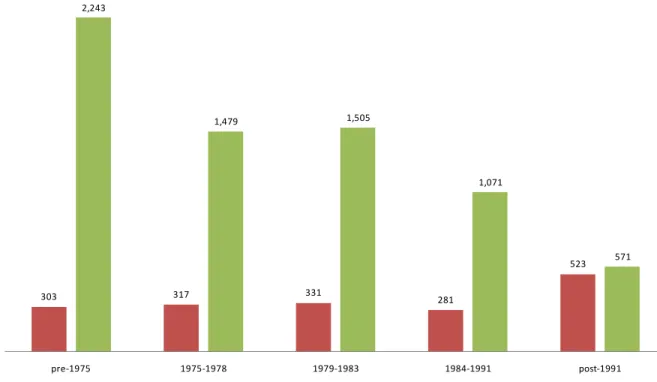
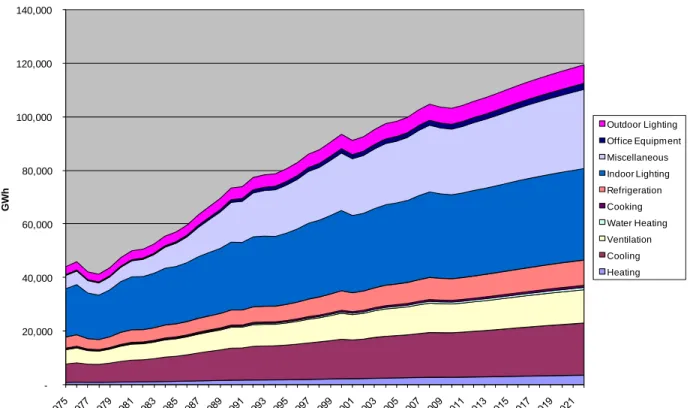
substantial contributions of older buildings. California’s existing residential building stock is dominated by pre‐code buildings, and this reality is expected to persist well into the next decade. There is substantial potential for improvement in energy performance (Figure 2) in existing buildings. Energy Commission projections estimate that in 2022 58 percent of all homes will have been built before 1980, when California energy standards in building construction came into effect, and 71 percent of all homes will have been built before 1990. In addition to the clear need to target the opportunity present in older homes, a look at the energy use attributed to space conditioning in homes by vintage shows that there is still an opportunity to reap great
33% 37% 15% 2% 7%5% 1% 2012 Electricity Consumption by Sector Residential Commmercial Industrial Mining Agricultural TCU Streetlighting 38% 16% 22% 21% 1% 2%
2012 Natural Gas Consumption by Sector Residential Commercial Industrial Mining Agricultural Other 43% 37% 12% 3% 5%