The Bayesian Spam Filter Project
March 24, 2004
1
Testing Methodology
The following section describes the testing methodology used for the Spam-BGon suite of products:
In setting up the tests for each tokenizer, training was performed in BS-FTrain on a random sampling of known, current email. Each tokenizer used the same email sets as the others, with training starting on small email sets and progressing through larger sets after each iteration. There were 16 sets total of spam email and 16 sets total of normal email, comprised of 1, 5, 10, 25, 50, 75, 100, 125, 150, 175, 200, 225, 250, 275, 300 and 325 emails each, respectively. (The training data is located under ./tests/and has the names norma thru norml and spama thru spaml).
To test performance of the filter, a random sampling of 40 current emails was fed thru BSFTest (it should be noted that none of the 40 emails were part of the training sets, although they were of similar “type”, i.e. related subject matter). 20 were known spam emails and 20 were known normal emails. (The email data is located under./tests/and has the namesn01.txtthru
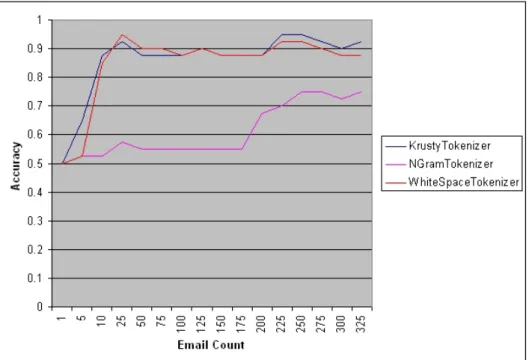
n20.txt and s01.txt thru s20.txt). This set of 40 emails was used with each of the three tokenizers against the aforementioned training data (all 16 sets). Data was collected and organized, and an accuracy rating was calculated and graphed. See Figure 1. (All test results can be found under
Figure 1: Tokenizer accuracy.
2
Performance
2.1
WhiteSpaceTokenizer
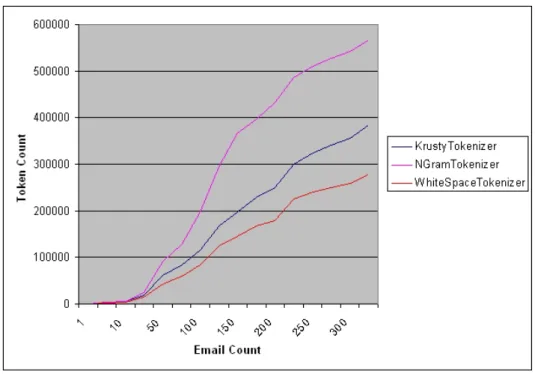
The WhiteSpaceTokenizer splits the analyzable section of an email message at whitespace characters and discards any and all punctuation. It’s a fairly simple tokenizer and generally produces a smaller token total than other to-kenizers (see Figure 2) and also tends to produce tokens of much greater length, and that can make it somewhat difficult to produce consistent spam hits. Overall, the WhiteSpaceTokenizer had an accuracy rate of approxi-mately 84.53% for the entire test run. Starting at about 200 emails in the training data, the rate improves to around 89.58%. For the sample sizes in-volved, I would consider this a decent rate, but not that great, and probably won’t increase that much more with further training as it appears the rate is leveling off.
2.2
KrustyTokenizer
tuation found in HTML tags and attributes as delimiters, just as whitespace would be treated. So, for example, given the following HTML in an email,
<br><br><img src="http://www.iamaspammer.com/eatme.jpg">
under WhiteSpaceTokenizer, the tokenizer would break up the input into the following tokens:
brbrimg
srchttpwwwiamaspammercomeatmejpg
Those are two fairly unique tokens, and really doesn’t say much about what the email contains. They might prove difficult to match up and pro-duce hits with other email passed to the tester. On the other hand, under KrustyTokenizer, the same line of input produces the following “more useful” tokens for classifying spam:
br br img src http www iamaspammer com eatme jpg
Here, KrustyTokenizer is creating more tokens from the input (from Fig-ure 2 one will notice that the total number of tokens have increased signifi-cantly) and the HTML is much more obvious. Under this scenario, more hits should occur within the spam data as more HTML tags are recognized, and thus should decrease the number of spam that get thru the filter.
Indeed, that appears to be the case as KrustyTokenizer improves on the accuracy rate of WhiteSpaceTokenizer (see Figure 1). Overall, it had an accuracy rate of approximately 85.94% for the entire test run. Starting at about 200 emails in the training data, the rate increases to about 92.08%. Not a huge difference to be sure, but it does suggest that this type of tokenizer might be better in the long run than plain old WhiteSpaceTokenizer. Much
like WhiteSpaceTokenizer, the rate seems to be leveling off and it doesn’t appear it would gain much more advantage with a lot more training.
Figure 2: Total token counts for each tokenizer.
2.3
NGramTokenizer
The NGramTokenizer splits the analyzable section of an email message into tokens ofncontiguous characters, where nis a value greater than 0. Whites-pace and puntuation are ignored in this tokenizer. For the testing here, an
n of value 5 was used. Unfortunately, the results were quite poor. Overall, NGramTokenizer had an accuracy rate of about 61.09%, far below that of the other two tokenizers. At 200 emails, the rate did increase to 72.50%, and from Figure 1 it appears that the trend is continuing upward. But really, up until about 200 emails, the rate is abysmal. Until this model has been trained with enough data, NGramTokenizer simply seems to produce a lot of tokens that don’t recognize much of what’s thrown at it and thus produces poor accuracy.
by Figure 2. In fact, the real downside to this tokenizer is the amount of memory it chews up. Whereas the other two tokenizers created statistical models of about 1.5 MB each for 325 emails, NGramTokenizer’s model was a hefty 8 MB plus. Saving and loading files of this size is not that fast (due to apparently not-so-fast serialization and the use of object streams).
3
Improvements
Obviously, there’s always room for improvement. Here are just a few ideas I can think of:
1. More Training- It could be that that NGramTokenizer is the greatest thing since sliced bread, or that KrustyTokenizer is really bad at its job. Running much more email through the trainer would clarify such things.
2. Better Algorithm - Sure, the na¨ıve Bayes approximation as imple-mented here works, but it might not work good enough. Paul Gra-ham in Better Bayesian Filtering suggests a different approach (which produces wildly accurate filtering) that perhaps could be explored in SpamBGon.
3. Serialization - Although it doesn’t affect the overall results, the se-rialization as implemented here just isn’t working efficiently. Sticking to my original idea of using two separate models for normal and spam would help, but the bottleneck is really in the loading and saving of the models. I’m not sure serialization is good for spam filtering, what with the amount of training required.
4. Better Tokenizers- KrustyTokenizer, for example, shows some promise, and perhaps extending it to treat things like Base64 encoding (a tok-enizer hairball) differently or keeping track of images or URL references to further filter on would be useful.
5. Blacklists & Whitelists - Verifying address and domains right off the bat would be an improvement, as well as being able to add to such lists after finding new spam.