Authors are encouraged to submit new papers to INFORMS journals by means of a style file template, which includes the journal title. However, use of a template does not certify that the paper has been accepted for publication in the named jour-nal. INFORMS journal templates are for the exclusive purpose of submitting to an INFORMS journal and should not be used to distribute the papers in print or online or to submit the papers to another publication.
Optimal Advance Scheduling
(Authors’ names blinded for peer review)
The dynamic assignment of patients to exam days in order to manage daily variations in demand and capacity is a long-standing open research area in appointment scheduling. In particular, the dynamic assignment of advance appointments has been considered to be especially challenging due to its high-dimensionality. We consider a canonical model of dynamic advance scheduling with two patient classes, an urgent demand class, which must be served on the day of arrival, and a regular demand class, which can be served at a future date. Patients take the earliest appointments offered and do not differentiate among providers. We derive a surprising characterization of an optimal policy and an algorithm to compute the policy exactly and efficiently. These are the first analytical results for the dynamic advance assignment of patients to exam days. We introduce the property of successive refinability, which allows advance schedules to be easily computable and under which there is no cost to the system to making advance commitments to patients. We allow multiple types of capacity to be considered, and both demand and capacity to be non-stationary and stochastic.
Key words: Dynamic programming; Decision analysis: Theory;Healthcare: Hospitals; Production-Scheduling
1.
Introduction
A visit to a healthcare facility, whether for a specialist exam, a surgical procedure, or diagnostic screen, usually requires an appointment. The appointment-scheduling process allocates service times at healthcare facilities to individual patients. From a systems per-spective, this process is the main mechanism for setting the pace of operations and
lating access to healthcare (Chakraborty, Muthuraman, and Lawley 2010). As such, it is widely considered to be both a “primary means of improving resource utilization” and a primary means of reducing patient wait times (Lowery and Martin 1989).
Poor scheduling is “a major source of operational inefficiency and patient dissatisfaction” (Chakraborty, Muthuraman, and Lawley 2010). “In the short term, [it] diverts potentially productive time of clinicians, receptionists, and others into the non-care processes of deci-sion making and triage. In the longer term, it diverts staff into the time-consuming process of managing an intentionally created delay, such as making reminder calls or filing and retrieving lists for future appointments”. Inadequate access to healthcare, manifesting as waits and delays, has been attributed by most analysis to problems in matching daily provider capacity with patient demand, rather than a true shortage of capacity (Murray and Berwick 2003).
Historically, the literature on Appointment Scheduling has focused on two forms of waiting: waiting within a day and waiting across days. Gupta and Denton (2008) define direct wait as approximately the interval between the scheduled appointment and the actual service time on the appointment day, and indirect wait as the interval between the patient’s first request for an appointment and the actual appointment. They also emphasize the relative importance of the indirect wait on the quality of care, since “excessive indirect wait[s] can pose a serious safety concern.”
Most of the literature in Appointment Scheduling focuses on intra-day scheduling, namely, the sequencing and timing of appointments within a day that primarily controls the direct wait. They assume that the number of patients served per day has been pre-determined by an external source or that it is fixed as part of a static strategy. Very few papers have tried to make express, active decisions about the indirect wait. In fact,
Gupta and Denton (2008) have identified the modeling and control of indirect waiting as an open challenge. Indirect waits can be controlled viamulti-day scheduling where patients are dynamically assigned to appointment days. These dynamic multi-day assignments are the main way in which a system can cope with the day-to-day variability of demand and capacity. Daily demand variability alone can be extremely high (McManus, Long, Cooper, Mandell, Berwick, Pagano, and Litvak 2003).
Allocation scheduling andadvance scheduling are the main paradigms for dynamic multi-day scheduling. In allocation scheduling, a wait list is maintained and patients are notified on the day of their appointments. In advance scheduling, patients are given appointments in the future at the time of request. The latter is the predominant paradigm in practice.
The standard dynamic programming formulation of advance scheduling generally can-not be solved easily due to the “curse of dimensionality.” When making a new appoint-ment, optimal advance-scheduling policies must consider all outstanding appointments. A description of these typically includes hundreds of patients and several months’ worth of appointment days. It has been observed by Gupta and Denton (2008) that with the added complexity of scheduling for multiple providers, “there is no obvious decomposition that can be applied to simplify the problem.”
In this paper, we study an advance scheduling problem that is motivated by the schedul-ing of Magnetic Resonance Imagschedul-ing (MRI) exams at Morgan Stanley Children’s Hospital in New York City. This problem has been described by Truong and Ruzal-Shapiro (2013). The hospital operates one MRI machine. It serves three types of patients. Emergency patients must be served immediately. Inpatients coming from within the hospital wards can technically wait beyond a day, but are generally served within 24 hours in order to min-imize back-ups in the wards. Finally, outpatients from various affiliated clinics are served
by advance appointments. It is difficult to further classify the patients for planning pur-poses using information such as medical history, physical characteristics, and the types of scans they require. The duration of exams for patients who require anesthesia, for example, largely depend on the time required to administer anesthesia and stabilize the patients’ vital signs, which is very difficult to predict. The challenge faced by the hospital is how to allocate exam time efficiently among these patient classes.
We consider a canonical model of dynamic advance scheduling with two patient classes, anurgent demand class, which must be served on the day of arrival, and aregular demand class, which can be served at a future date. The urgent class models the emergency and inpatients above, and the regular class models the outpatients. We assume that patients take the earliest appointments offered and do not differentiate among providers. There are costs for patient waiting and over-utilization, or over-time use, of available resources. We allow multiple types of capacity corresponding to multiple resources to be considered, and both demand and capacity to be non-stationary and stochastic. This model is a simpli-fied version of the model in Patrick, Puterman and Queyranne (2008) with two instead of n demand classes, random rather than deterministic service times, multiple resources rather than one resource, and non-stationary demands and capacity rather than station-ary demand and deterministic capacity. Our model can also be considered as an extension of the model of Gerchak, Gupta, and Henig (1996), with multiple rather than a single resource, and non-stationary rather than stationary demands. Whereas Gerchak, Gupta, and Henig (1996) study allocation scheduling, we study advance scheduling.
Our model is essentially an aggregate-planning model in the same spirit as that of Gerchak, Gupta and Henig (1996). The model can be used as part of a two-stage planning process. In stage one, the number of patients to be served on any given day is determined.
In stage two, the sequence and timing of individual exams are determined. Our model addresses stage-one decisions, which tradeoffs the cost of over-utilization of resources with the cost of making patients wait over multiple days.
The multi-resource, highly constrained environments that we consider in this paper are one of the “open challenges” described by Gupta and Denton (2008) in their influential review of medical scheduling literature. Healthcare services typically command many dif-ferent resources. For example, according to Gupta and Denton (2008), surgeries require “clinical assistants, nurses, anesthesiologists and surgeons, operating rooms, diagnostic devices, surgical tools and other equipment.” A shortage of any of these resources can aggra-vate waiting time and worsen outcome: the high level of utilization sought for expensive resources creates “resource-use conflicts that are exacerbated by tight schedules . . . patient no-shows, tardiness of providers and staff absences.” There are no known characteriza-tions of optimal policies or algorithms with performance guarantees for advance scheduling under these conditions.
The non-stationarity of resource availability and demand that we consider here is another common feature of healthcare scheduling, but is challenging to model and solve. In surgical scheduling, for example, staffing fluctuates greatly with the time of week and the time of year (Dexter et al. 1999). Demand is also generally non-stationary, exhibiting both season-ality and growth trends (Moore et al. 2008). Policies for stationary environments, therefore, would either perform poorly or simply be unimplementable in practice. The difficulty of finding optimal decisions in these environments comes from the need of such policies to adapt to changing conditions over time and to account for usage across many different resources, especially when both resource availability and demands are stochastic. There are few published papers on dynamic allocation-scheduling policies in these environments (Ayvaz and Huh 2010 and Huh, Liu, and Truong 2012) but no work on advance scheduling.
For the MRI scheduling problem that motivates this research, we show that there is an easy-to-compute optimal policy. The optimal policy does not schedule the same number of regular patients for each day, but dynamically increases this daily “regular work load” as the total number of regular patients in the system increases. Further, with each unit increase of the number of regular patients in the system, the optimal regular workload for each day only increases rather than decreases, and it increases by at most one patient. In stationary settings, the optimal policy schedules fewer regular patients farther into the future. In both stationary and non-stationary settings, there is no loss of flexibility to the system in scheduling patients via advance scheduling rather than allocation scheduling because under advance scheduling, it is always possible to incrementally revise the schedule following an optimal policy.
On the theory side, we show that there is an intimate connection between allocation scheduling and advance scheduling. Thus, this work connects two main independently ana-lyzed streams of literature. We exhibit a method to construct an optimal solution to a high-dimensional advance-scheduling problem from a solution to an associated, simple to compute, allocation-scheduling problem. This construction leads to a full characterization of the advance-scheduling solution and allows it to be computed exactly and efficiently. These are the first analytical results for the dynamic advance assignment of patients to exam days. We also introduce the property ofsuccessive refinability, which allows advance schedules to be easily computable and under which advance scheduling is as efficient as allo-cation scheduling, so that there is no cost to the system to making advance commitments to patients. We are not aware of any analogous result in this domain.
The paper is organized as follows. In Section 2 we discuss advance scheduling in the context of existing literature. In Section 3, we specify our model precisely. We take a
detour in Section 4 to study properties of a corresponding allocation-scheduling problem. In Section 5 we study an intermediate model, which serves as a bridge between allocation and advance scheduling. We also introduce the property of successive refinability. We derive an optimal policy for advance scheduling in Section 6. We discuss extensions in Section 7. In Section 8, we provide a numerical example illustrating our optimal advance-scheduling policy. We conclude in Section 9. We relegate all proofs to the Appendix.
2.
Related Literature
Appointment scheduling is a well-established area with connections to many topics, such as machine scheduling, capacity allocation in production and service systems, admission control for queues, and Revenue Management.
Machine scheduling. There is an extensive literature on scheduling jobs on machines. These problems are similar to intra-day scheduling problems with some key differences. First, jobs do not incur any waiting cost until past their due date; second, machine capacity is usually fixed, rather than extendable; third, unlike patient service times, job processing times tend to be deterministic rather than random (Gupta and Denton 2008). Leung (2004) provides a recent review of this literature.
Capacity allocation in production and service systems. Dynamic multi-day medi-cal scheduling problems share some characteristics with the sale of inventory to multiple customer classes whose arrivals are uncertain . A major difference is that inventory can be stocked, whereas service capacity is lost if it is not used (Ayvaz and Huh 2010). See, for example, Topkis (1968), Carr and Duenyas (2000), Ha (1997a), Ha (1997b), Sobel and Zhang (2001), Duran, Liu, Simchi-Levi, and Swann (2008), and Zhou and Zhao (2010). Sev-eral papers study pricing decisions, which are not relevant in healthcare settings (Maglaras and Zeevi 2005 and Ding, Kouvelis, and Milner 2006).
Revenue Management.The literature in Revenue Management shares a similar concern with allocating a finite, perishable amount of capacity among customer classes who arrive randomly over time. In Revenue Management, demand is for a particular resource at a particular time. Demand cannot be satisfied by supplying the resource at a later date. In our setting however, demand from regular patients arriving on a particular day can always be satisfied on another day. Another difference is that high-priority demand is lost if not accommodated in Revenue Management, whereas in healthcare, capacity must usually be “extended” at a cost to serve urgent demand (Gupta and Denton 2008). Talluri and Van Ryzin (2005) provides a detailed review of this literature.
Admission control for queues. Appointment scheduling shares many similarities with admission control for queues. In queuing models, patients are served in a greedy man-ner whereas in appointment scheduling, patients are given appointments at specific times (Gupta and Denton 2008). In addition, the type of stationary analysis employed on queu-ing models might not be suitable when the number of patients that can be seen per day is small. Queuing models, therefore tend to be used to study strategic decisions, such as capacity planning and reservation, and physician-panel design. See Young (1963), Esogbue and Singh (1976), Huang (1995), Green and Savin (2008), and Liu and Ziya (2012). Appointment scheduling.Many papers in this literature focus on intra-day scheduling. Examples of this stream of research include Wang (1999), Rohleder and Klassen (2000), Denton and Gupta (2003), Robinson and Chen (2003), Klassen and Rohleder (2004), Green, Savin, and Wang (2006), Kaandorp and Koole (2007), Hassin and Mendel (2008), Jouini and Benjaafar (2010), Cayirli, Yang, Quek (2012), and Luo, Kulkarni, and Ziya (2012). Some of these papers focus on finding the optimal number of patients to overbook in a day to reduce the impact of no-shows (Kim and Giachetti 2006, LaGanga and Lawrence 2007,
Muthuraman and Lawley 2008, Zeng, Turkcan, Lin, and Lawley 2010, Huang and Zuniga 2011, and LaGanga and Lawrence 2012). Others study the optimal percentage of same-day appointments to offer (Qu, Rardin, Williams, Willis 2007 and Robinson and Chen 2010).
Some of the literature model two classes of patients, one which must be served on the day of arrival, and another regular class, which can be served at a later date. For example, Dobson, Hasija, and Pinker (2011) fix the number of regular appointments that can be scheduled for each day and study various service measures as a function of the number of slots reserved for same-day patients. Qu, Rardin, Williams, Willis (2007) also fix the number of appointment slots available on each day and focus on finding the optimal constant number of slots to open up for regular patients. A distinguishing feature of our model is that we allow the number of regular appointments that can be scheduled on each day to be a dynamic decision, which helps the planner to tradeoff the cost of over-time work with the cost of patient waiting. Gupta and Wang (2008) model patient choice for physician-slot combinations and allow clinics to make acceptance/rejection decisions in response to patient requests. They essentially allow the number of slots given to regular patients to depend dynamically on the set of already accepted requests. However, since their model focuses on a single day, it does not capture the impact of scheduling decisions across days, which is an important feature of our model.
There is a growing literature on allocation-scheduling models. Mullen (2003) surveys approaches for prioritizing waiting lists. Swain, Kilpatrick, and Marsh (1977) develop heuristics to predict hospital census and determine elective-admission policies. George, Fox and Canvin (1983) formulate a linear-programming model to plan the aggregate through-put of the general surgical department. Gerchak, Gupta, and Henig (1996) characterize an optimal policy for allocating capacity to regular and emergency cases. Min and Yih (2010)
and Ayvaz and Huh (2010) extend this work by considering multiple patient classes. Min and Yih (2014) go further by modeling time-dependent priorities for patients. Huh, Liu, and Truong (2012) develop policies for allocation scheduling under correlated demands and multiple constrained resources.
Dynamic advance-scheduling problems have generally been deemed intractable. There has been no direct characterization of optimal policies in the published literature. Patrick, Puterman and Queyranne (2008) develop approximate-dynamic-programming-based heuristics for scheduling patients of different priorities. Gocgun and Ghate (2012) also develop an approximate dynamic programming method that uses Lagrangian relax-ation and constraint generrelax-ation to solve a similar problem. Liu, Ziya and Kulkarni (2010) propose heuristics taking into account cancellations and no-shows. Feldman, Liu, Topaloglu, Ziya (2012) develop heuristics assuming that patient’s preferences for appoint-ment times follow the Multinomial Logit Model. Truong and Ruzal-Shapiro (2013) charac-terize the optimal policy and propose effective heuristics for a two-class advance-scheduling problem in which patients may be expedited after they are first assigned advance appoint-ments. This systematic expediting of patients might not always be implementable in prac-tice. Patrick (2012) studies a dynamic multi-day scheduling problem with no-shows and demonstrates by simulation that using a short booking window might be more advanta-geous than using an open-access policy.
3.
Advance-Scheduling Model
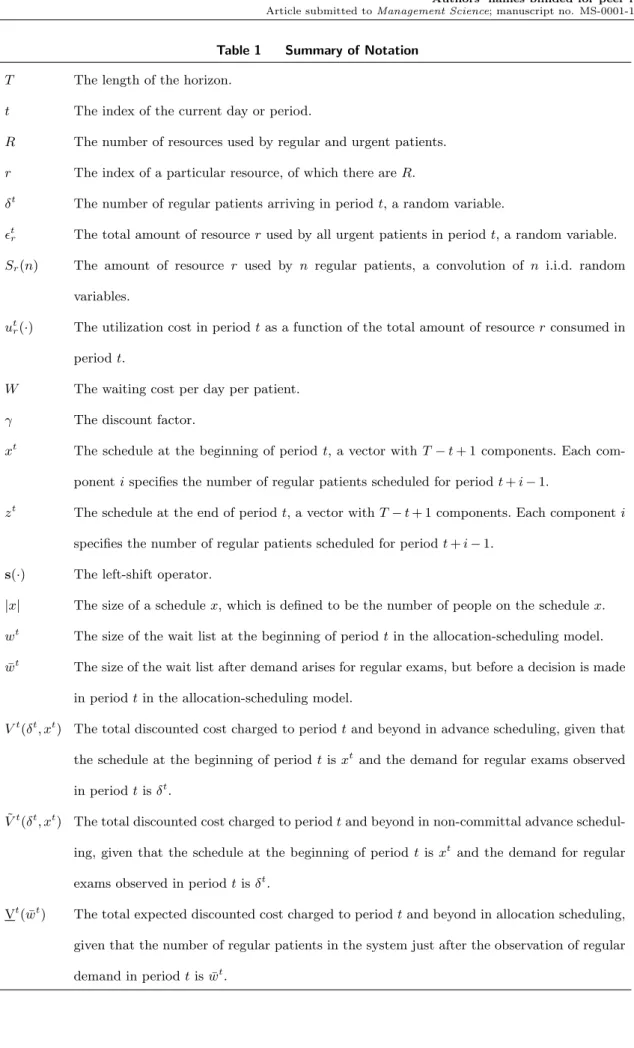
The reader can refer to Table 3 for a summary of notation. Consider an horizon of T
periods indexed by t∈ {1,2, . . . , T} in a forward manner. We will use “period” and “day” interchangeably, as a period normally corresponds to a day in reality. We allow T =∞.
In each period t in the horizon, demand arises for urgent exams and for regular exams. Urgent exams must be performed immediately in period t, whereas regular exams can be
performed some time in the future. The number of regular exams requested by patients arriving in period t is a random variable δt. The decision in period t is how to allocate
these demand requests to periods {t, . . . , T}.
There are R resources, that are used by urgent and regular exams. The amount of resourcer= 1, . . . , Rconsumed by each regular exam is a random variable that is indepen-dent and iindepen-dentically distributed (i.i.d.) across patients and days. For each r= 1, . . . , R, let
Sr(n) represent the total amount of resourcer that is consumed bynregular exams. Then Sr(n) is a convolution of n i.i.d. random variables. Let the amount of resource r that is
used by all urgent exams on day t be a random variable t r.
There is a randomutilization cost ut
r(tr+Sr(n)) to fulfill all urgent and nregular exams
scheduled on day t. The utilization cost models regular and overtime use of the resource, allowing the quantity of the resource to be both random and time-varying. We assume thatut
r(·) is convex, increasing, and independent over time. The cost of resource utilization
in healthcare facilities is often dominated by staffing costs. Our convex utilization cost captures a common pay structure whereby staffs are compensated at a higher rate for each hour of overtime work. It does not capture fixed set-up costs.
Note that since our model focuses on the tradeoff between the cost of over time work and the cost of making patients wait over multiple days, like Gerchak, Gupta and Henig (1996), we have approximated the total resource usage per day as a simple sum of individual exam usages. This approximation ignores within-day wait time by patients and idle time by providers.
We assume that all patients prefer to have their exams sooner rather than later. In other words, they will take the earliest appointments offered. This assumption follows Patrick, Puterman and Queyranne (2008) and Liu, Ziya and Kulkarni (2010). There is a
waiting cost of W for each day that a patient is made to wait for an exam after he first makes a request for an appointment. The waiting cost captures both the inconvenience of waiting and any loss in productivity to the patient and to society that is caused by delays in treatment. In practice, the real cost of such a wait in terms of health outcomes and perceived inconvenience might be very complicated and might increase steeply with the wait. Our unit waiting cost can be considered as an average daily cost of waiting. This model of the waiting cost follows Gerchak, Gupta and Henig (1996) and Ayvaz and Huh (2010).
Let the discount factor in each period be γ ∈(0,1). We would like to determine the scheduling policy to minimize the total expected discounted cost incurred over the horizon. We will consider two types of scheduling environments. In a non-stationary environ-ment, the sequences{δt}
t,{(t1, . . . , tR)}t, and{(ut1(·), . . . , utR(·))}tare independent, but not
necessarily identically distributed over time. In a stationary environment, the sequences are i.i.d.. In both environments, the distributions of these sequences of exogenous random variables are known at time 1. We sometimes omit the time superscripts when discussing stationary environments. When the horizon is infinite, we shall always assume that the environment is stationary.
The events in each period t follow the following sequence. 1. The numbers xt = (xt
1, . . . , xtT−t+1) of regular exams already scheduled for periods
{t, . . . , T} are observed.
2. The new random demand δt arises for regular exams. A decision is made to
deter-mine in which of the periods {t, . . . , T} these exams will be performed. We call the peri-ods {t, . . . , T} the booking window. The outcome of the decision is the new schedule zt=
(zt
1, . . . , zTt−t+1), where zit represents the number of regular exams scheduled for period i+t−1.
3. The new demand for urgent exams arising at t arises and is satisfied together with the zt
1 regular exams scheduled for period t.
4. A waiting costW is incurred by the system for each patient who is still on the schedule (i.e., as yet unserved).
The state of the system at the beginning of period t is the schedule for periods t, t+ 1, . . . , T. The schedule is described by the vector xt= (xt1, xt2, . . . , xtT−t+1). The component
xt
i specifies the number of regular exams scheduled for period t+i−1 as of the beginning
of period t. We will use | · | to denote the number of patients in the schedule, or the size of the schedule. That is, |x|=PT−t+1
k=1 xk. We shall always work with finite-size schedules.
We will also define s(x) to be the result of the left-shift operator acting on x. That is, s(x) = (x2, x3, . . . , xT−t+1).
Note that our waiting cost is also simpler than that of Patrick, Puterman and Queyranne (2008). Whereas we model a constant waiting cost W per patient per day of wait, Patrick, Puterman and Queyranne (2008) allow the waiting cost to be 0 if a patient is served within the target deadline for his priority class.
An issue with the above model is that patients might be served out of first-in-first-out (FIFO) order. Regular patients arriving later might be scheduled ahead of those arriving earlier if the total number of patients in the system is high, forcing the system to increase its “rate of service.” However, enforcing fairness reduces system flexibility because patients can only be added to the far end of a schedule, rather than anywhere in the schedule. In a real system, fairness can be enforced by expediting early arrivals, rather than scheduling late arrivals ahead of them. Truong and Ruzal-Shapiro (2013) study a model of advance scheduling in which expediting is performed systematically. More justifications of our model can be found in Patrick, Puterman and Queyranne (2008).
We formulate the problem of determining an optimal advance-scheduling policy as fol-lows. LetVt(δt, xt) denote the total discounted cost charged to periodt and beyond, given
that the schedule at the beginning of period t is xt and the demand for regular exams
observed in period t is δt. Vt(δt, xt) = min ( W|zt|+ R X r=1 E[utr(tr+Sr(zt1))] +γEδt+1 Vt+1(δt+1,s(zt)) ) s.t. zt ≥ xt |zt| = δt+|xt|. (1)
Above, the first constraint ensures that exams cannot be removed from a day once booked. The second constraint ensures that zt contains additions to xt of δt newly arrived regular
exam requests. In the non-stationary environment, we will also define VT+1(·,·) = 0. Note that since we assume that the distribution oft
r and the distribution of exam times
for regular patients are known, the convolution Sr(n) of n regular exam times, thus the
function E[ut
r(tr+Sr(n))], can be computed easily by Monte-Carlo simulation. In fact, E[utr(tr+Sr(n))] can be pre-computed easily for eachr and eachn= 0,1,2, . . ., so that for
each r, E[ut
r(tr+Sr(n))] can be considered as a simple deterministic function of n.
The advance-scheduling formulation (1) is challenging in several ways. First, the state and decision space are high-dimensional. Indeed, their dimension is equal to the size of the booking window, which is very large in reality. Second, the feasible region lacks the lattice structure that often helps to confer nice monotonicity properties. We will find avenues for solving this problem by examining several related formulations, which seem to be better structured.
4.
Insights from Allocation Scheduling
Before we attempt to solve (1), let us take a detour into allocation scheduling. The insights gleaned from this model will be useful in constructing optimal policies for advance schedul-ing.
4.1. Allocation-scheduling model
In allocation scheduling, a running wait list is maintained and the manager decides on the number qt of regular patients from the wait list to serve in each period t. The costs are
analogous. The events in each period t follow the following sequence: 1. The size wt of the wait list from the previous period is observed.
2. The new random demand δt arises for regular exams, and is added to the wait list, bringing the total to ¯wt=wt+δt.
3. A waiting costW is incurred by the system for each patient on the wait list. 4. The manager makes a decision to serve qt patients from the wait list in period t. 5. The random demand for urgent exams at t arises and is satisfied together with the
qt regular exams scheduled for period t. There is a random utilization costut
r(tr+Sr(qt))
to fulfill all urgent and qt regular exams scheduled on day t.
The state of the system at the beginning of period t, after the observation of regular demand, is the size ¯wt of the wait list.
We formulate the problem of determining an optimal allocation-scheduling policy as follows. Let Vt( ¯wt) denote the total expected discounted cost incurred by the system in period t and beyond, given that the state in period t is ¯wt.
Vt( ¯wt) = min ¯ wt≥qt≥0 ( Ww¯t+ R X r=1 E[utr(tr+Sr(qt))] +γEδt+1 Vt+1( ¯wt−qt+δt+1) ) . (2)
In the non-stationary environment, we will also define VT+1(·) = 0. This problem is rela-tively easy to solve, especially in the stationary setting, because the state and action space are both single-dimensional. Below, we characterize an optimal policy for this problem. 4.2. Allocation-scheduling properties
The theorems in this section generalize similar results by Gerchak, Gupta and Henig (1996) for a stationary, single-resource allocation-scheduling model.
First, we establish some basic properties of the value function in allocation scheduling. The convexity and monotonicity of the value function follow easily from the problem’s convex cost structure, linear state transitions, and convex action space:
Theorem 1. For each t, Vt(·) is convex and increasing.
Proofs for all results can be found in the Appendix.
Let the cost function to be minimized in each periodtbeGt(q,w¯) =Ww¯+PR
r=1E[utr(tr+ Sr(q))] +γE
Vt+1( ¯w−q+δt+1)
.
The submodularity of Gt(·,·) follows from the problem’s separable costs, convex value
function, and lattice action space. The following theorem uses standard results from super-modularity theory:
Theorem 2. For each t, Gt(·,·) is submodular
Using these basic properties, we show below that the optimal policy is not a simple threshold policy as might be surmised. The optimal numberqtof patients served in period t is an increasing function of the size ¯wt of the wait list. This is because the longer the
wait list becomes, the more pressure there is to increase the time-t work load. At a cost of paying higher utilization costs, the system can check the growth of the wait list and avoid paying higher waiting costs in the future. This property of the optimal policy implies that it is suboptimal to serve the same number of regular patients in each period. Systems should respond to longer wait lists by increasing the workload as appropriate.
A second property of the optimal policy, which will later be crucial to our development of a “successive refinability” property, is that, when the wait list ¯wt increases by 1, the workloadqtalways increases by at most 1. This property is natural in view of the fact that
linearly in the number of patients who are made to wait. On the other hand, utilization costs, which incentivize the system to spread out the work load by possibly delaying service, increase convexly in the number of patients who are to be served. When the wait list is short, the optimal policy serves every patient on the wait list immediately. The wait list size ¯wt and the work load qt increase at the same rate. As the wait list grows and with it,
the workload, it becomes increasingly expensive in terms of utilization costs to serve an additional patient. The utilization cost gradually dominates the waiting cost, so that we are more likely to make the additional patient wait rather than to serve him immediately.
Theorem 3. Let qt∗( ¯w) be the maximum optimal number of regular patients served at
t in allocation scheduling, given that the total number of regular patients in the system is ¯
w. Then qt∗( ¯w) is increasing in w¯. Moreover, qt∗( ¯w+ 1)≤qt∗( ¯w) + 1.
We call qt∗(·) an allocation function. We will return to these functions later, in the con-struction of an optimal advance-scheduling policy.
A reasonable assumption on the system is that at least one patient is served in each period, if the wait list is non-empty. We will make this assumption in the rest of the paper.
Assumption 1. If w¯≥1 then qt∗( ¯w)≥1.
This assumption is satisfied if for periodt and every resource r.
E[utr(tr+Sr(1))]−E[utr( t r)]≤
1
1−γW. (3)
In other words, it is cheaper for the system to serve the one patient on the wait list than to let the patient wait forever.
Armed with insights about optimal allocation scheduling, we will return to advance scheduling. But first, we will examine below a model that is a compromise between allo-cation and advance scheduling, namely non-committal advance scheduling.
5.
Non-Committal Advance Scheduling
Non-committal advance scheduling is a seemingly idiosyncratic modification of advance scheduling. It is an advance-scheduling model in which advance commitments do not have to be upheld. In this section we will show that this model serves as a critical link between allocation and advance scheduling.
5.1. Non-committal advance-scheduling model
We obtain the non-committal advance-scheduling model by taking the advance-scheduling model and dropping the requirement that pre-commitments must be upheld in subsequent periods, i.e., by dropping the first inequality in (1). We will use ˜Vt(δt, xt) to denote the
optimal expected cost on [t,∞) under non-committal advance scheduling. Compare to the definition of Vt(wt) for allocation scheduling in Section 4.
˜ Vt(δt, xt) = min ( W|zt|+ R X r=1 E[utr(tr+Sr(z1))] +γEδt+1 h ˜ Vt+1(δt+1,s(zt)) i ) s.t. |zt| = δt+|xt|.
This relaxed formulation turns out to be very well structured. It can be observed that the non-committal formulation above has a state space that is collapsible to one dimension. Since prior commitments can be ignored, the only information that matters is the number of patients outstanding.
Thus, the non-committal model is nearly identical to the easier allocation-scheduling model. The main difference is that the outcome of the decision at t in the non-committal model is an entire schedule (a vector zt), rather than just a single number (an integer qt).
Indeed, the two problems have the same optimal cost, since the constraints, the transitions, and the cost structures are the same. Below, we show that this optimal cost is less than or equal to the corresponding cost for the advance-scheduling model:
Proposition 1. For all period t, schedule x and demand δ, V˜t(δ, x) =Vt(δ+|x|)≤
Vt(δ, x).
In other words, both non-committal advance scheduling and allocation-scheduling can be viewed as relaxations of advance scheduling. We shall later make use of this interpretation. 5.2. Successive refinability
We call a schedule for the non-committal advance-scheduling model a pre-allocation since it is not binding in subsequent periods. We will construct optimal pre-allocations and prove properties of these pre-allocations, in particular the property of “successive refinability,” that makes them particularly useful for advance scheduling.
Recall the allocation functionqt∗( ¯w) from Section 4, which specifies an optimal number of regular patients to serve in periodtin an allocation-scheduling model, given that the size of the wait list is ¯w. We will use allocation functions to construct optimal pre-allocations. Defineqt∗( ¯w) = 0 for ¯w≤0. Define a policy π for the non-committal advance-scheduling problem, which determines pre-allocations as follows:
ztπ1 (δ, x) =qt∗(δ+|x|), (4) ztπk (δ, x) =q∗t+k−1(δ+|x| − k−1 X i=1 zitπ(δ, x)), k= 2, . . . ,∞. (5)
That is,π applies the functionqt∗(·) to the total number of regular patients outstanding to obtain the number to be served on dayt. Then it appliesqt∗(·) to the remaining number to obtain the number to be served on dayt+ 1. Then it appliesqt∗(·) to the remaining number to obtain the number to be served on day t+ 2, and so on. Note that in the stationary model, qt∗(·) is the same for all periods t.
As a policy, π has several nice properties, which we will discuss in turns.
First, we will show that π is a valid policy for non-committal advance scheduling in that it allocates some service day to each of the regular patients outstanding. That is, it
eventually gets to all of the regular patients in the manner described above. This is because by Assumption 1, the function qt∗(·), when applied to a positive number, will return a positive value. Each time thatπ applies the function qt∗(·), it strictly reduces the number remaining to be allocated. Thus, it eventually succeeds in allocating all outstanding regular patients to future days. The proposition below states that given an initial schedule x and a number δ of new regular arrivals, the schedule ztπ(δ, x) constructed by π contains all of
these δ+|x| regular patients.
Proposition 2. For all schedules x and demand δ, |ztπ(δ, x)|=δ+|x|.
Next is a useful technical reinterpretation of the construction of π. The number of patients allocated to period t+k is the result of the allocation function applied to the number of patients eventually allocated (at the end of period t) to period t+k or later. Another way to view it is that the workloads for periods t+k and later are oblivious (via the construction of π) of the workloads for periods strictly earlier than t+k.
Proposition 3. For all schedules x, demand δ, and k= 1,2, . . .,
zktπ(δ, x) =q∗t+k−1(|sk−1(ztπ(δ, x))|).
Finally, we will not find it difficult to see now that π is in fact, an optimal policy for the non-committal advance-scheduling model. This result is easy to argue. Note that by its construction, π serves the same number of regular patients in each period as an optimal allocation-scheduling policy. Thus, π has the same cost as that of an optimal allocation-scheduling policy. Indeed, the number of patients served in each period completely deter-mines the cost of a policy. Since the cost of an optimal allocation-scheduling policy is the same as that of an optimal non-committal scheduling policy (Proposition 1), the result follows:
Proposition 4. π is an optimal policy for the non-committal advance-scheduling
prob-lem.
A priori, it is entirely possible that a policy for non-committal advance scheduling might change its allocation from period to period. It might allocate a patient to a particular future period at t, then change this allocation to a strictly earlier or later period at t+ 1. This is because the non-committal advance-scheduling formulation does not require decisions to honor prior commitments. Therefore it is remarkable and surprising that π turns out to always honor prior commitments. That is, that in period t+ 1, when we repeat the pre-allocation procedure under π, none of the patients pre-allocated in period t needs to be moved. New patients arriving in period t+ 1 are simply added to the previous pre-allocation. The intuition is that the optimal allocation functions qt∗(n), which are used to construct π, change “slowly” with the state information n (Theorem 3). Therefore, as more patients arrive and the total number of patients change, these optimal allocations can always be updated in time.
The above property implies thatπ is not merely a valid policy for non-committal advance scheduling. It is also a valid policy for advance-scheduling. Thus, we will potentially be able to make use of π in our search for an optimal policy for advance scheduling.
Theorem 4. Assume that x1= 0. Then s(ztπ)≤zt+1π in the non-committal model in
each period t.
We say, therefore, that the pre-allocation defined by π is successively refinable. New pre-allocations are simply refinements of previous pre-pre-allocations that leave intact all patients previously pre-allocated. The term is named after a loosely analogous concept (Equitz and Cover 1991) in Rate-Distortion Theory (Berger 1971).
The intuition behind successive refinability property comes from the fact that policy π
is constructed from an optimal allocation function. By Theorem 3, this allocation function is increasing in the total number of regular patients outstanding. Moreover, when the total number of regular patients increases by 1, the allocation increases by at most 1. Consider any periodt. We would only want to revise the number to be served att (after new regular demand arrives in period t) if the total number of regular patients in the system changes. Since the total number of patients can only increase with new demand arrivals, we would only revise this number upwards. And since the amount of revision is always less than or equal to the number of new arrivals, it will always be possible to increase the number served at t by allocating some new arrivals to period t, rather than to move some patients tot who have previously been allocated to later periods. As we noted in Proposition 3, the workloads for periods strictly later than t are independent of the work load for t under π. Therefore, we can repeat this logic to show that with the new demand arrivals, policy π
will increase the number of patients allocated to each period in the future, thus keeping in tact all of its previous allocations.
Next we will use successive refinability to solve the advance-scheduling problem in Sec-tion 3.
6.
Optimal Advance Scheduling via Successive Refinability
We are now ready to characterize an optimal policy for advance scheduling.We say that an advance-scheduling problem issuccessfully refinable if there is an optimal pre-allocation that is successively refinable. From Section 5.2, we see that the advance-scheduling formulation given in Section 3 is successively refinable. Because of the successive refinability of the non-committal model, if we now make pre-allocations binding, we will not change the optimal value. But making pre-allocations binding gives us (1). In other
words, if x1= 0, so that π is feasible in period 1, then π is feasible for (1) in every period.
Since π is also optimal for non-committal advance scheduling, it is optimal for advance scheduling by Proposition 1. It follows that
Theorem 5. Assume that x1 = 0. Then π is an optimal policy for the
advance-scheduling problem. That is, there is an optimal schedule zt in each period t satisfying
z1t(δ, x) = qt∗(δ+|x|), (6) zkt(δ, x) = q∗t+k−1(δ+|x| − k−1 X i=1 zit(δ, x)), k= 2, . . . ,∞. (7)
Thus, we have a complete characterization of an optimal policy for advance scheduling. From the properties of the allocation function proved in Theorem 3, we can deduce that the optimal schedule dynamically allocates more regular patients to each day as the total number of regular patients outstanding increases. Further, with each increase of a regu-lar patient to the number outstanding, the optimal reguregu-lar workload for each day only increases, and it increases by at most one patient.
In the stationary model, we can infer additional structure for an optimal schedule. The theorem below shows that the optimal policy π schedules fewer regular patients farther into the future.
Theorem 6. Assume that x1= 0. In the stationary model, there is an optimal schedule
zt in each period t satisfying zt
1≥z2t≥. . ..
The proof of the above theorem is easy to see. In the stationary model, the allocation func-tion q∗(·) is time-independent. Since it decreases monotonically in the number of patients remaining to be “allocated” by Theorem 2, the theorem follows from the construction of an optimal schedule zt give in Theorem 5.
It might not always be feasible to follow policyπ. For example, in period 1, the schedule
x1 might be non-zero and might violate x1≤z1π. In the theorem below, we show that we
can still compute an optimal advance-scheduling policy by modifying our calculation of the allocation function. The result shows that the optimal policy is highly robust and can be calculated easily in a variety of circumstances. Further, since the result is an application of Theorem 5 to the non-stationary advance-scheduling model, it also showcases the usefulness of this model.
Theorem 7. Let the schedule at the beginning of periodtbex6= 0. Modify the
allocation-scheduling problem in Section 4 by setting us(y) =us(x
s−t+1+y) for every y and every s≥t. Let qt∗
x be the corresponding optimal allocation function. Then an optimal schedule
in period t is given by z1t(δ, x) = x1+qx∗t(δ), (8) zkt(δ, x) = xk+qx∗t+k−1(δ− k−1 X i=1 zti(δ, x)), k= 2, . . . ,∞. (9)
To see the above result, notice that if the starting schedule in period t is x, then in each periods≥t, at leastxs−t+1 patients must be served. We make use of the fact that the
opti-mal policy given in Theorem 5 holds for non-stationary, time-dependent utilization costs. We modify the advance-scheduling problem by computing the extra number of patients to serve in period s in addition to the quantity xs−t+1.
7.
Extensions
Although our model is motivated by the MRI-scheduling problem, it is general enough to apply to the scheduling of other types of diagnostic tests, such as x-rays, ultrasounds, fluoroscopy, etc.; to surgical scheduling, as shown, for example, by Gerchak, Gupta and Henig (1996) and Huh, Liu, and Truong (2012); to general outpatient-care scheduling; and to other types of service scheduling.
All of the results established in this paper extend straightforwardly to models with positive scheduling lead times. That is, the decision in each period t is how to assign to patients appointments in period t+L, t+L+ 1, . . ., for some positive integer L.
A revenue per patient treated can also be included in the model without changing any of our results. Similarly, although we have defined the end-of-horizon penalty to be
VT+1(·,·) = 0, any linear penalty can be used without changing any of our results.
Whether these results extend to more general models, for example those featuring no-shows and cancellations, an arbitrary number of patient classes, and more general cost structure, is still an open question at present.
8.
Numerical Example
We illustrate the optimal advance-scheduling policyπ with a numerical example. For con-venience, we will build on the computational examples provided by Gerchak, Gupta and Henig (1996). Note that Gerchak, Gupta and Henig (1996) models a revenue per patient treated, but we do not. However, as we have pointed out in Section 7, all of our results hold with the addition of this revenue.
Consider the stationary setting. Assume that time is the only resource needed. Each day has two eight-hour shifts, for a total of 16 available hours. The total time used to treat urgent patients each day is normally distributed with mean of 400 minutes and standard deviation of 80 minutes. The time required to treat a regular patient is normally distributed with a mean of 60 and standard deviation of 10. The daily regular demand is Poisson distributed with mean E[δ] = 8 or 10. The revenue earned per regular patient is 600. The daily discount rate is 0.99. The utilization cost as a function of the total number of hours
y used in a day is given by u1(y) = (y−16)+×15. The unit waiting cost is W = 2.99.
The allocation functionq∗(·) is shown in Figure 1 for the case thatE[δ] = 8 andE[δ] = 10. Note that the function is increasing in each case.
Now fix the mean demand to be 8. Assume that we start in period 1 with an empty schedule. Suppose that 35 patients arrive in the first period. The total number of patients outstanding is therefore 35. Since q∗(35) = 9, we allocate 9 patients to period 1, so that 26 patients remain. Since q∗(26) = 9, we allocate 9 patients to 2, so that 17 patients remain. Since q∗(17) = 8, we allocate 8 patients to period 3, so that 9 patients remain. Since
q∗(9) = 8, we allocate 8 patients to period 4, so that 1 patients remain. Since q∗(1) = 1, we allocate this last patient to period 5. This schedule, which is the schedule chosen at the end of period 1, is depicted in black in Figure 2.
By the time period 2 arrives, we have already served 9 patients in period 1. The remaining schedule allocates 9, 8, 8, and 1 patients to periods 2, 3, 4 and 5, respectively. Suppose that 4 new patients arrive, bringing the total number of patients outstanding to 9 + 8 + 8 + 1 + 4 = 30. Using the procedure described above, we will find that our new schedule allocates 9, 9, 8 and 4 patients to period 2, 3, 4 and 5, respectively. This new schedule is depicted in gray in Figure 2. Note that the new schedule is a successive refinement of the old schedule, in the sense that it only incrementally adds patients to the old schedule.
9.
Conclusions
9.1. Implementation issues
We assume in our model that the decision maker has full knowledge at the beginning of the horizon of the distributions of the daily regular and emergency demand for all periods. In practice, the distribution of daily regular and emergency arrivals can be inferred from historical data. This distribution can be used unmodified for all periods in stationary settings. The distribution can be scaled to reflect growth and seasonality in non-stationary settings.
The utilization function ut() captures the cost of providing service to a given number
0 5 10 15 20 25 30 35 0 1 2 3 4 5 6 7 8 9 10 11 n q*(n)
Figure 1 Allocation function whenE[δ] = 8(solid line)
andE[δ] = 10(dashed line).
1 2 3 4 5 0 1 2 3 4 5 6 7 8 9 Period t z11 z 2 1 z 3 1 z 5 1 z41 z 1 2 z2 2 z 3 2 z 4 2
Figure 2 Optimal schedules at the end of period1
(black) and period2(gray) whenE[δ] = 8,δ1= 35, and
δ2= 4.
amount of the resource available on a given day, the cost of providing service using the resource in regular and overtime, and the random amount of the resource consumed by each patient. The non-stationary setting is the more relevant setting in healthcare. In these non-stationary settings, resource availability is usually determined a few months in advance through tactical or strategic planning. Usually, the most relevant resource is provider time. The amount of provider time consumed by each patient can be estimated from historical data. The amount of provider time available is usually determined by staff schedules that are usually known at least three months in advance, with some variations provided for unplanned absences. Provider costs are reflected in wages.
Given the utilization function and the arrival distribution, the allocation function qt(), thus the optimal schedule, can be easily computed using backward recursion with T = 30 (capturing a horizon of one month) or larger. The value function (for allocation scheduling) in each period is a univariate function with domain{0, 1, 2, . . . , M}for a sufficiently large constant M capturing the maximum possible number of regular patients outstanding at any time.
Since the optimal policy specifies the optimal work load for each day, rather than the specific patients to be served, there is flexibility in implementation to honor a FIFO order. If FIFO service is desired, patients can be asked at the time of appointment whether they are willing to be expedited, if so, the range of days within which their appointments can be moved. If a day’s workload is increased under the optimal policy, patients with flexibility can be expedited before new patients are added to the schedule ahead of them.
9.2. Insights and future directions
For the MRI scheduling problem that motivates this research and similar problems in diagnostic-imaging scheduling, surgical scheduling, and outpatient scheduling, we show that there is an easy-to-compute optimal policy. The optimal policy does not schedule the same number of regular patients for each day, but dynamically increases the regular work-load for each day as the total number of regular patients outstanding increases. Further, with each increase of a regular patient to the number outstanding, the optimal regular workload for each day only increases rather than decreases, and it increases by at most one patient. In stationary settings, the optimal policy schedules fewer regular patients farther into the future. Finally, there is no loss of flexibility to the system in scheduling patients via advance scheduling rather than allocation scheduling because under advance scheduling, it is always possible to incrementally revise the schedule following an optimal policy.
More generally, we have connected the two main, independently analyzed paradigms in appointment scheduling, namely advance scheduling and allocation scheduling, by con-structing an optimal solution for the one from the other. We have obtained an simple algorithm that is both efficient and optimal for a high-dimensional advance-scheduling problem. We have introduced the fundamental property of successive refinability under which advance scheduling is as efficient as allocation scheduling and where the cost of
making advance commitments to patients is 0. It is a promising future research direction to derive necessary and sufficient conditions for successive refinability, and to identify these conditions in more general settings.
10.
Appendix
Proof of Theorem 1.Proof. Assume T <∞. VT+1(·) is convex and increasing trivially. Assume that the theorem holds for t+ 1. For each fixedq,
Ww¯+ R X r=1 E[utr(tr+Sr(q))] +γE Vt+1( ¯w−q+δt+1)
is jointly convex in (q,w¯) and increasing in ¯w, since each function Sr(q) is increasing and
linear in q in the sample-path sense (See Shaked and Shanthikumar (1988)[Example 4.3]). Moreover, the feasible region [0,w¯] is also convex. Therefore Vt(·) is convex by induction. The proof for the stationary case is similar.
Proof of Theorem 2.
Proof. Assume T <∞. Note that Ww¯+PR r=1E[u
t
r(tr+Sr(q))] is separable, therefore,
submodular. Moreover, Vt+1( ¯w−q+δt+1) is submodular in (q,w¯) by the convexity of V(·).
Therefore, Gt(q,w¯) is submodular.
The proof for the stationary case is similar. Proof of Theorem 3.
Proof. Assume T <∞. That qt∗(·) is increasing follows from Theorem 2. Let
Gt(q,w¯) = Ww¯+ R X r=1 E[utr(tr+Sr(q))] +γE Vt+1( ¯w−q+δt+1), Ft(q,w¯) = Ww¯+γE Vt+1( ¯w−q+δt+1) .
Fix t and ¯w and let q=qt∗( ¯w). We have
= Ft(q+ 2,w¯+ 1)−Ft(q+ 1,w¯+ 1) + R X r=1 E[utr(tr+Sr(q+ 2))]− R X r=1 E[utr(tr+Sr(q+ 1))] = Ft(q+ 1,w¯)−Ft(q,w¯) + R X r=1 E[utr(tr+Sr(q+ 2))]− R X r=1 E[utr(tr+Sr(q+ 1))] ≥ Ft(q+ 1,w¯)−Ft(q,w¯) + R X r=1 E[utr(tr+Sr(q+ 1))]− R X r=1 E[utr(tr+Sr(q))] = Gt(q+ 1,w¯)−Gt(q,w¯) ≥ 0. Therefore, qt∗( ¯w+ 1)≤q+ 1.
The proof for the stationary case is similar. Proof of Proposition 2. Proof. Fork= 1, . . . , T−t+ 1, if δ+|x| −Pk−1 i=1 z tπ i (δ, x)≥1 then sinceq∗t+k−1(δ+|x| − Pk−1 i=1 z tπ
i (δ, x))≥1 by Assumption 1, we must have zktπ(δ, x)≥1. Thus, there is a finiteK
such that δ+|x| −PK−1 i=1 z
tπ
i (δ, x)≤0 for the first time. Thus, zktπ(δ, x) = 0 for all k≥K.
We also know thatδ+|x| −PK−2 i=1 z tπ i (δ, x)≥0. Thus, zKtπ−1(δ, x)) =q∗t+K−2(δ+|x| − K−2 X i=1 zitπ(δ, x))≤δ+|x| − K−2 X i=1 zitπ(δ, x) by Theorem 3. Hence,δ+|x| −PK−1 i=1 z tπ i (δ, x)≥0. It follows thatδ+|x| − PK−1 i=1 z tπ i (δ, x) = 0, or |ztπ(δ, x)|=δ+|x|. Proof of Proposition 3. Proof. By definition, zktπ(δ, x) = q∗t+k−1(δ+|x| − k−1 X i=1 ztπi (δ, x)) = q∗t+k−1(|ztπ(δ, x)| − k−1 X i=1 zitπ(δ, x)) = q∗t+k−1( ∞ X i=k zitπ(δ, x)) = q∗t+k−1(|sk−1(ztπ(δ, x))|).
The second equality follows from Proposition 2. Proof of Theorem 4.
Proof. In period 1, since z0=x1= 0, the theorem is satisfied for any schedulez1.
Assume that the theorem holds up to period t−1. By definition and by Proposition 3, for k= 2, . . . ,∞, xtπk =qt∗(|sk−1(xtπ)|). By Proposition 2, |ztπ(δt, xtπ)|=|xtπ|+δt≥ |xtπ|, (10) and by Proposition 3, z1tπ(δt, xtπ) =qt∗(|ztπ(δt, xtπ)|). (11) Therefore, by Theorem 3 xtπ1 =qt∗(|xtπ|)≤z1tπ(δt, xtπ)≤qt∗(|xtπ|) +δt=xtπ1 +δt. (12) In particular, xtπ1 ≤z1tπ(δt, xtπ)≤xtπ1 +δt. From (12), it also follows that
|s(ztπ(δt, xtπ))|=|xtπ|+δt−z1tπ(δt, xtπ)≥ |s(xtπ)|, (13)
which implies that
ztπ2 (δt, xtπ) =qt∗(|s(ztπ(δt, xtπ))|)≥qt∗(|s(xtπ)|) =xtπ2 , (14)
and
= qt∗(|ztπ(δt, xtπ)| −z1tπ(δt, xtπ)) = qt∗(|xtπ|+δt−ztπ1 (δt, xtπ)) = qt∗(|s(xtπ)|+x1tπ+δt−z1tπ(δt, xtπ) | {z } ≥0 ) ≤ qt∗(|s(xtπ)|) +x1tπ+δt−z1tπ(δt, xtπ) | {z } ≥0 = xtπ2 +xtπ1 +δt−z1tπ(δt, xtπ) | {z } ≥0 . In other words, xtπ2 ≤z2tπ(δt, xtπ)≤xtπ2 +xtπ1 +δt−z1tπ(δt, xtπ) | {z } ≥0 . (15)
Continue to deduce that for every k= 1,2, . . .,
xtπk ≤zktπ(δt, xtπ)≤xtπk + k−1 X i=1 xtπi +δt− k−1 X i=1 zitπ(δt, xtπ) | {z } ≥0 . (16) Therefore, s(zt−1π) =xtπ≤ztπ(δt, xtπ).
References
Ayvaz, N., W.T. Huh. 2010. Allocation of hospital capacity to multiple types of patients.Journal of Revenue & Pricing Management 9(5) 386–398.
Berger, Toby. 1971. Rate-Distortion Theory. Wiley Online Library.
Carr, Scott, Izak Duenyas. 2000. Optimal admission control and sequencing in a make-to-stock/make-to-order production system. Operations Research 48(5) 709–720.
Cayirli, T., K.K. Yang, S.A. Quek. 2012. A universal appointment rule in the presence of no-shows and walk-ins. Production and Operations Management .
Chakraborty, Santanu, Kumar Muthuraman, Mark Lawley. 2010. Sequential clinical scheduling with patient no-shows and general service time distributions. IIE Transactions 42(5) 354–366.
Denton, B., D. Gupta. 2003. A sequential bounding approach for optimal appointment scheduling. IIE
Dexter, F., A. Macario, R.D. Traub, M. Hopwood, D.A. Lubarsky. 1999. An operating room scheduling strategy to maximize the use of operating room block time: computer simulation of patient scheduling and survey of patients? preferences for surgical waiting time. Anesthesia & Analgesia 89(1) 7. Ding, Qing, Panos Kouvelis, Joseph M Milner. 2006. Dynamic pricing through discounts for optimizing
multiple-class demand fulfillment. Operations Research 54(1) 169–183.
Dobson, Gregory, Sameer Hasija, Edieal J Pinker. 2011. Reserving capacity for urgent patients in primary care. Production and Operations Management 20(3) 456–473.
Duran, Serhan, Tieming Liu, David Simchi-Levi, Julie L Swann. 2008. Policies utilizing tactical inventory for service-differentiated customers. Operations Research Letters 36(2) 259–264.
Equitz, W.H.R., T.M. Cover. 1991. Successive refinement of information. Information Theory, IEEE
Trans-actions on 37(2) 269–275. doi:10.1109/18.75242.
Esogbue, Augustine O, Amar J Singh. 1976. A stochastic model for an optimal priority bed distribution problem in a hospital ward. Operations Research 24(5) 884–898.
Feldman, J., N. Liu, H. Topaloglu, S. Ziya. 2012. Appointment scheduling under patient preference and no-show behavior. Working.
George, JA, DR Fox, RW Canvin. 1983. A hospital throughput model in the context of long waiting lists.
Journal of the Operational Research Society 27–35.
Gerchak, Y., D. Gupta, M. Henig. 1996. Reservation planning for elective surgery under uncertain demand for emergency surgery. Management Science 321–334.
Gocgun, Yasin, Archis Ghate. 2012. Lagrangian relaxation and constraint generation for allocation and advanced scheduling. Computers & Operations Research 39(10) 2323–2336.
Green, L.V., S. Savin. 2008. Reducing delays for medical appointments: A queueing approach. Operations
Research 56(6) 1526–1538.
Green, L.V., S. Savin, B. Wang. 2006. Managing patient service in a diagnostic medical facility. Operations
Research 54(1) 11–25.
Gupta, D., B. Denton. 2008. Appointment scheduling in health care: Challenges and opportunities. IIE transactions 40(9) 800–819.
Gupta, Diwakar, Lei Wang. 2008. Revenue management for a primary-care clinic in the presence of patient choice. Operations Research 56(3) 576–592.
Ha, Albert Y. 1997a. Inventory rationing in a make-to-stock production system with several demand classes and lost sales. Management Science 43(8) 1093–1103.
Ha, Albert Y. 1997b. Optimal dynamic scheduling policy for a make-to-stock production system.Operations
Research 45(1) 42–53.
Hassin, R., S. Mendel. 2008. Scheduling arrivals to queues: A single-server model with no-shows.Management
Science 54(3) 565–572.
Huang, Xiao-Ming. 1995. A planning model for requirement of emergency beds. Mathematical Medicine and
Biology 12(3-4) 345–353.
Huang, Y., P. Zuniga. 2011. Dynamic overbooking scheduling system to improve patient access. Journal of
the Operational Research Society 63(6) 810–820.
Huh, T., N. Liu, V. Truong. 2012. Multi-resource allocation scheduling in dynamic environments.
Manufac-turing and Service Operations Management Forthcoming.
Jouini, O., S. Benjaafar. 2010. Queueing systems with appointment-driven arrivals, non-punctual customers, and no-shows. Tech. rep., University of Minnesota.
Kaandorp, G.C., G. Koole. 2007. Optimal outpatient appointment scheduling. Health Care Management
Science 10(3) 217–229.
Kim, S., R.E. Giachetti. 2006. A stochastic mathematical appointment overbooking model for healthcare providers to improve profits. Systems, Man and Cybernetics, Part A: Systems and Humans, IEEE
Transactions on 36(6) 1211–1219.
Klassen, K.J., T.R. Rohleder. 2004. Outpatient appointment scheduling with urgent clients in a dynamic, multi-period environment. International Journal of Service Industry Management 15(2) 167–186. LaGanga, Linda R, Stephen R Lawrence. 2012. Appointment overbooking in health care clinics to improve
patient service and clinic performance. Production and Operations Management 21(5) 874–888. LaGanga, L.R., S.R. Lawrence. 2007. Clinic overbooking to improve patient access and increase provider
Leung, Joseph YT. 2004.Handbook of scheduling: algorithms, models, and performance analysis. CRC Press. Liu, N., S. Ziya, V.G. Kulkarni. 2010. Dynamic scheduling of outpatient appointments under patient no-shows
and cancellations. Manufacturing & Service Operations Management 12(2) 347–364.
Liu, Nan, Serhan Ziya. 2012. Panel size and overbooking decisions for appointment-based services under patient no-shows. Tech. rep., Columbia University.
Lowery, Julie C, James B Martin. 1989. Evaluation of an advance surgical scheduling system. Journal of
Medical Systems 13(1) 11–23.
Luo, J., V.G. Kulkarni, S. Ziya. 2012. Appointment scheduling under patient no-shows and service interrup-tions. Manufacturing & Service Operations Management .
Maglaras, Constantinos, Assaf Zeevi. 2005. Pricing and design of differentiated services: Approximate analysis and structural insights. Operations Research 53(2) 242–262.
McManus, Michael L, Michael C Long, Abbot Cooper, James Mandell, Donald M Berwick, Marcello Pagano, Eugene Litvak. 2003. Variability in surgical caseload and access to intensive care services.Anesthesiology 98(6) 1491–1496.
Min, Daiki, Yuehwern Yih. 2010. An elective surgery scheduling problem considering patient priority. Com-puters & Operations Research 37(6) 1091–1099.
Min, Daiki, Yuehwern Yih. 2014. Managing a patient waiting list with time-dependent priority and adverse events. RAIRO-Operations Research 48(01) 53–74.
Moore, I.C., D.P. Strum, L.G. Vargas, D.J. Thomson. 2008. Observations on surgical demand time series: detection and resolution of holiday variance. Anesthesiology 109(3) 408.
Mullen, Penelope M. 2003. Prioritising waiting lists: how and why?European Journal of Operational Research 150(1) 32–45.
Murray, Mark, Donald M Berwick. 2003. Advanced access. JAMA: The Journal of the American Medical
Association 289(8) 1035–1040.
Muthuraman, K., M. Lawley. 2008. A stochastic overbooking model for outpatient clinical scheduling with no-shows. IIE Transactions 40(9) 820–837.
Patrick, J., M.L. Puterman, M. Queyranne. 2008. Dynamic multi-priority patient scheduling for a diagnostic resource. Operations Research 56(6) 1507–1525.
Patrick, Jonathan. 2012. A markov decision model for determining optimal outpatient scheduling. Health
care management science 15(2) 91–102.
Qu, Xiuli, Ronald L Rardin, Julie Ann S Williams, Deanna R Willis. 2007. Matching daily healthcare provider capacity to demand in advanced access scheduling systems. European Journal of Operational
Research 183(2) 812–826.
Robinson, Lawrence W, Rachel R Chen. 2003. Scheduling doctors’ appointments: optimal and empirically-based heuristic policies. IIE Transactions 35(3) 295–307.
Robinson, L.W., R.R. Chen. 2010. A comparison of traditional and open-access policies for appointment scheduling. Manufacturing & Service Operations Management 12(2) 330–346.
Rohleder, T.R., K.J. Klassen. 2000. Using client-variance information to improve dynamic appointment scheduling performance. Omega 28(3) 293–302.
Shaked, M., J.G. Shanthikumar. 1988. Stochastic convexity and its applications. Advances in Applied
Probability 427–446.
Sobel, Matthew J, Rachel Q Zhang. 2001. Inventory policies for systems with stochastic and deterministic demand. Operations research 49(1) 157–162.
Swain, Ralph W, Kerry E Kilpatrick, JJ Marsh, et al. 1977. Implementation of a model for census prediction and control. Health Services Research 12(4) 380.
Talluri, K.T., G. Van Ryzin. 2005.The theory and practice of revenue management, vol. 68. Springer Verlag, New York.
Topkis, Donald M. 1968. Optimal ordering and rationing policies in a nonstationary dynamic inventory model with n demand classes. Management Science 15(3) 160–176.
Truong, V. A., C. Ruzal-Shapiro. 2013. Optimal advanced scheduling, with expediting. Under review. Wang, P.P. 1999. Sequencing and scheduling N customers for a stochastic server. European Journal of
Young, John Paul. 1963. A queuing theory approach to the control of hospital inpatient census. Unpublished thesis.
Zeng, B., A. Turkcan, J. Lin, M. Lawley. 2010. Clinic scheduling models with overbooking for patients with heterogeneous no-show probabilities. Annals of Operations Research 178(1) 121–144.
Zhou, Yun, Xiaobo Zhao. 2010. A two-demand-class inventory system with lost-sales and backorders. Oper-ations Research Letters 38(4) 261–266.
Table 1 Summary of Notation
T The length of the horizon.
t The index of the current day or period.
R The number of resources used by regular and urgent patients. r The index of a particular resource, of which there areR.
δt The number of regular patients arriving in periodt, a random variable. t
r The total amount of resourcer used by all urgent patients in periodt, a random variable. Sr(n) The amount of resource r used by n regular patients, a convolution of n i.i.d. random
variables. ut
r(·) The utilization cost in periodtas a function of the total amount of resourcerconsumed in
periodt.
W The waiting cost per day per patient. γ The discount factor.
xt The schedule at the beginning of periodt, a vector withT−t+ 1 components. Each com-ponentispecifies the number of regular patients scheduled for periodt+i−1.
zt The schedule at the end of periodt, a vector withT−t+ 1 components. Each componenti specifies the number of regular patients scheduled for periodt+i−1.
s(·) The left-shift operator.
|x| The size of a schedulex, which is defined to be the number of people on the schedulex. wt The size of the wait list at the beginning of periodtin the allocation-scheduling model.
¯
wt The size of the wait list after demand arises for regular exams, but before a decision is made in periodtin the allocation-scheduling model.
Vt(δt, xt) The total discounted cost charged to periodtand beyond in advance scheduling, given that
the schedule at the beginning of periodtisxt and the demand for regular exams observed
in periodtisδt.
˜
Vt(δt, xt) The total discounted cost charged to periodtand beyond in non-committal advance
schedul-ing, given that the schedule at the beginning of periodtis xt and the demand for regular
exams observed in periodtisδt.
Vt( ¯wt) The total expected discounted cost charged to periodtand beyond in allocation scheduling, given that the number of regular patients in the system just after the observation of regular demand in periodtis ¯wt.
![Figure 2 Optimal schedules at the end of period 1 (black) and period 2 (gray) when E[δ] = 8, δ 1 = 35, and](https://thumb-us.123doks.com/thumbv2/123dok_us/9409759.2422735/27.892.511.754.134.387/figure-optimal-schedules-end-period-black-period-gray.webp)