This may be the author’s version of a work that was submitted/accepted for publication in the following source:
Watson, Amanda (2011)
Early experience of mobile telephony: A comparison of two villages in Papua New Guinea.
Media Asia,38(3), pp. 170-180.
This file was downloaded from: https://eprints.qut.edu.au/48856/
c
Copyright 2011 The Asian Media Information and Communication Centre
This work is covered by copyright. Unless the document is being made available under a Creative Commons Licence, you must assume that re-use is limited to personal use and that permission from the copyright owner must be obtained for all other uses. If the docu-ment is available under a Creative Commons License (or other specified license) then refer to the Licence for details of permitted re-use. It is a condition of access that users recog-nise and abide by the legal requirements associated with these rights. If you believe that this work infringes copyright please provide details by email to [email protected]
Notice:Please note that this document may not be the Version of Record (i.e. published version) of the work. Author manuscript versions (as Sub-mitted for peer review or as Accepted for publication after peer review) can be identified by an absence of publisher branding and/or typeset appear-ance. If there is any doubt, please refer to the published source.
Early experience of mobile telephony: a comparison of two villages in Papua New Guinea
by Amanda H A Watson [email protected] or [email protected] 34 Plymouth St Alderley QLD 4051 Australia
Abstract
This paper examines social change following the recent introduction of mobile telephony into rural communities in Papua New Guinea (PNG). It presents the findings of substantial fieldwork conducted in 2009, and suggests ways in which the new technologyis already changing people’s lives and relationships. The paper identifies the roles of mobile telephones in two communities, the changes taking place, and how villagers are responding to them. Comparison of the two villages is strategic as it highlights similarities in perceptions of mobile phones in these two very different settings. An ethnographic approach is adopted, situated within an interpretative methodology. Data collection methods include
semi-structured interviews, orally-administered surveys and participant observation. The theoretical lens is focused on the ‘communicative
ecology’ concept, which stems from the communication research tradition. This research is significant as it addresses changes currently occurring in the communication methods of whole communities.
Prior version
An earlier version of these research findings was presented at the 19th Annual AMIC (Asian Media Information and Communication Centre) Conference: Technology and Culture: Communication Connectors and Dividers, which was held in Singapore at Suntec City on 21-23 June 2010.
Biographical data
Amanda H A Watson was a lecturer in the Communication Arts
department of Divine Word University in Papua New Guinea from 2004 to 2007. Amanda is fluent in Tok Pisin, a language spoken throughout Papua New Guinea. Amanda is currently a PhD candidate at Queensland
University of Technology in Brisbane, Australia.
Contact details for inclusion in publication
Introduction
This paper presents a comparison of the role of mobile telephones in relation to communication practices and community life in two rural
villages in Papua New Guinea (PNG). There is a growing body of research around mobile phones, with some research being carried out in developing countries. Nonetheless, there is scope for a substantial increase in the amount of research undertaken regarding this technology in the
developing world, “where the distinct forces of cultural variability and economic constraint will enrich our understanding of mobile use for years to come” (Donner, 2008, p. 152). Little mobile telephony research has been conducted in developing countries, culturally diverse settings or during the time that this technology was first being introduced to any particular region. In particular, it is necessary “to document the different needs and motivations of rural and poor users (and nonusers) of mobile telephony in the developing world” (Donner, 2008, p. 151). Therefore, this research stands to contribute significantly to the growing body of
scholarship around mobile telephony.
PNG is a developing country, situated north of Australia and east of Indonesia, which has been inhabited for at least 40,000 years
(Rynkiewich, 2004, p. 17), with white contact since the 1800s (Stanley, 1982, pp. 318-319). Although culturally rich, PNG performs poorly on a wide range of development indicators, as is shown by its ranking of 148th out of 182 countries on the United Nations Human Development Index (United Nations, 2009). Over 87% of the people live in rural areas
(National Statistical Office of Papua New Guinea, 2004, np). Many parts of PNG boast only poor infrastructure (Government of Papua New Guinea & United Nations in Papua New Guinea, 2004, p. 5) and there are “whole regions with little access to basic services such as education and health” (Papoutsaki & Sharp, 2005, p. 3).
Prior to the entry of a private telecommunication company, Digicel, into PNG in July 2007, the government telecommunication provider, Telikom PNG, held a monopoly but provided only limited mobile phone networks with poor quality reception, even in urban areas. Since mid-2007, mobile phone uptake has increased at a rapid pace (Marshall, 2008), with the Digicel coverage in particular expanding well beyond urban centres (Barker, 2008). Mobile phone technology is now being avidly pursued in PNG. Against this, Internet access remains very poor, landline telephones are not at all widely available, and mass media penetration is also limited. This paper focuses on two villages in Sumkar District of Madang Province, Orora and Megiar, both of which are shown in Map 1. Orora is located on Karkar Island, while Megiar is on the mainland coast, north of Madang town. This paper compares and contrasts findings from these two field sites in order to draw out key findings and implications for the context of wider debates surrounding communication technologies and development.
Map Guide: A B C D E F Bogia Narer Orora Barikas Megiar Madang town
Map 1: Relative locations of Orora and Megiar Copyright: author, 2010
Theoretical Framework
This research explores the roles of mobile phones in the ‘communicative ecologies’ of rural PNG villages, or, in other words, the range of
communications that take place in a given setting (Tacchi, Slater & Hearn, 2003, p. 15). In this context, the term is important as it encourages
consideration of other communication tools, such as traditional
communication practices, as well as media consumption habits, rather than focusing exclusively on mobile phones. Therefore the research aims to investigate the communicative ecologies which were present in rural villages prior to the introduction of mobile phones, the ways in which this new technology is fitting into or changing existing communicative
ecologies, and the feelings expressed by rural people about the introduction of mobile telephony into their communities.
This research contributes to the growing body of research around mobile telephony. Much of the early mobile phone research was conducted in the developed world (Donner, 2008, p. 140; Goggin, 2006, p. 13; Goggin & Newell, 2006, p. 155; Kavoori & Chadha, 2006, p. 227), meaning that the relevance of this body of research in other localities was questioned (Goggin, 2006, p. 14). Mobile phones are ubiquitous in the developed world (Katz, 2006, pp. 3-4). Not only do people in developed countries carry their phones everywhere with them (Fogg, 2007, p. 6), but frequently they cannot bear to be apart from them (Fogg, 2007, pp. 5-6). If they do accidentally leave them behind, “[m]any mobile phone users experience intense anxiety” (Spasojevic, Hinman & Dzierson, 2007, p. 117). The omnipresence of mobile phones can become irritating (Rice, 2003, p. 95), and has also created concerns about an excessive intrusion of work responsibilities into people’s homes (Goggin, 2006, p. 36).
However, mobile phones are not distributed evenly around the world (Hawk & Rieder, 2003, p. xi): “the historically wealthy and powerful
countries predominate” (Goggin, 2006, p. 1), as has been the case with previous technologies (Levinson, 2004, p. 121). Nonetheless, the developing world is catching up, with mobile phones being taken up by consumers with enthusiasm (Donner, 2008, p. 143). For example, in Jamaica, it seems everyone now possesses a mobile phone, although “just a few years ago many low-income Jamaicans had little access to any kind of phone” (Horst & Miller, 2006, p. 1). For Masai tribes people, the mobile phone and the metal knife are the only exogenous tools they
possess (Katz, 2008). Poor people throughout Asia who are not yet mobile phone owners are planning to purchase one as soon as they are able to (LIRNEasia, 2007). Contemporaneous with the spread of mobile phones in the developing world, an increasing number of studies is emerging from these areas, such as research conducted in Africa (de Bruijn, Nyamnjoh & Brinkman, 2009; Govender, 2010; Kreutzer, 2008), Asia (Chib, 2009; Pannu, 2010; Sundari, 2010; Tabinas & Guzman, 2010) and the Pacific (Barker, 2008; Basnett & Brien, 2009).
This research has intersections with the ‘information and communication technologies for development’ (ICT4D) movement, although it stems from a less technologically deterministic basis than some of the work in this school of thought, practice and research. ICT4D literature conveys the “underlying hope that mobiles can contribute to livelihoods and wellbeing in resource-constrained settings” (Donner, 2008, p. 152). The present research takes a critical approach to notions of ICT4D as it is open to uncovering negative, positive and bidirectional relationships between life and technology, and questions the extent to which the emergence of a new communication technology can be used to achieve improved wellbeing for poor people.
Methodology and Methods
An ethnographic approach is adopted, situated within an interpretative methodology. Interpretivism “looks for culturally derived and historically situated interpretations of the social” (Crotty, 1998, p. 67). Interpretivism is particularly resonant in this research, which focuses on the social aspects of people’s lives, such as their communication strategies and their
relationships. Within the interpretative methodology, this research takes an ethnographic approach, although it does not aim to be comparable with the traditional form of ethnography, principally practiced by anthropologists (Marcus, 1995, p. 99). This research project instead uses what Marcus (1995) calls a multi-sited ethnography, in that it uses traditional methods in various locations to gain greater insights about the impact of the
intersection of world systems (in this case, the mobile telephone and cultural technologies associated with it) with local communities.
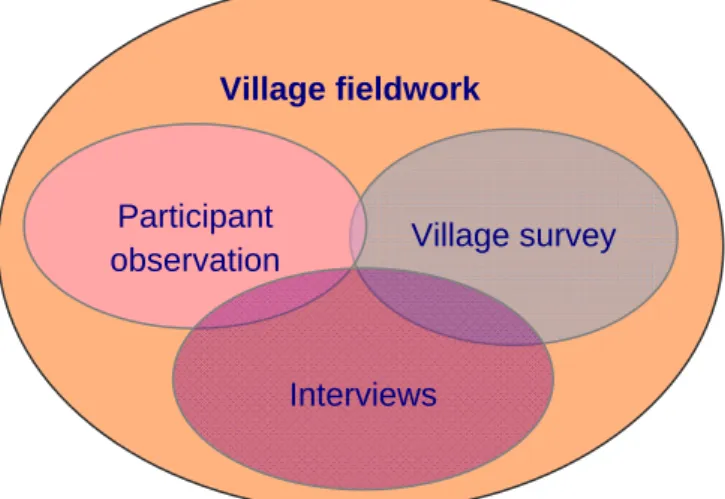
Ethical clearance for this research was granted by [removed for blind peer review]. In each village, permission was granted by appropriate leaders before research activities commenced. Data collection methods included semi-structured interviews with eight people, orally-administered surveys
with one hundred and seventy four (174) people and participant observation over about twenty five (25) days, as shown in Figure 1.
Figure 1: Methods used in the village fieldwork Copyright: author, 2008
The survey was conducted in Tok Pisin, with questions asked orally and verbal responses written down by the researcher. Following on from the survey, semi-structured interviews were conducted in each village with a small number of selected people of key interest to the research objectives. Semi-structured interviews “typically involve an interview guide as
opposed to a fully scripted questionnaire” (Willis, 2005, p. 20) which allows for some pre-determined questions to be used “flexibly according to what emerges” (Gillham, 2000, p. 3). In addition, detailed observations were made.
The data gathered includes both qualitative and quantitative data. Semi-structured interviews were transcribed and reviewed in search of recurring themes as well as insightful perspectives and illustrative anecdotes. Data analysis of the quantitative data was undertaken by entering the data into a software program (SPSS) and looking for patterns using standard representations such as frequency of responses. Basic statistical operations were carried out where appropriate.
Field Site 1
Orora is located on the mountainside on Karkar Island. Roads leading to the village are severely deteriorated. To reach Madang town, a long day’s journey is required, starting early in the morning on foot, followed by travel on the back of a truck and then a ferry ride. All of the houses in Orora are made of bush materials. There is no electricity supply. One family has a generator, but it is often not in use as it is difficult to get fuel for the generator from the stores on the coast.
Village survey Participant
observation
Interviews Village fieldwork
In terms of access to services, there is a very basic health facility in the next village, Urugen. A high incidence of sicknesses was visible in Orora, with regular evidence of skin infections, yaws and malaria. Community-based elementary schools provide “the first three years of formal
schooling” (Hopkins et al., 2005, p. 78) in PNG, usually in the vernacular language (Weeks, 1993), and feed into primary schools, where English language education commences (Hopkins et al., 2005, p. 77). The elementary school in Orora is run in the Catholic Church building. A
primary school operates in Urugen and is open to children from Orora. The Catholic Church building is the only permanent building in Orora and it is visited by a priest on a rotational basis. Access to water is problematic in Orora, with only one family owning a rainwater tank. During the dry
season, this tank tends to run out of water as all the villagers use its water. There is no marketplace or store in Orora, although a market operates in neighbouring Urugen one day a week.
Mobile phone reception became available in Orora in December 2007, when the new Digicel tower located in the neighbouring village of Narer commenced operations. There is full mobile reception throughout Orora, as shown by the reception graph on the mobile handset screen in Photo 1.
Photo 1: A villager in Orora holding up a mobile phone1 There are 50 houses in Orora. The researcher visited all of the houses during a stay in the village in February 2009, surveying 72 adults in total. Once the surveys were completed, three interviews were conducted with: village leader Albert Wowe regarding traditional communication
techniques; Shong ‘Moks’ Naing, the first man in the village to own a mobile phone, and village woman Gering Balipini. Detailed observations were also made.
Field Site 2
Megiar is a coastal village on the mainland. It is situated on a sealed road, with buses making regular trips to Madang town. Two of these buses are owned by families in Megiar. It takes about 90 minutes to get from Megiar
1
to town in a bus. Housing ranges from bush material houses, to semi-permanent houses using mixed materials2 and permanent houses. Some homes have mains electricity connected.
It takes about an hour and a half to walk to Mugil Health Centre from Megiar (Binib, 2009). Mugil Health Centre also has an ambulance. The elementary school in Megiar has its own bush material buildings. A
primary school is located at the edge of Megiar, catering for children from Megiar and other villages. A Catholic Mission Station is located next to Megiar, offering a range of services such as training courses and a bore water pump. Megiar residents obtain access to water from a range of sources, such as wells and springs. Some families have rainwater tanks or drums for storing water. An active marketplace operates in Megiar on a daily basis and can benefit from passing trade. There are several trade stores, at least two of which are open on a daily basis.
Digicel coverage extended to Megiar in October 2007 due to the construction of a tower at Barikas, a mountaintop village overlooking Megiar (see Photo 2).
Photo 2: The Digicel tower at Barikas (PNG 524 Didur)
Research was conducted in Megiar between September and November 2009. At that time, there were 116 houses in Megiar. 102 questionnaires were administered in total, with at least one person from each of the sub-areas within Megiar represented. Ninety-nine of the respondents lived in Megiar, while three lived in nearby villages, but were visiting Megiar at the time. Semi-structured interviews were undertaken with selected informants of key interest. The four people interviewed were: Kathy Uamo, the Head Teacher at the primary school; Willy Binib, a local ‘flex’ card (mobile phone credit) seller; Jacinta Fong, the President of the Megiar women’s group, and Fr Arnold Warangima, the Megiar Parish Priest. In addition,
Pancratius 'Pan' Lakot, a Megiar person who resides in Madang town was interviewed. Also, notes based on ethnographic observations were made daily, and reviewed and added to each evening.
2
Key Findings
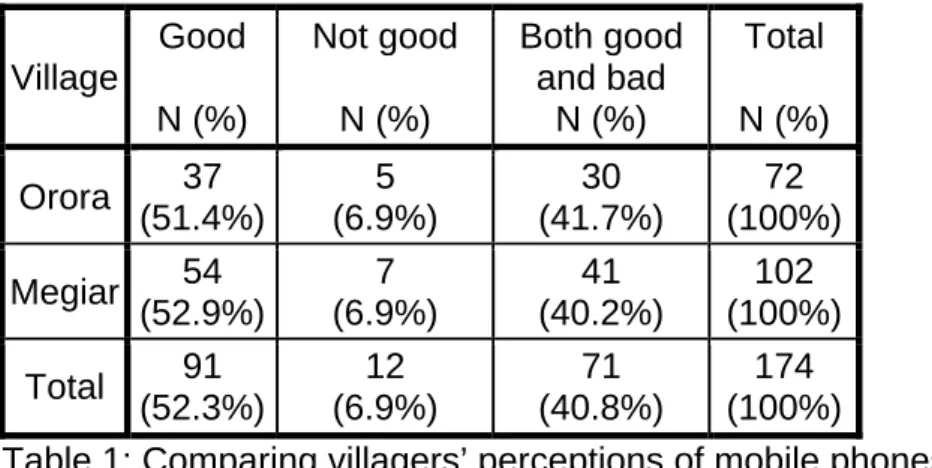
Despite marked differences between Orora and Megiar in terms of location and available services, there are striking similarities in the perceptions held by the villagers in both places regarding mobile phones. When asked whether they think that the introduction of mobile phones into PNG is a good or bad thing, the responses were similar for each village. About half responded that it is a positive development; a very small number said that it is a negative change, and a sizeable group expressed mixed feelings (see Table 1). A Pearson chi-square test was performed (Moore, McCabe & Craig, 2009, p. 531) to see if the proportions differ between the two villages. This test showed that there is no evidence of any differences in proportions between the two villages (p-value=0.979).
--- Table 1 about here
--- The explanations given for these perceptions were closely aligned as well. In terms of positives, people in both Orora and Megiar saw the main advantage of mobile telephone reception as the ability to talk to family members and friends who live a long way away. Two other positives were articulated in a high number of responses in both villages: the mobile phone can be used to send messages seeking assistance, and it is easier to make a phone call than to travel. In relation to the latter point, a number of respondents in both villages also pointed out that they can save money by using the mobile phone to convey information rather than paying for transport. A smaller but still substantial number of respondents in both villages also mentioned the role that a mobile phone can play in an emergency.
Negative changes in village life that were linked to mobile phones by survey respondents consistently related to three areas of concern: money, sex and crime. With regard to the first of these three categories,
respondents expressed concern about the high costs associated with purchasing, operating and recharging mobile phones. They said that the mobile phone makes villagers waste money, arguing that it is too
expensive for village people, who lead mainly subsistence lifestyles. The second concern was linked to the perception that the mobile phone could facilitate the formation of inappropriate relationships. In the case of
married people, this could lead to mistrust and arguments within couples, and even infidelity and marriage breakdown. With regard to young people, the phone’s enabling of private communication worried parents as it
restricted their ability to monitor the friendships which their children were forming. They feared this could lead to young people having unplanned pregnancies or marrying partners who were not vetted by their parents and therefore may be inappropriate or unsuited to them. The third concern related to crime. It was stated that potential thieves and other criminals
were able to use their own mobile phones to coordinate attacks and thefts. Villagers believed that raskols - a Tok Pisin word referring to gangs or criminals in general – could use mobile phones to arrange hold-ups on the road.
In its focus on mobile phones, the survey sought information on mobile phone ownership. In terms of ownership, a quarter of respondents in Orora owned a mobile phone (25.0%), with the majority of the remainder explaining that they did not own a mobile phone because it was too costly to purchase. By contrast, half of those surveyed in Megiar owned a mobile phone (50.0%).
The head of the Megiar women’s group believed that there was a gender imbalance amongst mobile phone owners, with disproportionately more men owning mobile phones than women (Fong, 2009). To establish whether gender has any bearing on whether or not villagers own a mobile phone, a Pearson chi-square test was performed (Moore et al., 2009, p. 531). In the case of the Megiar data, this test found that there is
reasonable evidence of dependence between these two variables, at 5% statistical significance (0.05>p-value>0.025). This means that there is some reason to believe that a person’s gender does have some impact on whether or not they own a mobile phone, with men in Megiar apparently more likely to own a mobile phone than women. By contrast, there is not evidence in the Orora data to indicate that dependency exists between gender and mobile phone ownership, again using the Pearson chi-square test (0.8>p-value>0.75). When considering all of the survey data from both villages combined, the same statistical test shows that a person’s gender does not have a bearing on mobile phone ownership (p-value=0.2). To establish usage patterns, mobile phone owners were asked to recall how much they used their phones on the previous day (see Table 2). In Orora, only one third of respondents had made at least one phone call on the previous day (33.3%), about a quarter had received at least one phone call on that day (27.8%), a third had sent at least one text message
(33.3%) and roughly a quarter had received at least one text message on that day (27.8%). Mobile phone usage in Orora is thus very low. In Megiar, there are some people who use their phones more (one respondent made ten phone calls on the previous day), but there are many mobile phone owners who have low usage (35.3% made one or two phone calls in a day) or are not using their phones at all (35.3% made no phone calls in a day). Of the fifty-one mobile phone owners surveyed in Megiar, eight did not use their phone at all on the preceding day.
--- Table 2 about here
--- The mobile phone handsets belonging to two residents of Orora had been stolen during road travel on foot on Karkar Island prior to the survey
period. In Megiar, six people were without mobile phones after they had been stolen. Eight of the eighteen mobile phone owners in Orora had no battery power in their handset at the time that they were surveyed. By contrast, only one of the mobile phone owners surveyed in Megiar had no battery power at the time, while a further two were without access to their handset that day as the battery was being charged.
A common feature of the basic mobile phone handsets sold in developing nations is the inclusion of a flashlight torch to assist with lighting in places where there is no electricity. It was noted that this function is used a great deal in Orora, particularly after nightfall if villagers are moving about, for example travelling on foot between houses or villages, or walking from the house to the toilet. Although this was not included in the survey in Orora (the magnitude of the phenomenon arose during the Orora fieldwork), in Megiar it was found that 64.7% of mobile phone owners used the flashlight torch function in their handset. Of the remainder, some did not have that feature in their phone.
The researcher wished to ascertain whether the mobile phone was being used in income generation activities. In Orora, there was no evidence of the phone being used in this manner, and interviewees were unsure as to what was meant by this line of questioning. Cocoa is the main cash crop in Orora, along with coconut. One interviewee is also the owner and operator of the only cocoa fermentary in Orora. He explained that there is no
benefit in using the mobile phone to establish which buyer on the coast has the best purchasing price as his transport options are so limited that he is not able to take the cocoa to the buyer of his choice (Naing, 2009). The situation in Megiar is different, with more informal economic activities already taking place. Some families have established profitable ‘flex’ card selling enterprises (Binib, 2009; Warangima, 2009). In addition, some survey respondents mentioned their use of the mobile phone in communicating with buyers who are based in the highlands. Although basic mobile phone handsets with limited capabilities are common in PNG, some people have handsets with cameras and/or the capacity to store images. In Megiar, 10.3% of mobile phone owners reported using their phone camera. It was discovered in September 2009 that there were pornographic images in children’s phones at the primary school (Uamo, 2009). The school’s staff and Board of Management
became aware of this when one student informed them that other students were sharing these images and showing them to students on the school grounds (Uamo, 2009). This situation has led to children being banned from bringing mobile phones to Megiar’s primary school (Uamo, 2009), although it may be difficult to halt the distribution of inappropriate images amongst the children (Warangima, 2009).
In terms of media access in Orora, there is no landline telephone infrastructure or television reception and no-one owns a television, computer or Internet connection. Less than one third of the survey
respondents (30.5%) had access to a working radio receiver in their home at the time that the survey was carried out. In Megiar, there is no landline telephone infrastructure. Small numbers of Megiar survey respondents had a television or a computer in their home (7.8% and 5.9% respectively), but no home in Megiar had an Internet connection. About one third of the survey respondents (34.3%) had a functioning radio receiver at home. Table 3 compares the household figures for communication and media devices in the two villages.
--- Table 3 about here
--- Television viewing is much more common in Megiar than the television ownership levels may suggest (50.0% of respondents had watched television within the last month) because those with televisions allow others to watch them, usually for a small fee. The satellite dish in Photo 3 is used for the broadcast of popular programming. An area is fenced off and attendees are charged a gate fee.
Photo 3: Satellite dish for television viewing in Megiar
Only 15.3% of survey respondents in Orora had read a newspaper in the last month. A very small number of survey respondents from Orora had watched television or seen a movie within the last month during travels to places outside of Orora (5.6% and 9.7% respectively). In Megiar, the mass media is more common in the lives of the people than in Orora, although computer usage remains low (see Table 4). The newspaper rates as the most popular medium, with 69.6% of respondents in Megiar having read a newspaper within the last month.
--- Table 4 about here
--- To gain further insights into communicative ecologies, the frequency of travel to an urban centre was considered (see Table 5). Of the survey respondents in Orora, only 1.4% had been to Bogia, one of the two service
towns, within the preceding month, and 16.7% had been to Madang town in the same period. By contrast, 6.9% of survey respondents in Megiar had been to Bogia during the last month, and a large number (75.5%) had been to Madang town during the same timeframe.
--- Table 5 about here
--- In Orora, the researcher noticed regular, almost daily, use of a traditional drum named the garamut. This is an important part of the communication landscape within the village, both in the contemporary setting as well as in more traditional times. Beating a garamut can convey a range of
messages, such as inviting people to a gathering, reminding them about a community working bee or notifying them of a death. In Orora, there are several clans. These clans have distinctive garamut tones. This enables a message to be sent which will be noted only by those members of a particular clan. Also, an individual’s own garamut serves as their “mobile phone number” (Wowe, 2009), meaning that they can be signalled if they are not at their own home. An individual will recognise their own garamut’s timbre and will thus realise that they are required at home. Photo 4 shows a garamut in use.
Photo 4: The local Ward Member beating the biggest of his three garamuts
By contrast, the garamut is no longer used for communication within Megiar or between Megiar and surrounding villages (Binib, 2009; Uamo, 2009) as it was in earlier times (Binib, 2009). The reasons for the
discontinuation of garamut usage are unclear. This change pre-dated the introduction of mobile phone reception. The only contemporary use of the garamut in Megiar is on school day mornings as a signal informing primary school students that it is time for classes (see Photo 5).
Photo 5: Garamut at primary school in Megiar Discussion
The levels of approval regarding mobile phones and the perceived
advantages and disadvantages of mobile telephony in the village context were closely aligned between these two villages. This similarity is all the more striking given the differences between the two villages in terms of their communicative ecologies, development status, proximity to an urban centre and access to services. For survey respondents in both Orora and Megiar, the most frequently expressed benefit of mobile telephony is the ability to communicate with family members and friends who reside in other parts of the country. This assessment of the main benefit of mobile telephony as being social is in keeping with research which has been done in other countries (cf. Bell, 2005; LIRNEasia, 2007; Tabinas & Guzman, 2010; Walsh, White & Young, 2007). Another important benefit of mobile telephony in rural areas of PNG is the role it stands to play in
emergencies, particularly in places like Orora where transportation is difficult to organise and other communication options are limited (Naing, 2009).
Although the mobile phone was viewed favourably by half the people in each of these communities, the concerns which were expressed were real and important to respondents, as evidenced by their explicit and firm comments. Research has found that “affordability remains the biggest obstacle to phone ownership” (LIRNEasia, 2007, np) amongst the poor in Asia. It is evident that the high costs associated with owning, operating and recharging a mobile phone are likewise major challenges for rural poor in PNG. As is the case with contemporary concerns in developed nations about the role of the Internet-based social networking site Facebook in marriage breakdown ("Affairs Start on Facebook," 2010; Facebook Ups Divorce," 2009), so too are people in PNG concerned about the advent of a new communication technology negatively impinging on marital stability. Similar concerns about technology facilitating extra-marital affairs were felt in the late 1800s with the advent of residential telephones (Marvin, 1988, p. 69) and more recently in Jamaica regarding mobile phones (Horst & Miller, 2006, pp. 169-170).
Until the advent of mobile telephony, parents and community members in Orora and Megiar were able to monitor the communicative behaviours and friendships of young people and could advise them regarding the choice of partners (Fong, 2009). Now, adults express confusion about young
people’s uses of mobile phones and are not able to monitor whom they are communicating with (Binib, 2009; Fong, 2009). The use of mobile phones to facilitate relationships is unsuited to the traditional way of finding prospective marriage partners, which was practiced in Orora and Megiar until mobile phone reception became available.
Although an earlier study found that early adopters of mobile phones thought these devices could enhance their safety (Ling & Haddon, 2003), in Orora and Megiar people worried the advent of this technology might decrease their safety, due to the potential use of phones by raskols to coordinate a range of criminal activities. The difference in context is perhaps important here: in rural areas of PNG, emergency services such as police and ambulances are often unavailable or unreliable.
Mobile phone owners in both Orora and Megiar have been subject to mobile phone theft. Although the Megiar Parish Priest said the incidence of phone theft has started to decline (Warangima, 2009), these cases may have fuelled the concerns expressed regarding the possible connection between mobile telephony and criminal activities. In Jamaica, similar concerns have been expressed, with suggestions that the mobile phone is a useful tool for professional assassins (Horst & Miller, 2006, p. 169). Mobile phone ownership rates in Orora in February 2009 were lower than ownership rates in Megiar later in the same year. Nonetheless, in both villages, there is relatively high penetration, given the short length of time that mobile service has been available. A high number of non-owners said they had not been able to afford to purchase a mobile phone. Although more people in Megiar owned mobile phones, there were still concerns in that community about the costs involved in operating these devices. Usage was low in Orora. Although usage patterns in Megiar were
generally higher, many mobile phone owners used their phones very little. It is likely that low usage levels in both places relate to the costs
associated with operating mobile phones. Recharging handset batteries can also be time-consuming, costly and difficult, although this problem is more severe in Orora, due to the lack of electricity infrastructure there. During the survey period in Orora, eight of the eighteen mobile phone owners volunteered the information that their phone had no battery power at the time that they were surveyed. This means that as few as ten mobile phones were working in the whole village at that time. In Megiar, the situation is different as there are houses with power connected.
Nonetheless, recharging the handset battery remains a challenging and costly exercise for some Megiar residents, costing as much as three Kina (approximately 1.50 AUD) per recharge in some cases. This usually means the owner is without their phone for about a day.
Another factor that may impact upon phone usage rates is the location of ‘flex’ card (mobile phone credit) sellers. In Orora, there are no residents who sell ‘flex’ cards, whereas in Megiar several residents have established businesses purchasing these cards in town at wholesale prices and then selling them in the village. Photo 6 shows a bush material hut erected in front of a family home in Megiar for the purpose of selling ‘flex’ cards. When a person registers as a ‘flex’ card seller, they receive an identity number that enables them to purchase cards at wholesale prices, and signs like the one shown in the photo.
Photo 6: ‘Flex’ card selling hut in Megiar
Mobile phone handsets offer various functions aside from voice calls and text messages. In both Orora and Megiar, a popular handset function is the torch (or flashlight). According to Greenfield, designers added the torch function to mobile phone handsets after they observed users in developing countries using the screen’s luminescence to provide light in locations with inadequate lighting (Greenfield, 2009).
In research conducted with poor market vendors in the Philippines, Tabinas and Guzman (2010) found that the mobile phone does improve communication and have a range of benefits, but it cannot be linked directly to improved income. Similarly, in Orora and Megiar, there are as yet weak indications of the use of the mobile phone to directly enhance household income. The potential benefit of mobile telephony in terms of income generation activities in Orora is limited due to other factors such as restricted access to both transport and markets. This finding fits with the outcomes of computer modelling which has shown that if transportation costs are prohibitively high, then communication technologies may be of limited value for poor farmers (DeMaagd, 2010).
The strong action taken in banning mobile phones from the primary school in Megiar due to concerns about students accessing and sharing
pornography mirrors the situation at a primary school in the Port Moresby area which has also banned students from using mobile phones in school, due to similar concerns ("Parents Ban Mobile Use," 2009). The issue of pornographic images in phones has led to a tribal fight in the highlands of
PNG (Alphonse, 2010) and has been raised both in court cases (Kelola, 2009; Tiden, 2008) and in the national parliament (Pendene, 2009). Travel between Megiar and Madang town is frequent, and people have access to a range of services, communication tools and media products during such journeys. The communicative ecologies in Orora and Megiar are quite different from each other. In Orora, there is a virtual absence of media access and no use of computers, whereas in Megiar there is more access to media, but computer use remains minimal. One interviewee from Megiar who resides in Madang town suggested that the garamut has not been used as a communication tool in Megiar since about 1970, and that no garamuts have been built since that time (Lakot, 2009). He is unsure of the reasons behind the change, but wonders if the construction of a road network may be the reason that garamut use has faded from daily life (Lakot, 2009).
Conclusion
Mobile telephony, on the evidence of this study, is taking its place among the array of factors introducing the shock of modernity (c.f. Toffler, 1970), as well as opportunities for economic and community development, into PNG life on an ongoing basis. It is a powerful medium which people have a desire to possess (shown by quick uptake and relatively high ownership rates in these communities), regardless of their existing communicative ecology. The mobile phone has the capacity to bring about entirely new situations (like the ability to communicate instantly with people far away), the power to create opportunities (as with small-scale entrepreneurism under way through supply of ‘flex’ cards or stores charging money to recharge batteries) and the potential to cause social tension and trouble (as with anxiety about sexual relations and crime). A potent factor is the prompt establishment of coverage across wide areas of the country, meaning there is less time available to adjust to the impacts of this medium of communication, compared with others like television or print media. There is evidence here that the culture, or “way of life” (Williams, 1988, p. 90), is changing in each of these two villages as mobile telephony is being integrated into day-to-day activities.
The mobile phone is not at this early stage enhancing the lives of the people in these two rural villages to the extent that may have been envisaged. In particular, ICT4D literature presents a dominant view that communication technologies lead to economic improvement (DeMaagd, 2010). Therefore, based on this body of literature, it was hypothesised that an increase in the presence and success of income generation activities would be evident in these two field sites. Although generally villagers are in favour of mobile telephony, the primary benefit that they cite is in the use of this technology in social communication, and there appears to be little evidence of this technology greatly enhancing household incomes, at least in its early stages.
Further research is recommended in order to tease out the issues raised in this research project. Undertaking similar research in other rural villages in Madang Province, and in other provinces in PNG, would help to
ascertain whether the trends noted in Orora and Megiar are more widespread. In particular, it would be of interest to see if the same perceptions of mobile phones are expressed in other places. This
research does not consider the role of mobile telephony in urban centres in PNG, although some understanding can be gleaned, given the
importance of communication with towns cited by rural villagers. Research which is situated in towns or cities in PNG would be valuable in creating a more comprehensive picture of mobile phone use and attitudes towards mobile phones.
This research addresses changes currently occurring in the
communication methods of whole communities which previously had little or no access to modern services and communication technologies.
Notwithstanding the differences between Orora and Megiar, both villages have a low development base, as measured by their levels of wealth and services, and what they have in common is indicative of the condition of a large proportion of PNG’s rural areas. Therefore, it is expected that similar outcomes could be found with respect to mobile telephony in other rural PNG villages. This paper shows that gains have been made with improved communication over distances. However, the contribution of the mobile phone in transforming rural lives for the better can be limited due to
external factors such as low funds, poor transport infrastructure, restricted access to markets and lack of electricity provision. Comparison of Orora and Megiar is strategic as it highlights the striking similarities in
perceptions of mobile phones, provoking better understanding, and thereby giving a useful indication of patterns to look for in villages throughout PNG, or in other developing nations.
Acknowledgements
References
Affairs Start on Facebook. (2010, 16 July). mX, p. 9.
Alphonse, A. (2010, 27 January). Phone Porn Sparks Clash. The National
Barker, P. (2008). ICT Legislation and Policy: Commentary. Paper presented at the PNG
Update. Goroka.
Basnett, B. S., & Brien, D. (2009). Implications of telecommunications liberalisation for small and medium enterprises in Vanuatu. Pacific Economic Bulletin, 24(2)
Bell, G. (2005). The Age of the Thumb: A Cultural Reading of Mobile Technologies from Asia. In P. Glotz, S. Bertschi & C. Locke (Eds.), Thumb Culture: The Meaning of
Mobile Phones for Society (pp. 67‐87). New Brunswick, USA: Transaction Publishers.
Binib, W. (2009). Interview: Willy Binib, 'flex' card seller. Megiar.
Chib, A. (2009). The Aceh Besar Midwives with Mobile Phones Program: Design and Evaluation Perspectives using the Information and Communication Technologies for Healthcare Model. Paper presented at the “Mobile 2.0: Beyond Voice?”: Pre‐
conference workshop at the International Communication Association (ICA)
Conference. Chicago, Illinois.
Crotty, M. (1998). The Foundations of Social Research. St Leonards, Australia: Allen & Unwin.
de Bruijn, M., Nyamnjoh, F., & Brinkman, I. (Eds.). (2009). Mobile Phones: The New
Talking Drums of Everyday Africa. Leiden: Langaa and African Studies Centre.
DeMaagd, K. (2010). The Spatial Value of ICT: A Complex Systems Approach. Paper presented at the 60th Annual ICA (International Communication Association)
Conference: Matters of Communication: Political, Cultural & Technological
Challenges. Suntec City, Singapore.
Donner, J. (2008). Research Approaches to Mobile Use in the Developing World: A Review of the Literature. The Information Society, 24(3), 140‐159.
Facebook Ups Divorce. (2009, 22 December). mX, p. 8.
Fogg, B. J. (2007). The Future of Persuasion is Mobile. In B. J. Fogg & D. Eckles (Eds.), Mobile Persuasion: 20 perspectives on the future of behaviour change (pp. 5‐11). Stanford, California: Persuasive Technology Lab, Stanford University.
Fong, J. (2009). Interview: Jacinta Fong, President, St Monica Mama Group. Megiar.
Gillham, B. (2000). The Research Interview. London: Continuum.
Goggin, G. (2006). Cell Phone Culture: Mobile Technology in Everyday Life. London: Routledge.
Goggin, G., & Newell, C. (2006). Disabling Cell Phones. In A. Kavoori & N. Arceneaux (Eds.), The Cell Phone Reader: Essays in Social Transformation (pp. 155‐172). New York: Peter Lang.
Govender, A. (2010). 'Sell‐phones in South Africa'. Paper presented at the 19th Annual
AMIC (Asian Media Information and Communication Centre) Conference:
Technology and Culture: Communication Connectors and Dividers. Suntec City, Singapore.
Government of Papua New Guinea, & United Nations in Papua New Guinea (2004). Papua New Guinea – Millennium Development Goals Progress Report 2004.
Greenfield, A. (2009). Personal communication with the author (Half hour one‐on‐one meeting with Nokia's head of design direction for service and user‐interface design ed.). Brisbane, Australia.
Hawk, B., & Rieder, D. M. (2003). Introduction: On Small Tech and Complex Ecologies. In B. Hawk, D. M. Rieder & O. Oviedo (Eds.), Small Tech:The Culture of Digital Tools (pp. ix‐xxiii). Minneapolis: University of Minnesota Press.
Hopkins, S., Ogle, G., Kaleveld, L., Maurice, J., Keria, B., Louden, W., et al. (2005).
‘Education for Equality’ and ‘Education for Life’: Examining Reading Literacy and Reading Interest in Papua New Guinea Primary Schools. Asia‐Pacific Journal of
Teacher Education, 33(1), 77‐96.
Horst, H. A., & Miller, D. (2006). The Cell Phone: An Anthropology of Communication. Oxford: Berg.
Katz, J. E. (2006). Magic in the Air. New Brunswick, USA: Transaction Publishers.
Katz, J. E. (2008). Lecture. Queensland University of Technology, Brisbane, Australia.
Kavoori, A., & Chadha, K. (2006). The Cell Phone as a Cultural Technology: Lessons from the Indian Case. In A. Kavoori & N. Arceneaux (Eds.), The Cell Phone Reader:
Essays in Social Transformation (pp. 227‐239). New York: Peter Lang.
Kelola, T. (2009, 20 July). Phone Porn Perturbs. PNG Post Courier, p. 4.
Kreutzer, T. (2008). Getting the Numbers Straight: Mobile Internet Usage by Low‐Income South African Youth. Paper presented at the MobileActive08. Johannesburg.
Lakot, P. (2009). Interview: Pancratius 'Pan' Lakot, Maintenance Controller, HeliNiugini, Madang town end of communication link with Megiar. Madang.
Levinson, P. (2004). Cellphone: The Story of the World's Most Mobile Medium and How It
Has Transformed Everything! New York: Palgrave Macmillan.
Ling, R., & Haddon, L. (2003). Mobile Telephony, Mobility, and the Coordination of Everyday Life. In J. E. Katz (Ed.), Machines That Become Us: The Social Context of
Personal Communication Technology (pp. 245‐265). New Brunswick, NJ: Transaction Publishers.
LIRNEasia (2007). Teleuse at the Bottom of the Pyramid. Retrieved 26 June 2008, from
http://lirneasia.net/projects/2006‐07/bop‐teleuse
Marcus, G. E. (1995). Ethnography in/of the World System: The Emergence of Multi‐ Sited Ethnography. Annual Review of Anthropology, 24, 95‐117.
Marshall, S. (2008). Correspondents Report – PNG mobile dispute reaches crisis point. Retrieved 18/4/08, from
http://www.abc.net.au/correspondents/content/2008/s2202568.htm
Marvin, C. (1988). When Old Technologies Were New: Thinking about Electric
Communication in the Late Nineteenth Century. New York: Oxford University Press.
Moore, D. S., McCabe, G. P., & Craig, B. A. (2009). Introduction to the Practice of
Statistics: Extended Version (6th ed.). New York: W. H. Freeman and Company.
Naing, S. M. (2009). Interview: Shong 'Moks' Naing, first man in Orora to own a mobile phone. Orora.
National Statistical Office of Papua New Guinea (2004). Population and Social Statistics. Retrieved 15 October 2008, from
http://www.spc.int/prism/country/pg/stats/Pop_Soc_%20Stats/popsoc.htm
Pannu, P. (2010). Public Service Announcements related to Health on Mobile Phones: Emerging Paradigm for Socio Economic Development of the Urban Poor. Paper presented at the 19th Annual AMIC (Asian Media Information and
Communication Centre) Conference: Technology and Culture: Communication
Connectors and Dividers. Suntec City, Singapore.
Papoutsaki, E., & Sharp, S. (2005). Island Nations in the South Pacific and their Communication Needs: From a Journalism Education Perspective. Paper presented at the 14th AMIC Annual Conference, ‘Media and Society in Asia’. Beijing, China.
Parents Ban Mobile Use. (2009, 2 September). PNG Post Courier, p. 21.
Pendene, J. (2009, 18 November). Mobile Phone Porn Rife. PNG Post Courier, p. 3.
Rice, J. E. (2003). Overhearing: The Intimate Life of Cell Phones. In B. Hawk, D. M. Rieder & O. Oviedo (Eds.), Small Tech: The Culture of Digital Tools (pp. 95‐97).
Minneapolis: University of Minnesota Press.
Rynkiewich, M. A. (2004). Cultures and Languages of Papua New Guinea. Goroka, PNG: The Melanesian Institute.
Spasojevic, M., Hinman, R., & Dzierson, W. (2007). Mobile Persuasion Design Principles. In B. J. Fogg & D. Eckles (Eds.), Mobile Persuasion: 20 Perspectives on the Future
of Behaviour Change (pp. 115‐121). Stanford, California: Persuasive Technology Lab, Stanford University.
Stanley, D. (1982). South Pacific Handbook (2nd ed.). Chico, USA: Moon Publications.
Sundari, T. T. (2010). Effects of cell phone use on rural women micro entrepreneurs: an Indian experience. Paper presented at the 19th Annual AMIC (Asian Media
Information and Communication Centre) Conference: Technology and Culture:
Communication Connectors and Dividers. Suntec City.
Tabinas, R. J. A., & Guzman, A. A. B. D. (2010). Effects of Mobile Phone Use on the Livelihood of Market Vendors in Eastern Philippines Paper presented at the 19th
Annual AMIC (Asian Media Information and Communication Centre) Conference:
Technology and Culture: Communication Connectors and Dividers. Suntec City, Singapore.
Tacchi, J. A., Slater, D., & Hearn, G. (2003). Ethnographic Action Research: A user's
handbook developed to innovate and research ICT applications for poverty
eradication. New Delhi: UNESCO.
Tiden, G. (2008, 17 March). Cop in for Porn. PNG Post Courier, p. 6.
Toffler, A. (1970). Future Shock. London: Pan Books.
Uamo, K. (2009). Interview: Kathy Uamo, Head Teacher, St Francis Xavier Megiar Primary School. Megiar.
United Nations (2009). Human Development Report 2009: Papua New Guinea. Retrieved 27 April 2010, from
http://hdrstats.undp.org/en/countries/country_fact_sheets/cty_fs_PNG.html
Walsh, S. P., White, K. M., & Young, R. M. (2007). Young and Connected: Psychological Influences of Mobile Phone Use Amongst Australian Youth. In G. Goggin & L. Hjorth (Eds.), Mobile Media 2007 (pp. 125‐134). University of Sydney.
Warangima, A. (2009). Interview: Fr Arnold Warangima, Parish Priest, Megiar Parish. Megiar.
Weeks, S. G. (1993). Education in Papua New Guinea 1973‐1993: The late development effect? Comparative Education, 29(3), 261‐274.
Williams, R. (1988). Keywords: A Vocabulary of Culture and Society. London: Fontana Press.
Willis, G. B. (2005). Cognitive Interviewing: A Tool for Improving Questionnaire Design. Thousand Oaks: Sage Publications.
Wowe, A. (2009). Interview: Albert Wowe, Orora Community Chairman. Orora.
Village Good N (%) Not good N (%) Both good and bad N (%) Total N (%) Orora 37 (51.4%) 5 (6.9%) 30 (41.7%) 72 (100%) Megiar 54 (52.9%) 7 (6.9%) 41 (40.2%) 102 (100%) Total 91 (52.3%) 12 (6.9%) 71 (40.8%) 174 (100%)
Village Phoned out N (%) Received phone call N (%) Sent text message N (%) Received text message N (%) Orora 6 (33.3%) 5 (27.8%) 6 (33.3%) 5 (27.8%) Megiar 33 (64.7%) 34 (66.7%) 21 (41.2%) 34 (66.7%) Table 2: Comparing mobile phone use on the previous day
Village Landline telephone N (%) Television N (%) Computer N (%) Internet N (%) Radio N (%) Orora 0 (0.0%) 0 (0.0%) 0 (0.0%) 0 (0.0%) 22 (30.5%) Megiar 0 (0.0%) 8 (7.8%) 6 (5.9%) 0 (0.0%) 35 (34.3%) Table 3: Comparing household media devices in two villages
Village Newspaper N (%) Television N (%) Movie N (%) Computer N (%) Internet N (%) Radio N (%) Orora 11 (15.3%) 4 (5.6%) 7 (9.7%) 0 (0.0%) 0 (0.0%) 27 (37.5%) Megiar 71 (69.6%) 51 (50.0%) 65 (63.7%) 8 (7.8%) 2 (2.0%) 62 (60.8%) Table 4: Comparing media access in the preceding month
Village Travel to Bogia N (%) Travel to Madang town N (%) No travel to urban centre N (%) Total N (%) Orora 1 (1.4%) 12 (16.7%) 59 (81.9%) 72 (100%) Megiar 7 (6.9%) 77 (75.5%) 18 (17.6%) 102 (100%) Table 5: Comparing travel away from villages