Affective Focus Increases
the Concordance Between
Implicit and Explicit Attitudes
Colin Tucker Smith
1and Brian A. Nosek
21
Ghent University, Ghent, Belgium,
2University of Virginia, Charlottesville, VA, USA
Abstract.Two attitude dichotomies – implicit versus explicit and affect versus cognition – are presumed to be related. Following a manipulation of attitudinal focus (affective or cognitive), participants completed two implicit measures (Implicit Association Test and the Sorting Paired Features task) and three explicit attitude measures toward cats/dogs (Study 1) and gay/straight people (Study 2). Based on confirmatory factor analysis, both studies showed that explicit attitudes were more related to implicit attitudes in an affective focus than in a cognitive focus. We suggest that, although explicit evaluations can be meaningfully parsed into affective and cognitive compo-nents, implicit evaluations are more related to affective than cognitive components of attitudes.
Keywords:affect, cognition, implicit attitudes, explicit attitudes, structural equation modeling
Over 80 years ago, L. L. Thurstone wrote, “It will be con-ceded at the outset that an attitude is a complex affair which cannot be wholly described by any single numerical index” (1928; p. 530). For years, measurement lagged behind Thurstone’s appreciation of attitude complexity as assess-ments deliberately simplified attitudes into singular, sum-mary evaluations. However, some applications have made useful distinctions, such as parsing affective and cognitive components of attitudes (e.g., Eagly & Chaiken, 1993). Further, over the past decade and a half, another parsing of that “complex affair” distinguishes between implicit and explicit components of attitudes. In this article, we inves-tigate the relationship between these two approaches to parsing the attitude construct.
Implicit attitudes are those that can be elicited without an act of introspection, whereas explicit attitudes, in con-trast, are the products of evaluative introspection (Green-wald & Banaji, 1995; Nosek & Green(Green-wald, 2009). Implicit and explicit attitudes are related but distinct (Nosek & Smyth, 2007), and both are predictive of behavior (Green-wald, Poehlman, Uhlmann, & Banaji, 2009). Explicit atti-tudes are commonly assessed with direct, self-report mea-sures such as asking “Do you like fish?”, whereas implicit measures usually use indirect means to infer evaluations. For example, evaluative priming compares the speed of evaluating a good or bad word immediately after a prime is presented. If the prime activates positivity, then the eval-uation of good words should be relatively faster than the evaluation of bad words (e.g., compared to a neutral prime).
It is important to note that the conception of “implicit” in both theory and measurement is heterogeneous. Implicit evaluations generally earn the term “implicit” if they lack one or more features of a typical self-report of one’s eval-uation: awareness of evaluating the target, intention to evaluate, control over the evaluation, and deliberation in making an evaluation (see Bargh, 1994; De Houwer, Teige-Mocigemba, Spruyt, & Moors, 2009; Nosek & Greenwald, 2009, for further discussion). Because of the heterogeneous quality of the “implicit” construct, there is considerable in-terest and debate about which processes (e.g., awareness, control, intention) are relevant for characterizing the dif-ferences between implicit and explicit measurement, espe-cially among the various measures that are considered to be implicit. This article is agnostic as to which particular evaluative processes distinguish implicit and explicit mea-sures. Instead, we take the fact that they elicit distinct eval-uations in some domains as our starting point and investi-gate whether shifting mindsets to be focused on one’s thoughts or feelings has implications for the strength of relation among these measures.
As research on the distinction between implicit and ex-plicit attitudes has evolved, imex-plicit evaluation has increas-ingly been described in affective terms (see Spence & Townsend, 2008, for a review). In fact, implicit attitudes have become nearly synonymous with the terms “automat-ic affective reactions” and “immediate affective reactions” (e.g., Friese & Hofmann, 2009; Gawronski & Bodenhau-sen, 2007; Hofmann, Friese, & Roefs, 2009; Huntsinger &
Smith, 2009; LeBel & Campbell, 2009; Payne, Govorun, & Arbuckle, 2008; Quirin, Kazen, & Kuhl, 2009). Howev-er, while there is some extant support for this interpretation, the evidence is incomplete because the contrast to “affect” (usually conceived of as “cognition”) has been inconsis-tently or weakly operationalized. For the studies reported in this article, we operationalized affect and cognition using an approach that closely follows the form that they are most commonly conceptualized in the present literature, wherein
affectrefers toemotions and feelingsabout the attitude
ob-ject andcognitionrefers tothoughts and beliefsabout the attitude object (Aikman & Crites, 2007; van den Berg, Manstead, van der Pligt, & Wigboldus, 2006; Crites, Fab-rigar, & Petty, 1994; Fabrigar & Petty, 1999; Farley & Stas-son, 2003; Giner-Sorolla, 2004; Haddock, Maio, Arnold, & Huskinson, 2008; Lavine, Thomsen, Zanna, & Borgida, 1998; Petty, Wegener, & Fabrigar, 1997; See, Petty, & Fab-rigar, 2008; Verplanken, Hofstee, & Janssen, 1998; Zanna & Rempel, 1988).
Some Evidence That Implicit
Attitudes Have More in Common
With Affect Than Cognition
Some studies have investigated the link between implicit attitudes and affective components of attitudes. For exam-ple, Banse, Seise, and Zerbes (2001) reported higher cor-relations between implicit and explicit measures when the explicit measures asked for affective as opposed to cogni-tive evaluations of gay people. However, this was trueonly
when gay people comprised half of the sample; among straight people, implicit attitudes were not differentially re-lated to affective versus cognitive self-reports.
Additionally, a study that evidenced a reduction in anti-black implicit bias following a course in diversity educa-tion (Rudman, 2004; Rudman, Ashmore, & Gary, 2001) suggested that changes observed in implicit attitudes may have been primarily driven by shifts in affective variables such as increased friendships with, a reduction in fear of, and an increased liking for African-Americans. Rudman and colleagues also found that implicit attitudes toward smoking and body weight are related to early childhood experiences (and explicit attitudes to more recent experi-ences). They suggest that childhood is more affective in nature, while the present is more cognitive (Rudman, Phe-lan, & Heppen, 2007; but see Castelli, Carraro, Gawronski, & Gava, 2010).
Ranganath, Smith, and Nosek (2008) found that explicit attitudes toward gay people were more related to implicit attitudes when those self-reports were referred to as “gut reactions” and “initial responses” as opposed to “actual feelings,” and when “given time to think fully about my feelings.” Similarly, Gawronski and LeBel (2008) found that implicit and explicit attitudes were more related when
participants focused on their feelings toward the attitude object versus their reasons for their preference or their knowledge about the attitude object. In another context, Scarabis, Florack, and Gosejohann (2006) found that im-plicit measures related to consumer choices when partici-pants made those choices while focusing on their feelings, but not while analyzing their reasons. These latter two pa-pers built on evidence that, because people do not have easy introspective access to their mental processes (Nisbett & Wilson, 1977), focusing on reasons leads to less satis-faction with behavioral choices (Wilson et al., 1993). The presumption is that reasons analysis leads people to con-fabulate factors that are actually irrelevant to the basis of their preferences. Reasons analysis is related to cognitive components of attitudes, but is more focused on the delib-erative process of generating reasons than the cognitive components of attitudes themselves.
A final piece of evidence linking implicit with affective components of attitudes more than cognitive components of attitudes comes from a meta-analysis of the relationship between implicit and explicit evaluations (Hofmann, Gaw-ronski, Gschwendner, Le, & Schmitt, 2005). Explicit mea-sures were coded by whether they were relatively affective (e.g., thermometer ratings of warmth) or cognitive (e.g., trait ratings); affective attitudes were found to be more re-lated to implicit attitudes than were cognitive attitudes across a variety of attitude topics.
While the existing literature is generally supportive of the hypothesis that implicit attitudes are more related to affective than cognitive components of attitude self-re-ports, most of the work has been correlational. The best experimental evidence to date used the reasons-analysis paradigm to disrupt the quality of self-report with thoughts that are irrelevant to the evaluation. It is possible that this manipulation shifted participants from an affective focus to a cognitive one. However, in the attitude literature about affective and cognitive components of attitudes, the latter are not necessarily weaker, less predictive of behavior, or less reflective of one’s mental representations (e.g., Crites et al., 1994; Lavine et al., 1998). As such, the “reasons” condition in the prior experimental research may not ap-propriately be thought of as capturing the cognitive com-ponents of evaluation.
Reasons analysis guides participants to think about the antecedent causes of their evaluation, rather than the evaluation itself. A cognitive focus, on the other hand, is supposed to keep participants’ attention on the evaluation itself rather than how they arrived at it. As such, reasons analysis manipulations may have just distracted partici-pants away from the basis of their evaluation whether af-fective or cognitive, rather than provide a good “cogni-tive focus” comparison. Our approach was to focus di-rectly on the relationship betweenimplicit-explicit and
affect-cognitiondimensions, without trying to disrupt the
quality of decision-making with deliberative reasoning or by operationalizing “cognition” in a way that may be less relevant for evaluation.
Overview of Studies
We tested the prediction that implicit attitudes are more related to affect than to cognition by manipulating attitudi-nal focus (affective focus vs. cognitive focus) between par-ticipants before assessing attitudes using multiple implicit and explicit measures with regard to cats and dogs (Study 1) and gay people and straight people (Study 2). The evi-dence from both studies suggests that an affective focus facilitates convergence of implicit and explicit attitude measures compared to a cognitive focus.
Study 1
In Study 1, we investigated the relationship between im-plicit and exim-plicit attitudes following a manipulation of at-titudinal focus. Crites and colleagues (1994) clarified how to distinguish between affective and cognitive attitudinal components and identified words that were primarily affec-tive (referring to feelings and emotions) or cogniaffec-tive (re-ferring to thoughts and beliefs). We induced a feeling-fo-cused or belief-fofeeling-fo-cused mode of processing by using these affective or cognitive words to manipulate attitudinal fo-cus: Participants read a short passage about attitudes to-ward pets and responded to multiple questions about their feelings (or thoughts) about cats and dogs. If implicit atti-tudes are primarily related to affect, then attitude reports focused on feelings and emotions may share more features with implicit attitudes than attitude reports focused on thoughts and beliefs that may correspond to slower, reflec-tive, and more controllable processes.
Participants completed multiple implicit and explicit at-titude measures in either an affective or cognitive focus condition. We tested our hypotheses in a confirmatory fac-tor analysis framework with comparative model fitting (see John & Benet-Martinez, 2000 for a detailed treatment of the rationale behind the use of this statistical strategy and Nosek & Smyth, 2007; Ranganath et al., 2008, for related examples of a model comparison approach). This approach has some important advantages over a more familiar ap-proach of comparing implicit-explicit zero-order correla-tions between “affect” and “cognitive” condicorrela-tions: (1) model comparisons are more sensitive (powerful) to detect-ing differences, zero-order comparisons are underpowered tests (Cohen, 1988), (2) comparing structural models al-lows a comparison of the latent factors of multiple mea-sures (the Implicit Association Test and Sorting Paired Fea-tures for implicit measures) rather than individual compar-isons of single measures, and (3) structural models mitigate unreliability of measurement enhancing the sensitivity of the tests (Baron & Kenny, 1986; Jaccard & Wan, 1999; Wu & Zumbo, 2008). We conducted hypothesis testing through comparative model fitting of different confirmatory models representing the relations among implicit and explicit
mea-sures in affective and cognitive experimental conditions. This tested whether the commonality between implicit and explicit evaluations was maximized in the affective-focus condition compared to the cognitive-focus condition.
Method
Participants
A group of 124 undergraduate students completed the study in partial completion of a course requirement. The mean age of the sample was 18.8 years, and 58% of the partici-pants were female.
Measures
Implicit Association Test (IAT)
The IAT (Greenwald, McGhee, & Schwartz, 1998) mea-sures associations between attitude objects (e.g., cats and dogs) and evaluative attributes (e.g., good and bad). Partic-ipants categorized pictures and words – presented in the center of a computer monitor into one of four categories using the “a” key to sort stimuli into the categories appear-ing on the left, and the “;” key for categories appearappear-ing on the right. Participants completed this task in seven blocks following the recommendations of Nosek, Greenwald, and Banaji (2005). In particular, participants first practiced cat-egorizing pictures of cats and dogs for 20 trials (Block 1), then practiced categorizing good and bad words for 20 tri-als (Block 2). Following these two practice blocks, partic-ipants categorized cats and good words with one key sponse (“a”) and dogs and bad words with another key re-sponse (“;”) for 56 trials (separated into blocks of 20 [Block 3] and 36 trials [Block 4] by a single trial instructing them to take a brief rest). Participants then practiced categorizing cats and dogs with the opposite keys from their first prac-tice block for 40 trials (Block 5). Finally, they categorized dogs and good words with one key response (“a”) and cats and bad words with the other key response (“;”) for 56 trials (again in two blocks of 20 [Block 6] and 36 trials [Block 7]). The difference in average response time sorting cats and good words together (and dogs and bad words togeth-er) compared to the reverse combination is taken as an in-dicator of association strengths between the animals and evaluative attributes. The order of these two categorization conditions was counterbalanced between participants. If participants made a categorization error, a red “X” ap-peared below the stimulus and the trial continued until the participant made the correct response. Stimuli appeared immediately following a correct response with an intertrial delay of 150 ms.
The IAT was scored following theDscoring algorithm (Greenwald, Nosek, & Banaji, 2003) with trial responses less than 400 ms deleted. Mean latencies were calculated
for each block of the task, and twoD-subscores were cal-culated by dividing the difference between the mean laten-cies for Block 3 from those of Block 6 (and likewise for Block 4 and Block 7) by the mean standard deviation of the trials in those blocks. Therefore, the first D-score is con-structed using the first 20 trials (i.e., Blocks 3 and 6) and the secondD-score uses the remaining 36 trials (i.e., Blocks 4 and 7). These twoD-scores served as the two IAT indi-cators for the confirmatory factor analyses. IAT scores were coded such that higher values indicated a stronger implicit preference for dogs relative to cats.1
Sorting Paired Features Task (SPF)
The SPF (Bar-Anan, Nosek, & Vianello, 2009) assesses the strength of associations between attitude objects (cats and dogs) and evaluative terms (good and bad) by having par-ticipants rapidly categorize word and picturepairsinto one of four conjoint category responses (i.e., cats + good, cats + bad, dogs + good, dogs + bad) presented in the four cor-ners of the screen.
Each trial of the SPF consisted of the presentation of a pair of stimuli – either a good or bad adjective directly below either a dog or cat picture – in the center of the com-puter screen. Pairs were categorized into the appropriate category (e.g., dogs + good) using the “q” key to sort pairs into the category appearing in the upper-left corner, the “c” key for the lower-left corner, the “p” key for the upper-right corner, and the “m” key for the lower-right corner. Each pair of stimuli appeared immediately following a correct response with an intertrial delay of 150 ms.
Participants responded to three blocks of 80 trials each, using the same stimuli from the IAT. Half of the participants performed an SPF with the two categories for cats on the left side and the two categories for dogs on the right side, and half of the participants completed an SPF with the dog and cat categories reversed.
The scoring algorithm for the SPF was adapted from the algorithm used with the IAT (Greenwald et al., 2003). First, trials in which the participant responded in less than 400 ms were deleted. A mean latency was then calculated for trials in each of the four category pairings (e.g., cats with good). SeparateD-scores were calculated for attitudes toward cats and dogs by taking the difference between mean latencies in a given block for categorizing attitude objects when paired with good items versus when paired with bad items and dividing by the standard deviation of the latencies for those trials. Positive scores indicated positive implicit atti-tudes toward the animal. To create a relative attitude that conceptually paralleled the IAT, we calculated the differ-ence between the catsD-score and the dogsD-score, result-ing in three manifest indicators, one from each block of 80
trials, with positive scores indicating a preference for dogs relative to cats.
Explicit Ratings
Participants reported their attitudes toward cats and dogs using a set of 8-point semantic differentials anchored by the following word pairs: bad/good, negative/positive, and unfavorable/favorable. All three semantic differentials were used to report attitudes toward both cats and dogs, for a total of six explicit ratings. Three manifest variables were created by calculating difference scores with positive num-bers indicating a preference for dogs relative to cats.
Procedure
Attitudinal focus was manipulated by first presenting a pa-ragraph relevant to either feelings and emotions or thoughts and beliefs about pets. In addition, participants rated their level of agreement with 14 affect- (or cognition-) relevant statements. Some items asked them to rate their level of agreement with a statement, whereas other items were sen-tence stems that participants completed using a Likert-type scale anchored by word pairs (e.g., “Dogs make me . . .” anchored by “sad” and “happy” in the affective focus con-dition, or, agree-disagree ratings of “For the most part, I believe that dogs are a mindless animal” in the cognitive focus condition). See the Appendix for the full text of the paragraphs and sentences.
After this manipulation, participants completed the two implicit attitude measures. Participants were then exposed to the attitudinal focus manipulation again before complet-ing explicit attitude measures. Durcomplet-ing the second manipu-lation, each of the 14 questions was changed so that if a participant responded to some aspect of their feelings (or beliefs) about cats the first time, the question asked them about dogs the second time. The order of implicit and ex-plicit procedures was counterbalanced between partici-pants; the two implicit procedures were always presented together and their order was counterbalanced between par-ticipants.
Analysis Strategy
Hypotheses were tested using model comparisons of con-firmatory factor analyses (Jöreskog, 1969). This technique has emerged as a powerful method for hypothesis testing that can represent and compare alternative structure of re-lations between multiple observed indicators of various constructs (John & Benet-Martinez, 2000; see similar ap-plications in Nosek & Smyth, 2007; Ranganath et al.,
1 The selection of targets and attributes is, of course, critical to interpreting any effects that are elicited (e.g., Bluemke & Friese, 2006; Steffens & Plewe, 2001; for a review of this and other procedural issues pertaining to the use of IATs see also Lane, Banaji, Nosek, & Greenwald, 2007; Nosek et al., 2005; Nosek et al., 2007).
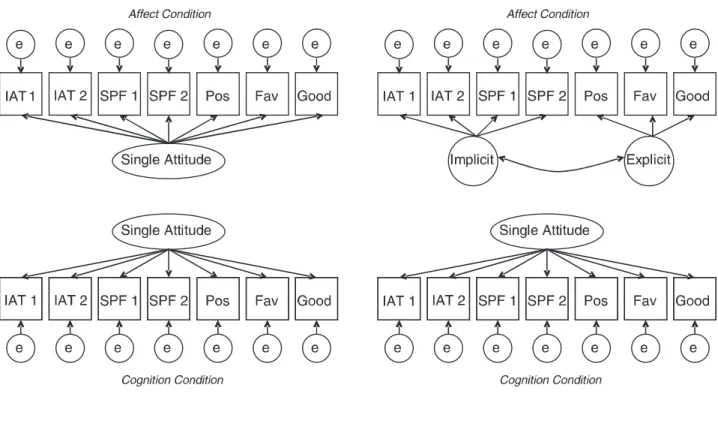
Figure 1. Representation of models within the structural model comparison series. Squares represent measured variables, and circles represent latent factors. Affect condition is on top of each individual model, and cognition condition is on bottom. IAT1 and IAT2 are indicators of the IAT; SPF1 and SPF2 are indicators of the SPF. Pos = positivity; Fav = favorability; Good = goodness.
2008). For example, one of the advantages of structural equation modeling is that shared method variance (e.g., of the implicit measures) is statistically removed from the re-lationship between the latent constructs, thereby clarifying extant relationships (e.g., Baron & Kenny, 1986; Jaccard & Wan, 1999; Wu & Zumbo, 2008). In confirmatory factor analysis, the experimenter uses theory to make decisions about relationships between manifest variables (measured during the study) and underlying latent variables (hypoth-esized, but not measured). The theorized data structure is then compared to the observed data structure, and the re-sulting chi-square estimate provides information about the goodness-of-fit of theory to data. We tested a series of mul-tiple-group models that allowed imposition of distinct fac-tor structures for our affective and cognitive focus groups. With multiple-group modeling, groups can have distinct theorized factor structures and the chi-square estimate tests the overall fit across groups. This is critical for testing our hypothesis that implicit and explicit measures will cohere more strongly in the affect condition compared to the cog-nition condition.
The assessment of each model’s fit was based on the chi-square estimate and the root mean square error of ap-proximation index (RMSEA, orεa).εais a comparative
as-sessment of the value of parsimony against the tendency for overall fit to improve in more complex representations. In other words,εais an indicator of the balance between
model fit and model complexity. The rule of thumb for model fitting is that anεaof < .05 is a “close” fit, .05–.08
is a “fair” fit, .08–.10 is a “mediocre” fit, and > .10 is a “poor” fit (MacCallum, Browne, & Sugawara, 1996).
The model comparison series (see Figure 1 for a repre-sentation of the four models) begins with a baseline model in which all manifest variables (five implicit and three ex-plicit) were indicated by a single latent factor. This is a one-attitude model against which we compare the other models. This first model represents the hypothesis that an implicit-explicit distinction is not necessary in order to un-derstand the relation among the various attitude measures. In the second model, a single constraint is relaxed so that two separate latent factors (one implicit and one explicit) are estimated in the affect condition, whereas a single fac-tor is again estimated in the cognition condition. In other words, the correlation between implicit and explicit atti-tudes is set to 1 (i.e., perfectly positively correlated) in the cognition condition, whereas it is freely estimated in the affect condition. A significance test compares the fit of these two representations. With this design, that signifi-cance test is the conceptual parallel to a comparison of cor-relations with the attendant advantages of representing all of the relations simultaneously in a single structural model. If the second model provides a significant improvement in fit over the baseline model (which holds the correlation between implicit and explicit attitudes to be 1 in both the affect and cognition condition), then we would conclude that implicit and explicit attitude measures in the affect condition are better represented by a dual implicit and
ex-plicit attitude model than a single attitude model. The third model does the opposite in comparison to the first model. The single factor is retained in the affect condition, and two factors (implicit and explicit) are estimated in the cognition condition. Similar to Model 2, if this shows a significant improvement in fit over Model 1, then we would conclude that implicit and explicit measures in the cognitive condi-tion are better represented as assessing distinct but related attitudes than as a single attitude factor. The fourth and final model estimates a separate implicit and explicit attitude factor for both affective and cognitive conditions; the cor-relation is freely estimated in both the affective and the cognitive condition. Conceptually speaking, the sequence of model comparisons is similar to a moderation analysis testing whether the relationship between implicit and ex-plicit latent variables is moderated by the experimental condition (Reinecke, 2002; Rigdon, Schumacker, & Woth-ke, 1998).
When comparing nested models, the inference test of differences in relative model fit is to place a 95% confi-dence interval (CI) around theεa of the change in
chi-square (εaΔ). If this CI encompasses .05, then the models
are considered to be close to one another meaning that any improved fit due to adding model complexity is not worth the loss of parsimony.
Results and Discussion
Descriptive Statistics
Indicators of implicit and explicit attitudes showed that participants self-reported preferring dogs over cats (Mdiff=
1.87,SD= 2.11,t(123) = 9.88,p < .0001,d = 0.89) and nonsignificantly preferred dogs over cats using the IAT (M
= 0.06,SD= 0.36,t(123) = 1.81,p =.07,d= 0.16). Using the SPF, participants showed a nonsignificant preference for dogs over cats (Mdiff= 0.06,SD= 0.41,t(123) = 1.57,
p =.12,d= 0.14). No differences in means or variances of animal preferences were hypothesized or found between conditions on any of the explicit or implicit measures (all
ts < 1.1). In other words, an affective or cognitive focus did not change average liking for dogs or cats.
Comparative Model Fitting
Here we summarize the absolute fits of the four structural models and then report the inferential tests of comparative model fits to test the primary hypotheses. See Table 1 for model fit statistics for both studies. Model 1 estimated a single latent attitude in both affective and cognitive condi-tions and was a “poor” fit to the data (χ²(40) = 96.5,εa=
.11). This replicates prior research findings that indicate implicit and explicit attitude measures do not conform well to a single-attitude structure (Cunningham, Preacher, & Banaji, 2001; Greenwald & Farnham, 2000; Nosek &
Smyth, 2007; Ranganath et al., 2008). Model 2 (single at-titude in the cognition condition and distinct implicit and explicit attitudes in the affect condition) was a “mediocre” fit to the data (χ²(39) = 79.3,εa= .09). Model 3 (single
attitude in the affect condition, and distinct implicit and explicit attitudes in the cognition condition) was a “fair” fit to the data (χ²(39) = 65.1,εa= .07). Finally, Model 4, which
estimated distinct, but related, implicit and explicit atti-tudes in both conditions was a “close” fit to the data (χ²(38) = 48,εa= .05).
Affect vs. Cognition
To answer whether attitudinal focus influences the concor-dance between implicit and explicit attitudes, we used in-ference tests to compare fit improvements from Model 1 (single attitude model) to Model 2 (single cognitive atti-tude, distinct affective attitudes) versus Model 3 (single af-fective attitude, distinct cognitive attitudes). Both showed a significant improvement in fit over Model 1; Model 1 versus 2 (Δχ²(1) = 17.2, 95% CIεaΔ= .19–.54), Model 1
versus 3 (Δχ²(1) = 31.4, 95% CIεaΔ= .32–.67) indicating
that, in both affective and cognitive focus conditions, im-plicit and exim-plicit attitudes are more appropriately consid-ered distinct but related constructs.
Model 2 and Model 3 are not nested and have the same number of degrees of freedom, so it is not possible to for-mally test whether one model makes a significantly larger improvement in fit. Instead, a comparison of their improve-ments over the baseline single-attitude model shows that Model 3, which fit a single attitude for the affective condi-tion and two distinct attitudes for the cognicondi-tion condicondi-tion is a much better improvement in fit (Δχ² = 31.4) than Model 2, which fit two attitude factors for the affective condition and a single attitude for the cognition condition (Δχ² = 17.2).
Model 4, which fit a dual implicit-explicit attitude model for both affect and cognition conditions was a better overall
fit than both Model 3 (Δχ²(1) = 17.1, 95% CIεaΔ= .19–.54)
and Model 2 (Δχ²(1) = 31.3, 95% CIεaΔ= .32–.67). This
suggests that implicit and explicit attitudes are still best conceived as related but distinct, even with an affective focus. However, this does not challenge the primary con-clusion that explicit attitudes are more related to implicit attitudes when one has an affective focus than when one has a cognitive focus.
While comparatively underpowered compared to the formal model comparisons, it is possible to assess the ex-tent to which implicit and explicit attitudes are related by looking at the correlation between the implicit and explicit constructs in Model 4. In the cognition condition, implicit and explicit latent constructs covaried at .51,p < .0001, whereas in the affect condition these constructs covaried at .72,p< .0001; these two correlations are marginally dis-tinct from one another (z= 1.92,p= .055) within the con-text of that single model. This observation reaffirms the inferential test of these relations from the comparative model fitting.
In sum, these data affirm that a dual-attitude structure is the best way to characterize the relationship between im-plicit and exim-plicit attitudes regardless of attitudinal focus, but focusing on one’s feelings increases the concordance between implicit and explicit attitude measures more than does focusing on one’s thoughts.
Study 2
The results of Study 1 support the prediction that cognitive versus affective focus influences the relationship between implicit and explicit attitude measures. Implicit and explic-it attexplic-itudes cohered to a single attexplic-itude factor better in an affective focus condition than in a cognitive focus condi-tion. However, estimating separate implicit and explicit
at-Table 1. Goodness of fit and model comparison information for structural models
Study 1
Model χ² df Δχ²/df εa 95% CIεaofΔ
Model 1: Single affective, Single cognitive 94.9 40 .10
Model 2: Two affective, Single cognitive 78.6 39 16.3/1 .09 .18–.53 Model 3: Single affective, Two cognitive 63.5 39 31.4/1 .07 .32–.67 Model 4: Two affective, Two cognitive 47.2 38 16.3/1 .04 .18–.53 Study 2
Model χ² df Δχ²/df εa 95% CIεaofΔ
Model 1: Single affective, Single cognitive 46.8 28 .09
Model 2: Two affective, Single cognitive 41.4 27 5.4/1 .08 .03–.43 Model 3: Single affective, Two cognitive 36.1 27 10.7/1 .06 .13–.53 Model 4: Two affective, Two cognitive 30.7 26 5.4/1 .04 .03–.43
Note.εa= root mean square error of approximation (RMSEA) for each model. 95% CIεaofΔ= confidence interval around RMSEA of the
change in fit between models. If the CI contains .05, then model fits are not considered to be significantly different. For Models 2 and 3,Δχ²/df
= change inΔχ² per degrees of freedom relative to Model 1. Model 4, however, is compared to Model 3, which is the better fitting of the mixed single-factor/dual-factor models.
titudes fit better than estimating a single attitude in either the affective or the cognitive conditions. This suggests that the correlation between implicit and explicit evaluations departs significantly from perfect correspondence, even when participants are focusing on their feelings and emo-tions. In Study 2, we sought to strengthen the conclusion by assessing attitudes in a different attitude domain – gay people and straight people. We hypothesized that attitudes toward gay people may be especially likely to include con-flicting affective and cognitive inputs, because of cognitive beliefs about fairness and equality as well as relatively neg-ative affects toward gay people (e.g., Moreno & Bodenhau-sen, 2001). This difference between affective and cognitive reactions may provide for stronger shifts in implicit-explic-it convergence based on our affective-cognimplicit-explic-itive focus ma-nipulation compared to attitudes toward dogs and cats.
Method
Participants
A group of 95 undergraduate students completed the study as partial completion of a course requirement. 53% were female, and the mean age of the sample was 18.7 years.
Measures
Implicit Association Test
The procedure for the presentation and scoring of the IAT was identical to Study 1. Attitude object stimuli were words relevant to gay and straight people (Nosek et al., 2007). Positive scores indicate a relative preference for straight people over gay people.
Sorting Paired Features
The stimuli sets used for the SPF were identical to those used for the IAT. The procedure was the same as in Study 1 except that two blocks of 80 trials were administered (rather than three blocks as in Study 1). Two manifest vari-ables were created (one from each block of 80 trials) by calculating relative scores such that positive numbers indi-cate a preference for straight people relative to gay people.
Explicit Ratings
Participants rated their attitudes toward both gay people and straight people using semantic differentials: bad/good, negative/positive, and unfavorable/favorable. Three mani-fest variables were created by subtracting attitudes toward gay people from attitudes toward straight people for the
semantic differentials such that positive scores indicate a preference for straight people.
Attitudinal Focus Manipulation
To induce attitudinal focus, participants read a paragraph highlighting feelings and emotions (or thoughts and be-liefs) about gay and straight people. And, as in Study 1, participants evaluated 14 statements about gay and straight people with either an affective or cognitive focus (see the Appendix for the full text of the paragraphs and sentences).
Procedure
Participants read an opening paragraph about either affec-tive or cogniaffec-tive attitudes toward gay and straight people and responded to 14 items regarding their affective or cog-nitive reactions toward gay people and straight people be-fore completing a set of explicit attitude measures. The ma-nipulation was then reinstated after the report of explicit attitudes when participants responded again to the 14 state-ments before completing a set of implicit attitude measures. The procedure and counterbalancing rules were the same as in Study 1.
Results and Discussion
Descriptive Statistics
Across conditions, participants self-reported more positiv-ity for straight people than for gay people (Mdiff= 1.01,SD
= 1.75,t(94) = 5.62,p< .0001,d= 0.58). They also showed an implicit preference for straight people relative to gay people on the IAT (M= 0.29,SD= 0.29,t(94) = 9.59,p< .0001,d= 0.98). On the SPF, participants also showed an implicit preference for straight people relative to gay peo-ple (Mdiff= 0.24,SD= 0.41,t(94) = 5.79,p < .0001,d =
0.59). No main effects or variance differences were found on any of the explicit or implicit measures based on exper-imental condition (allts < 0.99).
Comparative Model Fitting
As in Study 1, we first summarize the overall fits of the four structural models and then report the hypothesis test-ing with the relevant model fit comparisons. Model 1 esti-mated a single attitude in both conditions and showed a “mediocre” fit to the data (χ²(28) = 46.8,εa= .09)2. Model
2 (single attitude in the cognition condition and two distinct attitudes in the affect condition) also had a “mediocre” fit (χ² (27) = 41.4,εa= .08), whereas Model 3 (single attitude
2 The error variance on the second indicator of the IAT was estimated to be negative. Because this leads to an inadmissible solution, we followed the recommendation of Rindskopf (1984) in setting the error variance to 1.00 and estimating the pathway to the error variable.
in the affect condition, and separate attitudes in the cogni-tion condicogni-tion) was a “fair” fit to the data (χ²(27) = 36.1, εa= .06). Finally, Model 4, which estimated separate, but
related, implicit and explicit attitudes in both conditions was a “close” fit to the data (χ²(26) = 30.7,εa= .04).
Affect vs. Cognition
To assess whether implicit and explicit attitudes are more related when one is focusing on affect (versus cognition), the relevant model comparison is whether there was a meaningful difference in improvement in fit when moving from estimating a single attitude in both conditions (Model 1) to estimating separate implicit and explicit attitudes in either the affect condition (Model 2) or the cognition con-dition (Model 3). Replicating Study 1, estimating distinct attitude factors resulted in a significant improvement over the baseline, single-attitude model when participants were focusing on cognition (Model 3;Δχ²(1) = 10.7, 95% CIεaΔ
= .13–.53). However, estimating separate attitudes in the affective focus condition (Model 2) did not result in a sig-nificant improvement over the single attitude model (Δχ²(1) = 5.4, 95% CI εaΔ = .03–.43). Furthermore,
al-though estimating separate attitudes in both conditions (Model 4) was an improvement over estimating separate attitudes in the affect condition and one attitude in the cog-nition condition (Model 2: Δχ²(1) = 10.7, 95% CI εaΔ =
.13–.53), it was not a significant improvement over Model 3 (Δχ²(1) = 5.4, 95% CIεa = .03–.43) that fit a single atti-tude in the affect condition and two separate attiatti-tudes in the cognition condition.
As before, we can examine the difference in implicit-ex-plicit correlations in Study 4 as a more familiar (but weak-er) means of comparing conditions compared to the formal model comparisons. Implicit and explicit attitudes were more strongly related in the affect condition (r= .48,p= .015) than they were in the cognition condition (r= .17,p
= .37), though this difference was not significant (z= 1.70,
p= .089) – despite the fact that the formal model compar-isons did find significant differences. This is illustrative of the underpowered correlation comparison tests compared against the more modern methods of representing and test-ing structural relations.
Taken together, this suggests that when people focused on the cognitive components of their attitudes, their self-reported attitudes were different enough from their implicit attitudes that they were distinct constructs. However, when people focused on the affective components of their atti-tudes, their self-reported attitudes were similar enough to their implicit attitudes that the added structural complexity of a two-factor solution was not necessary3. Thus,
com-pared to a cognitive focus, inducing an affective focus
in-creases the concordance between implicit and explicit atti-tude measures.
General Discussion
In two studies we found that implicit and explicit attitudes were more related when focusing on feelings and emotions (i.e., affect) than on thoughts and beliefs (i.e., cognition). Study 1 found that implicit and explicit attitudes toward cats and dogs formed a single factor more effectively (though not completely) when participants focused on af-fective portions of attitudes as opposed to cognitive por-tions of those attitudes. The pattern of results in Study 2 supported the hypothesis more clearly. In fact, implicit and explicit attitudes toward gay and straight people were sim-ilar enough to fit onto a single factor when those attitudes were expressed while participants were focusing on their feelings and emotions. Reasoned thoughts and beliefs, while attitudinally important, were not as related to implicit attitudes as were feelings and emotions.
In both studies, we found that implicit and explicit atti-tudes were less similar when one focused on one’s reasoned thoughts and beliefs and were more similar when focusing on one’s feelings and emotions. Therefore, the oft-stated assertion that affect is more related than cognition to im-plicit attitudes was supported consistently. Attitudes gen-erated following a cognitive focus still necessitated a two-factor solution, but additional work is needed to understand if focusing on affect increases the concordance between implicit and explicit attitudes for all attitude domains, or if it is limited in scope. It is unlikely that the domains we selected (pet and sexual orientation attitudes) are the only two domains for which this holds. However, it is possible that an affective focus might increase only the concordance for attitude objects that are particularly affective in nature, or for which affective and cognitive responses tend to be in conflict. For example, Giner-Sorolla (2004) found that the accessibility advantage of affect over cognition (Ver-planken et al., 1998) held true only for attitude objects that were affectively based. Additionally, when given conflict-ing affective and cognitive information, participants focus-ing on affect formed explicit evaluations in line with the valence of the affective information whereas those focus-ing on cognition formed explicit evaluations in line with the valence of the cognitive information (van den Berg et al., 2006). Though we did not measure it directly, attitudes toward pets and sexual orientation may be particularly af-fectively based. Selecting attitudes that are more cognitive-ly based may show no difference in implicit-explicit con-vergence based on the focus condition, or might even show greater convergence when in a cognitive focus. If so, this
3 We caution that the fact that the single-factor solution is sufficient for the affect condition should not be taken to suggest that implicit and explicit attitudes are the same in that condition. Such a conclusion would require accepting the null hypothesis. Given the overall strength of relations, such a conclusion is not likely to persist with a much larger sample.
would suggest a different interpretation of the present data. Rather than implicit attitudes being determined more by affective reactions than by cognitions, it could be that im-plicit evaluations derive from whatever is most elaborated or accessible, whether affective or cognitive (Nosek, 2005). In addition, there is evidence that people differ in the extent to which they base their explicit attitudes on affect or cognition (Haddock & Zanna, 1994; Huskinson & Had-dock, 2004; See et al., 2008). With the present interpreta-tion, we would anticipate that people who base their explic-it evaluations more on affect would tend to show stronger implicit-explicit relations than people who base their ex-plicit evaluations more on cognition. With the just articu-lated alternative interpretation, the strength of implicit-ex-plicit correspondence would depend on matching the per-son’s evaluative style with the focus manipulation. Clarifying which of these holds will have significant impli-cations for understanding the relationship between affect-cognition and implicit-explicit construct designations.
Also, future work could clarify whether a manipulation of attitudinal focus is more influential on shifting explicit atti-tudes, or whether both implicit and explicit attitudes converge concurrently. Although from our perspective, it is likely that explicit attitudes are more amenable to the influence of the manipulation, we cannot rule out the possibility that both implicit and explicit attitudes shifted because the manipula-tion was presented before both the implicit and explicit atti-tude measures. Presenting the manipulation following im-plicit measurement would isolate whether having an affective focus caused implicit and explicit attitudes to simultaneously become more related to one another or whether it caused participants to report explicit attitudes using attitudinal inputs that are more related to implicit attitudes.
Implications for Attitude Taxonomies
This work has implications for current attitude taxonomies – in particular the distinctions between affective and cog-nitive attitudes and the distinctions between implicit and explicit attitudes. For one, we observed additional evidence that implicit and explicit attitudes are best considered to be distinct, but related constructs (Nosek & Smyth, 2007). At the same time, these results provide evidence for some con-vergence between alternate taxonomies of implicit versus explicit attitudes, and affective versus cognitive compo-nents of attitudes.The observed pattern of results provides experimental evidence that implicit-explicit and affect-cognition may be partially redundant dual-process characterizations of eval-uation. We saypartiallyredundant, because it is obviously not the case that implicit equals affect and explicit equals cognition. Rather, reasoned thoughts and beliefs, while at-titudinally important, were not as related to implicit atti-tudes as were feelings and emotions suggesting that cogni-tions are less useful as indicators of implicit attitudes.
These results highlight a perplexing issue in psycholog-ical science – how do the associations in memory give rise to affective (or cognitive) experiences? While the studies certainly do not provide traction on resolving this question, they are, at least, consistent with an interpretation that ac-tivation of associations provides an affective experience and if people are focused on that experience then their at-titude reports will be more reflective of those associations. However, the cognitive components of attitudes may be a distraction rather than a contributor to the effects of auto-matically activated associations on evaluative reports. Put another way, focusing on reasons and beliefs may be a sec-ondary process that moves people away from using their activated associations as a basis for judgment. This certain-ly is not the oncertain-ly possible interpretation of the present data; many areas of research inquiry will likely contribute to clarifying this important question.
It is useful to point out that the terms “affect,” “cogni-tion,” “implicit,” and “explicit” are theoretically defined rather than fixed and unchanging. The evolving definitions respond to the accumulating construct validation evidence. In this case, we provide further evidence for a relationship between two taxonomic distinctions between attitudes – af-fective versus cognitive and implicit versus explicit. Given this relationship, whether both distinctions are useful and necessary for theories about attitudes will require addition-al theoreticaddition-al refinement and empiricaddition-al investigation.
Conclusion
In two studies, we found that explicit attitudes were more related to implicit attitudes when participants focused on feelings and emotions compared to thoughts and beliefs. Focusing on our emotions may blur the dividing line be-tween implicit and explicit attitudes and elicit attitude re-ports that are more related to our activated evaluative as-sociations.
Acknowledgment
We thank Yoav Bar-Anan, Anne Gast, Jesse Graham, Selin Kesebir, Kate Ratliff, Fred Smyth, and Michelangelo Via-nello for their helpful comments. This research was sup-ported by a grant from the National Institute of Mental Health (R01 MH68447) to Brian Nosek.
References
Aikman, S. N., & Crites, S. L., Jr. (2007). Structure of food
atti-tudes: Replication of Aikman, Crites, and Fabrigar (2006).
Ap-petite, 49, 516–520.
homosexuality: Reliability, validity, and controllability of the IAT.Zeitschrift fur Experimentelle Psychologie, 48, 145–160. Bar-Anan, Y., Nosek, B. A., & Vianello, M. (2009). The sorting
paired features task: A measure of association strengths.
Ex-perimental Psychology, 56, 329–343.
Bargh, J. A. (1994). The four horsemen of automaticity: Aware-ness, intention, efficiency and control in social cognition. In
R. S. Wyer Jr. & T. K. Srull (Eds.),Handbook of social
cogni-tion(2nd ed, pp. 1–40). Hillsdale, NJ: Erlbaum.
Baron, R. M., & Kenny, D. A. (1986). The moderator-mediator variable distinction in social psychological research:
Concep-tual, strategic, and statistical considerations.Journal of
Per-sonality and Social Psychology, 51, 1173–1182.
Bluemke, M., & Friese, M. (2006). Do features of stimuli
influ-ence IAT effects?Journal of Experimental Social Psychology,
42, 163–176.
Castell, L., Carraro, L., Gawronski, B., & Gava, K. (2010). On the determinants of implicit evaluations: When the present
weighs more than the past.Journal of Experimental Social
Psychology, 46, 186–191.
Cohen, J. (1988).Statistical power analysis for the behavioral
sciences(2nd ed.). Hillsdale, NJ: Erlbaum.
Crites, S. L., Fabrigar, L. R., & Petty, R. E. (1994). Measuring the affective and cognitive properties of attitudes: Conceptual and
methodological issues.Personality and Social Psychological
Bulletin, 20, 619–634.
Cunningham, W. A., Preacher, K. J., & Banaji, M. R. (2001). Im-plicit attitude measures: Consistency, stability, and convergent
validity.Psychological Science, 12, 163–170.
De Houwer, J., Teige-Mocigemba, S., Spruyt, A., & Moors, A. (2009). Implicit measures: A normative analysis and review.
Psychological Bulletin, 135, 347–368.
Eagly, A. H., & Chaiken, S. (1993).Psychology of Attitudes. Fort
Worth, TX: Harcourt, Brace, Jovanovich.
Fabrigar, L. R., & Petty, R. E. (1999). The role of the affective and cognitive bases of attitudes in susceptibility to affectively and
cognitively based persuasion.Personality and Social
Psychol-ogy Bulletin, 25, 363–381.
Farley, S. D., & Stasson, M. F. (2003). Relative influences of af-fect and cognition on behavior: Are feelings or beliefs more
related to blood donation intentions?Experimental
Psycholo-gy, 50, 55–62.
Friese, M., & Hofmann, W. (2009). Control me or I will control you: Impulses, trait self-control, and the guidance of behavior.
Journal of Research in Personality, 43, 795–805.
Gawronski, B., & Bodenhausen, G. V. (2007). Unraveling the pro-cesses underlying evaluation: Attitudes from the perspective
of the APE model.Social Cognition, 25, 687–717.
Gawronski, B., & LeBel, E. (2008). Understanding patterns of attitude change: When implicit measures change, but explicit
measures do not.Journal of Experimental Social Psychology,
44, 1355–1361.
Giner-Sorolla, R. (2004). Is affective material in attitudes more ac-cessible than cognitive material? The moderating role of attitude
basis.European Journal of Social Psychology, 34, 761–780.
Greenwald, A. G., & Banaji, M. R. (1995). Implicit social
cogni-tion: Attitudes, self-esteem, and stereotypes.Psychological
Review, 102, 4–27.
Greenwald, A. G., & Farnham, S. D. (2000). Using the Implicit Association Test to measure self-esteem and self-concept.
Journal of Personality and Social Psychology, 79, 1022–1038.
Greenwald, A. G., McGhee, D. E., & Schwartz, J. L. K. (1998). Measuring individual differences in implicit cognition: The
Implicit Association Test.Journal of Personality and Social
Psychology, 74, 1464–1480.
Greenwald, A. G., Nosek, B. A., & Banaji, M. R. (2003). Under-standing and using the Implicit Association Test: I. An
im-proved scoring algorithm.Journal of Personality and Social
Psychology, 85, 197–216.
Greenwald, A. G., Poehlman, T. A., Uhlmann, E., & Banaji, M. R. (2009). Understanding and using the Implicit Association Test:
III. Meta-analysis of predictive validity.Journal of Personality
and Social Psychology, 97, 17–41.
Haddock, G., Maio, G. R., Arnold, K., & Huskinson, T. (2008). Should persuasion be affective or cognitive? The moderating
effects of need for affect and need for cognition.Personality
and Social Psychology Bulletin, 34, 769–778.
Haddock, G., & Zanna, M. P. (1994). Assessing the impact of af-fective and cognitive information in predicting attitudes
to-ward capital punishment.Law and Human Behavior, 22,
325–339.
Hofmann, W., Friese, M., & Roefs, A. (2009). Three ways to resist temptation: The independent contributions of executive atten-tion, inhibitory control, and affect regulation on the impulse
control of eating behavior.Journal of Experimental Social
Psychology, 45, 431–435.
Hofmann, W., Gawronski, B., Gschwendner, T., Le, H., & Schmitt, M. (2005). A meta-analysis on the correlation be-tween the Implicit Association Test and explicit self-report
measures.Personality and Social Psychology Bulletin, 31,
1369–1385.
Huntsinger, J., & Smith, C. T. (2009). First though, best thought: Positive mood maintains and negative mood degrades
implic-it-explicit attitude correspondence.Personality and Social
Psychology Bulletin, 35, 187–197.
Huskinson, T. L. H., & Haddock, G. (2004). Individual differenc-es in attitude structure: Variance in chronic reliance on
affec-tive and cogniaffec-tive information.Journal of Experimental Social
Psychology, 40, 82–90.
Jaccard, J., & Wan, C. K. (1999). Measurement error in the anal-ysis of interaction effects between continuous predictors using multiple regression: Multiple indicator and structural equation
approaches.Psychological Bulletin, 117, 348–357.
John, O. P., & Benet-Martinez, V. (2000). Measurement: Reliabil-ity, construct validation, and scale construction. In H. T. Reis
& C. M. Judd (Eds.),Handbook of research methods in social
and personality psychology(pp. 339–369). New York: Cam-bridge University Press.
Jöreskog, K. G. (1969). A general approach to confirmatory
max-imum likelihood factor analysis.Psychometrika, 34, 183–202.
Lane, K. A., Banaji, M. R., Nosek, B. A., & Greenwald, A. G. (2007). Understanding and using the Implicit Association Test: IV: What we know (so far). In B. Wittenbrink & N. S. Schwarz
(Eds.),Implicit measures of attitudes: Procedures and
contro-versies(pp. 59–102). New York: Guilford.
Lavine, H., Thomsen, C. J., Zanna, M. P., & Borgida, E. (1998). On the primacy of affect in the determination of attitudes and behav-ior: The moderating role of affective-cognitive ambivalence.
Journal of Experimental Social Psychology, 34, 398–421. LeBel, E. P., & Campbell, L. (2009). Implicit partner affect,
rela-tionship satisfaction, and the prediction of romantic breakup.
MacCallum, R. C., Browne, M. W., & Sugawara, H. M. (1996). Power analysis and determination of sample size for
covari-ance structure modeling.Psychological Methods, 1, 130–149.
Moreno, K. N., & Bodenhausen, G. V. (2001). Intergroup affect and social judgment: Feelings as inadmissible information.
Group Processes and Intergroup Relations, 4, 21–29. Nisbett, R., & Wilson, T. D. (1977). Telling more than we can
know: Verbal reports on mental processes.Psychological
Re-view, 84, 231–259.
Nosek, B. A. (2005). Moderators of the relationship between
im-plicit and exim-plicit evaluation.Journal of Experimental
Psy-chology: General, 134, 565–584.
Nosek, B. A., & Greenwald, A. G. (2009). (Part of) the case for a pragmatic approach to validity: Comment on De Houwer,
Teige-Mocigemba, Spruyt, and Moors (2009).Psychological
Bulletin, 135, 373–376.
Nosek, B. A., Greenwald, A. G., & Banaji, M. R. (2005). Under-standing and using the Implicit Association Test: II. Method
variables and construct validity.Personality and Social
Psy-chology Bulletin, 31, 166–180.
Nosek, B. A., & Smyth, F. L. (2007). A multitrait-multimethod validation of the Implicit Association Test: Implicit and
explic-it attexplic-itudes are related but distinct constructs.Experimental
Psychology, 54,14–29.
Nosek, B. A., Smyth, F. L., Hansen, J. J., Devos, T., Lindner, N. M., Ranganath, K. A., . . . Banaji, M. R. (2007).
Pervasive-ness and correlates of implicit attitudes and stereotypes.
Euro-pean Review of Social Psychology, 18, 36–88.
Payne, B. K., Govorun, O., & Arbuckle, N. L. (2008). Automatic attitudes and alcohol: Does implicit liking predict drinking?
Cognition and Emotion, 22, 238–271.
Petty, R. E., Wegener, D. T., & Fabrigar, L. R. (1997). Attitudes and
attitude change.Annual Review of Psychology, 48, 609–647.
Quirin, M., Kazen, M., & Kuhl, J. (2009). When nonsense sounds happy or helpless: The implicit positive and negative affect test
(IPANAT).Journal of Personality and Social Psychology, 97,
500–516.
Ranganath, K. A., Smith, C. T., & Nosek, B. A. (2008). Distin-guishing automatic and controlled components of attitudes
from direct and indirect measurement methods.Journal of
Ex-perimental Social Psychology, 44, 386–396.
Reinecke, J. (2002). Nonlinear structural equation models with the theory of planned behavior: Comparison of multiple group
and latent product term analyses.Quality and Quantity, 36,
93–112.
Rigdon, E. E., Schumacker, R. E., & Wothke, W. (1998). A com-parative review of interaction and nonlinear modeling. In R. E.
Schumacker & G. A. Marcoulides (Eds.),Interaction and
non-linear effects in structural equation modeling(pp. 1–16). Mah-wah, NJ: Erlbaum.
Rindskopf, D. (1984). Parameterizing inequality constraints on
unique variance in linear structural models.Psychometrika, 13,
73–83.
Rudman, L. A. (2004). Sources of implicit attitudes.Current
Di-rections in Psychological Science, 13, 79–82.
Rudman, L. A., Ashmore, R. D., & Gary, M. L. (2001). “Unlearn-ing” automatic biases: The malleability of implicit stereotypes
and prejudice.Journal of Personality and Social Psychology,
81, 856–868.
Rudman, L. A., Phelan, J. E., & Hebben, J. B. (2007).
Develop-mental sources of implicit attitudes. Personality and Social
Psychology Bulletin, 33, 1700–1713.
Scarabis, M., Florack, A., & Gosejohann, S. (2006). When con-sumers follow their feelings: The impact of affective of
cog-nitive focus on the basis of consumers’ choice.Psychology and
Marketing, 23, 1015–1023.
See, Y. H. M., Petty, R. E., & Fabrigar, L. R. (2008). Affective and cognitive meta-bases of attitudes: Unique effects on
informa-tion interest and persuasion.Journal of Personality and Social
Psychology, 94, 938–955.
Spence, A., & Townsend, E. (2008). Spontaneous evaluations: Similarities and differences between the affect heuristic and
implicit attitudes.Cognition and Emotion, 22, 83–93.
Steffens, M. C., & Plewe, I. (2001). Items’ cross-category associ-ations as a confounding factor in the Implicit Association Test.
Zeitschrift fur Experimentelle Psychologie, 48, 123–134.
Thurstone, L. L. (1928). Attitudes can be measured.The
Ameri-can Journal of Sociology, 33, 529–554.
van den Berg, H., Manstead, A. S. R., van der Pligt, J., & Wigbol-dus, D. H. J. (2006). The impact of affective and cognitive
fo-cus on attitude formation.Journal of Experimental Social
Psy-chology, 42, 373–379.
Verplanken, B., Hofstee, G., & Janssen, H. J. (1998). Accessibility
of affective versus cognitive components of attitudes.
Euro-pean Journal of Social Psychology, 28, 23–35.
Wilson, T. D., Lisle, D., Schooler, J., Hodges, S. D., Klaaren, K. J., & LaFleur, S. J. (1993). Introspecting about reasons can reduce
postchoice satisfaction. Personality and Social Psychology
Bulletin, 19, 331–339.
Wu, A. D., & Zumbo, B. D. (2008). Understanding and using
me-diators and moderators.Social Indicators Research: An
Inter-national Interdisciplinary Journal for Quality of Life Measure-ment, 87, 367–392.
Zanna, M. P., & Rempel, J. K. (1988). Attitudes: A new look at
an old concept. In D. Bar-Tal & A. W. Kruglanski (Eds.),The
social psychology of knowledge (pp. 315–334). Cambridge, UK: Cambridge University Press.
Received March 10, 2010
Final revision received May 28, 2010 Accepted June 02, 2010
Colin Tucker Smith Ghent University Henri Dunantlaan 2 9000 Ghent Belgium
Appendix A
Manipulation of Affect and Cognition for Study 1 and Study 2
Study 1: Attitudinal Focus Manipulation –
Affect
Opening Paragraph
Many people feel that pets are an important part of their emotional lives. People with pets tend to show very strong emotional attachments to their pets, often treating them as though they are a member of the family. Pets can comfort us and make us laugh when we are upset, and they can be a good outlet for our feelings. Some people even talk to their pets about their problems and report that their pets really understand how they feel. Whether it’s true or not, we often feel that our pets seem to be able to sense our emotions. Many people feel “warm and fuzzy” when they think about their pets. Of course, sometimes our pets do things to make us feel angry or upset, such as ruining fur-niture or upsetting a friend who comes over to our home. For people who are lonely or depressed, pets can create a feeling of warmth and understanding that is important for their emotional well-being. Overall, pets play a central role in the emotional lives of their owners, and most people report very strong feelings of affection toward their ani-mals.
Attitudinal Sentences
– Cats are an animal that is very emotionless/emotional. – Cats make their owners feel rejected/comforted. – A dog would make a good gift for someone who was
feeling depressed.
– I would most want to spend time with a dog when I am feeling sad/happy.
– If I were feeling down, having a dog around would make me feel worse/better.
– I feel that dogs can sense people’s emotions. – Dogs often feel lonely.
– Cats are probably a lot happier when other cats are around.
– The emotional make-up of most dogs is especially cold/warm.
– Whenever I’m around a cat, I feel very sad/happy. – Playing with a cat usually makes me feel bored/excited. – Cats are an animal that I really hate/love.
– Cats make me feel tense/calm. – Dogs make me sad/happy.
Study 1: Attitudinal Focus Manipulation –
Cognition
Opening Paragraph
Many people believe that pets serve an important function in their lives. For example, parents may come to the con-clusion that helping raise a pet instills a sense of responsi-bility in their children. Children who take care of pets can also learn valuable lessons about the necessity of food and water to living things. Also, pets are often useful in pro-tecting a home or business from intruders. Pets can also serve other purposes, such as allowing people with disabil-ities to live a more functional life. Of course, pets can be a financial burden, because they need to be provided for, and often their medical expenses can be significant. Many peo-ple believe that training an animal to carry out a task is an intellectually satisfying task that can help to give people a sense of control over their surroundings. Overall, pets can play a central role in the lives of their owners, and many people report the belief that living with pets is an important aspect of their day-to-day functioning.
Attitudinal Sentences
– Cats are a financial drain, and a smart person would not own one.
– For the most part, I believe that dogs are a mindless an-imal.
– Domesticated cats have evolved to be more intelligent than their untamed ancestors.
– Dogs have the cognitive capacity necessary to reason and solve simple problems.
– Providing for a cat takes a lot of thought.
– Dogs performing services for handicapped people is use-ful to society.
– I believe that cats are capable of thinking.
– The fact that a dog can be trained shows that they are thinking beings.
– Having a cat in the house is very useful.
– Helping to raise a dog makes children more responsible. – I think that people who own cats are likely to be
aca-demically successful.
– I believe that owning a dog can be a positive influence on one’s mental health.
– I believe that cats are very useful animals.
– I think that watching a dog is an especially thought-pro-voking activity.
Study 2: Attitudinal Focus Manipulation –
Affect
Opening Paragraph
Some people feel that gay people choose that lifestyle. Oth-ers feel that it’s something that you’re born with. In any case, the experience of telling others that you are gay (often referred to as “coming out”) is undoubtedly an emotionally trying one. A lot of people feel differently about gay people than they do about straight people. Some people report more feelings of disgust or anger, whereas others feel more compassion and love. You don’t have to be gay to feel com-passion toward gay people, nor do you have to be straight to feel anger toward them. People also have particular feel-ings about the lives that gay people can live. For example, some people feel that gay people are just as good as straight people at creating a warm, and caring home environment, but others feel that the emotional lives of gay people are too difficult to make for a nurturing home. Most likely, whatever a person’s overall feelings about gay people, it’s the case that individual people have a variety of different feelings and emotions toward gay people, just as they have a variety of different feelings and emotions toward straight people. This study is an opportunity for you to explore the variety of YOUR feelings and emotions toward both gay people and straight people.
Attitudinal Sentences
– I feel that gay people should be free to express their love. – Straight people probably have an emotionally stressful
life.
– Gay people are warm and caring individuals.
– My emotional reaction to straight people is typically one of disgust.
– I sometimes feel negative emotions when I’m talking to someone who I feel is gay.
– I feel that straight people are probably more emotional than gay people.
– Gay people probably feel more at ease when other gay people are around.
– I feel straight people are accepted warmly by society. – People should feel free to express whatever emotions
they want about gay people.
– Straight people do not experience real love.
– Gay people can contribute to an emotionally enriching environment.
– My life would be more exciting if I had a gay neighbor. – Someone would be happy if one of their roommates
an-nounced that they were straight.
– I feel that most straight people are far from being accept-ed.
Study 2: Attitudinal Focus Manipulation –
Cognition
Opening Paragraph
Some people believe that gay people choose that lifestyle. Others think that it’s something you’re born with. In any case, the decision to tell others that you’re gay (often referred to as “coming out”) is undoubtedly an intellectually taxing one. A lot of people think different thoughts about gay people than they do about straight people. Some people report more thoughts of unhealthiness or even harmfulness, whereas oth-ers think of gay people as being valuable and wholesome. You don’t have to be gay to think positive thoughts about gay people, nor do you have to be straight to think negative thoughts about them. People also have particular beliefs about the lives that gay people live. For example, some peo-ple believe that gay peopeo-ple are just as good as straight peopeo-ple at overseeing a stimulating and mentally challenging work environment, but others think that the mental lives of gay people are too difficult to allow them to create a positive workplace. Most likely, whatever a person’s overall beliefs about gay people, it’s the case that individual people have a variety of different thoughts and beliefs about gay people, just as they have a variety of different thoughts and beliefs about straight people. This study is an opportunity for you to ex-plore the variety of YOUR thoughts and beliefs toward both gay people and straight people.
Attitudinal Sentences
– I believe that gay people should be free to state their opinions.
– Straight people probably have an intellectually difficult life.
– Gay people are wise and valuable individuals.
– My intellectual reaction to straight people is typically one of condemnation.
– I sometimes think negative thoughts when I’m talking to someone who I believe is gay.
– I think that straight people are probably more intelligent than gay people.
– Gay people probably think more clearly when other gay people are around.
– I think straight people are more valuable than gay people to the functioning of society.
– People should be free to think whatever thoughts they want about gay people.
– Straight people do not think wholesome thoughts. – Gay people can contribute to an intellectually enriching
environment.
– My life would be more wholesome if I had a gay neighbor. – It would be perfectly reasonable for someone to tell their
roommate if they were straight.
– I believe that most straight people are far from being perfect.