National Center for Postsecondary Research
www.PostsecondaryResearch.orgNational Center for Postsecondary Research
www.PostsecondaryResearch.orgNational Center for Postsecondary Research
www.PostsecondaryResearch.orgNational Center for Postsecondary Research
www.PostsecondaryResearch.orgNational Center for Postsecondary Research
www.PostsecondaryResearch.orgNational Center for Postsecondary Research
www.PostsecondaryResearch.orgNational Center for Postsecondary Research
www.PostsecondaryResearch.orgNational Center for Postsecondary Research
Learning Communities
for Students in
Developmental Math
Impact Studies at Queensborough
and Houston Community Colleges
evan WeissmanKristin F. butcher emily Schneider Jedediah Teres Herbert Collado
David Greenberg February 2011
THe
LearNING
COMMuNITIeS
DeMONSTraTION
National Center for Postsecondary Research
www.PostsecondaryResearch.orgNational Center for Postsecondary Research
www.PostsecondaryResearch.orgNational Center for Postsecondary Research
www.PostsecondaryResearch.orgNational Center for Postsecondary Research
www.PostsecondaryResearch.orgNational Center for Postsecondary Research
www.PostsecondaryResearch.orgNational Center for Postsecondary Research
www.PostsecondaryResearch.orgNational Center for Postsecondary Research
www.PostsecondaryResearch.orgLearning Communities for Students
in Developmental Math
Impact Studies at Queensborough and Houston
Community Colleges
Evan Weissman Kristin F. Butcher Emily Schneider Jedediah Teres Herbert Collado David Greenberg (MDRC) With Rashida Welbeck February 2011The National Center for Postsecondary Research is a partnership of the Community College Research Center, Teachers College, Columbia University; MDRC; the Curry School of Education at the University of Virginia; and faculty at Harvard University.
The National Center for Postsecondary Research (NCPR) was established by a grant (R305A060010) from the Institute of Education Sciences of the U.S. Department of Education. The Learning Communities Demonstration is also supported by the Bill & Melinda Gates Foundation, the Ford Foundation, the Kresge Foundation, Lumina Foundation for Education, and the Robin Hood Foundation.
Dissemination of MDRC publications is supported by the following funders that help finance MDRC’s public policy outreach and expanding efforts to communicate the results and implications of our work to policymakers, practitioners, and others: The Ambrose Monell Foundation, The Annie E. Casey Foundation, Carnegie Corporation of New York, The Kresge Foundation, Sandler Foundation, and The Starr Foundation. In addition, earnings from the MDRC Endowment help sustain our dissemination efforts.
Contributors to the MDRC Endowment include Alcoa Foundation, The Ambrose Monell Foundation, Anheuser-Busch Foundation, Bristol-Myers Squibb Foundation, Charles Stewart Mott Foundation, Ford Foundation, The George Gund Foundation, The Grable Foundation, The Lizabeth and Frank Newman Charitable Foundation, The New York Times Company Foundation, Jan Nicholson, Paul H. O’Neill Charitable Foundation, John S. Reed, Sandler Foundation, and The Stupski Family Fund, as well as other individual contributors.
The contents of this report were developed under a grant (R305A060010) from the Institute of Education Sciences, U.S. Department of Education. However, those contents do not necessarily represent the policy of the Institute or the U.S. Department of Education, and you should not assume endorsement by the federal government. The findings and conclusions in this report do not necessarily represent the official positions or policies of the funders.
For information about NCPR and NCPR publications, visit www.postsecondaryresearch.org. For information about MDRC and MDRC publications, visit www.mdrc.org.
Copyright © 2011 by the National Center for Postsecondary Research and MDRC. All rights reserved.
Overview
Community colleges now serve over one-third of our nation’s postsecondary students each year. Because they have open admissions and are relatively low cost, they enroll larger percentages of low-income students than four-year institutions. Unfortunately, as enrollment in these colleges has increased, students’ success rates have not kept pace. One of the major barriers for academically underprepared students is the need to pass developmental (or remedial) math classes. These classes do not offer college credits, and rates of completing and passing them are low. Learning communi-ties are a popular strategy for moving students through the developmental math sequence. They enroll a cohort of students in two classes and often incorporate shared assignments and curricula, collaboration between faculty teaching pairs, and connections to student support services.
Queensborough Community College and Houston Community College are two large, urban institutions that offer learning communities for their developmental math students, with the goals of accelerating students’ progress through the math sequence and of helping them to perform better in college and ultimately earn degrees or certificates. They are two of six colleges participating in the National Center for Postsecondary Research’s Learning Communities Demonstration, in which random assignment evaluations are being used to determine the effects of learning communities. At Queensborough, classes in all levels of developmental math were linked primarily with college-level classes, and at Houston, the lowest level of developmental math was linked with the college’s student success class, designed to prepare students for the demands of college. A total of 1,034 students at Queensborough and 1,273 students at Houston entered the study between 2007 and 2009. The key findings presented in this report are:
Both Queensborough and Houston began by implementing a basic model of a one-semester developmental math learning community; the programs strengthened over the course of the demonstration by including more curricular integration and some connections to student support services.
Learning community students attempted and passed their developmental math class at higher rates at both colleges.
In the semesters following students’ participation in the program, impacts on de-velopmental math progress were far less evident. By the end of the study period (three semesters total at Queensborough and two at Houston), control group members at both col-leges had largely caught up with learning community students in the developmental math sequence.
On average, neither college’s learning communities program had an impact on persis-tence in college or cumulative credits earned.
With these results, a pattern is beginning to emerge in the experimental research on learning communities: Linked classes can have an impact on students’ achievement during the program semester, but this effect diminishes over time. However, a fuller understanding will be gained as findings are released from the remaining three colleges in the demonstration. A final project synthesis report, including further follow-up, will be published in 2012.
Table of Contents
Overview iii
List of Tables, Figures, and Boxes vii
Preface ix
Acknowledgments xi
Executive Summary ES-1
Chapter
1 Introduction 1
Background 3
Overview of the Learning Communities Demonstration 6
What Impacts Can Be Expected from Learning Communities for Students in
Developmental Math 9
Organization of This Report 12
2 The Colleges, the Study Sample, and Data Sources 13
The Participating Colleges and Their Environments 13
Developmental Math at the Colleges 15
Recruiting and Enrolling Students in the Study 17
Characteristics of the Sample 19
A Note on the Random Assignment Design 22
Data Sources and Follow-Up Periods 23
3 The Learning Communities Program at Queensborough
Community College 27
The Program Model: A “Basic” Model for Students at Both Levels of
Developmental Math 28
How Did Students Get into the Learning Communities? 29
How Comprehensive Were the Learning Communities at Queensborough? 32
How the Learning Community Experience Differed from Regular Services for
Developmental Students 40
Summary 44
4 Program Impacts on Educational Outcomes at Queensborough
Community College 45
Key Impact Findings 45
Research Methods 46
Results for the Full Sample 49
Subgroup Analyses 57
Summary of Queensborough Community College Results 63
5 The Learning Communities Program at Houston Community College 65
The Program: A “Basic” Model for Students at the Lowest Level of
Developmental Math 67
How Did Students Get into the Learning Communities? 70
How Comprehensive Were the Learning Communities at Houston? 71
The Cost of Running Learning Communities at Houston 80
How the Learning Community Experience Differed from Regular Services
for Students in Need of Developmental Math 86
Summary 90
6 Program Impacts on Educational Outcomes at Houston Community
College 91
Key Impact Findings 91
Research Methods 92
Results for the Full Sample 92
Subgroup Analyses 97
Summary of the Houston Results 102
7 Conclusions and Reflections 107
Does Prompt Enrollment in Developmental Math Drive Further Success? 108
Does Initial Success in Developmental Math Lead to Continued Progress
in the Sequence? 109
Does Early Progress in the Math Sequence Lead to Improvements in
Other Outcomes? 110
What About Student Engagement and Deeper Learning? 110
Does a Certain Type of Student Benefit Most from Developmental
Learning Communities? 111
What’s Next for Learning Communities? 112
Can the Effects of Learning Communities Be Improved or Sustained? 113
Looking Ahead in the Learning Communities Demonstration 113
Appendix A: Supplementary Tables 115
References 137
List of Tables, Figures, and Boxes
Table1.1 Overview of the Learning Communities in the Learning Communities Demonstration,
by College 8
2.1 Selected Characteristics of Queensborough Community College and Houston
Community College 14
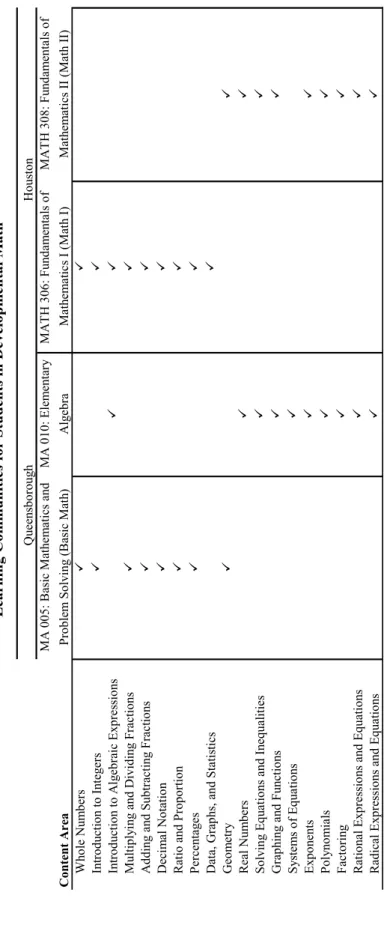
2.2 Developmental Math Course Content 16
2.3 Developmental Math Courses and Placement Scores 18
2.4 Characteristics of Sample Members at Baseline 20
2.5 Semesters of Enrollment in the Learning Communities Study 25
3.1 Queensborough Faculty Development Activities 34
3.2 Queensborough Course-Taking Patterns, Program Semester 42
3.3 Queensborough Program Differential during Semesters 2-4 43
4.1 Queensborough Transcript Outcomes, Math Progression 50
4.2 Queensborough Transcript Outcomes, Credit and Persistence Measures 55
4.3 Queensborough Transcript Outcomes by Cohort, Math Progression 58
4.4 Queensborough Transcript Outcomes by Cohort, Credit and Persistence Measures 61
5.1 Houston Faculty Development Activities 69
5.2 Houston Community College Learning Communities: Estimated Net Aggregate
and per Program Member Costs During the Fall 2009 Semester 82
5.3 Program Differential at Houston 87
5.4 Houston Course-Taking Patterns, Program Semester 88
6.1 Houston Transcript Outcomes, Math Progression 93
6.2 Houston Transcript Outcomes, Credit and Persistence Measures 96
6.3 Houston Transcript Outcomes by Placement Test Score, Math Progression 100
Table
6.4 Houston Transcript Outcomes by Placement Test Score, Credit and
Persistence Measures 103
A.1 Queensborough: Results of Learning Community Syllabi Analysis 117
A.2 Queensborough Transcript Outcomes by Placement Test Score, Math Progression 118 A.3 Queensborough Transcript Outcomes by Placement Test Score, Credit and
Persistence Measures 120
A.4 Queensborough Transcript Outcomes by Gender, Math Progression 123
A.5 Queensborough Transcript Outcomes by Gender, Credit and Persistence Measures 125
A.6 Houston: Results of Learning Community Syllabi Analysis 127
A.7 Houston Transcript Outcomes by Cohort, Math Progression 128
A.8 Houston Transcript Outcomes by Cohort, Credit and Persistence Measures 130
A.9 Houston Transcript Outcomes by Gender, Math Progression 132
A.10 Houston Transcript Outcomes by Gender, Credit and Persistence Measures 134
Figure
ES.1 Queensborough Math Outcomes ES-5
ES.2 Houston Math Outcomes ES-7
3.1 Queensborough: Learning Community Structures, Change over Time
(Semester 1 versus Semesters 2-4) 30
3.2 Queensborough: Average Scores on Two Dimensions from an Assessment of
Learning Community Syllabi: Fall 2007-Spring 2009 38
3.3 Queensborough Faculty Numbers 40
5.1 Houston: Average Scores on Two Dimensions from an Assessment of Learning 78 Community Syllabi: Spring 2008-Fall 2009
Box
Preface
Community colleges are increasingly becoming the most important pathway to higher education for millions of low-income, minority, and other students. Although enrollment in community colleges is soaring — more than a third of all students in higher education institu-tions in 2007-2008 attended community colleges — only a small percentage of these students are earning associate’s or bachelor’s degrees. There are a number of reasons for their low rates of success, including work and family obligations and part-time attendance. The most important challenge for the majority of community college students may be that they are academically underprepared for college.
Learning communities, which co-enroll small groups of students into linked courses, are a popular strategy for helping community college students pass their classes and ultimately earn a credential or transfer to a four-year institution. To test whether learning communities are effective, the National Center for Postsecondary Research (NCPR) launched the Learning Communities Demonstration, a study of different models of learning communities at six community colleges across the nation. MDRC is leading the study as part of its participation in NCPR, a partnership funded by a grant (R305A060010) from the Institute of Education Sciences, U.S. Department of Education. NCPR also includes the Community College Research Center at Columbia University’s Teachers College, the Curry School of Education at the University of Virginia, and faculty at Harvard University.
This report examines the impacts of one-semester developmental math learning com-munities at Queensborough Community College in New York and Houston Community College in Texas, where college administrators recognized the need to help students progress through required developmental (or remedial) math courses, which do not offer college credits. The goals of these learning communities were to change how material is taught in the classroom by offering context for the skills and knowledge acquired in each class, to strengthen students’ relationships with faculty and classmates, and to ultimately increase their rates of academic success. The learning communities at both colleges were relatively basic in scope. They enrolled groups of students in two classes — developmental math and either a college-level class or a college success class aimed at preparing students for the demands of college. But in the earlier stages of the demonstration, curricular integration between the classes in the learning communities was limited, and connections to support services were not common.
Although there were differences between the two colleges’ programs, the students they served, and how each college implemented and strengthened its learning communities program over the life of the demonstration from 2007 to 2009, the findings at the two colleges were similar. Students in the learning communities group attempted and passed their developmental
math classes at higher rates than students in a control group, and they began the next semester a “step ahead” in the math sequence. However, this impact generally did not translate into in-creased cumulative progress in math by the end of two or three semesters. Furthermore, the programs had no impact on students’ persistence in college or the cumulative credits they earned.
The results at these colleges, alongside other NCPR and earlier evaluations of learning communities, are helping us to better understand the possible benefits and limitations of these programs. A shortcoming of basic one-semester learning communities for students in develop-mental classes is that they seem to benefit students while they are participating in the program, but do not necessarily result in increases in important longer-term outcomes.
The next reports in the Learning Communities Demonstration will present the impacts at three additional colleges whose learning community program models were generally more ambitious. A final report in 2012 will examine trends across the six colleges, look for impacts which may occur with longer follow-up, and reflect on the body of evidence on the effective-ness of learning communities.
Gordon L. Berlin President, MDRC
Acknowledgments
The authors would like to begin by thanking the students and instructors at Queens-borough and Houston Community Colleges. This demonstration would not have been possible without their hard work and willingness to participate in the study.
While it would be impossible to name all of the individuals who supported the project at each college, we would like to single out a few who were primarily responsible for building up their learning community programs, recruiting and supporting instructors, reaching out to and enrolling students, and maintaining random assignment procedures: Susan Madera, Michele Cuomo, and Brian Kerr at Queensborough Community College, and Chyrell Botts, Beverly Hixon, Elaine Krieg, Patricia Ugwu, Patrick Nguyen, Lois Avery, Cheryl Peters, Maria Straus, and Elvia Sanchez at Houston Community College. Thanks are also due to Elizabeth Gordon, Alix Safir, and Maria Casey at Queensborough, and Edgar Chucle, Maria Garcia, and Ron Agatep at Houston for providing student records data and helping us understand those data.
The Learning Communities Demonstration is part of the National Center for Post-secondary Research (NCPR), which is supported by a grant (R305A060010) from the Institute of Education Sciences, U.S. Department of Education. The project received additional support from funders listed at the front of this report, but we would like to especially thank the Robin Hood Foundation for its support of Queensborough, and Lumina Foundation for Education for its support of Houston through the Achieving the Dream initiative. NCPR is a collaborative effort between several organizations, including MDRC, the Community College Research Center at Columbia University’s Teachers College, the University of Virginia, and faculty at Harvard University. In addition to ongoing advice and support of the project, Thomas Bailey of the Community College Research Center provided useful review and guidance on drafts of this report.
Finally, we are grateful to the large project team who worked alongside the authors and played critical roles in the Learning Communities Demonstration and at the Queensborough and Houston sites. Thomas Brock, Rob Ivry, and Mary Visher led the design and management of the overall project and reviewed this report. Michelle Ware helped launch the study at Houston, conducted field research, provided the college with assistance to strengthen its program, and with the help of Kendris Brumfield, implemented random assignment procedures. Christine Patton, Mary Visher, Heather Wathington, and Michael Weiss all conducted field research. Kate Gualtieri managed the budget for the demonstration. Melinda Jackson provided adminis-trative support. Hannah Fresques helped process, fact-check, and present the student records data, and Amanda Grossman helped collect and present data on program costs. Michael Weiss, Lashawn Richburg-Hayes, and Colleen Sommo provided invaluable insight and advice on the
analysis. Dan Bloom, John Hutchins, and Charles Michalopoulos reviewed drafts of the report. Phoebe Richman coordinated the report through the final stages of review, editing, and fact-checking. Margaret Bald edited the report, and David Sobel and Stephanie Cowell prepared it for publication. This report could not have come to fruition without the full Learning Communi-ties Demonstration team; we thank them all.
Executive Summary
Community colleges offer great promise to students in the United States. Every fall, about 34 percent of our nation’s postsecondary students enroll in these open-entry institutions, which are typically more affordable than four-year colleges and universities. Unfortunately, as enrollment in these essential institutions has increased over time, overall success rates have not kept pace; only about half the students who enroll in community college with the intention of earning a credential or transferring to a four-year institution meet that goal within six years. Students who are academically underprepared for college-level work succeed at even lower rates, particularly those who are referred into developmental math.
Developmental math — prerequisite courses that are intended to prepare students for college-level math but do not offer credits that count toward a degree or transfer — is a major barrier to college success for many students. These students often cannot achieve their college goals without passing through the developmental math sequence, but may be unable or unwil-ling to attempt and pass the required math classes. In response to this problem, community colleges and other stakeholders are beginning to suggest and implement a range of strategies to move students more successfully through the developmental sequence. Learning communities are a popular and prominent approach being implemented across the nation.
The most basic learning community model co-enrolls a cohort of students in two classes together. More comprehensive learning communities include additional components; for example, courses are often thematically linked and may share curriculum, assignments, and assessments. Proponents of learning communities believe that linking courses will lead to better outcomes for students in two ways: first, by strengthening relationships among students and between students and faculty, and second, by changing how material is taught in the classroom by contextualizing the skills and knowledge taught in each course. For students in developmen-tal math, a primary short-term goal of learning communities is to accelerate students’ progres-sion through the math sequence and into college-level coursework. A longer-term goal is that enrolling in developmental math learning communities will increase students’ ultimate likeli-hood of earning a credential or transferring to a four-year institution.
Queensborough Community College and Houston Community College are two large, urban institutions that have implemented developmental math learning communities with these goals in mind. At each school, cohorts of 20 to 25 students co-enrolled in developmental math and a linked course; at Queensborough, all levels of developmental math were linked primarily with college-level courses, and at Houston, the learning communities linked the lowest level of developmental math with the college’s student success course, which is designed to prepare students for the demands of college.
These colleges are two of the six participating in the National Center for Postsecondary Research’s (NCPR) Learning Communities Demonstration.1 The demonstration at these
colleges was designed to determine whether the programs succeeded in boosting their students’ success. The study used an experimental design in which students who were interested and eligible for the courses included in the learning community were randomly assigned to either a program group, whose members were strongly encouraged to participate in the learning communities, or to a control group, whose members received the college’s standard services. The impact of the learning communities program is estimated by comparing the academic outcomes of students in both groups for two to three semesters after random assignment. This report presents impact findings for Queensborough and Houston’s developmental math learning communities; other reports in the series describe the demonstration more broadly and present detailed findings for the other colleges.2
The key findings presented in this report are:
Both Queensborough and Houston began by implementing a basic mod-el of a semester-long devmod-elopmental math learning community; the pro-grams strengthened over the course of the demonstration by including more curricular integration and some connections to student support services.
Throughout the demonstration, the learning community programs at Queensborough and Houston successfully co-enrolled groups of students into both courses in the learning communities; students and faculty at both schools, and particularly at Houston, reported that students felt supported both personally and academically as a result of these cohorts.
1MDRC, in partnership with the Community College Research Center at Columbia University’s Teachers
College, the Curry School of Education at the University of Virginia, and faculty at Harvard University, created NCPR through a grant (R305A060010) from the Institute of Education Sciences, U.S. Department of Education. Several foundations provided additional support to the Learning Communities Demonstration: the Bill & Melinda Gates Foundation, the Ford Foundation, the Kresge Foundation, Lumina Foundation for Education, and the Robin Hood Foundation.
2For more details on the purpose and design of the Learning Communities Demonstration, see Mary G.
Visher, Heather Wathington, Lashawn Richburg-Hayes, and Emily Schneider, The Learning Communities
Demonstration: Rationale, Sites, and Research Design. An NCPR Working Paper (New York: National Center for Postsecondary Research, 2008). For a description of the early implementation experiences of the colleges in the demonstration, see Mary G. Visher, Emily Schneider, Heather Wathington, and Herbert
Collado, Scaling Up Learning Communities: The Experiences of Six Community Colleges (New York:
National Center for Postsecondary Research, 2010). For impact findings for Hillsborough Community College’s developmental reading learning communities, see Michael J. Weiss, Mary G. Visher, and Heather
Wathington, Learning Communities for Students in Developmental Reading: An Impact Study at
Hillsborough Community College (New York: National Center for Postsecondary Research, 2010). Forth-coming reports will present impact findings for Kingsborough Community College, Merced College, and The Community College of Baltimore County.
However, curricular integration and faculty collaboration — the other key components of comprehensive learning communities — were initially fairly minimal at both schools and increased over time as a result of leadership by program coordinators, growing faculty expe-rience, and participation in professional development activities. By the end of the demonstra-tion at Queensborough, many of the learning communities had themes supported by several assignments that integrated content across both courses. At Houston, faculty began to include at least three integrated assignments in their courses and included additional informal linkages between the courses. Both programs also explored promising means of using the learning communities to connect students to available support services at the campuses, such as coun-seling and tutoring.
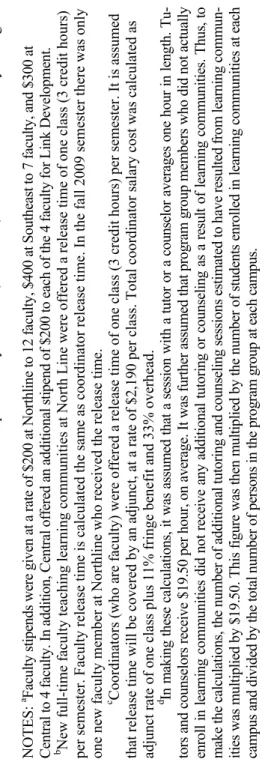
The level of curricular integration at both schools remained closer to the basic end of the spectrum when compared with the most robust learning communities discussed in the literature; nevertheless, the maturation of each program led to increasing differences between the experience of students in the learning communities and their counterparts in the control group. These differences were achieved at a relatively modest cost above that of standard classes: At Houston, program expenditures were about $120 per student, plus another $80 associated with increased use of tutoring and other services.
Learning community students attempted and passed their develop-mental math class at higher rates at both colleges.
When Queensborough and Houston launched their learning communities, one of the short-term goals of college administrators was to encourage and assist students in beginning the developmental math sequence early in their college tenure. Both colleges succeeded in this goal, as the offer to participate in learning communities led to significantly higher rates of enrollment in the developmental math courses that were part of the learning communities.
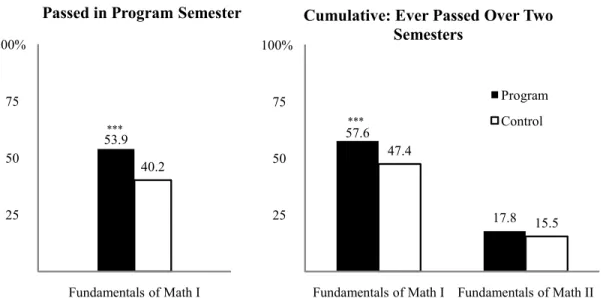
Students in the learning communities at both colleges also passed developmental math at higher rates than their control group counterparts, an important first step toward further success. These pass rates are compared in the first set of bars in Figures ES.1 and ES.2. At Queensborough, this result was driven largely by higher rates of enrollment in the learning communities; at Houston, the higher pass rates were driven both by higher attempt rates and by the fact that students who attempted math in learning communities were more likely to pass the course than those who attempted the same coursework in stand-alone classes. Possible explana-tions for this increased performance in the course could be that the student success course at
The Learning Communities Demonstration
Figure ES.1
Queensborough Math Outcomes
Learning Communities for Students in Developmental Math
41.5 17.3 4.4 35.0 15.4 4.2 25 50 75 100%
Cumulative: Ever Passed Over Three Semesters
Program Control
First matha Second mathb Third mathc
SOURCE: MDRC calculations from Queensborough Community College transcript data.
NOTES: Students who did not take the COMPASS pre-algebra placement test before being randomly assigned are excluded from this table.
Rounding may cause slight discrepancies in sums and differences.
A two-tailed t-test was applied to differences between research groups. Statistical significance levels are indicated as: *** = 1 percent; ** = 5 percent; * = 10 percent.
The probability of being assigned to the treatment group varies within cohorts, and estimates are weighted to account for the different random assignment ratios. Standard errors are clustered by learning community link.
Estimates are adjusted by cohort and score on the pre-algebra placement test at baseline.
All measures are based on courses that sample members are still enrolled in at the end of the add/drop period.
Cumulative outcomes include summer terms.
aIncludes MATH 005 for those placed into MATH 005 at baseline. Includes MATH 010 and MATH 013
for those placed into MATH 010/013.
bIncludes MATH 010 and 013 for those placed into MATH 005 at baseline. Includes MATH 114, 120,
301, and 321for those placed into MATH 010/013.
cIncludes MATH 114, 120, 301, and 321 for those placed into MATH 005 at baseline. Includes MATH
128, 260, 303, 336, and 440 for those placed into MATH 010/013. 34.0 22.2 25 50 75 100% Passed in Program Semester ***
Houston gave learning communities students the study skills they needed to better succeed in math or that the high levels of student engagement and peer support arising from co-enrollment were particularly beneficial for students in Houston’s diffuse setting. Another explanation could be that the teachers in these learning communities were more likely to give their students passing grades, either as a result of more effective teaching methods or simply of more generous grading curves.
%
The Learning Communities Demonstration
Figure ES.2 Houston Math Outcomes
Learning Communities for Students in Developmental Math
53.9 40.2 25 50 75 100% Fundamentals of Math I
Passed in Program Semester
*** 57.6 17.8 47.4 15.5 25 50 75 100%
Fundamentals of Math I Fundamentals of Math II
Cumulative: Ever Passed Over Two Semesters
Program Control
***
SOURCE: MDRC calculations from Houston Community College transcript data. NOTES: Rounding may cause slight discrepancies in sums and differences.
A two-tailed t-test was applied to differences between research groups. Statistical significance levels are indicated as: *** = 1 percent; ** = 5 percent; * = 10 percent.
The probability of being assigned to the treatment group varies within cohorts, and estimates are weighted to account for the different random assignment ratios. Standard errors are clustered by learning community link.
Estimates are adjusted by cohort, campus, and score on the pre-algebra placement test at baseline. All measures are based on courses that sample members are still enrolled in at the end of the add/drop period.
Interestingly, and perhaps as a result of the different placement test cut scores used, stu-dents at Houston — who were generally placed into a lower-level math course — experienced higher overall pass rates (for both the program and control groups) than students at Queens-borough, where equal scores could place students into a course with more advanced material.
Regardless of the differences between colleges or the explanation for these differences, students in learning communities at each college were more likely than their control counter-parts to enter the next semester a “step ahead” in the math sequence.
In the semesters following program participation, impacts on develop-mental math progress were far less evident. By the end of the study pe-riod, control group members at both colleges had largely caught up with learning community students in the developmental math sequence.
In the first postprogram semester, learning community students at both colleges were more likely to attempt the next level of developmental math, but only at Queensborough were they significantly more likely to pass the course.
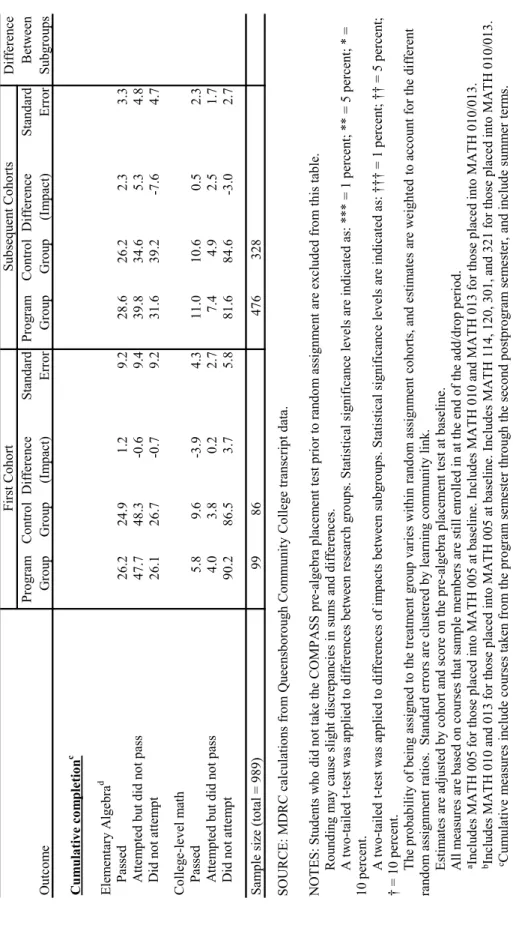
Additional students (in both the program and control groups) also continued to pass the first math class in the sequence in later semesters, so that the overall percentage that passed the class increased. At Queensborough, by the end of the second postprogram semester (three semesters total), control group members had caught up and “closed the gap” in terms of passing the first math class in the sequence, so that program group members were not significantly more likely than control group members to have passed the class. This cumulative math outcome for Queensborough is shown in the right set of bars in Figure ES.1. (The 6.5 percentage point difference between program and control group members’ pass rates was not large enough to give the researchers confidence that the impact did not occur by chance; this lack of statistical significance is indicated by the lack of asterisks over the bars.)
As further shown in the right-hand set of bars in Figure ES.1, by the end of the second postprogram semester, fewer than 20 percent of Queensborough students in the study had passed their second math course in the required sequence, and fewer than 5 percent had passed the third course in the sequence. There were no significant differences between program and control group members’ math pass rates.
A similar pattern of control group members catching up to program group members can be observed at Houston, although only two semesters of data are available. As at Queens-borough, fewer than 20 percent of students in the study sample went on to pass the second math class in the sequence, and there was no significant difference between program and control-group members’ pass rates — though in the first postprogram semester learning communities
students maintained an advantage over their control group counterparts in passing the first math class in the sequence. (See Figure ES.2)
Overall, at these two colleges learning communities clearly led students to take and pass developmental math earlier in their college careers, but this impact generally did not translate into increased cumulative progress along the math sequence by the end of the two or three semesters studied. Moreover, there is evidence that some of the initial progress along the developmental math sequence at Houston represents a substitution away from developmental English courses; thus, there was no increase in overall developmental credits earned by learning communities students at Houston. This enrollment trade-off between developmental math and developmental English may serve as a reminder of the constraints community college students face in their time and ability to tackle multiple courses.
On average, neither college’s learning communities program had an impact on persistence in college or on cumulative credits earned.
In addition to examining progress through the developmental math sequence, this study measures two key indicators of long-term success: persistence in college and credit accumula-tion, both of which are necessary steps on the path to earning a degree or credential or transfer-ring to a four-year institution. At the end of the study period covered in this report, neither college had achieved measurable impacts on these outcomes.
Thus, while the learning communities at Queensborough and Houston gave students a significant boost in their start along the developmental math sequence, this initial boost does not appear sufficient on its own to generate improvements in longer-term measures of success.
Some subgroups of students may have benefited more from the developmental math learning communities.
Subgroup analyses conducted for students at Queensborough and Houston suggest that the program effects differed somewhat between some groups of students, but there is no subgroup or type of student that clearly or consistently benefits the most from developmental math learning communities.
At Houston, the most encouraging program impacts were seen for students who placed in the lower half on the math placement test in relation to other students in the course. In addition to the increased progress along the math sequence that was seen for the full sample, there were also indications that students with lower-level math skills were earning more credits overall than their control counterparts. Although this impact was apparent in the program semester, there was no significant impact on credits earned in the postprogram semester. At Queensborough, a similar analysis did not show any differences based on level of math placement.
Placing These Findings in a Broader Context
The findings presented in this report, along with previous rigorous research on learning communities, show a similar pattern of impacts. Basic semester-long learning communities for students in developmental classes have the potential to significantly increase students’ success in the program semester, but these impacts — the differences between students in learning communities and students in regular stand-alone classes — diminish sharply over the semesters after program participation ends, as students in the control group catch up with those in the program group. While any progress in helping students initially move more quickly through the developmental sequence is promising, it appears that semester-long learning communities alone cannot be expected to help large numbers of students progress through the developmental sequence and into the college-level courses that are typically required for a degree or transfer.
The literature on learning communities also points to other routes to success for students in learning communities: These programs could boost persistence and success by providing students with a sense of engagement with the institution, as well as by facilitating deeper learn-ing. However, while students and faculty reported that students in the learning communities at Queensborough and Houston felt supported both personally and academically, this did not translate into a measurable increase in their likelihood to persist in college. Similarly, the lack of longer-term impacts on passing classes further along the math sequence or on cumulative credits earned, suggests that there was not a substantial sustained effect on learning. However, without post-test scores for all sample members, it is impossible to know for certain whether deeper learning was engendered by Queensborough’s and Houston’s learning communities.
It is important to remember that the learning communities programs in this study were — on the whole — relatively basic models compared with the comprehensive theoretical models in the literature, which feature extensive and consistent faculty collaboration, curricular integration, and integrated student supports. However, anecdotal evidence suggests that the majority of learning communities programs nationally — like those in the Learning Communi-ties Demonstration — do not consistently implement all of the components in an advanced model and generally experience variation or fluctuation within the programs and over time.
Looking Ahead
With findings from three of the six community colleges in the Learning Communities Demonstration released to date, there is still a much fuller understanding to be gained. Subse-quent reports on the remaining colleges will present results on Kingsborough Community College’s learning communities, which target continuing students in several career tracks, and on the developmental English learning communities at Merced College and The Community
College of Baltimore County (CCBC). These three colleges generally implemented learning communities with more advanced teacher collaboration, integration, or student support services than the first three colleges in the demonstration. It is important to note, though, that the variation in instructional strategies and strength of program implementation seemed at least as great across teaching teams within each college as between the six colleges.
A final report scheduled to be released in 2012 will synthesize findings across all six colleges in order to provide more rigorous evidence on the effectiveness of learning communi-ties. This final report will reflect on these findings, discuss them in the context of any other new research on learning communities, and present the results of additional analyses. Some results will be pooled across colleges and further follow-up on students from two or more colleges will be conducted to look for impacts that might continue or emerge after the two to three semesters of data analyzed in the initial reports. The program costs and effects at Houston — as well as for learning communities at CCBC — will also be analyzed further to help determine whether any longer-term effects of the program outweigh the costs.
Chapter 1
Introduction
How many yards of material from a 24-yard length of cloth remain after 3 pieces, each 3½ yards long, and 5 pieces, each 2¼ yards long, are removed?
A. 214 B. 414 C. 456 D. 1014 E. 1056
Students entering community colleges across the country encounter placement tests with a slew of questions similar to the one above.1 Many of these students are surprised that
they need to take the test, are unprepared academically to answer the questions, or are unaware of the consequences of doing poorly on the test. Those who can answer questions like the one above are on their way to passing their college’s requirements for “college-level” math, and if they do well enough on the test, can begin coursework in the first college-level math class. Those who cannot are typically referred to “developmental” math — prerequisite classes intended to prepare students for college-level math, which do not offer credits that count toward a degree or transfer. These students referred to developmental math have some of the nation’s lowest rates of college success.2
Queensborough Community College and Houston Community College attempted to raise the success rates for their students in need of math remediation by implementing learning communities, in which cohorts of about 20 to 25 students together took developmental math and a second linked class. This report presents results from random assignment evaluations of each program. Queensborough and Houston are two of the six community colleges in the national Learning Communities Demonstration; earlier reports from this demonstration include Scaling
Up Learning Communities: The Experiences of Six Community Colleges3 and Learning
Com-munities for Students in Developmental Reading: An Impact Study at Hillsborough Community College.4 The Learning Communities Demonstration is a research project being conducted by the
1ACT, Inc. (2010). The correct answer is A.
2Adelman (2004).
3Visher, Schneider, Wathington, and Collado (2010).
National Center for Postsecondary Research (NCPR). MDRC, in partnership with the Communi-ty College Research Center (CCRC) at Columbia UniversiCommuni-ty’s Teachers College, the Curry School of Education at the University of Virginia, and faculty at Harvard University, established NCPR through a grant (R305A060010) from the Institute of Education Sciences, U.S. Depart-ment of Education. Several foundations provided additional support to the Learning Communi-ties Demonstration.5
Queensborough Community College is a racially and ethnically diverse urban college in Queens, New York, serving about 13,000 students each semester. Before Queensborough entered the demonstration, the college offered learning communities for upper-level and honors courses. Upon entering the demonstration, Queensborough launched learning communities that linked developmental math with a variety of other courses, primarily at the college level. These developmental math learning communities were targeted largely to first-time students with the goal that these students would take developmental math while earning college credit in another course. The linked structure of the learning community would serve to strengthen their connec-tions with other students and faculty and boost their college success. Over the four semesters of the demonstration, 1,034 students at Queensborough chose to participate in the study; about 60 percent of these students were randomly assigned to the program group and were offered the opportunity to enroll in one of 26 learning communities offered by the college.
Houston Community College is a very large and diverse urban college in Houston, Texas, with over 50,000 students on its many campuses spread across one of the country’s most sprawling cities. Over 70 percent of the general student population at Houston attend part time (in contrast to Queensborough, where just over half attend full time). Before Houston entered the demonstration, the college began participating in Achieving the Dream, a national initiative to promote data-driven reform in community colleges, with a special focus on low-income students and students of color.6 Houston’s participation in the initiative led college leaders to
examine student records and note that a large number of students in need of developmental math put off taking these classes until late in their college career, and when students took these classes their failure rates were high. To counteract this trend, Houston chose to offer learning communities for first-year students in the lowest-level developmental math course, linking this course with a student success course that is required for all students and designed to prepare students for the demands of college. The goal of linking these two courses was to encourage students at the lowest level of math to begin tackling their developmental coursework early, while providing support and a cohort structure to boost pass rates and counteract the
5The following foundations generously supported this project: the Bill & Melinda Gates Foundation, the
Ford Foundation, the Kresge Foundation, Lumina Foundation for Education, and the Robin Hood Foundation.
6Achieving the Dream: Community Colleges Count is a national initiative funded by Lumina Foundation
ment and sense of anonymity that can be hard to overcome at such a large commuter institution. At Houston, 1,273 students took part in the study; about 60 percent were randomly assigned to the program group and were offered the opportunity to enroll in one of 33 learning communities available over the four semesters of the demonstration.
Both Queensborough and Houston began the study by implementing a basic model of semester-long developmental math learning communities, comprised primarily of co-enrolling groups of students into the two courses. Faculty teaching pairs collaborated occasionally, and as a result, there were a limited number of curricular connections between most courses. Each program strengthened over the course of the demonstration, as program coordinators raised expectations and provided more professional development opportunities for faculty; this led to increases in curricular integration in many of the learning communities at each college, as well as some stronger connections to student support services on campus. While the most robust learning community models in the literature include these key elements more extensively and deeply, anecdotal evidence suggests that the variation and fluctuation of the learning communi-ties programs at Queensborough and Houston are comparable to many of the programs current-ly being implemented in community colleges across the country.7
After briefly discussing the background and context for the national Learning Communi-ties Demonstration, this report will describe in more depth the features and implementation of the programs at Queensborough and Houston. Student academic outcomes and program impacts — changes over and above what students would have achieved in the college’s standard classes and services — are presented from the semester during which students were enrolled in the program, as well as from one to two full semesters after they completed the program.8
Background
The Policy Context
As open-entry institutions that are typically more affordable than four-year colleges and universities, community colleges offer great promise to students in the United States. Every year, about 34 percent of the nation’s postsecondary enrollees are in community colleges.9
7See Visher, Schneider, Wathington, and Collado (2010) for an in-depth discussion of the key elements of
comprehensive learning communities as identified by the research team: curricular integration, pedagogical strategies that encourage active and collaborative learning, faculty collaboration, student engagement arising from strong relationships among students and between students and faculty, and the integration of student support services.
8For more details on the purpose and design of the Learning Communities Demonstration, see Visher,
Wathington, Richburg-Hayes, and Schneider (2008).
Unfortunately, as enrollment has increased over time, overall success rates have not kept pace, and only about half the students who enroll in community college with the intention of earning a credential or transferring to a four-year institution meet that goal within six years.10 This low
rate of success is even lower for students in need of developmental education, particularly those who place into developmental math.11
According to a recent study of 57 Achieving the Dream colleges, only one-third of stu-dents who required developmental coursework in math completed the developmental sequence within three years. 12 This sequence is required before students can enter college-level math, and
college math is typically required before students can earn a degree. Interestingly, among the two-thirds of students who did not complete the developmental math sequence, the majority never enrolled in their first or subsequent course. This suggests that failure to enroll in math may be a greater barrier to completing the sequence than failure or withdrawal from courses.13
Because so many students never progress past the developmental math level and remain unable to enter even the needed first college-level math course, community colleges and other stakeholders are beginning to suggest and implement a range of new approaches. One genre of programs attempts to accelerate students’ progression to college math, either by compressing courses into less time or by putting students directly into college-level courses with extra supports.14 Another approach questions the developmental math course sequence even more
directly, by proposing a different set of math competencies that students should be expected to learn in order to be prepared to pursue their academic and personal goals in college and the modern workplace.15 A less radical approach is to provide another set of programs that increase
support for students in developmental math courses, such as extra advising or tutoring.16 All of
these approaches are designed to increase the number of students who progress successfully through the developmental sequence and, correspondingly, decrease the costs of providing developmental education. There is disagreement about the total cost of developmental educa-tion, but some national estimates put it at over $2 billion per year.17 Learning communities are
another popular response to this problem.
10Hoachlander, Sikora, and Horn (2003). Also see Weiss, Visher, and Wathington (2010); Visher,
Wathington, Richburg-Hayes, and Schneider (2008); and Brock (2010).
11Attewell, Lavin, Domina, and Levey (2006).
12Bailey, Jeong, and Cho (2009).
13Bailey, Jeong, and Cho (2009), pg 10.
14Zachry (2008); Adams, Miller, and Roberts (2009); Adams (2003).
15Bryck and Treisman (2010).
16Scrivener, Sommo, and Collado (2009); Visher, Butcher, and Cerna (2010).
Learning Communities: A Popular Strategy
In learning communities, small groups of students are co-enrolled as a cohort in two or more courses that are often thematically linked and may share curriculum, assignments, and assessments. Learning communities may be particularly promising as a strategy for increasing success rates of community college students, who often spend little time on campus due to competing demands, such as earning a living or caring for family members. Proponents of learning communities believe that linking courses will lead to better outcomes for these students in two ways: first, by strengthening relationships among students and between students and faculty, and second, by changing how material is taught in the classroom by contextualizing the skills and knowledge taught in each course.18
Learning communities are a particularly compelling strategy for teaching students in need of developmental education and increasing their ability to move on to college-level coursework.19 The social integration encouraged by co-enrollment in multiple classes can be
extremely important for academically underprepared students, who may be more marginalized from the college community. Moreover, the connection between the developmental-level course and the course with which it is linked — whether a college-level course as at Queensborough or a student success course as at Houston — may serve to bolster learning in each linked course.20
Important early research suggested that students in learning communities benefitted both academically and socially in comparison with similar students who did not enroll in learning communities.21 But these studies left open the question of whether the positive effects were due
to the program itself or to differences in the characteristics of the students who chose to enroll in the program (such as their ability, motivation, or tenacity). One way to control for these differ-ences is to randomly assign students to have access to the program or not, thus creating two groups of students that are similar in both observable and unobservable characteristics. Any subsequent substantial differences in educational outcomes can then be attributed, with a high level of confidence, to systematic differences in students’ experiences after they were randomly assigned; in this case, the opportunity and encouragement to enroll in a learning community.
MDRC conducted the first random assignment study of learning communities at Kingsborough Community College in Brooklyn, New York, as part of the Opening Doors
18See Smith, MacGregor, Matthews, and Gabelnick (2004); Tinto (1997); Minkler (2002).
19Boylan (2002); Center for Student Success (2007).
20For a more comprehensive review of learning communities practices and their theory of change, see
Visher, Schneider, Wathington, and Collado (2010).
21Especially Tinto, Goodsell-Love, and Russo (1994); Engstrom and Tinto (2008). For a more
compre-hensive review of prior research on learning communities, see Visher, Wathington, Richburg-Hayes, and Schneider (2008).
Demonstration.22 In this study, freshmen were assigned at random to either a program group
that had access to the learning communities or to a control group that received the college’s standard courses and services. Kingsborough’s Opening Doors learning communities enrolled cohorts of roughly 25 program group members into learning communities that linked three classes together: English (usually at the developmental level), a course in another academic subject, and a one-credit college orientation course. Students also received enhanced counseling and a textbook voucher, and faculty received professional development and support not always offered to other faculty on campus.
The findings from this rigorous study showed that the Kingsborough Opening Doors learning communities program had several positive impacts on students. First, students in the program group felt more integrated and engaged in college than students in the control group. Second, the program moved students more quickly through the developmental English se-quence. Program group students enrolled in English and passed the end-of-course assessment test at higher rates than their control group counterparts. And third, during their first semester in the study, students in the program passed more courses and earned more credits. However, these effects diminished in subsequent semesters, and Kingsborough’s developmental English learning communities had little immediate impact on continued persistence in college.23 The
results from this study and others mentioned above paved the way for the Learning Communi-ties Demonstration, which tested several different models of learning communiCommuni-ties at institu-tions across the country.
Overview of the Learning Communities Demonstration
Six community colleges participated in the Learning Communities Demonstration, the first large-scale, national random assignment evaluation of learning communities. The colleges, listed below, are spread across the country and all serve large numbers of students who are low income and in need of developmental coursework:
The Community College of Baltimore County (CCBC) (Baltimore, Maryland) Hillsborough Community College (Tampa, Florida)
Houston Community College (Houston, Texas)
22Opening Doors was a multisite study that tested interventions at six community colleges designed to
help low-income students stay in school and succeed.
For more information, see http://www.mdrc.org/project_31_2.html.
23Initially, the program did not have an impact on reenrollment; after two years, slightly more program
group than control group members attended college, but it is unclear whether this impact will be sustained over time (Scrivener et al., 2008).
Kingsborough Community College (Brooklyn, New York) Merced College (Merced, California)
Queensborough Community College (Queens, New York)
The six colleges chose different courses to link and in some cases added features such as enhanced access to student services and other forms of support. Table 1.1 summarizes the core features of each program, as well as its target population. The research team selected programs to represent the broad range of models and links in use in community colleges. The Houston and Hillsborough Community College programs — at the more basic end of the spectrum of possible learning community programs — both linked a student success course with a developmental course (math at Houston and reading at Hillsborough) and at least initially involved minimal expectations of faculty to collaborate or offer integrated curriculum.
At Queensborough, most of the learning communities linked developmental math with a college-level course. The program at CCBC was relatively comprehensive in its model, linking a college-level course with a developmental English or reading course and including a “Master Learner” seminar designed to help students “learn to learn” and work on integrated assignments. Merced College and Kingsborough, which each had long histories of running strong learning communities, encouraged a relatively high level of integration between the linked courses. Merced linked a variety of courses, both college-level and developmental, with a developmental English or reading course. Kingsborough, unlike the other five colleges, targeted continuing and transfer students who had already satisfied their requirements for developmental courses. Like CCBC, Kingsborough linked three courses: two college-level courses in specific majors with a single-credit “integrative seminar” designed to help students see connections between their course work and career goals.24
All of the colleges in the demonstration experienced a learning curve as they scaled up their programs to serve more students. During this time, each college worked to strengthen its learning communities, particularly two core components of the model: student cohorts and instructional practices such as curricular integration and collaborative learning. However, there remained significant variation across the learning communities within each college, as some faculty teams were more able to meet their program’s expectations than others. In fact, the variation in instructional strategies and strength of program implementation seemed at least as great within colleges as across colleges.25
24For a description of each college’s learning communities program model, see Visher, Schneider,
Wathington, and Collado (2010).
C ol leg e L ea rni ng Co m m u nit y P rog ra m M ode l E lig ible P opulat io n H ousto n C om m unity Co lle ge (Hou st on , T X ) • Dev elop m en tal m ath lin ked w ith a stu den t su ccess co ur se • St ud en t su ccess co ur se f ocu se s o n acclim atio n to c oll eg e, s tu dy sk ills • A ss es sed in to low es t l ev el of de ve lopm en ta l m at h • Fir st-ti m e stude nt s at H ousto n Q ue en sb or ough Co m m unit y Co ll eg e (Q ueen s, NY) • D ev elopm en tal m ath li nk ed w it h d evelo pm enta l or co llege-level E ng lis h (f al l 20 07), or w it h a c oll eg e-le ve l co ur se ( spr in g 200 8 a nd be yon d) • A sses sed in to ei ther of tw o levels of de ve lopm en ta l m at h • New stude nt s and s tud ents w ith less th an a sem ester o f cre dits T he Co m m un ity Colleg e of B altim or e C ou nt y (B alti m ore , MD ) • D ev elopm en tal En gl is h or readin g li nk ed w ith a col leg e-le ve l cou rs e (e.g ., ps yc ho lo gy , s oci olog y, bu sin es s) • Master L ear ner C om po nen t — a f ac ulty m em ber (so m etim es th e de ve lo pm en tal En gl is h in str ucto r) sits in on a co lle ge -l ev el co ur se an d co nd ucts a w eek ly , o ne-ho ur , n on cr edit s em in ar on le arn in g-to-lear n in th e co nt ex t o f th e co lleg e-lev el co ur se • A sses sed into h ighes t l evel of de ve lopm en ta l E ng li sh or re ad in g H ill sb or ough Co m m unity Co llege (T am pa , F L ) • Dev elop m en tal r eadin g lin ked w ith a stu den t su ccess co ur se • St ud en t su ccess co ur se f ocu se s o n acclim atio n to c oll eg e, s tu dy sk ills • A sses sed in to ei ther of tw o levels of de ve lopm en ta l re ad in g • Fir st-ti m e stude nt s M er ced Co lleg e (M er ce d, C A ) • Devel op m ent al E nglish linked w ith devel op m en tal r ead ing or m at h, a co lle ge-lev el co ur se, o r a stu den t s ucce ss cou rse • S ev er al of th e lin ks h av e s up pl em en tal in str ucto rs — tr ain ed p eer instr ucto rs w ho facilit ate vo luntar y gr oup s tud y ses sio ns • A sses sed in to an y of th ree lev els o f de ve lopm en ta l E ng li sh Ki ng sb orou gh C om m un it y C ol leg e (Brook ly n, N Y ) • T w o lin ked co ur ses reco m m en ded o r req uir ed f or an o ccu patio nal ma jo r • Requ ired atten dan ce in an “ in teg rativ e sem in ar ,” a 1 -cr ed it co ur se desig ned to h elp s tu den ts m ak e co nn ection s betw een th eir lin ked co ur ses, cou rse con ten t, car eer p lan s, an d th e r eal w or ld • I n targ eted o ccu patio nal m aj or : bu si nes s, a ccou ntin g, allied h ealth , m en tal h ealth , ea rly ch ild hoo d ed ucation , to ur is m an d h os pitality , an d li ber al ar ts • Con tin ui ng stu den ts an d tr an sf er stu den ts Int egr at iv e S emi na r a s A nch or C ou rs e The Learni ng Com m unit ies Demo nst rat io n Tab le 1.1 O ve rv ie w o f t h e Le ar ni ng C om m u nit ie s in t h e Le ar ni ng C om m u nit ie s D em on st rat io n, b y C olle ge Develo pm en ta l Eng lis h or Read in g as Anch or Cou rs e Develo pm en ta l M ath as An cho r Co ur se
Between fall 2007 and fall 2009, a total of 6,802 students across the six colleges volun-teered to be part of the study and were randomly assigned to either the program group or the control group. Nearly 4,000 of these students were randomly assigned to the program group, where they could enroll in a learning community that fit their schedules and course needs; the rest were assigned to the control group, where they were allowed to enroll in any course for which they were eligible or that was required, but could not enroll in a learning community. A total of 175 learning communities were included in the study.26 Study sample sizes were
sufficient at each college to permit researchers to test for the impacts of the program at each site separately.
Results of impact evaluations at the six colleges are being presented in a series of re-ports released in 2010 and 2011. The first report examined the impacts of learning communities for students in developmental reading at Hillsborough, where the most salient feature was the co-enrollment of students in the linked developmental reading and student success courses. Curricular integration and faculty collaboration were generally minimal at the start of the study, but increased over time as the faculty participated in professional development and the program coordinator clarified expectations for these elements. Overall (for the full study sample), Hillsborough’s learning communities program did not have a meaningful impact on students’ academic success. However, corresponding to the maturation of the program over the course of the study, evidence suggests that the program had positive impacts on some educational outcomes for the third cohort of students. For this cohort, during the program semester, students in the program group earned more credits than their control group counterparts. In the following semester, these students registered at a higher rate than their control group counterparts.27
This report presents the impacts of learning communities for students in the two dem-onstration colleges that focused on developmental math: Queensborough and Houston. Subse-quent reports will present the impacts of learning communities for continuing students at Kingsborough and the impacts of developmental English learning communities at CCBC and Merced. A final comprehensive report synthesizing and interpreting the results from all six colleges in the Learning Communities Demonstration is scheduled for release in 2012.
What Impacts Can Be Expected from Learning Communities for
Students in Developmental Math?
One of the primary expectations for the learning communities at Queensborough and Houston in the short term is that they may accelerate students’ progression through
26For a description of the methodology of the Learning Communities Demonstration, see Visher,
Wathington, Richburg-Hayes, and Schneider (2008).