ESSAYS ON BANKING
A Dissertation
Presented to the Faculty of the Graduate School of Cornell University
In Partial Fulfillment of the Requirements for the Degree of Doctor of Philosophy
by Yu Zhang May 2012
ESSAYS ON BANKING
Yu Zhang, Ph. D. Cornell University 2012
Diamond and Dybvig (1983) provide an analytical framework of modern banking: The key role of banks is to provide risk sharing between different types of consumers, and the mismatch of short-term liabilities and long-term asset can cause bank runs. In this dissertation, I use Diamond-Dybvig framework to analyze some key issues on banking: banks and the asset market, bank runs and bailouts, and characteristics of deposit contracts.
The first chapter addresses the coexistence of banks and the asset market. Jacklin (1987) showed that banks are redundant if the asset market exists. I show that if there is aggregate liquidity shock, then asset prices will be volatile. This will make the arbitrage opportunities in the market risky. Sufficiently risk-averse depositors will not arbitrage. Hence, incentive-compatibility constraint is relaxed, leaving room for the bank to provide "insurance" to the depositors.
The second chapter addresses the relationship between the probability of bank runs and bailouts. Following Keister (2010), my model includes both a private good and a public good. The major innovation in this paper is to determine the run
probability by using the global-games approach in Goldstein and Pauzner (2005), making the run probability endogenous. I show that bailouts increase the ex-ante run probability through two channels. The first channel works through the misaligned objectives of the bank and the government: Runs are less costly for banks when there are bailouts. Hence, banks take on more risk than is socially optimal. The second
channel works through the change in the depositor's incentives to run: Bailouts
increase the probability that a depositor will get her money if she participates in a run, thus increasing the likelihood of a run.
The third chapter characterizes how optimal deposit contract is related to the probability of bank runs. Peck and Shell (2003) show that the optimal deposit contract can tolerate bank runs if the run probability is low. In their two-consumer example, the deposit contract is a step function of the run probability. I generalize that example and show that, for some parameters which permit bank runs, the optimal contract changes continuously with the run probability until it reaches the threshold probability level. Above that threshold, the optimal contract eliminates bank runs. Hence, the run probability affects not only whether bank runs will be tolerated (like Peck and Shell's example) but also how bank runs will be tolerated.
BIOGRAPHICAL SKETCH
Yu Zhang was born on March 25, 1982 in Tianjin, China. He graduated from Peking University (Beijing, China) in 2004 with a bachelor's degree in Economics. He joined the Ph.D. program at the Department of Economics, Cornell University in the fall of 2006. In April 2012, he defended his dissertation.
ACKNOWLEDGMENTS
I would like to thank my dissertation committee: Professor Assaf Razin (co-chair), Professor Karl Shell (co-chair) and Professor Viktor Tsyrennikov for their kindness and guidance.
TABLE OF CONTENTS
Chapter 1: Banks and Markets: The Roles of Price Volatility and
Risk Aversion 7
1.1 Introduction . . . 7
1.2 The Model . . . 11
1.3 Asset Market Equilibrium . . . 14
1.4 The Bank And The Asset Market . . . 17
1.5 Conclusion . . . 27
1.6 Appendix . . . 28
1.7 References . . . 29
Chapter 2: Bailouts and Bank Runs 2.1 Introduction . . . 31
2.2 The Model . . . 37
2.2.1 Agents’Preferences . . . 37
2.2.2 Endowments and Asset Returns . . . 38
2.2.3 Agents’Information . . . 39
2.2.4 Banks . . . 40
2.2.5 Government . . . 41
2.2.6 Timeline . . . 42
2.3 Post-Deposit Game: Depositor’s Withdrawal Decision in Period 1 . . . 44
2.4 Pre-Deposit Game: Choices of the Government and the Banks in Period 0 49 2.4.1 The Bank’s Strategy . . . 49
2.4.2 The Government’s Strategy . . . 54
2.5 Bailouts without Government Commitment . . . 57
2.6 Summary . . . 60
Introduction 1
2.7 Appendix . . . 61
2.8 References . . . 76
Chapter 3: A Note on “Equilibrium Bank Runs”: Robustness of the Two-Consumer Example 79 3.1 Introduction . . . 79
3.2 Necessary Conditions For Equilibrium Bank Runs . . . 80
3.3 The Parameters . . . 85
3.4 Concluding Remarks . . . 91
Introduction
Banking and, more generally, …nancial intermediation perform essential roles for the e¢ cient allocation of resources in modern economies, but they can also be sources of instability. One such instability is the susceptibility of banks (and other …nancial intermediaries) to “runs”. A bank run occurs when an abnormally large number of depositors elect to withdraw their funds, leading to the failure of the bank to meet its commitments. Bank runs can be triggered by realizations of the bank fundamen-tals (e.g., poor performance of the bank’s portfolio or an abnormally large fraction of depositors receiving liquidity shocks) or merely because of self-ful…lling panic of the depositors.
“Bank runs”are not observed solely at depository institutions. The current …nancial crisis is largely the result of the instability in the shadow banking sector: “…nancial …rms ‘running’ on other …nancial …rms by not renewing sale and repurchase agree-ments”.1 In my dissertation, the formal model is of runs on depository banks, but the results can be loosely applied for runs generally.
Two di¤erent literatures have been developed to analyze bank runs. The …rst follows the seminal paper by Diamond and Dybvig (1983) [hereafter DD], which treats bank runs as panic-based: Depositors withdraw their funds only because they expect that the other depositors will do so. Hence, bank runs occur as a result of coordination failure. The other literature treats bank runs as fundamental-based. In these models (e.g., Allen and Gale (1998)), the depositors run because of unfavorable bank fundamentals, e.g. abnormally poor performance of bank assets. When a depositor decides to run, he will do so regardless of the other depositors’actions.
In this dissertation, I will employ the DD framework, treating bank runs as purely
panic-based. DD provides a workhorse for modelling not only bank runs but also the essential role of modern banking. The key role of DD banks is to provide risk sharing between the di¤erent types of consumers. The consequent mismatch of short-term liabilities and long-term assets can cause bank runs.
To be more precise, the individuals in the DD economy are subject to idiosyncratic liquidity shocks: they can be either patient or impatient. The impatient agents need to consume early and the patient agents can wait and consume later. The problem is that the long-term asset is illiquid: The return on this asset is low if harvested early. With-out the bank, the impatient agents would have to consume much less than the patient agents. If an agent is risk-averse, her expected utility can be improved by smoothing consumption between when she becomes patient and when she becomes impatient. In other words, insurance against the liquidity shocks is desirable. This insurance cannot be achieved in the insurance market because of asymmetric information: An agent’s type (patient or impatient) is her private information. The bank can provide some “insurance” by o¤ering demand deposit contract: An agent makes her deposit before she knows her type. After the liquidity shocks are realized, the bank “transfers”some of the resources from the patient depositors to the impatient depositors. Although the bank cannot observe the depositors’types, the depositors can self-select since the short-term payment is lower than the long-term payment. What we have described de-pends on the assumption that the depositors expect that other depositors will not run on the bank. If a depositor expects that all other depositors withdraw early regardless of their types, his best response is to withdraw early. This is because the bank’s assets would be exhausted in satisfying the early withdrawals. If the depositor waits, she will get nothing. Hence, a bank run occurs as a result of panic.
In this dissertation, I use the DD framework to analyze three issues in banking and …nance: (1) coexistence of DD banks and asset markets; (2) bank runs and government
bailouts, and (3) the structure of the optimal deposit contract as a function of the (exogenous) run-probability.
My …rst chapter addresses the coexistence of banks and the asset market. DD assume that the asset market does not exist. Jacklin (1987) shows that banks are redundant if we add the asset market to the DD model. That is because the asset market provides arbitrage opportunities: If the depositors withdraw early, they can use the withdrawals to buy assets in the market. To make the patient depositors withdraw late, the late-payment has to be not only larger than the early payment but also larger than the proceeds from the asset which can be bought in the market by the early payment. Hence, the arbitrage opportunities tighten the incentive-compatability constraint which makes the patient and impatient depositors self-select. I extend the DD model to an environment in which there is an aggregate liquidity shock and in which agents di¤er in their risk aversions. The aggregate liquidity shock makes asset prices volatile. Since depositors do not know the realization of the asset price while making their withdrawals, the arbitrage opportunities in the asset market are risky. Su¢ ciently risk-averse depositors prefer not to arbitrage in the market. Hence, the incentive-compatibility constraint is relaxed, leaving room for the bank to provide some “insurance” to these depositors. Banks are not redundant. But the less risk-averse agents will still take the risky arbitrage opportunities in the market. Hence, there is no bank targeting them as its depositors. They will make investments by themselves and obtain liquidity through the market. In this economy, there is nontrivial coexistence of banks and markets.
The second chapter addresses the relationship between the probability of bank runs and bailouts. Following Keister (2010), my model includes both a private good and a public good. The public good is introduced to represent the social cost of bank bailouts: Bailouts crowd out public good provision since the government budget must
be balanced. The major innovation I made is to determine the run probability by using the global-games approach in Goldstein and Pauzner (2005), making the run probabil-ity endogenous. I show that bailouts increase the ex-ante run probabilprobabil-ity through two channels. The …rst channel is that the bailouts distort theex-ante incentives of banks, increasing the riskiness of their banking contracts. This is because the banks do not internalize the social cost of a bailouts, the decreased level of public good provision. Thus, bank runs are less costly for the banks than for the social planner. Anticipating government bailouts, banks promise a higher short-term deposit interest rate than is socially optimal in order to attract depositors. The higher short-term deposit interest rate makes the banking sector more fragile. The second channel is that the antici-pated bailout increases the depositor’s probability of getting her money from the bank when she participates in a run. With the additional resources from the bailout, banks are provided with extra withdrawal capacity during a run. Hence, if a depositor ex-pects that a bank run will occur, the anticipated bailout increases the probability of the depositor getting her money from the bank if she participates in the run. When a depositor compares her expected utility between withdrawing early or waiting to withdraw, because of the bailout her incentive to withdraw early is increased and the
ex-ante probability of a run is increased. Knowing the con‡icts between alleviating bank runs and preventing bank runs, the government will announce,ex ante, a bailout policy that balances these two e¤ects.
My third chapter is a note on Peck and Shell (2003). DD show that a bank run can be an equilibrium in the post-deposit game for the contract which supports the constrained-e¢ cient allocation. The important question to ask is whether or not con-sumers will want to deposit in the bank if they expect that a bank run will occur. Peck and Shell show that under the optimal contract, the post-deposit game can have a run equilibrium. Given a propensity to run which is triggered by sunspots, the
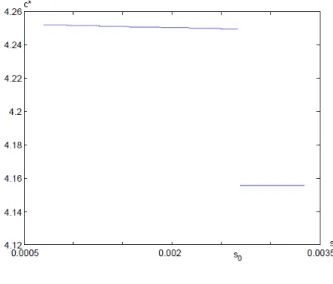
opti-mal contract for the full pre-deposit game can be consistent with runs that occur with small, but positive probability. In Peck and Shell’s 2-consumer example, the contract is characterized by c which is the consumption received by the …rst depositor in line in period 1. Let c (s) be the optimal contract o¤ered by the bank, where s is the sunspot-driven probability of a bank run. In the numerical example of Peck and Shell,
c (s) is a step function: If the probabilitys is less than a critical level s0, the contract
c (s)tolerates runs andc (s) = c (0). If the probabilitys is more thans0, the optimal
contract will be immune from runs and c (s) = cno run, the highest level at which
rational consumers will never run. The probability of a bank runs has only a “bang-bang” e¤ect on the optimal contract c (s). I generalize that example and show that, for some parameters which permit bank runs, the optimal contract changes continu-ously with the run probability until it reaches the threshold probability level. Above that threshold, the optimal contract eliminates bank runs. Hence, the run probability a¤ects not only whether bank runs will be tolerated (as in Peck and Shell’s example) but also how bank runs will be tolerated.
References
[1] Allen, Franklin and Douglas Gale. 1998. “Optimal Financial Crises.”The Journal of Finance 53: 1245-1284.
[2] Diamond, Douglas W., and Philip H. Dybvig. 1983. “Bank Runs, Deposit Insurance, and Liquidity.”Journal of Political Economy 91: 401-419.
[3] Goldstein, Itay and Ady Pauzner. 2005. “Demand-Deposit Contracts and the Probability of Bank Runs.”The Journal of Finance 60: 1293-1327.
[4] Gorton, Gary. 2009. “Slapped in the Face by the Invisible Hand: Banking and the Panic of 2007.”Federal Reserve Bank of Atlanta’s 2009 Financial Markets Conference: Financial Innovation and Crisis
[5] Jacklin, Charles J. 1987. “Demand Deposits, Trading Restrictions, and Risk Sharing.”InContractural Arrangements for Intertemporal Trade, edited by Edward J. Prescott and Neil Wallace. Minneapolis: University of Minnesota Press.
[6] Keister, Todd. 2010. “Bailouts and Financial Fragility.”Federal Reserve Bank of New York Sta¤ Reports 473.
[7] Peck, James and Karl Shell. 2003. “Equilibrium Bank Runs.”Journal of Polit-ical Economy 111: 103-23.
1
Chapter 1: Banks and Markets: The Roles of
Price Volatility and Risk Aversion
1.1
Introduction
There is typically a trade-o¤ between liquidity and return. Individuals are subject to liquidity shocks, but the higher return asset is usually illiquid. Banks and the asset market2 increase economic e¢ ciency beyond autarky by improving the liquidity-return trade-o¤. The asset market does this by providing individuals with opportunities to sell their illiquid assets (or claims on future consumption) in the market, as in Allen and Gale (1994). Banks do this by o¤ering demand deposit contracts as in Bryant (1980) and Diamond and Dybvig (1983). Banks and the asset market also interact with one another. This paper studies the operation of the DD-type bank in an economy with an asset market.
The model in this paper has two features: (1) The equilibrium price of the …nancial asset is volatile.3 Hence, the deposit contract o¤ered by the representative bank can protect the depositors not only from idiosyncratic liquidity shocks but also from the asset price volatility. (2) There is a separating equilibrium: the agents who are more risk averse choose to be depositors in the bank and those who are less risk averse trade in the market.4
The …rst feature contributes to the debate concerning the redundancy of the DD-type bank when the …nancial market exists. DD analyzed banking in an economy in which the liquidity shock is purely idiosyncratic and in which there is no asset
mar-2As other papers in this literature, asset markets are ex-post security markets
3Robert J. Shiller (1981), among others, have argued the prices of …nancial assets such as stocks
are characterized by excess volatility.
4In the model, for the CRRA utility function, those who have the coe¢ cient of relative-risk-aversion
greater than1will choose to be depositors and those who have the coe¢ cient of relative-risk-aversion smaller than1will choose to participate the market.
ket. DD showed how the demand deposit contract acts as “insurance” against the liquidity shocks. They also show that the …rst-best allocation5 can be achieved as an equilibrium. The incentive-compatibility constraint, which makes depositors with di¤erent liquidity needs self-select, does not bind at the …rst-best allocation. The non-binding incentive-compatibility constraint relies on the assumption that there is no asset market and hence ex-post6 arbitrage opportunities for the depositors are limited. The viability of the DD bank in an economy with an asset market was questioned by Jacklin (1987);7 von Thadder (1999) elucidated Jacklin’s “critique”. If a …nancial market exists, out-of-bank trades will give the depositors more ex-post arbitrage oppor-tunities and strengthen the incentive-compatibility constraint. For the case of purely idiosyncratic liquidity shocks, the prices of …nancial assets are stable. The incentive-compatibility constraint will be strengthened to the point that no room is left for the bank to provide the insurance against liquidity shocks and the bank can only mimic the …nancial market allocation. The bank is redundant. IfEU(i)is the representative agent’s expected utility under regimei, then we have:
maxEU(M) = maxEU(M&B)<maxEU(B),
whereM is the only-market regime,M&B is the market-and-bank regime andB is the only-bank regime. That is, the bank is redundant when there is a …nancial market. In my model, the price of the …nancial asset is volatile and I also assume realistically that asset prices are not revealed until after withdrawals are made.8 Hence, ex-post arbitrage
5First-best allocation is the allocation when there is no asymmetric information. 6By "ex-post", I mean "after a depositor learns his liquidity need".
7Haubrich and King (1990) and Hellwig (1994) also presented models that question the role of
banks when there is a …nancial market.
opportunities are risky for the depositors, which weakens the incentive-compatibility constraint. If depositors are su¢ ciently risk averse, the incentive-compatibility con-straint will leave room for the bank to manipulate the deposit contract which can partially insure the depositors from the volatility of asset prices. In this way, banks can increase the expected utility of their depositors. Banks are not redundant.
The non-redundancy of the bank shows the advantage of banking over the pure asset market economy. Then, the next question is: Why does not everyone deposits in the bank? The second feature of the model answers this question. Agents are assumed to di¤er in their attitudes toward risk. Hence, even though the ex-post arbitrage opportunities are risky, depositors may still want to take those opportunities depending on their degree of risk aversion. I show that the agents with su¢ ciently low risk aversion9will always take those arbitrage opportunities; i.e., the incentive-compatibility constraint can never be satis…ed for them. Thus, there is no bank which targets those low risk-aversion agents as depositors. In equilibrium, high risk-aversion agents are depositors in banks and low risk-averse agents have to invest for themselves and obtain their liquidity in the market.10
Equilibrium asset price volatility can be explained in many di¤erent ways. In this paper, it is the uncertainty of the aggregate liquidity shock which causes the price volatility.11 The relation between aggregate liquidity shock and the volatility of asset with certainty. To achieve this, in the model I assume that the market opens after the withdrawal decisions have been made. So depositors do not know which price is going to be realized when making their withdrawal decisions.
9For the CRRA utility function, the agents with coe¢ cient of relative risk aversion smaller than1. 10Those low-risk aversion agents may want to deposit in the bank which is designed for the high
risk-aversion depositors. To prevent such arbitrage activities, the bank will restrict the size of individual deposit to the level of the endowment owned by the high risk-aversion agents. If the low risk-aversion agents have much more endowments than that level, most of their endowments have to be invested by themselves and get most of the their liquidity through the market. Even though the low risk-aversion agents can deposit a small fraction of their endowment, it does not cause problem for the bank if the population of the low risk-aversion agents is small relative to the high risk-aversion agents.
11Aggregate liquidity shock is not new in this literature. In Diamond and Dybvig (1983), there
prices has been analyzed by Allen and Gale (1994). The main issue in their paper is how limited market participation can amplify the volatility of asset prices. In my paper, I focus on how the aggregate liquidity shock can explain the coexistence of banks and markets.12
There are several papers which also focus on the relation between banks and mar-kets. Wallace (1988) argued that DD model can be interpreted as a model in which no asset market exists because agents are physically separated. Diamond (1997) assumed that participation in the asset market is limited. He showed that bank is then useful because it can provide insurance among the impatient agents and the patient agents who cannot access the market. Increased participation in the market will cause the banking sector to shrink. Allen and Gale (2004) analyzed the relation between banks and inter-bank markets. Individual agents cannot trade in the inter-bank markets. Hence, markets do not strengthen the incentive-compatibility constraints. Antinol… and Prasad (2008) assumed that the asset market is characterized by limited enforce-ment of contracts. If borrowers default, only a fraction of their assets can be seized. This reduces the fraction of assets that can be used as collateral and individuals hit by the liquidity shock face borrowing constraints. Antinol… and Prasad (2008) showed that the bank can ameliorate these constraints by pooling the resources of depositors to increase the liquidity beyond that provided by the asset market. Farhi, Golosov and Tsyvinski (2009) showed that government regulation (They propose liquidity ‡oor.) imposed on intermediaries can improve the resource allocation and the …rst-best can be achieved even the market exists. But in that paper, they did not explain why agents shock. But aggregate liquidity shock has never been used to study the relation between banking and the …nancial market.
12There are other di¤erences between Allen and Gale (1994) and my paper. For example, in Allen
and Gale (1994), there is a …xed cost for agents to participate the market. If agents decide no to participate the market they have to be in autarky and they cannot invest in the illiquid asset. There is no participation cost of the market in my model. And the investment options are the same for each individual no matter whether she participate the market.
deposit in the intermediaries rather than make the investment by themselves. Peck and Shell (2009) captured the role of banks in providing checking accounts and facilitating transactions. In that paper, banks are not redundant because agents need checking account services.
In the present paper, the essential role of the bank is not based on its checking account service. Furthermore, there is no restriction on market participation and the asset market is free from the enforcement problems leading to collateral contracts. The coexistence of banks and markets comes from the market price volatility and heterogeneity in agents’risk aversion.
In section 1.2, I describe the setup of the model. In section 1.3, I analyze equilibrium for the case in which agents can only trade in the asset market. This will serve as a benchmark. Section 1.4 is on the coexistence of banks and markets. I will show how banks improve the expected utility of the high risk aversion agents and why there is no bank for the low risk-aversion agents and thus they have to use the market for re-adjusting their portfolios. Section 1.5 is the conclusion.
1.2
The Model
There are three periods: 0, 1 and 2. In each period, there is one good which can be used for either investment or consumption. There are two available assets. The …rst asset is liquid; it is the storage technology: every unit invested in period t (t = 0;1)
returns one unit of the good in period t+ 1: The other asset is illiquid but o¤ers a higher return: every unit of investment in period 0 can generate nothing in period 1
but it generates R > 1 units of the good in period 2: Table 1.1 describes the returns of the two assets.
Period 0 Period 1 Period 2
Liquid Asset 1 1
1 1
Illiquid Asset 1 0 R
Table 1.1: Asset Return
There is a continuum of agents. They can be divided into two groups. We label them as groupDand groupM. It is useful later to think of groupDas potential depositors and group M as the potential market participants. (In the next section, when we introduce the banking industry, we will show that groupD will be the depositors and group M will be the market participants.) The measure of the groups is 1 and m
respectively. The endowments at period 0 of each individual in the two groups are 1
and e respectively. There are no new endowments in later periods.
Both groups of agents have the DD preferences: In period 0, agents of a given group are identical. In period 1, they receive a liquidity shock which turns some of them into patient consumers and the rest into impatient consumers. A patient consumer values only period-2 consumption and an impatient consumer values only period-1 consumption. The liquidity shock to group-D agents is purely idiosyncratic: The fraction of group-D agents who turn to be impatient in period1is D and D is a
constant. group-M agents,however, face aggregate liquidity shocks: The fraction of the group-M agents becoming impatient in period 1 can be either H or L, where H > L. The probabilities of having high aggregate liquidity demand H and low aggregate
liquidity demand L areq and (1 q) respectively. The aggregate liquidity shock will
the polar version of this model in which H = L or me= 0;that is, if either there is
no aggregate liquidity shock for the M agents or the endowment adjusted measure of
M agents is zero.
If an agent from group-i consumes the consumption in the period of her liquidity need, her utility is given by the standard CRRA utility function:
Ui(C) = (C1 i 1)=(1 i)
where i > 0 for i = D; M: group-D agents are more risk averse than the group-M
agents:
M <1< D:
The degree of risk aversion determines whether or not there is going to a bank that targets that group for its depositors. We will show in section 1.4 that since M <1, a
bank can never make the agents with di¤erent liquidity needs in that group self-select given the arbitrage opportunities in the market. Group-M agents might deposit at the bank designed for theD group if there is arbitrage opportunity in doing so. But the deposit contract for group-D agents will take this into account and prevent such arbitrage activities. In equilibrium, most or all of the endowments of theM group has to be invested by themselves and they obtain the liquidity from the market.
An agents’group (D or M) and consumption type (patient or impatient) are her private information. Aggregate liquidity demand is revealed to agents only through observing asset prices.
In the next section, we will analyze the equilibrium when there is an asset market in period 1 in which agents can trade the illiquid asset after they learn their liquidity
need and in which there is no bank.
1.3
Asset Market Equilibrium
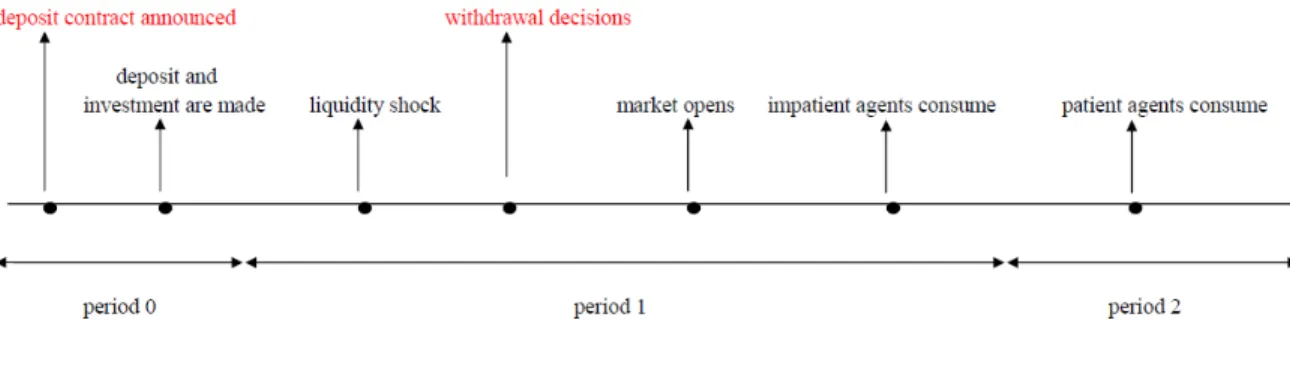
The asset market is the place where agents trade the illiquid asset for the consumption good (the return from the liquid asset). For this section, we assume that there is no bank. The sequence of the events is listed in the timeline in Figure 1.1.
Figure 1.1: Timeline 1
Each agent decides how to allocate her endowment at the beginning of period 0
given her expectation of the asset price of the illiquid asset in terms of consumption. In equilibrium, expectation must be correct. Let pS be the price in period 1 of the
illiquid asset when the aggregate liquidity shock to the M agents is S (S = H; L).
The state S is not revealed directly. Agents learn S from the asset price. At any positive price, the impatient agents would like to sell all of their illiquid asset. For the patient agents, ifpS > R; they also want to sell the illiquid asset. IfpS =R; they are
indi¤erent between selling and buying illiquid asset. If pS < R, they strictly prefer to
buy the illiquid asset with the proceeds from their liquid asset.
In the equilibrium, we must havepS R:IfpS > R;no one wants to buy the illiquid
asset in stateS and the market would be in equilibrium only if all of the endowment was invested in the liquid asset. But this means that the asset price will be larger
than R in each state. Then agents would invest only in the illiquid asset; which is a contradiction. Thus in equilibrium we must havepS R:
Equilibrium in the asset market is characterized by the following three conditions: Condition (1) : Given asset prices in the di¤erent states, a group-D agent will choose to invest the fractionlD of her endowment in the liquid asset to maximize her
expected utility. That is, she chooseslD 2[0; 1] to maximize
qf UD[lD + (1 lD)pH] + (1 )UD[lDR=pH + (1 lD)R]g
+(1 q)f UD[lD+ (1 lD)pL] + (1 )UD[lDR=pL+ (1 lD)R]g:
Condition (2) : Given asset prices in the di¤erent states, a group-M agent will choose to invest the fractionlM of her endowment in the liquid asset to maximize her
expected utility. That is, she chooseslM 2[0; 1]to maximize
qf HUM[(lM + (1 lM)pH)e] + (1 H)UM[(lMR=pH + (1 lM)R)e]g
+(1 q)f LUM[(lM + (1 lM)pL)e] + (1 L)UM[(lMR=pL+ (1 lM)R)e]g:
Condition (3) : The asset market clears in each state:
pS = minfR;
(1 D)lD +m(1 S)lMe D(1 lD) +m S(1 lM)eg
De…nition 1.1 An asset market equilibrium consists of {lD; lM; pH; pL} satisfying
con-ditions (1), (2) and (3).
The existence of the asset market equilibrium can be established with a standard …xed-point argument. The details are given in the appendix.
Proposition 1.1 There exists an asset market equilibrium of this model.
One property of the equilibrium is pH < 1 < pL.13 It means when the aggregate
liquidity need is high, the illiquid asset can only be sold at a loss. This leads to volatile consumption. LetCP Sj and CISj be the consumption of a patient agent (subscript “P” ) and an impatient agent (subscript “I” ) of group j (j =D; M) when the aggregate liquidity need of theM agents is S. We haveCIHj < C
j IL C j P L < C j P H:( C j IL =C j P L
if and only if pL =R ). So the expected utility of agents can be increased if one can
provide a “smoother”consumption bundle. This makes the bank useful. The numerical example below illustrates the market equilibrium.
13It can be seen by the following argument. By Condition (3), we have p
H pL. IfpL 1 , then
1 pH pL. Condition (1)and (2) implylD =lM = 0: No liquid asset investment and Condition
(3)then imply that pH =pL= 0. A contradiction. Hence we havepH <1: Now we can prove that
pL>1. If otherwise, then Condition(1)and(2)implylD=lM = 1:No illiquid asset investment and Condition(3)imply that pH =pL=R. A contradiction. Hence, we must havepH<1< pL:
Example 1.1
Parameters group-D agents group-M agents
fraction who are impatient D = 0:4
8 > < > : H = 0:45 w:p: q= 0:5 L = 0:35 w:p: 1 q = 0:5
coe¢ cient of risk aversion D = 3 M = 0:5
measure 1 m= 1
endowment 1 e= 1
asset return R = 1:2
The equilibrium is characterized by : (fraction of group-D agents’endowment invested in the liquid asset)lD = 0:4604;(fraction of group-M agents’endowment invested in the
liquid asset) lM = 0:3393; (price of the illiquid asset when H is realized) pH = 0:9019
and (price of the illiquid asset when L is realized) pL= 1:1111
In the above example, we can see that group-M agents invest less of their endow-ment than the D agents do. This is because group-M agents are less risk averse. The equilibrium consumptions of a group-D agent are: CD
IH = 0:9471; CP HD = 1:260;
CILD = 1:060 andCP LD = 1:145. The equilibrium consumptions of a group-M agent are:
CIHM = 0:9343; CP HM = 1:2430; CILM = 1:0723 and CP LM = 1:1581.
1.4
The Bank And The Asset Market
Now we introduce a banking industry into the model. As other papers in the literature, we assume that there is free entry in banking. Hence, a representative bank earns zero pro…ts and the equilibrium deposit contract is designed to maximize the depositors’ welfares.
The timeline will is described in Figure 1.2. (“deposit contract announced” and “withdrawal decisions” are new compared to Figure 1.1)
Figure 1.2: Timeline 2
Consider the case in which group-D agents have the opportunity to deposit in the bank in period 0. To make it simple, we assume that group-D agents can choose to deposit either 1 unit of the good or nothing. If an agent has deposited her entire endowment, she can withdraw eitherD1 units of good in period 1 or D2 units of good
in period 2. The withdrawal decision has to be made before the asset market opens. Since the aggregate liquidity shock is not observable at withdrawal, so D1 and D2
cannot depend on the aggregate liquidity need. The deposit contract (the values ofD1
and D2) is announced by the bank at the beginning of period 0. The timeline (with
two events added) is shown in Figure 1.2. As in the original Diamond-Dybvig model, the bank faces the resource constraint
DD1+ (1 D)D2=R= 1
The new, important feature here is that given the asset market, bank will face dif-ferent incentive-compatibility constraints. Incentive-compatibility constraints are used to allow depositors with di¤ering liquidity needs self-select correctly. If a depositor is patient and demands withdrawal early, she getsD1. She can either store the proceeds
and consume D1 in period 2 or go to the market, buy the illiquid asset and consume
the proceeds of the illiquid asset in period2. Preventing the former deviation requires the usual incentive constraint UD(D1) UD(D2): To prevent the latter deviation, we
need
qUD(D1R=pH) + (1 q)UD(D1R=pL) u(D2): (1)
Since both pH and pL are no larger than R, we know D1R=pH and D1R=pL are not
less thanD1. So condition (1) implies that UD(D1) UD(D2) holds.
For the impatient depositor, she can sell her right to withdraw D2 in exchange for
the period-1 good. Since the price of the illiquid asset is pS, the price of one unit of
period-2 good is pS=R. By selling D2 units of period-2 good, the impatient depositor
can get D2(pS=R) units of period-1 good. Her expected utility from this deviation
is qUD(D2pH=R) + (1 q)UD(D2pL=R): The incentive constraint which prevents this
deviation is
UD(D1) qUD(D2pH=R) + (1 q)UD(D2pL=R): (2)
SinceUD(D) = (C1 D 1)=(1 D); we have that (1) holds if and only if
D2
D1
b( D; pH; pL)R,
whereb( D; pH; pL) = 1=[q(pH) D 1+ (1 q)(pL) D 1)]1=( D 1). Inequality(2) holds if
and only if
a( D; pH; pL)R
D2
D1
,
a( D; pH; pL)> b( D; pH; pL)since D >1. So we have the incentive constraints faced
by the bank are
a( D; pH; pL)R D1D2 b( D; pH; pL)R (3)
Given the incentive constraints and the resource constraint, the bank will choose
(D1; D2)to maximize
DUD(D1) + (1 D)UD(D2);
such that DD1+ (1 D)D2=R= 1 and
a( D; pH; pL)R D1D2 b( D; pH; pL)R:
LetW(pH; pL)denote the maximum value14 of the expected utility.
Given the optimal contract(D1; D2), group-D agents will strictly prefer to deposit
in the bank if and only if (D1; D2) provides higher expected utility than the asset
market (meaning that the bank is not redundant). That is,
W(pH; pL)> V(pH; pL)
14Bank runs are ruled out since the illiquid asset cannot generate any return in the short run and
it will not be liquidated. Hence, the patient depositors can be guaranteed that they will get their consumption in the …nal period from the illiquid asset.
If we change the assumption on the asset returns so that the less liquid asset is not completely illiquid then bank runs are possible. But the results of the model still hold as long as the probability of bank runs is small. Peck and Shell (2003) study how bank runs can be tolerated when the run probability is small.
whereV(pH; pL) is the expected utility given the market price pH and pL. That is,
V(pH; pL) = M ax
0 lD 1
qf DUD[lD+ (1 lD)pH] + (1 D)UD[lDR=pH + (1 lD)R]g
+(1 q)f DUD[lD+ (1 lD)pL] + (1 D)UD[lDR=pL+ (1 lD)R]g
Banks targetingM agents as depositors will face the same incentive-compatibility constraint as in(3). However, since group-M agents are less risk averse than the
group-D agents and their coe¢ cient of relative risk aversion, M, is less than 1. Then we
have,
a( M; pH; pL)< b( M; pH; pL):
So the incentive-compatibility constraint cannot be satis…ed and there is no banks which targetingM agents as depositors.
Lemma 1.1 Banks targeting M agents as depositors are not available.
M agents may want to deposit in the bank forDagents. To prevent such arbitrage activities, theDagents’bank will restrict the individual deposit size to1unit of goods. If eachM agent has endowmente >> 1;most of their endowments cannot be deposited in the bank. The total deposit from the M agents, which is equal to the measure of that group, is m. It does not cause problem for the bank if m is su¢ ciently small relative to measure of D agents, which is 1:
Lemma 1.2 Ifm is su¢ ciently smaller than1ande is su¢ ciently larger than1;most of theM agents’endowment cannot be deposited and they have to obtain liquidity from the market. The bank for the D agents will not be a¤ected much.
Hence a group-M agent uses only the market and maximizes her expected utility by choosinglM 2[0;1] to maximize15
qf HUM[(lM + (1 lM)pH)e] + (1 H)UM[(lMR=pH + (1 lM)R)e]g
+(1 q)f LUM[(lM + (1 lM)pL)e] + (1 L)UM[(lMR=pL+ (1 lM)R)e]g:
The market-clearing condition must be satis…ed. If the group-D agents decide to deposit in the bank, only the group-M agents will trade on the asset market and hence we have the market clearing condition:16
pS = minfR;
(1 S)lM S(1 lM)g
forS =H; L:
De…nition 1.2 An equilibrium for the asset market and the bank in which the bank is not redundant consists of {D1; D2; lM; pH; pL} which satis…es (1) (D1; D2) solves
the bank’s maximization problem, (2)W(pH; pL)> V(pH; pL), (3) lM solves group-M
agents’maximization problem and (4) the asset market clears in each of the two states.
That conditions (3) and (4) in De…nition 1.2 are satis…ed can be established by a standard …x-point argument as in the proof of Proposition 1.1. Hence, the equilibrium exists if and only ifW(pH; pL)> V(pH; pL). The price volatility in the market makes
the participation in the market too risky for a group-D agent. If she needs liquidity in
15The value of l
M is independent of the endowment because of theCRRAutility function. Hence, whether or not theM agents deposit1unit of resource in the bank will not change their choice oflM:
16Since only theM agents use the market to get the liquidity, the size of the groupM agents (m)
period 1 (being impatient) and the aggregate liquidity shock is high ( H is realized),
she has to sell her illiquid asset at a low price pH. This will make her consumption
lower than that of the patient agents. Although when the aggregate liquidity need is low the gap is smaller, a su¢ ciently risk averse group-D agent would like to make the worst scenario (being impatient in a high aggregate liquidity need market) less bad. By depositing in the bank, a group-D agent is protected from price volatility. So we have the following proposition.
Proposition 1.2 If the group-D agents are su¢ ciently risk-averse, then there is an equilibrium in which both the asset market and the bank are active and in which neither is redundant.
Proof. As we have seen, it is su¢ cient to prove that we haveW(pH; pL)> V(pH; pL).
Let us …rst look atV(pH; pL) which is de…ned by:
V = M ax
0 lD 1
qf DUD[lD+ (1 lD)pH] + (1 D)UD[lDR=pH + (1 lD)R]g
+(1 q)f DUD[lD+ (1 lD)pL] + (1 D)UD[lDR=pL+ (1 lD)R]g:
This is a standard maximization problem. Given the utility functionUD(C) = (C1 D
1)=(1 D), the …rst-order interior condition becomes:
q(1 pH)f D (lD+ (1 lD)pH) D + (1 D)R=pH [lDR=pH + (1 lD)R] Dg +(1 q)(1 pL)f D (lD + (1 lD)pL) D + (1 D)R=pL [lDR=pL+ (1 lD)R] Dg = 0:
equation must be positive for 0 lD 1. So the corner solution lD = 1 is optimal. A
su¢ ciently risk averse group-Dagent would invests all of her endowment in the liquid asset to protect herself against the worst scenario i.e., being impatient when aggregate liquidity shock is high. So we have
V(pH; pL) = DUD(1) + (1 D)[qUD(R=pH) + (1 q)U(R=pL)]:
To …nd W(pH; pL); solve the bank’s problem. As D ! 1, a( D; pH; pL)!1=pH
and b( D; pH; pL) ! 1=pL. So the incentive constraints become R=pH D2=D1
R=pL. It is easy to see that as D ! 1, the lower bound of the incentive constraint
must bind and the optimal solution satis…es
DD1+ (1 D)D2=R= 1
and
D2 =D1R=pL:
Since (1; R) satis…es both the resource constraint and the incentive-compatibility constraint, we have
W(pH; pL)> DUD(1) + (1 D)UD(R): (4)
Also, for su¢ ciently large D, we must have UD(1)(R) > qUD(1)(R=pH) + (1
(1 q)UD(1)(R=pL) is true if and only if 1 < q(pH) D 1 + (1 q)(pL) D 1: Since
pL > 1, the last inequality must hold for su¢ ciently large D: Given UD(R) >
qUD(R=pH) + (1 q)UD(R=pL), we have
DUD(1) + (1 D)UD(R)
> DUD(1) + (1 D)[qUD(R=pH) + (1 q)UD(R=pL)]
=V(pH; pL):
(5)
(4) and (5) imply that when D is su¢ ciently large, we have
W(pH; pL)> V(pH; pL).
So there is an equilibrium in which both the asset market and the bank are active and in which neither is redundant. This assumes that the group-D agent is su¢ ciently risk-averse.
In Example 1.2, I use the same parameters as Example 1.1 except that m = 0:001
and e= 1000: These two changes are made to decrease the e¤ect of the deposits from
M agents in the Dagents’bank.17 Since m e= 1 which is the same as Example 1.1, the pure market equilibrium will be the same as Example 1.1.18
Example 1.2 Using the same parameters as in Example 1.1, we have D1 = 1:0189,
D2 = 1:1849, lM = 0:4056, pH = 0:8302, pL = 1:2. W = 0:0938 > V = 0:0884.
17In this example,M agents strictly prefer to deposit inD agents’bank and withdraw in period1
no matter what their liquidity needs are. TheD agents’bank will not be a¤ected much if it restricts the size of the deposit to1.
18Of course the equilibrium individual consumption of theM agents will be1000times the value of
By depositing in the bank, a group-D agent will receive higher expected utility than by participating in the market. The increase in a group-D agent’s welfare through the bank (compared to the market) will be the equivalent of an increase in the endowment of 0:66%:19 The bank will invest 0:4083 of the endowment in the liquid asset. This is
much lower than the fraction of endowment invested in liquid asset by D agents in the pure market result in Example 1.1 (lD = 0:4604). This is because now there is mutual
insurance among the depositors. Hence, there is no need to keep as much of the liquid asset to prepare for the liquidity need. The asset price is more volatile compared to the pure market equilibrium since the D agents are depositors who will not participate in the market where they absorb some of the aggregate liquidity shock caused by the M
agents. M agents will invest lM = 0:4056 of their endowment in the liquid asset. This
is more than in the pure market equilibrium of Example 1.1 (lM = 0:3393) because of
great asset price volatility.
When there is no aggregate uncertainty in the market, that is, when H = Lorm=
0, things are di¤erent. The price of the illiquid asset is stable. In equilibrium, we must have pH = pL = 1: The incentive constraints (3) collapse to D2=D1 = R: Combined
with the resource constraint the bank faces, we have thatD1 = 1 and D2 =R. Hence,
in this case the bank is redundant in equilibrium: W =V = DUD(1)+(1 D)UD(R).
Jacklin’s critique applies in this case.
Proposition 1.3 If liquidity shocks are purely idiosyncratic, the bank is redundant.
In the present model, uncertainty of aggregate liquidity shocks, which generates asset-price volatility, is necessary for non-redundancy of the bank. It is easier to coax
19If there is no market, that is, if we go back to the original Diamond-Dybvig model, the increase in
a group-Dagent’s welfare due to the bank (compared to autarky) will be the equivalent to an increase of the endowment by1:53%
depositors to "tell the truth" because they do not like the uncertainty in the asset market. The bank provides the depositors with some "insurance" against idiosyncratic liquidity shocks of the depositors and against the volatility of asset prices. Although this "insurance" cannot be at the same level as in the case of the original DD model (where no stock market exists), it nonetheless increases welfare over that of the pure asset-market allocation.
1.5
Conclusion
This paper studies a DD-type bank in an economy with a …nancial asset market. Previous studies have shown that the opportunity trade in the asset market strengthens the incentive-compatibility constraint for the bank, making the bank redundant. Two new factors are introduced in the present paper: (1) The aggregate liquidity shock is assumed to be uncertain (hence the market price of the illiquid asset is uncertain). (2) Agents di¤er in their risk-aversion. Since depositors do not know the asset price when making withdrawals, the …rst factor makes arbitrage opportunities in the market risky. For su¢ ciently risk-averse agents, they will not arbitrage in the market ,and the incentive-compatibility constraint leaves room for the bank to provide insurance. That is, banks are not redundant. But for less risk-averse agents, they will still take the risk arbitrage opportunity. Hence, there is no bank targeting them as the depositors. They will make investments by themselves and obtain liquidity through the market. In this economy, there is non-trivial coexistence of banks and markets.
1.6
Appendix
Proof of Proposition 1.1
For any (lD; lM) 2 [0;1] [0;1], there exists a unique price function pS(lD; lM)
de…ned by the market clearing condition (Condition 3):
pS(lD; lM) = minfR;
(1 D)lD +m(1 S)lM D(1 lD) +m S(1 lM)g
forS =H; L:
Given the asset price, a group-D agent maximizes her expected utility by choosing liquid asset investment (Condition 1). Since the expected utility function is continuous and strictly concave, there is a unique solution. LetF(lD; lM) = max
bl2[0;1]
EU(bl;pH(lD; lM); pL(lD; lM)).
By the Theorem of Maximum, F(lD; lM) is a contiguous function of (lD; lM):
Similarly, a group-M agent maximizes her expected utility by choosing liquid as-set investment (Condition 2). We denote the solution as G(lD; lM). G(lD; lM) is a
contiguous function of (lD; lM):
It is easy to see thatF Gmaps[0;1] [0;1]into itself and satis…es the conditions of Kakunati’s …xed-point theorem. Hence, the …xed point exits and it is the equilibrium.
1.7
References
[1] Allen, Franklin and Douglas Gale. 1994. “Limited Market Participation and Volatility of Asset Prices.”American Economic Review 84: 933–955.
[2] Allen, Franklin and Douglas Gale. 2004. “Financial Intermediaries and Mar-kets.”Econometrica 72: 1023-1061.
[3] Antinol…a, Gaetano and Suraj Prasad. 2008. “Commitment, banks and mar-kets.”Journal of Monetary Economics 55: 265–277.
[4] Bryant, John. 1980. “A Model of Reserves, Bank Runs, and Deposit Insurance.”
Journal Banking and Finance 4: 335–344.
[5] Diamond, Douglas W. 1997. “Liquidity, Banks and Markets.”Journal of Polit-ical Economy 105: 928-956.
[6] Diamond, Douglas W. and Philip H. Dybvig. 1983. “Bank Runs, Deposit Insurance, and Liquidity.”Journal of Political Economy 91: 401-419.
[7] Farhi, Emmanuel, Mikhail Golosov and Aleh Tsyvinski. 2009. “A Theory of Liquidity and Regulation of Financial Intermediation.”Review of Economic Studies
76: 973–992.
[8] Haubrich, Joseph G. and Robert G. King. 1990. “Banking and Insurance.”
Journal of Monetary Economics 26: 361-386.
[9] Hellwig, Martin. 1994. “Liquidity Provision, Banking, and the Allocation of Interest Rate Risk.”European Economic Review 38: 1363–1389.
[10] Jacklin, Charles J. 1987. “Demand Deposits, Trading Restrictions, and Risk Sharing.”InContractural Arrangements for Intertemporal Trade, edited by Edward J. Prescott and Neil Wallace. Minneapolis: University of Minnesota Press.
[11] Peck, James and Shell, Karl. 2003. “Equilibrium Bank Runs”, Journal of Political Economy 111: 103-123.
Assets Induce Bank Runs?”Journal of Monetary Economics 57: 420–427.
[13] Shiller, Robert J. 1981. “Do Stock Prices Move Too Much To Be Justi…ed by Subsequent Changes in Dividends?”American Economic Review 71: 421-436.
[14] von Thadden, Ernst-Ludwig. 1997. “Liquidity creation through banks and markets: Multiple insurance and limited market access.”European Economic Review
43: 991-1006.
[15] Wallace, Neil. 1988. “Another Attempt to Explain an Illiquid Banking Sys-tem: The Diamond-Dybvig Model with Sequential Service Taken Seriously.”Quarterly Review of the Federal Reserve Bank of Minneapolis 12: 3-16.
2
Chapter 2: Bailouts and Bank Runs
2.1
Introduction
Most countries, if not all, have su¤ered from bank runs. According to Laeven and Valencia (2008), 124 episodes of systemic bank runs have occurred in 93 countries since the late 1970s.20 Bank runs are not merely historical events nor are all “bank runs”runs on depository institutions. The recent …nancial crisis, which involved “…nancial …rms ‘running’on other …nancial …rms by not renewing sale and repurchase agreements”,21 is suggestive of a panic-based bank run. As former Federal Reserve Chairman Paul Volcker said, “The psychological panic— a classic run on banks— gives rise to a problem for the whole system”.22 Understanding panic-based bank runs is important.23 When a bank run occurs, government bailouts of banks (among other types of government interventions24) often follow. In some cases, including the recent …nancial meltdown, the magnitude of the government bailout is substantial. But bailouts are controversial. A systematic framework to analyze the relationship between runs and bailouts is called for.
In thinking about bailouts, two questions need to be addressed. First, why would the government want to intervene and bail out banksex-post, i.e. after a run? In other words, what is the crisis-management role25 of bailouts? Second, how does the bailout
20For other empirical studies, see e.g. Caprio, Klingebiel, Laeven, and Noguera (2005),
Demirguc-Kunt, Detragiache, and Gupta (2000), Lindgren, Garcia, and Saal (1996) and Martinez-Peria and Schmukler (2001).
21Gorton (2009). Gorton (2009) showed that: (1) The recent …nancial crisis is a bank run in the
shadow banking system. (2) The shadow banking system, including the combination of repo and securitized debt, is a kind of bank. (3) The runs on the shadow banking system had common features with the classical runs on commercial banks.
22Scott, Kenneth, George P. Shultz and John B. Taylor eds. (2010).
23Gorton (2009) pointed out how important it is to understand classic panic-based bank runs for
understanding the recent crisis and for thinking about future …nancial regulation policy.
24Laeven and Valencia (2008) collected data on crisis containment and resolution policies using a
variety of sources in the 42 systemic banking crises episodes (in 37 countries) that are well documented.
policy change the ex-ante probability of runs? That is, what is the crisis-prevention role of bailouts?
In this paper, I answer these two questions by using a modi…ed DD model.26 I show that these two roles of government bailouts are in con‡ict with each other. In my model, a benevolent government has an incentive to bail out banks when a run occurs since runs cause a misallocation of resources in the banking sector: Some depositors lose their deposits in a run since the bank’s assets are exhausted during the run. Bailouts, which transfer some resources from the government to the banking sector, can alleviate that misallocation by enabling more depositors to withdraw.
However, anticipated bailouts increase the ex-ante probability of runs through two channels. The …rst channel is that the bailouts distort theex-ante incentives of banks, increasing the riskiness of their banking contracts. Anticipating government bailouts, banks promise a higher short-term deposit interest rate in order to attract depositors. The higher short-term deposit interest rate makes the banking sector more fragile and increases the probability of a run. Regulation of the deposit-rate eliminates this dis-tortion. The second channel is that the anticipated bailout increases the depositor’s probability of getting her money from the bank when she participates in the run.27 With the additional resources from the bailout, banks are provided with extra with-drawal capacity during a run. Hence, if a depositor expects that a bank run will occur,
26Diamond and Dybvig (1983) (also Bryant (1980)) modeled the essential function of banks as
providing maturity transformation. The maturity transformation can improve theex-ante welfares of the agents subject to idiosyncratic liquidity shocks. They also show that bank runs, in which some agents “mispresent” their liquidity needs and withdraw early, may occur as a result of panic. That is, those agents who don’t need liquidity may decide to withdraw early if they expect that a large number of depositors will do so. As a result, the bank cannot satisfy all the withdrawal demand and indeed fails.
27In the model, the government does not have enough resources to bailout the whole banking sector
and satisfy all the withdrawal demand if a system-wide bank run occurs. The reason for this is that holding so much resources will distort the resources allocation in normal times and we assume the cost of that ine¢ ciency outweighs the bene…t of completely ruling out bank runs.
This assumption is realistic given the size of the banking sector in our economy. In early 2007, total assets of the entire banking system of the United States were about $10 trillion (Geithner, 2008).
the anticipated bailout increases the probability of the depositor getting her money from the bank if she participates in the run. When a depositor compares her expected utility between withdrawing early or waiting to withdraw, because of the bailout her in-centive to withdraw early is increased and theex-ante probability of a run is increased. Knowing the con‡icts between alleviating bank runs and preventing bank runs, the government will announce,ex ante, a bailout policy that balances these two e¤ects. At …rst, I assume that the government can commit to this bailout policy. In Section 2.5, I analyze the case of no-commitment and I show how the distortion of resources due to bailouts is exacerbated with lack of commitment.
In a seminal paper, Keister (2010) introduced public good consumption (funded by lump-sum tax revenue) into the DD model, providing a convenient way to model the social cost of government bailouts. Bailouts are transfers from the government28 to the banking sector in the event of a bank run. Both bailouts and the public good provision are funded by taxes collected ex-ante. Hence, bailouts crowd out the public good provision.
My main innovation is to make the run probability endogenous. To do this, I use a similar setup to Goldstein and Pauzner (2005), who applied the global-games approach29 to DD bank-run model.
The misalignment of objectives of the social planner and the banks is the key to explaining the distortion of resources due to bailouts.30 The government’s objective is to maximize social welfare: An individual agent’s welfare depends on her private
28This view (bailouts are transfers from the government, made to …rms or banks) was also raised
by Green (2010).
29Carlsson and van Damme (1993) and Morris and Shin (1998) showed that the introduction of
noisy signals to multiple-equilibria games may lead to a unique equilibrium. Goldstein and Pauzner (2005) …rst used the global-games approach to study the Diamond-Dybvig-type banks. They focus on how the probability of bank runs are determined as a function of short-run deposit rate. They do not discuss government policies which are the focus of this paper.
30In the original DD model, there is no public good consumption and the bank’s objective is the
good consumption and its timing and on the level of the public good. Since each agent consumes the same amount of the public good, an individual agent’s objective is to maximize her welfare from the private good consumption given the level of public good provision. In the free-entry banking sector,31 banks compete for depositors and make zero pro…ts in equilibrium. Hence, the deposit contract o¤ered by the represen-tative bank is the same as the one that maximizes the depositor’s objectives.32 That is, the deposit contract maximizes the depositor’s welfare solely from private good consumption. The representative bank, acting rationally and independently, does not internalize the …scal cost of bailouts to the aggregate economy, which is reduced public good provision. Hence, bank runs are “less costly” to the bank than to society (or the benevolent government). The deposit contract o¤ered by banks provides greater maturity transformation (i.e., a higher short-term deposit rate of interest) than the socially optimal level. If the run probability is an increasing function of the short-term deposit rate, this distortion results in an increased probability of bank runs.
To solve for the relationship between the short-term deposit rate and the prob-ability of a bank run, I make the major innovation in the model. I show that the probability of a bank run is endogenous, and is a function of the government bailout policy and the short-term deposit rate promised by the representative bank. I use a similar setup to that of Goldstein and Pauzner (2005), who applied the global-games approach to endogenize the ex-ante bank-run probability:33 The fundamentals of the economy are stochastic. Agents do not have common knowledge of the realization of the fundamentals, but rather obtain slightly noisy private signals. There is a unique
31The free-entry assumption is standard in the DD literature.
32In the DD literature which assumes free-entry competitive banking sector, the deposit contract
o¤ered by the bank is the same as the one that will maximize the depositor’s objective. Hence, without the wedge between the objectives of a representative agent and the government, the deposit contract o¤ered by a representative bank is socially optimal.
Bayesian-Nash equilibrium, in which a bank run occurs if and only if the realized state of the fundamentals is below a critical value. The critical value, which determines the probability of a bank run, is a function of the government bailout policy and the short-term deposit interest rate. I show, in this paper, that the run probability is an in-creasing function of the bailout level and short-deposit rate. It needs to be emphasized that runs in this model are largely panic based.34 In most scenarios, agents run on the banks because they fear that others will do so. The realization of the fundamentals de-termines whether or not a run occurs through changing agents’expectations. Without the change in agents’expectations, the fundamentals themselves can only make bank runs occur when the realization is extremely bad, which I assume occurs with only low probability.
There are several papers which analyzed government bailouts and bank runs. Keis-ter (2010) introduced the public good into DD model and showed that government bailouts can increase the “…nancial system fragility”. My paper is di¤erent from Keis-ter (2010) in the three aspects: Firstly, the probability of bank runs is exogenous in Keister (2010).35 Increased “…nancial system fragility” means for Keister that the set of parameters which tolerates the bank runs is larger. In my paper, the probability is
34Both the panic-based bank runs and the recent …nancial meltdown have their roots in
expectations— depositors or lenders are afraid that banks or other counter-parties cannot honor their obligations.
Federal Reserve Chairman Ben Bernanke expressed the same view in his testimony (September 2, 2010) to the Congress by saying that “Lenders in the commercial paper market and other short-term money markets, like depositors in a bank, place the highest value on safety and liquidity. Should the safety of their investments come into question, it is easier and safer to withdraw funds–‘run on the bank’–than to invest time and resources to evaluate in detail whether their investment is, in fact, safe.”
35In Keister (2010), bank runs are driven by a sunspot variable. Peck and Shell (2003) …rst used
this method and showed that if the probability is below a certain range, the optimal deposit contract will tolerate bank runs. Zhang (2011) analyzed the two-consumer example in Peck and Shell (2003) with di¤erent parameter values. Zhang (2011) found that for some range of the parameters the run probability determines not only whether the bank runs should be tolerated but also how bank runs should be tolerated–The deposit rate is a strictly decreasing function of the bank run probability up to a critical probability and above that critical probability the optimal deposit contract is run-proof.
endogenous. Hence, I can analyze how the run probability changes with the bailout policy. Secondly, Keister (2010) assumes that once the bank run occurs, the deposit contract is re-scheduled. In my paper, as in Goldstein and Pauzner (2005), the deposit contract is not re-scheduled. The bank will keep paying the promised payment to the depositors until it runs out of resources. Thirdly, in my paper, the “wedge” (between the bank’s objective and the government’s objective) is di¤erent from the wedge in Keister (2010). In my paper, the wedge is solely the public good consumption. The wedge causes distortion because: (1) the bank does not “see” the decreased public good consumption during bank runs. (2) the run probability increases as the bank increases the short-term deposit interest rate. Hence, the “expected cost”of increasing the deposit interest rate is lower for the bank than the for the planner. In Keister (2010), the “wedge” includes two parts: the public good consumption in a run, and the private good consumption when the government starts the bailout. The latter part is necessary for the wedge to cause distortion in Keister (2010). This is because the run probability is assumed to be exogenous by Keister and the run probability is independent of the short-term deposit interest rate. Hence, if the wedge is merely the public good consumption (as in my paper), the “expected cost” of increasing the deposit interest rate is the same for the bank as for the planner. If, as in my paper, the only thing the representative bank cannot “see” is its e¤ect on public goods, then in the Keister set-up in which the probability of run is exogenous, the bank’s choice of deposit interest rate would be the same as if it were chosen by the planner.
Acharya and Yorulmazer (2007), Chari and Kehoe (2010), Farhi and Tirole (2009) analyzed government bailouts and banking crises without modelling the behavior of depositors and they focus on moral hazard caused by bailouts.
The next section introduces the formal model. I will describe the agents’ prefer-ences, asset returns, information structure, and the timing. The model is analyzed in
two parts: the “post-deposit game” among the depositors (Section 2.3) and the “pre-deposit game”(Section 2.4) between the government and the bank. In the post-“pre-deposit game I analyze the depositor’s withdrawal decision in period 1; while the depositors take the government policy and the deposit contract as given. in the pre-deposit game I analyze the government’s and the bank’s choices in period 0; when they anticipate the e¤ects of their choices on the depositors in the post-deposit game. In section 2.5, I analyze the case in which the government is unable to make a commit to a bailout policy. Section 2.6 is the summary.
2.2
The Model
2.2.1 Agents’Preferences
There are three periods, t = 0;1 and 2. And there is a continuum of agents with measure 1 and indexed by i 2 [0;1]. The preferences of the agents are the same as Keister (2010): The agents consume both the private good and the public good. The public good is consumed in period 1: For the private good consumption, there is an idiosyncratic preference shock36 to each agent in period1 :the ex-ante identical agents become either patient or impatient. An impatient agent values only the private good in period1. A patient agent values the private good in both period1and period2;and they are perfect substitutes. If we denotect as the consumption of the private good in
periodt and g as the consumption of the public good in period 1, the utility function of an impatient agent is
u(c1) +v(g) (6)
36The preference shock can also be interpreted as a liquidity shock. The impatient agents need
The utility function of a patient agent is
u(c1+c2) +v(g) (7)
uand v are continuously di¤erentiable, strictly increasing and strictly concave.
cu00(c)=u0(c)>1;
for c > 0. That is, for the private good consumption, the coe¢ cient of relative risk aversion is larger than1:37 We normalizeu(0) to be 0.38
With probability the agent becomes impatient and with probability (1 ) she becomes patient. Agents’ types are i.i.d. Hence, the proportion of impatient and patient agents in period1 are and (1 )respectively.
2.2.2 Endowments and Asset Returns
Each agent is endowed with one unit of resources in period0:There are no endowments in later periods. The endowments in period 0can be invested in an asset. The return of the investment39 depends on ;which is the state of fundamentals and is uniformly distributed over the interval [0;1]. Higher realizations of corresponds to stronger fundamentals.
For 2[0; ], if the asset is liquidated in period 1, one unit of the asset yields one
37As Diamond-Dybvig, this assumption makes the maturity transformation desirable.
38This normalization is just for simpli…cation of the algebra. All the results still hold as long as u(0)> 1: Ifu(0) = 1, then bank runs are devastating and banks will not provide any maturity transformation.
unit of output. If the asset is liquidated in period2, one unit of the asset can generateR
units of output with probabilityp( ), or0units with probability 1 p( ): Ris strictly larger than 1 and p( ) is strictly increasing in : We assume E [p( )]u(R) > u(1). This implies that for patient agents the expected long-term return is superior to the short-term return.
For 2[ ;1];we will have a state at which the economic fundamentals are extremely strong. Extremely strong fundamentals make the the high returnR on the long-term asset to be certain: p( ) = 1for 2[ ;1]:Since this is just an extreme case, we assume that !1. The short-term asset return also improves because of the extremely strong fundamentals: if liquidated in period 1, one unit of asset can also yield R units of output. We will see in the next section that in the range of states at which fundamentals are extremely strong, a patient agent withdraws late no matter what others do. Hence, there are no panic runs. The assumption40 that this range of strong fundamentals exists re‡ects the intuition that su¢ ciently strong fundamentals can prevent the depositors from panicking.41
Both the private good and public good can be produced directly from the proceeds of the asset. One unit of the proceeds can produce one unit of public good or one unit of private good.
2.2.3 Agents’Information
In period 0, agents are identical. Each agent i knows that she will become impatient with probability and patient with probability (1 ) in period 1. She also knows
40This assumption is also used by other models which apply the global-games method. Morris and
Shin (1998), the authors assume that when the fundamentals are extremely strong, the speculators’ pro…ts from attacking the currency are outweighed by the transaction cost of doing so. Hence, there is no currency attack when the fundamentals are extremely strong.
41Some empirical studies, like Demirguc-Kunt and Detragiache (1998), show that the probability of