Network Security
Ludˇ
ek Matyska
Slides by: Tom´aˇs Rebok
Faculty of Informatics Masaryk University
Spring 2015
Course Introduction
PA160 – Course Introduction
Course Organization
attending the lectures is optional
the knowledge acquired during PB156 & PA159 courses is assumed
course materials will be published on the course webpage (more or
less in time ;-) )
assessment methodology:
final exam (written form)course literature:
slides, RFCs, . . .
literature being announced in relevant course parts
Course Overview
the course goal:
to provide an advanced insight into the area of computer networks and their applications
discussed topics:
network securitynetwork management and monitoring parallel and distributed applications, grids service-oriented architectures
specification and verification of communication protocols network simulators and emulators
etc.
1. Network Security
1. Network Security
Lecture overview
1 IntroductionMotivation
Network Security Elements 2 Cryptography Introduction
Symmetric Cryptography Asymmetric Cryptography 3 Network Security Mechanisms
Entity Authentication Message Confidentiality (Security) Message Integrity
Message Authentication Digital Signature
Key Management and Distribution
4 Example Protocols Ensuring Network Security in the Internet Application-layer Security
Transport-layer Security Network-layer Security Link-layer Security
5 Network & Data Protection – Maintaining the Availability Firewalls
Intrusion Detection Systems
Denial of Service (DoS) & Distributed Denial of Service (DDoS) attacks Virusses & Worms
Network & Data Protection – Concluding Remarks 6 Conclusion
Lecture overview
1 IntroductionMotivation
Network Security Elements
2 Cryptography Introduction Symmetric Cryptography Asymmetric Cryptography
3 Network Security Mechanisms Entity Authentication Message Confidentiality (Security) Message Integrity
Message Authentication Digital Signature
Key Management and Distribution
4 Example Protocols Ensuring Network Security in the Internet Application-layer Security
Transport-layer Security Network-layer Security Link-layer Security
5 Network & Data Protection – Maintaining the Availability Firewalls
Intrusion Detection Systems
Denial of Service (DoS) & Distributed Denial of Service (DDoS) attacks Virusses & Worms
Network & Data Protection – Concluding Remarks
6 Conclusion
Security
most of computer science is concerned with achieving
desired
behavior
in some sense, security is concerned with preventing
undesired
behavior
different way of thinking!
an enemy/opponent/hacker/adversary may beactivelyandmaliciously
trying to circumvent any protective measures one put in place
computer
vs.
network
security
computer security– focuses on security aspects of systems in isolation
viruses, secure data storage, OS security, etc.
network security– focuses on security of data as it is transmitted between networked systems
authentication protocols, encryption of transmitted data, firewalls, etc.
not always a clear-cut dividing line. . .
What can go wrong?
when your computer
y
receives or is waiting for a message
m
?
What can go wrong?
Message loss
adversary
A
can discard
m
in its transit
What can go wrong?
Message interception
adversary
A
can get a copy of
m
when
m
passes by
What can go wrong?
Message modification
adversary
A
can arbitrarily modify the content of
m
to become
m
0What can go wrong?
Message insertion
adversary
A
can arbitrarily fabricate a message
m
, pretending that
m
was sent by
x
What can go wrong?
Message replay
adversary
A
can replay a message
m
that has been sent earlier by
x
and received by
y
What can go wrong?
Denial-of-Service attack
adversary
A
can send huge amount of messages to
y
to block
m
from
arriving at
y
in the case of botnet attack, the adversary instructs many bots to send
messages toy simultaneously
What is needed?
Reliable transmission
y
wants to receive all messages sent by
x
to her
both
x
and
y
want to make sure the message is not tampered with
eventually they both want the message not to be overheard by any
third party
What is needed?
Sender verification
y
wants to be able to verify that the message
m
has been really sent
by
x
What is needed?
Message non-repudiation
x
wants to be able to prove to third party
z
that
y
has received a
message
m
from
x
y
wants to be able to prove to third party
z
that
x
has sent a
message
m
to
y
Network Security
Network Security is great. . .
protects messages from interception in their transit
provides desired level of privacy for users or data
detects and discards messages that had been modified, inserted, or
replayed
disallows unauthorized access to local system resources and sensitive
data
. . . but hard to achieve
many layers in network architecture
many different media of network connection
adversary’s location hard to determine
new attacks keep emerging
cryptographic overhead
Network Security – Basic Elements
A
secure communication network
should provide the following
mechanisms/services:
AAA
Authentication Authorization Accounting+
secured communication
Confidentiality Integrity Non-repudiation+
Availability
Network Security – Basic Elements
Authentication
Authentication
in Czech: autentizace
NOTautentikace, autentifikace, . . .
several perspectives:
a process verifying that someone is who they claim they are (=entity authentication)
a process assuring the recipient that the message is from the source that it claims to be from (=message authentication)
requires a determination of the entity’s identity several methods for identity determination exist:
based on what a user knows– a proper pair of username and password/PIN based on what a user has– a tool which a user owns (USB dongle, smart card, private key, etc.)
based on what a user is– a user has characteristics, which can be verified (fingerprint, retinal images, etc.)
based on what a user can– a user is able to answer particular verifying questions
Network Security – Basic Elements
Authorization and Accounting
Authorization
process of granting the user access to specific system resources
based on user’s profile and the local/global policy controlling the resource access
follows the authentication process
ensured by access control lists (ACLs)
define permissions to perform particular operation or to access particular resources
Accounting
monitoring the users’ usage of network services
the information can be used for management, planning, billing, or any
other purposes
Network Security – Basic Elements
Confidentiality, Integrity, and Non-repudiation
Confidentiality
protects data and information from unauthorized disclosure (sniffers)
data during transmission cannot be read by any unauthorized user
just the sender and receiver understand the content of the transferred message
ensured by message encryption
Integrity
protects data from unauthorized modification
data during transmission cannot be modified or fabricated by any unauthorized user
usually based on encryption and hashing algorithms
Non-repudiation
sender nonrepudiationandreceiver nonrepudiationserves the receiver/sender for the purposes of proving origin/delivery of the message
neither the sender of a message can deny the transmission of the message nor the receiver of a message is able to deny the reception of the message
ensured by digital signatures
Network Security – Basic Elements
Availability
Availability
property of a system, network, or a resource being accessible and
usable any time upon demand by an authorized system entity
i.e., a system is available if it provides services according to the system design whenever users require them
has to be associated with various security services
such as services protecting from denial of service (DoS) attacks
Lecture overview
1 IntroductionMotivation
Network Security Elements
2 Cryptography Introduction Symmetric Cryptography Asymmetric Cryptography
3 Network Security Mechanisms Entity Authentication Message Confidentiality (Security) Message Integrity
Message Authentication Digital Signature
Key Management and Distribution
4 Example Protocols Ensuring Network Security in the Internet Application-layer Security
Transport-layer Security Network-layer Security Link-layer Security
5 Network & Data Protection – Maintaining the Availability Firewalls
Intrusion Detection Systems
Denial of Service (DoS) & Distributed Denial of Service (DDoS) attacks Virusses & Worms
Network & Data Protection – Concluding Remarks
6 Conclusion
Cryptography Introduction
network security is mostly achieved through the use of
Cryptography
Cryptography:
the science and art of transforming messages to make them secure
and immune to attacks
basic cryptography mechanisms:
symmetric (secret-key) cryptography asymmetric (public-key) cryptography
Symmetric Cryptography
the same key is used by both parties for both encryption and
decryption
advantages:
low computational demands
suitable for encryption of large messages
drawbacks:
a necessity to share the secret key (→a mechanism for key distribution is required)
can lead to many keys required to be maintained (e.g., many-to-one communication in distributed environment)
e.g., DES, 3DES, IDEA, Blowfish, Rivest Cipher 4 (RC4), AES, etc.
Symmetric Cryptography
Simple Symmetric Ciphers
Character-oriented
operate on characters of an alphabet
substitution ciphers
– substitutes one symbol with another
monoalphabetic– a character/symbol in the plaintext is always changed to the same character/symbol in the ciphertext (e.g., Caesar cipher)
polyalphabetic– each occurrence of a character can have a different substitute
transposition ciphers
– reorders (permutes) symbols in a block of
symbols
instead of substitutions, locations of characters change
Bit-oriented
operate on blocks of bits
e.g., XOR cipher, rotation cipher, etc.
Symmetric Cryptography
DES (Data Encryption Standard)
DES (Data Encryption Standard)
designed by IBM and adopted by the U.S. government as the
standard encryption method for nonmilitary and nonclassified use
the algorithm encrypts a 64-bit plaintext blocks using a 64-bit key
in fact, the key is just 56-bits long (every eighth bit is used for parity checking and is ignored)
DES has two transposition blocks (so-called
P-boxes
) and 16 complex
round ciphers
although the 16 iteration round ciphers are conceptually the same, each uses a different key derived from the original key
not considered to be secure
any more
because of the key length (too short)see details in the animation:
http://www.cs.bham.ac.uk/
research/projects/lemsys/DES/DESPage.jsp
Symmetric Cryptography
DES (Data Encryption Standard) – Algorithm outline I.
Symmetric Cryptography
DES (Data Encryption Standard) – Algorithm outline II. (single round)
Symmetric Cryptography
Triple DES (3DES)
Triple DES (3DES)
has been proposed and implemented to lengthen the DES key
uses three DES blocks
encryption: DES encryption-decryption-encryption
decryption: DES decryption-encryption-decryption
different variants:
3DES with three keys→the size of the key is increased to 168 bits 3DES with two keys (Key1=Key3)→the size of the key is 112 bits
if (Key1=Key2=Key3)⇒standard DES
Symmetric Cryptography
Triple DES (3DES)
Symmetric Cryptography
AES (Advanced Encryption Standard)
AES (Advanced Encryption Standard)
proposed as a reaction to competition for selecting a successor to
DES (1997)
originally calledRijndael
standardized in 2001
three variants: AES-128, AES-192 and AES-256
the number indicates the key lengththe keysize has no theoretical maximum
operates on a 4
×
4 array of bytes (= 128 bits)
AES performs a number of repetitions of transformation rounds that convert the input plaintext into the final output of ciphertext
each round consists of several processing steps, including one that depends on the encryption key
can be effectively implemented in HW
see details in the animation:
http://www.formaestudio.com/rijndaelinspector/
Symmetric Cryptography
AES (Advanced Encryption Standard) – Algorithm outline I.
Symmetric Cryptography
AES (Advanced Encryption Standard) – Algorithm outline II. (single round)
Asymmetric Cryptography
also known as
Public-key Cryptography
uses different keys for encryption and decryption
both keys are denoted askeypairthepublic keyis used for encryption, while theprivate keyis used for decryption
the message encrypted by a public key can be decryptedonlyby the appropriate private key
advantages:
no secret key is passed between two communicating parties⇒lowers
the risk of its disclosure the public key can be published
drawbacks:
the speed⇒asymmetric ciphers are suitable for small messages
for example, for a symmetric key exchange
suffer from the man-in-the-middle attack
the public keys have to be provided by a trusted party
e.g., RSA, Diffie-Hellman (key exchange), etc.
Asymmetric Cryptography
Illustration
Asymmetric Cryptography
RSA (Rivest, Shamir, and Adleman algorithm) I.
RSA (Rivest, Shamir, and Adleman algorithm)
the most common and popular public key algorithm
RSA gets its security from the difficulty of factoring large numbers
uses two (large) numbers,eandd, as the encryption and decryption keys public/private keys generation:
choose two random large prime numbers,pandq (ideally of equal length, e.g., 200 digits)
compute the productN=p·q
then randomly choose theencryption key,e (between 1 andN−1), such thate and (p−1)(q−1) are relatively prime
then compute thedecryption key,d: d=e−1mod ((p−1)(q−1)) i.e.,d·e= 1mod((p−1)(q−1))
pandqare no longer needed
public key: (e,N)
private key: (d,N)
Asymmetric Cryptography
RSA (Rivest, Shamir, and Adleman algorithm) II.
RSA (Rivest, Shamir, and Adleman algorithm)
cont’d
message encryption
to encrypt a messagem, it has to be divided into numerical blocks
smaller thanN
each block is then individually encrypted: c=memod N
message decryption
decrypt every block by: m=cd mod N
see all the details in the RSA animation:
http://cryptool.org/media/RSA/RSA-Flash-en/player.html
Lecture overview
1 IntroductionMotivation
Network Security Elements
2 Cryptography Introduction Symmetric Cryptography Asymmetric Cryptography
3 Network Security Mechanisms Entity Authentication Message Confidentiality (Security) Message Integrity
Message Authentication Digital Signature
Key Management and Distribution
4 Example Protocols Ensuring Network Security in the Internet Application-layer Security
Transport-layer Security Network-layer Security Link-layer Security
5 Network & Data Protection – Maintaining the Availability Firewalls
Intrusion Detection Systems
Denial of Service (DoS) & Distributed Denial of Service (DDoS) attacks Virusses & Worms
Network & Data Protection – Concluding Remarks
6 Conclusion
Entity Authentication
Passwords
Password authentication:
the simplest and the oldest method
Alice authenticates to Bob by sending a password
fixed passwords
– subjects to several attacks:
eavesdropping, stealing a password, accessing a file with passwords, guessing (dictionary attacks), etc.
can be (partially) solved by:
hashing the passwords hashing salted passwords
e.g., PAP (Password Authentication Protocol) – transmits unencrypted ASCII passwords (assumes out-of-band control channel)
one-time passwords
– passwords valid just for only one login session
new password generated based on previous passwordnew password generated based on a challenge
specialized electronic tokens, out-of-band channels (SMS), etc.
Entity Authentication
Challenge-Response Authentication
in password authentication, the claimant proves her identity by
demonstrating that she knows a secret (the password)
however, since the claimant reveals this secret, the secret issusceptible to interceptionby the adversary
in
challenge-response authentication
, the claimant
proves that she
knows a secret without revealing it
the challenge is a time-varying value (a random number or a timestamp) sent by the verifier
the claimant applies a function to the challenge and sends the result (response) to the verifier
the response shows that the claimant knows the secret
Entity Authentication
Challenge-Response Authentication – Symmetric keys using a nonce
Alice asks Bob for sending a
nonce
(a random number, timestamp,
etc.)
Alice encrypts the nonce by shared secret key (the password) and
sends it back to Bob
Entity Authentication
Challenge-Response Authentication – Symmetric keys using a nonce (mutual auth.)
same as the previous one, but with the mutual authentication
Entity Authentication
Challenge-Response Authentication – Hash functions usage
instead of encryption/decryption, one can also use a hash function for
entity authentication
hash function – a one-way function generating a message digest details on hash functions – see Message Integrity part
e.g., MS CHAP (Challenge-Handshake Authentication Protocol)
Entity Authentication
Asymmetric keys – Public key usage
instead of symmetric-key ciphers, asymmetric-key ciphers can be also
used for entity authentication
the secret is the private key of the claimant
she must show that she owns the private key related to the public key
the nonce can be encrypted either by the claimant’s
public key
Entity Authentication
Asymmetric keys – Private key usage
or by her
private key
(= digital signatures, see later)
Message Confidentiality/Security – Data Encryption
the transmitted data are usually (especially for the long messages)
encrypted using a
symmetric cryptography algorithm
because of their speed
the shared secret key necessary for the encryption can be (prior to the transmission) obtained using:
asymmetric cryptography– the chosen shared key is encrypted using the public key of the communicating partner and delivered to her Diffie-Hellman algorithm– shared key computation
Message Confidentiality/Security – Data Encryption
Symmetric Cryptography
Message Confidentiality/Security – Data Encryption
Diffie-Hellman algorithm for session key generation I.
G andNare prime numbers, which both parties have to agree on can be freely transmitted through the network
thexandyare (private) large numbers chosen by the parties independently on each other the computedK becomes the shared key used for the following symmetric encryption employed principle: (Gxmod N)ymod N= (Gymod N)xmod N=Gxymod N
Message Confidentiality/Security – Data Encryption
Diffie-Hellman algorithm for session key generation II.
a weakness – suffers from aman-in-the-middle attack
can be avoided if Bob and Alice first authenticate each other
Message Integrity
Hash functions
encryption provides confidentiality, but not
integrity
sometimes, the message does not need to be hidden (encrypted) – the only need is to keep it safe from any tampering
to preserve the integrity of a message, the message is passed through
a
hash function
an algorithm that creates a compressed “image” (fingerprint) of the message
so-called amessage digestor amodification detection code (MDC) the digest needs to be kept secret
Message Integrity
Hash function criteria
to be eligible for a hash, a function needs to meet the
four criteria
:
one-wayness– a message digest is created by a one-way hashing function
it must be impossible to recreate the message from the digest resistance to weak collision– ensures that a message cannot easily be forged
one cannot easily modify the original message so that the new message hashes exactly to the same digest
resistance to strong collision– ensures that we cannot find two messages that hash to the same digest
called “strong” because the probability of a collision is higher than in the previous case
computation ease– it must be easy to compute the hash value for any given message
hash function examples:
MD5 (broken⇒not secure), SHA-1, SHA-256, SHA-512, etc.
Message Integrity
Message integrity check
Message Authentication
Message Authentication
a process assuring the recipient that the message is from the source
that it claims to be from
can be provided by:
symmetric cryptography – keyed hash functions, HMAC asymmetric cryptography – digital signature
Message Authentication
Symmetric cryptography
keyed hash functions
are used
when creating the digest, such a function includes the symmetric key between the sender and receiver into the computation
⇒so-calledMessage Authentication Code (MAC)is computed
besides the message authentication, the message integrity is obviously ensured as well
Message Authentication
Symmetric cryptography – HMAC
instead of keyed hash functions, a keyless hash function can also be
used for message authentication
=
hashed MAC (HMAC)
creates a MAC by applying a keyless hash function to the concatenation of the message and a symmetric key
i.e., a copy of the symmetric key is prepended to the message and this combination is hashed using a keyless hash function (e.g., SHA-1, SHA-256, etc.)
Digital Signature
MAC’s/HMAC’s main drawback: they require a symmetric key to be
established between the sender and the receiver
⇒
Digital Signatures
– employ asymmetric cryptography to provide
message authentication and integrity
besides, themessage nonrepudiationis also provided
Digital Signature
a message is “signed” (= encrypted) using the sender’s private key
and “verified” (= decrypted) using the sender’s public key
can be achieved in two ways:
signing the whole document– easier, but less efficient (for long messages)
signing a digest of the document most commonly used
instead of signing the whole document, just the message’s digest is signed
Digital Signature
Sender’s side
Digital Signature
Receiver’s side
Digital Signature
Summary
Remember
In a cryptosystem (to provide
message confidentiality
), we use the private
and public keys of the
receiver
; in digital signatures (to provide
message
authentication/integrity/nonrepudiation
), we use the private and public
keys of the
sender
.
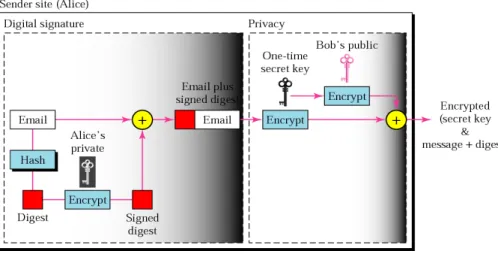
to combine both, the message is signed at first and later both the
message and the signature are encrypted
Key Management and Distribution
How secret keys in symmetric-key cryptography and how public keys in
asymmetric-key cryptography are distributed and maintained?
Symmetric-key Distribution
the symmetric key needs to be shared between every two
communicating parties
if Alice needs to exchange confidential messages withN people – she
needs to maintainN different keys
ifN people need to communicate with one another – a total of
N·(N−1)/2 keys is needed
(each person needs to maintainN−1 keys; since the keys are shared, we need “only”N·(N−1)/2 keys)
moreover, the keys’ distribution is another problem
⇒
a trusted party –
Key Distribution Center (KDC)
– is needed to
reduce the number of keys
Symmetric-key Management and Distribution
Key Distribution Center (KDC) I.
Key Distribution Center (KDC)
each person/entity establishes a shared secret key with the KDC
Symmetric-key Management and Distribution
Key Distribution Center (KDC) II.
Key Distribution Center (KDC)
cont’d.
the process of sending a confidential message from Alice to Bob may proceed as follows:
1 Alice sends a request to KDC, stating that she needs asession (temporary)
secret keybetween herself and Bob 2 KDC informs Bob of Alice’s request
3 If Bob agrees, a session key is created between the two
once the communication is terminated, the session key is no longer valid several approaches of creating the session key based on the previous ideas have been proposed
e.g., basic approach, Needham-Schroeder protocol, Otway-Rees protocol, etc. for the following three slides, the following holds:
KA (KB) . . . a symmetric key known only toAandS (resp.B andS) R,RA,RB,R1,R2. . . nonces
KAB . . . the symmetric session key example real implementation – Kerberos
Symmetric-key Management and Distribution
Key Distribution Center (KDC) III. – Basic Approach
Symmetric-key Management and Distribution
Key Distribution Center (KDC) III. – Needham-Schroeder protocol
Symmetric-key Management and Distribution
Key Distribution Center (KDC) III. – Otway-Rees protocol
Public-key Management and Distribution
Public-key Distribution
in public-key cryptography, everyone shields a private key and
advertises a public key
the public-key is freely available
Why a public-key distribution mechanism is needed, when the
public-keys can be freely announced?
to protect the keys from forgery
the mechanism: the use of a trusted center –Certification Authority
Public-key Management and Distribution
Certification Authority (CA)
Certification Authority (CA)
issues so-called
public-key certificates
bind an entity (human, server, etc.) with its public key
to prevent the certificate itself from being forged, the CA signs the certificate with its private key
such a certificate can be freely published and distributed
anyone who wants to extract the public key from the certificate uses the CA’s public key to extract it
when compromised, the previously issued certificates can be revoked example: X.509 certificates
supports hierarchical structure to allow the use in the wide Internet
(= hierarchical trust model)calledPublic Key Infrastructure (PKI)
Public-key Management and Distribution
X.509 Certificates
Public-key Management and Distribution
Public Key Infrastructure (PKI)
One of many definitions: a set of hardware, software, people, policies, and procedures needed to create, manage, store, distribute, and revoke
certificates based on public key cryptography
each certificate is issued (and signed) only by a single party (= CA)
each CA certifies only its children
the CA’s certificate itself may be signed by a different CA (all the way up to a “self-signed” root certificate)
⇒root certificates must be available to those who use a lower level CA certificate (root certificates are typically widely distributed)
Lecture overview
1 IntroductionMotivation
Network Security Elements
2 Cryptography Introduction Symmetric Cryptography Asymmetric Cryptography
3 Network Security Mechanisms Entity Authentication Message Confidentiality (Security) Message Integrity
Message Authentication Digital Signature
Key Management and Distribution
4 Example Protocols Ensuring Network Security in the Internet Application-layer Security
Transport-layer Security Network-layer Security Link-layer Security
5 Network & Data Protection – Maintaining the Availability Firewalls
Intrusion Detection Systems
Denial of Service (DoS) & Distributed Denial of Service (DDoS) attacks Virusses & Worms
Network & Data Protection – Concluding Remarks
6 Conclusion
Example Protocols Ensuring Network Security in the
Internet
all the presented concepts can be realized on:
application layer– security mechanisms provided by applications (application protocols) themselves
e.g., PGP, SET, S/MIME, S-HTTP, etc. transport layer– SSL and TLS
network layer– IPv6 & IPSec (IPv4)
link layer– e.g., PPP
Application-layer Security
Pretty Good Privacy (PGP)
Pretty Good Privacy (PGP)
a de-facto standard proposed by Phil Zimmermann (1991) the mechanism providingsecure email communicationchannels
originally uses an alternative approach to PKI for distributing user’s public keys – Web of Trust
decentralized trust model
identity certificates are digitally signed by other users who, by that act, endorse the association of that public key with the person/entity listed in the certificate
⇒leaves the trust decisions in the hands of individual users
there are several levels of confidence which can be included in such signatures later versions are able to use PKI as well
involves all the basic security mechanisms:
email confidentiality (using a symmetric one-time key because of performance – 3DES, IDEA, etc.)
integrity (hash functions – MD5, SHA)
authentication (asymmetric cryptography – RSA) non-repudiation (through the use of PKI) ≈Digital Signatures
Application-layer Security – PGP
Sender’s side
Figure : The mechanism of signing and encrypting the sending message (sender’s side).
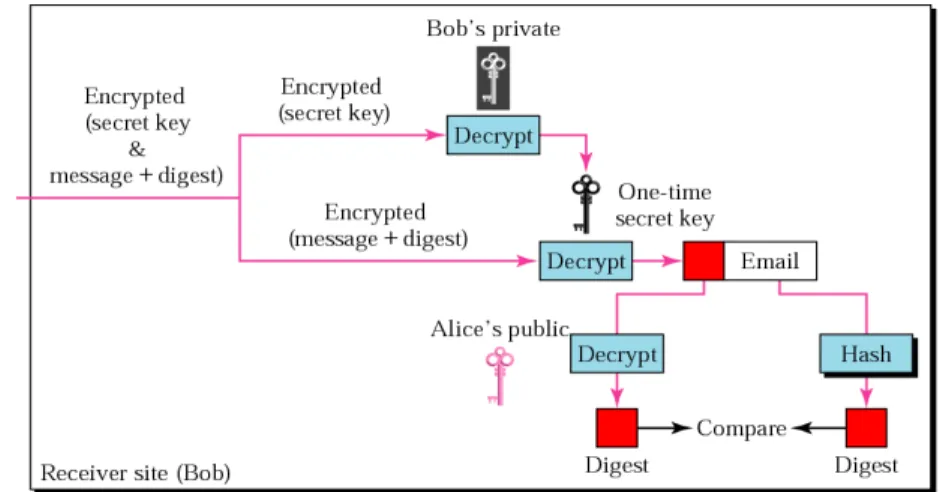
Application-layer Security – PGP
Receiver’s side
Figure : The mechanism of decrypting and verifying the received message (receiver’s side).
Application-layer Security
Secure Electronic Transactions (SET) I.
Secure Electronic Transactions (SET)
a specialized cryptographic protocol developed by a group of
companies (Visa, Microsoft, IBM, MasterCard, etc.)
designed for securing credit card transactions over insecure networks
NOT for a general encryptiondesign goals:
confidentiality of payment and ordering information integrity of all transmitted data
authentication of all card holders
ensuring that a merchant can accept card transactions based on buyer’s relationship with her financial institution
the merchant does not need to know the buyer’s identity
creating protocols that neither depend on transport security mechanism nor prevent their use
Application-layer Security
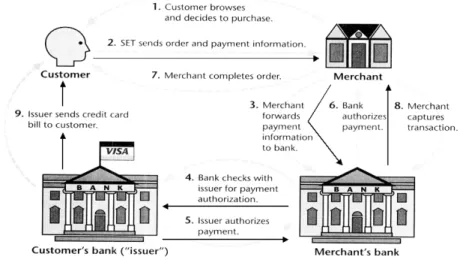
Secure Electronic Transactions (SET) II.
Figure : The SET transactions outline.
Application-layer Security
S/MIME and S-HTTP
Secure/Multipurpose Internet Mail Extension (S/MIME)
a standard for public key encryption and signing of MIME data
MIME – Internet standard that extends the format of e-mail to support, e.g., text in character sets other than ASCII, non-text attachments (pictures, video, audio, etc.), message bodies with multiple parts, etc.
provides authentication, message integrity and non-repudiation of origin (using digital signatures) and privacy and data security (using encryption)
Secure-HTTP (S-HTTP)
extends the Hypertext Transfer Protocol (HTTP) to support encryptions and digital signatures
extends the negotiation between the client browser and the server to include the negotiation for security matters
uses additional headers for message encryption, digital certificates, and authentication in the HTTP format
the HTTP headers are encapsulated into the S-HTTP headers
has been bundled away by the HTTPs (HTTP over SSL/TLS)
Transport-layer Security – SSL/TLS I.
Secure Sockets Layer (SSL) / Transport Layer Security (TLS)
the protocols for ensuring secure communication channels on the transport layer
(SSL precedes the TLS) SSL 3.0≈TLS 1.0
SSL/TLS provide secure and authenticateddata paths between servers and
clients:
data encryption– protect data in transport between the client and the server from interception (making them readable only by the intended recipient) server and client authentication– the SSL uses standard public key encryption to authenticate the communicating parties to each other message integrity– achieved through the use of session keys so that data cannot be intentionally/unintentionally tampered
main drawback: the necessity to adapt the applications (applications’ protocols)
HTTP→HTTPS (HTTP Secure) FTP→FTPS (FTP Secure) etc.
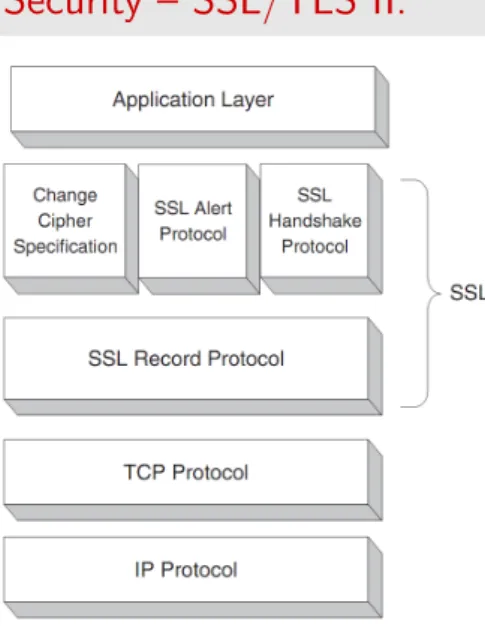
Transport-layer Security – SSL/TLS II.
Figure : The SSL protocol stack.
Transport-layer Security – SSL/TLS III.
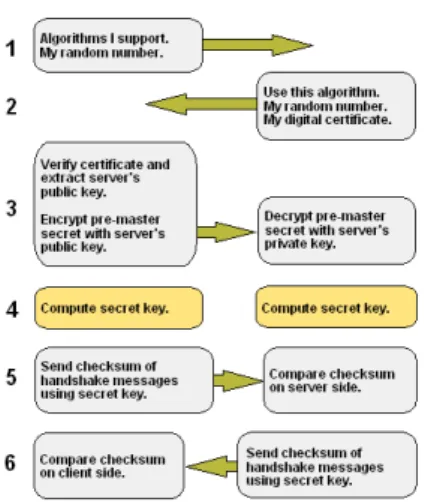
Before any SSL connection can be established, there must be a handshake performed:
Figure : The SSL handshake (steps 5 and 6 verify the integrity of the handshake; the communication is encrypted using a symmetric (session) key).
Network-layer Security – IPv6 & IPSec (IPv4) I.
IP Security – IPv6 & IPSec (IPv4)a set of protocols providing secured communication channels on the network layer Authentication Header (AH)protocol – designed for ensuring sender’s and receiver’s authentication and communication integrity (NOT for
communication confidentiality)
Encapsulating Security Payload (ESP)protocol – designed for providing sender’s authentication, communication integrity and confidentiality can be used independently or in combination
establishes logical channels (calledSecurity Associations, SAs) always one-way channels (two channels are needed for duplex communication)
identified by:
protocol identifier (AH or ESP), source IP address, and channel identification (so-calledSecurity Parameter Index, SPI)
operates in 2 modes:
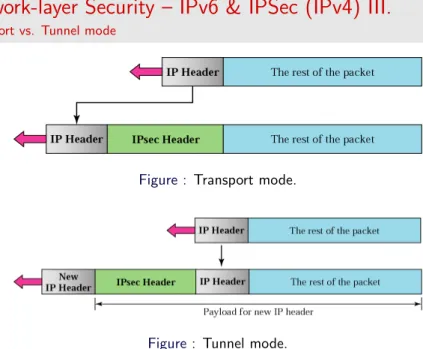
Transport mode– IPSec header is inserted between IP header and message body
Tunnel mode– IPSec header is inserted in front of the original IP header; subsequently, a new IP header is created
Network-layer Security – IPv6 & IPSec (IPv4) II.
IP Security – IPv6 & IPSec (IPv4)cont’d.
key distribution:
Internet Key Exchange (IKE)– used to set up an SA (RFC 4306 for v2) uses X.509 certificates for authentication and Diffie–Hellman key exchange to set up a shared session secret
Internet Security Association and Key management Protocol (ISAKMP)– a framework for authentication and key exchange (RFC 2408)
designed to be key exchange independent (IKE or other protocols can be used to provide authenticated keying material)
advantages: secures all the data flows between two communicating parties; it is not necessary to adapt applications (application protocols)
drawbacks: there are no automated mechanisms for cryptographic keys’ management
further information:
see IPv6 section in PA159
see the animation (ongoing BP Thesis⇒will be available in a month):
http://frakira.fi.muni.cz/~jeronimo/vyuka/IPSec
Network-layer Security – IPv6 & IPSec (IPv4) III.
Transport vs. Tunnel mode
Figure : Transport mode.
Figure : Tunnel mode.
Network-layer Security – IPv6 & IPSec (IPv4) IV.
Virtual Private Networks (VPNs) I.
Virtual Private Network (VPN)
a computer network that uses a public telecommunication infrastructure (such as the Internet) to provide remote offices or individual users with secure access to their organization’s network
using a secure cryptographic method, it encapsulates data transfers between two or more networked devices which are not on the same private network
in order to keep the transferred data private
the VPN technology provides the following activities:
IP encapsulation– involves enclosing TCP/IP data packets within another packet with an IP-address of either a firewall or a server that acts as a VPN endpoint
various tunneling mechanisms: IPSec ESP tunnel, Point-to-Point Tunneling protocol (PPTP), Layer 2 Tunneling Protocol (L2TP), PPP over SSL and PPP over SSH, etc.
Encryption– used to obfuscate the contents of the encapsulated data Authentication– used to determine whether or not the endpoint can participate in the encrypted tunnel
may also be used to exchange the secret or public key used for payload encryption
Network-layer Security – IPv6 & IPSec (IPv4) IV.
Virtual Private Networks (VPNs) II.
Link-layer Security
Point-to-Point Protocol (PPP)
Point-to-Point Protocol (PPP)
a data link protocol commonly used in establishing a direct
connection between two networking nodes
limited to a single data link
provides connection authentication, transmission encryption
(confidentiality), and compression
several authentication protocols can be used (PAP, CHAP, EAP, etc.) transmission encryption – DES or 3DES
most commonly used forms:
Point-to-Point Protocol over ATM (PPPoA) Point-to-Point Protocol over Ethernet (PPPoE)
both serve to establish a DSL line connection with an ISP
Lecture overview
1 IntroductionMotivation
Network Security Elements
2 Cryptography Introduction Symmetric Cryptography Asymmetric Cryptography
3 Network Security Mechanisms Entity Authentication Message Confidentiality (Security) Message Integrity
Message Authentication Digital Signature
Key Management and Distribution
4 Example Protocols Ensuring Network Security in the Internet Application-layer Security
Transport-layer Security Network-layer Security Link-layer Security
5 Network & Data Protection – Maintaining the Availability Firewalls
Intrusion Detection Systems
Denial of Service (DoS) & Distributed Denial of Service (DDoS) attacks Virusses & Worms
Network & Data Protection – Concluding Remarks
6 Conclusion
Network&Data Protection – Maintaining the Availability I.
all the previous security mechanisms cannot prevent Eve from sending
a harmful message to a system
network & data protection
– a complicated problem without a
simple solution
authentication and encryption mechanisms are just technical fundamentals
organizationalandsocialaspects are needed
humans (users) are usually the weakest elements⇒social engineering
possible threats:
accessing private data
modification of private or public data
including their removal (e.g., web pages)
undesired interferences to the network traffic/operation
including services’ denial (so-calledDenial of Serviceattacks)
Network&Data Protection – Maintaining the Availability I.
A bit of History
Network&Data Protection – Maintaining the Availability II.
Attack/Intrusion
a deliberate unauthorized attempt, successful or not, to break into, access,
manipulate, or misuse some valuable property and where the misuse may
result into or render the property unreliable or unusable
The attack/intrusion process consists of few stages:
Reconnaissance
– the process of gathering information about the
target system and the details of its workings and weak points
a scanning program sends network traffic to all/selected computers and expects receiving return traffic that will indicate whether those
computers have known vulnerabilities
Physical Intrusion
to acquire/modify private information, and/or
Denial of Service
to crash a service (or a machine), overload network
links or machines’ CPU, fill up a disk, etc.
Network&Data Protection – Maintaining the Availability
III.The protection from exploits has to be implemented on:
physical level
access protection
software level
authentication encryption
traffic monitoring and instant reaction to incidents
juridical level
a definition ofdesiredandundesiredbehaviour
The basic security mechanisms for network protection:
Firewalls
Intrusion Detection Systems
Antiviruses
Firewalls I.
Firewall
a primary mean of securing a private network against penetration
firewall
= a hardware, software, or a combination of both that
monitors and filters traffic packets that attempt to either enter or
leave a protected private network
i.e., interconnects networks withdifferent trust
creates aperimeter defensedesigned to protect information resources of an organization
Firewalls II.
What a firewall can do. . .
implement security policies (
≈
network access protection) at a single
point
only authorized traffic is allowed to access the network/services (or leave the network)
monitor security-related events (audit, log)
alarms for abnormal behavior can be implemented
Firewalls III.
and what a firewall
cannot
do. . .
protect against attacks that bypass the firewall
e.g., dial-out from internal host to an ISPprotect against internal threats
disgruntled employee
an insider cooperates with an external attacker
protect against the transfer of virus-infected programs or files
not including application gateways, which may be able to do soFirewalls IV.
Firewalls’ Classification
Basic firewalls’ classification:
Packet filtering firewalls
– operate on network layerCircuit level gateways
– operate on session/transport layerApplication gateways (or proxy servers)
– operate on application layerDynamic packet filtering firewalls (or Session filtering firewalls)
a combination of the three above
these technologies operate at different levels of detail, providing
varying degrees of network access protection
Firewalls V.
Packet Filtering firewalls
Packet Filtering firewalls
decisions are made on per-packet basis
no state information is maintained
applies packet filters based on access rules defined by the following
parameters:
source address destination address
application or protocol/next header (TCP, UDP, etc.) source port number
destination port number
advantages:
simple, low cost, fast, transparent to users
disadvantages:
cannot prevent attacks that employ application-specific vulnerabilities or functions
because they do not examine upper-layer data
Firewalls V.
Dynamic Packet Filtering (Session Filtering) firewalls I.
Dynamic Packet Filtering (Session Filtering) firewalls
traditional packet filters do not examine higher layer context
i.e., matching the incoming (returned) packets with an outgoing flow
dynamic packet filtering examines and maintains a
context of each
packet
they keep track of client-server connection
⇒a connection table (so-calledState table) is maintained
packet decision is made in the context of a connection
if a packet establishes a new connection, it is checked against a policy if a packet is a part of an existing connection, it is matched up in the state table
advantages:
transparent to users low CPU overheads
for all the packets (except the first one) belonging to the same connection, no policy database lookups are performed
Firewalls V.
Dynamic Packet Filtering (Session Filtering) firewalls II.
Firewalls V.
Circuit Level Gateways I.
Circuit Level Gateways
work at the session layer of the ISO/OSI model (TCP layer of the TCP/IP model)
monitor TCP handshaking between packets to determine whether a requested session is legitimate
do not permit an end-to-end TCP connection
rather, the gateway sets up two TCP connections one between itself and a TCP user on an inner host, and one between itself and a TCP user on an outside host
once the two connections are established, the gateway typically relays TCP segments from one to the other without examining the contents
usage example:
hiding information about internal/protected networks
non-requested data from outside the firewall is not allowed in – all ports are closed until the firewall opens them
e.g., requests from protected network pass through the gateway, which intercept and record them
once the answer reaches the gateway, it is compared to the original request to see if the IP address and the port match up
Firewalls V.
Circuit Level Gateways II.
Circuit Level Gateways
cont’d.
a combination of circuit-level gateway with Internet sharing =Network
Address Translation (NAT)
originally a reaction to IPv4 address exhaustion but the NAT isnot a firewallon itself!
Firewalls V.
Circuit Level Gateways III.
Firewalls V.
Application Gateways I.
Application Gateways
similar to circuit-level gateways except that they are application specific
i.e., tailored to a specific application program
every connection between two networks is made via an application program called a proxy
proxies are application/protocol specific
they investigate the content of the passing flows connection state is maintained and updated
only protocols that have specific proxies configured are allowed through the firewall (all other traffic is rejected)
e.g., a gateway that is configured to be a web proxy will not allow any FTP, telnet or other traffic through
Firewalls V.
Application Gateways II.
Application Gateways
cont’d.
usage example:
HTTP proxies (URL blocking), SMTP proxies (virus scanning, spam identification), DNS proxies, etc.
advantages:
more secure than packet filtering firewalls
can investigate the content of the flows can protect against protocol errors
it is easy to log and audit all incoming/outgoing traffic
disadvantages:
very CPU intensive⇒lower performance
require high performance host computer
more vulnerable to DoS attacks (see later) problematic for encrypted data (including IPSec)
Firewalls VI.
Concluding Remarks
firewalls cannot serve as a panacea to network security threats
many security attacks led from within the internal (not protected) networkincrease the risk of rapid infection spread
false safety feeling
the internal network is not usually sufficiently protected users become lazy
usually cause a slowdown on high-speed networks
their functionality is very useful for interrupting the ongoing attack
application proxies
:
risk of faults (e.g., false virus detection) the importance of privacy protection
Intrusion Detection Systems (IDS) I.
network perimeter security technologies (i.e., firewalls) and anti-malicious software technologies (i.e., antiviruses, see later) cannot stop attackers if they obtain authenticated access to target computers and log on to them as if they are legitimate users
(i.e., they had obtained login information of a legitimate user)
it is desirable (and often necessary) to detect intrusion activities by monitoring ingress packets that have passed through firewalls and analyze how users use their computers
⇒Intrusion Detection Systems (IDS)andHoneypots
Intrusion Detection Systems (IDS)
a system used todetect unauthorized intrusions into computer systems and
networks
based on an assumption that the behavior of the intruder differs from that of a legitimate user
they collect information from a variety of system and network sources and look forattack signatures
= specific patterns that usually indicate malicious or suspicious intent
Intrusion Detection Systems (IDS) II.
Classification
IDS classification:
different ways of classifying an IDS
IDSs based on
detection model
:
anomaly detection
signature based misuse (misuse detection) hybrid
IDSs based on
scope
:
host-based multihost-based network-based
IDSs based on
operation
:
offline – inspect system logs at set intervals online – monitor the system continuously
Intrusion Detection Systems (IDS) III.
Anomaly Detection
Anomaly Detection IDSs:
model the normal usage of the network as a noise characterization
anything distinct from the noise (atypical behavior) is assumed to be
an intrusion activity
e.g., flooding a host with lots of packet
the
primary strength
is its ability to recognize novel attacks
drawbacks:
assume, that intrusions will be accompanied by manifestations that are sufficiently unusual
generate many false alarms
⇒compromise the effectiveness of the IDS
Intrusion Detection Systems (IDS) III.
Misuse Detection
Misuse Detection IDSs:
recognize known attacks based on
signatures
a set of attack signatures has to be defined (and updated)
if an action matching a signature is detected, it is considered to be an
attack
drawbacks:
unable to detect novel attacks suffer from false alarms
have to be programmed again for every new pattern to be detected
Intrusion Detection Systems (IDS) III.
Host-based & Multihost-based IDSs I.
Host-based IDSs:
host operating system (or an application) logs in the audit
information
e.g., use of identification and authentication mechanisms (logins, etc.), file opens and program executions, admin activities, etc.
the audit is then analyzed to detect trails of intrusion
Multihost-based IDSs:
audit information is analyzed from multiple hosts
analysis architecture:
centralized– all data shipped to a central location for analysis
hierarchical– data is analyzed as it passed up through the layers
distributed– distributed analysis of the data
Intrusion Detection Systems (IDS) III.
Host-based & Multihost-based IDSs II.
Host-based & Multihost-based IDSs:
cont’d.
advantages:
can detect data that are encrypted during transmissions do not need special hardware devices
check system logs and so can analyze system behavior more accurately
disadvantages:
are installed in the target systems, and so they require extra system managing
may consume extra computing resources on the systems might become affected by attacks that affect the host computers/servers they are installed in
Intrusion Detection Systems (IDS) III.
Network-based IDSs
Network-based IDSs:
look for attack signatures in network traffic via a promiscuous interface a filter is usually applied to determine which traffic will be discarded or passed on to an attack recognition module
to filter out known un-malicious traffic advantages:
low cost – usually small number of selected points to monitor the entire network
no interference – packets are monitored passively (it does not interfere normal network traffic)
intrusion resistent – usually a small system, which can be easily made to resist an intrusion
disadvantages:
may not be able to analyze encrypted packets
may not be able to handle large volume of network traffics in time some intrusion activities (e.g., fragmentation-attack) are hard to identify hard to determine, whether the intrusion activity has been successfully carried out
Intrusion Detection Systems (IDS) IV.
Concluding Remarks
Intrusion Detection Systems
are only one piece of the whole security
puzzle
they must be supplemented by other security and protection
mechanisms
they are a very important part of security architecture but do not
solve all the potencial problems
Honeypots
Honeypot
a system designed to teach how intruders probe for and exploit a
system
by learning their tools and methods, one can better protect her network and systems
usually used for:
diverting an attacker from accessing critical systems collecting information about the attacker’s activity
encouraging the attacker to stay on the system long enough for administrators to respond
based on virtual or real systems
Honeypots
“Tracking Their Moves” I.
“Tracking Their Moves”
do not log information on the honeypot itself
the fewer modification you make to the honeypot, the better
the more changes you make, the better the chance an intruder will discover something is up
you can easily lose the information
track in layers, do not depend on a single source of information
first layer of tracking is the firewall logssecond layer is the system logs
third layer of tracking is to use a sniffer
it picks up all keystrokes and screen captures
run, e.g., theTripwireon the honeypot
to discover what binaries have been altered on a compromised system
Honeypots
“Tracking Their Moves” II.
“Tracking Their Moves”
cont’d.
do not mindlessly reinstall the compromised system!!!
otherwise you’ll lose the information about the security hole the intruder had exploited
if possible, do not reboot the compromised system
running malicious programs may not automatically start after the reboot
if possible, do not disconnect the compromised system from the
network
the system, once being disconnected from the network, may close all the active network connections
better way is to cut off the system on the closest firewall
or disconnect it behind first network element (switch, router, etc.)
Denial of Service (DoS) & Distributed DoS (DDoS) I.
Denial of Service (DoS) attack:
an attack that causes a loss of a service to users
typically the loss of network connectivity and services by consuming the bandwidth of the victim’s network or overloading the computational resources of the victim’s system
the flood of incoming messages essentially forces the target system to shut down (thus denying the service)
attack leadfrom a single source
not too dangerous – can be stopped in the closest active network element
attack leadfrom many sources=Distributed Denial of Service (DDoS)
attack
a synchronized attack from many sources (e.g., Botnets)
hard to discover – all the requests appear to be sent by legitimate users much more dangerous
stopping requires a cooperation in the network
stopping inactive networks– consecutive cut of flows against their direction
Denial of Service (DoS) & Distributed DoS (DDoS) II.
Virusses & Worms I.
Computer virus
a self-propagating computer program designed to alter or destroy a
computer system resource
Worm
a self-replicating program, similar to a computer virus – a virus attaches
itself to, and becomes part of, another executable program; however, a
worm is self-contained and does not need to be part of another program to
propagate itself (through security holes of a networked system)
Virus/Worm attacks:
some sort of trigger will activate the attack phase, and the virus will then “do something”
trigger= a specific date, or the number of times the virus has been replicated, or anything similar
“do something”= anything from printing a silly message on the screen to erasing all of your data
Virusses & Worms II.
Protection from virus/worm attacks:
run a secure operating system with access rights
security features keep viruses awayrun virus protection software
in end-nodes and/or application gateways
avoid programs from unknown sources
educating the users is a must
=computer hygiene
Network & Data Protection – Concluding Remarks
attacks/intrusions – an effort to acquire an access to a network or its
services
reasons range from boyish fun (“testing neighbor’s pears”) to military/terroristic actions
usage:
private data access/modification
source platform for subsequent activity (e.g., DDoS)
protection:
access control on all possible levels
regular maintanance (patches, upgrades, etc.) network traffic monitoring
monitoring of processes running on the servers/end-nodes
users’ education
Lecture overview
1 IntroductionMotivation
Network Security Elements
2 Cryptography Introduction Symmetric Cryptography Asymmetric Cryptography
3 Network Security Mechanisms Entity Authentication Message Confidentiality (Security) Message Integrity
Message Authentication Digital Signature
Key Management and Distribution
4 Example Protocols Ensuring Network Security in the Internet Application-layer Security
Transport-layer Security Network-layer Security Link-layer Security
5 Network & Data Protection – Maintaining the Availability Firewalls
Intrusion Detection Systems
Denial of Service (DoS) & Distributed Denial of Service (DDoS) attacks Virusses & Worms
Network & Data Protection – Concluding Remarks
6 Conclusion
Recapitulation – Network Security
AAA mechanisms + secured communication mechanisms + data/services protection/availability
features of a secured communication network: Confidentiality
Integrity Non-repudiation
symmetric (shared key) and asymmetric (key pair – private and public) cryptography
secured communication mechanisms can be provided on various ISO/OSI layers (application, transport, network, data link)
further information:
PV017: Information Technology Security (doc. Staudek) PV079: Applied Cryptography (prof. Maty´aˇs et al.)
PV080: Protection of Data and Information Privacy (prof. Maty´aˇs) PV157: Authentication and Access Control (prof. Maty´aˇs and dr. ˇ
R´ıha)
PV210: Security analysis of network traffic (RNDr. Vykopal) etc.