Recent Progress in Complex Network Analysis.
Models of Random Intersection Graphs
Mindaugas Bloznelis∗, Erhard Godehardt†, Jerzy Jaworski‡, Valentas Kurauskas∗, Katarzyna Rybarczyk‡
Adam Mickiewicz University‡, Heinrich Heine University†, Vilnius University∗
Abstract
Experimental results show that in large complex networks such as internet or biological networks, there is a tendency to connect elements which have a com-mon neighbor. This tendency in theoretical random graph models is depicted by the asymptotically constant clustering coefficient. Moreover complex networks have power law degree distribution and small diameter (small world phenomena), thus these are desirable features of random graphs used for modeling real life networks. We survey various variants of random intersection graph models, which are impor-tant for networks modeling.
key words: Random intersection graphs, Random graph applications, Network models, Compelx networks
1
Introduction
Given a finite set W and a collection of its subsets D1, . . . , Dn, the active intersection
graph defines an adjacency relation between the subsets by declaring two subsets adjacent whenever they share at least s common elements (in this sense, each subset Di can be
considered as a vertex vi of a vertex set V). The passive intersection graph defines an
adjacency relation between the elements of W. A pair of elements is declared an edge if it is contained ins or more subsets. Here s≥1 is a model parameter. Both models have reasonable interpretations, for example, in the active graph, two peoplevi andvj with sets
of hobbiesDiandDj establish a communication link whenever they have sufficiently many
common hobbies. In the passive graph, students (represented by elements of W) become acquaintances if they participate in sufficiently many joint projects; here the projects (respectively their managers) form the setV. In order to model active and passive graphs with desired statistical properties, we choose subsets D1, . . . , Dn at random and obtain
random intersection graphs. Alternatively, a random intersection graph can be obtained from a random bipartite graph with bipartition V ∪W, where each vertex (actor) vi
from the set V = {v1, . . . , vn} selects the set Di ⊂ W of its neighbors (attributes) in
the bipartite graph at random. Now, the active intersection graph defines the adjacency relation on the vertex set V: vi and vj are adjacent if they have at least s common
neighbors in the bipartite graph. Similarly, vertices wi, wj ∈ W are adjacent in the
passive graph whenever they have at least s common neighbors in the bipartite graph. An attractive property of these models is that they capture important features of real net-works, the power-law degree distribution (called also the “scale-free” property), small typ-ical distances between vertices (the “small-world” property, see Strogatz and Watts 1998), and a high statistical dependency of neighboring adjacency relations expressed in terms of clustering and assortativity coefficients (we give a detailed account of these properties in the accompanying paper Bloznelis et al. 2015). In the literature a network possessing these properties is called acomplex network. Many real life networks such as the internet network, the world wide web, or many biological networks are believed to be complex networks.
Complex network models based on random intersection graphs help to explain and un-derstand some statistical properties of real networks, like the actor network where actors are linked by an edge when they have acted in the same film, or the collaboration network where authors are declared adjacent when they have co-authored at leasts papers. These networks exploit the underlying bipartite graph structure: Actors are linked to films, and authors to papers. Newman et al. 2002 pointed out that the clustering property of those networks could be explained by the presence of such a bipartite graph structure, see also Barbour and Reinert 2011, Guillaume and Latapy 2004. The bipartite structure does not need to be given explicitly: The members of a social network tend to establish a link if they share some common interests even if the total “set of interests” might be difficult to specify.
In what follows we present several random intersection graph models and describe rela-tions between them. Our analysis shows that random intersection graph models provide remarkably good approximations to some real networks (such as the actor network) as long as the degree and clustering properties are considered. These empirical observations are supported by theoretical findings (see Bloznelis et al. 2015). The study of random intersection graphs has just started and many interesting properties are still unexplored.
2
Models
Let n and m be positive integers. The structure of a random intersection graph re-sults from relations between elements of two disjoint sets V = {v1, . . . , vn} and W = {w1, . . . , wm}. V is a set of actors and W a set of attributes.
2.1
Binomial intersection graph
The first random intersection graph model, denoted by G(n, m, p), was introduced in Karo´nski et al. 1999. Given p ∈ [0; 1], in G(n, m, p) each actor vj adds an attribute wi
to Dj with probability p independently of all other elements of V ∪W. This relation
may be represented by a bipartite graph with bipartition (V, W) in which each edge joining an element ofV with an element of W appears independently with probability p.
G(n, m, p) is a graph with vertex set V in which vertices vi and vj are adjacent if Di
to the gate matrix layout problem that arises in the context of physical layout of “Very Large Scale Integration”, see Karo´nski et al. 1999 and references therein. The model was generalised in Godehardt and Jaworski 2001, Godehardt and Jaworski 2003 to an active and passive random intersection graph.
2.2
Active intersection graph
Given a set of attributes W = {w1, . . . , wm}, an actor v is identified with the set D(v)
of attributes selected by v from W. Let the actors v1, . . . , vn choose their attribute sets Di =D(vi), 1≤i≤n, independently at random, and declarevi and vj adjacent (vi ∼vj)
whenever they share at least s common attributes, i.e., |Di∩Dj| ≥ s. Here and below, s≥1 is the same for all pairs vi, vj. The graph on the vertex setV ={v1, . . . , vn}defined
by this adjacency relation is called the active random intersection graph, see Godehardt and Jaworski 2003. Subsets of W of size s play a special role; we call them joints. They serve as witnesses of established links: vi ∼vj whenever there exists a joint included both
inDi and Dj.
For simplicity, we assume that the random sets D1, . . . , Dn have the same probability
distribution of the form
P(Di =A) =P(|A|) |mA|
−1
for A⊂W. (1)
That is, given an integer k, all subsets A ⊂ W of size |A| = k receive equal chances, proportional to the weight P(k), where P is a probability on {0,1, . . . , m}. The random intersection graph defined in this way is denoted Gs(n, m, P). Note that the active
in-tersection graph Gs(n, m, P) becomes the binomial intersection graph Gs(n, m, p) if we
chooseP =Bin(m, p). Also note thatG1(n, m, p) is G(n, m, p) as defined in Karo´nski et
al. 1999.
The active intersection graphGs(n, m, δx), whereδx is the probability distribution putting
mass 1 on a positive integerx(i.e., all random sets are of the same, non-random sizex) has attracted particular attention in the literature (Blackburn and Gerke 2009, Bloznelis and Luczak 2013, Eschenauer and Gligor 2002, Godehardt and Jaworski 2003, Nikoletseas et al. 2011, Rybarczyk 2011a, Yagan and Makowski 2009) as it provides a convenient model of a secure wireless network. It is called the uniform random intersection graph and denotedGs(n, m, x).
The sparse active random intersection graph admits power-law degree distribution (asymp-totic asn, m→ ∞), which has the form of a Poisson mixture (Bloznelis 2008, Bloznelis 2010c, Deijfen and Kets 2009, Jaworski et al. 2006, Rybarczyk 2012, Stark 2004), tunable cluster-ing (Bloznelis 2013, Deijfen and Kets 2009, Yagan and Makowski 2009) and assortativity coefficients (Bloznelis et al. 2013). To get a power-law active intersection graph one chooses n = O(m) and the probability distribution of the size |Di| of the typical set
such that pn/m|Di| are asymptotically power-law distributed as n, m→+∞. Detailed
results concerning degree distribution, clustering and other properties are given in the accompanying paper Bloznelis et al. 2015.
The phase transition in the component size of an active random intersection graph has been studied in Behrisch 2007, Bloznelis et al. 2009, Godehardt et al. 2007, Rybar-czyk 2011a. The effect of the clustering property on the phase transition in the
com-ponent size and on the epidemic spread has been studied in Lager˚as and Lindholm 2008, Bloznelis 2010c, Britton et al. 2008 respectively. Finally, we would like to mention the in-tersection graph model of Johnson and Markstr¨om 2013, where the setsDi have a special
structure in that they are subcubes of the cube W ={0,1}n.
2.3
Passive intersection graph
Let D1, . . . , Dn be independent random subsets of W with the same probability
dis-tribution (1). Let vertices w, w0 ∈ W be linked by Dj if w, w0 ∈ Dj. For example,
every w0 ∈ Dj \ {w} is linked to w by Dj. The links created by D1, . . . , Dn define a
multigraph on the vertex set W. In the passive random intersection graph, two vertices
w, w0 ∈ W are defined adjacent whenever there are at least s links between w and w0, i.e., the pair {w, w0} is contained in at least s subsets of the collection {D1, . . . , Dn},
see Godehardt and Jaworski 2003. We denote the passive random intersection graph
G∗s(n, m, P) with P as the common probability distribution of the random variables
X1 = |D1|, . . . , Xn = |Dn|. The passive intersection graph G∗s(n, m, P) becomes the
binomial intersection graph Gs(m, n, p) if P =Bin(n, p).
The sparse passive random intersection graph admits a power-law asymptotic degree dis-tribution which has the form of a compound Poisson disdis-tribution, see Bloznelis 2013, Ja-worski and Stark 2008. It has a tunable clustering and assortativity coefficients (Bloznelis et al. 2013, Godehardt et al. 2012, see also Bloznelis 2013).
2.4
Inhomogeneous intersection graph
In order to model inhomogeneity of adjacency relations that takes into account the vari-ability of “activity” of actors and “attractiveness” of attributes, the binomial model has been generalized in Nikoletseas et al. 2004, Nikoletseas et al. 2008 by introducing inho-mogeneous weight sequences, see also Barbour and Reinert 2011, Deijfen and Kets 2009, Rybarczyk 2013, Shang 2010. Given weight sequences x={xi}1≤i≤m and y ={yj}1≤j≤n
with xi, yj ∈ [0,1], i, j ≥ 1, consider the random bipartite graph Hx,y with bipartition V ={v1, v2, . . .} and W ={w1, w2, . . .}, where edges {wi, vj} are inserted independently
and with probabilities pij = xiyj. Define the inhomogeneous graph Gx,y on the vertex
setV by declaringu, v ∈V adjacent (denotedu∼v) whenever they have a common neigh-bor in Hx,y. Now an attribute wi is picked with probability proportional to the activity yj of the actor vj and the attractiveness xi of the attribute wi. Consider, for example,
the French actor networkGF, where two actorsvi, vj ∈V are declared adjacent whenever
they have acted in the same movie wk ∈ W (real network data from the actor network,
see http://www.imdb.com). The number of actors|V|= 43204 and the number of movies
|W|= 5629. LetG0F be the inhomogeneous random intersection graph where the activity of an actor vj is proportional to the number of movies she or he acted in and the
attrac-tiveness of the moviewi is proportional to the number of actors that acted in this movie.
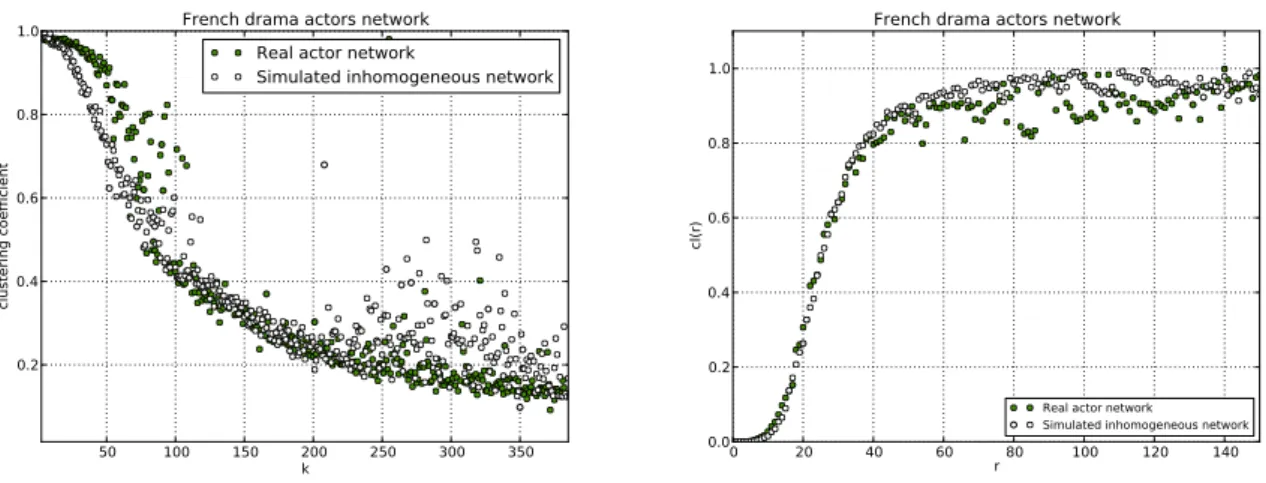
We simulate an instance of G0F so that in the simulated network actors pick attributes independently at random, but with the probabilities estimated from the true networkGF.
In Fig. 1. we plot the clustering coefficients k →P(v1∗ ∼ v2∗|v1∗ ∼ v3∗, v2∗ ∼v3∗, d(v3∗) = k) of GF and G0F, and the clustering function r → P(v∗1 ∼ v∗2|d(v1∗, v2∗) = r) of GF and G0F
50 100 150 200 250 300 350 k 0.2 0.4 0.6 0.8 1.0 clustering coefficient
French drama actors network Real actor network
Simulated inhomogeneous network
0 20 40 60 r80 100 120 140 0.0 0.2 0.4 0.6 0.8 1.0 cl(r)
French drama actors network
Real actor network Simulated inhomogeneous network
Figure 1: Clustering coefficient and clustering function.
(Bloznelis and Kurauskas 2012). Here (v∗1, v∗2, v∗3) is an ordered triple of vertices sampled at random from V. By ∼ we denote the adjacency relation and d(v) counts the number of neighbors of v, d(v, u) counts the number of common neighbors ofu and v.
Analysis of the inhomogeneous intersection graph becomes simpler if we impose some regularity conditions on the weight sequences x and y. For example, if we drop the con-ditionxi, yj ∈[0,1] and replacepij by ˜pij = min{1, xiyj/
√
nm}, we obtain a modification of Gx,y, which we denote ˜Gx,y. In addition a convenient assumption is that x and y are
realized values of two independent sequences of i.i.d. random variables X = {Xi}1≤i≤m
and Y = {Yj}1≤j≤n respectively. Let P1 and P2 denote the probability distributions of
the random variables Y1 and X1. By G(n, m, P1, P2) we denote the random intersection
graph ˜GX,Y.
Note that G(n, m, P1, δx) is an active random intersection graph and G(n, m, δx, P2) a
passive one (we recall thatδx is the probability distribution putting mass 1 onx >0). In
particular, the model G(n, m, P1, P2) admits a power-law asymptotic degree distribution
and tunable clustering and assortativity coefficients (Bloznelis and Damarackas 2013, Bloznelis and Kurauskas 2012, see also Bloznelis and Karo´nski 2013). Bloznelis and Damarackas 2013 revises an incorrect result of Shang 2010.
Inhomogeneous random intersection graphs reproduce empirically observed clustering properties of a real actor network with remarkable accuracy as shown in Bloznelis and Kurauskas 2012. One drawback of such models is that they do not account for various characteristics of the networks that change over time. This shortage is overcome by the random intersection graph process in Bloznelis and Karo´nski 2013, aimed at modeling an affiliation network evolving in time, see Martin et al. 2013.
2.5
Intersection digraph
Often relations between actors of a social network are non-symmetric. Such adjacency relations are usually modeled with the aid of a directed graph (digraph). In order to obtain a random digraph admitting non-vanishing clustering coefficients it is convenient to employ the bipartite structure, similarly as in the case of a random intersection graph.
Given two collections of subsets S1, . . . , Sn and T1, . . . , Tn of a set W = {w1, . . . , wm},
define the intersection digraph on a vertex set V ={v1, . . . , vn}such that the arc vi →vj
is present in the digraph whenever Si ∩Tj 6= ∅ for i 6= j. Assuming that the sets Si
and Ti, i = 1, . . . , n, are drawn at random, one obtains a random intersection digraph
(Bloznelis 2010a). For example, the set Si may be used to represent the set of papers
(co-) authored by the i-th scientist, while Tj may be the set of papers cited by the j
-th scientist. Then -the corresponding intersection digraph represents scholarly influences. For simplicity, one may consider the class of random intersection digraphs where the pairs of random subsets (Si, Ti), i = 1, . . . , n, are independent and identically distributed. In
addition, we assume that the distributions of Si and Ti are mixtures of uniform
distri-butions. That is, for every k, conditionally on the event |Si| = k, the random set Si
is uniformly distributed in the class Wk of all subsets of W of size k. Similarly,
con-ditionally on the event |Ti| = k, the random set Ti is uniformly distributed in Wk. In
particular, with PS∗ and PT∗ denoting the distributions of |Si| and |Ti|, we have that,
for every A ⊂ W, P(Si = A) = |mA|
−1
PS∗(|A|) and P(Ti = A) = |mA|
−1
PT∗(|A|). By
D(n, m, P∗) we denote the random intersection digraph generated by independent and
identically distributed pairs of random subsets (Si, Ti), 1 ≤ i ≤ n, where P∗ denotes the common distribution of pairs (Si, Ti). Random intersection digraphs D(n, m, P∗) are flexible enough to model random digraphs with in- and outdegrees having some desired statistical properties as a power-law outdegree distribution and a bounded-support inde-gree distribution. Assuming, e.g., that Si and Ti intersect with positive probability, one
can obtain a random digraph with a clustering property (Bloznelis 2010a).
3
Relations between the models
The theory of random graphs investigates asymptotic properties of random graph models, in particular properties of random intersection graphs. The following sets are examples of properties: B=Bn consisting of all connected graphs on n vertices,C =Cn consisting of
all graphs onnvertices with maximal degree at most 6 orD =Dn consisting of all graphs
onnvertices which have a given degree distribution. IfG∈ Bwe say thatGis connected and so on. Moreover Ais calledincreasing (decreasing)if for everyGwith propertyA,G
with added (deleted) any edge has property A. A property A which is either increasing or decreasing is called monotone. For instance B is increasing, C is decreasing and D is an intersection of one increasing and one decreasing property.
Sometimes it is possible to compare graph models in order to deduce something about asymptotic (usually monotone) properties of one model using known results concerning the other one. The comparison technique is called coupling. It was used in Bloznelis et al. 2009 to determine relationship between Gs(n, m, δd), Gs(n, m, p) and Gs(n, m, P). In
particular it was shown that for any fixeds≥1 and increasing propertyA, if lnn=o(m p) then for any integers 0≤d−≤m p−t and m p+t≤d+≤m we have as n→ ∞
Pr Gs(n, m, δd−)∈ A −o(1)≤Pr Gs(n, m, p)∈ A ≤Pr Gs(n, m, δd+)∈ A +o(1).
Analogue inequalities hold for any decreasing property B. Informally speaking, the in-equalities allow to show that for d ∼ mp and lnn = o(d) Gs(n, m, δd) and Gs(n, m, p)
have the same monotone properties with probability tending to 1 as n → ∞. A similar theorem concerning more generalG(n, m, P) can be found in Bloznelis et al. 2009. It would be convenient to find any such relation between random intersection graphs and well studied models such as the Erd˝os–R´enyi random graph G(n,pˆ), in which each edge appears independently with probability ˆp. For the inhomogeneous random intersection graphGx,y withx= (1,1. . . ,1) andy = (p1, p2. . . , pm), 0≤pi ≤1 it is possible to define
ˆ
p, such that for any increasing property A
lim inf
n→∞ Pr{G(n,pˆ)∈ A} ≤lim supn→∞ Pr{Gx,y ∈ A)}.
This and other relations between the random graph models are used in Rybarczyk 2011c, Rybarczyk 2013 to establish threshold functions in random intersection graphs for many monotone properties such as k-connectivity, Hamiltonicity and existance of a perfect matching.
Some random graph models have the same asymptotic properties even though they are defined in different ways. We call such models equivalent. For example, for np small, the edges of G(n, m, p) appear almost independently. More precisely, in Fill et al. 2000, Rybarczyk 2011b, for p=o((n√3m)−1) there is ˆpsuch that for any property B
Pr{G(n,pˆ)∈ B} →a if and only if Pr{G(n, m, p)∈ B} →a.
It is conjectured in Fill et al. 2000 that the condition p=o((n√3m)−1) may be replaced
by p = Ω(n−1m−1/3) and p =O(p
lnn/m), and m = nα with α > 3. The conjecture is
still open, however it is shown in Rybarczyk 2011b to be true for monotone properties.
Acknowledgement. The work of M. Bloznelis and V. Kurauskas was supported by the Lithuanian Research Council (grant MIP–067/2013). J. Jaworski and K. Rybarczyk were supported by the National Science Centre – DEC-2011/01/B/ST1/03943. Co-operation between E. Godehardt and J. Jaworski was also supported by Deutsche Forschungsge-meinschaft (grant no. GO 490/17–1).
References
BARBOUR, A.D. and REINERT, G. (2011): The shortest distance in random multi-type intersection graphs, Random Structures and Algorithms, 39, 179–209.
BEHRISCH, M. (2007): Component evolution in random intersection graphs, The Electronic Journal of Combinatorics, 14(1).
BLACKBURN, S. and GERKE, S. (2009): Connectivity of the uniform random inter-section graph, Discrete Mathematics, 309, 5130–5140.
BLOZNELIS, M. (2008): Degree distribution of a typical vertex in a general random intersection graph,Lithuanian Mathematical Journal, 48, 38–45.
BLOZNELIS, M. (2010a): A random intersection digraph: Indegree and outdegree distributions,Discrete Mathematics,310, 2560–2566.
BLOZNELIS, M. (2010b): Component evolution in general random intersection graphs,
SIAM J. Discrete Math., 24, 639–654.
BLOZNELIS, M. (2010c): The largest component in an inhomogeneous random inter-section graph with clustering, The Electronic Journal of Combinatorics 17(1), R110. BLOZNELIS, M. (2013): Degree and clustering coefficient in sparse random intersection graphs,The Annals of Applied Probability 23, 1254–1289.
BLOZNELIS, M. and DAMARACKAS, J. (2013): Degree distribution of an inhomo-geneous random intersection graph, The Electronic Journal of Combinatorics, 20(3), R3.
BLOZNELIS, M., GODEHARDT, E., JAWORSKI, J., KURAUSKAS, V., and RY-BARCZYK, K. (2015): Recent progress in complex network analysis – properties of ran-dom intersection graphs, In: B. Lausen, S. Krolak-Schwerdt, and M. Boehmer (Eds.):
European Conference on Data Analysis. Springer, Berlin – Heidelberg – New York, in this volume.
BLOZNELIS, M., JAWORSKI, J. and KURAUSKAS, V. (2013): Assortativity and clustering of sparse random intersection graphs, Electronic Journal of Probability 18, N-38.
BLOZNELIS, M., JAWORSKI, J. and RYBARCZYK, K. (2009): Component evolution in a secure wireless sensor network, Networks, 53(1), 19-26.
BLOZNELIS, M. and KARO ´NSKI, M. (2013): Random intersection graph process, In: A. Bonato, M. Mitzenmacher, and P. Pralat (Eds.): WAW 2013. Algorithms and Models for the Web Graph. Lecture Notes in Computer Science 8305. Springer International Publishing, 93–105.
BLOZNELIS, M. and KURAUSKAS, V. (2012): Clustering function: a measure of social influence,http://arxiv.org/abs/1207.4941.
BLOZNELIS, M. and LUCZAK, T. (2013): Perfect matchings in random intersection graphs,Acta Math. Hungar., 138, 1533.
BRITTON, T., DEIJFEN, M., LINDHOLM, M. and LAGER˚AS, N.A. (2008): Epi-demics on random graphs with tunable clustering,J. Appl. Prob., 45, 743–756.
DEIJFEN, M. and KETS, W. (2009): Random intersection graphs with tunable degree distribution and clustering,Probab. Engrg. Inform. Sci., 23, 661–674.
ESCHENAUER, L. and GLIGOR, V.D. (2002): A key-management scheme for dis-tributed sensor networks, in: Proceedings of the 9th ACM Conference on Computer and Communications Security, 41–47.
FILL, J.A., SCHEINERMAN, E.R. and SINGER-COHEN, K.B. (2000): Random in-tersection graphs whenm=ω(n): an equivalence theorem relating the evolution of the
G(n, m, p) andG(n, p) models, Random Structures and Algorithms, 16, 156–176.
GODEHARDT, E. and JAWORSKI, J. (2001): Two models of random intersection graphs and their applications,Electronic Notes in Discrete Mathematics, 10, 129–132. GODEHARDT, E. and JAWORSKI, J. (2003): Two models of random intersection graphs for classification. In: M. Schwaiger, and O. Opitz (Eds.): Exploratory Data Analysis in Empirical Research. Springer, Berlin – Heidelberg – New York, 67–81. GODEHARDT, E., JAWORSKI, J. and RYBARCZYK, K. (2007): Random intersec-tion graphs and classificaintersec-tion. In: R. Decker, H.-J. Lenz (Eds.): Advances in Data Analysis. Springer, Berlin – Heidelberg – New York, 67–74.
GODEHARDT, E., JAWORSKI, J. and RYBARCZYK, K. (2012): Clustering coeffi-cients of random intersection graphs, In: W. Gaul, A. Geier-Schulz, L. Schmidt-Thieme, J. Kunze (Eds.): Challenges at the Interface of Data Analysis, Computer Science, and Optimization. Springer, Berlin – Heidelberg – New York, 243–253.
GUILLAUME, J.L. and LATAPY, M. (2004): Bipartite structure of all complex net-works,Inform. Process. Lett., 90, 215–221.
JAWORSKI, J., KARO ´NSKI, M. and STARK, D. (2006): The degree of a typical vertex in generalized random intersection graph models, Discrete Mathematics, 306, 2152–2165.
JAWORSKI, J. and STARK, D. (2008): The vertex degree distribution of passive random intersection graph models,Combinatorics, Probability and Computing, 17, 549– 558.
JOHNSON, J. R. and MARKSTR ¨OM, K. (2013): Tur´an and Ramsey properties of subcube intersection graphs,Combinatorics, Probability and Computing, 22(1), 55–70. KARO ´NSKI, M., SCHEINERMAN, E.R. and SINGER-COHEN,K.B. (1999): On ran-dom intersection graphs: The subgraph problem,Combinatorics, Probability and Com-puting, 8, 131–159.
LAGER˚AS, A.N. and M. LINDHOLM, M. (2008): A note on the component structure in random intersection graphs with tunable clustering,Electronic Journal of Combina-torics, 15(1).
MARTIN, T., BALL, B., KARRER, B. and NEWMAN, M.E.J. (2013): Coauthorship and citation in scientific publishing,ArXiv:1304.0473v1.
NEWMAN, M.E.J., WATTS, D.J. and STROGATZ, S.H. (2002): Random graph mod-els of social networks,Proc. Natl. Acad. Sci. USA, 99 (Suppl. 1), 2566–2572.
NIKOLETSEAS, S., RAPTOPOULOS, C. and SPIRAKIS, P. (2004): The existence and efficient construction of large independent sets in general random intersection graphs. In. J. Daz, J. Karhumki, A. Lepist and D. Sannella (Eds.): ICALP (Lecture Notes in Computer Science, Vol. 3142. Springer, Berlin, 1029–1040.
NIKOLETSEAS, S., RAPTOPOULOS, C. and SPIRAKIS, P. (2008): Large indepen-dent sets in general random intersection graphs, Theoretical Computer Science, 406, 215–224.
NIKOLETSEAS, S., RAPTOPOULOS, C. and SPIRAKIS, P.G. (2011): On the inde-pendence number and Hamiltonicity of uniform random intersection graphs,Theoretical Computer Science, 412, 6750–6760.
RYBARCZYK, K. (2011a): Diameter, connectivity, and phase transition of the uniform random intersection graph, Discrete Mathematics, 311, 1998–2019.
RYBARCZYK, K. (2011b): Equivalence of the random intersection graph andG(n, p),
Random Structures and Algorithms, 38, 205–234.
RYBARCZYK, K. (2011c): Sharp threshold functions for random intersection graphs via a coupling method,The Electronic Journal of Combinatorics, 18(1), P36.
RYBARCZYK, K. (2012): The degree distribution in random intersection graphs. In: W. Gaul, A. Geier-Schulz, L. Schmidt-Thieme, J. Kunze (Eds.): Challenges at the Interface of Data Analysis, Computer Science, and Optimization. Springer, Berlin – Heidelberg – New York, 291–299.
RYBARCZYK, K. (2013): The coupling method for inhomogeneous random intersec-tion graphs,arXiv:1301.0466.
SHANG, Y. (2010): Degree distributions in general random intersection graphs, The Electronical Journal of Combinatorics 17, #R23.
STARK, D. (2004): The vertex degree distribution of random intersection graphs,
Random Structures and Algorithms, 24, 249–258.
STROGATZ, S.H. and WATTS, D.J. (1998): Collective dynamics of small-world net-works,Nature, 393, 440–442.
YAGAN, O. and MAKOWSKI, A.M. (2009): Random key graphs – can they be small worlds? In: 2009 First International Conference on Networks & Communications, 313–318.