Journal of Computational Design and Engineering 3 (2016) 91–101
E-quality control: A support vector machines approach
Tzu-Liang (Bill) Tseng
a, Kalyan Reddy Aleti
a, Zhonghua Hu
a, Yongjin (James) Kwon
b,na
Department of Industrial, Manufacturing and Systems Engineering, The University of Texas at El Paso, El Paso, TX 79968, USA
b
Department of Industrial Engineering, Ajou University, Suwon 443–749, South Korea Received 7 January 2015; received in revised form 15 June 2015; accepted 15 June 2015
Available online 9 July 2015
Abstract
The automated part quality inspection poses many challenges to the engineers, especially when the part features to be inspected become complicated. A large quantity of part inspection at a faster rate should be relied upon computerized, automated inspection methods, which requires advanced quality control approaches. In this context, this work uses innovative methods in remote part tracking and quality control with the aid of the modern equipment and application of support vector machine (SVM) learning approach to predict the outcome of the quality control process. The classifier equations are built on the data obtained from the experiments and analyzed with different kernel functions. From the analysis, detailed outcome is presented for six different cases. The results indicate the robustness of support vector classification for the experimental data with two output classes.
&2015 Society of CAD/CAM Engineers. Production and hosting by Elsevier. This is an open access article under the CC BY-NC-ND license (http://creativecommons.org/licenses/by-nc-nd/4.0/).
Keywords:Support vector machines; Part classifications; Remote inspection; Networked robotic station; e-quality
1. Introduction
It is more likely that the rapid advancements in sensor, computer, communication, and information technologies are bringing about the fundamental changes in manufacturing settings. This includes fully-automated, 100% quality
inspec-tion that can process a large amount of measurement data[1–
6]. Other production related activities and business functions
will be also integrated into the company information manage-ment network, which guarantees the instant access to critical
production data for enhanced decision making[7–9]. This new
approach is referred to as e-quality control, and one of the enabling tools is the ability to predict the variations and performance losses during the various production stages. This means that the traditional quality control scheme, which relies on sampling techniques, would be replaced by the sensor-based, automatic, computerized inspection methods that pro-vide the unprecedented level of data processing and handling. Since the production equipment is integrated into the network,
the condition of the machines can be monitored, while the
product quality from specific machines can be instantly
identified. In order to test the new quality control approach,
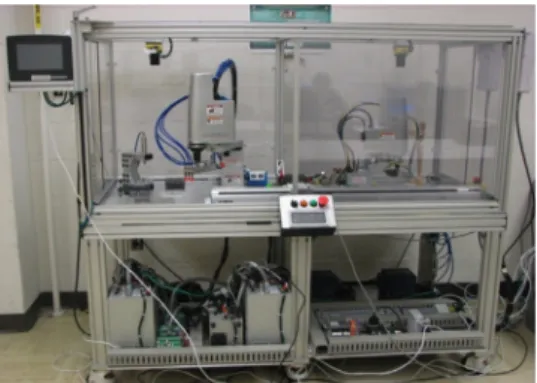
the authors have developed a networked quality control station. This includes two network-accessible assembly robots, two networked vision sensors, and other ancillary equipment which constitutes the cell. The overall setting of the system is
presented inFig. 1.
The vision sensors see the part and measure the dimensions.
The captured image has 640480 pixel size and the analysis
results are produced by the computer algorithms. Part gauging is established by using a pattern matching technique. For each
part, the vision sensor conducts the pre-defined quality control
tasks, and sends the information to the awaiting robot. If the part passes the quality standard, it will be picked up by the robot and dropped into the bin. Otherwise, the bad parts will be carried away by the conveyor belt. The picture of entire setup
is shown inFig. 2.
In the context of e-quality control, the objective of this paper is to apply the machine learning approach in the form of support vector machines (SVMs) to predict the outcome of the
part classification. Data obtained from the remote inspection
www.elsevier.com/locate/jcde
http://dx.doi.org/10.1016/j.jcde.2015.06.010
2288-4300/&2015 Society of CAD/CAM Engineers. Production and hosting by Elsevier. This is an open access article under the CC BY-NC-ND license (http://creativecommons.org/licenses/by-nc-nd/4.0/).
nCorresponding author.
experiments will be analyzed using SVM classifier equations to build a model, which can be used for predictions (i.e., good vs. bad quality). The motivation behind this work is to build
robust classifiers, which can sort the incoming parts based on
the vision-sensor generated dimensional data into the
prede-fined groups in an automated way.
2. Literature review
Data mining, which is also referred to as knowledge discovery in databases, means a process of nontrivial extraction of implicit, previously unknown and potentially useful informa-tion (such as knowledge rules, constraints, regularities) from data in databases. In modern manufacturing environments, vast amounts of data are collected into the database management systems and data warehouses from all involved areas, such as product and process design, assembly, materials planning and control, order entry and scheduling, maintenance, recycling, and so on. Different researchers tried to solve the quality control and inspection using various machine learning approaches in an effort to address different types of problems. Automated diagnosis of sewer pipe defects was done using support vector machines (SVMs), where the results showed that the diagnosis accuracy using SVMs was better than that derived by a
Bayesian classifier [10]. A combination of fuzzy logic and
SVMs was used in the form of Fuzzy support vector data
description (F-SVDD) for the automatic target identification for
a TFT-LCD array process, where the experimental results indicated that the proposed method ensemble outperformed
the commonly used classifiers in terms of target defect
identification rate[11]. Independent component analysis (ICA)
and SVMs were used as a combination for intelligent faults diagnosis of induction motors, where the results show that the
SVMs achieved high performance in classification using
multi-class strategy, one-against-one and one-against-all [12]. Fault
diagnosis was also done based on the particle swarm optimiza-tion and support vector machines, where the new method can select the best fault features in a short time and has a better real-time capacity than the method based on principal component
analysis(PCA) and SVMs [13]. Multi-class support vector
machines were used for the fault diagnostics of roller bearing using kernel based neighborhood score multi-class support vector machine, where it was shown the multi-class SVM was effective in diagnosing the fault conditions and the results were
comparable with binary SVM [14]. Artificial neural networks
were used for addressing quality control issue as a non-conventional way to detect surface faults in mechanical front seals, which achieved good results in comparison with the
deterministic system which was already implemented [15].
Fuzzy association rules were used to develop an intelligent quality management approach with the research providing a generic methodology with knowledge discovery and the coop-erative ability for monitoring the process effectively and
efficiently [16]. An automatic optical inspection was adopted
for on-line measurement of small components on the eyeglasses assembly line, which was designed to be used at the beginning
of the assembly line and is based on artificial vision, exploits
two CCD cameras and an anthropomorphic robot to inspect and
manipulate the objects[17].
In fact, the very insightful resources are abounded in terms of fuzzy learning with kernels and SVMs. One example includes the learning of one-class SVM, which requires non-labeled data
[18,19]. Other studies also utilized the method of non-labeled
data, hence being able to operate in a fully unsupervised manner
[20,21]. Fuzzy analytical hierarchy process was used to select
unstable slicing machines to control wafer slicing quality, where the results of exponentially weighted moving average control chart demonstrated the feasibility of the proposed algorithm in effectively selecting the evaluation outcomes and evaluating the
precision of the worst performing machines [22]. Logistic
Regression and PCA were the data mining algorithms used for monitoring PCB assembly quality, where the results demonstrated that the statistical interpretation of solder defect distributions can be enhanced by the intuitive pattern
visualiza-tion for process fault identification and variation reduction[23].
Fuzzy logic was used for the fault detection in statistical process control of industrial processes and the comparative rule-based study has shown that the developed fuzzy expert system is
superior to the preceding fuzzy rule-based algorithm [24].
SVMs were used for an intelligent real-time vision system for surface defect detection, where the proposed system was found to be effective in detecting the steel surface defects based on the experimental results generated from over one thousand images
[25]. SVMs were also used as a part of the optical inspection
Internet Yamaha Robot RCX 40 Controller Application Programming Interface Web Cameras
Machine Vision Cameras
Remote Users
Fig. 1. Overall schematic of the proposed e-quality control system.
system for the solder balls of ball grid array, where the system also gives the training model adjustment judgment core SVM
which is efficient for the image comparison and classification
[26]. SVMs were used for quality monitoring in robotized arc
welding, where the results show that the method can be feasible
to identify the defects online in welding production [27]. A
defect classification algorithm for the rolling system surface
inspection was developed using Neural Networks and SVMs
with good classification ability and generalization performance
[28]. SVMs along with the wavelet feature extraction based on
vector quantization and SVD techniques were used for improved defect detection with the results outlining the impor-tance of judicious selection and processing of 2D DWT wavelet
coefficients for industrial pattern recognition applications as well
as the generalization performance benefits obtained by involving
SVM neural networks instead of other ANN models [29].
Radial basis function (RBF) neural networks (NNS) and SVMs were used for quality monitoring in a plastic injection molding process, where the experimental results obtained thus far
indicate improved generalization with the large margin classifier
as well as better performance enhancing the strength and
efficacy of the chosen model for the practical case study [30].
Two very different studies involve the surface inspection applications, where different approaches can be used within
the similar domains of quality inspection [31,32]. Table 1
summarizes the applications listed in the manuscript.
Although significant amount of literature is published on solving
quality related issues using data mining techniques or support vector machines in particular, the concept of addressing e-quality using SVMs remains unexplored. This is due to the fact that the whole
idea of e-quality is still in its developmental stages. However, some researchers developed the idea to address e-quality for manufactur-ing within the framework of internet-based systems. The researchers designed the setup to perform quality control operations over the Internet using Yamaha robots and machine vision cameras. The present work is an extension to this type of work, where the data obtained from these experiments is analyzed using SVMs for predictions. The idea behind using SVMs for this work is solely based on the fact that the performance of SVMs on binary output data is better, when compared to other widely used approaches like the neural networks, principal component analysis and independent component analysis. Most literatures support that SVMs outper-formed better than other methods in many quality applications. Note that the objective of this paper is to focus on determining a better
classification model, based on the tuning of the parameters among
different SVM kernels.
3. Methodology
This section explains the model selection for running the
experiments using the support vector classifiers, the values of
training parameters selected, and the values of parameters used
for different kernel functions. Fig. 3 shows the conceptual
framework used as a part of this work.
3.1. Model selection
In training SVMs, we need to select a kernel and set a value
to the margin parameter C. To develop the optimal classifier,
Table 1
Support vector machines applications.
Applications Approach Researchers
Automated diagnosis Support vector machines(SVMs) Yang and Su 2008[10]
Automatic target defect identification Fuzzy support vector data description (F-SVDD) Liu et al. 2009[11]
Intelligent faults diagnosis Independent component analysis (ICA) and support vector machines (SVMs) Widodo et al. 2007[12]
Fault diagnostics Support vector machine Yuan and Chu 2007[13]
Fault diagnostics Multi-class support vector machine (MSVM) Sugumaran et al. 2008[14]
Surface faults detection Artificial neural networks Barelli et al. 2008[15]
Intelligent quality management Fuzzy association rules Lau et al. 2009[16]
On-line dimensional measurement Automatic optical inspection Rosati et al. 2009[17]
Optimization Learning with Kernels Schölkopf and Smola 2002[18]
Machine learning One class SVM for classification Manevitz and Yousef 2001[19]
Fault detection Residual based fuzzy logic Serdio et al. 2014[20]
Fault detection Multivariate time series modeling Serdio et al. 2014[21]
Quality control Fuzzy analytical hierarchy process Chang et al. 2008[22]
Quality control Logistic Regression, principal component analysis (PCA) Zhang and Luk 2007[23]
Fault detection Fuzzy logic El-Shal and Morris 2000[24]
Surface defect detection Support vector machine Jia et al. 2004[25]
Optical inspection Support vector machine Chen 2007[26]
Quality monitoring Support vector machine Huang and Chen 2006[27]
Surface inspection Neural network, support vector machine Choi et al. 2006[28]
Defect detection Support vector machine Karras 2003[29]
Quality monitoring Radial basis function (RBF) neural networks (NNS), support vector machines (SVMs) Ribeiro 2005[30] Surface inspection SVMs, decision trees with CART and C4.5, fuzzy classifiers, K-NN, neural classifiers, etc. Eitzinger et al. 2010[31]
we need to determine the optimal kernel parameter and the
optimal value of C. A k-fold (a value of k¼10) cross
validation approach is adopted for estimating the value of training parameter. The minimum value considered was 0.1 and the maximum value was 500. The value of C with the high
level training accuracy percentage was identified as the optimal
value (highlighted in bold characters). The performance of the
classifiers is evaluated by using different kernel functions in
terms of testing accuracy, training accuracy, a number of support vectors, and validation accuracy. Four different kernel
functions are identified for this research based on the
knowl-edge gained from the literature review. They include (1) Linear Kernel, (2) Polynomial Kernel, (3) Radial Basis Function (RBF) Kernel, and (4) Sigmoid Kernel. Polynomial and RBF kernels are by far the most commonly used kernels in the
research world. The following section identifies the different
parameters involved in all kernels, and also discusses the range for each parameter.
3.1.1. Linear Kernel
k xi;xj
¼ xi; xj ð1Þ
It is the inner product ofxi; xj, so there is no gamma and
no bias.
3.1.2. Polynomial Kernel
k xi;xj
¼ ðγxixj þcoefficientÞdegree ð2Þ
whereðdegreeAℕ; coefficientZ0; γ40Þ
Two cases are designed based on this kernel, which include
the degrees of 2 and 3. Gamma as 2, coefficient as 1, are
chosen based on the data. Trial and error method was adopted
to find the optimal values, which gives high testing data
classification accuracy.
3.1.3. Radial Basis Function (RBF) Kernel
k xi;xj ¼exp γjxixjj2 ð3Þ whereðγ 40Þ.
Two cases are also designed based on this kernel with gamma values of 0.5 and 2. Trial and error method was
adopted to find the optimal values, which gives high testing
data classification accuracy.
3.1.4. Sigmoid Kernel k xi;xj ¼ tan h γxixj þcoefficient ð4Þ whereðγ 40; coefficientZ0Þ.
Values of gamma 0.2 and coefficient 0.1 were chosen for
this work based on the data.
3.2. Training the Support Vector Classifiers
After the acquisition of the data from the experiments, the
following characteristics were identified. Total number of
cases¼138 (note: a total number of times that the experiment
ran. It includes‘auto’and‘manual’modes.). Number of input
features¼5 (note: five features include the five different
dimensions of the test piece.). Number of output features¼2
(note: two outputs include the cases where the test piece is
‘compliant’ or ‘non-compliant.). As SVMs are a part of the
supervised learning methods, the data are divided into the training set and testing set. Going with the standard approach, two-thirds of the data are divided into the training set and the remaining one thirds into a testing set. Accordingly, it has been
Remote Inspection Process Data Acquisition Preparing Training Data Model Selection Sensitivity Analysis with different C values Comparing results with different kernels Identifying Optimal Values Different Test Samples Using for future prediction
set as the training data sample size of 92, and the testing data sample size of 46. According to the literature review, in obtaining the support vectors, one needs to solve the equation:
maximizeαAℝm Wð Þ ¼α Xm i¼1 αi1=2 Xm i;j¼1 αiαjyiyjkðxi;xjÞ ð5Þ subject to the constraints
0rαirCfor alli¼1;…:;m; and
Xm i¼1
αiyi¼o ð6Þ
Accordingly, one has to estimate the value of the training
parameter C. After closely following the literature and going
through the published materials, it is decided that the k-fold cross validation method is used to estimate the value of
training parameterC.
4. Results and comparisons
In this section, the various steps involved in the process of conducting experiments are presented. The results generated
from using the classifiers in six different cases are also shown
in the form of tables. In addition, the comparison between the performances of different kernel functions on the given data is
made and thefindings are reported.
4.1. Preparing test samples
The experimental setup considered for this research is in the development stage and as of now it cannot be completely commercialized and used for real-world problems. Due to this reason, a similar scenario is designed, which depicts the real world cases. Instead of parts dealt in a typical production line, small test pieces are designed to conduct the experiment. These pieces are smaller in size, less complicated in dimensions and shapes when compared to the parts used in various types of
industries.Fig. 4shows the geometry of the test piece used in the
experiment, indicating thatL: length of the piece;W: width of the
piece; D1 and D2: diameters of two circles; and CCL: distance
between the circle centers. There are about 20 pieces made. Each differs from the original in at least one dimension, in order to depict that there are defective products in the production line.
4.2. Performing the inspection process
The experiment includes recording real-time measurements on sample work pieces (products) that are passed around on a conveyor belt, compare these dimensions to the required
speci-fications, make a decision on the quality of the product (i.e. if it is compliant or non-compliant), and take an appropriate action on the product. We used a Cognex DVT 540 vision sensor for making inspections and measurements on the object under test.
We have set the camera to have an image resolution of 640480
bits with an exposure time of 4 ms and a frequency of 2 snapshots per second. The camera is initially trained to learn
the profile of the object being tested and make the required
measurements on it. Once trained, it can detect the presence of the same kind of object under different orientations. The camera can be addressed using an IP address and is capable of exchanging information with other entities over a data network. Subsequently, during inspections, the camera makes measurements on the objects passing on the conveyor belt and reports it back along with the objects' position to an application server over the network. The application is software written in VB6 and runs in a PC. It communicates with the camera over the network and receives the measurement and position information about the object. It then uses this information to decide whether the product
adheres to the required specifications. Once a decision is made, it
communicates with the robot over the network, and instructs it to it stop the belt and do the proper pick and place operation on the object. The robot places the compliant and non-compliant objects on to two different stacks. The camera placed at the inspection site also allows for visual monitoring of the ongoing process from
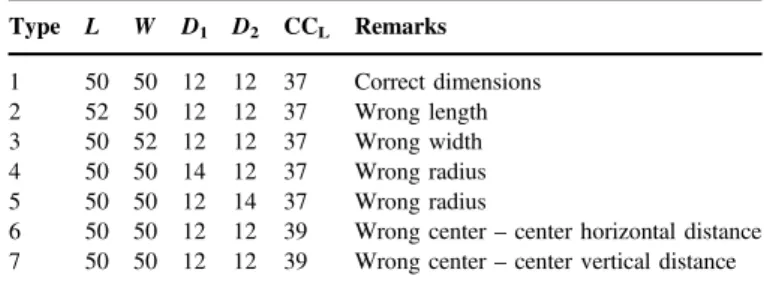
a remote location.Table 2summarizes the specifications for the
different type of work pieces used for the experiment. Type 1
constitutes objects that adhere to the required specifications. The
other types deviate from these specifications in one dimension.
4.3. Data acquisition
Based on the previous phase, the experiment is conducted allowing the user to test the different samples. The user has CCL
W
D1
D2
L
Fig. 4. Test Piece Geometry.
Table 2
Work piece specifications (units: mm). Type L W D1 D2 CCL Remarks 1 50 50 12 12 37 Correct dimensions 2 52 50 12 12 37 Wrong length 3 50 52 12 12 37 Wrong width 4 50 50 14 12 37 Wrong radius 5 50 50 12 14 37 Wrong radius
6 50 50 12 12 39 Wrong center–center horizontal distance 7 50 50 12 12 39 Wrong center–center vertical distance
two options to perform this type of experiment, which includes dealing with the robot in manual and auto modes. The data used for this experiment consists of data recorded in two modes. (1) Manual mode: after the test piece is placed on the conveyor system, it stops as soon as it comes right below the DVT vision sensor, which records the dimensions. Through a VB interface, the user is able to see the values and has to make a judgment whether the test piece is compliant or non-compliant. After the user takes a decision the robot is programmed to pick up the object and place it in the respective stack. The process continues until all test samples are put on
the conveyor. The significance of this mode lies on the users'
ability to make the correct decision to classify the object. (2) Auto mode: the process is almost similar to the manual mode except after the dimensions are recorded by the DVT vision sensor camera, the application itself takes the decision, whether the piece is compliant or non-compliant. The VB application has the option to write all the data recorded along
with the action taken into an excelfile. Most analysis part is
done using a statistics software package, called STATISTICA, which provides a selection of data analysis, data management,
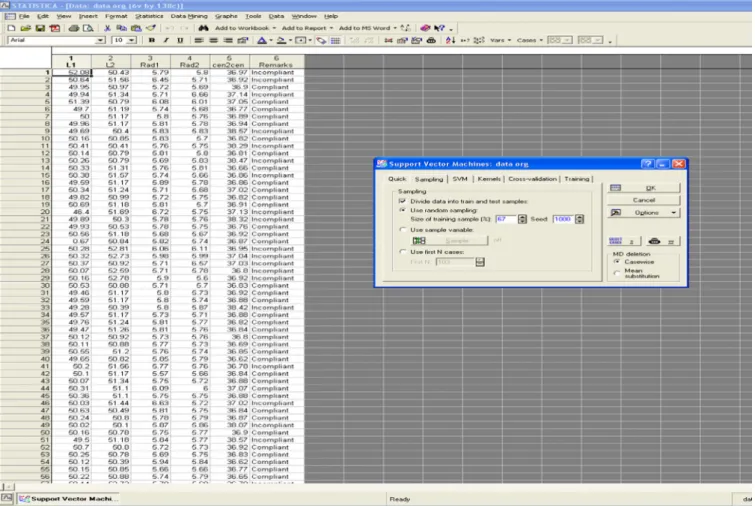
data mining, and data visualization procedures. Fig. 5shows
the screen shot of the input data used for the analysis in the STATISTICA 8.0 data mining module.
4.4. Case studies
Results obtained from six different cases are presented in this section. All cases vary in the type of kernel functions used
for classification. The cases include: Case 1. Radial Basis
Function Kernel (gamma¼0.5); Case 2. Radial Basis Function
Kernel (gamma¼2.0); Case 3. Polynomial Kernel (degree¼2,
gamma¼2, coefficient¼1); Case 4. Polynomial Kernel
(degree¼3, gamma¼2, coefficient¼1); Case 5. Linear
Ker-nel; and Case 6. Sigmoid Kernel (gamma¼0.2,
coefficient¼0.1).
4.4.1. Case 1. Radial Basis Function Kernel (gamma¼0.5)
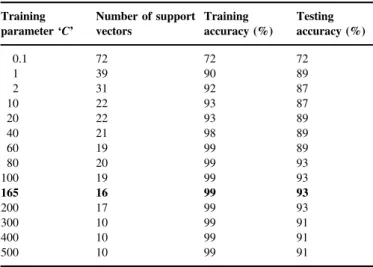
The classifier equations are tested with the radial basis
function kernel using a gamma value of 0.5 and different runs are made using different values of the training parameter. For each run, a number of support vectors generated, while the accuracy of classifying the data in the training and testing sets
are noted. The summary is presented inTable 3.
Values from the table are plotted in the form of a graph
shown inFig. 6with training parameter values on theX-axis
and accuracy percentages on theY-axis. Optimal cross
valida-tion value is found and highlighted in the graph. Fig. 5. Screen shot of the STATISTICA 8.0 interface.
4.4.2. Case 2. Radial Basis Function Kernel (gamma¼2.0)
The classifier equations are tested with the radial basis
function kernel using a gamma value of 2 and different runs are made using different values of the training parameter. For each run, a number of support vectors generated the accuracy of classifying the data in the training and testing sets are noted.
The summary is presented inTable 4.
The values from the table are plotted in the form of a graph
shown inFig. 7using Statistica with training parameter values
on theX-axis and accuracy percentages on theY-axis. Optimal
cross validation value is found and highlighted in the graph.
4.4.3. Case 3. Polynomial Kernel (degree¼2, gamma¼2,
coefficient¼1)
The classifier equations are tested with the polynomial
kernel and different runs are made using different values of the training parameter. For each run, a number of support vectors are generated, and the accuracy of classifying the data
in the training and testing sets are noted. The summary of all
these observations is presented in Table 5.
The values from the table are plotted in the form of a graph
shown inFig. 8using Statistica with training parameter values
on the X-axis and the accuracy percentages on the Y-axis.
Optimal cross validation value is found and highlighted in the graph.
4.4.4. Case 4. Polynomial Kernel (degree¼3, gamma¼2,
coefficient¼1)
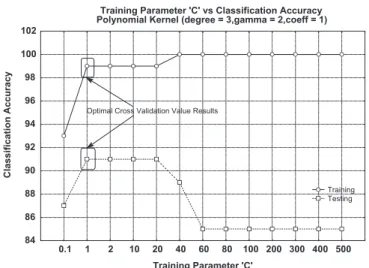
The classifier equations are tested with the Polynomial
Kernel and different runs are made using different values of the training parameter. For each run, a number of support vectors generated, and the accuracy of classifying the data in the training set and testing set are noted. The summary of all
these observations is presented in Table 6.
The values from the table are plotted in the form of a graph
shown inFig. 9using Statistica with training parameter values
on the X-axis and the accuracy percentages on the Y-axis.
Table 3
Summary table for Case 1. Training parameter‘C’ Number of support vectors Training accuracy (%) Testing accuracy (%) 0.1 72 72 72 1 39 90 89 2 31 92 87 10 22 93 87 20 22 93 89 40 21 98 89 60 19 99 89 80 20 99 93 100 19 99 93 165 16 99 93 200 17 99 93 300 10 99 91 400 10 99 91 500 10 99 91
Training Parameter 'C' vs Classification Accuracy RBF Kernel (gamma = 0.5) 0.1 1 2 10 20 40 60 80 100 165 200 300 400 500 Training Parameter 'C' 70 75 80 85 90 95 100 105 C la s sific a ti o n Ac cu ra cy Training Testing Optimal Cross Validation Value Results
Fig. 6. Graph showing different‘C’values plotted against accuracy levels.
Table 4
Summary table for Case 2. Training parameter‘C’ Number of support vectors Training accuracy (%) Testing accuracy (%) 0.1 61 89 87 1 29 91 89 2 24 95 89 10 21 97 89 20 20 99 91 40 16 99 91 60 15 99 91 80 12 99 91 100 12 99 91 200 13 99 91 300 13 99 91 376 13 99 93 400 13 99 93 500 13 99 93
Training Parameter 'C' vs Classification Accuracy RBF Kernel (gamma = 2.0) 0.1 1 2 10 20 40 60 80 100 200 300 376 400 500 Training Parameter 'C' 86 88 90 92 94 96 98 100 C la s sific a tion Ac c u racy Training Testing Optimal Cross Validation Value Results
Optimal cross validation value is found and highlighted in the graph.
4.4.5. Case 5. Linear Kernel
The classifier equations are tested with Linear Kernel and
different runs are made using different values of the training parameter. For each run, a number of support vectors are generated, and the accuracy of classifying the data in the training set and testing set are noted. The summary of all these
observations are presented inTable 7.
The values from the table are plotted in the form of a graph
shown inFig. 10. Optimal cross validation value is found and
highlighted in the graph.
4.4.6. Case 6. Sigmoid Kernel (gamma¼0.2, coefficient¼0.1)
The classifier equations are tested with the Sigmoid Kernel
and different runs are made using different values of the training parameter. For each run, a number of support vectors are generated, and the accuracy of classifying the data in the training set and testing set are noted. The summary is
presented inTable 8.
The values from the table are plotted in the form of a graph
shown inFig. 11. Optimal cross validation value is found and
highlighted in the graph. Table 5
Summary table for Case 3. Training parameter‘C’ Number of support vectors Training accuracy (%) Testing accuracy (%) 0.1 28 93 85 1 19 93 87 2 17 97 89 6 14 99 93 10 14 99 93 20 13 99 91 40 11 99 91 60 12 99 91 80 12 99 91 100 11 99 91 200 10 99 91 300 11 100 89 400 9 100 91 500 11 100 89
Training Parameter 'C' vs Classification Accuracy Polynomial Kernel (degree =2,gamma = 2,coeff = 1)
0.1 1 2 6 10 20 40 60 80 100 200 300 400 500 Training Parameter 'C' 84 86 88 90 92 94 96 98 100 102 C la s sification A c cur acy Training Testing Optimal Cross Validation Value Results
Fig. 8. Graph showing different‘C’values plotted against accuracy levels.
Table 6
Summary table for Case 4. Training parameter‘C’ Number of support vectors Training accuracy (%) Testing accuracy (%) 0.1 20 93 87 1 13 99 91 2 12 99 91 10 8 99 91 20 9 99 91 40 8 100 89 60 8 100 85 80 8 100 85 100 8 100 85 200 8 100 85 300 8 100 85 400 8 100 85 500 8 100 85
Training Parameter 'C' vs Classification Accuracy Polynomial Kernel (degree = 3,gamma = 2,coeff = 1)
0.1 1 2 10 20 40 60 80 100 200 300 400 500 Training Parameter 'C' 84 86 88 90 92 94 96 98 100 102 Classification Accuracy Training Testing Optimal Cross Validation Value Results
Fig. 9. Graph showing different‘C’values plotted against accuracy levels.
Table 7
Summary table for Case 5. Training parameter‘C’ Number of support vectors Training accuracy (%) Testing accuracy (%) 0.1 73 78 76 1 39 93 85 2 30 93 85 10 22 93 85 20 20 93 85 40 20 93 87 60 18 93 85 80 17 93 87 100 16 93 87 200 16 96 93 300 15 96 93 400 15 96 93 476 18 97 93 500 19 96 93
4.5. Comparison
This section compares the results obtained from the different cases. After executing the model with different kernel
func-tions, the results that a specific kernel gives the best accuracy
are identified and used for comparison along with other
kernels.Table 9 summarizes thefinding.
Additionally, to show the advantage of the SVMs, two other methods that are commonly used have been tested. The results
are shown inTable 10.
5. Conclusions
This section presents the importantfindings that can be drawn
from the analyses. The purpose of this research was to develop a
support vector classifier model based on the experimental data
in order to facilitate the process of e-quality control. The study was conducted under the following assumptions. (1) The data used for analysis contained 138 different cases, which were obtained by running the experiment with different test samples.
(2) The model selection for training parameterCwas based on
the v-fold cross validation approach. (3) The range of training
parameter C values included 0.01 to 500, where much higher
values in the order of four digits andfive digits can also be used
based on the characteristics of data. (4) The parameters of the kernel functions were assumed based on the trial and error, to obtain the best accuracy level. After analyzing the data obtained
Training Parameter 'C' vs Classification Accuracy Linear Kernel 0.1 1 2 10 20 40 60 80 100 200 300 400 476 500 Training Parameter 'C' 74 76 78 80 82 84 86 88 90 92 94 96 98 Classification Accuracy Training Testing Optimal Cross Validation Value Results
Fig. 10. Graph showing different‘C’values plotted against accuracy levels.
Table 8
Summary table for Case 6. Training parameter‘C’ Number of support vectors Training accuracy (%) Testing accuracy (%) 0.1 72 61 67 1 72 86 80 2 58 86 80 10 35 93 85 16 30 93 85 20 28 93 85 40 24 93 85 60 24 93 85 80 22 93 85 100 22 93 85 200 18 92 85 300 17 92 85 400 17 92 85 500 16 92 85
Training Parameter 'C' vs Classification Accuracy Sigmoid Kernel (gamma = 0.2, coeff = 0.1)
0.1 1 2 10 16 20 40 60 80 100 200 300 400 500 Training Parameter 'C' 55 60 65 70 75 80 85 90 95 Classification Accuracy Training Testing Optimal Cross Validation Value Results
Fig. 11. Graph showing different‘C’values plotted against accuracy levels.
Table 9 Summary of experiments. Kernel Training parameter‘C’ Train rate (%) Test rate (%) SVs Linear 476 97 93 18(7a) Polynomial (degree ¼2) 6 99 93 14(8a) Polynomial (degree ¼3) 1 99 91 13(6a) RBF (gamma¼0.5) 165 99 93 16(6a) RBF (gamma¼2) 376 99 93 13(1a) Sigmoid (gamma¼0.2, coef¼0.1) 16 93 85 30(25a) a
Bounded support vectors.
Table 10
Comparison between decision tree and logistics regression methods. Methods Train rate (%) Test rate (%)
Decision tree 97 87
using SVM classifiers and testing the accuracy levels using different kernels, the following conclusions can be drawn. Since
the SVMs produced good classification results for data with
binary outcome, the results achieved for this data were
significant. The highest testing rate of 93% was achieved, when
using Linear, Polynomial and RBF kernels in different cases. Polynomial kernel of second degree and RBF kernel with gamma values had slightly higher training rate values. Among
all cases, the RBF kernel with a gamma value of 2 is identified
as the best performer, as it has the lowest number of support
vectors used in the classification method. Heuristically, a less
number of support vectors signifies the robustness of the
classifier. However, this might not be true in all cases, since it
also depends on the number of bounded support vectors, which are located between the margins. The value of the training
parameter‘C’identified as 376 for the RBF kernel also satisfies
the basic necessity for selecting the ideal training parameter. If
‘C’is too small, the insufficient stress will be placed onfitting
the training data. If it is too large, the algorithm leads to over
fitting the data. As to the data size, even though the available
data are not large, it is adequate for the research. It may have a better result (i.e., a better predict accuracy) with the larger data sets. Basically, there are also problems in dealing with the big
data, such as overfitting and outliers. Moreover, the proposed
model may be insensitive only given by certain data sets. In
other words, different data sets may lead various “optimal”
models. Consequently, it is suggested that pre-processing effort could focus on eliminating bias, particularly pre-existing pattern
data prior the use of SVM classification. One of the future
works could dedicate to develop a better model, which may be hybrid in nature through combining different approaches (i.e., SVM and non-SVM) and/or fusing different kernel functions under feasible conditions. Another future work might be to realize the equality in the dynamic environments. The new algorithm will be affected by the dynamic data, when setting the parameters automatically to optimize the models.
Acknowledgments
This work was partially supported by the National Science Foundation, United States (Award DUE-1246050) and the US
Department of Education (Award P031S120131 and
P120A130061). This research was also supported by the Basic Science Research Program through the National Research Foundation of Korea (NRF) funded by the Ministry of Education (Grant no. NRF-2013R1A1A2006108). The authors
wish to express sincere gratitude for their financial support
received the duration of the research.
References
[1] A. Cohen, Simulation Based Design, DARPA Plus-Up Workshop on SBD Alpha Release (DARPA/TTO Program), 1997.
[2] Bennis F, Castagliola P, Pino L. Statistical analysis of geometrical tolerances. A case study.J. Qual. Eng.2005;17(3)419–27.
[3] Goldin D, Venneri S, Noor A. Newfrontiers in engineering.Mech. Eng. 1998;120(2)63–9.
[4]Goldin D, Venneri S, Noor A. Ready for the future?Mech Eng.1999;121 (11)61–70.
[5]Kwon Y, Wu T, Ochoa J. SMWA. A CAD-based decision support system for the efficient design of welding,.J. Concurr. Eng. Res. Appl. 2004;12(4)295–304.
[6] Y. Kwon, G. Fischer, Three-year vision plan for undergraduate instruc-tional laboratories. Simulation-based, reconfigurable integrated lean manufacturing systems to improve learning effectiveness, (A funded proposal with $100,000), College of Engineering Equipment Fund. University of Iowa, Iowa City, 2003.
[7]Waurzyniak P. Moving toward the e-factory. Manufacturing industry takes first steps toward implementing collaborative e-manufacturing systems.SME Manuf. Eng.2001;127(5)43–60.
[8]Aronson R. More automation, less manpower. Smarter cells and centers. SME Manuf. Eng.2005;134(6)85–108.
[9] Center for Intelligent Maintenance Systems, 2005, Available at:〈http// wumrc.engin.umich.edu/ims/?page=home〉.
[10]Yang M, Su T. Automated diagnosis of sewer pipe defects based on machine learning approaches,.Expert Syst. Appl.2008;35(3)1327–37. [11]Liu Y, Lin S, Hsueh Y, Lee M. Automatic target defect identification for
TFT-LCD array process inspection using kernel FCM-based fuzzy SVDD ensemble.Expert Syst. Appl.2009;36(2)1978–98.
[12]Widodo A, Yang B, Han T. Combination of independent component analysis and support vector machines for intelligent faults diagnosis of induction motors.Expert Syst. Appl.2007;32:299–312.
[13]Yuan S, Chu F. Fault diagnostics based on particle swarm optimization and support vector machines. Mech. Syst. Signal Process. 2007;21: 1787–98.
[14]Sugumaran V, Sabareesh G, Ramachandran K. Fault diagnostics of roller bearing using kernel based neighborhood score multi-class support vector machine.Expert Syst. Appl.2008;34(4)3090–8.
[15]Barelli L, Bidini G, Mariani F, Svanziroli M. A non-conventional quality control system to detect surface faults in mechanical front seals.Eng. Appl. Artif. Intell.2008;21(7)1065–72.
[16]Lau H, Ho G, Chu K, Ho W, Lee C. Development of an intelligent quality management system using fuzzy association rules,.Expert Syst. Appl.2009;36(2)1801–15.
[17]Rosati G, Boschetti G, Biondi A, Rossi A. On-line dimensional measurement of small components on the eyeglasses assembly line. Opt. Lasers Eng.2009;47(3–4)320–8.
[18]Schölkopf B, Smola AJ. Learning with Kernels-Support Vector Machines, Regularization, Optimization and Beyond. London, England: MIT Press; 2002.
[19]Manevitz L, Yousef M. One-class SVMs for document classification,.J. Mach. Learn. Res.2001;2:139–54.
[20]Serdio F, Lughofer E, Pichler K, Buchegger T, Efendic H. Residual-based fault detection using soft computing techniques for condition monitoring at rolling mills.Inf. Sci.2014;259:304–20.
[21]Serdio F, Lughofer E, Pichler K, Pichler M, Buchegger T, Efendic H. Fault detection in multi-sensor networks based on multivariate time-series models and orthogonal transformations.Inf. Fusion2014;20:272–91. [22]Chang C, Wu C, Chen H. Using expert technology to select unstable
slicing machine to control wafer slicing quality via fuzzy AHP.Expert Syst. Appl.2008;34:2210–20.
[23]Zhang F, Luk T. A data mining algorithm for monitoring PCB assembly quality.IEEE Trans. Electron. Packag. Manuf.2007;30(4)299–305. [24]El-Shal S, Morris A. A fuzzy expert system for fault detection in
statistical process control of industrial processes.IEEE Trans. Syst. Man Cybern. C. Appl. Rev.2000;30(2)281–9.
[25] H. Jia, Y. Murphey, J. Shi, and T. Chang, An intelligent real-time vision system for surface defect detection, in: Proceedings of the 17th Interna-tional Conference on Pattern Recognition, ICPR’04, vol. 3, 2004, pp. 239–242.
[26] S. Chen, An optical inspection system for the solder balls of BGA using support vector machine classification, in: Proceedings of the Sixth International Conference on Machine Learning and Cybernetics, Hong Kong, pp. 19–22, 2007.
[27]Huang X, Chen S. SVM-based fuzzy modeling for the arc welding process.Mater. Sci. Eng.: A2006;427(1–2)181–7.
[28] K. Choi, K. Koo, and J. Lee, Development of defect classification algorithm for POSCO rolling strip surface inspection system, in: Proceedings of the SICE-ICASE International Joint Conference 2006 Oct. 18–21, 2006, Bexco, Busan, Korea.
[29] D. Karras, Improved defect detection using support vector machines and wavelet feature extraction based on vector quantization and SVD techniques, in: Proceedings of the International Joint Conference on Neural Networks, vol. 3, 2003, pp. 2322–2327.
[30] Ribeiro B. Support vector machines for quality monitoring in a plastic injection molding process.IEEE Trans. Syst. Man Cybern. C: Appl. Rev. 2005;35(3)401–10.
[31] Eitzinger C, Heidl W, Lughofer E, Raiser S, Smith J, Ahir M, Sannen D, van Brussel H. Assessment of the influence of adaptive components in trainable surface inspection systems.Mach. Vis. Appl.2010;21(5)613–26. [32] Heidl W, Thumfart S, Lughofer E, Eitzinger C, Klement E. Machine learning based analysis of gender differences in visual inspection decision making.Inf. Sci.2013;224:62–76.