A SOFTWARE PROJECT DYNAMICS MODEL FOR
PROCESS COST, SCHEDULE AND RISK ASSESSMENT
by
Raymond Joseph Madachy
A Dissertation Presented to the
FACULTY OF THE GRADUATE SCHOOL
UNIVERSITY OF SOUTHERN CALIFORNIA
In Partial Fulfillment of the Requirements for the Degree
DOCTOR OF PHILOSOPHY
(Industrial and Systems Engineering)
December 1994
Acknowledgements
The author would like to acknowledge some of the many people who made this work possible. Sincere thanks to my dissertation committee of Dr. Barry Boehm, Dr. Behrokh Khoshnevis and Dr. Eberhardt Rechtin for their inspiration, guidance, encouragement and support through the years. Several other researchers also provided data and suggestions along the way. Thanks also to Litton Data Systems for their support of this research.
Many thanks are due to my patient wife Nancy who endured countless hours of my work towards this goal, and my parents Joseph and Juliana Madachy who provided my initial education.
Table of Contents
Acknowledgements ii List of Figures v List of Tables vi Abstract vii CHAPTER 1 INTRODUCTION 11.1 Statement of the Problem 2
1.2 Purpose of the Research 3
CHAPTER 2 BACKGROUND 7
2.1 Software Engineering 10
2.1.1 Process Technology 10
2.1.1.1 Process Lifecycle Models 10
2.1.1.2 Process Modeling 15
2.1.1.3 Process Improvement 18
2.1.2 Cost Estimation 19
2.1.3 Risk Management 20
2.1.4 Knowledge-Based Software Engineering 22
2.2 Simulation 23
2.2.1 System Dynamics 24
2.3 Software Project Dynamics 25
2.4 Critique of Past Approaches 26
CHAPTER 3 MODELING OF AN INSPECTION-BASED PROCESS 30
3.1 Background 31
3.2 Industrial Data Collection and Analysis 33
3.3 Model Overview 35
CHAPTER 4 KNOWLEDGE-BASED RISK ASSESSMENT AND COST ESTIMATION 44
4.1 Background 44
4.2.1 Risk assessment 46
4.2.2 Rule base 49
4.2.3 Summary and Conclusions 50
CHAPTER 5 MODEL DEMONSTRATION AND EVALUATION 52
5.1 Test Cases 55
5.1.1 Reference Test Case 55
5.1.1.1 Calibration Procedure 56
5.1.2 Additional Test Cases 56
5.2 Process Assessment 57
5.2.1 Example 1: Effects of Performing Inspections 57
5.2.2 Example 2: Staffing Policies 63
5.2.3 Example 3: Schedule Compression 65
5.2.4 Example 4: Monte-Carlo Simulation 66
5.2.5 Example 5: Experience Learning Curve 67
5.3 Integrated Risk Assessment and Simulation 68
5.4 Derivation of a Detailed COCOMO Cost Driver 71
5.5 Validation Against Industrial Data 72
5.6 Evaluation Summary 77
CHAPTER 6 CONCLUSIONS 78
6.1 Research Summary 78
6.2 Contributions 79
6.3 Directions for Future Research 80
BIBLIOGRAPHY 84
APPENDIX A SYSTEM DYNAMICS MODEL SUPPLEMENT 92
A.1 Reference Behavior 92
A.2 Test Case Results 106
A.3 Validation Summary 109
List of Figures
Figure 2-1: Venn Diagram of Research Areas 8
Figure 2-2: Bibliographic Taxonomy 9
Figure 3-1: Experimental Paradigm 32
Figure 3.1-1: Effect of Inspections on Project Effort 34
Figure 3.1-2: Defects Found per Subject Type 36
Figure 3.4-1: Inspection Model Diagram 38
Figure 3.4-2: Correspondence Between Dynamic Model and COCOMO 40
Figure 3.4-3: High Level Model Boundary 43
Figure 4.2-1: Sample Input Screen 47
Figure 4.2.1-1: Assignment of Risk Levels 48
Figure 4.2.1-2: Sample Risk Outputs 50
Figure 4.2.1-3: Prioritized Risks 50
Figure 4.2.2-1: Rule Taxonomy 52
Figure 5.2.1-1: Manpower Rates With and Without Inspections 60
Figure 5.2.1-2: Error Generation Rate Effects 61
Figure 5.2.1-3: Error Multiplication Rate Effects 63
Figure 5.2.1-4: Net Return-on-investment for Different Inspection Policies 64
Figure 5.2.2-1: Rectangular Staffing Profile Input 66
Figure 5.2.2-2: Rectangular Staffing Simulation Results 66
Figure 5.2.3-1: Total Manpower Rate Curves for Relative Schedule 67
Figure 5.2.3-2: Cumulative Effort and Actual Schedule Time vs. Relative Schedule 67
Figure 5.2.4-1: Probability Distributions for Project Effort 68
Figure 5.2.5-1: Design Learning Curve 69
Figure 5.2.5-2: Design Productivity 69
Figure 5.2.5-3: Design Progress 69
Figure 5.3-1: Input Anomaly Warning 70
Figure 5.3-2: Revised Inputs for Nominal Project 70
Figure 5.3-3: Inputs for Risky Project 71
Figure 5.3-4: Expert COCOMO Output for Nominal Project 71
Figure 5.3-5: Expert COCOMO Output for Risky Project 72
Figure 5.3-6: Resulting Staffing Profiles 72
Figure 5.4-1: Effort Multipliers by Phase for Use of Inspections 74
Figure 5.5-1: Correlation Against Actual Cost 78
Figure 5.5-2: Project Risk by COCOMO Project Number 78
Figure A.1-1: Task Graphs 94
Figure A.1-2: Error Graphs 95
List of Tables
Table 4.2.2-1: Rule Base 51
Table 5-1: Summary Table of System Dynamics Model Validation Tests 54
Table 5.1.2-1: Test Cases 58
Table 5.2.1-1: Test Results Summary - Effects of Inspections 59
Table 5.4-1: Rating Guidelines for Cost Driver Use of Inspections 73
Table 5.2.4-1: Monte-Carlo Statistical Summary 68
Table 5.5-1: Inspection ROI Comparison 75
Table 5.5-2: Testing Effort and Schedule Comparison 76
Table 5.5-3: Rework Effort Ratio Comparison 76
Table 5.5-4: Softcost Effort Multiplier Comparison 77
Table A.2-1: Test Case Results 109
Abstract
A dynamic model of an inspection-based software lifecycle process has been developed to support quantitative evaluation of the process. In conjunction with a knowledge-based method that has been developed for cost estimation and project risk assessment, these modeling techniques can support project planning and management, and aid in process improvement.
The model serves to examine the effects of inspection practices on cost, schedule and quality throughout the lifecycle. It uses system dynamics to model the interrelated flows of tasks, errors and personnel throughout different development phases and is calibrated to industrial data. It extends previous software project dynamics research by examining an inspection-based process with an original model, integrating it with the knowledge-based method for risk assessment and cost estimation, and using an alternative modeling platform.
While specific enough to investigate inspection practices, it is sufficiently general to incorporate changes for other phenomena. It demonstrates the effects of performing inspections or not, the
effectiveness of varied inspection policies, and the effects of other managerial policies such as manpower allocation. The dynamic effects are tracked throughout the time history of a project to show resource usage, task completions and defect trends per phase. Cumulative metrics and development tradeoffs for decision making are also presented.
The knowledge-based method has been implemented on multiple platforms. As an extension to COCOMO, it aids in project planning by identifying, categorizing, quantifying and prioritizing project risks. It also detects cost estimate input anomalies and provides risk control advice in addition to conventional cost and schedule calculation. It extends previous work by focusing on risk assessment, incorporating substantially more rules, going beyond standard COCOMO, performing quantitative validation, and providing a user-friendly interface. The method is being used and enhanced in industrial environments as part of an integrated capability to assist in system acquisition, project planning and risk management.
Several types of validation tests are performed against industrial data, existing theory and other prediction models, and practitioners are used to evaluate the model. The results indicate a valid model that
can be used for process evaluation and project planning, and serve as a framework for incorporating other dynamic process factors.
Chapter 1 Introduction
This study extends knowledge in the fields of software project dynamics modeling, process technology, cost estimation and risk management. It is a significant contribution because explication of the dynamic interdependencies of software project variables fills in knowledge gaps in these fields to produce an integrated model of their relationships.
A large knowledge gap exists for measuring different software development practices and planning large software projects. There are virtually no methods of quantitatively comparing dynamic characteristics of software development processes and few for assessing project risk. Very little data exists on the tradeoffs of alternative software development process models, and expert knowledge is not utilized in tool assistants for cost and schedule estimation or project risk assessment.
This research investigates system dynamics modeling of alternative software development processes and knowledge-based techniques for cost, schedule and risk assessment of large software projects with a primary focus on cost. In particular, an inspection-based development process is modeled. By combining quantitative techniques with expert judgement in a common model, an intelligent simulation capability results to support planning and management functions for software development projects. This provides greater insight into the software development process, increased estimation and risk management capabilities to reduce project cost and schedule variances, and the capability to evaluate process
improvement via process definition and analysis. The overall project assessment toolset provides a framework for software cost/schedule/risk management and process maturity improvement across software development organizations.
The system dynamics model employs feedback principles to simulate dynamic interactions of management decision-making processes and technical development activities. Dynamic modeling of the software development process has provided a number of useful insights, and can be used to predict the consequences of various management actions or test the impact of internal or external environmental factors. By having an executable simulation model, managers can assess the effects of changed processes and management policies before they commit to development plans.
A calibrated dynamic model enables a metrics-based continuous process improvement capability, and a basis for prioritizing organizational process improvement investments by providing a measure of software development processes. The process model can be used as a baseline for benchmarking process improvement metrics.
The knowledge-based component of this study incorporates expert heuristics to assess various facets of cost and schedule estimation and project risk assessment based on cost factors. Incorporation of expert system rules can place considerable added knowledge at the disposal of the software project planner or manager to help avoid high-risk development situations and cost overruns.
1.1 Statement of the Problem
The main problem investigated in this research is what are the effects of changes to the software development process on cost, schedule and risk? In particular, the effects of performing inspections during the process are investigated. The rationale for this study is to improve software engineering practice. Some general definitions are provided below before expanding on the problem and purpose:
software engineering: the discipline in which science and mathematics are applied in developing software process: a set of activities, methods, practices, and transformations that people use to develop and maintain software and the associated products [Paulk et al. 91]
inspection: a formal review of a software artifact such as design or code to efficiently find errors. An inspection requires training of participants, sufficient preparation time before an inspection meeting, a structured meeting with timing and defect recording protocols, specific roles executed during the meeting, and followup of fixing defects found during the inspection. See Chapter 3 for more details of inspections including the effort required to perform them.
cost estimation: prediction of both the person effort and elapsed time of a project risk: the possibility of an unsatisfactory outcome on a project
knowledge-based system: a program that operates on captured knowledge and expertise using inference to emulate human reasoning.
The term "process model" has two distinct interpretations in this research. A process model refers to 1) a method of software development, i.e. a lifecycle process model that determines the order of the stages involved in software development and evolution, and establishes the transition criteria for progressing between stages and 2) an executable simulation model of the software development process. This research develops a simulation model of a software development method. Proper interpretation of the term will be made clear in context.
Some specific sets of questions addressed by this research include the following:
1) What are the dynamic effects of process changes on cost, schedule, risk and related factors? What are
the quantitative and qualitative (heuristic) features of an inspection-based process from a cost/schedule/risk perspective?
2) Which expert heuristics using cost factors are useful for risk assessment? To what extent can they be quantified? Can knowledge-based project risk assessment in the form of heuristic rules be combined with a dynamic model? What are some common factors that can be used to link the risk assessment and dynamic modeling?
3) What are the relationships between dynamic and static models and how are they complementary? How can the results of static models contribute to dynamic models? Can a dynamic model be calibrated such that a point prediction will always match that of a static model?
To delimit the scope of this research, only medium to large size software projects are considered. These typically fall in the range of 50,000 to 1,000,000 delivered lines of code [Charette 89]. Only an inspection-based development processes will be modeled, as identified in subsequent sections.
The practice of software engineering is multi-faceted with a host of interrelated problems, and this research explores methods to help alleviate some of these problems. The remainder of this section
describes these problems and the relevance of this study for helping to solve them.
The role of software in complex systems has increased dramatically over the last couple of decades. Software is often the critical factor in project success, and companies are recognizing software as the key to competitiveness. Software is normally the control center of complex architectures, provides system flexibility and increasingly drives hardware design. Though there have been substantial advancements in software practices, there are difficult development problems that will pose increasing challenges for a long time.
The magnitude of software development has increased tremendously; the annual cost is now estimated at $200B in the United States alone. As the problems to be solved increase in complexity, systems grow in size and hardware performance increases, the task of software development for large and innovative systems becomes more difficult to manage. Despite these obstacles, the software demand continues to increase at a substantial rate.
The term software crisis refers to a set of various problems associated with the software
development of large systems that meet their requirements and are cost effective, timely, efficient, reliable and modifiable. Escaping from a software crisis can be accomplished by improving the organizational process by which software is created, maintained and managed [Humphrey 89].
One of the first books to highlight the process problem was The Mythical Man-Month [Brooks 75]
where the problems were identified as not just product failures but failures in the development process itself. In the ensuing years, software has become the medium of new systems in a much larger way. Development of complex systems is increasingly reliant on software development practices as the proportion of software to hardware development effort has transitioned from a small part to the sizable majority [Charette 89, Boehm 89].
Tools are needed to assist in alleviating the problems associated with the development of large, complex software systems. Planning and management are at the core of the problems due to a lack of understanding of the development process coupled with the increasing size and complexity demanded of systems. Much of the difficulty of development can be mitigated by effectively applying appropriate engineering methods and tools to management practices. Much focus is on improving technical
development activities, but without corresponding advances in software management tools and practices, software projects will continue to produce cost overruns, late deliveries and dissatisfied customers.
Many techniques have been developed and used in software development planning. Besides cost models, other well-known methods include Critical Path Method/Program Evaluation and Review
Techniques (CPM/PERT), decision analysis and others [Boehm 89, Pressman 87]. These methods all have limitations. CPM/PERT methods can model the detailed development activities and cost estimation models produce estimates used for initial planning, but none of these techniques model the dynamic aspects of a project such as managerial decision making and software development activities in a micro-oriented integrative fashion.
Typical problems in software development include poor cost and schedule estimation, unreasonable planning, lack of risk identification and mitigation, constantly shifting requirements baselines, poor hiring practices, and various difficulties faced by developers prolonged by a lack of managerial insight. These problems are related in important ways, and explication of the
interdependencies can provide knowledge and techniques for assistance.
A major research problem is how to identify and assess risk items. Risks on software projects can lead to cost overruns, schedule slip, or poorly performing software. Risk factors are frequently built into problem-ridden software projects via oversimplified assumptions about software development, such as assuming the independence of individual project decisions and independence of past and future project experience.
Project planners often overlook risk situations when developing cost and schedule estimates. After the proposal or project plan is approved, the software development team must live with the built-in risk. These initial project plans are usually not revised until it's too late to influence a more favorable outcome. By incorporating expert knowledge, these risks can be identified during planning and mitigated before the project begins.
Many of the aforementioned problems can be traced to the development process. The traditional waterfall process has been blamed for many of the downfalls. It prescribes a sequential development cycle of activities whereby requirements are supposed to be fixed at the beginning. Yet requirements are
virtually never complete at project inception. The problems are exacerbated when this occurs on a large, complex project. Changes to requirements are certain as development progresses, thereby leading to substantial cost and schedule inefficiencies in the process. Other problems with the traditional waterfall include disincentives for reuse, lack of user involvement, inability to accommodate prototypes, and more [Agresti 86, Boehm 88].
In recent years, a variety of alternative process models have been developed to mitigate such problems. However, project planners and managers have few if any resources to evaluate alternative processes for a proposed or new project. Very few software professionals have worked within more than one or two types of development processes, so there is scant industrial experience to draw on in
organizations at this time. Different process models, particularly the newer ones of interest, are described
in section 2.1.1.1 Process Lifecycle Models.
When considering potential process changes within the decision space of managers, it would be desirable to predict the impact via simulation studies before choosing a course of action. The use of a simulation model to investigate these different software development practices and managerial decision making policies will furnish managers with added knowledge for evaluating process options, provide a baseline for benchmarking process improvement activities, and more accurate prediction capability.
As described, methods are needed to provide automated assistance in the areas of process evaluation and risk assessment to support planning and management of large projects. Given the
Chapter 2 Background
The background of this study is multi-disciplinary, and Figure 2-1 shows a Venn diagram of relevant major research areas1. To assist in categorizing specific work and to illustrate the intertwining of research, Figure 2-2 shows a taxonomy of the bibliography. The disciplines of software engineering and software metrics provide wide coverage, and their references supply general background for this research. Software metrics is highly relevant to the other subdisciplines since measurement is essential to each. This section is divided up along the different research areas in Figure 2-1, so some cited works will be relevant
in multiple sections due to the disciplinary overlap. Sections 2.1 Software Engineering and 2.2 Simulation
both lead to section 2.3 Software Project Dynamics, which is a new field of research that uses system
dynamics simulation to explore software engineering issues.
________________________
1 To simplify the diagram, overlap of software engineering and simulation is not shown. In particular,
process technology - the focus of this research, and performance analysis are two aspects of software engineering that heavily use simulation as shown below.
Simulation Performance
Analysis Process Technology
System Dynamics Simulation Knowledge-Based Software Engineering Risk Management Cost Estimation Process Technology Software Engineering
2.1 Software Engineering
An early definition of software engineering was "the establishment and use of sound engineering principles in order to obtain economically software that is reliable and works efficiently on real machines" [Naur 69]. Boehm adds the provision of human utility in the definition "software engineering is the application of science and mathematics by which the capabilities of computer equipment are made useful to man via computer programs, procedures and associated documentation" [Boehm 81]. In practice, the engineering principles are applied as a combination of different methods. This research investigates new methods to assist in software engineering, and the following subsections provide background on relevant subdisciplines.
2.1.1 Process Technology
Software process technology is a new field being used to address several critical issues in software engineering, where a process is a sequence of software development activities using associated tools and methods. Process technology encompasses three general classes of research: new process lifecycle models, process modeling and process improvement. This research involves all of these, since modeling of
lifecycle processes is used to achieve process improvement. Background for each of these areas is described in separate sections.
2.1.1.1 Process Lifecycle Models
A process lifecycle model determines the order of the stages involved in software development, and establishes the transition criteria between stages. The process used in the initial days of software development is now called the "code-and-fix" model [Boehm 88]. It essentially contained two steps: 1) write code and 2) fix the problems in the code. Requirements, design, test and maintenance were not considered before coding began. This type of development led to poorly structured code that was expensive to fix and did not match users' requirements. These problems led to the recognition of the testing and maintenance phases, and early planning. The stagewise model, where software was to be developed in successive stages, came about to address the deficiencies of the code-and-fix model [Boehm 88].
The waterfall model was first documented by Royce [Royce 70]. It offered two primary enhancements to the stagewise model: 1) feedback loops between stages and 2) a "build it twice" step parallel with requirements analysis [Boehm 88]. Variations of the waterfall model all contain the essential activities of specification, design, code, test and operations/maintenance. The lifecycle model was further popularized by Boehm in a version that contained verification, validation or test activity at the end of each phase to ensure that the objectives of the phase were satisfied [Boehm 76]. In this model, the phases are sequential, none can be skipped and baselines are produced throughout the phases. No changes to baselines are made unless all interested parties agree. The economic rationale for the model is that to achieve a successful product, all of the subgoals within each phase must be met and that a different ordering of the phases will produce a less successful product [Boehm 81]. Another primary virtue of the waterfall model is its recognition of design as a critical activity [Agresti 86].
However, the waterfall model implies a sequential approach to product development, which is often impractical for large projects due to shifting requirements. Some other critiques of the waterfall model include: a lack of user involvement, ineffectiveness in the requirements phase, inflexibility to accommodate prototypes, unrealistic separation of specification from design, inability to accommodate reuse, and various maintenance related problems [Agresti 86], [Boehm 88]. In [Swartout-Balzer 82], it is argued that specification and design are inevitably intertwined, which implies that process models should reflect this reality. Agresti claims that the fundamental weakness of the waterfall model is the imbalance of analysis versus synthesis due to the influence of the systems approach and the reality of software practices when the model was formulated [Agresti 86]. An annotated bibliography of critiques of the conventional lifecycle is provided in [Agresti 86].
Some of the difficulties of the conventional (waterfall) lifecycle have been addressed by extending it for incremental development, parallel developments, evolutionary change and other revisions and refinements [Boehm 88, Agresti 86]. Agresti describes the prototyping, operational specification and transformational paradigms as alternatives to the waterfall [Agresti 86]. These are shown to respond to the inadequacies of the waterfall by delivering executable objects early to the user and increasing the role of automation. The following sections describe selected enhancements and alternatives to the waterfall model.
Note that process models can be synthesized into hybrid approaches depending on the development situation.
Prototyping is a process that enables the developer to create a quick initial working model of the software to be built, and is similar to the "build it twice" step in Royce's 1970 waterfall model. A formal definition of prototyping is "a full-scale model and functional form of a new system or subsystem. (A prototype does not have to be the complete system - only the part of interest)" [Thayer-Dorfman 1990]. The objective of prototyping is to clarify the characteristics and operation of a system [Agresti 86]. This approach may be used when there is only a general set of objectives, or other uncertainties exist about algorithmic efficiencies or the desired form of an interface. A quick design occurs focusing on software aspects visible to the user, and the resulting prototype is evaluated to refine the requirements [Boehm 89, Pressman 87].
The incremental process approach develops a system in increments, whereby all requirements are determined up front and subsets of requirements are allocated to separate increments. The increments are developed in sequential cycles, with each incremental release adding functionality. One example is as the Ada process model [Boehm 89a, Royce 90] which uses salient features of Ada to mitigate risks, such as the ability to compile specifications of design early on. The incremental approach reduces overall effort and provides an initial system earlier to the customer. The effort phase distributions are different and the overall schedule may lengthen somewhat [Boehm 81]. The Ada process model prescribes more effort in requirements analysis and design, and less for coding and integration.
Inspections are a formal, efficient and economical method of finding errors in design and code [Fagan 76]. They are a form of peer review, as are structured walkthroughs. An inspection-based process uses inspections at a number of points in the process of project planning and system development, and thus can be used for requirements descriptions, design, code, test plans, or virtually any engineering document.
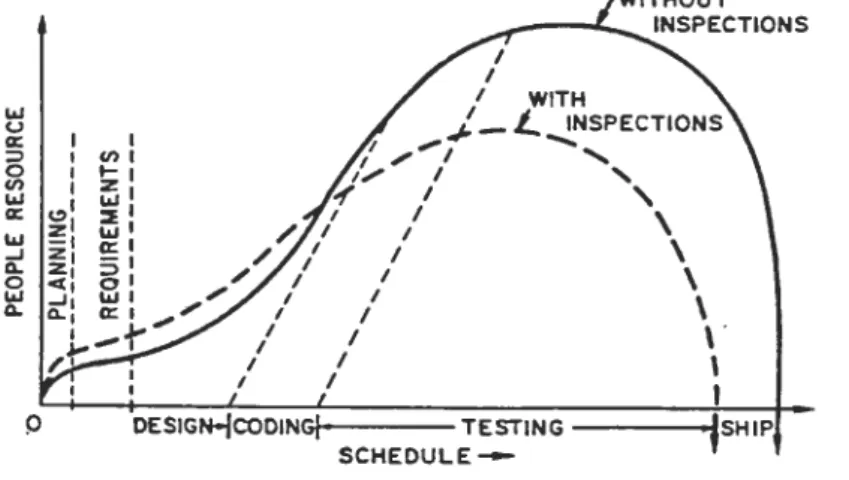
Inspections are carried out in a prescribed series of steps including preparation, having an inspection meeting where specific roles are executed, and rework of errors discovered by the inspection. By detecting and correcting errors in earlier stages of the process such as design, significant cost reductions can be made since the rework is much less costly compared to later in the testing and integration phases
[Radice-Phillips 88, Grady 92, Madachy et al. 93a]. Further background and a model of the
inspection-based process is discussed in Chapter 3 Modeling of an Inspection-Based Process.
The transform model automatically converts a formal software specification into a program [Balzer et al. 83]. Such a model minimizes the problems of code that has been modified many times and is difficult to maintain. The steps involved in the transform process model identified in [Boehm 88] are: 1) formally specify the product, 2) automatically transform the specification into code (this assumes the capability to do so), 3) iterate if necessary to improve the performance, 3) exercise the product and 4) iterate again by adjusting the specification based on the operational experience. This model and its variants are often called operational specification or fourth-generation language (4GL) techniques.
The evolutionary model was developed to address deficiencies in the waterfall model related to having fully elaborated specifications [McCracken-Jackson 83]. The stages in the evolutionary model are expanding increments of an operational product, with evolution being determined by operational
experience. Such a model helps deliver an initial operational capability and provides a real world operational basis for evolution; however, the lack of long-range planning often leads to trouble with the operational system not being flexible enough to handle unplanned paths of evolution [Boehm 88].
The spiral model can accommodate previous models as special cases and provides guidance to determine which combination of models best fits a given situation [Boehm 88]. It is a risk-driven method of development that identifies areas of uncertainties that are sources of project risk. The development proceeds in repeating cycles of determining objectives, evaluating alternatives, prototyping and
developing, and then planning the next cycle. Each cycle involves a progression that addresses the same sequence of steps for each portion of the product and for each level of elaboration. Development builds on top of the results of previous spirals. This is in contrast to the waterfall model which prescribes a single shot development where documents are the criteria for advancing to subsequent development stages. The spiral model prescribes an evolutionary process, but explicitly incorporates long-range architectural and usage considerations in contrast to the basic evolutionary model [Boehm 88].
A number of proposed reuse process models have been published. Some are risk-driven and based on the spiral model, while others are enhanced waterfall process models. Those based on the spiral
model have only mapped partial activities onto the spiral [Prieto-Diaz 91a], or adapted the model to a specific application domain [Danner 91]. A set of process models has been proposed by Cohen at the Software Engineering Institute for different levels of reuse: adaptive, parameterized and engineered [Cohen 91].
A process for reusing software assets provides reduced development time, improved reliability, improved quality and user programmability [Boehm-Scherlis 92]. A software process model for reuse and re-engineering must provide for a variety of activities and support the reuse of assets across the entire lifecycle. Such assets may include requirements, architectures, code, test plans, QA reviews, documents, etc. It must support tasks specific to reuse and re-engineering, such as domain analysis and domain engineering [Prieto-Diaz 91]. Re-engineering differs from reuse in that entire product architectures are used as starting points for new systems, as opposed to bottom-up reuse of individual components. In [Boehm-Scherlis 92], the term megaprogramming is given to the practice of building and evolving
software component by component. It incorporates reuse, software engineering environments, architecture engineering and application generation to provide a product-line approach to development [Boehm-Scherlis 92].
The cleanroom process approach [Mills 87] certifies the reliability of a software system based on a certification model, and is being used in several companies and government agencies. In this process, programmers can't even compile their own code as it's done by independent workers. Much of the traditional programming task work shifts to certification activities in this process model.
In summary, primary differences between some major models are: prototyping develops small working models to support requirements definition, transformational approaches specify the software and employ automatic code generation, incremental development defines all requirements up front and then allocates requirement subsets to individual releases, evolutionary approaches also develop software in increments except that requirements are only defined for the next release, reuse-based development uses previously developed software assets and the spiral model is a risk-driven variation of evolutionary development that can function as a superset process model. Some of the other identified process changes provide alternative methods for implementing subprocesses of the more encompassing lifecycle models.
Few guidelines have been published to aid in selecting an appropriate process model for a given project, though Boehm has developed a process structuring table [Boehm 89] and Sabo has developed a knowledge-based assistant for choosing a process [Sabo 93]. One application of the spiral model was for process generation itself [Boehm-Belz 88]. The spiral model provided an approach for determining the requirements, architecture and design of a software development process. This research develops methods for evaluating alternative processes including risk analysis, which are critical activities called for by the risk-driven spiral approach to process development.
There have been a couple small experiments comparing different programming processes in terms of productivity, resulting product size and quality. In [Boehm 88a], an experiment was performed
comparing development teams that used prototyping versus writing requirements specifications. In [Davis 88], an initial framework was developed for comparing lifecycle models. The comparison framework was a non-quantitative approach for visualizing differences between models in terms of the ability to meet user's functional needs. These studies were both preliminary, did not consider dynamic project
interactions, provided little data and no tool support that project planners can utilize, and stressed the need for further research to quantify the tradeoffs.
2.1.1.2 Process Modeling
Osterweil has argued that we should be as good at modeling the software process as modeling applications [Osterweil 87]. Process modeling is representing a process architecture, design or definition in the abstract [Feiler-Humphrey 93]. Software process modeling supports process-driven development and related efforts such as process definition, process improvement, process management and automated process-driven environments [Curtis et al. 92, Kellner 92]. As a means of reasoning about software processes, process models provide a mechanism for recording and understanding processes, evaluating, communicating and promoting process improvements. Thus, process models are a vehicle for improving software engineering practice.
To support the above objectives, process models must go beyond representation to support analysis of a process including the prediction of potential process changes and improvements [Kellner 91,
Feiler-Humphrey 93]. Unfortunately, there is no standard approach for process modeling. A variety of process definition and simulation methods exist that answer unique subsets of process questions.
Software process modeling is distinguished from other types of modeling in computer science because many of the phenomena are enacted by humans [Curtis et al. 92]. Research on software process modeling supports a wide range of objectives including facilitating human understanding and
communication, supporting process improvement, supporting process management, automating process guidance and automating execution support [Curtis et al. 92]. A background of process improvement is
provided in the next section, 2.1.1.3 Process Improvement.
This research uses process modeling to support several of the aforementioned objectives, particularly process improvement and process management. It will also help facilitate human understanding and communication of the process, but does not explicitly consider automated process guidance or automated execution support.
Process modeling languages and representations usually present one or more perspectives related to the process. Some of the most commonly represented perspectives are functional, behavioral,
organizational and informational. They are analogous to different viewpoints on an observable process. Although separate, these representations are interrelated and a major difficulty is tying them together [Curtis et al. 92, Kellner 91, Kellner 92].
There have been a host of language types and constructs used in software process modeling to support the different objectives and perspectives. Five approaches to representing process information, as described and reviewed in [Curtis et al. 92] are programming models (process programming), functional models, plan-based models, Petri-net models (role interaction nets) and quantitative modeling (system dynamics). The suitability of a modeling approach depends on the goals and objectives for the resulting model. No current software process modeling approach fully satisfies the diverse goals and objectives previously mentioned [Kellner 91].
Functional models have been developed with the Hierarchical and Functional Software Process (HFSP) description and enaction language [Suzuki-Katayama 91]. HFSP is primarily a declarative and textual language. A process is defined as a set of mathematical relationships among inputs (such as
specifications) and outputs (such as source code). HFSP is primarily oriented towards the functional and behavioral perspectives.
Plan-based models have been implemented in a constraint-based language called GRAPPLE [Huff-Lessor 89]. It models software development as a set of goals, subgoals, preconditions, constraints and effects. An effective plan-based process model requires coding information of the environment and the goal hierarchies of the process.
The role interaction structure of a project can be represented by a Petri-net based representation. Interaction nets can be used to coordinate the routing of artifacts among interacting roles and can be used to track progress as the completions of role interactions. There have been problems with scalability and using the technique if a basic description of the organization process does not already exist [Curtis et al. 92].
System dynamics is one of the few modeling techniques that involves quantitative representation. Feedback and control system techniques are used to model social and industrial phenomena. See section
2.2.1 System Dynamics for more background on system dynamics and section 2.3 Software Project Dynamics for research that uses system dynamics to model behavioral aspects of software projects.
Dynamic behavior, as modeled through a set of interacting equations, is difficult to reproduce through modeling techniques that do not provide dynamic feedback loops. The value of system dynamics models are tied to the extent that constructs and parameters represent actual observed project states [Curtis et al. 92].
A process modeling approach that combines several language paradigms has been developed by Kellner and colleagues at the Software Engineering Institute (SEI) [Kellner 90, Kellner 91, Kellner 92]. It utilizes the STATEMATE tool that includes state transitions with events and triggers, systems analysis and design diagrams and data modeling to support representation, analysis and simulation of processes. This approach enables a quantitative simulation that combines the functional, behavioral and organizational perspectives.
The modeling approach was used for an example process, investigating quantitative aspects of managerial planning [Kellner 91]. In the micro-level study, specific coding and testing tasks with assumed task durations and outcomes were used to derive schedules, work effort and staffing profiles.
Another technique for process modeling is the Articulator approach developed by Mi and Scacchi [Mi-Scacchi 91, Mi-Scacchi 92, Scacchi-Mi 93]. They have developed a knowledge-based computing environment that uses artificial intelligence scheduling techniques from production systems for modeling, analyzing and simulating organizational processes. Classes of organizational resources are modeled using an object-oriented knowledge representation scheme. The resource classes characterize the attributes, relations, rules and computational methods used. The resource taxonomy serves as a meta-model for constructing process models consisting of agents, tools and tasks. Consistency, completeness and traceability of the process can be analyzed with the Articulator approach, and simulation takes place through the symbolic performance of process tasks by assigned agents using tools and other resources.
2.1.1.3 Process Improvement
In order to address software development problems, the development task must be treated as a process that can be controlled, measured and improved [Humphrey 89]. This requires an organization to understand the current status of their processes, identify desired process change, make a process
improvement plan and execute the plan.
Humphrey has developed a model of how software organizations can mature their processes and continually improve to better meet their cost and schedule goals called the Capability Maturity Model (CMM) [Humphrey 89]. The CMM framework identifies five levels of organizational maturity, where each level lays a foundation for making process improvements at the next level. The framework utilizes a set of key practices including requirements management, project planning and control, quality assurance, configuration management, process focus and definition, process measurement and analysis, quality management and others. The SEI, tasked by the government to improve software engineering practices, is using the CMM as a basis for improving the software processes of organizations [Paulk et al. 91].
At level one in the CMM, an organization is described as ad-hoc, whereby processes are not in place and a chaotic development environment exists. The second level is called the repeatable level. At
this level, project planning and tracking is established and processes are repeatable. The third level is termed the defined level, whereby processes are formally defined. Level 4 is called the managed level, whereby the defined process is instrumented and metrics are used to set targets. Statistical quality control can then be applied to process elements. At level 5, the optimized level, detailed measurements are used to guide programs of continuous process improvement, technology innovation and defect prevention.
To make the process predictable, repeatable and manageable, an organization must first assess the maturity of the processes in place [Paulk et al. 91]. By knowing the maturity level, organizations can identify problem areas to concentrate on and effect process improvement in key practice areas. The SEI has developed assessment procedures based on the CMM [Humphrey-Sweet 87].
Software process modeling is essential to support process improvements at levels 4 and 5 through process definition and analysis. Process models can represent the variation among processes, encapsulate potential solutions and can be used as a baseline for benchmarking process improvement metrics [Lai 93]. In [Grady 92], guidelines for collecting and analyzing metrics to support process improvement are
provided.
2.1.2 Cost Estimation
Cost models are commonly used for project planning and estimation. The most widely accepted and thoroughly documented software cost model is Boehm's COnstructive COst MOdel (COCOMO) presented in his landmark book on software engineering economics [Boehm 81]. The model is
incorporated in many of the estimation tools used in industry and research. The multi-level model provides formulas for estimating effort and schedule using cost driver ratings to adjust the estimated effort. It is also used to compute the initial project plan for Abdel-Hamid's dynamic project simulation [Abdel-Hamid-Madnick 91].
The COCOMO model estimates software effort as a nonlinear function of the product size and modifies it by a geometric product of effort multipliers associated with cost driver ratings. The cost driver variables include product attributes, computer attributes, personnel attributes and project attributes. In the most detailed version of COCOMO, the effort multipliers are phase-sensitive, thus taking on different
values throughout the various phases of the project. The revised Ada COCOMO model adds some more cost drivers, including process attributes [Boehm-Royce 89].
In terms of prediction capability against the COCOMO database, the Basic version of COCOMO which does not incorporate cost drivers estimates within 20% of project actuals only 25% of the time. The Intermediate version incorporating cost drivers predicts within 20% of actuals 68% of the time. The prediction increases to 70% of the time for the Detailed version. This prediction performance represents the approximate upper range of current cost models [Boehm 81, Conte et al. 86, Charette 89].
While COCOMO is an empirical model incorporating analytic equations, statistical data fitting and expert judgement, other cost models are more theoretically based [Conte et al. 86]. Putnam's resource allocation model called SLIM assumes that manpower utilization follows a Rayleigh-type curve [Putnam 80]. Jensen's model is similar to Putnam's model, but it attempts to soften the effect of schedule
compression on effort. The RCA PRICE S is another composite model like COCOMO geared towards embedded system applications. Several other models have been proposed throughout the years that are algorithmic, top-down, bottom-up, Parkinsonian and other types.
2.1.3 Risk Management
Risk is the possibility of undesirable outcome, or a loss. Risk impact, or risk exposure is defined as the probability of loss multiplied by the cost of the loss. Risk management is a new discipline whose objectives are to identify, address and eliminate software risk items before they become either threats to successful software operation or major sources of software rework [Boehm 89].
Examples of risk in software development include exceeding budget, schedule overrun, or delivering an unsuitable product. Boehm identifies the top 10 generic software risk items in [Boehm 89], and Charette provides documented evidence of many software development failures to highlight the need for risk management practice [Charette 89].
Software risk management involves a combination of methods used to assess and control risk, and is on ongoing activity throughout a development project. Some common techniques used include
performance models, cost models, network analysis, decision analysis, quality factor analysis and others [Boehm 89, Rook 93]. Risk management involves both risk assessment and risk control [Boehm 89,
Charette 89]. The substeps in risk assessment are risk identification, risk analysis and risk prioritization, whereas risk control entails risk management planning, risk resolution and risk monitoring.
Risk identification produces a list of risk items, risk analysis evaluates the magnitudes of loss probability and consequence, and risk prioritization produces an ordered list of the risk items by severity. Risk management planning is the creation of plans to address specific risk items, risk resolution is creating a situation that eliminates or lessens a given risk, and risk monitoring is tracking of the risk resolution activities [Boehm 89].
Risk management attempts to balance the triad of cost-schedule-functionality [Charette 89, Boehm 89]. Though cost, schedule and product risks are interrelated, they can also be analyzed
independently. Some methods used to quantify cost, schedule and performance risk include table methods, analytical methods, knowledge based techniques, questionnaire-based methods and others.
A risk identification scheme has been developed by the SEI that is based on a risk taxonomy [Carr et al. 93]. A hierarchical questionnaire is used by trained assessors to interview project personnel.
Different risk classes are product engineering, development environment and program constraints [Carr et al. 93].
Knowledge-based methods can be used to assess risk and provide advice for risk mitigation. In Chapter 4, a risk assessment scheme is described that uses cost factors from COCOMO to identify risk items from [Madachy 94]. Toth has developed a method for assessing technical risk based on a knowledge base of product and process needs, satisfying capabilities and capability maturity factors [Toth 94]. Risk areas are inferred by evaluating disparities between needs and capabilities.
Risk management is heavily allied with cost estimation [Boehm 89, Charette 89, Rook 93]. Cost estimates are used to evaluate risk and perform risk tradeoffs, risk methods such as Monte Carlo simulation can be applied to cost models, and the likelihood of meeting cost estimates depends on risk management.
The spiral model is often called a risk-driven approach to software development [Boehm 88], as opposed to a document-driven or code-driven process such as the waterfall. Each cycle through the spiral entails evaluation of the risks. Thus, the spiral model explicitly includes risk management in the process.
Risk management bridges concepts from the spiral model with software development practices [Boehm 88].
Performing inspections is a method of reducing risk. By reviewing software artifacts before they are used in subsequent phases, defects are found and eliminated beforehand. If practiced in a rigorous and formal manner, inspections can be used as an integral part of risk management.
2.1.4 Knowledge-Based Software Engineering
Recent research in knowledge-based assistance for software engineering is on supporting all lifecycle activities [Green et al. 87], though much past work has focused on automating the coding process. Progress has been made in transformational aids to development, with much less progress towards
accumulating knowledge bases for large scale software engineering processes [Boehm 92]. Despite the potential of capturing expertise to assist in project management of large software developments, few applications have specifically addressed such concerns. Knowledge-based techniques have been used to support automatic programming [Lowry-McCartney 91], risk analysis, architecture determination, and other facets of large scale software development. Some recent work has been done on relevant applications including risk management and process structuring.
Using a knowledge base of cost drivers for risk identification and assessment is a powerful tool. Common patterns of cost and schedule risk can be detected this way. An expert systems cost model was developed at Mitre [Day 87] employing about 40 rules with the COCOMO model, though it was used very little. Expert COCOMO is a knowledge-based approach to identifying project risk items related to cost and schedule and assisting in cost estimation [Madachy 94]. This work extends [Day 87] to incorporate
substantially more rules and to quantify, categorize and prioritize the risks. See Chapter 4
Knowledge-Based Risk Assessment and Cost Estimation for more details on Expert COCOMO.
Toth has also developed a knowledge-based software technology risk advisor (STRA) [Toth 94], which provides assistance in identifying and managing software technology risks. Whereas Expert COCOMO uses knowledge of risk situations based on cost factors to identify and quantify risks, STRA uses a knowledge base of software product and process needs, satisfying capabilities and maturity factors. STRA focuses on technical product risk while Expert COCOMO focuses on cost and schedule risk.
A knowledge-based project management tool has also been developed to assist in choosing the software development process model that best fits the needs of a given project [Sabo 93]. It also performs remedial risk management tasks by alerting the developer to potential conflicts in the project metrics. This work was largely based on a process structuring decision table in [Boehm 89], and operates on knowledge of the growth envelope of the project, understanding of the requirements, robustness, available technology, budget, schedule, haste, downstream requirements, size, nucleus type, phasing, and architecture
understanding.
2.2 Simulation
Simulation is the numerical evaluation of a model, where a model consists of mathematical relationships describing a system of interest. Simulation can be used to explain system behavior, improve existing systems, or to design new systems [Khoshnevis 92]. Systems are further classified as static or dynamic, while dynamic systems can be continuous, discrete or combined depending on how the state variables change over time. A discrete model is not always used to model a discrete system and vice-versa. The choice of model depends on the specific objectives of a study.
2.2.1 System Dynamics
System dynamics refers to the simulation methodology pioneered by Forrester, which was developed to model complex continuous systems for improving management policies and organizational structures [Forrester 61, Forrester 68]. Models are formulated using continuous quantities interconnected in loops of information feedback and circular causality. The quantities are expressed as levels (stocks or accumulations), rates (flows) and information links representing the feedback loops.
The system dynamics approach involves the following concepts [Richardson 91]:
-defining problems dynamically, in terms of graphs over time
-striving for an endogenous, behavioral view of the significant dynamics of a system
-thinking of all real systems concepts as continuous quantities interconnected in information feedback loops and circular causality
-identifying independent levels in the system and their inflow and outflow rates -formulating a model capable of reproducing the dynamic problem of concern by itself -deriving understandings and applicable policy insights from the resulting model -implementing changes resulting from model-based understandings and insights.
The mathematical structure of a system dynamics simulation model is a system of coupled, nonlinear, first-order differential equations,
x'(t) = f(x,p),
where x is a vector of levels, p a set of parameters and f is a nonlinear vector-valued function. State
variables are represented by the levels. Implementations of system dynamics include DYNAMO [Richardson-Pugh 81], and ITHINK [Richmond et al. 90]. DYNAMO is a programming language that requires the modeler to write difference equations. ITHINK uses visual diagramming for constructing dynamic models, allows for graphical representation of table functions and also provides utilities for modeling discrete components.
Although the applicability of feedback systems concepts to managerial systems has been studied for many years, only recently has system dynamics been applied in software engineering. The following section provides background on the use of system dynamics for modeling software development.
2.3 Software Project Dynamics
When used for software engineering, system dynamics provides an integrative model which supports analysis of the interactions between related activities such as code development, project
management, testing, hiring, training, etcetera [Abdel-Hamid-Madnick 91]. System dynamics modeling of project interactions has been shown to replicate actual project cost and schedule trends when the simulation model is properly initialized with project parameters [Abdel-Hamid 89a, Lin et al. 92]. A dynamic model could enable planners and managers to assess the cost and schedule consequences of alternative strategies such as reuse, re-engineering, prototyping, incremental development, evolutionary development, or other process options.
In [Abdel-Hamid 89] and [Abdel-Hamid 89a], the dynamics of project staffing was investigated and validation of the system dynamics model against a historical project was performed. In the book
Software Project Dynamics [Abdel-Hamid-Madnick 91], previous research is synthesized into an overall framework. A simulation model of project dynamics implemented in DYNAMO is also supplied in the book. Aspects of this model are further described in Chapter 3, as it constitutes a baseline for comparison.
Subsequently work was done in [Abdel-Hamid 93], where the problem of continuous estimation throughout a project was investigated. Experimental results showed that up to a point, reducing an initial estimate saves cost by decreasing wasteful practices. However, the effect of underestimation is
counterproductive beyond a certain point because initial understaffing causes a later staff buildup. Others are testing the feasibility of such modeling for in-house ongoing development [Lin-Levary 89, Lin et al. 92]. In [Lin-Levary 89], a system dynamics model based on Abdel-Hamid's work was integrated with an expert system to check input consistency and suggest further changes. In [Lin et al. 92], some enhancements were made to a system dynamics model and validated against project data.
Most recently, Abdel-Hamid has been developing a model of software reuse [Abdel-Hamid 93a]. The focus of the work is distinct from the goals of this research, as his model is for a macro-inventory perspective instead of an individual project decision perspective. It captures the operations of a development organization as multiple software products are developed, placed into operation and
maintained over time. Preliminary results show that a positive feedback loop exists between development productivity, delivery rate and reusable component production. The positive growth eventually slows down from the balancing influence of a negative feedback loop, since new code production decreases as reuse rates increase. This leads to a decreasing reuse repository size since older components are retired in addition to less new code developed for reuse.
After the initial planning phase of a software project, development starts and managers face other problems. In the midst of a project, milestones may slip and the manager must assess the schedule to completion. There are various experiential formulas [NASA 90] or schedule heuristics such as Brooks' law or the "rubber Gantt chart" heuristic [Rechtin 91] used to estimate the completion date.
Dynamic modeling can be used to experimentally examine such heuristics. Brooks stated one of the earliest heuristics about software development: "Adding more people to a late software project will make it later" [Brooks 75]. This principle violated managerial common sense, yet has been shown to be valid for many historical projects. This pointed out that management policies were not founded on the realities of software development.
Abdel-Hamid investigated Brooks' law through simulation and found that it particularly applies when hiring continues late into the testing phases, and that extra costs were due to the increased training and communication overhead [Abdel-Hamid-Madnick 91]. This is an example of dynamic simulation used to investigate managerial heuristics and quantitatively and qualitatively refine them.
2.4 Critique of Past Approaches
Past approaches for planning and management of software projects have largely ignored the time dynamic aspects of project behavior. Software project plans, even when based on validated cost models, assume static values for productivity and other important project determinants. Activities are interrelated in a dynamic fashion, thus productivity can vary tremendously over the course of a project depending on many factors such as schedule pressure or time devoted to training of new personnel. The remainder of this section critiques past approaches for investigating the problems of this research, and is decomposed into different disciplines.
Process Modeling
Discrete event based process representations (such as Petri-nets) used in [Kellner 90, Kellner 91, Kellner 92] and others change state variables at discrete time points with non-uniform time intervals. They don't model the phenomena of interest varying between the time points, though software project behavior often consists of gradual effects. A typical example is the learning curve exhibited at the start of projects. This continuously varying effect cannot easily be captured through discrete event simulation. A
continuous representation such as system dynamics captures the time-varying interrelationships between technical and social factors, while still allowing for discrete effects when necessary.
The approach used by Kellner presents a micro view of project coding activities, and outputs a staffing profile too discrete to plan for. Additionally, the micro view is unscalable for large projects where dozens or hundreds of people are involved. System dynamics provides a framework to incorporate diverse knowledge bases in multiple representations (functional, tabular, etc.) which are easily scalable, since differential equations are used to describe the system of interest. These representations also contribute to the development of static cost models.
A model of software development activities should be discrete if the characteristics of individual tasks are important. If however, the tasks can be treated "in the aggregate", the tasks can be described by differential equations in a continuous model. This is the perspective taken by planners and high-level managers. Front-end planning does not concern itself with individual tasks; in fact the tasks are not even identifiable early on. Likewise, managers desire a high-level, bottom-line view of software development where tracking of individual tasks is not of immediate concern, and is generally handled by subordinate management. Dynamic system behavior on a software project is therefore best modeled as continuous for the purposes of this research.
As this research is not concerned with low level details of software implementation, process models such as the Articulator [Mi-Scacchi 91] that analyze process task/resource connectivities provide more process detail than is necessary and also do not model effects of internal behavior over time. For
instance, there is no easy way to implement a learning curve or the effect of perceived workload on productivity.
Cost Estimation
Most cost models provide point estimates and are static whereby cost parameters are independent of time. They are not always well-suited for midstream adjustments after a project starts and cost
estimation is often done poorly. Consistency constraints on the model may be violated or an estimator may overlook project planning discrepancies and fail to realize risks.
Current cost models such as COCOMO do not provide a representation of the internal dynamics of software projects. Thus the redistribution of effort to different phases for various project situations cannot be ascertained, except as a function of size and development mode. Other methods are needed to account for dynamic interactions involved in managerial adjustment strategies, and to provide the effort and schedule distribution as a function of environmental factors and managerial decisions.
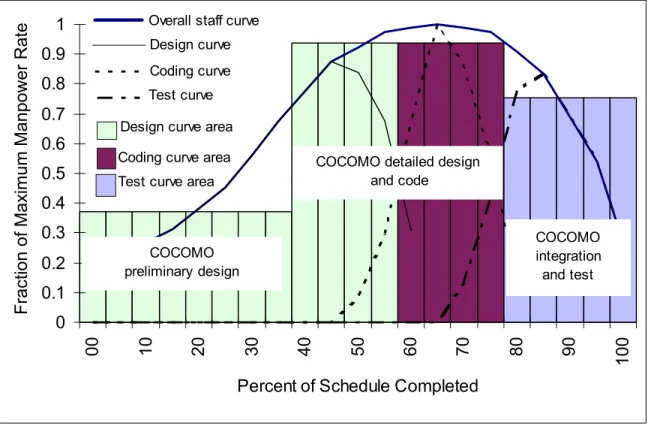
The staffing profile provided by COCOMO is a discrete step function, and is not realistic for planning purposes. Though it can be transformed into a continuous function, the model does not directly provide a continuous staffing curve.
Risk Management
Very few risk management approaches for software projects have employed knowledge captured from experts in an automated fashion. Techniques that identify risks before any development begins still require subjective inputs to quantify the risks. There is little consistency between personnel providing these inputs and many do not have adequate experience to identify all the risk factors and assess the risks. Approaches for identifying risks are usually separate from cost estimation, thus a technique that identifies risks in conjunction with cost estimation is an improvement.
Abdel-Hamid and others [Abdel-Hamid 89, Abdel-Hamid 89a, Abdel-Hamid 90, Abdel-Hamid-Madnick 91, Abdel-Hamid 93, Lin et al. 92] have taken initial steps to account for dynamic project interactions. The current system dynamic models have primarily investigated the post-requirements development phases for projects using a standard waterfall lifecycle approach. They have been predicated on and tested for narrowly defined project environments for a single domain where the project
development is based on the traditional waterfall process model. As such, the models are not applicable to all industrial environments. Only the post requirements phases have been investigated but the initial requirements and architecting phases provide the highest leverage for successful project performance. As the waterfall process model has a relatively poor track record and current research concentrates on different process models and architectures, researchers and practitioners need models of alternative processes. Enhancements are needed for alternative lifecycle models and for the high leverage initial phases of a project.
Abdel-Hamid's model is highly aggregated, as only two levels are used to model the stages of software development. Less aggregation is needed to examine the relationships between phases. The model also glosses over important interactions, such as the effectiveness of error reduction techniques. For instance, a single measure of QA effectiveness is used, although there are important internal behavioral interactions that contribute to the overall error removal rates.
More granularity is needed for managerial decision-making and planning purposes, such as what proportion of effort should be devoted to error removal activities, what is the optimal size of inspection teams, at what rates should documents and code be inspected for optimal error removal effectiveness, etc. Additionally, the QA effort formulation is inaccurate for modern organizations that institute formal methods of error detection, such as inspections or cleanroom techniques. See Chapter 3 for how this research models error removal activities on a more detailed level.
Chapter 3 Modeling of an Inspection-Based Process
This chapter describes the development of an inspection-based process model that has drawn upon extensive literature search, analysis of industrial data, and expert interviews. The working hypothesis is that a system dynamics model can be developed of various aspects of an inspection-based lifecycle process. An inspection-based development process is one where inspections are performed on artifacts at multiple points in the lifecycle to detect errors, and the errors are fixed before the next phase. Examples of artifacts include requirements descriptions, design documents, code and testing plans. Specific process aspects of concern are described below.
The purpose of the modeling is to examine the effects of inspection practices on effort, schedule and quality during the development lifecycle. Both dynamic effects and cumulative project effects are investigated. When possible, these effects are examined per phase. Quality in this context refers to the absence of defects. A defect is defined as a flaw in the specification, design or implementation of a software product. Defects can be further classified by severity or type. The terms defect and error are synonymous throughout this dissertation.
The model is validated per the battery of tests for system dynamics models described in Chapter 5
Model Demonstration and Evaluation. Specific modeling objectives to test against include the ability to predict inspection effort broken down by inspection meeting and rework; testing effort; schedule; and error levels as a function of development phase. Validation has been performed by comparing the results against collected data and other published data. See [Madachy et al. 93a] for the initial industrial data collection and analysis aspect of this work which contains items not included in this dissertation.
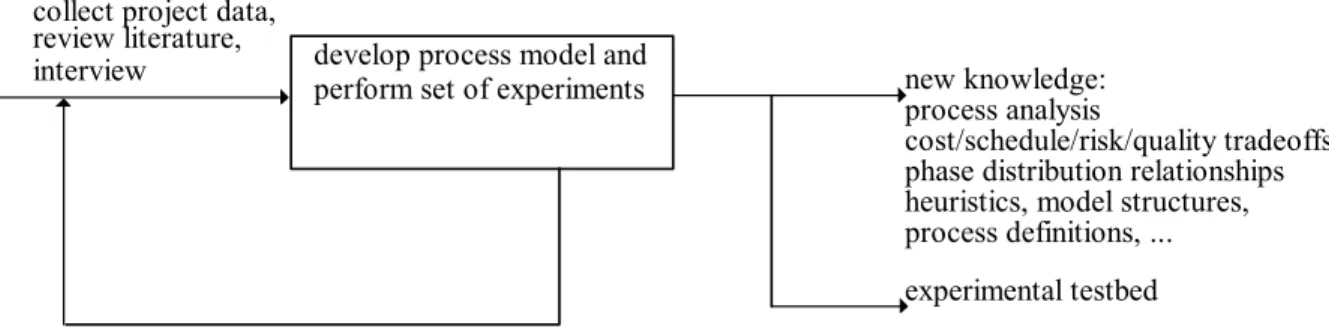
The experimental paradigm used is shown in Figure 3-1. This work covers all of the research activities portrayed in the figure: literature search, expert interviews, analysis of industrial data and system dynamics model development including validation. One goal of the literature search is to help identify reference modes of the system. Reference modes help to define a problem, help to focus model
conceptualization, and are important in later validation phases [Richardson-Pugh 81]. Reference behavior modes are identified at the outset as patterns over time, and used during validation to check the simulation
output. After experimental validation of the process model, knowledge of software phenomenology results as well as having a testbed for further experiments.
Development of this inspection process model was done in an incremental fashion, where model subsets were developed separately, validated and integrated into successively larger pieces. When parts were integrated together or the model revised, the entire suite of validation tests was performed again as regression testing.
develop process model and perform set of experiments collect project data,
review literature,
interview new knowledge:
process analysis
cost/schedule/risk/quality tradeoffs phase distribution relationships heuristics, model structures, process definitions, ... experimental testbed
Figure 3-1: Experimental Paradigm
3.1 Background
Inspections were devised by Fagan at IBM as a formal, efficient and economical method of finding errors in design and code [Fagan 76]. Since their introd