Managing Overloaded Hosts for Dynamic
Consolidation of Virtual Machines in Cloud Data
Centers under Quality of Service Constraints
Anton Beloglazov and Rajkumar Buyya
Abstract—Dynamic consolidation of virtual machines (VMs) is an effective way to improve the utilization of resources and energy efficiency in cloud data centers. Determiningwhenit is best to reallocate VMs from an overloaded host is an aspect of dynamic VM consolidation that directly influences the resource utilization and quality of service (QoS) delivered by the system. The influence on the QoS is explained by the fact that server overloads cause resource shortages and performance degradation of applications. Current solutions to the problem of host overload detection are generally heuristic based, or rely on statistical analysis of historical data. The limitations of these approaches are that they lead to suboptimal results and do not allow explicit specification of aQoS goal. We propose a novel approach that for any known stationary workload and a given state configurationoptimallysolves the problem of host overload detection by maximizing the mean intermigration time under the specified QoS goal based on a Markov chain model. We heuristically adapt the algorithm to handle unknown nonstationary workloads using the Multisize Sliding Window workload estimation technique. Through simulations with workload traces from more than a thousand PlanetLab VMs, we show that our approach outperforms the best benchmark algorithm and provides approximately 88 percent of the performance of the optimal offline algorithm.
Index Terms—Distributed systems, cloud computing, virtualization, dynamic consolidation, energy efficiency, host overload detection
Ç
1
INTRODUCTION
C
LOUDcomputing has revolutionized the ICT industry by enabling on-demand provisioning of computing re-sources based on a pay-as-you-go model. An organization can either outsource its computational needs to the cloud avoiding high up-front investments in a private computing infrastructure and consequent maintenance costs, or imple-ment a private cloud data center to improve the resource management and provisioning processes. However, the problem of data centers is high energy consumption, which has risen by 56 percent from 2005 to 2010, and in 2010 accounted to be between 1.1 and 1.5 percent of the global electricity use [1]. Apart from high operating costs, this results in substantial carbon dioxide (CO2) emissions, which are estimated to be 2 percent of the global emissions [2]. The problem has been partially addressed by improvements in the physical infrastructure of modern data centers. As reported by the Open Compute Project,1Facebook’s Oregon data center achieves a Power Usage Effectiveness (PUE) of 1.08, which means that 93 percent of the data center’s energy consumption are consumed by the computingresources. Therefore, now it is important to focus on the resource management aspect, i.e., ensuring that the comput-ing resources are efficiently utilized to serve applications.
One method to improve the utilization of data center resources, which has been shown to be efficient [3], [4], [5], [6], [7], [8], [9], [10], [11], [12], [13], [14], is dynamic consolidation of Virtual Machines (VMs). This approach leverages the dynamic nature of cloud workloads: The VMs are periodically reallocated using live migration according to their current resource demand to minimize the number of active physical servers, referred to as hosts, required to handle the workload. The idle hosts are switched to low-power modes with fast transition times to eliminate the static power and reduce the overall energy consumption. The hosts are reactivated when the resource demand increases. This approach has basically two objectives, namely minimization of energy consumption and max-imization of the quality of service (QoS) delivered by the system, which form an energy-performance tradeoff.
The QoS requirements can be defined in terms of a variety of metrics and are formalized in the service level agreements (SLAs). In this work, to specify the QoS requirements we apply a modification of the workload independent metric proposed in our previous work [15]. Therefore, the problem transforms into minimization of energy consumption under QoS constraints. This problem is too complex to be treated analytically as a whole, as just the VM placement, which is a part of dynamic VM consolidation, is an NP-hard problem [4], [9], [13]. Moreover, many aspects of the problem have to be addressed, e.g., the heterogeneity of physical resources and VMs; nonstationary and unknown workloads, as observed in Infrastructure as a Service (IaaS) environments; power and performance costs of VM migrations; and the
. The authors are with the Cloud Computing and Distributed Systems (CLOUDS) Laboratory, Department of Computing and Information Systems, the University of Melbourne, Room 7.12, Doug McDonell Building, Parkville Campus, Melbourne, VIC 3010, Australia.
E-mail: [email protected], [email protected]. Manuscript received 28 May 2012; accepted 2 Aug. 2012; published online 13 Aug. 2012.
Recommended for acceptance by V. Misic.
For information on obtaining reprints of this article, please send e-mail to: [email protected], and reference IEEECS Log Number TPDS-2012-05-0506. Digital Object Identifier no. 10.1109/TPDS.2012.240.
1. The Open Compute project. http://opencompute.org/.
large scale of cloud data center infrastructures. Another argument for splitting the problem is decentralization of the resource management algorithm, which is important for scaling the resource management system for efficient handling of thousands of servers. Therefore, to make the problem of dynamic VM consolidation tractable and provide decentralization, in our previous work [15] we have proposed its division into four subproblems:
1. Deciding when a host is considered to be over-loaded, so that some VMs should be migrated from it to other hosts to meet the QoS requirements. 2. Deciding when a host is considered to be
under-loaded, so that its VMs should be migrated, and the host should be switched to a low-power mode. 3. Selecting VMs to migrate from an overloaded host. 4. Allocating the VMs selected for migration to other
active or reactivated hosts.
In this paper, we focus on the first subproblem—the problem of host overload detection. Detecting when a host becomes overloaded directly influences the QoS, because if the resource capacity is completely utilized, it is highly likely that the applications are experiencing resource shortage and performance degradation. What makes the problem of host overload detection complex is the necessity to optimize the time-averaged behavior of the system, while handling a variety of heterogeneous workloads placed on a single host. To address this problem, most of the current approaches to dynamic VM consolidation apply either heuristic-based techniques, such as static utilization thresh-olds [5], [6], [7], [8]; decision-making based on statistical analysis of historical data [12], [13]; or simply periodic adaptation of the VM allocation [3], [4]. The limitations of these approaches are that they lead to suboptimal results and do not allow the administrator to explicitly set a QoS goal. In other words, the performance in regard to the QoS delivered by the system can only be adjusted indirectly by tuning parameters of the applied host overload detection algorithm. In contrast, our approach enables the system administrator to explicitly specify a QoS goal in terms of a workload independent QoS metric. The underlying analy-tical model allows a derivation of an optimal randomized control policy for any known stationary workload and a given state configuration. Ourcontributionsin this paper are: 1. We analytically show that to improve the quality of VM consolidation, it is necessary to maximize the mean time between VM migrations initiated by the host overload detection algorithm.
2. We propose anoptimal offline algorithm(OPT) for host overload detection, and prove its optimality. 3. We introduce a novel Markov Chain model that
allows a derivation of a randomized control policy thatoptimallysolves the problem of maximizing the mean time between VM migrations under an explicitly specified QoS goal for any known sta-tionary workload and a given state configuration in theonlinesetting.
4. To handle unknown nonstationary workloads, we apply the Multisize Sliding Window workload estimation approach [16] to heuristically build an adapted algorithm, which leads to approximately
15 percent higher mean intermigration time com-pared to the best benchmark algorithm for the input workload traces used in our experiments. The adapted algorithm leads to approximately 88 percent of the mean intermigration time produced by the OPT.
We evaluate the algorithm by simulations using real-world workload traces from more than a thousand PlanetLab2 VMs hosted on servers located in more than 500 places around the world. Our experiments show that the introduced algorithm outperforms the benchmark algorithms, while meeting the QoS goal in accordance with the theoretical model. The algorithm uses a workload independent QoS metric and transparently adapts its behavior to various workloads using a machine-learning technique; therefore, it can be applied in an environment with unknown nonstationary workloads, such as IaaS.
It is important to note that the model proposed in this paper is based on Markov chains requiring a few funda-mental modeling assumptions. First of all, the workload must satisfy the Markov property, which implies memory-less state transitions and an exponential distribution of state transition delays. These assumptions must be taken into account in an assessment of the applicability of the proposed model to a particular system. A more detailed discussion of the modeling assumptions and validation of the assumptions is given in Section 6.4.
The remainder of the paper is organized as follows: In Section 2, we discuss the related work followed by the objective of host overload detection and workload inde-pendent QoS metric in Sections 3 and 4, respectively. We introduce an OPT for the problem of host overload detection in Section 5. In Section 6, we introduce a Markov model for the problem of host overload detection and approximate it for unknown non-stationary workloads in Section 7. In Section 8, we propose a control algorithm followed by a multicore CPU model in Section 9 and an experimental evaluation in Section 10. We conclude the paper with Section 11 discussing the results and future research directions.
2
RELATED
WORK
Prior approaches to host overload detection for energy-efficient dynamic VM consolidation proposed in the literature can be broadly divided into three categories: Periodic adaptation of the VM placement (no overload detection), threshold-based heuristics, and decision-making based on statistical analysis of historical data. One of the first works, in which dynamic VM consolidation has been applied to minimize energy consumption in a data center, has been performed by Nathuji and Schwan [3]. They explored the energy benefits obtained by consolidating VMs using migration and found that the overall energy consumption can be significantly reduced. Verma et al. [4] modeled the problem of power-aware dynamic VM consolidation as a bin-packing problem and proposed a heuristic that minimizes the data center’s power consump-tion, taking into account the VM migration cost. However, the authors did not apply any algorithm for determining
when it is necessary to optimize the VM placement—the
proposed heuristic is simply periodically invoked to adapt the placement of VMs.
Zhu et al. [5] studied the dynamic VM consolidation problem and applied a heuristic of setting a static CPU utilization threshold of 85 percent to determine when a host is overloaded. The host is assumed to be overloaded when the threshold is exceeded. The 85 percent utilization threshold has been first introduced and justified by Gmach et al. [6] based on their analysis of workload traces. In their more recent work, Gmach et al. [7] investigated benefits of combining both periodic and reactive thresh-old-based invocations of the migration controller. VMware Distributed Power Management [8] operates based on the same idea with the utilization threshold set to 81 percent. However, static threshold heuristics are unsuitable for systems with unknown and dynamic workloads, as these heuristics do not adapt to workload changes and do not capture the time-averaged behavior of the system. We have enhanced the static threshold heuristic in our previous work [15] by dynamically adapting the value of the threshold according to statistical analysis of the workload history. In this paper, we use static and dynamic threshold heuristics as benchmark algorithms in the experimental evaluation of the proposed approach.
Jung et al. [9] investigated the problem of dynamic consolidation of VMs running multitier web applications to optimize a global utility function, while meeting SLA requirements. The approach is workload specific, as the SLA requirements are defined in terms of the response time precomputed for each transaction type of the applications. When the request rate deviates out of an allowed interval, the system adapts the placement of VMs and the states of the hosts. Zheng et al. [10] proposed automated experi-mental testing of the efficiency of a reallocation decision prior to its application, once the response time, specified in the SLAs, is violated. In the approach proposed by Kumar et al. [11], the resource allocation is adapted when the application’s SLAs are violated. Wang and Wang [17] applied control loops to manage resource allocation under response time QoS constraints at the cluster and server levels. If the resource capacity of a server is insufficient to meet the applications’ SLAs, a VM is migrated from the server. All these works are similar to threshold-based heuristics in that they rely on instantaneous values of performance characteristics but do not leverage the ob-served history of system states to estimate the future behavior of the system and optimize time-averaged performance metrics.
Guenter et al. [12] implemented an energy-aware dynamic VM consolidation system focused on web applica-tions, whose SLAs are defined in terms of the response time. The authors applied weighted linear regression to predict the future workload and proactively optimize the resource allocation. This approach is in line with the Local Regression (LR) algorithm proposed in our previous work [15], which we use as one of the benchmark algorithms in this paper. Bobroff et al. [13] proposed a server overload forecasting technique based on time-series analysis of historical data. Unfortunately, the algorithm description given in the paper is too high level, which does not allow us to implement it to compare with our approach. Weng et al.
[18] proposed a load-balancing system for virtualized clusters. A cluster-wide cost of the VM allocation is periodically minimized to detect overloaded and under-loaded hosts, and reallocate VMs. This is a related work but with the opposite objective—the VMs are deconsolidated to balance the load across the hosts.
As mentioned above, the common limitations of the prior works are that, due to their heuristic basis, they lead to suboptimal results and do not allow the system administrator to explicitly set a QoS goal. In this work, we propose a novel approach to the problem of host overload detection inspired by the work of Benini et al. [19] on power management of electronic systems using Markov decision processes. We build a Markov chain model for the case of a known stationary workload and a given state configuration, and using a workload independent QoS metric derive a Nonlinear Programming (NLP) problem formulation. The solution of the derived NLP problem is the optimal control policy that maximizes the time between VM migrations under the specified QoS constraint in the online setting. Since most real-world systems, including IaaS, experience highly variable nonstationary workloads, we apply the Multisize Sliding Window workload estima-tion technique proposed by Luiz et al. [16] to heuristically adapt the proposed model to nonstationary stochastic environments and practical applications. Although the final approach is a heuristic, in contrast to the related works it is based on an analytical model that allows the computation of an optimal control policy for any known stationary workload and a given state configuration.
3
THE
OBJECTIVE OF A
HOST
OVERLOAD
DETECTION
ALGORITHM
In this section, we show that to improve the quality of VM consolidation, it is necessary to maximize the time intervals between VM migrations from overloaded hosts. Since VM consolidation is applied to reduce the number of active physical hosts, the quality of VM consolidation is inversely proportional toH, the mean number of active hosts overn time steps: H¼1 n Xn i¼1 ai; ð1Þ
where ai is the number of active hosts at the time step i¼1;2;. . .; n. A lower value ofHrepresents a better quality of VM consolidation.
To investigate the impact of decisions made by host overload detection algorithms on the quality of VM consolidation, we consider an experiment, where at any time step the host overload detection algorithm can initiate a migration from a host due to an overload. There are two possible consequences of a decision to migrate a VM relevant to host overload detection:Case 1, when a VM to be migrated from an overloaded host cannot be placed on another active host due to insufficient resources, and therefore, a new host has to be activated to accommodate the VM; and Case 2, when a VM to be migrated can be placed on another active host. To study host overload detection in isolation, we assume that no hosts are switched
off during the experiment, i.e., once a host is activated, it remains active untiln.
Letpbe the probability ofCase 1, i.e., an extra host has to be activated to migrate a VM from an overloaded host determined by the host overload detection algorithm. Then, the probability of Case 2 is ð1pÞ. Let T be a random variable denoting the time between two subsequent VM migrations initiated by the host overload detection algo-rithm. The expected number of VM migrations initiated by the host overload detection algorithm overn time steps is n=E½T, whereE½Tis the expected intermigration time.
Based on the definitions given above, we can define XBðn=E½T; pÞ, a binomially distributed random variable denoting the number of extra hosts switched on due to VM migrations initiated by the host overload detection algo-rithm overntime steps. The expected number of extra hosts activated is E½X ¼np=E½T. Let A be a random variable denoting the time during which an extra host is active between the time steps 1 andn. The expected value ofAcan be defined as follows: E½A ¼ X n E½T j k i¼1 ðn ði1ÞE½TÞp ¼ n E½T p 2 nþn n E½T 1 E½T np 2 1þ n E½T : ð2Þ
Let us rewrite (1) as follows: H¼1 n Xn i¼1 ai ¼1 n Xn i¼1 a1þ 1 n Xn i¼1 ðaia1Þ ¼a1þ 1 n Xn i¼1 ðaia1Þ: ð3Þ
The first term a1 is a constant denoting the number of hosts that have been initially active and remain active until the end of the experiment. The second term H¼ 1
n Pn
i¼1ðaia1Þ is the mean number of hosts switched on due to VM migrations being active per unit of time over n time steps. We are interested in analyzing the average behavior, and thus estimating the expected value ofH. It is proportional to a product of the expected number of extra hosts switched on due to VM migrations and the expected activity time of an extra host normalized by the total time, as shown in E½H /1 nE½XE½A 1 n np E½T np 2 1þ n E½T ¼ np 2 2E½T 1þ n E½T : ð4Þ
Since the objective is to improve the quality of VM consolidation, it is necessary to minimizeE½H. From (4), the only variable that can be directly controlled by a host
overload detection algorithm isE½T; therefore, to minimize E½Hthe objective of a host overload detection algorithm is to maximizeE½T, i.e., to maximize the mean time between migrations from overloaded hosts.
4
A WORKLOAD
INDEPENDENT
QOS METRIC
To impose QoS requirements on the system, we apply an extension of theworkload independent QoS metricintroduced in our previous work [15]. We define that a host can be in one of two states in regard to its load level: 1) serving regular load; and 2) being overloaded. It is assumed that if a host is overloaded, the VMs allocated to the host are not being provided with the required performance level leading to performance degradation. To evaluate the overall performance degradation, we define a metric denoted Overload Time Fraction (OTF):OT FðutÞ ¼toðutÞ
ta ; ð5Þ
whereutis the CPU utilization threshold distinguishing the nonoverload and overload states of the host;tois the time, during which the host has been overloaded, which is a function ofut; andtais the total time, during which the host has been active. Using this metric, SLAs can be defined as the maximum allowed value of OTF. For example, if in the SLAs it is stated that OTF must be less or equal to 10 percent, it means that on average a host is allowed to be overloaded for not more than 10 percent of its activity time. Since the provider is interested in maximizing the resource utilization while meeting the SLAs, from his perspective this requirement corresponds to the QoS goal of OT F !10%, while OT F 10%. The definition of the metric for a single host can be extended to a set of hosts by substituting the time values by the aggregated time values over the set of hosts.
The exact definition of the state of a host, when it is overloaded, depends on the specific system requirements. However, the value of the CPU utilization threshold ut defining the states of a host does not affect the model proposed in this paper, the model allows setting the threshold to any value. For example, in our experiments, we define that a host is overloaded, when its CPU utilization is 100 percent, in which case the VMs allocated to this host do not get the required CPU capacity leading to performance degradation. The reasoning behind this is the observation that if a host serving applications is experien-cing 100 percent utilization, the performance of the applications is constrained by the host’s capacity; therefore, the VMs are not being provided with the required performance level.
It has been claimed in the literature that the performance of servers degrade, when their load approaches 100 percent [20], [21]. For example, the study of Srikantaiah et al. [21] has shown that the performance delivered by the CPU degrades when the utilization is higher than 70 percent. If due to system requirements, it is important to avoid performance degradation, the proposed OTF metric allows the specification of the CPU utilization threshold at the required level below 100 percent. The host is considered to
be overloaded, when the CPU utilization is higher than the specified threshold.
In general, other system resources, such as memory, disk, and network bandwidth, should also be take into account in the definition of QoS requirements. However, in this paper we only consider the CPU, as it is one of the main resources that are usually oversubscribed by Cloud providers. Therefore, in our analysis we assume that the other system resources are not significantly oversubscribed and do not become performance bottlenecks.
Verma et al. [22] proposed a similar metric for estimating the SLA violation level in a system, which they defined as the number of time instances, when the capacity of a server is less than the demand of all applications placed on it. However, their metric shows a nonnormalized absolute value, which, for example, cannot be used to compare systems processing the same workload for different periods of time. In contrast, the OTF metric is normalized and does not depend on the length of the time period under consideration.
In the next section, based on the objective of a host overload detection algorithm derived in Section 3 and the OTF metric introduced in this section, we propose an OPT for the problem of host overload detection and prove its optimality.
5
AN
OPTIMAL
OFFLINE
ALGORITHM
As shown in Section 3, it is necessary to maximize the mean time between VM migrations initiated by the host overload detection algorithm, which can be achieved by maximizing each individual intermigration time interval. Therefore, we limit the problem formulation to a single VM migration, i.e., the time span of a problem instance is from the end of a previous VM migration and to the end of the next. Given the results of Sections 3 and 4, the problem of host overload detection can be formulated as an optimization problem (6)-(7)
taðtm; utÞ !max ð6Þ
toðtm; utÞ taðtm; utÞ
M; ð7Þ
where tm is the time when a VM migration has been initiated; ut is the CPU utilization threshold defining the overload state of the host; toðtm; utÞ is the time, during which the host has been overloaded, which is a function of tm and ut; ta is the total time, during which the host has been active, which is also a function oftmandut; andMis the limit on the maximum allowed OTF value, which is a QoS goal expressed in terms of OTF. The aim of a host overload detection algorithm is to select the tm that maximizes the total time until a migration, while satisfying the constraint (7). It is important to note that the optimiza-tion problem (6)-(7) is only relevant to host overload
detection, and does not relate to host underload situations. In other words, maximizing the activity time of a host is only important for highly loaded hosts. Whereas for underloaded hosts, the problem is the opposite—the activity time needs to be minimized; however, this problem is not the focus of the current paper and should be investigated separately.
In the offline setting, the state of the system is known at any point in time. Consider an offline algorithm that passes through the history of system states backwards starting from the last known state. The algorithm decre-ments the time and recalculates the OTF value toðtm;utÞ
taðtm;utÞ at
each iteration. The algorithm returns the time that corresponds to the current iteration if the constraint (7) is satisfied (Algorithm 1).
Algorithm 1.An Optimal Offline Algorithm (OPT)
Input:A system statehistory
Input:M, the maximum allowed OTF
Output:A VM migration time 1: whilehistoryis not emptydo
2: ifOTF ofhistoryMthen
3: returnthe time of the lasthistorystate 4: else
5: drop the last state fromhistory
6: end if
7: end while
Theorem 1. Algorithm 1 is an OPT for the problem of host overload detection.
Proof. Let the time interval covered by the system state history be ½t0; tn, and tm be the time returned by Algorithm 1. Then, according to the algorithm the system states corresponding to the time intervalðtm; tn do not satisfy the constraint (7). Since tm is the right bound of the interval ½t0; tm, then tm is the maximum possible time that satisfies the constraint (7). Therefore, tm is the solution of the optimization problem (6)-(7), and Algorithm 1 is an OPT for the problem of host
overload detection. tu
6
A MARKOV
CHAIN
MODEL FOR THE
HOST
OVERLOAD
DETECTION
PROBLEM
In this section, we base our model on the definitions of Markov chains, a mathematical framework for statistical modeling of real-world processes. Bolch [23] provides a detailed introduction to Markov chains.
6.1 The Host Model
Each VM allocated to a host at each point in time utilizes a part of the CPU capacity determined by the application workload. The CPU utilization created over a period of time by a set of VMs allocated to a host constitutes the host’s workload. For the initial analysis, we assume that the workload is known a priori, stationary, and satisfies the Markov property. In other words, the CPU utilization of a host measured at discrete time steps can be described by a single time-homogeneous DTMC.
There is a controller component, which monitors the CPU utilization of the host and according to a host overload detection algorithm decides when a VM should be migrated from the host to satisfy the QoS requirements, while maximizing the time between VM migrations. According to Section 5, we limit the problem formulation to a single VM migration, i.e., the time span of a problem instance is from the end of a previous VM migration to the end of the next.
To describe a host as a DTMC, we assign states to N subsequent intervals of the CPU utilization. For example, if N ¼11, we assign the state 1 to all possible values of the CPU utilization within the interval [0, 10 percent), 2 to the CPU utilization within ½10;20 percentÞ;. . .,N to the value 100 percent. The state space S of the DTMC contains N states, which correspond to the defined CPU utilization intervals. Using this state definition and knowing the workload of a host in advance, by applying the Maximum Likelihood Estimation (MLE) method it is possible to derive a matrix of transition probabilities P. The matrix is constructed by estimating the probabilities of transitions
b
pij¼Pcij k2Scik
between the defined N states of the DTMC for i; j2 S, wherecijis the number of transitions between statesiandj. We add an additional stateðNþ1Þto the Markov chain called an absorbing state. A state k2 S is said to be an absorbing state if and only if no other state of the Markov chain can be reached from it, i.e., pkk¼1. In other words, once the Markov chain reaches the state k, it stays in that state indefinitely. The resulting extended state space is S¼ S [ fðNþ1Þg. For our problem, the absorbing state ðNþ1Þ represents the state, where the DTMC transitions once a VM migration is initiated. According to this definition, the control policy can be described by a vector of the probabilities of transitions from any nonabsorbing state to the absorbing stateðNþ1Þ, i.e., the probabilities of VM migrations, which we denotemi, wherei2 S. To add the state ðNþ1Þ into the model, the initial transition probability matrix P is extended with a column of unknown transition probabilities m¼ ½mi8i2 S resulting in an extended matrix of transition probabilitiesP:
P¼ p11 p1N m1 .. . . . . .. . .. . pN1 pNN mN 0 0 0 1 0 B B B @ 1 C C C A; ð8Þ
wherepij are defined as follows:
pij ¼pijð1miÞ; 8i; j2 S: ð9Þ In general, the workload experienced by the host’s VMs can lead to any CPU utilization from 0 to 100 percent; therefore, the original DTMC can be assumed to be ergodic. We will restrict the extended DTMC to the states in S; therefore, using Q¼PI [23], the extended matrix of transition probabilities P can be transformed into a corresponding extended matrix of transition ratesQ:
Q¼ p111 p1N m1 .. . . . . .. . .. . p N1 pNN1 mN 0 0 0 0 0 B B B @ 1 C C C A: ð10Þ
In the next section, we formulate the QoS constraint in terms of the introduced model, derived extended matrix of transition ratesQ, and OTF metric.
6.2 The QoS Constraint
Let
LðtÞ ¼ Z t
0
ðuÞdu; ð11Þ
thenLiðtÞdenotes the total expected timethe CTMC spends in the state i during the interval ½0; tÞ. By integrating an equation for the unconditional state probability vector ðtÞ:
dðtÞ=dt¼ðtÞQon both sides, a new differential equation forLðtÞis derived [23]:
dLðtÞ
dt ¼LðtÞQþð0Þ; Lð0Þ ¼0: ð12Þ The expected time spent by the CTMC before absorption can be calculated by finding the limitLSð1Þ ¼limt!1LSðtÞ restricting the state space to the states inS. The limit exists due to a nonzero probability of a transition to the absorbing stateðNþ1Þ. However, the limit does not exist for the state ðNþ1Þ. Therefore, to calculate LSð1Þ, the extended infinitesimal generator matrixQ is restricted to the states inS, resulting in a matrixQS of the sizeN N. The initial probability vector ð0Þ is also restricted to the states in S resulting inSð0Þ. Restricting the state space to nonabsorb-ing states allows the computation oflimt!1 on both sides of (12) resulting in the followinglinearequation [23]:
LSð1ÞQS¼ Sð0Þ: ð13Þ LetN denote the state of a host when it is overloaded, e.g., when the CPU utilization is equal to 100 percent, then the expected time spent in the stateNbefore absorption can be calculated by finding LNð1Þ from a solution of the system of linear (13). Similarly, the total expected time of the host being active can be found asPi2SLið1Þ. Letting the VM migration time be Tm, the expected OTF can be calculated as follows:
OT F¼ TmþLNð1Þ
TmþPi2SLið1Þ: ð14Þ
6.3 The Optimization Problem
By the solution of (13), closed-form equations for L1ð1Þ; L2ð1Þ;. . .; LNð1Þ are obtained. The unknowns in these equations are m1; m2;. . .; mN, which completely describe the policy of the controller. For our problem, the utility function is the total expected time until absorption, as the objective is to maximize the intermigration time. To introduce the QoS goal in the problem formulation, we specify a limit M on the maximum allowed value of the OTF metric as a constraint resulting in the following optimization problem: X i2S Lið1Þ !max TmþLNð1Þ TmþPi2SLið1ÞM: ð15Þ
The (15) form an NLP problem. The solution of this NLP problem is the vectormof the probabilities of transitions to the absorbing state, which forms the optimal control policy defined as a PMF m¼ ½mi8i2 S. At every time step, the
optimal control policy migrates a VM with probability mi, where i2 S is the current state. The control policy is
deterministic if 9k2 S:mk¼1 and 8i2 S; i6¼k:mi¼0; otherwise, the policy israndomized.
6.4 Modeling Assumptions
The introduced model allows the computation of the optimal control policy of a host overload detection controller for a given stationary workload and a given state configuration. It is important to take into account that this result is based on a few fundamental modeling assumptions. First of all, it is assumed that the system satisfies the Markov property, or in other words, the sojourn times (i.e., the time a CTMC remains in a state) are exponentially distributed. Assuming an exponential dis-tribution of sojourn times may not be accurate in many systems. For instance, state transition delays can be deterministic due to a particular task scheduling, or follow other than exponential statistical distribution, such as a bell-shaped distribution. Another implication of the Mar-kov property is the assumption of memoryless state transitions, which means that the future state can be predicted solely based on the knowledge of the current state. It is possible to envision systems, in which future states depend on more than one past state.
Another assumption is that the workload is stationary and known a priori, which does not hold in typical computing environments. In the next section, we show how the introduced model can be heuristically adapted to handle unknown nonstationary workloads. The proposed heuristically adapted model removes the assumption of stationary and known workloads; however, the assump-tions implied by the Markov property must still hold. In Section 10, we evaluate the proposed heuristically adapted model and test the assumptions through a simulation study using real workload traces from more than a thousand PlanetLab VMs. The simulation results show that the model is efficient for this type of mixed computing workloads.
With a correct understanding of the basic model assumptions and careful assessment of the applicability of our model to a particular system, an application of the model can bring substantial performance benefits to the resource management algorithms. As demonstrated by our simulation study in Section 10, our approach outperforms the benchmark algorithms in terms of both the mean intermigration time and the precision of meeting the specified QoS goal.
7
NONSTATIONARY
WORKLOADS
The model introduced in Section 6 works with the assumption that the workload is stationary and known. However, this is not the case in systems with unknown nonstationary workloads, such as IaaS. One of the ways to adapt the model defined for known stationary workloads to the conditions of initially unknown nonstationary workloads is to apply the Sliding Window workload estimation approach proposed by Chung et al. [24]. The base idea is to approximate a nonstationary workload as a sequence of stationary workloadsU ¼ ðu1; u2;. . .; uNuÞthat
are enabled one after another. In this model, the transition
probability matrix P becomes a function of the current stationary workload PðuÞ.
Chung et al. [24] called a policy that makes ideal decisions for a current stationary workload ui the best adaptive policy. However, the best adaptive policy requires the perfect knowledge of the whole sequence of workloads Uand the times, at which the workloads change. In reality, a model of a workload ui can only be built based on the observed history of the system behavior. Moreover, the time at which the current workload changes is unknown. Therefore, it is necessary to apply a heuristic that achieves results comparable to the best adaptive policy. According to the Sliding Window approach, a time window of lengthlw
slidesover time always capturing lastlwevents. Letcijbe the observed number of transitions between states i and j, i; j2 S, during the last windowlw. Then, applying the MLE method, the transition probabilitypij is estimated as
b
pij ¼Pcij k2Scik
:
As the window lengthlw! 1, the estimatorbpij converges to the real value of the transition probabilitypijif the length of the current stationary workloadui is equal tolw [24].
However, the Sliding Window approach introduces three sources of errors in the estimated workload:
1. The biased estimation error, which appears when the window lengthlwis shorter than the length of a sequence of outliers.
2. The resolution error (referred to as the sampling error by Luiz et al. [16]), which is introduced due to the maximum precision of the estimates being limited to1=lw.
3. The adaptation time (referred to as the identification delay by Luiz et al. [16]), which is a delay required to completely fill the window with new data after a switch from a stationary workload ui1 to a new stationary workloadui.
Luiz et al. [16] extended the Sliding Window approach by employing multiple windows with different sizes, where a window to use is selected dynamically using the information about the previous system state and variances of the estimates obtained from different windows. They referred to the extended approach as the Multisize Sliding Window approach. The proposed algorithm dynamically selects the best window size to eliminate the bias estimate error and benefit from both the small sampling error of large window sizes and small identification error of small window sizes. In this paper, we apply the Multisize Sliding Window approach to the model introduced in Section 6 to adapt it to initially unknown nonstationary workloads.
We adapt the calculation of the expected OTF (14) by transforming it to a function of t2IRþ to incorporate the information that is known by the algorithm at the time of decision making:
OT FðtÞ ¼ TmþyðtÞ þLNð1Þ TmþtþPi2SLið1Þ
; ð16Þ
whereyðtÞis a function returning the total time spent in the stateN during the time interval½0; t.
7.1 Multisize Sliding Window Workload Estimation
In this section we briefly introduce the Multisize Sliding Window approach; for more details, reasoning and analysis please refer to Luiz et al. [16]. A high-level view of the estimation algorithm is shown in Fig. 1. First of all, to eliminate the biased estimation error, the previous history is stored separately for each state in S resulting in S state windows Wi, i¼1;2;. . .; S. Let J, D, and NJ be positive numbers; L ¼ ðJ; JþD; Jþ2D;. . .; Jþ ðNJ1ÞDÞ a se-quence of window sizes; and lwmax ¼Jþ ðNJ1ÞD the maximum window size. At each time t, the Previous State Buffer stores the system state st1 at the time t1 and controls the window selector, which selects a window Wi such thatst1¼i. The notationWikðtÞdenotes the content of the window Wi in a positionk at the timet. The selected window shifts its content one position to the right to store the current system state:Wikþ1ðtÞ ¼WikðtÞ,8k¼1;. . .; lwmax; discards the rightmost elementWlwmax
i ðtÞ; and storesstin the position Wi1ðtÞ. Once the selected state window Wi is updated, new probability estimates are computed based on this state window for all window sizes as follows:
b
pijðt; mÞ ¼ PLm
k¼1ðWikðtÞ ¼¼jÞ
Lm ; ð17Þ
where “==” is the equivalence operation, i.e., ð1¼¼1Þ ¼
1;ð1¼¼0Þ ¼0. A computed probability estimate is stored in NJ out of the SSNJ estimate windows EijmðtÞ, where i; j2 S, and m is the estimate window size index,
1mNJ. NJ estimate windows EijmðtÞ are selected such that st1¼i and st¼j, 8m¼1;. . .; NJ. Similarly to the update process of the state windows, the selected estimate windows shift their contents one position to the right, discard the rightmost element ELm
ijmðtÞ, and store b
pijðt;LmÞin the positionE1
ijmðtÞ. To evaluate the precision of the probability estimates, the next step is to estimate the variance Sði; j; t; mÞ of the probability estimates obtained from every updated estimate window:
pijðt; mÞÞ ¼ 1 Lm XLm k¼1 Eijmk ðtÞ; Sði; j; t; mÞ ¼ 1 Lm1 XLm k¼1 ðEk ijmðtÞ pijðt;LmÞÞ 2 ; ð18Þ
where pijðt; mÞ is the mean value of the probability estimates calculated from the state window Wi of length Lm. To determine what values of the variance can be considered to be low enough, a function of acceptable varianceVacðbpijðt; mÞ; mÞis defined [16]:
Vacðpijb ðt; mÞ; mÞ ¼bpijðt;LmÞð1pijðt;b LmÞÞ
Lm : ð19Þ
Using the function of acceptable variance, probability estimates are considered to be adequate if Sði; j; t; mÞ Vacðbpijðt; mÞ; mÞ. Based on the definitions given above, a window size selection algorithm can be defined (Algo-rithm 2). According to the selected window sizes, transition probability estimates are selected from the estimate windows.
Algorithm 2.The Window Size Selection Algorithm
Input:J,D,NJ,t,i,j
Output:The selected window size 1: lw J
2: fork¼0toNJ1do
3: ifSði; j; t; kÞ Vacðbpijðt; kÞ; kÞthen
4: lw JþkD 5: else 6: break loop 7: end if 8: end for 9: returnlw
The presented approach addresses the errors mentioned in Section 7 as follows:
1. The biased estimation error is eliminated by intro-ducing dedicated history windows for each state: Even if a burst of transitions to a particular state is longer than the length of the window, the history of transitions from the other states is preserved. 2. The sampling error is minimized by selecting the
largest window size constrained by the acceptable variance function.
3. The identification error is minimized by selecting a smaller window size when the variance is high, which can be caused by a change to the next stationary workload.
8
THE
CONTROL
ALGORITHM
We refer to a control algorithm based on the model introduced in Section 6 as the Optimal Markov Host Overload Detection (MHOD-OPT) algorithm. We refer to the MHOD-OPT algorithm adapted to unknown nonsta-tionary workloads using the Multisize Sliding Window workload estimation technique introduced in Section 7 as the Markov Host Overload Detection (MHOD) algorithm. A high-level view of the MHOD-OPT algorithm is shown in Algorithm 3. In the online setting, the algorithm is Fig. 1. The Multisize Sliding Window workload estimation.
invoked periodically at each time step to make a VM migration decision.
Algorithm 3.The MHOD-OPT Algorithm
Input:Transition probabilities
Output:A decision on whether to migrate a VM 1: Build the objective and constraint functions 2: Invoke the brute-force search to find themvector 3: ifa feasible solution existsthen
4: Extract the VM migration probability 5: ifthe probability is < 1then
6: return false
7: end if
8: end if
9: return true
Closed-form equations forL1ð1Þ; L2ð1Þ;. . .; LNð1Þare precomputed offline from (13); therefore, the runtime computation is not required. The values of transition probabilities are substituted into the equations for L1ð1Þ; L2ð1Þ;. . .; LNð1Þ, and the objective and constraint func-tions of the NLP problem are generated by the algorithm. To solve the NLP problem, we applied a brute-force search algorithm with a step of 0.1, as its performance was sufficient for the purposes of simulations. In MHOD-OPT, a decision to migrate a VM is made only if either no feasible solution can be found, or the migration probability corresponding to the current state is 1. The justification for this is the fact that if a feasible solution exists and the migration probability is less than 1, then for the current conditions there is no hard requirement for an immediate migration of a VM.
The MHOD algorithm shown in Algorithm 4 can be viewed as a wrapper over the MHOD-OPT algorithm, which adds the Multisize Sliding Window workload estimation. During the initial learning phase Tl, which in our experiments was set to 30 time steps, the algorithm does not migrate a VM. Once the learning phase is over, the algorithm applies the Multisize Sliding Window technique to estimate the probabilities of transitions between the states and invokes the MHOD-OPT algorithm passing the transi-tion probability estimates as the argument. The result of the MHOD-OPT algorithm invocation is returned to the user.
Algorithm 4.The MHOD Algorithm
Input:A CPU utilization history
Output:A decision on whether to migrate a VM 1: ifthe CPU utilization history size >Tlthen
2: Convert the last CPU utilization value to a state 3: Invoke the Multisize Sliding Window estimation to
obtain the estimates of transition probabilities 4: Invoke the MHOD-OPT algorithm
5: returnthe decision returned by MHOD-OPT 6: end if
7: return false
9
THE
CPU MODEL
The models and algorithms proposed in this paper are suitable for both single core and multicore CPU architec-tures. The capacity of a single core CPU is modeled in terms
of its clock frequency F. A VM’s CPU utilization ui is relative to the VM’s CPU frequencyfi and is transformed into a fraction of the host’s CPU utilization U. These fractions are summed up over theN VMs allocated to the host to obtain the host’s CPU utilization, as shown in
U¼FX
N
i
fiui: ð20Þ
For the purpose of the host overload detection problem, we model multicore CPUs as proposed in our previous work [15]. A multicore CPU with n cores each having a frequencyf is modeled as a single core CPU with the nf frequency. In other words,F in (20) is replaced bynf. This simplification is justified, as applications and VMs are not tied down to a specific core, but can by dynamically assigned to an arbitrary core by a time-shared scheduling algorithm. The only physical constraint is that the CPU capacity allocated to a VM cannot exceed the capacity of a single core. Removing this constraint would require the VM to be executed on more than one core in parallel. However, automatic parallelization of VMs and their applications cannot be assumed.
10 PERFORMANCE
EVALUATION
10.1 Importance of Precise Workload Estimation
The purpose of this section is to show that the precision of the workload estimation technique is important to achieve high performance of the MHOD algorithm. To show this, we constructed an artificial workload that illustrates a case when the MHOD algorithm with the Multisize Sliding Window workload estimation leads to lower performance compared to MHOD-OPT due to its inability to adapt quickly enough to a highly nonstationary workload.
We define that the host can be in one of two possible statesf0;1g, where the state 1 means that the host is being overloaded. Let the nonstationary workload be composed of a sequence of three stationary workloads, whose probabilities of transitions between the states are shown in Table 1. We used simulations to evaluate the algorithms. For this experiment, the OTF constraint was set to 30 percent, and the sequence of window sizes for the Multisize Sliding Window workload estimation was ð30;40;50;60; 70;80;90;100Þ. The code of the simulations is written in Clojure.3 To foster and encourage reproduci-bility of experiments, we have made the source code of all our simulations publicly available online.4
TABLE 1
An Artificial Nonstationary Workload
3. The Clojure programming language. http://clojure.org/. 4. https://github.com/beloglazov/tpds-2013-simulation/.
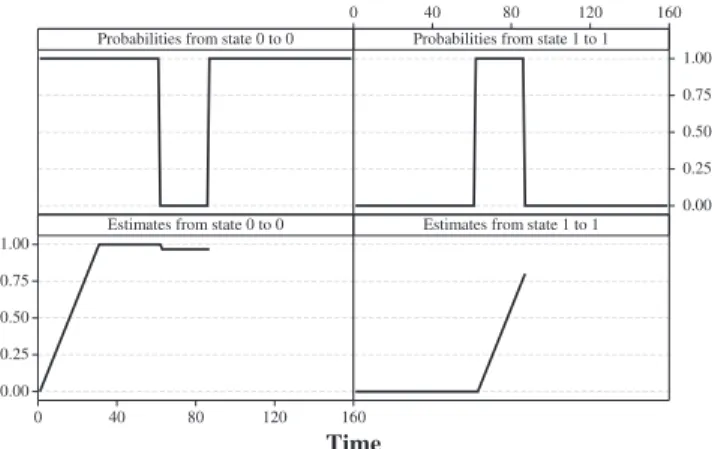
The simulation results are shown in Table 2. According to the results, for the workload defined in Table 1 the MHOD-OPT algorithm provides exactly the same performance as the OPT. However, the MHOD algorithm migrates a VM at the beginning of the third stationary workload because it is not able to immediately recognize the change of the workload, as shown forp00andpb00 in Fig. 2.
In summary, even though the Multisize Sliding Window workload estimation provides high quality of estimation [16], in some cases it may result in an inferior performance of the MHOD algorithm compared to MHOD-OPT. This result was expected, as MHOD-OPT skips the estimation phase and utilizes the knowledge of real transition probabilities. The artificial workload used in this section was specifically constructed to show that imprecise work-load estimation may lead to unsatisfactory performance of the MHOD algorithm. However, as shown in the next section, the MHOD algorithm performs closely to OPT for real-world workloads.
10.2 Evaluation Using PlanetLab Workload Traces
In an environment with multiple hosts, the MHOD algorithm operates in a decentralized manner, where independent instances of the algorithm are executed on every host. Therefore, to evaluate the MHOD algorithm under a real-world workload, we simulated a single host with a quad-core CPU serving a set of heterogeneous VMs. The clock frequency of a single core of the host was set to 3 GHz, which according to the model introduced in Section 9 transforms into 12 GHz. These CPU characteristics correspond to a mid-range Amazon EC2 physical server type [25]. The amount of the host’s memory was assumed to be enough for the VMs. The CPU frequency of a VM was randomly set to one of the values approximately corre-sponding to the Amazon EC2 instance types5: 1.7, 2, 2.4, and 3 GHz. The CPU utilization of the VMs was simulated based on the data provided as a part of the CoMon project, a monitoring infrastructure for PlanetLab [26]. The project provides the data measured every 5 minutes from more than a thousand VMs running in more than 500 locations around the world. For our experiments, we have randomly chosen 10 days from the workload traces collected during March and April 2011.
For a simulation run, a randomly generated set of VMs with the CPU utilization traces assigned is allocated to the host. At each time step, the host overload detection algorithm makes a decision of whether a VM should be migrated from the host. The simulation runs until either the CPU utilization traces are over, or until a decision to migrate a VM is made by the algorithm. At the end of a simulation run, the resulting value of the OTF metric is
calculated according to (5). The algorithm of assigning the workload traces to a set of VMs is presented in Algorithm 5. To avoid trivial cases and stress the algorithms with more dynamic workloads, we decided to filter the original workload traces. We constrained the maximum allowed OTF after the first 30 time steps to 10 percent and the minimum overall OTF to 20 percent. Using the workload assignment algorithm, we pregenerated 100 different sets of VMs that meet the defined OTF constraints and ran every algorithm for each set of VMs. The workload data used in the experiments are publicly available online.6
Algorithm 5.The Workload Trace Assignment Algorithm
Input:A set of CPU utilization traces
Output:A set of VMs
1: Randomly select the host’s minimum CPU utilization at the time 0 from 80 percent, 85 percent, 90 percent, 95 percent, and 100 percent
2: whilethe host’s utilization < the thresholddo
3: Randomly select the new VM’s CPU frequency 4: Randomly assign a CPU utilization trace 5: Add the new VM to the set of created VMs 6: end while
7: returnthe set of created VMs 10.2.1 Benchmark Algorithms
In addition to the OPT introduced in Section 5, we implemented a number of benchmark algorithms and ran them with different parameters to compare with the proposed MHOD algorithm. In this section, we give a brief overview of the benchmark algorithms; a detailed descrip-tion of each of them is given in our previous work [15]. The first algorithm is a simple heuristic based on setting a CPU utilization threshold (THR), which monitors the host’s CPU utilization and migrates a VM if the defined threshold is exceeded. This threshold-based heuristic was applied in a number of related works [5], [6], [7], [8]. The next two algorithms apply statistical analysis to dynamically adapt the CPU utilization threshold: based on the median absolute deviation (MAD), and on the interquartile range (IQR) [15]. Two other algorithms are based on estimation of the future CPU utilization usingLR(i.e., Loess method) and a Fig. 2. The estimatedbp00compared top00.
TABLE 2
Comparison of MHOD, MHOD-OPT, and OPT
modification of the method robust to outliers, referred to as
robust LR [15]. We denote these algorithms LR and Local Regression Robust (LRR), respectively. The LR algorithm is in line with the regression-based approach proposed by Guenter et al. [12]. Another algorithm continuously monitors the host’s OTF and decides to migrate a VM if the current value exceeds the defined parameter; we refer to this algorithm as the OTF Threshold (OTFT) algorithm. The last benchmark algorithm, the OTF Threshold Migration Time (OTFTM) algorithm, is similar to OTFT; however, it uses an extended metric that includes the VM migration time:
OT Fðto; taÞ ¼Tmþto
Tmþta; ð21Þ
where to is the time, during which the host has been overloaded;ta is the total time, during which the host has been active; andTmis the VM migration time.
10.2.2 MHOD Compared with Benchmark Algorithms To shorten state configuration names of the MHOD algorithm, we refer to them by denoting the thresholds between the utilization intervals. For example, a 3-state configuration ð½0;80 percentÞ, ½80;100 percentÞ,100 percentÞ is referred to as 80-100. We simulated the following 2- and 3-state configurations of the MHOD algorithm: 80-100, 90-100, and 100 (a 2-state configuration). We simulated each state configuration with the OTF parameter set to 10, 20, and 30 percent. In our experiments, the VM migration time was set to 30 seconds.
To find out whether different numbers of states and different state configurations of the MHOD algorithm significantly influence the algorithm’s performance in regard to the time until a migration and the resulting OTF value, we conducted paired t-tests. The tests on the produced time until a migration data for comparing MHOD 80-100 with MHOD 100 and MHOD 90-100 with MHOD 100 showed nonstatistically significant differences with the p-values 0.20 and 0.34, respectively. This means that the simulated 2- and 3-state configurations of the MHOD algorithm on average lead to approximately the same time until a migration. However, there are statisti-cally significant differences in the resulting OTF value
produced by these algorithms: 0.023 percent with 95 percent Confidence Interval (CI) (0.001, 0.004 percent) andp-value ¼0:033for MHOD 100 compared with MHOD 80-100; and 0.022 percent with 95 percent CI (0.000, 0.004 percent) and p-value¼0:048for MHOD 100 compared with MHOD 90-100. However, differences in the resulting OTF value in the order of less than 0.1 percent are not practically significant; therefore, we conclude that the simulated 2-and 3-state configurations produce approximately the same results. Further in this section, we compare only the ð½0;
100 percentÞ, 100 percentÞ 2-state configuration of MHOD with the benchmark algorithms, as it requires simpler computations compared with the 3-state configurations.
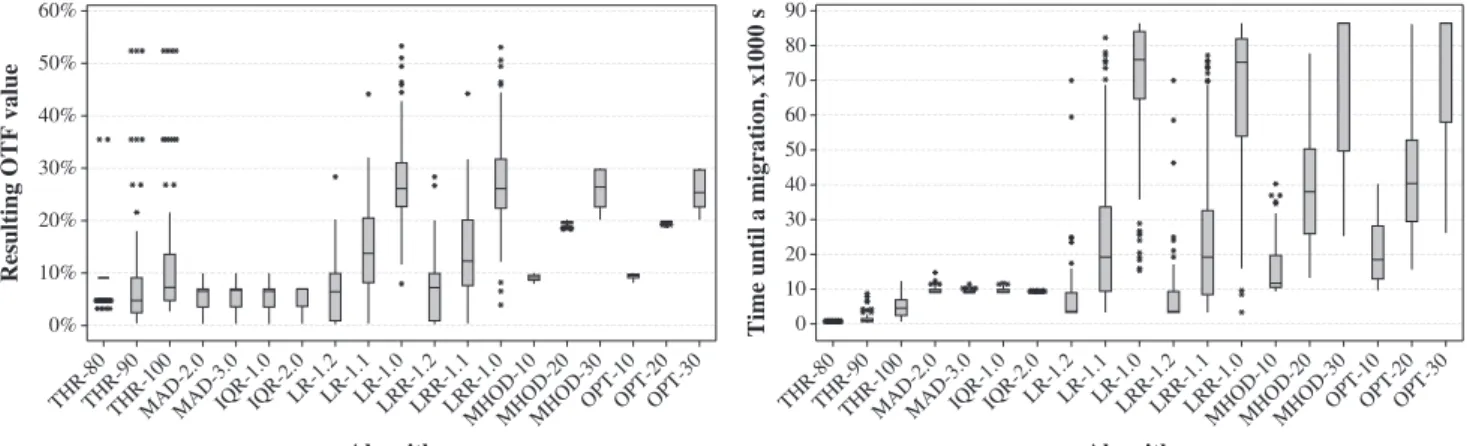
The experimental results comparing the 2-state config-uration of the MHOD algorithm (for the MHOD algorithm, the OTF parameter is denoted in the suffix of the algorithm’s name, e.g., for 10, 20, and 30 percent: MHOD-10, MHOD-20, and MHOD-30) with the benchmark algo-rithms are depicted in Figs. 3a and 3b. It is remarkable how closely the resulting OTF value of the MHOD algorithm resembles the value set as the parameter of the algorithm for 10 and 20 percent. The wider spread for 30 percent is explained by the characteristics of the workload: In many cases the overall OTF is lower than 30 percent, which is also reflected in the resulting OTF of the optimal offline algorithm (OPT-30). The experimental results show that the algorithm is capable of meeting the specified OTF goal, which is consistent with the theoretical model introduced in Section 6.
Figs. 3a and 3b show that the THR, MAD, and IQR algorithms are not competitive compared with the LR, LRR, and MHOD algorithms, as the produced time until a migration is low and does not significantly improve by adjustments of the algorithm parameters. To compare the LR and LRR algorithms with the MHOD algorithms, we ran additional simulations of the MHOD algorithm with the OTF parameter matching the mean value of the resulting OTF produced by LR and LRR. The following values of the OTF parameter of the MHOD algorithm were set to match the mean resulting OTF values of LR and LRR: To match LR-1.2, LR-1.1, and LR-1.0—6.75, 15.35, and 40 per-cent, respectively; to match 1.2, 1.1, and LRR-1.0—6.76, 14.9, and 36.6 percent, respectively.
As intended, paired t-tests for the comparison of MHOD with LR and MHOD with LRR showed nonstatistically significant differences in the resulting OTF values with both p-values > 0.7. Results of paired t-tests for comparing the time until a migration produced by the algorithms with matching resulting OTF values are shown in Table 3. The results of the comparison of the MHOD and LRR algorithms are graphically depicted in Fig. 4. According to the results, there is a statistically significant difference in the time until a migration produced by the algorithms: The MHOD algorithm on average leads to approximately 16.4 and 15.4 percent better time until a migration than LR and LRR, respectively, with the same mean resulting OTF values. It is also interesting to notice from Fig. 4 that the spread of the resulting OTF produced by the MHOD algorithm is much narrower than LRR’s, which means that MHOD more precisely meets the QoS goal.
10.2.3 Comparison of MHOD with OTFT and OTFTM OTFT and OTFTM are two other algorithms that apart from the MHOD algorithm allow explicit specification of the QoS goal in terms of the OTF parameter. To compare the performance of the OTFT, OTFTM, and MHOD algorithms we introduce another performance metric. This metric is the percentage of SLA violations relatively to the total number of VM migrations, where SLA requirements are defined as OT F M, M is the limit on the maximum allowed resulting OTF value. The SLA violation counter is incre-mented if after a VM migration the resulting OTF value is higher than the valueMspecified in the SLAs.
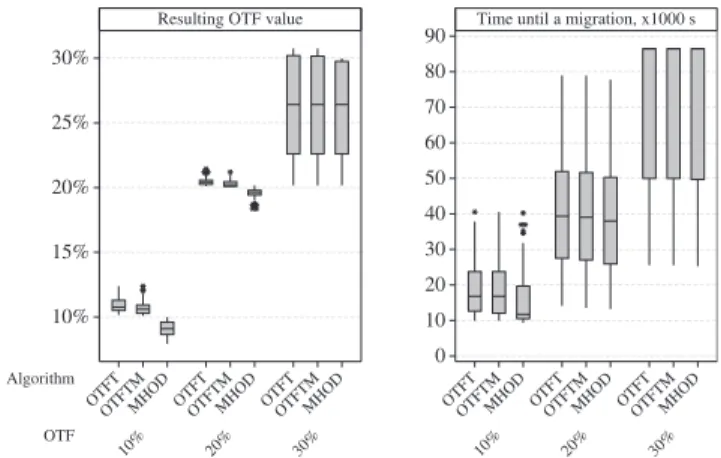
We simulated the OTFT, OTFTM, and MHOD algo-rithms using the PlanetLab workload described earlier. We simulated the algorithms setting the following values of the OTF parameter as the SLA requirement: 10, 20, and
30 percent. The simulation results are shown in Fig. 5. The graphs show that MHOD leads to slightly lower resulting OTF values and time until a migration. The SLA violation levels caused by the algorithms are shown in Table 4. It is clear that the MHOD algorithm substantially outperforms the OTFT and OTFTM algorithms in the level of SLA violations leading to only 0.33 percent SLA violations, whereas both OTFT and OTFTM cause the percentage of SLA violations of 81.33 percent.
The obtained results can be explained by the fact that both OTFT and OTFTM are unable to capture the overall behavior of the system over time and fail to meet the SLA requirements. In contrast, the MHOD algorithm leverages the knowledge of the past system states and by estimating future states avoids SLA violations. For instance, in a case of a steep rise in the load, OTFT and OTFTM react too late resulting in an SLA violation. In contrast, MHOD acts more intelligently and by predicting the potential rise migrates a VM before an SLA violation occurs. As a result, for the simulated PlanetLab workload the MHOD algorithm keeps the level of SLA violations at less than 0.5 percent.
10.2.4 Comparison of MHOD with OPT
Figs. 3a and 3b include the results produced by the OPT for the same values of the OTF parameter set for the MHOD algorithm: 10, 20, and 30 percent. The results of paired t-tests comparing the performance of OPT with MHOD are shown in Table 5. The results show that there is no statistically significant difference in the resulting OTF value, which means that for the simulated PlanetLab workload the MHOD algorithm on average leads to approximately the same level of adherence to the QoS goal as the OPT. There is a statistically significant difference in the time until a migration with the mean difference of 4,639 with 95 percent
Fig. 4. Comparison of MHOD with LRR. TABLE 3
Paired T-Tests with 95 Percent CIs for Comparing the Time Until a Migration Produced by MHOD, LR, and LRR
Fig. 5. Comparison of OTFT, OTFTM, and MHOD.
TABLE 4
CI: (3,617, 5,661). Relatively to OPT, the time until a migration produced by the MHOD algorithm converts to 88.02 percent with 95 percent CI: (86.07, 89.97 percent). This means that for the simulated PlanetLab workload, the MHOD algorithm on average delivers approximately 88 percent of the performance of the OPT, which is highly efficient for an online algorithm.
11 CONCLUSIONS AND
FUTURE
DIRECTIONS
In this paper, we have introduced a Markov chain model and proposed a control algorithm for the problem of host overload detection as a part of dynamic VM consolidation. The model allows a system administrator to explicitly set a QoS goal in terms of the OTF parameter, which is a workload independent QoS metric. For a known stationary workload and a given state configuration, the control policy obtained from the Markov model optimally solves the host overload detection problem in the online setting by maximizing the mean intermigration time, while meeting the QoS goal. Using the Multisize Sliding Window work-load estimation approach, we have heuristically adapted the model to handle unknown nonstationary workloads. We have also proposed an OPT for the problem of host overload detection to evaluate the efficiency of the MHOD algorithm. The conducted experimental study has led to the following conclusions:
1. For the simulated PlanetLab workload, 3-state configurations of the MHOD algorithm on average produce approximately the same results as the ð½0;100Þ;100Þ 2-state configuration of the MHOD algorithm; therefore, we prefer the 2-state config-uration, as it requires simpler computations. 2. The 2-state configuration of the MHOD algorithm
outperforms the LRR algorithm, the best benchmark algorithm, by producing on average approximately 15.4 percent better time until a VM migration with the same mean but much narrower spread of the resulting OTF value, leading to a better quality of VM consolidation according to Section 3.
3. The MHOD algorithm substantially outperforms the OTFT and OTFTM algorithms in the level of SLA violations resulting in less than 0.5 percent SLA violations compared to 81.33 percent of OTFT and OTFTM.
4. The MHOD algorithm on average provides mately the same resulting OTF value and approxi-mately 88 percent of the time until a VM migration produced by the OPT.
5. The MHOD algorithm enables explicit specification of a desired QoS goal to be delivered by the system
through the OTF parameter, which is successfully met by the resulting value of the OTF metric. The introduced model is based on Markov chains requiring a few fundamental assumptions. It is assumed that the workload satisfies the Markov property, which may not be true for all types of workloads. Careful assessment of the assumptions discussed in Section 6.4 is important in an investigation of the applicability of the proposed model to a particular system. However, our experimental study invol-ving multiple mixed heterogeneous real-world workloads has shown that the algorithm is efficient in handling them. For the simulated PlanetLab workload, the MHOD algo-rithm performed within a 12 percent difference from the performance of the OPT, which is highly efficient for an online algorithm. As a part of future work, we plan to implement the MHOD algorithm as an extension of the VM manager within the OpenStack Cloud platform7to evaluate the algorithm in a real system as a part of energy-efficient dynamic VM consolidation.
ACKNOWLEDGMENTS
The authors would like to thank Rodrigo N. Calheiros, Saurabh Garg, Sivaram Yoganathan, and Andrey Kan from the University of Melbourne, and Egor Gladkikh from G-SCOP Laboratory of Grenoble for their input and con-structive comments on improvements of the paper.
REFERENCES
[1] J. Koomey, Growth in Data Center Electricity Use 2005 to 2010.
Analytics Press, 2011.
[2] Gartner, Inc.,Gartner Estimates ICT Industry Accounts for 2 Percent of Global CO2 Emissions.Gartner Press Release, Apr. 2007. [3] R. Nathuji and K. Schwan, “Virtualpower: Coordinated Power
Management in Virtualized Enterprise Systems,”ACM SIGOPS Operating Systems Rev.,vol. 41, no. 6, pp. 265-278, 2007.
[4] A. Verma, P. Ahuja, and A. Neogi, “pMapper: Power and Migration Cost Aware Application Placement in Virtualized Systems,”Proc. Ninth ACM/IFIP/USENIX Int’l Conf. Middleware,
pp. 243-264, 2008,
[5] X. Zhu et al., “1000 Islands: Integrated Capacity and Workload Management for the Next Generation Data Center,”Proc. Fifth Int’l Conf. Autonomic Computing (ICAC),pp. 172-181, 2008. [6] D. Gmach, J. Rolia, L. Cherkasova, G. Belrose, T. Turicchi, and
A. Kemper, “An Integrated Approach to Resource Pool Management: Policies, Efficiency and Quality Metrics,” Proc. IEEE 38th Int’l Conf. Dependable Systems and Networks (DSN),
pp. 326-335, 2008.
[7] D. Gmach, J. Rolia, L. Cherkasova, and A. Kemper, “Resource Pool Management: Reactive versus Proactive or Lets be Friends,”
Computer Networks,vol. 53, no. 17, pp. 2905-2922, 2009.
[8] “VMware Distributed Power Management Concepts and Use,”
Information Guide,VMware Inc., 2010.
[9] G. Jung, M.A. Hiltunen, K.R. Joshi, R.D. Schlichting, and C. Pu, “Mistral: Dynamically Managing Power, Performance, and Adap-tation Cost in Cloud Infrastructures,” Proc. 30th Int’l Conf. Distributed Computing Systems (ICDCS),pp. 62-73, 2010.
[10] W. Zheng, R. Bianchini, G. Janakiraman, J. Santos, and Y. Turner, “JustRunIt: Experiment-Based Management of Virtualized Data Centers,”Proc. USENIX Ann. Technical Conf.,pp. 18-33, 2009. [11] S. Kumar, V. Talwar, V. Kumar, P. Ranganathan, and K. Schwan,
“vManage: Loosely Coupled Platform and Virtualization Manage-ment in Data Centers,”Proc. Sixth Int’l Conf. Autonomic Computing (ICAC),pp. 127-136, 2009.
[12] B. Guenter, N. Jain, and C. Williams, “Managing Cost, Perfor-mance, and Reliability Tradeoffs for Energy-Aware Server Provisioning,”Proc. IEEE INFOCOM,pp. 1332-1340, 2011.
TABLE 5
Paired T-Tests for Comparing MHOD with OPT
[13] N. Bobroff, A. Kochut, and K. Beaty, “Dynamic Placement of Virtual Machines for Managing SLA Violations,” Proc. IFIP/ IEEE 10th Int’l Symp. Integrated Network Management (IM),
pp. 119-128, 2007.
[14] A. Beloglazov, R. Buyya, Y.C. Lee, and A. Zomaya, “A Taxonomy and Survey of Energy-Efficient Data Centers and Cloud Comput-ing Systems,” Advances in Computers,M. Zelkowitz ed., vol. 82, pp. 47-111, Elsevier, 2011.
[15] A. Beloglazov and R. Buyya, “Optimal Online Deterministic Algorithms and Adaptive Heuristics for Energy and Performance Efficient Dynamic Consolidation of Virtual Machines in Cloud Data Centers,”Concurrency and Computation: Practice and Experi-ence,vol. 24, pp. 1397-1420, 2012, DOI: 10.1002/cpe.1867. [16] S.O. Luiz, A. Perkusich, and A.M.N. Lima, “Multisize Sliding
Window in Workload Estimation for Dynamic Power Manage-ment,” IEEE Trans. Computers, vol. 59, no. 12, pp. 1625-1639, Dec. 2010.
[17] X. Wang and Y. Wang, “Coordinating Power Control and Performance Management for Virtualized Server Clusters,”IEEE Trans. Parallel and Distributed Systems,vol. 22, no. 2, pp. 245-259, Feb. 2011.
[18] C. Weng, M. Li, Z. Wang, and X. Lu, “Automatic Performance Tuning for the Virtualized Cluster System,”Proc. 29th Int’l Conf. Distributed Computing Systems (ICDCS),pp. 183-190, 2009. [19] L. Benini, A. Bogliolo, G.A. Paleologo, and G.D. Micheli, “Policy
Optimization for Dynamic Power Management,” IEEE Trans. Computer-Aided Design of Integrated Circuits and Systems,vol. 18, no. 6, pp. 813-833, June 1999.
[20] Q. Zheng and B. Veeravalli, “Utilization-Based Pricing for Power Management and Profit Optimization in Data Centers,”J. Parallel and Distributed Computing,vol. 72, no. 1, pp. 27-34, 2011. [21] S. Srikantaiah, A. Kansal, and F. Zhao, “Energy Aware
Con-solidation for Cloud Computing,” Cluster Computing, vol. 12, pp. 1-15, 2009.
[22] A. Verma, G. Dasgupta, T.K. Nayak, P. De, and R. Kothari, “Server Workload Analysis for Power Minimization Using Consolida-tion,”Proc. USENIX Ann. Technical Conf.,pp. 28-28, 2009. [23] G. Bolch, Queueing Networks and Markov Chains: Modeling and
Performance Evaluation with Computer Science Applications. Wiley-Blackwell, 2006.
[24] E.Y. Chung, L. Benini, A. Bogliolo, Y.H. Lu, and G.D. Micheli, “Dynamic Power Management for Nonstationary Service Re-quests,” IEEE Trans. Computers, vol. 51, no. 11, pp. 1345-1361, Nov. 2002.
[25] K. Mills, J. Filliben, and C. Dabrowski, “Comparing VM-Placement Algorithms for On-Demand Clouds,”Proc. IEEE Third Int’l Conf. Cloud Computing Technology and Science (CloudCom),
pp. 91-98, 2011.
[26] K.S. Park and V.S. Pai, “CoMon: A Mostly-Scalable Monitoring System for PlanetLab,” ACM SIGOPS Operating Systems Rev.,
vol. 40, no. 1, pp. 65-74, 2006.
Anton Beloglazovreceived the BSc and MSc degrees in computer science and engineering from Novosibirsk State Technical University, Russia, in 2006 and 2008, respectively, and is working toward the PhD degree at the Cloud Computing and Distributed Systems (CLOUDS) Laboratory at the University of Melbourne, Australia. His research interests include distrib-uted systems, cloud computing, virtualization, resource management, algorithm design and analysis, and energy efficiency in data centers.
Rajkumar Buyyais a professor and the director of the Cloud Computing and Distributed Sys-tems (CLOUDS) Laboratory at the University of Melbourne, Australia. He is also serving as the founding CEO of Manjrasoft, a spin-off company of the University, commercializing its innovations in grid and cloud computing. He received the “2009 IEEE Medal for Excellence in Scalable Computing” for pioneering the economic para-digm for utility-oriented distributed computing platforms such as grids and clouds.
. For more information on this or any other computing topic, please visit our Digital Library atwww.computer.org/publications/dlib.