Myoungkyu Song
Dissertation submitted to the faculty of the Virginia Polytechnic Institute and State University in partial fulfillment of the requirements for the degree of
Doctor of Philosophy in
Computer Science and Applications
Eli Tilevich (Chair) Stephen H. Edwards Dennis Kafura Barbara G. Ryder Kwangkeun Yi April 5, 2013 Blacksburg, Virginia
Keywords: declarative programming, metadata, domain-specific language, enhancement, program transformation, bytecode engineering, debugging, source-to-source translation,
frameworks, transparent persistence, unit testing, refactoring, invariants
Myoungkyu Song
ABSTRACT
In recent years,metadata-driven software developmenthas gained prominence. In this implemen-tation model, various application concerns are provided as third-party frameworks and libraries that the programmer configures through metadata, such as XML configuration files or Java an-notations. Metadata-driven software development is a special case ofdeclarative programming: metadata serves as a domain-specific language that the programmer uses to declare various con-cerns, whose implementation is provided by an elaborate ecosystem of libraries and frameworks that serve as pre-defined application building blocks. Examples abound: transparent persistence mechanisms facilitate data management; security frameworks provide access control and encryp-tion; unit testing frameworks provide abstractions for implementing and executing unit tests, etc. Metadata-driven software development has been particularly embraced in enterprise computing as a means of providing standardized solutions to common application scenarios.
Despite the conciseness and simplicity benefits of metadata-driven software development, this im-plementation model introduces a unique set of reuse and evolution challenges. In particular, meta-data is not reusable across application modules, and program evolution causes unsafe discrepan-cies between the main source code and its corresponding metadata. The research described in this dissertation addresses five fundamental problems of metadata-driven software development: (1) bytecode enhancements that transparently introduce concerns hinder program understanding and debugging; (2) mainstream enterprise metadata formats are hard to understand, evolve, and reuse; (3) concerns declared via metadata cannot be reused when source-to-source compiling emerging languages to mainstream ones; (4) metadata correctness cannot be automatically ensured as appli-cation source code is being refactored and enhanced; and (5) lacking built-in metadata, JavaScript programs can be enhanced with additional concerns only through manual source code changes. The research described in this dissertation leverages domain-specific languages and automated code generation to enable effective reuse and safe evolution in metadata-driven software devel-opment. The specific innovations that address the problems outlined above are as follows: (1) a domain-specific language (DSL) describing bytecode enhancement that facilitates the under-standing and debugging of additional concerns; (2) a novel metadata format expressed as a DSL that is easier to author, understand, reuse, and maintain than existing metadata formats; (3) auto-mated metadata translation that enables effective reuse of target language additional concerns from source-to-source compiled source language programs; (4) metadata invariants—a new abstraction for expressing and verifying metadata coding convention; and (5) a new approach to declaratively enhancing JavaScript programs with additional concerns.
This dissertation is based on research papers that appeared at OOPSLA’09 [128], AOSD’10 [148], AOSD’12 [131], and ICSE’12 [130], and software demos presented at OOPSLA’09 [127] and ICSE’12 [129].
I wish to express my gratitude to my advisor and committee members who supported me during my doctoral research.
Firstly, I would like to express my deepest appreciation for my advisor and research mentor, Eli Tilevich, for his valuable support, prompt guidance, and effective encouragement throughout my graduate program. He has supported me on every aspects of my Ph.D. dissertation research, in particular with emphasis on guiding me to the true research process. He always made himself available whenever I needed his advice, selflessly introducing substantial amount of time guiding this research, regardless to weekends and holidays.
He has his special mentoring skill that he can listen not only what students are saying, but also what students are not saying. His guidance encompassed such diverse perspectives. I have learned how research ideas should be selected and developed to publish top-tier conferences. And, his practical and thoughtful mentoring has also led me to participate in a couple of research proposals.
I also thank my committee members, Steve H. Edwards, Dennis Kafura, Barbar Ryder, and Kwangkeun Yi, for carefully reading my dissertation and presenting constructive feedbacks and valuable insight that made it possible for me to improve the overall quality of the dissertation research.
Steve H. Edwards provided the essential assistance in improving this dissertation manuscript, espe-cially on the chapters, Introduction, Case Studies and Conclusion. Sharing with me his insightful comments about this research helped me clarify the general contributions of this work.
My special thanks go to Barbara G. Ryder, our department head, who took time from her busy schedule to provide me with constructive help in enhancing my research papers and addressing future work directions being applicable to my dissertation.
My graduate journey would have not been possible without warmest care from other faculty mem-bers, and staffs, as well as my family, colleagues, and friends.
I would like to thank all my lab mates and VT CS friends, as well as all my Korean graduate friends, for their friendship and countless help. I improved my all practice talks by means of the comments raised by them, with whom I also enjoyed brainstorming research ideas.
I would not have gotten that far without the support of my family. I thank my lovely wife, Hyeonsu Park. She made my life much more dynamic, which could turn to encouragement during the past few years. I thank my parents’ constant support and my sisters’ help, while patiently waiting for me to complete my studies.
1 Introduction 1
1.1 Background . . . 3
1.2 Research Agenda . . . 4
1.3 Major Research Contributions . . . 8
1.3.1 Facilitating Corrective Maintenance in Metadata-Driven Software Devel-opment . . . 8
1.3.2 Enabling Effective Reuse in Metadata-Driven Software Development . . . 9
1.3.3 Enabling Safer Evolution in Metadata-Driven Software Development . . . 10
1.3.4 Availing Benefits of Metadata-Driven Software Development to Languages without Metadata . . . 10
1.4 Broader Impacts . . . 11
1.5 Structure of This Document . . . 12
2 Literature Review 13 2.1 Enhancing Source-Level Programming Tools with an Awareness of Transparent Program Transformations . . . 13
2.1.1 Debugging Transformed Code . . . 13
2.1.2 Program Transformation Languages . . . 14
2.1.3 Program Differencing . . . 16
2.1.4 Symbolic Execution . . . 16
2.2 Reusable Enterprise Metadata with Pattern-Based Structural Expressions . . . 16
2.3 Reusing Additional Concerns Across Languages . . . 19
2.4 Metadata Invariants: Checking and Inferring Metadata Coding Conventions . . . . 21
2.4.1 Validation for Metadata . . . 21
2.4.2 Pattern-Matching Techniques . . . 22
2.4.3 Code Generation . . . 22
2.5 Declarative Enhancement for JavaScript Programs . . . 23
2.5.1 Interfacing with Foreign Languages . . . 23
2.5.3 Validation for Metadata . . . 24
2.5.4 Program Transformation for Web applications . . . 24
3 Enhancing Source-Level Programming Tools with An Awareness of Transparent Pro-gram Transformations 25 3.1 Background . . . 27
3.1.1 Transparent Persistence Frameworks . . . 29
3.1.2 Example: Mortgage Authorization Application . . . 29
3.2 Understanding and Expressing Bytecode Enhancement . . . 31
3.2.1 Structural Enhancements . . . 32
3.2.2 Semantics of Structural Enhancements . . . 33
3.2.3 SER Language Design . . . 34
3.2.4 SER language interpretation . . . 40
3.3 Summary . . . 42
4 Reusable Enterprise Metadata with Pattern-Based Structural Expressions 43 4.1 Motivation . . . 45
4.1.1 Programmability . . . 45
4.1.2 Understandability . . . 47
4.1.3 Maintainability . . . 47
4.1.4 Reusability . . . 48
4.2 Pattern-Based Structural Expressions . . . 50
4.2.1 Examples from Different Domains . . . 51
4.3 Design and Implementation . . . 55
4.3.1 Language Summary . . . 55
4.3.2 Translator Implementation . . . 56
4.3.3 Translation Semantics . . . 57
4.3.4 Integration with Eclipse IDE . . . 58
5 Reusing Additional Concerns Across Languages 60
5.1 Problem Definition and Solution Overview . . . 61
5.2 Design and Implementation . . . 64
5.2.1 Design Objectives and General Approach . . . 65
5.2.2 Implementation Details . . . 66
5.2.3 Metadata Translation . . . 67
5.3 Summary . . . 72
6 Metadata Invariants: Checking and Inferring Metadata Coding Conventions 74 6.1 Problem Definition and Solution Overview . . . 76
6.1.1 Metadata-Related Bugs . . . 76
6.1.2 Finding Bugs by Metadata Invariants . . . 77
6.2 MIL Design . . . 81
6.2.1 Language Summary . . . 81
6.2.2 Assertion Semantics . . . 82
6.3 Metadata Invariants Inference Algorithm . . . 83
6.3.1 Algorithm Summary . . . 84
6.3.2 Implementation . . . 87
6.4 Summary . . . 89
7 Declarative Enhancement for JavaScript Programs 90 7.1 Motivating Example . . . 91
7.2 Design and Implementation . . . 94
7.2.1 Design Considerations . . . 94
7.2.2 Architecture and Design . . . 95
7.2.3 Template-Based Code Generation . . . 102
7.2.4 Motivating Example Revisited . . . 103
7.3 Summary . . . 104
8.1 Case Study: Enhancements-Aware Programming Tools . . . 105
8.1.1 Source Editor with Zoom-in-on-enhancements View . . . 106
8.1.2 A Symbolic Debugger for Enhanced Intermediate Code . . . 109
8.1.3 Discussion . . . 112
8.2 Case Study: Reusable Enterprise Metadata with PBSE . . . 113
8.2.1 Programmability . . . 114
8.2.2 Understandability . . . 115
8.2.3 Maintainability . . . 115
8.2.4 Reusability . . . 116
8.2.5 Discussion . . . 116
8.3 Case Study: Automated Cross-Language Metadata Translation . . . 118
8.3.1 Unit Testing X10 Programs . . . 119
8.3.2 Transparently Persisting X10 Programs . . . 124
8.3.3 Discussion . . . 129
8.4 Case Study: Checking and Inferring Metadata Invariants . . . 129
8.4.1 Inferring Metadata Invariants . . . 130
8.4.2 Checking Metadata Invariants . . . 133
8.4.3 Discussion . . . 133
8.5 Case Study: Enhancing JavaScript Programs via Java Annotations . . . 134
8.5.1 Persistence for JavaScript . . . 135
8.5.2 Security for JavaScript . . . 136
8.5.3 Transactions for JavaScript . . . 138
8.5.4 Discussion . . . 139
9 Conclusions and Future Work 141 9.1 Summary of Contributions . . . 141
9.2 Future Work . . . 142
9.2.1 Improving the Awareness of Transparent Program Transformation . . . 142
9.2.3 Eliminating Interferences and Increasing Expressiveness of PBSE in the Presence of Multiple Concerns . . . 143
9.2.4 Extending the Applicability of Metadata Invariants . . . 144 9.2.5 Enhancing Scalability and Expressiveness of TAE-JS . . . 144
Bibliography 145
1.1 Metadata-driven software development. . . 3
3.1 Enhancing intermediate code via bytecode engineering. . . 26
3.2 Original source code. . . 28
3.3 Bytecode enhanced by the JDO enhancer. . . 28
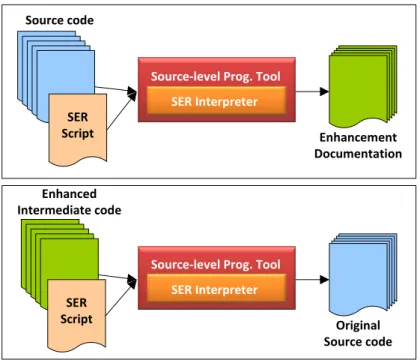
3.4 Source level programming tools with intermediate code enhancement information. 31 3.5 SER Script for the JDO Enhancement. . . 35
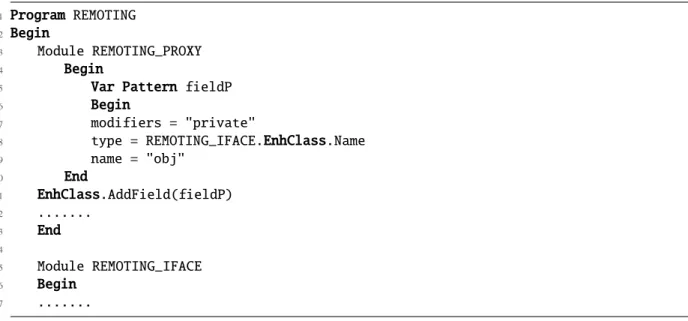
3.6 SER script for the Remoting enhancement. . . 36
3.7 SER Script for the Hibernate Enhancement. . . 37
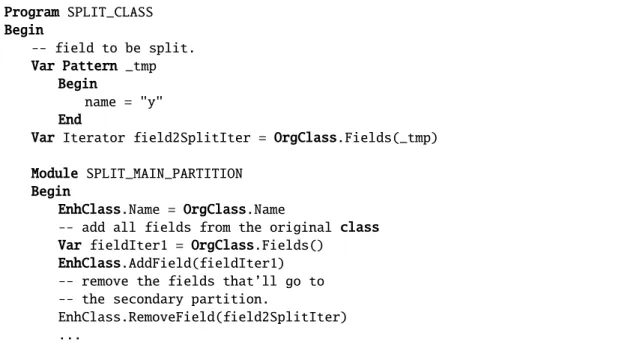
3.8 SER script for ‘split a class to minimize the amount of network transfer’ enhance-ment. . . 38
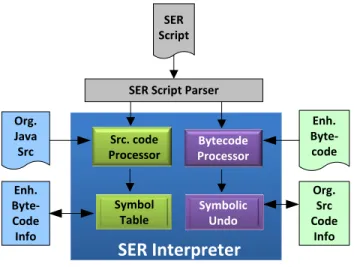
3.9 SER Interpreter. . . 41
4.1 Transparent Persistence Framework Example. . . 46
4.2 Transparent Persistence Framework PBSE Example. . . 49
4.3 PBSE metadata for JUnit framework. . . 52
4.4 PBSE metadata for TestNG framework . . . 52
4.5 PBSE metadata for security framework . . . 53
4.6 PBSE metadata for Spring Web Service. . . 55
4.7 Translating PBSE to annotations as an intermediate build step. . . 57
5.1 An X10 class to be compiled to Java and C++. . . 62
5.2 Metadata to persist the X10 class in Figure 5.1. . . 62
5.3 Generating Target Sources and Metadata formats. . . 66
5.4 Translating Metadata formats. . . 68
5.5 Meta-metadata for translating PBSE from X10 to Java. . . 69
5.6 Meta-metadata for translating PBSE for Java to XML used by the JDO system. . . 69
5.7 A generated visitor. . . 70
5.9 PBSE visitors translating metadata format. . . 71
5.10 The code template for generating database transaction API for the Java (top) and C++ (bottom) backend. . . 72
6.1 Transparent Persistence Framework Example. . . 75
6.2 Expressing JUnit 4 metadata invariants in MIL. . . 78
6.3 MIL for JUnit 4voidmethods. . . 79
6.4 A JUnit 4 test suite class. . . 79
6.5 Expressing JUnit 4 return type metadata invariant in MIL. . . 79
6.6 Expressing Hibernate annotations invariants in MIL. . . 80
6.7 Expressing Hibernate XML field column invariant in MIL. . . 80
6.8 Expressing Hibernate XML field name invariant in MIL. . . 80
6.9 Integrating Metadata Invariants into Software Development. . . 87
6.10 The generated tree structures for XML and Java 5 annotations (simplified version). 87 6.11 Discovering metadata invariant candidates. . . 88
6.12 Checking metadata invariants. . . 88
7.1 Core business logic. . . 92
7.2 Code (green) in Figure 7.1 enhanced with transparent persistence. . . 92
7.3 Code (red) in Figure 7.1 enhanced with security. . . 93
7.4 Code (redandgreen) in Figure 7.1 enhanced with security and persistence. . . 93
7.5 Enhancing JavaScript Programs Transparently: Control Flow Diagram. . . 95
7.6 Annotation-aware IDE. . . 97
7.7 Annotation editor: annotatingfailedCheck. . . 98
7.8 The roles played by concern and application developers in TAE-JS. . . 98
7.9 Code in Java annotation editor; gray—invisible generated; blue—visible gener-ated;red—programmer entered. . . 99
7.10 Pseudo-code for the APT persistence plug-in. . . 100
7.11 AspectScript to add persistence. . . 101
7.13 Hand-modified AspectScript code to add application-specific logic. . . 102
7.14 A portion of a StringTemplate template for generating AspectScript code to add persistence. . . 103
7.15 An Ant build script with TAE-JS rules. . . 103
8.1 Documentation for the JDO Enhancement. . . 107
8.2 Documentation for the Hibernate Enhancement. . . 107
8.3 Documentation for the Proxy class Enhancement. . . 108
8.4 Documentation for the Split class Enhancement. . . 108
8.5 The zoom-in-on-enhancement view collaboration diagram. . . 108
8.6 Debugging transparently enhanced programs. . . 110
8.7 The symbolic debugger’s collaboration diagram. . . 111
8.8 Debugging enhanced code: Debugger with an enhancements awareness vs. JDB . . 111
8.9 Identifying getters forprivatefields. . . 117
8.10 An X10 Integrate class to be unit tested. . . 119
8.11 The unit testing class for the X10 Integrate class in Figure 8.10. . . 120
8.12 The class diagram for unit testing X10 programs with JUnit and CppUnit. . . 121
8.13 The PBSE specification for unit testing the X10 program. . . 122
8.14 The sequence diagram for unit testing X10 programs with JUnit. . . 122
8.15 Extended macros based on CppUnit. . . 123
8.16 The sequence diagram for unit testing X10 programs with CppUnit. . . 123
8.17 A persisting classFmm3d(simplified version) for the X10FmmModelclass in Figure. . 124
8.18 Translated XML for the JDO system. . . 125
8.19 PBSE for transparent persistence in Java. . . 125
8.20 Translated C++ pragmas for the ODB system. . . 127
8.21 PBSE for transparent persistence in C++. . . 127
8.22 Persistence overhead for both backends. . . 128
8.23 AspectScript code enhanced with security. . . 137
8.25 from Figure 8.24. . . 138 8.26 AspectScript code enhanced with transactions. . . 138
3.1 Syntax definitions of SER . . . 33
3.2 Structural Enhancement Operations. . . 34
3.3 SER language constructs. . . 40
4.1 PBSE constructs. . . 56
4.2 Syntax definitions of PBSE. . . 57
4.3 Translation rules. . . 58
6.1 MIL constructs and grammar. . . 82
6.2 Syntax definitions of MIL. . . 83
6.3 Metadata invariants assertion rules. . . 84
8.1 Conciseness of different metadata formats. . . 114
8.2 Inferring Metadata Invariants from Third-Party Applications. . . 131
8.3 The case studies metrics (i.e., persistence, security, and transactions). (APC in JS: Annotated Program Constructs in JavaScript.) . . . 134
Introduction
The reality of modern software development in multiple application domains requires delivering software in the presence of tight deadlines, limited budgets, and scarce programming talent. State-of-the-art software engineering techniques and tools (e.g., programming conventions, reusable li-braries, application frameworks, code generators, bug finding tools, etc.) are continuously created and perfected to address these challenges. One such technique is the declarative programming model, in which programmers declare the required functionality at a high level of abstraction, with the actual implementation provided by automated tools such as libraries, program transformation frameworks, and code generators.
A key benefit of the declarative programming model is that it enables a clear separation of con-cerns, a design and implementation principle that promotes treating individual pieces of appli-cation functionality independently from each other. In industrial software development, various non-functional requirements (e.g., persistence, security, transactions, etc.) were shown to lend themselves well to be implemented declaratively. Other common software engineering tasks such as unit testing are being implemented increasingly declaratively as well. Thus, the declarative programming model has become an integral part of modern industrial software development.
In modern software development practices, the declarative programming model is commonly ex-pressed by means of metadata, such as XML, Java 5 annotations, C# attributes, and C/C++ prag-mas. Metadata declaratively identifies the program constructs (e.g., classes, methods, fields, etc.) as the program points at which additional concerns are to be introduced. As an example, per-sistence frameworks automatically persist the fields of a class annotated with the @Column Java Persistence Architecture (JPA) [138] annotation. Programmers only need to declare which ob-ject fields correspond to relational database columns, and persistence frameworks supply all the required functionality to render the annotated fields persistent.
In essence, metadata codifies a domain-specific language (a language specially designed for solv-ing problems in a given domain) for expresssolv-ing various concerns declaratively. All in all, metadata constitutes an important building block of modern software applications. Software developers remain oblivious as to how the declarative metadata directives are translated into specific concern implementations, but instead spend their time and efforts on writing and maintaining metadata.
spite being the foundation of the declarative programming model, metadata incurs unique software maintenance and evolution burdens that cannot be addressed with the existing software mainte-nance techniques, approaches, and tools.
One such problem is that mainstream metadata formats do not lend themselves easily to systematic reuse. For example, in J2EE[143], a set of standards for developing enterprise applications in Java, XML deployment descriptors specify how individual Java classes interface with frameworks that implement various concerns. Especially, programmers write XML files for each program class that uses any framework functionality. When using Java annotations, programmers must not only annotate each program separately, but they also have to annotate each class in the same program. This lack of metadata reusability constrains the power of the declarative model. Although dec-larations are shorter than procedural instructions, the need to repeat decdec-larations not only creates surplus work for the programmer, but also increases the probability of introducing errors.
Due to its domain-specific nature, mainstream metadata cannot be handled by source-to-source compilers, commonly used for implementing emerging programming languages. Source-to-source compilers are domain-independent, as they translate languages based on the general semantic of their program constructs. As a result, source language programs cannot reuse the functionali-ties configured by means of metadata in the target language. Consequently, emerging language programmers must reimplement these functionalities from scratch, an undertaking that requires porting numerous complex libraries and frameworks to the emerging language.
Additionally, there is the problem of ensuring that metadata maintains its integrity and correct-ness during software evolution. In particular, when a program evolves, its main source code and metadata may become inconsistent, introducing insidious, difficult-to-catch bugs, compromising software utility and reliability. Existing, mainstream methodologies, techniques, and tools for managing software evolution have not been designed with metadata in mind.
Finally, as web applications now constitute an integral part of the modern computing infrastruc-ture, JavaScript programs keep growing in size and complexity. Multiple JavaScript libraries have been introduced for implementing various application concerns. To use these libraries, program-mer modify the original JavaScript source code by hand. Adding different concerns to the same JavaScript code base by hand creates divergent program versions that must be maintained sepa-rately. Thus, the declarative programming model, in which the same codebase can be declared to include different concerns, can potentially benefit JavaScript programs as well. However, lacking built-in metadata, JavaScript is poorly fit for declarative programming.
1.1
Background
In this section, we introduce the main concepts and technologies used in the research described in this dissertation: enterprise applications, software reuse, bytecode enhancement, domain-specific languages, and automatic code generation.
Enterprise applications help enterprises improve the efficiency of their workflows. The spectrum of enterprises that has benefited from such applications ranges from small on-line stores to large, multinational corporations. In recent years, enterprise computing has embraced the practices of metadata-driven software development as shown in Figure 1.1.
Core Concerns Source code Compiler Business Logic Additional Concerns Metadata Annot-ation C# Attribute XML C o n fig u re Security Testing Persist-ence Fault Tolerance Enterprise Application Business Logic
Figure 1.1: Metadata-driven software development.
Whenever striving to improve software quality or increase productivity, programmers commonly resort to reusing existing software, a practice known as software reuse [48]. This practice refers to extracting reusable pieces from an existing software product to be integrated in a new software product. Reusing software rather than developing it from scratch increases programmer produc-tivity [120]. Reusing tested software pieces in a software product improves the product’s overall quality [21]. Applications in the same domain, such as banking, retail, government, and defense, commonly share common functionalities. The larger the domain, the more applications can po-tentially reuse these functionalities, thereby saving development effort and costs. Because of its proven quality and productivity benefits, software reuse has received considerable attention from software researchers and practitioners alike. The research literature contains numerous exam-ples of reusing a variety of software artifacts, including components [113, 110, 112, 7], libraries [20, 54, 55], and specifications [156, 36, 26]. In this dissertation, we explore the issues of reusing
yet another artifact of modern software construction—metadata, which comes in many formats, such as XML, Java 5 annotations, etc.
The majority of enterprise applications are written in managed languages such as Java and C# that are compiled to intermediate representation such as bytecode. A technique called bytecode enhancement transparently modifies the application’s bytecode to introduce additional concerns. Alternatively, special libraries can be configured through metadata and added to the compiled byte-code. This dissertation addresses the software maintenance problems that arise from the differences between the programmer written code and its enhanced version executed at runtime.
Domain-specific languages (DSLs) reduce the complexity of constructing software in a particu-lar domain by providing domain-specific syntactic abstractions. In other words, a DSL is tai-lored toward the problems in a single domain, such as database programming—SQL[77], sta-tistical computations—R[47], and text processing—LATEX[78]. As compared to general purpose
languages, a DSL can solve a domain problem more concisely with a reduced programming ef-fort [15, 45]. DSLs have been successfully employed to solve software construction challenges in multiple domains. This dissertation explores how the expressive power of DSLs can be exploited to address the issues pertaining to reusing concern implementations in metadata-driven software development.
One of the most effective approaches to automating menial programming tasks is automatic code generation. A code generator takes a high level description as input and generates lower level code. That is, the input specification for generators is simpler and shorter than the generated code. Hence, code generation not only saves time and effort, but also avoids many programming errors and increases programmer productivity [124, 123]. As the complexity of computing systems continues to grow, software generators have the potential to provide elegant solutions that tame the complexity, enabling the design at a higher level of abstraction and the use of declarative approaches [124]. This dissertation explores how automated code generation can alleviate some of the problems pertaining to reuse and evolution in metadata-driven software development.
1.2
Research Agenda
As software development has become heavily dependent on the declarative model for implement-ing mission-critical functionality, the role of metadata has gained prominence. Indeed, program-mers spend a substantial amount of their time and efforts writing, understanding, and evolving
metadata. As a result, systematic approach to metadata reuse and evolution can yield tangible software engineering benefits. This dissertation studies several key problems of metadata-driven software development, with an emphasis on effective metadata reuse and safe program evolution. This work examines why the existing state of the art in metadata-driven software development poorly supports reuse and is vulnerable to evolution-related issues; it then proposes novel solu-tions to these problems. In the following discussion, we summarize the research agenda of this dissertation by first presenting the main technical questions it addresses and then outlining the solutions. Section 1.3 provides additional details for the solutions.
• How does metadata-driven software development affect software maintenance tasks, such as symbolic debugging?
– In metadata-driven software development, the framework functionality is commonly introduced directly to the bytecode of a program, a practice that results in runtime execution whose semantics differs from that expressed by the source code. As a result, the programmer cannot directly understand the program’s behavior by browsing its source code, nor map its execution to the source code.
• How does metadata-driven software development affect software reuse?
– Mainstream metadata is not reusable, not only across applications but even across dif-ferent parts of the same program.
– When source-to-source compiling an emerging language to a mainstream language, the concerns expressed by metadata in the target language programs cannot be reused by the emerging language programs.
• How does metadata-driven software development affect the safety of common software evolution tasks, such as refactoring and enhancement?
– The main source code and their corresponding metadata interconnect so tightly that neither one can be safely evolved independently. Since metadata coding conventions are domain-specific, their violations cannot be discovered by existing compilers or bug finding tools.
• Can the benefits of metadata-driven software development be made available in lan-guages that lack built-in metadata?
– Introducing concerns to JavaScript programs requires modifying the base source code by hand, thus creating divergent versions of the codebase that must be maintained sep-arately, thus increasing the maintenance burden. Declarative programming is inappli-cable to JavaScript, which lacks built-in metadata.
The broader impact of this dissertation will help practicing software engineers to improve both their productivity (by enabling effective reuse of metadata) and software quality (by enabling safer evolution of software that relies on metadata). From the technical perspective, this research lever-ages the power of DSLs and automated code generation to address the aforementioned problems;
• Facilitating Corrective Maintenance in Metadata-Driven Software Development – A novel DSL expresses structural program enhancements—framework functionalities
introduced at the binary level, thus improving the precision and utility of software tools such as symbolic debuggers and code browsers. The DSL serves as a foundation for a novel debugging architecture that enables symbolic debugging of programs whose intermediate code has been transparently enhanced. Another contribution is a special code browser that informs the programmer about how various program constructs will be enhanced at the bytecode level.
• Enabling Effective Reuse in Metadata-Driven Software Development
– An alternative to mainstream metadata formats, Pattern-Based Structure Expressions (PBSE) offers several software engineering advantages compared to XML and Java annotations. This novel metadata format leverages the common patterns between the source code and its metadata exhibited by modern enterprise framework applications. By explicitly capturing and expressing these patterns, PBSE conveys metadata infor-mation declaratively and can be reused not only within the same application, but also across other applications that use the same enterprise frameworks.
– A novel approach effectively reuses concerns expressed via metadata across languages by translating metadata, when emerging languages are source-to-source compiled to mainstream ones. This makes it possible for emerging language to take advantage of standardized, fine-tuned implementations of common concerns (e.g., persistence, security, transactions, and testing) in mainstreams languages.
– A novel DSL expressesMetadata Invariants, which codify the metadata naming con-ventions that commonly occur between metadata and the source code it tags. The DSL can help identify metadata-related bugs and inconsistencies for the programmer to examine, especially during program evolution. Metadata invariants also can be au-tomatically inferred by analyzing large codebases.
• Availing Benefits of Metadata-Driven Software Development to Languages without Metadata
– A declarative approach to enhancing JavaScript programs applies the Java annotations infrastructure to JavaScript, without extending the JavaScript language; programmers declare how concerns should be added to a JavaScript program using Java annotations. Based on the annotations, a code generator synthesizes aspect code that adds the spec-ified concerns.
The solutions outlined above are evaluated as follows:
1. The applicability of the enhancements-aware programming tools are evaluated by augment-ing existaugment-ing source-level programmaugment-ing tools—a code editor and a symbolic debugger—with an awareness of bytecode enhancements.
2. The reusability of PBSE is evaluated by expressing the transparent persistence functionality for a reference enterprise application and comparing the resulting implementation with those that use standard metadata.
3. The effectiveness of reusing additional concerns across languages is evaluated by adding concerns to third-party emerging language (X10) programs, by reusing implementations of these additional concerns in the source-to-source compilation target languages (C++ and Java).
4. The effectiveness of the metadata invariant inference algorithm is assessed with third-party, real-world enterprise applications that rely on metadata. The utility of metadata invariants checking is demonstrated by integrating this functionality as an IDE plug-in that displays the violated metadata invariants in the error window.
5. The effectiveness of declarative enhancement of JavaScript programs is evaluated based on the ability of this approach to introduce concerns declaratively thus eliminating the need—
the concern developer’s effort, to manually modify the maintained version of the JavaScript source code.
1.3
Major Research Contributions
In the following discussion, we provide an overview of the major contributions made by this disser-tation, which include an approach to understanding transparent bytecode transformations, reusable enterprise metadata format, an approach to reusing additional concerns across languages, an ab-straction for metadata coding convention, and an approach to declaratively enhancing JavaScript programs with additional concerns.
1.3.1
Facilitating Corrective Maintenance in Metadata-Driven Software
De-velopment
Enhancing Source-Level Programming Tools with an Awareness of Transparent Program Transformations Programs written in managed languages are compiled to a platform-independent intermediate representation, such as Java bytecode. The relative high level of Java bytecode has engendered a widespread practice of changing the bytecode directly, without modifying the main-tained version of the source code. This practice, called bytecode engineering or enhancement, has become indispensable in transparently introducing various concerns, including persistence, distribution, and security. For example, transparent persistence architectures help avoid the entan-glement of business and persistence logic in the source code by changing the bytecode directly to synchronize objects with stable storage. With functionality added directly at the bytecode level, the source code reflects only partial semantics of the program. Specifically, the programmer can neither ascertain the program’s runtime behavior by browsing its source code, nor map the run-time behavior back to the original source code. This research presents an approach that improves the utility of source-level programming tools by providing enhancement specifications written in the Structural Enhancement Rule (SER) language, a Domain-Specific Language (DSL). By inter-preting the specifications, a source-level programming tool can gain an awareness of the bytecode enhancements and improve its precision and usability. We demonstrate the applicability of our approach by making a source code editor and a symbolic debugger enhancements-aware.
1.3.2
Enabling Effective Reuse in Metadata-Driven Software Development
Reusable Enterprise Metadata with Pattern-Based Structural Expressions An essential part of modern enterprise software development is metadata. Mainstream metadata formats, includ-ing XML deployment descriptors and Java 5 annotations, suffer from a number of limitations that complicate the development and maintenance of enterprise applications. Their key problem is that they make it impossible toreusemetadata specifications not only across different applications but even across smaller program constructs such as classes or methods. To provide better enterprise metadata, we presentpattern-based structural expressions (PBSE), a novel metadata representation that offers conciseness and maintainability advantages and is reusable. To apply PBSE to enter-prise applications, we translate PBSE specifications to Java annotations, with annotating classes automatically as an intermediate build step. We demonstrate the advantages of the new metadata format by assessing its conciseness and reusability, as compared to XML and annotations, in the task of expressing metadata of J2EE reference applications and a mid-size, commercial, enterprise application.Reusing Additional Concerns Across Languages Emerging languages are often source-to-source compiled to mainstream ones, which offer standardized, fine-tuned implementations of additional concerns—including persistence, security, transactions, and testing. Because these ad-ditional concerns are specified through metadata such as XML configuration files, compiling an emerging language to a mainstream one does not include additional concern implementations. Un-able to access the mainstream language’s additional concern implementations, emerging language programmers waste development effort reimplementing additional concerns. In this research, we present a novel approach to reusing additional concern implementations across languages by au-tomatically translating metadata. To add an additional concern to an emerging language program, the programmer declares metadata, which is then translated to reuse the specified additional con-cern implementation in the source-to-source compiled mainstream target language program. By automatically translating metadata, our approach eliminates the need to reimplement additional concerns in the emerging language. As a validation, we add unit testing and transparent persis-tence to X10 by reusing implementations of these additional concerns in Java and C++, the X10 backend compilation targets. The reused persistence additional concerns is efficient and scalable, making it possible to checkpoint and migrate processes, as demonstrated through experiments with third-party X10 programs. These results indicate that our approach can effectively reuse additional concern implementations across languages, thus saving development effort.
1.3.3
Enabling Safer Evolution in Metadata-Driven Software Development
Metadata Invariants: Checking and Inferring Metadata Coding Conventions As the pre-vailing programming model of enterprise applications is becoming more declarative, programmers are spending an increasing amount of their time and efforts writing and maintaining metadata, such as XML or annotations. Although metadata is a cornerstone of modern software, automatic bug finding tools cannot ensure that metadata maintains its correctness during refactoring and enhance-ment. To address this shortcoming, this research presents metadata invariants, a new abstraction that codifies various naming and typing relationships between metadata and the main source code of a program. We reify this abstraction as a domain-specific language that we call the Metadata Invariants Language (MIL). We also introduce algorithms to infer likely metadata invariants and to apply them to check metadata correctness in the presence of program evolution. We demonstrate how metadata invariant checking can help ensure that metadata remains consistent and correct dur-ing program evolution; it finds metadata-related inconsistencies and recommends how they should be corrected. Similar to static bug finding tools, a metadata invariant checker identifies metadata-related bugs as a program is being refactored and enhanced. Because metadata is omnipresent in modern software applications, our approach can help ensure the overall consistency and correct-ness of software as it evolves.1.3.4
Availing Benefits of Metadata-Driven Software Development to
Lan-guages without Metadata
Declarative Enhancement for JavaScript Programs Recent state-of-the-art approaches en-hance JavaScript programs with concerns (e.g., persistence, security, transactions, etc.) by modi-fying the source code by hand to use special libraries. As a result, adding concerns to a JavaScript program creates divergent codebases that must be maintained separately. At the core of the prob-lem is that JavaScript lacks metadata to express concerns declaratively. In this research, we present TAE-JS(TransparentAutomatedEnhancement forJavaScript), a declarative approach to enhanc-ing JavaScript programs that applies the Java annotations infrastructure to JavaScript, without ex-tending the JavaScript language. An IDE combines JavaScript and Java during the development, but processes the languages separately. Programmers declare how concerns should be added to a JavaScript program using Java annotations. Based on the annotations, a code generator synthesizes aspect code that adds the specified concerns. Although these enhancements are implemented as
third-party libraries, our approach can transparently insert them into JavaScript programs given a declarative specification.
1.4
Broader Impacts
By enabling the declarative programming model, metadata is one of the cornerstones of modern software, but unfortunately it is not properly supported by automated approaches that can verify its integrity during program evolution. The intellectual merit of this dissertation is concerned with systematically extending the state-of-the-art in reuse and evolution with respect to metadata-driven software development.
The solutions presented in this dissertation are defined at a fundamental, conceptual level, mak-ing them applicable to a wide range of languages and applications. The utility of this research is verified empirically against realistic applications. As this research activities aims at success-ful support of evolution complexity in metadata-driven software development, practicing software developers can be equipped with powerful software methodologies, techniques, and tools that en-sure an awareness of transparent program transformed specified by metadata, a reusable metadata format across components, applications, and languages, automated cross-language metadata trans-lation, safe evolution of applications using metadata, and declarative enhancements of JavaScript programs based on the Java annotation infrastructure.
The expected benefits include (1) precision and utility of programming tools, as making the tools aware of transparent bytecode enhancement help programmers enjoy the benefits of transpar-ent bytecode enhancemtranspar-ent without suffering any of its disadvantages, (2) reducing a substantial amount of time and efforts implementing and maintaining metadata, as enterprise software de-velopment has become heavily dependent on the role of metadata, (3) eliminating the need to reimplement additional concerns in emerging languages, as automated translating metadata along-side compiling the source language makes it possible to reuse additional concerns in mainstream languages, (4) increasing programmer productivity, as the efforts expended on verifying metadata correctness during program evolution can be significantly reduced, and (5) cleanly separated con-cerns when enhancing JavaScript code with additional concon-cerns, as the metadata infrastructure of a foreign programming language (Java) is embedded in a host language (JavaScript), without modifying the host language’s syntax.
1.5
Structure of This Document
The rest of this dissertation is structured as follows. Chapter 2 compares this research with the existing state of the art. Chapters 3, 4, 5, 6, and 7 covers motivations, design, and implementation of SER, PBSE, the automated cross-language metadata translation, metadata invariants, and TAE-JS. Chapter 8 reflects on our experiences of implementing and evaluating this research through case studies. Chapter 9 presents concluding remarks, the contributions of this research, and discuses future work directions.
Literature Review
The objective of this chapter is to put the research described in this dissertation into perspective by showing how it relates to existing work. First, we discuss directly related work as pertaining to each of the components explored by this dissertation. Then we identify how this work on metadata-driven software development utilizes approaches and techniques from different research areas. Finally, we outline how this work could benefit or influence various areas of research and practice.
2.1
Enhancing Source-Level Programming Tools with an
Aware-ness of Transparent Program Transformations
Our approach to augmenting source-level programming tools with an awareness of intermediate code enhancements is related to several research areas including the debugging of transformed code, program transformation languages, and structural program differencing.
2.1.1
Debugging Transformed Code
Debugging Optimized Code. Modern compilers have powerful code optimization capabilities. Compilers optimize code via performance-improving transformations. However, because com-pilers transform an intermediate representation of a program, the relationship between such a transformed representation and the original source code of a program becomes obscured. Specif-ically, performance-improving transformations reorder and delete existing code as well as insert new code. Thus, debugging optimized code is hindered by the changes in data values and code location. A significant amount of research aims at the problem of debugging optimized code [57, 59, 16, 80, 43, 28, 49]. The proposed solutions enable source-level debuggers to display the information about an optimized program, as if the original (unoptimized) version of the code was being debugged.
The techniques for debugging optimized code deal with the challenges arising as a result of opti-mizing compilers transforming intermediate code to improve performance. While these transfor-mations can be quite extensive, they are usually confined to method bodies and do not alter the debugged program’s semantics. By contrast, structural enhancement aims at larger-scale program transformations that can add new classes and interfaces to a program. Thus, source level debugging of structurally enhanced programs requires different debugging techniques such as the presented symbolic undo.
Debugging for AOP.Aspect-Oriented Programming (AOP) [73] can be viewed as an enhancement technology, and several approaches aim at debugging support for AOP [38, 109, 66]. However, de-bugging aspect-oriented programs is different from dede-bugging transparently enhanced programs. AOP provides a domain-specific language for programming enhancements such as AspectJ [71], and an AOP debugger traces the bytecode generated by AspectJ to its aspect source file. By con-trast, transparent bytecode enhancements have no source code representation. Thus, the approaches to debugging AOP software cannot be applied to debugging transparently enhanced programs.
In addition, AspectJ as a language cannot express all the structural enhancement transformations. For example, it is impossible to express in AspectJ that the name of a program construct (e.g., class, field, or method) be changed. AspectJ does not provide facilities for removing a program construct, something that program enhancers need to do on a regular basis. For example, the split class enhancement moves fields from a class to another class, thus removing them from the original class. Finally, program enhancers often generate new classes and interfaces and reference them in the enhanced program. AspectJ is not designed for expressing how to generate a new class, whose structure is based on some existing program construct. Thus, we could not have used AspectJ instead of SER to represent structural enhancements.
2.1.2
Program Transformation Languages
SER is a domain-specific language for expressing how bytecode is enhanced structurally. Other domains also feature domain-specific languages for expressing program transformations.
JunGL [151], a domain-specific language for refactoring, combines functional and logic query language idioms. JunGL represents programs as graphs and manipulates refactorings via graph transformations. The language provides predicates to facilitate the querying of graph structures. JunGL uses demand-driven evaluation to prevent scripts from becoming prohibitively complex.
program transformers from specifications. The Prolog language is augmented with facilities for incremental evaluation of regular path queries. The augmented language is used to specify program transformations by expressing a program and its transformed counterpart. The transformations can be combined with a strategy script, based on Stratego [152], to specify the traversals of a program and the order of the transformations.
Whitfield and Soffa’s code-improving transformation framework consists of a case tool and a spec-ification language [157]. The specspec-ification language, called Gospel, declares program transforma-tions; the case tool, called Genesis, generates a program transformer given a Gospel specification. A Gospel script consists of a declaration section, containing variables declarations, a precondition section, containing code pattern descriptions and control dependence conditions, and an action section, containing a set of transformation operations.
The Coccinelle [135] tool introduces the SmPL language for locating and automatically fixing bugs. SmPL programs specify how in response to some runtime condition, a program should be transformed to fix a bug and log the changes.
FSMLs [30] is a domain specific modeling language for describing the framework-provided knowl-edge, including framework instantiation, procedures for implementing interfaces, and proper us-age of framework services. FSMLs bears similarity to our approach in its ability to provide a bi-directional mapping between framework features and their abstract representation.
JAVACOP [2] introduces a declarative rule language for expressing programmer-defined types, called pluggable types. The types are described as user-defined rules, which JAVACOP uses for transforming the abstract syntax tree of a program.
Compile-Time Reflection (CTR) [41] enables generative programming without the intricacies of the reflection API in the mainstream managed languages such as Java or C#. To that end, CTR extends C# with the ability to inspect and generate code using templates and pattern matching. CTR generates code at compile time, thus ensuring that the generated code is statically checked. The purpose of CTR is to express how source code should be generated, rather than how bytecode should be enhanced.
Because these program transformation languages were designed specifically for their respective domains, we could not have used any of them for our purposes. The main design goal of our SER language was to be able to express structural enhancements used by bytecode enhancers declaratively and to provide special constructs for domain-specific transformations such as adding getter/setter methods.
2.1.3
Program Differencing
SER scripts describe generalized structural program differences. Program differencing is an active research area and several new differencing algorithms have been proposed recently.
Previtali et al.’s technique [111] generates version differences of a class at bytecode level. Their algorithm produces the information on added, removed, or modified classes. Dmitriev incorpo-rates program change history into a Java make utility that selectively recompiles dependent source files [34]. The JDIFF[4] algorithm identifies changes between two versions of an object-oriented program using an augmented representation of a control-flow graph. M. Kim et al. [75] infer generalized structural changes at or above the level of a method header, represented as first-order relational logic rules. These techniques could be leveraged to generate SER scripts automatically by generalizing the differences between the original and enhanced versions of multiple classes.
Our own Rosemari system [144] generalizes structural differences between two versions of a rep-resentative example. Such examples are usually supplied by framework vendors to guide the de-velopers in upgrading their legacy applications from one framework version to another. Rosemari features a DSL for describing program transformations, but can be retargeted to present structural changes in SER instead.
2.1.4
Symbolic Execution
The idea of symbolic undo, used in implementing our debugger, is influenced by symbolic exe-cution [76], which analyzes a program by executing it with symbolic inputs, but without actually running it. By analogy, our symbolic undo technique enables source level debugging of enhanced bytecode by mapping it back, via symbolic operations, to its original source code, also without affecting the program’s execution.
2.2
Reusable Enterprise Metadata with Pattern-Based
Struc-tural Expressions
Both AspectJ 5 [145] and JBoss AOP [67] provide language support for introducing annotations. AspectJ 5 does so thorough thedeclare annotationconstruct. JBoss AOP provides two ways
to introduce annotations: using XML with theannotation-introductiontag and using a spe-cial meta-annotation. Both of these AOP languages provide wildcards to specify a set of program constructs to which annotations are introduced. Although these wildcards enable greater flexibil-ity in expressing the set of annotated program constructs, the resulting pointcut expressions are not easily reusable. While one can express, for example, that a certain annotation be added to all the methods matching a certain name pattern, the resulting aspect program constructs are not parameterizable—one cannot reuse them with a different class. In addition, neither AspectJ 5 nor JBoss AOP make it possible to express annotation names and attributes as a function of the an-notated program constructs. Overall, the pointcut expressions used in introducing annotations in AspectJ 5 and JBoss AOP do not capture the structural dependencies between the annotations and the annotated program constructs. As a result, neither of these AOP languages can express reusable enterprise framework metadata as concisely as can PBSE.
In addition, AspectJ 5 can match join points based on annotations by including pointcuts for all types of Java 5 annotations. The support of AspectJ for join point matching based on annotations may help manage some of the shortcomings of annotations as a metadata format. While AspectJ does not attempt to create a better metadata representation for enterprise frameworks, this was our intent behind creating PBSE.
PBSE is related to several research efforts whose objective is to validate the correctness of meta-data. Eichberg et al. [40] check the correctness of annotation-based applications, in terms of their implementation restrictions and dependencies that are implied by annotations. The cases when the checked source code violates such restrictions and dependencies are reported by an automated, user-extensible tool. Noguera et al. [99] check the correctness of using annotations by adding to their declarations meta-annotations that define various constraints. Expressed as Object Constraint Language queries, these constraints must be satisfied when the declared annotations are used in the program. The definitions of annotation model constraints are validated at compile time by an automated tool. Cepa et al. [23] check the correctness of using custom attributes in .NET by pro-viding meta-attributes that define dependencies between attributes. The attribute dependencies are expressed declaratively as a custom attribute and are checked using an automated tool.
These approaches are quite powerful and can catch many inconsistencies of using metadata. The need for these approaches, however, is a testament that the mainstream metadata formats, such as Java 5 annotations or .NET custom attributes, are not sufficiently expressive. This is the problem that PBSE aims to address. PBSE encodes the structural dependencies between program constructs and their corresponding metadata. By encoding such correspondences explicitly, PBSE
specifica-tions are less likely to contain unexpected inconsistencies and bugs. Furthermore, the declarative nature of PBSE makes it easier to ascertain complex metadata invariants by examining a single PBSE specification.
Pattern-based reflective declaration [42, 64, 63] extends C# and Java to declare program constructs such as fields and methods as a static, pattern-based, reflective iteration over other classes. Pattern-based reflective declaration is a meta-programming technique for generating well-typed program constructs such as classes, methods, and fields. By contrast, PBSE is a new metadata format that uses patterns over the structure of program constructs to achieve conciseness and reusability.
Other more expressive metadata representations have been proposed in the literature. RDF [93]— an XML based metadata representation—improves network-based services such as the discovery and rating of resources. RDF associates values with properties and resources through a meta-data schema. RDF provides flexibility and robustness advantages but is inapplicable to enterprise frameworks. SGF [84]—an XML based metadata representation—describes the structure of a web site to ease its navigation by creating interactive site maps; SGF also captures the semantic re-lationship between different web pages. The KNOWLEDGE GRID metadata [89] uses XML to represent information for managing the resources of a heterogeneous Grid, including computers, data, telecommunication, networks, and software. Orso, Harrold, and Rosenblum [102] discuss how metadata can be used to support a wide range of software engineering tasks with respect to distributed component-based systems. A particular focus of their work is testing and analysis of components. PBSE could simplify the analysis and testing of framework-based applications by capturing their architectural properties.
The complexity of enterprise metadata has motivated the creation of code generators that can au-tomatically create metadata files based on higher level input. XDoclet, a popular open-source extensible code generator [153], is often used to automatically generate XML deployment descrip-tors for EJB from the source of a Java class. XDoclet works by parsing Java source files and special metadata tags (annotations inside Java comments) in the source code. Output is generated by using XDoclet template files that contain XML-style tags to access information from the source code.
The XDoclet metadata tags suffer from the same set of limitations as Java 5 annotations. Our translation tool described in Section 4.3 can be retargeted to output standalone XML deployment descriptors rather than annotated Java source files.
2.3
Reusing Additional Concerns Across Languages
Our approach to reusing additional concerns across languages is rooted in metadata translation, expressing additional concerns via AOP, and code generation—an extensive body of related work. Thus, next we discuss only the closely related state of the art.
Metadata Translation Similarly to our approach, several prior approaches also leverage meta-data translation, albeit not across languages. Godby et al. [51] translate among the common metadata schemas by using syntactic transformation and semantic mapping to retrieve and create heterogeneous databases in the digital library’s web service. MiningMart [98] presents a metadata compiler for preprocessing their metadata M4 to generate SQL code while providing high-level query descriptions for very large databases.
Ruotsalo et al. [117] transform across different metadata formats to achieve knowledge represen-tation compatibility in different domains by means of domain knowledge. Hern´andez et al. [58] translate their custom metadata specifications for database mapping and queries.
Popa et al. [108] generate a set of logical mappings between source and target metadata formats, as well as translation queries while preserving semantic relationships and consistent translations, focusing on capturing the relationship between data/metadata and metadata/data translations.
These metadata translation approaches are quite powerful and can avoid inconsistencies when translating metadata. Our approach follows similar design principles but focuses on cross-language metadata and provides meta-metadata to encode the translation rules. The objective of our ap-proach is to bring the power of metadata translation to emerging source-to-source compiled lan-guages, enabling the programmer to reuse complex additional concern implementations declara-tively.
Reusing Additional Concerns with AOP Aspect-oriented Programming [73] is the foremost programming discipline for implementing additional concerns. It has been debated which addi-tional concerns can be treated separately [74]. However, our approach reuses only those addiaddi-tional concerns that have already been expressed separately in target languages. Even though our ap-proach does not use any mainstream AOP tools, it follows the general AOP design philosophy of treating cross-cutting concerns separately and modularly.
AOP tools, including AspectJ 5 [145] and JBoss AOP [67], can introduce metadata to programs (e.g., declare annotation and annotation introduction), thereby implementing additional con-cerns. However, these means of introducing metadata are not easily reusable as they are not pa-rameterizable. As compared to AspectJ 5 and JBoss AOP, PBSE captures the structural correspon-dences between program constructs and metadata, and as a function of the program constructs can be reused across multiple programs.
Code Generation Much of the effectiveness of our approach is due to its heavy reliance on automatic code generation. The benefits of this technique are well-known in different domains.
Milosavljevi´c et al. [95] map Java classes to database schemas by generating database code given an XML descriptor. XML schema elements translate to Java classes, fields, and methods. Our approach relies on standardized, mainstream implementations of additional concerns. Instead of generating database code directly, our approach generates metadata that enables the target program to interface with platform-specific ORM systems.
DART [52] is an automated testing technique that uses program analysis to generate test harness code, test drivers, and test input to dynamically analyze programs executing along alternative pro-gram paths. Based on an external description, the generated test harness systematically explores all feasible program paths by using path constraints. Our approach to reusing unit testing is similar in employing an external specification to describe tests. However, the X10 programmer still writes test harness code by hand. As future work, we may explore whether our approach can be integrated with a unit test generator such as JCrasher [29].
Devadithya et al. [32] add reflection to C++ by adding metadata to the compiled C++ binaries. Metadata classes are generated by parsing input C++ class and traversing the resulting syntax trees. Our approach can be thought of as a cross-platform reflection mechanism, albeit limited to the program constructs interfacing with additional concern implementations. Although our reflective capabilities are not as powerful and general, we support both Java and C++ as our source-to-source compilation platforms.
2.4
Metadata Invariants: Checking and Inferring Metadata
Coding Conventions
Metadata invariants are related to validating metadata, pattern-matching, and code generation.
2.4.1
Validation for Metadata
Metadata invariants share the objective of validating the correctness of metadata with several prior efforts. Eichberg et al. [40] verify the correctness of annotation-based applications by checking the annotations’ implementation restrictions and dependencies. An automated, user extensible tool reports the cases when the verified source code violates any restrictions or dependencies. Noguera et al. [99] enhance annotation declarations with meta-annotations that define various constraints to check the correctness of using annotations. The constraints, expressed as Object Constraint Lan-guage queries, must be satisfied whenever the corresponding annotations appear in the program. An automated tool validates the definitions of annotation model constraints at compile time. Cepa et al. [23] check the correctness of using custom attributes in .NET by providing meta-attributes that define dependencies between attributes. An automated tool checks these attribute dependen-cies declaratively expressed as a custom attribute.
Orso, Harrold, and Rosenblum [102] propose using metadata to support a wide range of software engineering tasks in the domain of distributed component-based systems. Their goal is to facilitate the process of testing and analyzing components. MIL can enable a new class of program analysis and testing techniques that focus on metadata.
Minamide et al. [97] validate XML metadata using a string analyzer. Their algorithm checks and validates metadata grammar. Compared to their approach, metadata invariants make it possible to verify how metadata relates to the program constructs it tags.
Although these approaches are quite powerful and can catch many inconsistencies of using meta-data, metadata invariants explicitly codify implicit metadata programming conventions and rules. By automatically inferring metadata invariants and checking them on evolving software, a meta-data invariants checker can easily identify metameta-data-related inconsistencies and bugs. Furthermore, the declarative nature of MIL should flatten the learning curve for the average programmer.
2.4.2
Pattern-Matching Techniques
In the domain of XML processing, techniques have been proposed [13, 10, 60, 61] to extract general XML programming patterns. However, they consider the patterns occurring in XML files, not the ones that codify how metadata relates to the tagged program constructs.
Pattern-based reflective declaration [42, 64, 63] is a meta-programming technique for generating well-typed program constructs such as classes, methods, and fields. This C# and Java language extension makes it possible to declare program fields and methods as a static, pattern-based, re-flective iteration over other classes. Similarly, MIL uses patterns over the structure of program constructs to express metadata invariants.
The programming languages community has proposed extending Java to enable the programmer to express pattern-matching [94, 82, 86]. These extensions describe how program constructs are declared and how they can be extracted based on the specified patterns. In addition, the declarative mechanism leverages the pattern-matching facility to add new functionality to existing one at the source or intermediate code levels. In some sense, MIL extends the notion of pattern-matching facilities to verify metadata correctness.
2.4.3
Code Generation
Code generators have been employed to automatically synthesize metadata from higher level in-put. XDoclet, an extensible code generator [153], can automatically generate XML deployment descriptors from special source code tags. It parses Java source files to extract special metadata tags. XDoclet templates guide the generation process that can reference program constructs as well. The XDoclet metadata tags constitute yet another metadata format, and as such, can be verified using our approach.
DART [52] automatically tests program by leveraging program analysis to generate test harness code, test drivers, and test input to dynamically analyze programs executing along alternative pro-gram paths. The generated test harness using path constraints to systematically explore all feasible program paths. Our approach also automatically generates metadata invariants in MIL, but instead of unit tests that verify the correctness of individual program methods, our approach verifies global metadata properties.
2.5
Declarative Enhancement for JavaScript Programs
TAE-JS are related to interfacing with foreign languages, supporting separation of concerns via metadata, validation of metadata, and program transformation for web applications.
2.5.1
Interfacing with Foreign Languages
TAE-JS enables JavaScript to use the metadata facilities of Java. Several prior approaches focused on interfacing with foreign languages. SWIG [9] automatically generates bindings between C/C++ code and scripting languages, including Tcl, Python, Perl and Guile. Using SWIG, C/C++ code can be invoked from a scripting language using annotated header files. Exu [18] provides bindings acrsoss multiple languages. In particular, Exu generates the language bindings that can interface Java and C++. With these approaches, the programmer is responsible for maintaining binding configurations. In contrast, TAE-JS focuses on interfacing with the metadata facilities of a foreign language and automatically maintains the correctness of the inter-language interfaces.
2.5.2
Supporting separation of concerns via Metadata
Aspect-oriented programming [73] is the foremost programming discipline for modularizing con-cerns (especially cross-cutting concon-cerns). There is ongoing debate as to which concon-cerns avail themselves to be treated separately [74], which determines the applicability of TAE-JS. Its declar-ative programming model follows the general AOP philosophy of treating cross-cutting concerns separately and modularly.
AOP tools, including AspectJ 5 [145] and JBoss AOP [67], can add metadata (e.g., declare annotation andannotation introduction), thus implementing concerns. Because JavaScript does not have built-in metadata, TAE-JS uses Java annotations entered by means of an special IDE.
Song et al.[131] reuse the concern implementations in established languages from emerging lan-guages by translating metadata alongside that of the main source code. By contrast, TAE-JS ex-presses concern implementations within the same language declaratively.
Code generators can automatically synthesize metadata from higher level input. XDoclet, an exten-sible code generator [153], can automatically generate XML deployment descriptors from special source code tags. It parses Java source files to extract special metadata tags. XDoclet templates