The Impact of Using Multimedia in an Online
Learning Setting for College Students
Majed Abdoh Alsam
1, 21
Master in Educational Technology Program, College of Education, Missouri State University, Springfield, MO, USA
2
The Ministry of Education, Riyadh, Saudi Arabia
Email address
To cite this article
Majed Abdoh Alsam. The Impact of Using Multimedia in an Online Learning Setting for College Students. International Journal of Educational Research and Information Science. Vol. 2, No. 4, 2015, pp. 108-121.
Abstract
The impact of multimedia on online learning has made its way to let the students realize how well they can improve their learning in a positive way. Learning is done in a computer-based setup where multimedia is used as a material for teaching. Having multimedia presentations through videos creates a sense of understanding on a given scenario and takes an application after as the learners use it in everyday life. Multimedia is considered to be an online resource as it is always available anytime, in fact most of the time; it is reliable too; focusing on present scenarios. This study provided ways to use of multimedia and expanded the students’ knowledge on a specific topic as they get to experience visualization at its best. The effective use of multimedia presentation results to positive learning; thus, inculcate the importance of education in any way it can be done. It created an interactive way of producing outcome that are not being forced but because of the motivation that both the online teacher and the student give. This study targeted college students who were using more of integrated modes of multimedia that are acknowledged in a society. It can be summarized from the findings that using multimedia in online learning was very useful since they positively affected students’ learning experiences.
Keywords
Online Learning, Multimedia, Student-Centered, Collaborative Work
1. Introduction
Nowadays, technology has been the number one accessible source of information around the world and its remarkable continuity gets to blow up as the years go by. In fact, it has become a feasible and possible preference to people especially to those who are into learning. It has given an opportunity for a new learning net to be born. Certainly, multimedia and online learning nurture information that is merely pertinent, applicable and significant for the college students. Furthermore, it would be best inculcated to them if multimedia is interactive and the control of it solely relies on the learner. So as for example, in a live chat with a student who is shy, inspirational videos such as believing in one’s self can encourage the student even more to believe in herself. As the college students continue to explore what life has to offer, engaging in the learning process results to a better exploration as they see it through an enhanced multimedia instruction.
Online learning, or what is also referred to as distance learning, is an educational medium of instruction through the use of Internet. Its objectives are aligned with the same goals one would find in a traditional classroom setup. However, instruction can take place anytime and anywhere. Moreover, the people behind this learning are experienced teachers who are also into an online system.
Through this, the essence of learning is still occurring, thus, provides a convenient avenue of educating students. Multimedia is a mode of communication that includes text, graphics, sounds and the like. Mayer 2005 as cited at Harvard `Initiative for Learning and Teaching (2012) stated that through visualization such as presenting photo descriptions, a better learning process takes place than presenting in words alone which, sometimes, create more confusion. It is true that learners will get into the process of learning effectively if they get to see and experience the value of what the lesson is all about. Since words are focused on discourse; and pictures are in line with graphics, image, videos and the like, with these two combined, learners can clearly comprehend the
information being imparted to them. 1.1. Significance of the Study
The completion of this study provided an extensive knowledge of multimedia for administrators, fellow researchers, and teachers. They would be able to think of multimedia as a helpful tool to expand the learning in an online learning environment. Since this learning environment is conducted online, the teachers, as facilitators of learning, will value a student-centered system, integrating a collaborative work for both teachers and students. This study attempts to prove that learning does not only take place alone through teaching, thus, must be accompanied with technology, through multimedia for today’s advancement requires the people to use technology in an affirmative response.
1.2. Purpose of the Study
The purpose of this study was to identify the impact of multimedia in an online learning setting for college students and the multimedia considerations that must be prioritized in order for the quality learning to occur.
1.3. Research Questions
In this study, the research questions focused on the impact and the considerations of multimedia in an online learning setting for college students. The research questions were: First, how can multimedia greatly affect the teaching and the learning of college students in an online learning setup? Second, what are the considerations that must be prioritized in using multimedia in order for quality learning to occur? 1.4. Assumptions
Assumptions were made prior the study and they are as follows:
1.Online teachers will use multimedia content and apply it effectively to the online learning environment. 2.College students will maximize their potential to
achieve quality learning through multimedia.
3.Online classroom environment will be an avenue to explore which multimedia works best in a specific discussion.
4.Multimedia instructions will be available for it is important to the success of this study.
5.There will be multimedia considerations that must be prioritized.
6.The participants will enter this research positively as they attempts to improve and enhance the use of multimedia in an online learning setup.
1.5. Definition of Terms
1.Online learning, or as it is sometimes referred to as distance learning, is an educational medium of instruction through the use of Internet.
2.Multimedia is a mode of communication that includes
text, graphics, sounds and the like.
3.Student-centered, the focus is solely on the student, letting him/her do the work and the teacher is just a facilitator.
4.Collaborative work, an engagement of learning for both the teacher and the learner.
2. Review of Related Literature
The purpose of this study was to determine the impact of multimedia in an online learning setting for college students, and the multimedia considerations that must be prioritized so as to achieve quality education. This literature review is divided into nine main topics: (a) Multimedia, (b) Knowing more about the Audience and the use of Videos as a Tool, (c) Establishing Technology in a Learning Perspective, (d) Focusing on the Instructional Design, (e) Technology for Support and not Distraction, (f) Multiple Representations Integration, (g) Gradually Launch Multimedia, (h) Becoming More Interactive and Motivated, (i) Summary.
2.1. Multimedia
The fast improvement of modern technology has resulted in a profound change in people’s lives. Thus, making it a part of their lives as it delivers the latest and the most advanced information. In the educational field, technology’s fast progression makes efficiency and effectiveness more demanding as the identification of what works best is the number one priority. Educators need to identify which particular technology will best improve and develop the learner’s acquired knowledge. It is necessary to determine the impact of technology on learning at this point in time. Learning does not just happen in the four walls of classroom, it has now moved online.
Technology plays a significant role in the educational world as it creates opportunities for both the learners and the educators. Those opportunities have become the educational field’s target in order to attain quality learning. For instance, technology acts as the medium to access rich multimedia content, online learning, the social networking that gives an avenue to knowledge, and websites for a more developmental education.
Sankey, Birch, and Gardiner (2011) stated that educational technology and its modernization have come to give meaningful opportunities for teachers, especially for online teachers, to create an improved, stimulating, and more wide-ranging curriculum. Technology now is an inevitable part of the learning process to achieve the learning goals. It is now expected to be the source of information that can be an important factor in the learning process. However, the use of technology also presents a challenging scenario. For example, making decisions on the kind of technological tools that will be used is not an easy thing, for there is an array of technology to choose from. A particular technology must be considered in order to enhance the students’ learning. This makes way to the idea that learning depends on where, when, how, and way once uses that particular technology (Whitton, 2009).
Young people, including those who are in college, use technology and the Internet to sustain and manage their learning, and there is existing evidence of how they do it (Whitton, 2009). A particular technology being taken into consideration as evidence is multimedia. Multimedia is a transmission that brings together media of communication, be it a text or graphics and sounds (Thangarajath & Enok, 2012). It is a single application, an interactive one that puts together graphical images, text, animation, color, audio, and full-motion video. It potentially creates a pathway for the learners’ improvement of understanding as it presents an animation and a narration in a learning system.
The use of multimedia gives an avenue to develop the students’ knowledge. Many of the aspects being presented now in the field of multimedia have existed before, but multimedia is a combination of one aspect, audio-visual, making it a more innovative tool, and is now accessible to both students and teachers. Srivastava (2012) indicated that multimedia with interactive platforms unites the five major types of media, text, video, sound, graphics, and animation, into a learning environment, be it in a classroom setting or online. These are text, video, sound, graphics, and animation.
Using this multimedia is an effective way of nurturing the two balancing educational features, which are teaching and learning (Cabrera, 2013). To achieve learning goals, an effective and efficient teaching-learning process ought to be in place (Cabrera, 2013). Alongside with these two complementary features of education are the questions what and how. In learning, the content and how it will be applied are two of the elements that are necessary to meet the learning end goal. These two questions, what are being reflected in the curriculum or the syllabus that is being used during how merely focuses on the methodology. Indeed, teaching and learning were affected through enhanced teaching pedagogies, faster access to information, and availability of a wider range of academic resources. (Thangarajathi & Enok, 2012). Mandernach (2009) articulated that there is considerable evidence indicating that a well-designed multimedia resource can improve learning and enhance achievement of leaning goals.
According to Harper and Hedberg (1997), Sims (1998), and Shinde (2003), a primary and chief feature of a well-designed multimedia courseware is called the user interactivity. It was shown by researchers that learning with an interactive environment can produce a successful teaching and learning system. Teaching and learning, if done effectively, can result in a quality learning outcome. These two can be done through the use of multimedia. Higher education becomes more a reality when the use of multimedia and learning are combined. The content and how it will be taught are necessary to identify which multimedia will work best in a particular learning scenario. It improves the students’ learning involvement and engagement because an interactive visual image is being presented to them.
Managing to keep the students connected to multimedia is important because it lets them experience active learning. Teachers, especially in an online learning context, can extend
their efforts more to involve the students and be able to develop the opportunities for learning through different instructional strategies. An approach that they can use is the integration of multimedia. Miller (2009) once said,
Quality online multimedia can help to promote any number of pedagogical objectives, ranging from sparking student interest in the subject matter to possibly encouraging intergroup respect and appreciation. However, their most critical function in terms of cognitive learning appears to lie in their capacity to serve as representational applications for key course ideas. (pp. 395-423)
He expressed the great impact that technology has on learners. Cabrera (2013) discovered that multimedia, which have different forms, such as, visual and auditory, or graphical images and the like may strengthen the students’ understanding and improve the students’ retention of information.
As the pursuit of knowledge continues to unfold, different exciting modes of learning have come about. The traditional classroom setting has proven its maximum strength in providing quality education to learners (Miller, 2009). It has been an effective educational status quo up to date and will forever be a successful one (Genden, 2005). However, as time goes by, some changes have been inevitable for those who hunger for learning. One of these changes is the boom of online learning. Various researchers have made studies examining the how effective multimedia is in learning. The studies suggest that those students who used computer-based multimedia instruction do better when it comes to their tests scores, than those students who just learn through the traditional classroom setup (Cabrera, 2013; Genden, 2005; Miller, 2009; Thangarajathi & Enok, 2012).
Online learning, or sometimes referred to as distance education, is an educational medium of instruction through the use of the Internet. Its objectives are aligned with the same goals in a classroom setup, however, can be done anytime and anywhere. Moreover, the people behind this kind of learning are experienced teachers who are also into an online system. Poe and Stassen (n.d.) stated that online learning is most effective when delivered by teachers experienced in their subject matter. There are two positive products that usually occur in an online learning environment. First, a more active, lively and reflective students are being produced. Because it is an innovation that makes the interaction more exciting, the students tend to maximize their potential and enjoy the learning experience. Secondly, because both the teachers and the students involve themselves in learning through technology usage, they are becoming more familiar with technology.
Computer Technology has gone so far in the field of education as the educators also improve themselves in applying them to their daily teaching activities. There are different factors to be considered to make an efficient use of multimedia that can help the students enjoy their learning opportunities.
2.2. Knowing More About the Audience and the Use of Videos as a Tool
field or discipline is introduced to the students. Cabrera (2013) said that the audience, their background, their culture, individual differences and the like must be taken into consideration. The needs of those with different learning preferences will be met if there is a familiarization of the audience. It is a significant tool in order to present a variety of ways for new concepts. There are quite a lot of multimedia types that can be used such as images, videos, physical models, audio recordings and the like.
The Constructivist Theory, which presupposes that make meaning out of their background knowledge, supports the idea that teachers must be familiar with their audience. According to Tausend (n.d.), this theory is significant in an online learning setup because it helps the learners expand their knowledge and add up to their acquired knowledge.
Showing video presentations can do well to add knowledge to what has already been learned by the student. They can create an active learning experience, too. Constructivists support the idea that students must be involved in an active, positive, purposeful, real, and supportive learning environment for the attainment of effective learning. The Cognition and Technology Group at Vanderbilt University has conducted research supporting the constructivists’ argument. A video-based instruction was enhanced by them for the learners to be involved in the real-world situation. The research was fruitful as they were able to show how it was designed and used, and how the students’ problem-solving skills were enhanced through reasoning and thinking (Hsieh, Wu, Lai, Chang, Chen, & Kao, 2010).
Chen (2012) stated that it is true that video, as one of the most influential virtual learning tool, enhances college learners’ comprehension. Because they actually see it, which makes them feel like part of the video presentation, this results in better information retention. In this study, the target learners are the college students who are in an online learning setting. The teachers would not have a hard time creating a relationship with the students when a particular multimedia mode is used. For instance, the word “trainers” would be a confusing word to both students who grew up in the US and the UK. In the US, teachers would mean a fitness expert who guides people when working out while, in the UK, trainers would mean shoes, sneakers specifically. The teacher can use multimedia, such as image of which kind of trainer that he or she wants to refer to. He or she can also use physical models and videos that show a sample of what the teacher is referring to.
Using Multimedia is a practical approach to solving difficulties that create gaps in communication (Chen, 2012). Aside from that, it serves as a bridge connecting learners to other learners, or could help them learn from other cultures. It has an impact on helping the college student comprehend what the teacher wants to discuss.
2.3. Establishing Technology in a Learning Perspective
Yamamoto, Kush, Lombard, and Hertzog (2010) pointed out that in any subject technology is considered to be a
supporting tool to meet the learning end goal. However, both teachers and learners must be reminded that the time for learning content should not be dedicated to teaching the use of technology just for the sake of using it. Teachers should first identify the curricular objectives and then look for a suitable multimedia tool that will support the process of meeting the curricular goal.
The impact of having an appropriate multimedia tool used in an online classroom setting for college students can help them become more motivated. They will understand that their teacher works hard to provide them with the best incorporated multimedia to be used in their daily discussion. They will become more engaged, thus, feel that they are all part of the learning goals, and that no one is being left behind.
2.4. Focusing on the Instructional Design Both teachers and learners must be reminded that technology does not run the educational system. Yes, it has advantages but it is only a part of the education; it does not represent all educational systems.
Computer Technology advancement may have been inclined in the success of the multimedia application in the educational field; it must not be the source of learning as always. It must be used only if it can support the course content and student learning. Multimedia can also be a negative factor if it is being used improperly and unsuitably. It can mislead, confuse or even distract the students, specifically college students, since they experience higher learning. The learning outcome, instructional objectives, and especially the course goals must go hand in hand effectively through the course content design and not just on the accessibility of technology (Cabrera, 2013).
Technology also fails at times; that is why learning should not merely rely on what it can offer. There should always be the strength of the content and how it will be applied even without technology. Genden (2005) agreed that all the uses of media must be well appraised and evaluated, improved by the instructional designer and lastly must be included into sound instructional design and development. Teachers must remember that the instructional design is not the technology itself. Learning must still come from teaching even if it is being supported by the availability of technology.
2.5. Technology for Support and Not Distraction
According to Cabrera (2013), it is best to say that enhanced learning can also be achieved with the help of multimedia. It can make discussions clearer, which helps the students to better understand the content. However, multimedia can also lead to interruption that might stop the learning progress. For example, if an image presented to the students is of course not connected with the on-screen text or supplementary narration, conflict in comprehending the whole description might happen, resulting in students having a challenging time while trying to figure out what it means.
Another example is a teacher lectures from a text and reads it word-for-word. The students read and listen to that same message and encounter too much cognitive weight, and can become overwhelmed (Cabrera, 2013).
Technology, specifically the use of multimedia, must support learning. Meaningful and valuable content should be taught in a precise manner because the students need it, and it is a part of the curricular goals. The learners must not be distracted by unnecessary information linked by multimedia’s inappropriate use. In fact, it must encourage the college students to become more engaged because distraction is a dilemma that no teacher can afford to experience.
If college students in an online learning setting are presented with the correct content combined with proper multimedia, they will be able to see what the real world can actually offer to them. The linking of course content and the application of multimedia must not give any discrepancy to avoid any learning interruptions.
2.6. Multiple Representations Integration According to Yamamoto et al. (2010), in the field of online education, specifically in the subject of mathematics, making connections between verbal, graphical images, numerical, and algebraic expressions can be assisted by technology. Technology can raise the number of available resources for students. For instance, the use of the graphing calculator gives students a chance to integrate verbal, graphical images, numerical and algebraic expressions in learning a specific content.
Kamat and Shinde (2009) used some multimedia packages that are meant for the subjects of science, mathematics, geography, and history. This project was from the test on numbers of interactive multimedia packages for grade I to IV. Even though multimedia is better than traditional educational methods, teachers are still using chalk and talk methods of instructions.
Davies and Graff (2005) emphasized that technology and the change of the detailed set of courses that intend to develop students’ perceptions of calculus concepts must be well utilized by teachers. They must also expand technical understanding in ways that are significant to college learners.
This advantage provides a positive impact on college students as they can best make use of the multimedia presented to them. They will be able to learn more of the content because a lot of stimulating activities await them. 2.7. Gradually Launch Multimedia
Teachers, being the facilitator of learning, should add multimedia in one step at a time, in a gradual process. For example, a teacher can have an audio recording as part of the lesson every week, then post it to a suitable content area in the Blackboard course every start of the week. College students can play it and find out what to expect in the next few weeks. Nevertheless, there will always be an exception to the rule. New teachers must be introduced to the use of multimedia with enough orientation. If not, they might be
overwhelmed by it which can result in misuse of the multimedia (Cabrera, 2013).
Aside from the teachers who might get overwhelmed, college students who are busy with other matters will also feel overwhelmed if they are bombarded with technology usage. The use of technology must be incorporated gradually, so as to give the students time to learn one multimedia at a time. Asking a feedback from other teachers who have had experienced multimedia successfully will assist the students to learn more technical skills. Experience is the best teachers and having a feedback from someone who has successfully used multimedia is a helpful one (Chen, 2012). Those who have used multimedia can provide comments on the evaluation and usefulness of a particular multimedia material (Cabrera, 2013).
2.8. Becoming More Interactive and Motivated
According to Holzinger, Kickmeier-Rust, Wassertheurer, and Hessinger, (2009), teaching and learning became more advanced and successful when a traditional lesson was used in an online setting using multimedia. The students become more interactive and motivated in knowing more of the lessons. As it indicated by Said (2007), interactive multimedia e-learning systems that are well-designed motivate the learners to have more valuable information. It is an important factor to have an active engagement in order to develop the learning process. Holzinger et al. (2009) discovered how comparable the effectiveness of the designed simulator and the conventional text lessons are. It was said that through the use of additional guidance with the developed simulator helps to progress the learning process. It deals with the simulation effects in discussing physiological models that are complex.
2.9. Summary
It is important to acknowledge that there are factors needed to be considered in order to identify if the multimedia content will work at its best. From the factors, the impact of multimedia in an online learning setup will be determined. Through an application of multimedia, innovative course topics and concepts that are appropriate in online discussions, presented in real time or recorded, evaluation of the readings and lecture transcripts that are already allocated to them, examination of imagery visually like photographs, videos, drawings, animation or more of actual physical models, will be introduced to the students. Students’ interaction with new topics and ideas will be prioritized through computer simulation (Cabrera, 2013).
Multimedia is a helpful tool in meeting the learning goals. Including it as part of the educational system can ease the difficulty of providing clear instructions to students, especially to those who are in college. However, both teachers and students must remember that multimedia should be used appropriately. Alongside with that, there are factors to be considered; knowing more of the audience and the use
of videos as a tool, establishing technology in a learning perspective, focusing on the instructional design, technology for support and not distraction, multiple representations integration, gradually launch multimedia, existing multimedia as useful resources and the evaluation of the college students. In order to attain the expected learning outcome, these factors of the multimedia should be considered. These factors also go together with teaching and learning. The teacher must never forget that learning still goes with the idea of how the content will be implemented. Education is a process; it will not be achieved without the work of teaching, learning, and technology, specifically the multimedia.
Today, the quest for the use of technology and innovation in an educational setting continues. Having such a concept, the use of technological tools in order to learn is useful in educational technology. It targets a selection of tools, and the most commonly used is multimedia. The growth of multimedia in the educational field has picked up the pace in the past few years. The old days of communication modes such as audio-visual are long gone. Now, as the present world changes rapidly, the field of education has been experiencing it, in particular, media services are taken into consideration, and one of these services is multimedia.
3. Methodology
3.1. Research DesignA qualitative interview study is a great way to solicit answers from the participants based on their own experiences and judgments, as well quantitative survey questionnaires. A qualitative and quantitative study were used to find the answers for the two research questions. The students, in the first group, were asked to the effect of multimedia in their classes, and teachers and students, in the second group, were asked to the considerations that must be prioritized in order for quality learning to occur.
The survey method in the first approach addressed the effectiveness of multimedia content as the first group had experienced it. They were provided with a survey questionnaire of multiple-choice questions in regards to how has multimedia affected their learning setup.
The interview research in the second approach sought responses from the participants, who were online teachers and online college students. They wrote their answers through the email citing the multimedia tool that they used and the factors that the students have considered to achieve a quality-learning outcome.
3.2. Site of the Study
The survey and the interviews were conducted in online teaching class in a small metropolitan area in southwest Missouri. As a metropolitan area, Missouri is a perfect scope of the study because it has high IT infrastructure that has also been integrating into the learning institutions.
3.3. Participants
The participants who were 32 in total were online teachers and college students selected to see the effectiveness of both the multimedia used, alongside with the considerations of using multimedia in online learning and teaching. There were two different types of participations. First, participants who engaged in the survey method were thirty students. There were several multiple-choice questions for them to answer. Second participants, two online teachers and three students from the first group, got interviewed. The three students who will participate in the two instruments were randomly selected.
In this case, it will be imperative to employ a thematic analysis to determine the trends of using multi-media on the three students.
3.4. Sample Procedure
A study started with the creation of different questions. The participants in this survey were chosen from a group of students who still working on their degrees. These students had taken at least one online class where multimedia was used. This was mandatory because the study focused on the effects of multimedia on students studying through online classes. Two teachers who have experience in multimedia also took part in the study. The number of participants who took part in the study was 30 students and two teachers. The responses from the survey were agreeing or disagreeing. It also includes open-ended question in an interview with 5 participants. This allowed the participants to give a detailed explanation of the techniques used in online learning that they deemed useful. Additionally, they were in a position to provide their experiences about online classes, the challenges and mostly benefits that accrued to them other than those in traditional classes.
3.5. Data Collection Procedures
The two different data collection methods used were interviews and survey through email. The participants would be asked different questions depending on the method used to gather information. Both the students and online teachers will take part in the study.
3.6. Interview Approach
The two online teachers and the three college students were interviewed by email and asked to answer various questions to find out what kind of multimedia they consider in order to quality learning to occur.
The students using this approach were asked various questions including:
What type of multimedia they preferred most and benefited from it?
What are their views about using multimedia to achieve quality learning?
On the other hand, teachers received questions that entailed:
What is the best multimedia to apply so as to guarantee quality education?
What are their considerations so as to gain quality learning when using multimedia?
How can we tell that a particular multimedia fits the online class and if not, why?
Finally, what do they consider before using a particular multimedia in the online classes?
4. Analysis of the Results
4.1. IntroductionThe rationale for multimedia learning is the belief that learners are able to better understand a classroom lesson when it is presented in words and pictures rather than in words alone. With computers, iPads, mobile and tablet devices becoming more prolific and popular in classrooms across the world, teachers increasingly seek opportunities to bring multimedia resources and techniques to make learning more effective in both online and offline class rooms (Mayer, 2009). This part of the research work covers three sections; the first part attempts to discuss the effectiveness of using multimedia in an online setting for college students based on survey results. In the second part, the interview results will be analyzed to study the effectiveness of the multimedia learning and to investigate the considerations that should be prioritized for quality learning experiences. The findings of these two sections will be compared and contrasted in the third section.
4.2. Analysis of the Survey Results
Demographics. The researcher surveyed a total of 30 students to investigate about the effectiveness of using multimedia in an online learning setting. Basic information related to gender, numbers of online courses completed, multimedia experiences with learning etc are analyzed below:
Gender. The figure-1 below illustrates the gender of the respondents of the Out of the total respondents whose educators used multimedia in their online learning, 13 were male and 17 were female, representing 43% and 57% respectively.
Figure 1. Percentage of male and female students who used multimedia for online course.
Numbers of online courses respondents completed. Out of
the 30 respondents, 13 have completed more than one online course before, but 17 have completed only one online course that used multimedia. Out of 13 who completed more than 1 online course, 3 students completed 4 or more online courses, whereas 4 students completed 3 online courses and 6 students completed 2 online courses. It is detailed below:
Table 1. Details of online courses completed by respondents
No. of students Courses completed
17 students 1
6 students 2
4 students 3
3 students 4 and more
Year in school. Figure-2 illustrates that 12 students, representing 40%, were in first year of their online course, whereas 9 students representing 30% were in second year. 8 students were in third year, and only one student was in fourth year.
Figure 2. In which year respondents were in?
First experience with Multimedia. When students were asked whether their current course was their first experience with multimedia, 24 students responded yes, and 6 responded ‘No’.
Figure 3. Is this course your first experience with multimedia? Survey questions and results. The survey consisted of 15 questions with likert-scale answers of Strongly agree, Agree, Neither agree nor disagree, Disagree and Strongly Disagree.
In a nutshell, it was found that most of the respondents were of the view that multimedia tools have helped them understand the classes better and further enhanced their learning. Each survey question with its answers are detailed below:
1- I use multimedia with every class sessions. 6 students ‘strongly agreed’ and 13 students ‘agreed’ that they use multimedia with every session, whereas 8 students disagreed and 3 students strongly disagreed with this statement. As figure-4 depicts below, 63% of the students agreed that they use multimedia, whereas 37% said that they do not use it in their online course.
Figure 4. Use of multimedia in the online course.
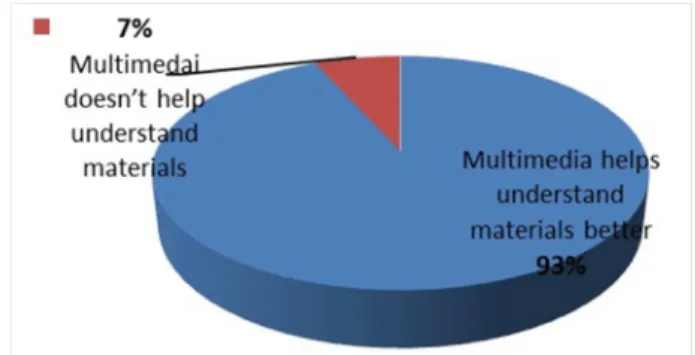
2- Multimedia tools have helped me understand the
material better. Figure -5 illustrates that 17 students ‘strongly agreed’ and 11 students ‘agreed’ that multimedia has helped them understand the materials better. However, only 2 students, representing just 7%, said that multimedia did not help them understand materials better.
Figure 5. Multimedia tools helping understand materials better. 3- Multimedia has helped me manage study time outside the class. The responses to this question are detailed in the table 2. The table shows that 7 students neither agreed nor disagreed that multimedia has helped them manage their study time outside their class.
Table 2. Multimedia helping to manage study time.
Strongly Agree Agree Neither Agree nor Disagree Disagree Strongly Disagree
Multimedia has helped me manage study
time outside of class better 19 students 11 students 0 0 0
4- I prefer online classes that corporate technology like multimedia. The result of this question showed that all the students liked online courses that incorporated some technical tools such as multimedia so as to make their learning more interesting and effective. Out of the total 30 students, 19 (63%) strongly agreed and the remaining 11 (37%) ‘agreed’ that they preferred online classes that corporate technology such as multimedia.
5- The instruction and material is clearer if presented visually. The survey results showed that instructions and materials become clearer when they are presented visually, as students will be able to grasp the contents and concepts more clearly when they are presented with videos, animations and pictures. Out of the 30 students, only 1 student disagreed with this statement, whereas 29 students agreed or strongly agreed that instructions as well as materials are clearer if presented visually. The result is illustrated in the table 3.
Table 3. Clarity of lessons when presented visually.
Strongly
Agree Agree
Neither Agree
nor Disagree Disagree
Strongly Disagree
10 students 19 students 0 1 student 0 6- Using multimedia such as video, sound, or animations enhanced my learning. The survey results proved that using multimedia such as videos, animations, pictures and sounds would enhance students’ learning. 29 students said that their
learning has been enhanced when multimedia is incorporated with their learning, whereas only one student ‘disagreed’ with it. The result is illustrated below.
Figure 6. Multimedia helps learners enhance understanding.
Figure 7. Students NEVER acquired benefits of using multimedia. 7- I never acquired any benefits of using multimedia in my online class. The result of this question showed that
multimedia benefits students. Only one student said that multimedia never benefitted him, but remaining 29 students said that multimedia benefitted them. Out of these 29 students, 17 students strongly disagreed with the statement.
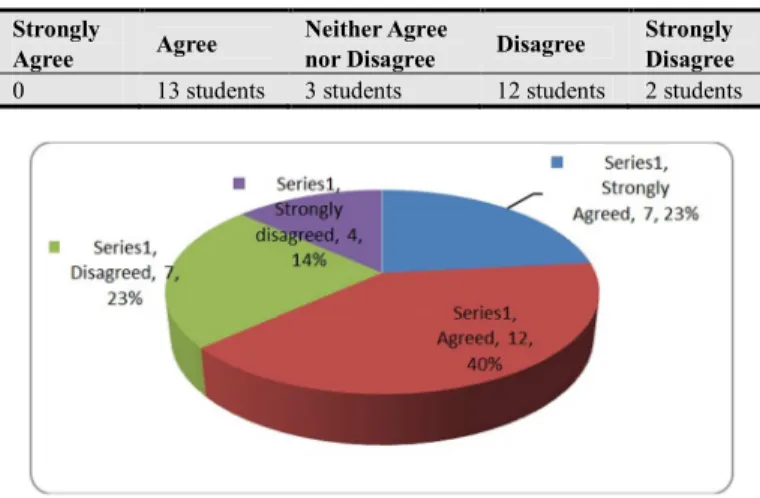
8- Multimedia makes group projects easier to accomplish. The majority of students did not feel that multimedia makes group projects easier to accomplish. Only 12 students, representing 40%, said that multimedia made group projects easier to accomplish, whereas 14 students, accounted to be 47% pointed that multimedia made group projects easier to be accomplished. 3 students neither agreed nor disagreed with this statement. It is illustrated in table 4.
Table 4. Multimedia making group projects easier.
Strongly
Agree Agree
Neither Agree
nor Disagree Disagree
Strongly Disagree
0 13 students 3 students 12 students 2 students
Figure 8. Multimedia affected students learning set up.
9- I agree that multimedia has affected my learning. 12 students ‘agreed’ and 7 students ‘strongly agreed’ that multimedia has affected their learning set up, whereas only 4 and 7 students strong disagreed and disagreed with this statement. The figure below illustrates that 23% strongly agreed and 40% of the students felt that multimedia has affected their learning. The result is illustrated with the help of figure-8.
10- I rather read a hard copy of a book than to read it in a
media format. Only 4 students agreed that they read through hard books or hard materials, than that they read through soft materials such as media formats. 26 students disagreed with this statement as they opinioned that they prefer soft-copies or they rather read from multimedia formats.
Table 5. Reading from multimedia formats or hard copies.
Strongly
Agree Agree
Neither Agree
nor Disagree Disagree
Strongly Disagree
0 4 students 0 13 students 13 students
11- Using multimedia in online classes made it easier for me to understand the lessons. Students’ responds to this survey question showed that almost all of them felt that using multimedia in their online classes made it easier for them to understand the classes.
29 students, 18 strongly and 11 neutrally agreed that using multimedia in online classes made it easier for them to understand the classes. Only 1 student, representing 3%, disagreed with this view. It is illustrated below:
12- Multimedia presents information in an understandable and effective way. Similarly, 29 students, representing 97%, agreed, including both neutral and strong, that multimedia presents information in a more understandable and effective ways. The result is outlined below:
Table 6. Multimedia delivers information more effectively.
Strongly Agree Agree Neither Agree nor Disagree Disagree Strongly Disagree
Multimedia presents information in an
understandable and effective way 15 students 14 students 0 1 student 0
In percentage 50% 47% 0 3% 0
13- I interact with both students and teacher through medium more thoroughly and effectively. The majority of the students surveyed responded that they interacted with teachers as well as students through multimedia more
thoroughly and effectively. One student has neither agreed nor disagreed with the statement. The result is analyzed with the help of table 7.
Table 7. Interaction through multimedia.
Strongly Agree Agree Neither Agree nor Disagree Disagree Strongly Disagree
Multimedia presents information in an
understandable and effective way 16 students 10 students 1 3 students 0
In percentage 54% 33% 3% 10% 0
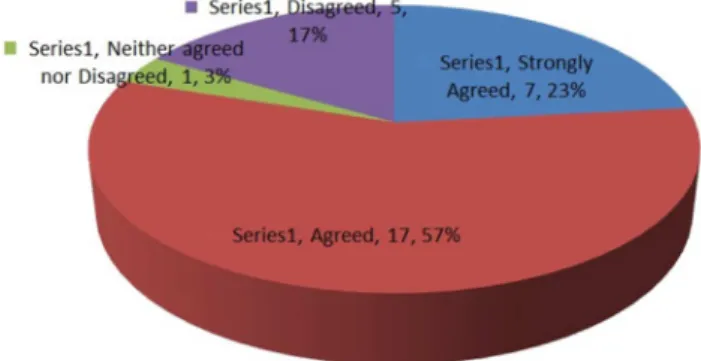
14- I believe learning is structured more thoroughly within multimedia. Learning is more structured when the classes are
delivered through multimedia. As depicted in the figure-9 below, 80% of the students said that their learning is more
structured when the lessons are delivered through multimedia. Out of these, 57 neutrally agreed, and 23% strongly agreed. This is illustrated with the help of figure 9.
Figure 9. Learning is structured with multimedia.
15- I would say that multimedia has impacted my educational experience. 21 students, accounting to be 70% agreed, whereas 8 students, accounting to be 27% strongly agreed that that multimedia has impacted their learning experiences. The answers are outlined below:
Strongly Agree Agree Neither Agree nor Disagree Disagree Strongly Disagree Multimedia has impacted my educational experience 8
students 21 students 0 1 student 0
In percentage 27% 70% 0 3% 0
4.3. Summary of the Survey Findings
Based on the survey results outlined above, the researcher found that multimedia helped students better understand the lessons and to manage their study time outside the class. Multimedia use in the online setting has affected students’ learning experiences. They found instructions clearer and easier to understand when they are delivered through multimedia. A good number of students responded that they have preferred multimedia to hardcopies of books or journals.
4.4. Analysis of the Interview Answers
The researcher interviewed 2 teachers and 3 students who used multimedia for teaching and learning in their online courses. Interview questions and their answers are discussed below:
Interview with students:
Question- 1 - What type of multimedia they preferred most and benefited from it?
Student 1: He is a 21 year old student in the Bachelor of Business Administration program, and it is the first online course he participated in multimedia learning experiences. He said that videos, animated Power Points and colorful models and images were the multimedia types that he has more benefitted from. Power Points are of popular use in interactive classes and online courses since they give brief
illustrations to students and they help students recall points for quite a longer time (Bowman, 2010).
Student 2: She is a 22 years female student in the Bachelor of Music program and this is the first time she participated an online class with multimedia learning facilities. She prefers pictures and animations along with music being played in background for getting her enthusiastic about learning. She said that pictures and music in backgrounds are most preferred types of multimedia for learning.
Student 3: She is a 24 years old female student in the Master of Business Administration program. She has experienced many multimedia courses before. She likes images and videos along with syllabus contents are delivered to her in her class room.
Question- 2: What are their views about using multimedia to achieve quality learning?
Student 1: His view about using multimedia in online learning setting is that he could learn better with multimedia. Lecture based classes made him bored. So, he is of the view that multimedia in online classes help student become more interested and excited.
Student 2: She pointed out that, while multimedia is used for learning, she could improve understanding of the concepts. When images or animations and videos are used, students could understand classes better than the way when lessons are delivered only in words.
Student 3: She also said that multimedia made her more interested in the lesson and prevented her from feeling bored in classes.
Interview with teachers:
Question- 1: What is the best multimedia to apply so as to guarantee quality education?
Teacher 1: He is a 32 years old professor in the Bachelor of Economics program. He has been using multimedia for several years especially after Power Points and animated videos became more popular in teaching. He said that animated vides and images were the best modes of multimedia to guarantee quality education.
Teacher 2: She is a 37 years old professor who teaches in both Bachelor and Master courses in Economics. She prefers graphs, pictures and models to ensure quality education.
Question- 2: What are their considerations so as to gain quality learning when using multimedia?
Teacher 1: He is of the view that a teacher must plan the contents well in advance, so as to make sure that multimedia to be used is syllabus oriented, clear and brief with a view to help students learn better. The images or videos or animated PPTs that a teacher uses in the class must be brief, clear and appropriate with the syllabus contents.
Teacher 2: She said that a teacher should help students get better grades and to perform better in assessments though that may not be the ultimate goal of teaching, and therefore, the teacher should consider those aspects or factors that can help students score better grades in the assessments while planning and preparing multimedia use in the class.
Question- 3: How can we tell that a particular multimedia fits the online class and if not, why?
Teacher 1: He said that Power Points are good when students have to learn syllabus related contents based on images as well as graphs or figures. Similarly, printed images would work when students need to get insight about the lessons.
Teacher 2: She said that a multimedia can be said to be fit to the online class if students could understand what is taught. For example, videos and animated flash would be appropriate if students have to learn some scientific experiments or the like.
Question- 4: What do they consider before using a particular multimedia in the online classes?
Teacher 1: He said that the main consideration of the teacher must be to ensure whether the multimedia chosen would benefit students’ learning or not. For that, he has to consider various different factors such as time available for the teacher, accuracy of the contents, accessibility, availability of the materials required, appropriateness with the syllabus contents etc.
Teacher 2: She is of the opinion that students should
benefit in regard to their grades and performance in assessments. So, this must be the main consideration before planning and preparing for multimedia in an online class setting.
4.5. Summary of the Interview Results
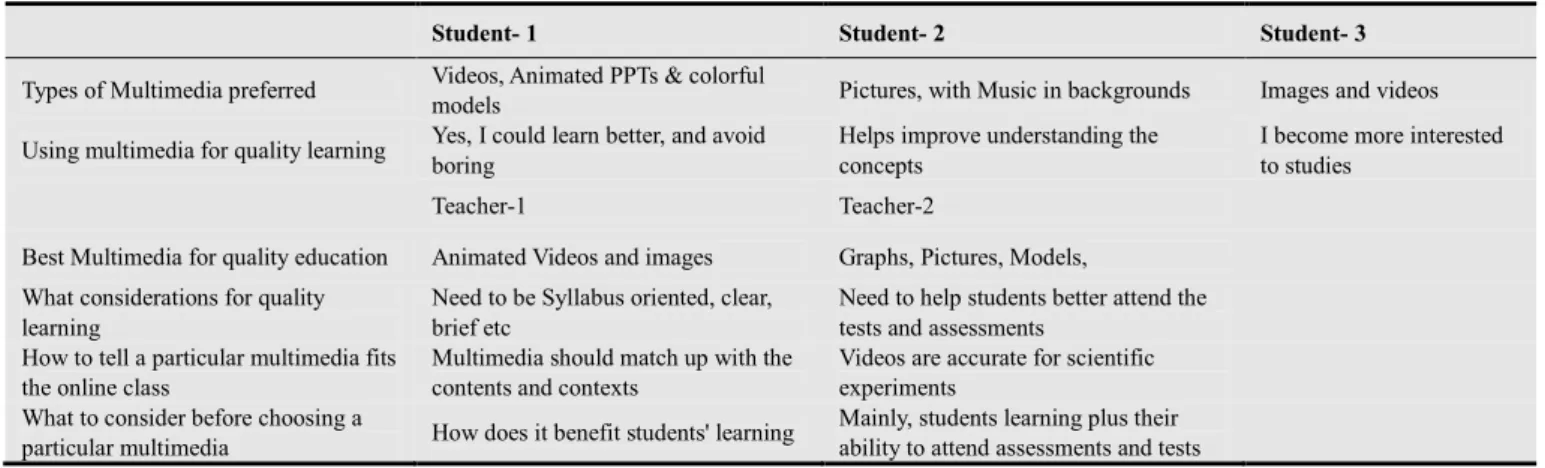
The interview with 3 students and 2 teachers showed that images, videos, animated Power Points etc are the major types of multimedia that can be used in online learning. Students responded that multimedia use in online classes helped them get highly interested and to improve their understanding of the concepts taught. Before designing and developing or preparing the multimedia for learning, teachers should consider factors such as time, availability of materials required, accessibility and so on. Whether the multimedia used in the class would help them achieve better scoring or perform better in assessments are also to be considered. Following table illustrates a brief summary of the interview findings.
Table 8. Summary of the Interview Results.
Student- 1 Student- 2 Student- 3
Types of Multimedia preferred Videos, Animated PPTs & colorful
models Pictures, with Music in backgrounds Images and videos Using multimedia for quality learning Yes, I could learn better, and avoid
boring
Helps improve understanding the concepts
I become more interested to studies
Teacher-1 Teacher-2
Best Multimedia for quality education Animated Videos and images Graphs, Pictures, Models, What considerations for quality
learning
Need to be Syllabus oriented, clear, brief etc
Need to help students better attend the tests and assessments
How to tell a particular multimedia fits the online class
Multimedia should match up with the contents and contexts
Videos are accurate for scientific experiments
What to consider before choosing a
particular multimedia How does it benefit students' learning
Mainly, students learning plus their ability to attend assessments and tests
4.6. Summary of Findings and Results for Both Surveys and Interviews
It is undeniably accepted that learners are able to better understand from their classrooms when the contents are delivered to them with the help of multimedia rather than being presented simply in words. To find out how effective is the use of multimedia for teaching and learning, the researcher surveyed 30 students and interviewed 5 people, 2 of them are teachers and 3 are students. This section of the paper is meant to compare and contrast the main findings of survey that are discussed in section one and the main findings of interview that are discussed in section two.
Multimedia helps students better understand the class. 93% of the survey respondents said that multimedia tools have helped them better understand their classes. While interviewed, two students said that multimedia helped them understand their classes better and that it helped them avoid becoming bored in class. Third student has also said that multimedia tools made them interested in class. Survey results showed that 97% of the students felt that multimedia
benefited their learning.
Multimedia affected students’ learning. 63% of the respondents said that multimedia affected their learning experiences. While interviewed, students said that multimedia helped them improve their learning and understanding of the lessons.
Learning is more structured. 80% of the students felt that learning is more structured while the lessons are delivered through multimedia. In the interview with teachers, they stated that teachers should consider making the multimedia contents more brief and accurate as well as appropriate so as to make sure that quality education can be enhanced.
Considerations for ensuring quality education. Teachers opinioned that the lessons delivered through multimedia must be able to improve students’ performance in assessments and tests even though it is not the ultimate goal of education.
5. Discussion, Future Research and
Conclusion
effectively from words and pictures than from words alone. The purpose of this survey was to investigate the impacts of using multimedia in an online setting for college students and to find out how multimedia influences students’ experiences in learning. The study involved students who use multimedia for learning. The structured questionnaire method was used for survey and interview.
5.1. Summary of Findings
The results of the survey and interview proved that using multimedia in online learning is very useful since it positively affects students’ learning experiences. Out of the total 30 students, 93% felt that they could understand materials better when multimedia is used in their classes. With a goal to make classes more interesting, teachers use varieties of tools such as images, videos, PowerPoints and other software-assisted tools that were found to help students listen and understand the classes better than learning from words alone.
Survey responses proved that students could manage their study time better outside the classrooms with the use of multimedia. All the students who responded to the survey believed that multimedia has helped them manage their time for study. They prefer online classes that incorporate technology like multimedia because using multimedia in classrooms helps to increase students’ listening and learning motives. When lessons are delivered to students in words alone, they feel that it is not as clear as it could be if multimedia was used. The results also proved that lessons and instructions become very clear to them when multimedia is used. Multimedia has helped students make their group projects easier too.
It was found from the survey results that multimedia affected students’ learning positively. 63% of the students felt that use of multimedia in their classes has affected their learning. It is generally believed that students in recent years are highly dependent on electronic copies of books and journals. From the survey, it was found that most of the students prefer reading books, journals and other materials in media format to reading them in hard copies. With recent developments in information technology, students have easier access to communication tools such as social media, smartphone applications etc with which they interact with teachers for academic help. It was found from the survey that almost 97% of the students have been using multimedia as an effective tool for communicating with teachers for their learning purpose.
The results of the face-to-face interview with 2 teachers and 3 students could act as evidence for the fact that multimedia helps students learn lessons better. Videos, animated PowerPoints, images, music, models and graphs are
used by teachers. From the interview, it was found that students became more interested in studies and they could learn better when their teachers used multimedia for learning. It is highly important to consider whether the multimedia tools are helpful for the students to understand the given lessons. Graphs will be more important in an Economics and Statistics class, whereas videos and images more useful in a Biology class. In short, the study highlighted that using multimedia in online learning is extremely helpful for students to learn better and for teachers to teach well. There were limitations identified for this study. The participants were chosen through purposive sampling to determine which multimedia content works best. The results also cannot be generalized for a large range of population.
5.2. Recommendations for Further Study This research attempted to study the impact of using multimedia in an online learning setting and found that using multimedia in learning is a very effective tool to increase students’ interest in learning and to improve their learning experiences. However, it is not clear whether the use of multimedia helps students score better grades or perform well in the assessments. Students who learn better may not always be able to score better grades or to perform well in exams due to that application, analytical and other skills are important requirements for gaining improved performance in exams. Hence, this research recommends further study to find out the impacts of multimedia in students’ performance in exams.
Walsh (2011) stressed that digital technologies and use of multimedia in learning can improve students’ learning interest and knowledge, however multimedia by itself does not always lead to analytical and application skills such as critical thinking. In exams, students are given various questions to check their application, analytical and critical thinking skills. Once they learn the lessons, they have to critically think about the concepts they learned and to think to apply theories to practical experiences. Hence, this research recommends further study about how multimedia use in learning may impact students’ analytical and application skills that are required for better performance in exams. In conclusion, technology is considered as a main source for knowledge worldwide. Such progress is important to observe students’ performance in the exams after they have been given some specific numbers of classes with multimedia and to compare these results with the findings from those students who attended exams after attending classes without multimedia use. After the research was conducted, the assumptions that made earlier proven to be correct. Further research should also examine the relationship between multiple online teaching strategies and students’ understanding level.
Appendixes
Survey Questions Demographic Data1. Please indicate your gender: Female Male
2. How many online courses have you completed? 1 2 3 4 or more 3. In which year are you in? 1st year 2nd year 3th year 4th year or more 4. Is this online course your first experience with multimedia? Yes No
SA=Strongly Agree; A=Agree ; N=Neither Agree nor Disagree; D=Disagree; SD=Strongly Disagree
SA A N D SD
I use multimedia with every class session.
Multimedia tools have helped me understand the material better. Multimedia has helped me manage study time outside of class better. I prefer online classes that corporate technology like multimedia. The instruction and material is clearer if presented visually.
Using multimedia such as video, sound, or animations enhanced my learning I never acquired any benefits of using multimedia in my online class. Multimedia makes group projects easier to accomplish.
I agree that multimedia has affected my learning setup. I rather read through hard book than have it in media format.
Using multimedia in online classes made it easier for me to understand the lessons. Multimedia presents information in an understandable and effective way
I interact with both students and teacher through medium more thoroughly and effectively. I believe learning is structured more thoroughly within multimedia.
Overall, I would say that multimedia has impacted my educational experience.
In the space provided below, please make any additional comments that you would like to add about Multimedia or justification for any of the responses above:
____________________________________________________________________________________________________ ______________________________________________________________________________________________________ ______________________________________________________________________________________________________ ________ Interview method Questions asked
The students using this approach were asked various questions including: What type of multimedia they preferred most and benefited from it? What are their views about using multimedia to achieve quality learning? On the other hand, teachers received questions that entailed:
What is the best multimedia to apply so as to guarantee quality education?
What are their considerations so as to gain quality learning when using multimedia? How can we tell that a particular multimedia fits the online class and if not, why? Finally, what do they consider before using a particular multimedia in the online classes?
References
[1] Bowman, L, 2010, Online Learning: A User-Friendly Approach for High School and College Students, R&L Education. [2] Cabrera, D. (2013). Integrating multimedia in your course.
Retrieved from http://facdevblog.niu.edu/integrating-multimedia-in-your-course.
[3] Chen, Y. T. (2012). The effect of thematic video-based instruction on learning and motivation in e-learning. International Journal of Physical Sciences, 7(6), 957- 965. [4] Davies, J., & Graff, M. (2005). Performance in e‐learning:
Online participation and student grades. British Journal of Educational Technology, 36(4), 657-663.
[5] Genden, S. (2005). The use of multimedia in online distance
learning. Retrieved from
http://www.gendendesign.net/pdfs/MultimediaUse.pdf
[6] Harper, B., & Hedberg, J. (1997). Creating motivating interactive learning environments: A constructivist view. Paper presented at ASCILITE. Retrieved from http://ascilite.org.au/conferences/perth97/papers/Harper/Harpe r.html
[7] Holzinger, A., Kickmeier-Rust, M., Wassertheurer, S. & Hessinger, M. (2009). Learning performance with interactive. Simulations in medical education: Lessons learned from results of learning complex physiological models with the HAEMOdynamics SIMulator, Computers & Education, 52(2), 292–301.
[8] Hsieh, H.L., Wu, J.Y., Lai, P., Chang, S.K., Chen, T.Y., & Kao, W.J. (2010). The effect of movie viewing on learning English as a foreign language. Academic Journal of Interdisciplinary Studies, 2(4), 121-132.
[9] Kamat, V., & Shinde, J. (2009). Enrichment of the learning experience of rural children through interactive multimedia. Yarmouk University, Irbid: Jordan.
[10] Mandernach, J. (2009). Effect of instructor-personalized multimedia in the online classroom. Retrieved from http://www.irrodl.org/index.php/irrodl/article/view/606/1263 [11] Mayer, R. E, 2009, Multimedia Learning, Second edition,
Cambridge University Press
[12] Miller, M.V. (2009). Integrating online multimedia into college course and classroom: With application to the social sciences. MERLOT Journal of Online Learning and Teaching, 5(2), 395-423.
[13] Poe, M., & Stassen, M., (n.d.). Teaching and learning online: Communication, community, and assessment. Amherst, MA: University of Massachusetts.
[14] Said, N. S. (2007). Towards a ‘model of engagement’ designing multimedia application for children, Digital Learning, 3(1), 133-139.
[15] Sankey, M.D., Birch, D., & Gardiner, M.W. (2011). The impact of multiple representations of content using multimedia on learning outcomes across learning styles and modal preferences. International Journal of Education and Development using Information and Communication Technology (IJEDICT), 7(3), 18-35.
[16] Shinde, J. (2003). Effectiveness of multimedia CAI package with reference to levels of interactivity and learning styles. Masters Thesis. Shreemati Nathibai Damodar Thackersey Women’s University, Mumbai.
[17] Sims, R. (1998). Interactivity for effective educational communication and engagement during technology-based and
online learning. In McBeath, McLoughlin & Atkinson (Eds.). Planning for progress, partnership and profit. Proceedings EdTech'98.
[18] Srivastava, S. (2012). A study of multimedia & its impact on
students' attitude. Retrieved from
http://ieeexplore.ieee.org/xpl/login.jsp?tp=&arnumber=62086 06&url=http%3A%2F%2Fieeexplore.ieee.org%2Fxpls%2Fab s_all.jsp%3Farnumber%3D6208606
[19] Tausend, J. (n.d.). Effects of interactive multimedia in e-learning on learners and developers. Retrieved from https://julietausend.files.wordpress.com/2012/02/effects-of-multimedia-on-elearning.pdf
[20] Thangarajathi, S., & Enok, J. (2012). Impact of multimedia in teaching and learning. Retrieved from http://connection.ebscohost.com/c/articles/78383643/impact-multimedia-teaching-learning
[21] Walsh, J. P, Sun, J and Riconscente, M, 2011, Online Teaching Tool Simplifies Faculty Use of Multimedia and Improves Student Interest and Knowledge in Science, NCBI, Retrieved from http://www.ncbi.nlm.nih.gov/pmc/articles/PMC3164569/ [22] Whitton, N. (2009). Review of the research literature on the impact of multimedia revision. Retrieved from http://downloads.bbc.co.uk/aboutthebbc/insidethebbc/whatwe do/learning/audienceresearch/research_report.pdf
[23] Yamamoto, J., Kush, J., Lombard, R., & Hertzog, C. J. (2010). Technology implementation and teacher education: Reflective models. Hershey, PA: Information Science Reference.