EFFICIENT SECURITY PROTOCOLS FOR FAST HANDOVERS IN WIRELESS MESH NETWORKS
CELIA LI
A DISSERTATION SUBMITTED TO THE FACULTY OF GRADUATE STUDIES IN PARTIAL FULFILMENT OF THE REQUIREMENTS
FOR THE DEGREE OF DOCTOR OF PHILOSOPHY
GRADUATE PROGRAM IN
COMPUTER SCIENCE AND ENGINEERING YORK UNIVERSITY
TORONTO, ONTARIO JULY 2015 c
Abstract
Wireless mesh networks (WMNs) are gaining popularity as a flexible and inexpensive replacement for Ethernet-based infrastructures. As the use of mobile devices such as smart phones and tablets is becoming ubiquitous, mobile clients should be guaranteed uninterrupted connectivity and services as they move from one access point to another within a WMN or between networks. To that end, we propose a novel security framework that consists of a new architecture, trust models, and protocols to offer mobile clients seamless and fast handovers in WMNs. The framework provides a dynamic, flexible, resource-efficient, and secure platform for intra-network and inter-network handovers in order to support real-time mobile applications in WMNs. In particular, we propose solutions to the following problems: authentication, key management, and group key management. We propose
(1) a suite of certificate-based authentication protocols that minimize the authentication delay during handovers from one access point to another within a network (intra-network authentication).
(2) a suite of key distribution and authentication protocols that minimize the cation delay during handovers from one network to another (inter-network authenti-cation).
(3) a new implementation of group key management at the data link layer in order to reduce the group key update latency from linear time (as currently done in IEEE 802.11 standards) to logarithmic time. This contributes towards minimizing the latency of the handover process for mobile members in a multicast or broadcast group.
Acknowledgements
I would like to express my deepest gratitude to my supervisor Professor Uyen Trang Nguyen for her expert supervision. I highly appreciate the valuable advice, professional guidance, and consistent encouragement from Professor Nguyen through all stages of my study and research.
I am grateful to my thesis committee members, Professors Zhen Ming Jiang, Bobby Ma, Hongmei Zhu, Suprakash Datta, and Aijun An, for reviewing my thesis and providing their valuable insights.
I would like to thank my postgraduate fellow and friend, Farzana Yasmeen, for re-viewing my thesis and providing useful and detailed comments.
I would like to dedicate this thesis to my family for their deepest love, continuous encouragement, and unconditional support.
Table of Contents
Abstract ii
Acknowledgements v
Table of Contents vi
List of Tables vii
List of Figures viii
Publications from the Thesis ix
Abbreviations xi
1 Introduction 1
1.1 Motivations and Contributions of the Thesis . . . 4
1.1.1 Efficient Authentication for Fast Intra-network Handovers in a Wire-less Mesh Network . . . 5
1.1.2 Efficient Authentication and Key Distribution for Fast Inter-Network
Handovers among Multiple Wireless Mesh Networks . . . 7
1.1.3 Efficient Group Key Management for Wireless Mesh Access Points 9 1.2 Thesis Organization . . . 11
2 Literature Review 12 2.1 Overview of Wireless Communications . . . 12
2.1.1 Transmission Range and Interference Range . . . 13
2.1.2 Hidden Terminal and Exposed Terminal Problems . . . 14
2.1.3 Medium Access Mechanisms . . . 15
2.1.4 Overview of DSSS and OFDM . . . 21
2.2 Overview of Cryptography . . . 26
2.2.1 Encryption Schemes . . . 27
2.2.2 Public Key Cryptography . . . 32
2.2.3 Digital Signatures . . . 36
2.2.4 Message Authentication Code . . . 39
2.3 Security Threats . . . 41
2.4 Security Models and Trust Management in Wireless Networks . . . 46
2.4.1 Security Models for Handovers in Wireless Networks . . . 46
2.4.2 Trust Management . . . 50
2.5 Overview of IEEE 802.11i Security Standard . . . 52
2.5.2 Key Management and Group Key Management in IEEE 802.11i . 57
2.6 Security Protocols for Intra-network and Inter-network Handovers . . . . 61
2.6.1 Handover Operations in Wireless Networks . . . 61
2.6.2 Authentication and Key Distribution Schemes for Intra-network Handovers . . . 63
2.6.3 Authentication and Key Distribution Schemes for Inter-network Handovers . . . 72
2.7 Group Key Management . . . 91
2.7.1 Centralized GKM . . . 91
2.7.2 Contributory GKM . . . 93
2.7.3 Decentralized GKM . . . 95
2.7.4 Applicability to GKM at the Data Link Layer . . . 99
2.8 Chapter Summary . . . 99
3 Efficient Authentication for Fast Intra-Network Handovers in a Wireless Mesh Network 101 3.1 The Proposed Trust Model and Certificates for Intra-network Handovers . 103 3.1.1 The Proposed Trust Model . . . 103
3.1.2 Certificates Used in the Proposed Authentication Protocols . . . . 105
3.2 The Proposed Authentication Protocols . . . 112
3.2.1 The Login Authentication Protocol (LAP) . . . 113
3.2.3 Key Generation . . . 124
3.3 Security Analysis of the Proposed Authentication Protocols . . . 126
3.3.1 Overview . . . 126
3.3.2 Identity Privacy Attack . . . 128
3.3.3 Forgery Attack . . . 128
3.3.4 Time-memory Trade-off Attack . . . 129
3.3.5 Replay Attack . . . 129
3.3.6 Denial-of-Service (DoS) Attack . . . 135
3.3.7 Compromised MAPs . . . 137
3.4 Performance Evaluation . . . 138
3.4.1 Numerical Analysis . . . 139
3.4.2 Simulation Results . . . 145
3.5 Chapter Summary . . . 159
4 Security Protocols for Fast Inter-Network Handovers among Multiple Wireless Mesh Networks 160 4.1 The Proposed Architecture, Trust Model, and Certificates for Inter-Network Handovers . . . 162
4.1.1 The Proposed Inter-network Architecture . . . 162
4.1.2 The Proposed Inter-network Trust Model . . . 167
4.1.3 Certificates for Inter-Network Handovers . . . 171
4.2.1 Phase 1: Network Initialization . . . 178
4.2.2 Phase 2: Inter-network Handover . . . 182
4.3 Security Analysis . . . 201
4.3.1 Overview . . . 201
4.3.2 Security Analysis of the Proposed Security Protocols . . . 203
4.4 Performance Evaluation . . . 215
4.4.1 Numerical Analysis . . . 216
4.4.2 Simulation Results . . . 223
4.5 Chapter Summary . . . 244
5 Efficient Group Key Management for Wireless Mesh Access Points 246 5.1 Overview of LKH and OFT Algorithms . . . 247
5.1.1 Logical Key Tree . . . 247
5.1.2 LKH Operations . . . 253
5.1.3 OFT Operations . . . 259
5.2 Implementing LKH and OFT in Mesh Access Points . . . 270
5.2.1 LKH Implementation . . . 270 5.2.2 OFT Implementation . . . 276 5.3 Performance Evaluation . . . 283 5.3.1 Computational Complexity . . . 283 5.3.2 Communication Complexity . . . 287 5.3.3 Numerical Analysis . . . 289
5.4 Simulation Results . . . 304
5.4.1 Performance Metric . . . 304
5.4.2 Simulation Parameters . . . 304
5.4.3 Simulation Results of DSSS . . . 308
5.4.4 Simulation Results of OFDM . . . 317
5.5 Chapter Summary . . . 328
6 Conclusion and Future Research Directions 331 6.1 Summary . . . 331
6.2 Future Research Directions . . . 333
A The Handover Authentication Protocol by Kassab et al. 335
B Adaptive Protocol - Authentication and Key Agreement (AP-AKA) 338
List of Tables
2.1 Comparison of authentication approaches in wireless networks . . . 73
3.1 Notations . . . 107
3.2 Standards for one-way delay limits . . . 122
3.3 Computation and communication costs of authentication protocols . . . . 142
3.4 Common simulation parameters . . . 143
3.5 Simulation parameters for different experiments . . . 144
4.1 Notations . . . 172
4.2 Computation and communication costs of the ABD protocol . . . 218
4.3 Computation and communication costs of key distribution . . . 221
4.4 Computation and communication costs of authentication . . . 222
4.5 Common simulation parameters . . . 226
4.6 Simulation parameters for different experiments . . . 231
5.2 Each member’s key structure for OFT . . . 279
5.3 Computational complexity . . . 284
5.4 Number of hash operations in OFT . . . 287
5.5 Communication complexity . . . 288
5.6 Latency Components . . . 294
5.7 Rekeying Latency . . . 295
5.8 Timing Related Parameters . . . 298
5.9 Simulation parameters . . . 305
5.10 IEEE 802.11 standards used in the experiments . . . 306
List of Figures
1.1 An example of a WMN . . . 2
2.1 Transmission range and interference range . . . 13
2.2 An example of hidden terminal problem . . . 14
2.3 IEEE 802.11 protocol architecture . . . 16
2.4 CSMA/CA . . . 18
2.5 DCF with RTS/CTS/Data/ACK . . . 19
2.6 Spreading with DSSS . . . 22
2.7 DSSS Generation . . . 23
2.8 DSSS decoding . . . 23
2.9 Traditional view of receiving signals carrying modulation . . . 24
2.10 OFDM Spectrum . . . 25
2.11 Symmetric key encryption and decryption . . . 28
2.12 Public key encryption and decryption . . . 30
2.14 Basic RSA Key Exchange . . . 35
2.15 Digital signature generation and verification . . . 37
2.16 The use of MAC algorithm . . . 40
2.17 Mobile IP datagram flow . . . 48
2.18 WEP Authentication . . . 53
2.19 802.1x . . . 55
2.20 EAP-TLS . . . 57
2.21 The 4-way handshake protocol . . . 59
2.22 802.11i key hierarchy . . . 60
2.23 Backhaul overhead . . . 68
2.24 3GPP AKA . . . 77
2.25 Generation of authentication vectors . . . 78
2.26 An example of key distribution methods proposed by Hoeper . . . 82
2.27 The ONSP inter-domain authentication process . . . 84
2.28 Inter-domain handover authentication process . . . 87
2.29 Inter-network handover scenario . . . 90
2.30 An example of a contributory approach . . . 94
2.31 An example of a decentralized architecture . . . 96
3.1 Trust model of a WMN . . . 105
3.2 Information exchange between a client and MAPs . . . 112
3.4 Network with four MAPs . . . 148
3.5 Network with five MAPs . . . 149
3.6 Simulation results . . . 154
4.1 Scalable WMN architecture for secure inter-network handovers . . . 164
4.2 An example of an agent hierarchy . . . 167
4.3 Trust model of WMNs . . . 169
4.4 Adjacent BMAP Discovery (ABD) protocol . . . 180
4.5 Inter-network handover . . . 183
4.6 Login authentication protocol through a BMAP . . . 185
4.7 Key distribution to neighbors (KDN) protocol . . . 188
4.8 Inter-network handover authentication protocol (IHAP) . . . 190
4.9 An integrated authentication system . . . 195
4.10 A mobile client roams from network X to networkY, then to networkZ . 196 4.11 Key distribution delay . . . 220
4.12 IHAP and AP-AKA . . . 223
4.13 Topologies of BMAPs . . . 227
4.14 Function of number of adjacent BMAPs . . . 232
4.15 Function of background traffic load . . . 235
4.16 Function of number of clients . . . 238
4.17 Function of background traffic load . . . 241
5.1 A logical key tree . . . 249
5.2 Client CH joins the group . . . 252
5.3 Client CH leaves the group . . . 254
5.4 Client CH joins the group - OFT . . . 263
5.5 Client CH leaves the group - OFT . . . 268
5.6 Rekeying message format . . . 274
5.7 LKH message example after clientCH joins the group . . . 277
5.8 LKH message example after clientCH leaves the group . . . 277
5.9 OFT message example after clientCH joins the group . . . 282
5.10 OFT message example after clientCH leaves the group . . . 282
5.11 Unicast and broadcast message exchanges at the data link layer . . . 292
5.12 Rekeying latency incurred by a JOIN operation . . . 301
5.13 Rekeying latency incurred by a LEAVE operation . . . 303
5.14 DSSS - Rekeying latency of Join/Leave operation . . . 313
5.15 DSSS - Each broadcast message is sent 3 times . . . 315
5.16 DSSS - The impact of background traffic . . . 319
5.17 OFDM - Rekeying latency of Join/Leave operation . . . 322
5.18 OFDM - Each broadcast message is sent 3 times . . . 326
5.19 OFDM - The impact of background traffic . . . 330
Publications from the Thesis
Refereed Journal Article
1. Celia Li, Uyen Trang Nguyen, Hoang Lan Nguyen and Nurul Huda, Efficient Au-thentication for Fast Handover in Wireless Mesh Networks, Elsevier Journal of Computer & Security, Vol. 37, pp. 124-142, September 2013.
Refereed Conference Proceedings
2. Celia Li and Uyen Trang Nguyen, Efficient Group Key Management in Wireless Lo-cal Area Networks, International Conference on Mobile, Ubiquitous, and Intelligent Computing (MUSIC 2012), Vancouver, Canada, June 2012.
3. Celia Li and Uyen Trang Nguyen, Fast Authentication for Mobility Support in Wire-less Mesh Networks, IEEE WireWire-less Communications and Networking Conference (WCNC 2011), Cancun, Mexico, March 2011.
Mesh Networks, IEEE Canadian Conference on Electrical and Computer Engineer-ing (CCECE 2010), Calgary, Canada, May 2010.
5. Celia Li and Uyen Trang Nguyen, Group Key Management in Wireless Mesh Net-works, International Conference on Heterogeneous Networking for Quality, Reli-ability, Security and Robustness (QShine ’07, co-sponsored by IEEE and ICST (Institute for Computer Sciences, Social Informatics and Telecommunications En-gineering)), Vancouver, Canada, August 2007.
Abbreviations
AAD Average Authentication Delay
ACK Acknowledgement
AES Advanced Encryption Standard
AIAD Average Inter-network Authentication Delay AKDD Average Key Distribution Delay
AP-AKA Access Point - Authentication and Key Agreement
AS Authentication Server
BMK Border MAC Key
BMAP Border Mesh Access Point
BSSID Basic Service Set Identifier
CA Certificate Authority
CBR Constant Bit Rate
CMK Client MAC Key
CTS Clear to Send
DCF Distributed Coordination Function
DEK Data Encryption Key
DIFS Distributed Inter-Frame Space
DoS Denial-of-Service
DSSS Direct Sequence Spread Spectrum EAP Extensible Authentication Protocol
EAP-TLS Extensible Authentication Protocol-Transport Layer Security
GKM Group Key Management
GKS Group Key Server
GSM Global System for Mobile Communications
GTK Group Transient Key
GPRS General Packet Radio Service HAP Handover Authentication Protocol IAPP Inter-Access Point Protocol
IP Internet Protocol
KCK Key Confirmation Key
KDC Key Distribution to Client KDN Key Distribution to neighbors
KM Key Management
KPDD Key Pre-Distribution Delay
LAN Local Area Network
LAP Login Authentication Protocol
LKH Logical Key Hierarchy
MAC Message Authentication Code MAD Maximum Authentication Delay
MAP Mesh Access Point
MIAD Maximum Inter-network Authentication Delay MKDD Maximum Key Distribution Delay
MP Mesh Point
MSDU Media Access Control Service Data Unit
NBD Neighboring BMAP Discovery
OFT One-way Function Tree
OFDM Orthogonal Frequency Division Multiplexing
PANA Protocol for Carrying Authentication for Network Access PDA Personal Digital Assistant
PKI Public Key Infrastructure
PMK Pairwise Master Key
PGP Pretty Good Privacy
RADIUS Remote Authentication Dial In User Service
RTS Request to Send
SHA Secure Hash Algorithm
SIFS Short Inter-Frame Space SIM Subscriber Identity Module
TK Temporal Key
UMTS Universal Mobile Telecommunication System
VoIP Voice over IP
WEP Wired Equivalent Privacy
WiMAX Worldwide Interoperability for Microwave Access WLAN Wireless Local Area Network
WPA Wi-Fi Protected Access
Chapter 1
Introduction
Wireless mesh networking is an emerging technology that supports many important applications such as Internet access provisioning in rural areas, ad hoc networking for emergency and disaster recovery, security surveillance, and information services in public transportation systems [1]. The technology enables networking capability where wiring or installing cables is difficult or expensive.
A WMN is dynamically self-organized and self-configured, with nodes in the network automatically establishing and maintaining mesh connectivity among themselves. This feature brings many benefits to WMNs such as low installation cost, large-scale deploy-ment, fault-tolerance, and self-management. WMNs are gaining popularity as a promising technology for ubiquitous high speed network access, not only for their significant cost savings but also for their flexibility and resilience.
A wireless mesh network (WMN) consists of mesh clients and mesh points (MPs). Mesh clients can be static (e.g., desktops, database servers) or mobile hosts (e.g., cellular
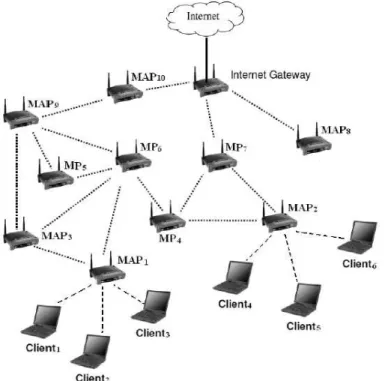
phones, laptops, personal digital assistants [PDAs], tablets). The mesh points form a wireless mesh backbone to provide multi-hop connectivity from one mesh client to another or to the Internet. A subset of mesh points act as mesh access points (MAPs), connecting mesh clients to the WMN. MAPs can be mobile or static. In the thesis we assume that MAPs are mostly static, such as those used for Internet access provisioning in rural areas, municipal and metropolitan networking, and security surveillance [2]. A small number of mesh points work as gateways, connecting the WMN to the Internet. Figure 1.1 shows an example of a WMN.
Figure 1.1: An example of a WMN
Mesh access points (MAPs) in a WMN are connected to other MAPs by one or more radio (wireless) links. Given a network of n nodes arranged in a string topology (i.e., a
straight line) and a carrier sense multiple access with collision avoidance (CSMA/CA)-based medium access control protocol such as IEEE 802.11, it has been shown through experiments that the throughput degrades approximately to 1/nof the raw channel band-width [3]. This experimental result implies that the longer a source-to-destination path (in terms of the number of wireless hops), the high the probability that a packet sent by the source to the destination will be lost or damaged. The path length thus has a significant impact on the performance of existing security protocols used in WMNs as will be discussed shortly.
In a WMN, a mobile device is connected to a MAP through a radio link. As a mobile client moves away from a MAP, it switches its connectivity to another MAP. This connectivity change involves a transition process called handover. When a mobile client roams from one MAP to another MAP within the same network, anintra-network handover takes place to provide the client with continued service. (In this dissertation, a network is defined as a set of points or nodes interconnected by communication paths and controlled by a single network operator. The term “networks” refers to different networks controlled by different network operators.) A mobile client may also switch connectivity from a MAP in one network to a MAP in another network, in which case aninter-network handover is required.
A handover typically involves the following operations: mobility management, au-thentication, authorization, key management, and accounting for billing purposes. If all these operations are performed via multi-hop wireless communications (e.g., in wireless
ad hoc networks such as WMNs), the handover latency may be unacceptably long, re-sulting in lost connectivity and thus service interruption. On the other hand, the current version of the wireless mesh networking standard IEEE 802.11s does not specify any mechanisms to support fast handovers for mobile clients. For example, a mesh client has to be authenticated by an authentication server via multi-hop wireless communications, which may result in long delay, low reliability, and thus potential service interruption.
We propose a novel security framework that consists of a new architecture, trust models, and protocols to enable seamless and fast handovers in WMNs. The framework provide a dynamic, flexible, resource-efficient and secure platform for intra-network and inter-network handovers in order to support real-time mobile applications in WMNs. In particular, we propose solutions to the following problems: authentication, key manage-ment, and group key management.
1.1 Motivations and Contributions of the Thesis
We propose the following secure and efficient solutions to support fast intra-network and inter-network handovers in WMNs:
1. We propose a novel trust model and certificates to support mobile clients moving from one MAP to another within a network. Based upon the proposed trust model, we design a suite of certificate-based authentication protocols that minimize the authentication delay during the handover process within a WMN in order to support fast intra-network handovers.
2. We design a new architecture, a trust model and certificates to support fast au-thentication when a mobile client moves from one network to another. Based on the proposed inter-network architecture, trust model and certificates, we propose a suite of security protocols for authentication and key distribution to minimize inter-network authentication latency.
3. We propose a new implementation of group key management at the data link layer in order to reduce the key update latency from linear time (as currently done in the IEEE 802.11s standard) to logarithmic time. This contributes towards minimizing the latency of the handover process for members in a multicast or broadcast group.
Following sections detail the motivations and contributions of our work.
1.1.1 Efficient Authentication for Fast Intra-network Handovers in a Wire-less Mesh Network
With the rapid growth of mobile services for handheld devices such as smart phones, tablets and laptops, Internet connectivity anytime, anywhere has become a necessity in every day life, business, education, and entertainment. While cellular networks effectively handle the handover problem using signaling embedded in their low-level protocols, there are currently no efficient, transparent handover solutions for IEEE 802.11-based wireless networks. At the moment, these networks, even if they give the appearance of continuous connectivity to mobile clients, provide connections that are in fact often interrupted when a client transfers from one access point to the next, because the handover delay can be
as long as several seconds [4]. For some applications (e.g. transferring files), this delay is acceptable; however, it is far too long for real-time traffic such as interactive voice over IP (VoIP) or video conferencing [5].
The current version of wireless mesh networking standards IEEE 802.11s does not specify any mechanisms to support fast handovers for mobile clients. A mesh client has to be authenticated by an authentication server via multi-hop wireless communications, which may result in long delays, low reliability and thus potential service interruption. A performance study of message transmission delay in IEEE 802.11-based mesh networks by Srivatsa and Xie [7] shows that as the number of wireless hops between two routers increases from one to five, the delay of a message between the routers increases from 0.15 seconds to 0.8 seconds. Since the authentication process involves several messages (e.g., nine messages in the EAP-TLS protocol used by 802.11s), the handover latency may be several seconds long, which is not acceptable for real-time applications such as VoIP, newscast, and stock quote distributions.
Our work contributes towards extending the IEEE 802.11s standards to support fast handovers in a wireless mesh network. In particular, we focus on fast authentication during the handover process as well as during the initial login time. We propose a new trust model and accompanying certificates, based upon which our proposed authentica-tion protocols are designed. We develop certificate-based authenticaauthentica-tion protocols that are resource-efficient and resilient to attacks. The authentication server does not need to be involved in the handover authentication. Instead, a new mesh access point
di-rectly authenticates a mobile client during the handover process using certificates issued by the current access point. Numerical analysis and simulation results show that our login authentication protocol improves the authentication latency of IEEE 802.11s, and our handover authentication protocol supports fast authentication during the handover process, which is lacking in IEEE 802.11s.
1.1.2 Efficient Authentication and Key Distribution for Fast Inter-Network Handovers among Multiple Wireless Mesh Networks
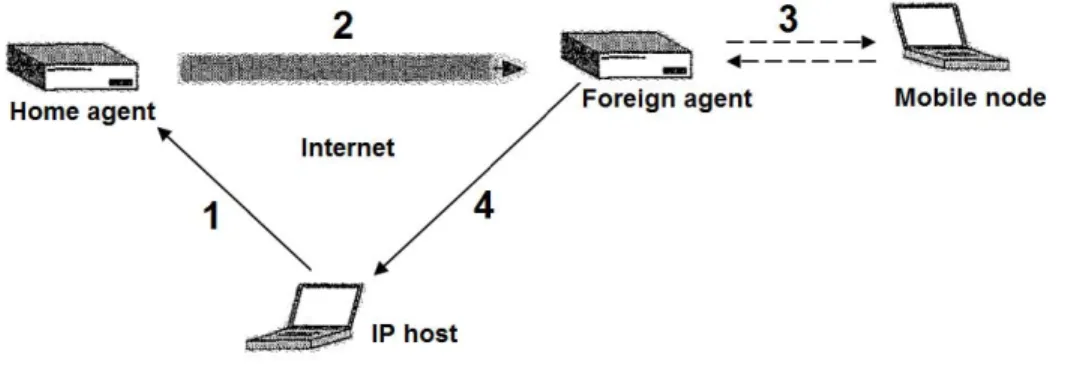
The home-foreign-domain model [9] provides a key distribution method and an authen-tication approach for inter-network handovers in the Global System for Mobile Commu-nications (GSM) [10], Universal Mobile Telecommunication System [11], and mobile IP networks [12]. The trust between a client and a foreign network is based on a bilateral roaming agreement and real-time interactions between the client’s home network and the foreign network. To access a foreign network, a client’s subscriber identity module (SIM) card and the authentication center of the client’s home network are pre-installed with a shared secret key K. The foreign network must communicate with the client’s home network to obtain the shared keyK in order to authenticate the mobile client.
In mobile IP and cellular networks, the client and the foreign base station (access point) communicate via a one-hop wireless link. Furthermore, the communication be-tween the foreign base station and the client’s home network is via high speed wired connections. Therefore, the handover latency is acceptable in these networks.
In wireless ad hoc networks such as WMNs, the connection between two access points (or between an access point and its authentication server) could all be wireless and through multiple hops. As mentioned above, the delivery latency of a message via a five-hop wireless connection can be up to 0.8 seconds. Given several messages involved in an authentication, the authentication latency incurred by the home-foreign domain handover approach can be unacceptably long in a wireless ad hoc network.
The above limitation of the home-foreign domain handover approach necessitates he development of a new security architecture and algorithms for handovers among multiple WMNs. We propose a scalable system architecture, a new trust establishment model, and certificates for inter-network handovers between WMNs. Our new architecture and trust model do not require a mobile device to be bound to its home network. A mobile client and a foreign network trust each other through via their respective certificates issued by certificate agents. Thus, a foreign network does not need to communicate with a client’s home network when authenticating a client, but instead verifies the validity of an inter-network transfer certificate.
We propose a suite of fast authentication and key distribution protocols that are resource-efficient and resilient to attacks for inter-network handovers. The authentica-tion server of a foreign network does not need to be involved in the handover authenti-cation process. Instead, a MAP in the foreign network directly authenticates a mobile client, which avoids multi-hop wireless communications and thus minimizes the authen-tication latency. Numerical analysis and simulation results show that our inter-network
authentication and key distribution protocols significantly reduce the authentication la-tency during the inter-network handover process compared with the home-foreign domain authentication approach.
1.1.3 Efficient Group Key Management for Wireless Mesh Access Points
Multicast is a form of communication that delivers information from a source to a set of destinations simultaneously in an efficient manner; the messages are delivered over each link of the network only once and only duplicated at branch points, where the links to the destinations split. Important applications of multicast include distribution of financial data, billing records, software, newspapers, pay-per-view movies; audio/video conferencing; distance learning; and distributed online games. Although multicast is required to support many important applications, research on multicast in WMNs is still in its infancy. We address one of the most essential issues of multicast in WMNs − security. In particular, we focus on the issue of group key management in WMNs.
Given a multicast group, in order to ensure that only authorized users can access the multicast data, the data are encrypted using a cryptographic key known as the group key. The group key is known only to authenticated and authorized members of the multicast group. Every time a membership change occurs, the group key must be changed to ensure backward and forward secrecy. Backwards secrecy guarantees that a new user joining the multicast group does not have access to any old keys. This ensures that a member cannot decrypt messages sent before it joins the group. Forward secrecy requires that a member
leaving the group does not have access to any future keys. This ensures that a member cannot decrypt future messages after it leaves the group. Group key management refers to the actions taken to update and distribute the group key upon members joining and leaving a multicast group.
IEEE 802.11s, the wireless mesh network standard, employs the same security archi-tecture as IEEE 802.11i, the standard specifying security mechanisms for wireless local area networks (WLANs). In a WMN, a mesh access point (MAP) shares a pairwise key with each mobile device it is connected to. In addition, the MAP shares a group key with all the trusted mobile devices associated with the MAP so that it can send multicast and broadcast data to this trusted group. When a client joins (or leaves) the WMNs, the MAP has to update the group key to ensure backward (or forward) secrecy. The MAP generates a new group key, encrypts it using the pairwise key the MAP shares with each trusted member, and sends the new group key to the members one by one. Thus, the communication cost of a group key update isO(n), where nis the number of associated members. As the group size becomes large, the rekeying latency becomes unacceptable, especially for real-time applications.
We apply the logical key hierarchy (LKH) [13] and one-way function tree (OFT) [14] algorithms to group key management (GKM) at the data link layer to improve its rekeying performance. Specifically, we incorporate the LKH and OFT algorithms into the GKM operations of an access point and its associated mobile devices. We provide numerical analysis that shows that the LKH and OFT algorithms reduce the rekeying latency in
WMNs from linear time to logarithmic time. We also present simulation results obtained from various network conditions under realistic settings that show that the LKH and OFT algorithms dramatically improve the rekeying performance compared with the original GKM operations of IEEE 802.11.
1.2 Thesis Organization
The remainder of the thesis is organized as follows. We provide a review of related work in Chapter 2. In Chapter 3, we present a suite of authentication protocols that support fast intra-network handovers in a WMN. In Chapter 4, we present a suite of new security protocols to minimize the inter-network handover latency. In Chapter 5, we present a new implementation of group key management at the data link layer to minimize the key update latency. We conclude the thesis, and outline future research directions in Chapter 6.
Chapter 2
Literature Review
This chapter begin with background information on wireless communication, followed by a review of cryptographic techniques and security threats. We then provide a review of security models and trust management in wireless networks, followed by an overview of the IEEE 802.11i security standard. Lastly, we present a survey of security protocols for intra-network and inter-network handovers, followed by a literature review of group key management.
2.1 Overview of Wireless Communications
In this section, we provide an overview of wireless communications with an emphasis on transmission and interference range, hidden terminal and exposed terminal problems, medium access mechanisms and spread spectrum technologies.
2.1.1 Transmission Range and Interference Range
Successful transmission and reception of a signal mainly depends on the transmission range and the interference range [27]. Assuming a concentric dissemination, a transmis-sion range constitutes the range where a signal can be correctly received. An interference range is the range within which stations in receive mode can be “interfered with” by an unrelated transmitter and thus suffer a loss of packets.
Figure 2.1: Transmission range and interference range
Figure 2.1 shows an example of the transmission and interference ranges of a node
D where the solid line denotes its transmission range, and the dotted line depicts its interference range. Assume that node D and E are within each other’s transmission range and node F is between D’s transmission and interference range. If node E and node F send packets at the same time to nodeD, node F can disturb the transmission from nodeE to nodeD. The interference range of nodeDtherefore includes all positions of nodeF that can damage E’s packets being sent to nodeD.
While the transmission range of a node mainly depends on its signal propagation function, its interference range may not to be able to be foreseen, and depends on pa-rameters such as signal strength or reflection, and may change frequently. This effect is known from practical implementations on data transmission.
2.1.2 Hidden Terminal and Exposed Terminal Problems
In wireless communications, a channel represents a band of frequencies over which signals are carried from sources to destinations. A radio antenna is capable of sending or receiving signals on a specific channel. Wireless is a shared medium and wireless devices share the same air space. This can lead to collisions if more than one device tries to send to the same receiver on the same channel.
Consider the scenario with three wireless mobile devices, as shown in Figure 2.2. The transmission range ofA reaches B, but notC. The transmission range of C reaches B, but notA. Finally, the transmission range ofB reaches bothA and C.
In the scenario shown in Figure 2.2, A starts sending packets to B. C does not receive this transmission. Calso wants to send packets toB and senses the medium. The medium appears to be free asAis out ofC’s range andC cannot sense the packets being sent from A to B. Hence, C also starts sending packets simultaneously to B, causing a collision atB. A cannot detect this collision atB and continues with its transmission. A
ishidden fromC and vice versa.
While hidden terminals may cause collisions, the following problem may cause un-necessary delay. Assuming the same orientation as shown in Figure 2.2, consider the situation thatB sends packets toAandC wants to transmit data to some other wireless mobile device outside the interference range ofAandB. C senses the carrier and detects that the carrier is busy (B’s signal). C postpones its transmission until it detects the medium is idle again. However, as A is outside the interference range of C, waiting is not necessary. A ‘collision’ at B fromC’s transmission to another device is too weak to propagate toA, and will not interfere withB’s transmission to A. In this situation, C is
exposed toB.
2.1.3 Medium Access Mechanisms
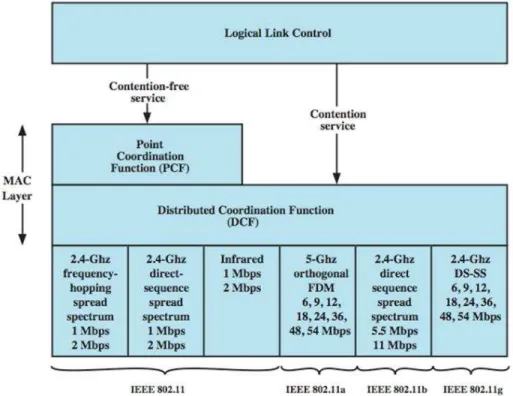
The IEEE 802.11 standard defines two methods in which an IEEE 802.11 radio card may gain control of the half-duplex medium. The default method, Distributed Coordination Function (DCF), is a random access method determining who gets to transmit on the wireless medium next. The other medium access control method called Point
Coordi-nation Function (PCF), where the access point briefly takes control of the medium and polls the stations served by the AP. DCF uses a contention-based algorithm to provide access to all traffic, which includes two methods, CSMA/CA (Carrier Sense Multiple Access/Collision Avoidance) and DCF with RTS/CTS (Request to Send/Clear to Send). The PCF and DCF sub-layers are shown in Figure 2.3.
Figure 2.3: IEEE 802.11 protocol architecture
In IEEE 802.11 standards, carrier sensing is the primary method used to avoid colli-sions. Carrier sensing is accomplished by simply measuring the amount of energy received on the channel. If that energy is above a certain threshold, the sensing node determines
that another node is currently transmitting and that it must remain wait for the channel to become free/available.
Along with carrier sensing, inter-frame space (IFS) is primarily used to ensure that the channel is truly free. When a node is sensing the channel, the channel must be free for the length of the distributed coordination function IFS (DIFS) period. The DIFS is the longest inter-frame space, used as a minimum delay for asynchronous frames contending for access. The SIFS is the shortest waiting time for medium access and used as the wait time between the Request to Send (RTS), Clear to Send (CTS), DATA, and acknowledgement (ACK) frames. Since the SIFS is always shorter than the DIFS, this ensures that another node does not incorrectly determine that the channel is idle during the handshake and that priority is given to the transmission in progress.
In the following subsections, we discuss two medium access mechanisms in DCF, CS-MA/CA (Carrier Sense Multiple Access/Collision Avoidance) and RTS/CTS/Data/ACK.
2.1.3.1 CSMA/CA
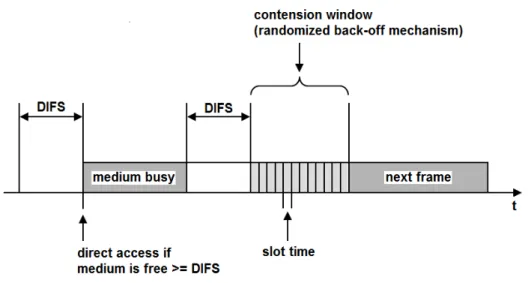
Carrier sense with multiple access and collision avoidance (CSMA/CA) is a media ac-cess control (MAC) layer mechanism used by IEEE 802.11 wireless local area networks (WLANs). CSMA/CA is a random access scheme with carrier sense and collision avoid-ance through random backoff. The basic CSMA/CA mechanism is shown in Figure 2.4. If the medium is idle for at least the duration of the DCF (distributed coordination function) inter-frame spacing (DIFS), a node can access the medium right away.
Figure 2.4: CSMA/CA
If the medium is busy, nodes have to wait for the duration of the DIFS, entering a contention phase afterwards. Each node chooses a random backoff time within a con-tention window and starts counting down its backoff timer. The backoff timer stores a node’s residual backoff times. The node continues to sense the medium. If a node senses the channel is busy, it has to wait for the next chance until the medium is idle again. If a certain station does not get access to the medium in the first cycle, it stops its backoff timer, waits for the channel to be idle again for the DIFS duration and starts the counter again. As soon as the counter expires, the node accesses the medium. This means that deferred stations do not choose a randomized backoff time again, but continue to count down. Stations that have waited longer have an advantage over stations that have just entered, in that they only have to wait for the remainder of their backoff timer from the previous cycles. Thus, this randomly distributed delay helps to avoid collisions;
other-wise all stations would try to transmit data after waiting for the medium to become idle again. CSMA/CA reduces the probability of collision among nodes, but it cannot avoid the hidden terminal problem.
2.1.3.2 RTS/CTS/Data/ACK
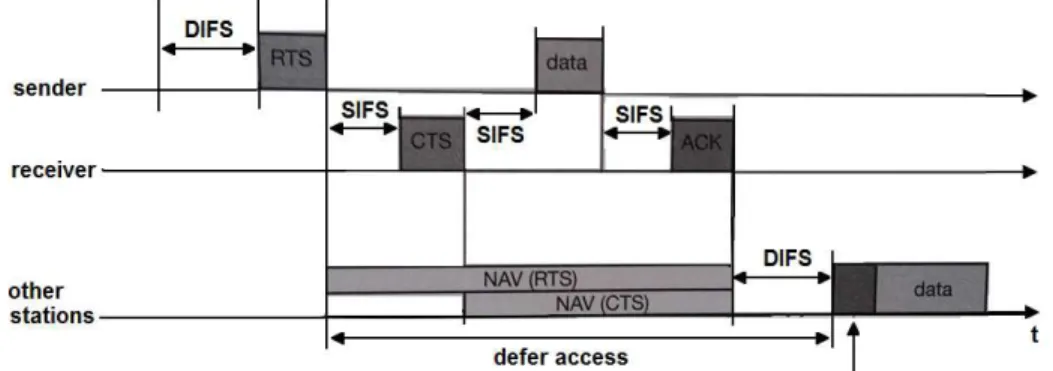
To solve the hidden terminal problem discussed in Section 2.1.2, the IEEE 802.11 WLAN standard defines a medium access control mechanism using two control packets RTS and CTS. Acknowledgements are added for enhanced reliability. Figure 2.5 illustrates the use of RTS, CTS, data and acknowledgement (ACK).
Figure 2.5: DCF with RTS/CTS/Data/ACK
After waiting for the DIFS duration (plus a random backoff time if the medium was busy), the sender issues a RTS control packet. The RTS packet includes the receiver’s address of the data transmission to come and the duration of the whole data transmission. This duration specifies the time interval necessary to transmit the whole data frame and the acknowledgement (ACK) related to it. Every node receiving this RTS has to set its
network allocation vector (NAV) in accordance with the duration field. The NAV then specifies the earliest point at which the station can try to access the medium again.
If the receiver of the data transmission receives the RTS, it answers with a CTS message after waiting for a short inter-frame spacing (SIFS) interval. The CTS packet contains the duration field. All stations receiving this packet from the receiver of the intended data transmission have to adjust their NAV. The latter set of receivers need not be the same as the first set receiving the RTS packet. All nodes have to wait be-fore accessing the medium. Thus, this mechanism reserves the medium for one sender exclusively.
Finally, the sender can send the data after a SIFS interval. The receiver waits for a SIFS period of time after receiving the data packet and then acknowledges whether the transfer was correct. When the transmission completes, the NAV in each node marks the medium as free and the standard cycle can start again.
When using RTS and CTS to avoid the hidden terminal problem, collisions can only occur at the beginning while the RTS is sent. This is because two or more stations may start sending at the same time (RTS or other data packet).
The above RTS/CTS mechanism is only used in unicast communications, but not used in multicast communications. There currently does not exist an effective algorithm for implementing RTS/CTS mechanism in multicast communications for the following two reasons. First, CTS packets sent by the multicast neighbors of a transmitter have a very high probability of colliding at the transmitter. More importantly, it may not be possible
for all the multicast neighbors to agree on a common time slot for the transmission of a packet, or the delay would be very long to reach such an agreement. Therefore, all multicast implementations in wireless networks so far have used only CSMA/CA without RTS/CTS.
2.1.4 Overview of DSSS and OFDM
The IEEE 802.11 standard specifies two modulation methods, which are direct-sequence spread spectrum (DSSS) and orthogonal frequency-division multiplexing (OFDM) [28]. IEEE 802.11 introduces DSSS as a technology to minimize the interference for the 2.4 GHz frequency band, while IEEE 802.11a uses OFDM modulation to control interference in the 5 GHz frequency band. DSSS supports the transmission rate up to 11Mbit/s at the physical layer, while OFDM supports the transmission rate up to 54Mbits/s.
2.1.4.1 Direct Sequence Spread Spectrum (DSSS)
Direct sequence spread spectrum (DSSS) is a spread spectrum modulation technique. In DSSS, the original data signal is multiplied with a pseudorandom noise spreading code. DSSS provides stronger protection against interfering signals, and makes the interfering signal less perceptible. DSSS also provides security of transmission if the code is not known to the public, which makes it very popular in military applications.
When transmitting data using DSSS, the required data signal is multiplied with what is known as a spreading or chip code data stream. Figure 2.6 shows spreading with
DSSS. The resulting data stream has a higher data rate than the data itself. The data is multiplied using the XOR (exclusive OR) function.
Figure 2.6: Spreading with DSSS
Each bit in the spreading sequence is called a chip, and this is much shorter than each information bit. The spreading sequence or chip sequence has the same data rate as the final output from the spreading multiplier. The rate is called the chip rate, and this is often measured in terms of a number ofM chips/second.
The baseband data stream is then modulated onto a carrier. Figure 2.7 shows the process of DSSS generation. In this way the overall signal is spread over a much wider bandwidth than if the data had been simply modulated onto the carrier. The reason is that signals with high data rates occupy wider signal bandwidths than those with low data rates.
To decode the signal and receive the original data, the signal is first demodulated from the carrier to reconstitute the high speed data stream. Demodulating the received signal
Figure 2.7: DSSS Generation
is achieved using the same carrier as the transmitter and reversing the modulation. The result is a signal with approximately the same bandwidth as the original spread spectrum signal. Additional filtering can be applied to generate the original signal. The receiver then uses the same chip sequence to reconstruct the original data. Figure 2.8 shows the process of DSSS decoding.
Figure 2.8: DSSS decoding
It is possible to transmit several sets of data independently on the same carrier and then reconstitute them at the receiver without mutual interference. This way a base station can send data to several mobile devices on a single channel. Similarly several mobile devices can send data to a single base station, provided that in each case an independent spreading code is used.
2.1.4.2 Orthogonal Frequency Division Multiplexing (OFDM)
Orthogonal Frequency Division Multiplexing or OFDM is a modulation format that is being used for many of the latest wireless and telecommunications standards, such as IEEE 802.11a, 802.11b, 802.11g, 802.11n, 802.11ac and more.
OFDM is a form of multi-carrier modulation. OFDM works by splitting the radio signal into multiple smaller sub-signals that are then transmitted simultaneously at dif-ferent frequencies to the receiver. It is necessary for a receiver to be able to receive the whole signal to be able to successfully demodulate the data. As a result, when signals are transmitted close to one another, they must be spaced so that the receiver can separate them using a filter, and there must be a guard band between them. Figure 2.9 shows the traditional view of receiving signals carrying modulation. On the other hand, the sidebands overlap from each carrier in OFDM as shown in Figure 2.10. The sidebands in OFDM can still be received without the interference because they are orthogonal to each another. This is achieved by having the carrier spacing equal to the reciprocal of the symbol period.
Figure 2.10: OFDM Spectrum
The data to be transmitted on an OFDM signal is divided over a large number of radio frequencies. Each radio frequency carries only a small portion of the total amount of data. This reduces the data rate taken by each carrier. The lower data rate has the advantage that interference from reflections is much less critical. This is achieved by adding a guard band time or guard interval into the system. This ensures that the data is only sampled when the signal is stable and no new delayed signals arrive that would alter the timing and phase of the signal.
The distribution of the data across a large number of carriers in the OFDM signal has some further advantages. Nulls caused by multi-path effects or interference on a given frequency only affect a small number of the carriers, the remaining ones being received correctly. By using error-coding techniques, which does mean adding further data to the transmitted signal, it enables many or all of the corrupted data to be reconstructed within the receiver. This can be done because the error correction code is transmitted in a different part of the signal.
Thus, using OFDM makes the transmitted signal robust against frequency selective interference and fading, such as multipath fading. If frequency selective fading occurs on the radio channel, only a small portion of the data is affected, while in a broadband transmission with all data on a single carrier the complete radio-frequency signal would be affected.
One requirement of the OFDM transmitting and receiving systems is that they must be linear. Any non-linearity will cause interference between the carriers as a result of inter-modulation distortion. This will introduce unwanted signals that would cause interference and impair the orthogonality of the transmission.
2.2 Overview of Cryptography
Cryptography is defined as the study of mathematical techniques related to aspects of information security such as confidentiality, data integrity, and authentication [15]. The use of cryptographic techniques offers:
• confidentiality: ensuring that no one can read the message except the intended receiver;
• data integrity: assuring the receiver that the received message has not been altered; • authentication: proving the identity of the user;
A goal of cryptography is to adequately address the above four criteria in both theory and practice. Cryptography is about the prevention and detection of any malicious activ-ity. In this section, we will discuss major cryptographic techniques, namely, encryption and decryption, digital signatures, and message authentication codes.
2.2.1 Encryption Schemes
In cryptography, encryption is the process of encoding messages in such a way that others cannot read it, but authorized parties can. An encryption scheme is an effective approach to achieve confidentiality. In an encryption scheme, a message is encrypted using an encryption algorithm, turning it into an unreadable ciphertext. This is usually done with the use of an encryption key, which specifies how the message is to be encoded. Any adversary that can see the ciphertext should not be able to determine anything about the original message. An authorized party, however, is able to decode the ciphertext using a decryption algorithm that usually requires a decryption key. There are two types of encryption schemes: symmetric-key encryption and public-key encryption [16].
2.2.1.1 Symmetric-key Cryptography
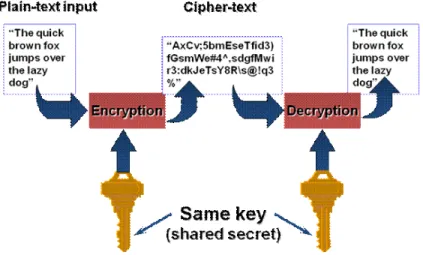
Symmetric-key algorithms use a single secret key to encrypt and decrypt messages, as shown in Figure 2.11. Thus communicating parties must agree on the same secret key before they wish to communicate with each other.
follows:
(1) The key generation algorithmG is a randomized algorithm that returns a stringK. Let Keys(SE) denote a set of all strings that have non-zero probability of being output by G. The members of this set are called keys. We write K ←R− G for the operation of executingGand let K denote the key returned.
(2) The encryption algorithm E takes the key K ∈ Keys(SE) and a plaintext M ∈ {0,1}∗ to return a ciphertext C ∈ {0,1}∗ denoted as C←R−E
K(M).
(3) The decryption algorithmDtakes a keyK ∈Keys(SE) and a ciphertextC∈ {0,1}∗ to return the plaintextM ∈ {0,1}∗ denoted as M ←D
K(C).
2.2.1.2 Public-key Cryptography
Public-key encryption algorithms use a private key that is known only to its owner and a public key that can be made known to anyone. The public key and the private key are mathematically linked. Data encrypted with a public key can be decrypted only with its corresponding private key and vice versa.
Each useruin the network has a pair of keyshPu, Suiassociated with him. The public keyPu is accessible to everyone, and the private-keySu is known only to useru. A public and private key pair is generated by running a key-generation algorithm. To send a secret messageM to useru, the sender first encrypts messageM into a cipher textC =EPu(M)
using u’s public key Pu and a public encryption algorithmE, and then sends the cipher textC to useru. E is a public encryption algorithm. Upon receiving cipher textC, user
ucan decrypt the message by using his private key Su and computing DSu(C), where D
is a decryption algorithm. Clearly, for this to work we need thatDSu(EPu(M)) =M.
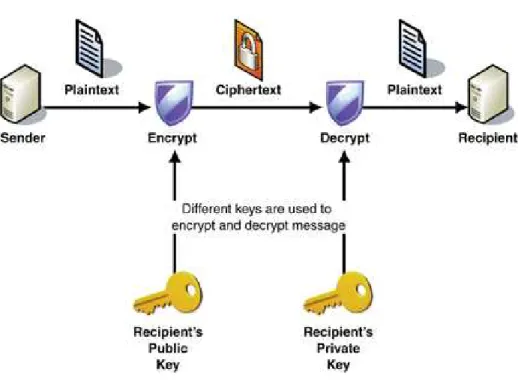
Figure 2.12 shows the public-key encryption and decryption process. Two parties (sender and recipient) use public-key encryption as follows. If the sender wants to send to the recipient an encrypted message, he uses the recipient’s public key to encrypt the message. For example, Bob wants to send a message to Alice. Bob first encrypts the message using Alice’s public key and then sends the encrypted message to Alice. When receiving the encrypted message, Alice decrypts the encrypted message using her private key.
inter-Figure 2.12: Public key encryption and decryption
cept the encrypted message from Bob. However, the unauthorized user cannot retrieve the original message since the encrypted message can only be decrypted with Alice’s pri-vate key, which is known only to Alice. If Alice wants to send a message back to Bob, she encrypts her message using Bob’s public key. Bob then decrypts the message using his private key.
A public-key encryption scheme is a triplet (G, E, D) of algorithms (key generation, encryption, and decryption) which are required to satisfy the following conditions [16]:
(1) Key generation algorithm: an algorithmGproduces a pair (Pu, Su), wherePuis called the public key, andSu is the corresponding private key. We also refer to (Pu, Su) as a pair of encryption/decryption keys.
(2) Encryption algorithm: an algorithm E takes as inputs a public-key Pu and a string
M ∈ {0,1}k called the message, and produces as output a string C ∈ {0,1}∗ called the ciphertext. The notationC∈EPu(M) denotesCbeing an encryption of message M using keyPu.
(3) Decryption algorithm: an algorithmDtakes as inputs a private-keySu and a cipher-textCfrom the range ofEPu(M), and produces as output a stringM0∈ {0,1}∗, such that for every pair (Pu, Su), for everyM, for everyC ∈D(Pu, M), the probability for the decryption resultDSu(C) being not equal to the output stringM0 is negligible.
2.2.1.3 Symmetric-key vs. Public-key Cryptography
Symmetric-key cryptography uses a single key for both encryption and decryption. It is easier to implement, and generally requires less processing power. On the other hand, public-key cryptography uses different keys for encryption and decryption. The decryp-tion key cannot be calculated from the encrypdecryp-tion key. Public-key encrypdecryp-tion is normally used to encrypt other keys for subsequent communications. Symmetric-key cryptograph is well suited for performing cryptographic transformations on large streams of data because symmetric key encryption is computationally less expensive than public-key encryption given equivalent levels of security.
Symmetric-key cryptography requires a sender and a receiver to agree on a key before data transmission. The security of the cryptographic algorithm lies solely with the key. Symmetric-key cryptography incurs high costs for key creation and maintenance. For
example, given M people, the total of M2 keys have to be created/maintained. On the other hand, the public-key cryptography only requires to maintain M pair of keys. The drawbacks of public-key cryptography is that it is more computationally expensive compared with most symmetric-key algorithms of equivalent security, and also requires the use of large keys. These drawbacks makes it cost prohibitive to send large amounts of data using public-key encryption.
Since both symmetric and public key cryptography have their own advantages, file transfer systems typically employ a hybrid of the two, such as SSL (secure socket layer) used in FTPS (file transfer protocol secure) and HTTPS (hypertext transfer protocol secure), or SSH (secure shell) used in SFTP (secure file transfer protocol). Hybrid cryp-tosystems employed in an FTPS or SFTP server use public keys to initially encrypt symmetric keys known as session keys. The session keys are then used to encrypt the actual data. A session key is only used in one session. After the session, the key is simply discarded. If a session key is compromised, only the data sent within that particular session will be at risk.
2.2.2 Public Key Cryptography
Public key cryptography can be used to provide a secure method for exchanging secret keys. Two of the most common key exchange algorithms are the Diffie-Hellman key agreement algorithm and RSA key exchange process. Diffie-Hellman and RSA are two most popular public key algorithms in use today.
2.2.2.1 Diffie-Hellman Key Agreement
In 1976, Whitfield Diffie and Martin Hellman published the Diffie-Hellman algorithm for key exchange [96]. This was the first published use of public key cryptography. The Diffie-Hellman key exchange algorithm was the first practical method for establishing a shared secret over an unsecured communication channel.
The effectiveness of the Diffie-Hellman key agreement algorithm depends on the diffi-culty of computing discrete logarithms. Figure 2.13 shows the basic Diffie-Hellman Key Agreement process.
Figure 2.13: Diffie-Hellman key agreement
• Alice and Bob agree on a prime number p and a base g, which is a primitive root modulop.
• Bob chooses a secret numberb, and sends Alicegbmodp. • Alice computes (gbmodp)amodp=gab modp.
• Bob computes (gamodp)amodp=gabmodp.
Both Alice and Bob then use the numbergab modpas their shared key for confidential communications.
However, the Diffie-Hellman algorithm is vulnerable to man-in-the-middle attacks as there is no authentication in place before keys are exchanged. Therefore, the algorithm is usually used in combination with an additional authentication method, such as digital signatures. For example, IPsec uses the Diffie-Hellman algorithm in conjunction with RSA authentication to exchange a session key that is used for encrypting all traffic that crosses an IPSec tunnel.
The Diffie-Hellman algorithm is not intended for use as a general encryption scheme. Its purpose is to transmit a shared key across an insecure medium.
2.2.2.2 RSA Key Exchange
In the year following the Diffie-Hellman proposal, Ron Rivest, Adi Shamir, and Leonard Adleman proposed another public key encryption system, which is now known as the Rivest-Shamir-Adleman (RSA) algorithm [97]. The RSA algorithm shares many simi-larities with the Diffie-Hellman algorithm in that RSA is also based on multiplying and factoring large integers. However, RSA is significantly faster than Diffie-Hellman algo-rithm [98]. The RSA algoalgo-rithm can be used for digital signatures, key exchanges and
encryption. It is built into software such as Microsoft, Apple and Novell products. It has also been implemented into hardware such as network interface cards and smart cards.
For RSA key exchange, secret keys are exchanged securely online by encrypting a secret key with the intended recipient’s public key. Only the intended recipient can decrypt the message to retrieve the secret key because the decryption requires the use of the recipient’s private key. Therefore, a third party who intercepts the encrypted shared secret key cannot decrypt the message without the knowledge of the intended recipient’s private key. Figure 2.14 illustrates the basic RSA key exchange process.
Figure 2.14: Basic RSA Key Exchange
2.2.2.3 Diffie-Hellman vs. RSA Key Exchange
Hellman and RSA are both based on supposedly intractable problems. While Diffie-Hellman is based on the difficulty of exponentiation and modular arithmetics, RSA is based on the difficulty of factoring large numbers. With keys of 1,024 bits long, Diffie-Hellman and RSA give comparable levels of security [98].
In terms of computation time, the RSA encryption using public keys is substantially faster than any Diffie-Hellman operation. The RSA decryption using private keys entails more or less the same amount of work as the Diffie-Hellman key exchange with similar resistance [98]. Therefore, we choose RSA rather than Diffie-Hellman for key exchanges in our proposed authentication protocols to support fast intra-network and inter-network handovers.
2.2.3 Digital Signatures
A digital signature gives a recipient reasons to believe that the message was created by a known sender and that the message was not altered in transit [16]. Digital signatures ensure the integrity, authentication, and non-repudiation of a message.
A digital signature is a hash value that has been encrypted with the sender’s private key. A hash value (often called a message digest) is derived from the original text of the message. The act of signing just means the hash value was encrypted with a private key. The hashing function ensures the integrity of the message, and the signing of the hash value provides authentication and non-repudiation.
Following are the available cryptographic methods to provide different types of secu-rity services:
• A message can be encrypted, which provides confidentiality. • A message can be hashed, which provides integrity.
non-repudiation.
• A message can be encrypted and digitally signed, which provides confidentiality, integrity, authentication, and non-repudiation.
Figure 2.15: Digital signature generation and verification
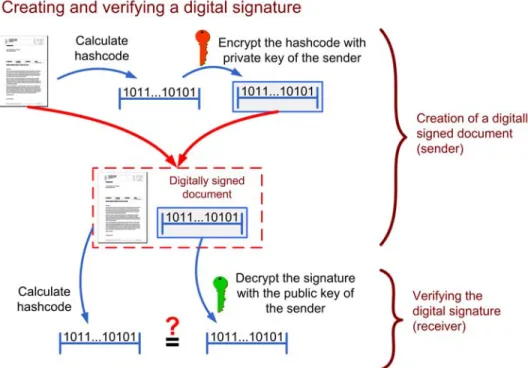
Figure 2.15 shows a digital signature generation and verification process. Assume two users have agreed upon a hash function and a key for the signature verification process in advance. If Alice wants to send a digitally signed message to Bob, Alice will perform the following steps:
• Encrypting the message digest using her private key (This encrypted message digest is the digital signature.)
• Transmiting the message and the digital signature to Bob Upon receiving the digitally signed message, Bob will: • generate a new digest for the received message
• decrypt the attached digital signature using Alice’s public key • compare the value he calculated with the value he decrypted
If Alice’s digital signature can be verified, the following can be assumed:
• Bob is assured that the message was not modified. If even one bit of the original message was changed, the digest generated using the received message would differ from the decrypted value, and cause the signature verification process to fail. • Bob is assured that Alice sent the message. Public key transformation functions
cannot be duplicated by any practical means; therefore, only a signature generated by the originator’s private key can be correctly decrypted using the originator’s public key.
Although the integrity of the message is assured, there is no authentication supporting non-repudiation unless Alice’s public key can be proven to belong to Alice only.
For example, if Sue were able to establish an alias for herself as Alice, she might masquerade as Bob’s friend Alice. This problem is resolved by using an authentication
service. An authentication server is a third party who vouches for the identity of a public key owner using a public key infrastructure (PKI). A PKI provides the public-key encryption and digital signature services necessary to verify, enroll, and certify users of a secure application.
2.2.4 Message Authentication Code
Another technique to ensure data integrity is message authentication codes (MACs). Unlike digital signatures, MAC values are both generated and verified using the same key. This implies that the sender and receiver of a message must agree on a shared key before initiating communication.
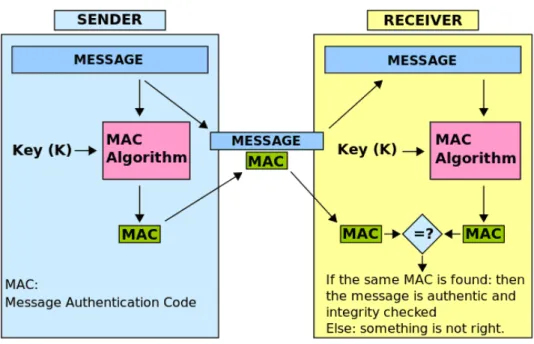
The process of MAC generation and verification is shown in Figure 2.16. The sender of a message executes a MAC algorithm to produce a MAC value. The message and a key shared by the sender and receiver are the inputs to the algorithm. The message and the MAC value are then sent to the receiver. The receiver in turn runs the message of the transmission through the same MAC algorithm using the same key, producing a second MAC value. The receiver then compares the first MAC received to the second generated MAC. If they are identical, the receiver can safely assume that while in transit the message was not altered.
A message authentication code M A = (G, τ, ν) results from three algorithms, as follows [16]:
Figure 2.16: The use of MAC algorithm
denoted as K←R−G.
(2) The MAC algorithm τ is an algorithm that takes the key K and a message M to return a MAC valueσ; denoted as σ←τK(M).
(3) The verification algorithmν is an algorithm that takes the keyK, a messageM, and a MAC value τ for M to return a verification result d, which is a one-bit message indicating if the verification is successful and denoted as d←νK(M, τ).
The cryptographic security goal of a MAC is to ensure integrity and authentication. Digital signatures provide non-repudiation property in addition to integrity and authen-tication. Digital signatures are usually slower than MACs, and thus used only when there is not yet a shared secret or the non-repudiation property is required. Thus, we
choose MACs in our proposed authentication protocols to support fast intra-network and inter-network handovers.
2.3 Security Threats
In this section, we review major security threats encountered in WMNs [18, 19].
(1) Physical Threats
Routers of a WMN are usually deployed outdoors, such as the roofs of buildings, or on street lamps. They are thus vulnerable to attacks, such as tampering with information inside routers, stealing private keys stored in routers, or even replacing a router with a rogue router. Therefore, physical protection of routers in a WMN is very important.
(2) Jamming Attacks
Jamming is a type of attack which interferes with the radio frequencies that a node uses for communications. A jamming source could be powerful enough to disrupt communication in the entire network. Even with less powerful jamming sources, an adversary can potentially disrupt communication in the entire network by strategi-cally distributing the jamming sources. Jamming attacks in WMNs may happen very often since this type of attack can be launched without much effort and sophistication.
(3) Threats to Routing Protocols
Many of these threats require packet injection with specialized knowledge of the routing protocol. We summarize these threats below.
• In a black-hole attack, an attacker creates forged packets to impersonate a valid router and subsequently drops packets resulting in high packet loss rates. • In a grey-hole attack, an attacker creates forged packets to selectively drop routes
or inspect network traffic.
• In a worm-hole attack, routing control messages are replayed from one network location to another, which can severely disrupt routing.
• In a route error injection attack, an attacker disrupts routing by injecting forged route error messages to break mesh links. Relative to other routing attacks, this attack conceivably has higher exploitability because it does not require detailed knowledge of the routing protocol state model.
(4) Identity Privacy Attack
Users would like to remain anonymous while roaming in different parts of the network for privacy reasons. To protect clients’ privacy, client IDs are numbers or strings that should not relate to the clients’ real identities, much like bank account numbers or social security numbers.
(5) Forgery Attack
Forgery usually describes a message-related attack against a cryptographic digital sig-nature scheme. An attacker tries to fabricate a digital sigsig-nature for a message without
having access to the respective signer’s private signing key, which is called a forgery attack. There are three types of forgery: existential, selective, and universal [17]. Existential forgery is the creation (by an attacker) of at least one message/signature pair where the signature was not produced by the legitimate signer. Existential forgery is essentially the weakest adversarial goal. As long as the pair of message and signature is valid, the attacker has succeeded in constructing an existential forgery. Selective forgery is the creation (by an attacker) of a message and signature pair where the message has been chosen by the attacker prior to the attack. The message may be chosen to have interesting mathematical properties with respect to the signature algorithm. However, in selective forgery, the message must be fixed before the start of the attack.
Universal forgery is the creation (by an attacker) of a valid signature for any given message. An attacker capable of universal forgery is able to sign messages he chose himself (as in selective forgery), messages chosen at random, or even specific messages provided by an opponent.
Besides the above forgery attacks, there is also a total break: when an attacker can compute the signer’s private key and therefore forge any possible signature on any message.
(6) Space-time Trade-off Attack