Kavitha. K, et al. J Sci Res Pharm, 2018;7(7):84-91
World Inventia Publishers
J
ournal of
S
cientific
R
esearch in
P
harmacy
http://www.jsrponline.com/
Vol. 7, Issue 7, 2018 ISSN: 2277-9469
USA CODEN: JSRPCJResearch Article
STABILITY INDICATING RP-HPLC METHOD FOR ESTIMATION OF THIOCOLCHICOSIDE IN
PARENTERAL DOSAGE FORMS
Kavitha. K 1 *, Kumar. P 1, Manjula Devi A.S 2
1 Department of Pharmaceutical Chemistry, Grace College of Pharmacy, Kodunthirapully, Athalur, Palakkad, Kerala, INDIA.
2 Department of Pharmaceutical Analysis, College of Pharmacy, Sri Ramakrishna Institute of Paramedical Sciences, 395, Sarojini Naidu road,
Coimbatore, Tamil Nadu, INDIA.
Received on: 08-07-2018; Revised and Accepted on: 29-07-2018
ABSTRACT
A
rapid, simple, precise stability indicating RP-HPLC method for the determination of thiocolchicoside on C18 column (250mm × 4.0mm,5µm) have been developed. A mobile phase consisting of ammonium acetate: methanol (50:50) was used. The flow rate was 0.8ml/min by UV detection at 256 nm. The specificity of the method was ascertained by forced degradation studies by alkali, acid degradation and oxidation, photolysis. Beer law was obeyed over the range of 1-10µg/ml, correlation co efficient as 0.9996. This method was also successfully applied for routine analysis of thiocolchicoside in parenteral dosage forms.
KEYWORDS: RP-HPLC, Thiocolchicoside, Forced degradation, Stability, Parenteral dosage form.
INTRODUCTION
T
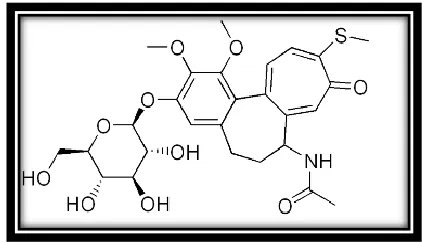
hiocolchicoside is (s)-N-{3-(BD-glucopyranoxyloxy)- 5,6,7,9-tertrahydro-1,2-dimethoxy-10-(methylthio)9-oxobenzo-{a}heptalen-7yl}acetamide, sulfur derivative of cochicoside (Fig-1),and also which exhibiting the non-sedating muscle relaxant action [1]. Itschemical formula C10 H2 NO7, mode of action includes modulation of
chemokine and prostanoid production, inhibition of neutrophil and endothelial cell adhesion molecules by interferes the iniation, amplification of the joint inflammation [2, 3]. Moreover it has selective
affinity for y-amino –butyric acid (GABA) receptors which acts on the muscular contracture by activating the GABA- inhibitory pathways, there by which acting as a potent muscle relaxant [4].
The significance of stability testing is to provide evidence on how the quality of a drug substance or drug product varies with time under the influence of a variety of environmental factors such as temperature, humidity, and light, enables recommendation of storage conditions, retest periods, and shelf lives to be established. The principal aspects of drug products that play an important role in shelf life determination of formulation are assay and dissolution of active drug and degradants generated during the stability study. The assay of drug product in stability test sample needs to be determined using stability indicating method, as recommended by the International Conference on Harmonization (ICH) guidelines (ICH, 2000) and USP 29 (United State Pharmacopoeia, 2005). The main purpose of this investigation is to develop and validate simple, precise, sensitive and accurate stability indicating reversed phase high-performance liquid chromatographic methods .assortment of literature, suggested that there are several HPLC and UV spectroscopy methods reported for determination of
*Corresponding author:
Kavitha. K
Department of Pharmaceutical Chemistry, Grace College of Pharmacy, Kodunthirapully, Athalur, Palakkad, Kerala, INDIA.
* E-Mail: [email protected]
DOI: https://doi.org/10.5281/zenodo.1326519
thiocolchicoside in bulk and pharmaceutical dosage forms but not much about reported that Parenteral estimation by using HPLC [5-7]. Therefore,
the present study focused on parenteral dosage forms of thiocolchicoside in pharmaceutical dosage forms.
Fig. 1: Chemical Structure of Thiocolchicoside
EXPERIMENTAL WORK
Chemicals and reagents:
All the reagents, solvents were of analytical, HPLC grade and also included water, methanol, ammonium acetate, were purchased from Merck Ltd.Mumbai.india.all other reagents used in the present study were AR grade.
Method of optimization:
To ascertain ,the detection of To ascertain the detection lmax of the proposed method, the drug solution (10 mg mL-1) was scanned between the wavelength ranges of 200 – 380 nm and was found to be 286 nm.to develop a suitable ,robust HPLC method determination of thiocolchicoside various mobile phase such as methanol: ammonium acetate were done in different compositions of mobile phases (40:60,
50:50 and 60:40) at different flow rates (0.7, 0.8 and 0.9ml min-1).th mobile phase methanol: ammonium acetate at the ratio of 50:50%v/v in
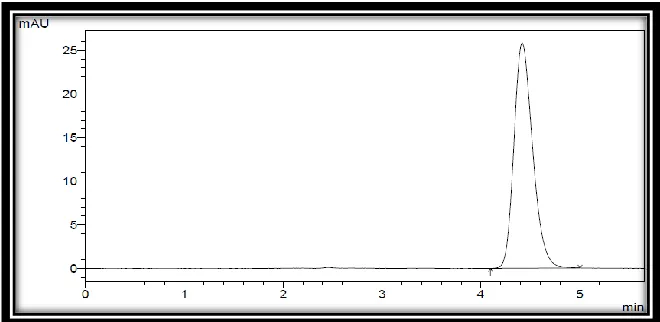
the flow rate of 0.8ml min-1 gave peaks with symmetric shape and good resolution for thiocolchicoside drugs. A steady baseline was recorded with the fixed chromatographic conditions, and standard drug solutions were injected and chromatograms were recorded. Retention time was found to be 4.6 minutes for Thiocolchicoside followed by injection of sample solution obtained from the formulation, (fig: 4) the optimized chromatographic conditions, system suitability parameters which are shown at table no 1.
Table No. 1: Optimized chromatographic conditions, system suitability Parameters
Parameters Method
Optimized chromatographic conditions
Column 250mm
Mobile phase Ammonium acetate: methanol (50:50)
Flow rate(ml min-1) 0.8 (ml min-1)
Ruuning time(minutes) 4.6 mins
Column temperature(00C) Room temp
Detection wave lengh (NM) 256
Drug(RT) 2.004
system suitability
Theoretical plates(N) 7469
Tailing factor(T) 1.24
Preparation of mobile phase:
Ammonium acetate : Methanol, which were ultrasonicated
for 30minutes with HPLC grade , both the components were filtered through the 0.45µm membrane filter .method was developed using lichrocart column. Chromatography was selected for separation.
Selection of Wavelength:
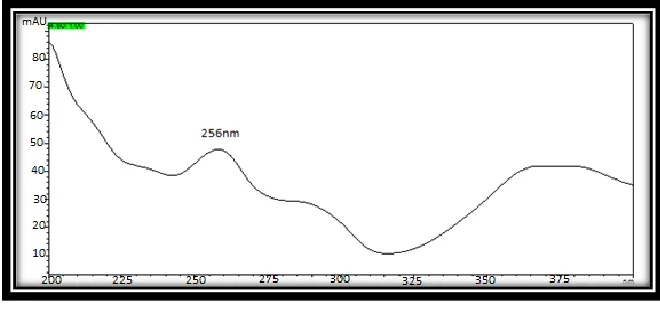
Good analytical results will be obtained only by careful selection of wavelength used for detection. This choice requires knowledge of absorption spectra of the sample. An absorption spectrum of Thiocolchicoside was recorded and it was found, that the drug show absorbance at λmax of 256 nm, (fig 2). Hence 256nm was selected for the
present study.
Fig. 2: Absorption spectrum of Thiocolchicoside
RESULT AND DISCUSSION
A
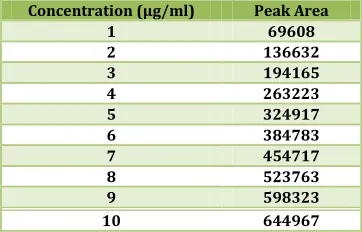
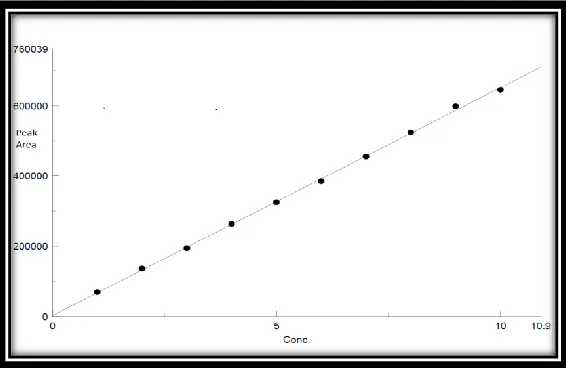
dequate dilutions were prepared from the standard stock solution to get a concentrations ranging from for 0.1 - 15 µg/ml of Thiocolchicoside using methanol. Peak areas of these solutions were measured at 256 nm, the measured peak areas were plotted against concentrations. From the graph it was found that Thiocolchicoside showed the linearity range between 1 - 10µg/ml, (table: no: 2). The calibration curve was plotted using the mean peak area Vs concentration of standard solutions, The slope, intercept and correlation co-efficient values were found to 64802.4606, 3096.2667 and 0.9996 respectively. A representative chromatogram of standard drug is shown in (Fig: 3) The Calibration Curve was plotted taking peak area ratio on y-axis against concentration of drug on x-y-axis.The injection containing 2mg was taken in a 10ml standard flask and the volume was made up with methanol to get the concentration of 200µg/ml. From the above solution suitable aliquots were prepared in the concentrations ranges between the linearity of standard.
A steady baseline was recorded with the fixed chromatographic conditions, and standard drug solutions were injected and chromatograms were recorded. Retention time was found to be 4.6 minutes for Thiocolchicosidefollowed by injection of sample solution obtained from the formulation (fig: 5). The amount of drug present in the sample solution was determined using the calibration curve of standard drug.
Intra-day precision:
Intra-day precision was determined by injecting three solutions of the same concentration (5µg/ml) for three times on the same day and the response for each injection was measured. Peak areas were noted and the percentage of relative standard deviation was calculated.
Inter-day precision:
Inter-day precision was determined by injecting a concentration of the standard solutions (2, 5, 8µg/ml) for three days and the percentage of relative standard deviation was calculated.
Recover studies:
To check the accuracy of the proposed method and recovery studies were carried out at 80,100 and 120% of the test solution concentration as per ICH guidelines (refe)]. The recovery study was performed 3 times at each level. The percentage recovery and its %RSD were calculated,
Limit of detection (LOD) and limit of quantification (LOQ):
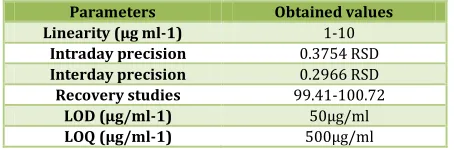
LOD and LOQ were determined by injecting progressively lower concentrations of the drug. LOD, (fig 6) and LOQ, (fig 7) of Thiocolchicoside were found to be 50ng/ml and 500ng/ml respectively.
Robustness:
In order to demonstrate the robustness of the method, the following optimized conditions were slightly varied.
1)± 1 in ratio of methanol in mobile phase 2)± 5 units in strength of buffer
3)± 0.1 in flow rate
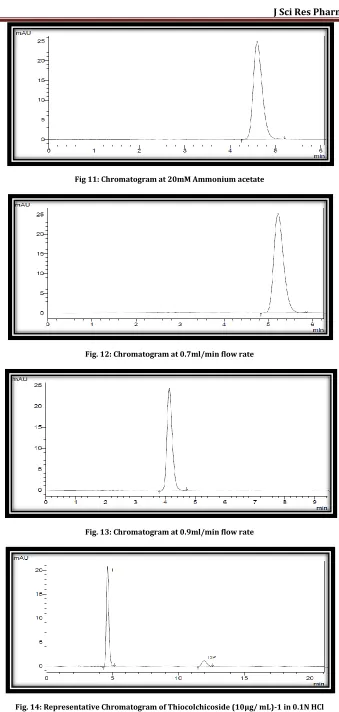
The response factors for those changed chromatographic parameters were almost same as that of the fixed chromatographic parameters and hence developed method is said to be robust, (table: 3)
Specificity:
The specificity of the HPLC method was determined by complete separation of thiocolchicoside in the presence of its degradation products.
The solution was prepared by dissolving the drug substance in methanol and the drug was subjected to accelerated degradation under acidic condition by refluxing with 0.1N HCL at 70ºC and the sampling was done at every half an hour till sufficient degradation was achieved. The resulting solution was neutralized, appropriately diluted and chromatograms were recorded, (fig: 14).
Alkaline condition:
The drug substance was dissolved in methanol and the drug was subjected to accelerated degradation under alkaline condition by refluxing with 0.1N NaOH at 70ºC and the sampling was done at every half an hour till sufficient degradation was achieved. The resulting solution was neutralized, appropriately diluted and chromatograms were recorded, (fig: 15).
Oxidative studies:
Initial oxidative was performed in 3% H2O2 at room
temperature for 10 hours, subsequently the drug was exposed to 30% H2O2 at room temperature and analyzed periodically. The resulting
solution was appropriately diluted and chromatograms were recorded, (fig: 16).
For photolytic stress studies, the samples of drug product were exposed to sun light during the day time for four hours. Samples were withdrawn at appropriate time intervals and subjected to HPLC analysis after suitable dilutions. Appropriates controls were also prepared and injected for each degradation studies, (fig: 17).
Table No. 2: Calibration of standard Graph Data
Concentration(µg/ml) Peak Area
1 69608
2 136632
3 194165
4 263223
5 324917
6 384783
7 454717
8 523763
9 598323
Fig. 4: Calibration curve (1-10µg/ml)
Preparation of sample solution:
Fig. 5: Representative chromatogram of thiocolchicoside10µg/ml
Table No. 3: Robustness
Chromatographic condition Peak area Fig no
Mobile phase ratio
(10mM Ammonium acetate: Methanol) 49:51 51:49 332111 334438 7 8
Strength of Ammonium acetate 5mM 331309 9
10mM 331914 10
Flow rate 0.7 ml/min 382113 11
0.9 ml/min 297457 12
Fig. 8: Chromatogram at 49:51 ratio of 10mM Ammonium acetate: Methanol
Fig. 9: Chromatogram at 51:49 ratio of 10mM Ammonium acetate: Methanol
Fig 11: Chromatogram at 20mM Ammonium acetate
Fig. 12: Chromatogram at 0.7ml/min flow rate
Fig. 15: Representative Chromatogram of Thiocolchicoside (10μg/ mL)-1 in 0.1NaOH
Fig. 16: Representative Chromatogram of Thiocolchicoside (10μg/ mL)-1 in 3%H2O2
Fig. 17: Representative Chromatogram of Thiocolchicoside (200μg/mL)-1 after Photolysis
Table No. 4: Degradation data
Conditions Time in hrs %recovery Retention time of drug
0.1N HCl ½ hr 15 11.9
0.1NNaOH ½ hr 49 6.9 &11.9
H2O2 (3%V/V solution) ½ hr 23 3.2
Photolysis 6hr --- ----
In all degradation studies acid hydrolysis, alkaline hydrolysis and neutral hydrolysis there was a corresponding formation of degradation products when compared to the standard solution of the drug. This indicated that, may be the drug degraded to low molecular weight non-chromophoric compounds. The drug showed extensive degradation in alkali hydrolytic condition. The blank chromatogram of all stress test were studied, its show there is no interference between
Table No. 5: Method of Validation
Parameters Obtained values
Linearity (µg ml-1) 1-10
Intraday precision 0.3754 RSD
Interday precision 0.2966 RSD
Recovery studies 99.41-100.72
LOD (µg/ml-1) 50µg/ml
LOQ (µg/ml-1) 500µg/ml
A critical evaluation of the method was performed. The different method validation parameters were validated and the results are shown in Table 5.The good % recovery in tablet formulation suggests that the excipients present in the formulation have no interference in the estimation. The % RSD was also less than 2% showing high degree of precision of the proposed method. The developed method was also specific as it was capable of determining Thiocolchicoside in presence of its degradation products. The forced degradation study of Thiocolchicoside shows that; the drug degrades in the order, Photolysis >0.1N HCl ≥H2O2>0.1N NaOH. So the developed method can be accepted as a novel stability indicating ion- pairing RP-HPLC method which uses ammonium acetate: methanol as the mobile phase (50:50) which has been not used previously as per literature.
CONCLUSION
I
n the present, concluded that the developed RP-HPLC method was stability indicating, simple, rapid, specific, accurate and precise and could be employed successfully for the determination of thiocolchicoside in Parenteral dosage form.ACKNOWLEDGEMENTS
T
he authors are very much thankful to principal and management and head of,sri Ramakrishna institute of paramedicalsciences , college of pharmacy ,sarojini Naidu road, avaram palayam, Coimbatore, for given their necessary facilities.
REFERENCES:
1. Suraj D. Jadhav et al. Validated stability indicating RP-HPLC method simultaneous determination and in vitro dissolution studies of thiocolchicoside and diclofenac potassium from tablet dosage form. Arab J Chem 2015;8:118-128.
2. Rossol. Alberto Stefano zuccaro. J Chromatogr A 1998 ;825:96-10.
3. Jeffery GH, Basset J, Mendham J, Denney RC, Vogel’s text book of
quantitative analysis. Longman Sci and Tech 1999;5:10. 4. Indian Pharmacopoeia, Ministry of health and family welfare,
Indian pharmacopoeia commission, Ghaziabad, India, tenth edition, 2014;2860-2861.
5. Arvind R. Umarkar, Niki Srewatkar et al. Stability indicating RP-HPLC Method for estimation of thiocolchicoside in capsule dosage forms. Res J Pharm Biol Chem Sci 2011;2(1):750. 6. Kiran rathod, Jitendra Patel et al. Simultaneous estimation of
etodolac and thiocolchicoside in their combined marketed formulation by RP-HPLC. 2012;4(4):1513-1519.
7. Dr. D. Satyavati, K. Shanthi, B. Madhavi Latha, Dr. A. Madhukar. Validated RP-HPLC method for simultaneous estimation of lornoxicam and thiocolchicoside in bulk and tablet dosage forms. J Sci Res Pharm 2018;(7)3:24-29.
How to cite this article:
Kavitha. K, et al. STABILITY INDICATING RP-HPLC METHOD FOR ESTIMATION OF THIOCOLCHICOSIDE IN PARENTERAL DOSAGE FORMS. J Sci Res Pharm 2018;7(7):84-91.DOI:https://doi.org/10.5281/zenodo.1326519
Conflict of interest: The authors have declared that no conflict of interest exists.