University of Massachusetts Amherst
ScholarWorks@UMass Amherst
Open Access Dissertations
5-2013
Exploiting Domain Structure in Multiagent
Decision-Theoretic Planning and Reasoning
Akshat Kumar
University of Massachusetts Amherst, [email protected]
Follow this and additional works at:
https://scholarworks.umass.edu/open_access_dissertations
Part of the
Computer Sciences Commons
This Open Access Dissertation is brought to you for free and open access by ScholarWorks@UMass Amherst. It has been accepted for inclusion in Open Access Dissertations by an authorized administrator of ScholarWorks@UMass Amherst. For more information, please contact
Recommended Citation
Kumar, Akshat, "Exploiting Domain Structure in Multiagent Decision-Theoretic Planning and Reasoning" (2013).Open Access Dissertations. 734.
EXPLOITING DOMAIN STRUCTURE IN MULTIAGENT DECISION-THEORETIC PLANNING AND REASONING
A Dissertation Presented by
AKSHAT KUMAR
Submitted to the Graduate School of the
University of Massachusetts Amherst in partial fulfillment of the requirements for the degree of
DOCTOR OF PHILOSOPHY
May 2013
c
Copyright by Akshat Kumar 2013 All Rights Reserved
EXPLOITING DOMAIN STRUCTURE IN MULTIAGENT DECISION-THEORETIC PLANNING AND REASONING
A Dissertation Presented by
AKSHAT KUMAR
Approved as to style and content by:
Shlomo Zilberstein, Chair
Daeyoung Kim, Member
Victor Lesser, Member
Sridhar Mahadevan, Member
Lori Clarke, Department Chair Computer Science
ACKNOWLEDGMENTS
First and foremost, this thesis would not have been possible without the direction of my advisor Shlomo Zilberstein. His faith in my ability, constant encouragement, both at the professional and the personal level and insightful technical advice were the key to the research directions of this thesis. Shlomo, in many wonderful ways, has been a great advisor for me and I hope to reach his high standards of advising in my career as well.
A special thanks is also due to my committee members. I met Victor on my first day in the department. In my every single subsequent meeting with him, his constant encouragement of my work and his passion for research in multiagent systems kept me motivated. His advice has been crucial in shaping the bigger picture of this thesis. Sridhar has been a great mentor as well as an inspiring teacher. I credit his machine learning course as the key enabler to bringing in the ML flavor of my thesis. Daeyoung Kim has been the source of many insightful pointers to some of the intricate machinery of my work.
I also wish to thank Boi Faltings and Marc Toussaint. Boi gave me my first break in AI and multiagent systems. His advice and encouragement early into my grad student life were instrumental in shaping up my research direction. Interactions with Marc were crucial in the clean formulation of technical aspects of some of my work.
I had been fortunate to be in the good company of fellow members of RBR and MAS labs. Thanks Marek for promoting the awareness of Microsoft products and trying to steer me to single agent systems, Chris for his energy and fantasy baseball discussions, Sid for being a source of much awaited dinner invitations to his home, Alan for being a travel companion and a source of American humor, Xiaojian for being my guide into the Chinese culture, both the Luises for bringing in the fresh energy to the lab and Rick for being such an energetic project partner.
MAS lab members were equally phenomenal—Hala was a constant presence in my dis-cussions on multiagent systems to other late night cribs, thanks Yoonheui for defeating me
in many Racquetball games and making me work harder and introducing me to Korean cuisine, Chongjie and Xiaoxi constantly encouraged me even when things were not rosy. Will, another extended member of RBR and MAS lab, had been a great source of comic relief and a trusted colleague. My friends in the CS department were equally great. Rahul provided expert gym lessons for free, Uppi has been a trusted source of advice on all philo-sophical, spiritual and farcical matters, Naveen’s focused enthusiasm had been inspiring, Parate taught me the art of wine tasting and Keen provided a roof over my head for my final few days. Ashish, Mohit, Rishi and Jabhi have always been the blast from the past! Without the support of such friends, my experience at UMass would have been incredibly dull.
I also owe a lot to the CS department for being such a friendly place to students. Leeanne was most helpful and resourceful in navigating the academic maze. Michele made conference travel so much smoother and efficient!
This thesis is dedicated to my parents and sister. Without their unflinching support and unwavering belief in my abilities over a number of years, I would have gone nowhere. They provided me the freedom to pursue my dreams even in the face of personal sacrifices. I stand forever in their debt for their support and encouragement.
ABSTRACT
EXPLOITING DOMAIN STRUCTURE IN MULTIAGENT DECISION-THEORETIC PLANNING AND REASONING
MAY 2013
AKSHAT KUMAR
B.Tech., INDIAN INSTITUTE OF TECHNOLOGY GUWAHATI M.Sc., UNIVERSITY OF MASSACHUSETTS AMHERST Ph.D., UNIVERSITY OF MASSACHUSETTS AMHERST
Directed by: Professor Shlomo Zilberstein
This thesis focuses on decision-theoretic reasoning and planning problems that arise when a group of collaborative agents are tasked to achieve a goal that requires collective effort. The main contribution of this thesis is the development of effective, scalable and quality-bounded computational approaches for multiagent planning and coordination un-der uncertainty. This is achieved by a synthesis of techniques from multiple areas of artificial intelligence, machine learning and operations research. Empirically, each algorithmic con-tribution has been tested rigorously on common benchmark problems and, in many cases, real-world applications from machine learning and operations research literature.
The first part of the thesis addresses multiagent single-step decision making problems where a single joint-decision is required for the plan. We examine these decision-theoretic problems within the broad frameworks of distributed constraint optimization and Markov random fields. Such models succinctly capture the structure of interaction among different decision variables, which is subsequently exploited by algorithms to enhance scalability. The
algorithms presented in this thesis are rigorously grounded on concepts from mathematical programming and optimization.
The second part of the thesis addresses multiagentsequential decision making problems under uncertainty and partial observability. We use the decentralized partially observable Markov decision processes (Dec-POMDPs) to formulate multiagent planning problems. To address the challenge of NEXP-Hard complexity and yet push the envelope of scalability, we represent the domain structure in a multiagent system using graphical models such as dynamic Bayesian networks and constraint networks. By exploiting such graphical planning representation in an algorithmic framework composed of techniques from different sub-areas of artificial intelligence, machine learning and operations research, we show impressive gains in increasing the scalability, the range of problems addressed and enabling quality-bounded solutions for multiagent decision theoretic planning.
Our contributions for sequential decision making include a) development of efficient dynamic programming algorithms for finite-horizon decision making, resulting in signifi-cantly increased scalability w.r.t. the number of agents and multiple orders-of-magnitude speedup over previous best approaches; b) development of probabilistic inference based algorithms for infinite-horizon decision making, resulting in new insights connecting infer-ence techniques from the machine learning literature to multiagent systems;c)development of mathematical programming based scalable techniques for quality bounded solutions in multiagent systems, which has been considered intractable so far.
Several of our contributions are some of the first for the respective class of problems. For example, we show for the first time how machine learning is closely related to multiagent decision making via a maximum likelihood formulation of the planning problem. We develop new graphical models and machine learning based inference algorithms for large factored planning problems. We also show for the first time how the problem of optimizing agents’ policies can be formulated as a compact mixed-integer program, resulting in optimal solution for a range of Dec-POMDP benchmarks.
In summary, we present a synthesis of different techniques from multiple sub-areas of AI, ML and OR to address the scalability and efficiency of algorithms for decision-theoretic
reasoning and planning in multiagent systems. Such advances have already shown great promise to bridge the gap between multiagent systems and real-world applications.
TABLE OF CONTENTS
Page
ACKNOWLEDGMENTS. . . v
ABSTRACT. . . vii
LIST OF TABLES. . . .xiv
LIST OF FIGURES . . . .xvi
CHAPTER 1. INTRODUCTION. . . .2
1.1 Examples of Multiagent Decision Making . . . 5
1.1.1 Single-Step Multiagent Decision Making . . . 6
1.1.2 Sequential Multiagent Decision Making . . . 7
1.2 Summary of Contributions . . . 8
1.2.1 Single-Step Decision Making . . . 8
1.2.2 Sequential Decision Making . . . 10
1.2.2.1 Finite-Horizon Planning . . . 11
1.2.2.2 Infinite-Horizon Planning . . . 11
1.2.3 Bounded Optimality for Sequential Decision Making . . . 12
1.3 Discussion . . . 14
I SINGLE STEP DECISION MAKING 2. DISTRIBUTED CONSTRAINT OPTIMIZATION FRAMEWORK . . . 17
2.1 Markov Random Fields and MAP Estimation . . . 18
2.2 The DCOP Model . . . 19
2.3 Applications . . . 20
2.5 Discussion . . . 22
3. MESSAGE-PASSING ALGORITHMS FOR DCOPS . . . 24
3.1 Related Work . . . 25
3.1.1 DCOP Algorithms . . . 25
3.1.2 MAP Estimation Algorithms . . . 26
3.2 Variational Methods—An Optimization-based View . . . 29
3.3 Our Approach—A Hybrid Variational Bound . . . 32
3.4 DC Programming for Optimization Over Hybrid Bound . . . 35
3.4.1 DC Formulation of MAP . . . 36
3.4.2 Solving the CCCP Iteration . . . 38
3.4.3 DC Programs and Proximal Minimization . . . 39
3.5 Message-Passing for MAP DC Program . . . 41
3.5.1 The Gradient ofv(µ, y) and Outer Loop Message-Passing . . . 41
3.5.2 CCCP Inner Loop and Message-Passing . . . 42
3.5.3 Properties of HBP Algorithm . . . 44
3.6 Other Contributions . . . 45
3.7 Empirical Evaluation . . . 46
3.7.1 DCOP Benchmarks . . . 50
3.7.2 Operations Research Benchmarks . . . 56
3.7.3 Machine Learning Benchmarks . . . 58
3.7.3.1 Synthetic Benchmarks . . . 58
3.7.3.2 Real-World Protein Design Benchmarks . . . 59
3.8 Discussion . . . 61
II SEQUENTIAL DECISION MAKING 4. THE DECENTRALIZED POMDP MODEL. . . 67
4.1 The Dec-POMDP Model . . . 67
4.2 Policy representation . . . 69
4.2.1 Finite-Horizon Policy Trees . . . 70
4.2.1.1 Objective Function . . . 71
4.2.2 Infinite-Horizon Finite-State Controllers . . . 72
4.3 Applications . . . 73
4.4 Discussion . . . 75
5. EFFICIENT DYNAMIC PROGRAMMING FOR FINITE-HORIZON SEQUENTIAL DECISION MAKING . . . 77
5.1 Approximate Dynamic Programming for Dec-POMDPs . . . 78
5.2 Related Work . . . 80
5.3 Decentralized Backup—Two Agents . . . 81
5.3.1 Complexity of Decentralized Backup . . . 83
5.3.2 Optimal Backup Approach Using WCSPs . . . 85
5.3.2.1 Solving the Backup WCSP . . . 88
5.3.2.2 Comparison with PBIP . . . 88
5.3.3 Experiments . . . 89
5.4 Decentralized Backup—Multiple Agents . . . 92
5.4.1 WCSP Formulation—Case 1 . . . 94
5.4.2 WCSP Formulation—Case 2 . . . 96
5.4.3 Experiments . . . 98
5.5 Discussion . . . 103
6. PROBABILISTIC INFERENCE FOR INFINITE-HORIZON SEQUENTIAL DECISION MAKING . . . 105
6.1 Related Work . . . 105
6.2 Policy Optimization for Infinite-Horizon Dec-POMDPs . . . 108
6.3 Dec-POMDPs as Mixture of DBNs . . . 109
6.4 The Expectation-Maxmization Algorithm . . . 112
6.4.1 E-step . . . 113
6.4.1.1 Complexity . . . 114
6.4.2 M-step . . . 114
6.4.2.1 Action updates . . . 115
6.4.2.2 Controller node transition updates . . . 117
6.4.2.3 Initial node distribution . . . 118
6.4.2.4 Complexity and implementation issues . . . 118
6.4.3 The Intuition Behind EM Update Strategy . . . 119
6.5 Experiments . . . 121
7. ACHIEVING SCALABILITY FOR RESTRICTED MODELS. . . 127
7.1 Related Work . . . 128
7.2 Value Factorization Framework for Multiagent Planning . . . 129
7.2.1 DBN mixture for value factors . . . 132
7.2.2 The Expectation-Maximization Algorithm . . . 133
7.2.3 Finite-Horizon Planning . . . 136
7.2.4 Scalability and Message-Passing Implementation . . . 136
7.2.5 Nature of Local Optima . . . 138
7.3 Experiments . . . 139
7.4 Discussion . . . 143
III BOUNDED OPTIMALITY FOR SEQUENTIAL DECISION MAKING 8. QUALITY BOUNDED SOLUTIONS FOR SEQUENTIAL DECISION MAKING . . . 146
8.1 Related Work . . . 147
8.2 LP Formulation of MDPs . . . 148
8.3 Cross-Product MDP For a 2-Agent Dec-POMDP . . . 149
8.4 Mixed-Integer Linear Program for Dec-POMDPs . . . 152
8.4.1 Objective . . . 152
8.4.2 Variables and Constraints . . . 152
8.4.3 Correctness of the MILP for 2-Agent Dec-POMDP . . . 154
8.4.3.1 Justification For MILP Constraint (8.14) and (8.15) . . . 157
8.4.3.2 Justification For MILP Constraint (8.13) . . . 158
8.4.3.3 Decentralization and Partial Observability Constraints . . . 159
8.4.4 Complexity . . . 161
8.5 Mixed-Integer Linear Program for POMDPs . . . 162
8.6 Extension to Multiple Agents—Lagrangian Relaxation . . . 164
8.7 Experiments . . . 168
8.8 Discussion . . . 169
9. SUMMARY . . . 171
9.1 Single-Step Decision Making . . . 172
9.2 Sequential Decision Making . . . 173
9.3 Future Directions . . . 176
LIST OF TABLES
Table Page
1.1 Summary of contributions . . . 14
3.1 Quality and time (in sec.) comparisons with BnB ADOPT and centralized branch-and-bound solver AOBB. A ‘–’ indicates the algorithm did not terminate within 16000 sec. time limit. The top half of the rows indicate 1-step scheduling benchmarks and the bottom half denotes the 4-step scheduling benchmarks. Error is w.r.t. the optimal solution given by AOBB in percentage:=(HBP−AOBBAOBB)∗100 . . . 54
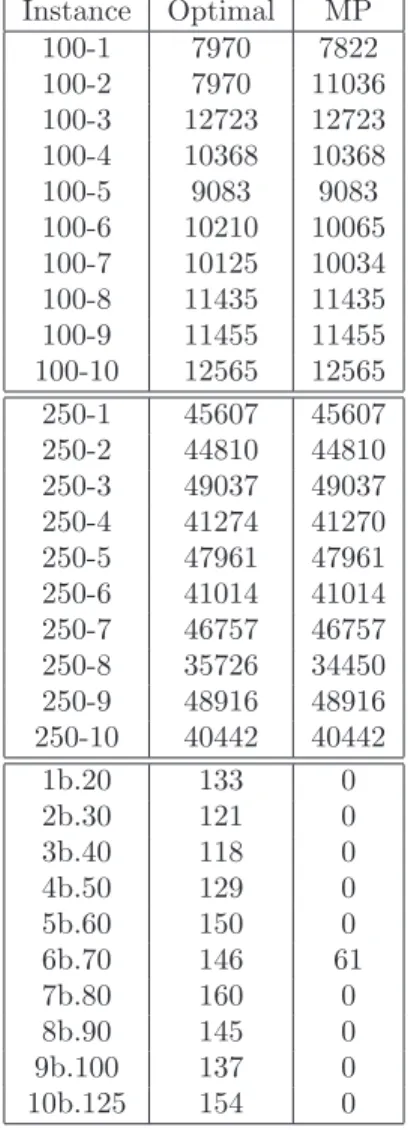
3.2 Quality and runtime comparisons for the Biq benchmarks. ‘Inst.’ is the instance name and ‘Opt.’ is the known optimal quality from [123]. ‘–’ denotes failure of the algorithm to produce a solution.. . . 55
3.3 Solution quality comparisons for max-sum (MS) on Biq benchmarks . . . 58
5.1 Mars Rover: Execution time . . . 92
5.2 Box pushing: Search time Vs. Total time . . . 92
5.3 Mars Rover: Search time Vs. Total time . . . 93
6.1 The linear program used by the DEC-BPI algorithm to find new parameters for a nodepof agent 1 [15]. Variablex(a) represents the action selection parameter P(a|p); variablex(a, y, p0) represents controller node transition parameter P(a, p0|y, p). . . . 106
6.2 Nonlinear programming based formulation for optimizing a 2-agent, infinite-horizon Dec-POMDP policy [6]. Variablex(p, a) represents the action selection parameterP(a|p) for agent 1;x(p, y, p0) represents the controller node transition parameterP(p0|p, y) for agent 1. VariableV(p, q, s) represents the value function for the controller state (p, q) and environment states. Other variables are defined analogously for agent 2.. . . 107
6.3 Broadcast channel: Policy value, execution time . . . 121
7.1 Time in seconds per iteration of EM . . . 140
7.2 Quality comparisons with a loose upper bound and random controllers for all instances . . . 141
7.3 Solution quality/time comparison of EM (100 iterations) with NLP for the 5P domain,N denotes controller size, Time in seconds . . . 141
7.4 Quality of handcrafted controllers vs. EM (11H) . . . 142
7.5 Serial vs. parallel execution times per EM iteration in 20D. . . 143
8.1 Mixed-integer program for optimizing a 2-agent Dec-POMDP policy. The 0-1 binary variables are shown in Eq. (8.30). The rest are continuous,
positive variables: x(·)≥0. . . 155
8.2 Mixed-integer program for optimizing a single agent POMDP policy. The 0-1 binary variables are shown in Eq. (8.67). The rest are continuous,
positive variables: x(·)≥0. . . 163
8.3 Problem size for different instances; |S|represents the state-space,|A|represents the action-space per agent and|Y|represents the observation-space per
agent. . . 168
8.4 Runtime comparison between CPLEX for the Dec-POMDP MILP and the NLP
LIST OF FIGURES
Figure Page
1 Chapter and concept dependencies. Numbers in (·) denote the chapter
number. Text without (·) denote a concept. . . 1
1.1 Target tracking in sensor networks. . . 6
2.1 An example of a MRF. . . 19
2.2 A protein backbone structure and its corresponding MRF [130] . . . 21
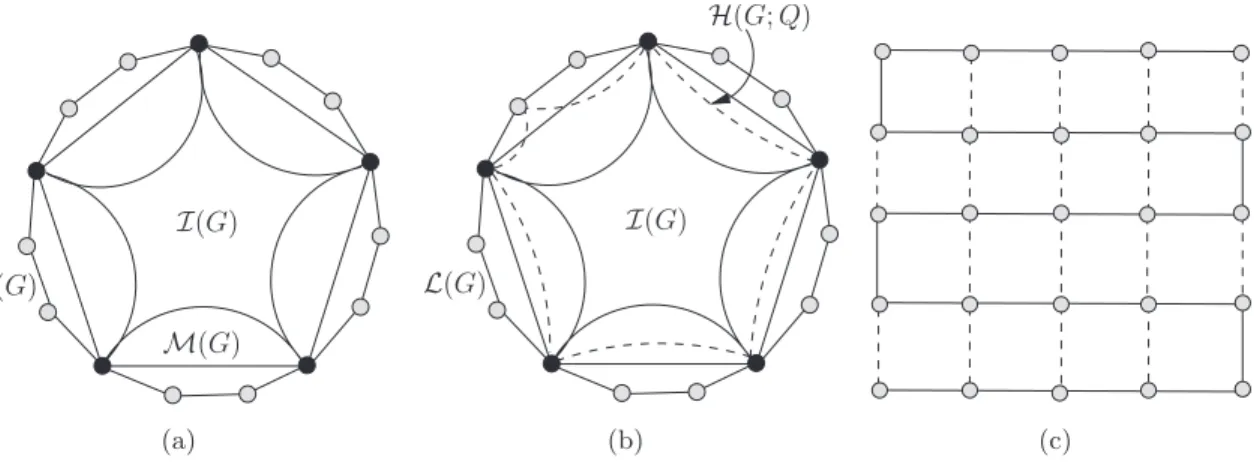
3.1 a) Relationship among marginal polytope, inner and outer bound; b) Hybrid bound; c) A grid graph with dotted edges denoting QP edges setQ. . . 33
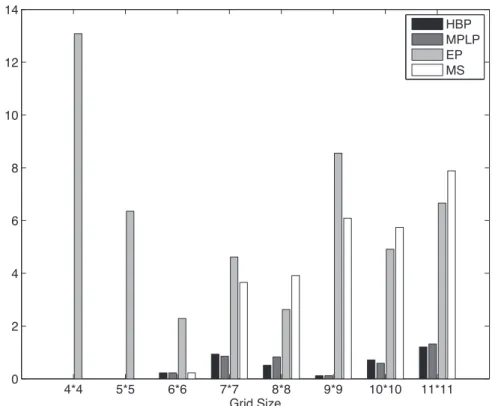
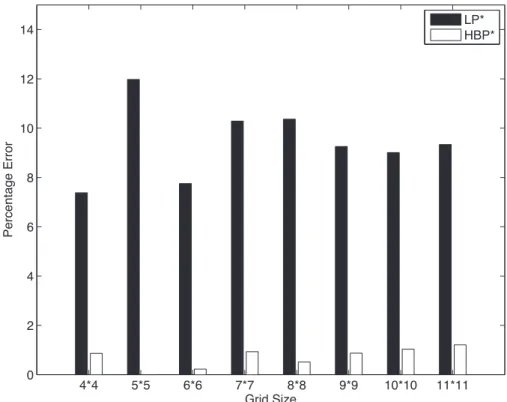
3.2 Solution quality comparisons for sensor scheduling domain. The absence of a bar for a particular algorithm denote zero error implying the algorithm achieved the optimal solution. . . 49
3.3 Fractional solution quality comparisons for sensor scheduling domain. The absence of a bar for a particular algorithm denote zero error implying the algorithm achieved the optimal solution. . . 52
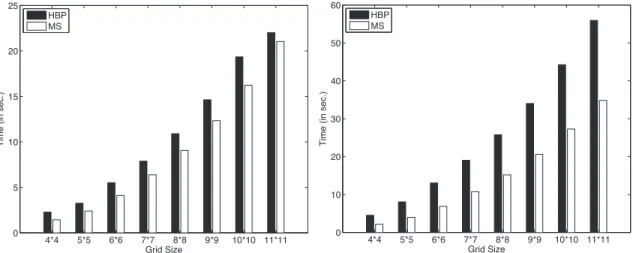
3.4 Time comparisons for sensor scheduling domain. a) 1-step sensor scheduling; b) 4-step sensor scheduling . . . 53
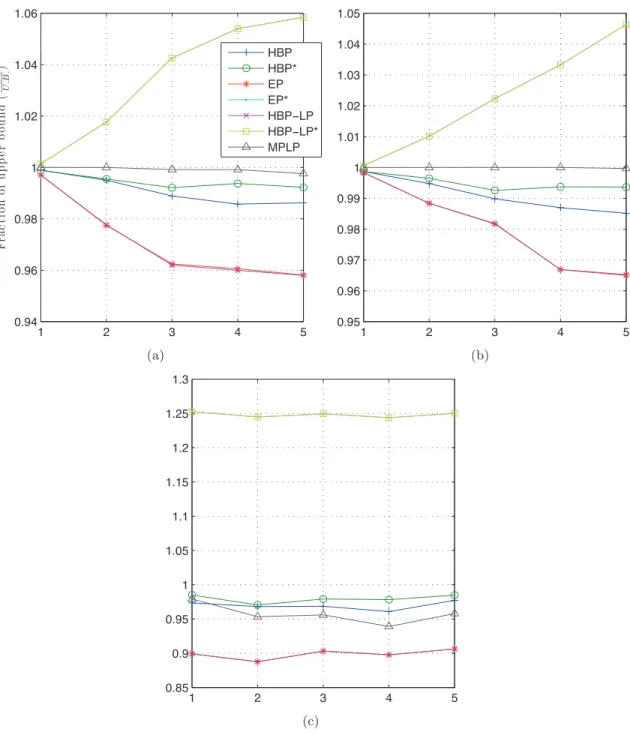
3.5 Quality comparison for 50×50 grids: a) Potts model with variable domain size 4 and b) with domain size 8; c) Ising model (domain size = 2). The x-axis shows the coupling parameterβ and y-axis the normalized quality.. . . 60
3.6 Protein design . . . 62
3.7 Protein design . . . 63
4.1 A 2-time slice dynamic decision network (DDN) representation of a 2-agent Dec-POMDP. All nodes are random variables. Square nodes represent decisions; diamond nodes represent the reward;p and q represent the states of policy for agent 0 and 1 respectively; subscripts denote time. . . 68
4.3 Representation of an exponential sized policy using linear space by re-using policy trees [127] . . . 71
4.4 Representation of a 2-agent infinite-horizon joint-policy using finite-state controllers. Each node is a memory state. Edges represent the node transition function. Agent 1 has two observationsy1 andy2. Agent 2
also has two observationsz1 and z2. . . 73
5.1 Bottom up dynamic programming framework for 2-agent Dec-POMDPs . . . 79
5.2 Schematic representation of decentralized backup operation for 2-agents.
Optimization variables are denoted using the placeholder ‘?’. . . 82
5.3 Primal graph of a WCSP for the backup problem. Each agent has three
observations . . . 88
5.4 Comparison of our approach CBPB with PBIP . . . 90
5.5 Targets T1 and T2 follow dotted trajectories. . . 94
5.6 An example of a pairwise interaction graph (left) and its corresponding
WCSP primal graph (right) . . . 95
5.7 WCSP formulation (Case 2) for 4 agents with the interaction structure of
Figure 5.6(a). Each agent has 2 observations. . . 96
5.8 Sensor network configurations . . . 99
5.9 Comparisons of a) the solution quality and b) the execution time of our approach CBDP and different versions of FANS (Node, Link) on the
domain 5P . . . 100
5.10 Comparisons of a) the solution quality and b) the execution time of CBDP and different versions of FANS (Node, Link) on the domain 7-H . . . 101
5.11 Comparisons of a) the solution quality and b) the execution time between our approach CBDP and FANS for 11-helix, 15-3D and 15-mod with T = 3 . . . 102
5.12 Solution Quality and Execution time comparisons of CBDP and FANS for a range of horizons for 15-3D. . . 102
6.1 A two time slice dynamic decision network (DDN) for a two-agent
6.2 The time dependent DBN mixture (right) corresponding to a 2-agent Dec-POMDP (left). The first DBN component in the mixture
corresponds to the reward for time step 1, second DBN corresponds to the reward for time step 2. The last DBN in the mixture shows the
general structure of aT-step DBN. . . 110
6.3 Solution quality and runtime for ‘recycling robots’ (a) & (b) and ‘meeting on a grid’ (c) & (d) . . . 122
6.4 Solution quality (a) and likelihood (b) for ‘multiagent tiger’ . . . 123
6.5 Solution quality and runtime for box pushing (a) & (b) and Mars rovers (c) & (d) . . . 124
7.1 Plate notation for (a) Dec-MDPs; (b) ND-POMDPs . . . 130
7.2 (a) Value factor mixture; (b) Zoomed-in view of each mixture component (x, y are generic placeholders for random variables). . . 132
7.3 Message passing on the value factor graph: (a) shows the message direction for E-step; (b) shows the M-step. . . 136
7.4 Benchmarks 20D (left), 15-3D, 5P and 11H (right) . . . 138
7.5 Solution quality achieved by EM (y-axis denotes quality and x-axis denotes the iteration number). . . 139
8.1 Two time slice DBN for single agent MDP . . . 149
8.2 Cross-product MDP corresponding to a 2 agent Dec-POMDP . . . 151
8.3 Cross-product MDP corresponding to a single agent POMDP . . . 162
8.4 Quality comparison between the Dec-POMDP MILP solved using CPLEX and the NLP-based solver. Solution quality (y-axis) is normalized, with 1 representing the optimal solution. . . 167
!"#$%&!'( )$*+$,-."/ 01234 ).,5/$6(-$701 284 9,:,.-$6;&!.<&, .,.-$6;&!.<&, =/5&!.-;#(2>4 =/5&!.-;#( 2?@A4 B+"/.-CD&+,E(2F4 =/5&!.-;#(2G4
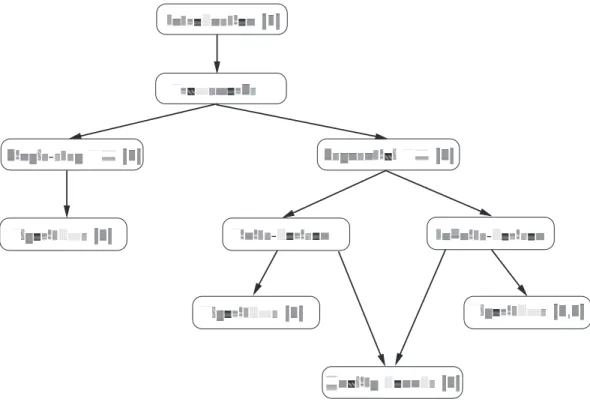
Figure 1. Chapter and concept dependencies. Numbers in (·) denote the chapter number. Text without (·) denote a concept.
CHAPTER 1 INTRODUCTION
Multiagent systems are one of the cornerstones of artificial intelligence. A key challenge in multiagent systems is how to achieve intelligent coordination among agents despite avail-ability of only limited information to each agent and stochasticity in the environment. In this thesis, we address this problem of multiagent planning and coordination using decision-theoretic formal frameworks. When only a single decision maker is present in the environ-ment, then the decision-theoretic framework of partially observable MDPs is a popular and well understood choice. However, extending decision theory to address multiagent systems presents unique challenges such as significantly high complexity barrier than single-agent approaches and the limited scalability of even approximate approaches. The main contribu-tion of this thesis is the development of effective, scalable and quality-bounded computacontribu-tional approaches for multiagent planning and coordination. This is achieved by exploiting the do-main structure in an algorithmic framework developed using a synthesis of techniques from multiple areas of artificial intelligence, machine learning and operations research.
When this thesis was started 5 years ago, research in decision-theoretic multiagent plan-ning was mainly focused on developing scalable techniques for just 2-agent systems. There were attempts to handle larger multiagent systems using restricted models, but their scal-ability and the range of addressed problems were limited. Furthermore, the majority of the relatively scalable algorithms were approximate and could not provide quality bounds. Much of the research altogether avoided the question of quality bounds due to perceived high intractability. The already proven complexity result that finding the optimal policy just for 2-agents is NEXP-Complete hinted that despite the tantalizing promise of decision-theoretic multiagent planning, developing effective and scalable approaches was bound to be a fruitless effort.
The main insight which pushed us to move forward in addressing the challenges of multiagent coordination and planning was that despite the theoretical hardness, many real-world inspired problems have underlying structure that can be exploited to yield scalable approaches. Furthermore, instead of reinventing the wheel for scalable multiagent planning, one may fare significantly better by bringing algorithmic advances from different areas of artificial intelligence (AI), machine learning (ML) and operations research (OR) to the context of multiagent systems. Some of the big questions which this thesis addresses include: how to represent domain structure in a generic manner, how to exploit it in an algorithmic framework and how to synthesize algorithmic advances in different sub-areas of AI, ML and OR for scalable multiagent coordination and planning. We highlight this strategy below:
• Frameworks: We use the decision-theoretic frameworks of distributed constraint optimization (DCOP) and decentralized partially observable MDPs (Dec-POMDPs) to address multiagent decision making. DCOPs model single-step decision making, where agents need to take a single action in a coordinated manner to maximize the joint utility. Dec-POMDPs model scenarios where a team of agents need to take multiple actions in a sequential manner to achieve their goal. Developing optimal algorithms for DCOPs is NP-Hard and for Dec-POMDPs, it is NEXP-Hard.
• Representation: The first requirement for exploiting domain structure in a multia-gent system is to find frameworks that can represent precisely the interdependencies among multiple agents in a generic manner. We use the well established language of
probabilistic graphical models to represent structure within a large multiagent system. We use both directed models such as dynamic Bayesian networks and undirected models such as Markov random fields that lay bare the independencies present in a multiagent system for exploitation in an algorithmic framework.
• Reasoning: Once the structure in a multiagent system is established using a graph-ical model, we develop new algorithms that leverage techniques from AI, ML and optimization literature to exploit the structure of this graphical model. For example, we show that DCOPs can be handled by mapping them to Markov random fields and then solved using mathematical optimization based approaches that result in a
dis-tributed message-passing scheme over the underlying graph. Similarly, we show that a Dec-POMDP can be modeled using a mixture of dynamic Bayesian networks and thus, amenable to probabilistic inference based techniques from the ML literature.
Our main contributions are as following:
• Forsingle-step multiagent decision making problems modeled using DCOPs, our ap-proach has been to develop scalable algorithms using the framework of variational inference from machine learning. Our approach is the first that unifies two different existing frameworks based on quadratic and linear programming for DCOPs. We show that the resulting hybrid framework is analytically tighter than existing formu-lations. Furthermore, it combines desirable properties of existing formulations such as accuracy and convexity, while minimizing the impact of their weaknesses. We de-velop a scalable mathematical optimization based algorithm that efficiently exploits the domain structure using a message-passing scheme over the underlying graph. Our approach is always convergent, can provide tight quality bounds unlike other approxi-mate approaches such as Max-Sum for DCOPs and empirically, provides near-optimal solutions for a number of synthetic and real-world benchmarks from multiagent sys-tems, machine learning and operations research literature.
• For sequential multiagent decision making problems modeled using Dec-POMDPs, our approach has been to exploit techniques from machine learning and mathematical optimization literature for developing scalable algorithms. Our main contributions are as follows:
– We show how to exploit the underlying problem structure for finite-horizon plan-ning using constraint networks, which are a sub-class of graphical models. Using techniques from constraint optimization literature, our approach is more than an order-of-magnitude faster than previous approaches and scalable even for larger multiagent systems that could not be handled using previous approaches.
– We show how the multiagent planning problem can be reformulated as that of probabilistic inference in a dynamic Bayesian network based graphical model.
Using this insight, we develop new algorithms based on techniques from the ML literature such as Expectation-Maximization for multiagent planning. Our ap-proach is the first to bring such inference-based view to multiagent planning. The insight of representing a planning problem using a graphical model exposes in-dependencies among different problem parameters enabling scalable algorithms, and allows one to potentially address much richer class of problems such as fac-tored and continuous planning models. We develop one such facfac-tored model based on value factorization and show how using such a graphical model based view results in a highly scalable message-passing algorithm.
– We develop the first mixed-integer linear programming (MILP) based approach for Dec-POMDPs than enables quality-bounded solutions. Furthermore, our ap-proach is also the first that can formulate single-agent planning problems modeled using POMDPs as a MILP. Using such MILP-based formulations allows us to use highly efficient industrial strength solvers such as CPLEX for multiagent planning. We further show how one can exploit loosely-coupled multiagent sys-tems in a Lagrangian relaxation based optimization framework to get scalable, quality bounded solutions. Empirically, our approach is more than an order-of-magnitude faster than previous approaches and provides provably near-optimal solutions for a number of benchmark problems for the first time.
1.1 Examples of Multiagent Decision Making
Multiagent decision making is applicable in several different domains such as multi-robot coordination [12, 100], broadcast channel protocols [13] and target tracking by a team of sensors [99]. Some emerging application areas of multiagent decision making include smart power grids [118], collaborative sensing of the atmosphere [91, 69] and cloud computing [167] among others. Smart grids present a radical new design from its current monolithic structure to being distributed and autonomous in nature. The presence of multiple renewable sources of power and the uncertainty in supply and demand present a fertile ground for multiagent decision making under uncertainty. My previous work has addressed the important task
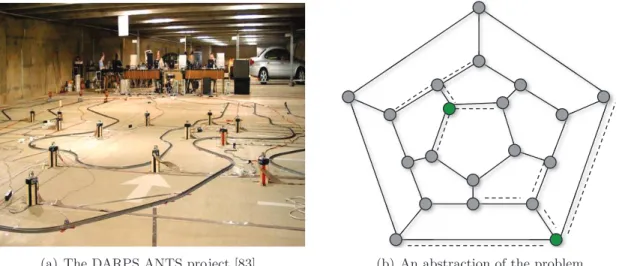
(a) The DARPS ANTS project [83] (b) An abstraction of the problem Figure 1.1. Target tracking in sensor networks.
of reconfiguring a power grid after line failures using a distributed message-passing based approach [74]. Another example of multiagent decision making is the distributed collabora-tive sensing initiacollabora-tive of the NSF that focuses on a distributed sensing of the atmosphere, rather than using a few, high cost radars [91] . My work has developed new models and tractable algorithms for early outbreak detection of stochastically evolving events, such as tornadoes in the atmosphere [69].
We next describe the single-step and sequential version of a multiagent sensor network problem.
1.1.1 Single-Step Multiagent Decision Making
Fig. 1.1(a) shows the target tracking problem in a sensor network for the DARPA ANTS project [83]. The tracks in the figure show where mobile targets can move. The task for the stationary sensors is to track the targets by coordinated scanning of the target. An abstraction of this problem is represented in Fig. 1.1(b). Each node in the graph is a sensor agent. The edges of the graph represent the possible locations where a target can be. There are multiple targets which can be present on the different edges of the graph. First, consider the single-step reasoning problem where all targets are stationary. To track a target, a joint scan of the edge where the target is present is required. When such coordination happens, a positive joint-reward is given to the scanning agents. If agents scan in an uncoordinated
manner or they scan an edge where a target is not present, a penalty is given to each agent. There is no central controller which knows the location of all the agents and targets. Each agent has a strictly local view of the problem which involves knowledge about only those sensors that are its immediate neighbors. The goal for all the agents is to come up with a scan strategy such that the joint reward is maximized. Furthermore, agents can only communicate with their immediate neighbors using message-passing. Such decision making problems can be modeled as a distributed constraint optimization problem (DCOP) [95].
Distributed meeting scheduling presents another multiagent decision making domain [109]. In this problem, an agent represents a person in an organization. Each agents needs to par-ticipate in multiple meetings with a required set of attendees and range of start times. The goal for such automated personal agents is to find a joint meeting schedule that satisfies the local constraints of each meeting attendee and the global constraints for each meeting. Such multiagent distributed decision making has also found applications in several other domains such as distributed power supply reconfiguration in smart grids [74], synchronized traffic lights [60] and truck route planning [103].
1.1.2 Sequential Multiagent Decision Making
Now consider a much more realistic sequential decision making version of the sensor net-work problem described earlier. This version takes into account the case when the sensors can be faulty and targets are mobile. This problem can be formulated as a decentralized partially observable MDP (Dec-POMDP) [13]—the standard model for multiagent sequen-tial decision making. In this problem, targets are mobile. All targets have independent, stochastic trajectories, which means that either the target can stay at the same location with some (low) probability or move to an adjacent location. Sensors also have aninternal state, an indication of the battery level of the sensor. Each scan action depletes the battery. In addition to scanning, sensors have two additional actionssensor off and recharge. The
sensor off action allows sensors to conserve energy by remaining idle. When the battery is completely depleted, a sensor must perform therecharge action, which has a cost. Each sensor can receive one of the following observations after performing a scan action: target present, target absent and sensor idle. False positives/negatives are allowed for the first
two observations. Sensors are encouraged to coordinate as simultaneous scans by multiple sensors are required to get the reward, otherwise a penalty is given. At runtime, sensors operate in adecentralized manner without a central controller. This implies that each sensor must select its next action based only on its local observation history. It seems that there is no communication among sensors during execution time. However, this is not true. The observations sensors receive are correlated by a joint observation function, that facilitates information exchange during execution time.
This particular sensor network domain presents several interesting characteristics as a multiagent planning benchmark. There are multiple agents (2) involved in the decision making, which requires for scalability in the planning approach. There is significant struc-ture present in the domain such as local interaction among sensors, which can be potentially exploited for scalability. Furthermore, the requirement for coordination is significant as un-coordinated scanning provides no benefit and incurs negative penalty. Other applications for multiagent planning which can be formulated using the Dec-POMDP model include coordinating the operation of planetary exploration rovers [12], coordinating firefighting robots [100] and broadcast channel protocols [13].
1.2 Summary of Contributions
We now describe the main contributions of this thesis, which address multiagent decision making problems that arise in different contexts. We address decision making problems in which a single joint-decision is required and refer this as single-step decision making. We also address sequential decision making problems in which agents need to perform several actions in a sequential manner to achieve a common goal. Finally, we address the problem of computing quality bounded solutions for sequential decision making problems in a scalable manner, that has been particularly challenging so far in multiagent planning.
1.2.1 Single-Step Decision Making
Main research question: The main research question we address is how can multiple agents coordinate in an intelligent manner to achieve a common goal by using only local
communication protocols. As this is an NP-Hard problem, we also address the question of finding quality bounds for a given problem instance.
Framework: We model the single-step multiagent decision making problem using the framework of distributed constraint optimization (DCOP) [95]. We address a broader ver-sion of this problem by showing that the problem of finding the maximum-a-posteriori (MAP) assignment in Markov random fields [153] is equivalent to solving the DCOP under certain conditions. We thus develop approaches which are equally applicable to DCOP and the MAP problem in Markov random field, which is commonly used in machine learning applications.
Technical contributions: We address the MAP problem by using the framework of vari-ational inference, which analyzes the inference problem through the lens of mathematical optimization. There are two main variational formulations for the MAP—Quadratic pro-gramming (QP) formulation and linear propro-gramming (LP) formulation. The main advan-tage of the LP formulation is that it is convex and computationally tractable, thus there are no local optima. However, this formulation is inexact, implying the optimum of the LP does not solves the MAP problem optimally. The QP formulation, on the other hand, is exact. However, it is non-convex. Thus, globally optimizing the QP is intractable. We present a new variational framework which combines the benefits of both the QP and the LP formulation, while minimizing the impact of their weaknesses. This new hybrid formula-tion presents a series of relaxaformula-tions of the MAP problem, which on one extreme is identical to the QP formulation and on the other extreme, it is identical to the LP formulation. It can also represent an arbitrary combination of the QP and LP formulations, thus providing high flexibility.
The main benefit of this formulation lies in settings where the LP formulation is loose for a given instance. That is, the global optimum of the LP does not provide a good approximation to the MAP problem. We show analytically as well as empirically that the new hybrid formulation provides a tighter approximation to the MAP problem than the LP formulation, which translates into a better solution quality. By judiciously choosing how to introduce the QP constraints in the hybrid formulation, we can control the non-convexity of
the hybrid formulation, which otherwise can lead to a poor local optima. Thus, optimization over the hybrid formulation can avoid getting stuck in such poor local optima, which is the main obstacle for the QP formulation.
We also develop a message-passing algorithm called Hybrid Belief Propagation (HBP) that solves the hybrid variational formulation. This message-passing approach is developed by exploiting the connection between the MAP problem and the difference-of-convex func-tion programming. This approach is also guaranteed to converge unlike other approaches such as max-sum [107, 41]. Such message-passing approach is also ideal for large multia-gent systems as it only requires exchanging local, fixed-size messages among neighboring agents. Empirically, we show that our approach provides much better solution quality than the state-of-the-art approaches in both multiagent systems community and the machine learning community on a number of large synthetic and real-world benchmarks.
1.2.2 Sequential Decision Making
Main research question: The main research question we address is how to develop scalable planning algorithms that allow multiple agents to operate collaboratively in a de-centralized manner and under the partial observability of the environment. In this setting, multiple rounds of decision making are required. In each round, agents take an action based on their individual history of observations received from the environment so far. They per-ceive a new observation after taking the action. We address the problem of increasing the scalability of planning algorithms w.r.t. both the number of time steps in the plan (also called planning horizon) and the number of agents.
Framework: We use the framework of decentralized POMDPs (Dec-POMDPs) to model multiagent sequential decision making problems [13]. We also use restricted sub-classes of the Dec-POMDP model that can represent problems with structured interactions, such as the Network-Distributed POMDP (ND-POMDP) [99]. We also develop a new sub-class of the Dec-POMDP model called value-factorization based multiagent planning [76].
Technical contributions: Our technical contributions are along the two main sub-classes of sequential decision making—finite-horizon planning and infinite-horizon planning.
1.2.2.1 Finite-Horizon Planning
In finite-horizon planning problems, agents operate over a finite number of time steps without any discounting of the reward they receive. Computing optimal policies under this framework even for two agents is NEXP-Hard [13]. Therefore, approximation algorithms are commonly used. We focus on the bottleneck dynamic programming step of several approximate algorithms, also known as the backup problem. We investigate the compu-tational characteristics of the backup problem for 2-agents and show that it is NP-Hard. Despite this negative result, we present an efficient and scalable optimal algorithm for the decentralized backup problem. We show how this problem can be mapped to a weighted constraint satisfaction problem (WCSP). We then use state-of-the-art WCSP solvers to solve the backup problem. Our results show that bringing the perspective of constraint optimization helps solve the backup problem more than an order-of-magnitude faster than state-of-the-art solver PBIP [36]. We also investigate the backup problem in other restricted sub-classes of the Dec-POMDP model, such as ND-POMDPs, that can model larger mul-tiagent systems. We again show how to solve this problem efficiently using WCSP solvers. This approach provides magnitudes of speedup in the policy computation and generates better quality solution for all test instances than earlier approaches [146, 88, 70].
1.2.2.2 Infinite-Horizon Planning
In theinfinite-horizon planning problems, agents operate continuously with a discount-ing of the reward. We address the problem of optimizdiscount-ing the joint-policy of a team of agents represented as finite-state controllers (FSC) under the Dec-POMDP framework for infinite-horizon planning problems [15, 6]. Relatively few algorithms existed before our work for solving this planning class due to the intrinsic difficulty of infinite-horizon planning. We present a promising new class of algorithms for the infinite-horizon case for 2-agent Dec-POMDPs, which recasts the optimization problem as inference in a mixture of dynamic Bayesian networks (DBNs), which represent directed graphical models. An attractive fea-ture of this approach is the applicability of existing inference techniques in DBNs for solving Dec-POMDPs and supporting richer representations such as factored or continuous states and actions. We perform the inference in such DBNs by using the well known Expectation
Maximization (EM) algorithm from the machine learning literature to optimize the joint policy. Experiments on benchmark domains show that EM compares favorably against the state-of-the-art solvers.
We also try to answer the following question: Is there a general characterization of the interaction among agents that when present in a multiagent planning model leads to a rel-atively scalable approximate algorithm? We identify such conditions based on a joint-value factorization assumption, that when present in a planning model, enhances the scalability w.r.t. the number of agents. We also develop a scalable, message-passing algorithm that can solve such planning problems using the EM framework. The EM framework is particularly suited for developing algorithms for such restricted models as the EM approach works di-rectly on the DBN representation of the planning problem. Such graphical representation allows for exploiting the independencies present in the planning model than the existing nonlinear programming based approach.
1.2.3 Bounded Optimality for Sequential Decision Making
Main research questions: The main question we address in this part is how to develop approaches that can provide boundedly optimal solutions for multiagent sequential deci-sion making problems in a scalable manner. Since planning in the Dec-POMDP framework is NEXP-Hard [13], an optimal approach would naturally be highly inefficient. However, we can alternatively address the question that what is the optimal joint-policy when each agent’s policy is restricted to a particular class of all the allowed policies. This sub-class corresponds to the case when the agents’ policies are represented as finite-state con-trollers [6]. We address the question of how to find optimal finite-state concon-trollers of a given size for all the agents. This work is the first to propose a scalable technique for finding optimal controller based policies for multiagent planning.
Framework: We use the the Dec-POMDP model as the multiagent planning frame-work. We also use some restricted sub-classes of Dec-POMDPs, such as the ND-POMDP model [99]. We use the mixed integer linear programming (MILP) framework [22] to model the problem of finding optimal joint controllers. We also use the Lagrangian relaxation
technique [16] in conjunction with the MILP framework to extend this approach to large multiagent systems with structured interactions.
Technical contributions: Our main technical contribution is to show how to formulate the problem of optimizing the joint-policy of agents represented as fixed-size finite state con-trollers in the Dec-POMDP model as a compact mixed integer linear program (MILP). Once we have a MILP representation of the planning problem, we can use off-the-shelf and highly efficient MILP solvers such as CPLEX, which can solve the MILP to optimality or provide non-trivial upper bounds. Previously, several attempts have been made to formulate both the single-agent and multiagent planning problems under uncertainty using mathematical programming [114, 24, 3, 4, 15, 6]. However, most of these approaches either result in a non-convex program, which suffers from the problem of local optima or they approximate the policy optimization using a convex program, which does not guarantee accuracy. These difficulties arise due to the highly non-linear nature of the planning problem. We resolve these problems by interpreting themultiagent planning problem under partial observability
as a single-agent planning problem under full observability. We then incorporate a small number of constraints into the MILP which guarantee that the resulting policy will work for the multiagent setting under partial observability.
Such connections to the MILP formulation also lays the groundwork for applying ad-vanced mathematical programming techniques to planning. The mixed integer program-ming is one of the heavily researched area in the mathematical optimization community unlike non-convex programming. There are several techniques that can provide an approx-imate solution to large mixed integer programs, while also providing a worst case quality guarantee. We show how to apply one such technique called Lagrangian relaxation [16] when there are large number of agents (2) involved in the planning problem. These tech-niques can be easily implemented in a message-passing manner, implying their suitability for multiagent systems.
Area Contributions Techniques
Single-step decision making Efficient message-passing al-gorithms for DCOP
Mathematical optimization—
Linear prog., quadratic prog. and difference-of-convex function prog.
Sequential decision making– Finite-horizon
Scalable dynamic program-ming based algorithms
Constraint optimization, branch-and-bound search
Sequential decision making– Infinite-horizon
Inference based approximate planning algorithms
Machine learning—Graphical
models, probabilistic inference, likelihood maximization
Sequential decision making– Bounded optimality
Techniques for quality
bounded solutions for finite state controller based policy optimization
Mixed integer linear prog., La-grangian relaxation, dual opti-mization
Table 1.1. Summary of contributions
1.3 Discussion
To conclude, our main contributions lie along two broad contexts in multiagent systems— single-step decision making and sequential decision making. For the single-step case, we ad-dress the question that how can multiple agents coordinate in a decentralized manner when the coordination problem is described using the distributed constraint optimization frame-work. We develop efficient message-passing algorithms using techniques from mathematical optimization.
For the finite-horizon sequential decision making problems, we address the bottleneck decentralized backup step of several approximate dynamic programming algorithms. The re-sulting techniques based on constraint optimization provide more than an order-of-magnitude speed up over previous best approaches. For the infinite-horizon case, we explore and exploit the connection between multiagent planning and probabilistic inference in graphical models to develop scalable approximate planning algorithms. Finally, we present several techniques that can provide quality bounded solutions for multiagent planning. This is achieved by reformulating the policy optimization problem as a mixed integer program, which can be solved using highly efficient off-the-shelf solvers such as CPLEX. Table 1.1 summarizes the main contributions of this thesis.
By bringing together such diverse perspectives from a number of different sub-areas of AI, ML and operations research, we show how efficient and rigorous algorithms can be
developed for some of the most computationally challenging problems in multiagent systems. Such synergy among multiple sub-disciplines of computer science holds a signicant promise to make multiagent planning scalable in real-world settings.
CHAPTER 2
DISTRIBUTED CONSTRAINT OPTIMIZATION FRAMEWORK
In several scenarios, multiple agents need to coordinate with each other so as to opti-mize a joint objective function. Such problems can be formulated as distributed constraint optimization problems (DCOPs) [95, 109]. Intuitively, each agent in these settings has its own internal optimization problem, which may reflect its private utility on assignments to decision variables modeled as constraints. Additionally, agents have shared constraints with other agents, which may reflect, for example, the need to share common resources [39]. Because internal optimization problems are private, agents only have knowledge about shared decision variables. A consensus among agents optimizing the joint utility must be reached through a distributed message-passing scheme rather than a centralized planning approach. Such problems arise in several application areas of growing importance such as stream processing and cloud computing [39]. In these settings, agents represent users who have to perform computation on several data streams in an overlay network. The network provides computing resources, which have limited capacity and are shared across different users. Users may have budget constraints and different preferences over the computing resources that process their queries, defining their internal optimization problem. The task for different users is to coordinate in a distributed manner so that the system efficiency is maximized for a given amount of shared resources. The DCOP formulation has been used to model several other practical multiagent problems such as coordinating unmanned aerial vehicles [125, 161], coordinating sensor management [83], distributed power supply management [74] among others.
While distributed constraint optimization is a relatively new framework dating back to mid 90s [162, 164], a closely related model in the machine learning community, that of Markov random field (MRF) [18], has been actively researched for more than thirty years. We show that the decision-theoretic problem of finding the maximum-a-posteriori
assignment (MAP) in MRFs is equivalent to that of DCOP with minor modifications [75]. Consequently, we build upon the wealth of research that already exists in the MRF literature and show that it offers an effective framework for solving DCOPs. This has the additional advantage that the resulting algorithms are equally applicable to several practical problems that are modeled using MRFs in such areas as bioinformatics (protein-prediction), computer vision (image denoising) among others. We first describe the MAP estimation problem in MRFs, followed by its connection to the DCOP problem.
2.1 Markov Random Fields and MAP Estimation
A Markov random field is a class of undirected graphical models which define a prob-ability distribution over a collection of random variables [63]. Markov random fields are particularly useful in modeling inference problems for structured practical applications as they marry probability theory with graph theory. Inference in such graphical models can be made highly efficient by exploiting the local interaction structure among random variables.
Definition 1. A pairwise Markov random field (MRF) is described using an undirected graph G= (V, E) such that
• There are nnodes in the graph.
• A discrete random variable xi is associated with each node i∈V of the graph.
• A random variable can take values over a finite domain with maximum size k. • Associated with each edge (i, j)∈E is a potential function θij(xi, xj).
• The complete assignmentxto all the variables in the MRF defines the following joint probability: p(x;θ)∝exp X ij∈E θij(xi, xj) (2.1)
Although we have only described pairwise MRFs, this is without loss of generality as any m-ary MRF can be converted to a pairwise MRF. Figure 2.1 represents a grid shaped
0
x
"01x
12
x
x
3Figure 2.1. An example of a MRF.
MRF. Each node has a random variable associated with it and edges represent the potential functions. Next, we describe the MAP problem.
Definition 2. The maximum a posteriori (MAP) problem consists of finding the most probable assignment to all the variables of the MRF under p(x;θ). Formally, it is given as:
argmax x exp X ij∈E θij(xi, xj) (2.2)
The above problem is also equivalent to the following optimization problem, which is mathematically a more convenient representation:
f(x;θ) = X
ij∈E
θij(xi, xj) (2.3)
We assume w.l.o.g. that eachθij is nonnegative, otherwise a constant can be added to each
θij without changing the optimal solution.
2.2 The DCOP Model
Like MRFs, a distributed constraint optimization problem (DCOP) with binary con-straints can also be visualized by an undirected graph G = (V, E), commonly called a
constraint graph. It is formally defined as:
• A set of agents X ={xi | ∀i∈ V}, where each agent has a finite domain of possible
• A set of constraint functionsθ={θij(xi, xj)| ∀(i, j)∈E}. Each constraintθij(xi, xj)
is associated with an edge (i, j)∈E.1
Therefore agents and constraint functions in a DCOP correspond to random variables and potential functions in an MRF, respectively. Similar to the MAP estimation problem, the objective in a DCOP is to find the complete assignment x that maximizes the func-tion f(x;θ) in Equation (2.3). The main difference between MAP estimation problems and DCOPs is that the former are centralized problems while the latter are decentralized problems. In MAP estimation problems, a single agent has complete knowledge of all the potential functions and controls the value assignments of all the random variables. On the other hand, in DCOPs, each agent has knowledge of only the constraint functions that it is involved in and chooses its own value only. That is, an agent can compute based only on its local information about its immediate neighbors in the constraint graph. Nonetheless, many (centralized) MAP estimation algorithms are implemented using message-passing along the edges of the MRF. These messages are computed based only on the local information avail-able to a variavail-able (or an agent) and the immediate neighbors of a variavail-able in the MRF (or the constraint graph). Thus, message-passing algorithms for MAP estimation in MRFs can bedirectly adopted to solving DCOPs [75]. A significant advantage of such message-passing algorithms is that they exploit the structure of the underlying MRF very efficiently and can scale well to large problems. Thus, developing novel message-passing algorithms based on rigorous principles from mathematical optimization will be the focus of our work.
2.3 Applications
We now describe some common application domains of DCOPs and MAP estimation.
• Multiagent systems: As the DCOP framework can naturally model problems where distributed decision making is required, they have found numerous applica-tions in multiagent systems. They have been applied in distributed meeting
schedul-1Although the typical notation of a constraint function is F
ij or cij in the DCOP literature, we use the notation in the machine learning literature to better illustrate the mapping between MAP estimation problems and DCOPs.
Protein backbone! Side-chains! X3! X1! X2 ! X4!
Figure 2.2. A protein backbone structure and its corresponding MRF [130]
ing [86, 108, 160], coordinating unmanned aerial vehicles [125], coordinated sensor networks [82, 83, 168, 95, 58, 171], distributed power supply reconfiguration in smart grids [74], synchronized operation of traffic lights [60] and truck route planning [103].
• Bioinformatics: Predicting the protein structure from its amino acid sequence is crucial for drug design and biotechnology. The side-chain prediction problem involves finding the three-dimensional configuration of rotamers given the backbone structure of protein [134, 62]. This problem can be mapped to finding the MAP in an appro-priately constructed MRF [134]. Figure 2.2 shows a schematic representation of this problem.
• Computer vision: Recovering the original digital image from a given image that has been contaminated with Gaussian noise is an important challenge in computer vision [19]. This problem can also be handled by using MAP estimation in MRFs. Computer stereo vision, which entails extracting 3D information from a set of images, can also be addressed using this framework [68].
• Information theory: Given observations over a noisy channel, the decoding problem is to determine the most likely codeword. In the context of low-density-parity-check (LDPC) codes, which have proven to be quite useful in noisy communication channels, the decoding task can again be translated to that of MAP estimation over a codeword factor graph [43].
2.4 Algorithmic Approach—Message-Passing
As most algorithms for DCOPs require iterative message-passing among the agents, we now describe some of the desirable characteristic of such message-passing approaches.
• Convergence: An algorithm is said to have this property if it is guaranteed to converge to a fixed point after a finite number of iterations. For message-passing algorithms, the fixed point is the point where the content of every message no longer changes. This property can be used as a basis to guarantee termination.
• Anytime Behavior: An algorithm is said to have this property if it finds solutions whose qualities are monotonically non-decreasing.
• Error Bounded: An algorithm is said to have this property if it has an error bound on the solution quality. This bound can provide a worse case guarantee about how far the current solution is from the optimal.
• Adaptive: An algorithm is said to have this property if it is able to solve dynamic DCOPs, that is, DCOPs that change over time. In such dynamic DCOPs, a message-passing approach must be able to incorporate the situations in which new agents may join the system or some of the agents become inactive over time. A desirable property is that in spite of such dynamism, the message-passing approach must be able to warm start the computation from previously computed messages, rather than throwing all the work performed so far.
• Privacy Preserving: This a relevant property to DCOP algorithms which is not ap-plicable in the MAP estimation case. In particular, this involves answering questions such as what private information is revealed by such message-passing algorithms and can such message-passing approaches be anonymized.
In section 3.5, we present message-passing algorithms that have most of the above properties.
2.5 Discussion
In this chapter, we have formally introduced the framework of distributed constraint optimization as a model for multiagent single-step decision making. We have established a
close relationship of this problem with that of MAP estimation in Markov random fields. Our work is also the first that formally establishes such connections between DCOPs and MAP estimation [75]. As a result, we can easily leverage approaches from machine learning literature under the umbrella of message-passing algorithms for multiagent systems.
CHAPTER 3
MESSAGE-PASSING ALGORITHMS FOR DCOPS
In this chapter, we provide an overview of message-passing approaches for multiagent systems and related approaches in the Markov random field (MRF) literature. We start with a review of complete and approximate algorithms for DCOPs, followed by variational infer-ence based techniques commonly used in the machine learning literature. We then present our contributions that leverages techniques from the machine learning and optimization literature to develop novel algorithms for DCOPs.
A key contribution of our work is the unification of two different existing variational frameworks based on quadratic programming (QP) and linear programming (LP) for MAP and DCOPs [77]. The main benefit of the unified framework lies in its ability to combine desirable properties of existing formulations such as the accuracy of the QP formulation and the convexity of the LP formulation, while minimizing the impact of their weaknesses, namely the non-convexity of the QP formulation and approximate nature of the LP for-mulation. We show that the resulting unified framework is also analytically tighter than existing formulations. We then develop a scalable algorithm based on difference-of-convex functions (DC) programming that efficiently exploits the underlying graph structure using a message-passing scheme. This approach is always convergent, can provide tight quality bounds unlike other approximate approaches such as Max-Sum and empirically, provides near-optimal solutions for a number of real-world and synthetic benchmarks from the mul-tiagent systems, machine learning and operations research literature. Extensive empirical results show that our approach significantly outperforms state-of-the-art approaches both in the multiagent systems and machine learning literature.
3.1 Related Work
3.1.1 DCOP Algorithms
DCOP algorithms have been typically categorized asincompletealgorithms andcomplete
algorithms. Incomplete algorithms generally refer to an approximation scheme, whereas complete algorithms solve the DCOP problem optimally. It should be noted that the DCOP problem is NP-Hard [34]. Therefore, any complete algorithm requires exponential compu-tational time/space in the worst case in the number of agents, unless P=NP.
Some of the incomplete DCOP algorithms include the distributed breakout algorithm (DBA) [163], distributed stochastic algorithm (DSA) [45] and maximum gain message [85]. These algorithms have the common property that they consider changing the assignments of a small group of agents while keeping the assignments of the rest of the agents fixed. Hence, these are hill climbing algorithms that converge quickly, but are prone to getting stuck in poor local optima. There is another class of message-passing algorithms based on the classical max-product algorithm [107], called max-sum [42]. Several extensions and application domains of this method have been presented [137, 138, 139]. Another class of algorithms include k-optimal algorithms [106, 21, 52, 149] and t-optimal algorithms [61]. Other frameworks for incomplete DCOP algorithms include anytime local search [170] and divide-and-coordinate [148].
There has also been progress along complete DCOP algorithms. Some complete DCOP algorithms allow partial centralization in which local groups of agents can transfer their information to a mediator agent [87, 53]. There are also completely decentralized asyn-chronous search algorithms such as ADOPT [95], BnB-ADOPT [161], no commitment branch-and-bound search (NCBB) [25, 26] and SBB [55]. These algorithms have small memory requirements, but the number of messages exchanged can be exponential in the number of agents to reach optimality. Another direction for complete DCOP algorithms is based on dynamic programming. The distributed pseudo-tree optimization (DPOP) al-gorithm and its several variants have been influential in this direction [108, 109, 110, 111]. The dynamic programming approaches have the advantage that the number of messages ex-changed remain linear in the number of agents. However, messages can have an exponential size related to the tree width of the constraint network.
3.1.2 MAP Estimation Algorithms
As the problem of MAP estimation in MRFs has proven to be useful in several different application areas such as computer vision and information theory, there exists tremendous literature on how to find the MAP in specialized cases that arise in these applications, such as binary graphs or graphs with submodular potential functions. We do not attempt to provide a comprehensive overview. Instead, we limit ourselves to general graphs and state-of-the-art algorithms that have message-passing structure, rather than having a com-binatorial nature such as being based on graph cuts [66] or network flow [121]. This is because message-passing algorithms naturally satisfy the privacy and distributed computa-tion requirements of multiagent decision making models such as DCOPs, and are therefore directly applicable to DCOPs.
One of the earliest message-passing algorithm for finding the the MAP assignment in MRFs is max-product belief propagation [107]. While this algorithm has been used suc-cessfully in a variety of information-theoretic applications [1, 152], it comes without any guarantee of either correctness or convergence on general graphs. As highlighted before, the message-passing nature of this algorithm has led to its successful adoption for DCOPs too [41]. As this algorithm has poor theoretical guarantees for general graphs, most of the contemporary work for finding the MAP has been focused on the linear programming (LP) relaxation of the MAP problem and its connection with the embedded spanning trees of the graph [151]. Another direction of work has focused on the quadratic programming (QP) relaxation of the MAP problem. We first provide an overview of LP-based approaches followed by QP-based techniques.
An optimal solution of the LP relaxation provides an upper bound over the MAP as the LP solution can be fractional, whereas the MAP assignment is always integral. The LP formulation is also beneficial in proving optimality, which is guaranteed if the LP solution is integral. The LP formulation is at the core of most of the state-of-the-art MAP algo-rithms [151, 65, 154, 134, 131, 133, 120, 90, 68]. We now describe some of these approaches briefly.
One of the earliest studies that introduced the LP relaxation method and led to a flurry of developments in the field is due to Wainwright et al. [151]. They formally described
the LP relaxation and its properties, and established its connection with the underlying spanning trees of the graph. They also developed the tree-reweighted message-passing algorithm (TRW) which solves thedual of the LP relaxation.
For tree-structred graphs, the TRW algorithm reduces to the max-product algorithm, thus providing a formal grounding for max-product on trees. This algorithm has a partic-ularly attractive property that at each iteration, it provides an upper bound on the MAP solution quality. This algorithm is designed to decrease this upper bound and upon conver-gence, it will provide the optimal LP solution. It can also provide a guarantee of optimality based on certain optimum specifications. However, it is not guaranteed to decrease the dual objective for every iteration and some damping of messages is required to guarantee conver-gence. The non-monotonicity of TRW was addressed by Kolmogorov [65], who presented the sequential TRW (TRW-S) algorithm that monotonically decreased the upper bound with each iteration. The TRW-S algorithm modifies the original TRW algorithm in that messages are updated in a specific sequential manner rather than in parallel. The TRW-S is guaranteed to converge, however its converged solution may not provide the optimal bound, a disadvantage compared to TRW. Werner [154] introduced another message-passing algo-rithm, Max-Sum diffusion (MSD), that is also guaranteed to decrease the upper bound. However, it is also not guaranteed to converge to the optimal bound based on the LP relax-ation. Another approach which works on the dual of the LP relaxation is the max-product LP (MPLP) algorithm [49]. This approach also monotonically decreases the upper bound on MAP like TRW-S, but may get stuck in local optima.
The development of such theoretical advances led to the application of these approaches to many practical problems such as protein side-chain prediction and protein design in bioinformatics and in computer vision [159]. An empirical study of TRW-based algorithms showed their effectiveness against black-box solvers such as CPLEX, which were not able to solve LPs for some large problems [159], whereas message-passing algorithms still provided good solutions as they effectively exploited the underlying graphical representation. Com-bining such message-passing approaches with domain-dependent heuristics helped optimally solve some large MAP instances in computer vision [92].