Gillespie, Mark and Rivers, Ian (2017) Assistant grade nurses and
nursing students : a diary study. Mental Health Practice, 21 (3). pp. 21-25.
ISSN 1465-8720 , http://dx.doi.org/10.7748/mhp.2017.e1227
This version is available at https://strathprints.strath.ac.uk/62692/
Strathprints is designed to allow users to access the research output of the University of Strathclyde. Unless otherwise explicitly stated on the manuscript, Copyright © and Moral Rights for the papers on this site are retained by the individual authors and/or other copyright owners. Please check the manuscript for details of any other licences that may have been applied. You may not engage in further distribution of the material for any profitmaking activities or any commercial gain. You may freely distribute both the url (https://strathprints.strath.ac.uk/) and the content of this paper for research or private study, educational, or not-for-profit purposes without prior permission or charge.
Any correspondence concerning this service should be sent to the Strathprints administrator:
The Strathprints institutional repository (https://strathprints.strath.ac.uk) is a digital archive of University of Strathclyde research outputs. It has been developed to disseminate open access research outputs, expose data about those outputs, and enable the
1
Reference: Gillespie, M., & Rivers, I. (2017). Assistant grade nurses and nursing students: A
diary study.
Mental Health Practice
, 21(3), 21-25. DOI: 10.7748/mhp.2017.e1227
Assistant Grade Nurses and Nursing Students: A Diary Study
Abstract
Little is known about the role of the assistant grade nurse in the clinical development of
pre-registration student nurses during their practice placement experiences, and even less focus
has been given to this relationship for those in training for the mental health field. Recent
policy changes in parts of the UK have markedly enhanced the career opportunities for
assistant grade staff, who are now able to work towards registration and to undertake
increasingly complex tasks, many of which require competencies student nurses are
expected to master. This paper reports on the descriptive statistics that emerged within a
wider phenomenological study of this subject, with the qualitative components considered
in a separate article. Results from diaries kept by nine participants suggest a larger and
more complex relationship than has been previously understood.
Introduction
The ratio of assistant grade staff within clinical nursing teams in the UK has grown
considerably since the training of pre-registration student nurses moved into the domain of
higher education (Hancock and Campbell, 2006). Prior to this the bulk of hands-on care was
delivered by the students and their removal created a gap that was filled through the
recruitment of assistant grade nurses
AGN
(McGowan, 2006). More recently
government responses to the care delivery concerns raised by investigations such as the
Francis Report (2013) have included a focus on the relationship between student nurses and
2
the assistant grade workforce, including combining the two in an effort to increase
occupational opportunity and a more caring workforce (Department of Health, 2014). This
focus emerged without strong evidence for its effectiveness and one recent study even
identified a negative correlation between the two roles (Snowden et al, 2015). The role of
AGN
practice placements is poorly understood
and markedly under-researched, especially in fields such as mental health (Hasson,
McKenna and Keeney, 2012). This study therefore sought to examine the relationship
AGN
exploration with a
literature review, the findings of which are summarised below. The review findings were
used to shape a phenomenological research study that utilised an Interpretative
Phenomenological Analysis Methodology comprising individual interviews with nine subject
AGN
“MHN
), and a diary of the
participants work patterns. This paper will focus on the diary findings.
Literature
Three research groups have been active in investigating the role of
AGN
in the clinical
development of student nurses. Each of the groups have incorporated a multiple method
approach to data collection, and as their main studies were carried out almost a decade
apart and emerged from two countries with markedly different formats for nurse training,
so they allow comparison over time and across culturally diverse health systems. The
studies by the University of Tasmania (Robinson et al, 2005) and the University of Canberra
(Grealish, Bail and Ranse, 2010) meeting Australian government intentions to identify how
best to support student nurses within older adult residential care settings, and the study by
Hasson, McKenna and Keeney (2012) reporting the AGN perspective on the topic within a
Northern Irish, adult care setting.
The work of Grealish and associates in Canberra reflects a number of studies spanning a
term of over a decade, building a picture of student nurse development within Australian
aged care settings. More recent papers from this group recognising that student awareness
of the value of learning from AGN contact needs aligned to a more positive and realistic
perspective in order to maximise the effectiveness of the relationship (Grealish and
Henderson, 2016).
3
A group of Tasmanian researchers published a paper in 2005 detailing what they identified
as the final report in a series of documents emerging from the one research project.
Subsequent publications from this group have explored the efficacy of interventions they
implemented to overcome deficiencies in student support within such environments,
including one specifically relating to the role of
AGN
as student mentors (Annear, Lea and
Robinson, 2014).
Their 2005 study identified that
AGN
students reported with the placement, providing u
(Annear, Lea and Robinson, 2014). Time spent with
AGN
strongly shaped the tasks
students were involved in, with higher levels of time supervised by
AGN
s correlated with
T
hygiene and attending to dietary needs of patients. More time with registered nurse
mentors equated to more involvement with clinical tasks such as medication administration.
The only UK focused paper on this subject reported on a large scale qualitative component
of a larger mixed methods study, completed as part of a doctoral qualification programme
(Hasson, McKenna and Keeney, 2012
T
AGN
involvement within student nurse training. Findings were similar to the Australian study in
AGN
AGN
number of skilled clinical tasks including venepuncture, the delivery of patient education
and the use of a variety of clinical assessment formats. This role however seemed to be
completed on an ad- hoc basis, with students generally allocated to work with
AGN
because mentor support was unavailable, or because the assistant was seen as having a
These studies identify reliance upon
AGN
to contribute towards the development of a
wide range of clinical skills in student nurses placed within their clinical teams. These skills
range from those labelled as basic, though essential may be a more accurate description,
through to highly complex therapeutic interventions. This role is informal and therefore
AGN
are not involved in the coordination or documentation rel
4
required, and as the studies took place within several clinical teams in different continents a
decade apart, it is obvious that the phenomenon is not isolated to one care environment
and that surprisingly little research focus has been directed to investigate what seems to be
a major influence within student nurse education. As no prior research has been done
within the mental health setting there is obviously a need to explore this issue.
Ethics
The requirement for consideration of, and adherence to ethical principles, is strongly linked
to the process of social research (King and Horrocks, 2010), and the moral parameters for
such a study are generally defined by the application of common ethical principles (Edwards
and Talbot, 1994), and via the requirement to meet professional standards (Hek and Moule,
2006). This study was considered and approved by the ethics committees of three
organisations; two academic institutions and the host Health Board. Ethical considerations
included a focus on fully informed participation, participant awareness of their right to
withdraw from the study and a focus on retaining the confidentiality of those involved.
Methodology and methods
Weaver and Olson (2006) recommend a pragmatic process in selecting research methods in
nursing on the basis that they should ultimately result in improvements for those studied
and for society in general. Recognising the paucity o
AGN
“MHN
discussions with practitioners, led to the selection of a research methodology considered to
aid investigation of previously unexplored subjects. Interpretative Phenomenological
Analysis (IPA) facilitates exploration of such subjects through engagement with the lived
experience of participants close to the area of investigation (Smith, 2004).
IPA enables such deep exploration through focusing on a small number of key participants,
using descriptive and interpretative phenomenology to analyse information generated
mainly via individual interviews, the themes emerging then available to compare across
individuals and groups (Smith, 2004). Diaries are also commonly employed within IPA
studies, one advantage being that they encourage participants to focus on the topic in
5
question, moving their appraisal of it from a superficial pre-conscious awareness to a more
considered understanding (Smith, Flowers and Larkin, 2009). This paper will focus on the
findings of the completed diaries, the results of which were used to frame the semi
structured interviews used in the subsequent interviews. The diaries asked mentors,
“MHN
AGN
review their activity over a consecutive working week and as the
timeframes were broken into half hour slots so the results allow a snapshot of work
practices within mental health services in one Board of the Scottish NHS in 2016.
Results
Who the student was supervised by Student sessions/ (%) S1- total= 80 S2- total= 73 sessions S3- total= 100 sessions None identified 9 (11%) 5 (7%) 4 (4%) Nurse direct 20 (25%) 32 (44%) 22 (22%) Nurse indirect 20 (25%) 12 (16%) 3 (3%) No one 5 (6%) 5 (7%) 0 (0%) AGN 20 (25%) 18 (25%) 66 (66%) Other professionals 3 (4%) 2 (3%) 6 (6%)
Activities when AGN was main supervisor (in descending order);
S1= Diet and fluids, Patient escort, Patient activity (Quiz/ dominos), Personal Hygiene.
S2= Patient activity (talking to and calming patients), Diet and fluids, Personal hygiene.
S3=Diet and fluids, personal hygiene, Patient activities (Quiz, painting, relaxing with patients, General tidying
Table 1 Students perceptions of who was supervising them.
Table 1 above confirms a substantial percentage of time recognised by students wherein
their practice is supervised by
AGN
s. In the case of S (student)3 this covered two thirds of
the timeframe investigated and for the other students a quarter of their placement time.
For one of these students (S3) the duration over which they believe they are supervised by
6
take responsibility for guiding student learning (NMC, 2010). These students therefore
consider
AGN
s as significant contributors towards their clinical learning.
There was also a clear connection between AGN supervision and the delivery of direct care,
including the application of essential care tasks, especially the meeting of nutrition,
hydration and hygiene needs. Several other authors (for example Gillespie, 2013: Grealish
and Henderson, 2016) have commented on the connection between the AGN role and the
completion of these skills, and the lack of relevance in learning these skills seen by some
student nurses. As seen in table 2 these diaries have additionally shown that
AGN
s are the
main guides for student mental health nurses during the application of a wider range of
tasks requiring skills in group-work, de-escalation, communication and socialisation. This
would suggest that
“MHN
recognise AGN involvement in guiding student nurse learning in
a far more significant scope of competencies than previously identified.
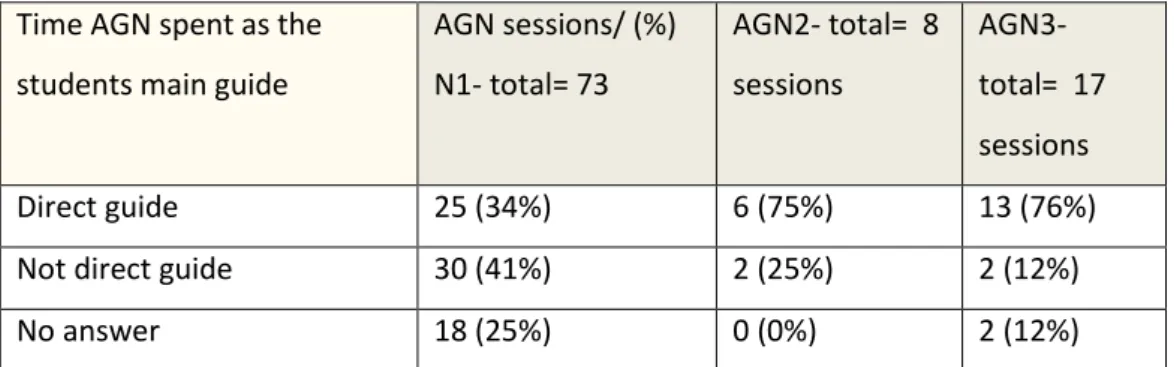
Time AGN spent as the students main guide
AGN sessions/ (%) N1- total= 73 AGN2- total= 8 sessions AGN3- total= 17 sessions Direct guide 25 (34%) 6 (75%) 13 (76%)
Not direct guide 30 (41%) 2 (25%) 2 (12%)
No answer 18 (25%) 0 (0%) 2 (12%)
Activities when AGN was main supervisor (in descending order);
AGN1- Patient activities (Crossword/ quiz/ talking to patients), Diet and fluids, Personal Hygiene.
AGN2- Communication (writing case files/ reporting back to team), Education (teaching staff, teaching relatives).
AGN3- Patient activities (assessment/ carer contact/ teaching student
communication interventions), Student induction, Communication (feedback to own team, feedback in wider review).
7
Table 2 suggests that
AGN
s saw themselves as being the main student guide over a period
ranging from 34 to 76% of the time recorded. The main activities they engaged in at the
time included recreational pursuits with patients, clinical skills including patient assessment,
family educational programmes and support, as well as the delivery of essential care skills
within in-patient settings. In addition then to identification of involvement in, and
responsibility for, a wide range of skilled tasks, the
AGN
s here recognise that during the
times where they have a student allocated to work with them, they are carrying out a broad
range of therapeutic tasks; tasks which require a significant level of competency and which
nt. The lack of recognition of this in the
current NMC (2010) guidance around student nurse education, is therefore concerning.
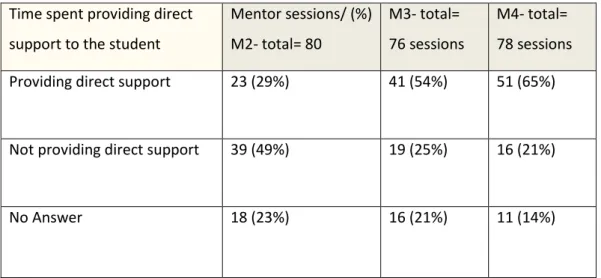
Time spent providing direct support to the student
Mentor sessions/ (%) M2- total= 80 M3- total= 76 sessions M4- total= 78 sessions Providing direct support 23 (29%) 41 (54%) 51 (65%)
Not providing direct support 39 (49%) 19 (25%) 16 (21%)
No Answer 18 (23%) 16 (21%) 11 (14%)
Table 3 Mentor perceptions of their supervision involvement
Mentors see mentors as spending large volumes of time directly supporting students,
between a third and two thirds of that available according to M (mentor)2 and M4. The
high figures given however identifying the volume of time within which students are not
supervised by mentors are notable as the influence of role models in the development of
student nurse practice is well recognised (Felstead and Springett, 2015). For students to be
guided through their development by non- mentors over large swathes of their programme
would support the notion that other groups, including
AGN
s, are contributing significantly
to student mental health nurse education.
8
M
to
AGN
s, and that within that the
AGN
s are showing students how to complete tasks as
diverse as security checks, personal hygiene and graded exposure.
The importance of placement location
T
relationship between the AGN and the student, as is the stage of their training and their
own personal preferences. With all of the students working with the same client group S1
and S3 spent the same percentage of their time working with registered nurses, however
the time spent with
AGN
s was markedly different, with S3 (a stage 2 student) working
alongside this group for over two thirds of the time covered, while this occurred for only a
quarter of the time the more senior S1 recorded. S2 (a stage 1 student) showed a more
even spread in working with people from a variety of backgrounds despite working in the
same clinical specialism as S3. As this was in a different hospital and ward from S3 it
appears that factors other than specialism shape this phenomenon. A study by Gillespie
(2013) found that while a group of student nurses in Scotland identified undertaking tasks
they saw as AGN related, as the most concerning issue for them during the first week of
their programme, such concern was not unanimously held. That individuals vary between
acceptance and avoidance of association with the AGN role, from the very commencement
of their programme, suggests variance in student engagement with AGNs is likely, and at
least partially shaped by individual student preference.
Conclusions
AGN
s contribute significantly to the clinical development of student mental health nurses
this contribution has existed since the inception of formalised nurse training. At present it
incorporates
AGN
s leading students in the development of many of the essential care skills
required in modern healthcare, as well as in the application of increasingly complex
technical and interpersonal competencies. This contribution from
AGN
s is expected across
all of the groups involved in student nurse education, although largely devoid of any formal
recognition. The goodwill shown by
AGN
s in providing support for student nurses is
9
compromised by this lack of recognition and the ongoing expansion of the AGN role is
further complicating this.
The social scientist Norbert Elias postulated that societal development is a continuous
process (van Krieken, 1998) and as a consequence change is something we should expect
and prepare for. Modern nursing has evolved considerably since a move to professionalism
was triggered by pioneers such as Florence Nightingale, and visionaries such as Annie
Altschul and Jack Lyttle have helped drive mental health nursing forward as a specialism.
Authors including Harmer (2010) have however expressed caution around the unfolding role
that nursing seems to be moving towards, with especial concern focused on the influence of
AGN
K
-Raynor and Duffin, 2008).
The success of the socialisation of student nurses into the occupational role expected of
them is reliant upon cohesion between the groups that constitute the clinical nursing team
and that relationship is currently in a state of flux. This leaves students uncertain of what
they are required to achieve in terms of a professional identity. Madsen, McAllister,
G
G
R
their lack of professional attachment as resulting in insecure and isolated workers without
understanding of the history of their role. Successful clinical development for students then
needs to be closely matched to a considered acceptance of the skills, experience and
knowledge available to them from their AGN colleagues and a clearly defined pathway to a
professional nursing role.
It is apparent that such development of health delivery structures and processes is ongoing,
and far from stopping, seems to be accelerating in pace since the publication of the Francis
Report (2013). To date, recognition of the contribution of
AGN
s towards student nurse
development has yet to be formalised, and as such ignores obvious opportunity to embrace
and enhance that relationship. It is only within isolated pockets, like older adult care in
Australia (Grealish and Henderson, 2016), where practical need has driven acceptance that
this should be seen as something to engage with. Nurse education seems blinded to
incorporation of structures that fall out-with what fits within the sense of professionalism
that nursing strives for, and as a consequence actively fights against accommodation of that
phenomenon. This reluctance is complicating student nurse education as it hinders the
10
creation of a route to development of a professional identity for student nurses. Nurse
education must therefore work to predict and lead change, as opposed to waiting until it is
forced upon them, or even worse trying to ignore it is happening.
Strengths and limitations of the study
The identification of the strengths and limitations of a health related research study are
crucial in allowing identification of the usefulness and applicability of that study towards
practice development (Rebar and Gersch, 2015). It is important therefore to identify the
worth and limitations of this study.
Exploration of the available literature identified that while there has been limited research
around the influence of the AGN on the clinical development of student nurses working
within physical and older adult care settings, there has been none investigating this
phenomenon within the mental health setting. This study is therefore ground breaking in
fore fronting this issue and in determining how it currently presents.
That only nine individuals took part in the study, all working within one Health Board area in
Scotland, exposes the project to criticism around the wider relevance of the findings and
their applicability across wider healthcare settings. Smith, Flowers and Larkin (2009)
counter that the small sample sizes associated with IPA research leads to the uncovering of
deeper understandings in as yet un-researched groups. They suggest that while this cannot
claim to be representative of all such similar cultures it is likely to uncover meanings
recognisable and useful to practitioners within comparable settings. They describe this as
Theoretical Transferability.
This study has confirmed the existence of a more extensive educational relationship
AGN
“MHN
recognised. The small number of
study participants and limited geographical spread of their clinical environments
necessitates further exploration of this topic within a wider spread of locations, the
involvement of larger participant cohorts and the use of other research methodologies in
order to strengthen what is known about this subject.
11 References
Annear, M, Lea, E. and Robinson, A. (2014) Are care workers appropriate mentors for nursing students in residential aged care? BMC Nursing. 13:44 doi.1186/s12912-014-0044-8
Department of Health. (2014) Hard Truths, The Journey to Putting Patients First; Volume one of the Government Response to the Mid- Staffordshire NHS trust Public Inquiry. Retrieved from
https://www.gov.uk/government/uploads/system/uploads/attachment_data/file/270368/34658_C m_8777_Vol_1_accessible.pdf
Edwards, A and Talbot, R. (1994) The hard Pressed Researcher: A Research Handbook for the Caring Professions. London: Longman.
Felstead, I. S. and Springett, K. (2015) An exploration of role model influence on adult nursing
A Nurse Education Today.
Retrieved from doi: 10.1016/j.nedt.2015.11.014.
Francis, R. (2013) Report of the Mid Staffordshire NHS Trust Public Inquiry: Executive Summary. Retrieved from https://hee.nhs.uk/sites/default/files/documents/WES_Executive_summary.pdf Gillespie, M. (2013) Student Nurse Perceptions of Client Groups and Clinical Placement Areas. British Journal of Nursing. 22 (6), 340-345.
Grealish, L. B K R K I
Journal of Clinical
Nursing. 19, 2291- 2299.
Grealish, L. and Henderson, A. I
experiences of organisational learning culture in aged care settings following a programme of cultural development. Contemporary Nurse. DOI: 10.1080/10376178.2016.1173518
Hancock, H. and Campbell, S. (2006) Developing the role of the healthcare assistant. Nursing Standard. 20 (49), 35-41.
Harmer, V. (2010) Are nurses blurring their identity by extending or delegating roles? British Journal of Nursing. 19 (5), 295- 299.
12 Hasson, F. McKenna, H.P. and Keeney, S., (2012) P
role in pre- Journal of Advanced Nursing. 69 (7), 1918-1929.
Hek, G and Moule, P. (2006) Making Sense of Research; An Introduction for Health and Social Care Practitioners. London: Sage Publications.
Kendall-Raynor, P. and Duffin, C. (2008) Students are being taught skills by support staff, professor warns. Nursing Standard. 22 (33), 9.
King, N.and Horrocks, C. (2010) Interviews in Qualitative Research. London: Sage Publications Ltd. Madsen, W., McAllister, M., Godden, J., Greenhill, J. and R R N H system of nursing education in Australia is undermining professional identity. Contemporary Nurse. 32 (1-2), 9-18.
McGowan, B. (2006) Who do they think they are? Undergraduate perceptions of the definition of supernumerary status and how it works in practice. Issues in Clinical Nursing. 15, 1099- 1105. Nursing and Midwifery Council. (2010) Standards for Pre-registration Nurse Education. Retrieved from http://standards.nmc-uk.org/PreRegNursing/statutory/Standards/Pages/Standards.aspx Rebar, C., R. and Gersch, C., J. (2015) Understanding Research for Evidence Based Practice (4th Ed). Philadelphia. Wolters Kluwer.
Robinson, A., Venter, L., Andrews-Hall, S., Cubit, K., Jongeling, L., Menzies, B. and Fassett, M. (2005) Building connections in aged care: Developing support structures for student nurses on placement in residential care: final report. Retrieved from
http://eprints.utas.edu.au/1325/1/Building_Connections_in_Aged_Care_report.pdf
Smith, J.A. (2004) Reflecting on the development of Interpretative Phenomenological Analysis and its contribution to qualitative research in psychology. Qualitative Research in Psychology. 1 (1), 39-54. Smith, J.A. Flowers, P and Larkin, M. (2009) Interpretative Phenomenological Analysis; theory, method and research. London: Sage.
Snowden, A., Stenhouse, R., Young, J., Carver, H., Carver, F. and Brown, N. (2015) The relationship between Emotional Intelligence, previous caring experience and mindfulness in student nurses and midwives: A cross sectional analysis. Nurse Education Today. 35 (1), 152-158.
13 Weaver, K. and Olson, J.K. (2006) Understanding Paradigms used for Nursing Research. Journal of Advanced Nursing. 53 (4) 459-469.