Digital and parallel distributed arithmetic parallel-prefix
adder residue number system for reverse converter
SK.Mujafar Ahmed
1; Pakalapati Mounika
2& Boggarapu Kantha Rao
31
Associate Professor ECE Dept. Medha Institute of Science and Technology for Women, Khammam [email protected]
2
M-Tech ECE Department, Medha Institute of Science and Technology for Women 3
HOD &Assoc Prof, Medha Institute of Science and Technology for Women
Abstract
In this brief, the design of reverse converter using parallel prefix adder based multiplier for residue number system is proposed. Nowadays the parallel prefix adders are not used even though it provides significant delay reduction and high speed operation because of higher power consumption. The novel specific hybrid parallel prefix adder components that compensate the delay and power consumption in the existing system is applied to design the reverse converter. Different parallel adder structures are analyzed among that the Brent Kung prefix network is used for the parallel prefix addition because of the minimum fanout. In the proposed system the high speed parallel prefix adder is designed for modulo (4n+1) addition for n=5 and thereby designing the multiplier by using the shifting operation in the same design.
Keywords:
Digital arithmetic; parallel-prefix adder (PPX); residue number system (RNS); parallel distributed arithmetic convolution architecture; reverse converter.1.
Introduction
The Residue Number System plays a significant role in the battery based and portable devices because of its low power features and its competitive delay. The Residue number system reverse converter is designed with parallel prefix addition by using new components methodology for higher speed operation[1].The RNS consists of two main components forward and the reverse converter that are integrated with the existing digital system. The forward converter performs the operation of converting the binary number to the modulo number whereas the reverse converter performs the operation of reverse converting the modulo number to the binary number which is the hard and time consuming
process compared with the forward converter. The fundamental RNS concepts such as 1)RNS
definition with properties and their
applications,2)consideration of modulo set
selection,3)design of forward
converter,4)modulo arithmetic units,4)design of reverse converter are discussed[2].
the basic properties of RNS includes shorter critical path, reduced complexity and low power[3].New architectures are presented for the moduli sets(2n- 1,2n,2n+1) for the conversion
from the residue to the binary
equivalents[4].Here the speed and the cost are major concern. Distributed arithmetic principles are used to perform the inner product computation in[5].The input data which are in the residue domain which are encoded using the Thermometer code format and the ouputs are encoded using the One hot code format. Compared to the conventional method which used Binary code format, the proposed system which achieves higher operating speed. The residue number system which provides carry free addition and fully arithmetic operation[6],for several applications such as digital signal processing and cryptography[7]-[11]. In this brief, we present a comprehensive method which uses the parallel prefix adder in selected position, thereby using the shift operation on one bit left to design a multiplier on the same design module to achieve a fast reverse converter design.
The usage on parallel prefix structure in the design leads to higher speed in operation meanwhile it increases the area and power consumption. Inorder to compensate the tradeoff between the speed, area and power consumption, a novel specific hybrid parallel prefix based adder components are used to design the reverse converter. These hybrid design which provides the significant reduction in the power delay product(PDP)metric and leads to considerable improvements in the area time² product(AT²) in comparison with the traditional converters without using parallel prefix adders.
2.
Related Work
The Residue number system mainly composed of three main parts such as, forward converter, modulo arithmetic units and reverse converter. On comparing with the other parts the reverse converter design is a complex and no modular structure. So more attention is needed in
designing the reverse converter thereby
preventing the slow operation and compromises the benefits of the RNS. The parallel prefix structure helps to achieve the faster operation in the reverse converter design but causes increased power consumption. In the existing system the novel specific hybrid parallel prefix adder based components are used to replace the existing
components thereby reducing the power
consumption and getting faster operation.
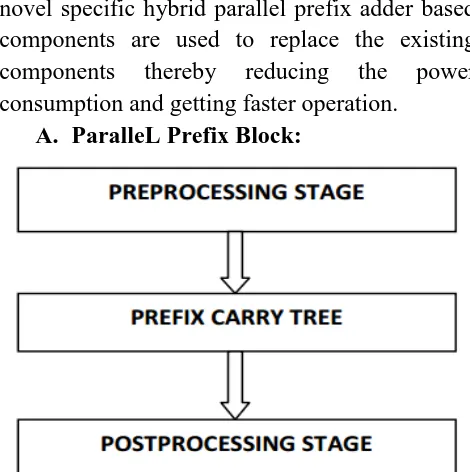
A. ParalleL Prefix Block:
Fig 1(a):Basic Parallel prefix structure.
compute both the propogate (P(i,j)) and generate (G(i,j)) by using the equation[3] &[4].The Gray cell executes only the generate(G(i,j)).The carry bits generated in the second stage get passed to the post processing block thereby generating the sum using the equation[5].The block diagram is shown in the Fig.1(a).
Gm:n=An AND Bn (1) G0 =Cin (2)
Pm:n=An XOR Bn (3) P0 =0 (4)
Gm:n=Gn:k OR Pn:k AND Gk-1:n (5) Pm:n=Pn:k AND Pk-1:j (6)
Sn =Pn XOR Cin (7)
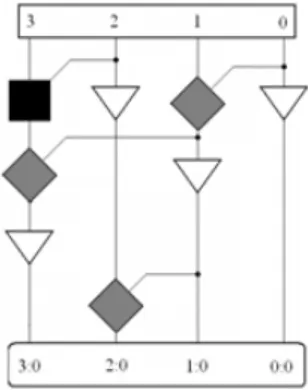
The Brent Kung adder prefix structure is employed to achieve the higher speed with reduced power consumption. On comparing with the other parallel prefix adder structure the BK adder is chosen mainly for minimum fanout and should be higher speed in operation than others.Fig.1.(b) shows the example BK adder prefix structure which uses the three basic cells in the prefix structure. These structure is elaborated for the proposed design having the modulo addition of (4n+1) for n=5.
Fig 1(b): 4-bit BK adder prefix structure.
B. HRPX Structure: (Hybrid Regular Parallel prefix XOR/OR adder component)
Fig 2: HRPX Structure using BK prefix network.
Fig. 2 shows HRPX Structure. The regular parallel prefix adder is used to do the first part of addition and the simplified RCA logic is used to do the second part where the corresponding bits of the operand are fully variable. Full adder can be designed with XOR/OR gates because of the constant operand. In this reverse converter design the carry chain is not needed and can be ignored. For most modulo sets (2ⁿ-1) addition is a necessary operation. The End around Carry (EAC) for (2ⁿ-1) addition is represented with two zero, but for the reverse converter design one zero representation is required. To correct these zero representation problem, a detector circuit was employed in the design but it incorporates additional delay. So, the Binary to excess one converter (BEC) is used to solve the double zero representation issue.
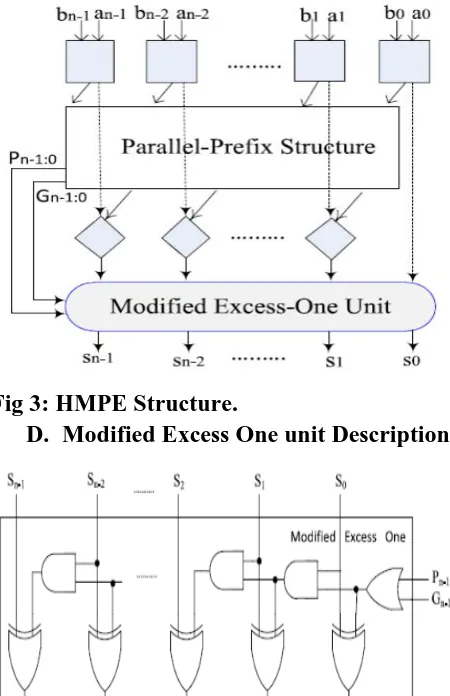
C. HMPE Structure (Hybrid Modular Parallel prefix Excess one adder component)
conditionally incremented based on the control signal generated by the prefix structure to assure the single zero representation.
Fig 3: HMPE Structure.
D. Modified Excess One unit Description
Fig 4: shows the Modified Excess One unit circuit diagram.
The result generated by the prefix structure is conditionally incremented by this unit based on the control signal generated by the parallel prefix adder.
3.
Implementation
The proposed design, as shown in Fig.3 .The reverse converter design is implemented for (4n+1)modulo addition( n=5) designing the adder and also the multiplier by using the same adder
design without using any parallel prefix multiplier structure for designing multiplier. In this design, the adder design is implemented by using the BK adder parallel prefix structure. Here the first two operands are added by using the prefix adder preprocessing stage thereby generating the propogate and generate equation. The first stage processed signal get passed to the next stage called the prefix carry tree, this stage again computes the generate and propogate equation by using the previous output and all the logic cells employed in the BK adder network. These processed signals are passed to the post processing block.
Fig 5: Parallel prefix adder based multiplier design.
4.
Experimental Results
The circuit can be designed and specified in
Verilog. For four different values of
n(4,8,12,16)are considered in the base paper whose experimental results are compared with the prosed vale of n=5.When comparing with the fully prefix adders, the area,power,AT² AND PDP of the proposed design is significantly improved. The PDP for the proposed converters are worse when compared with the RCA based, but this one get improved for the larger value of n(i.e)for n=16 the HMPE and HRPX better improvement on PDP over RCA based one. The main goal is to provide a better tradeoff between the delay and the power consumption. The delay occurs in the multiplier design is mainly due to shift operation. For instance at n=16,63% of power is saved at the expense of 35% of delay increase and also there is 42% of improvement in the PDP metric when comparing with the fully parallel prefix adder design. The proposed design consumes more power in order to operate in higher speed when compared with the RCA based one.
The comparison Table1.for different n values using HMPE-BK network in described below. These table provides the comparison including the area ,power consumption,AT² metric and PDP metrics to analyse the performance of the existing one with the proposed one. The proposed prefix adder based component allows us to achieve the better trade off between the cost and the speed thereby choosing the correct adder structure. The different parallel prefix adder structures are analysed based on the area, power consumption and speed, by using that evaluated value computed in the table [1].
5.
Conclusion
In this paper, the reverse converter can be implemented by using the BK parallel prefix adder network and the parallel prefix adder components are designed by using novel specific hybrid adder components for faster operation and reduced power consumption. The parallel prefix adder can be implemented upto (4n+1) modulo addition for n=5 in Verilog. The same adder design can be used for designing the multiplier by using the shift operation.
6. References
[1] Azadeh Alsadat Emrani Zarandi, Amir Sabbagh Molahosseini, Mehdi Hosseinzadeh, Saeid Sorouri, Samuel Antão, and Leonel Sousa ,― Reverse Converter Design via Parallel-Prefix Adders: Novel Components, Methodology, and Implementations‖ in IEEE Trans. on VLSI SYSTEMS., January 16, 2014
[2] K. Navi, A. S. Molahosseini, and M. Esmaeildoust, ―How to teach residue number system to computer scientists and engineers,‖ IEEE Trans. Educ., vol. 54, no. 1, pp. 156–163, Feb. 2011.
residue number system,‖ IEEE Trans. Very Large Scale Integr. (VLSI) Syst., vol. 21, no. 7, pp. 1322–1332, Jul. 2013.
[4] A. Benjamin Premkumar, M. Bhardwaj, and T. Srikanthan ,― High-Speed and Low-Cost Reverse Converters for the (2n-1,2n,2n+1) Moduli Set‖, IEEE Trans. on circuits and
systems—II: Analog and Digital Signal
Processing, vol. 45, no. 7, July 1998.
[5] Chan Hua Vun, Senior Member, IEEE,
Annamalai Benjamin Premkumar, Senior
Member, IEEE, and Wei Zhang, Member, IEEE, ―A New RNS based DA Approach for Inner Product Computation‖, IEEE Trans.Circuits And Systems—I: Regular Papers, vol. 60, no. 8, AugusT 2013.
[6] A. Omondi and B. Premkumar, Residue Number Systems: Theory and Implementations. London, U.K.: Imperial College Press, 2007.
[7] B. Parhami, Computer Arithmetic:
Algorithms and Hardware Designs,2nd ed., New York, NY, USA: Oxford Univ. Press, 2010.
[8] J.Chen and J. Hu, ―Energy-efficient digital signal processing via voltageover scaling-based residue number system,‖ IEEE Trans. Very Large Scale Integr. (VLSI) Syst., vol. 21, no. 7, pp. 1322– 1332, Jul. 2013.
[9] C. H. Vun, A. B. Premkumar, and W. Zhang, ―A new RNS based DA approach for inner product computation,‖ IEEE Trans. Circuits Syst. I, Reg. Papers, vol. 60, no. 8, pp. 2139–2152, Aug. 2013.
[10] S. Antão and L. Sousa, ―The CRNS framework and its application to programmable and reconfigurable cryptography,‖ ACM Trans.
Authors Profiles
Mr.SK.MUJAFAR AHMED
SK.MUJAFAR AHMED received the B.Tech. Degree in Electronics and Communication Engineering from Jawaharlal Nehru Technological University, Hyderabad in 2005 and M.Tech in Systems and Signal Processing from Jawaharlal Nehru Technological University, Hyderabad in 2011, is a faculty member in the department of Electronics and Communication Engineering, Medha Institute of Science and Technology for Women, Khammam and presently working as Associate Professor. His research
Pakalapati Mounika
M-Tech ECE Department, Medha Institute of Science and Technology for Women
Boggarapu Kantha Rao
HOD &Assoc Prof, Medha Institute of Scienceand Technology for Women, India,B.KANTHA RAO received the B.Tech. Degree in Electronics and Communication Engineering from Jawaharlal Nehru Technological University, Hyderabad in 2006 and M.Tech in EMBEDDED SYSTEMS from Jawaharlal Nehru Technological University, Hyderabad in 2010, is a faculty member in the department of Electronics and Communication Engineering, Medha Institute of Science and Technology for Women, Khammam and presently working as Associate Professor. His research interests include Embedded