lication in the following source:
Asghar, Hassan Jameel, Desmedt, Yvo,Pieprzyk, Josef, & Steinfeld, Ron (2014)
A subexponential construction of graph coloring for multiparty computa-tion.
Journal of Mathematical Cryptology,8(4), pp. 363-403.
This file was downloaded from: http://eprints.qut.edu.au/82448/
c
Copyright 2014 Walter de Gruyter GmbH
Notice: Changes introduced as a result of publishing processes such as copy-editing and formatting may not be reflected in this document. For a definitive version of this work, please refer to the published source:
DOI 10.1515 / jmc-????-???
A Subexponential Construction of Graph Coloring
for Multiparty Computation
Hassan Jameel Asghar, Yvo Desmedt, Josef Pieprzyk and
Ron Steinfeld
Communicated by ???
Abstract.We show the first deterministic construction of an unconditionally secure mul-tiparty computation (MPC) protocol in the passive adversarial model over black-box non-Abelian groups which is both optimal (secure against an adversary who possesses any t < n
2 inputs) and has subexponential complexity of construction based on coloring of
planar graphs. More specifically, following the result of Desmedt et al. (2012) that the problem of MPC over non-Abelian groups can be reduced to finding at-reliablen-coloring of planar graphs, we show the construction of such a graph which allows a path from the input nodes to the output nodes when anyt-party subset is in the possession of the adver-sary. Unlike the deterministic constructions from Desmedt et al. (2012) our construction has subexponential complexity and is optimal at the same time, i.e., it is secure for any t < n2.
Keywords.Multiparty computation, Graph coloring, Non-Abelian group, Planar graph.
2010 Mathematics Subject Classification.94A60, 05C10, 05C15, 05C25.
1
Introduction
Secure multiparty computation (MPC), a topic first addressed by Yao as a gener-alization of his famous millionaires’ problem in 1982 [16], enables two or more parties to securely compute a function on their individual secrets such that the parties involved obtain the correct output without revealing their secrets. Since Yao’s germinal work, extensive research has been done in cryptography to con-struct protocols for secure MPC. Most protocols for unconditionally secure MPC, which is the adversarial model considered in this paper, involve performing mul-tiplications and additions over a finite field. Some of these protocols have been generalized to work over rings; [7] presents an example. A natural extension of this trend is to realize MPC over groups. Recent years has seen a surge in interest in the cryptographic applications of non-Abelian groups [14, 15]. A result from Barrington [2] that any function can be computed by the non-Abelian symmetric
groupS5[11], arises further interest in the study of secure MPC over non-Abelian
groups. Following the trend, we are interested in secure MPC of circuits over
a finite non-Abelian group (G,·), where the group operations are performed by
the circuit gates. These circuits are aptly namedG-circuits. Our focus is limited
to protocols that only require black-box access to G. This means that the only
operations performed by the parties are group multiplication, group inverse and sampling a random element of the group.
Secure MPC over Abelian groups is easily realized through a well known black-box protocol that uses only two rounds, based on the notion of homomorphic
secret-sharing schemes [6]. It is secure against tpassive (or equivalently,
semi-honest) parties out ofn, wheretcan be any number less thann. The
communi-cation complexity of the construction isO(n2)group elements. A homomorphic
secret-sharing scheme has the property that ifv = (v1, v2, . . . , vn)is a vector of
shares of the secrets∈G, andw= (w1, w2, . . . , wn)is the corresponding share
vector of another secrets0 ∈G, then the product vector(v1·w1, v2·w2, . . . , vn·wn)
is the share vector of the secret s·s0. In other words, just by knowing the
indi-vidual shares of the two vectors the product of the two secrets can be computed. The MPC protocol based on such a scheme then works as follows. Each of the
n-parties holds a unique input from the vector(x1, x2, . . . , xn). The goal is to
securely compute the product of the inputs. In the first round, each party computes
n shares of its inputxi and sends a unique share to each of thenparties. In the
second round each party computes the product of all the nshares received from
the parties. By the homomorphic property the computed product is a share vector
for the productx1·x2· · ·xnwhich can then be computed by the parties.
As soon as one enters the realm of non-Abelian groups the above construction fails. This is not surprising as it was shown that there is no homomorphic construc-tion for the non-Abelian case [12]. Until recently, only non black-box approaches
for MPC ofG-circuits over non-Abelian groups were known. But these
construc-tions incur efficiency penalties, which we shall elaborate further while discussing
related work. Note that unlike the setting of Abelian groups, at-private protocol
over a non-Abelian group should have an honest majority, i.e.,t < n2 [3]. A
re-cent work from [11] showed for the first time the construction of black-box MPC
ofG-circuits over non-Abelian groups under the passive adversarial model. They
reduce the problem of t-privaten-party MPC protocol to a graph coloring
prob-lem over planar graphs. The result is a notion oft-reliablen-coloring of a planar
graph which is secure against an adversarial access of anyt-color subsetIof the
ncolors. The first of the three constructions of graph colorings described in [11]
is optimal, i.e., it can be used for anyt < n2, but only at the expense of exponential
respectively.1 The same construction is used recursively to obtain a protocol that
achieves polynomial complexity of construction for anyt∈ O(n1−)whereis
any positive constant. Notice that polynomial complexity is achieved here at the cost of optimality. The last construction is probabilistic and achieves optimal
re-silience, i.e.,t < n2, while maintaining polynomial construction complexity. By
adjustingt, the complexity can be reduced to as low asO(t2)wheret ≤ n
2+ for
any positive constant.
In this paper we show adeterministicconstruction of at-reliablen-coloring of
planar graphs that is optimal (t < n2) under the passive adversarial model with
a subexponential complexity of constructionO(t2·log2t). Unlike [11] where
spe-cific coloring constructions were given for small values oft, our construction is
applicable to arbitraryt.
2
Related Work
In accordance with the theme of the paper, our treatment of related work is
re-stricted tot-private protocols forG-circuits over non-Abelian groups. The
afore-mentioned non black-box approach for constructing such protocols for anyt < n2
comprises of two methods, both based on Shamir’st-of-nsecret-sharing scheme.
The first method [3, 4] represents the G-circuit as a Boolean circuit and then
uses Shamir’s t-of-nsecret sharing scheme over the field GF(p)for some prime
p > 2t+1. The communication complexity of this protocol isO(t2logt), in-cluding a multiplicative factor equal to the number of AND gates. Due to its de-pendence on the number of AND gates of the circuit, the protocol is only efficient
for a small circuit, and hence a small groupG. Some later improvements on this
bound have been achieved (cf. [8, 9]) but the communication complexity is still linearly dependent on the number of AND gates.
The second approach [1, 7] represents the G-circuit as an arithmetic circuit
over a finite ring R. Shamir’s secret-sharing scheme generalized to any finite
ring is then used to complete the construction. The communication complexity
of this protocol is O(t2logt·NM(C)·l(R)). Here NM(C) is the number of
multiplications in the representation of theG-circuit over the ringRandl(R)is
the number of bits required to represent the elements of the ring, which satisfies
l(R)≥log|R|. For a generic ringR, if the groupGis ‘embedded’ in the ring so
that the multiplication operation inRis the same asG,l(R)is as big as|G|, i.e.,
the communication complexity is linearly dependent on the number of elements in
G.
1 For the sake of clarity a multiplicative factor, which represents the size of theG-circuit, is not
To the best of our knowledge, the first constructions of black-box MPC ofG -circuits over non-Abelian groups were shown in [11], where three different con-structions are illustrated. The idea behind the concon-structions is to reduce the
prob-lem of constructing at-privaten-party MPC protocol to at-reliablen-coloring of
planar graphs. Informally, this means that if the adversary is in possession of a
randomtcolor subsetI, then the graph is not blocked in the sense that there is at
least one path from the inputs to the outputs that does not contain any element from
I. The constructions in [11] are therefore illustrations oft-reliablen-colorings of
planar graphs. Central to the constructions is a square planar graphGtri(l, l)whose
t-reliablen-coloring is demonstrated. Here the parameterlrepresents the number
ofx(left) andy(right) input nodes which is the same for a square graph. The first
construction achieves optimal resilience with t < n2 but at the cost of
exponen-tial complexity of construction, i.e., l = nt
. Recursive use of this construction
leads to a construction with polynomial complexity but in whichtis not a constant
fraction of n. More specifically, the second construction requires t = O(n1−)
for some positive constant . The third construction is probabilistic and simply
assigns a random color from 1 tonto each node of the square graphGtri(l, l). This
probabilistic construction achieves optimal resilience while maintaining polyno-mial communication (construction) complexity.
Recently, Cohen et al. [5] have independently shown a construction of secure MPC over black-box non-Abelian groups in the passive model that achieves the
asymptotically optimal bound of 12−Ω 1n. The complexity of their construction
isnO(logn)which compares well with our construction. However, their
tion is based on logarithmic depth threshold formulae as opposed to our construc-tion which is based on graph coloring of non-planar graphs. Cohen et al. also
show two polynomial time constructions [5]. The first construction isalmost
op-timal, shying away from the optimal bound. More precisely it is secure against
1 2 −2
−O(√logn) fraction of passively corrupted parties. The second polynomial
time construction achieves the asymptotically optimal bound described above, but only under the assumption of the so-called majority from majorities conjecture. Loosely speaking, this conjecture states the existence of a polynomial time
algo-rithm inn, withnan odd integer, which generates a formula onninputs of
log-arithmic depth, which consists only of 3-input majority gates (and no constants)
and computes the majority function onninputs [5]. At the time of this writing, no
such algorithm is known.
Active Adversaries. Although the focus of this paper is on security against a passive adversary, we nevertheless briefly describe the work on MPC over black-box non-Abelian groups in the active model for the sake of completeness. The first
secure protocol under an active attack model was shown by Desmedt et al. in [10].
The protocol is optimal in the sense that it satisfies theQ3property, which means
that the adversary structure ∆does not contain any three subsets of players, the
union of which is the entire set of players. Notice that this condition is necessary to achieve active security [13]. The construction from Desmedt et al. is quadratic
in the number of maximal sets in the adversary structure∆, which in general can be
exponential in the number of playersn. Recently, Cohen et al. [5] have improved
on that result by showing a construction based on threshold formulae of
logarith-mic depth which isalmostoptimal, i.e., is secure against an active adversary that
controls at most 13−Ω(√1
logn)players.
3
Preliminaries, Notations and Definitions
Before proceeding to our construction of at-reliablen-coloring of a planar graph,
we recall some results from [11] which establish the link between secure MPC over
G-circuits andt-reliablen-coloring of certain graphs. To this end, it is first shown
in [11] that the problem of constructingt-privaten-party MPC protocols overG
-circuits can be reduced to the problem of constructing at-private subprotocol for
ann-party shared 2-product function, where the two inputs and the solitary output
of this function are shared among the parties. In the second step, it is shown how to reduce the problem of a shared 2-product subprotocol to the problem of finding
at-reliablen-coloring of planar graphs. The details of these reductions together
with the definitions of these terms can be found in [11]. For the sake of this paper,
we shall restrict our scope to constructingt-reliablen-coloring of planar graphs,
and take the results from [11] for granted which show how these constructions
suffice to realize secure MPC overG-circuits. Notice that a separate result from
[11] shows the reduction from MPC over arbitrary Boolean circuits to MPC over
G-circuits using Barrington’s result [2]. Thus, the construction shown here, and
the ones described in [11], can be used for general secure MPC.
As already mentioned, in this paper we are going to study graph coloring struc-tures. The underlying mathematical object of interest is a planar directed acyclic graph (PDAG) for which we have two well defined collections of nodes. The first one contains all input nodes (source) and the second collection comprises of all output nodes (sink). These two collections correspond to the players of a MPC protocol that receive the inputs and outputs. Each node in the graph is assigned a label (color) which indicates the player doing the computation. The edges
rep-resent elements of the groupGthat are transmitted to other players. The
compu-tation at each node is multiplication of group elements from all incoming edges,
outgo-ing edges. Thek-of-ksecret-sharing scheme follows from the following amended proposition from [11]:
Proposition 3.1.Let (G,·) be a finite group, and fix an elementg ∈ G. Fur-ther fix integers k and j ∈ [k]. Suppose (sg(1), sg(2), . . . , sg(k)) is a k-of-k
sharing of g achieved by sampling k − 1 shares {sg(i)}i∈[k]\{j} uniformly at
random from G, and obtainingsg(j)as the unique element ofGsuch thatg =
sg(1) ·sg(2)· · ·sg(k). Then j is independent of the distribution of the shares (sg(1), sg(2), . . . , sg(k)).
Proposition 3.2.Let(G,·)be a finite group, and fix an elementg∈G. Further fix integerskandj ∈[k]. Ifk−1shares{sg(i)}i∈[k]\{j}are sampled uniformly and
independently at random fromG, andsg(j)is obtained as the unique element of
Gsuch thatg =sg(1)·sg(2)· · ·sg(k), then(sg(1), sg(2), . . . , sg(k))is ak-of-k
sharing ofg.
We are now ready to precisely charaterize the PDAGs relevant to our study.
Definition 3.3.A graph G with set of nodes V is calledTriangle PDAG if the following properties hold:
• The input and output nodes create a triangle. The sides of the triangle contain
input nodes. The setLincludes all input nodes from the left-hand side. The
set R- all input nodes from the right-hand side. The base of the triangle,
denoted by the setB, is created by the output nodes.
• The intersection of the setsLandRconsists of a single node (it can receive
input from left and right).
• The intersectionsL ∩ BandR ∩ Bcontain single nodes that play double role
of input and output nodes.
• V ⊇ {L ∪ R ∪ B}.
Note that the definition does not provide any details about the internal structure
of the graphG. The aim of this paper is to provide details about it.
Definition 3.4.A graphRGover the set of nodesV is calledRectangle PDAGif the following properties hold:
• The input and output nodes create a rectangle. The input nodes are inserted
on the top and the right-hand side of the rectangle and the sets of nodes
are T andR, respectively. The output nodes create the left-hand side and
the bottom of the rectangle. The sets of nodes are denoted by L and B,
• The nodesT ∩ LandB ∩ Rplay double role of input and output nodes.
• V ⊇ {L ∪ R ∪ B ∪ T }.
Definition 3.5.The function
C :V →[n]
is at-Reliablen-Coloring for triangle PDAGGover the set of nodesVif for each
t-color subsetI ⊂[n], there are three nodes{`, r, b}such that
• `∈ L,r∈ Randb∈ Band{C(`)∪C(r)∪C(b)} ∩I=∅
• There is a path PATH`
b inG from the input node` ∈ Lto the output node
b∈ B, such that none of the nodes in the path has a color in the subsetI(the
path is calledI-avoiding).
• There is a path PATHr
b in G from the input noder ∈ Rto the output node
b∈ B, such that none of the nodes in the path has a color in the subsetI.
Definition 3.6.The function
C :V →[n]
is a(h, v)-Reliablen-Coloring for a rectangle PDAGRGover the set of nodesV, if
• for eachh-color subsetI ⊂[n], there are two nodes`∈ Landr ∈ Rsuch
that there is a (horizontal)I-avoiding path PATHr`fromrto`,
• for eachv-color subsetJ ⊂[n], there are two nodest∈ T andb∈ Bsuch
that there is a (vertical)J-avoiding path PATHtbfromttob.
4
Overview of the Constructions
Our construction shows how to build a family of triangle PDAGGt+n+12 for which
the corresponding(t+1)-reliable(n+2)-coloring exists, wheren=2t+1. The
construction is recursive and uses the following two building blocks:
• a triangle PDAGGn
t witht-reliablen-coloring and,
• a rectangle PDAGRGn
(t−1,t+1)with(t−1, t+1)-reliablen-coloring, i.e., the
rectangle graph provides a horizontalI-avoiding path as long as|I| ≤t−1
and a verticalI-avoiding path if|I| ≤ t+1. Horizontal and vertical paths
exist simultaneously if |I| ≤ t−1. Note that only vertical paths exist if
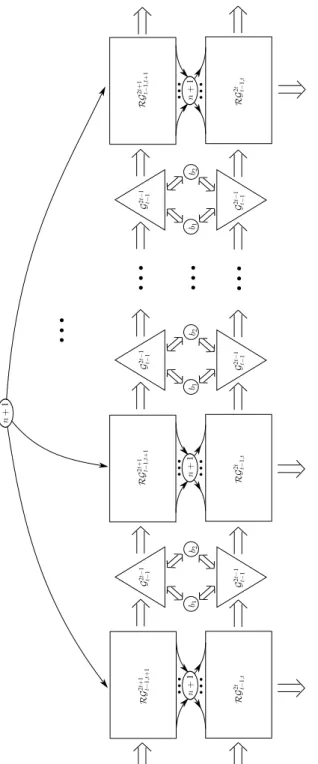
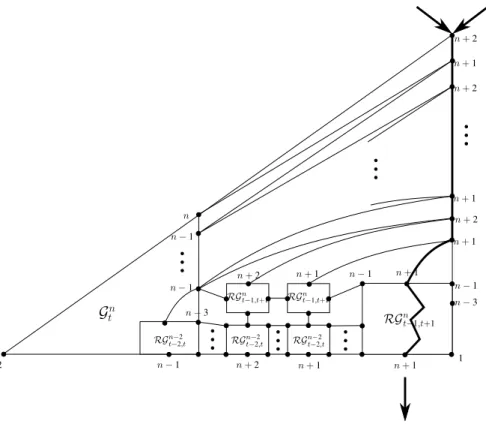
n+1 n+2 n+1 n+2 Gn t RG n t−1,t+1 Figure 1. Construction ofGn+2 t+1.
Note that apart from the two basic componentsGn
t andRGnt−1,t+1, the
construc-tion applies a collecconstruc-tion of vertices colored by either(n+1)or(n+2). Also,
the coloring of the component graph RGnt−1,t+1 uses the two additional ‘helper’
colors n+1 orn+2, in addition to the colors from[n], but the analysis only
requires the existence of paths forI ∈ [n]. All these components are depicted in
Figure 1. Each vertex of the right-hand side of Gn
t is connected to two vertices
with colors(n+1)and(n+2). Assume that the setIconsists of(t+1)colors.
The construction has to provideI-avoiding paths for the following three cases:
• Case 1: |I ∩ {n+1, n+2}| = 0 - this also means that the graphGn
t is
blocked. However, anI-avoiding path can be constructed using the very top
vertex with color(n+2)(that accepts two inputs from left and right) and goes
through all vertices with colors(n+1)and(n+2). The path also passes
through the rectangle graphRGnt−1,t+1, which supplies a verticalI-avoiding
path within the component.
• Case 2:|I∩{n+1, n+2}|=1 - the graphGn
t provides theI\{n+1, n+
2}-avoiding path within itself. We will show that the right-hand path can be
extended by using either one of the nodes with color{n+2, n+1}or by
using the rectangle graphs.
• Case 3:|I∩ {n+1, n+2}|=2 - the right-hand vertices with colors(n+1)
and(n+2) are blocked. An I-avoiding path is going to be created from
I-avoiding paths that exist in bothGn
t and the copies ofRGnt−1,t+1.
The crux of the construction is the rectangle graph RGn
t−1,t+1 that extends the
Figure 2 depicts the overall structure of the graph, assumingn≡1 mod 4, i.e.,
n = 4t+1 colors for somet ∈ N. Notice that this essentially means thattis a
power of 2. The structure uses
• triangle graphsG2t−1
t−1 to facilitate the horizontal avoiding paths,
• rectangle graphs RG2t+1
t−1,t+1 andRG 2t
t−1,t. The second graph has one color
less than the first. This is caused by the fact that the odd integerncannot be
split into halves,
• two groups of vertices colored with (n+1) or (n+2). Figure 2 shows
the color(n+1). An important observation is that both colors(n+1)and
(n+2)are not used in horizontal paths. They provide vertical avoiding paths
inRG4t+1
2t−1,2t+1,
• and twobridging nodeslabeledb1andb2which connect two vertically
adja-cent copies ofG2t−1
t−1 .
As noted above, the above construction assumes thattis a power of 2 for some
t ∈ N. In the following section, we shall show the construction of rectangle
graphs assumingtto be a power of 2. This enables us to show the construction of
the graphsRG2t−t+11,t+1,RG42t+t−11,2t+1,RG48tt+−11,4t+1, . . ., in a straigtforward manner.
In casetis not a power of 2, the construction ofRG2t+1
t−1,t+1is somewhat different,
G 2 t − 1 t − 1 RG 2 t + 1 t − 1 ,t + 1 RG 2 t t−1 ,t RG 2 t + 1 t − 1 ,t + 1 RG 2 t t − 1 ,t RG 2 t + 1 t − 1 ,t + 1 RG 2 t t−1 ,t G 2 t − 1 t − 1 G 2 t − 1 t − 1 G 2 t − 1 t − 1 G 2 t − 1 t − 1 b1 b1 b2 b2 b2 b1 G 2 t − 1 t − 1 n + 1 n + 1 n + 1 n + 1
Figure 2. Generic construction ofRG4t+1
2t−1,2t+1. Figure 90° counter-clockwise
5
Building Elements
Triangle and rectangle graphs are relatively simple for small parametersnandt.
For n = 1 andt = 0, the triangle graphG1
0 is a single vertex with color 1. For
n=3 andt=1, the graphG3
1with 1-reliable 3-coloring is shown in Figure 3. The
3
1 2
Figure 3. 1-reliable 3-coloring graphG3
1.
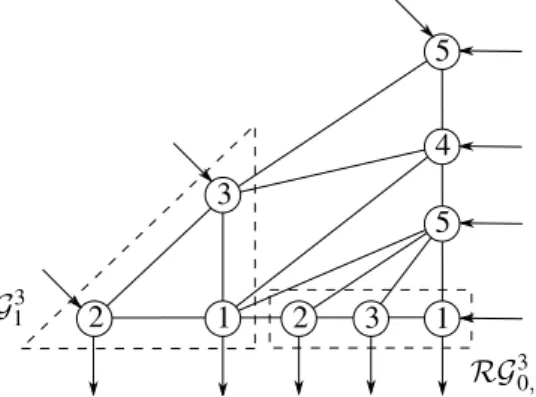
structure of 2-reliable 5-coloring graphG5
2is illustrated in Figure 4. It is built from
a triangle graph G3
1 which is 1-reliable 3-coloring and a rectangle graph RG
3 0,2
which is(0,2)-reliable 3-coloring. The rectangle graphRG30,2is the smallest that
can be defined. It allows a horizontalI-avoiding path only if|I∩ {1,2,3}| =0.
A verticalI-avoiding path inRG3
(0,2)exists if|I∩ {1,2,3}|=2. G3 1 RG3 0,2 5 5 1 1 2 2 3 3 4
Figure 4. A 2-reliable 5-coloring graphG5
2.
The graphs can be made symmetric by using mirror tricks. An example is
shown in Figure 5. The structure consists of two copies of the same graph, where one is a vertical reflection of the other. If we apply the trick once again but flipping the structure horizontally, we will get a graph that is fully symmetric that has the same number of inputs and outputs.
3
1 2
3
1 2 G13
Figure 5. Mirror trick forG3
1.
5.1 Analysis of Rectangle GraphsRG42tt+−11,2t+1for Vertical Paths
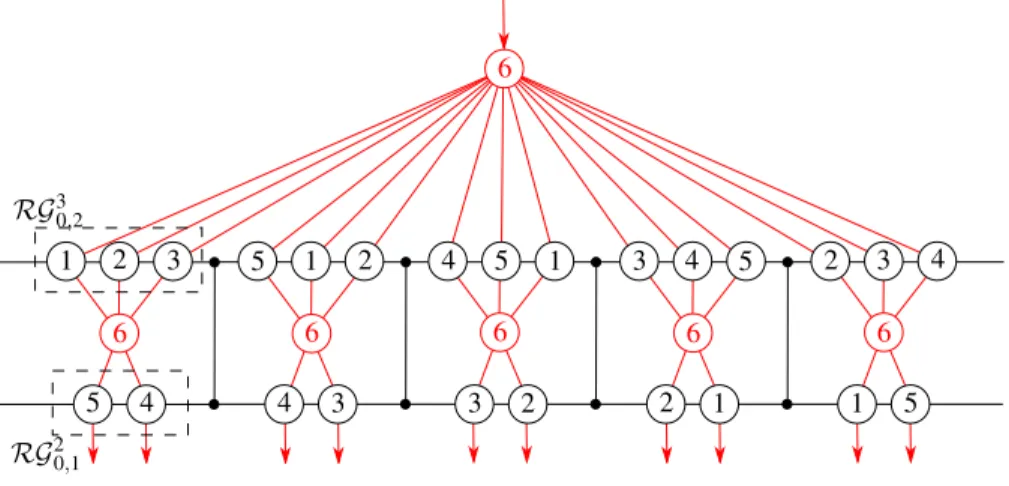
Let us start from the simplest rectangle graphRG5
1,3that can be built fromG01and
RG3
0,2. The overall structure is shown in Figure 6. The rectangle graphRG
2 0,1is a 6 6 6 6 6 6 RG3 0,2 RG2 0,1 1 1 1 1 2 2 2 2 3 3 3 3 4 4 4 4 5 5 5 5 1 2 3 5 4
Figure 6. Rectangle graphRG51,3.
modified copy ofRG3
0,2, where one color is removed (or equivalently duplicated).
This obviously means that the vertical paths in it can be blocked by the two
ver-tices. The triangle graphsG1
0 are replaced by bullet points (but could be replaced
by a single vertex from either left or right side). One of the purposes ofRG5
1,3is
to provide at least one vertical path from a top vertex with the color 6 that passes through the graph and ends up at one of the outputs (in red).
We claim that the graphRG51,3provides at least one verticalI-avoiding path as
long as|I∩[5]| =3. To prove this we need to consider all possible cases for the
set I. There are 53
= 10 such subsets. For instance, ifI = {1,4,5}, there is
the left) ending at the 3rd output (from the left). Note that there are 5 components
(RG3
0,2,RG20,1) and each pair is defined for vertices with 5 colors. The collection
of colors in each component is a simple “rotation" of colors between the pairs. Now we are ready to consider the vertical paths in the generic construction
from Figure 2. We assume that the construction ofRG4t+1
2t−1,2t+1consists of exactly
n = 4t+1 copies of (RGt2−t+11,t+1, RG2t
t−1,t) connected by appropriate copies of
Gt2−t−11. We assume that for each component (RGt2−t+11,t+1,RG2t−t1,t), we split colors
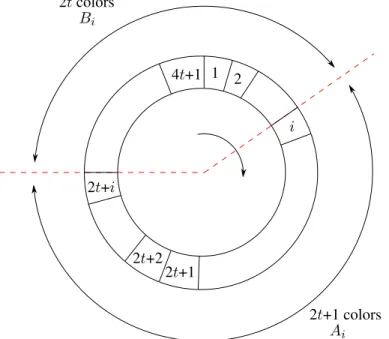
by a simple rotation of colors, i.e.,
• the first componentRG2t+1
t−1,t+1,RG 2t
t−1,tgets assigned the colors:
A1={1,2, . . . ,2t+1}andB1={2t+2, . . . ,4t+1},
respectively,
• thei-th componentRG2t+1
t−1,t+1,RG 2t
t−1,tgets the colorsAiandBiby rotating
the colors as shown in Figure 7.
1 2 4t+1 2t+i i 2t+1 2t+2 2tcolors Bi 2t+1 colors Ai Figure 7. Assignment of colors to components(RG2t+1
t−1,t+1,RG
2t
t−1,2t).
Theorem 5.1.Given the rectangle graph RG4t+1
2t−1,2t+1 built from n components
RG2t−t+11,t+1,RG2t
Assume that each component RG2t−t+11,t+1, RG2t−t1,t is assigned the sets colors of
colors(Ai, Bi)as described in Figure7. Then for an arbitraryI;|I| ≤ 2t+1,
there is a verticalI-avoiding path inRG4t+1 2t−1,2t+1.
Proof. Assume we have a setI of(2t+1)colors that needs to be avoided. To
create a path that avoidsI, we need to find a componentRG2t+1
t−1,t+1,RG 2t t−1,twith
(Ai, Bi)such that
|I∩Ai|=t+1 and|I∩Bi|=t (5.1)
To see that this is possible, consider the ring of colors in Figure 7. We put the colors
from the setIon the ring in their positions and then rotate the ring (or move from
(Ai, Bi)to(Ai+1, Bi+1)) until there is such pair which satisfies Conditions (5.1).
Note that this can always be done as a single step in rotation (move from(Ai, Bi)
to(Ai+1, Bi+1)may increase (or decrease) the numbers in the intersections by 1).
As the rotation is cyclic, there must be a pair of subsets(Ai, Bi)that contain the
required number of colors of the verticalI-avoiding path.
5.2 Analysis of Rectangle GraphsRG42tt+−11,2t+1for Horizontal Paths
We have proved that the rectangle graphRG4t+1
2t−1,2t+1provides verticalI-avoiding
paths as long as|I| ≤2t+1 and it has to haven=4t+1 components(RG2t−t+11,t+1,
RG2t
t−1,2t). Now we have to show thatRG42t+t−11,2t+1permits horizontalI-avoiding
paths as long as|I| ≤2t−1.
We start from the simplest case whent = 1 that is illustrated in Figure 6. To
avoid confusion, the graphRG5
1,3is redrawn without the vertices with the color
(n+1) =6 in Figure 8. Note that the vertices with the color 6 are used to provide
vertical paths only. It is easy to check that for all setsIwith a single color, there
1 1 1 1 1 2 2 2 2 2 3 3 3 3 3 4 4 4 4 4 5 5 5 5 5 Figure 8. Rectangle graphRG5
1,3with a horizontal path in red that avoidsI={3}.
is a horizonal path.
For t = 2, the rectangle graphRG9
3,5 consists of 9 copies of(RG51,3,RG41,2),
and enough copies of the triangle graph G3
1 to provide connections. The graph
RG9
1, 2, 3 2, 3, 4 RG 51,3 G 31 1 6 6, 7 7, 8 2 7 3 8 4 9 5 1 6 2 7 3 8 4 RG 41,2 Bridging nodes 4, 5 5, 6 8, 9 9, 1 3, 4, 5 6, 7 8, 9 1, 2 2 3, 4 9 7, 8 3 4, 5 1 8, 9 4, 5, 6 7, 8 9, 1 2, 3 4 5, 6 2 9, 1 5, 6, 7 8, 9 1, 2 3, 4 5 6, 7 3 1, 2 6, 7, 8 9, 1 2, 3 4, 5 6 7, 8 4 2, 3 7, 8, 9 1, 2 3, 4 5, 6 7 8, 9 5 3, 4 8, 9, 1 2, 3 4, 5 6, 7 8 9, 1 6 4, 5 9, 1, 2 3, 4 5, 6 7, 8 9 1, 2 7 5, 6
Figure 9. Rectangle graph RG93,5 without vertical nodes. Figure 90° counter-clockwise rotated.
Note also that the collection of colors for copies ofG3
1are chosen in such a way
that the colors are present in both the left and right-hand side copies of the rect-angle graphs. A justification for this choice is that this component can be blocked only if both copies of the rectangle graphs are blocked. The vertically adjacent
copies ofG3
1 are connected via the bridging nodes. These nodes are assigned the
two colors that areswappedbetween the diagonally adjacent rectangle graphs. For
instance, in the first component in Figure 9, the colors 1 and 6 have been swapped
between the two pairs of diagonal rectangle graphs (RG5
1,3andRG41,2). These are
then assigned to the bridging nodes. Notice that the triangle graph G3
1 has three
nodes in its base (obtained using the mirror trick). The left (resp. right) bridging node connects with the two nodes in the base of the left (resp. right) image of
the triangle graphG3
1. This is made explicit in Figure 10, where a segment of the
rectangle graphRG9
3,5is shown. As we shall see next, the vertical path through
the triangle graphs is only used when exactly one of the two colors assigned to the bridging nodes is blocked. Thus, this connection ensures that the path between the two triangle graphs is not blocked when used for vertical traversing.
4 3 2 3 6 1 9 8 7 8
Figure 10. The vertical connection between two copies of the triangle graphsG3
1via
the bridging nodes 1 and 6 inRG9
3,5.
To prove that there is a horizontalI-avoiding path, where|I|=3, it is enough
to enumerate all possible subsets of 3 elements out of 9. There are 93=84 such
cases. However, there is a better way to prove. This method can also be naturally extended for the general case. Because the structure is regular, it is enough to analyze transition of paths between two neighbouring components as shown in
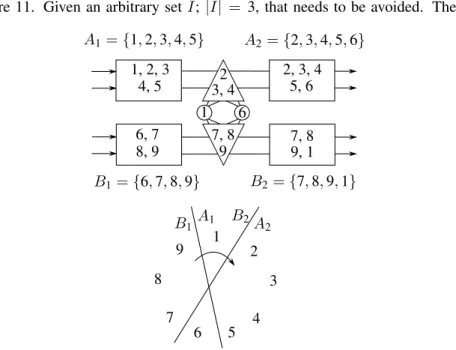
Figure 11. Given an arbitrary setI; |I| = 3, that needs to be avoided. The set 1, 2, 3 2 2, 3, 4 1 2 3 4 5 6 7 A1={1,2,3,4,5} A2={2,3,4,5,6} B1={6,7,8,9} B2={7,8,9,1} A1 B1 B2A2 1 6 9 4, 5 5, 6 6, 7 8, 9 7, 8 9, 1 3, 4 7, 8 8 9
Figure 11. Two consecutive pairs of rectangle graphs.
splits in a natural way into two subsetsIA1 = I∩A1 andIB1 = I∩B1for the
first component and also for the second one, i.e.,IA2 =I∩A2andIB2 =I∩B2.
Let us have a closer look at the colors 1 and 6 that are switched between sets, the
color 1 goes fromA1toB2and 6 - fromB2toA2. There are the following four
possibilities:
• the colors 1 ∈/ I and 6 ∈/ I - nothing is changing and the appropriate
hori-zontal path can be extended (i.e. if the graph with colors fromA1is blocked,
then the graph with colors fromA2is also blocked. Alternatively, if the graph
with colorsA1provided the horizontal avoiding path, then the graph withA2
extends the path),
• the colors 1 ∈ I and 6 ∈ I - the elements fromI were swapped and the
rectangle graphs provide an avoiding path by corresponding rectangle graphs,
• the colors 1 ∈ I and 6 ∈/ I - this also means that |IA
2| = |IA1| −1 and
|IB2| = |IB1|+1. The switch between two rectangle graphs happens if the
top graph with colors A1 was blocked by two colors (i.e. |IA1| = 2) as
the graph with colors fromA2is now providing horizontal avoiding path as
|IA2|=1. Clearly the graph with colorsB2has been blocked. For example,
a horizontal avoiding path. The graphRGA2 extends the avoiding path (via
the copies ofG3
1) whileRGB2 is blocked. Thus, a vertical transition has to
be made through the triangle graphs. Since the bridging node with color 1 is blocked, the transition between the two triangle graphs is provided by the bridging node with color 6. Note however that the switch will not happen if
|IA1|=3 as the graph with colors fromA2is blocked.
• the colors 1∈/Iand 6∈I- this case is similar to the previous one.
We did not consider how the rectangle graphs are to be connected to triangle graphs G3
1. This can be done by taking 3 vertices with colors from the intersection between
the colors of the neighboring rectangle graphs. The assignment of colors to inputs
and outputs for a part of the graph RG9
3,5 is given in Figure 12. Note that the
1, 2, 3 2, 3, 4 1 6 6, 7 7, 8 2 7 4, 5 5, 6 8, 9 9, 1 3, 4, 5 6, 7 8, 9 1, 2 2 3, 5 9 7, 8 3 4, 6 1 8, 9 1 4 6 8 2 5 7 9 2 5 7 9 3 6 8 1 3 6 8 1 4 7 9 2
Figure 12. Assignment of colors to inputs and outputs in first few components of
RG9
3,5.
triangle graphsG3
1 have the same colors on both sides. This can be done using
the mirror trick. The top and bottom copies ofG3
1, are connected via the bridging
nodes each one of which is connected to two of the three nodes in the base of the triangle graphs (this is the result of the mirror trick). See Figure 10.
Consider the general case for horizontal avoiding paths inRG4t+1
2t−1,2t+1forn=
4t+1, as shown in Figure 13. The vertices with the colorn+1 = 4t+2 are
not shown as they are used in vertical avoiding paths only. The graphRG4t+1
2t−1,2t+1
appliesncopies of pairs (RG2t−t+11,t+1,RG2t
t−1,t) that are connected by appropriate
copies of the graphGt2−t−11 - see Figure 2. The copies (RGt2−t+11,t+1, RG2t−t1,t) are
labelled by the colors(Ai, Bi);i=1, . . . , n. The following colors are assigned to
the pair(A1, B1):
A1={1, . . . ,2t+1}andB1={2t+2, . . . ,4t+1},
and the pair(Ai, Bi)is obtained from(Ai−1, Bi−1)by rotation of colors by one
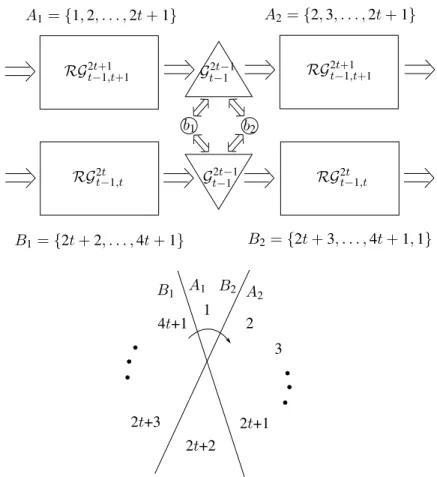
-see Figure 13. Without loss of generality, we consider the horizontal paths between
two components shown in Figure 13. Given an arbitrary setI;|I|= 2t−1, that
Gt2−t−11 RG2t+1 t−1,t+1 RG2t t−1,t RG2t+1 t−1,t+1 RG2t t−1,t b2 b1 Gt2−t−11 A1={1,2, . . . ,2t+1} A2={2,3, . . . ,2t+1} B1={2t+2, . . . ,4t+1} B2={2t+3, . . . ,4t+1,1} 1 2 3 2t+1 2t+2 2t+3 A1 B1 B2 A2 4t+1
Figure 13. Two first components of the graphRG4t+1
2t−1,2t+1.
andIB1 =I∩B1for the first component and also for the second one, i.e. IA2 =
I∩A2andIB2 =I∩B2. Let us have a closer look at the colors 1 and 2t+2 that
are switched between sets, the color 1 goes fromA1toB2and 2t+2 - fromB1to
A2. There are the following four possibilities:
• the colors 1 ∈/ I and 2t+2 ∈/ I - nothing is changing and the appropriate
horizontal path can be extended (i.e. if the graph with colors from A1 is
blocked, then the graph with colors fromA2is also blocked. Alternatively,
if the graph with colors A1 provided the horizontal avoiding path, then the
graph withA2extends the path),
• the colors 1∈Iand 2t+2∈I- the elements fromIwere swapped. If there
is an avoiding path in the graphs(RGA1,RGB1), then it can be extended in
• the colors 1 ∈ I and 2t+2 ∈/ I - this also means that |I
A2| = |IA1| −1
and|IB2| = |IB1|+1. The switch between two rectangle graphs happens
if the top graph with colors A1 is blocked bytcolors (i.e. |IA1| = t) and
bottom graph with colorsB1provides a horizontal avoiding path (as|IB1|=
t−1). The graph with colors fromA2provides a horizontal avoiding path as
|IA2|=t−1. Clearly the graph with colorsB2has been blocked. The switch
is made possible through the triangle graphs via the bridging node with color
2t+2. Note however that the switch will not happen if|IA1|> tas the graph
with colors fromA2remains blocked.
• the colors 1∈/Iand 2t+2∈I- this case is similar to the previous one.
To facilitate the switch the triangle graphs must provide appropriate extension of
avoiding paths. Note that the triangle graph betweenRGA1 andRGA2 is labelled
by 2t−1 colors that are in both setsA1andA2. This also means that the triangle
graph is blocked only if both graphsRGA1 andRGA2are blocked. Similar remark
applies for the triangle graph betweenRGB1 andRGB2.
5.3 Rectangle GraphsRG2t−1t+,t1+1for Arbitraryt
The design of the rectangle graphs discussed so far is limited totbeing a power of
2. For an arbitraryt, the construction of the rectangle graphRG2t+1
t−1,t+1is slightly
different. Appendix A details how to obtain such a rectangle graph. Thus, we
RG2t−t+11,t+1 1 2 t 1 2 t 2t+2
Figure 14. Rectangle graphRG2t−t+11,t+1.
assume from now on that we have a rectangle graphRG2t−t+11,t+1that is horizontally
I-avoiding and verticallyJ-avoiding as long as|I| ≤t−1 and|J| ≤t+1 and
I, J ⊆ [n]. The graph is illustrated in Figure 14. Note that horizontal input and
6
Construction for
G
2t+1 tThe triangle graphGn+2
t+1 forn= 2t+1, wheret =2,3,4, . . ., is constructed as
follows (see Figure 15):
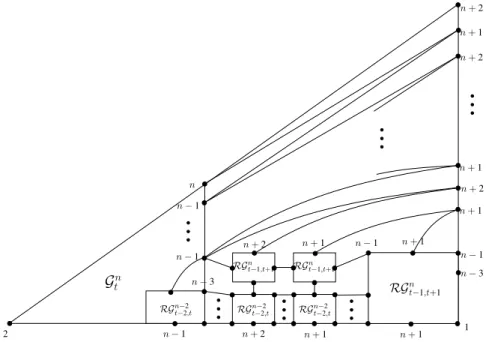
n+2 n+1 n+2 n+2 n+1 n+1 n−1 n−3 1 n+1 n+1 n+2 n−1 2 n+2 n+1 n−1 n+1 n n−1 n−1 n−3 Gn t RGn t−1,t+1 RGn−2 t−2,t RG n−2 t−2,t RG n−2 t−2,t RGn t−1,t+1 RGnt−1,t+1
Figure 15. The recursive construction ofGn+2
t+1.
Step 1: Take a triangle graphGn
t that ist-reliablen-coloring and a rectangle graph
RGnt−1,t+1, where the graphRGnt−1,t+1is(t−1, t+1)-reliablen-coloring
and with the structure as shown on Figure 14. The structure applies three
copies ofRGn
t−1,t+1and two copies ofRG
n−2 t−2,t.
Step 2: A single node (with colorn+2) is added as the top node ofGn+2
t+1. This
node belongs to both the top left and right sides of the graph and accepts inputs from both directions.
Step 3: The right-hand side of the triangle graphGn+t+12consists of a collection of
nodes colored alternately by two colorsn+2 andn+1 together with the nodes
from the right side of the bottom copy of the rectangle graphRGnt−1,t+1. Each
node with colors{n, n−1}is connected by two edges to their corresponding
nodes of the right side of the triangle graphGn+2
t+1 with colors (n+2)and
Step 4: The rectangle graph that is the component ofGn
t is connected to its two
copies and the last copy is connected to the bottom copy ofRGn
t−1,t+1.
Step 5: Two copies ofRGn
t−1,t+1are used to connect the bottom node ofGtnwith
color(n−1)to the very top of the bottom copy ofRGn
t−1,t+1.
Theorem 6.1.Given
(i) a rectangle graphRGn(t−1,t+1)that is(t−1, t+1)-reliablen-coloring and
(ii) the triangle graphGn t,
the triangle graphGn+2
t+1 generated by the recursive construction described above
is(t+1)-reliable(n+2)-coloring.
Proof. Before we start our proof, we introduce some useful notations. As the construction uses a sequence of related rectangle graphs, we denote the set of
colors It that need to be avoided in the graphs Gtn, wheret = 1,2, . . .andn =
2t+1. Observe that any particular pattern of colorsIthas to satisfy the following
relation
I1⊆I2⊆ · · · ⊆It ⊆It+1
This relation is enforced by the construction.
We have to argue that for an arbitrary setIt+1of(t+1)colors, whereIt+1 ⊂
[n+2], the graphGn+2
t+1 contains three nodes`∈ L,r∈ Randb∈ Bsuch that the
two paths PATH`band PATHrbareIt+1-avoiding. We consider three possible cases
for the setIt+1, namely
(i) |It+1∩[n]|=t+1 and|It+1∩ {n+1, n+2}|=0,
(ii) |It+1∩[n]|=tand|It+1∩ {n+1, n+2}|=1,
(iii) |It+1∩[n]|=t−1 and|It+1∩ {n+1, n+2}|=2
The proof proceeds by induction. It is easy to verify that the triangle G3
1 is
1-reliable 3-coloring. It takes a bit more effort (by trivial exhaustive search) to
es-tablish that the triangleG5
2is 2-reliable 5-coloring.
The induction step - we assume that the triangleGn
t ist-reliablen-coloring and
that the rectangle graphs are providing appropriate horizontal and vertical avoiding
paths. Assume that the setIt+1containst+1 colors taken from the set[n+2].
We also assume thatGn
t has the following property:
Property A.If|It| ≤tand the colorsn−1 andnare not both inIt, then
there exists anIt-avoiding path inGnt that enters via one of the input
nodes of colorn−1 ornon the top right hand side ofGn
This property is evident from the way the triangle graph is connected, and is
pre-served by the recursion. We also assume that the horizontalI-avoiding paths in
the rectangle graphs are symmetric (they enter and exit at the same node positionr
from the bottom) and moreover that the following property holds for the rectangle graphs:
Property B.If|It|=t−1 and{2k,2k+1}∈/Itfor somek≤t, then fork+1 < α ≤ t, theIt avoiding paths viaRG2αα−−21,αall go via the
same input/output node positionr(and thus can be extended from one
rectangle to the next).
The above property is justified through the way the rectangle graphs inGn+2
t+1 are
connected as shown in Appendix B.
Case 1:|It+1∩[n]|=t+1 and|It+1∩ {n+1, n+2}|=0.
The case is illustrated in Figure 16. As both colorsn+2 andn+1 do not belong
toIt+1, theIt+1-avoiding path exists if we select the top node that belongs to both
sets LandRor in other words ` = r. In fact, we have a single path that takes
inputs from both the left and right sides. This path includes all nodes with colors
{n+2, n+1}- in the Figure 16 the path is depicted by a thick line. The last node
with colorn+1 is connected to the nodes of the rectangle graphRGn
(t−1,t+1)that
completes the path. Note that the colorn+1 is used internally in the rectangle
graph to provide a path, and property A of Gn
t has been preserved in Gt+n+12, as
required. Further notice that we have not used the induction assumption here.
Case 2:|It+1∩[n]|=tand|It+1∩ {n+1, n+2}|=1.
In the proof, we are going to show the existence ofIt+1-avoiding paths. We assume
that there is aIt-avoiding path inGtn. There are the two possible cases
Case 2a – the avoiding path inGn
t starts from one of the nodes with colors in
the set{n, n−1}. By construction this path can be extended as each node
with a color from{n, n−1}is connected to two nodes with a color from
{n+2, n+1}. This scenario is illustrated in Figure 17.
Case 2b – the avoiding path inGn
t starts from one of the nodes in the rectangle
graphRGnt−−22,tat the bottom of the graph. The two copies ofRGnt−−22,textend
this path horizontally until the graphRGn
t−1,t+1which is horizontally blocked
(out ofncolorstcolors belong toIt). Here, we have used the fact that since
case 2a does not hold, we know that both the colorsn−1 andnbelong toIt.
As a result, due to property A ofGn
t, the set of colors[n−2]used in the two
copies ofRGnt−−22,tcontains|It|−2=t−2 colors inIt−1, so theIt−1-avoiding
paths inRGn−2
t−2,texist. Moreover they can be extended straight through
be-tween the two copies, thanks to the symmetry assumption onRGn−2
t−2,t. As
n+2 n+1 n+2 n+2 n+1 n+1 n−1 n−3 1 n+1 n+1 n+2 n−1 2 n+2 n+1 n−1 n+1 n n−1 n−1 n−3 Gn t RGn t−1,t+1 RGn−2 t−2,t RG n−2 t−2,t RG n−2 t−2,t RGn t−1,t+1 RG n t−1,t+1
Figure 16. AIt+1-avoiding path inGtn+1+2- Case 1.
which goes vertically by a pair of rectangle graphs (RGn
t−1,t+1,RG n−2 t−2,t) as both graphs have appropriate avoiding paths. Clearly, the two parts of the path must intersect as is shown in Figure 18.
Note that property A ofGn
t has been preserved inG
n+2
t+1, as required.
Case 3:|It+1∩[n]|=t−1 and|It+1∩ {n+1, n+2}|=2.
The collection of colors[n+2]is partitioned by the constructions intot+1 subsets,
namely
{1,2,3}; {4,5}; . . . {n−1, n}; {n+1, n+2}
As the last collection includes two colors from It+1, this means that at least one
subset (partition) from the collection
{1,2,3}; {4,5}; . . . {n−1, n};
must have two colors that do not belong toIt+1(if we haveturns andt−1 balls
n+2 n+1 n+2 n+2 n+1 n+1 n−1 n−3 1 n+1 n+1 n+2 n−1 2 n+2 n+1 n−1 n+1 n n−1 n−1 n−3 Gn t RGn t−1,t+1 RGn−2 t−2,t RG n−2 t−2,t RG n−2 t−2,t RGn t−1,t+1 RGnt−1,t+1
Figure 17. AIt+1-avoiding path inGtn+1+2- Case 2a.
partition{2k,2k+1}that does not have any color fromIt+1, wherek≤tand all
other partitions{2α,2α+1}fort≥α > khave at least one color inIt+1. Note
that in this case the last partition{n+1, n+2}contains both elements inIt+1.
Thus, the partition of colors has to be of the following form {1,2,3} | {z } 1 {4,5} | {z } 2 . . . {2k−2,2k−1} | {z } k−1 {2k,2k+1} | {z } k {2k+2,2k+3} | {z } k+1 . . . {2t,2t+1} | {z } t {2t+2,2t+3} | {z } t+1 where • |{2k,2k+1} ∩I t+1|=0 and • |{2α,2α+1} ∩It+
1| 6=0 for allα, wherek < α≤t+1.
The conclusion from the above reasoning is that it is enough to consider the
“worst" scenario when two colors{n, n−1}∈/It, where|It|=t−1 as|It+1|=
t+1. Being more specific there are other cases, that are equivalent to this one.
Horizontally blocked n+2 n+1 n+2 n+2 n+1 n+1 n−1 n−3 1 n+1 n+1 n+2 n−1 2 n+2 n+1 n−1 n+1 n n−1 n−1 n−3 Gn t RGn t−1,t+1 RGn−2 t−2,t RG n−2 t−2,t RG n−2 t−2,t RGn t−1,t+1 RGnt−1,t+1
Figure 18. AIt+1-avoiding path inGnt+1+2- Case 2b.
of single colors belonging toIt+1, i.e.,
|{2α,2α+1} ∩It+1|=1 forα=k+1. . . , t
where colors 2t+2,2k+3∈It+1. In all these cases the rectangle graphsRGnt−−22,t
can be used to provide the horizontal path together with the rightmost rectangle
graphRGn
t−1,t+1. The existence of this path follows from property B mentioned
before which is justified via the connection of the rectangle graphs as shown in Appendix B.
The path avoidingIt starts from the top node of the graphGtn with the color
n and goes vertically through the rectangle RGn−2
t−2,t on the left-hand side - see
Figure 19. The bottom node with the color n−1 is connected via three copies
of the rectangle graphs RGn
t−1,t+1 to the node n−1 on the right-hand side of
the graph Gn+2
t+1. Note that the rectangle graphs provide the horizontal avoiding
Blocked nodes n+2 n+1 n+2 n+2 n+1 n+1 n−1 n−3 1 n+1 n+1 n+2 n−1 2 n+2 n+1 n−1 n+1 n n−1 n−1 n−3 Gn t RGn t−1,t+1 RGn−2 t−2,t RG n−2 t−2,t RG n−2 t−2,t RGn t−1,t+1 RG n t−1,t+1
Figure 19. AIt+1-avoiding path inGtn+1+2- Case 3.
7
Complexity of Construction of
G
nt
Denote byG(t)andT(t)the complexity functions forGn
t andRGnt−1,t+1,
respec-tively, wheren =2t+1. For simplicity, assume first thattis a power of 2. The
resursive relation for the functionT(t)is of the following form
T(t) = (4t+2)·T t 2 +4·t·G t 2 +4·t,
where the first term follows from the fact that there aren=2t+1 pairs of rectangle
graphs, the second term is true since there are 2tpairs of triangle graphs, and the
last term accommodates for the 2tpairs of bridging nodes. The relation forG(t)
is as follows
G(t) =G(t−1) +3T(t−1) +2T(t−2) +2t≤G(t−1) +5T(t−1) +2t,
where the term “2t” is the number of nodes labelledn+1 andn+2 on the right
hand side ofGn
t (see Figure 15). Using the above relation, we can write
G(t) ≤ G(t−2) +5T(t−2) +5T(t−1) +2(t−1) +2t G(t) ≤ G(t−3) +5T(t−3) +5T(t−2) +5T(t−1) +2(t−2) + 2(t−1) +2t .. . G(t) ≤ G(1) +5 t−1 X i=1 T(i) +2 t−1 X i=1 (i+1). If we replaceT(i)by(4i+2)T 2i +4iG 2i +4i, we get G(t) ≤ G(1) +5 t−1 X i=1 (4·i+2)·T i 2 +4·i·G i 2 +2 t−1 X i=1 (i+1) ≤ G(1) +5 t−1 X i=1 (4·i+2)·T t 2 +4·i·G t 2 +2 t−1 X i=1 (i+1) = G(1) +5T t 2 t−1 X i=1 (4·i+2) +20G t 2 t−1 X i=1 i+2 t−1 X i=1 (i+1) = G(1) +10(t2−1)T t 2 +20t(t−1) 2 G t 2 +t2+t−2 ≤ G(1) +10t2T t 2 +10t2G t 2 +t2+t−2 = C·t2·T t 2 +C·t2·G t 2 +C·t2.
Now we can replace
T t 2 = (2t+2)T t 4 +2tG t 4 +2tand G t 2 ≤ Ct 2 4 T t 4 + Ct 2 4 G t 4 +Ct 2 4 , we obtain G(t) ≤ Ct2 2t+2+Ct 2 4 ·T(t/4) +Ct2 2t+Ct 2 4 ·G(t/4) + Ct2 2t+Ct 2 4 .
We repeat the substitution T t 4 = (t+2)T t 8 +tG t 8 +tand G t 4 ≤ Ct 2 16 T t 8 + Ct 2 16 G t 8 +Ct 2 16 , and get G(t) ≤ Ct2 2t+2+ Ct 2 4 ·T(t/4) +Ct2 2t+ Ct 2 4 ·G(t/4) + Ct2 2t+ Ct 2 4 = Ct2 2t+2+ Ct 2 4 t+2+ Ct2 16 ·T(t/8) +Ct2 2t+ Ct 2 4 · t+Ct 2 16 ·G(t/8) +Ct2 2t+Ct 2 4 t+ Ct2 16 .
If we continue substituting complexities of T(n/2i)andG(n/2i)byT(n/2i+1)
andG(n/2i+1), then in some point we hit the stopping caseT(1)andG(1). This
is to say that the number of terms is upper bounded by log2tor
G(t) ≤ Ct2 2t+2+Ct 2 4 t+2+ Ct2 16 · · · | {z } log2ttimes T(1) + Ct2 2t+Ct 2 4 t+ Ct2 16 · · · | {z } log2ttimes G(1) + Ct2 2t+Ct 2 4 t+ Ct2 16 · · · | {z } log2ttimes .
The number of replacements is upper bounded by log2t. This also means that
Now assume thattis odd, then the rectangle graphRGnt−1,t+1has the following recursive relation: T(t) = (2t+1)·T dt 2e + (2t+1)·T dt 2e −1 +2·t·G dt 2e + 2·t·G dt 2e −1 +4·t ≤ (4t+2)·T dt 2e +4·t·G dt 2e +4·t,
which is the same expression as the case whentis a power of 2.2 This leads us
to the same complexity evaluation. Iftis neither odd nor a power of 2, then the
recursive relation forRGn
t−1,t+1is the same as in the case whentis a power of 2
until an odd value is encountered during recursion. In this case, we can substitute
the (bounded) recursive relation obtained above for an oddt. Thus, the complexity
evaluation holds in this case as well.
Concluding Remarks
We cannot say for certain whether the construction of at-reliablen-coloring
tri-angle PDAG is the best that can be achieved and if it is possible to improve on the subexponential complexity of the specific construction shown in this paper. It remains an open problem to show a deterministic construction that is optimal and has polynomial complexity of construction. Indeed an MPC protocol over
non-Abelian groups with black-box access does not necessarily have to be at-reliable
n-coloring of a planar graph. It could employ some other mathematical structure.
Such possibilities are likely to incite further interest in this topic.
Bibliography
[1] J. Bar-Ilan and D. Beaver, Non-cryptographic fault-tolerant computing in constant number of rounds of interaction, in:Proceedings of the eighth annual ACM Sympo-sium on Principles of distributed computing, PODC ’89, pp. 201–209, ACM, New York, NY, USA, 1989.
[2] D A Barrington, Bounded-width polynomial-size branching programs recognize ex-actly those languages inNC1, in: Proceedings of the eighteenth annual ACM sym-posium on Theory of computing, STOC ’86, pp. 1–5, ACM, New York, NY, USA, 1986.
2 Note that iftis a power of 2, thendt
2e=
t
[3] Michael Ben-Or, Shafi Goldwasser and Avi Wigderson, Completeness theorems for non-cryptographic fault-tolerant distributed computation, in:Proceedings of the twentieth annual ACM symposium on Theory of computing, STOC ’88, pp. 1–10, ACM, New York, NY, USA, 1988.
[4] David Chaum, Claude Crépeau and Ivan Damgard, Multiparty unconditionally se-cure protocols, in:Proceedings of the twentieth annual ACM symposium on Theory of computing, STOC ’88, pp. 11–19, ACM, New York, NY, USA, 1988.
[5] Gil Cohen, Ivan Bjerre Damgård, Yuval Ishai, Jonas Kölker, Peter Bro Miltersen, Ran Raz and Ron D. Rothblum, Efficient Multiparty Protocols via Log-Depth Threshold Formulae - (Extended Abstract)., in:CRYPTO’13, Lecture Notes in Com-puter Science 8043, pp. 185–202, Springer-Verlag, 2013.
[6] Josh Cohen Benaloh, Secret sharing homomorphisms: keeping shares of a secret secret, in: Proceedings on Advances in cryptology—CRYPTO ’86, pp. 251–260, Springer-Verlag, London, UK, UK, 1987.
[7] Ronald Cramer, Serge Fehr, Yuval Ishai and Eyal Kushilevitz, Efficient multi-party computation over rings, in: Proceedings of the 22nd international conference on Theory and applications of cryptographic techniques, EUROCRYPT’03, pp. 596– 613, Springer-Verlag, Berlin, Heidelberg, 2003.
[8] Ivan Damgård, Yuval Ishai and Mikkel Krøigaard, Perfectly secure multiparty com-putation and the comcom-putational overhead of cryptography, in: Proceedings of the 29th Annual international conference on Theory and Applications of Cryptographic Techniques, EUROCRYPT’10, pp. 445–465, Springer-Verlag, Berlin, Heidelberg, 2010.
[9] Ivan Damgård and Jesper Buus Nielsen, Scalable and unconditionally secure mul-tiparty computation, in: Proceedings of the 27th annual international cryptology conference on Advances in cryptology, CRYPTO’07, pp. 572–590, Springer-Verlag, Berlin, Heidelberg, 2007.
[10] Yvo Desmedt, Josef Pieprzyk and Ron Steinfeld, Active security in multiparty com-putation over black-box groups, in:Proceedings of the 8th international conference on Security and Cryptography for Networks, SCN’12, pp. 503–521, Springer-Verlag, Berlin, Heidelberg, 2012.
[11] Yvo Desmedt, Josef Pieprzyk, Ron Steinfeld, Xiaoming Sun, Christophe Tartary, Huaxiong Wang and Andrew Chi-Chih Yao, Graph Coloring Applied to Secure Computation in Non-Abelian Groups,J. Cryptology25(2012), 557–600.
[12] Yair Frankel, Yvo Desmedt and Mike Burmester, Non-Existence of Homomorphic General Sharing Schemes for Some Key Spaces (Extended Abstract), in:Advances in Cryptology - CRYPTO ’92, pp. 549–557, Springer, 1992.
[13] Martin Hirt and Ueli Maurer, Complete characterization of adversaries tolerable in secure multi-party computation (extended abstract), in:Proceedings of the sixteenth annual ACM symposium on Principles of distributed computing, PODC ’97, pp. 25– 34, ACM, New York, NY, USA, 1997.
[14] Spyros S. Magliveras, Douglas R. Stinson and Tran van Trung, New Approaches to Designing Public Key Cryptosystems Using One-Way Functions and Trapdoors in Finite Groups,J. Cryptology15(2002), 285–297.
[15] Seong-Hun Paeng, Kil-Chan Ha, Jae Heon Kim, Seongtaek Chee and Choonsik Park, New Public Key Cryptosystem Using Finite Non Abelian Groups, in: Proceedings of the 21st Annual International Cryptology Conference on Advances in Cryptology, CRYPTO ’01, pp. 470–485, Springer-Verlag, London, UK, UK, 2001.
[16] Andrew C. Yao, Protocols for secure computations, in: Proceedings of the 23rd Annual Symposium on Foundations of Computer Science, SFCS ’82, pp. 160–164, IEEE Computer Society, Washington, DC, USA, 1982.
A
Rectangle Graphs
RG
2t+1t−1,t+1
for Arbitrary
t
The purpose of this Appendix is to show how to reduce the construction of
rectan-gle graphsRG2t+1
t−1,t+1for arbitraryt, to smaller rectangle graphsRG
2t0+1 t0−1,t0+1and
RG2t00
t0−1,t0 of the same form, witht0 < t and a triangle graph G2t
0−1
t0−1 . Together
with the recursion forGt2t+1shown in Section 6, this gives a construction ofGt2t+1,
RG2t+1
t−1,t+1for anyt. Recall that, in Section 6 we only showed the construction of
RG2t−t+11,t+1whentis a power of 2. We first show the construction ofRG2t−t+11,t+1
whentis odd. We will then show how the case whentis even and not a power of
2 can be reduced to this case.
A.1 Analysis of Rectangle GraphsRG2t−1t+1,t+1with Oddtfor Horizontal Paths
The smallest of such graphs is the rectangle graphRG3
0,2(t=1) which can be
triv-ially drawn as three connected nodes. We therefore consider the rectangle graph
RG7
2,4, corresponding tot=3, shown in Figure 20.
It consists of 7 pairs of rectangle graphs(RG5
1,3,RG 2
0,1). Adjacent copies of
RG5
1,3 are connected via the triangle graphG31. The triangle graph G01 (which
consists of a single node) connects neighbouring copies ofRG2
0,1.G01also connects
adjacent copies of RG2
0,1. G01is colored with the common color of the adjacent
rectangle graphsRG20,1. The colors ofG3
1are chosen such that they are present in
both the left and right hand rectangle graphRG5
1,3. This ensures that this triangle
graph is blocked only if both copies of rectangle graphsRG5
1, 2, 3 2 6 7 7 7 1 1 1 2 2 2 3 3 3 4 4 4 5 5 5 6 RG 51,3 RG 20,1 G 31 0G1 1 6 2 7 3 1 4 2 5 3 6 4 Bridging Nodes 4, 5 3, 4 3 4, 5 4 5,6 5 6,7 6 7,1 7 1,2 5, 6 2, 3, 4 6, 7 3, 4, 5 7, 1 4, 5, 6 1, 2 5, 6, 7 2, 3 6, 7, 1 7, 1, 2 3, 4
Figure 20. Rectangle graph RG7
2,4 without vertical nodes. Figure 90°
G3
1andG01are connected via two nodes which are labelled “bridging nodes” in
the figure. Each bridging node is assigned the color which is swapped between the diagonal rectangle graphs. For instance, in the first component in Figure 20, the colors 1 and 6 have been swapped between the two pairs of diagonal rectangle
graphs(RG5
1,3andRG20,1). These are then assigned to the bridging nodes. Notice
that the triangle graph G3
1 has three nodes in its base (obtained using the mirror
trick). The left (resp. right) bridging node connects with the two nodes in the base
of the left (resp. right) image of the triangle graph G3
1. This is made explicit in
Figure 21, where a segment of the rectangle graphRG72,4is shown. Recall that the
vertical path through the triangle graphs is only used when exactly one of the two colors assigned to the bridging nodes is blocked. Thus, this connection ensures that the path between the two triangle graphs is not blocked when used for vertical
traversing. The graphRG6
2,3is the same asRG72,4except that the rectangle graphs
RG5 1,3are replaced byRG41,2. 7 4 3 2 3 6 1
Figure 21. The vertical connection between the triangle graphsG3
1 andG01via the
bridging nodes 1 and 6 inRG7
2,4.
To show that the given construction provides a horizontalI-avoiding path, we
consider the example of the rectangle graphRG11
4,6which corresponds tot = 5.
One way is to check all 112 = 55 possible paths. But as before, we can
uti-lize the regularity of the structure to analyze the path between two neighbouring components. Figure 22 shows a segment of these components. This graph is
con-structed with the help of pairs of the rectangle graphsRG7
copies ofRG72,4are connected throughG5
2 whereas those ofRG
4
1,2are linked via
G3
1. The figure illustrates how the two triangle graphs are connected vertically via
the bridging nodes. The triangle graphG5
2has 9 nodes in its base as a result of the
mirror trick. The left image of this graph is connected to the left bridging node (colored 1), and the right image is connected to the right bridging node (colored 8). Notice that the two images have one base node in common (the middle base
node). The two mirror images of the triangle graphG3
1 are connected similarly to
the bridging nodes.
Now given an avoiding setI, where|I|=4, we need to show that there is a
hor-izontal I-avoiding path between two neighbouring components. Without loss of
generality, we consider the first component as shown in Figure 22. Let us represent the colors of the four rectangle graphs by the following sets:
A1={1,2,3,4,5,6,7},
A2={2,3,4,5,6,7,8},
B1={8,9,10,11},
B2={9,10,11,1}.
LetRGA1,RGA2,RGB1andRGB2represent rectangle graphs with colors from
the setsA1, A2, B1andB2respectively. Given an aribitrary setI, we can split it
into subsetsIA1 =I∩A1andIA2 =I∩A2in a straightforward way.IB1 andIB2
are defined likewise. There are four possible scenarios if we consider the colors
switched between the two rectangles, i.e., 1 and 8:3
• the colors 1∈/Iand 8∈/I- the horizontal paths are provided by the rectangle
graphsRGAiorRGBi. For instance, if the rectangle graphRGB1is blocked
then so isRGB2. On the contrary, ifRGB1 allows a horizontal path then so
doesRGB2. The same is true forRGA1 andRGA2.
• the colors 1∈Iand 8∈I - the colors are swapped between the rectangles,
and the horizontal path is provided by either the rectangle graphsRGAi or
RGBi.
• the colors 1∈I and 8∈/ I- this implies that|I
A2|=|IA1| −1 and|IB2| =
|IB1|+1. Now, there will be a switch between the two types of rectangle
graphs ifRGA1 is blocked by three nodes, i.e.,|IA1| =3. This means that a
horizontal path exists throughRGB1as|IB1|=1. However,RGB2is blocked
because |IB2| = 2. Thus, a vertical transition has to be made through the
triangle graphs. Since the bridging node with color 1 is blocked, the transition 3 These are also the colors of the bridging nodes.
between the two triangle graphs is provided by the bridging node with color
8. The horizontal path is then completed throughRGA2 since|IA2|= 2. In
caseRGA1is not blocked by three nodes, a switch is not required.
• the colors 1∈/Iand 8∈I- this is similar to above, except now the bridging
node with color 8 is blocked and therefore the vertical connection between the two triangle graphs is provided through the bridging node colored 1.
2, 3 4, 5, 6 9, 10 11 G5 2 G3 1 1, 2, 3, 4 5, 6, 7 2, 3, 4, 5 6, 7, 8 8, 9 10, 11 9, 10 11, 1 1 8 RG7 2,4 RG4 1,2
Figure 22. A section of the rectangle graphRG11
4,6. G2t0−3 t0−2 G2t0−1 t0−1 RG2t0+1 t0−1,t0+1 RG2t0−2 t0−2,t0−1 RG2t0+1 t0−1,t0+1 RG2t0−2 t0−2,t0−1 b1 b2
Figure 23. The general construction of the rectangle graphRG2t+1
t−1,t+1for an oddt.
Let t0 = d2te. To generalize, for any odd twe see that the rectangle graph
andRGt20t−0−22,t0−1. Adjacent copies ofRG2t 0+1
t0−1,t0+1are connected through the
trian-gle graphGt20t−0−11. The neighbouring copies ofRG2t
0−2
t0−2,t0−1are connected via the
triangle graphGt20t−0−23. This is shown in Figure 23. The vertical connection between
the two triangle graphs is established through the two bridging nodes labelled b1
andb2in the figure. As before, the left mirror images of the two triangle graphs
are connected tob1and the right mirror images tob2. The color assignment to the
rectangle graph is shown in Figure 24, where the setsAiandBirepresent the
col-ors assigned to the ith rectangle graphRGt20t−0+11,t0+1 andRG2t
0−2
t0−2,t0−1respectively,
wherei∈ {1,2, . . . ,2t+1}. Theith pair of bridging nodes is assigned the colors
(i,2t0+i+1), since this is the pair of colors swapped between the diagonal
rect-angle graphs. The trirect-angle graphs are assigned colors which are common to the two copies of rectangle graphs that are attached to them.
1 2 2t+1 2t0+i i 2t0+1 2t0+2 2t0-2 colors Bi 2t0+1 colors Ai Figure 24. The assignment of colors to the rectangle graphs RG2t0+1
t0−1,t0+1 and
RG2t0t−0−22,t0−1.
We have the following theorem for vertical paths inRG2t+1
t−1,t+1for an oddt.
Theorem A.1.Supposetis odd and lett0 =dt2e. LetRG2t−t+11,t+1be the rectangle graph built from2t+1rectangle graph componentsRGt20t−0+11,t0+1andRG2t
0−2