Anonymizing Large Transaction Data
Using MapReduce
A thesis submitted in partial fulfilment
of the requirement for the degree of Doctor of Philosophy
Neelam Memon
January 2016
School of Computer Science & Informatics
Cardiff University
i
Declaration
This work has not previously been accepted in substance for any degree and is not concurrently submitted in candidature for any degree.
Signed . . . (candidate)
Date . . . .
Statement 1
This thesis is being submitted in partial fulfillment of the requirements for the degree of PhD.
Signed . . . (candidate)
Date . . . .
Statement 2
This thesis is the result of my own independent work/investigation, except where oth-erwise stated. Other sources are acknowledged by explicit references.
Signed . . . (candidate)
Date . . . .
Statement 3
I hereby give consent for my thesis, if accepted, to be available for photocopying and for inter-library loan, and for the title and summary to be made available to outside organisations.
Signed . . . (candidate)
ii
Abstract
Publishing transaction data is important to applications such as marketing research and biomedical studies. Privacy is a concern when publishing such data since they often contain person-specific sensitive information. To address this problem, different data anonymization methods have been proposed. These methods have focused on protecting the associated individuals from different types of privacy leaks as well as preserving utility of the original data. But all these methods are sequential and are designed to process data on a single machine, hence not scalable to large datasets.
Recently, MapReduce has emerged as a highly scalable platform for data-intensive ap-plications. In this work, we consider how MapReduce may be used to provide scalab-ility in large transaction data anonymization. More specifically, we consider how set-based generalization methods such as RBAT (Rule-Based Anonymization of Transac-tion data) may be parallelized using MapReduce. Set-based generalizaTransac-tion methods have some desirable features for transaction anonymization, but their highly iterat-ive nature makes parallelization challenging. RBAT is a good representatiterat-ive of such methods. We propose a method for transaction data partitioning and representation. We also present two MapReduce-based parallelizations of RBAT. Our methods en-sure scalability when the number of transaction records and domain of items are large. Our preliminary results show that a direct parallelization of RBAT by partitioning data alone can result in significant overhead, which can offset the gains from parallel pro-cessing. We propose MR-RBAT that generalizes our direct parallel method and allows to control parallelization overhead. Our experimental results show that MR-RBAT can
Abstract iii
scale linearly to large datasets and to the available resources while retaining good data utility.
iv
Acknowledgements
I would like to thank all those who have given me academic and moral support for my research work over the last years. I would like to thank the department of Computer Science and Informatics, in particular to my supervisors, Dr. Jianhua Shao and Dr. Grigorios Loukides for their guidance and valuable advice. I would like to thank all the school staff members, specifically my annual review panel members, for their help and constructive feedback to my research. I would like to also thank my family and friends, for their support.
v
Contents
Abstract ii
Acknowledgements iv
Contents v
List of Figures viii
List of Tables x
List of Algorithms xii
1 Introduction 1
1.1 Privacy and Its Protection . . . 2
1.2 Privacy Protection in Transaction Data . . . 3
1.3 Research Problem . . . 7
1.4 Research Methodology . . . 8
1.5 Research Challenges . . . 9
Contents vi
1.7 Thesis Structure . . . 11
2 Related Work 13 2.1 Transaction data anonymization . . . 13
2.1.1 Generalization-based Transaction Data Anonymization . . . . 15
2.2 Non-Parallel Methods for Scalable Data Anonymization . . . 22
2.3 Possible Choices for Parallelization . . . 26
2.3.1 PRAM . . . 27
2.3.2 BSP . . . 27
2.3.3 MapReduce . . . 28
2.4 MapReduce and Privacy Protection . . . 32
2.5 Other applications of MapReduce . . . 34
2.6 Summary . . . 41
3 RBAT and MapReduce 43 3.1 Preliminaries and Problem Definition . . . 43
3.1.1 Problem Statement . . . 47
3.2 Overview of RBAT . . . 48
3.3 Parallel Design of RBAT using MapReduce . . . 51
3.4 Summary . . . 53
4 Direct Parallelization of RBAT 55 4.1 Data Partitioning and Representation . . . 56
Contents vii
4.3 Direct Parallelization of RBAT . . . 62
4.4 Experimental Evaluation . . . 71
4.5 Summary . . . 82
5 MR-RBAT: A Scalable Transaction Data Anonymization Method 84 5.1 MR-RBAT . . . 85 5.1.1 α-Split . . . 86 5.1.2 γ-Check . . . 91 5.2 Performance Estimation . . . 95 5.3 Experimental Evaluation . . . 99 5.3.1 Evaluation of MR-RBAT . . . 100
5.3.2 Evaluation of Performance Estimation . . . 107
5.4 Summary . . . 109
6 Conclusions and Future Work 111 6.1 Research Summary . . . 111
6.2 Future Work . . . 114
viii
List of Figures
2.1 An example hierarchy . . . 15
2.2 A example R-tree fork-anonymous data . . . 24
2.3 A example2-anonymous data using Mondrian . . . 25
2.4 A schematic representation of a MapReduce round . . . 29
3.1 An example Split-Tree . . . 50
3.2 A general framework for MapReduce-based design of RBAT . . . 52
4.1 A schematic representation of Parallel RBAT . . . 63
4.2 Datasize vs. Runtime . . . 73
4.3 Scalability with respect to cluster size . . . 75
4.4 Scalability with respect to cluster size . . . 76
4.5 Performance with respect to|Θ|, k = 60, c= 0.8 . . . 77
4.6 Performance with respect to|Θ|, k = 80, c= 0.7 . . . 79
4.7 Rules Input vs. Checked (k = 60, c = 0.8) . . . 80
4.8 Performance with respect to|I| . . . 81
List of Figures ix
5.1 Effect ofα . . . 101
5.2 αvs. Skewness . . . 102
5.3 Scalability with respect to Datasize . . . 103
5.4 Scalability with respect to Cluster Size . . . 104
5.5 Effect of|I| . . . 105
5.6 Effect ofγ . . . 106
5.7 Scaleup . . . 107
5.8 Evaluation of cost estimation ofα-Split with respect toα . . . 108
x
List of Tables
1.1 An example transaction dataset . . . 3
1.2 De-identified transaction dataset . . . 4
1.3 An example of set-based generalization . . . 6
2.1 An example dataset . . . 16
2.2 A2-anonymized dataset using local generalization . . . 16
2.3 A2-anonymized dataset using global generalization . . . 16
2.4 Comparision of transaction data anonymization methods . . . 23
2.5 An example DatasetT . . . 24
3.1 An example datasetD . . . 44
3.2 The most generalized datasetD˜ . . . 45
3.3 An anonymized datasetD˜ . . . 51
4.1 Notations used in our work . . . 56
4.2 An example datasetT . . . 57
List of Tables xi
4.4 Hadoop parameter settings . . . 74
xii
List of Algorithms
3.1 RBAT (D,Θ,˜i,k,c) . . . 48 4.1 COMPUTEUL (P) . . . 64 4.2 FINDMAXPAIR (˜i) . . . 65 4.3 MR-SPLIT(˜i) . . . 67 4.4 UPDATECUT(P˜,˜i,˜il,˜ir) . . . 69 4.5 GENERALIZE(D,P˜) . . . 69 4.6 MR-CHECK(D,Θ,k,c) . . . 71 5.1 MR-RBAT (D,Θ,˜i,k,c) . . . 87 5.2 α-SPLIT(˜i,α) . . . 89 5.3 γ-CHECK(D,P˜Θ,k,c,γ) . . . 941
Chapter 1
Introduction
The digital data containing person-specific information are increasingly being collec-ted, analysed and disseminacollec-ted, often in response to government laws or to benefit organizations. For example, private California-based hospitals [13] are required to publicly release some demographic data for every patient discharged from their facil-ity1. Electronic Patient Record [88], an online system in the United Kingdom, allows patients’ demographics, their medical and billing details to be collected and shared. Tesco, a large retail organization, collect and share their customers’ information with a range of retailers and manufacturers [103]. Different countries including the United States of America, the United Kingdom and Canada have also created a range of online data repositories following open government initiatives [90, 120, 91].
These collected datasets are valuable sources for analytical studies. For example, health-related personal information shared among healthcare institutions can help ad-vance personalized medicine [42]. Business Intelligence is another application of person-specific data. As reported by Chen et al. [15], survey results showed that 97 percent of companies with revenues exceeding $100 million are engaged in business analytics using the data containing personal information. However, such data often contain sensitive information about individuals, and releasing them in their original
1.1 Privacy and Its Protection 2
form may compromise individuals’ privacy. According to a survey [119], 89% of on-line users have expressed serious concerns about their privacy. Estimated by Forrestor Research, e-tailers lose $15 billion a year due to privacy concerns of online consumers [19]. Westin [61] conducted over 30 surveys from 1978 to 2004 to show people’s at-titude towards privacy over time and found that the majority fall into the Pragmatic category i.e. they are willing to share their information only with trusted parties. It is important therefore that we consider how individuals’ privacy contained within data may be protected.
1.1
Privacy and Its Protection
Despite the fact that many attempts have been made over a long time [28, 107], we do not have a single, universally agreed-upon definition for privacy. For example, Westin [128] defined privacy as an ability to know when, how, and to what extent information about us is communicated to others. Parent [95] defined it as the amount of control someone has over information about himself. Allen [4] defined it as an ability to con-trol the way others have access to us. Not surprisingly, how privacy may be protected will depend on the specific aspects of privacy that one seeks to protect. For example, cryptography [118, 134] and access control [10, 47] seek to provide secrecy and pro-tect access to information, whereas data anonymization [34] controls the amount of information that can be publicly released.
In this thesis, we consider a scenario where data are required to be released to third parties or to be made available publicly. Typically, how the published data may be analysed is not known at the time the data are published. For example, in October 2006, Netflix released a dataset containing 100 million anonymous movie ratings and challenged the research community to develop predictive algorithms that would do better than their own recommendation system [6]. At the time of publishing the data, Netflix could not be certain how the data might be used or analysed. To protect privacy
1.2 Privacy Protection in Transaction Data 3
in this type of scenario, we need to have the data sanitized (anonymized) to a pre-defined privacy level, so that no sensitive information about the individuals contained in the data will be disclosed when the data are released.
1.2
Privacy Protection in Transaction Data
Data can be of different forms, for example, relational data such as demographics, graph data produced by social networks, search logs maintained by search engines, and location data collected by location-based applications. Among them, transactional data are of interest and important. They are a major source of information for understanding and analysing the habits and activities of an individual.
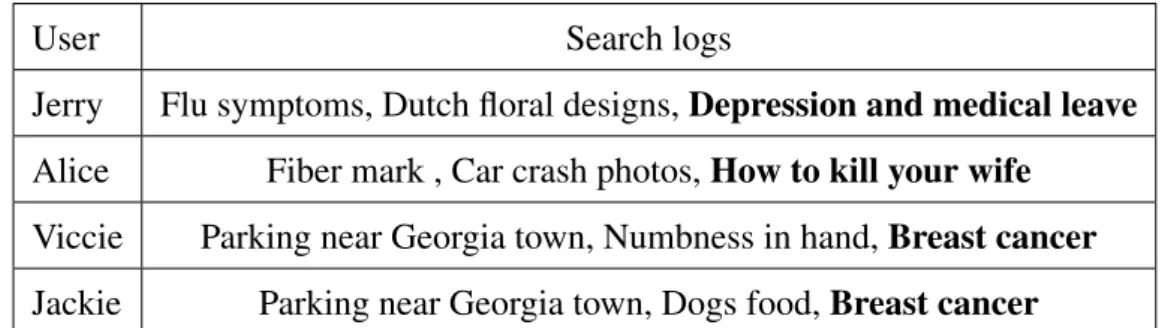
A transaction dataset is a collection of records called transactions. Each transaction is a set of items drawn from a domain and is assumed to be associated with an individual. Table 1.1 shows an example of transaction dataset containing query terms posed by search engine users, where each search term is an item and each row (collection of search terms) is a transaction.
User Search logs
Jerry Flu symptoms, Dutch floral designs,Depression and medical leave Alice Fiber mark , Car crash photos,How to kill your wife
Viccie Parking near Georgia town, Numbness in hand,Breast cancer Jackie Parking near Georgia town, Dogs food,Breast cancer
Table 1.1: An example transaction dataset
Transaction data are useful in different applications. For example, search logs such as the dataset given in Table 1.1 can help personalized web search. The diagnosis records and market basket data can assist in personalized medicine and purchasing trend pro-jection. However, transaction data also contain person-specific sensitive information, as can be seen from Table 1.1, which can be disclosed when the data are released.
1.2 Privacy Protection in Transaction Data 4
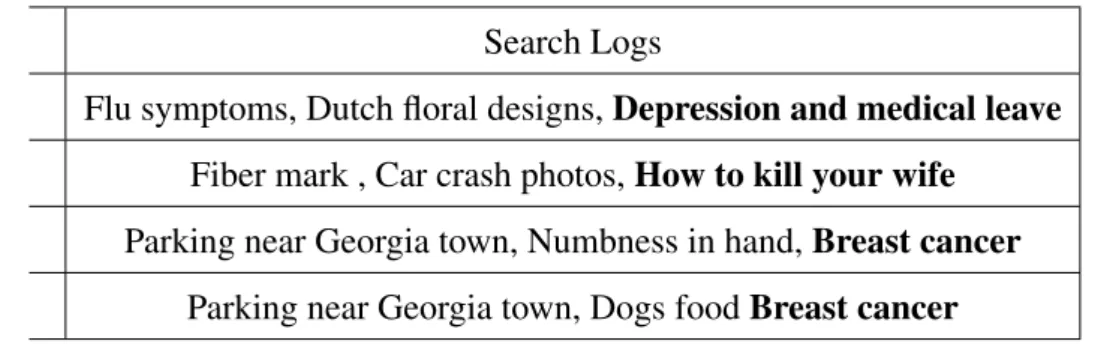
To protect such data, transactions are typically de-identified prior to their release. That is, direct person identifying items such as social security numbers, names or phone numbers are removed. Table 1.2 shows the de-identified transactions given in Table 1.1. Unfortunately this may not provide sufficient protection for individuals’ privacy because combinations of non person-identifying items may still be used to identify an individual in a identified dataset [5, 84]. For example, AOL released the de-identified search logs of its 650,000 users in 2006 in order to support research [5]. Searcher No. 4417749 was tracked back to Thelma Arnold, a 62-year-old resident of Lilburn from the released dataset by her neighbour, even if the explicit identifiers such as user names and IP addresses were removed from the released search records. Netflix, the world’s largest online movie rental service, released a de-identified dataset contain-ing movie ratcontain-ings records of nearly a half-million of its users in 2006, with the motive to improve the accuracy of its movie recommendations algorithm. Narayanet al. [85] used the rating information from Internet Movies Database (IMDb), another movies-related website to show that only a small fraction of external information (rating dates and some movies) is needed to identify Netflix subscribers even if the published data are fully de-identified. This can then lead to the disclosure of the sensitive information associated with them, by observing and inferring from movie titles suggesting polit-ical beliefs (e.g. Fahrenheit 9/11), religious views (e.g. Jesus of Nazareth), and sexual orientations (e.g. Queer as Folk).
Search Logs
Flu symptoms, Dutch floral designs,Depression and medical leave Fiber mark , Car crash photos,How to kill your wife
Parking near Georgia town, Numbness in hand,Breast cancer Parking near Georgia town, Dogs foodBreast cancer
Table 1.2: De-identified transaction dataset
Publishing transaction data therefore requires protection against two types of potential privacy leak: identity disclosure and sensitive information disclosure.identity
disclos-1.2 Privacy Protection in Transaction Data 5
ure occurs when an individual can be linked to their transactions in the dataset. This usually happens when certain combination of items occurs uniquely or infrequently within the released data and an attacker has the knowledge of this combination. For example, if we know that Viccie is a Lilburn resident and has a numbness problem, then releasing Table 1.2 will lead to the unique identification of her record in the dataset.
Sensitive item disclosure is where sensitive information about an individual is learnt with or without identifying their transactions. For example, knowing that Jackie has searched for Parking near Georgia Town, one can infer that she has searched for Breast Cancer too.
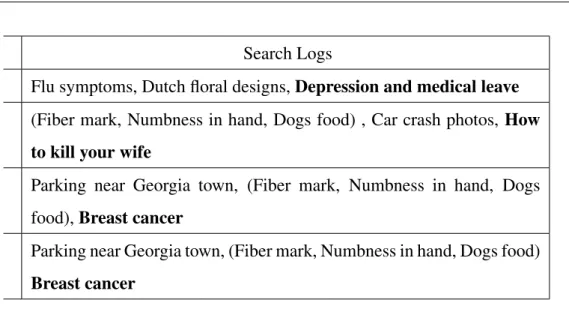
One solution to preventing such disclosures is to anonymize data [21, 36]. That is, we perform some form of data transformation so that the frequency of item occurrences is altered, hence the two types of disclosure are prevented in the transformed data. Different anonymization techniques have been proposed in the literature [113, 116, 50, 12, 36, 132, 73]. A popular approach is set-based generalization which attempts to hide an original item by replacing it with a set of items. For example, Table 1.3 is a set-based generalized version of Table 1.2, where(Fiber mark, Numbness in hand, Dogs food) is a generalized item which is interpreted as representing any non-empty subset of the items contained in it. As can be seen, with this type of generalization, Viccie can no longer be uniquely identified from Table 1.3, even if we know that she has a numbness problem.
However, protecting transactions through set-based generalization has a price to pay: we lose some utility in the generalized data. For example, suppose that we need to count the number of times the search terms Fiber Mark and Dog Foods appear together in the search log. Using Table 1.3, three transaction records satisfy this query whereas in the original dataset (Table 1.1), it is not supported by any transaction record. It is important therefore to have an anonymization method that will not lead to excessive data distortion. However, finding an optimal generalization solution that achieves the required privacy protection and retains the utility of the data as much as possible is
1.2 Privacy Protection in Transaction Data 6
Search Logs
Flu symptoms, Dutch floral designs,Depression and medical leave (Fiber mark, Numbness in hand, Dogs food) , Car crash photos,How to kill your wife
Parking near Georgia town, (Fiber mark, Numbness in hand, Dogs food),Breast cancer
Parking near Georgia town, (Fiber mark, Numbness in hand, Dogs food) Breast cancer
Table 1.3: An example of set-based generalization
challenging.
Existing transaction data anonymization approaches [113, 116, 50, 12, 132, 73] are designed to perform anonymization in sequential settings, and typically assume the use of a single centralized machine. This limits their applicability to small-scale data-sets. However, data are becoming larger and more scalable anonymization methods are needed.
One way to enhance the scalability of existing methods is to optimize their memory utilization. For example, using sampling [63, 65, 75] can help reduce memory require-ment. However, such strategies may still not be able to deal with increasingly large datasets [80]. Sample sizes can still be very large and the anonymization solutions derived from the samples can significantly compromise privacy and data utility. For instance, Walmart handles more than a million customers every hour, collecting an estimated 2.5 petabytes of data in the process [1]. Gartner predicts that the amount of data in all forms will grow 650% in the next five years [3]. According to IDC2, the amount of digital information doubles every eighteen months. In 2011, the data held by hospitals and medical centres were estimated to be about one billion terabyte [3]. When dealing with such large-scale data, parallel and distributed computing using
1.3 Research Problem 7
shared-nothing commodity clusters is becoming a promising direction.
Recently, MapReduce [22] has emerged as a scalable and cost-effective data-processing platform, providing a simple, yet powerful parallel computing paradigm. In recent years there has been an increasing support for MapReduce from both industry and aca-demia, making it one of the most rapidly adopted frameworks for parallel processing of large data volumes today [58]. Google uses its implementation of MapReduce to process more than ten petabytes of information per day [22, 58]. Hadoop, an open source implementation of MapReduce, has been adopted by more than 160 different organizations including commercial companies and research institutes such as Yahoo, Twitter, Facebook, Amazon and IBM3.
1.3
Research Problem
Our work aims to study how MapReduce may be used for large transaction data an-onymization. More specifically, we attempt to address the scalability issues associated with set-based generalization methods [75, 69, 73]. We will focus on the parallel-ization of RBAT (Rule-Based Anonymparallel-ization of Transaction data) [72], an existing transaction data anonymization method, on MapReduce.
RBAT is able to deal with both types of disclosure and can retain high data utility by allowing fine-grained privacy requirements to be specified. Moreover, it does not require a generalization hierarchy, hence its search space for generalization solutions is wider than those explored by hierarchy-based methods. This allows better utility to be retained in anonymized data.
Since, achieving required privacy level and good data utility are important aspects of a data anonymization method, our study is based on the following hypothesis:
A MapReduce-based parallelization of RBAT will scale linearly to large transaction 3http://wiki.apache.org/hadoop/PoweredBy
1.4 Research Methodology 8
data while achieving the same privacy level and utility of anonymized data as its se-quential counterpart.
Note that while we consider the parallelization of RBAT using the MapReduce paradigm in this thesis, some design aspects of our proposed method are applicable to other trans-action data anonymization methods too. Thus, our solutions are not limited to RBAT only.
1.4
Research Methodology
Recall that this study aims to check the feasibility of the application of MapReduce in design of a transaction data anonymization solution that is scalable to large data and achieves the required level of privacy without significant loss of utility. We perform our study in the following sequential steps.
1. The first and foremost step towards the design of scalable transaction data anonym-ization is to design a partitioning strategy. RBAT has more than one inputs that can be considered for partitioning. There can be more than one way to partition an input and to represent the partitions in the memory of the assigned nodes. Also, different partitioning methods can have different effects on the anonymized results as well as the level of parallelization that can be achieved. Therefore, we design a partitioning method by studying different possible partitioning methods and identifying their effect on the anoymized results and on the level of parallelization that can be achieved.
2. Next, we design the parallelelization of RBAT. To carry this out, we first identify the high-level steps that must be kept intact to ensure that the same anonymized results can be achieved as RBAT does. For each step, we design its parallel implementation by partitioning data and performing the key operations using MapReduce.
3. Finally, we experimentally evaluate our implementation over a physical cluster. We mainly measure the scalability with respect to large problem instances and the physical
1.5 Research Challenges 9
resources available. We also analyse the performance and identify any bottlenecks that may have arisen due to the design constraints, imposed by MapReduce.
1.5
Research Challenges
Parallelizing a set-based generalization method such as RBAT on MapReduce is chal-lenging, and the following issues need to be tackled:
1. Data Partitioning is important to any algorithm that attempts to process a large amount of data in parallel and it is important to the parallelization of RBAT too. Partitioning must allow to deal with large problem instances in a scalable way and the workload among processing nodes must be balanced. Transaction datasets often are large and contain varying numbers of items in each record. Therefore, even when the number of records are equally split among partitions, the workload associated with each partition may not be fairly distributed. In MapReduce, parallel tasks are created typically by partitioning one input and all other inputs need to be replicated to each processing node [23]. Dealing with large problem instances consisting of large transaction records or the domain of items is challenging.
2. Most of the computations in set-based generalization methods such as RBAT re-quire a global view of data. A MapReduce computation usually consists of a sequence of two key computational stages: Map and Reduce. The communic-ation among processing node during these stages is not allowed except at the end of the map stage. If the computations assigned to a processing node are de-pendent on the data assigned to the other nodes, most of the data will need to be communicated to the reduce stage via network interconnection. Communicating such a large amount of data can incur high communication cost and may result in ineffective resource utilization. Therefore careful partitioning and placement of input is required.
1.6 Contribution 10
3. RBAT is a good representative of iterative transaction data anonymization. The method iterates until the solution gives the required privacy level with best pos-sible utility based on some heuristics. Each iteration consists of a number of iterative steps. To ensure good utility of data, these steps must be performed in sequence. In MapReduce, no data is kept between any iterations. Each itera-tion requires to set up parallel tasks and to re-load data associated to the tasks. Designing a performance-effective solution is not straightforward.
4. Parallelization may also affect the utility of anonymized data. If the scalabil-ity achieved is at the cost of sacrificing a large amount of data utilscalabil-ity, then the anonymized results may not be usable, rendering our algorithm ineffective.
1.6
Contribution
In this work, we address the challenges described in the previous section. In particular, we make the following contributions:
1. We propose a partitioning scheme for transaction data. The method does not put any restriction on the number or size of any partitions and allows to balance the workload associated with each partition even when the datasets consist of transaction records of varying sizes. It partitions more than one input and hence allows to deal with problem instances consisting of a large number of transaction records or domain of items. This is useful for achieving scalability. Our parti-tioning does not require a large amount of data to be communicated among ma-chines and therefore does not incur high network cost. Our partitioning scheme also represents data in a way so that the required computations are performed efficiently.
2. We propose two parallelizations of RBAT: direct parallelization and loop-controlled parallelization. The direct parallelization implements RBAT on MapReduce by
1.7 Thesis Structure 11
mainly partitioning data in order to achieve scalability. Our experimental study shows that the method is scalable but its performance can be even worse than its sequential counterpart due to large parallelism overhead. The loop-controlled parallelization deals with the parallelism overhead and addresses the perform-ance bottlenecks of our direct parallel method. Our method is based on the idea that increasing the number of MapReduce rounds increases the level of syn-chronization during anonymization operations but decreases the communication cost at each MapReduce round, whereas decreasing the number of rounds to be employed will incur less parallelism overhead but increases the amount of com-putations during each MapReduce round. Our loop-controlled method general-izes the direct parallel method and allows to control the number of MapReduce rounds to be employed at each iteration of the anonymization process.
3. We evaluate our design on real-world transaction datasets using a commodity cluster. Our experimental results show that our loop-controlled method can scale linearly to large datasets, and nearly linear to cluster sizes. Our method can perform nearly9times faster than RBAT using a cluster of14processing nodes while retaining almost the same level of utility as RBAT does.
1.7
Thesis Structure
The rest of the thesis is organized as follows:
Chapter 2 surveys the existing work relevant to our problem of large-scale transaction data anonymization. We briefly discuss the existing transaction data anonymization methods, and review different techniques used to address the scalability issues of data anonymization in centralized settings. The application of MapReduce for privacy-preserving data publishing and other areas are also surveyed.
Chapter 3 gives the background necessary to understanding our work. We define rel-evant concepts and introduce some important notations. This is followed by a brief
1.7 Thesis Structure 12
overview of RBAT and MapReduce. We also present a framework where general is-sues concerning the parallelization of a method such as RBAT on MapReduce will be discussed.
Chapter 4 describes a direct parallelization of RBAT using MapReduce. We give detailed description of our data partitioning and representation mechanism, and our MapReduce-based design for RBAT. We experimentally evaluate the scalability of our method over large data volumes of up to128million real-world transaction records us-ing a commodity cluster consistus-ing of 14 homogenous slave nodes and a master node.
Chapter 5 analyses in detail the performance bottlenecks that arise from the direct parallelization of RBAT presented in Chapter 4. We present our loop-controlled paral-lelism to deal with these performance bottlenecks. We also present the details of the solution to deal with these performance bottlenecks. We give an analytical model to es-timate the performance of our proposed method. We test the scalability of our method on various data volumes and available resources.
Chapter 6 concludes the thesis and presents some possible future research directions for our work.
13
Chapter 2
Related Work
This chapter will review the existing literature relevant to our problem of anonymizing large transaction data. We first review the existing works on transaction data anonym-ization, then techniques used by existing sequential methods to address the problem of scalable anonymization. We also study the application of MapReduce in different applications including privacy preservation methods.
2.1
Transaction data anonymization
There are considerable research efforts for designing privacy-preserving data publish-ing methods [36, 2]. Privacy-preservpublish-ing data publishpublish-ing aims to protect the privacy of individuals whose records are contained in the released data. One way to achieve this is to anonymize data, before releasing the data to untrusted recipients. The anonym-ization techniques typically transform the data in a way that the published records are protected against identity and sensitive information disclosure attacks [34].
Existing data anonymization methods mostly differ in two important aspects: privacy protection and utility preservation. A method must ensure that the anonymized data is protected against the disclosure of identity and the sensitive information contained in their records. But this must not be at the cost of high data utility loss. A method
2.1 Transaction data anonymization 14
that gives maximum possible privacy protection but distorts the data significantly, may result in the published data far from serving the purpose of its release. Therefore, some tradeoff between privacy and utility must be made. The privacy and utility level achieved by an anonymization method is determined by the privacy model and the anonymization techniques used.
A privacy model defines the constraints of privacy protection. For example,k-anonymity [110] requires that the probability of an individual being uniquely identified in the released data is no more than 1k. Other privacy models include l-diversity [76], t -closeness [68], δ-presence [86], (c,t)-isolation [14], (a,k)-anonymity [129], (c, l )-diversity, confidence bounding [125, 124] and -differential privacy [26, 25]. These privacy models cannot be trivially adopted to anonymize transaction data, as transac-tion records do not follow a small fixed schema and each record is a subset of items usually drawn from a large domain. So applying these privacy principles to transaction data may cause high information loss, which can render the anonymized data useless [39, 75]. Therefore, a different set of privacy models, considering specifically the characteristics of transaction data, were proposed. For example,km-anonymity [114],
(h, k, p)-coherence [132], complete k-anonymity [51], andρ-uncertainty [12].
An anonymization technique is used to transform data in order to satisfy a privacy model. Several data anonymization techniques exist: generalization [35, 109, 126, 56], suppression [109, 56], perturbation [100, 18] and dissociation [40, 117]. Generaliza-tion [35, 109, 126, 56] transform data by replacing a value with a more generalized but consistent value. Suppression [109, 56] anonymizes data by removing a value or a record. Perturbation [100, 18] distorts the data by adding noise, swapping values, or generating synthetic data based on some statistical properties of the original data. Dissociation [40, 117] dissociates the relationship between sensitive and non-sensitive items. These techniques have implications on the privacy and utility achieved. For example, suppressing the values or the records gives high privacy protection but may also cause high data distortion. Perturbation preserves statistical information and the
2.1 Transaction data anonymization 15
anonymized data can be used to build data mining models accurately but noise addition falsifies the information contained at record-level. Hence, the anonymized results are limited in their applications. For example, when biomedical studies [72, 34] require analyses to be made at record-level, such perturbed data may not be useful. In this thesis, we consider the methods based on generalization since they provide good util-ity of data and retain the original information at record-level. In the following, we will discuss these methods and the level of privacy and utility they provide in detail.
2.1.1
Generalization-based Transaction Data Anonymization
Different generalization-based methods exist for transaction data anonymization [72, 114, 132, 51, 115, 70, 12, 73]. These methods achieve the required privacy by repla-cing an item with its generalized representation containing less specific information. Generalization may be performed by allowing different occurrences of an original item to be mapped to different generalized items. Such generalization is called Local Gen-eralization. For example, consider 2-anonymizing the dataset shown in Table 2.1.
Figure 2.1: An example hierarchy
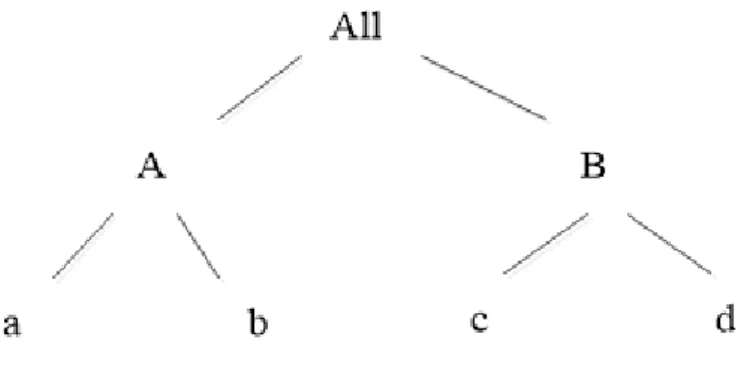
Using the hierarchy shown in Figure 2.1, the anonymized form of Table 2.1 using local generalization is shown in Table 2.2. Note that the occurrences of items a andb are intact in the last three transaction records whereas the same items are replaced by their generalized representationAin the first two transaction records.
2.1 Transaction data anonymization 16 TID Items 1 a 2 a, b 3 a, b, d 4 a, b, c, d 5 a, b, d
Table 2.1: An example dataset
TID Items 1 A 2 A 3 a, b, B 4 a, b, B 5 a, b, B
Table 2.2: A2-anonymized dataset using local generalization
representation. For example, 2-anonymized form of Table 2.1 using global generaliza-tion is given in Table 2.3.
TID Items 1 A 2 A 3 A, B 4 A, B 5 A, B
Table 2.3: A2-anonymized dataset using global generalization
Below, we survey some local and global generalization methods for transaction data anonymization.
2.1 Transaction data anonymization 17
Local Generalization-based Methods
Heet al. [51] and Terrovitiset al. [115] proposed local-generalization based methods to achieve completek-anonymity andkm-anonymity.
Heet al.[51] proposed a top-down greedy partitioning method, which uses local gen-eralization to achieve k-anonymity for transaction data. The method starts with all the transaction records creating a single partition. It then splits each partition into sub-partitions, until no split can be performed without violating the required privacy protection. Logically, each partition represents a generalized representation, corres-ponding to a level in given generalization hierarchy. Every time when a partition is to be split, one of the generalized item associated with the partition is specialized to its child nodes in the hierarchy. The choice of the generalized item is made greedily, depending on which specialization causes maximum information gain. This requires iterating over all the generalized items associated with the partition and computing the information gain as a result of specialization. The method terminates when no partition can further be split without violating the privacy protection requirement.
Terrovitiset al. [115] proposed a local recoding method, which sorts the records and partition them into n parts. Each part is anonymized independently using their pro-posed Apriori anonymization method to achieve km-anonymity. The whole process generalizes the dataset progressively inm iterations. That is, theith iteration ensures
that the anonymized data achieveski-anonymity. This is done by computing the num-ber of occurrences of all itemsets of sizeiand finding the unprotected itemsets in given datasets. For each itemset found unprotected, the algorithm attempts to find a general-ized representation that makes the itemset protected and causes minimum information loss. To make the count of occurrences of the itemsets efficiently and reducing memory requirements, the algorithm scans the whole dataset at the beginning of each iteration and constructs a count tree, similar to a FP-tree [48].
2.1 Transaction data anonymization 18
However, the inconsistent generalization of items in a dataset may result in derivation of inaccurate results [34, 75]. Also, all the existing local recoding methods achieve privacy protection against identity disclosure attack and are not trivial to extend them for protection against sensitive itemset disclosure. The methods are also based on the models with some uniform privacy assumptions and therefore may excessively distort the data. For example, completek-anonymity is based on the assumption the itemsets of all sizes in given dataset need to be protected. Therefore, the model requires that each transaction record must be identical to(k−1)other transaction records. Similarly,
km-anonymity requires that all itemsets of size m must be contained by at least k
transaction records.
The MapReduce realization of such local generalization methods is relatively trivial, since the algorithms recode data chunks independently. However, the issues such as dealing with the large domain of items may still need to be addressed. For example, an ith iteration of apriori anonymization [115] constructs a count tree, containing all
possible itemsets of sizeiand their possible generalizations. Similarly, the partitioning method proposed in [51] requires the taxonomy tree to be loaded into the memory, while anonymizing each partition.
Global Generalization-based Methods
Anonymization methods employing global generalization has also been proposed. Some of these methods find the anonymized solution by replacing one or more items by any of their ancestor nodes in the hierarchy. Other methods do not require any gener-alization hierarchy and the generalized representation is created dynamically by the methods.
2.1 Transaction data anonymization 19
Hierarchy-based Methods
Terrovitis et al. [114] designed a global generalization-based method to achieve km
-anonymity. Their method works in bottom-up fashion. Starting from original items, the algorithm performsmiterations, protecting increasingly large combination of items in each iteration. During each iteration, the unprotected combinations of certain size are protected by replacing a group of items by a more generalized item using a given generalization hierarchy. For each unprotected combination of items, the algorithm examines all possible generalizations and finds one that incurs the least information loss and satisfieskm-anonymity.
Hierarchy-based generalization have also been integrated with suppression by some works [70, 12]. Liuet al. [70] proposed a top-down greedy method which replaces a set of public items with their generalized representations and suppresses some items to enforcekm-anonymity. Starting with the most generalized cut, which is to generalize all the items to the root of a given taxonomy tree, the algorithm greedily attempts to find a more specialized cut, giving the required privacy protection while incurring less information loss, until no such specialization is found. To find a specialized cut, the method evaluates all possible nodes of the current cut and specializes the node causing maximum information gain due to specialization and incurring minimum suppression cost. The suppressions, required for a given generalization cut, is also determined by greedily constructing a tree in top-down manner which starts by assuming that all items are to be suppressed and iteratively removes an item from the suppression list, which is the most promising in terms of privacy and utility. For performance reasons, the algorithm works inm rounds to progressively protect the unprotected combination of items. That is, at anithround, it ensures to achieveki-anonymity. Caoet al. [12]
pro-posedρ-uncertainty, a model to limit the probability of inferring any non-public item, given that the attacker may know any sensitive and non-sensitive items of a record. The potential set of sensitive inferences are framed as sensitive association rules, with a set of items as antecedent assumed to constitute the background knowledge of an attacker.
2.1 Transaction data anonymization 20
They also proposed a top-down algorithm to achieve this. The method first iteratively suppresses non-public itemsets to control the confidence of the rules involving sensit-ive items only, and then generalizes public items to ensure that no sensitsensit-ive association rule has confidence greater thanρ. The generalization starts with all non-sensitive items mapped to the most generalized item in a given hierarchy. The algorithm then iterat-ively specializes a generalized item causing maximum possible information gain, until no information gain can be harnessed anymore, without violating theρ-uncertainty.
Set-based Generalization Methods
All the methods discussed in the previous section require the use of a generalization hierarchy. In such methods, if an original item is generalized to any of its ancestors, all of its siblings are forced to be generalized to that common ancestor in the hierarchy too. This limits the search space considered by these methods. Another set of methods overcomes this limitation by using set-based generalization, which is to replace a com-bination of original items with their set representation. Set-based generalization was first introduced by Liet al. [69] to anonymize transaction data, and has been shown to retain utility better, since it allows to explore a larger search space [75, 69, 73].
Loukides et al. [73] also showed that full-subtree recoding is a specific case of set-based generalization, where the generalizations that original items are mapped to are restricted to their ancestors in a given taxonomy tree. So the methods based on set-based generalization can also be restricted to find a solution set-based on the given tax-onomy tree. The method proposed by Loukides et al. [73] is one such example. They proposed a constraint-based k-anonymity model that allows to specify privacy and utility constraints and proposed a heuristic, constraint-based anonymization of transactions (COAT), which protects transaction records by ensuring that all poten-tially linkable itemsets (specified by the privacy constraints) appear at least ink trans-action records, using allowable generalizations (specified by the utility constraints). To achieve this, COAT iteratively performs the anonymization. During each iteration,
2.1 Transaction data anonymization 21
it finds and protects an unprotected privacy constraint whose itemset specified in the privacy constraint appears most frequently in given dataset. To protect a privacy con-straint, the algorithm iteratively selects an item from the itemset specified in the privacy constraint that appears least frequently and generalizes it. The generalization is made using the generalization incurring minimum information loss from all allowable gen-eralizations, specified by the utility constraints and suppresses it if no utility constraint exists to generalize it any further. The algorithm continues generalizing or suppressing items, until the current privacy constraint is protected and then moves on to the next unprotected privacy constraint. The algorithm stops when all the privacy constraints are protected. The method does not require a hierarchy for generalization. The pri-vacy protection is achieved by a constraint specification model which allows to specify the privacy requirements and does not make any assumption on the number or size of itemsets to be protected. However, the model anonymizes data based on the utility constraints. This may result in the anonymization solution with good data utility for intended utility requirements and may ignore the anonymization solution which gives better utility in general.
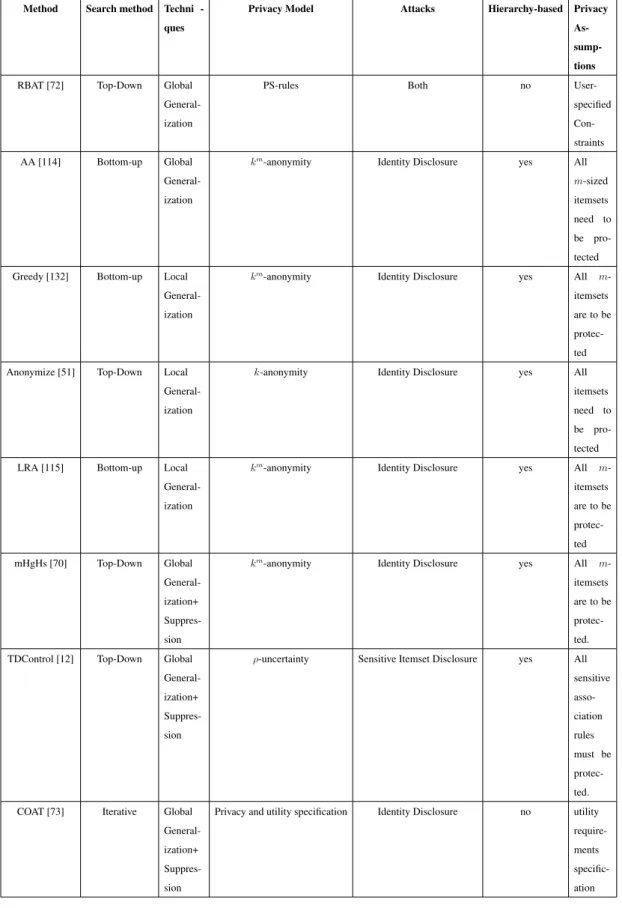
Loukides et al. [74] proposed PS-rules model which allows to specify the privacy constraints, and Rule-Based Anonymization of Transaction data (RBAT), a top-down specialization method which generalizes given transaction data to protect the PS-rules. As shown by Table 2.4, comparing to other methods, RBAT has some desirable fea-tures. For example, it ensures the protection against both identity and sensitive itemset disclosure attacks. The method does not require a generalization hierarchy. The PS-rules model [74, 75] allows privacy constraints to be specified, and does not make any assumption about the privacy constraints such as the itemsets of certain size must be protected. Therefore, it provides good data utility.
RBAT is also a good representative of other global anonymization methods. For ex-ample, global anonymization methods are mostly iterative and each iteration involves a number of anonymization operations to be performed in sequence. RBAT can also be
2.2 Non-Parallel Methods for Scalable Data Anonymization 22
used to achieve the privacy constraints specified by most of the other transaction data anonymization models such askm-anonymity [114], (h, k, p)-Coherence [132], com-plete k-anonymity [51], and ρ-uncertainty [12]. For example, specifying the privacy constraints consisting of all itemsets of size m using PS-rules and setting RBAT to achieve identity disclosure only, will allow to achieve thekm-anonymity. We therefore
consider the parallelization of RBAT in this work.
2.2
Non-Parallel Methods for Scalable Data
Anonym-ization
The scalable anonymization of large transaction data has been considered in central-ised settings. Data indexing and sampling are two commonly used techniques. Disk-based methods with external indexing is one way considered by existing methods. Iwuchukwuet al. [55] proposed the application of spatial indexing tok-anonymizing data. The proposed method uses a multi-dimensional R-tree. Each node in the tree rep-resents a generalized representation. A path from the root node to a leaf node produces a set of records in a given dataset that satisfy the generalization constraints imposed by the path followed to reach the leaf node. For example, consider3-anonymizing a rela-tional dataset shown in Table 2.5. The possible R-tree constructed is shown in Figure 2.2.
LeFevre et al. [63] also proposed a technique for scaling an existing generalization method, Mondrian [64], to datasets larger than the available memory. The algorithm is based on the idea of decision tree construction method, RainForest [37]. Starting with all attribute values generalised to the root, the algorithm scans the input datasetD to collect some statistics (depending on the split criteria), and creates a frequency group. It then chooses an allowable split attribute based on this frequency group.Dis scanned again to createm partitions based on the split attribute. The partitions are written to the disk, if they are larger than available memory. The process is recursively repeated
2.2 Non-Parallel Methods for Scalable Data Anonymization 23
Method Search method Techni -ques
Privacy Model Attacks Hierarchy-based Privacy As- sump-tions RBAT [72] Top-Down Global
General-ization
PS-rules Both no
User-specified Con-straints AA [114] Bottom-up Global General-ization
km-anonymity Identity Disclosure yes All m-sized itemsets need to be pro-tected Greedy [132] Bottom-up Local
General-ization
km-anonymity Identity Disclosure yes All m -itemsets are to be protec-ted Anonymize [51] Top-Down Local
General-ization
k-anonymity Identity Disclosure yes All itemsets need to be pro-tected LRA [115] Bottom-up Local
General-ization
km-anonymity Identity Disclosure yes All m -itemsets are to be protec-ted mHgHs [70] Top-Down Global General-ization+ Suppres-sion
km-anonymity Identity Disclosure yes All m -itemsets are to be protec-ted. TDControl [12] Top-Down Global
General-ization+ Suppres-sion
ρ-uncertainty Sensitive Itemset Disclosure yes All sensitive asso-ciation rules must be protec-ted. COAT [73] Iterative Global
General-ization+ Suppres-sion
Privacy and utility specification Identity Disclosure no utility require-ments specific-ation
2.2 Non-Parallel Methods for Scalable Data Anonymization 24
Figure 2.2: A example R-tree fork-anonymous data
ID Age Sex 1 21 F 2 22 F 3 35 F 4 36 M 5 45 M 6 55 M
Table 2.5: An example DatasetT
in depth-first manner, until no split is possible. Using such disk-based approaches with high-speed disks may address the problem of anonymizing data larger than main memory but these disk-based methods in general limit the performance of the method, to the capabilities of current hardware technologies such as disk I/O speed. Also, the use of resources will still be limited to the processing and storage capability of a single machine. For example, accessing a large amount of data from disks frequently may lead to a performance bottleneck. Therefore, dealing with increasing scale of data using disk-based methods may not be promising in terms of scalability.
The use of sampling techniques have also been considered by some works [63, 65, 75]. Lefevreet al.[63] proposed the use of random sampling for scalablek-anonymization
2.2 Non-Parallel Methods for Scalable Data Anonymization 25
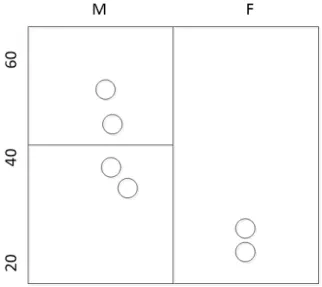
Figure 2.3: A example2-anonymous data using Mondrian
of relational data. The method scans the input data and generates a random sample that fits in the available memory and applies the Mondrian method to anonymize the data. The sample is used to construct the partition tree by choosing the allowable splits. For example, consider a sample of six records used to create a partition tree as shown in Figure 2.3. The data sample is first partitioned vertically across the sex attribute and then horizontally across the age attribute. This creates three different partitions satisfying2-anonymity. The partition tree created by the sample is used to anonymize original data and any splits violating the privacy constraints are undone. Most closely related to our work is the sampling-based method proposed by Loukides et al. [75] to anonymize transaction data. The algorithm uses top-down specialization. It selects a random sample of pre-determined size. Starting with all the items mapped to the most generalized item, it recursively performs specializations until no specialization can be made without violating any privacy constraint. Each time, a specialization operation is performed, the privacy constraints are checked using the sample. The set of generalizations acquired using the sample are then revised using the top-down and bottom-up cut-revision phases. The top-down revision phase further attempts to specialize the generalized items in order to find a solution with same privacy level but better utility. The bottom up cut-revision phase ensures the privacy protection
2.3 Possible Choices for Parallelization 26
by generalizing the items further, if the anonymized solution found using the sample does not give the required privacy protection for the whole dataset. Although the above approaches solve the problem of the limitations put by disk-based methods, the privacy and utility achieved by the anonymized solution using the sample may not guarantee the same level of privacy and utility for the original data. Therefore, the anonymized solution may need to be revised using the whole dataset.
2.3
Possible Choices for Parallelization
There are two important aspects of a parallel system: an algorithm for carrying out the computation in parallel and the parallel model used for its design. The choice of a parallel model affects the way the parallel algorithms are designed and help determines their different characteristics such as parallelism overhead, degree of parallelismetc. According to the existing work [104, 106, 11], a parallel model must be general enough to model a range of physical architectures. This makes the parallel solutions portable to various architectures. The cost of the algorithms estimated using a parallel model must not differ too much from its cost in practice on the targeted physical architectures. The model must also be manageable. That is, it must abstract the details such as parallelism, communication, synchronizationetc.
Several parallel architectures exist [11, 66, 130] supported by different parallel models. Based on characteristics such as the instructions and the data processing patterns, Flyyn [32] broadly classified these architectures into four categories: SISD (Single Instruc-tion, Single Data Stream), SIMD (Single InstrucInstruc-tion, Multiple Data Stream), MISD (Multiple Instruction, Single Data Stream) and MIMD (Multiple Instruction, Multiple Data Stream). Two important families of these parallel architectures suitable to our problem of large-scale data processing are SIMD and MIMD. For example, a cluster of workstations or massive parallel processor allows the use of multiple processors to perform large-scale computations in parallel. Below, we survey some important
2.3 Possible Choices for Parallelization 27
parallel models supported by these classes of physical architectures and analyse their characteristics.
2.3.1
PRAM
Fortune and Wyllie [33] proposed PRAM (Parallel Random Access Machine), a paral-lel extension of the random access machine model. It consists of an unbounded number of processors, each with its own local set of registers. All the processors are connected to an unbounded global memory, shared among the processors via which they commu-nicate. A PRAM processing cycle consists of a number of time steps. During a unit time step, each processor may read any data from global memory into its local register set, perform any computations over the data stored in its local registers and write any data to the shared memory.
Although the model is simple to adopt and had led itself to be a widely accepted re-search tool, as evidenced by a number of solutions designed based on it [59], the model is based on some unrealistic assumptions and neglects some practical issues. For ex-ample, the cost of a PRAM algorithm assumes that cost incurred by a processor to access its local registers and the cost to perform inter-processor communication is the same. All processors are also assumed to work synchronously. Therefore, the perform-ance of the parallel solutions in practice may be far worse than estimated at the time of their design [41, 20].
2.3.2
BSP
Valient [121] proposed the BSP (Barrier Synchronous Parallel) model, in an attempt to overcome the unrealistic assumptions made by PRAM about the physical characterist-ics of the underlying architecture. The model assumes the use of two-level memory: local and global. It also differentiates the costs associated with accessing local memory and global memory. A BSP system consists of a number of components, each of which
2.3 Possible Choices for Parallelization 28
is assumed to have a processor and a local memory associated with it. All the compon-ents are assumed to be connected to all other processors via some means of point-to-point communication.
The computation consists of a sequence of steps called supersteps. During a superstep, each component performs its assigned tasks locally and any necessary communication with other components. Everyl time steps, a global check is made to determine if the current superstep is completed by all the participating components. If all the tasks of current superstep is finished, the components are synchronized and moved to the next superstep. Otherwise, the system waits for anotherltime steps to allow the completion of unfinished tasks of the current superstep.
The model takes into account the different characteristics related to parallel design and the physical architecture used such as computational cost, communication and synchronization cost, bandwidth inefficiencyetc., so the estimated performance of the parallel method on any given architectural settings is more predictable than PRAM.
The parallel programs written in different implementations of BSP are portable to vari-ous architectures [105, 45]. However, the implementations of the model still require specifications related to parallel execution such as synchronization etc.
2.3.3
MapReduce
Dean et al. [22] proposed MapReduce for large-scale data processing in parallel. It simplifies the design of the scalable solutions for processing a large amount of data, by hiding lower-level details of parallel execution such as fault-tolerance, load balancing and synchronization.
MapReduce follows the client/server architecture. One of the machines works as a master node which performs scheduling of tasks, coordinates the distribution of data to the worker nodes and holds, all the book-keeping about the workers, jobs and the data.
2.3 Possible Choices for Parallelization 29
Each client node is assumed to have its own local memory and a global distributed memory shared among all nodes.
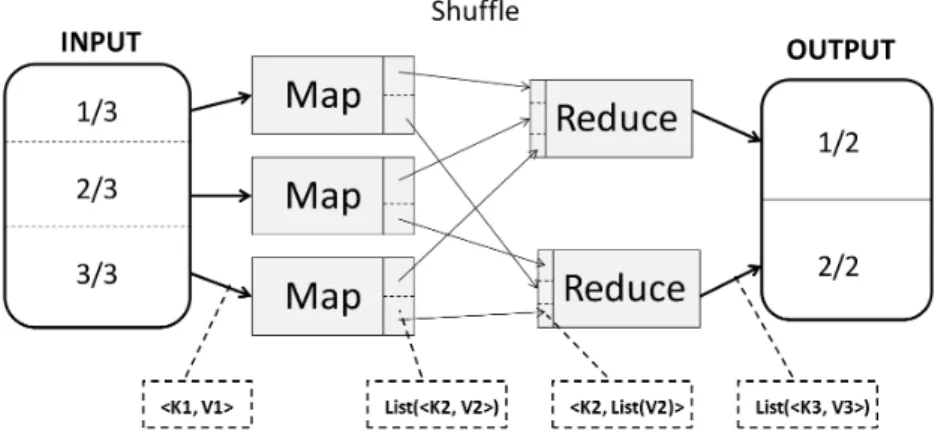
Working Mechanism: A MapReduce computation consists of a number of MapRe-duce rounds. Each MapReMapRe-duce round consists of two computational stages called Map and Reduce, intermediated by a communication stage called Shuffle. An schematic representation of a typical MapReduce round is shown in Figure 2.4.
Figure 2.4: A schematic representation of a MapReduce round
The map/reduce computations take input and produce output as a set of key/value pairs. The input and output are usually stored in a distributed file system [38]. A typical MapReduce cluster consists of a single master node (computer) which schedules and monitors different map/reduce data processing tasks over the slave nodes. Concep-tually, a MapReduce round consists of map, shuffle and reduce phases, and can be expressed as:
M ap(k1, v1)→list(k2, v2)
Reduce(k2, list(v2))→list(k3, v3)
In the Map stage, the given data are logically partitioned into a number of disjoint sub-sets and each subset is assigned to a mapper. The assignment of partitions to mappers
2.3 Possible Choices for Parallelization 30
is made dynamically and is determined at runtime. A mapper (in parallel to other map-pers) reads a record in the form(k1, v1)from its assigned data partition, performs the
user-specified computation, and outputs another setlist(k2, v2). If a mapper runs out
of memory at this stage, the part of output is temporarily moved to the local file system (LFS).
The output pairs produced by mappers (intermediate output) go through a shuffle phase. At this stage, each mapper locally performs the partitioning of its output. Given
r reducers, the key space of intermediate output is divided into r partitions in a way each partition has almost an equal number of distinct keys. This is to ensure that the amount of work associated with each partition is approximately the same. The parti-tioning is usually done via a hash functionhon a keykof each pair,i.e. h(k)mod r. This ensures that the pairs with the same key from different mappers are assigned to a single reducer. The partitioning strategy is based on the assumption that the amount of work associated with each key of intermediate output is the same. Note that a mapper output may not be local to its assigned reducer. In this case, shuffle also involves trans-ferring mapper output to a reducer over the network. The shuffle phase starts as soon as the first mapper finishes its processing, so it may overlap with the map phase.
A reducerriacquires its assigned part of map output by copying the pairs(k2, v2)from bi,j, an ith partition from the jth mapper (1 ≤ j ≤ M), sorts all the assigned pairs
by their keys to construct(k2, list(v2))and processes list(v2)for each distinct keyk2
using a user-specified reduce function. The output produced by the reduce phase can be the final output or can be input to another mapper in the next MapReduce round.
It is worth noting that there is an overhead for achieving parallelization in MapReduce. This mostly consists of the cost of initializing a MapReduce job, I/O cost of reading input and writing output by mappers and reducers during the map and reduce stages, and the cost of shuffling mapper output over the network to reducers. It is also worth observing that output produced by mappers is an input to reducers, which is transferred via shuffle phase. Therefore, less the intermediate output produced by the map stage,
2.3 Possible Choices for Parallelization 31
the lower the cost of transferring it over the network will be and the lower the I/O cost of writing intermediate output and reading input by the mappers and reducers will be. The number of mappers and reducers must also be specified based on the available resources. Setting them to a high value may result in a small amount of work for each mapper or reducer, and the performance gain by parallel processing may be offset by their setup cost. Setting them to a low value on the other hand, may result in ineffective resource utilization.
Example 1. Consider a simple word count using MapReduce. A given text is divided into M = 3 chunks and assigned to mappers. During the map stage, a mapper is assigned a chunk of text. Each ith line of the assigned chunk is read in the form of a
pairhi, lii, wherelirepresents the contents ofithline in the partition. It then counts the
occurrences of each distinct word inli, and outputshword, occurrencesjifor each
dis-tinct word. Once the lines are processed, the output pairs of each mapper are divided into r = 2partitions. For each map output pair hword, occurrencesji, it computes
h(word)mod r to decide to which of the two reducers the pair is sent to. The pairs are then copied to their assigned reducers. A reducer sums up all localoccurrencesj
(1≤j ≤M) of aword, and outputs the global counthword, occurencei.
MapReduce and other Parallel Architectures: Mapreduce was originally designed to run on a large cluster of commodity machines, but later was also adopted to other parallel architectures. Some existing works [49, 108, 16] proposed a design and im-plementation of MapReduce over graphics processing unit (GPU) clusters. Chen et al. [17] attempted to scale up MapReduce applications by proposing a number of work partitioning schemes which leverages both CPUs and GPUs to perform the given computations in parallel. Karloff et al. [58] and Goodrich et al. [44] showed that MapReduce can also be used to simulate PRAM and BSP models.
Unlike other parallel models such as BSP, MapReduce was not introduced with any formal cost estimation formulation. Therefore, an analytical study taking into account the characteristics of physical architecture and the given problem instance is needed to
2.4 MapReduce and Privacy Protection 32
help predict the cost of a parallel solution.
2.4
MapReduce and Privacy Protection
The privacy protection using MapReduce has recently been considered. Some methods allow the computations to be performed using MapReduce while controlling the access to original data or the sensitive information therein. Roy et al. [102] proposed Air-avat, a MapReduce-based system that ensures security and privacy guarantees, when the distributed computations are performed over sensitive data stored in a cloud. The system prevents the information leakage which might occur due to access available to original data or output of the computation performed by the untrusted data users. The privacy and security is achieved by enforcing access control policies over the data access via system resources such as network connections or storage channels and by also ensuring that the output of the computations are differentially private [26]. Zhang
et al. [136] studied the problem of performing MapReduce-based computations over hybrid clouds. They adopted MapReduce to perform secure computations using the non-sensitive data in public clouds and the sensitive data in private clouds. They pro-posed Sediac, a MapReduce-based system which partitions a computing job according to the required privacy level. The tasks performing computations over public data are scheduled on a public cloud and those processing private data always stay on a private cloud. A two-stage process is used to aggregate the results. In the first stage, the public and private clouds individually perform their local aggregation. The aggregated res-ults from public clouds are then brought to private cloud for final aggregation. The use of cryptographic methods to perform information-retrieval operations in a privacy-preserving way using MapReduce has also been considered. Blasset al.[7] proposed a MapReduce-based privacy-preserving method to search words from the data stored in public clouds in encrypted form. During the map stage, each node performs the search over encrypted data using an instance of private information retrieval method on its assigned data partition. The intermediate search results are aggregated by the reduce
2.4 MapReduce and Privacy Protection 33
phase. Mayberryet al. [78] proposed a MapReduce-based solution to the problem of protecting the privacy of cloud users from untrusted cloud providers. More specific-ally, they proposed a method to protect the information leakage about the data access patterns of cloud users. Givennfiles stored in a cloud, their MapReduce-based imple-mentation of a private information retrieval protocol allows an encrypted query to be performed over distributed data in a way that the information about which files were accessed is not disclosed to the cloud provider. All these privacy-preserving meth-ods focus on the privacy and security concerning data sharing over clouds rather than focusing on achieving scalability. These methods also make different privacy assump-tions and can not be adopted to our scenario. For example, adopting the access control method will need to limit the access of data to trusted users and is orthogonal to our scenario of releasing data to untrusted recipients.
Leveraging MapReduce to address scalability issues in privacy-preserving methods has also recently been investigated. Zhanget al. [137] proposed a MapReduce-based local recoding method to k-anonymize the data to prevent proximity privacy attacks [127], which happens when the sensitive values in an anonymized group are not di-verse enough. The proposed method uses clustering and consists of two phases. The first phase uses a method similar to Lloyd’sk-means clustering [71] and partitions data-set into a pre-defined number of partitions so that records with similar non-sensitive at-tribute values and contain semantically distant sensitive values are placed in the same partition. During the second stage, each partition is assigned to a worker node, which then uses complete linkage agglomerative clustering to produce groups of records, each of size at leastk. The non-sensitive attribute values in each group are replaced by their most generalized representation in the group. The groups from all the worker nodes are finally combined to form the anonymized dataset. Since the partitioning is made based on the data distribution, the created partitions may not be balanced in the associated workload.
bottom-2.5 Other applications of MapReduce 34
up [138] methods to achievek-anonymity. The top-down specialization method pro-posed by Zhang et al. [139] partitions data into a number of partitions by randomly assigning records to the partitions. All partitions are then anonymized in parallel. Each partition is anonymized by a number of worker nodes using a MapReduce-based top-down specialization job. To ensure that all the data partitions achieve the same level of anonymization, the algorithm merges all the generalization cuts into a single most generalized cut, by choosing the most generalized representation of an attribute value used in any of the data partitions. Zhanget al. [138] proposed a MapReduce-based im-plementation of bottom-up generalization method. Starting from the original attribute values, the algorithm iteratively finds the best generalization and updates the anonym-ized dataset accordingly, until all the generalizations occur in no less thankrecords. To find the best generalization candidate, the algorithm scans the dataset and collects the required statistics in a single MapReduce round. Similar to our method, the algorithm performs all the computations requiring full data scan in parallel and keeps the updated anonymization level which is used to construct the anonymized dataset in the end us-ing sus-ingle MapReduce round. But this may lead to poor performance, as evidenced by our preliminary experiments (Section 4.4). Also, all the methods are for relational data so do not take into account the characteristics of transaction data. Furthermore, these method also achievek-anonymity. Unlikek-anonymity however, the models for protecting sensitive information disclosure do not have the property of monotonicity. That is, achieving the required protection on individual data partitions may not guar-antee the same or higher protection level on the overall dataset. So such methods can not trivially be extended to achieve the protection against both types of disclosure.
2.5
Other applications of MapReduce
MapReduce has been adopted to address scalable data processing in various applica-tions [67, 99, 94, 29]. Despite its wide-spread adoption, its simplicity introduces some limitations in the way the processing must be performed. This often causes degraded