Stefano Cascino, Joachim Gassen
What drives the comparability effect of
mandatory IFRS adoption?
Article (Accepted version)
(Refereed)
Original citation:
Cascino, Stefano and Gassen, Joachim (2015) What drives the comparability effect of
mandatory IFRS adoption? Review of Accounting Studies, 20 (1). pp. 242-282. ISSN 1380-6653 DOI: 10.1007/s11142-014-9296-5
© 2014 Springer Science+Business Media New York This version available at: http://eprints.lse.ac.uk/57682/ Available in LSE Research Online: August 2015
LSE has developed LSE Research Online so that users may access research output of the School. Copyright © and Moral Rights for the papers on this site are retained by the individual authors and/or other copyright owners. Users may download and/or print one copy of any article(s) in LSE Research Online to facilitate their private study or for non-commercial research. You may not engage in further distribution of the material or use it for any profit-making activities or any commercial gain. You may freely distribute the URL (http://eprints.lse.ac.uk) of the LSE Research Online website.
This document is the author’s final accepted version of the journal article. There may be differences between this version and the published version. You are advised to consult the publisher’s version if you wish to cite from it.
What Drives the Comparability Effect of Mandatory IFRS Adoption?
Stefano Cascino Department of Accounting London School of Economics Houghton Street - WC2A 2AE
London, United Kingdom Phone: +44(0)20-7955 6457 E-mail: [email protected]
Joachim Gassen
Wirtschaftswissenschaftliche Fakultät
C.A.S.E. - Center for Applied Statistics and Economics Humboldt-Universität zu Berlin
10099 Berlin, Germany Phone: +49(0)30-2093 5764 E-mail: [email protected]
Forthcoming at Review of Accounting Studies March 2014
We thank Lakshmanan Shivakumar (the editor) and an anonymous referee for their insightful suggestions and constructive feedback. We acknowledge the helpful comments of Rashad Abdel-Khalik, Jan Barton, Sudipta Basu, Katheryn Bewley, Ulf Brüggemann, Maria Correia, Lucie Courteau, Dan Givoly, Steven Huddart, Bjørn Jørgensen, Bin Ke, Urška Kosi, Garen Markarian, Peter Pope, Karthik Ramanna, Bill Rees, Shyam Sunder, İrem Tuna, Pauline Weetman, Steven Zeff, and seminar participants at the University of Amsterdam, University of Bari, ESMT Berlin, Bocconi University, Cass Business School, University of Cologne, Edinburgh University, HEC Paris, IE Madrid, London School of Economics, University of Naples Federico II, Rotterdam School of Management as well as conference participants at the 2009 AAA International Accounting Section Mid-Year Meeting, the 2009 EAA Conference, the 2009 AAA Annual Meeting, and the 2010 Pennsylvania State University Annual Conference. We thank Katarina Wilhelm for excellent research assistance. Joachim Gassen acknowledges the financial support of the German research foundation (DFG) under project A7 of the collaborative research center SFB 649 at Humboldt University. Stefano Cascino thanks the SFB 649 for co-founding his research visit at Humboldt University.
What Drives the Comparability Effect of Mandatory IFRS Adoption?
ABSTRACT: We investigate the effects of mandatory IFRS adoption on the comparability of financial accounting information. Using two comparability proxies based on De Franco et al. [2011] and a comparability proxy based on the degree of information transfer, our results suggest that the overall comparability effect of mandatory IFRS adoption is marginal. We hypothesize that firm-level heterogeneity in IFRS compliance explains the limited comparability effect. To test this conjecture, we first hand-collect data on IFRS compliance for a sample of German and Italian firms and find that firm-, region-, and country-level incentives systematically shape IFRS compliance. We then use the identified compliance determinants to explain the variance in the comparability effect of mandatory IFRS adoption and find it to vary systematically with firm-level compliance determinants, suggesting that only firms with high compliance incentives experience substantial increases in comparability. Moreover, we document that firms from countries with tighter reporting enforcement experience larger IFRS comparability effects, and that public firms adopting IFRS become less comparable to local GAAP private firms from the same country.
Keywords: international accounting, IFRS, comparability, compliance, reporting incentives
1.
Introduction
The mandatory adoption of International Financial Reporting Standards (IFRS) by European listed firms in 2005, accompanied by similar regulatory action in other jurisdictions, represents one of the most influential accounting rule changes of recent times. In this paper we investigate whether firms subject to the mandatory adoption of IFRS have experienced a material increase in the comparability of financial accounting information. In addition, we identify firm- and country-level determinants that influence the comparability change around mandatory IFRS adoption.
European policy makers state that the reason for mandating a common set of accounting standards for listed companies is to “level the playing field” for participants in the European capital market by increasing the comparability of financial statements prepared by publicly traded companies across Europe (Regulation (EC) No. 1606/2002, Par. 1). The International Accounting Standard Board (IASB) similarly argues that a single set of high quality global accounting standards is meant to provide financial market participants with comparable financial statements and thereby help them make economic decisions (IASC Foundation, Constitution 2(a)). Increased cross-country comparability is also thought to be the main motivation behind the Securities and Exchange Commission’s (SEC) continuing support for convergence and global accounting standards (SEC, 2010, Hail et al. [2010], Joos and Leung [2013]). To the extent that mandatory adoption of IFRS successfully levels the playing field for market participants by introducing high quality accounting standards across countries, we should observe two first-order effects: an improvement in financial reporting quality (transparency), and an improvement in the cross-sectional comparability of financial accounting information (Hail et al. [2010]).
To date, however, the majority of studies on mandatory IFRS adoption primarily investigates only one of the two first-order effects above, namely, changes in financial
reporting quality (see Ahmed et al. [2013], Atwood et al. [2011], Landsman et al. [2011]), as well as second-order capital-market consequences1 (see Beneish et al. [2012], Daske et al. [2008], Horton and Serafeim [2010], Li [2010], Yu [2010]) of the IFRS mandate. Surprisingly, little evidence has been produced on the other important first-order effect, that is, on changes in cross-country comparability of accounting information. Thus, to our knowledge, our study is one of the few attempts to explicitly analyze the impact of mandatory IFRS adoption on the cross-country comparability of financial accounting information and the only study that investigates firm- as well as country-level determinants of the comparability effect.
We address our research question using an identification strategy that is developed in three stages. First, we try to directly observe the impact of mandatory IFRS adoption on the comparability of financial accounting information by using two measurement constructs based on the work by De Franco et al. [2011]. To identify the impact of IFRS adoption, we apply a variant of the standard difference-in-differences analysis (Bertrand et al. [2004]; Daske et al. [2008]). Different from prior studies that model IFRS adoption by using a dichotomous treatment, we model IFRS adoption by introducing a heterogeneous treatment indicator. To do so, we assume the effect of IFRS adoption on the local accounting regime of a given country to vary systematically with the proximity of the local accounting regime to IFRS (Bae et al. [2008], Yu [2010]). We construct our sample by calculating average comparability levels across sets of firm pairs stemming from the same industry but different countries. Based on this approach, we are able to
1 By characterizing the capital-market effect of mandatory IFRS adoption as a “second-order effect” we by
no means imply that this effect is of sub-ordinate economic relevance. “Second-order” simply refers to the notion that IFRS adoption potentially causes capital-market effects (second-order) by having an effect on accounting outcomes (first-order). It seems hard to imagine that IFRS could have an effect on capital-markets without affecting accounting outcomes first.
predict varying IFRS treatment effects whenever at least one of the two countries that form the respective country pair switches to IFRS.2
Based on this first test, we find only weak evidence of the effect of mandatory IFRS adoption on comparability. Our follow-up analyses aim to shed light on why the mandatory adoption of IFRS might have only a limited impact on the comparability of financial accounting information. For a change in accounting standards to have an effect on accounting outcomes, compliance with accounting standards is a necessary condition. Limited compliance (i.e., firms’ failure to provide information required by accounting standards) limits the potential effect of accounting standards reforms. In addition, limited compliance impairs the ability of market participants to compare different firms’ financial reports. Prior work has shown that limited compliance tends to be systematically associated with firms’ characteristics, hence suggesting lack of compliance to be a response to the incentives that firms face in their respective institutional environments (Glaum et al. [2013]). A study conducted by the staff of the SEC (SEC, 2011) raises significant concerns with respect to the cross-country heterogeneity of IFRS application and compliance. Following this idea, limited compliance with IFRS is likely to contribute to the weak cross-country comparability effect of IFRS adoption. Therefore, compliance incentives are potential key drivers explaining changes in comparability induced by the IFRS mandate.
To measure firm-level compliance with IFRS and to identify its potential drivers, we employ a set of hand-collected data on the IFRS measurement and disclosure choices of German and Italian firms. Our strategy is to identify incentives for compliance with accounting standards at the firm, region, and country levels. Given that within-country
2 This heterogeneity of the IFRS treatment allows us, together with our pre and post IFRS design, to
effectively address the issue of serial correlation that affects traditional difference-in-differences designs (Bertrand et al. [2004]).
institutional complementarities are important determinants and tend to shape reporting practices over time (Leuz [2010]), using only a sub-sample of countries allows us to dive deeper into their institutional determinants. The selection of Germany and Italy is motivated by the following three factors: (a) they are relatively large EU economies providing us with a sufficiently large sample of mandatory IFRS adopters, (b) their local GAAP regimes exhibit significant differences from each other and from IFRS, so that adopting IFRS should have a clear effect on financial accounting measurement and disclosure, and (c) they exhibit substantial differences in their institutional infrastructures allowing for powerful tests for compliance incentives.
The results of our second test provide clear evidence that a lack of IFRS compliance can be explained by firm-, region-, and country-level factors. Evidence from measurement and disclosure compliance choices of German and Italian IFRS adopting firms indicates that compliance incentives are important and shape accounting information even when firms share a common set of accounting standards. In our third test, we use the compliance incentives identified in the second test (i.e., auditor type, board independence and governmental ownership) to investigate whether the comparability effect of IFRS adoption is moderated by compliance incentives. Following a design similar to the first test, we find that compliance incentives increase the overall comparability of accounting information and moderate the treatment effect of mandatory IFRS adoption on comparability. Firms with more incentives to comply experience systematically larger IFRS comparability effects. In addition, as enforcement has been documented to play an influential role around the time of IFRS adoption (Christensen et al. [2013]), we explore the role of enforcement in our setting. We find that country-level enforcement complements firm-level compliance incentives in moderating the comparability effect of IFRS adoption.
We run two additional analyses to assess the robustness of our findings and to explore related aspects. First, we verify that our inferences are robust to the use of an alternative measure of accounting comparability based on the degree of cross-country information transfer (Yip and Young [2012]). Second, we test the comparability effect of mandatory IFRS adoption using a within-country matched sample of private firms as a control group. This allows us to hold the institutional environment constant, addressing a prominent concern that applies to studies investigating the effects of IFRS adoption using firms from other jurisdictions as a control group. While we continue to find the comparability effect of mandatory IFRS adoption to be clustered on public firms with large compliance incentives, we also document that IFRS adopting public firms become less comparable to local GAAP private firms only from the same country. We take this result as consistent with the idea that a different GAAP regime for public and private firms within the same country renders these public and private firms less comparable. This interpretation hints at a potential cost of IFRS adoption.
Our paper makes four distinct contributions to the growing body of literature that investigates the effects of IFRS adoption. First, we extend previous work that focuses on the overall first-order effects of mandatory IFRS adoption on transparency (e.g., Ahmed et al. [2013] for the effect of IFRS on earnings quality, Atwood et al. [2011] for the impact of IFRS on earnings informativeness, and Landsman et al. [2011] for the effect of IFRS on the information content of earnings) by focusing on the effect of mandatory IFRS adoption on the comparability of accounting information (Barth et al. [2012], Brochet et al. [2013], Yip and Young [2012]). Second, in line with the recent call by Christensen et al. [2013] for a deeper understanding of the “sources” that drive the effects of the IFRS mandate, our paper is the first to explicitly identify firm-level (compliance) as well as country-level (enforcement) determinants as important sources of the IFRS
comparability effect. Third, by showing that public firms adopting IFRS become less comparable to local GAAP private firms from the same country, we document evidence consistent with a potential cost of mandatory IFRS adoption. Fourth and finally, our paper contributes to the methodological challenge of improving the identification of the IFRS (comparability) effect by: (i) exploiting cross-country variation in relative distances between local GAAP regimes and IFRS (Hail et al. [2010]) to improve the identification of the IFRS effect through a heterogeneous treatment indicator, (ii) developing a cash flow-based comparability measure that has the advantage to be unaffected by cross-country differences in capital-market efficiency (Holthausen, [2003]), and (iii) using a matched sample of local GAAP private firms from the same country as a control group that complements the standard control group of non-IFRS public firms from different countries.
The remainder of the paper proceeds as follows. Section 2 provides a brief discussion of the related literature. Section 3 presents our research design, sample, and results. Finally, Section 4 concludes.
2.
Related Literature
While several studies use the comparability argument to justify expected effects of mandatory IFRS adoption, thereby indirectly testing for a comparability effect (e.g., Yu [2010]; Wu and Zhang [2010]; Defond et. al [2011]; Ozkan et al. [2012]), to date very few studies have looked at the direct effect of the adoption on accounting comparability.
Barth et al. [2012] investigate whether the adoption of IFRS by non-U.S. firms increases the comparability of accounting information with respect to U.S. firms applying U.S. GAAP. The authors document that following IFRS adoption, IFRS firms and U.S. GAAP firms exhibit higher accounting system and value relevance comparability
although some differences still persist. Using a sample of U.K. firms, Brochet et al. [2013] document a decrease in information asymmetries following the introduction of IFRS. They link this positive capital-market consequence to firm-level changes in comparability and interpret this as evidence for an increase in accounting comparability. Wang [2011] looks at cross-country information transfer to capture the comparability effect of IFRS adoption. She finds for the post IFRS adoption period larger information transfers and interprets this evidence as indicative of IFRS increasing comparability. The paper most closely related to our study is Yip and Young [2012]. Using a sample of 17 European countries and three proxies to measure comparability (i.e., the similarity of accounting function, the degree of information transfer, and the information content of earnings and book value) they provide evidence of increased accounting comparability following IFRS adoption.
In sum, the direct evidence on the IFRS effect on accounting comparability is limited. Our study is, to the best of our knowledge, the first that analyzes the impact of mandatory IFRS adoption on the cross-country comparability of financial accounting information by investigating its firm- as well as country-level determinants.
3.
Empirical Analyses
3.1 IDENTIFICATION STRATEGY
In order capture accounting comparability, we start by following the methodology introduced by De Franco et al. [2011]. The authors assess the comparability of financial accounting information by measuring the similarity of the earnings-return relation for subsamples of U.S. firms grouped by industry. They use the coefficient estimates of quarterly firm-specific time series regressions of earnings on returns to predict earnings of the investigated firms. In addition, the estimated coefficients of other firms within the
same industry are used with the returns of the investigated firms to produce alternative earnings predictions based on the coefficients of the industry peer firms. The smaller the average absolute forecast errors of these different earnings predictions, the more comparable the accounting earnings of the respective firm to its peers. De Franco et al. [2011] limit the measure to the most comparable peers and average their measure over the last four calendar years, effectively basing their measure on 8 years of quarterly data. While De Franco et al. [2011] have the possibility to use long firm-specific time series of quarterly data from firms of the same institutional environment, our setting requires some adjustments to their methodology that are very similar to the modifications applied by Yip and Young [2012] and Brochet et al. [2013]. First, we use annual data as cross-country differences in reporting frequency and lack of quarterly data availability make the quarterly data approach infeasible in our international setting;3 second, our post IFRS period is limited to four years of data; and finally, we are contrasting comparability effects across different countries whose markets possibly exhibit variation in information efficiency.
In order to adjust our methodology accordingly, we measure the comparability of accounting information for a given country-industry group (based on its two-digit SIC code) with the same industry group from other countries. We assess accounting
3 To verify that using annual data for constructing our comparability measures does not drive our results,
we construct a sample based on semiannual data. For this, we collect data from Datastream and Compustat Global. A balanced sample with observations for the pre and post IFRS period in principle requires consecutive interim financial reporting data over the period 2001 to 2008. We settle with requiring at least six semiannual observations for each firm and four-year period to balance the sample size with the benefits of using interim data. To augment our semiannual observations, we combine quarterly reporting observations to semiannual observations by appropriately combining two accounting data from two consecutive quarters. This approach yields a final sample of 6,719 firms. Roughly two-thirds of these observations are from the U.S. and Japan and many European IFRS adopting countries are not well represented in the sample. However, we repeat our analysis for this reduced sample and find our main inferences to be qualitatively unchanged. Also, we verify that our comparability measures based on annual data are consistently linked to firm-level measures of the information environment (analyst following, forecast accuracy, forecast dispersion, and bid-ask spreads) in an economically meaningful way.
comparability separately for a 4-year time period prior to IFRS adoption (2001-2004) and post IFRS adoption (2005-2008). We measure comparability at the industry level separately for pairs of countries and our sample is thus organized by industry, country, peer-country and pre/post accounting regime change.4
For each firm within a country-industry group, we estimate the following two models separately for the two time periods pre and post IFRS adoption:
(1) , , , , , , , , ,
,
(2) _ , , , , , , _ , , ,
where p indicates the period (pre or post IFRS), i denotes the firm, t is a time indicator for the year, NIBE stands for net income before extraordinary items deflated by lagged market capitalization, RET stands for the fiscal year end buy and hold return, NIBE_TA indicates net income before extraordinary items deflated by lagged total assets, ACC_TA stands for total accruals deflated by lagged total assets, and CFO_TA stands for cash flow from continuing operations deflated by lagged total assets. Resulting coefficients from estimating models (1) and (2) are truncated at the top 1 and 99 percentiles of their distributions.5
Model (1) closely resembles the approach of De Franco et al. [2011]. As reliance on stable levels of market efficiency across countries and time might be problematic, we use an alternative modeling approach inspired by Ball and Shivakumar [2006] to capture the same notion of mapping of economic events while avoiding the potentially confounding effects of differences in market efficiency. As the mapping of cash flow into accruals is a core feature of the financial reporting process (Dechow [1994]) that substantially affects
4 Additional details about the sample structure and an illustrative example are provided in Appendix 1. 5 Total accruals are calculated as change in current assets minus change in current liabilities minus
change in cash plus change in current debt minus depreciation and amortization minus change in provisions. Cash flow from operations is calculated as net income before extraordinary items minus total accruals.
the volatility of earnings as well as their predictability and persistence (Dichev and Tang [2009]), model (2) captures a central aspect of the accounting recognition process. In addition, it has the advantage of capturing economic events via cash flows and therefore rules out any concerns about differences in market efficiency.6 The firm-period-level
coefficients of each model are then used to predict earnings for the investigated firm. In addition, the coefficients of each industry-peer firm (from the same and different countries) are used to produce alternative earnings predictions. The absolute difference of these earnings predictions is averaged across country, peer-country, and industry to produce our comparability measure:
(3) , , , ∑, , , , , , , , , , ,
n , , , ,
where DKVCOMP indicates our De Franco et al. [2011] based comparability measure derived from estimations of model (1), ci stands for the country of firm i, cj stands for the country of firm j, k stands for the two-digit SIC industry code of firms i and j, and np,ci,cj,k
indicates the number of available firm pairs within each industry k with firm i from country ci and firm j from country cj and, in case of ci = cj, i ≠ j. All other variables are as previously defined.
Following the same approach, we calculate our alternative cash flow-based comparability construct (CFCOMP) as:
(4) , , , ∑, , , , , _ , , , , , _ ,
n , , , ,
6 While conceptually, cash flow from operations should be unaffected by accounting standards, the
indirect method of cash flow calculation and the separation of cash flow from investments from cash flow from operations introduces a modest impact of accounting standards (IAS 7 in the case of IFRS) on the measurement of cash flow from operations. However, rules for calculating cash flow from operations are remarkably similar around the world. Thus, we assume the impact of different accounting regimes on the cash flow from operations to be marginal.
where all variables are as previously defined. In addition, we calculate rank-based measures of DKVCOMP and CFCOMP (R_DKVCOMP and R_CFCOMP) where we percentage-rank each absolute difference of earnings predictions for each i,j firm pair, separately for each industry group. These ranks are then averaged across period, country, peer-country, and industry group. Using this ranking approach we are able to investigate non-parametric effects of shifts in the country distributions of comparability pre and post IFRS adoption.
We use the quasi-experimental setting of mandatory IFRS adoption as our treatment. In line with prior literature, we assume the treatment decision to be exogenous in the sense that we do not control for the potential self-selection of countries into the treatment group. As our treatment is assigned at the country level, our main level of analysis lies on the comparability effects at the country-peer-country level meaning that we measure comparability at the industry level separately for pairs of countries.
When we model the determinants of comparability for a pair of countries, we control for country-level and industry-level determinants of comparability by including country-, peer-country-, and industry-level fixed effects.7 We assume the comparability of accounting information between two countries to be influenced by the similarity of their respective GAAP regimes, meaning that two countries with similar GAAP regimes should have firms with more comparable accounting information. Thus, our main independent variable of interest is the difference of accounting regimes across pairs of countries. This strategy enables us to assess the effect of the IFRS treatment by modeling the change of country-peer-country-level GAAP proximity caused by IFRS adoption. While other research in the area mostly models the IFRS treatment as a binary variable,
7 This controls for, e.g., differences in country-level institutions. For example, a fixed effect for country
A will control for the effect of the enforcement system of country A that reduces the variance of accounting outcomes in country A.
our identification strategy builds on the systematic variance of the IFRS regime shock across countries. Hence, we are able to exploit the heterogeneous nature of the IFRS treatment for our identification (similar to Yu [2010]). We identify the effect of IFRS adoption by estimating a change model that captures the effect of IFRS induced changes in GAAP proximity on changes in accounting comparability across time. By using a change setup based on two observations pre and post, we avoid the serial correlation problem that potentially affects difference-in-differences studies based on panels with long time series (Bertrand et al. [2004]).
In the second set of tests, we turn our focus to the degree to which adopting firms comply with IFRS and the determinants of compliance across firms and countries in order to identify potential firm-level variables that are likely to moderate the overall comparability effect. To do so, we use a hand-collected sample of accounting measurement and disclosure compliance data of German and Italian IFRS adopting firms and investigate whether firm-, region- and country-level incentives explain the differences in compliance that we document.
The third set of tests follows a design similar to the first test, but builds on the identified compliance determinants from the second set of tests (i.e., auditor type, board independence and governmental ownership) to investigate whether compliance incentives moderate the comparability effect of mandatory IFRS adoption. Also, we assess the moderating effect of country-level enforcement by estimating a set of change models.8
8 In addition to these main tests, we conduct a set of additional analyses that are discussed in sections 3.7
3.2 SAMPLE SELECTION
Our first and last sets of tests focus on publicly traded firms from 29 different countries (14 IFRS adopters and 15 non-IFRS adopters) and cover the period 2001 to 2008. The sample selection starts with U.S. firms (for which we use CRSP and Compustat data) and all firms in the Worldscope universe of countries that have more than 100 public firms followed by Worldscope. From this initial sample, we delete all firm-year observations that correspond to voluntary IFRS adoption as voluntary IFRS adopters are likely to have different reporting incentives from those of mandatory adopters (Ashbaugh [2001]) and thus make the IFRS treatment endogenous to firm-level incentives.9 We further delete firm-year observations for which data necessary for estimating our comparability measures are absent. Since our main focus lies on the identification of comparability effects across time, we require a balanced panel of firms to rule out changes in comparability across time that are caused by sample changes. In addition, we require each country to have at least 50 firms with sufficient data. This procedure yields a base sample of 78,784 firm-year observations (9,848 firms) to construct our comparability measures.10 Descriptive statistics for both treatment and control samples can be found in Panel A of Table 1. We estimate our models (1) and (2) for each firm-period in our sample, yielding a maximum of 19,690 coefficients per model. Based on the coefficients and the methodology discussed above, we calculate our comparability metrics at the
9 Since in some countries voluntary adoption of IFRS was permitted before 2005, our sample of
mandatory IFRS adopters could be potentially subject to a reverse selection issue. Given the relatively high frequency of voluntary adopters in Germany, this issue is likely to be relevant for German firms in particular. To assess the robustness of our findings, we repeat our main tests excluding German firms and find our inferences to be qualitatively unchanged.
10 To verify that the results of our analyses are insensitive to sample composition, we repeat our main tests
using different samples: (i) excluding observations from the U.S., Japan, and the U.K.; (ii) restricting the maximum number of observations for each country to 100 randomly chosen observations; (iii) excluding observations from European countries; (iv) excluding financial institutions. While the results become weaker when we focus on non-European observations, the tenor of our findings is not affected by these design choices.
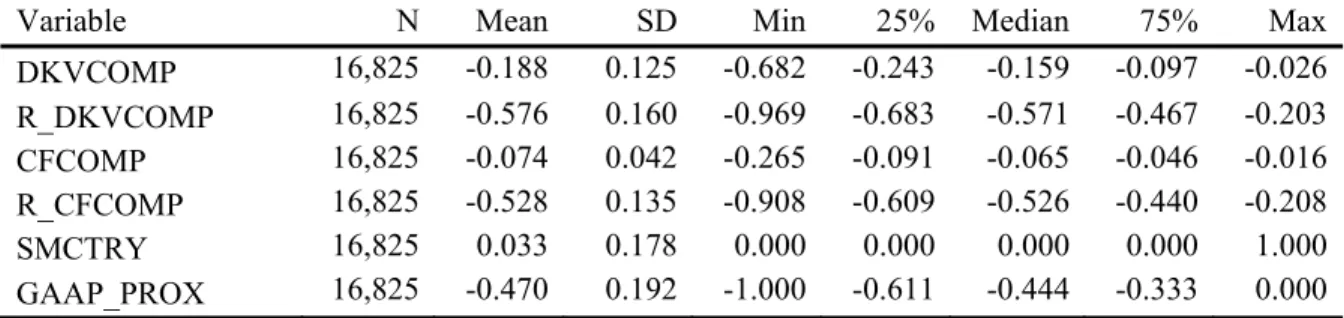
period, country, peer-country, and industry level. The resulting descriptive statistics are disclosed in Panels B and C of Table 1.11 Throughout the analysis higher values of our measures indicate that the financial accounting information of the two respective countries for a given period and industry are more comparable with each other.
Our second set of tests requires hand-collection of financial reporting and governance data. Given our interest in identifying country- and firm-level determinants of comparability while balancing the data collection costs, we study a sub-sample of German and Italian firms. The sample comprises all 2006 German and Italian IFRS mandatory adopters. The total sample size is 289 observations.
For our third set of tests, we require additional data to compute our compliance incentives proxy. We obtain worldwide data on board independence and governmental ownership from the Orbis database published by Bureau van Dijk (BvDEP) and Risk-Metrics (formerly IRRC), and auditor type from Worldscope. Requiring this additional data reduces our firm-level sample to 54,368 firm-year observations (6,796 firms).
3.3 BASE TEST FOR THE COMPARABILITY EFFECT OF MANDATORY IFRS
ADOPTION
In order to verify our identification strategy we first focus on the pre IFRS adoption period (2001-2004). If our comparability measures capture differences in financial accounting regimes, they should be systematically linked to the proximity of GAAP across countries. In order to test whether this is the case, we estimate the following model on the pre IFRS section of the sample:
11 Conceptually, 29 countries and 73 two-digit SIC industry groups would allow for a total of29*29*73 =
61,393 observations for each period. However, we require at least three firms for each country, peer-country, industry group reducing the sample to 16,820 observations covering all countries and 69 industries.
(5)
, ,
, _ ,
, ,
,
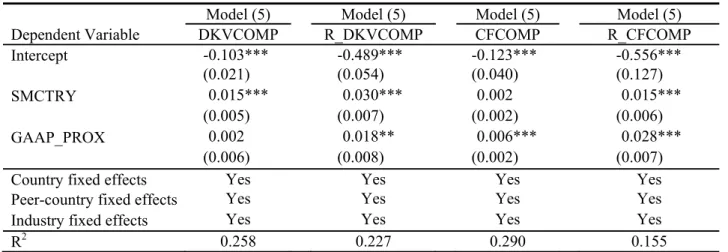
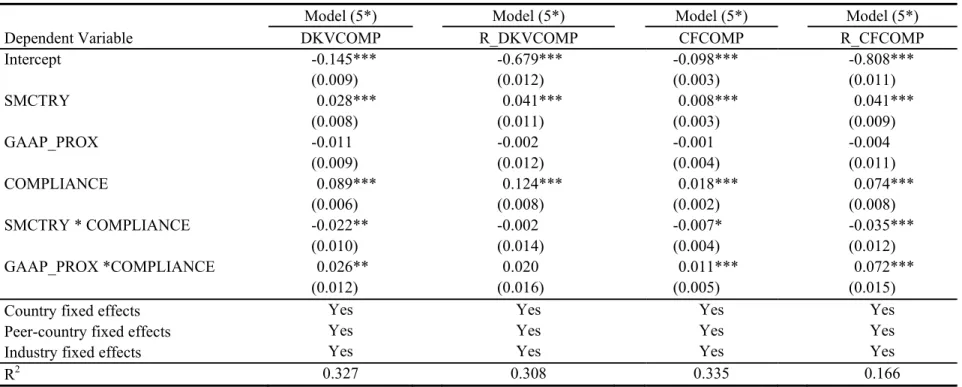
where COMPM stands for the comparability measure used (either DKVCOMP, R_DKVCOMP, CFCOMP, or R_CFCOMP), COUNTRY is a series of ci country fixed effects, PCOUNTRY is a series of cj peer-country fixed effects, and INDUSTRY is a series of industry fixed effects based on two-digit SIC codes. SMCTRY is a binary variable that takes the value of one if ci = cj, indicating that the comparability of financial accounting regimes within one country is observed. As prior literature indicates that the financial accounting regime is not only influenced by accounting standards but also by other institutional factors, we assume that, ceteris paribus, firms from the same country have higher levels of financial accounting comparability. GAAP_PROX is based on Bae et al. [2008] who build their GAAP proximity measure on the information available in the international GAAP survey study by Street [2001]. This measure captures country-pair GAAP distance by counting differences between two countries based on the GAAP differences measure presented in Bae et al. [2008: Table 1]. We define GAAP_PROX as the negative number of differences divided by the maximum number of differences observed across all country pairs, so that larger values of GAAP_PROX indicate higher similarity of GAAP across countries. If both countries are the same, GAAP_PROX takes the value of zero, i.e. the maximum value of GAAP proximity. We expect the coefficients of SMCTRY and GAAP_PROX to be significantly positive for our pre IFRS sub-sample. The results of the respective tests are reported in Panel A of Table 2. All reported coefficients show the predicted sign with six out of eight being significant at conventional
levels. We take this as evidence indicating that our identification strategy is sufficiently powerful to detect the effect of financial accounting standards on financial accounting comparability. However, the documented effect is not very large in economic terms. An increase in GAAP_PROX as measured by its interquartile range translates into a rank increase of 2.3 percentage points in comparability.
The next test directly investigates the IFRS treatment effect on comparability.12 To use each country-peer-country pair as its own control, we estimate the following change model: (6) , , , _ , , , ,
where COMPM) stands for the change in the respective comparability measure (either DKVCOMP, R_DKVCOMP, CFCOMP, or R_CFCOMP) from the pre period to the post period, with a positive value indicating an increase in comparability. IFRS_EFFECT captures the change in GAAP_PROX caused by the adoption of IFRS in the treatment countries. Since the adoption of IFRS has affected the GAAP of some treatment countries to become more dissimilar relative to some control countries, values of the IFRS_EFFECT can be negative as well as positive. If the mandatory adoption of IFRS has an effect on the international comparability of financial accounting information, we
12 In unreported sensitivity analyses we also include additional control variables (mean size, mean
book-to-market, standard deviation of earnings and cash flows) into our (modified) versions of models (5) and (6). Also, for model (6), we use changes instead of levels. Our inferences are insensitive to any of these design choices.
expect the coefficient of IFRS_EFFECT to be significantly positive. We make no prediction for SMCTRY.
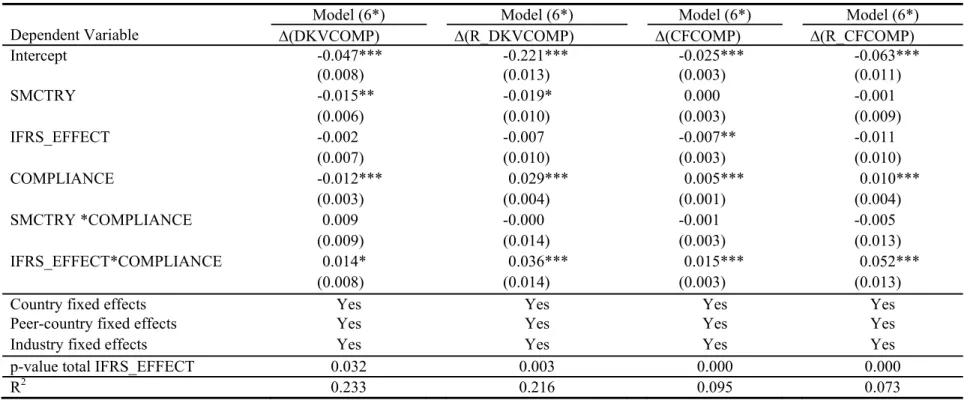
As it can be assessed from Panel B of Table 2, we do not find a robust treatment effect of IFRS across our models. The relevant coefficient has the predicted sign in three out of four cases ((R_DKVCOMP), (CFCOMP), and (R_CFCOMP)) and significantly so in two regressions ((R_DKVCOMP) and (R_CFCOMP)). In economic terms, an IFRS-induced increase in GAAP_PROX (measured by its interquartile range) leads to a 1.2 percentage points rank increase in comparability (measured by R_CFCOMP). Based on this analysis, we conclude that the overall effect of mandatory IFRS adoption on the comparability of financial accounting information appears to be marginal.
3.4 COMPLIANCE TESTS
Our second series of tests investigates the cross-country determinants of accounting compliance. The expected comparability effect of mandatory IFRS adoption is based on the assumption that companies comply with the new set of rules. Lax compliance is consistent with managerial incentives having a predominant role in shaping accounting outcomes. As managerial incentives vary both systematically and unsystematically across firms, we expect them to reduce the comparability effect of mandatory IFRS adoption. Our strategy therefore is to identify different incentives for compliance with accounting standards (at the firm, region, and country level). We argue that firms with high incentives to comply are the ones that are likely to experience more pronounced comparability effects from IFRS adoption.
Using a unique dataset on the 2006 accounting measurement and disclosure compliance of German and Italian firms that are publicly listed since at least 2004 and
that mandatorily adopted IFRS in 2005, we first investigate whether there are significant differences in accounting measurement and disclosure compliance across countries for these firms. To do so, we hand-collect accounting measurement and disclosure compliance data from the 2006 financial reports of all firms that meet our data requirements (136 German and 153 Italian firms).13 A summary of the main features of the instrument used to hand-collect compliance data is presented in Appendix 2. Further details on this instrument, the data collection process, and the setting being investigated are available in the online Appendix to this paper.14
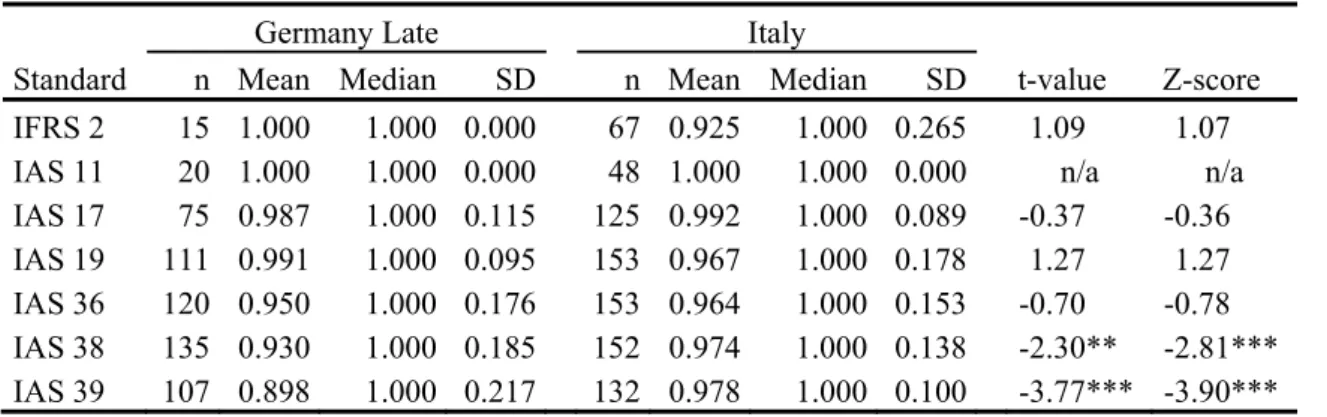
Table 3 presents results on accounting measurement compliance in Panel A and disclosure compliance in Panel B. In Panel A, we report stated accounting measurement compliance separately for German and Italian firms for the following IFRS standards: IFRS 2 (Share-based Payment), IAS 11 (Construction Contracts), IAS 17 (Leases), IAS 19 (Employee Benefits), IAS 36 (Impairment of Assets), IAS 38 (Intangible Assets), and IAS 39 (Financial Instruments: Recognition and Measurement). While we generally find the observed accounting measurement compliance to be similarly high across countries, we find significant differences with respect to IAS 38 and IAS 39, with German firms showing lower compliance than Italian firms.15
13 To mitigate possible sample selection issues, we also collect compliance data from the group financial
reports of German voluntary adopters and use propensity score matching to match German firms to similar Italian firms. We replicate our analysis by comparing the Italian firms with a matched sample of 153 German firms (116 of which voluntary adopters) and check that our results and inferences stay unchanged.
14 The online appendix is available at http://www.wiwi.hu-berlin.de/rewe/research/cg_online_app.pdf. 15 Looking more closely at the detailed response data (untabulated), we find that German firms tend a) to
expense development costs, and b) not to recognize the fair value of derivative financial instruments on their balance sheets. These non-compliant measurement choices are consistent with German firms exhibiting a general tendency towards historical cost (Christensen and Nikolaev, 2013). We find a similar result for the German matched sample, although with a somewhat lower level of significance. In contrast, the German matched firms exhibit a higher level of IFRS 2 measurement compliance than Italian firms.
In Panel B, we report disclosure compliance scores separately for German and Italian firms for the same standards as in Panel A as well as for IAS 33 (Earnings Per Share). Comparing the disclosure compliance scores with the accounting measurement compliance scores, we find that disclosure compliance is significantly lower than measurement compliance (this finding is in line with prior literature; see, e.g., Street and Gray [2001]). Further, we find much more cross-country variance in disclosure compliance. This variance does not lean towards one country, however: Italian firms exhibit significantly higher disclosure compliance for IFRS 2, IAS 33, IAS 36 and IAS 39, while German firms score significantly better for IAS 17 and IAS 38.
To investigate the within-country variance of compliance and to identify potential determinants of the IFRS effect on accounting comparability, we then focus on determinants of compliance. We limit our analysis to disclosure compliance as measurement compliance tends to be generally high and exhibits low cross-sectional variation. We perform both a within-country and a pooled-sample analysis on our German and Italian data. To construct our dependent variable, CSCORE, we average all disclosure scores for each of the 136 German and 153 Italian firms. We estimate country sample and interacted pooled sample versions of the following disclosure compliance determinant model:16
16 To address possible omitted variable concerns, we also estimated alternative versions of this model that
included leverage, index membership, number of years since the initial public offering, seasoned public offerings (SPO), American Depositary Receipts (ADR), foreign listing, foreign sales, and analyst following as additional independent variables. These additional variables do not change our inferences.
(7) _ _
4 _
,
where CSCORE is average firm-level compliance, calculated using the instrument presented in Appendix 2. The subscripts i, and j denote firm and industry. INDUSTRY is a set of one-digit SIC industry dummy variables.17 SIZE is the natural logarithm of
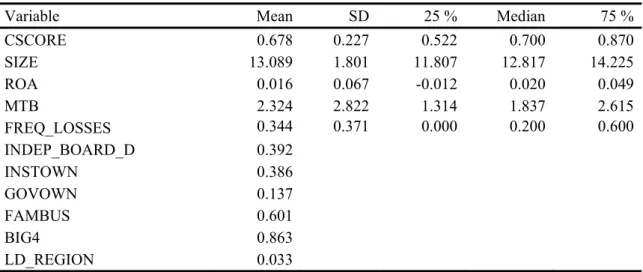
total assets. ROA is return on assets, calculated by dividing earnings before interest and taxes by beginning of fiscal year total assets. MTB is market capitalization divided by book value of equity. FREQ_LOSSES is the frequency of losses, defined as the proportion of the previous five fiscal years in which the firm reported negative earnings. INDEP_BOARD is a dummy variable for board independence that for the Italian sample is coded one if the number of independent directors divided by the total number of board members is above the mean and zero otherwise, and for the German sample is coded one if the head of the supervisory board was not the former chief executive officer of the respective firm and zero otherwise. INSTOWN is a dummy variable indicating significant institutional ownership (above 2%) in the firm. GOVOWN is a dummy variable indicating whether a governmental body has a stake in the firm. FAMBUS is a dummy variable indicating whether the firm is controlled by a managing family. BIG4 is a dummy variable indicating whether the firm’s financial statements have been audited by a one of the four leading audit suppliers of the respective country. LD_REGION is a dummy variable indicating whether the respective German (Italian) firm is domiciled in
17 While in all the other tests we define industry with two-digit SIC codes, industry groups in the German
the eastern regions of Germany (southern regions of Italy) based on the location of its headquarters.
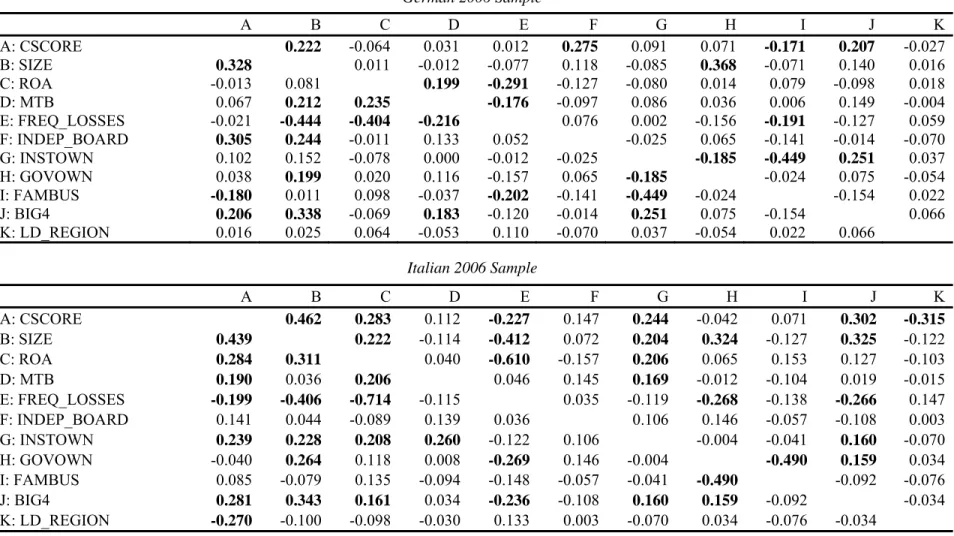
Descriptive statistics for the potential determinants of differences in disclosure compliance as well as the control variables are presented in Panel A of Table 4. Panel B of Table 4 reports correlations among the dependent and independent variables. Compliance for Italian firms is significantly positively related with size, profitability, growth, audit quality, institutional ownership, and southern origin. For the German sample, disclosure compliance is significantly positively associated with size, independent board members, and audit quality.
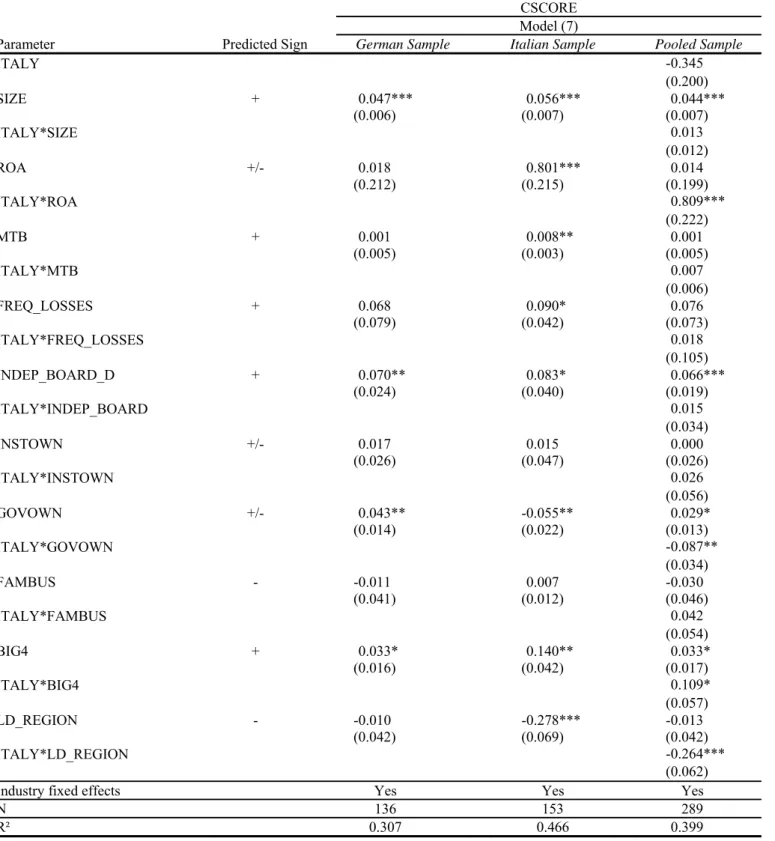
Table 4, Panel C presents the multivariate results of model (5). The fit of the model is comparable to those of similar studies (e.g., Street and Gray [2001], Glaum et al. [2013]). Also, the findings are economically significant. As an example, firms with a big4 auditor in Italy tend to have a compliance score that is about 24 percentage points higher than their non-big4 peers.18 Taken together, these results clearly indicate that both in Germany and Italy, firm-level incentives influence compliance. Size, board independence, governmental ownership and auditor type significantly influence accounting compliance. In addition, the pooled-sample analysis shows that the coefficients on profitability, governmental ownership, dominant auditor and less developed region vary significantly between Italy and Germany. This result indicates that more profitable firms generally tend to provide more forthcoming disclosures in Italy than in Germany, potentially because German firms tend to face higher levels of competition (Djankov et al. [2002]), making proprietary costs of disclosure more relevant for profitable firms. In addition, the interplay between governmental ownership and firm
18 Since we do not control for the (unobserved) determinants of auditor choice, this effect should not be
compliance seems to be different between the two countries: While in Germany, in line with our expectations, governmental ownership is related to higher compliance levels, the opposite seems to be true in Italy. This is consistent with a monitoring function of the German government and an entrenched position of the Italian government in Italian firms (La Porta et al. [1999]). The impact of high quality auditing on compliance also appears to be more pronounced in Italy, possibly because Italian audit firms tend to be more heterogeneous in terms of quality than German firms (Ashbaugh and Warfield [2003]). For Italy we find a robust negative impact of the geographical region on compliance, consistent with the Italian business environment being geographically diverse (Gerschenkron [1955], Eckaus [1961], Terrasi [1999]) with Southern regions being characterized by informal governance institutions that are expected to reduce the demand for disclosure compliance. On the other hand, we do not find a similar effect for Germany although, subsequent to reunification, a lack of convergence between the less developed East and the more industrialized West led to considerable disparity in the levels of income, investment, and productivity (Boltho et al. [1999]). We view this finding as indicating that it is not the overall economic situation of a less developed region that drives differences in compliance; rather, the relationship-driven institutions that Southern Italy has developed over centuries (and that are unavailable in Eastern Germany) act as an alternative communication device for corporations.19
19 In untabulated robustness checks, we re-run our analysis by contrasting the Italian sample with a pooled
sample of German voluntary and mandatory adopters. Interestingly, German firms show overall higher compliance than Italian firms. Based on the insight from the geographical region results, this finding might be driven by different cultural attitudes towards compliance in general. Our findings are also in line with the common-held belief that Italian firms tend to “label adopt” IFRS without any serious commitment to transparency because, in a strong insider system like Italy, information asymmetries are mainly resolved via means other than publicly disclosing accounting information. This finding is consistent with the argument supported by Daske et al. [2013] and might also be driven by the German enforcement system being more efficient than its Italian counterpart. We explore this intuition in subsequent analyses. Finally, our results show that voluntary adopters provide better disclosure compliance than late adopters.
Taken together, the tests indicate that IFRS compliance differs systematically due to determinants that vary at the firm, region, and country levels. Since compliance is a necessary condition for comparability effects of accounting reforms to materialize, these determinants might be important moderating variables for the comparability effect of mandatory IFRS adoption. Based on the analysis presented in this section, we expect large firms with dominant auditors and independent boards to be more compliant. The final series of main tests will investigate whether the compliance determinants identified in this section moderate the comparability effect of mandatory IFRS adoption.
3.5 THE COMPARABILITY EFFECT OF MANDATORY IFRS ADOPTION: THE
MODERATING ROLE OF COMPLIANCE DETERMINANTS
In order to directly test for the impact of compliance on the comparability effect of mandatory IFRS adoption, one would have to obtain firm-level data on compliance for the broad international sample used in the first series of tests. In an untabulated analysis, we use the CSCORE measure of the compliance test to see whether for the German and Italian firms of our sample, compliance has an impact on comparability. Based on a sample of 366 observations, we find CSCORE to moderate the comparability effect of IFRS for our ranked comparability measures. While this test is low-powered because of the small sample size, we take this result as first-level evidence that the comparability effect of mandatory IFRS adoption is centered on firms with high levels of IFRS compliance.
To investigate whether this finding holds for the full sample, we use the results of the compliance determinants test to construct a measure for compliance that is based on the first principal component of the compliance determinants that turned out to be significant in the second test: auditor type, board independence and governmental
ownership. We then test the impact of these compliance determinants on the IFRS comparability effect for the full sample.20 We break up the observations from the first series of tests into smaller groups that are constructed by period (pre and post IFRS adoption), country pair, industry, and ranks of our compliance construct. This, at the same time, increases (because of the finer groups) and decreases (because newly constructed groups fall below the size threshold of three observations per group) the number of observations.
In the analysis presented in Table 5, our compliance measure (COMPLIANCE) is based on firm-level values of the first principal component explained above. We construct three ranks. If both firms have a first principal component measure above the median, then our ranked metric COMPLIANCE takes the value of 1. If one firm has a first principal component measure above and the other one has a first principal component measure below the median, COMPLIANCE takes the value of 0.5. If both firms have first principal component measures below the median, COMPLIANCE takes the value of zero. Based on these ranks, we group our firm pairs into groups defined by country pair, industry, and compliance level. We then fully interact our base models (5) and (6) with COMPLIANCE.
Panel A of Table 5 provides firm-pair-level correlations for our dependent variables, the input variables of the first principal component analysis, the resulting first principal component compliance measure, and firm size. Based on the De Franco et al. [2011] comparability measures, it seems that all compliance incentives are positively related to
20 We refrain from using size as an additional input variable as size usually captures a myriad of different
firm-level characteristics and thus it seems hard to unambiguously interpret any effect related to size. To verify the construct validity of our compliance incentives proxy, we repeat our tests including size in our first principal component analysis as well as using alternative first principle components (i.e., including and excluding in turn governmental ownership, board independence, and auditor type) and find our main findings to be robust.
comparability. For our cash flow-based variant of that comparability measure the results appear more mixed. It also seems important to note that overall larger firms seem to exhibit higher levels of comparability.
Turning to the multivariate evidence presented in Panel B, we see that for all four specifications of comparability, higher compliance incentives are linked to more comparable financial accounting information. In addition, we find that, in general, stronger compliance incentives strengthen the link between accounting standards similarity and comparability: For firm pairs with strong compliance incentives, accounting standards seem to have a larger influence on comparability. This finding is consistent with firms with higher compliance incentives being more compliant with GAAP on average and thus with GAAP differences across countries having a larger impact on financial accounting comparability for these firms.
Panel C reports the results of the difference-in-differences test for the effect of IFRS adoption. We focus our discussion on the impact of IFRS_EFFECT. As can be assessed from the interaction of IFRS_EFFECT with COMPLIANCE, the effect of mandatory IFRS adoption on comparability seems to be completely moderated by compliance incentives: The larger the compliance incentives, the more pronounced the IFRS effect. The relevant coefficient has the predicted sign and is significant at conventional levels for each of the four dependent variables. Based on this analysis, we conclude that the overall marginal comparability effect of IFRS adoption seems to be centered on firms with large compliance incentives. The results for the Wald-test that tests for the combined significance of the main effect IFRS_EFFECT together with the interaction effect IFRS_EFFECT*COMPLIANCE indicate that the firm-to-firm matches, where both firms have above median compliance incentives, experience a significantly positive IFRS adoption effect on comparability regardless of which specification of comparability we
use. In order to gauge the economic significance of this finding, we estimate the magnitude of the comparability effect using a standard univariate difference-in-differences approach. For the full sample, adopting IFRS is related to a statistically insignificant rank increase in comparability of 0.7 percentage points, based on an average rank of 50.6% of the treatment sample prior to IFRS adoption. Firms with high compliance incentives instead experience a statistically significant rank increase in comparability of 6.5 percentage points based on an average rank of 56.1% of this treatment sub-sample prior to IFRS adoption. We interpret this as an economically sizable effect.
3.6 THE COMPARABILITY EFFECT OF MANDATORY IFRS ADOPTION: THE
ROLE OF ENFORCEMENT
Prior literature has documented that reporting enforcement plays an important role for the observed liquidity effects around the IFRS mandate (Christensen et al. [2013]). While the main focus of our study is on firm-level determinants, and thus we use an identification strategy that allows us to use country-level fixed effects to control for country-level determinants of comparability, we also explore whether country-level differences in enforcement have an impact on the comparability effect of mandatory IFRS adoption. To do so, we estimate a variant of model (6) which does not include country and peer-country fixed effects21 but includes proxies for levels (BPT_ENF_SCORE) and changes ((BPT_ENF_SCORE)) in reporting enforcement based on Brown et al. [2013] and interacts these proxies with the treatment effect of IFRS
21 We drop country fixed effects from the analysis to allow the country-level main effect of enforcement to
manifest itself in the data. The fact that enforcement effects are only sizeable once country-level fixed effects are omitted from the analysis indicates that we are unable to separate a potentially moderating effect of enforcement on the comparability effect of IFRS from other unobservable country-level effects on comparability.
(IFRS_EFFECT). 22 Results from this test are reported in Table 6. While our firm-level measure of compliance incentives still continues to moderate the comparability effect of mandatory IFRS adoption, we also observe a significant impact of the level of enforcement on the comparability effect of mandatory IFRS adoption, as can be assessed by the coefficient for the interaction of BPT_ENF_SCORE and IFRS_EFFECT. We interpret the negative main effect of enforcement levels as indicating that firms from countries with high levels of enforcement experience on average smaller changes in comparability. This is also consistent with the positive and significant coefficients on the main effect that captures the effect of change in enforcement for the return-based comparability measures.
We conclude from this additional analysis that country-level reporting enforcement has a positive impact on the comparability of accounting information and that this effect is complementary to the moderating effect of compliance incentives.23
3.7 ADDITIONAL ANALYSES: COMPARABILITY MEASURE BASED ON THE
DEGREE OF INFORMATION TRANSFER
To mitigate potential measurement error concerns with the comparability construct developed by De Franco et al. [2011], we re-run our analyses using the degree of information transfer as an alternative proxy for accounting comparability (Yip and Young [2012]). Table 7 reports the results. We use all observations from the base sample for which we are able to obtain earnings announcement data from I/B/E/S and the data
22 Because the enforcement change indicator introduced by Christensen et al. (2013) is not available for all
countries in our sample, we proxy for enforcement levels using the measure developed by Brown et al. (2013) and construct an enforcement change indicator based on their data in the spirit of Christensen et al. (2013). However, using the substantive enforcement change indicator by Christensen et al. (2013) yields qualitatively similar results albeit for a smaller set of countries.
23 To test for additional interaction effects, we also estimate a fully saturated version of the model
presented in Table 6, including the three-way interactions of BPT_ENF_SCORE, COMPLIANCE and IFRS_EFFECT and find our inferences to be unchanged.
required to estimate our compliance incentives measures. In particular, the requirement of earnings announcement data significantly reduces our sample size. The final sample is based on 3,463 firm-year observations.24 We calculate the unexpected earnings for each announcing firm by subtracting the last consensus earnings per share forecast prior the reporting date from the reported earnings per share, deflating the result by share price. The absolute value of these unexpected earnings is our variable ABS_AF_UE. The cumulative abnormal returns of the non-announcing firms are estimated with market models using daily domestic market-wide returns and firm returns starting 185 days prior and ending 6 days prior to the reporting dates of the announcing firm. These non-announcing firm abnormal returns are averaged over all firms with the same non-announcing firm’s two-digit SIC code having reporting dates subsequent to those of the announcing firm. The absolute value of this variable is our dependent variable ABS_NAF_CAR.
In line with Yip and Young [2012], if mandatory IFRS adoption has a sizable effect on accounting comparability, we expect the link between ABS_AF_UE and ABS_NAF_CAR to become more pronounced, indicating that post IFRS adoption, earnings reported by announcing firms become more informative for non-announcing firms within the same industry. To test this conjecture, we estimate the following model:
24 Our sample is larger than the sample in Yip Young [2012, Table 3 Panel B, right-most column] (939
observations), first of all, because we study more countries. Secondly, even when we limit our sample only to the countries investigated in Yip and Young [2012], our sample is still slightly larger (1,367 observations).
(8) _ _ , _ _ , , _ _ , ∗ , , , , , ,
where IFRS is an indicator variable, taking the value of one whenever the firm-year observation is by an announcing firm reporting under IFRS, SIZE is measured by the natural logarithm of the announcing firm total assets in USD, NUMEST captures the number of earnings estimates of the last consensus forecast, and LOSS is an indicator variable taking the value of one whenever the announcing firm reports a negative net income before extraordinary items.
Consistent with prior studies that document that the effects of cross-country information transfers are limited (Firth, [1996]; Alves et al. [2007]), the explanatory power of our model is weak. The main coefficient of interest, 3, is marginally
insignificant, (t-value: 1.19, two-sided p-value: 23 %) indicating that, controlling for the time trend using a control group, the information transfer effect of mandatory IFRS adoption is not significant. This evidence confirms our main findings using a different measure of accounting comparability.25
25 Our results differ from the main findings presented by Yip and Young [2012: Table 3] who document a
positive impact of IFRS adoption on the degree of information transfer. A potential reason for this divergence might be that we use a difference-in-difference design with a control group of firms from non-adopting countries while the analyses in Yip and Young [2013] rely on an interrupted time series approach without a control group.
In order to see whether firms with larger compliance incentives experience a larger information transfer effect induced by the mandatory IFRS adoption, we estimate a modified version of model (8):
(9) _ _ , _ _ , _ , , _ _ , ∗ _ , _ _ , ∗ , _ _ , ∗ _ , ∗ , , , , , ,
where COMPLIANCE_FPC is the firm-level first principle component of our compliance incentives as discussed in section 3.5. All other variables are as previously defined. Here, our main interest lies with the three-way interaction of ABS_AF_UE, IFRS, and COMPLIANCE_FPC. We find the corresponding coefficient to be positive and marginally significant, indicating that firms with larger compliance incentives experience larger information transfer effects after mandatory IFRS adoption.
Taken together, these results corroborate our main findings: The comparability effect of mandatory IFRS adoption appears to be marginal on average and centered on firms with large compliance incentives.
3.8 ADDITIONAL ANALYSES: PRIVATE FIRMS AS A WITHIN-COUNTRY CONTROL GROUP
One inherent limitation of studies investigating the effects of mandatory IFRS adoption is that the identification usually relies on control firms form different countries with different institutional environments and a treatment effect that is to a large extent clustered in time (Christensen et al. [2013]). While our study makes no exemption with regards to the time-clustering of the event, we now address the problem of the control sample being from different countries by using local GAAP private firms from the same country matched on industry, size and profitability as an alternative control group.26 This
research design allows for cleaner identification as it holds the jurisdictional environment of treatment and control firms constant.
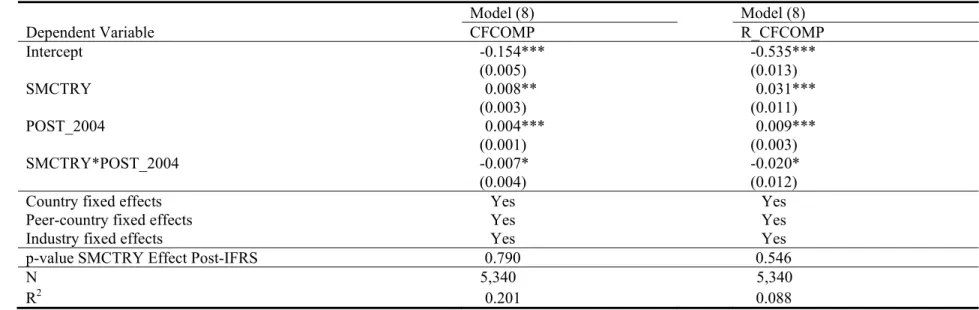
We use Bureau van Dijk Orbis data to identify suitable private firms. We employ propensity score matching to match public firms with private firms from the same country on industry, size, and profitability. We average the resulting firm pairs by country, peer-country, listing status (i.e., public or private), peer firm listing status, industry, and pre and post 2004 groups, yielding a sample of 10,744 observations. Out of these observations, 2,776 observations are public-public pairs, 2,628 are private-private pairs, and 5,340 are private-public pairs. The results of the tests are reported in Table 8.
We use the following model to estimate the effect of mandatory IFRS adoption on comparability:
(10) , , , , , , , _2004 , ∗ _2004 , ∗ _2004 , , , , , .
COMPM is either CFCOMP or R_CFCOMP. PUBLIC takes the value of one if the respective observations capture the comparability of public firms and zero otherwise. POST_2004 takes the value of one for observations based on the time period 2005-2008, and zero otherwise. All other variables are as previously defined. Panel A reports the results for the tests containing only firm pairs with the same listing status (i.e., either public-public or private-private). This means that observations comparing public to private firms are excluded (results for public-private pairs are presented in Panel B). The first two columns report the results for all public-public and private-private observations. We generally find that public firms and firms from the same country report more comparable earnings. While the former result is consistent with public firms having greater incentives to comply because they are subject to stronger enforcement (Ball and Shivakumar [2005]), the latter result is consistent with the idea that firms sharing the same institutional infrastructure tend to have more comparable reporting practices. In addition to that, the analyses conducted using CFCOMP as dependent variable show a general decrease in comparability after 2004 while public firms report even more comparable earnings relative to private firms in the period post IFRS adoption. Results for R_CFCOMP point to the same direction but are not significant. Taken together, we
see these findings as consistent with a marginal comparability effect of mandatory IFRS adoption.27
We now turn to the analysis of the moderating impact of compliance incentives on the comparability effect. For this, we partition our public-public firms’ observations by their respective levels of compliance incentives. The third and fourth column of Panel A report the results when we exclude public-public observations where firms face high compliance incentives form the analysis. In line with the results of our main tests, we find no significant IFRS comparability effect for public firms that face low compliance incentives as the coefficient for PUBLIC*POST_2004 becomes negative and insignificant. However, when we exclude the observations based on public firms with low compliance incentives (fifth and sixth column of Panel A), we find a strong and significant coefficient for the IFRS effect. This effect is also sizable in economic terms as indicated by a comparability rank increase of 10.4 percentage points for public firms with large compliance incentives.
We summarize the results of Panel A as confirming that the effect of mandatory IFRS adoption on comparability is centered on firms with high compliance incentives. In addition, we find a marginally positive comparability effect of mandatory IFRS adoption for European firms when we use private firms from the same country as a control group. This finding is consistent with the results from the test using public firms from non-IFRS countries as a control group.
We then use private firm data to test whether comparability between public and private firms declines after the mandatory IFRS adoption for public firms. A reduction in comparability could be interpreted as transparency-enhancing if driven by differences
27 While this finding seems to be driven by the comparability of private firms decreasing, the
comparability of public firms remains more or less constant which we regard as evidence consistent with a marginal comparability effect of mandatory IFRS adoption.
between public and private firms becoming more apparent to users of financial statements post IFRS adoption. Such a decline in comparability should affect the comparability between public and private firms across all IFRS adopting countries. However, if a decline in comparability is only observed when private and public firms come from the same country, this would likely be driven by different GAAP regimes (IFRS for public and local GAAP for private firms) post 2004. Such an effect would be consistent with a potential cost of IFRS adoption since financial statement users now face higher information processing costs when comparing public and private firms from the same country.
Panel B of Table 7 reports the results for this test. For this analysis, we limit our sample to observations that measure the comparability between public and private firms. Thus, the indicator variable PUBLIC and its interaction with POST_2004 are dropped. Our main variables of interest are POST_2004 and the interaction of SMCTRY and POST_2004. The coefficient for POST_2004 indicates that, on average, public firms become more comparable to private firms post IFRS adoption.28 This finding is inconsistent with the transparency argument outlined above since an increase in transparency would require a decrease in comparability across all countries. The coefficient for the interaction of POST_2004 and SMCTRY captures whether, after public firms adopt IFRS, public and private firms from the same country become more or less comparable. We find a negative and marginally significant coefficient, indicating that after public firms adopt IFRS, they become less comparable to private firms within the same country. Again, this effect is meaningful in economic terms as indicated by a rank decrease in comparability of 5 percentage points for public-private firm pairs from
28 Since a control sample of non IFRS-adopting countries is not available for this test, we cannot rule out