Procedia Technology 23 ( 2016 ) 264 – 271
ScienceDirect
2212-0173 © 2016 The Authors. Published by Elsevier Ltd. This is an open access article under the CC BY-NC-ND license (http://creativecommons.org/licenses/by-nc-nd/4.0/).
Peer-review under responsibility of the organizing committee of ICIAME 2016 doi: 10.1016/j.protcy.2016.03.026
3rd International Conference on Innovations in Automation and Mechatronics Engineering,
ICIAME 2016
KERNEL RECURSIVE LEAST SQUARES FUNCTION APPROXIMATION IN GAME
THEORY BASED CONTROL
Dr. Hitesh Shah
a, Dr. M. Gopal
ba Professor, Department of Electronics & Communication Engineering,
G H Patel College of Engineering & Technology, Vallabh Vidyanagar (Gujarat) 388120, INDIA
E-mail: iitd.hitesh@ gmail.com
b Director, School of Engineering, Shiv Nadar University, Noida (Uttar Pradesh), INDIA
E-mail: [email protected]
Abstract
A game theoretic aspect in reinforcement learning based controller design with kernel recursive least squares algorithm for value function approximation is proposed in this paper. A kernel recursive least-squares-support vector machine is used to realize a mapping from state, controller’s action and disturber’s action to Q-value function. Online sparsification framework permits the addition of training sample into the Q-function approximation only if it is approximately linearly independent of the preceding training samples. Markov game setup is shown to be one of the important platforms for addressing robustness of direct adaptive optimal control of nonlinear systems. A game against nature strategy shows the strength of state importance in terms of accelerated learning, and better relative stability of the system. Simulation results on two-link robot manipulator show that the proposed method has high learning efficiencybetter accuracy measured in terms of mean square error; and lesser computation time, compared to the least-squares support vector machine.
Keywords: kernel Recursive Least Squares Support Vectors, Game Theory, Reinforcement Learning Control, Two-link robot control
.
1.IntroductionMarkov games [1] are a generalization of classical game theory, and Markov Decision Process (MDP) setup provides a powerful tool for optimizing the behavior of a reinforcement learning (RL) agent in a multi-agent scenario. Sharma and Gopal [2, 3] envisage a game-theoretic RL task as a two-player zero-sum Markov game between the controller acting as a minimizer and the disturbance and/or noise acting as the maximiser.
A Markov game based controller uses minmax-Q[4] algorithm instead of the ‘min’ or ‘max’ Q-value function as used in the MDP based control. Use of conservative minmax criteria means that the controller attempts to maximize performance in the face of worst disturbance. In zero-sum games model situations [5], two players control some dynamic system and both have opposite objectives. One player wishes typically to maximize a cost which has © 2016 The Authors. Published by Elsevier Ltd. This is an open access article under the CC BY-NC-ND license
(http://creativecommons.org/licenses/by-nc-nd/4.0/).
to be paid to the other player, i.e., two-players have diametrically opposite goals. Since a gain by one player signifies an equal loss to other, it suffices to summarize the game in terms of the payoff to one player. Design considers the two players as agent (controller) and opponent (disturber); the game is usually represented by the payoff matrix to the agent. The solution of the game is based on the principal of securing the best of the worst for the agent, the so called minmax strategy; it prefers conservative strategies for minimization to more daring ones that accrue a great deal of rewards against the opponent or lose a great deal to the opponent.
Adopting minmax strategies, Markov game setup simplifies the mathematics but makes it difficult to consider the important phenomenon that occurs in decision making under uncertainty. When formulated as a game, the agent is required to maximize its gain against an opponent that plays at random. Assuming that the opponent could always work towards minimizing the gain to the agent, is a weakness of the minmax strategy when applied to the problem of control. In fact, the random action of the opponent may help the agent maximize its gain, rather than opposing it all the time.
A simple solution proposed in this paper approximately resolves this issue while retaining the simple mathematics of minmax strategies. This exploits the a priori knowledge on focus of attention in the game, available to the agent. In state-action space, some decisions are more important than the others. For example, making mistake in a state close to the equilibrium state (stability region) can often be recovered from, but taking a wrong action in
the state away from the equilibrium state (oscillatory/instability regions) can force the system into a “death spiral”
from which crash is unavoidable. This effect can be amplified as one decision has impact on the agent’s subsequent
decisions. The imperfect-sensitive agent (that takes state importance into account in its strategy) is expected to perform better than the imperfect-insensitive agent, which can behave arbitrarily in some situations.
We reformulate Markov game based RL control problem for decision-making under uncertainty, wherein agent exploits the suboptimalities of the opponent. The agent in a Markov game must adopt maximizer actions as well as exploratory actions. The agent takes conservative actions (minmax strategy) in a region away from equilibrium state, but while in a region close to equilibrium state, the agent can afford exploration. This design strategy guarantees the best performance under worst-case behavior of nature.
For moderately large state-space, minmax-Q can be implemented using table lookup approach. However, in cases when the state space is huge or continuous, lookup tables do not scale up or are intractable. Function approximation and generalization methods seem to be more feasible solutions. Extensive experimentation using neural network (NN) [2], and fuzzy inference systems (FIS) [3] as function approximators, in game-theoretic RL control have been reported in the literature.
Our primary focus in this paper is on applicability of the generic function approximation for learning and control in a Markov game setup with worst case design strategies for games against nature for continuous state-space nonlinear systems. The objective in hand is to explore the use of a support vector machine (SVM), one of the most popular methods in solving classification and regression problems [6]. Conventional SVMs have properties of global optimization, and good adaptability. In addition, SVM can overcome the difficulty of determining the structure and the number of hidden neurons of traditional neural networks (NN). However, the optimal solutions are obtained by solving standard quadratic programming, which results in high computational cost. In order to reduce the computational cost, Suykens and Vandewalle [7] proposed least square support vector machine (LS-SVM), which converts constraints from linear inequalities to linear equations. LS-SVM has been successfully applied to RL problems [8]. Its application in game-theoretic RL task requires solving a regression problem, wherein the observed states, controller’s actions and disturber’s actions are considered as inputs and Q-value functions as output. All the training samples may be the support vectors in LS-SVM, and thus the support vectors are no longer sparse. It may lead to poor generalization, increasing the number of input training pairs and equations that may result in higher computational cost.
Online learning in real-time applicationsas required in controlcannot be realized by straightforward usage of off-the-shelf machine learning methods such as support vector regression. Kernel recursive least-squares (KRLS) [9] is a kind of online sparse regression method using kernel machine, through which one can achieve on-line learning support vector machine with sparse support vectors, low computational cost and satisfactory accuracy. In the present work, we propose a structure and algorithm for value function approximation with kernel recursive least squares support vector machine (KRLS-SVM) in MDP based and game theory based reinforcement learning control.
This paper aims at designing a KRLS-SVM algorithm for Markov game based RL control with the potency of worst case design strategy for games against nature, and demonstrating its potential through simulation experiments on two-link robot manipulatora high dimensional continuous state-space nonlinear system. In first stage of
Action selector (H-greedy) Unknown Plant U – + + 1 (k) V x J ( )k Q x k x KRLS-SVM TD error kc u v K + pd u k x Error metric evaluator + k c ( , ) k i i Q x u u U (desired) k x c u
simulation experiments, we develop a KRLS-SVM algorithm for reinforcement learning (MDP setup) and compare it with the scheme based on LS-SVM. The mean square error accuracy, maximum absolute error, maximum absolute torque, and computational cost show effectiveness of the KRLS-SVM algorithm with low value of computational cost and better accuracy. In second stage, we develop KRLS-SVM algorithm for Markov game based RL control for decision making under uncertainty, which exhibits strong robustness in presence of external disturbances and parameter variations. The results are compared with MDP setting.
The remaining part of the paper is organized as follows: Section 2 presents architecture of MDP and Markov game settings on KRLS-SVM controller. Section 3 gives details of on-line KRLS-SVM learning algorithm. Section 4 compares and discusses the empirical performance study on the basis of simulation results. Additionally this section highlights the features of KRLS-SVM in comparison with LS-SVM. Finally in Section 5, the conclusions are presented.
2.Reinforcement Learning Controller Based On KRLS-SVM
In reinforcement learning paradigm, an agent (controller) must learn from interaction with its environment (plant) in order to achieve certain goals. The goal of RL agent is to estimate the optimal policy or optimal value function for Markov decision process (MDP)/Markov game based RL, without knowing its model. In order to do so, most current RL techniques estimate the value of actions, i.e., the future reward one can expect as a result of executing an action, using recursive estimation techniques. Q-learning [10] is the most well-known RL approach, which estimates the discounted future rewards for taking actions from given states based on temporal-difference (TD) learning [11]. Q-learning maps every state-action pair to a real number, the Q-value, which tells how optimal that action is in that state. In a case of large continuous state-space, usual approach of storing Q-values in a look-up table [12] is either impractical or impossible. This problem is shared by both MDP and Markov game based RL. In fact, some form of generalization in terms of value function approximation has played an important role in extending classical MDP/Markov game framework to deal with practical problems.
Support vector machine function approximation (SVMQ-learning) is one of the RL frameworks to deal with continuous space problem. Further, a LS-SVM has good generalization property, and is used to approximate the Q -values of state-action pairs online by taking the advantage of not falling into the trap of local minima. On the other hand, LS-SVM suffers from poor sparsification of support vectors and results in higher computational cost when number of training pairs increases. The KRLS-SVM is a strong candidate to achieve sparse support vectors, low computational cost and satisfactory accuracy. This subsection discusses a novel KRLS-SVM function approximation in MDP and Markov game based RL control framework.
2.1 MDP based control
In MDP setting, the controller assumes a stationary environment and achieves optimal behavior by repeated interaction with the environment. Fig. 1 gives architecture of a KRLS-SVM controller in MDP setting based on Q-learning.
The input of KRLS-SVM is The state-action pair (x uk, k); where xk
^
x x1k, 2k, ,xnk`
is the current system state and uk is the each possible discrete controlaction in action set U
^ `
uk ; 1,k ,m; is the input of KRLS-SVM and the estimated Q-value corresponding to (x uk, k) is the output. Training samples of KRLS-SVMFig. 1 KRLS-SVM controller in MDP setting should be obtained during interaction between the learning system and its environment. In specific, control actions are selected using an exploration/exploitation policy (H -greedy) in order to explore the set of possible actions and acquire experience through the RL signals [12]. We use a pseudo-stochastic exploration as in [13].
It is an online incremental learning algorithm that learns an approximate state-action value function ( , )Q x u that converges to the optimal function Q (commonly called Q-value). Online version is given by
1 1 1 ( , ) ( , ) [ k min ( , ) ( , )] k k k k k k k k k u U Q x u Q x u c Q x u Q x u m K J (1)
where xkock xk1 is the state transition under the action
k
u at instant k, K(0,1] is the learning rate parameter and J(0,1] is the discount factor that controls the trade-off between immediate and future costs.
2.2 Markov game based control
In a Markov game (MG) formulation of controller, controller (agent) and the disturber (noise/disturbances) are the two players, and the tussle between them as a two-player zero-sum Markov game. In game theory based RL controller formulation, the Q-value function contains an accurate summary of the controller-disturber-environment interaction consequences. A Markov game formalism to continuous state-action space problems using a continuous action variant of minmax-Q based on KRLS-SVM is shown in Fig.2.
We consider a learning system (controller) that interacts with its environment (discrete-time dynamical system). For each state xkX of the dynamical system at Fig.2 KRLS-SVM controller in Markov game setting discrete-time k, there is a finite set of possible decisions (control actions) uk u x( k)U x( k) that may be taken by the learning system. Simultaneously, the opponent
(disturber) takes an action dk d x( k)D x( k) at state xk and there the tussle between controller-disturber is viewed as a two-player zero-sum Markov game. Continuous state-space discrete-action Markov game based controller consists of two parts (i) game solver and (ii) SVM function approximator. The input of KRLS-SVM is the state-action pair (x u dk, k, k), while the output is the estimated Q-value corresponding to (x u dk, k, k). Q -value constructs the game matrix. The game solver is a linear program [14] that solves the game matrix to generate a policy Su(xk) over the controller’s action set, i.e., it solves for
( )
( ) arg min max ( , , )
u k k u u PD U d D u U x Q x u d
¦
S S S (2)Policy Su(xk) specifies a probability distribution over the controller’s action set and we use this probability distribution to generate a continuous control action ukc as: ( ) k( )
k k
kc u k
u x
¦
S x u (3)Controller observes the next system state xk1, cost ck and updates the Q-values:
1 ( , , ) ( , , ) [ k ( ) ( , , )] k k k k k k k k k k Q x u d mQ x u d Kc JV x Q x u d (4) where 1 1 ( ) ( ) min max ( , , ) u k k u PD U d D u U V x Q x u d
¦
S S is the game-value at state
1
k
x .
Training samples of KRLS-SVM should be obtained during interaction between the learning system and its environment. In specific, control actions are selected using an exploration/exploitation policy (EEP) in order to explore the set of possible actions and acquire experience through the RL signals [12]. We use a pseudo-stochastic exploration (H-greedy) as in [13]. In H-greedy exploration, we gradually reduce the exploration (determined by the H parameter) according to some schedule; we have reduced H to its 90 percent value after every 50 iterations. The lower limit of parameter H has been fixed at 0.002 (to maintain exploration).
3.Online KRLS-SVM Learning
The Kernel Recursive Least Squares (KRLS) algorithm was introduced in [9] and has a conceptual foundation related to Principal Component Analysis (PCA) and SVM. KRLS algorithm produces much sparser solutions with higher robustness to noise. Moreover, KRLS is a fully online algorithm designed to operate in real-time
Game Solver Unknown Plant U – + + 1 (k) V x J ( ,k , ) k k Q x u d k x KRLS-SVM TD error kc u v K + upd k x Error metric evaluator + k c ( , , ) at ( ), ( ) k k k k Q x u d x u U x d D x (desired) k x c u D
environments where data became available one sample at a time. As a matter of fact, KRLS seems to be the best choice as a function approximator in reinforcement learning algorithm.
In our setting, KRLS is presented with input-output pairs, i.e., state-action pair, with estimated Q-value arising from an unknown mapping. The standard recursive least-square (RLS) algorithm is used to recursively train a linear regression model [15], which can be expressed in the following parametric form:
ˆ( ) , ( ) ; n,
Q f x wI x b w b (5)
where, ( )I x is a fixed, finite dimensional nonlinear mapping from input space to some high-dimensional feature space, .,. denotes inner products, and w is a weight vector of parameters that can be adjusted in a manner such that the bias term b becomes zero. In this case, regression model reduces to the simpler form as:
ˆ( ) , ( ) ( )T ; n
Q f x wI x I x w w (6)
The objective of learning algorithm is to minimize, 2 1 ˆ ( ) ( ( )) n i i i
g w
¦
y f x with respect to thew
weight vector.The optimal weight vector can be expressed as, 1
( )
n i i i
w
¦
D I x and the regression model becomes,ˆ( ) ( )T ( )
Q f x I x I Dx (7)
Kernel methods present an alternative to the parametric approach. KRLS attempts to learn an approximation to the mapping f xˆ( ) in the form of a weighted linear sum of the kernels ( , )k x xi I( ), ( )xi I x , where
^ `
xi ti1 are thetraining data points up to time t. This leads to
1
ˆ( ) t ( , )
i i i
Q f x
¦
Dk x x (8)The vector xi associated with coefficients Di !0 are called support vectors and only these contribute to
minimizing the cost function. In general, Radial Basis kernel function is the most common choice for nonlinear system study. In order to reduce the number of adjustable parameters in (8), KRLS-SVM employs a form of online
sparsification. By making use of online sparsification, the training data can be stored in a compact form, i.e., only a
fraction of training data will be actually used for training purpose. The sparsification methodology permits the addition of training sample into the approximation (8) only if it is approximately linearly independent of the preceding training samples. In the sparsification procedure, the linearly independent training data points will be stored in a Dictionary Set. To prove the linear dependency of new data vector on the dictionary vectors, the
approximate linear dependences (ALD) test is
2 1 1 min ( ) ( ) t t a j j t j a x x
¦
G I I X (9)where X is the dictionary-inclusion threshold, which is an important tuning parameter that determines the accuracy of approximation (8). Solving for optimality of the cost function, we can get: at K k ( )-1t-1 t-1 xt and
T -1 k ( )
t ktt t xt at
G , where [K ]t1i j, k x x( ,i j), [k ( )]t-1 xt i k x x( ,i t) and ktt k x x( ,t t). While updating the weight
vector Donline, if Gi X, the new training data point will not be added in the dictionary set. But if Gi !X then new
training data point will be added in the dictionary set. As a result, the weight vectors Dt (D D1, 2, Dt1) are learned by KRLS over time through successive minimization of the approximation error in the least-squares sense. We use KRLS algorithm as proposed in [9] for Markov game reinforcement learning control.
4. Simulation Studies and Analysis
To verify the proposed KRLS-SVM learning approach, we use two-link robot manipulator tracking control problem as the standard benchmark. In robot-manipulator tracking control problem, we try to train the kernel recursive least square support vector machine so that its outputs can track those of an unknown dynamic system over the time interval [0, T]. The dynamical model of the two-link robotic manipulator and parameters as specified in [16], have been used in this simulation study.
4.1 Controller learning details
Simulation parameters and learning details for KRLS-SVM value function approximator in MDP and Markov game RL control structure are as follows:
We define tracking error vector as: k k k d
e T T and cost function k , 0
k k T
c e /e / / ! with
^
`
diag 30,20
/ . Maximum limit of error is taken as 0.2 rad for both the links (10% of peak-to-peak of reference trajectory). System state space (continuous) has four variables, i.e., xk [ T T T T1 2 1 2]T [ ]x x1 2 x x1 2 T . Controller action sets for link1 and link2 are U(1)
>
20 0 20@
Nm, and U (2)>
2 0 2@
Nm, respectively. We assume the action sets for the disturber to be 20% of these values. Exploration levelH
decays from0.5o0.002 over the iterations. The discount factor J is set to 0.8; learning-rate parameter K is set to 0.2, and PD gain matrixKv diag 20, 20
^
`
. We deliberately introduce deterministic noise of r1% in control effort with a probability of (1/3), for stochastic simulation.A KRLS-SVM is used to realize mapping from state-action pair to Q-value function. For simplicity, the controller uses two function approximators, one each for the two links. The training samples of KRLS-SVM are obtained during the interaction between the controller and the environment. The Gaussian kernel
2
( (( )/ ) ) ( , ) x y
K x y e U is chosen for our simulation studies. The variance of Gaussian kernel is set to 0.1, and
threshold for linear dependence test is 0.1.
In controller implementations, we have used controller structure with an inner PD loop. Control action to the robot manipulator is a combination of an action generated by an adaptive learning RL signal through KRLS-SVM and a fixed gain PD controller signal. The PD loop will maintain stability until KRLS-SVM controller learns, starting with zero initialized Q-values. The controller, thus, requires no offline learning.
4.2 Simulation Results
In order to study the learning performance, and robustness against uncertainties, KRLS-SVM learning approach has been simulated on two-link robot manipulator control problem. MATLAB 7.4.0 (R2010a) has been used as simulation tool. To analyze the KRLS-SVM algorithm for computational cost, accuracy, and robustness, we compare the proposed approach with LS-SVM reinforcement learning approach.
4.2.1 Learning performance study
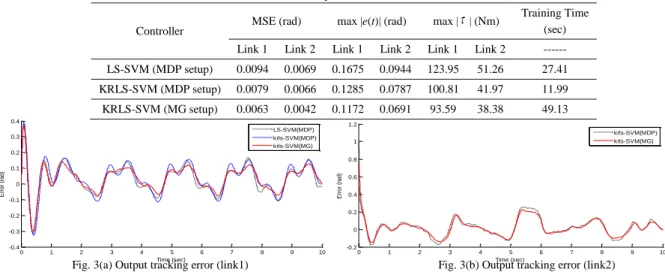
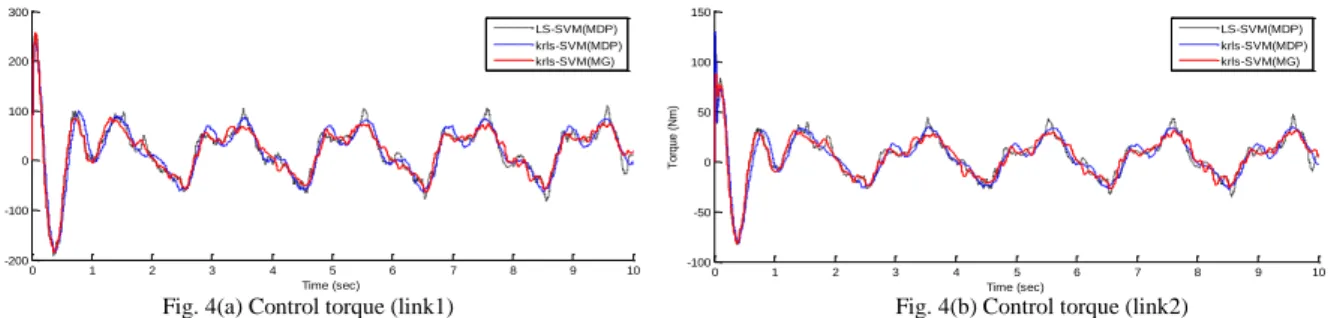
The physical system has been simulated for a single run of 10 sec using fourth-order Runge-Kutta method, with fixed time step of 10 msec over a single episode. The output tracking error (both the links) and control torque (both the links) for LS-SVM, KRLS-SVM (MDP setup) and KRLS-SVM (MG setup) algorithms are shown in Fig. 3 and Fig. 4, respectively. Table 1 tabulates the mean square error, absolute maximum error (max |e(t)|), and absolute maximum control effort (max |W|) under nominal operating conditions.
Table 1 Comparison of controllers
Controller MSE (rad) max |e(t)| (rad) max |W | (Nm)
Training Time (sec) Link 1 Link 2 Link 1 Link 2 Link 1 Link 2 --- LS-SVM (MDP setup) 0.0094 0.0069 0.1675 0.0944 123.95 51.26 27.41 KRLS-SVM (MDP setup) 0.0079 0.0066 0.1285 0.0787 100.81 41.97 11.99 KRLS-SVM (MG setup) 0.0063 0.0042 0.1172 0.0691 93.59 38.38 49.13
Fig. 3(a) Output tracking error (link1) Fig. 3(b) Output tracking error (link2)
0 1 2 3 4 5 6 7 8 9 10 -0.4 -0.3 -0.2 -0.1 0 0.1 0.2 0.3 0.4 Time (sec) E rro r (ra d ) LS-SVM(MDP) krls-SVM(MDP) krls-SVM(MG) 0 1 2 3 4 5 6 7 8 9 10 -0.2 0 0.2 0.4 0.6 0.8 1 1.2 Time (sec) E rro r (ra d ) krls-SVM(MDP) krls-SVM(MG)
Fig. 4(a) Control torque (link1) Fig. 4(b) Control torque (link2)
From the results (Fig. 3 and Fig. 4, Table 1), we observe that training time for KRSVM is lesser than LS-SVM. This shows KRLS-SVM has good generalization ability with low computational cost. KRLS-SVM outperforms LS-SVM, in terms of lower tracking errors and the low value of absolute error and control effort for both the links.
4.2.2 Robustness study
In the following, we compare the performance of MDP setup and Markov game setup with games against nature strategy for KRLS-SVM controllers under uncertainties. For this study, we trained the controller for 20 episodes, and then evaluated the performance for two cases:
Effect of payload variations: The end-effector mass is varied with time, which corresponds to the robotic arm
picking up and releasing payloads having different masses. The mass is varied as: (a) t 2 s ; m2 1 kg (b) 2
2 d t 3.5 s ; m 2.5 kg (c) 3.5 d t 4.5 s ; m2 1 kg (d) 4.5 d t 6 s ; m2 4 kg (e) 2
6 d t 7.5 s ; m 1 kg (f) 7.5 d t 9 s ; m2 2 kg (g) 9d t 10 s ; m2 1 kg. Figs. 5(a) and (b) show the output tracking errors (both the links) and Table 2 tabulates the mean square error, absolute maximum error (max |e(t)|), and absolute maximum control effort (max |W|) at payload variations with time.
Table 2 Comparison of controllers
Controller MSE (rad) max |e(t)| (rad) max |W | (Nm) Link 1 Link 2 Link 1 Link 2 Link 1 Link 2 KRLS-SVM (MDP setup) 0.0239 0.0126 0.4151 0.9075 281.05 400.00 KRLS-SVM (MG setup) 0.0176 0.0090 0.3502 0.6864 262.53 359.93
Fig. 5(a) Output tracking error (link1) Fig. 5(b) Output tracking error (link2)
Effects of external disturbances: A torque disturbance with a sinusoidal variation of frequency 2S rad/sec, was
added with time to the model. The magnitude of torque disturbance is expressed as a percentage of control effort. The magnitude is varied as: (a) t 2 s ; 0% (b) 2 d t 3.5 s ; 0.2% (c) 3.5 d t 4.5 s ; 0% (d) 4.5 d t 6 s ; 0.8% (e) 6 d t 7.5 s ; 0% (f) 7.5 d t 9 s ; 0.2% (g) 9d t 10 s ; 0%. Figs. 6(a) and (b) show the output tracking errors (both the links) and Table 3 tabulates the mean square error, absolute maximum error (max |e(t)|), and absolute maximum control effort (max |W|) for torque disturbances added with time to the model variation.
Table 3 Comparison of controllers
Controller MSE (rad) max |e(t)| (rad) max |W| (Nm) Link 1 Link 2 Link 1 Link 2 Link 1 Link 2 KRLS-SVM (MDP setup) 0.0120 0.0065 0.3748 0.9075 281.13 400.00 KRLS-SVM (MG setup) 0.0138 0.0069 0.3876 0.8962 238.06 353.13 0 1 2 3 4 5 6 7 8 9 10 -0.4 -0.2 0 0.2 0.4 0.6 0.8 1 Time (sec) E rro r (ra d ) LS-SVM(MDP) krls-SVM(MDP) krls-SVM(MG) 0 1 2 3 4 5 6 7 8 9 10 -200 -100 0 100 200 300 Time (sec) T o rq u e (Nm ) LS-SVM(MDP) krls-SVM(MDP) krls-SVM(MG) 0 1 2 3 4 5 6 7 8 9 10 -100 -50 0 50 100 150 Time (sec) T o rque ( N m ) LS-SVM(MDP) krls-SVM(MDP) krls-SVM(MG) 0 1 2 3 4 5 6 7 8 9 10 -0.3 -0.2 -0.1 0 0.1 0.2 0.3 0.4 0.5 Time (sec) E rro r (ra d ) krls-SVM(MDP) krls-SVM(MG)
Fig. 6(a) Output tracking error (link1) Fig. 6(b) Output tracking error (link2)
Simulation results (Fig. 5 and Fig. 6, Table 2 and Table 3) show better robustness property for Markov game based RL control with games against nature strategy in comparison with MDP based RL algorithm, for KRLS-SVM based controller. Markov game based RL control formulation is the viable alternative to MDP based RL control for better handling of noise (external disturbances) and payload variations.
5. Conclusions
As an important machine learning method, reinforcement learning has a difficulty scaling to challenges in large-scale space problems. A KRLS-SVM algorithm for MDP and Markov game based RL control is proposed in this paper by taking advantage of good generalization ability with low computational cost of KRLS-SVM. Online sparsification using linear independent test permits the addition of training sample into the value function approximation of the preceding training samples only if it is approximately linearly independent of the preceding training samples.
Simulation results on two-link robot manipulator show that the proposed KRLS-SVM function approximator is suitable for working in large-scale continuous state-space; in fact the proposed scheme gives better accuracy, lower computational cost and better robustness property compared with the scheme based on LS-SVM.
Markov game setup is shown to be one of the important platforms for addressing robustness of direct adaptive optimal control of nonlinear systems. A game against nature strategy shows the strength of state importance in terms of accelerated learning, and better relative stability of the system.
References
[1] Littman ML, Markov games as a framework for multi-agent reinforcement learning. Proceedings 11th International Conference Machine Learning, San Francisco; 1994. p. 157–163
[2] Sharma R, Gopal M, A robust Markov game controller for nonlinear systems. Applied Soft Computing 2007; 7(3): 818–827
[3] Sharma R, Gopal M, A Markov game-adaptive fuzzy controller for robot manipulators. IEEE Trans on Fuzzy System 2007; 16(1): 171–
186
[4] Littman ML, Value-function reinforcement learning in Markov games. Journal of Cognitive System 2001; 2: 55–66
[5] Littman ML, Algorithms for Sequential Decision Making. Ph.D. Thesis, Department of Computer Science, Brown University; 1996. [6] Richard G, Brereton, Gavin R, Lloyd, Support vector machine for classification and regression. Analyst 2010; 135: 230–267 [7] Suykens JAK, Vandewalle J, Least square support vector machine classifiers. Neural processing letters 1999; 9: 293–300
[8] Wang X, Tian X, Cheng Y, Value approximation with least square support vector machines in reinforcement learning system. Journal of Computational and Theoretical Nanoscience 2007; 4(7-8): 1290–1294
[9] Engel Y, Mannor S, Meir R, The Kernel Recursive Least-Squares Algorithm. IEEE Trans on Signal Proc 2004; 52(8): 2275–2285 [10] Watkins CJCH, Learning with delayed rewards. Ph. D. Thesis, University of Cambridge, England; 1989.
[11] Sutton RS, Temporal credit assignment in reinforcement learning. Ph. D Thesis, Dept. of Computer and Information Science, University of Massachusetts; 1984.
[12] Sutton RS, Barto AG, Reinforcement Learning: An Introduction. Cambridge, MIT Press; 1998.
[13] Shah H, Gopal M, A fuzzy decision tree based robust Markov game controller for robot manipulators. International Journal of Automatic and Control 2010; 4(4): 417–439
[14] Strang G, Linear Algebra and its Applications, 2nd Ed., Orlando FL: Academic Press; 1980.
[15] Myers RH, Classical and Modern regression with Applications, 2nd Edn., Boston; 1994.
[16] Green, Sasiadek JZ, Dynamics and trajectory tracking control of a two-link robot manipulator. Journal Vibration Control 2004; 10(10): 1415–1440 0 1 2 3 4 5 6 7 8 9 10 -0.4 -0.3 -0.2 -0.1 0 0.1 0.2 0.3 0.4 Time (sec) E rro r (ra d ) krls-SVM(MDP) krls-SVM(MG) 0 1 2 3 4 5 6 7 8 9 10 -0.4 -0.2 0 0.2 0.4 0.6 0.8 1 Time (sec) E rro r (ra d ) krls-SVM(MDP) krls-SVM(MG)