SEA LEVEL VARIATIONS OVER GEOLOGIC TIME
M. A. Kominz, Western Michigan University, Kalamazoo, MI, USA
Copyright^ 2001 Academic Press doi:10.1006/rwos.2001.0255
Introduction
Sea level changes have occurred throughout Earth history. The magnitudes and timing of sea level changes are extremely variable. They provide con-siderable insight into the tectonic and climatic his-tory of the Earth, but remain difRcult to determine
with accuracy.
Sea level, where the world oceans intersect the continents, is hardlyRxed, as anyone who has stood
on the shore for 6 hours or more can attest. But the ever-changing tidal Sows are small compared with
longer-termSuctuations that have occurred in Earth
history. How much has sea level changed? How long did it take? How do we know? What does it tell us about the history of the Earth?
In order to answer these questions, we need to consider a basic question: what causes sea level to change? Locally, sea level may change if tectonic forces cause the land to move up or down. How-ever, this article will focus on global changes in sea level. Thus, the variations in sea level must be due to one of two possibilities: (1) changes in the vol-ume of water in the oceans or (2) changes in the volume of the ocean basins.
Sea Level Change due to Volume of
Water in the Ocean Basin
The two main reservoirs of water on Earth are the oceans (currently about 97% of all water) and gla-ciers (currently about 2.7%). Not surprisingly, for at least the last three billion years, the main variable controlling the volume of water Rlling the ocean
basins has been the amount of water present in glaciers on the continents. For example, about 20 000 years ago, great ice sheets covered northern North America and Europe. The volume of ice in these glaciers removed enough water from the oceans to expose most continental shelves. Since then there has been a sea level rise (actually from about 20 000 to about 11 000 years ago) of about 120 m (Figure 1A).
A number of methods have been used to establish the magnitude and timing of this sea level change.
Dredging on the continental shelves reveals human activity near the present shelf-slope boundary. These data suggest that sea level was much lower a rela-tively short time ago. Study of ancient corals shows that coral species which today live only in very shallow water are now over 100 m deep. The car-bonate skeletons of the coral, which once thrived in the shallow waters of the tropics, yield a detailed picture of the timing of sea level rise, and, thus, the melting of the glaciers. Carbon-14, a radioactive isotope formed by carbon-12 interacting with high-energy solar radiation in Earth’s atmosphere (see
Cosmogenic Isotopes) allows us to determine the
age of Earth materials, which are about 30 thou-sand years old.
This is just the most recent of many, large changes in sea level caused by glaciers, (Figure 1B). These variations in climate and subsequent sea level changes have been tied to quasi-periodic variations in the Earth’s orbit and the tilt of the Earth’s spin axis. The record of sea level change can be esti-mated by observing the stable isotope, oxygen-18 in the tests (shells) of dead organisms (see Cenozoic
Climate+ Oxygen Isotope Evidence). When marine microorganisms build their tests from the calcium, carbon, and oxygen present in sea water they incor-porate both the abundant oxygen-16 and the rare oxygen-18 isotopes. Water in the atmosphere gener-ally has a lower oxygen-18 to oxygen-16 ratio be-cause evaporation of the lighter isotope requires less energy. As a result, the snow that eventually forms the glaciers is depleted in oxygen-18, leaving the ocean proportionately oxygen-18-enriched. When the microorganisms die, their tests sink to the
sea-Soor to become part of the deep marine sedimentary
record. The oxygen-18 to oxygen-16 ratio present in the fossil tests has been calibrated to the sea level change, which occurred from 20 000 to 11 000 years ago, allowing the magnitude of sea level change from older times to be estimated. This technique does have uncertainties. Unfortunately, the amount of oxygen-18 which organisms incorporate in their tests is affected not only by the amount of oxygen-18 present but also by the temperature and salinity of the water. For example, the organisms take up less oxygen-18 in warmer waters. Thus, during glacial times, the tests are even more enriched in oxygen-18, and any oxygen isotope record reveals a combined record of changing local temperature and salinity in addition to the record of global glaciation.
High
Low Low High
0 10 20 500 1000 (A) (B) (C) High Low 50 40 30 20 10 60 70 Greenland Ice Sheet Antarctic Ice Sheet (D) High Low 100 50 200 150 0 15 5 NorthAtlantic Kerguelen Ontong Java 0 0 Time (thousands of y ears) Time (millions of y ears) Sea level
Figure 1 (A) Estimates of sea level change over the last 20 000 years. Amplitude is about 120 m. (B) Northern Hemisphere glaciers over the last million years or so generated major sea level fluctuations, with amplitudes as high as 125 m. (C) The long-term oxygen isotope record reveals rapid growth of the Antarctic and Greenland ice sheets (indicated by gray bars) as Earth’s climate cooled. (D) Long-term sea level change as indicated from variations in deep-ocean volume. Dominant effects include spreading rates and lengths of mid-ocean ridges, emplacement of large igneous provinces (the largest, marine LIPs are indicated by gray bars), breakup of supercontinents, and subduction of the Indian continent. The Berggrenet al. (1995) chronostratigraphic timescale was used in (C) and (D).
Moving back in time through the Cenozoic (zero to 65 Ma), paleoceanographic data remain excellent due to relatively continuous sedimentation on the ocean Soor (as compared with shallow marine
and terrestrial sedimentation). Oxygen-18 in the fossil shells suggests a general cooling for about the last 50 million years. Two rapid increases in the oxygen-18 to oxygen-16 ratio about 12.5 Ma and about 28 Ma are observed (Figure 1C). The forma-tion of the Greenland Ice Sheet and the Antarctic Ice Sheet are assumed to be the cause of these rapid isotope shifts. Where oxygen-18 data have been col-lected with a resolution Rner than 20 000 years,
high-frequency variations are seen which are pre-sumed to correspond to a combination of temper-ature change and glacial growth and decay. We hypothesize that the magnitudes of these high-frequency sea level changes were considerably less in the earlier part of the Cenozoic than those observed over the last million years. This is because consider-ably less ice was involved.
Although large continental glaciers are not com-mon in Earth history they are known to have been present during a number of extended periods (‘ice house’ climate, in contrast to ‘greenhouse’ or warm climate conditions). Ample evidence of glaciation is
found in the continental sedimentary record. In par-ticular, there is evidence of glaciation from about 2.7 to 2.1 billion years ago. Additionally, a long period of glaciation occurred shortly before theRrst
fossils of multicellular organisms, from about 1 bil-lion to 540 milbil-lion years ago. Some scientists now believe that during this glaciation, the entire Earth froze over, generating a ‘snowball earth’. Such con-ditions would have caused a large sea level fall. Evidence of large continental glaciers are also seen in Ordovician to Silurian rocks (&420 to 450 Ma),
in Devonian rocks (&380 to 390 Ma), and in
Car-boniferous to Permian rocks (&350 to 270 Ma).
If these glaciations were caused by similar mecha-nisms to those envisioned for the Plio-Pleistocene (Figure 1B), then predictable, high-frequency, peri-odic growth and retreat of the glaciers should be observed in strata which form the geologic record. This is certainly the case for the Carboniferous through Permian glaciation. In the central United States, UK, and Europe, the sedimentary rocks have a distinctly cyclic character. They cycle in repetitive vertical successions of marine deposits, near-shore deposits, often including coals, intoSuvial
sedimen-tary rocks. The deposition of marine rocks over
nonmarine, suggests very large-scale sea level cha-nges. When the duration of the entire record is taken into account, periodicities of about 100 and 400 thousand years are suggested for these large sea level changes. This is consistent with an origin due to a response to changes in the eccentricity of the Earth’s orbit. Higher-frequency cyclicity associated with the tilt of the spin axis and precession of the equinox is more difRcult to prove, but has been
suggested by detailed observations.
It is fair to say that large-scale (10 to '100 m),
relatively high-frequency (20 000}400 000 years;
often termed ‘Milankovitch scale’) variations in sea level occurred during intervals of time when conti-nental glaciers were present on Earth (ice house climate). This indicates that the variations of Earth’s orbit and the tilt of its spin axis played a major role in controlling the climate. During the rest of Earth history, when glaciation was not a dominant climatic force (greenhouse climate), sea level changes corresponding to Earth’s orbit did oc-cur. In this case, the mechanism for changing the volume of water in the ocean basins is much less clear.
There is no geological record of continental ice sheets in many portions of Earth history. These time periods are generally called ‘greenhouse’ climates. However, there is ample evidence of Milankovitch scale variations during these periods. In shallow marine sediments, evidence of orbitally driven sea level changes has been observed in Cambrian and Cretaceous age sediments. The magnitudes of sea level change required (perhaps 5}20 m) are far less
than have been observed during glacial climates. A possible source for these variations could be vari-ations in average ocean-water temperature. Water expands as it is heated. If ocean bottom-water sour-ces were equatorial rather than polar, as they are today, bottom-water temperatures of about 23C
to-day might have been about 163C in the past. This
would generate a sea level change of about 11 m. Other causes of sea level change during greenhouse periods have been postulated to be a result of vari-ations in the magnitude of water trapped in inland lakes and seas, and variations in volumes of alpine glaciers. Deep marine sediments of Cretaceous age also show Suctuations between oxygenated and
anoxic conditions. It is possible that these variations were generated when global sea level change re-stricted Sow from the rest of the world’s ocean to
a young ocean basin. In a more recent example, tectonics caused a restriction at the Straits of Gibral-tar. In that case, evaporation generated extreme sea level changes and restricted their entrance into the Mediterranean region.
Sea Level Change due to Changing
Volume of the Ocean Basin
Tectonics is thought to be the main driving force of long-term (550 million years) sea level change.
Plate tectonics changes the shape and/or the areal extent of the ocean basins.
Plate tectonics is constantly reshaping surface fea-tures of the Earth while the amount of water present has been stable for about the last four billion years. The reshaping changes the total area taken up by oceans over time. When a supercontinent forms, subduction of one continent beneath another de-creases Earth’s ratio of continental to oceanic area, generating a sea level fall. In a current example, the continental plate including India is diving under Asia to generate the Tibetan Plateau and the Himalayan Mountains. This has probably generated a sea level fall of about 70 m over the last 50 million years. The process of continental breakup has the opposite effect. The continents are stretched, generating passive margins and increasing the ratio of continental to oceanic area on a global scale (Figure 2A). This results in a sea level rise. In-crements of sea level rise resulting from continental breakup over the last 200 million years amount to about 100 m of sea level rise.
Some bathymetric features within the oceans are large enough to generate signiRcant changes in sea
level as they change size and shape. The largest physiographic feature on Earth is the mid-ocean ridge system, with a length of about 60 000 km and a width of 500}2000 km. New ocean crust and
lithosphere are generated along rifts in the center of these ridges. The ocean crust is increasingly old, cold, and dense away from the rift. It is the heat of ocean lithosphere formation that actually generates this feature. Thus, rifting of continents forms new ridges, increasing the proportionate area of young, shallow, ocean Soor to older, deeper ocean Soor
(Figure 2B). Additionally, the width of the ridge is a function of the rates at which the plates are moving apart. Fast spreading ridges (e.g. the East PaciRc Rise) are very broad while slow spreading
ridges (e.g. the North Atlantic Ridge) are quite nar-row. If the average spreading rates for all ridges decreases, the average volume taken up by ocean ridges would decrease. In this case, the volume of the ocean basin available for water would increase and a sea level fall would occur. Finally, entire ridges may be removed in the process of subduction, generating fairly rapid sea level fall.
Scientists have made quantitative estimates of sea level change due to changing ocean ridge volumes. Since ridge volume is dependent on the age of the
Continent splitting to form two continents Deep ocean New ridge Older ridge Shallow ocean Shallow ocean (A) (B) Deep ocean Deep ocean Young ridge Large igneous provinces Shallow ocean Slow spreading rates generate narrow ridges (E) (D) Fast spreading rates generate broad ridges (C) (F)
Figure 2 Diagrams showing a few of the factors which affect the ocean volume. (A) Early breakup of a large continent increases the area of continental crust by generating passive margins, causing sea level to rise. (B) Shortly after breakup a new ocean is formed with very young ocean crust. This young crust must be replacing relatively old crust via subduction, generating additional sea level rise. (C) The average age of the ocean between the continents becomes older so that young, shallow ocean crust is replaced with older, deeper crust so that sea level falls. (D) Fast spreading rates are associated with relatively high sea level. (E) Relatively slow spreading ridges (solid lines in ocean) take up less volume in the oceans than high spreading rate ridges (dashed lines in ocean), resulting in relatively low sea level. (F) Emplacement of large igneous provinces generates oceanic plateaus, displaces ocean water, and causes a sea level rise.
ocean Soor, where the age of the ocean Soor is
known, ridge volumes can be estimated. SeaSoor
magnetic anomalies are used to estimate the age of the oceanSoor, and thus, spreading histories of the
oceans (see Magnetics). The oldest ocean crust is about 200 million years old. Older oceanic crust has been subducted. Thus, it is not surprising that quantitative estimates of sea level change due to ridge volumes are increasingly uncertain and cannot be calculated before about 90 million years. Sea level is estimated to have fallen about 230 m ($120 m) due to ridge volume changes in the last
80 million years.
Large igneous provinces (LIPs) are occasionally intruded into the oceans, forming large oceanic plateaus (see Igneous Provinces). The volcanism as-sociated with LIPs tends to occur over a relatively short period of time, causing a rapid sea level rise. However, these features subside slowly as the litho-sphere cools, generating a slow increase in ocean volume, and a long-term sea level fall. The largest marine LIP, the Ontong Java Plateau, was emplaced in the PaciRc Ocean between about 120 and 115 Ma
(Figure 1D). Over that interval it may have gener-ated a sea level rise of around 50 m.
In summary, over the last 200 million years, long-term sea level change (Figure 1D) can be largely attributed to tectonics. Continental crust expanded by extension as the supercontinents Gon-dwana and Laurasia split to form the continents we see today. This process began about 200 Ma when North America separated from Africa and continues with the East African Rift system and the formation of the Red Sea. The generation of large oceans occurred early in this period and there was an over-all rise in sea level from about 200 to about 90 million years. New continental crust, new mid-ocean ridges, and very fast spreading rates were responsible for the long-term rise (Figure 1D). Sub-sequently, a signiRcant decrease in spreading rates,
a reduction in the total length of mid-ocean ridges, and continent}continent collision coupled with an
increase in glacial ice (Figure 1C) have resulted in a large-scale sea level fall (Figure 1D). Late Creta-ceous volcanism associated with the Ontong Java Plateau, a large igneous province (see Igneous
Prov-inces), generated a signiRcant sea level rise, while
subsequent cooling has enhanced the 90 million year sea level fall. Estimates of sea level change from changing ocean shape remain quite uncertain. Mag-nitudes and timing of stretching associated with continental breakup, estimates of shortening during continental assembly, volumes of large igneous provinces, and volumes of mid-ocean ridges improve as data are gathered. However, the exact conR
gura-tion of past continents and oceans can only be a mystery due to the recycling character of plate tectonics.
Sea Level Change Estimated from
Observations on the Continents
Long-term Sea Level Change
Estimates of sea level change are also made from sedimentary strata deposited on the continents. This is actually an excellent place to obtain observations of sea level change not only because past sea level has been much higher than it is now, but also because in many places the continents have sub-sequently uplifted. That is, in the past they were below sea level, but now they are well above it. For example, studies of 500}400 million year old
sedi-mentary rocks which are now uplifted in the Rocky Mountains and the Appalachian Mountains indicate that there was a rise and fall of sea level with an estimated magnitude of 200}400 m. This example
also exempliRes the main problem with using the
continental sedimentary record to estimate sea level change. The continents are notRxed and move
ver-tically in response to tectonic driving forces. Thus, any indicator of sea level change on the continents is an indicator of relative sea level change. Obtaining a global signature from these observations remains extremely problematic. Additionally, the continental sedimentary record contains long periods of non-deposition, which results in a spotty record of Earth history. Nonetheless a great deal of information about sea level change has been obtained and is summarized here.
The most straightforward source of information about past sea level change is the location of the strand line (the beach) on a stable continental craton (a part of the continent, which was not involved in local tectonics). Ideally, its present height is that of sea level at the time of deposition. There are two problems encountered with this ap-proach. Unfortunately, the nature of land}ocean
in-teraction at their point of contact is such that those sediments are rarely preserved. Where they can be observed, there is considerable controversy over which elements have moved, the continents or sea level. However, data from the past 100 million years tend to be consistent with calculations derived from estimates of ocean volume change. This is not saying a lot since uncertainties are very large (see above).
Continental hypsography (cumulative area versus height) coupled with the areal extent of preserved marine sediments has been used to estimate past sea
Measured section T5 T4 T3 T2 T1 T0 (A) Observed sediment thickness Decompacted sediment thickness, S* First reduction R1 Paleo-water depth Equivalent basin for sediment thickness S* T1 T0 T1 T0 T2 T2 T0 T1 T2 (B) T0 T1 T2 T3 T4 T5 R1 Theoretical thermal subsidence (C)
Sea level change and nonthermal tectonics
T0 T1 T2 T3 T4 T5
(D)
Height
Depth
Figure 3 Diagrams depicting the backstripping method for obtaining sea level estimates in a thermally subsiding basin. (A) A stratigraphic section is measured either from exposed sedimentary rocks or from drilling. These data include lithologies, ages, and porosity. Note that the oldest strata are always at the base of the section (T0). (B) Porosity data are used to estimate the thickness that each sediment section would have had at the time of deposition (S*). They are also used to obtain sediment density so that the sediments can be unloaded to determine how deep the basin would have been in the absence of the sediment load (R1). This calculation also requires an estimate of the paleo-water depth (the water depth at the time of deposition). (C) A plot of R1 versus time is compared (by least-squares fit) to theoretical tectonic subsidence in a thermal setting. (D) The difference between R1 and thermal subsidence yields a quantitative estimate of sea level change if other, nonthermal tectonics, did not occur at this location.
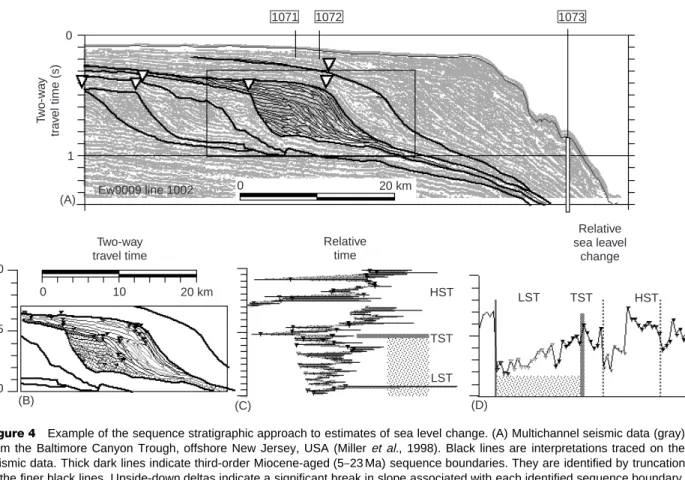
0.0 0.5 1.0 0 10 20 km (A) Two-way travel time (B) (C) (D) HST TST LST LST TST HST Relative sea leavel change Relative time 0 20 km Ew9009 line 1002 0 1 T w o-w a y tr a v el time (s) 1071 1072 1073
Figure 4 Example of the sequence stratigraphic approach to estimates of sea level change. (A) Multichannel seismic data (gray) from the Baltimore Canyon Trough, offshore New Jersey, USA (Milleret al., 1998). Black lines are interpretations traced on the seismic data. Thick dark lines indicate third-order Miocene-aged (5}23 Ma) sequence boundaries. They are identified by truncation
of the finer black lines. Upside-down deltas indicate a significant break in slope associated with each identified sequence boundary. Labeled vertical lines (1071}1073) show the locations of Ocean Drilling Project wells (Deep-sea Drilling Methodology), used to
help date the sequences. The rectangle in the center is analyzed in greater detail. (B) Detailed interpretation of a single third-order sequence from (A). Upside-down deltas indicate a significant break in slope associated with each of the detailed sediment packages. Stippled fill indicates the low stand systems tract (LST) associated with this sequence. The gray packages are the transgressive systems tract (TST), and the overlying sediments are the high stand systems tract (HST). (C) Relationships between detailed sediment packages (in B) are used to establish a chronostratigraphy (time framework). Youngest sediment is at the top. Each observed seismic reflection is interpreted as a time horizon, and each is assigned equal duration. Horizontal distance is the same as in (A) and (B). A change in sediment type is indicated at the break in slope from coarser near-shore sediments (stippled pattern) to finer, offshore sediments (parallel, sloping lines). Sedimentation may be present offshore but at very low rates. LST, TST, and HST as in (B). (D) Relative sea level change is obtained by assuming a consistent depth relation at the change in slope indicated in (B). Age control is from the chronostratigraphy indicated in (C). Time gets younger to the right. The vertical scale is in two-way travel time, and would require conversion to depth for a final estimate of the magnitude of sea level change. LST, TST, and HST as in (B). Note that in (B), (C), and (D), higher frequency cycles (probably fourth-order) are present within this (third-order) sequence. Tracing and interpretations are from the author’s graduate level quantitative stratigraphy class project (1998, Western Michigan University).
level. In this case only an average result can be obtained, because marine sediments spanning a time interval (generally 5}10 million years) have been
used. Again, uncertainties are large, but results are consistent with calculations derived from estimates of ocean volume change.
Backstripping is an analytical tool, which has been used to estimate sea level change. In this tech-nique, the vertical succession of sedimentary layers is progressively decompacted and unloaded (Figure
3A, B). The resulting hole is a combination of the
subsidence generated by tectonics and by sea level change (Figure 3B, C). If the tectonic portion can be established then an estimate of sea level change can
be determined (Figure 3C, D). This method is gener-ally used in basins generated by the cooling of a thermal anomaly (e.g. passive margins). In these basins, the tectonic signature is predictable (ex-ponential decay) and can be calibrated to the well-known subsidence of the mid-ocean ridge.
The backstripping method has been applied to sedimentary strata drilled from passive continental margins of both the east coast of North America and the west coast of Africa. Again, estimates of sea level suggest a rise of about 100}300 m from about
200}110 Ma followed by a fall to the present level
(Figure 1D). Young interior basins, such as the Paris Basin, yield similar results. Older, thermally driven
200 _ 100 _ 50 0 50 100 150 _ 150 _ 200 Third-Order ∆SL sequence stratigraphy shifted down by 100 m 60 50 40 30 20 10 0
Time (million years before present)
Sea level (meters)
Third-Order ∆SL
backstripping
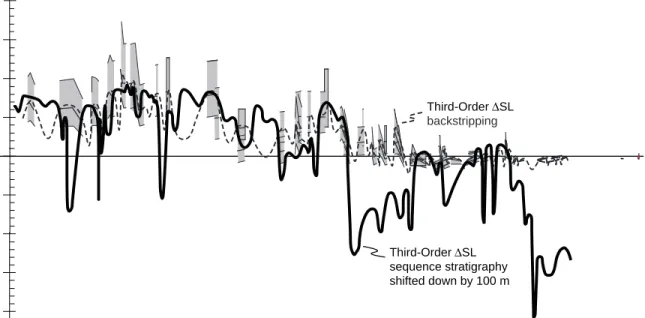
Figure 5 Million year scale sea level fluctuations. Estimates from sequence stratigraphy (Haqet al., 1987; solid curve) have been shifted down by 100 m to allow comparison with estimates of sea level from backstripping (Kominzet al., 1998; dashed curve). Where sediments are present, the backstripping results, with uncertainty ranges, are indicated by gray fill. Between backstrip observations, lack of preserved sediment is presumed to have been a result of sea level fall. The Berggren et al. (1995) biostratigraphic timescale was used.
basins have also been analyzed. This was the method used to determine the (approximately 200 m) sea level rise and fall associated with the breakup of a Pre-Cambrian supercontinent in earliest Phanerozoic time.
Million Year Scale Sea Level Change
In addition to long-term changes in sea level there is evidence of Suctuations that are considerably
shorter than the 50}100 million year variations
discussed above, but longer than those caused by orbital variations (40.4 million years). These
vari-ations appear to be dominated by durvari-ations which last either tens of millions of years or a half to three million years. These sea level variations are some-times termed second- and third-order sea level change, respectively. There is considerable debate concerning the source of these sea levelSuctuations.
They have been attributed to tectonics and changing ocean basin volumes, to the growth and decay of glaciers, or to continental uplift and subsidence, which is independent of global sea level change. As noted above, the tectonic record of subsidence and uplift is intertwined with the stratigraphic record of global sea level change on the continents. Syn-chronicity of observations of sea level change on
a global scale would lead most geoscientists to sug-gest that these signals were caused by global sea level change. However, at present, it is nearly im-possible to globally determine the age equivalency of events which occur during intervals as short as a half to two million years. These data limitations are the main reason for the heated controversy over third-order sea level.
Quantitative estimates of second-order sea level variations are equally difRcult to obtain. Although
the debate is not as heated, these somewhat longer-term variations are not much larger than the third-order variations so that the interference of the two signals makes deRnition of the beginning, ending
and/or magnitude of second-order sea level change equally problematic. Recognizing that our under-standing of second- and third-order (million year scale) sea levelSuctuations is limited, a brief review
of that limited knowledge follows.
Sequence stratigraphy is an analytical method of interpreting sedimentary strata that has been used to investigate second- and third-order relative sea level changes. This paradigm requires a vertical suc-cession of sedimentary strata which is analyzed in at least a two-dimensional, basinal setting. Packages of sedimentary strata, separated by unconformities, are observed and interpreted mainly in terms of their
internal geometries (e.g. Figure 4). The unconformi-ties are assumed to have been generated by relative sea level fall, and thus, reSect either global sea level
or local or regional tectonics. This method of strati-graphic analysis has been instrumental in hydrocar-bon exploration since its introduction in the late 1970s. One of the bulwarks of this approach is the ‘global sea level curve’ most recently published by Haq et al. (1987). This curve is a compilation of relative sea level curves generated from sequence stratigraphic analysis in basins around the world. While sequence stratigraphy is capable of estimating relative heights of relative sea level, it does not estimate absolute magnitudes. Absolute dating re-quires isotope data or correlation via fossil data into the chronostratigraphic timescale (see Geomagnetic
Polarity Timescale). However, the two-dimensional
nature of the data allows for good to excellent relative age control.
Backstripping has been used, on a considerably more limited basis, in an attempt to determine million year scale sea level change. This approach is rarely applied because it requires very detailed, quantitative, estimates of sediment ages, paleo-environments and compaction in a thermal tectonic setting. A promising area of research is the applica-tion of this method to coastal plain boreholes from the mid-Atlantic coast of North America. Here an intensive Ocean Drilling Project survey is underway which is providing sufRciently detailed data for this
type of analysis (see Deep-sea Drilling
Methodo-logy). Initial results suggest that magnitudes of
mil-lion year scale sea level change are roughly one-half to one-third that reported by Haq et al. However, in glacial times, the timing of the cycles was quite consistent with those of this ‘global sea level curve’ derived by application of sequence stratigraphy
(Fig-ure 5). Thus, it seems reasonable to conclude that,
at least during glacial times, global, third-order sea level changes did occur.
Summary
Sea level changes are either a response to changing ocean volume or to changes in the volume of water contained in the ocean. The timing of sea level change ranges from tens of thousands of years to over 100 million years. Magnitudes also vary signiR
-cantly but may have been as great as 200 m or more. Estimates of sea level change currently suffer from signiRcant ranges of uncertainty, both in
magnitude and in timing. However, scientists are converging on consistent estimates of sea level changes by using very different data and analytical approaches.
See also
Cosmogenic Isotopes. Deep-sea Drilling Methodo-logy. Geomagnetic Polarity Timescale. Igneous Provinces. Magnetics.
Further Reading
Allen PA and Allen JR (1990) Basin Analysis: Principles
&Applications. Oxford: Blackwell ScientiRc Publications. Berggren WA, Kent DV, Swisher CC, Aubry MP (1995) A revised Cenozoic geochronology and chronostratig-raphy. In: Berggren WA, Kent DV and Hardenbol J (eds) Geochronology, Time Scales and Global
Strati-graphic Correlations:A UniTed Temporal Framework for an Historical Geology. SEPM Special Publication
No. 54, pp. 131}212.
Bond GC (1979) Evidence of some uplifts of large magni-tude in continental platforms. Tectonophysics 61: 285}305.
CofRn MF and Eldholm O (1994) Large igneous provinces: crustal structure, dimensions, and external consequences. Reviews of Geophysics 32: 1}36. Crowley TJ and North GR (1991) Paleoclimatology.
Ox-ford Monographs on Geology and Geophysics, no. 18. Fairbanks RG (1989) A 17,000-year glacio-eustatic sea level record: inSuence of glacial melting rates on the Younger Dryas event and deep-ocean circulation.
Nature 6250: 637}642.
Hallam A (1992) Phanerozoic Sea-Level Changes. NY: Columbia University Press.
Haq BU, Hardenbol J and Vail PR (1987) Chronology of Suctuating sea levels since the Triassic (250 million years ago to present). Science 235: 1156}1167. Harrison CGA (1990) Long term eustasy and epeirogeny
in continents. In: Sea-Level Change, pp. 141}158. Washington, DC: US National Research Council Geophysics Study Committee.
Hauffman PF and Schrag DP (2000) Snowball Earth.
ScientiTc American 282: 68}75.
Kominz MA, Miller KG and Browning JV (1998) Long-term and short Long-term global Cenozoic sea-level estimates. Geology 26: 311}314.
Miall AD (1997) The Geology of Stratigraphic Sequences. Berlin: Springer-Verlag.
Miller KG, Fairbanks RG, Mountain GS (1987) Tertiary oxygen isotope synthesis, sea level history, and conti-nental margin erosion. Paleoceanography 2: 1}19. Miller KG, Mountain GS, Browning J et al. (1998)
Ceno-zoic global sea level, sequences, and the New Jersey transect; results from coastal plain and continental slope drilling. Reviews of Geophysics 36: 569}601. Sahagian DL (1988) Ocean temperature-induced change
in lithospheric thermal structure: a mechanism for long-term eustatic sea level change. Journal of Geology 96: 254}261.
Wilgus CK, Hastings BS, Kendall CG St C et al. (1988)
Sea Level Changes: An Integrated Approach. Special
Publication no. 42. Society of Economic Paleontol-ogists and MineralPaleontol-ogists.