Concepts and Entities and their Applications in
Natural Language Processing
Scuola di Dottorato in Informatica
Dottorato di Ricerca in Informatica – XXX Ciclo
Candidate
Jose Camacho Collados ID number 1644576
Thesis Advisor Prof. Giovanni Stilo
A thesis submitted in partial fulfillment of the requirements for the degree of Doctor of Philosophy in Computer Science October 2017
Semantic Vector Representations of Word Senses, Concepts and Entities and their Applications in Natural Language Processing
Ph.D. thesis. Sapienza – University of Rome © 2017 Jose Camacho Collados. All rights reserved
This thesis has been typeset by LATEX and the Sapthesis class. Author’s email: [email protected]
Abstract
Representation learning lies at the core of Artificial Intelligence (AI) and Natural Language Processing (NLP). Most recent research has focused on develop representations at the word level. In particular, the representation of words in a vector space has been viewed as one of the most important successes of lexical semantics and NLP in recent years. The generalization power and flexibility of these representations have enabled their integration into a wide variety of text-based applications, where they have proved extremely beneficial. However, these representations are hampered by an important limitation, as they are unable to model different meanings of the same word.
In order to deal with this issue, in this thesis we analyze and develop flexible semantic representations of meanings, i.e. senses, concepts and entities. This finer distinction enables us to model semantic information at a deeper level, which in turn is essential for dealing with ambiguity.
In addition, we view these (vector) representations as a connecting bridge between lexical resources and textual data, encoding knowledge from both sources. We argue that these sense-level representations, similarly to the importance of word embeddings, constitute a first step for seamlessly integrating explicit knowledge into NLP applications, while focusing on the deeper sense level. Its use does not only aim at solving the inherent lexical ambiguity of language, but also represents a first step to the integration of background knowledge into NLP applications. Multilinguality is another key feature of these representations, as we explore the construction language-independent and multilingual techniques that can be applied to arbitrary languages, and also across languages.
We propose simple unsupervised and supervised frameworks which make use of these vector representations for word sense disambiguation, a key application in natural language understanding, and other downstream applications such as text categorization and sentiment analysis. Given the nature of the vectors, we also investigate their effectiveness for improving and enriching knowledge bases, by reducing the sense granularity of their sense inventories and extending them with domain labels, hypernyms and collocations.
Contents
1 Introduction 1
1.1 Motivation . . . 2
1.2 Objectives . . . 3
1.3 Contributions and outline . . . 4
1.4 Publications . . . 5
2 Preliminaries: Knowledge Resources 9 2.1 WordNet . . . 9
2.2 Wikipedia . . . 10
2.3 BabelNet . . . 10
2.4 Other resources . . . 11
2.5 Nomenclature . . . 11
PART 1: Semantic Representations of Senses, Concepts and Entities 13 3 From Word to Sense Representations: Background 15 3.1 Word Representations . . . 15
3.2 Sense Representations . . . 16
4 NASARI: Multilingual Representations of Concepts and Entities 19 4.1 Representing texts as vectors . . . 19
4.1.1 Lexical specificity . . . 20
4.1.2 Lexical vector representation . . . 23
4.1.3 Embedded vector representation . . . 23
4.1.4 Unified vector representation . . . 24
4.1.5 Vector comparison . . . 26
4.2 From a synset to its vector representations . . . 26
4.2.1 Getting contextual information for a given synset . . . 27
4.2.2 Transforming the contextual information into vector represen-tations . . . 28
4.3 Intrinsic Evaluation: Semantic Similarity . . . 30
4.3.1 Monolingual word similarity: English . . . 31
4.3.2 Multilingual word similarity . . . 34
4.3.3 Cross-lingual word similarity . . . 35
4.3.4 Cross-level semantic similarity . . . 36
4.4 Analysis . . . 38
5 SW2V: Senses and Words to Vectors 41
5.1 Connecting words and senses in context . . . 42
5.2 Joint training of words and senses . . . 43
5.2.1 Output layer alternatives . . . 45
5.2.2 Input layer alternatives . . . 45
5.3 Analysis of Model Components . . . 45
5.3.1 Model configurations . . . 46
5.3.2 Disambiguation / Shallow word-sense connectivity algorithm 47 5.4 Intrinsic Evaluation . . . 47
5.4.1 Word similarity . . . 48
5.4.2 Word and sense interconnectivity . . . 50
5.5 Conclusion . . . 51
PART 2: Applications 53 6 Word Sense Disambiguation 55 6.1 Related Work . . . 55
6.1.1 Supervised WSD . . . 56
6.1.2 Knowledge-based WSD . . . 56
6.2 Monolingual Word Sense Disambiguation . . . 57
6.2.1 Word Sense Disambiguation using Wikipedia . . . 58
6.2.2 Named Entity Disambiguation using BabelNet . . . 59
6.2.3 Word Sense Disambiguation using WordNet . . . 60
6.2.4 Discussion: global and local contexts . . . 61
6.3 Multilingual Word Sense Disambiguation Exploiting Comparable or Parallel Corpora . . . 62
6.3.1 Methodology . . . 63
6.3.2 SenseDefs: Multilingual corpus of sense-annotated definitions 64 6.3.3 EuroSense: Europarl sense-annotated corpus . . . 72
6.4 Conclusion . . . 75
7 Knowledge Base Enrichment 77 7.1 Sense Clustering . . . 77 7.1.1 Background . . . 77 7.1.2 Methodology . . . 78 7.1.3 Experimental setting . . . 78 7.1.4 Results . . . 79 7.2 Domain Labeling . . . 81 7.2.1 Background . . . 81 7.2.2 Methodology . . . 82 7.2.3 BabelDomains: Statistics . . . 84 7.2.4 Intrinsic evaluation . . . 85 7.2.5 Conclusion . . . 86 7.3 Hypernym Discovery . . . 87 7.3.1 Background . . . 89 7.3.2 Preliminaries . . . 90 7.3.3 Methodology . . . 91
7.3.4 Automatic evaluation . . . 93
7.3.5 Manual evaluation: Extra-coverage . . . 96
7.3.6 Conclusion . . . 97
7.4 Collocation Discovery . . . 98
7.4.1 Background . . . 99
7.4.2 Methodology . . . 99
7.4.3 Intrinsic evaluation: Precision of collocate relations . . . 102
7.4.4 Extrinsic evaluation: Retrofitting vector space models to Col-WordNet . . . 104
7.4.5 Conclusion . . . 105
8 Downstream NLP Applications: Text Categorization and Senti-ment Analysis 107 8.1 Related Work . . . 107
8.2 Disambiguation Algorithm . . . 108
8.3 Classification Model . . . 110
8.3.1 Pre-trained Word and Sense Embeddings . . . 111
8.3.2 Pre-trained Supersense Embeddings . . . 112
8.4 Evaluation . . . 112 8.4.1 Experimental setup . . . 112 8.4.2 Topic Categorization . . . 113 8.4.3 Polarity Detection . . . 115 8.4.4 Analysis . . . 117 8.5 Conclusion . . . 118
9 Conclusion and Future Work 121
List of released resources 125
List of Acronyms 129
Chapter 1
Introduction
Effectively representing meaning is a key challenge in Natural Language Processing (NLP) and Artificial Intelligence (AI). In particular, the understanding of lexical items lies at the core of how humans process and generate language. Therefore, this is a crucial aspect in AI and NLP on their common overarching goal of enabling machines to understand language. Research on semantically representing lexical items dates back to the early days of NLP (Firth, 1957; Salton et al., 1975) and has agglutinated a large body of work since then. In fact, most current approaches are still based on the principles of Harris (1954), which called for an interpretation of the context in order to understand the meaning of words.
The most prominent research on this area of semantics nowadays is based on Vector Space Models (Turney and Pantel, 2010, VSM). In particular, research has in the main focused on representing words as points in a vector space. Recently, advances based on neural networks (i.e. word embeddings) have increased the popularity of this mainstream technique by successfully embedding words into low-dimensional vector spaces (Mikolov et al., 2013a; Pennington et al., 2014). Word embeddings have been successfully integrated into different neural architectures to provide a generalization boost on many applications such as machine translation (Zou et al., 2013), syntactic parsing (Weiss et al., 2015), and Question Answering (Bordes et al., 2014), to name a few.
However, word embeddings are hampered by an important limitation, as they conflate the different meanings of the same word into a single vector representation. In other words, they do not handle language lexical ambiguity. This is one of the main reasons why we propose to go beyond the word level by modeling senses instead of words. In fact, the waves of the word embedding tsunami have also lapped on the shores of sense representation, as several techniques for extending word embedding models to cluster contexts and induce senses from text corpora have been proposed (Huang et al., 2012; Neelakantan et al., 2014; Tian et al., 2014; Li and Jurafsky, 2015; Vu and Parker, 2016; Qiu et al., 2016). These techniques are usually referred to as unsupervised sense representations. While these unsupervised models are characterized by their adaptability to different domains, their induced senses are in the main hardly interpretable (Panchenko et al., 2017) and not easy to map to lexical resources, which limits their application.
rep-resentation of lexical items going beyond the word level. Because they represent the lowest linguistic level, word senses play a vital role in natural language under-standing. Effective representations of word senses have been proved to be directly useful in tasks such as Word Sense Disambiguation (Chen et al., 2014; Rothe and Schütze, 2015), semantic similarity (Budanitsky and Hirst, 2006; Turney and Pan-tel, 2010; Pilehvar and Navigli, 2015), coarsening of sense inventories (Snow et al., 2007; Pilehvar et al., 2013), alignment of lexical resources (Niemann and Gurevych, 2011; Navigli and Ponzetto, 2012; Pilehvar and Navigli, 2014a), lexical substitution (McCarthy and Navigli, 2009; Cocos et al., 2017a), and semantic priming (Neely et al., 1989). In particular, in this thesis we study the complementarities of both encyclopedic and lexicographic resources, putting forward various techniques for building flexible semantic representations for word senses, concepts and entities. This knowledge transferring has additional advantages that we also investigate in our work, with a marked emphasis in multilinguality. Acting as a bridge between the knowledge encoded in lexical resources and NLP applications, these knowledge-based representations pave the way for new lines of applied research.
Finally, we show how these representations can be easily integrated into diverse applications, from word sense disambiguation to downstream NLP tasks such as text categorization and sentiment analysis. Additionally, we propose frameworks for leveraging these sense representations in applications aiming at improving the quality of current knowledge resources (sense clustering, domain labeling, hypernym discovery and collocation discovery), establishing an interesting interplay between lexical resources and NLP applications. For these applications we provide their background and position our methods with respect to the state of the art, which makes each of these sections self-sufficient as they provide interesting insights on their own. The versatility, flexibility and applicability of our proposed knowledge-based representations is largely proved throughout an extensive list of experiments.
1.1
Motivation
With the help of an example news article from the BBC, shown in Figure 1.1, we highlight some of the potential deficiencies of word-based NLP models which can be directly or indirectly solved by modeling senses:
Ambiguity. Language is inherently ambiguous. For instance, Mercedes, race, Hamilton andFormula can refer to different entities or meanings. Current neural models have managed to successfully represent complex semantic associations by effectively analyzing large amounts of data. However, the word-level functionality of these systems is still a barrier to achieve a deep natural language understanding. This is one of the main deficiencies of word-bases models. Since in our pipeline we model senses instead of words, our proposal is particularly tailored towards addressing this issue.
Multiword expressions. MultiWord Expressions (MWE) are lexical units made up of two or more words which are idiosyncratic in nature (Sag et al., 2002), e.g, Lewis Hamilton, Nico Rosberg and Formula 1. Most existing word-based models
Figure 1.1. Excerpt of a news article from the BBC.
ignore the interdependency between MWE’s subunits and treat them as individual units. Handling MWE has been a long-standing problem in NLP and has recently received a considerable amount of interest (Tsvetkov and Wintner, 2014; Salehi et al., 2015). Our pipeline facilitates this goal thanks to the modeling of lexical items as represented in a given sense inventory, including instances consisting of multiple tokens.
Co-reference. Co-reference resolution of concepts and entities is not explicitly tackled by our approach. However, thanks to the fact that words that refer to the same meaning in context, e.g.,Formula 1-F1 or German Grand Prix-German GP-Hockenheim, are all disambiguated to the same concept, the co-reference issue is
also partly addressed by explicitly modeling sense-level information.
Out-Of-Vocabulary words. Out-Of-Vocabulary (OOV) words are a recurring problem when using word-based models. As word vector representations are utilized in a wide variety of problems and domains, it is not rare to encounter these OOV words in practice (e.g. domain-specific words like F1 orRosberg). However, many OOV words are already represented in high-coverage lexical resources (see Section 2). Therefore, the use of these knowledge resources (e.g. WordNet, Wikipedia) for learning semantic representations could partially solve this problem. As we also argue throughout the thesis, a shared vector space of both words and senses would further contribute to expand this coverage, exploiting the best of both worlds.
1.2
Objectives
The main goal of this thesis is to advance the research in the lexical semantics field, and in general, on natural language processing. The concrete objectives of this thesis are listed below:
• Deal with language ambiguity through three inter-connected paths: (1) de-veloping semantic representations at the sense, concept and entity levels; (2)
improving word sense disambiguation; and (3) enriching knowledge resources. • Investigate the use of knowledge resources for the development of semantic
representations and their integration into NLP applications.
• Explore the complementarities of using both encyclopedic and lexicographic resources.
• Investigate the potential of concept and entity representations in multilingual and cross-lingual environments.
• Develop benchmarks for evaluating word and sense vector representations intrinsically and extrinsically.
• Study the integration of sense representations into NLP applications, in par-ticular word sense disambiguation, knowledge base enrichment and text classi-fication.
1.3
Contributions and outline
The remainder of the thesis is organized as follows. We first present an overview of the main knowledge resources utilized in this thesis in Chapter 2.
Then, we move on to the first part of the thesis on semantic representation learning. In Chapter 3we present an overview of the related work on semantic representations, both at the word level and with a special focus on the works dealing with representations at the sense level. In the subsequent chapters we present two complementary models for learning semantic representations, Nasariand SW2V: • In Chapter 4 we present Nasari (a Novel Approach to a
Semantically-Aware Representation of Items), which is one of the main contributions of this thesis. Nasariis based on the seamless integration of the encyclopedic and lexicographic resources presented in Chapter 2. We provide different types of semantic vector representation for concept and entities, going beyond the shallower word level. In addition to aiming at solving the ambiguity issue of word representations,Nasari provides three additional key features: (1) multilinguality, as the approach exploits at best the language diversity
of Wikipedia and BabelNet, (2) high-coverage of both concepts and named entities as both WordNet and more importantly the full Wikipedia are covered, and (3) flexibility, as we put forward various vector representations which are easy to integrate into different applications as presented in the second part of the thesis.
• In Chapter 5 we presentSW2V (Senses and Words To Vectors), a flexible architecture for jointly learning word and sense embeddings on a single joint training phase. SW2Vis complementary toNasarias they learn from different signals. While Nasari provides representations for concept and entities from knowledge bases,SW2V learn word and sense embeddings directly from text
corpora. The main feature of SW2Vlies on its flexibility and adaptability, as it can learn representations given any text corpora and semantic network. The second part of the thesis focuses on the applications of these flexible semantic representations of senses, concepts and entities. We present the individual applications from Chapter 6 to 8:
• Word Sense Disambiguation (Chapter 6). Word Sense Disambiguation is a long-standing task in Artificial Intelligence and Natural Language Processing. In this chapter we present a knowledge-based approach for word and named entity disambiguation. The approach heavily relies onNasariand, despite its simplicity, achieves results in line with the state of the art for several languages and resources, while showing interesting complementarities with supervised systems. Additionally, we show howNasarican be leveraged for a high-confidence disambiguation of concepts and entities in multiple languages by leveraging comparable corpora. Thank to this approach we released two sense-annotated multilingual corpora: a large corpus of textual definitions and the Europarl parallel corpus.
• Knowledge-based Enrichment (Chapter 7). One of the advantages of exploit-ing knowledge-based sense vector representations is their ability to encode relevant semantic properties from lexical items in knowledge resources. This, coupled with their sense-based nature, enable them to accurately incorporate different sources of information stored on their vector representations. Being represented in a mathematical vector space, they can be effectively leveraged for improving and enriching knowledge resources. In particular, in this chapter we present four applications within this broad area: sense clustering, domain labeling, hypernym discovery and collocation discovery.
• Downstream NLP applications (Chapter 8). In this Chapter we present a simple approach to integrate senses into neural network architectures for downstream applications (Pilehvar et al., 2017). The integration is based on a pre-WSD step along with the use of pre-trained knowledge-based sense representations from WordNet and Wikipedia (Nasari). The evaluation is focused on two text classification tasks (i.e. topic categorization and sentiment analysis) and shows the potential of moving from the standard word-level to the sense-level on downstream applications. Our analysis also highlights the main advantages of this sense-based pipeline (and also its current weaknesses). Finally, we present the conclusions and future work in Chapter 9.
1.4
Publications
A wide portion of the content of this thesis has already been published in relevant peer-reviewed conferences and journals from Natural Language Processing and Artificial Intelligence. The content of some of these publications represent the core of this thesis and their insights are included at great extent in some chapters or
sections. We present the list of all the publications contributing to the overall thesis below:1
• Jose Camacho-Collados, Mohammad Taher Pilehvar and Roberto Navigli. 2016. Nasari: Integrating explicit knowledge and corpus statistics for a multilingual representation of concepts and entities. Artificial Intelligence Journal, 240, pp. 36-64. Chapter 4.
• Massimiliano Mancini*, Jose Camacho-Collados*, Ignacio Iacobacci and Roberto Navigli. Embedding Words and Senses Together via Joint Knowledge-Enhanced Training. Proceedings of CoNLL, Vancouver, Canada, pp. 100-111. Chapter
5.
• Mohammad Taher Pilehvar, Jose Camacho-Collados, Roberto Navigli and Nigel Collier. 2017. Towards a Seamless Integration of Word Senses into Downstream NLP Applications. Proceedings of ACL, Vancouver, Canada, pp. 1857-1869. Chapter 8.
• Jose Camacho-Collados, Claudio Delli Bovi, Alessandro Raganato and Roberto Navigli. 2017. SenseDefs: A Multilingual Corpus of Sense-annotated Textual Definitions. Language Resources and Evaluation Journal, accepted. Section 6.3.
• Jose Camacho-Collados and Roberto Navigli. 2017. BabelDomains: Large-Scale Domain Labeling of Lexical Resources. Proceedings of EACL (2), Valencia, Spain, pp. 223-228. Section 7.2.
• Luis Espinosa-Anke, Jose Camacho-Collados, Claudio Delli Bovi and Horacio Saggion. 2016. Supervised Distributional Hypernym Discovery via Domain Adaptation. Proceedings of EMNLP, Austin, USA, pp. 424-435. Section 7.3. • Luis Espinosa-Anke, Jose Camacho-Collados, Sara Rodríguez-Fernández, Ho-racio Saggion and Leo Wanner. 2016. Extending WordNet with Fine-Grained Collocational Information via Supervised Distributional Learning. Proceddings
of COLING, Osaka, Japan, pp. 3422-3432. Section 7.4.
• Claudio Delli Bovi, Jose Camacho-Collados, Alessandro Raganato and Roberto Navigli. 2017. EuroSense: Automatic Harvesting of Multilingual Sense Anno-tations from Parallel Text. Proceedings of ACL (2), Vancouver, Canada, pp. 594-600. Section 6.3.3.
• Jose Camacho-Collados, Mohammad Taher Pilehvar and Roberto Navigli. 2015. NASARI: a Novel Approach to a Semantically-Aware Representation of Items. Proceedings of NAACL, Denver, USA, pp. 567-577.
1
The publications with a higher contribution to the thesis are presented on top, and their corresponding chapters or sections are indicated accordingly. The rest of the publications, while having a more reduced space in the thesis, they have contributed to the overall dissertation and are acknowledged accordingly.
• Jose Camacho-Collados, Mohammad Taher Pilehvar and Roberto Navigli. 2015. A Unified Multilingual Semantic Representation of Concepts. Proceedings of ACL, Beijing, China, pp. 741-751.
• Jose Camacho-Collados, Mohammad Taher Pilehvar and Roberto Navigli. 2015. A Framework for the Construction of Monolingual and Cross-lingual Word Similarity Datasets. Proceedings of ACL (2), Beijing, China, pp. 1-7. • Jose Camacho-Collados, Claudio Delli Bovi, Alessandro Raganato and Roberto
Navigli. 2016. A Large-Scale Multilingual Disambiguation of Glosses. Proceed-ings of LREC, Portoroz, Slovenia, pp. 1701-1708.
• Jose Camacho-Collados and Roberto Navigli. 2016. Find the word that does not belong: A Framework for an Intrinsic Evaluation of Word Vector Representations. Proceedings of the ACL Workshop on Evaluating Vector Space Representations for NLP, Berlin, Germany, pp. 43-50.
• Alessandro Raganato, Jose Camacho-Collados and Roberto Navigli. 2017. Word Sense Disambiguation: A Unified Evaluation Framework and Empirical Comparison. Proceedings of EACL, Valencia, Spain, pp. 99-110.
• Jose Camacho-Collados*, Mohammad Taher Pilehvar*, Nigel Collier and Roberto Navigli. 2017. SemEval-2017 Task 2: Multilingual and Cross-lingual Semantic Word Similarity. Proceedings of the International Workshop on Semantic Evaluation (SemEval), Vancouver, Canada, pp. 15-26.
Chapter 2
Preliminaries: Knowledge
Resources
In this thesis we investigate how to integrate knowledge from lexical resources for representing senses, concepts and entities and use them as a bridge on NLP applications. In this chapter we describe the main knowledge resources utilized in our work.
Knowledge resources can be split into two main groups: expert made and collaboratively constructed. Expert or manually constructed resources feature highly-accurate encoding of concepts and semantic relationships between them but, with a few exceptions, are usually limited in their lexical coverage, and are typically focused on a specific language only. On the other hand, collaboratively-constructed resources encode a different source of information, e.g. extracted from large amounts of textual data. For this reason they tend to be less accurate but provide a different set of features such as a higher coverage and multilinguality. Likewise, knowledge resources can encode different kind of knowledge, i.e. lexicographic or encyclopedic. Each type has its own advantages and limitations. Some of these resources, i.e. WordNet (Section 2.1) or BabelNet (Section 2.3) which are used in this work, are structured as graphs, with nodes denoting concepts and edges representing relations between concepts. Resources containing a diverse set of relations are known as knowledge bases.
In our work we attempt to take the best of all these types of resource by combining their most prominent features. In particular, we make use of an expert-made lexicographic resource, i.e. WordNet (Section 2.1), and a collaboratively-constructed encyclopedic resource, i.e. Wikipedia (Section 2.2). In order to combine the knowledge from these two resources, we make use of BabelNet (Section 2.3) as a bridge. We additionally present other lexical resources used in this thesis in Section 2.4 and some common notions and nomenclature from these knowledge resources in Section 2.5.
2.1
WordNet
A prominent example of expert-made resource is WordNet (Miller et al., 1990; Miller, 1995), a semantic network whose basic units are synsets. A synset represents
a concept which may be expressed through nouns, verbs, adjectives or adverbs and is composed of one or more lexicalizations (i.e., synonyms that are used to express it). For example, the synset of the middle of the day concept consists of six lexicalizations: noon, twelve noon, high noon, midday, noonday, noontide. Synsets may also be seen as nodes in a semantic network. These nodes are connected to each other by means of lexical or semantic relations (hypernymy, meronymy, etc.). These relations are seen as the edges in the WordNet semantic network. Despite being one of the largest and most complete manually-made lexical resources, WordNet still lacks coverage of lemmas and senses from domain specific lexicons (e.g., law or medicine), named entities, slang usages, or those for technology that came into existence only recently. In our experiments we used WordNet 3.0, which covers more than 117K unique nouns in about 80K synsets.
2.2
Wikipedia
Wikipediais one of the the most prominent examples of collaboratively-constructed resources. It provides features such as multilinguality (Wikipedia covers more than 250 languages), wide coverage, encyclopedic information and up-to-dateness. As of September 2015, Wikipedia provided more than 100K articles in over fifty languages. This coverage is steadily increasing. For instance, the English Wikipedia alone receives 750 new articles per day. Each of these articles provides, for its corresponding concept, a great deal of information in the form of textual information, tables, infoboxes, and various relations (such as redirections, disambiguations, and categories). These features have persuaded many researchers over the past years to exploit the large amounts of semi-structured knowledge available in such collaborative resources for different NLP applications (Cucerzan, 2007; Gabrilovich and Markovitch, 2007; Wu and Weld, 2010; Hovy et al., 2013; Wu and Giles, 2015; Søgaard et al., 2015). In this work we utilized the Wikipedia dump from November 2014 in multiple languages.
2.3
BabelNet
The types of knowledge available in the expert-based and collaboratively-constructed resources make them complementary. This has motivated researchers to com-bine various lexical resources across the two categories (Niemann and Gurevych, 2011; Pilehvar and Navigli, 2014a). A prominent example is BabelNet (Nav-igli and Ponzetto, 2012), which provides a mapping of WordNet to a number of collaboratively-constructed resources, including Wikipedia. The structure of Ba-belNet1 is similar to that of WordNet. Synsets are the main linguistic units and are connected to other semantically related synsets, whose lexicalizations are mul-tilingual in this case. For instance, the synset corresponding to United States is represented with a set of multilingual lexicalizations including United_StatesEN, United_States_of_AmericaEN, AmericaEN, U.S.EN, and U.S.A.EN in English, Estados_UnidosES, Estados_Unidos_de_AméricaES, EEUUES, E.E.U.U.ES, and
1
EE. UU.ES in Spanish, and Stati_Uniti_d’AmericaIT, Stati_UnitiIT, AmericaIT, and U.S.A.IT in Italian. The relations between synsets are come from WordNet (hypernyms, hyponyms, etc.), plus new semantic relations coming from other re-sources such as Wikipedia hyperlinks and Wikidata relations (e.g. Madridcapital of Spain). BabelNet is the largest multilingual semantic network available, containing 13,789,332 synsets (6,418,418 concepts and 7,370,914 named entities) and 354,538,633 relations for 271 languages2. For the English language, BabelNet contains 4,403,148 synsets with at least one Wikipedia page associated and 117,653 synsets with one WordNet synset associated, from which 99,705 synsets are composed of both a Wikipedia page and a WordNet synset.
2.4
Other resources
Wikidata3(Vrandečić and Krötzsch, 2014) is a document-oriented semantic database operated by the Wikimedia Foundation with the goal of providing a common source of data that can be used by other Wikimedia projects (e.g. Wikipedia). It is designed as a document-oriented semantic database based on items, each representing a con-cept or an entity and associated with a unique identifier. Knowledge is encoded with statementsin the form of property-value pairs, among which definitions (descriptions) are also included. Wikidata is also integrated into BabelNet, containing over 8 mil-lion definitions4. In this thesis we use Wikidata both for obtaining term-hypernym pairs (Section 7.3) and as a repository of definitions (Section 6.3.2).
Beyond these resources, we also use two collaborative multilingual dictionar-ies (i.e. Wiktionary and OmegaWiki) as an additional repository of definitions. Wiktionary5 is a Wikimedia project designed to represent lexicographic knowl-edge that would not be well suited for an encyclopedia (e.g. verbal and adverbial senses). It is available for over 500 languages typically with a very high coverage, including domain-specific terms and descriptions that are not found in WordNet. Similar to Wiktionary,OmegaWiki6 is a large multilingual dictionary based on a relational database, designed with the aim of unifying the various language-specific Wiktionaries into a unified lexical repository.
2.5
Nomenclature
In this thesis we mainly follow the same nomenclature of WordNet and BabelNet. In these resources asynset refer to an specific meaning as defined on the knowledge resource (e.g. the concept ofmiddle of the day mentioned above) which may have more than one or more words as its associated lexicalizations (e.g. noon, twelve noon, high noon, midday, noonday, noontide for the concept of middle of the day). Synsets may beconcepts (e.g. middle of the day) or entities (e.g. Microsoft). In
2The statistics are taken from the BabelNet 3.0 release, which is the version used in our
experiments. More statistics can be found athttp://babelnet.org/stats 3https://www.wikidata.org
4
Given its strictly computational nature, it often provides minimal definition phrases containing only the superclass of the definiendum.
5
https://www.wiktionary.org 6
general, when we refer to a synset and if it is not explicitly mentioned, we refer to both concepts and entities. Sensemay refer to the general term including all representations going beyond the word level, or explicitly to a word associated with a specific meaning (e.g. noon with its meaning middle of the day)7, irrespective of whether the meaning belongs to a pre-defined sense inventory or not. Following previous works (Navigli, 2009), we use the following notation for senses: wordpn is the nth sense of word with part of speech p.
7
PART 1: Semantic
Representation of Senses,
Concepts and Entities
In this initial part of the thesis we focus on the semantic representation of word senses, concepts and entities. We investigate and propose theoretical frameworks for learning these fine-grained semantic representations. In partic-ular, we concentrate on the research area making use of knowledge resources for enhancing representation learning. This first block is structured as follows. First, we provide a comprehensive overview on previous work on word and sense representations (Chapter 3). We begin this background chapter by presenting and describing some fundamental theories of word-level represen-tation learning. Then, inspired by these grounding works, we present more recent related works on the semantic representation of lexical items of a finer granularity, i.e., senses.
Following this background chapter we move on to explain our work on sense representation learning. We present two theoretical models for learning sense representations: Nasari (Chapter 4), a purely knowledge-based method
which exploits the complementarities of various knowledge resources and text corpora; and SW2V (Chapter 5), a method for jointly training word and
sense embeddings from text corpora exploiting semantic networks. These two methods, exploiting distinct signals, learn different kinds of semantic representation, providing advantages and disadvantages depending on their application8.
8
In the second part of this thesis we will present a set of relevant applications for which these semantic representations prove their suitability.
Chapter 3
From Word to Sense
Representations: Background
In this chapter we present an overview of related approaches on semantic repre-sentation learning. In Section 3.1 we describe mainstream techniques for word representation learning, while in Section 3.2 we briefly review the recent literature on the representation of word senses, which is the main topic of this thesis.1
3.1
Word Representations
Word representation learning constitutes one of the main research topics in semantics since the origin of NLP. The most prominent methods are in the main based on the Vector Space Model (VSM), which is in turn supported by research in human cognition (Landauer and Dumais, 1997; Gärdenfors, 2004). The earliest use of this model considered a document as a vector whose dimensions were the vocabulary (Salton et al., 1975). Weights of individual dimensions were initially based on its corresponding word’s frequencies within the document. Different weights have also been explored, but mainly based on frequencies or normalized frequencies (Salton and McGill, 1983). This methodology has been successfully refined and applied in many NLP applications such as information retrieval (Lee et al., 1997) text classification (Soucy and Mineau, 2005), or sentiment analysis (Turney, 2002), to name a few. Turney and Pantel (2010) provides a comprehensive overview of VSM and their applications.
This document-based VSM has also been extended to other lexical items like words. On this case a word is represented as a point in the vector space. A word-based vector is traditionally constructed word-based on the normalized frequencies of the co-occurring words within a corpus (Lund and Burgess, 1996), trailing the initial theories of Harris (1954). These models have also proved effective in NLP tasks such as information extraction (Laender et al., 2002), semantic role labeling (Erk, 2007), word similarity (Radinsky et al., 2011), WSD (Navigli, 2009) or spelling correction (Jones and Martin, 1997), inter alia.
1
For a complementary overview on this topic we recommend our ACL 2016 tutorial on “Semantic Representations of Word Senses and Concepts" (Camacho-Collados et al., 2016b).
One of the main drawbacks of these approaches is the high dimensionality of the produced vectors. Since the dimensions correspond to words in the vocabulary, this number could easily add to the hundreds of thousands or even millions, depending on the underlying corpus. The most recurrent approaches for dimensionality reduction make use of the Singular Value Decomposition (SVD) and are known as Latent Semantic Analysis (Hofmann, 2001; Landauer and Dooley, 2002, LSA)
A more recent trend exploit neural network architectures to embed words into low-dimensional vectors. These models are commonly known as word embeddings. The earliest attempts of this kind were built upon the probabilistic feedforward neural network language model Bengio et al. (2003). This approach was popularized through Word2Vec (Mikolov et al., 2013a), proposing a simplified architecture and showed some interesting semantic properties of the output vectors (Mikolov et al., 2013d). Another prominent word embedding architecture is GloVe (Pennington et al., 2014), combining global matrix factorization and local context window methods through a bilinear regression model. Word embeddings have been shown to provide a valuable prior knowledge which have been proved decisive for achieving state-of-the-art performance in many NLP tasks when integrated into a neural network architecture (Zou et al., 2013; Kim, 2014; Bordes et al., 2014; Weiss et al., 2015).
However, word representations fail to capture the meaning of the various senses of the same word (Yaghoobzadeh and Schütze, 2016). In the following section we present approaches attempting to overcome this limitation by modeling senses instead of words.
3.2
Sense Representations
While most research studies in semantic representation have so far concentrated on the representation of words, few studies have focused on the representation of word senses or concepts. This is partly due to the so-called knowledge acquisition bottleneck that arises because the application of distributional word modeling techniques at the sense level would require the availability of high-coverage sense-annotated data. However, word representations are known to suffer from some issues which dampen their suitability for tasks that require accurate representations of meaning. The most important drawback with word representations lies in their inability to model polysemy and homonymy, as they conflate different meanings that a word can have into a single representation (Tversky and Gati, 1982; Reisinger and Mooney, 2010). For instance, a word representation for the word bank does not distinguish between its financial institution and river bank meanings (the noun bank has ten senses according to WordNet 3.0). Approaches which leverage semantic lexicons to improve word representations (Yu and Dredze, 2014; Faruqui et al., 2015; Goikoetxea et al., 2015; Speer and Lowry-Duda, 2017; Mrkšic et al., 2017) also suffer from the same drawback, as their target modeling units are still potentially-ambiguous words.
Because they represent the lowest linguistic level, word senses and concepts play a crucial role in natural language understanding. Meanings of a word are identified and separately modeled, the resulting representations are ideal for performing an accurate semantic processing. In addition, the fine-grained representation of word senses can be directly extended to higher linguistic levels (Budanitsky and Hirst, 2006),
which makes them particularly interesting. These features have recently attracted the attention of different research studies. Most of these techniques view sense representation as a specific type of word representation and try to adapt the existing distributional word modeling techniques to the sense level, usually through clustering the contexts in which a word appears (Schütze, 1998; Reisinger and Mooney, 2010; Huang et al., 2012). The main fundamental assumption of these works is that the intended meaning of a word mainly depends on its context and hence one can obtain sense-specific contexts for a given word sense by clustering the contexts in which the word appears in a given text corpus. Various clustering-based techniques usually differ in their clustering procedure and how this is combined with the representation technique. For instance, while some approaches rely on monolingual corpora only (Neelakantan et al., 2014; Tian et al., 2014; Li and Jurafsky, 2015; Vu and Parker, 2016; Qiu et al., 2016), other works rely on bilingual or multilingual corpora for building their sense vector representations (Guo et al., 2014; Ettinger et al., 2016; Šuster et al., 2016; Upadhyay et al., 2017). However, all these models are often limited to representing only those senses that are covered in the underlying corpus. Moreover, the sense representations obtained using these methods are generally not interpretable (Panchenko et al., 2017) and usually not linked to any sense inventory. Therefore such linking has to be carried out, either manually, or with the help of sense-annotated data if the representations are to be used for direct applications such as Word Sense Disambiguation.
Most sense modeling techniques have based their representation on the knowledge derived from resources such as WordNet. Earlier techniques exploit the information provided in WordNet, such as the synonymous words in a synset, for the repre-sentation of word senses (Mihalcea and Moldovan, 1999; Agirre and de Lacalle, 2004). More recent approaches usually adapt distributional models to the sense level on the basis of lexico-semantic knowledge derived from lexical resources such as Wikipedia (Gabrilovich and Markovitch, 2007; Mihalcea, 2007), WordNet (Chen et al., 2014; Jauhar et al., 2015; Rothe and Schütze, 2015) or other language-specific semantic networks (Johansson and Pina, 2015). WordNet can be also viewed as a semantic network where its individual synsets are represented on the basis of graph-based algorithms (Pilehvar et al., 2013; Pilehvar and Collier, 2016). Word Sense Disambiguation of large amounts of textual data has also been explored as a means of obtaining high-coverage annotated data for learning sense representations based on neural networks (Iacobacci et al., 2015), representations referred to as sense embeddings. Chen et al. (2014), which uses WordNet as main knowledge source, also relies on WSD for obtaining their sense representations. However, these two approaches are hampered by their inherently imperfect WSD systems.
Additionally, these techniques are often limited to the reduced coverage of WordNet and to the English language only. In contrast, our proposed methods (see Chapter 4) provide a multilingual representation of word senses on the basis of the complementary knowledge of two different resources, enabling a significantly higher coverage of specific domains and named entities. In addition, the synset representations proposed are inherently multilingual, which open up new possibilities for their application in multilingual and cross-lingual applications.
Moreover, the representation of words and senses in the same vector space has been proved key for applying these knowledge-based sense vector representations in
downstream applications, particularly for their integration into neural architectures (Pilehvar et al., 2017) via word and sense embeddings. In the literature, various different methods have attempted to build a shared space of word and sense vectors. Chen et al. (2014) proposed a model for obtaining both word and sense embeddings based on a first training step of conventional word embeddings, a second disam-biguation step based on sense definitions, and a final training phase which uses the disambiguated text as input. Likewise, Rothe and Schütze (2015) aimed at building a shared space of word and sense embeddings based on two steps: a first training step of only word embeddings and a second training step to produce sense and synset embeddings. These two approaches require multiple steps of training and make use of a relatively small resource like WordNet, which limits their coverage and applicability. Wang et al. (2014) and Fang et al. (2016) increased the coverage of these WordNet-based approaches by exploiting larger resources like Wikipedia, proposing a model to align vector spaces of words and entities from knowledge bases. However, these approaches are restricted to nominal instances only (i.e. Wikipedia pages or entities). In contrast, we propose a model (see Chapter 5) which learns both words and sense embeddings from a single joint training phase, producing a common vector space of words and senses as an emerging feature.
Chapter 4
NASARI: Multilingual
Representations of Concepts
and Entities
In this chapter we describe the methodology for constructing semantic representations of concepts and entities. Our approach, referred to asNasari (Novel Approach to a Semantically-Aware Representation of Items), exploits the structural knowledge derived from semantic networks, along with distributional statistics from text corpora, to produce effective representations of individual word senses or concepts. Our method provides two main advantages in comparison to previous VSM techniques: (1) it is multilingual, as it can be directly applied for the representation of concepts in dozens of languages; and (2) each vector represents a concept, irrespective of its language, in a unified semantic space having words or concepts as its dimensions, permitting direct comparison of different representations across languages and hence enabling cross-lingual applications.
The rest of this chapter is structured as follows. First, in Section 4.1, we describe our methodology to convert text into lexical, embedded and unified vectors. The process to obtain vector representations for synset vectors by leveraging the knowledge resources described in Chapter 2 is presented in Section 4.2. In Section 4.3 we perform an intrinsic evaluation of these vectors. We analyze the performance of different components of our model in Section 4.4. Finally, we provide the concluding remarks in Section 4.5.
4.1
Representing texts as vectors
One of the contributions of this chapter is the framework we are proposing for transforming texts into three different kinds of vector: lexical, embedded and unified. Our lexical vectors follow the conventional approach for representing a linguistic item in a semantic space with words1 as its dimensions (Pantel and Lin, 2002). The weights in these vectors are usually computed on the basis of raw term frequencies (tf) or normalized frequencies, such astf-idf Jones (1972). Instead, we use lexical
1
specificity for the computation of the weights in our lexical vectors. Having a solid statistical basis, lexical specificity provides several advantages over the previously mentioned measures (see Section 4.4 for a comparison between lexical specificity and tf-idf). In what follows in this section we first explain lexical specificity and propose an efficient way for its fast computation (Section 4.1.1). We then provide more details of our three types of vector, i.e., lexical (Section 4.1.2), embedded (Section 4.1.3) and unified (Section 4.1.4).
4.1.1 Lexical specificity
Lexical specificity (Lafon, 1980) is a statistical measure based on the hypergeometric distribution2. The measure has been widely used in different NLP applications including term extraction (Drouin, 2003), textual data analysis (Lebart et al., 1998) and domain-based term disambiguation (Camacho-Collados et al., 2014; Billami et al., 2014), but it has rarely been used to measure weights in a vector space model. Lexical specificity essentially computes the set of most representative words for a given text based on the hypergeometric distribution. In our setting, we are interested in representing a given text, hereafter referred to as the sub-corpus SC, through a vector comprising the weighted set of its most relevant words or concepts. In order to compute lexical specificity, we need a reference corpus RC which should be a superset ofSC. Lexical specificity computes the weights for each word by contrasting the frequencies of that word acrossSC and RC.
Following the notation of Camacho-Collados et al. (2015c), letT andtbe the respective total number of content words inRC and SC, while F and f denote the frequency of a given word w inRC andSC, respectively. Our goal is to compute a weight quantifying the association strength ofw with our text SC. We compute the probability of a word w having a frequency equal to or higher thanf in our sub-corpusSC using a hypergeometric distribution which takes as its parameters the frequency of win the reference corpusRC, i.e., F, and the sizes of RC andSC, i.e., Tandt, respectively. A wordwwith a high probability is one with a high occurrence chance across arbitrary subsets of RC of sizet. Hence, the representative words of a given sub-corpus will be those with low probabilities since these specific words are the most suitable ones for distinguishing the sub-corpus from the reference corpus. As a result, the computed probability is inversely proportional to the relevance of the word w toSC. In order to make the relation directly proportional, thus making the weights more interpretable, we apply the −log10 operation to the computed probabilities as has been customary in the literature (Drouin, 2003; Heiden et al., 2010). This logarithmic operation also speeds up the calculations (more details in the following section). Morover, using log10, instead of for instance the natural logarithm, has the added benefit of leading to an easy calculation of the prior probability. For example, if an item has a lexical specificity of 5.0, it means that the probability of
2
“The hypergeometric distribution is a discrete probability distribution that describes the probability of k successes in n draws, without replacement, from a finite population of size N that contains exactly K successes, wherein each draw is either a success or a failure. In statistics, the hypergeometric test uses the hypergeometric distribution to calculate the statistical significance of having drawn a specific k successes (out of n total draws) from the aforementioned population” (https://en.wikipedia.org/wiki/Hypergeometric_distribution).
observing that item in SC is 10−5 = 0.00005. Therefore, the lexical specificity ofw inSC is given by the following expression:
spec(T, t, F, f) =−log10P(X ≥f) (4.1) where X represents a random variable following a hypergeometric distribution with parameters F,t andT and P(X≥f) is defined as follows:
P(X≥f) = F X
i=f
P(X=i) (4.2)
whereP(X =i) represents the probability of a given word to appear exactlyitimes in the subcorpusSC according to the hypergeometric distribution of parameters F, tand T. In the following we propose an efficient implementation of Equation 4.2. Efficient implementation of lexical specificity
According to Equation 4.2, the computation of the hypergeometric distribution involves summing (F−f) + 1 addends, each of which is calculated as follows3:
P(X =i) = F i T−F t−i T t = F!(T−F)!t!(T−t)! T!i!(F−i)!(t−i)!(T −F −t+i)! (4.3) Given that the summation range of Equation 4.2 is generally directly proportional to the size of the corpus, the computation of lexical specificity can be quite expensive on large corpora wherein the value ofF tends to be very high. Lafon (1980) proposed a method to reduce the computation cost of Equation 4.2. According to this method, one can first calculate P(X=i) only for the smallest i(i.e.,f) and then calculate the rest of probabilities, i.e., P(X = f + 1), ..., P(X = F), using the following property of the hypergeometric distribution:
P(X =i+ 1) = P(X=i)(F −i)(t−i)
(i+ 1)(T−F−t+i+ 1) (4.4) Lafon (1980) also suggested using the well-known Stirling formula for the com-putation of the factorial components in Equation 4.3. According to the Stirling formula, the logarithm of a factorial can be approximated as follows:
logn! =nlogn−n+1
2log (2πn) (4.5)
Thanks to the application of the Stirling formula we can transform Equation 4.3 into a summation. Despite these improvements in the calculation of lexical specificity, there remain issues when the above computation is to be applied to a large reference corpus. One of the main problems is the multiplication of potentially very small quantities. Specifically, a 64-bit binary floating-point number, which is the one typically used in current computers, has an approximate range from 10−308 through 10+308. During the computation of lexical specificity on large corpora, the lower bound can be reached several times. Our solution to solve this problem (which
3
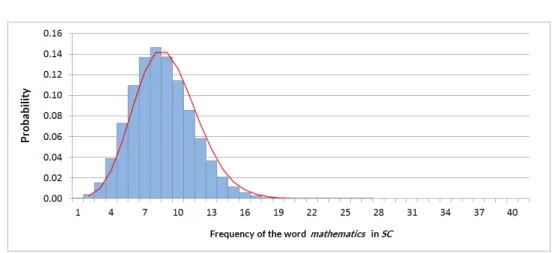
Figure 4.1. Hypergeometric distribution for the wordmathematics in an arbitraty sub-corpus (SC) of size 100,000 in Wikipedia.
even optimizes the calculations) is obtained via the next two equations. Firstly, we rewrite Equation 4.4 by extracting the common factor P(X=f):
P(X ≥f) = F X i=f P(X =i) =P(X=f) F X i=f ai (4.6) whereaf = 1 and ai=ai−1(i+1)((FT−−iF)(t−−ti+)i+1),∀i=f + 1, ..., F.
Now we only need to apply the logarithm to both sides of the equation in order to transform the previous multiplication into an addition and thus avoid small values. In this way we also avoid unnecessary exponentials in the calculations ofP(X =f):
−log10P(X≥f) =−log10P(X =f)−log10
F X i=f ai (4.7)
Therefore, according to Equation 4.1 and by applying a change of logarithm base, we can compute lexical specificity given the four parameters T, t,F, and f as follows:
spec(T, t, F, f) =−klogeP(X=f)−log10
F X i=f ai (4.8)
wherek is the natural logarithm of 10 (i.e., loge10). For computational feasibility, the PF
i=fai sum is usually not computed until F. Instead, a stopping criterion is introduced into the loop. Since the probability mass in the tail of the hypergeometric distribution is in most cases mathematically insignificant with respect the final cumulative probability distribution, the stop-ping criterion is usually satisfied well before reaching to the final F value, which considerably reduces the computation time.
As an example we show in Figure 4.1 the estimated probability distribution for the word mathematics in an arbitrary sub-corpus SC of 100,000 content words from Wikipedia. If the word mathematics occurs more than twenty times inSC, the word is considered to be very specific to the given subcorpus, since, as we can see
from Figure 4.1, most of the probability mass in the hypergeometric distribution is concentrated in the left part of the distribution range. The distribution range extends until 70,029, which is the number of occurrences of the wordmathematics in the whole Wikipedia. However, the probabilityP(X = 45) is already as small as 10−20and rapidly gets much smaller. This illustrates the point made above, in which the right tail of the probability mass is generally insignificant to values close to the expected value, and adding a stopping condition might make the calculations much faster, while not having any noticeable effect to the final specificity score.
The next three sections provide more details on our three types of vector and on how we leverage lexical specificity for their construction.
4.1.2 Lexical vector representation
So far we have explained how lexical specificity can be used to determine the relevance of words for a given text. In this section we explain how we leverage lexical specificity in order to construct a lexical vector for a given text (i.e., SC). In this chapter all the texts considered come from Wikipedia, thus we use the whole Wikipedia as our reference corpus (RC). Our lexical vectors have individual words as their dimensions, therefore, in our lexical semantic space, a text is represented on the basis of its association with a set of lexical items, i.e., words. By contrasting the term frequencies acrossSC andRC, we compute the lexical specificity of each term for the given subcorpus.
Specifically, in order to compute our lexical vector~vlex(SC), we simply iterate over all the content words in our subcorpusSC (only words with a total frequency greater than or equal to five in the whole Wikipedia are considered) and compute lexical specificity for each of them. We then prune the resulting vectors by keeping only those words that are relevant to the target text with a confidence of 99% or more according to the hypergeometric distribution (P(X≥f)≤0.01), as also performed in earlier works (Billami et al., 2014; Camacho-Collados et al., 2015b). Words with weights below the aforementioned threshold are considered as zero dimensions. The vector truncation step helps reduce noise. Additionally, the truncation helps in speeding up the computation of the vectors, as they will be sparse and therefore computationally easier to work with.
In our setting we also consider multiword expressions when they appear as lexicalizations of piped links4. Note that we apply lexical specificity to content words (nouns, verbs and adjectives) after tokenization and lemmatization, but for notational simplicity we will keep using the term “word” to refer to them.
4.1.3 Embedded vector representation
In recent years, semantic representation has experienced a resurgence of interest in the use of neural network-based learning, a trend usually referred to as word embeddings.
4
A piped link is a hyperlink which is found within the Wikipedia article that redirects the user to another Wikipedia page. For example, the piped link [[dockside_crane|Crane_(machine)]] is a hyperlink that appears asdockside_crane in the text, but links to the Wikipedia page titled
Crane_(machine). The Wikipedia article is therefore represented with a suitable lexicalization that preserves the grammatical and syntactic structure, the contextual coherency and the flow of the sentence.
In addition to their fast processing of massive amounts of text, word embeddings have proved to be reliable techniques for modeling the semantics of words on the basis of their contexts. However, the application of these word-based techniques to the representation of word senses is not trivial and is bound to the availability of large amounts of sense-annotated data. There have been efforts aimed at learning sense-specific embeddings without needing to resort to sense-annotated data, often through clustering the contexts in which a word appears (Weston et al., 2013; Huang et al., 2012; Neelakantan et al., 2014). However, the resulting representations are usually not aligned to existing sense inventories.
We put forward an approach that allows us to plug in an arbitrary word embedding representation with that of our lexical vector representations, providing three main advantages: (1) benefiting from the word-based knowledge derived as a result of learning from massive corpora for our sense-level representation; (2) reducing the dimensionality of our lexical space to a fixed-size continuous space; and (3) providing a shared semantic space between words and synsets (more details in Section 4.2), hence enabling a direct comparison of words and synsets.
Our approach exploits the compositionality of word embeddings. According to this property, a compositional phrase representation can be obtained by combining, usually averaging, its constituents’ representations (Mikolov et al., 2013c). For instance, the vector representation obtained by averaging the vectors of the words Vietnam andcapital is very close to the vector representation of the wordHanoi in the semantic space of word embeddings. Our approach builds on this property and plugs a trained word embedding-based representation into our lexical vectors.
Specifically, given an input textT and a space of word embeddingsE, we first calculate the lexical vector ofT (i.e.,~vlex(T)) as explained in Section 4.1.2 and then map our lexical vector to the semantic space E as follows:
E(T) = P w∈~vlex(T) 1 rank(w,~vlex(T))E(w) P w∈~vlex(T) 1 rank(w,~vlex(T)) (4.9)
where E(w) is the embedding-based representation of the word w in E, and rank(w, ~vlex(T)) is the rank of the dimension corresponding to the word w in the lexical vector~vlex(T), thus giving more importance to the higher weighted di-mensions. In Section 4.4 we compare this harmonic average giving more importance to higher weighted words over a simple average. One of the main advantages of this representation combination technique is its flexibility, since any word embedding space can be given as input. As we show in our experiments in Section 4.3, this combination enables us to benefit from word-specific knowledge and improve it by integrating it into our sense-specific representations.
4.1.4 Unified vector representation
We additionally propose a third representation, which we call unified, that, in contrast to the lexical vector representation which has potentially ambiguous words as individual dimensions, has unambiguous BabelNet synsets as its individual dimensions. Algorithm 1 shows the construction process of a unified vector given the sub-corpus SC. The algorithm first clusters together those words inSC that have a
Algorithm 1 Unified Vector Construction
Input: A reference corpusRC and a sub-corpusSC
Output: the unified vector~us where~us(h) is the dimension corresponding to the synseth
1: T ←size(RC)
2: t←size(SC)
3: H ← ∅
4: for eachlemmal∈ SC
5: for eachhypernymhofl in BabelNet
6: H ←H∪ {h}
7: ~u←empty vector
8: for eachh∈H
9: if ∃l1, l2∈ SC: l1,l2hyponyms ofhandl16=l2then
10: F ←0
11: f ←0
12: hyperpass←F alse
13: for eachlexicalizationlex ofh
14: F ←F+freq(lex,RC)
15: f ←f+freq(lex,SC)
16: spech←specificity(T, t,freq(lex,RC),freq(lex,SC))
17: if spech≥specthres then
18: hyperpass←T rue
19: if hyperpass then
20: for eachhyponymhypoofh
21: for eachlexicalizationlexofhypo
22: F←F+freq(lex,RC)
23: f ←f+freq(lex,SC)
24: ~u(h)←specificity(T, t, F, f)
25: return ~u
sense sharing the same hypernym (h in the algorithm) according to the WordNet taxonomy integrated in BabelNet (lines 4-6).
On all hyponym clusters we impose the restriction that they should have at least one lexicalization of the hypernym above the standard lexical specificity threshold 2 (lines 16-18). The reason why we include this in the unified representation is to reduce some noise detected by applying our previously proposed unified algorithm (Camacho-Collados et al., 2015c). Finally, if the cluster passes the threshold, the specificity is computed for the set of all the hyponyms of h, even those which do not occur in the sub-corpus SC (lines 20-24). As in Section 4.1.1, F and f denote the frequencies in the reference corpusRC (Wikipedia) and the sub-corpus SC, respectively. In this case, the frequencies correspond to the aggregation of frequencies ofh and all its hyponyms.
Our clustering of sibling words into a single cluster represented by their common hypernym transforms a lexical space into a unified semantic space. This space has multilingual synsets as dimensions, enabling their direct comparability across languages. We evaluated this feature of the unified vectors on the task of cross-lingual word similarity in Section 4.3.3. The clustering may also be viewed as an implicit disambiguation of potentially ambiguous words, as they are disambiguated into their intended sense represented by their hypernym, resulting in a more accurate semantic representation.
4.1.5 Vector comparison
As our vector comparison method for the lexical and unified vectors we use the square-rooted Absolute Weighted Overlap (Camacho-Collados et al., 2015b,c), which is based on the Weighted Overlap measure (Pilehvar et al., 2013). For notational brevity, we will refer to the square-rooted Absolute Weighted Overlap as Weighted Overlap (WO). WO compares two vectors on the basis of their overlapping dimensions, which are harmonically weighted by their absolute rankings. For this measure the vectors are viewed as semantic sets or ranked lists (Webber et al., 2010), as the weights are only used to sort the elements within the vector and their actual values are not used in the calculation. Formally, Weighted Overlap between two vectors v~1 and v~2 is defined as follows:
W O(v~1, ~v2) = v u u t P d∈O rank(d, ~v1) +rank(d, ~v2) −1 P|O| i=1(2i)−1 (4.10) whereO is the set of overlapping dimensions (i.e., concepts or words) between the two vectors and rank(d, ~vi) is the rank of dimension din the vector v~i. Absolute WO differs from the original WO, which takes into account the relative ranks of the dimensions with respect to the overlapping dimensions, instead of considering all the dimensions of the vector. Owing to the use of absolute ranks this measure gives lower scores in comparison to the original WO. This is the reason behind the use of the square-root operator, which smooths the distribution of values over the [0,1] scale. This metric has been shown to suit specificity-based vectors more than the conventional cosine distance (Camacho-Collados et al., 2015b).
In contrast, for comparing our embedded vector representations we use cosine, which is the usual measure used in the literature to measure similarity in an embedding space (Mikolov et al., 2013a; Chen et al., 2014; Li and Jurafsky, 2015). The dimensions of the embedded representations are not interpretable and the dimension values do not represent weights, thus rank-based WO is not applicable on this setting.
4.2
From a synset to its vector representations
In Section 4.1 we proposed three vector representations of an arbitrary text or subcorpus SC belonging to a larger collection. We now see how we leverage these representations to obtain a semantic vector representation for concepts and named entities. As knowledge base we use BabelNet5, a multilingual encyclopedic dictio-nary which merges WordNet with other lexical and encyclopedic resources such as Wikipedia and Wiktionary, thanks to its use of an automatic mapping algorithm (Navigli and Ponzetto, 2012). We chose BabelNet due to its large coverage of named entities and concepts in hundreds of languages. Moreover, concepts and named entities are organized into a full-fledged taxonomy which integrates the WordNet taxonomy, which is the one used in our experiments, and, from its latest versions, the Wikipedia Bitaxonomy (Flati et al., 2014), WikiData, and is-a relations coming from open information extraction techniques (Delli Bovi et al., 2015b). Our approach
5
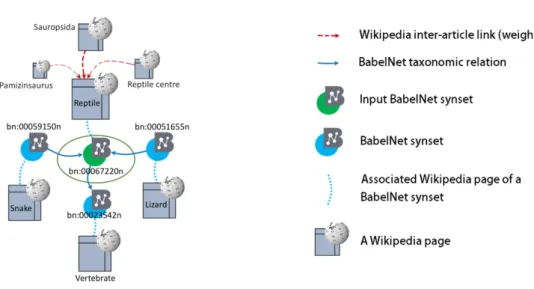
Figure 4.2. Our procedure for getting contextual information of the sample BabelNet synset represented by its main sensereptile1
n.
makes use of the full power of BabelNet, as it exploits the complementary information of the distributional statistics in Wikipedia articles that are tied to the taxonomical relations in BabelNet. The rest of this section is divided into two parts. We first show how we collect contextual information for a given synset (Section 4.2.1) and then explain how this contextual information is processed in order to obtain our vector representations (Section 4.2.2).
4.2.1 Getting contextual information for a given synset
The goal of the first step is to create a subcorpus SCs for a given BabelNet synset s. Let Ws be the set containing the Wikipedia page corresponding to the concept s(wps henceforth) and all the related Wikipedia pages that have an outgoing link to that page. Note that at this stage Ws might be empty if there is no Wikipedia page corresponding to the BabelNet synset s. We further enrich Ws by adding the corresponding Wikipedia pages of the hypernyms and hyponyms of s in the taxonomy of BabelNet. Figure 4.2 illustrates our procedure for obtaining contextual information. Let SCs be the set of content words occurring in the Wikipedia pages ofWs after tokenization and lemmatization. The frequency of each content word w ofSCs is calculated as follows: f(w) = n X i=1 λifi(w) (4.11)
where nis the number of Wikipedia pages in Ws, fi(w) is the frequency of win the Wikipedia pagepi ∈ Ws (i=1,...,n), andλi is the weight assigned to the pagepi to denote its importance. In the following subsection we explain how we calculate the weight λi for a given page pi.
Weighting semantic relations
In this section we explain how we weight the BabelNet semantic relations (i.e., λi in Equation 4.11) between the target synset s and the i-th page in Ws. In previous versions of Nasari(Camacho-Collados et al., 2015b,c) we were making an assumption that all the Wikipedia pages in Ws were equally important (i.e., λi = 1,∀i≤n). In this work we set more meaningful weights for these pages on the basis of the source and type of semantic connection to the target synset s.
A Wikipedia page in Ws may come from three different sources (see Section 4.2.1): (1) the Wikipedia page corresponding tos (wps), (2) the related Wikipedia pages that have an outgoing link to the page wps, and (3) the Wikipedia pages that are connected tosthro