Journal of Product & Brand Management
Drivers and Outcomes of Branded Mobile App UsageIntention
Journal: Journal of Product & Brand Management Manuscript ID JPBM-02-2017-1436.R4
Manuscript Type: Regular Paper
Keywords: Mobile marketing, Branded mobile applications, Technology adoption, Post-adoption outcomes
Journal of Product & Brand Management
Drivers and Outcomes of Branded Mobile App Usage Intention AbstractPurpose: This study examines the drivers and outcomes of the usage intention of branded mobile applications (apps), revealing findings of theoretical and practical relevance. First, it uncovers the specific technological features that underpin the perceived usefulness and ease of use of branded apps driving (directly and indirectly) usage intention. Second, it outlines two key outcomes that are relevant to the strategic management of branded apps: willingness to recommend the app and willingness to pay to continue using the app.
Approach: This study uses data randomly derived from a panel of one million UK consumers, analyzed via structural equations modeling. The unit of analysis was individual apps prominently displaying a brand identity. The study tested indirect relationships between the key drivers considered and usage intention, via perceived usefulness and ease of use.
Findings: Consumers who view branded apps as protecting their privacy, customizable and compatible with what they do, will have stronger perceptions of usefulness and ease of use, and greater intention to use the app. These effects also occur indirectly. Furthermore, usage intention drives the willingness to recommend the app and to pay to continue using it.
Practical implications: To influence usage intention, managers can improve the perception of usefulness of branded apps by protecting consumer privacy, and improving the app’s design and its compatibility with people’s needs and lifestyle. Managers can also enhance the perception of ease of use of the branded app by heightening its security and ubiquity. Combined, these factors can enhance (directly and indirectly) the intention to use the app, which will lead to the willingness to recommend the app and pay for it.
Originality/value: This study extends previous research by examining factors driving the intention to use branded apps and the resulting outcomes. It also offers a model that yields predictions for individual branded apps (not the brand powering the app), thus providing practical recommendations on how to manage, in general, apps with a brand identity.
Keywords: Branded Mobile Applications, Technology Adoption, Post-Adoption Outcomes, Mobile Marketing. 3 4 5 6 7 8 9 10 11 12 13 14 15 16 17 18 19 20 21 22 23 24 25 26 27 28 29 30 31 32 33 34 35 36 37 38 39 40 41 42 43 44 45 46 47 48 49 50 51 52 53 54 55
Journal of Product & Brand Management
1. Introduction Mobile applications (thereafter apps) play a vital role in supporting consumer acceptance and use of mobile technologies (Tojib and Tsarenko, 2012). Apps also provide organizations with countless opportunities for establishing relationships with customers, which is in line with Sultan and Rohm’s (2005) original definition of apps as “brands in the hand”. More recently, Taivalsaari and Mikkonen (2015) describe the “brandification” of apps as the process of substituting the more simplistic functions available on mobile devices, such as messaging, camera and music players with custom-build apps. Such apps often become commercially popular either as standalone offers (see the example of the Spotify app for music streaming), or as extensions of existing offline brands (e.g., the Facebook app). For example, Newman, Wachter and White (2017) highlight that many retailers have the chance to reacquire or reinforce their competitive advantages through apps, especially if they are able to deliver value to consumers across multiple ‘touch-points’ – i.e., via ensuring that apps complement and extend physical and virtual channels. While there is still quite a long-way before apps will result in the demise of Web as a software platform, the prominence of apps in present day business ecosystems is undeniable.Unsurprisingly, as Kim and Yu (2016) highlight, the use of branded apps as mobile communication marketing tools is increasingly common among many corporations. This strategic shift seems justified, at least in part, by the documented effect that branded apps have in relation to brand loyalty and purchase intention. In fact, branded apps are an attractive marketing tool for engaging consumers and interacting with them in a manner that has clearly surpassed the opportunities that the traditional web format can offer. However, with 3.8 million apps currently available to consumers via the Google Play Store (Statista, 2018), managers need to know which
3 4 5 6 7 8 9 10 11 12 13 14 15 16 17 18 19 20 21 22 23 24 25 26 27 28 29 30 31 32 33 34 35 36 37 38 39 40 41 42 43 44 45 46 47 48 49 50 51 52 53 54 55
Journal of Product & Brand Management
factors can be leveraged to encourage consumers to use branded apps, and the potential outcomes of adoption that can yield concrete economic returns. Also, as Ahmed et al. (2016) mention, consumers download on average approximately 40 apps, but regularly use a mere 15 or fewer, with only some of them branded. This is because consumers spend half of their time using only about three favorite apps. In fact, Tarute, Nikou and Gautis (2017) remark that although the number of apps available to consumers continue to increase margins remain relatively low, possibly due to not focusing sufficiently on meeting the evolving needs of technology users. Therefore, as Bellman et al. (2013) highlight, the most prominent challenge for branded apps is to remain in the short-list of apps that consumers continue to use, because of their particular usefulness. Accordingly, more insights concerning branded apps are needed for businesses to make informed strategic decisions when planning the introduction of an app linked to an existing offer or the launch of a new branded app – e.g., to start a new business venture (see also Stocchi et al., 2017). The need for more insights concerning branded apps is also highlighted in other recent works such as Tarute et al. (2017) and Newman et al. (2017), where it is implied that although research efforts have intensified the understanding of cause and effects relationships is still rather limited.Existing research in the mobile context can be categorized into works discovering drivers of technology adoption vs. works examining post-adoption outcomes (Nysveen et al., 2015). Research on adoption has been significant, although it has primarily concerned the uptake of mobile technology in general and/or specific instances of mobile technologies, such as mobile data services, mobile payments, mobile marketing and, of course, mobile apps. Importantly, as Alnawas and Aburub (2016) remark, many scholars have drawn upon the Technology Acceptance Model (Davies et al., 1989) to understand how and why consumers adopt apps. This
3 4 5 6 7 8 9 10 11 12 13 14 15 16 17 18 19 20 21 22 23 24 25 26 27 28 29 30 31 32 33 34 35 36 37 38 39 40 41 42 43 44 45 46 47 48 49 50 51 52 53 54 55
Journal of Product & Brand Management
strand of research has consistently highlighted that perceived usefulness and ease of use are the key drivers of attitudes, intention to use, and actual use of mobile apps (see Kim, Yoon and Han, 2016; Tojib and Tsarenko, 2012; Yang, 2013). However, these aspects have not been explored in relation to branded apps, i.e. apps clearly showing a brand identity (Bellman et al., 2011). Moreover, drivers of adoption are often understood in relation to the brand or organisation powering the app (e.g., Chen et al., 2012; Chong, 2013; Cyr, Head and Ivanov, 2006), rather than for the app itself.At the same time, existing frameworks have failed to consider important outcomes, such as satisfaction and purchase intentions, and have focused too narrowly on predicting the intentions to use the app or to continue using the app. Other outcomes beyond acceptance, such as engagement, are not fully understood. In contrast, research on post-adoption have focused on the factors that motivate consumers to continue to use the technology, and have extended the confines of the TAM model by combining it with other theoretical bases (e.g., motivation theory and expectancy theory). For example, Yang (2016) considers brand attachment and self-congruence theory, while Kim, Ling and Sung (2013), Wu (2015), and Wang, Kim and Malthouse (2016) draw on brand engagement theory. As a result, to date, there is no framework comprehensively explaining the drivers and outcomes of branded app usage intention.
Furthermore, findings of studies that examine the effectiveness of branded apps as advertising medium (c.f. Bellman et al., 2011) confirm the need to understand more about the drivers and consequences of branded apps usage. Finally, as Morosan and DeFranco (2016) suggest, the understanding of mechanisms that characterize consumer interactions with branded apps is becoming increasingly difficult, given that consumer–firm interactions occur seamlessly
3 4 5 6 7 8 9 10 11 12 13 14 15 16 17 18 19 20 21 22 23 24 25 26 27 28 29 30 31 32 33 34 35 36 37 38 39 40 41 42 43 44 45 46 47 48 49 50 51 52 53 54 55
Journal of Product & Brand Management
and simultaneously across multiple channels. This is one of the reasons why scholars have been called to intensify research efforts examining branded apps.In light of the above, understanding of the full potential of branded apps from a strategic marketing perspective clearly comes across as an underexplored issue of theoretical and practical relevance for a number of reasons. Above all, branded apps can deliver important outcomes that can yield economic returns – e.g., in the form of positive attitudes, purchase intentions, advertising response and consumer engagement (Seitz and Aldebasi, 2016; Yang, 2016). Furthermore, branded apps represent tools that firms can use to establish new connections with customers and to reinforce existing ones, creating unique customer experiences (Kim, Lin and Sung, 2013; Peng, Chen and Wen, 2014). Moreover, branded apps differ to some extent from other mobile technologies, given the considerable potential for consumer engagement and interconnectivity (e.g., Seitz and Aldebasi, 2016; Yu, 2013).
The present study contributes to existing knowledge of consumers’ adoption of branded apps, focusing on technology-specific characteristics of mobile apps such as privacy, security, design characteristics, ubiquity, and compatibility as antecedents of perceived usefulness and ease of use. At the same time, it examines outcomes such as word-of-mouth (WOM) recommendation and willingness to pay for extra app features. Lastly, this study also considers indirect connections between these factors (mediation) to further enhance the understanding of the drivers and outcomes of branded app usage intention. These insights emerge from the analysis of a set of consumer panel data gathered in the UK featuring demographic information, consumer perceptions and other relevant information (e.g., intention to use, willingness to pay for the app, and willingness to recommend). The result is a robust framework that generates predictions for individual branded apps, as opposed to the brand powering the app. The
3 4 5 6 7 8 9 10 11 12 13 14 15 16 17 18 19 20 21 22 23 24 25 26 27 28 29 30 31 32 33 34 35 36 37 38 39 40 41 42 43 44 45 46 47 48 49 50 51 52 53 54 55
Journal of Product & Brand Management
framework offers insights that are applicable to two important scenarios: i) instances of existing brands wanting to launch an app to communicate with their customers and engage them; and ii) instances of branded apps being offered and marketed to consumers as standalone offers. Accordingly, this study delivers a range of practical outcomes that offer some guidance to managerial tactics in the mobile context, especially in relation to determining product and brand management strategies that, when applied to apps, can yield economic returns.2. Background
2.1 Existing Research on Branded Apps
Bellman et al. (2011) define branded apps as mobile apps prominently displaying a brand identity. Such apps retain the baseline technological features of mobile apps in general, while functioning also as advertising medium (see Bellman et al., 2011), especially in the instance of branded apps linked to an existing brand (e.g., the Facebook app). Branded apps may also compete in the marketplace as standalone offers, if inherently branded via a logo or other branded elements (e.g., color or trademark) and not linked to any existing brand (e.g., the Candy Crush Saga app; see Stocchi et al., 2017).
Several researchers have argued that branded apps differ from the more generic domain of mobile services and warrant separate research. Ahmed et al. (2016) argue that branded apps differ from other facets of mobile marketing because they are most effective at engaging consumers and facilitating brand-driven communication. Just like traditional advertising, branded apps are often impersonal and sponsored forms of communication aimed at persuasion. However, unlike traditional advertising, branded apps are ideal for interactive, controlled and
3 4 5 6 7 8 9 10 11 12 13 14 15 16 17 18 19 20 21 22 23 24 25 26 27 28 29 30 31 32 33 34 35 36 37 38 39 40 41 42 43 44 45 46 47 48 49 50 51 52 53 54 55
Journal of Product & Brand Management
highly personalized communication, whereby the consumer becomes much more actively engaged (see also Bellman et al., 2011). In fact, as Kim, Lin and Sung (2013) explain, branded apps can facilitate engagement thanks to their vividness and novelty. Branded apps can also motivate consumers, thanks to features that enable control, customization and feedback mechanisms, across multiple platforms. For these reasons, as an advertising medium, apps can be highly influential (see also Calder et al., 2009).According to Seitz and Aldebasi (2016), branded apps enable firms to communicate, interact and deliver messages to consumers. Interactivity is particularly important, as it is crucial to brand-related outcomes, such as: i) the establishment of positive attitudes towards the brand and the enhancement of purchase intention (Yu, 2013), ii) the reinforcement of relational dimensions of brand equity (Hoogendoorn, 2013), and iii) bolstering advertising response and persuasion (Bellman et al., 2011). Yang (2016) argues that branded apps offer a closer connection with the brand through hand-held devices embedded in consumers’ lives, such as smart phones and tablets, increasing the familiarity and accessibility of brands, and offering multiple experiences to consumers. These factors, combined, ultimately result in brand attachment, and reinforce consumer-brand relationships through engagement and the establishment of emotional connections. Importantly, Yang (2016) elaborates that these outcomes may be obtained through the fulfillment of affective needs and self-identification. Accordingly, branded apps can create new bonds between brands and consumers, and reinforce existing relationships (Peng, Chen and Wen, 2014); they also provide unique experiences associated with the brand (Kim, Lin and Sung, 2013). In a similar vein, Jin (2016) argues that the role of branded apps has evolved beyond the provision of information and the promotion of goods and services. Namely, branded apps are often entrenched in people’s lifestyle to the point
3 4 5 6 7 8 9 10 11 12 13 14 15 16 17 18 19 20 21 22 23 24 25 26 27 28 29 30 31 32 33 34 35 36 37 38 39 40 41 42 43 44 45 46 47 48 49 50 51 52 53 54 55
Journal of Product & Brand Management
of delivering unique brand experiences that strengthen the connection between consumers and brands through instantaneous interactions. In light of such an enhanced role, Jin concludes that it is imperative to determine the drivers of branded apps’ effectiveness.Bellman et al. (2013) present some additional reflections on the importance of branded apps as advertising medium. For example, the authors highlight that branded apps favour ‘pull’ advertising strategies and by-pass the need for opt-in permission marketing, since technically consumers access apps on their own initiative. Furthermore, branded apps provide firms with the advantage of tailored marketing, through localized and personalised information. Bellman and colleagues therefore conclude that branded apps can enhance persuasion by means of facilitating the processing of brand-related information and strengthening consumer-to-brand interactions.
The unique characteristics of branded apps described thus far add to the widely accepted belief that mobile apps, in general, create a realm of opportunities beyond the scope of the traditional mobile marketing strategies (Kim, Yoon and Han, 2014). Specifically, mobile apps have transformed the way firms communicate to consumers (Racherla et al., 2012) by offering personalized content that facilitates consumer engagement (Watson et al., 2013). As such, apps are a powerful strategic marketing tool that can generate cross-channel synergies alongside other digital advertising media, web advertisement, search-engine optimization and emails (Wang, Kim and Malthouse, 2016). Above all, since they are heavily embedded into consumers’ lives, apps can achieve “what other channels cannot”, such as: i) actively prompting context-dependent brand recall on a frequent basis, ii) altering the way consumers access a brand’s offering by means of integration in existing routines such as repeat purchasing, and iii) triggering new consumption habits and/or reinforcing behavior.
3 4 5 6 7 8 9 10 11 12 13 14 15 16 17 18 19 20 21 22 23 24 25 26 27 28 29 30 31 32 33 34 35 36 37 38 39 40 41 42 43 44 45 46 47 48 49 50 51 52 53 54 55
Journal of Product & Brand Management
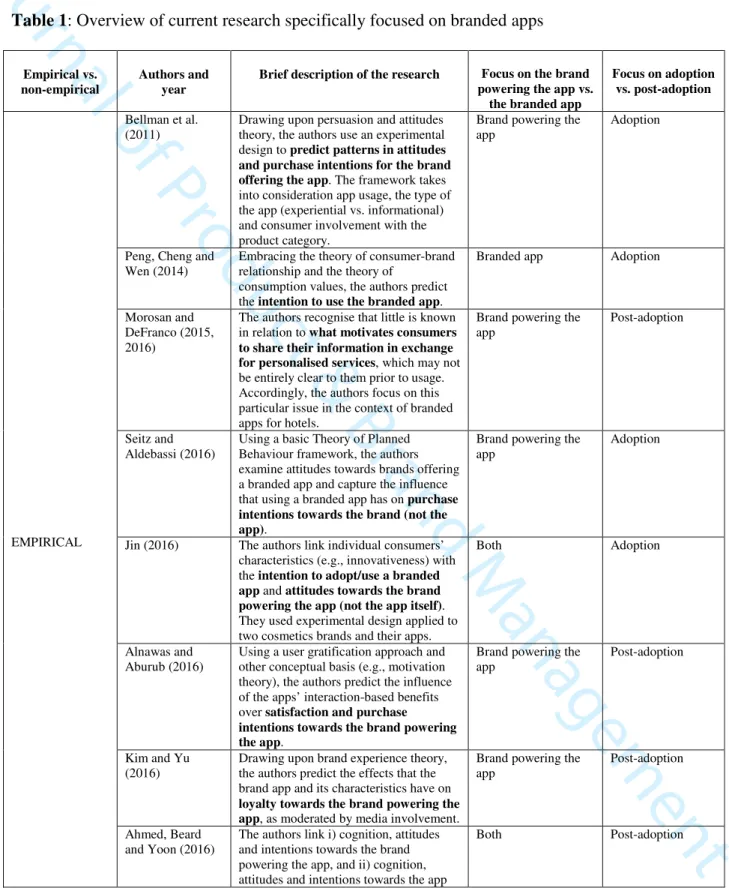
In general, however, literature specifically examining branded apps is seriously limited (see Table 1), especially in comparison to the vast array of studies considering mobile technologies as a whole and even in comparison to research focused on mobile apps as specific instance of mobile digital technology.Empirical research that has focused on the adoption of branded apps includes Peng et al. (2014). Extending the line of thought of Bellman et al.’s (2011) work, Peng and colleagues (2014) examine how branded apps might reinforce the pre-existing relationship between consumers and the brand powering the apps via the provision of additional stimuli and touch-points. The authors study the factors that drive the adoption of a branded app (intention to use) from the perspectives of brand relationship and consumption values, using a different theoretical basis to the widely accepted Technology Acceptance Model (TAM) (see Legris et al., 2003; Porter and Donthu, 2006; Venkatesh et al., 2007). Later on, Seitz and Aldebasi (2016) research consumer attitudes towards branded apps, and the relative influence on purchase intentions and usage. However, Seitz and Aldebasi’s (2016) work is based on a very small student sample and their outcome variable relates to the brand providing the app, not to the app itself. Jin (2016) considers the brand powering the app as well as the branded app itself, and sheds light on some interesting dynamics. For example, branded apps often offer both cognitive and behavioral experiences. The cognitive side is fulfilled by the provision of information and knowledge about the brand powering the app and its products or services, and the behavioral side is often addressed via rich sensory experiences offered virtually. Yet, Jin’s results are based on the analysis of only two branded apps, which limits significantly the scope of the implications drawn. 3 4 5 6 7 8 9 10 11 12 13 14 15 16 17 18 19 20 21 22 23 24 25 26 27 28 29 30 31 32 33 34 35 36 37 38 39 40 41 42 43 44 45 46 47 48 49 50 51 52 53 54 55
Journal of Product & Brand Management
Empirical research examining post-adoption behavior and focusing on branded apps is relatively more substantial. However, it utilizes more disparate theoretical bases that differ substantially from the core body of research examining technology adoption through the TAM. Yang’s (2016) study is a partial exception and seems to be the only work concerned with understanding the post-adoption of branded apps by extending the TAM framework through the inclusion of theoretical relationships concerning brand attachment and self-congruence. However, like Bellman et al. (2011) and Seitz and Aldebasi (2016), the dependent variable that Yang (2016) uses related to the brand offering the app, not to the app. Similarly, Natarajan, Balasubramanian and Kasilingam (2017) also draw upon the TAM framework to explore post-adoption matters, but focus exclusively on mobile commerce apps linked to retailers and do not clarify whether they focused on specific branded apps as opposed to apps as a whole. Their findings were also limited to one specific context (India), whereby the uptake of technology has experienced abnormal growth rates.Morosan and DeFranco (2015, 2016) explore the value of branded apps in the context of the hospitality industry and in relation to the likely marketing functions that apps can satisfy such as advertising, distribution, CRM and so forth. These authors argue that the key rationale for hotel brands to deploy apps is the need to: i) simplify and enhance the interactions with customers and ii) acquire and manage rich information about customers. These two factors, combined, can result in the provision of a broad range of ancillary services that are also uniquely personalised and superior in quality. Yet, Morosan and DeFranco recognise that little is known in relation to what motivates consumers to share their information in exchange for personalised services that may not be entirely clear to them prior to usage. Accordingly, they focus on this particular issue and do not examine other aspects of post-adoption of branded apps. In a similar
3 4 5 6 7 8 9 10 11 12 13 14 15 16 17 18 19 20 21 22 23 24 25 26 27 28 29 30 31 32 33 34 35 36 37 38 39 40 41 42 43 44 45 46 47 48 49 50 51 52 53 54 55
Journal of Product & Brand Management
vein, Veríssimo (2018) focuses exclusively on health-related apps (supposedly branded) and the likely effectiveness that they can have in relation to leading to better clinical decision-making, via enhancing app usage intensity.Kim, Wang and Malthouse (2015) test empirically whether using a branded app can actually increase spending in relation to the brand powering the app, in light of rather stable pre-adoption spending patterns. However, their analysis is based on the case of one single app and post-adoption was captured within the customer base of a loyalty program; hence, their results might not be generalizable to different consumer segments and/or other branded apps.
Tarute et al. (2017) focus on the likely effects of consumer engagement on continued use intention for branded apps, albeit considering only a limited set of characteristics that apps might have (e.g., design and quality of the information provided) and asking research participants to think of one specific app that they routinely use, without specifying whether it had to be branded or not. In contrast, Wu (2015) presents a formalized model of customer engagement with branded apps and identifies performance expectancy (underpinned by the relationship between perceived interactivity and effort expectancy), social influence and brand identification as key drivers of continue use intention. Similarly, Alnawas and Aburub (2016) evaluate the benefits (learning, social integrative, personal integrative and hedonic) resulting from consumer interactions with branded apps – i.e., in terms of customer satisfaction and purchase intentions. Accordingly, they claim that their findings corroborate the assumption that it is essential to consider the primary motives and benefits likely to drive the use of branded apps and what consumers do with the app. Kim and Yu (2016) examine the effects of the holistic experiences that branded apps offer when it comes to fostering the relationship between consumers and brands. They draw upon a different conceptual background (i.e., brand experience theory) and by
3 4 5 6 7 8 9 10 11 12 13 14 15 16 17 18 19 20 21 22 23 24 25 26 27 28 29 30 31 32 33 34 35 36 37 38 39 40 41 42 43 44 45 46 47 48 49 50 51 52 53 54 55
Journal of Product & Brand Management
taking into account consumer involvement. They found that affective, cognitive, behavioral and relational experiences have a significant impact on brand loyalty, moderated by involvement. Crucially, however, Wu (2015), Alnawas and Aburub (2016) and Kim and Yu (2016) offer conclusions exclusively in relation to the brand offering the app, not to the branded app itself. As mentioned earlier, this limits the scope of the implications of the results, given that many branded apps available to consumers are not necessarily linked to existing brands.In contrast, Ahmed et al. (2016) and Fang (2017) focus on both the brand powering the app as well as on the branded app itself. In more detail, Ahmed et al. (2016) show that attitudes towards the branded app are the strongest driver of app effectiveness (captured in terms of intention to use the branded app and purchase intentions), especially directly. Accordingly, they conclude that marketers should constantly strive to improve the characteristics of the app in order to improve consumer attitudes and purchase intentions. At the same time, brand-related information should not be neglected, because it drives consumer attitudes towards the brand powering the app, which also feed into the intention to use the branded app and purchase intentions. Fang (2017) explores how the potential for consumer engagement of branded apps influences repurchase-intention for the brand powering the app and the intention to continue using the app. Although thoroughly discussed and well justified, Fang’s results were effectively based only on two branded apps. In contrast, Stocchi et al. (2017) examine a large number of branded apps, including free and paid ones, and including apps linked to existing brands as well as standalone apps. However, they focus on a different theoretical and practical aspect, studying the relationship between app usage and app image.
Research specifically focused on branded apps also includes three conceptual studies. For example, Kim, Ling and Sung (2013) discuss on-going engagement with branded apps and
3 4 5 6 7 8 9 10 11 12 13 14 15 16 17 18 19 20 21 22 23 24 25 26 27 28 29 30 31 32 33 34 35 36 37 38 39 40 41 42 43 44 45 46 47 48 49 50 51 52 53 54 55
Journal of Product & Brand Management
identify a number of app characteristics likely to drive the desire to “proceed to the next level” from a consumer perspective (i.e., vividness, novelty, motivation, control, customization, feedback, multi-platforming, and resonance). Zhao and Balagué (2015) present a series of assumptions concerning objectives and features that branded apps should have in order to maximize outcomes. Wang, Kim and Malthouse (2016) present a systematic literature review, but do not include any empirical result.*** Insert Table 1 about here
In light of the above, further research is needed to fully understand and conceptualize the relationships underpinning adoption and post-adoption of branded apps. The decision to consider, simultaneously, adoption and post-adoption in the present study is based on the notion of app lifecycle (Böhmer et al., 2011; Racherla et al., 2012), which includes: i) adoption or discovery of apps, ii) subsequent and ongoing use of apps, and iii) outcomes of usage (e.g., making transactions, word-of-mouth etc.). Moreover, to enhance the theoretical soundness, this study introduces a theoretical framework that is drawn upon the most widely used conceptual basis, i.e. the TAM model and subsequent adaptations. The TAM model comprise of valid, reliable, responsive and easy-to-operationalize constructs (Legris et al., 2003; Porter and Donthu, 2006; Venkatesh et al., 2007) and, despite its limitations (e.g., Benbasat and Barki, 2007), it is the dominant theory, because it explains more variance in consumer intention to use and actual usage of technologies (Porter and Donthu, 2006; Venkatesh and Bala, 2008). Additionally, recent research has used the TAM model to explain the adoption of mobile services, interactive media and social media technologies in multiple contexts (Childers et al., 2002; Koenig-Lewis et al.,
3 4 5 6 7 8 9 10 11 12 13 14 15 16 17 18 19 20 21 22 23 24 25 26 27 28 29 30 31 32 33 34 35 36 37 38 39 40 41 42 43 44 45 46 47 48 49 50 51 52 53 54 55
Journal of Product & Brand Management
2015; Muk and Chung, 2015; Siamagka et al., 2016; Tojib and Tsarenko, 2012). However, as Peng et al. (2014) state, the majority of existing studies have focused on understanding the drivers of the adoption of apps and mobile commerce in general, as opposed to focusing on understanding the likely impact of branded apps on a broader range of outcomes. Therefore, the present study introduces a comprehensive framework for examination of the drivers and outcomes of branded app usage intention, and the indirect relationships between these. Importantly, to extend the scope of the implications of this line of research, the framework includes outcomes in relation to the branded app, not the brand powering the app. Accordingly, the results may apply to a wider range of branded apps currently available to consumers.2.2 Drivers and Outcomes of Branded App Usage
Previous research draws on TAM constructs to examine adoption of mobile marketing as a whole (e.g., Gao et al., 2013; Rohm et al., 2012), mobile commerce (e.g., Cyr et al., 2006; Sultan et al., 2009; Wu and Wang, 2005; Yang, 2005), specific services offered by mobile apps (e.g., mobile payments) (Koenig-Lewis et al., 2015), and mobile apps in general (e.g., Kim, Yoon and Han 2016; Tojib and Tsarenko, 2012; Yang, 2013). Lately, Yang (2016) and Fang (2017) include TAM-like theoretical links in their frameworks investigating outcomes of the adoption of branded apps, albeit focusing more markedly on outcomes for the brand powering the apps (not the app itself). Natarajan et al. (2017) do the same, albeit considering outcomes for the app as well. Seitz and Aldebasi (2016) have also examined mobile app usage and impact on attitude and intention to buy the brand powering the app.
In addition, extant studies have also analyzed individual factors as determinants of adoption, such as risk, personal attachment, social influence, innovativeness, product reviews by
3 4 5 6 7 8 9 10 11 12 13 14 15 16 17 18 19 20 21 22 23 24 25 26 27 28 29 30 31 32 33 34 35 36 37 38 39 40 41 42 43 44 45 46 47 48 49 50 51 52 53 54 55
Journal of Product & Brand Management
Lewis et al., 2015; Sultan et al., 2009). For example, Gao et al., (2013) focus on individual factors such as innovativeness, attachment and risk avoidance as moderators of the relationships between ease of use and perceived usefulness and attitude towards mobile marketing (see also Bauer et al., 2005; Bruner and Kumar, 2005; Pedersen et al., 2002; Shankar et al., 2010; Sultan et al., 2009; Tojib and Tsarenko, 2012). In a similar line, Koenig-Lewis et al. (2015) and Kim et al. (2016) examine mobile payments and usage of apps (respectively), including TAM constructs in their adoption models. Accordingly, this present study draws on the substantial body of evidence concerning basic TAM-like constructs and inherent conceptual relationships to outline the key elements of a new framework, which encompasses antecedents and outcomes of branded app adoption. The rationale for this conceptual assumption is the following. Regardless of the peculiarities of branded apps, discussed amply in the previous section, it is plausible to assume that like any other technology, perceived usefulness and ease of use of branded apps should provide the impetus to consumer motivations, perceptions, and behavioral reactions.2.2.1 Perceived Usefulness and Perceived Ease of Use
Perceived usefulness reflects the extent to which the use of a specific technology (e.g., branded app) is advantageous, whereas perceived ease of use relates to the effortlessness and/or convenience of the use of a specific technology (Davis et al., 1992; Ha and Stoel, 2009; Tojib and Tsarenko, 2012). Previous research conceptualizes antecedents of perceived usefulness and perceived ease of use focusing on two streams of thought (Porter and Donthu, 2006). First, research focuses on psychological or personal traits as direct predictors (or as moderators) of perceived usefulness. For example, Gao et al. (2013) look at innovativeness and personal attachment as moderators of perceived usefulness and attitude towards mobile marketing.
3 4 5 6 7 8 9 10 11 12 13 14 15 16 17 18 19 20 21 22 23 24 25 26 27 28 29 30 31 32 33 34 35 36 37 38 39 40 41 42 43 44 45 46 47 48 49 50 51 52 53 54 55
Journal of Product & Brand Management
Tsarenko, 2012), as antecedents of usefulness and ease of use. This present study follows the second stream and considers the following antecedents of branded app usage as predictors of perceived usefulness and perceived ease of use: privacy, security, design characteristics, ubiquity and compatibility.Perceived usefulness and perceived ease of use predict attitude and intention to use and can lead to the adoption of mobile technologies, including apps (e.g., Kim et al., 2016; Koenig-Lewis et al., 2015; Tojib and Tsarenko, 2012; Yang, 2013; Natarajan et al., 2017). However, some studies have highlighted that perceived usefulness is a stronger predictor relative to perceived ease of use (Koufaris, 2002; Pavlou, 2003; Porter and Donthu, 2006; Shih, 2004). More specifically, research in digital technology contexts suggests that perceived usefulness explains over 50% of variance in intention (Xiao, 2010), implying that individuals use technology products due to their functionality, as opposed to their ease of use (e.g., Venkatesh and Bala, 2008).
In the instance of branded apps, Fang (2017) has recently confirmed that perceived usefulness embodies the value that users seek, which often translates (conceptually) into the outcomes of usage – e.g., improvement of task effectiveness and efficiency (labeled “utilitarian path” in Fang’s research). This is why Fang (2017) recommends including perceived usefulness in the formulation of hypotheses aimed at predicting outcomes in relation to branded apps, since it is a vital driver facilitating continuance intention and repurchase intention. Nevertheless, the literature seems to model both perceived usefulness and ease of use as predictors of intention to use certain technologies, including mobile apps (Kim et al., 2016; Koenig-Lewis et al., 2015; Venkatesh and Davis, 2000). This can be better explicated if one considers the following concrete examples of branded apps. Consumers might wish to use branded apps powering
3 4 5 6 7 8 9 10 11 12 13 14 15 16 17 18 19 20 21 22 23 24 25 26 27 28 29 30 31 32 33 34 35 36 37 38 39 40 41 42 43 44 45 46 47 48 49 50 51 52 53 54 55
Journal of Product & Brand Management
helpful functions including access to bank accounts (e.g., HSBC app) or online catalogues (e.g., Specsavers’ app with which consumers may browse and even ‘try on’ frames) on the basis of whether the apps are in fact useful to them (e.g., they actually wish to do banking via the app or to find new eyewear) and how easy they are to operate (i.e., depending on whether the tasks/objectives that they want to accomplish are easily manageable, in the form of taking little time or being relatively intuitive). Further, ease of use is likely to enhance the consumer’s perception of how useful the branded app is (e.g., if the banking app is easy to operate, it is quite likely that the consumer using it will also consider it useful). Further evidence of the relevance of usefulness and ease of use in relation to the intention to use branded apps can be drawn from recent findings by Natarajan et al. (2017), who highlighted that both factors drive consumer intentions in relation to apps linked to retailers (thus branded); and Veríssimo (2018) who found the same for health-related apps (supposedly branded). Also, Tarute et al. (2017) have suggested that poor usability is a key factor that encourages consumers to delete or not use an app. These aspects, combined, will underpin the intention to use branded apps in the near future. Put more formally:H1: The more useful a branded app is perceived to be, the greater the intention to use it. H2: The easier to use a branded app, the greater the intention to use it.
H3: The easier to use a branded app, the greater its perceived usefulness.
2.2.2 Branded App Characteristics
General as well as context-specific functional characteristics shape perceptions of usefulness and ease of use of a particular technology (Kim and Garrison, 2009; Lu et al., 2003; Looney et al., 2004; Sarker and Wells, 2003). Within this study, the focus is on privacy, security, design
3 4 5 6 7 8 9 10 11 12 13 14 15 16 17 18 19 20 21 22 23 24 25 26 27 28 29 30 31 32 33 34 35 36 37 38 39 40 41 42 43 44 45 46 47 48 49 50 51 52 53 54 55
Journal of Product & Brand Management
characteristics, ubiquity and compatibility, considered as antecedents of perceived usefulness and perceived ease of use for branded apps. As mentioned earlier, these characteristics should be inherently prominent and flexible to manage through branded apps, given their potential for interactivity and engagement (Peng et al., 2014; Seitz and Aldebasi, 2016). Moreover, according to Ahmed et al. (2016), perceptions of a branded app are a strong driver of the app effectiveness. Hence, the authors argued that marketers should constantly strive to improve the characteristics of the app in order to improve consumer attitudes and purchase intentions. The next sections present more details of the rationale supporting the theoretical links between individual characteristics of apps and the perceived usefulness and ease of use.2.2.2.1 Privacy and Security
Scholars have examined the notions of privacy and security (e.g., Gao et al., 2013; Ha and Stoel, 2009; Shankar et al., 2010; Vijayasarathy, 2004;) and have concluded that, although related, security and privacy are conceptually distinct (Vijayasarathy, 2004). Privacy denotes the extent to which a technology is perceived to compromise privacy, while security indicates whether a technology is secure from unauthorized third parties (Ha and Stoel, 2009; Miyazaki and Fernandez, 2001; Udo, 2001).
Previous research on online shopping conceptualizes privacy and security as antecedents of usefulness and ease of use (Amin, 2007; Chen, 2008; Ha and Stoel, 2009; Pikkarainen et al., 2004; Polasik and Wisniewski, 2009; Wu and Wang, 2005). Similarly, Gao et al. (2013) conceptualize loss of privacy and security (i.e., risk avoidance) as moderators of relationships between perceived usefulness and attitudes towards mobile marketing. Shankar et al. (2010) argue that heightened perceptions of privacy and security can increase perceived usefulness,
3 4 5 6 7 8 9 10 11 12 13 14 15 16 17 18 19 20 21 22 23 24 25 26 27 28 29 30 31 32 33 34 35 36 37 38 39 40 41 42 43 44 45 46 47 48 49 50 51 52 53 54 55
Journal of Product & Brand Management
privacy and security have been modeled as antecedents of both perceived usefulness and ease of use, and are highlighted as highly correlated (Lallmahamood, 2007). Additionally, Natarajan et al. (2017) confirmed that perceived risk (i.e., consumer uncertainty resulting from the perceptions of likely negative outcomes) has a negative impact on the intention to use apps linked to retailers.More generally, branded apps that facilitate transactions, such as the Uber app or the Amazon app, have an obligation towards consumers to retain and protect sensitive information, such as credit card and billing details, phone numbers etc. Equally, social media apps, such as the Facebook and Instagram apps, offer features that protect consumers from the possible threat of third unauthorized parties accessing private information, such as photos and videos saved on their devices. To do so, branded apps use security protocols, such as pin codes, to avoid presenting users with a request to enter personal or account information every time they use the app. Such safety measures would make a branded app easy to use, limiting the cognitive effort required. This reduction in effort, in turn, may intuitively influence the perceived usefulness of the app, and most likely influence the intention to use the app. In a similar line, the extent to which a branded app ensures privacy and security of personal information stored within the app should impact the perceptions of usefulness and ease of use, leading to increased usage intentions. Importantly, Morosan and DeFranco (2016) argue that branded apps are characterized by a paradoxical combination of personalization and privacy, whereby one is not possible without bypassing the other (at least to a certain extent). Surprisingly, as they claim, the privacy-personalization dyad is not well understood and the two elements are often treated as separate (at least from a conceptual perspective), failing to mimic a fundamental aspect of any m-commerce ecosystem. Morosan and DeFranco also successfully confirm that perceptions of personalization
3 4 5 6 7 8 9 10 11 12 13 14 15 16 17 18 19 20 21 22 23 24 25 26 27 28 29 30 31 32 33 34 35 36 37 38 39 40 41 42 43 44 45 46 47 48 49 50 51 52 53 54 55
Journal of Product & Brand Management
and privacy as well as consumer characteristics, such as innovativeness and, more general privacy concerns, predict the intention to use branded apps in the hospitality industry. Hence:H4a/b: The higher the perceptions of (a) privacy and (b) security of a branded app, the higher the perceived usefulness.
H4c/d: (c) Privacy and (d) security of the branded app indirectly impact usage intention, through perceived usefulness.
H5a/b: The higher the perceptions of (a) privacy and (b) security of the branded app, the higher the perceived ease of use.
H5c/d: (c) Privacy and (d) security of the branded app indirectly impact usage intention through perceived ease of use.
2.2.2.2 Design Characteristics
Venkatesh and Bala (2008) argue that design characteristics or features of a technology impact acceptance (Davis, 1993). Design characteristics involve information or system-related features (DeLone and McLean, 1992) that meet users’ needs and enable them to exercise control. Meeting consumer needs and empowering consumers, in turn, typically impact the perceived usefulness and perceived ease of use. For example, design characteristics of websites (e.g., options offered and customization of navigation features and browsing preferences) often allow more control over navigation, and have been found to shape user acceptance and adoption of a certain technology (Pituch and Lee, 2006; Thong et al., 2002; Wu, 2014). In fact, Tarute et al. (2017) consider, more broadly, design solutions (e.g., in terms of aesthetics and functionalities)
3 4 5 6 7 8 9 10 11 12 13 14 15 16 17 18 19 20 21 22 23 24 25 26 27 28 29 30 31 32 33 34 35 36 37 38 39 40 41 42 43 44 45 46 47 48 49 50 51 52 53 54 55
Journal of Product & Brand Management
among the likely characteristics of apps that can drive engagement with apps, ultimately underpinning continued usage intention.Fang (2017) argues that beyond valuable utility, branded apps can connect consumers with brands in a different way to traditional online and mobile advertising, and branded app interactivity increases the effectiveness of brand related messages and the opportunities for customization. These two factors, in turn, strengthen the relationship between the consumer and brand, and generate greater levels of engagement (see also Kim, Lin and Sung, 2013). Intuitively, this greater potential for engagement originates from the fact that branded apps include a variety of features that allow users to customize the app in order to meet individual needs. For instance, many branded apps powering games such as the Candy Crush Saga app enable consumers to customize the app (e.g., to save their gaming preferences and scores, game avatar name, best performances, statistics on games won etc.). Similarly, branded apps linked to retailers such as Zara and H&M allow saving of browsing preferences (e.g., favorite products and styles, price ranges etc.) and past shopping lists. Thus, branded apps designed in a way that presents consumers with features for customization will result in stronger perceptions of usefulness and ease of use, and subsequently to higher usage intention. Therefore:
H6a/b: Design characteristics of the branded app are positively related to the (a) perceived usefulness of the app, and (b) perceived ease of use of the app.
H6c/d: Design characteristics of the branded app indirectly impact usage intention through the (c) perceived usefulness of the app, and (d) perceived ease of use of the app.
3 4 5 6 7 8 9 10 11 12 13 14 15 16 17 18 19 20 21 22 23 24 25 26 27 28 29 30 31 32 33 34 35 36 37 38 39 40 41 42 43 44 45 46 47 48 49 50 51 52 53 54 55
Journal of Product & Brand Management
2.2.2.3 Ubiquity and Compatibility Ubiquity refers to the ability of mobile devices to allow consumers to access services and applications anywhere, everywhere and when needed (Looney et al., 2004; Lu et al., 2003; Tojib and Tsarenko, 2012). Specifically, Kim and Garrison (2009) define ubiquity as an “individual’s perception regarding the extent to which [a wireless technology] provides personalized and uninterrupted connection and communications between the individual and other individuals and/or networks” (p. 326). Recent research concerning advanced mobile services (which therefore include, by definition, apps) shows that ubiquity of mobile technologies positively impacts ease of use as well as perceived usefulness through the provision of convenience, efficiency and experiential value in achieving the task – conditions that ultimately increase the likelihood of app usage (Tojib and Tsarenko, 2012). Importantly, Fang (2017) hypothesizes two utilitarian factors, localization and ubiquity, which can influence apps continuance intention and brand repurchase intention through perceived usefulness. However, Fang’s (2017) findings show that the role of ubiquity in increasing perceived usefulness was much more prominent.Branded apps assisting consumers with their productivity (e.g., the Evernote app, the Outlook app, the Dropbox app, etc.) and fitness apps (e.g., Sweat with Kayla app, 7-Minutes workout app, etc.) exemplify the prominent role of ubiquity in the perception of usefulness and ease of use. The possibility to effortlessly and efficiently accomplish certain tasks will most likely result in stronger perceptions of perceived usefulness and ease of use of the branded app, and subsequently in stronger usage intentions than opportunity for localization. Therefore:
H7a/b: There is a positive relationship between the ubiquity of the branded app and its (a) perceived usefulness, and (b) perceived ease of use.
3 4 5 6 7 8 9 10 11 12 13 14 15 16 17 18 19 20 21 22 23 24 25 26 27 28 29 30 31 32 33 34 35 36 37 38 39 40 41 42 43 44 45 46 47 48 49 50 51 52 53 54 55
Journal of Product & Brand Management
H7c/d: Ubiquity indirectly impacts usage intention through (c) perceived usefulness, and (d) perceived ease of use.Compatibility is another characteristic that the information technology literature has examined extensively in relation to its impact on perceived usefulness and perceived ease of use (Chau and Hu, 2001; Wu and Wang, 2005). Compatibility captures notions of operational compatibility as well as normative compatibility (e.g., compatibility with the needs of the user) (Karahanna et al., 2006; Tornatzky and Klein, 1982). Operational or practical compatibility refers to the compatibility with what individuals do (Karahanna et al., 2006). Normative compatibility refers to what individuals feel or think about a technology (Moore and Benbasat, 1991; Tornatzky and Klein, 1982) and/or how it fits with their lives (Kleijnen et al., 2004). However, normative conceptualizations of compatibility may be confounded with perceived usefulness, since it is unlikely that individuals would perceive a technology as useful if it does not reflect a level of consistency with what they think or perceive (i.e., a relative advantage, see Karahanna et al., 2006; Moore and Benbasat, 1991). Previous research in the context of mobile marketing suggests that compatibility may represent either a facilitator or an inhibitor of mobile technology adoption (Shankar and Balasubramanian, 2009). Additionally, Kang et al. (2015) argue that compatibility of mobile apps enhances perceptions underpinned by utilitarian motives (e.g., functionality and usefulness). Thus, the extent to which individuals perceive an app to be operationally compatible and “fitting with their needs and preferences” (Kang et al., 2015, p. 46) will impact perceptions of usefulness and ease of use, leading to a stronger intention to use the app. Consumers perceive apps more useful and easy to use in instances where apps assist with routine tasks or activities such as accessing social media sites and news (e.g., Twitter app or BBC news app), or even
3 4 5 6 7 8 9 10 11 12 13 14 15 16 17 18 19 20 21 22 23 24 25 26 27 28 29 30 31 32 33 34 35 36 37 38 39 40 41 42 43 44 45 46 47 48 49 50 51 52 53 54 55
Journal of Product & Brand Management
exchanging instant messages with other individuals (e.g., via messaging apps such as WhatsApp app), ultimately leading to higher usage intention. Therefore:H8a/b: There is a positive relationship between the compatibility of the branded app and (a) perceived usefulness, and (b) perceived ease of use.
H8c/d: App compatibility indirectly impacts usage intention through (c) perceived usefulness, and (d) perceived ease of use.
2.2.3 Intention to Use Branded Apps
Conventional thought (Davis, 1989; Fishbein and Ajzen, 1981) confirms that usage intention underpins the adoption or uptake of a technology. This has also been tested in relation to branded apps and other mobile technologies (Bellman et al., 2011; Kim, Kim and Wachter 2013; Seitz and Aldebasi, 2016; Porter and Donthu, 2006). At the same time, strong usage intentions are likely to drive re-use intentions, which is particularly key in the context of mobile apps given the gradual “buying” experience resulting from app features (Jarvenpaa et al., 2003; Miluzzo et al., 2010; Mylonopoulos and Doukidis, 2003). That is, consumers often first download the free baseline version of a certain app; then, they are asked if they wish to update and/or upgrade the app, paying a small fee to continue using the app or to improve it (e.g., to remove in-app advertisements). For examples, many branded apps powering games or DIY artwork can be trialed for free and then upgraded to no-ads for a fee (e.g., the Solitaire game app) or require a fee to continue using them (e.g., the Colorfy app for drawing).
In addition to the above, it is not uncommon for consumers to use apps intermittently, i.e. occasionally stopping usage of an app and then eventually resuming its use depending on several
3 4 5 6 7 8 9 10 11 12 13 14 15 16 17 18 19 20 21 22 23 24 25 26 27 28 29 30 31 32 33 34 35 36 37 38 39 40 41 42 43 44 45 46 47 48 49 50 51 52 53 54 55
Journal of Product & Brand Management
in a specific city that they are visiting for work or leisure, and stop using it upon their departure, only to re-use it again during another trip. In fact, Venkatesh, Thong and Xu (2012) argue that in the context of technology acceptance, embracing the habit/automaticity perspective implies that “repeated performance of a behavior produces habituation and behavior can be activated directly by stimulus cues” (p. 164). This means that, on subsequent occasions, an automatic response without conscious or cognitive mediation (i.e., attitude or intention) might occur.Intention to use mobile technologies also leads to other marketing outcomes such as satisfaction, loyalty and and/or word of mouth (WOM) (e.g., Ellonen et al., 2009; Gruen et al., 2006; Kim et al., 2013; Samson, 2010; Seitz and Aldebasi, 2016). WOM refers to informal communication of a specific product or service to other consumers (e.g., Christodoulides et al., 2012; Sun et al., 2006; Westbrook, 1987), and has been extensively researched in online and mobile communication domains (Okazaki, 2008, 2009). Previous research indicates that intention to recommend an app to others has also been confirmed as result of the likelihood to use mobile apps (Xu et al., 2015; Newman et al., 2017).
Combining the reflections presented thus far concerning the likely cyclical nature of apps usage (especially in relation to the possibility to pay for a branded app, either to upgrade its features or to continue using it) and the likely impact on outcomes such as word-of-mouth, it is plausible to assume that:
H9: The higher the usage intention of the branded app, the greater the likelihood to recommend it to other consumers, family and friends.
H10: The higher the usage intention of the branded app, the stronger the willingness to pay for the app.
3 4 5 6 7 8 9 10 11 12 13 14 15 16 17 18 19 20 21 22 23 24 25 26 27 28 29 30 31 32 33 34 35 36 37 38 39 40 41 42 43 44 45 46 47 48 49 50 51 52 53 54 55
Journal of Product & Brand Management
Figure 1 shows the resulting conceptual model comprising all research hypotheses. The model also includes two control variables that this study tests for completeness: i) the type of branded apps, classed as either hedonic or utilitarian (Childers et al., 2002), mimicking the distinction that Bellman et al. (2011) use; and ii) consumer demographics (e.g., age and income), in line with Yang (2013). Controlling for the type of branded app is particularly important, since a similar distinction has been made in the analysis of how consumers interact with Internet-based technologies, and given that branded apps offer further opportunity for such a distinction in terms of the possible creative styles that can be executed (c.f. Bellman et al., 2011). Moreover, Peng et al. (2014) remark that it is widely accepted that apps satisfy the utilitarian and non-utilitarian needs of consumers, and that this facilitates the consumers’ decision to use a branded app. The usage itself exposes the consumer to several favourable features, which can bolster the feelings and attachment between the consumer and the brand, exerting positive effects such as sense of belongingness and sameness with the brand. In fact, there are many cases of branded apps linked to an existing brand are launched to establish and/or maintain a connection between the brand and its customers. In doing so, however, it is paramount that branded apps extend the pool of values that the brand delivers and strive for high quality. In fact, Bellman et al. (2013) argue that delivering to consumers an informational or utilitarian app that they can continue to find useful is much more challenging than offering an experiential app with the sole aim to entertain and engage consumers. Moreover, making sure that consumers notice a branded app may be extremely difficult, given that there are thousands of apps available to them. Accordingly, the present study posits that controlling for the type of branded app is paramount.3 4 5 6 7 8 9 10 11 12 13 14 15 16 17 18 19 20 21 22 23 24 25 26 27 28 29 30 31 32 33 34 35 36 37 38 39 40 41 42 43 44 45 46 47 48 49 50 51 52 53 54 55
Journal of Product & Brand Management
*** Insert Figure 1 about here The next section presents the methodology used to validate this model and the empirical results obtained, together with a discussion of the key implications of this study.3. Methods
3.1 Data Collection
Data for this study were collected in 2015, using an online questionnaire. Responses were acquired through a commercial provider (Smart Survey), which administered the survey to a random sample derived from a panel of 1 million UK consumers (screening criteria: 18 years of age and above). The use of panel data is very common in academic literature with a multitude of studies researching branding using panel data. Such research often obtains results from larger response sizes than obtained from student and convenience samples, which ultimately offers greater representativeness of the relevant populations (e.g., Devasagayam et al., 2010;Norberg et al., 2011; Paredes et al., 2013; Peng, Cui and Li, 2012; Simon et al., 2016). For the present study, a total of 335 responses were collected. However, to ensure that the profile of respondents fitted the objectives of this research, the analysis excluded responses by people who indicated that they did not own and/or use a technological device powering apps, such as smart phones and/or tablets. This approach is in line with recent research such as Tarute et al. (2017), Natarajan et al. (2017) and Newman et al. (2017). A total of 253 valid and usable responses remained, and the sample consisted of 43.1 per cent males and 56.9 per cent females. The profile
3 4 5 6 7 8 9 10 11 12 13 14 15 16 17 18 19 20 21 22 23 24 25 26 27 28 29 30 31 32 33 34 35 36 37 38 39 40 41 42 43 44 45 46 47 48 49 50 51 52 53 54 55
Journal of Product & Brand Management
of the sample was well spread between the income and education levels (see Table 2), in line with the profile of the relevant population (UK users of mobile technologies such as apps).Respondents were presented with a list of the most used apps in the UK taken from AppAdvise.com (accessed in February 2015) to ensure respondents’ familiarity with the branded apps. The list included 10 paid-for and 10 free apps. Importantly, the apps presented all prominently displayed a brand identity (see also Bellman et al., 2011) and included SNS apps, games and utilities (e.g., maps). Respondents were then asked to choose an app that they knew and to answer a series of questions about the app they chose (see also Tarute et al., 2017). Respondents were given the option to indicate an app of their choice, if they did not know any of the apps in the list. The frequency of selection of the individual apps is presented in Appendix A. The unit of analysis was individual branded apps, which reflected a deliberate analytical decision underpinned by the desire to generate a conceptual model yielding predictions for the actual app, as opposed to the brand powering the app. Other studies have followed a similar approach (e.g., Peng at al., 2014; Stocchi et al., 2017; Wu, 2015) and have extended the scope of the implications drawn in light of the existence of many branded apps that are “stand-alone” – i.e., not necessarily linked to an existing brand (e.g., the Spotify app). Nonetheless, when testing the hypothesized relationships, no distinction was made between which branded app respondents chose. Instead, as mentioned earlier, the analysis controlled for the type of the app chosen and whether it fulfilled utilitarian or hedonic needs (Childers et al., 2002). This distinction was based on the combination of two factors: i) the insights that emerged from qualitative exploratory research (not reported in this study, but part of a broader project), where 22 participants discussed and evaluated the main purpose for which they use different apps (e.g., utilitarian or hedonic), and ii) the verbatim responses that respondents provided in the questionnaire in
3 4 5 6 7 8 9 10 11 12 13 14 15 16 17 18 19 20 21 22 23 24 25 26 27 28 29 30 31 32 33 34 35 36 37 38 39 40 41 42 43 44 45 46 47 48 49 50 51 52 53 54 55
Journal of Product & Brand Management
relation to the open-end question: “In your view, what is this app for? E.g., to complete a task, pass time, connect with others etc.”. Bellman et al. (2011) made similar assumptions, and highlighted that this distinction should be determined exogenously (i.e., not within the analytical framework) in order to capture consumer perceptions more accurately. This assumption also allowed capturing more variance, thus producing a more generalizable model.*** Insert Table 2 about here
3.2 Measures
In order to compare the outcomes of this study against the results of previous research concerning the adoption of mobile technologies and relative post-adoption outcomes, this study derived most measures from existing research or established conventions, as follows (see Appendix A for a detailed list of all measurement items). Measures of perceptions of privacy, security, design characteristics, ubiquity and operational compatibility were all captured using a 1-5 Likert scale (strongly disagree to strongly agree) and were based on the works of Miyazaki and Fernandez (2001), Park and Kim (2003), Wu (2014), Tojib and Tsarenko (2010), and Wu and Wang (2005), respectively. Importantly, the selected measures provided some of the most suitable advancements concerning enablers of technology adoption, which was in line with the aims of the proposed conceptual framework. For the antecedents, this study referred back to the seminal work of Davies et al. (1989), adapting the items of perceived usefulness and ease of use to the context of this study (i.e., phrased in terms of branded apps, e.g. “I find this app useful” and “I find this app easy to use” etc.), which were also measured using a 1-5 Likert scale. Finally, the measure of usage intention was based on Chen et al. (2012) and adapted for branded
3 4 5 6 7 8 9 10 11 12 13 14 15 16 17 18 19 20 21 22 23 24 25 26 27 28 29 30 31 32 33 34 35 36 37 38 39 40 41 42 43 44 45 46 47 48 49 50 51 52 53 54 55
Journal of Product & Brand Management
apps. As far as the post-adoption outcome measures are concerned (i.e., likelihood to recommend and willingness to pay for the app), this study relied upon established conventions and opted for two simple measures. Likelihood to recommend the app (WOM) was measured by asking the following questions: “How likely are you to recommend mobile apps to friends and family?” “How likely are you to provide feedback through online ratings and/or reviews?” (captured with 5 point scales).Willingness to pay for the app was measured using the questions: “I am willing to pay to keep using this app” and “I am willing to pay a small fee for the app upgrades”. The decision to use these simple measures was based on recent remarks concerning the need to use parsimonious outcome variables to develop theoretically sophisticated models, and to achieve stronger statistical control of potential confounders (see Hayduk and Littvay, 2012). Moreover, in other areas of research on intention, such as on buying behavior, intention scales are often interpreted as simple probability indicators or chances for outcomes of interest to occur (e.g., Wright and MacRae, 2007).All measures were subject to standard reliability and CFA statistical checks in order to identify the items to be retained for modeling purposes. The process resulted into two single-item measures as outcome variables, which were nonetheless deemed appropriate (see Littvay, 2012).
3 4 5 6 7 8 9 10 11 12 13 14 15 16 17 18 19 20 21 22 23 24 25 26 27 28 29 30 31 32 33 34 35 36 37 38 39 40 41 42 43 44 45 46 47 48 49 50 51 52 53 54 55
Journal of Product & Brand Management
4. Analysis and Results 4.1 Measurement ModelThe first step of the analysis included testing for the validity and reliability of all measures via confirmatory factor analysis using Lisrel 8.71 and the maximum likelihood estimation (MLE) method (Jöreskog and Sörbom, 1993). The results of the CFA test provided in Table 3 indicated a good model fit: χ² (227) = 517.227; χ²/df = 2.52; p = 0.00; RMSEA = 0.078; NNFI = 0.953; CFI = 0.967 and Standardized RMR = 0.05 (e.g., Bentler and Chou, 1987; Bollen, 1989). Moreover, Cronbach’s alpha for the multi-item measures indicated good internal consistency as all values exceeded the recommended threshold of 0.7 (Nunnally, 1978). Furthermore, where possible, constructs were submitted to convergent validity and discriminant validity tests. Factor loading estimates, composite reliabilities (CR) and percentages of variance extracted (AVE) indicated construct validity with factor loadings for all measurement items significant at 1 percent level (or better) and values for CRs and AVEs were all above the recommended thresholds of 0.60 and 0.50 (Bagozzi and Yi, 1988) (see Table 3).
Discriminant validity was assessed using Fornell and Larcker’s (1981) test, which requires comparison of the shared variance between each pair of constructs to the value of AVE. As Table 4 indicates, discriminant validity was obtained for each of the construct used1, as all AVE values (where available) are greater than the square of the correlations between each pair of constructs. 3 4 5 6 7 8 9 10 11 12 13 14 15 16 17 18 19 20 21 22 23 24 25 26 27 28 29 30 31 32 33 34 35 36 37 38 39 40 41 42 43 44 45 46 47 48 49 50 51 52 53 54 55
Journal of Product & Brand Management
*** Insert Table 3 and 4 about hereTo exclude concerns of potential common method variance (CMV), the analytical procedure deployed a combination of two approaches: one procedural and one statistical (Podsakoff et al., 2003). First, the use of standard survey procedures ensured clarity of questioning and minimized respondent fatigue through the use of different response formats. Second, in terms of statistical remedies, the Harman’s single-factor test (Podsakoff et al., 2003) ensured the absence of any potential common method bias. No single factor was found, which indicated that CMV was not a threat: the CMV single factor model fit was poor: χ² (303) = 10338.85; χ²/df = 34.12; p = 0.00; RMSEA = 0.363; NNFI = 0.608; CFI = 0.635 and Standardized RMR = 0.252; and the improvement in model fit on moving from the CMV single factor model to the six-factor model was significant (p < .01) (see Table 5). Moreover, since the Harman’s test is not without criticism, as a precaution, the analysis also considered marker variable testing (Lindell and Whitney, 2001). The assessment of correlations between the constructs and the marker variable “How often do you see mobile apps adverts in store/retailer/service provider?” returned non-significant and low correlations (the highest for perceived ease of use: -0.86). Taken collectively, these results lead to the conclusion that CMV does not pose a threat in this study.
*** Insert Table 5 about here
3 4 5 6 7 8 9 10 11 12 13 14 15 16 17 18 19 20 21 22 23 24 25 26 27 28 29 30 31 32 33 34 35 36 37 38 39 40 41 42 43 44 45 46 47 48 49 50 51 52 53 54 55
Journal of Product & Brand Management
4.2 Hypotheses Testing Procedure To test the hypotheses presented in the conceptual model, this study used LISREL 8.71 with a covariance matrix as input data and a maximum likelihood estimation method. Table 6 presents the details of the path estimates and t-values for the chosen unrestricted model. In line with previous research, the results confirmed the basic TAM model relationships. Specifically, in line with H1, the relationship between app usefulness and the intention to use the branded app was positive and significant (t = 5.87; p< 0.01). Perceptions of ease of use also had a direct positive effect on the intention to use the branded app (H2) (t = 2.42; p< 0.05). In addition, the results highlighted a positive and significant relationship between perceptions of ease of use and usefulness of a branded app (H3) (t = 2.51; p< 0.05).Furthermore, the results indicated that privacy (H4a), design characteristics (H6a) and compatibility (H8a) increase the perceived usefulness of the branded app (t = 2.11; p< 0.05; t = 2.87; p< 0.01 and t = 4.00; p< 0.01, respectively). Conversely, perceptions of security (H4b) and ubiquity (H7a) do not have an effect on perceptions of usefulness of the branded app. With regard to the effect on perceived ease of use, the results showed that perceived security (H5b) (t = 2.75; p< 0.05), design characteristics (H6b) (t = 1.94; p< 0.05), ubiquity (H7b) (t = 5.17; p< 0.01) and compatibility (H8b) (t = 2.78; p< 0.05) positively impact the perceptions of ease of use of the branded app. Finally,