INTERNATIONAL JOURNAL OF PHARMACEUTICAL, CHEMICAL AND BIOLOGICAL SCIENCES
Available online at
www.ijpcbs.com
A CURRENT REVIEW ON
CURCUMA LONGA LINN.
PLANT
S. Dada Khalandar
*, T. Naga Adithya, S. Jilani Basha, M. Koshma,
U. Venkata Subbareddy and V. Jaya Sankar Reddy
Department of Pharmacology, Krishna Teja Pharmacy College,
Chadalawadanagar, Tirupati, Andhra Pradesh, India.
INTRODUCTION
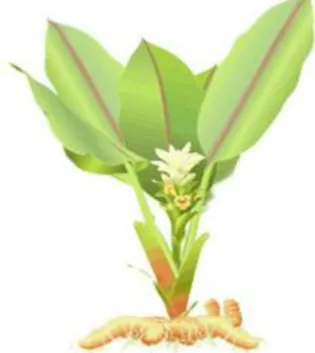
Turmeric is the rhizome or underground stem of ginger like plant. The plant is an herbaceous perrineal, 60-90 cm high with a short stem tufted leaf (Fig. 1). Its flowers are yellow, between 10-15 cm in length and they group together in dense spikes, which appear from the end of spring until the middle session. No fruits are known for this plant.
Fig. 1: Curcuma longa (Turmeric) Plant
The whole turmeric rhizome, with a rough, segmented skin. The rhizome is yellowish-brown with a dull orange interior that looks bright yellow when powdered. Rhizome measures 2.5-7.0 cm (in length), and 2.5 cm (in diameter) with small tuber branching off. Turmeric held a place of honor in Indian traditional ayurvedic medicine.
In ayurvedic, it was prescribed for the treatment of many medical problems ranging from constipation to skin diseases. It was used as digestive aid and treatment for fever, inflammation, wounds, infections, dysentery, arthritis, injuries, trauma, jaundice and other liver problems.
In Unani turmeric is considered to be se fest herb of choice for all blood disorders since it purifies, stimulates and builds blood. To most people in India, from housewives to Himalayan hermits, turmeric affectionately called the ‘KITCHEN QUEEN’, the main spice of kitchen. Long term use in turmeric, tulsi and triphala can be likened to a short term Pancha Karma treatment. Turmeric is relatively broad spectrum antifungal1.
Review Article
ABSTRACT
Turmeric is a very important spice in India, which is obtained from rhizomes of plant Curcuma longa, a member of the Zingiberaceae family. Turmeric forms a part of most Indian curry powder. It is a natural antiseptic. The spice is sometimes also called the ‘Indian saffron’ thanks to its brilliant colour. Components of turmeric are named curcuminoids, which include mainly curcumin (deferulolylmethane), demethoxycurcumin and bis demethoxycurcumin. Turmeric with its active principles curcumin and curcuminoids seems to be much more than merely a yellow colorant for Indian curries. Due to its extra-ordinary molecular structure it shows strong anti-oxidative, as well as anti-inflammatory properties. It is extensively used for imparting color and flavor to the food in the traditional Indian medicine, turmeric powder is used to treat a wide variety of diseases.
PLANT PROFILE Common name
Curcuma, Indian saffron
Synonyms
Sanskrit : Ameshta English : Indian saffron Hindi : Haldi
Bengali : Halud Telugu : Haridra Tamil : Ameshta French : Curcuma Indonesian : Kunyit Malay : Kunyitbasah
Biological source
Turmeric obtained from the rhizome of Curcuma
longa linn. (curcuma domestic valeton)
belonging to the natural order Zingiberaceae.
Geographical source
It is commonly found in Cambodia, China, India, Nepal, Indonesia, Madagascar, Malaysia, Philippines and Vietnam.
Indian scenario
It is commonly found in West Bengal, Tamil Nadu, and Maharashtra and also in Madras. Family: Zingiberaceae
Taxonomy
Scientific Name : Curcuma longa Kingdom : Plantae
Sub-kingdom : Tracheobionta -Vascular plants Super division : Spermatophyta Division : Magnoliophyta – Flowering plants Class : Lilliopsida- monocotyledons Subclass : Zingiberidae Order : Zingiberales Genus : Curcuma L. curcuma Species : Curcuma longa L
NATURAL HABITAT
Curcumin is the principal curcuminoid of the popular Indian spice turmeric, which is a member of the ginger family (Zingiberaceae). The other two curcuminoids are desmethoxycurcumin and bis-desmethoxycurcumin. The curcuminoids are poly phenols and are responsible for the yellow color of turmeric. Curcumin can exist in at least two tautomeric forms, keto and enol. The enol form is more energetically stable in the solid phase and in solution. Curcumin can be used for boron quantification in the so-called curcumin method. It reacts with boric acid forming a red
colored compound, known as rosocyanine. Curcumin is brightly yellow colored and may be used as a food coloring. 2
MACROSCOPIC CHARACTERS
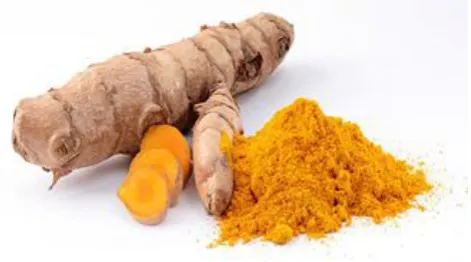
The main rhizome (round turmeric) is ovate or pear-shaped, up to 4 cm. long and 3cm thick (Fig. 2). The upper part is encircled by leaf-scars; the lower part is marked by scars of the secondary rhizomes and roots. It is sliced before drying. The secondary rhizomes (long turmeric) are 0.5-1.5 cm. thick, elongated, indistinctly ringed, simple or sparingly branched.
Fig. 2: Turmeric Rhizome & Powder
The vitality of the rhizomes is destroyed by scalding previous to drying, thus converting the grains into lumps, to which the mixture of oil and curcumin liberated from the oil cells imparts a deep yellow color. As found on the market, the product is hard, tough, and sinks in water. The fractured surface is smooth, waxy, of an orange-yellow color. As appears in cross section, the rind is thicker than in ginger, constituting almost one-quarter of the thickness of the rhizome. It cannot be removed by scraping.
MICROSCOPIC CHARACTERS
The transverse section of turmeric rhizomes shows the outmost 4 to 6 layers of brick shaped parenchymatous cork, followed by cork cabin. The cortex onsets of thin walled rounded parenchymatous cells containing scattered vascular bundies. Oleo-resin cells with brownish vascular bundles are present in cortex and are collateral. Vascular bundles in pith region are scattered forming discontinuous ring under endodermis. Endodermis is well marked and starch grains (5 to 15 in diameter) are abundant. 3,4
CHEMICAL CONSTITUENTS
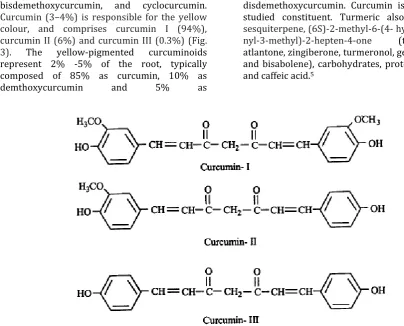
bisdemethoxycurcumin, and cyclocurcumin. Curcumin (3–4%) is responsible for the yellow colour, and comprises curcumin I (94%), curcumin II (6%) and curcumin III (0.3%) (Fig. 3). The yellow-pigmented curcuminoids represent 2% -5% of the root, typically composed of 85% as curcumin, 10% as demthoxycurcumin and 5% as
disdemethoxycurcumin. Curcumin is the well-studied constituent. Turmeric also contains: sesquiterpene, (6S)-2-methyl-6-(4- hydroxyphe-nyl-3-methyl)-2-hepten-4-one (turmerone, atlantone, zingiberone, turmeronol, germacrone, and bisabolene), carbohydrates, protein, resins, and caffeic acid.5
Fig. 3: Various Curcumins
TRADITIONAL USES
It is an essential substance to purify the gum resin of Commiphoramukul (Guggul) before it is made use of in ayurvedic formulations.
In veterinary medicine, turmeric is used to heal wounds or ulcers of animals.
Turmeric powder is used as an insect and ant repellant and sprinkled around the vessels to be protected.
Turmeric and its constituents play an important role in our life.
Turmeric has been found to have a hepatoprotective characteristic similar to that of silymarin.
The volatile oils and curcumin and turmeric exhibit potent anti-inflammatory effects.
Constituents of turmeric exert several protective effects on the gastrointestinal tract.
Constituents of turmeric affect Alzheimer’s disease.
Extract of turmeric suppresses symptoms associated with arthritis. Turmeric and its extract inhibit
angiogenesis.
Turmeric constituents can induce radioprotection.
Turmeric constituents inhibit proliferation of vascular smooth muscle cell.
Turmeric lower serum cholesterol levels.
Constituents of turmeric block the replication of HIV.6
Phyto-chemical screening of turmeric The phyto-chemical screening of petroleum ether extract, benzene extract, chloroform extract, acetone extract, methanol extract, ethanol extract and water extract was performed. The main chemical components are phenolic compounds and terpenoids have been identified, including di-aryl heptanoids (curcuminoids), diarylpentanoids, monoterpenes, sesquiterpenes, diterpenes, triterpenoids, alkaloids, and sterols. Curcumin (60%), desmethoxycurcumin, monodemethoxycurcumin,
(diferuloylmethane) (3-4%) is responsible for yellow color and comprises of curcumin I (94%), curcumin II (6%) and curcumin III (0.3%). Demethoxy and bis-demethoxy derivatives of curcumin have also been isolated. 7, 8
PHARMACOLOGICAL PROPERTIES Alzheimer’s disease
The ability of curcumin to scavenge free radicals has shown that it is able to outperform vitamin E (α-tocopherol) and tetrahydrocurcumin. The studies proved that the connection between curcumin and AD is the blood-brain-barrier (BBB), Curcumin was shown to be able to cross the BBB and prevent disruption and degradation of the BBB by preventing damage from ONOO. These studies suggest that curcumin may be able to serve as an indicator of Alzheimer’s disease by identifying A β plaques. Curcumin may inhibit A β plaque formation indirectly as well through macrophages.9
Analgesic activity
The powdered rhizome is effective in the treatment of sprain and inflammation. Turmeric paste mixed with a little lime and salt peter and applied hot is a popular application to sprains. 10
Anti-bacterial activity
Antibacterial activity of all leaf and rhizome extracts was tested. Promising use of turmeric rhizome essential oil as a novel natural effective antibacterial agent for the prevention and treatment of boils infections instead of the chemical drugs. Future clinical trials on the infected animals and humans (in vivo) are required to support the obtained outcomes. 11
Anti-cancerous activity
It is now proved that the antioxidants present in turmeric neutralize carcinogenic free radicals. It is evaluated and proved the anticancer activity of turmeric. The antioxidant and antitumor-promoting effects of curcumin were shown to be due to the induction of apoptosis in human leukemia cells, and this aspect was studied and positively proved. Supporting investigation on the specific inhibitory effect of cyclo oxygenase (cox) - 2 by dietary curcumin in human colon cancer cells. Curcumin has showed a suppressive effect on human breast carcinoma cells.12
Anti-coagulant property
The anticoagulation activity of curcumin has shown that curcumin extends the blood clotting times as proved by prothrombin time, thrombin time and activated partial thromboplastin time analysis in comparison with the control blood
sample. Curcumin and its derivative (bisdemethoxycurcumin) has prolonged activated partial thromboplastin time and prothrombin time significantly and inhibited thrombin and activated factor X activities.13
Anti-diabetic activity
Oral administration of the aqueous rhizome extract of Curcuma longa to the diabetic rats significantly reduced the level of TG, TC, and LDL and significantly increases the level of HDL. The results suggest that aqueous extract of
Curcuma longa rhizome possesses potential
therapeutic value in combating atherosclerosis, which is one of the major complications of diabetes by lowering serum lipids particularly total cholesterol, triglyceride and low density lipoprotein level.14
Anti-fertility activity
Turmeric is reported to possess anti-fertility activity, as observed in experimental animals. Petroleum ether and aqueous extracts produced 100% anti-implantation effects in rats at a dose of 200 mg/kg body weight fed orally on the first to seventh day of pregnancy. Studies showed the effect of curcumin as a potential vaginal contraceptive and found that it inhibited human sperm motility and had the potential for the development of novel intra vaginal contraceptive. The test results indicated that curcumin had a selective sperm-immobilizing effect in addition to a previously studied antihuman immunodeficiency virus (HIV) property. Investigation showed the contraceptive effect of turmeric in male albino rats and observed a reduction in sperm motility and density in treated group. Turmeric is supposed to have affected the androgen synthesis, either by inhibiting the Leydig cell function or hypothalamus pituitary axis, thereby inhibiting the spermatogenesis. 15
Anti-Hyper lipidemic
Turmeric, as well as curcumin, is reported to reduce the uptake of cholesterol from the gut and increase the high-density lipids (HDL) cholesterol and decrease low-density lipids (LDL) type. It can also inhibit the peroxidation of serum LDL, which can lead to atherosclerotic lesions. It is reported that the levels of serum cholesterol and liver cholesterol decreased to one-half, while cholesterol-fed rats were treated with curcumin. 16
Anti-inflammatory activity
anti-inflammatory action. It cures the etiological factors and pathological changes of inflammation. It was further reported that oral doses of curcumin possess significant anti-inflammatory action in both acute and chronic animal models.17
Antioxidant activity
Curcumin has been shown be a powerful scavenger of oxygen free radicals. Its antioxidant activity is comparable to vitamins C and E. It can protect lipids or hemoglobin from oxidation. It can significantly inhibit the generation of reactive oxygen species (ROS) such as H2O2, superoxide anions and nitrite radical generation by activated macrophages. Its derivatives, bis-demethoxycurcumin and demethoxycurcumin also have antioxidant activities.
Curcumin pre-treatment has been shown to decrease ischemia-induced oxidative stress and changes in the heart. An in vitro study measuring the effect of curcumin on an inducible stress protein, resulted in enhanced cellular resistance to oxidative damage.18
Cardio protective activity
Curcumin, the main bioactive compound in these plant extracts increases the cardiac glutathione content, suggesting that it may augment the action of these naturally occurring sulfhydryl groups to maintain membrane integrity with concomitant decrease of enzymes leakage from the cardiocytes, protection of cardiac tissue from damage.19
GIT protective activity
Turmeric is a traditionally used spice. In the digestive system, turmeric acts as a carminative and protective against intestinal gas formation. Turmeric acts as anti-flatulent, digestive, and stimulant due to its hot potency (as per ayurveda). It is reported to have anti-spasmodic activity, inhibiting excessive peristaltic movements of the intestine.20
Healing property, skin care
Oil of turmeric have proved to be antifungal, anti-protozoan, antiviral, and antibacterial. In a screening for antibiotic property, turmeric showed broad-spectrum antibacterial activity. Polyphenols, terpenoids present in curcumin fights against free radicals and its high antioxidant content is responsible for healiing property and protects skin.21
Hepatoprotective activity
Turmeric is considered good for afflictions of the liver. Turmeric is effective in treating
jaundice and is recommended in the diet of patients suffering from jaundice or even infective hepatitis. 22
Respiratory diseases
Turmeric is well accepted as a Kaphaharadrug (phlegmatic conditions are termed as “Kapha” and that which cures it is Kaphahara). Turmeric is anti-inflammatory and anti-purulent in nature. It is reported that volatile oil of turmeric as oral drug in a clinical trial was found very effective in the treatment.23
Rheumatoid Arthritis
In a preliminary double-blind, Randomized Controlled Trial (RCT), curcumin was compared to phenyl butazone in patients with rheumatoid arthritis. Curcumin given at 1200 mg daily was effective in improving joint swelling, morning stiffness, and walking time.24
CONCLUSION
Turmeric is one of the most important and powerful plant on earth and is being used as a natural wonder by the ancient people of India. Turmeric is proving beneficial in the treatment of many different health conditions from cancer to Alzheimer's disease. Turmeric may play a vital role in fighting against HIV/AIDS. Curcumin can modulate multiple cellular targets, hence it became an attractive object of research. More extensively well controlled clinical trials are now needed to fully investigate its potential. Because of the presence of curcuinoids. Curcumin has proven chemo preventive and therapeutic potential and potent pharmacological activities of turmeric at in-vivo and in-vitro which made it a nature’s precious drug.
REFERENCES
1. Jaggi Lal. Turmeric, Curcumin and Our Life: A Review. Bulletin of Environment, Pharmacology and Life Sciences. 2012;(17):11-17.
2. Roshan Prasad Yadav and Gaur Tarun. Versatility of turmeric: A review the golden spice of life. Journal of Pharmacognosy and Phytochemistry. 2017;6(1):41-46.
3. Winton A. Microscopy of vegetable foods. 1916; 2nd edition.
4. Culbreth.D. A manual of Materia medica and pharmacology. 1917; 6th edition. 5. Pfeiffer E, Hhle S, Solyom AS and
6. Khanna MM. Turmeric - Nature's precious gift. Current Sci. 1999;76(10): 1351-1356.
7. Arutselvi R, Balasaravanan T, Ponmurugan P, Muthu Saranji N and Suresh P. Phytochemical screening and comparative study of anti microbial activity of leaves and rhizomes of turmeric varieties. Asian Journal of Plant Science and Research. 2012;2 (2):212-219.
8. Trishna D, Shanthi BM, Mrinmoy B, Mohanty JP and Shildibyendu. Evaluation of phytochemical screening and anti-fertility activity of curcuma aromatica salisb. International Journal of Pharmaceutical Sciences and research. 2010;1(1).
9. Edward C Yao and Lei Xue. Therapeutic effects of curcumin on Alzheimer’s disease. Advances in Alzheimer’s disease. 2014;3:145-159.
10. Sangita Jogdand and Jagruti Bhattacharjee. Evaluation of analgesic activity of turmeric (Curcuma longa Linn.) in Wister rats. International Journal of Basic and Clinical Pharmacology. 2017;6 (3):568-571 11. Negi PS, Jayaprakasha GK, Jagan Mohan
Rao L and Sakariah KK. Antibacterial activity of turmeric oil: a byproduct from curcumin manufacture. J Agric Food Chem. 1999;47:4297-4300. 12. Kuttan R, Bhanumati P, Nirmala K and
George MC. Potential anticancer activity of turmeric (Curcuma longa). Cancer Lett. 1985;29:197-202.
13. Wannee Jiraungkoorskul, Kanjana Sirisidthi, Piya Kosai and Kanitta Jiraungkoorskul. Antithrombotic activity of turmeric (Curcuma longa): A review Indian J Agric Res. 2016;50(2): 101-106.
14. Olatunde A, Joel EB, Tijjani H, Obidola SM and Luka CD. Anti-diabetic Activity of Aqueous Extract of Curcuma longa (Linn) Rhizome in Normal and Alloxan-Induced Diabetic Rats. Researcher. 2014;6(7):58-65.
15. Purohit A and Meenakshi B. Contraceptive effect of Curcuma longa
(L.) in male albino rat. Asian J Andrology. 2004;6:71-74.
16. Patil TN and Srinivasan M. Hypo cholesteremic effect of Curcumin in induced-hyper cholesteremic rats. Ind J Exp Biol. 1971;9:167-169.
17. Srimal RC, Khanna KM and Dhawan BN. A preliminary report on anti-inflammatory activity of curcumin. Ind J Pharmacol. 1971;3:10.
18. Ahsan H, Parveen N, Khan NU and Hadi SM. Pro-oxidant, anti-oxidant and cleavage activities on DNA of curcumin and its derivatives demethoxycurcumin and bisdemethoxycurcumin. Chem Biol Interact. 1999;121(2):161-175.
19. Eman M El-Sayed, Amal S Abd El-azeem, Abeer A Afify, Manal H Shabana and Hanaa H Ahmed. Cardioprotective effects of Curcuma longa L. extracts against doxorubicin-induced cardiotoxicity in rats. Journal of Medicinal Plants Research. 2011;5(17):4049-4058.
20. Dasgupta SR, Sinha M, Sahana CC and Mukherjee BP. A study of the effect of an extract of Curcuma longa Linn. On experimental gastric ulcers in animals. Ind J Pharmacol. 1969;1:49-54.
21. Bonte F, Noel-Hudson MS, Wepierre J and Meybeck A. Protective effect of curcuminoids on epidermal skin cells under free oxygen radical stress. Planta Medica. 1997;63:265-266.
22. Song EK. Diarylheptanoids with free radical scavenging and hepato protective activity in-vitro from Curcuma longa. Planta Med. 2001;67: 876- 877.
23. Lee CJ, Lee JH, Scok JH, Hur GM, Park YC and Scol IC. Effects of baicalein, berberine, curcumin and hespiridin on mucin release from airway goblet cells. Planta Med. 2003;69:523-526.