Tampere University of Technology
Publications 460
Anssi Klapuri
Signal Processing Methods for the Automatic
Transcription of Music
Thesis for the degree of Doctor of Technology to be presented with due permission for public examination and criticism in Auditorium S1, at Tampere University of Technology, on the 17th of March 2004, at 12 o clock noon.
Tampere 2004
ISBN 952-15-1147-8 ISSN 1459-2045
Copyright © 2004 Anssi P. Klapuri.
All rights reserved. No part of this work may be reproduced, stored in a retrieval system, or transmitted, in any form or by any means, electronic, mechanical, photocopying, recording or otherwise, without prior permission from the author.
[email protected] http://www.cs.tut.fi/~klap/
Abstract
Signal processing methods for the automatic transcription of music are developed in this the-sis. Music transcription is here understood as the process of analyzing a music signal so as to write down the parameters of the sounds that occur in it. The applied notation can be the tradi-tional musical notation or any symbolic representation which gives sufficient information for performing the piece using the available musical instruments. Recovering the musical notation automatically for a given acoustic signal allows musicians to reproduce and modify the origi-nal performance. Another principal application is structured audio coding: a MIDI-like repre-sentation is extremely compact yet retains the identifiability and characteristics of a piece of music to an important degree.
The scope of this thesis is in the automatic transcription of the harmonic and melodic parts of real-world music signals. Detecting or labeling the sounds of percussive instruments (drums) is not attempted, although the presence of these is allowed in the target signals. Algorithms are proposed that address two distinct subproblems of music transcription. The main part of the thesis is dedicated to multiple fundamental frequency (F0) estimation, that is, estimation of the F0s of several concurrent musical sounds. The other subproblem addressed is musical meter
estimation. This has to do with rhythmic aspects of music and refers to the estimation of the
regular pattern of strong and weak beats in a piece of music.
For multiple-F0 estimation, two different algorithms are proposed. Both methods are based on an iterative approach, where the F0 of the most prominent sound is estimated, the sound is can-celled from the mixture, and the process is repeated for the residual. The first method is derived in a pragmatic manner and is based on the acoustic properties of musical sound mixtures. For the estimation stage, an algorithm is proposed which utilizes the frequency relationships of simultaneous spectral components, without assuming ideal harmonicity. For the cancelling stage, a new processing principle, spectral smoothness, is proposed as an efficient new mecha-nism for separating the detected sounds from the mixture signal.
The other method is derived from known properties of the human auditory system. More spe-cifically, it is assumed that the peripheral parts of hearing can be modelled by a bank of band-pass filters, followed by half-wave rectification and compression of the subband signals. It is shown that this basic structure allows the combined use of time-domain periodicity and fre-quency-domain periodicity for F0 extraction. In the derived algorithm, the higher-order (unre-solved) harmonic partials of a sound are processed collectively, without the need to detect or estimate individual partials. This has the consequence that the method works reasonably accu-rately for short analysis frames. Computational efficiency of the method is based on calculat-ing a frequency-domain approximation of the summary autocorrelation function, a physiologically-motivated representation of sound.
Both of the proposed multiple-F0 estimation methods operate within a single time frame and arrive at approximately the same error rates. However, the auditorily-motivated method is superior in short analysis frames. On the other hand, the pragmatically-oriented method is “complete” in the sense that it includes mechanisms for suppressing additive noise (drums) and for estimating the number of concurrent sounds in the analyzed signal. In musical interval and chord identification tasks, both algorithms outperformed the average of ten trained musicians.
For musical meter estimation, a method is proposed which performs meter analysis jointly at three different time scales: at the temporally atomic tatum pulse level, at the tactus pulse level which corresponds to the tempo of a piece, and at the musical measure level. Acoustic signals from arbitrary musical genres are considered. For the initial time-frequency analysis, a new technique is proposed which measures the degree of musical accent as a function of time at four different frequency ranges. This is followed by a bank of comb filter resonators which per-form feature extraction for estimating the periods and phases of the three pulses. The features are processed by a probabilistic model which represents primitive musical knowledge and per-forms joint estimation of the tatum, tactus, and measure pulses. The model takes into account the temporal dependencies between successive estimates and enables both causal and non-causal estimation. In simulations, the method worked robustly for different types of music and improved over two state-of-the-art reference methods. Also, the problem of detecting the beginnings of discrete sound events in acoustic signals, onset detection,is separately discussed.
Keywords—Acoustic signal analysis, music transcription, fundamental frequency estimation,
Preface
This work has been carried out during 1998–2004 at the Institute of Signal Processing, Tam-pere University of Technology, Finland.
I wish to express my gratitude to Professor Jaakko Astola for making it possible for me start working on the transcription problem, for his help and advice during this work, and for his contribution in bringing expertise and motivated people to our lab from all around the world. I am grateful to Jari Yli-Hietanen for his invaluable encouragement and support during the first couple of years of this work. Without him this thesis would probably not exist. I would like to thank all members, past and present, of the Audio Research Group for their part in making a motivating and enjoyable working community. Especially, I wish to thank Konsta Koppinen, Riitta Niemistö, Tuomas Virtanen, Antti Eronen, Vesa Peltonen, Jouni Paulus, Matti Ryynänen, Antti Rosti, Jarno Seppänen, and Timo Viitaniemi, whose friendship and good humour has made designing algorithms fun.
I wish to thank the staff of the Acoustic Laboratory of Helsinki University of Technology for their special help. Especially, I wish to thank Matti Karjalainen and Vesa Välimäki for setting an example to me both as researchers and as persons.
The financial support of the Tampere Graduate School in Information Science and Engineering (TISE), the Foundation of Emil Aaltonen, Tekniikan edistämissäätiö, and the Nokia Founda-tion is gratefully acknowledged.
I wish to thank my parents Leena and Tapani Klapuri for their encouragement on my path through the education system and my brother Harri for his advice in research work.
My warmest thanks go to my wife for her support, love, and understanding during the intensive stages of putting this work together.
I can never express enough gratitude to my Lord and Saviour, Jesus Christ, for being the foun-dation of my life in all situations. I believe that God has created us in his image and put into us a similar desire to create things – for example transcription systems in this context. However, looking at the nature, its elegance in the best sense that a mathematician uses the word, I have become more and more aware that Father is quite many orders of magnitude ahead in engineer-ing, too.
God is faithfull, through whom you were called into fellowship with his son, Jesus Christ our Lord. –1.COR. 1:9
Tampere, March 2004 Anssi Klapuri
Contents
Abstract. . . i
Preface. . . iii
Contents . . . v
List of publications. . . vii
Abbreviations . . . ix
1 Introduction . . . 1
1.1 Terminology . . . 3
1.2 Decomposition of the music transcription problem . . . 3
Modularity of music processing in the human brain . . . 3
Role of internal models . . . 5
Mid-level data representations . . . 6
How do humans transcribe music? . . . 7
1.3 Scope and purpose of the thesis . . . 7
Relation to auditory modeling . . . 8
1.4 Main results of the thesis . . . 9
Multiple-F0 estimation system I . . . 9
Multiple-F0 estimation system II . . . 10
Musical meter estimation and sound onset detection . . . 11
1.5 Outline of the thesis . . . 11
2 Musical meter estimation . . . 13
2.1 Previous work . . . 14
Methods designed primarily for symbolic input (MIDI) . . . 14
Methods designed for acoustic input . . . 16
Summary . . . 17
2.2 Method proposed in Publication [P6] . . . 17
2.3 Results and criticism . . . 19
3 Approaches to single-F0 Estimation . . . 21
3.1 Harmonic sounds . . . 21
3.2 Taxonomy of F0 estimation methods . . . 23
3.3 Spectral-location type F0 estimators . . . 24
Time-domain periodicity analysis methods . . . 24
Harmonic pattern matching in frequency domain . . . 25
A shortcoming of spectral-location type F0 estimators . . . 26
3.4 Spectral-interval type F0 estimators . . . 26
3.5 “Unitary model” of pitch perception . . . 27
Periodicity of the time-domain amplitude envelope . . . 27
Unitary model of pitch perception . . . 28
Attractive properties of the unitary model . . . 29
4 Auditory-model based multiple-F0 estimator . . . 31
4.1 Analysis of the unitary pitch model in frequency domain . . . 31
Auditory filters (Step 1 of the unitary model) . . . 32
Flatted exponential filters . . . 34
Compression and half-wave rectification at subbands (Step 2 of the model) . . . . 36
Periodicity estimation and across-channel summing (Steps 3 and 4 of the model) 40 Algorithm proposed in [P4] . . . 42
Harmonic sounds: resolved vs. unresolved partials . . . 45
Overview of the proposed modifications . . . 46
Degree of resolvability . . . 50
Assumptions underlying the definition of . . . 53
Model parameters . . . 57
Reducing the computational complexity . . . 59
Multiple-F0 estimation by iterative estimation and cancellation . . . 61
Multiple-F0 estimation results . . . 65
5 Previous Approaches to Multiple-F0 Estimation . . . 69
5.1 Historical background and related work . . . 69
5.2 Approaches to multiple-F0 estimation . . . 70
Perceptual grouping of frequency partials . . . 72
Auditory-model based approach . . . 74
Emphasis on knowledge integration: Blackboard architectures . . . 74
Signal-model based probabilistic inference . . . 76
Data-adaptive techniques . . . 77
Other approaches . . . 77
6 Problem-Oriented Approach to Multiple-F0 Estimation . . . 79
6.1 Basic problems of F0 estimation in music signals . . . 79
6.2 Noise suppression . . . 80
6.3 Predominant-F0 estimation . . . 82
Bandwise F0 estimation . . . 83
Harmonic selection . . . 84
Determining the harmonic summation model . . . 85
Cross-band integration and estimation of the inharmonicity factor . . . 87
6.4 Coinciding frequency partials . . . 88
Diagnosis of the problem . . . 89
Resolving coinciding partials by the spectral smoothness principle . . . 90
Identifying the harmonics that are the least likely to coincide . . . 91
6.5 Criticism . . . 92
7 Conclusions and future work . . . 95
7.1 Conclusions . . . 95
Multiple-F0 estimation . . . 95
Musical meter estimation . . . 95
7.2 Future work . . . 96
Musicological models . . . 96
Utilizing longer-term temporal features in multiple-F0 estimation . . . 97
7.3 When will music transcription be a “solved problem”? . . . 98
Bibliography . . . 99
Appendices . . . 111
Author’s contribution to the publications . . . 111
Errata . . . 111
Publications . . . 113 λ2( )τ
List of publications
This thesis consists of the following publications and of some earlier unpublished results. The publications below are referred in the text as [P1], [P2], ..., [P6].
[P1] A. P. Klapuri, “Number theoretical means of resolving a mixture of several harmonic sounds,” In Proc. European Signal Processing Conference, Rhodos, Greece, 1998.
[P2] A. P. Klapuri, “Sound onset detection by applying psychoacoustic knowledge,” In Proc.
IEEE International Conference on Acoustics, Speech, and Signal Processing, Phoenix,
Ari-zona, 1999.
[P3] A. P. Klapuri, “Multipitch estimation and sound separation by the spectral smoothness principle,” In Proc. IEEE International Conference on Acoustics, Speech, and Signal
Processing, Salt Lake City, Utah, 2001.
[P4] A. P. Klapuri and J. T. Astola, “Efficient calculation of a physiologically-motivated repre-sentation for sound,” In Proc. 14th IEEE International Conference on Digital Signal
Processing, Santorini, Greece, 2002.
[P5] A. P. Klapuri, “Multiple fundamental frequency estimation based on harmonicity and spectral smoothness,” IEEE Trans. Speech and Audio Proc., 11(6), 804–816, 2003.
[P6] A. P. Klapuri, A. J. Eronen, and J. T. Astola, “Automatic estimation of the meter of acous-tic musical signals,” Tampere University of Technology, Institute of Signal Processing, Report 1–2004, Tampere, Finland, 2004.
Abbreviations
ACF Autocorrelation function.
ASA Auditory scene analysis.
CASA Computational auditory scene analysis.
DFT Discrete Fourier transform. Defined in (4.21) on page 38
EM Expectation-maximization.
ERB Equivalent rectangular bandwidth. Defined on page 33.
F0 Fundamental frequency. Defined on page 3.
FFT Fast Fourier transform.
flex Flatted-exponential (filter). Defined in (4.11) on page 35.
FWOC Full-wave (odd) vth-law compression. Defined on page 36.
HWR Half-wave rectification. Defined on page 27.
IDFT Inverse discrete Fourier transform.
MIDI Musical Instrument Digital Interface. Explained on page 1.
MPEG Moving picture experts group.
roex Rounded-exponential (filter). Defined in (4.2) on page 33.
SACF Summary autocorrelation function. Defined on page 28.
1 Introduction
Transcription of music is here defined as the process of analyzing an acoustic musical signal so
as to write down the parameters of the sounds that constitute the piece of music in question. Traditionally, written music uses note symbols to indicate the pitch, onset time, and duration of each sound to be played. The loudness and the applied musical instruments are not specified for individual notes but are determined for larger parts. An example of the traditional musical notation is shown in Fig. 1.
In a representational sense, music transcription can be seen as transforming an acoustic signal into a symbolic representation. However, written music is primarily a performance instruction, rather than a representation of music. It describes music in a language that a musician under-stands and can use to produce musical sound. From this point of view, music transcription can be viewed as discovering the “recipe”, or, reverse-engineering the “source code” of a music signal. The applied notation does not necessarily need to be the traditional musical notation but any symbolic representation is adequate if it gives sufficient information for performing a piece using the available musical instruments. A guitar player, for example, often finds it more con-venient to read chord symbols which characterize the note combinations to be played in a more general manner. In the case that an electronic synthesizer is used for resynthesis, a MIDI1file is an example of an appropriate representation.
A musical score does not only allow reproducing a piece of music but also making musically meaningful modifications to it. Changes to the symbols in a score cause meaningful changes to the music at a high abstraction level. For example, it becomes possible to change the arrange-ment (i.e., the way of playing and the musical style) and the instruarrange-mentation (i.e., to change, add, or remove instruments) of a piece. The relaxing effect of the sensomotoric exercise of per-forming and varying good music is quite a different thing than merely passively listening to a piece of music, as every amateur musician knows. To contribute to this kind of active attitude to music has been one of the driving motivations of this thesis.
Other applications of music transcription include
• Structured audio coding. A MIDI-like representation is extremely compact yet retains the identifiability and characteristics of a piece of music to an important degree. In structured audio coding, sound source parameters need to be encoded, too, but the bandwidth still stays around 2–3 kbit/s (see MPEG-4 document [ISO99]). An object-based representation is able to utilize the fact that music is redundant at many levels.
• Searching musical information based on e.g. the melody of a piece.
• Music analysis. Transcription tools facilitate the analysis of improvised music and the
man-1. Musical Instrument Digital Interface. A standard interface for exchanging performance data and parameters between electronic musical devices.
agement of ethnomusicological archives.
• Music remixing by changing the instrumentation, by applying effects to certain parts, or by selectively extracting certain instruments.
• Interactive music systems which generate an accompaniment to the singing or playing of a soloist, either off-line or in real-time [Rap01a, Row01].
• Music-related equipment, such as syncronization of light effects to a music signal.
A person without a musical education is usually not able to transcribe polyphonic music1, in which several sounds are playing simultaneously. The richer is the polyphonic complexity of a musical composition, the more the transcription process requires musical ear training2 and knowledge of the particular musical style and of the playing techniques of the instruments involved. However, skilled musicians are able to resolve even rich polyphonies with such an accuracy and flexibility that computational transcription systems fall clearly behind humans in performance.
Automatic transcription of polyphonic music has been the subject of increasing research inter-est during the last ten years. Before this, the topic was explored mainly by individual research-ers. The transcription problem is in many ways analogous to that of automatic speech recognition, but has not received a comparable academic or commercial interest. Larger-scale research projects have been undertaken at Stanford University [Moo75,77, Cha82,86a,86b], University of Michigan [Pis79,86, Ste99], University of Tokyo [Kas93,95], Massachusetts Institute of Technology [Haw93, Mar96a, 96b], Tampere University of Technology [Kla98, Ero01, Vii03, Pau03a, Vir03, Ryy04], Cambridge University [Hai01, Dav03], and University of London [Bel03, Abd_]. Doctoral theses on the topic have been prepared at least by Moorer [Moo75], Piszczalski [Pis86], Maher [Mah89], Mellinger [Mel91], Hawley [Haw93], Gods-mark [God98], Rossi [Ros98b], Sterian [Ste99], Bello [Bel03], and Hainsworth [Hai01, Hai_]. A more complete review and analysis of the previous work is presented in Chapter 5.
Despite the number of attemps to solve the problem, a practically applicable general-purpose transcription system does not exist at the present time. The most recent proposals, however, have achieved a certain degree of accuracy in transcribing limited-complexity polyphonic music [Kas95, Mar96b, Ste99, Tol00, Dav03, Bel03]. The typical limitations for the target sig-nals are that the number of concurrent sounds is limited (or, fixed) and the interference of drums and percussive instruments is not allowed. Also, the relatively high error rate of the sys-tems has reduced their practical applicability. Some degree of success for real-world music on CD recordings has been previously demonstrated by Goto [Got01]. His system aims at extract-ing the melody and the bass lines from complex music signals.
A few commercial transcription systems have been released [AKo01, Ara03, Hut97, Inn04, Mus01, Sev04] (see [Bui04] for a more comprehensive list). However, the accuracy of the pro-grams has been very limited. Surprisingly, even the transcription of single-voice singing is not a solved problem, as indicated by the fact that the accuracy of the “voice-input” functionalities in score-writing programs is not comparable to humans (see [Cla02] for a comparative evalua-tion of available monophonic transcribers). Tracking the pitch of a monophonic musical
pas-1. In this work, polyphonic refers to a signal where several sounds occur simultaneously. The word mono-phonic is used to refer to a signal where at most one note is sounding at a time. The terms monaural signal and stereo signal are used to refer to single-channel and two-channel audio signals, respectively. 2. The aim of ear training in music is to develop the faculty of discriminating sounds, recognizing musical
sage is practically a solved problem but quantization of the continuous track of pitch estimates into note symbols with discrete pitch and timing has turned out to be a very difficult problem for some target signals, particularly for singing. Efficient use of musical knowledge is neces-sary in order to “guess” the score behind a performed pitch track [Vii03, Ryy04]. The general idea of an automatic music transcription system was patented in 2001 [Ale01].
1.1 Terminology
Some terms have to be defined before going any further. Pitch is a perceptual attribute of sounds, defined as the frequency of a sine wave that is matched to the target sound in a psycho-acoustic experiment [Ste75]. If the matching cannot be accomplished consistently by human listeners, the sound does not have pitch [Har96]. Fundamental frequency is the corresponding physical term and is defined for periodic or nearly periodic sounds only. For these classes of sounds, fundamental frequency is defined as the inverse of the period. In ambiguous situations, the period corresponding to the perceived pitch is chosen.
A melody is a series of single notes arranged in a musically meaningful succession [Bro93b]. A
chord is a combination of three or more simultaneous notes. A chord can be consonant or
dis-sonant, depending on how harmonious are the pitch intervals between the component notes.
Harmony refers to the part of musical art or science which deals with the formation and
rela-tions of chords [Bro93b]. Harmonic analysis deals with the structure of a piece of music with regard to the chords of which it consists.
The term musical meter has to do with rhythmic aspects of music. It refers to the regular pat-tern of strong and weak beats in a piece of music. Perceiving the meter can be characterized as a process of detecting moments of musical stress in an acoustic signal and filtering them so that underlying periodicities are discovered [Ler83, Cla99]. The perceived periodicities (pulses) at different time scales together constitute the meter. Meter estimation at a certain time scale is taking place for example when a person taps foot to music.
Timbre, or, sound colour, is a perceptual attribute which is closely related to the recognition of
sound sources and answers the question “what something sounds like” [Han95]. Timbre is not explained by any simple acoustic property and the concept is therefore traditionally defined by exclusion: “timbre is the quality of a sound by which a listener can tell that two sounds of the same loudness and pitch are dissimilar” [ANS73]. The human timbre perception facility is very accurate and, consequently, sound synthesis is an important area of music technology [Roa96, Väl96, Tol98].
1.2 Decomposition of the music transcription problem
Automatic transcription of music comprises a wide area of research. It is useful to structurize the problem and to decomposing it into smaller and more tracktable subproblems. In this sec-tion, different strategies for doing this are proposed.
1.2.1 Modularity of music processing in the human brain
The human auditory system is the most reliable acoustic analysis tool in existence. It is there-fore reasonable to learn from its structure and function as much as possible. Modularity of a certain kind has been observed in the human brain. In particular, certain parts of music cogni-tion seem to be funccogni-tionally and neuro-anatomically isolable from the rest of the auditory
cog-nition [Per01,03, Zat02, Ter_]. There are two main sources of evidence: studies with brain-damaged patients and neurological imaging experiments in healthy subjects.
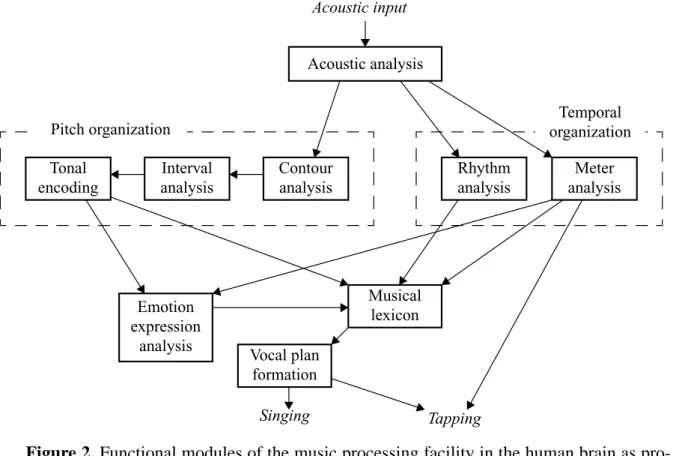
An accidental brain damage at the adult age may selectively affect musical abilities but not e.g. speech-related abilities, and vice versa. Moreover, studies of brain-damaged patients have revealed something about the internal structure of the music cognition system. Figure 2 shows the functional architecture that Peretz and colleagues have derived from case studies of specific music impairments in brain-damaged patients. The “breakdown pattern” of different patients was studied by representing them with specific music-cognition tasks, and the model in Fig. 2 was then inferred based on the assumption that a specific impairment may be due to a damaged processing component (box) or a broken flow of information (arrow) between components. The detailed line of argument underlying the model can be found in [Per01].
In Fig. 2, the acoustic analysis module is assumed to be common to all acoustic stimuli (not just music) and to perform segregation of sound mixtures into distinct sound sources. The sub-sequent two entities carry out pitch organization and temporal organization. These two are viewed as parallel and largely independent subsystems, as supported by studies of patients who suffer from difficulties to deal with pitch variations but not with temporal variations, or vice versa [Bel99, Per01]. In music performance or in perception, either of the two can be selec-tively lost [Per01]. The musical lexicon is characterized by Peretz et al. as containing represen-tations of all the musical phrases a person has heard during his or her lifetime [Per03]. In some cases, a patient cannot recognize familiar music but can still process musical information oth-erwise adequately.
Figure 2. Functional modules of the music processing facility in the human brain as
pro-posed by Peretz et al. (after [Per03]; only the parts related to music processing are repro-duced here). The model has been derived from case studies of specific impairments of musical abilities in brain-damaged patients [Per01, 03]. See text for details.
Acoustic input
Acoustic analysis
Rhythm
analysis analysisMeter Contour analysis Interval analysis Tonal encoding Pitch organization Musical lexicon Emotion expression
analysis Vocal plan
formation
Temporal organization
The main weakness of the studies with brain-damaged patients is that they are based on a rela-tively small number of cases. It is more common that an auditory disorder is global in the sense that it applies for all types of auditory events. The model in Fig. 2, for example, has been inferred based on approximately thirty patients only. This is particularly disturbing because the model in Fig. 2 corresponds “too well” to what one would predict based on the established tra-dition in music theory and music analysis [Ler83, Deu99].
Neuroimaging experiments in healthy subjects provide another important source of evidence concerning the modularity and localization of the cognitive functions. In particular, it is known that speech sounds and higher-level speech information are preferentially processed in the left auditory cortex, whereas musical sounds are preferentially processed in the right auditory cor-tex. Interestingly, however, when musical tasks involve specifically processing of temporal information (temporal synchrony or duration), the processing is associated with the left hemi-sphere [Zat02, Per01]. Also, Bella et al. suggest that in music, pitch organization takes place primarily in the right hemisphere and the temporal organization recruits more the left auditory cortex [Bel99]. As concluded both in [Zat02] and in [Ter_], the relative asymmetry between the two hemispheres is not bound to informational sound content but to the acoustic character-istics of the signals. Rapid temporal information is more common in speech, whereas accurate processing of spectral and pitch information is more important in music.
Zatorre et al. used functional imaging (positron emission tomography) to examine the response of human auditory cortex to spectral and temporal variation [Zat01]. In the experiment, the amount of temporal and spectral variation in the acoustic stimulus was parametrized. As a result, responses to the increase in temporal variation were weighted towards the left, while responses to the increase in melodic/spectral variation were weighted towards the right. In [Zat02], the authors review different types of evidence which support the conclusion that there is a relative specialization of the auditory cortices in the two hemispheres so that the left audi-tory cortex is specialized to a better temporal resolution and the right audiaudi-tory cortex to a better spectral resolution. Tervaniemi et al. review additional evidence from imaging experiments in healthy adult subjects and come basically to the same conclusion [Ter_].
In computational transcription systems, rhythm and pitch have most often been analyzed sepa-rately and using different data representations [Kas95, Mar96b, Dav03, Got96,00]. Typically, a better time resolution is applied in rhythm analysis and a better frequency resolution in pitch analysis. Based on the above studies, this seems to be justified and not only a technical artefact. The overall structure of transcription systems is often determined by merely pragmatic consid-erations. For example, temporal segmentation is performed prior to pitch analysis in order to allow the sizing and positioning of analysis frames in pitch analysis, which is typically the computationally more demanding stage [Kla01a, Dav03].
1.2.2 Role of internal models
Large-vocabulary speech recognition systems are critically dependent on language models, which represent linguistic knowledge about speech signals [Rab93, Jel97, Jur00]. The models can be of very primitive nature, for example merely tabulating the occurrence probabilities of different three-word sequences (N-gram models), or more complex, implementing part-of-speech tagging of words and syntactic inference within sentences.
Musicological information is equally important for the automatic transcription of
sequentially can be straightforwardly estimated, since large databases of written music exist in an electronic format [Kla03a, Cla04]. More complex rules governing music are readily availa-ble in the theory of music and composition and some of this information has already been quantified to computational models [Tem01].
Thus another way of structurizing the transcription problem is according to the sources of
knowledge available. Pre-stored internal models constitute a source of information in addition
to the incoming acoustic waveform. The uni-directional flow of information in Fig. 2 is not realistic in this sense but represents a data-driven view where all information flows bottom-up: information is observed in an acoustic waveform, combined to provide meaningful auditory cues, and passed to higher level processes for further interpretation. Top-down processing uti-lizes internal high-level models of the input signals and prior knowledge concerning the prop-erties and dependencies of the sound events in it [Ell96]. In this approach, information also flows top-down: analysis if performed in order to justify or cause a change in the predictions of an internal model.
Some transcription systems have applied musicological models or sound source models in the analysis [Kas95, Mar96b, God99], and some systems would readily enable this by replacing certain prior distributions by musically informed ones [Got01, Dav03]. Temperley has pro-posed a very comprehensive rule-based system for modelling the cognition of basic musical structures, taking an important step towards quantifying the higher-level rules that govern musical structures [Tem01]. More detailed introduction to the previous work is presented in Chapter 5.
Utilizing diverse sources of knowledge in the analysis raises the issue of how to integrate the information meaningfully. In automatic speech recognition, probabilistic methods have been very successful in this respect [Rab93, Jel97, Jur00]. Statistical methods allow representing uncertain knowledge and learning from examples. Also, probabilistic models have turned out to be a very fundamental “common ground” for integrating knowledge from diverse sources. This will be discussed in Sec. 5.2.3.
1.2.3 Mid-level data representations
Another efficient way of structurizing the transcription problem is through so-called mid-level
representations. Auditory perception may be viewed as a hierarchy of representations from an
acoustic signal up to a conscious percept, such as a comprehended sentence of a language [Ell95,96]. In music transcription, a musical score can be viewed as a high-level representa-tion. Intermediate abstraction level(s) are indispensable since the symbols of a score are not readily visible in the acoustic signal (transcription based on the acoustic signal directly has been done in [Dav03]). Another advantage of using a well-defined mid-level representation is that it structurizes the system, i.e., acts as an “interface” which separates the task of computing the mid-level representation from the higher-level inference that follows.
A fundamental mid-level representation in human hearing is the signal in the auditory nerve. Whereas we know rather little about the exact mechanisms of the brain, there is much wider consensus about the mechanisms of the physiological and more peripheral parts of hearing. Moreover, precise auditory models exist which are able to approximate the signal in the audi-tory nerve [Moo95a]. This is a great advantage, since an important part of the analysis takes place already at the peripheral stage.
The mid-level representations of different music transcription systems are reviewed in Chapter 5 and a summary is presented in Table 7 on page 71. Along with auditory models, a representation based on sinusoid tracks has been a very popular choice. This reprerentation is introduced in Sec. 5.2.1. An excellent review of the mid-level representations for audio content analysis can be found in [Ell95].
1.2.4 How do humans transcribe music?
One more approach to structurize the transcription problem is to study the conscious
transcrip-tion process of human musicians and to inquire their transcriptranscrip-tion strategies. The aim of this is
to determine the sequence of actions or processing steps that leads to the transcription result. Also, there are many concrete questions involved. Is a piece processed in one pass or listened through several times? What is the duration of an elementary audio chunk that is taken into consideration at a time? And so forth.
Hainsworth has conducted interviews with musicians in order to find out how they transcribe [Hai02, personal communication]. According to his report, the transcription proceeds sequen-tially towards increasing detail. First, the global structure of a piece is noted in some form. This includes an implicit detection of style, instruments present, and rhythmic context. Sec-ondly, the most dominant melodic phrases and bass lines are transcribed. In the last phase, the inner parts are examined. These are often heard out only with the help from the context gener-ated at the earlier stages and by applying the priorly gained musical knowledge of the individ-ual. Chordal context was often cited to be used as an aid to transcribing the inner parts. This suggests that harmonic analysis is an early part of the process. About 50% of the respondees used musical instrument as an aid, mostly as a means of reproducing notes for comparison with the original (most others were able to do this in their heads via “mental rehearsal”).
In [Hai02], Hainsworth points out certain characteristics of the above-described method. First, the process is sequential rather than concurrent. Secondly, it relies on the human ability to attend to certain parts of a sonic spectrum while selectively ignoring others. Thirdly, informa-tion from the early stages is used to inform later ones. The possibility of feedback from the later stages to the lower levels should be considered [Hai02].
1.3 Scope and purpose of the thesis
This thesis is concerned with the automatic transcription of the harmonic and melodic parts of real-world music signals. Detecting or labeling the sounds of percussive (drum) instruments is not attempted but an interested reader is referred to [Pau03a,b, Gou01, Fiz02, Zil02]. However, the presence of drum instruments is allowed. Also, the number of concurrent sounds is not restricted. Automatic recognition of musical instruments is not addressed in this thesis but an interested reader is referred to [Mar99, Ero00,01, Bro01].
Algorithms are proposed that address two different subproblems of music transcription. The main part of this thesis is dedicated to what is considered to be the core of the music transcrip-tion problem: multiple fundamental frequency (F0) estimatranscrip-tion. The term refers to the estima-tion of the fundamental frequencies of several concurrent musical sounds. This corresponds most closely to the “acoustic analysis” module in Fig. 2. Two different algorithms are proposed for multiple-F0 estimation. One is derived from the principles of human auditory perception and is described in Chapter 4. The other is oriented towards more pragmatic problem solving and is introduced in Chapter 6. The latter algorithm has been originally proposed in [P5].
Musical meter estimation is the other subproblem addressed in this work. This corresponds to
the “meter analysis” module in Fig. 2. Contrary to the flow of information in Fig. 2, however, the meter estimation algorithm does not utilize the analysis results of the multiple-F0 algo-rithm. Instead, the meter estimator takes the raw acoustic signal as input and uses a filterbank emulation to perform time-frequency analysis. This is done for two reasons. First, the multiple-F0 estimation algorithm is computationally rather complex whereas meter estimation as such can be done much faster than in real-time. Secondly, meter estimation benefits of a relatively good time resolution (23ms Fourier transform frame is used in the filterbank emulation) whereas multiple-F0 estimator works adequately for 46ms frames or longer. The drawbacks of this basic decision are discussed in Sec. 2.3.
Musical meter estimation and multiple-F0 estimation are complementary to each other. The musical meter estimator generates a temporal framework which can be used to divide the input signal into musically meaningful temporal segments. Also, musical meter can be used to per-form time quantization, since musical events can be assumed to begin and end at segment boundaries. The multiple-F0 estimator, in turn, indicates which notes are active at each time but is not able to decide the exact beginning or end times of individual note events. Imagine a time-frequency plane where time flows from left to right and different F0s are arranged in ascending order on the vertical axis. On top of this plane, the multiple-F0 estimator produces horizontal lines which indicate the probabilities of different notes to be active as a function of time. The meter estimator produces a framework of vertical “grid lines” which can be used to decide the onset and offset times of discrete note events.
Metrical information can also be utilized in adjusting the positions and lengths of the analysis frames applied in multiple-F0 estimation. This has the practical advantage that multiple-F0 estimation can be performed for a number of discrete segments only and does not need to be performed in a continuous manner for a larger number of overlapping time frames. Also, by positioning multiple-F0 analysis frames according to metrical boundaries minimizes the inter-ference from sounds that do not occur concurrently, since event beginnings and ends are likely to coincide with the metrical boundaries. This strategy was used in producing the transcription demonstrations available at [Kla03b].
The focus of this thesis is in bottom-up signal analysis methods. Musicological models and top-down processing are not considered, except that the proposed meter estimation method uti-lizes some primitive musical knowledge in performing the analysis. The title of this work,
“sig-nal processing methods for...”, indicates that the emphasis is laid on the acoustic sig“sig-nal
analysis part. The musicological models are more oriented towards statistical methods [Vii03, Ryy04], rule-based inference [Tem01], or artificial intelligence techniques [Mar96a].
1.3.1 Relation to auditory modeling
A lot of work has been carried out to model the human auditory system [Moo95a, Zwi99]. Unfortunately, important parts of the human hearing are located in the central nervous system and can be studied only indirectly. Psychoacoustics is the science that deals with the percep-tion of sound. In a psychoacoustic experiment, the relapercep-tionships between an acoustic stimulus and the resulting subjective sensation is studied by presenting specific tasks or questions to human listeners [Ros90, Kar99a].
The aim of this thesis is to develop practically applicable solutions to the music transcription problem and not to propose models of the human auditory system. The proposed methods are
ultimately justified by their practical efficiency and not by their psychoacoustic plausibility or the ability to model the phenomena in human hearing. The role of auditory modeling in this work is to help towards the practical goal of solving the transcription problem. At the present time, the only reliable transcription system we have is the ears and the brain of a trained musi-cian.
Psychoacoustically motivated methods have turned out to be among the most successful ones in audio content analysis. This is why the following chapters make an effort to examine the proposed methods in the light of psychoacoustics. It is often difficult to see what is an impor-tant processing principle in human hearing and what is merely an unimporimpor-tant detail. Thus, departures from psychoacoustic principles are carefully discussed.
It is important to recognize that a musical notation is primarily concerned with the (mechani-cal) sound production and not with perception. As pointed out by Scheirer in [Sch96], it is not likely that note symbols would be the representational elements in music perception or that there would be an innate transcription facility in the brain. The very task of music transcription differs fundamentally from that of trying the predict the response that the music arises in a human listener. For the readers interested in the latter problem, the doctoral thesis of Scheirer is an excellent starting point [Sch00].
Ironically, the perceptual intentions of music directly oppose those of its transcription. Breg-man pays attention to the fact that music often wants the listener to accept simultaneous sounds as a single coherent sound with its own striking properties. The human auditory system has a tendency to segregate a sound mixture to the physical sources, but orchestration is often called upon to oppose these tendencies [Bre90,p.457–460]. For example, synchronous onset times and harmonic pitch relations are used to knit together sounds so that they are able to represent higher-level forms that could not be expressed by the atomic sounds separately. Because the human perception handles such entities as a single object, music may recruit a large number of harmonically related sounds (that are hard to transcribe or separate) without adding too much complexity to a human listener.
1.4 Main results of the thesis
The original contributions of this thesis can be found in Publications [P1]–[P6] and in Chapter 4 which contains earlier unpublished results. The main results are briefly summarized below.
1.4.1 Multiple-F0 estimation system I
Publications [P1], [P3], and [P5] constitute an entity. Publication [P5] is partially based on the results derived in [P1] and [P3].
In [P1], a method was proposed to deal with coinciding frequency components in mixture sig-nals. These are partials of a harmonic sound that coincide in frequency with the partials of other sounds and thus overlap in the spectrum. The main results were:
• An algorithm was derived that identifies the partials which are the least likely to coincide. • A weighted order-statistical filter was proposed in order to filter out coinciding partials
when a sound is being observed. The sample selection probabilities of different harmonic partials were set according to their estimated reliability.
In [P3], a processing principle was proposed for finding the F0s and separating the spectra of concurrent musical sounds. The principle, spectral smoothness, was based on the observation that the partials of a harmonic sound are usually close to each other in amplitude within one critical band. In other words, the spectral envelopes of real-world sounds tend to be smooth as a function of frequency. The contributions of Publication [P3] are the following.
• Theoretical and empirical evidence was presented to show the importance of the smooth-ness principle in resolving sound mixtures.
• Sound separation is possible (to a certain degree) without a priori knowledge of the sound sources involved.
• Based on the known properties of the peripheral hearing in humans [Med91], it was shown that the spectral smoothing takes a specific form in the human hearing.
• Three algorithms of varying complexity were described which implement the new principle. In [P5], a method was proposed for estimating the F0s of concurrent musical sounds within a single time frame. The method is “complete” in the sense that it included mechanisms for sup-pressing additive noise (drums) and for estimating the number of concurrent sounds in the ana-lyzed signal. The main results were:
• Multiple-F0 estimation can be performed reasonably accurately (compared with trained musicians) within a single time frame, without long-term temporal features.
• The taken iterative estimation and cancellation approach makes it possible to detect at least a couple of the most prominent F0s even in rich polyphonies.
• An algorithm was proposed which uses the frequency relationships of simultaneous spectral components to group them to sound sources. Ideal harmonicity was not assumed.
• A method was proposed for suppressing the noisy signal components due to drums. • A method was proposed for estimating the number of concurrent sounds in input signals.
1.4.2 Multiple-F0 estimation system II
Publication [P4] and Chapter 4 of this thesis constitute an entity. Computational efficiency of the method proposed in Chapter 4 is in part based on the results in [P4].
Publication [P4] is concerned with a perceptually-motivated representation for sound, called the summary autocorrelation function (SACF). An algorithm was proposed which calculates an approximation of the SACF in the frequency domain. The main results were:
• Each individual spectral bin of the Fourier transform of the SACF can be computed in O(K) time, i.e., in a time which is proportional to the analysis frame length K, given the complex Fourier transform of the wideband input signal.
• The number of distinct subbands in calculating the SACF does not need to be defined. The algorithm implements a model where one subband is centered on each discrete Fourier spectrum sample, thus approaching a continuous density of subbands (in Chapter 4, for example, 950 subbands are used). The bandwidths of the subbands need not be changed. In Chapter 4 of this thesis, a novel multiple-F0 estimation method is proposed. The method is derived from the known properties of the human auditory system. More specifically, it is assumed that the peripheral parts of hearing can be modelled by (i) a bank of bandpass filters and (ii) half-wave rectification (HWR) and compression of the time-domain signals at the sub-bands. The main results are:
• A practically applicable multiple-F0 estimation method is derived. In particular, the method works reasonably accurately in short analysis frames.
• It is shown that half-wave rectification at subbands amounts to the combined use of time-domain periodicity and frequency-time-domain periodicity for F0 extraction.
• Higher-order (unresolved) partials of a harmonic sound can be processed collectively. Esti-mation or detection of individual higher-order partials is not robust and should be avoided.
1.4.3 Musical meter estimation and sound onset detection
Publication [P2] proposed a method for onset detection, i.e., for the detection of the beginnings of discrete sound events in acoustic signals. The main contributions were:
• A technique was described to cope with sounds that exhibit onset imperfections, i.e., the amplitude envelope of which does not rise monothonically.
• A psychoacoustic model of intensity coding was applied in order to find parameters which allow robust one-by-one detection of onsets for a wide range of input signals.
In [P6], a method for musical-meter analysis was proposed. The analysis was performed jointly at three different time scales: at the temporally atomic tatum pulse level, at the tactus pulse level which corresponds to the tempo of a piece, and at the musical measure level. The main contributions were:
• The proposed method works robustly for different types of music and improved over two state-of-the-art reference methods in simulations.
• A technique was proposed for measuring the degree of musical accent as a function of time. The technique was partially based on the ideas in [P2].
• The paper confirmed an earlier result of Scheirer [Sch98] that comb-filter resonators are suitable for metrical pulse analysis. Four different periodicity estimation methods were evaluated and, as a result, comb-filters were the best in terms of simplicity vs. performance. • Probabilistic models were proposed to encode prior musical knowledge regarding well-formed musical meters. The models take into account the dependencies between the three pulse levels and implement temporal tying between successive meter estimates.
1.5 Outline of the thesis
This thesis is organized as follows. Chapter 2 considers the musical meter estimation problem. A review of the previous work in this area is presented. This is followed by a short introduction to Publication [P6] where a novel method for meter estimation is proposed. Technical details and simulation results are not described but can be found in [P6]. A short conclusion is given to discuss the achieved results and future work.
Chapter 3 introduces harmonic sounds and the different approaches that have been taken to the estimation of the fundamental frequency of isolated musical sounds. A model of the human pitch perception is introduced and its benefits from the point of view of F0 estimation are dis-cussed.
Chapter 4 elaborates the pitch model introduced in Chapter 3 and, based on that, proposes a previously unpublished method for estimating the F0s of multiple concurrent musical sounds. Also, Chapter 4 presents background material which serves as an introduction to [P4].
Chapter 5 reviews previous approaches to multiple-F0 estimation. Because this is the core problem in music transcription, the chapter can also be seen as an introduction to the potential approaches to music transcription in general.
multiple-F0 estimation. The method has been originally published in [P5] and is “complete” in the sense that it includes mechanisms for suppressing additive noise and for estimating the number of concurrent sounds in the input signal. These are needed in order to process real-world music signals. Introduction to Publications [P1] and [P3] is given in Sec. 6.4. An epilogue in Sec. 6.5 presents some criticism of the method.
2 Musical meter estimation
This chapter reviews previous work on musical meter estimation and serves as an introduction to Publication [P6]. The concept musical meter was defined in Sec. 1.1. Meter analysis is an essential part of understanding music signals and an innate cognitive ability of humans even without musical education. Virtually anybody is able to clap hands to music and it is not unu-sual to see a two-year old child swaying in time with music. From the point of view of music transcription, meter estimation amounts to temporal segmentation of music according to cer-tain criteria.
Musical meter is a hierarchical structure, consisting of pulse sensations at different levels (time scales). In this thesis, three metrical levels are considered. The most prominent level is the
tac-tus, often referred to as the foot tapping rate or the beat. Following the terminology of [Ler83],
we use the word beat to refer to the individual elements that make up a pulse. A musical meter can be illustrated as in Fig. 3, where the dots denote beats and each sequence of dots corre-sponds to a particular pulse level. By the period of a pulse we mean the time duration between successive beats and by phase the time when a beat occurs with respect to the beginning of the piece. The tatum pulse has its name stemming from “temporal atom” [Bil93]. The period of this pulse corresponds to the shortest durational values in music that are still more than inci-dentally encountered. The other durational values, with few exceptions, are integer multiples of the tatum period and onsets of musical events occur approximately at a tatum beat. The
musical measure pulse is typically related to the harmonic change rate or to the length of a
rhythmic pattern. Although sometimes ambiguous, these three metrical levels are relatively well-defined and span the metrical hierarchy at the aurally most important levels. Tempo of a piece is defined as the rate of the tactus pulse. In order that a meter would make sense musi-cally, the pulse periods must be slowly-varying and, moreover, each beat at the larger levels must coincide with a beat at all the smaller levels.
The concept phenomenal accent is important for meter analysis. Phenomenal accents are events that give emphasis to a moment in music. Among these are the beginnings of all discrete sound events, especially the onsets of long pitch events, sudden changes in loudness or timbre, and harmonic changes. Lerdahl and Jackendoff define the role of phenomenal accents in meter perception compactly by saying that “the moments of musical stress in the raw signal serve as cues from which the listener attempts to extrapolate a regular pattern” [Ler83,p.17].
Automatic estimation of the meter alone has several applications. A temporal framework facil-itates the cut-and-paste operations and editing of music signals. It enables synchronization with light effects, video, or electronic instruments, such as a drum machine. In a disc jockey application, metrical information can be used to mark the boundaries of a rhythmic loop or to
96 97 98 99 100 101 102
Tatum Tactus Measure
Figure 3. A musical signal with three metrical levels illustrated (reprinted from [P6]).
synchronize two or more percussive audio tracks. Meter estimation for symbolic (MIDI) data is required in time quantization, an indispensable subtask of score typesetting from keyboard input.
2.1 Previous work
The work on automatic meter analysis originated from algorithmic models which tried to explain how a human listener arrives at a particular metrical interpretation of a piece, given that the meter is not explicitly spelled out in music [Lee91]. The early models performed meter estimation for symbolic data, presented as an artificial impulse pattern or as a musical score [Ste77, Lon82, Lee85, Pov85]. In brief, all these models can be seen as being based on a set of
rules that are used to define what makes a musical accent and to infer the most natural meter.
The rule system proposed by Lerdahl and Jackendoff in [Ler83] is the most complete, but is described in verbal terms only. An extensive comparison of the early models has been given by Lee in [Lee91], and later augmented by Desain and Honing in [Des99].
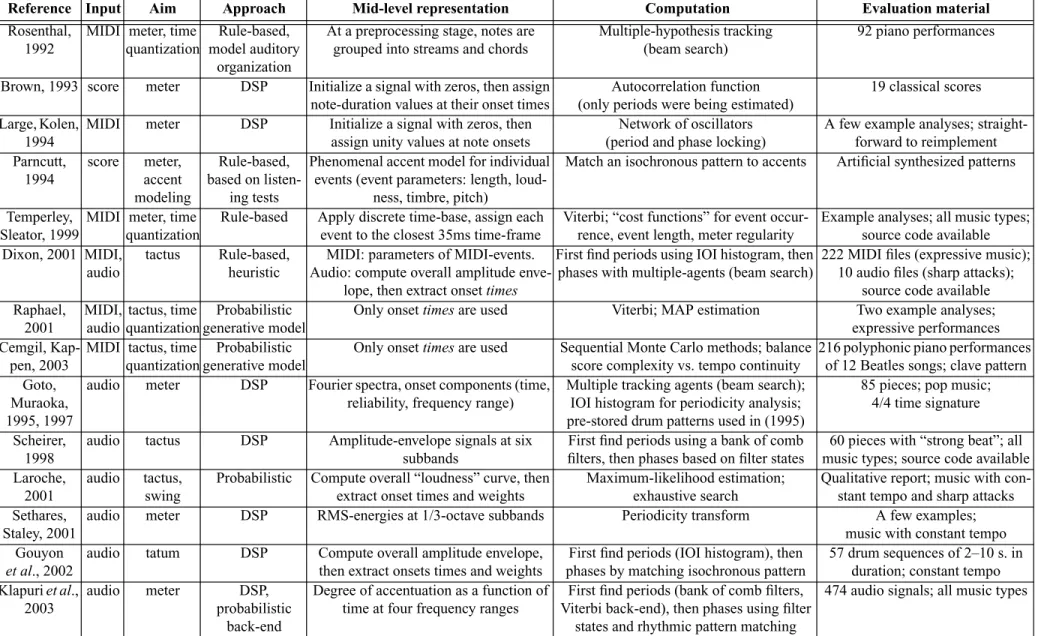
Table 1 lists characteristic attributes of more recent meter analysis systems. The systems can be classified into two main categories according to the type of input they process. Some algo-rithms are designed for symbolic (MIDI) input whereas others process acoustic signals. The column, “evaluation material”, gives a more specific idea of the musical material that the sys-tems have been tested on. Another defining characteristic of different syssys-tems is the aim of the meter analysis. Many algorithms do not analyze meter at all time scales but at the tactus level only. Some others produce useful side-information, such as quantization of the onset and offset times of musical events. The columns “approach”, “mid-level representation” and “computa-tion” in Table 1 attempt to summarize the technique that is used to achieve the analysis result. More or less arbitrarily, three different approaches are discerned, one based on a set of rules, another employing a probabilistic model, and the third deriving the analysis methods mainly from the signal processing domain. Mid-level representations refer to the data representations that are used between the input and the final analysis result. The column “computation” sum-marizes the strategy that is applied to search the correct meter among all possible meters.
2.1.1 Methods designed primarily for symbolic input (MIDI)
Rosenthal has proposed a system which processes realistic piano performances in the form of MIDI files. His system attempted to emulate the human rhythm perception, including meter perception [Ros92]. Notable in his approach is that other auditory functions are taken into account, too. During a preprocessing stage, notes are grouped into melodic streams and chords, and this information is utilized later on. Rosenthal applied a set of rules to rank and prune com-peting meter hypotheses and conducted a beam search to track multiple hypotheses through time. The beam-search strategy was originally proposed for pulse tracking by Allen and Dan-nenberg in [All90].
Parncutt has proposed a detailed model of meter perception based on systematic listening tests [Par94]. His algorithm computes the salience (weigth) of different metrical pulses based on a quantitative model for phenomenal accents and for pulse salience.
Apart from the rule-based models, a straightforward signal-processing oriented approach was taken by Brown who performed metrical analysis of musical scores using the autocorrelation function [Bro93a]. The scores were represented as a time-domain signal (sampling rate
2M
USICAL
METER
ESTIMATION
Table 1: Characteristics of some meter estimation systems
Reference Input Aim Approach Mid-level representation Computation Evaluation material
Rosenthal,
1992 MIDI meter,timequantization model auditoryRule-based, organization
At a preprocessing stage, notes are
grouped into streams and chords Multiple-hypothesis tracking(beam search) 92 piano performances Brown, 1993 score meter DSP Initialize a signal with zeros, then assign
note-duration values at their onset times (only periods were being estimated)Autocorrelation function 19 classical scores Large,Kolen,
1994 MIDI meter DSP Initialize a signal with zeros, thenassign unity values at note onsets (period and phase locking)Network of oscillators A few example analyses; straight-forward to reimplement Parncutt,
1994 score accentmeter, modeling
Rule-based, based on
listen-ing tests
Phenomenal accent model for individual events (event parameters: length,
loud-ness, timbre, pitch)
Match an isochronous pattern to accents Artificial synthesized patterns Temperley,
Sleator, 1999 MIDI meter,timequantization Rule-based Apply discrete time-base, assign eachevent to the closest 35ms time-frame Viterbi; “cost functions” for event occur-rence, event length, meter regularity Example analyses; all music types;source code available Dixon, 2001 MIDI,
audio tactus Rule-based,heuristic Audio: compute overall amplitude enve-MIDI: parameters of MIDI-events. lope, then extract onsettimes
First find periods using IOI histogram,then
phases with multiple-agents (beam search) 222 MIDI files (expressive music);10 audio files (sharp attacks); source code available Raphael,
2001 MIDI,audio quantizationtactus,timegenerative modelProbabilistic Only onset
times are used Viterbi; MAP estimation Two example analyses;
expressive performances Cemgil,
Kap-pen, 2003 MIDI tactus,timequantizationgenerative modelProbabilistic Only onsettimes are used Sequential Monte Carlo methods; balancescore complexity vs. tempo continuity 216 polyphonic piano performancesof 12 Beatles songs; clave pattern Goto,
Muraoka, 1995, 1997
audio meter DSP Fourier spectra,onset components (time,
reliability, frequency range) Multiple tracking agents (beam search);IOI histogram for periodicity analysis; pre-stored drum patterns used in (1995)
85 pieces; pop music; 4/4 time signature Scheirer,
1998 audio tactus DSP Amplitude-envelope signals at sixsubbands filters, then phases based on filter statesFirst find periods using a bank of comb music types; source code available60 pieces with “strong beat”; all Laroche,
2001 audio tactus,swing Probabilistic Compute overall “loudness” curve,thenextract onset times and weights Maximum-likelihood estimation;exhaustive search Qualitative report; music with con-stant tempo and sharp attacks Sethares,
Staley, 2001 audio meter DSP RMS-energies at 1/3-octave subbands Periodicity transform music with constant tempoA few examples; Gouyon
et al., 2002
audio tatum DSP Compute overall amplitude envelope,
then extract onsets times and weights phases by matching isochronous patternFirst find periods (IOI histogram), then 57 drum sequences of 2–10 s. induration; constant tempo Klapuriet al., audio meter DSP, Degree of accentuation as a function of First find periods (bank of comb filters, 474 audio signals; all music types
200Hz), where each individual note was represented as an impulse at the position of the note onset time and weighted by the duration of the note. Pitch information was not used. Large and Kolen associated meter perception with resonance and proposed an “entrainment” oscillator which adjusts its period and phase to an incoming pattern of impulses, located at the onsets of musical events [Lar94].
As a part of a larger project of modeling the cognition of basic musical structures, Temperley and Sleator proposed a meter estimation algorithm for arbitrary MIDI files [Tem99,01]. The algorithm was based on implementing the preference rules verbally described in [Ler83], and produced the whole metrical hierarchy as output. Dixon proposed a rule-based system to track the tactus pulse of expressive MIDI performances [Dix01]. Also, he introduced a simple onset detector to make the system applicable for audio signals. The methods works quite well for MIDI files of all types but has problems with audio files which do not contain sharp attacks. The source codes of both Temperley’s and Dixon’s systems are publicly available for testing. Cemgil and Kappen developed a probabilistic generative model for the event times in expres-sive musical performances [Cem01, 03]. They used the model to infer a hidden continuous tempo variable and quantized ideal note onset times from observed noisy onset times in a MIDI file. Tempo tracking and time quantization were performed simultaneously so as to bal-ance the smoothness of tempo deviations versus the complexity of the resulting quantized score. The model is very elegant but has the drawback that it processes only the onset times of events, ignoring duration, pitch, and loudness information. In many ways similar Bayesian model has been independently proposed by Raphael who has also demonstrated its use for acoustic input [Rap01a,b].
2.1.2 Methods designed for acoustic input
Goto and Muraoka were the first to present a meter-tracking system which works to a reasona-ble accuracy for audio signals [Got95,97a]. Only popular music with 4/4 time signature was considered. The system operates in real time and is based on an architecture where multiple agents track alternative meter hypotheses. Beat positions at the larger levels were inferred by detecting certain drum sounds [Got95] or chord changes [Got97]. Gouyon et al. proposed a system for estimating the tatum pulse in percussive audio tracks with constant tempo [Gou02]. The authors computed an inter-onset interval histogram and applied the two-way mismatch method of Maher [Mah94] to find the tatum (“temporal atom”) which best explained multiple harmonic peaks in the histogram. Laroche used a straightforward probabilistic model to esti-mate the tempo and swing1 of audio signals [Lar01]. Input to the model was provided by an onset detector which was based on differentiating an estimated “overall loudness” curve. Scheirer proposed a method for tracking the tactus pulse of music signals of any kinds, pro-vided that they had a “strong beat” [Sch98]. Important in Scheirer’s approach was that he did not detect discrete onsets or sound events as a middle-step, but performed periodicity analysis directly on the half-wave rectified differentials of subband power envelopes. Periodicity at each subband was analyzed using a bank of comb-filter resonators. The source codes of Scheirer’s system are publicly available for testing. Since 1998, an important way to categorize acoustic-input meter estimators has been to determine whether the systems extract discrete events or
1. Swing is a characteristic of musical rhythms most commonly found in jazz. Swing is defined in [Lar01] as a systematic slight delay of the second and fourth quarter-beats.
onset times as a middle-step or not. The meter estimator of Sethares and Staley is in many ways similar to Scheirer’s method, with the difference that a periodicity transform was used for periodicity analysis instead of a bank of comb filters [Set01].
2.1.3 Summary
To summarize, most of the earlier work on meter estimation has concentrated on symbolic (MIDI) data and typically analyzed the tactus pulse only. Some of the systems ([Lar94], [Dix01], [Cem03], [Rap01b]) can be immediately extended to process audio signals by employing an onset detector which extracts the beginnings of discrete acoustic events from an audio signal. Indeed, the authors of [Dix01] and [Rap01b] have introduced an onset detector themselves. Elsewhere, onset detection methods have been proposed that are based on using an auditory model [Moe97], subband power envelopes [P2], support vector machines [Dav02], neural networks [Mar02], independent component analysis [Abd03], or complex-domain unpredictability [Dux03]. However, if a meter estimator has been originally developed for symbolic data, the extended system is usually not robust to diverse acoustic material (e.g. clas-sical vs. rock music) and cannot fully utilize the acoustic cues that indicate phenomenal accents in music signals.
There are a few basic problems that a meter estimator needs to address to be successful. First, the degree of musical accentuation as a function of time has to be measured. In the case of audio input, this has much to do with the initial time-frequency analysis and is closely related to the problem of onset detection. Some systems measure accentuation in a continuous manner [Sch98, Set01], whereas others extract discrete events [Got95,97, Gou02, Lar01]. Secondly, the periods and phases of the underlying metrical pulses have to be estimated. The methods which detect discrete events as a middle step have often used inter-onset interval histograms for this purpose [Dix01, Got95,97, Gou02]. Thirdly, a system has to choose the metrical level which corresponds to the tactus or some other specially designated pulse level. This may take place implicitly, or by using a prior distribution for pulse periods [Par94], or by applying rhyth-mic pattern matching [Got95]. Tempo halving or doubling is a symptom of failing to do this.
2.2 Method proposed in Publication [P6]
The aim of the method proposed in [P6] is to estimate the meter of acoustic musical signals at three levels: at the tactus, tatum, and measure-pulse levels. The target signals are not restricted to any particular music type but all the main genres, including classical and jazz music, are rep-resented in the validation database.
An overview of the method is shown in Fig. 4. For the time-frequency analysis part, a new technique is proposed which aims at measuring the degree of accentuation in music signals. The technique is robust to diverse acoustic material and can be seen as a synthesis and general-ization of two earlier state-of-the-art methods [Got95] and [Sch98]. In brief, preliminary
time-frequency analysis is conducted using a quite large number of subbands and by
meas-uring the degree of spectral change at these channels. Then, adjacent bands are combined to
arrive at a smaller number of “registral accent signals” for which periodicity
analy-sis is carried out. This approach has the advantage that the frequency resolution suffices to detect harmonic changes but periodicity analysis takes place at wider bands. Combining a cer-tain number of adjacent bands prior to the periodicity analysis improves the analysis accuracy. Interestingly, neither combining all the channels before periodicity analysis, , nor
ana-b0>20 3≤c0≤5
lyzing periodicity at all channels, , is an optimal choice but using a large number of
bands in the preliminary time-frequency analysis (we used ) and three or four
regis-tral channels leads to the most reliable analysis.
Periodicity analysis of the registral accent signals is performed using a bank of comb filter res-onators very similar to those used by Scheirer in [Sch98]. Figure 5 illustrates the energies of the comb filters as a function of their feedback delay, i.e., period, . The energies are shown for two types of artificial signals, an impulse train and a white-noise signal. It is important to notice that all resonators that are in rational-number relations to the period of the impulse train (24 samples) show response to it. This turned out to be important for meter analysis. In the case of an autocorrelation function, for example, only integer multiples of 24 come up and, in order to achieve the same meter estimation performance, an explicit postprocessing step (“enhanc-ing”) is necessary where the autocorrelation function is progressively decimated and summed with the original autocorrelation function.
Periods Filter states
Figure 4. Overview of the meter estimation method. The two intermediate data
represen-tations are registral accent signals at band c and metrical pulse strengths for
resonator period at time n. (Reprinted from [P6].)
vc( )n s(τ,n) τ Time-frequency analysis Comb filter resonators Meter Music signal vc( )n s(τ,n) Combine Probabilistic model for pulse periods Phases Phase model c0 = b0 b0 = 36 c0 0 24 48 72 96 0 0.2 0.4 0.6 0.8 1 0 24 48 72 96 0 0.2 0.4 0.6 0.8 1 0 24 48 72 96 0 0.2 0.4 0.6 0.8 1 0 24 48 72 96 0 0.2 0.4 0.6 0.8 1
Figure 5. Output energies of comb filter resonators as a function of their feedback delay
(period) . The energies are shown for an impulse train with a period-length 24 samples (left) and for a white noise signal (right). Upper panels show the raw output energies and the lower panels the energies after a specific normalization. (Reprinted from [P6].)
τ
Delayτ(samples) Delayτ(samples)
Ener
gy

![Figure 13. (a) Illustration of Fletcher’s experiment. See text for details. (b) Idea of the notched-noise method which has been used to determine the shape of the auditory filter response (after [Pat76])](https://thumb-us.123doks.com/thumbv2/123dok_us/1039672.2637668/45.892.159.816.103.569/figure-illustration-fletcher-experiment-details-determine-auditory-response.webp)