ADVERTISING CREATIVITY IN CHINA: AN EXAMINATION OF CHINESE INDUSTRY PERCEPTIONS AND CONSUMER RESPONSES
TO ADVERTISING CREATIVITY
Julie Anne Bilby
Master of Business (Marketing) Bachelor of Arts (Visual Communication)
School of Economics, Finance and Marketing College of Business
RMIT University
August 2014
A thesis submitted in fulfillment of the requirements for the degree of Doctor of Philosophy from the Royal Melbourne Institute of Technology
ii DECLARATION
I certify that except where due acknowledgement has been made, the work is that of the researcher alone; the work has not been submitted previously, in whole or part, to qualify for any other academic award; the content is the result of work which has been carried out since the official commencement date of the approved research program; any editorial work, paid or unpaid, carried out by a third party is acknowledged; and ethics procedures and guidelines have been followed.
Julie Bilby August 2014
iii ACKNOWLEDGMENTS
From the outset, this research has been a joy and a privilege - made possible by the generous help and support of countless people - both at RMIT and beyond.
I owe an enormous debt of gratitude to my colleagues in the School of Media and Communication (RMIT) for their constant support, especially when I was away doing fieldwork or writing up. Also to Mrs Guosheng Chen, Dr Lynne Li and others in the School of Global and Urban Social Sciences for their unwavering encouragement and practical help.
In addition, I thank the RMIT School of Economics, Finance and Marketing for providing funding and resources that made so many things possible – especially my data collection in China. I have also had the very best of supervisors in Associate Professor Mike Reid and Professor Linda Brennan - I cannot begin to express my thanks to you both.
I have valued the wise counsel of many, including Professor Felix Mavondo, Professor Harmen Oppewal and Dr Jiemiao Chen at Monash University; Professor Mark Uncles and others at the University of NSW. I am also grateful for the generous advice of academics at Fudan University, Shanghai Jiaotong University, Shanghai University and the Shanghai Institute of Foreign Trade in China.
One of the highlights of conducting this research was the opportunity to meet and work with many talented and passionate advertising professionals in China. Their generosity, candour and kindness was amazing. In particular, I thank Tim Broadbent, Rod Campbell and Kunal Sinha. There are also many who cannot be named in this thesis for the sake of confidentiality, but I am deeply indebted to them all.
Throughout my research journey, I encountered many organisations doing innovative and wonderful things in China. One such organisation is BrainJuicer. Through their interest in my research project, and willingness to conduct my consumer surveys on a pro bono basis, Han Zantingh, Nathan Waechter and the BrainJuicer team made it possible to gauge consumer sentiment in hitherto untapped regions of China. And to do it faster and more economically than anyone dreamed possible.
iv Finally, I thank all my family and friends for their patient encouragement - and for
constantly reminding me that there is life beyond academia. Special thanks to Chris, Alastair, Gemma and Pippa. See, it wasn't so bad after all, was it?
v In loving memory of my nephew, Joseph Jon Shields (2005–2013),
vi PUBLICATIONS
The following publications include aspects of the material and results presented within this thesis.
Bilby, J. (2011), 'Advertising creativity in China: the moderating effect of cultural uncertainty avoidance on consumers’ need for cognitive closure', University of Nottingham, Ningbo: Creativity, Globalisation and Chinese Cities Workshop, Shanghai, China
Bilby, J. (2013), 'The future of Chinese advertising creativity: Practitioner insights into the evolution of advertising communication in a changing environment', International Communication Association (ICA) Regional Conference, Shanghai, China
Bilby, J. (2013), 'Advertising creativity in China: the moderating effect of culture and individual creativity on consumer processing of creative advertising', Doctoral Colloquim, Australia and New Zealand Marketing Academy Conference, Auckland, New Zealand
Bilby, J. (2014), 'The future of Chinese advertising creativity from a practitioner perspective', Asian Society of Management and Marketing Research Conference, Abu Dhabi, UAE
Bilby, J. & Reid, M. (2014), 'The Future of Advertising in China: Practitioner Insights into the Evolution of Chinese Advertising Creativity', Journal of Advertising Research, pending second review
vii TABLE OF CONTENTS
CHAPTER ONE – INTRODUCTION ... 4
1.1 Background To The Research ... 4
1.2 Research Problem, Research Questions And Contribution ... 7
1.3 Justification For The Research ... 7
1.4 Methodology ... 9
1.4.1 Qualitative Research Phase ... 9
1.4.2 Quantitative Research Phase ... 10
1.5 Outline Of The Thesis ... 10
1.6 Definitions ... 12
1.7 Delimitations Of Research Scope ... 14
1.8 Conclusion To The Chapter ... 14
CHAPTER TWO – LITERATURE REVIEW ... 15
2.1 Introduction To The Chapter ... 15
2.2 Advertising Creativity ... 16
2.2.1 Defining advertising creativity ... 18
2.2.2 Measuring advertising creativity ... 19
2.2.2.1 Divergence and relevance ... 20
2.2.3 Impact of advertising creativity on consumers ... 21
2.2.4 Culture and advertising creativity ... 22
2.3 Information Processing And Persuasion ... 22
2.3.1 Dual-process models ... 23
2.3.2 Information processing and advertising persuasion ... 23
2.3.3 Information processing and personality traits ... 24
2.3.3.1 Desire to postpone closure ... 25
2.3.4 Influence of culture on persuasion and consumer processing ... 25
2.4 Individual Creativity ... 27
2.4.1 Defining individual creativity ... 28
2.4.1.1 Creativity and intelligence ... 29
2.4.1.2 Creativity or innovation ... 30
2.4.1.3 Everyday creativity ... 30
2.4.2 Consumer creativity ... 30
2.4.3 Characteristics and measures of individual creativity ... 31
viii
2.4.4 Creativity across cultures ... 36
2.4.4.1 Chinese perceptions of creativity ... 37
2.5 Cultural Values ... 38
2.5.1 Culture and cultural values defined ... 38
2.5.2 Cultural values in advertising research ... 40
2.5.3 Cultural uncertainty avoidance ... 40
2.5.3.1 China and uncertainty avoidance ... 41
2.5.3.2 Heterogeneous versus homogenous views of culture ... 45
2.5.4 Measuring uncertainty avoidance ... 45
2.5.5 China’s city tiers - segmentation in a Chinese context ... 46
2.5.5.1 Media consumption across city tiers ... 48
2.6 Summary of the chapter ... 48
CHAPTER THREE – CONCEPTUAL MODEL ... 50
3.1 Introduction to the chapter ... 50
3.2 Research questions ... 51
3.3 Conceptual model ... 54
3.4 Ad creativity as antecedent for information processing ... 55
3.4.1 Cognitive processing and the impact of advertising creativity ... 56
3.4.2 Affective processing and the impact of ad creativity ... 58
3.5 Moderators ... 59
3.5.1 Uncertainty avoidance and consumer processing ... 59
3.5.2 Individual creativity and consumer processing ... 61
3.6 The role and influence of Chinese city tiers ... 62
3.7 Conative responses to ad processing ... 63
3.7.1 Viewing intentions ... 64
3.7.2 Purchase intentions ... 64
3.8 Summary of the chapter ... 64
CHAPTER FOUR – METHODOLOGY ... 67
4.1 Introduction to the chapter ... 67
4.2 Research approach ... 67
4.2.1 Theoretical paradigm ... 67
4.2.2 Mixed methods approach ... 68
4.3 Unit of analysis ... 69
4.4 Research design ... 69
4.5 Stage 1 - Literature review ... 72
ix
4.6 Stage 2 – Qualitative research ... 72
4.6.1 Sampling procedure ... 73
4.6.1.1 Sample selection ... 73
4.6.1.2 Sample size ... 74
4.6.2 Data collection process ... 74
4.6.2.1 Practitioner interviews ... 74
4.6.3 Analytical method for qualitative research outcomes ... 75
4.6.3.1 Grounded theory ... 75
4.6.3.2 Coding and thematic analysis ... 76
4.6.4 Standards of quality and verification ... 77
4.6.5 Conclusions from qualitative research ... 77
4.7 Stage 3 – Quantitative research ... 78
4.7.1 Data collection and administration process ... 78
4.7.1.1 Quasi experimental research ... 78
4.7.1.2 Administration of the survey ... 79
4.7.2 Sampling ... 80
4.7.2.1 Sample selection ... 80
4.7.2.2 Sample size ... 80
4.7.3 Response bias issues and resolution ... 81
4.7.3.1 Manipulation checks ... 81
4.7.3.2 Common method bias ... 82
4.7.3.3 Order effects ... 83
4.7.4 Measurement scale development ... 83
4.7.4.1 Operationalisation of constructs ... 83
4.7.4.2 Multi-item measures ... 84
4.7.5 Survey design and development ... 85
4.7.5.1 Development of online instrument ... 85
4.7.5.2 Questionnaire language and translation ... 86
4.7.5.3 Choice of advertising medium for survey instrument ... 86
4.7.5.4 Pretesting the survey ... 87
4.7.5.5 Questionnaire design – main study ... 89
4.7.5.6 Structure and sequencing ... 90
4.8 Data analysis ... 90
4.8.1 Data preparation ... 91
4.8.2 Data screening ... 91
4.8.2.1 Demographic characteristics of respondents ... 92
x
4.8.2.3 Outliers ... 92
4.8.2.4 Assumptions of multivariate analysis ... 93
4.8.2.5 Multicollinearity and singularity ... 94
4.8.3 Factor analysis ... 95
4.8.4 Reliability ... 96
4.8.5 Specification of formative and reflective measurement models ... 96
4.8.6 Validity ... 98
4.8.6.1 Content validity ... 98
4.8.6.2 Construct validity ... 98
4.8.7 Confirmatory Factor Analysis (CFA) ... 99
4.8.7.1 Measurement model assessment ... 100
4.8.7.2 Goodness of fit measures ... 100
4.8.7.3 Formative model assessment ... 101
4.8.8 Measurement invariance assessment ... 102
4.9 Hypothesis testing ... 103
4.9.1 Multiple regression ... 104
4.9.2 Test of moderation effects ... 104
4.9.3 Test of Structural Relationships ... 105
4.9.3.1 Overall advertising creativity as interaction variable ... 105
4.9.3.2 Multigroup comparison ... 106
4.10 Ethics and confidentiality ... 106
4.10.1 Phase One – qualitative practitioner interviews ... 107
4.10.2 Phase Two – quantitative consumer research ... 107
4.10.2.1 Pretests ... 107
4.10.2.2 Main study ... 107
4.11 Summary of the chapter ... 108
CHAPTER FIVE – QUALITATIVE RESEARCH RESULTS AND DISCUSSION ... 109
5.1 Introduction to the chapter ... 109
5.2 Overview of advertising creativity in China ... 109
5.3 Demographic characteristics of surveyed respondents ... 112
5.4 Results and key themes ... 114
5.4.1 Practitioner definitions of creativity, and creativity in a Chinese context ... 116
5.4.2 Client attitudes towards creativity ... 117
5.4.3 Client attitudes towards lower tier consumers ... 118
5.4.4 Finding a Chinese advertising voice ... 119
xi
5.5.1 Changing economic environment ... 121
5.5.2 Changing cultural, political and social environment ... 122
5.5.3 China’s tiered cities ... 122
5.5.4 Client-agency relationships ... 124
5.5.5 Need for innovation in consumer research ... 125
5.5.5.1 Intra-cultural research agenda ... 126
5.6 Summary of chapter ... 126
CHAPTER SIX – QUANTITATIVE RESEARCH RESULTS AND DISCUSSION ... 128
6.1 Introduction to the chapter ... 128
6.2 Pretest results and measurement scale development ... 130
6.2.1 Pretest 1 – Determining sample advertisements ... 130
6.2.1.1 Creativity measures ... 130
6.2.1.2 Covariate measures ... 131
6.2.1.3 Product category and involvement ... 132
6.2.2 Pretest 2 – Measurement scale reliability ... 132
6.3 Demographic characteristics of surveyed respondents ... 133
6.4 Data screening and statistical analysis ... 135
6.4.1 Manipulation checks ... 136 6.4.2 Outliers ... 137 6.4.2.1 Univariate outliers ... 137 6.4.2.2 Multivariate outliers ... 137 6.4.3 Normality ... 138 6.4.4 Linearity ... 138 6.4.5 Homoscedasticity ... 138 6.4.6 Independence of errors ... 138 6.4.7 Multicollinearity ... 138
6.5 Exploratory Factor Analysis ... 141
6.5.1 Factor reliability and specification ... 144
6.6 Confirmatory Factor Analysis (CFA) ... 144
6.6.1 Goodness of fit ... 145
6.6.2 Construct validity ... 145
6.6.2.1 Advertising creativity ... 145
6.6.2.2 Positive affect, purchase intentions and viewing intentions ... 147
6.6.3 Formative measurement model assessment ... 149
6.6.4 Measurement invariance assessment ... 151
xii
6.6.4.2 City tiers ... 152
6.7 Hypothesis testing ... 152
6.7.1 Multiple regression analysis ... 153
6.7.2 Test of Structural Relationships ... 159
6.7.3 Test of moderation effects ... 163
6.7.3.1 Moderation effects of uncertainty avoidance ... 163
6.7.3.2 Moderation effects of individual creativity ... 165
6.7.3.3 Moderation effects of production values ... 166
6.7.4 Structural model with moderators ... 167
6.7.5 Multigroup analysis ... 169
6.8 Overview of key findings ... 172
6.9 Summary of the chapter ... 173
CHAPTER SEVEN – CONCLUSIONS AND IMPLICATIONS ... 175
7.1 Introduction to the chapter ... 175
7.2 Conclusions and key findings ... 176
7.3 Limitations of the study ... 184
7.4 Contributions of the study ... 186
7.4.1 Academic contributions ... 186 7.4.2 Managerial Implications ... 186 7.5 Future research ... 192 7.6 Concluding remarks ... 193 REFERENCES ... 195
xiii LIST OF TABLES
Table 2.1 Characteristics Of Creative Individuals ... 33
Table 2.2 Summary Of Cultural Conservatism Findings For China ... 43
Table 3.1 Summary Of Research Questions And Hypotheses To Be Examined ... 65
Table 4.1 Criterion For Goodness Of Fit Indices ... 101
Table 5.1 Characteristics Of Informants ... 112
Table 5.2 Summary Of Key Themes ... 114
Table 6.1 Quantitative Research Questions And Associated Hypotheses ... 128
Table 6.2 Participant Demographics ... 133
Table 6.3 Results Of Manipulation Checks – Main Study ... 136
Table 6.4 Multicollinearity Assessment ... 139
Table 6.5 Correlations – All Key Constructs ... 140
Table 6.6 Factor Analysis And Adequacy For Intention Scales ... 141
Table 6.7 Factor Analysis And Adequacy For Ad-Related Scales ... 142
Table 6.8 Factor Analysis And Adequacy For Processing Scales ... 142
Table 6.9 Factor Analysis And Adequacy For Psycho-Social Scales ... 143
Table 6.10 Summary Of Factor Reliability And Specification ... 144
Table 6.11 Internal Consistency, AVE And Correlation Matrix – Advertising Creativity ... 147
Table 6.12 Internal Consistency, AVE And Correlation Matrix – Positive Affect, Purchase And Viewing Intentions ... 148
Table 6.13 Goodness Of Fit – Desire To Postpone Closure Measurement Model ... 150
Table 6.14 Multigroup Cfa: Advertising Creativity By Product Category ... 151
Table 6.15 Multigroup Cfa - Key Variables By City Tier ... 152
Table 6.16 Model Summary Of Ad Creativity - DPC (Information Search) ... 153
Table 6.17 Model Summary Of Ad Creativity - DPC (Open Mindedness) ... 154
Table 6.18 Model Summary Of DPC - Viewing Intentions ... 155
Table 6.19 Model Summary Of DPC - Purchase Intentions ... 156
Table 6.20 Model Summary Of Ad Creativity - Positive Affect ... 157
Table 6.21 Model Summary Of Positive Affect – Viewing Intentions ... 158
Table 6.22 Model Summary Of Positive Affect – Purchase Intentions ... 159
Table 6.23 Goodness Of Fit Indicators – Integrated Structural Model ... 160
Table 6.24 Test Of Structural Model And Associated Hypotheses ... 162
Table 6.25 Moderation Effects Of Uncertainty Avoidance ... 164
Table 6.26 Moderation Effects Of Individual Creativity ... 165
xiv Table 6.28 Uncertainty Avoidance And Individual Creativity Differences Between Tiers ... 170 Table 6.29 Multiple Group Comparison Between High And Low Tier Cities In China ... 171 Table 6.30 Summary Of Hypothesis Testing ... 174
xv LIST OF FIGURES
Figure 1.1 Structure Of The Thesis ... 11
Figure 2.1 Literature Review Structure ... 16
Figure 3.1 Theoretical Domains ... 50
Figure 3.3 Structural Model From Yang And Smith (2009) ... 52
Figure 3.4 Conceptual Model With Moderators ... 55
Figure 4.1 Research Design ... 71
Figure 6.1 Measurement Model – Advertising Creativity ... 146
Figure 6.2 Measurement Model – Positive Affect, Purchase And Viewing Intentions ... 148
Figure 6.3 Formative Measurement Model – Desire To Postpone Closure ... 150
Figure 6.4 Integrated Structural Model ... 161
xvi LIST OF APPENDICES
Appendix A Summary of advertising creativity research ... 223
Appendix B Summary of key creativity research and scale/assessment developments ... 232
Appendix C Practitioner interview discussion guide ... 235
Appendix D Final questionnaire (English version) ... 237
Appendix E Pretest 1 questionnaire ... 243
Appendix F Sample advertisements ... 253
Appendix G Pretest 1 - Comparison of sample advertisements on creativity measures………….253
Appendix H Pretest 1 - Comparison of sample advertisements on covariate measures………….253
Appendix I Pretest 1 - Comparison of sample advertisements on involvement measures...…….253
Appendix J Pretest 2 questionnaire ... 255
Appendix K Pretest 2 - Reliability of key constructs ... 267
Appendix L Ethics approval – practitioner interviews ... 269
Appendix M Ethics approval – China fieldwork ... 270
Appendix N Multivariate outliers – Cook’s Distance ... 271
Appendix O Linearity scatterplot matrix – key reflective variables ... 272
Appendix P Test of homoscedasticity – key variables ... 273
1 ADVERTISING CREATIVITY IN CHINA: AN EXAMINATION OF
CHINESE INDUSTRY PERCEPTIONS AND CONSUMER RESPONSES TO ADVERTISING CREATIVITY
2 ABSTRACT
There is little doubt that creativity is central to the role and practice of advertising. Yet, for all that is written and said about it, there is a surprising lack of empirical knowledge around advertising creativity, and what there is, is largely derived from US and European-based research and observation. If we accept that advertising theory and phenomena are culturally bound, then the situation for China with its distinctive cultural context, should lead us to reconsider some of the theories and practices that Western advertising takes for granted.
This research examines the rapidly growing Chinese market, investigating industry notions of change in the advertising industry and comparing consumer responses from both high and low Chinese city tiers, to address many of the questions that are currently left unanswered around the role and effect of advertising creativity.
The research is divided into two main studies. Each study is complete in its own right, yet together, they provide a rich and detailed picture of the situation for advertising creativity in contemporary China.
The first study involved a series of depth interviews with advertising practitioners operating in China. As such, it gives a unique, insiders’ view of the dynamic Chinese advertising industry. Many themes emerged from these practitioner interviews. Most notably, advertising professionals expressed frustration at the lack of understanding and appreciation of the role and value of creativity on the part of their clients. Many also reported that their clients appear to regard consumers – especially those from lower tier Chinese cities - with a degree of disdain. In particular, clients were said to view these consumers as less likely to appreciate advertising creativity than those in higher tier cities.
The second study builds on this latter theme to explore Chinese consumer views of advertising creativity. On this basis, an online survey was conducted across China – in both high and low city tiers - to determine whether advertising creativity was equally effective for reaching and persuading different populations. This phase also examined
3 cultural uncertainty avoidance and individual creativity to determine, firstly, their
potential to moderate the impact of advertising creativity. Secondly, to explore the possibility that consumers in high tier cities are more or less tolerant of ambiguity, or more or less creative, than their lower tier counterparts.
The quantitative findings of this research pointed to the fact that Chinese consumers appreciate and respond favourably to creative advertising, regardless of which city tier they are from. Additionally, consumers from higher tier Chinese cities were not found to be any more or less creative - or conservative - than their compatriots in the less developed, lower tier cities.
Overall, the research provides an investigation of practitioner perceptions of advertising creativity in China, and the relationships between cognitive and affective processing, uncertainty avoidance and individual creativity for Chinese consumers. In doing so, it exposes a need for advertising clients and their agencies to better understand - and thus engage with – their Chinese consumers, both current and future. In taking international advertising creativity research ‘out of the office and into the field’, this research also contributes to a deeper understanding of how marketers can best communicate with current and potential consumers in China.
4 CHAPTER ONE: INTRODUCTION
True to the nature of creative collaboration, one of the best and most unlikely outcomes… is the combined use of both qualitative and quantitative methodological techniques… [This] changes the scholarly mindset to explore more interpretative hypotheses… should lead to a richer understanding of the impact of creativity… [and] allow scholars to engage in on-site fieldwork [and] get out of the office! (Sasser 2014, p. 227)
This thesis presents a mixed method investigation of advertising creativity in the
context of the rapidly growing and changing Chinese marketplace. The research adopted a two-stage process to establish, firstly, the current state of creativity in the Chinese advertising industry from a practitioner perspective. Secondly, on the basis of emergent themes to determine - from a consumer perspective - whether advertising creativity is an effective means of connecting with a Chinese audience. Thirdly, to explore whether cultural values (specifically uncertainty avoidance) and individual traits (particularly individual creativity) may moderate the effect of creativity on consumer responses to advertising. In doing so, it takes international advertising creativity research out of the office and into the field (Sasser 2014), thus contributing to an understanding of how marketers can best communicate with current and potential consumers in China.
1.1 BACKGROUND TO THE RESEARCH
Creativity is widely acknowledged to be pivotal to the efficacy and practice of advertising (Kilgour, Sasser & Koslow 2013). For example, Broadbent (2011), in practitioner literature, describes advertising creativity as a ‘turbo boost’ for effective advertising while Sheinin, Varki and Ashley (2011) state that creativity is integral to advertising effectiveness. Zinkhan (1993) suggests that advertising could not exist without it and Belch and Belch (2013) claim that creativity in advertising is ‘too powerful to ignore’ (p. 222).
Yet, advertising creativity is also described as something that is elusive to define (Ewing, Napoli & West 2001) and difficult to measure (Zinkhan 1993). Hence, one of the key objectives of this research is to explore and test ways of measuring advertising creativity -
5 and its effects - in a Chinese context. In order to do so, advertising creativity must first be defined in a way that is relevant to the stated research intentions. El-Murad and West (2004) borrow from the words of Leo Burnett to describe advertising creativity as ‘the art of establishing new and meaningful relationships between previously unrelated things in a manner that is relevant, believable, and in good taste’ (p. 190). Still others (eg. Till & Baack 2005; Smith et al. 2007; Runco & Jaeger 2012) identify it as the interaction between two distinct traits, divergence and relevance,where divergence (or originality) refers to ‘the extent to which an ad contains elements that are novel, different or unusual’ (Yang & Smith 2009, p. 936). Relevance, or appropriateness, refers to ‘elements that are meaningful, appropriate and useful and valuable to the audience in some way’ (Smith et al. 2007, p. 280).
Advertising creativity has been shown to assist in getting consumers’ attention but then goes beyond this to influence consumer cognitive and affective processing, inducing among other things, a ‘desire to postpone closure’ or keep an open mind towards
persuasive messages (Yang & Smith 2009). As West, Kover and Caruana (2008) suggest, advertisements do not have to be creative to be effective, but such ‘safe’ ads are both easy to imitate and eventually lead to an apathetic and bored audience. Creative advertisements, on the other hand, allow brands to be noticed and impact customer decisions’ (p. 36).
However, theory regarding the role and value of creativity in advertising is largely derived from US and European-based research and observation (Niu & Kaufmann 2013; Leung & Hui 2014). As marketing efforts become increasingly internationalised, the impetus to understand more about the impact of culture on consumer behavior inevitably grows (Craig & Douglas 2012). This is made more challenging by the dynamic and changing nature of culture – both national and intra-national (Nakata 2009; Briley, Wyer & Li 2014).
The People’s Republic of China has witnessed dramatic social and cultural change over the past 30 years (Guthrie 2009). Made up of 56 distinct cultural groups (Ouyang, Zhou & Zhou, 2000) and representing the largest single market in the world (Okazaki & Mueller 2007), China presents both a fascinating case study and complex and demanding
marketplace (Zhao, Flynn & Roth 2006). If, as Hung, Tse and Cheng (2012) propose, advertising theory and phenomena are inextricably linked with culture, then China - with
6 its unique cultural characteristics – ‘forces us to reconsider some normative constructs, postulates, and theories in advertising’ (p. 133).
At this point in time, Chinese advertising is not considered to be very creative, relying heavily on product information and repetition to communicate (Yuxian, Rana & Moulee 2007; Broadbent 2013; Man & Piepalius 2013). In fact, it appears to be a commonly-held view amongst marketers in China that Chinese consumers are unlikely to respond to creative advertising (Broadbent 2013). However, market and consumer research shows that Chinese audiences appreciate and respond to advertising creativity as much any other (Broadbent 2011; 2013). Indeed, Chinese consumers show a clear preference for advertising that utilises emotion and narrative (Ang & Low 2000; Sinha & Chak 2009; Broadbent 2011).
As Chinese culture and society rapidly changes and the marketplace becomes more savvy and experienced, the pressure will be on marketers - in China as elsewhere - to create advertising that stands out from the crowded media environment, rewards attention and is remembered and discussed (Jeffrey 2005). In order to do so, it is important to have a clear grasp of how consumers respond to advertising and the factors, individual and cultural, that may impact on this response.
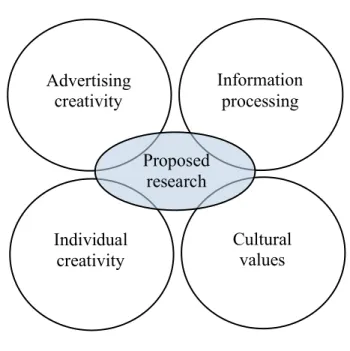
This research lies at the intersection of four theoretical domains - advertising
creativity, information processing, individual traits (specifically consumer creativity) and cultural values (specifically uncertainty avoidance). It employs a mixed methods approach to examine both industry perspectives and consumer responses with regard to creative advertising in China. The research is conducted in two main phases - each with a completely different focus, objective, approach and outcome. The first phase examines practitioner perceptions regarding the value and role of advertising creativity in contemporary China. The second phase evolves directly out of the first. Of several key themes to emerge from the practitioner interviews - including tensions between agencies and clients, and the need to foster the next generation of creative advertising talent – it was decided to examine advertising creativity from a Chinese consumer perspective. In this way, the research sets out to provide a complete and rich picture of the state of Chinese advertising creativity.
7 1.2 RESEARCH PROBLEM, RESEARCH QUESTIONS AND CONTRIBUTION The research problem at the heart of this thesis is how the advertising industry in China perceives and values creativity, and whether cultural and other factors influence the way that Chinese consumers to respond to creative advertising. While creativity has been shown to have a positive impact on the way consumers process advertising communication (eg. Ang, Lee & Leong 2007), and contribute to advertising effectiveness (eg. Dahlen, Rosengren & Torn 2008), the research focus has been on and for Western markets (Leung & Hui 2014). Little is known about the situation in China, one of the world’s largest and fastest growing consumer markets (McKinsey 2012). This raises a series of questions to be investigated in this thesis.
Firstly, from a practitioner point of view:
1. What is the state of advertising creativity in the contemporary Chinese market? Next, from a consumer perspective:
2. To what degree does creativity influence the cognitive and affective processing of advertising communication by Chinese consumers?
3. To what degree do cultural uncertainty avoidance and individual creativity moderate the relationship between advertising creativity, cognitive and affective information processing, and subsequent consumer behaviour?
The research contributes to the current body of knowledge in providing an understanding of industry perceptions, and consumer responses, with regard to the role and value of advertising creativity in China.
1.3 JUSTIFICATION FOR THE RESEARCH
For an issue that is so much at the heart of advertising, creativity has received surprisingly little attention from researchers over the years. In 1993, Zinkhan commented on the dearth of research into advertising creativity – a situation that, according to Sasser and Koslow (2008), did not change significantly over the next 15 years. Nonetheless, there has been
8 some advertising creativity research in the last decade worth noting. For example, El-Murad and West (2004) set up definitions and measures of creative advertising; Smith and Yang (2004) defined advertising creativity and modeled the determinants and effects of advertising creativity while Smith, Yang and colleagues (2007) showed that perceptions of creativity influence consumer responses to advertising. Dahlen, Rosengren and Torn (2008) researched the effect of advertising creativity on brand perceptions. Kilgour, Sasser and Koslow (2013) found that the use of creativity awards as proxy measures of advertising creativity leads to a bias towards originality at the expense of appropriateness. Apart from these examples though, there remains very little empirical research around advertising creativity - even less that has been tested and substantiated in a non-Western market – a situation that this research sets out to address on both fronts.
While some aspects of the Chinese advertising industry have attracted the attention of researchers, there is minimal discussion of how creativity is applied, responded to, or dealt with within an advertising industry context in China. Keane (2007; 2013), for example, examined various creative industries in China but only briefly mentioned advertising. Tai (2007), conversely, found a correlation between creativity and the success of Chinese brand advertising while Li, Dou, Wang and Zhou (2008) discovered that agency creativity has a positive effect on Chinese advertising campaigns. At this stage, few researchers have taken a consumer-centric approach to advertising creativity research in China, although Tai and Pae (2002) found that Chinese consumers prefer foreign-sourced commercials for their higher levels of creativity and subsequent emotional impact. The suggestion here is that Chinese consumers not only appreciate advertising creativity, but that they respond in an emotional manner – a likelihood that will be investigated throughout the course of this research.
More recently, Leung and Hui (2014) determined - through a series of depth interviews with practitioners - that advertising creativity is ‘valuable, useful and appropriate in [a] Chinese context’ (p. 148). While their research was based on interviews with professionals based in Hong Kong, it provides a complementary stance to the one taken in this thesis, particularly as the practitioners reported that their (mainland) Chinese clients were intolerant of creative advertising ideas. Again, these issues will be investigated more fully throughout the research presented in this thesis.
9 One of the biggest challenges facing the rapidly-growing advertising industry in China is the relative inexperience of Chinese marketing managers and advertisers (Maddox 2006; Sinclair 2008). In spite of its place as the third largest and fastest growing advertising market in the world (Hung, Tse & Cheng 2012; Yeh & Zhang 2013), the Chinese advertising industry only began to emerge in its present form since the 1980s (Prendergast, West & Shi 2006). As a consequence, collective marketing knowledge in China is ‘understandably modest’ (Ewing et al. 2002). Chinese marketing managers are therefore more conservative in their judgments, and less inclined to take risks, than those in developed markets (Sinclair 2008). It is likely that such conservatism is curbing the development of creative – and arguably more effective - advertising in China (Sasser & Koslow 2008). All of this points to a need for advertising research and knowledge particular to the Chinese experience and marketplace; vital as it is for ‘creative work to be driven by clearly defined consumer insights’ (McStay 2013, p. 21). Indeed, as Christodoulides and Jevons (2011) state, ‘the greatest challenge for brands is how to… be attractive and engaging for consumers both individually and collectively’ (p. 10).
1.4 METHODOLOGY
A realist ontology provides the framework for the study (Maxwell 2012), although the research takes a problem-centered approach that is not bound to any one research philosophy (Mackenzie & Knipe 2006). As such, a mixed methodology is employed to examine the research problem in two main phases – qualitative and quantitative. Taken together, the qualitative and quantitative research outcomes form a richer, fuller response to the underlying research problem and subsequent research questions (Sasser 2014).
1.4.1 Qualitative research phase
The formative, qualitative phase of the research provided an industry perspective from which to respond to the first research question regarding the current situation for advertising creativity in China. Consisting of a series of 20 depth interviews with advertising practitioners currently operating in China, and taking a modified grounded theory approach to analysis, this research unearthed a number of themes related to advertising creativity in China. Of these, one critical theme was chosen to form the
10 basis of the subsequent quantitative phase. This theme concerned the potential difference in consumer processing and response to creative advertising between city tiers in China1.
Little is known about how Chinese consumers respond to advertising creativity (Broadbent 2011). Even less is known about lower tier Chinese consumers. However, in the words of Christopher Vollmer, Global Brand Manager of Booz Digital, ‘ideas and creativity still matter a lot, but they need to be connected to… consumer insights’ (Precourt 2008, p. 6). Thus, in seeking to understand the state of advertising creativity in a Chinese context, it was first necessary to gain an accurate picture of the consumers at whom it would be directed.
1.4.2 Quantitative research phase
The quantitative research employed a quasi-experimental approach in the form of an online survey whereby Chinese consumers were asked a series of questions to assess their responses to creative and non-creative ad stimuli. Building on the central theme of tier differences that emerged from the practitioner interviews, surveys were conducted in tiers one and two, and tier five and six cities, across China. Subsequent analysis of the collected data provided responses to the remaining research questions and the associated hypotheses.
1.5 OUTLINE OF THE THESIS
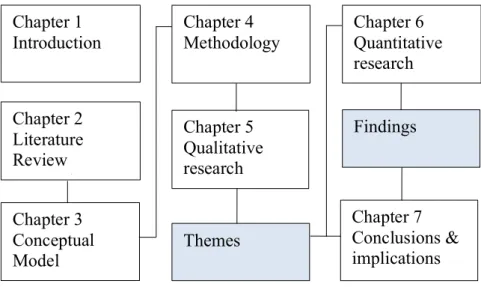
An outline of the thesis is presented as a structural diagram in Figure 1.1.
11 Figure 1.1 Structure of the thesis
Chapter One provides an introduction and background to the thesis.
Chapter Two presents an examination of relevant literature, with a focus on four key theoretical domains: advertising creativity, information processing, individual traits and cultural values.
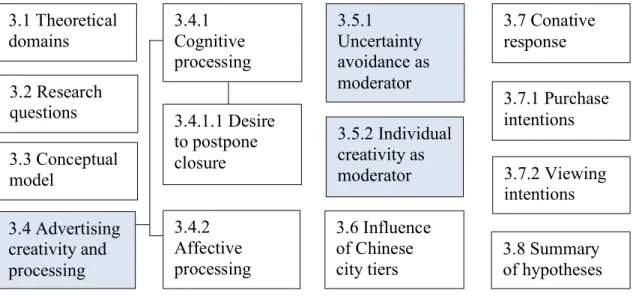
Chapter Three presents an overview of the key theoretical concepts and resulting conceptual model that arise from the literature review. The relationships between the variables identified in the literature are developed into a series of hypotheses to be tested empirically.
Chapter Four details the research methods and stages to be employed in the study. The chapter begins with a discussion of the research design and research paradigm employed, and presents the rationale for the mixed methods approach taken by the research. The qualitative research methodology is presented in detail, including descriptions of the sampling, depth interview and data analysis procedures. This is followed by a comprehensive overview of the quantitative research phase. Details regarding the development of the questionnaire, data collection and administration procedures, and data preparation, screening and analysis techniques are presented. Ethical considerations are also reviewed.
Chapter 7 Conclusions & implications Themes Findings Chapter 6 Quantitative research Chapter 5 Qualitative research Chapter 4 Methodology Chapter 1 Introduction Chapter 2 Literature Review Research Chapter 3 Conceptual Model
12 Chapter Five describes the process and outcomes of the qualitative phase of the
research. It commences with a profile of the practitioner participants and follows with analysis and discussion of the themes to emerge from the depth interviews. These themes in turn, informed the development of a conceptual model and associated hypotheses, which were then tested in the quantitative phase.
Chapter Six reports the results of an online survey conducted with consumers across China and an exploration of the hypotheses associated with the research questions that underpin the thesis. The chapter begins by reporting the participant profile. It then provides an evaluation of the validity and reliability of each construct in the conceptual model using coefficient alphas, exploratory and confirmatory factor analysis and correlation analysis. Regression analysis and structural equation modeling are used to examine relationships between constructs and to determine the moderating effects of individual creativity and uncertainty avoidance. The chapter concludes by reporting and discussing the key findings of the hypothesis testing.
Chapter Seven brings together the findings from the qualitative and quantitative research phases to present a detailed discussion of how each of the research questions and associated hypotheses has been answered. Finally, the academic and management implications arising from this study are identified and discussed, along with opportunities for future research.
1.6 DEFINITIONS
To ensure clarity and consistency of meaning of key words used throughout the thesis, the following definitions are provided.
West versus East: The use of the word ‘West’ provides a shorthand expression for regions and nations that include the United States, Europe, Canada, Australia and New Zealand (Kurth 2004). The term ‘East’ is used in this thesis to describe Asian nations including Japan, China, Vietnam and India; while ‘non-Western’ may refer to Asian nations plus African, Latin American, Eastern-European countries.
13 Emerging markets: Also known as ‘evolving’ or ‘developing markets’, the term describes national economies that are experiencing rapid growth but have not yet have reached full economic stability and maturity (Anonymous 2008; Khanna & Palepu 2010).
Consumers: Strictly speaking, a consumer is an individual who purchases a product or service for personal use, rather than manufacturing or resale purposes. In the context of this thesis, the term is used more generically to refer to anyone who makes
purchase decisions and can be influenced by marketing and advertising efforts (investorwords.com 2014).
Advertising creativity: Refers to advertising concepts that are both ‘divergent’ and ‘relevant’ (see definitions below). For an idea to be considered creative, it must exhibit both originality and appropriateness in some measure (Sasser, Koslow & Kilgour 2013).
Divergent: An advertising idea that is novel, original and even ambiguous in comparison to the expected norm(Smith & Yang 2004; Van Dyk 2014).
Relevant: A concept that is appropriate in how it relates to the objectives, strategy and target audience that have been determined for the advertising (Smith & Yang 2004; Van Dyk 2014).
Desire to postpone closure: A state of mind characterised by the savouring of uncertainty and reluctance to commit to a definite opinion. It is said to result in open mindedness, curiosity and postponing of judgment about an advertised brand (Yang, Bublitz & Wang 2014).
Positive affect: Positive emotion produced as an outcome of affective or emotional thought processes that, in turn, drives a behavioural response (Yang & Smith 2009; Percy 2012: Taute, Peterson & Sierra 2013).
Individual creativity: A personality trait characterised by an ability to solve problems in unexpected ways, divergent thinking, openness to new experience and intellectual curiosity - among other things (McCrae 1987; Gardner 1988; Kaufman, Pumaccahua & Holt 2013).
14 Uncertainty avoidance: There is a definite overlap between uncertainty avoidance
at cultural and individual levels While an uncertainty avoidance score at a national level cannot be used to predict individual behaviour, it is reasonable to expect that a high uncertainty avoidance culture would yield more people who fit the definition of uncertainty avoidance (de Mooij 2014). Uncertainty avoidance, one of Hofstede’s (1980) cultural values, is defined as the degree to which individuals feel threatened by uncertain, ambiguous or undefined circumstances (Choi & Kim 2008). The underlying dimension of uncertainty avoidance is ‘intolerance for ambiguity’ (Maher & Parikh 2011).
Chinese city tiers: A system introduced by the Chinese government in the 1980s as a means of planned prioritization of infrastructure and urban development throughout the nation (Starmass 2011). Although the tier system began as a bureaucratic classification, it has now become a proxy for demographic and social segmentation in China (eg. Liu, Liang & Michelson 2014).
1.7 DELIMITATIONS OF RESEARCH SCOPE
The scope of the thesis is limited to the Chinese advertising industry and the responses of Chinese consumers, from tier one and two, and tier five and six cities, to advertising creativity. Whilst there are implications for future research that arise from the reported findings, no attempt is made to generalise the findings to other populations or industries.
1.8 CONCLUSION TO THE CHAPTER
This chapter laid the foundations and provided the background for the research thesis. It introduced the research problem and subsequent questions to be addressed by the research. The research was justified and definitions given. An outline of the methodology and the scope, structure and limitations of the thesis were presented. On this basis, the thesis now proceeds with a detailed description of the research.
15 CHAPTER TWO – LITERATURE REVIEW
2.1 INTRODUCTION TO THE CHAPTER
Chapter One presented the background and context for the thesis along with an overview of the research problem and hypotheses. The broad field of enquiry was introduced, followed by a statement of the anticipated research contribution and an outline of the research methodology, scope and structure.
This chapter presents a review of literature from four important areas of existing theory: advertising creativity, information processing, individual creativity and the influence of culture. The junction of these four domains provides the impetus and opportunity for the following thesis. In the process, discrepancies in the current literature and between theories are investigated and identified. This leads, in turn, to the development of a conceptual model to be presented and explored in following chapters.
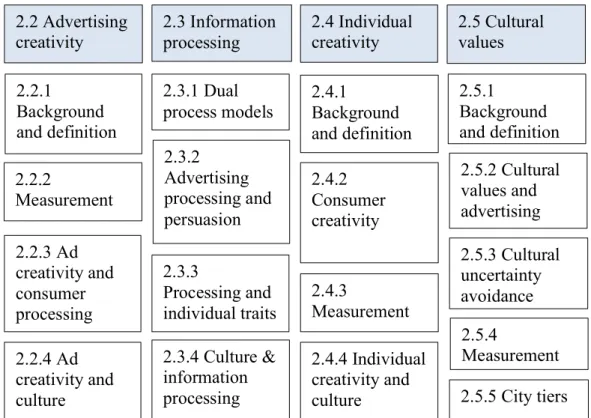
16 Figure 2.1 Literature review structure
2.2 ADVERTISING CREATIVITY
There is little doubt that creativity is central to the role and practice of advertising. Entire departments of advertising agencies, international advertising award shows and numerous chapters of advertising textbooks are dedicated to creativity (Smith & Yang 2004; Till & Baack 2005). Broadbent (2011), in practitioner literature, describes advertising creativity as a ‘turbo boost’ for effective advertising while Zinkhan (1993) states that ‘advertising, as we know it, could not exist without creativity’ (p. 1).
Zinkhan (1993) was, in fact, among the first to draw attention to the scarcity of research dedicated to advertising creativity. His observation that there were only five articles published on the topic of ad creativity in the Journal of Advertising between 1978 and 1993, paints a bleak picture of the attention that has been paid to one of the issues most central to the advertising industry. Yet, a subsequent survey of work that appears in the Journal of Advertising and other leading advertising journals since 1993, reveals that very
2.3.3
Processing and individual traits
2.4.4 Individual creativity and
culture 2.5.5 City tiers 2.2.4 Ad creativity and culture 2.3.2 Advertising processing and persuasion 2.5.2 Cultural values and advertising 2.5.3 Cultural uncertainty avoidance 2.2.3 Ad creativity and consumer processing 2.3.4 Culture & information processing 2.4.2 Consumer creativity 2.2.2 Measurement 2.4.3 Measurement 2.2 Advertising creativity 2.3 Information processing 2.4 Individual creativity 2.5 Cultural values 2.4.1 Background and definition 2.2.1 Background and definition 2.3.1 Dual process models 2.5.1 Background and definition 2.5.4 Measurement
17 little has actually changed. For a comprehensive summary of advertising creativity
research, see Appendix A.
The starting point for this overview was to conduct an online search, beginning with all articles that cite Zinkhan’s (1993) plea. Next, a more general search of any papers dealing with advertising and creativity (and including a definition of advertising creativity) ensured that all key papers were captured. The final list is quite small. It seems that advertising creativity research - at least until 2008 - had still not received the attention Zinkhan (1993) and the others who subsequently joined the cause (eg. West & Ford 2001; Smith & Yang 2004; Sasser & Koslow 2008) envisaged for it. As Johar, Holbrook and Stern had observed in 2001; ‘ironically, advertising creativity has barely been studied’ (p.2). However, from 2008 to the present, there have been quite a number of articles published - no doubt spurred by special issues of the Journal of Advertising (Winter 2008) and the Journal of Advertising Research (September 2013) - featuring the issue of creative advertising research.
Advertising creativity differs from creativity found in other disciplines. Advertising creativity is required, often under tight constraints such as marketing objectives, budgets, client and agency briefs and the layers of approval required within and without the agency, to work extremely hard (Bell 1992; McStay 2010). Yet, it is all the while subjected to intense scrutiny and constant review. It is also difficult to quantify, measure and define (West, Caruana & Leelapanyalert 2013).
Some of the most notable researchers who have explored the area of advertising creativity in recent years include Smith and Yang with various colleagues (2004; 2009; Smith et al. 2007; Smith, Chen & Yang 2008), El-Murad and West (2004) and Dahlen, Rosengren and Torn (2008). Collectively, they established models for testing advertising creativity and successfully operationalised them. They developed a working definition of advertising creativity (divergence and relevance) and investigated the effects of creative advertisements on consumers – demonstrating that the role and value of creativity in advertising goes beyond attracting consumers’ attention in an increasingly crowded media environment. In 2008, Baack, Wilson and Till examined the effect of creative advertising on recall and persuasion. More recently, Kilgour, Sasser and Koslow (2013), explored the reliability of using creativity awards as measures for advertising creativity,
18 finding that originality is generally favoured over relevance or appropriateness. Apart from these examples, however, there are many aspects of advertising creativity that remain somewhat unknown. This is even more pronounced in non-Western contexts such as China.
2.2.1 Defining advertising creativity
As can be seen from the summary of advertising creativity research, presented in Appendix A, there have been numerous attempts to define ad creativity. However, for something that is reportedly as difficult to define as advertising creativity (West, Caruana & Leelapanyalert 2013), there is in fact, substantial agreement between authors over time. Without exception, each of the researchers mentioned in this survey define advertising creativity as a combination of originality (or some variation of this - divergence, novelty, unexpectedness) and appropriateness (or relevance, usefulness, meaning, value).
Sasser, Koslow and Kilgour (2013), for example, argue that originality and appropriate-ness - in addition to defining creativity in general - are also the defining elements of advertising creativity. Creativity, in an advertising context, refers to ideas that are both ‘original’, where a concept is divergent or novel in comparison to the expected norm, and ‘appropriate’ in how they relate to the objectives, strategy and target audience that have been determined for the advertising. Thus, a creative advertisement is one that is both original and appropriate.
West, Caruana and Leelapanyalert (2013) also arrive at what is essentially the same definition of creativity, summarising it as ‘the ability to produce work that is both novel (i.e., original, unexpected) and appropriate (i.e., useful, adaptive concerning task
constraints)’ (p. 3). Mallia, Windels and Broyles (2013) likewise argue that, ‘though semantics differ, most definitions of “creativity” identify novelty and appropriateness as critical elements’ (p. 342).
El-Murad and West (2004) define advertising creativity in the words of Leo Burnett (1968) as, ‘the art of establishing new and meaningful relationships between previously unrelated things in a manner that is relevant, believable, and in good taste, but which somehow presents the product in a fresh, new light’ (p.190). Smith and Yang (2004)
19 expand upon and consolidate this definition, setting up a pragmatic and consumer-oriented definition and approach to advertising creativity, and paving the way for some innovative thinking in this field.
There are two notable exceptions to the standardised, two-dimensional definition of ad creativity, however. Ang and Low (2000) propose adding emotion to the defining factors, while White, Shen and Smith (2002) add execution. But it is worth noting that in neither case do the researchers provide convincing evidence to support the inclusion of either emotion or execution in a global definition of advertising creativity. This is not to say that emotion and execution can be completely dismissed. The possibility remains that either or both of these variables could have a moderating effect on the impact of advertising creativity and will be more fully explored later in the research.
Thus, for the sake of providing a parsimonious and workable definition of advertising creativity it will, in this thesis, be constrained to the interaction between two distinct elements - divergence and relevance - where divergence refers to ‘the extent to which an ad contains elements that are novel, different or unusual’ (Yang & Smith 2009, p. 936) and relevance refers to ‘elements that are meaningful, appropriate and useful and valuable to the audience in some way’ (2009, p. 280). For an advertisement to be considered creative, it must therefore be both divergent and relevant - although this can be in varying proportions.
2.2.2 Measuring advertising creativity
In addition to being difficult to define, creativity is said to be almost impossible to measure and quantify (Khatena 1982; Hunsaker & Callahan 1995). Certainly the
number of different scales and measures employed in the advertising creativity research, summarised in Appendix B, points to the complexity of the issue. El Murad and West (2004) provide a review of creativity measures used in advertising research between 1950 and 2000, concluding that while psychometric measures are still useful for determining individual creativity, measuring advertising creativity is still largely reliant on some form of expert opinion - usually award shows. Bell (1992), for example, proposes that audience response to a creative product (eg. a television commercial) may provide a useful proxy for creativity, measured audience reaction instead of attempting to measure creativity.
20 This research, building as it does on models previously established by Smith, Yang and colleagues (Smith & Yang 2004; Smith et al. 2007; Smith, Chen & Yang 2008; Yang & Smith 2009) uses the creativity (divergence and relevance) measures prescribed in their research - work which is strongly endorsed by other eminent creativity researchers. For example, in their review of advertising creativity research, Sasser and Koslow (2008) identify Smith and Yang’s (2004) work as the only response-oriented, theoretical research that had been conducted into advertising creativity up to that point. Similarly, McStay (2010) describes Smith and Yang’s work as the ‘most comprehensive intervention’ in the area of advertising creativity research (p.38).
2.2.2.1 Divergence and relevance
Smith et al. (2007) identified five key determinants of divergence in creative advertising: originality, flexibility, elaboration, synthesis and artistic value. Originality refers to elements within an advertisement that are rare, surprising, not obvious or commonplace. Flexibility refers to ideas within an ad that are perceived to be different, or switch from one perspective to another. Elaboration is determined by unexpected details or the extension of basic thoughts into intricate, complicated or sophisticated ideas. Synthesis refers to ads that combine, blend or connect ideas or objects that are normally unrelated. Artistic value refers to elements of an ad that are visually or verbally pleasing or attractive to the viewer. The second characteristic of creative advertisements is relevance, which refers to elements of an ad that are appropriate, meaningful and of value to the audience: either brand-related (for example, presenting new information) or ad-related (for instance, meaningful music and images) (Smith et al. 2007; Yang & Smith 2009; Van Dyk 2014).
An important finding that Yang and Smith present in their 2009 paper is that creative advertising is not either divergent or relevant, but rather, ‘an effective combination of the two: divergence by relevance’ (Van Dyk 2014, p. 50). Further, Yang and Smith’s (2009) research shows that advertising which is both divergent and relevant has two important effects on consumer information processing and persuasion - a cognitive effect and an affective (or emotional) effect (Van Dyk 2014). This issue will be explored in detail in the next section.
21 2.2.3 Impact of advertising creativity on consumers
As established earlier in this chapter, advertising creativity differs from other forms of creativity (eg. the arts) in that it has a specific role to fulfill and job to do (El Murad & West 2004). A large part of that job involves connecting and communicating with consumers (eg. Ang et al. 2014). Advertising creativity has been shown to have positive effects for consumers, aside from just creating a ‘contrast effect’ (i.e. standing out from the crowd) (Smith & Yang 2004). It is also suggested that creativity induces both cognitive and affective consumer processing responses; encouraging depth of processing (thus maximising recall) and a willingness to keep an open mind towards the advertising message (Smith & Yang 2004; Yang & Smith 2009).
West, Kover and Caruana (2008) suggest that advertisements do not have to be creative to be effective, but propose that ‘safe’ ads are both easy to imitate and eventually lead to an apathetic and bored audience. ‘Creative advertisements, on the other hand, allow brands to be noticed and impact customer decisions’ (p. 36). Campbell (2013) similarly asserts that creativity enables brands to fix and define themselves in consumers’ minds, thus driving brand success. According to Campbell, great creativity sustains positive financial growth, leading to, ‘massive benefits from increased sales, superior pricing power, greater trade leverage, brand loyalty, and resilience in recessionary times’ (2013, p. 223). However, Campbell goes on to caution that creativity must act in service to the brand stating that, ‘proof is no further away than that most humiliating (and all too common) paradox of a consumer remembering, with delight, a particular piece of advertising... and having no idea of the object of their affection’ (p. 223).
Rosengren, Dahlen and Modig (2013) further observe that advertising creativity has even wider, and often unintentional, benefits for media and brand - and even consumers’ own creative processes. They suggest that creative ads send a positive message to consumers about the value of the brand, the implication being that the advertiser has spent money and resources in having creative ads generated, thus the brand must be ‘worth it’.
22 2.2.4 Culture and advertising creativity
There is no doubt that advertising creativity is a multi-faceted and complex construct. For an area that is credited by many in the advertising industry as the most vital ingredient for advertising success (Ashley & Oliver 2010; Mallia, Windels & Broyles 2013), it remains noticeably under-researched (Sasser & Koslow 2008). The past few years have seen a renewed interest in ad creativity research but there is still a long way to go with the vast majority of existing research, including the development of models and theory, having taken place in the West - most notably the US (Niu & Kaufmann 2013). The following chapters build on current literature and models to provide an examination of advertising creativity that takes into account the possible impact and influence of culture and individual creativity, all the while seeking the views and responses of both advertising practitioners and consumers alike.
2.3 INFORMATION PROCESSING AND PERSUASION
For the past sixty years, researchers have been seeking to understand, describe and predict consumers' attitudes and responses to advertising (MacInnis & Jaworski 1989) by examining the key cognitive (thought), affective (emotion) and conative (motivation) stages of consumer response to advertising messages (Palda 1966; Yang & Smith 2009). The motivation for marketers is, of course, to find any variable that that could reduce consumer resistance - or conversely, enhance consumer response - to persuasion (Yang & Smith 2009).
Since the 1980s, information processing has been one of the dominant paradigms
informing and underpinning advertising creativity research (Baack, Wilson & Till 2008; Sasser & Koslow 2008). Using this information processing approach, creativity has been found to increase advertising effectiveness (Smith et al. 2007), leading to higher recall and more favourable attitudes towards an advertisement (Ang, Lee & Leong 2007). This research, in turn, has led to important insights into consumer cognition and - according to Baack, Wilson and Till (2008) - future advertising creativity research should leverage these findings.
23 2.3.1 Dual-process models
Contemporary information processing theories, originating from social psychology research, led to the development of models such as the elaboration likelihood model (ELM; Petty & Cacioppo 1984; 1986) and the heuristic-systematic model (HSM; Chaiken 1987; Chaiken & Maheswaran 1994). Both of these models differentiate between ‘central route’ (or systematic) processing and ‘peripheral route’ (or heuristic) processing (Chaiken & Maheswaran 1994).
The dual routes – central and peripheral – refer to attitude changes that are based on varying levels of elaborative information processing activities. Central route attitude change or formation results from extensive information processing (relying on an analytical approach and extensive information scrutiny) while peripheral route attitude change or formation typically requires less cognitive processing effort, relying as it does on pre-existing attitudes or simple rules (heuristics). Under conditions where information availability is limited, or motivation to process is low, message evaluation is most likely to based on heuristic cues with minimal input from relevant information (Maheswaran & Aaker 1997). This of course, has implications for advertising communication where consumers have limited time, motivation or information with which to process a message.
The difference in these two models lies in the question of whether or not heuristic (or peripheral) and systematic (or central route) processing can occur simultaneously. Petty and Cacioppo’s ELM (1986) has been interpreted as presenting two mutually exclusive routes to persuasion (Stiff 1986), while Chaiken’s HSM (Eagly & Chaiken 1993) views heuristic and systematic processing as parallel, or possibly simultaneous, modes
of information processing. Differences aside, both of these models provide a useful framework for understanding attitude formation and change through persuasion (Crawford 2011).
2.3.2 Information processing and advertising persuasion
Persuasive communication, including advertising, has been shown to bring about change in a message recipient’s beliefs, producing corresponding outcomes on recipient attitudes and thus, behaviours. For instance, exposure to advertising may bring about changes in
24 beliefs about products and resultant attitudes toward using or purchasing those products (Yang & Smith 2009). This attitude change may come about as a result of cognitive processing (such as when a consumer defers making a purchase decision in favour of seeking more information about a product or brand), or affective processing (when positive feelings are generated towards the product or brand), or a combination of both. As such, the ELM and HSM models have found applications in a marketing and advertising context; facilitating the prediction and testing of consumer response to advertising messages. In addition, a number of advertising-specific frameworks have been developed on the basis of these dual-processing models (Taute, Peterson & Sierra 2014).
Smith and Swinyard (1988), for example, propose an integrative information response model that examines the roles of curiosity and uncertainty in consumer’s response to product related information. They, as others before them (eg. Wright 1973), challenge the belief that cognition, affect and conation happen sequentially and suggest that there are many other factors that influence cognitive processing and therefore effective persuasion. Smith and Swinyard (1988) additionally argue that uncertainty is not necessarily a
negative; indeed, when combined with product awareness and interest, it could lead to product-related curiosity. These factors - curiosity and uncertainty - also have parallels with the uncertainty avoidance and cognitive closure theories that follow in this thesis.
MacInnis and Jaworski (1989) likewise expand on the ELM, proposing an integrative model of advertising that identifies several important phases of ad processing that are directly linked to consumer responses. Cognitive responses (thoughts about the brand or ad) and affective responses (feelings toward the brand or ad) together determine consumer purchase intentions - but many other variables such as needs, motivation, ability and opportunity to process information, and exposure to ad stimuli - impact this process along the way.
2.3.3 Information processing and personality traits
It is also possible that certain personality traits may impact consumer information processing ability and motivation (Goodwin & Etgar 1980). One example, which will be explored in the next section of this chapter, is individual creativity and consumer
25 innovativeness - characterised, among other things, by open mindedness. In addition, it has been suggested that a consumer's characteristic mode of resolving cognitive uncertainty may lead them to either seek clarification and additional information or avoid uncertainty when it comes to advertising messages (Goodwin & Etgar 1980). Individuals with a high need for cognitive closure (NCC) - characterised by cognitive impatience - are unlikely to consider new information regarding a brand and adhere to their original opinions of the advertised brand (Yang, Bublitz & Wang 2014).
2.3.3.1 Desire to postpone closure
‘Desire to postpone closure’ (DPC) was first coined by Yang and Smith (2009) to identify and explain the effect of advertising creativity. Need for cognitive closure (NCC) is proposed to sit at one end of a continuum with a desire to postpone closure (DPC) - characterised by the savouring of uncertainty and reluctance to commit to a definite opinion - at the other (Yang, Bublitz & Wang 2014). Exposure to creative ads is purported to induce a desire to postpone closure, even in consumers with a high need for closure. This is said to result in increased open mindedness, curiosity and likelihood of postponing judgments about the advertised brand.
Yang and Smith’s (2009) research demonstrates that creative advertising (that is, advertising that is both divergent and relevant) has two important effects - both a cognitive effect and an affective (or emotional) effect - on consumer information processing (Van Dyk 2014). The cognitive effect is ‘based on the ability of creative advertising to ensure that people view the source [the advertisement] with an open mind and a less defensive attitude’ (Van Dyk 2014, p. 50). Creative advertising is therefore found to encourage consumers ‘to offer less resistance to the advertisement’s attempts to convince him or her’ (Van Dyk 2014, p.50). Smith and Yang’s (2009) findings also indicate that as a result of this more open minded attitude, consumers may be more inclined to watch the same advertisement again; as well as more positively disposed towards purchasing the advertised product or brand.
2.3.4 Influence of culture on persuasion and consumer processing
With the increasing globalisation of marketing practice and activity comes an ever-increasing impetus to understand consumer behaviour ‘in all its cultural complexity’