Fractionation Of Medium Chain Fatty Acid Ethyl
Esters From Virgin Coconut Oil Via
Transesterification and Distillation Under Reduced
Pressure
Jusman
a*, Bambang Setiaji
b, Triyono
band Akhmad Syoufian
ba
Postgraduate Student of Chemistry Department, Faculty of Mathematic and Natural Sciences, Gadjah Mada University, Sekip Utara, Kotak Pos 21 Bls Yogyakarta, Indonesia 55281
bDepartment of Chemistry, Faculty of Mathematic and Natural Scien ces, Gadjah Mada University, Sekip Utara, Kotak Pos 21
Bls Yogyakarta, Indonesia 55281
* Corresponding author, phone : +6285241095775 email: [email protected]
Abstract
--
A study fractionation of medium chain fatty acids ethyl esters from virgin coconut oil via transesterification and distillation under reduced pressure. Transesterification was strarted by preparing sodium ethoxyde from sodium hydroxyde and ethanol and then mixed it with the coconut oil : ratio ethanol/oil (1:2), stirring speed 500 rpm, 2% NaOH catalyst concentration, and reaction time of 60 minutes at room temperature. Ethyl ester which was obtained in every treatment was separated, washed and filtered, which was then characterized by GC-MS . Then ethyl ester formed separated using distillation under reduced pressure method based on differences in boiling point. At this stage fractionation by three fractions, namely the fraction 1 (<140oC), fraction 2 (140-170 oC), and fraction 3 (> 170 oC). Each fraction was analyzed composition of fatty acid ethyl esters using gas chromatography (GC). The result showed that the yield medium chain fatty acid ethyl ester is 75.59% . While the stage fractionation of fatty acid ethyl ester dominated by ethyl laurate with a range of above 60% for each fraction.
Index Term-- virgin coconut oil, transesterification, ethyl ester, fractionation, ethyl laurate
I. INTRODUCTION
Coconut (Cocos nucifera L) oil is a natural source of medium chain triglycerides (MCTs) with approximately 60% of the total oil content being MCTs. The term MCT refers to triglyceride which is composed of a glycerol backbone and three saturated fatty acids with chain length of 6-12 carbons. MCTs have been reported to be beneficial to human health [1]. Coconut oil is rich in saturated fatty acids (SFA) (≈93%). However, coconut oil also contains medium chain fatty acids (MCFA) (≈60%), especially C12:0 (≈50%). MCFAs (C6:0, C8:0, C10:0, C12:0) are smaller than the standard storage unit of fat (C14), and hence are burnt for energy rather than stored in the body [2].
Coconut oil that is extracted from fresh coconut flesh is known as virgin coconut oil (VCO). The extraction involves a process that does not use thermal treatment or food preservatives. Coconut oil contains a high level of low molecular weight saturated fatty acids, the distinctive characteristic of lauric oil [3]. In application of virgin coconut oil can be further processed as a material development of oleochemicals through transesterification process to produce intermediate products .
Transesterification is the general term used to describe the important class of organic reactions where an ester is transformed into another through interchange of the alkoxy moiety [4]. In the transesterification of vegetable oils, a triglyceride reacts with an alcohol in the presence of a strong acid or base, producing a mixture of fatty acids alkyl esters and glycerol (fig. 1).
Fig. 1. T ransesterification of vegetable oils
The most widely known process consists of a chemical reaction in which the triacylglycerides (TAGs) found in these fatty materials (e.g., soybean oil) combine with an alcohol (methanol or ethanol) in the presence of an alkaline catalyst (usually NaOH, KOH and their alkoxides) to produce alkyl monoesters (biodiesel) and glycerin [5].
Fatty acid methyl esters or ethyl esters can be transformed into a lot of useful chemicals, and raw materials for further synthesis in alkanolamides, fatty alcohols, isopropyl esters, sucrose polyesters etc [4]. Ethyl ester of fatty acids of coconut oil has advantages compared with the ethyl ester of fatty acids from vegetable oils other. Excess is a medium chain fatty acid content is quite high, which is about 63% with details ranging from 6% ethyl caprylate, ethyl caprate ranges from 9% and ranges from 48% ethyl laurate [6]. Ethyl laurate may play a role as a raw material for the production of monolaurin that serve as antimicrobial, antiviral and antinematoda [6]. Thus about 63% beneficial to human health, while the remaining 37% can be used as a substitute for diesel fuel biodiesel.
The tools used in this study are as follows: a set of laboratory glassware, machinery stirrer RW 16 basic brand-IKAWERE (stirre propeller), a set series of fractionation under reduced pressure distillation apparatus, magnetic stirrer, electric heaters, Gas Chromatography (GC Hewlett Packard 5890 series II), and Gas Chromatography -Mass Spectroscopy (GC-MS QP2010S Shimadzu).
Methods
Fatty Acid Ethyl Ester Synthesis
Synthesis of fatty acids ethyl ester from virgin coconut oil performed in stirred engine capacity of 2 liters. The
Medium Chain Fatty Acid Ethyl Ester that have analyzed the
GC-MS, further distilled under reduced pressure
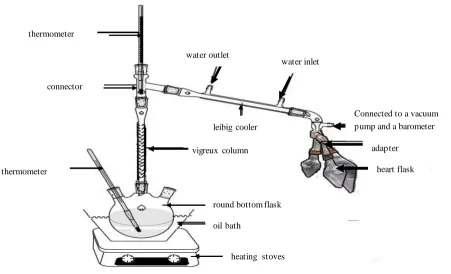
fractionation based on differences in boiling point. At this stage, each divided into 3 fractions are fractions 1 (<1400C), fraction 2 (140-1700C), and fraction 3 (> 1700C). Each fraction was analyzed composition of fatty acid ethyl esters using gas chromatography (GC).
Fig. 2. Distillation under reduced pressure method III. RESULTS AND DISCUSSION
Synthesis medium chain fatty acid ethyl ester via transesterification
Transesterification reaction is an equilibrium reaction in which to obtain the optimal amount of product that can be carried out using excess reagent. The reaction between one mole of triglyceride with three moles of ethanol, the stoichiometry will produce three moles of ethyl
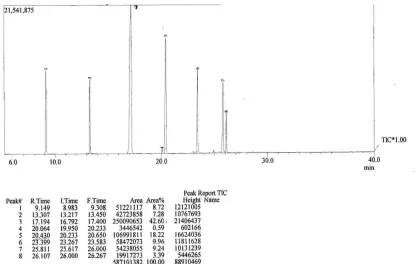
ester and one mole of glycerol [7]. The result is a mixture of ethyl ester transesterification were analyzed using GC-MS. This analysis is expected to be able to know the type of fatty acid content of coconut oil is obtained through transesterification reaction. The number of peaks in Fig. 3 shows the chromatogram of the compounds contained in the ester of coconut oil with a retention time different.
heating stoves oil bath
round bottom flask vigreux column
thermometer
connector thermometer
water outlet
water inlet
Connected to a vacuum pump and a barometer
adapter
Fig. 3. GC-MS chromatograms of a mixture fatty acid ethyl ester Chromatogram GC-MS analysis showed 8 peaks were
detected as ethyl esters of fatty acids, but there are only seven mass spectra are shown and a major peak that has great intensity. Peaks on the chromatogram first leave the short carbon chain ester, ester followed by a long carbon chain. Therefore ester shorter carbon chain will have a smaller retention times than the ester carbon chain length. The first peak of GC-MS chromatogram with a retention time of 9.149 minutes is ethyl caprylate an area of 8.72%. Mass spectra ethyl caprylate presented in following fig. 4:
Fig. 4. Mass spectra ethyl caprylate
The second peak of GC-MS chromatogram with a retention time of 13.450 minutes is ethyl caprate an area of 7.28%. Mass spectra ethyl caprylate presented in fig. 5 below:
Fig. 5. Mass spectra ethyl caprate
The third peak of GC-MS chromatogram with a retention time of 17.194 minutes is ethyl laurate and an area
of 42.60%. Mass spectra ethyl caprate presented in Fig. 6 below:
Fig. 6. Mass spectra ethyl laurate
The fifth peak GC-MS chromatogram with a retention time of 20.430 minutes is ethyl myristate and an area of 18.22%. Mass spectra ethyl myristate presented in Fig. 7 below:
Fig. 7. Mass spectra ethyl myrist ate
The sixth peak GC-MS chromatogram with a retention time of 23.399 minutes is ethyl palmitate and an area of 9.96%. Mass spectra ethyl palmitate presented in Fig. 8 below:
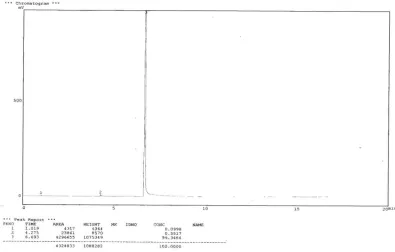
below: distillation method. at this stage fractionation with 3 fractions of each fraction 1 (<140 C), fraction 2 (140-170 C), and fraction 3 (> 170 C). In this study using ethyl laurate standard for comparison. The results of gas chromatographic analysis is presented in the following picture:
Fig. 4. GC chromatogram of ethyl laurate standard GC chromatogram analysis ethyl ester (fraction 1) after
distillation under reduced pressure at a temperature (<140
oC) showed that the peak number 4 is expected ethyl laurate
Fig. 5. Chromatogram GC ethyl ester (fraction 1)
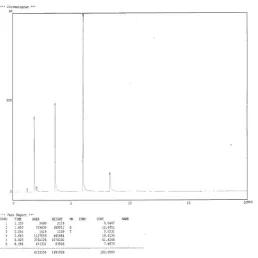
In fig. 6 (temperature 140-170o C) shows that the peak number 5 is expected ethyl laurate-based retention time 6.025 minutes, compared to the ethyl laurate standard shown in fig. 4 the retention time of 6.693 minutes.
Fig. 6. Chromatogram GC ethyl ester (fraction 2) While in fig. 7 (temperature > 170 oC) shows that the peak number 4 is estimated based on the retention time of ethyl laurate 6.040 minutes, compared to the ethyl laurate standard shown in fig. 4 retention time 6.693 minutes.
Fig. 7. Chromatogram GC ethyl ester (fraction 3)
IV. CONCLUSIONS
Transesterification reaction of virgin coconut oil with ethanol on the condition ratio ethanol / oil 1:2, stirring speed 500 rpm, 2% NaOH catalyst, a reaction time of 60 minutes at room temperature produces ethyl esters of medium chain fatty acids with a yield of 75.59%. While fatty acid ethyl ester fractionation using reduced-pressure distillation method is generally dominated by ethyl laurate with content above 60% in each of the fractions , indicating that the reduced pressure fractionation method can be used to separate the ethyl esters of medium chain and long based on different boiling points.
ACKNOWLEDGM ENT
This investigation was supported by PT. Tropical
Nuciferra Industry Yogyakarta Indonesia, and by
Laboratory Facilities from the Department of Physical Chemistry and Organic Chemistry Laboratory, University of Gadjah Mada, Indonesia.
REFERENCES
[1] N.A. Nik Norulaini, W.B. Setianto, I.S.M. Zaidul, A.H. Nawi, C.Y.M. Azizi, A.K. Mohd Omar, “ Effects of supercritical carbon dioxide extraction parameters on virgin coconut oil yield and medium-chain triglyceride content ,” Food Chem istry 2009, 116 : 193–197.
[2] A. S. Bhatnagar, P. K. Prasanth Kumar , J. Hemavathy, A. G. Gopala Krishna,” Fatty acid composition, oxidative stability, and radical scavenging activity of vegetable oil blends with coconut oil,” J Am
Oil Chem Soc 2009, 86:991–999.
[3] A. M. Marina,Y. B. Che Man, S. A. H. Nazimah, I. Amin,” Chemical properties of virgin coconut oil,” J Am Oil Chem Soc 2009, 86:301– 307.
[4] Ulf Schuchardt, Ricardo Sercheli, Rogério Matheus Vargas,” T ransesterification of vegetable oils: a review,” J. Braz. Chem . Soc, 1998 Vol. 9, No. 1, 199-210.
[5] Karla T . Kucek, Maria Aparecida F. Ce´sar-Oliveira, Helena M. Wilhelm, Luiz P. Ramos,” Ethanolysis of refined soybean oil assisted by sodium and potassium hydroxides,” J Am er Oil Chem Soc 2007, 84:385–392.