Abstract— Today, e-commerce has grown into a big industry and is generating huge revenues from online retailing. It requires the integration of transportation, information and communication technologies for the success of e-commerce. But e-commerce cannot be now seen as clean way of doing business as it can have some harmful impacts on environment. The rapid growth of the e-commerce is the basis of different, positive as well as negative impacts on environment. This paper explores the positive and negative impacts of e-commerce on environmental and focuses on spreading awareness regarding these possible impacts among people. Our work can serve as warning to agencies and industries involved in the development of e-commence standards and procedures, about the consequences of e-commerce on environment and how they can reduce the negative impacts of e-commerce. Also the impact of ecommerce for environmental sustainability in the modern enterprises is studied.
Index Terms— E-commerce, Environmental Impacts, Internet, Intranet, Extranet, Global Warming.
I. INTRODUCTION
The Internet has created a new economic ecosystem, the e-commerce marketplace, and it has become the virtual main street of the world. Providing a quick and convenient way of exchanging goods and services both regionally and globally, e-commerce has boomed. Due to vast and fast development of e-commerce, companies and businesses are paying so much attention to the production of low cost products. Also, they are focusing on developing efficient methods and practices which increases productivity in minimum efforts and cost. They are not aware and hence not concerned about its adverse environmental implications. The Internet has now entered almost every corner of the world. Furthermore E-commerce can well coordinate, collaborate and manage the business activities but it may have some negative effects like air pollution, harmful radiation etc. E-commerce is the foundation of the economy development in several developing and developed nations [5].
Here, Environmental Impacts of E-Commerce are considered for case study and survey. It is very tempting to know that the marketing on the Internet is beneficial to the environment. The literature study revealed some possibly negative effects as well as positive effects of e-commerce. For example, one can argue that pollution from the transportation used to reach shopping malls can be avoided, retail space can be reduced, inventories and waste can also be reduced by the virtue of E-Commerce. However, one should
Manuscript received May 30, 2011
F. A. Author is with the Krishna Engineering College , Ghaziabd UP , India, (e-mail: [email protected]).
S. B. Author, is with JSSATE Noida Up , India (e-mail: [email protected]).
also consider the fact that a product ordered online may be shipped partially by air freight across the country and require local truck delivery. Also, the product is likely to be packaged individually, which in turn causes various negative impacts. The adverse impacts on the environment due to such transportation can be significant, and the net effect of different logistics systems is not obvious. This study have focused on three major issues- energy, resources and pollution as these are crucial factors behind global warming [5]. In this respect a survey has been conducted to know the level of awareness among people. The aim behind this study and survey is to create awareness on the environmental impact of e-commerce and to find whether people are prepared to fix this problem at personal level and to figure out their level of concern about the ‘Mother Nature’. Along with this the impacts of e-commerce on human health and effect of e-commerce practices on corporate environment management have also been considered.
The summary based on the critical review of the literature; from institutions that works in the area of protection against non-ionizing radiation are available and updated periodically shows that, one cannot imagine human life without telecommunication technologies, fixed and mobile telephony, Internet, video ,television and many other resources that the multimedia transmissions offers. This telecommunication facility nowadays increases the comfort of people and enhances the features of E-Commerce. But equally important is that its application must be in the control and protection of natural resources and the environment with powerful satellite systems and offer to man the ability to observe and predict the environmental impacts caused naturally and by human actions.
From the observations, technology has too much facilities to offer to man for environment protection. The need is to make these technologies resistant to possible negative impacts to the environment and ultimately to the human. So it is essential to have well defined rules that pursue efficient mechanisms for monitoring and surveillance and procedures for its installation and operation [11].
Following the methodology adopted in this study [11], it has been concluded that the systems, operating within the established international thresholds of exposure, do not cause harm to human health and damage to the environment and is accepted by the World Health Organization.
The rest of the paper is organized as follows. A brief description of relation between ‘Environment and E-Commerce’ is given in section 2. Section 3 describes the effects of E-Commerce on Global Warming. Section 4 describes the impacts of e-commerce on human health. Section 5 describes the effect of e-commerce on green house gas emission. Section 6 describes the support for corporate environment management. The survey conducted on
E-Commerce: Prospect or Threat for Environment
‘Environmental impacts of E-Commerce’ is described in Section 7 and finally section 8 concludes the paper.
II. IMPACTS OF E-COMMERCE ON ENVIRONMENT
The overwhelming sustainable development and major technological innovations have not only brought fundamental change to the economic system but also extensive environmental impacts, for better or worse. The environmental implications, in most cases are a reflection of human economic activities as mediated by technology. After decades of development, the Internet brings a new era, in which worldwide participants has been increasing as shown in figure1. This estimate is given for 1,966,514,866 Internet users on 30th June 2010 [8]. E-Commerce sales value is also increasing dramatically along with the Internet users.
From 2009 onward, the Internet is expected to grow significantly in Brazil, Russia, India, China, and Indonesia (BRICI countries). These countries have large populations and moderate to high economic growth, but still low Internet penetration rates. In 2009, the BRICI countries represented about 45 percent of the world's population and had approximately 610 million Internet users. But it is expected that, by 2015, Internet users in BRICI countries will be doubled [7]. With this increase in the usages of Internet its applications, more and more people will use the electronic commerce activities.
Fig. 1 Internet user Development Internet world (source: statshttp:// www.Internetworldstats.com/stats.htm [8])
As a consequence of increased Internet penetration some important questions are raised with some overwhelming challenges for scientists, policymakers and human society’ and they are as follows.
• Can the Internet-led information technologies serve as one of the most important means to improve the environment’?
• Do demands for the development of a sustainable economy compete or coincide with the new reality of the e-commerce?
• Is e-commerce a truly clean, environmentally caring economy, which will simply lead to the substitution of information for physical resource flows along energy and transportation networks?
• Or alternatively, does e-commerce encourage more movement by generating new demands for material and energy that will further deteriorate the fragile environment?
• What kind of environmental policies should be developed in the Internet-led information age?
The founding father of modern computer science and technology ‘John von Neuman’ claim in his under-appreciated essay “Can we survive technology?” that technological power and efficiency is an unsure achievement. The study showed that e-commerce is not always the most efficient model in terms of cost, energy consumption, pollution, dematerialization, de-carbonization and demobilization [3].
Kalakota and Whinston, defined e-commerce from four perspectives: communication perspective, business process perspective, service perspective and online perspective. From a communication perspective, e-commerce is the delivery of information, products/services, or payments over telephone lines, computer networks, or any other electronic means; from a business process perspective, e-commerce is the application of technology toward the automation of business transactions and work flow; from a service perspective, e-commerce is a tool that addresses the desire of firms, consumers, and management to cut service costs while improving the quality of goods and increasing the speed of service delivery; from an online perspective, e-commerce provides the capability of buying and selling products and information on the Internet and other online services[1].
Transportation is responsible for a large percentage of carbon dioxide emissions. It is obvious that reducing the number of vehicle trips is one way of reducing the level carbon emissions. E-commerce applications are the means of conducting business without actually commuting. Business may further reduce their carbon foot print, by allowing their employees work in virtual office, shopping online and working from home which reduces the number of commuters on the road. The number of commuters may further reduced if more business transactions could be conducted online. Moving towards the paperless society would be advantageous for deforestation which contributes to global warming. There are many ways in which digital transfer of information through ecommerce could be useful.
Ecommerce can potentially reduce waste and the need for inventory, warehouse space, operating cost of business. For example it is not required to have the office space on rent or to send out bills via the traditional more expensive means using papers. Further for the benefit of the environment recyclable packaging of goods must be used.
E-commerce has also been alleged to prevent waste by vastly increasing the efficiency of the market for secondary materials through online auctioning on a global scale [4, 3]. The imagination of the “negative environmental impact” of e-commerce is very difficult. It does not release any pollutants and also not uses much energy or natural resources. The negative environmental impacts of E-commerce are not only present but also these impacts are significant. The nature and magnitude of these negative impacts are such that the ways to resolve them are by no means evident or familiar to us.
to save material and energy cannot be denied, it is too early to conclude that e-commerce has only positive impacts on environment. Each potential positive impact is coupled with a potentially overwhelming negative impact as well. For example, moving business online can reduce waste such as printed catalogues, retail space, and transportation requirements, but we have to manufacture more energy intensive computers instead! Web-based marketing may encourage profligate rather than savvy consumption. Indeed, the Internet has already dramatically increased mass production of various products on a global scale. The ease of online shopping itself causes people to buy more.
In terms of energy consumption, faster delivery requirements tend to create a situation in which trucks are moving half empty. E-commerce also tends to favor faster transportation modes, which can increase fuel consumption exponentially. When we opt for trucks instead of boats or rail, energy use goes up by a large factor. Moving the same package by air again increases the energy use dramatically. Therefore, some of the increase in transport energy consumption can be attributed to the growth in e-commerce as it tends to encourage the consumer preferences to more energy-consumptive, faster deliveries trips. The Internet economy is a double-edged sword. Despite the growing literature on environmental impacts of e-commerce, our knowledge of the extent of, and mechanisms behind, the patterns of material use and energy consumption are very limited. At this stage the question may arise: Can we survive the Internet? [4]
The environmental effects of e-commerce focuses on three aspects: energy, resources and pollution [5].As of today the scientists or policy makers still do not have clear statements about relationship between the ecommerce and the environment. But of course it has potentials of positive environmental impacts which has been summarized as three D’s for the new economy: dematerialization which reduces the material consumption by shifting books to bytes, compact disks to MP3s, check books to clicks and so on, de-carbonization by reducing the Green House Gas emissions and making the goals of Kyoto protocol easier [6] and demobilization by reducing the transportation [4].
III. EFFECTS OF E-COMMERCE ON GLOBAL WARMING
‘Global Warming’ is a phrase that refers to the effect of human activities on the climate. The burning of fossil fuels (coal, oil and gas) and large-scale deforestation cause emissions of large amounts of greenhouse gases, of which carbon dioxide emission has most significant impacts on global warming. Political leaders had gathered in Kyoto, Japan, in December 1997 to consider a world treaty restricting human production of “greenhouse gases,” chiefly carbon dioxide. They feared that CO would result in “human-caused global warming”— hypothetical severe increases in Earth’s temperatures, with disastrous environmental consequences. Many political efforts have been made to force worldwide agreement to the Kyoto treaty during the past 10 years [6].
E-commerce strongly improves the energy efficiency of the economy [4]. Each potential positive impact is coupled
with a potentially vast negative impact as well. For example, moving business online can reduce waste such as printed catalogues, retail space, and transportation requirements, but we have to manufacture more energy intensive computers instead! In fact, carbon dioxide emissions and energy use for the online purchase were found to be 35% less than a trip in a car to the mall [5, 6].
IV. EFFECTS OF ECOMMERCE ON PEOPLE’SHEALTH
E-commerce has also influenced the growth of network technologies and standards. Also, wireless technologies are being used extensively nowadays in intranet and Internet. This has exposed the user to harmful electromagnetic radiations. Due to rapid expansion of these network technologies service providers need to install a lot of base stations to meet the user requirements and to maintain the Quality of Service. This intern increase the harmful radiation which may affect the human health negatively. These radiations may even cause diseases like cancer. There are adverse effects on human health due to non-ionizing radiations and in particular it may cause cancer.
While talking about the pollution the first thing which comes to one’s mind is the industries pouring sewage in the rivers, or vehicles emitting smoked in the air and the pesticides affecting the quality of food products. But besides this one should remember the other types of pollution that cause serious harm to health, such as visual pollution. Visual pollutions influence human minds and psychology.
The network infrastructures are mainly designed keeping in mind the technical requirements but commercial broadcasting, television, data communications, radar, radio, satellite communication, has helped produce an unpleasant aesthetic impact on the environment, affecting the landscape of cities, and has been raising great concern of public entities and society in general. Therefore, there is a need to make network technologies immune to possible negative impacts to humans and the environment. This can be done by having well defined rules and procedures for network installation and operation. Moreover, it is essential that these rules are met through efficient mechanisms for monitoring and surveillance.
As an example of effect of network infrastructure used in e-commerce, prior studies provide relatively consistent estimates of mobile device energy consumption. One study reports 110.22 kJ per day, which equates to 0.031 kWh per day. Another study estimates that a charger consumes 3 W while charging the phone, and 1.5 W while the charger remains plugged in all day but sits empty , suggesting daily consumption of 0.0375 kWh if the battery is charged in an hour. Chargers consume 0.055 kWh per day but that new “smart” chargers require only 0.0027 kWh per day.
V. EFFECT OF E-COMMERCE ON GREEN HOUSE GAS
EMISSION
The findings from the literature study of the potential environmental effects of e-commerce and their implications for GHG emissions are described in this section.
E-commerce application requires three basic options in sourcing e.g. create electronic marketplaces, seek new suppliers using information technology, or use information technology to enhance current supplier relationships. Changing the relationship have two important effects on environment- they can affect the distance that the supplies are transported and may play an important role in reengineering which can cut down the overproduction. Electronic markets may lead to more sales between suppliers and customers that are not in proximity to each other. E-commerce may also link local supplier and consumer. This may lead to increase or decrease in Green House Gas Emission from transportation, depending on modes and distance of transportation.
E-commerce places heavier pressures on costs and lead times. This may shift the controlled manufacturing options and production may follow the fluctuation of demands more accurately and hence overproduction can be decreased. Also e-commerce demands faster deliveries with little or no charges. As a result one has to move to shorter delivery lead times in response to the shorter delivery lead times of their competitors. These piles up tremendous pressure on global companies. But by better and more fluent cooperation, companies could establish better transportation fill rates This would make distribution more efficient and reduce the GHG emissions of transportation.
VI. EFFECT OF E-COMMERCE ON CORPORATE ENVIRONMENT
MANAGEMENT
The different paradigms has outlined [10] alternative approaches for organization managers or analysts to assess the quality of IT support in the newly emerging and challenging area of corporate environmental sustainability.
Orgocentric, ecocentric and socioecocentric are three environmental paradigms which defines the key features
• Conception of sustainability,
• Representation of organizations and/or the environment,
• Challenge of corporate environmental practices, These key features describe the requirements for e-commerce support and are the principle criteria for evaluating the quality of e-commerce use in such practices. The salient criteria suggested for the basis for assessing the quality of IT support are: eco-efficiency, eco-efficacy and eco-effectiveness.
The principal defining feature for assessing quality of e-commerce application within Orgocentric sustainability paradigm is ecoefficiency i.e. doing things cheaply, with minimal waste or pollution, within Ecocentric sustainability paradigm is eco-efficacy i.e. doing things rightly by matching the needs and principles of ecosystems and within Socio-ecocentric sustainability paradigm is eco-effectiveness i.e. doing the right thing, in relation to a contested context of social/ethical legitimacy [10].
On the basis of these three alternative paradigms the question arises that which paradigm should an organization follows? It is important, however, that there is a systematic and ongoing monitoring to ensure that the suggested and then deployed paradigms are beneficial and are in the safe hands. So eventually it depends on the people who are the primary sources of driving the organizations.
VII. STUDY OF IMPACTS OF ECOMMERCE ON ENVIRONMENT
A survey has been conducted on Environmental Impact of E-commerce At JSS Academy of Technical Education, Noida. The survey contained ten questions, all of which were created by us. 500 people who are well aware of e-commerce were surveyed in total. After this the results of survey has been analyzed. In this survey we had involved the students and faculty members of JSS Academy of Technical Education, NOIDA. We spent several hours devising a 10 question survey form with closed questions which aims to create awareness, concern and willingness to act regarding environmental impacts of e-commerce.
A. Notable findings and Analysis
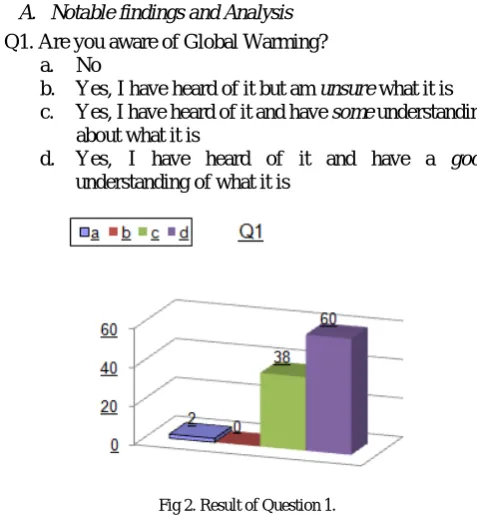
Q1. Are you aware of Global Warming? a. No
b. Yes, I have heard of it but am unsure what it is c. Yes, I have heard of it and have some understanding
about what it is
d. Yes, I have heard of it and have a good
understanding of what it is
Fig 2. Result of Question 1.
Q2 Do you responsible for think E-Commerce increasing Global Warming?
a. Yes b. No c. Unsure
Q3 On a scale of One to Five how concerned are you about Global Warming?
a. 1 b. 2 c. 3. d. 4 e. 5
Fig 4. Result of Question 3
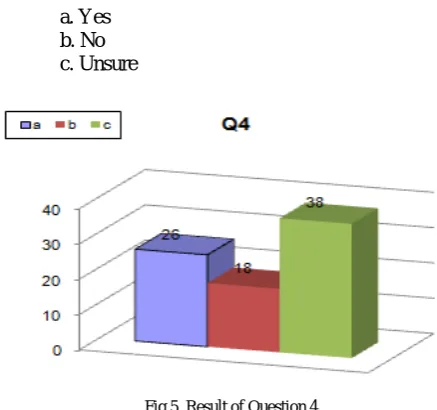
Q4. Do you think potentially positive Environmental impacts of E-commerce are much more than potentially negative impacts?
a. Yes b. No c. Unsure
Fig 5. Result of Question 4
Q5. On a time scale, when will the impacts of E-Commerce be a major risk to Environment?
a. They are now
b. Not for at least 10 years c. Not for at least 20 years e. Not for at least 50 years f. Not at all
Fig 6. Result of Question 5
Q6. How quickly do you think something should be done about Global Warming?
a. Start Now
b. to do something in the next 5 years c. Start to do something in 10 years time d. Start to do something in 20 years time e. Never, it is not a problem
Fig 7. Result of Question 6
Q7. Are you personally prepared to do something about Global Warming?
a. Yes b. No
Fig 8. Result of Question 7
Q8. Do you believe acting on environmental impacts of E-Commerce will end up costing you financially?
a. Yes b. No c. Unsure
Fig 9. Result of Question 8
Q9. Do you think it is possible to reduce negative impacts of ecommerce on environment?
Fig 10. Result of Question 9
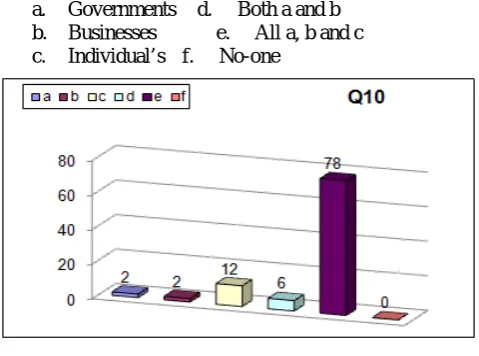
Q10. Who do you think should be responsible for doing something about reducing negative impacts of ecommerce on environment?
a. Governments d. Both a and b b. Businesses e. All a, b and c c. Individual’s f. No-one
Fig 11. Result of Question 10
Some interesting facts can be derived from the survey, which are listed further. Sixty percent of the people have heard of global warming and have a good understanding of what it is. People do not have clear idea about the relation of E-Commerce and global warming and also its positive or negative impact. Almost sixty percent of people think that e-commerce will not be the major risk to environment for at least 10 to 50 years while 26 percent of people think that it is on the door. 86% of the people think that we should take the steps now and they are personally prepared for it but approximately 72% people do not know whether it is possible to reduce negative impacts of ecommerce on environment or not. Finally 78% public is agree on the fact that Government, Businesses, and Individuals altogether should be responsible for doing something about reducing negative impacts of ecommerce on environment.
VIII. CONCLUSION
This can be figured out from the study that e-commerce cannot be always considered as a prospect for environment as it imposes certain threats to environment. Energy saving and time saving are few positive factors of e-commerce but they are associated with certain negative aspects. So it is very difficult to state that the e-commerce is a prospect or a threat and it is not easy to clearly define whether the positive effects have the weigh over the negative ones, or the reverse is true. Since, it has two aspects so people need to find how to
balance these two aspects. It is totally dependent on the people who are the users of the Internet that how they use it. If it is used properly then it will be in the benefit of the society otherwise it may be the reason of spoiling the environment for forthcoming generations. The important issue is that environment does not have to bear at the cost of the economy.
In the future, as consumers become more attentive of the negative impacts of global warming due to Internet usage, they may insist to select e-commerce with only those organizations that enforce an ethical perspective for reducing carbon emissions.
Along with this the impact of e-commerce on people health, GHG emission and on the corporate environment management is also studied. All these studies clearly give a warning to the agencies and industries involved in the development of e-commence standards and procedures, about the consequences of e-commerce on environment and how they can reduce the negative impacts of e-commerce.
Our analytical study can be adjusted for different assumptions about shipping distances, return rates or shopping allocations. As a matter of fact e-commerce can be found to be less costly than the traditional retailing system in certain ways. It is noted that different assumptions about population density and thus, distances to retail stores and order sizes would significantly affect the e-commerce success. Nevertheless, our analysis case suggests that E-Commerce sales have a cost advantage and environmental benefits.
REFERENCES
[1] Tuerk V., “Assessing the resource intensity of the Internet structure” Master’s Thesis, International Institute of Industrial Environmental Economics, Lund University, Lund,2001
[2] Fichter, K.,” Environmental effects of e-business and Internet economy”, Working Paper for the German Federal Environment Ministry (BMU), Borderstep Institute for Innovation and Sustainability, Berlin,2001.
[3] Digital Europe – EC Project, “Virtual Dematerialization: E-business and Factor X”, project funded by the European Community and the Information Society Technology Programme,2002
[4] Daniel Z. Sui, David W. Rejeski, “Environmental Impacts of the Emerging Digital Economy: The E-for-Environment E- commerce?” ,Springer-Verlag New York Inc Environmental Management Vol. 29, No. 2, pp. 155–163, 2002.
[5] Lifang Peng, Qi Li2, Xianfeng Zhang “ Optimism or Pessimism: Environmental Impacts of the E-Commerce.” Environmental Informatics Archives, Scholl of Management, Xiamen University, Xiamen 361005, China 2School of Economics and Finance,Volume 3, pp 263 – 269, 2005.
[6] Stephen Corea, Margi Levy, ”Quality of IT Support for Corporate Environmental Management: a Paradigmatic Framework Digital Information Management, 2007. ICDIM '07. Volume: 1, Publication Year: 2007 , pp: 424 – 429
[7] Keshnee Padayachee, “Utilizing E-Commerce and M-Commerce Applications to Address the Effect of Global Warming”, E-Leader Karakow ,School of Computing University of South Africa Unisa, South Africa, 2008
[8] Jorge Fe rnandes Morai s, Glaucio Lima Sique ira, “Wireless Technologies Environmental Impacts”, Microwave and Optoelectronics Conference (IMOC), 2009 SBMO/IEEE MTT-S International Publication Year: 2009 , pp: 523 – 52.
Case Study of Grocery Home Delivery in Finland, Journal of
Industrial Ecology Volume 6, Number 2 , pp 83-97, 2008
[10] "Internet users in BRICI countries set to double by 2015". International BusinessTimes ,IBTIMES.com,2010-09-01,
http://www.ibtimes.com/art/services/print.php?articleid=48062, Retrieved on 09/12/2010
[11] Ineternet usage statistics, “The Internet Big Picture World Internet
Users and Population Stats” ,http://www.Internetworldstats.com/stats.htm retrieved on
09/12/2010.
Sunita Tiwari was born at Ujjain, India in 1979. She received B. Tech. degree from OIST Bhopal in Computer Science and Engineering and M.Tech from IIT Delhi in Computer Science. Now she is working toward a PhD degree in School of IT at Indian Institute of Technology Delhi. She is in academics since 2002 in various engineering colleges. Currently she is an Associate Professor at Department of Computer Science, KEC, Ghaziabad, India. Her research interest includes Web Services, Location Based Services and Soft Computing and E-commerce.
![Fig. 1 Internet user Development Internet world (source: statshttp:// www.Internetworldstats.com/stats.htm [8])](https://thumb-us.123doks.com/thumbv2/123dok_us/1392030.1650539/2.595.61.268.404.521/internet-development-internet-world-source-statshttp-internetworldstats-stats.webp)