E-Learning Framework Based on Blockchain
Technology
1
Mohamed A. El-dosuky; 2 Gamal H. Eladl
1 Computer Sciences Department, Faculty of Computer & Info, Mansoura University, Egypt
2 Information Systems Department, Faculty of Computer & Info, Mansoura University, Egypt
Abstract - Education is one of the most important pillars of real future planning. Online learning is embraced and adopted by many schools, universities, and firms worldwide to deliver education, training, certification, and even higher degrees. Blockchain is a promising new technology and a trending information revolution that has imposed itself on various areas of life. According to the Harvard Business Review (HBR), blockchain is a software architecture concept, whose transactions enjoy the following characteristics. First, they are recorded in a distributed ledger (denoted C1 henceforward). Second, they are permanent and cannot be edited (C2). Third, they are verifiable (C3). This research paper aims to design and develop a framework model for an educational environment that is effective and defect-free. It focuses on handling well-recognized defects in the delivery of materials to students, and assessing them. The research paper suggests the application of blockchain in e-learning, integrating aspects of Learning Management System (LMS) and University Management System (UMS), in which blockchain acts as safeguarded distributed repository. This allows students to obtain information quickly and with high privacy and transparency. This can be achieved by designing a triad of material bank, question bank and assessment bank. The three banks take advantage of C1, C2 and C3, allowing for the distributed verification of certifications everywhere, and keeping certifications themselves un-manipulated. The proposed framework shows how to develop a private blockchain in PHP and Google Firebase. Gossip protocol can model large-scale distributed systems. The proposed framework takes into account quality Assurance. Therefore, the application of the proposed framework will lead to advancement in e-learning. For evaluating the effectiveness of the proposed e-learning framework, Kirkpatrick’s model is adopted. It was proven that the proposed framework is scalable.
Keywords - Blockchain, E-Learning, E-Learning Framework, LMS, UMS, Quality Assurance.
1. Introduction
ducation, in particular, is one of the most important pillars of future planning [1]. It plays a vital role in knowledge production and distribution [2]. Online learning is embraced and adopted by many schools, universities, and firms worldwide to deliver education, training, certification, and even higher degrees [3]. According to Forbes, the global market of online learning is expected to reach $325 billion by 2025, based on estimation of the past achievement of $ 107 Billion (2015) [4].
Blockchain is a new technology and a revolution [5] that has imposed itself on various areas of life [6].
Even there are many books providing guidance to blockchain such as [7], it is notoriously hard to understand leading to a recent book that subtitled it as "The Technology That Nobody Understands" [8].
The problem of lacking full comprehension of this technology is an obstacle facing its optimal use. This
problem is tackled by more technical papers providing hands-on on practicalities of the nascent technology. This research paper aims to design and develop a framework model for an educational environment that is effective and defect-free. It focuses on handling well-recognized defects in the delivery of materials to students, and assessing them.
The focus of this paper is to present a tailored e-learning framework based on a lite implementation of blockchain. The paper quickly reviews blockchain and attempts of applying it in online-learning in the following section, before proposing, implementing, evaluating and concluding the proposed framework in subsequent sections.
2. Literature Survey
ledger (Let us denote it C1 henceforward). Second, they are permanent and cannot be edited (C2). Third, they are verifiable (C3).
This technology is investigated for both challenges and opportunities as presented in e-learning conference [11]. The nascent technology is proposed for e-learning environments [12], with an honorable mention go to EduCTX solution [13]. However all of the aforementioned proposals, and others, do not go beyond identity management [14,15] This follows the success of blockchain in managing medical records[16,17].
Recently, blockchain is employed in learning analytics [18] and in smart learning environment [19].
Although, there are rare solutions that effectively employ the nascent technology in the core of exam life cycle, this paper is considered as a proposal to handle this issue.
3. Research Methodology
This paper suggests the application of blockchain in e-learning, integrating aspects of Learning Management System (LMS) and University Management System (UMS), in which blockchain acts as safeguarded distributed repository, as shown in Fig. 1.
As shown in Figure 1, it allows all students to obtain information quickly and with high privacy and transparency.
The framework is based on designing a triad of material bank, question bank and assessment bank. The three banks take advantage of HBR C1, C2 and C3, allowing for the distributed verification of certifications everywhere, and keeping certifications themselves un-manipulated.
The teacher's journey, shown in red arrows in Figure 1, starts with consulting the Intended-Learning-Outcomes (ILOs) before creating the exam. Then, the exam is stored in the question bank. The student journey, shown in yellow arrows in Fig. 1, starts with login form to the portal. The student can access materials or exams created by the teachers. Assessments are stored properly in the assessment bank.
Research in blockchain application is exploring the employment of smart contracts; however this paper focuses only on the use of blockchain as a distributed storage system.
Ethereum and Hyperledger technologies are the main frameworks to develop blockchain-based solutions; however the authors choose to build the blockchain infrastructure from scratch, based on [20], for many reasons. First reason is to build a tailored solution that is compatible with a legacy exam management system temporarily hosted on the website of one of the authors. Second reason is to build a lite blockchain without all facilities of Ethereum or Hyperledger. The same argumentation answers why not building upon available LMSs. Different LMS like Canvas LMS and Moodle offer robust integration and solutions that address the same issues addressed by this paper. The paper presents a compatible solution with a legacy exam management system based on a lite blockchain implementation.
Teacher/Admin Student Login Form Login Form Login Form Login Form Teacher Portal Teacher Portal Teacher Portal Teacher Portal ILOs ILOs ILOs ILOs Exam Exam Exam Exam Generation Generation Generation Generation
Blockchain Bank Management Blockchain Bank Management Blockchain Bank Management Blockchain Bank Management
System System System
System (BB(BB(BB(BBMMMMS)S)S)S)
Student Portal Student Portal Student Portal Student Portal Exam Exam Exam Exam Taking TakingTaking Taking Material MaterialMaterial Material Generation GenerationGeneration Generation Material Material Material Material Bank Bank Bank Bank Question Question Question Question Bank BankBank Bank A AA
Assessment ssessment ssessment ssessment
Bank BankBank Bank Enter/access Redirect Create exam Enter/access Redirect
Take exam View Upload
Create
Take exam View Upload ILOs
Query Query
Query Result Result
Result
The rest of this section elaborates on practicalities of developing private blockchain in PHP and Google Firebase; thus it may be useful for newcomer developers. First, it should be noted that the nascent technology is not intended to solve all problems in the world. It is suitable
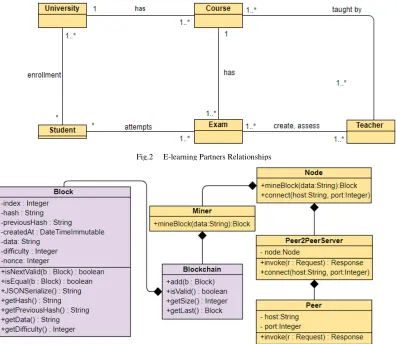
only to certain use-cases that it fits. Just imagine that we are developing special digital money, but instead of storing balances, we are going to store transactions that carry scores regarding achievements of students in exams. Fig. 2 shows a rough class diagram showing relationships among e-learning partners. The University has many courses, each of which is assigned at least one teacher. A teacher can create and assess exams.
Fig. 3 shows the class diagram. It distinguishes radically between a block and a node. A Node class is composed of a Miner and a Peer-To-Peer-Server.
A Miner has Blockchain which in turn is composed of many Blocks. Each of them has index, hash, previous-hash,
creation Time, data, difficulty, and nonce attributes. The core operation is to check for validity by comparing hashes. By default and initially after creation, it is guaranteed the emptiness of the wallet of the new user. Genesis block is the very first block. It corresponds to a first transaction from the
university to the enrolling of a student. It could be created with a given amount of Effort-Coins. The student pays some of those Effort-Coins as expenses to attempt an exam. To avoid double-spend problem, blocks are hashed, stored and validated as shown next.
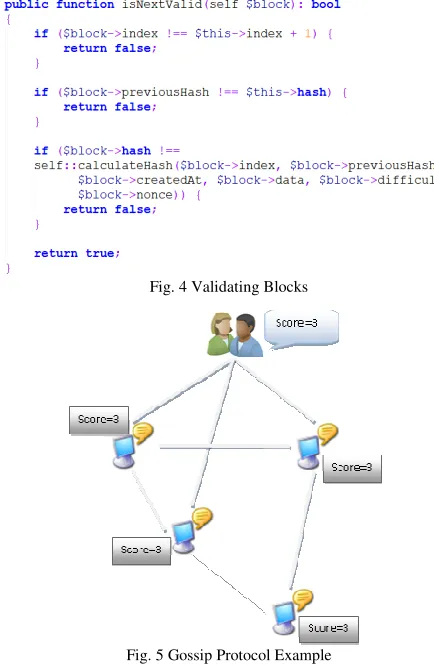
There is a global variable is the configuration file called USED_HASH_ALGORITHM which is set to sha256.To validate a block, PHP code in fig. 4 is used. It checks that indices and hashes are correct. The admin set a Difficulty-Level global variable in the configuration file. Based on that variable the leading numbers of zeros in generated hashes, a.k.a Nonce, is determined to ensure Proof-of-Work.
Gossip Protocol, as shown in Fig. 5, lends itself into inter-node communication [21], as traditional communication
Fig.2 E-learning Partners Relationships
protocols may not be suitable to gain consensus over decentralized networks.
Fig. 4 Validating Blocks
Fig. 5 Gossip Protocol Example
Gossip protocol can model large-scale distributed systems [22]. Fig. 6 shows implementation of gossip protocol in action.
hop_count ← 0 Φ is empty set Infinite loop
Wait a certain amount of time peer ← PeerSelection( ) if PUSHING then
descriptor ← (address, hop_count) temp ← view ∪ { descriptor } send temp to peer
else
send Φ to peer if PULLING then
get viewpeer from peer
viewpeer←IncreaseHops (viewpeer)
temp ← viewpeer∪ view view ← ViewSelection(temp)
Fig. 6 Implementation of Gossip Protocol in action [22]
Initially, hop_count is zero. A hop is a transition from one node to another. In an infinite loop, wait a certain amount of time, then select a peer, and check if the state is either pulling or pushing.
If the state is pushing, a descriptor is calculated based on the address and current hop_count. Then merge the descriptor with the current view. Finally, send the result of the merge to the selected peer. If not pushing, then return an empty set to the selected peer.
If the state is pulling, get the view of the selected peer, then increase hop_count based on that peer view. Then merge the peer view with the current view. Finally, select and update current view based on the result of the merge to the peer view.
The database is created using Google Firebase. Fig. 7 and Fig. 8 show material and score instances respectively.
Fig. 7 Material Instance
Fig. 9 shows conceptual model. Firebase is callable by web, mobile or Python applications, as shown in Appendix A. The
Firebase application is deployed at
https://uaechain.firebaseapp.com/, However, a front-end portal is temporarily hosted at the website of one of the authors. The entry point is the login form as shown in Fig. 10.
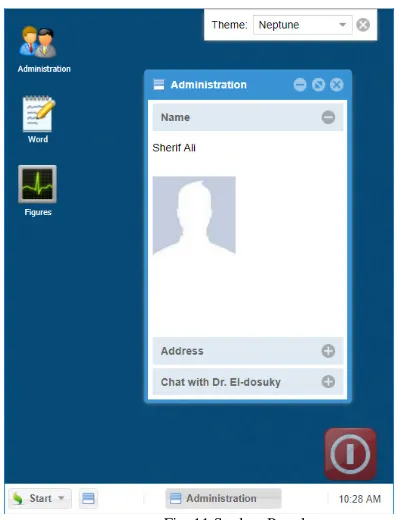
For student you can test the system with the credentials provided from Student Affairs Department. This loads the student portal as shown in Fig. 11.
Fig 10 Login Form
Fig. 11 Student Portal
4. Results
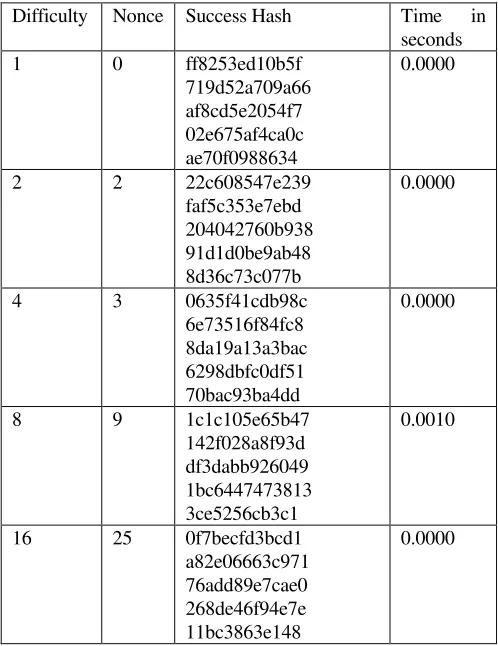
Table 1 shows the evolution of difficulty and Nonce. It is generated using Python code shown in Appendix B. It shows the capability the system to generate successful hashes for higher values of difficulties in approximately zero time. Table 1 indicates that the proposed framework is scalable to larger values of difficulties.
Fig. 9 Conceptual Model
Teacher
Course
Material Teaches
Has
Score
Student Has
Exam
Question Has Includes
TABLE 1 Evolution of Difficulty and Nonce
Creating questions follows Intended Learning Outcomes (ILOs) which means that the proposed framework adheres to the basics of quality assurance standards.
Evaluating e-learning frameworks may be a difficult task. For evaluating the effectiveness of the proposed e-learning framework, Kirkpatrick’s model is adopted which has the following four levels [23]:
1. Reaction – Is the course relevant, and worth time? 2. Learning – Does the course increase knowledge/skill? 3. Behavioral Change – Is there a change in behavior
based on the learning?
4. Business impact – Is there a tangible value after learning?
A simple questionnaire is designed based on Kirkpatrick’s model. Then, it was delivered to 345 students. The response was 100%, 95%, and 87% and 73% to the four levels respectively
5. Conclusion and Future Directions
This paper suggests the application of blockchain in e-learning, integrating aspects of Learning Management System (LMS) and University Management System (UMS), in which blockchain acts as safeguarded distributed repository.
This allows students to obtain information quickly and with high privacy and transparency. This can be achieved by designing a triad of material bank, question bank and assessment bank. The proposed framework takes into account quality standards. Therefore, the application of the proposed framework will lead to advancement in e-learning.
One possible direction may be towards securing the gossip protocol. This may be achieved by employing a recent protocol called FireChain [24], or integrating other recent security preserving methods such as [25] and [26]. Another possible direction is enhancing the Exam-as-a-service.
Appendix A: Python Code to Access Google Firebase import firebase_admin
from firebase_admin import auth from firebase_admin import credentials from firebase_admin import db # Initialize the default app
cred = credentials.Certificate('./uaechain-firebase-sdk.json') default_app = firebase_admin.initialize_app(cred, { 'databaseURL': 'https://uaechain.firebaseio.com'}) ref = db.reference("students")#(app=default_app) print(ref.get())
Appendix B : Python Implementation of Proof-Of-Work
import hashlib import time import sys
max_nonce = sys.maxsize
def POW(the_header, bits_of_difficulty):
difficulty_target = 2 ** (256 - bits_of_difficulty) for n in xrange(max_nonce):
h = hashlib.sha256(str(the_header)+str(n)).hexdigest() if long(h, 16) < difficulty_target:
print "Nonce %d" % n print "Hash %s" % h return (h,n)
. Difficulty Nonce Success Hash Time in
seconds
1 0 ff8253ed10b5f
719d52a709a66 af8cd5e2054f7 02e675af4ca0c ae70f0988634
0.0000
2 2 22c608547e239
faf5c353e7ebd 204042760b938 91d1d0be9ab48 8d36c73c077b
0.0000
4 3 0635f41cdb98c
6e73516f84fc8 8da19a13a3bac 6298dbfc0df51 70bac93ba4dd
0.0000
8 9 1c1c105e65b47
142f028a8f93d df3dabb926049 1bc6447473813 3ce5256cb3c1
0.0010
16 25 0f7becfd3bcd1
a82e06663c971 76add89e7cae0 268de46f94e7e 11bc3863e148
References
[1] TRUSTY, Jerry; NILES, Spencer G.; CARNEY, JoLynn V. 2005, Education-career planning and middle school counselors. Professional School Counseling, 9.2: 2156759X0500900203.
[2] MACHLUP, Fritz. 2014,Knowledge: its creation, distribution and economic significance, Volume I: Knowledge and knowledge production. Princeton university press.
[3] HARPER, Kimberly C.; CHEN, Kuanchin; YEN, David C. 2004, Distance learning, virtual classrooms, and teaching pedagogy in the Internet environment. Technology in Society, 2004, 26.4: 585-598.
[4] TJ McCue, 2018,E Learning Climbing To $325 Billion By 2025 UF Canvas Absorb Schoology Moodle, Forbes, https://www.forbes.com/sites/tjmccue/2018/07/31/e- learning-climbing-to-325-billion-by-2025-uf-canvas-absorb-schoology-moodle/
[5] TAPSCOTT, Don; TAPSCOTT, Alex. 2016, Blockchain revolution: how the technology behind bitcoin is changing money, business, and the world. Penguin.
[6] CASEY, Michael J.; VIGNA, Paul. 2018,The Truth Machine: The Blockchain and the Future of Everything. St. Martin's Press.
[7] BAMBARA, J. J., et al. 2018, Blockchain: A practical guide to developing business, law, and technology solutions, McGraw Hill Education.
[8] Omid Malekan, 2018, The Story of the Blockchain: A Beginner's Guide to the Technology That Nobody Understands, Triple Smoke Stack
[9] Swan, Melanie. 2015, Blockchain: Blueprint for a new economy. " O'Reilly Media, Inc."
[10] IANSITI, Marco; LAKHANI, Karim R. 2017, The truth about blockchain. Harvard Business Review, 95.1: 118-127.
[11] HOLOTESCU, Carmen. 2018, Understanding Blockchain Opportunities and Challenges. eLearning & Software for Education
[12] TOLBATOV, A. V. 2018, Using blockchain technology for E-learning. International scientific-technical magazine–Measuring and computing devices in technological processes. Hmelnuckyi, 1-P: 110-113. [13] TURKANOVIĆ, Muhamed, et al. 2018, EduCTX: A
blockchain-based higher education credit platform. IEEE Access, 6: 5112-5127.
[14] FILVÀ, Daniel Amo, et al. 2018, Privacy and identity management in learning analytics processes with blockchain. In: Proceedings of the Sixth International Conference on Technological Ecosystems for Enhancing Multiculturality. ACM,. p. 997-1003.
[15] FORMENT, Marc Alier, et al. 2018, Learning Analytics' Privacy on the Blockchain. In: Proceedings of the Sixth International Conference on Technological Ecosystems for Enhancing Multiculturality. ACM, p. 294-298. [16] AZARIA, Asaph, et al. Medrec: 2016, Using blockchain
for medical data access and permission management. In:
Open and Big Data (OBD), International Conference on. IEEE, p. 25-30.
[17] HALAMKA, John D.; EKBLAW, Ariel. 2017, The potential for blockchain to transform electronic health records. Harvard Business Review.
[18] Flanagan, B. and Ogata, H., 2018. Learning analytics platform in higher education in Japan. Knowledge Management & E-Learning: An International Journal, 10(4), pp.469-484.
[19] Anil, G.R. and Moiz, S.A., 2020. Blockchain Enabled Smart Learning Environment Framework. In Advances in Decision Sciences, Image Processing, Security and Computer Vision (pp. 728-740). Springer, Cham. [20] https://www.youtube.com/watch?v=QkBbs5JRQ-k , last
access 30th October 2019
[21] VAN RENESSE, Robbert. 2016, A Blockchain Based on Gossip?–a Position Paper. Cornell University. [22] Jelasity, M., Guerraoui, R., Kermarrec, A.M. and Van
Steen, M., 2004, October. The peer sampling service: Experimental evaluation of unstructured gossip-based implementations. In ACM/IFIP/USENIX International Conference on Distributed Systems Platforms and Open Distributed Processing (pp. 79-98). Springer, Berlin, Heidelberg.
[23] Kirkpatrick, D. and Kirkpatrick, J., 2006. Evaluating training programs: The four levels. Berrett-Koehler Publishers.
[24] MIKALSEN, Jon Foss. 2018, FireChain: An Efficient Blockchain Protocol using Secure Gossip. Master's Thesis. UiT Norges arktiske universitet.
[25] El-dosuky, Mohamed A., and Gamal H. Eladl. 2019, "SPAINChain: Security, Privacy, and Ambient Intelligence in Negotiation Between IOT and Blockchain." World Conference on Information Systems and Technologies. Springer, Cham.
[26] El-Dosuky, Mohamed A., and Gamal H. Eladl. 2019, "DOORchain: Deep Ontology-Based Operation Research to Detect Malicious Smart Contracts." World Conference on Information Systems and Technologies. Springer, Cham.
Authors –
Mohamed A. El-dosuky was born in Mansoura, Egypt in 1984. He received the B.S. and master degrees in Computer Sciences from Mansoura University, in 2005 and 2008 respectively. He received his Ph.D. degree in Artificial Intelligence from Mansoura University in 2013. From 2013 to 2017, he managed to have a B.S. in Applied Sociology from Cairo University. He is the author of 5 books, and more than 30 articles. His research interests include meta heuristics optimization, quantum computing, block chains, cyber security, deep learning, and data science. Dr. El-dosuky is a member of ACM and IAENG.