Enhancing QoS in WSN using Hybrid Optimal Hop-Alert Routing Algorithm
(HORA)
J.Gowthama Raja Kumaran1 and Dr. A Suresh Kumar2
1PG Student, Department of CSE, Mahendra Engineering College (Autonomous), Namakkal, Tamilnadu, India. 2Associate Professor, Department of CSE, Mahendra Engineering College (Autonomous), Namakkal, Tamilnadu, India.
Article Received: 25 September 2017 Article Accepted: 29 December2017 Article Published: 19 January 2018
1. INTRODUCTION
Wireless sensor networks (WSNs) contain numerous sensor nodes which receive the data and transfer to the sink.
This communication between nodes is done by the links in it. Each node is built with four units, they are: processing
unit, energy unit, sensor unit and communication unit [1]. The communication between nodes is not always perfect
so it is important to use routing algorithm to transfer data from source to sink. But this process may consume time
and the data also put in queue manner to avoid congestion. If the path is not predefined it may results in delay even
the source is single [2]. This leads to wastage of energy which then reduce the network lifetime. Some sensor
network applications such as intruder detection, medical care, awareness of the fire, nuclear reactor control and
identify health, have real-time requirements for the data. A network is meant to be good when packet delivery is
perfect. The data has to be transferred without any delay for real-time applications especially in healthcare. The
data is valid only for limited duration after that it cannot be sed. This duration can vary depends on applications.
Quality of service (QoS) is defined as the service requirement of each application in the network [3].
Throughput, delay, jitter and packet loss rate are the parameters of QoS. Apart from this reliability, timeliness,
robust, availability, security are also important. The above mentioned parameters are used to measure the degree of
satisfaction. The need of this QoS is varied for different environment. It is a tedious task to reduce the traffic and
achieve better QoS in all topology of networks.
While designing the protocols and algorithms for wireless sensor networks facing many problem in research area in
terms of energy utilization so that network lifetime can be increased. Apart from lifetime many parameter such as
latency, throughput, packet loss are taken into consideration [4]. Depending upon the applications delay may occur
during data transfer between sensor nodes. The reliability of data also important but it is affected by the practical
attributes ex., temperature sensor nodes are not sensing and forwarding the data to the sink at time intervals Another
example is forest fire detection which follows the above mentioned process. As an advanced applications the A B S T R A C T
Wireless sensor networks have wide usage in real-time applications but it has some problems while designing routing algorithm especially delay and high bandwidth. To achieve better performance in ESN we propose hybrid optimal hop-alert routing algorithm (HORA) in our work. The aim of our algorithm is to find the optimal path to transfer data. Here the proposed algorithm is compared with existing algorithms LBORF and EEAR.
multimedia sensor nodes are used to overcome the throughput and delay limitations at crucial times [5]. QoS
(Quality of service) depends upon bandwidth and energy consumption in the network. So we have to aware about
usage in QoS in various applications with different layer of protocol stack. This results in efficient accessing of
sensor readings[6]. Therefore, enabling many applications in sensor networks requires energy and QoS awareness
in different layers of the protocol stack in order to have efficient utilization of the network resources and effective
access to sensors readings. Thus QoS routing is an important topic in sensor networks research, and it has been
under the focus of the research community of WSNs.
The rest of the paper is organized as, Section 2 discusses the related work and the proposed mechanism is presented
in Section 3. The performance analysis of the proposed protocol and its comparison with a few similar protocols is
shown via simulation in Section 4. Finally, the conclusion is presented in Section 5.
2. LITERATURE SURVEY
Chenyang Lu et al. [7] proposed a Real-time Architecture and Protocols (RAP) which is based on velocity [that
leads to give better service by classifying the packets and transferring in time allocating with domain based strategy
X.Hunag and Y.Fang considered Qos requirements (i.e.,) delay and reliability have proposed Multi Constrained by
designed an algorithm named Multi Path (MCMP) routing protocol [8]. The author mainly concentrated on
optimization problem and created a method to solve that. The method is named as linear programming. According
to this algorithm multipath is created to transfer the packets with minimum number of hops. This minimum number
of hops leads to less energy consumption [8].
Z.Lei et al. developed extension of SPEED protocol named as FT-SPEED [9] whereas it avoids the routing
problems during the transmission of data from source to destination. Foh et al. in [10] calculated successive hop
lengths for reactive algorithms. According to this algorithm, when number of hops increases the data forwarding
nodes becomes periphery for broadcasting purpose. Conditional Max-Min battery capacity routing algorithm
proposed find the minimum power in case the nodes having same battery capacity. Based on that power the route is
selected. In case the route is reached the remaining power can be neglected [11].
CEDAR, is proposed by Sivakumar et al,. [12] especially for medium sized adhoc networks that consist of hundred
number of nodes in it. Core extracted distributed adhoc routing algorithm is designed in a way that automatically
incremented and propagates through the link that has high stabled bandwidth. Here the route is created based on
demand based method using local conditions. In [13] the author proposed a Hop-based Energy Aware Routing
(HEAR) algorithm which can largely reduce energy consumption as well as prolong network lifetime. However,
the hotspot problem cannot be avoided since we try to minimize the total energy consumption during certain route
rather than to let sensor nodes consume their energy at similar rate. In [14] energy aware dual-path routing is
proposed for real time traffic by Mahapatra et al.,. In this scheme, the process of routing takes into consideration
message exchange with neighbours, each node maintain a neighbour table that contains the geographic location of
a neighbouring node, the energy left, the estimated time delay and the mobility factor. To increase reliability, data
packets are duplicated at the source node. Through simulation authors show an improvement in performance for
high traffic real-time packets as compared to other geographic routing scheme.
3.RESEARCHMETHODOLOGY
According to our proposed routing algorithm, four phases should be followed: Zone partitioning, updating the
tables, Route discovery process, Optimal path finding. Many routing algorithms are quite flexible in terms of
wireless area network, but it is not able to provide support for energy awareness and requires a best path for a
communication among the nodes in network. The wireless channels are unstable, there is no assurance for data
deliverance from sensors to the sink. It leads to data loss, wastage of energy and also decreases the total data
collected by the sink and increase the overall energy utilization by the sensors. So it is important to find the best
path which is achieved by our proposed Hybrid Optimal hop-alert Routing Algorithm (HORA).
A. Zone partitioning
We dynamically partition a network field into zones and randomly chooses nodes in zones as intermediate relay
nodes, which form a non traceable anonymous route. Specifically, in each routing step, a data sender or forwarder
partitions the network field in order to separate itself and the destination into two zones. In the last step, the data is
broadcasted to k nodes in the destination zone, providing k-anonymity to the destination. A sensor in each zone has
a probability p of becoming a CH during each round. The probability p is determined relative to the number of
nodes in the zone: p = 1/(number of nodes in zone). Zone partitioning divides the sensor field into z equal zones.
Equal zones were chosen because the distribution of nodes is uniform in the field. we assume the entire network
area is generally a square shaped and the information of the bottom-right and upper left boundary of the network
area is configured into each node when it joins in the system.
B. Table updating
One entry in the inter-zone routing table, denoted InterZoneRT, contains the destination zone (destZoneId), the
next zone (nextZoneId) and the zone metric (zoneM). The packets exchanged in this table-construction phase
contain the following information: the source node (srcId), the next hop (nextHopId), the zone of the source node
(srcZoneId), the subject (which may be COMPL TABLE: complete the table or UPDATE TABLE: update the
table), the zone table (InterZoneRT) and the final destination (finalDestId). When receiving a routing control
packet packet, a node processes it depending on its type (NORMAL, BORDER or BORDER-CHIEF). A normal
node forwards the packet towards the final destination; a chief node updates the InterZoneRT routing table and
sends updates to some border nodes of its zone and to the border nodes of the neighboring zones. Finally, a border
node forwards the packet to the chief node of its zone, if the packet comes from a border node of a neighboring
zone. Otherwise, if the border node is a final destination, either it updates the table, or it forwards the packet to the
C. Route discovery
A source initiates route discovery in the same manner as in AODV. However, after it transmits an RREQ, it also
sends an additional RREQ ALERT packet. This is sent at the MAC layer after a Short Inter Frame Space (SIFS)
duration following the transmission of the RREQ and is transmitted at a lower transmission power to cover fewer
nodes which are closer to the source. We refer to the coverage area of the alert packet as Alert Range (AR) and that
of the route request as Request Range (RR). Intuitively, AR ≤ RR with AR = RR in pure AODV.
However, in Hop Alert, any node within the AR, on receiving the RREQ ALERT, would defer broadcasting for a
duration large enough for it to hear a rebroadcast from any other node within its range. This duration is
predetermined in the implementation of the algorithm and kept constant across all nodes. If, during this duration, it
receives another copy of the same RREQ, it drops its own copy of the packet. This would imply that there are
nodes located farther away from itself which can act as the forwarding node. On the other hand, if there are no
nodes located in the region between AR and RR, there would be no broadcasts of the same request during the
waiting period. In this case, the nodes within AR would broadcast their own copies of RREQ once the wait
duration times out. Any subsequent node which rebroadcasts the route request also sends an alert message in the
same manner. Thus, for each hop, the forwarding node is likely to be towards the periphery of the RR. Therefore the
number of hops is minimized.
D. Optimal path finding
The routing decision is done according to nodes that are located at a distance with two hop sender node. Access to
information for node that are located at a distance with two hop to sender node, each node periodically calls from
neighbors that their routing table information including their neighbors they are sent to the requesting node. With
access to the neighbor`s table sender node in addition to the information nodes that are in one hop themselves, the
information will be available to the nodes that are located in hop jumps. To reduce the overhead caused of this
information, nodes only request the required information. In our algorithm only will be ask information about the
remaining energy of nodes. Also, to reduce the traffic caused by sending information packets, these packets with
the piggyback method on the acknowledgement packets will be sent to the applicant node. Efficiency of this
method is due to the fact that whatever the value awareness sender node is more extensive than its neighbor nodes,
a route that is selected for the forward chosen can be more accurate and more efficient and this causes that prevent
of sending to the routes have nodes with lower energy.
4.PERFORMANCEANALYSIS
In this sub-section, the comparison results of the Hybrid Optimal hop-alert Routing Algorithm (HORA) algorithm
are discussed. The results of this technique have been compared with the results of the previous LBORF (Location
based optimal route finding), EEAR (Energy efficient ant based routing algorithm). The LBORF and EEAR
protocols are selected for the comparison with HORA because these protocols are advanced protocols of providing
Table-1 Simulation parameters indication
Simulation Parameters Values
Area 1200*1200
No of Nodes 100
Simulation Time 50ms
Routing algorithm AODV
Initial Power 150J
Transmit power 0.03J
Receiving power 0.03J
Table-2 Comparison of existing and proposed algorithm
PARAMETERS LBORF EEAR HORA
(PROPOSED)
QOS of network 47% 53% 58%
Average delay 0.038ms 0.033ms 0.031ms
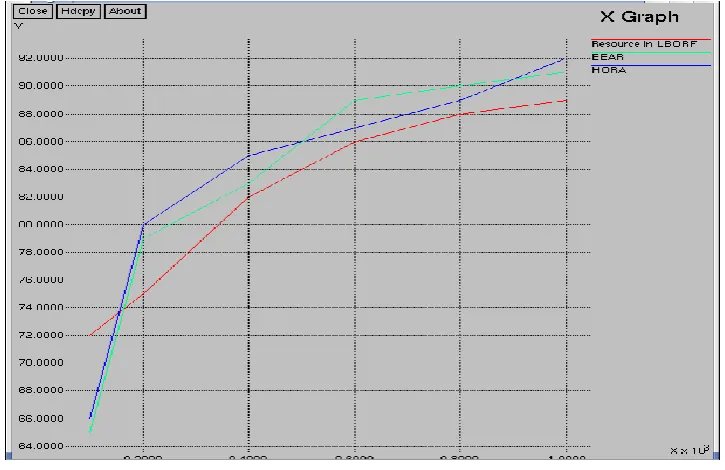
Resource sharing 87% 91% 92%
Energy consumption
0.062 0.069 0.074
Network lifetime 0.087 0.091 0.092
Packet loss percentage
38% 33% 31%
From figure-1 we found that proposed HORA have more lifetime about 92% comparing with other algorithms
Figure-2 Analysis of resource
This figure 2 shows that more amount of resource is shared by our proposed mechanism.
Figure-3 Analysis of packet loss
Figure 3 shows the Packet loss percentage is calculated by subtract to the number of data packets sent to source and
number of data packets received destination through the number of packets originated by the application layer of
Figure-4 Comparison of energy consumption
Figure 4 show delay was predictable because of packets should take to reach the destination in the shortest way.
Figure-5 Comparison of average delay
Figure-6 QOS analysis between three algorithms
5. CONCLUSION
We have developed HORA, a new kind of routing algorithm for the WSN network architecture of the current
real-time applications. Hop Alert actively tries to reduce the number of nodes taking part in the route discovery
phase by making use of an alert message which restricts some nodes from participating in route request forwarding.
We show in our simulations that this helps to obtain paths with shorter hop counts while using up fewer
transmissions. We compared the performance of EEAR and LBORF in the same typical simulation scenarios. The
simulation results for packet delivery ratio and average packet delay show that HORA performed better than EEAR
and LBORF. We will investigate the other performance metrics of HORA and design more flexible simulation
scenarios.
REFERENCES
[1] Sanati.S, Yaghmaee.M.H, Beheshti.A. 2009. “Energy Aware Multi-path and Multi-SPEED Routing Protocol
in Wireless Sensor Networks”, Proceedings of the 14th International CSI Computer Conference (CSICC'09),
978-1-4244-4262-1/09/$25.00 ©2009 IEEE.
[2] Rajshree S. Dubey, Rajnish Choubey, Amit Dubey. 2010. “Challenges for Quality of Service (QoS) in
Wireless Sensor Networks”. International Journal of Engineering Science and Technology, Vol. 2 (12). 7395-7400.
[3] P. Mohapatra, J. Li, and C. Gui. QoS in mobile ad hoc networks. Special Issue on QoS in Next Generation
Wireless Multimedia Communications Systems in IEEE Wireless Communications, 10(3):44–57, June, 2002.
[4] Bashir Yahya, Jalel Ben-Othman, “Towards a classification of energy aware MAC protocols for wireless
sensor networks”, Journal of Wireless Communications and Mobile Computing, Wiley.
[5] Kemal Akkaya, Mohamed Younis, “A Survey on Routing for Wireless Sensor Networks”, Journal of Ad Hoc
Networks, Volume, 3, Pages: 325- 349, 2005.
[6] D. Chen, P.K. Varshney, “QoS Support in Wireless Sensor Networks: a Survey”, In the Proceedings of the
International Conference on Wireless Networks (ICWN), 2004, pp 227- 233.
[7] C. Lu, B.M.Blum, T. F. Abdelzaher,J.A. Stankovic and T.He , “RAP: a real-time communication architecture
for largescale wireless sensor networks”, In Proc. Real-Time and Embedded Technology and Applications Symposium, IEEE conference, 2002K. Elissa, “Title of paper if known,” unpublished.
[8] X. Huang and Y.Fang, “Multi constrained QoS multipath routing protocol in wireless sensor networks”
Wireless Networks, Vol. 14, No 4, August 2008.
[9] L. Zhao,B.Kan, Y.Xu and X.Li, “FT-SPEED: A faulttolerant, real-time routing protocol for wireless sensor
networks”, In Proc. of International Conference on Wireless Communications, Networking and Mobile
Computing, Shanghai, China, September 21–23, 2007.R. Nicole, “Title of paper with only first word capitalized,”
J. Name Stand. Abbrev., in press.
[10] C. H. Foh, J.W. Tantra, C. Jianfei, C. T. Lau and C. P. Fu, “Modeling Hop Length Distributions for Reactive
Routing Protocols in One Dimensional MANETs,” in Proc. IEEE Int. Conf. on Communications (ICC), Jun. 2007,
pp. 3882-3886.
[11] C.K.Toh, ”Maximum battery life routing to support ubiquitous mobile computing in wireless ad hoc
networks”, IEEE Communication Magazine, pp.2-11, June 2001.
[12] R.Sivakumar, P.Sinha and V.Bharghavan, CEDAR: a core extraction distributed ad hoc routing algorithm,”
IEEE Journal on Selected Areas in Communication, pp 1454-1466, August 1999.
[13] Wang, J.; Cho, J; Lee, S.; Chen, K.C.; Lee, Y.K. Hop-based Energy aware routing algorithm for wireless
sensor networks. IEICE Trans. Commun. 2010, 2, 305-316.
[14] Mahapatra, A., K. Anand and D.P. Agrawal, 2006. QoS and energy aware routing for realtime traffic in
wireless sensor networks. Comput. Communi., 29: 437-445.