An Arabic Web-Based Exam Management System
Magdi Z. Rashad
2, Mahmoud S. Kandil
1, Ahmed E. Hassan
1, and Mahmoud A. Zaher
21-Mansoura University Faculty of Engineering.
2-Mansoura University Faculty of Computers & Information Sciences
Abstract— Web-based Exam Management Systems (EMS) are an effective solution for mass education evaluation. This paper proposed web based online examination system based. This system carries out the examination and auto-grading for students exams. This system facilitates conducting exams, collection of answers, auto marking the submissions and production of reports for the test. It supports many kinds of questions. It is used via Internet and is therefore suitable for both local and remote examination. This system could help lecturers, instructors, teachers and others who are willing to create new exams or edit existing ones as well as students participating in the exams.
The system is built using. various open source technologies AJAX, PHP, HTML and MYSQL database are used in this system. An auto-grading module is generalized to enable different exam and question types.
The system is tested in the Mansoura university quality assurance center. The test proved the validity of using this kind of web based systems for evaluates students in the institutions with high rate of students
Index Term-- E-Learning, Exam Management Systems, Automatic assessment system, web-based exams, Validation, Usability.
I. INTRODUCTION
The growth of the Internet, and in particular the World Wide Web, is already influencing the way science is taught and will undoubtedly do so to greater extent in the future. In areas of education it offers a medium that has the potential to be more responsive to students. To encourage greater participation in their own learning, and to give greater access to different sources of information than traditional methods offer. (1),( 2),(3).
In past decades, a variety of assessment approaches and systems have been proposed. And as information technology keeps improving, numerous of them have been transformed from traditional paper-and-pencil to computerized and web-based format in recent years. It is necessary to build a Web-based examination system for institutions which has a large number of students like in Egyptian universities, as an effective solution to mass learning and evaluation of basic undergraduate education.
It is urgent to develop an automatic grading system which can grade the operating questions as well as the objective ones. However, the previous Web-based exam system cannot support such functions (4). Testing the students through the Internet is one of the most difficult challenges in E-learning (5), as part of the modern development in the technology of education systems.
Web-based Examination system could be used via Internet or intranet for manages student examination (6). Web-based assessment is widely used to support students in
learning and help them to achieve their learning goals. For example, readiness self-assessments are often used in open universities to help students determine if they have the necessary skills and attitudes for successful completion of a course or program. Another application of exam management systems includes assessment of the learning process itself. Self-assessment tests are commonly used in technology enhanced environments (7), especially in learning management systems. Students can use such self-assessment tests to check their acquired knowledge and get feedback about their learning progress.
Exam management systems are very important for all whom involved in the education process like (Faculty, students and administration staff).
For the faculty:
Marking the test is done automatically and instantaneously; the faculty is relieved from these, time consuming duties,
Questions can be easily recycled from the question bank, easily edited and changed,
Different versions of the same question can be generated for different students.
For the students:
Tests can be taken anytime Tests can be taken anywhere,
Questions can be attempted in a stress-less environment,
Test can be taken using a simple personal computer and the minimal requirement is just a Web browser, Questions can be viewed with special visual effects
such as 3D, and objects in motion can be viewed.
For the administration:
The marks are automatically collected, analyzed, and disseminated for purposes like evaluation of teaching and learning process.
The extensive use of automated testing in grading reduces grading time and allows graders to focus on issues such as code style. In this paper the focus is on the marriage of computerized testing systems with the World Wide Web to produce web-based assessment and testing systems. This paper focuses on comprehensive systems in which exams are delivered and graded by a central server. The objective of this work is to build exam management tool for students and instructors to monitor and boost learning and teaching practices.
basic skills. This will help the teaching and learning process in higher education in the intensive based institutes.
The proposed question types of that examination system could be formally checked and easily evaluated online. The typical questions are not limited to yes/no questions, multiple choice/single answer questions, multiple-choice/multiple-answer questions, and fill-in questions with a string and numeric answer. It also supports essay questions.
II. RELATED WORK
In their paper (8) Yuan et al proposed a multi layer based exam system based on Microsoft DCOM technology. The system is not reliable enough. Also it uses a specific technology not open source technology. The system is designed specifically for computer science students. It is not designed for general purpose students. Also it does not support Arabic language. In his research (9) Hoffman et al proposed an exam system for testing student in the software engineering courses and that system is used offline.
JeflMcGough et al (10) proposed a browser-based exams
system to prove of concept. That system does not support full interactivity and it does not support different languages it's also designed for computer science students. In his research (11) Ji-hoon et al proposed exam generator program which helps both users and instructors. The system is built for generating exams for fundamental engineering students. The exam is designed taking into consideration one type of exams which is Multiple Choice Questions.
Raymound et al (12) proposed a web based Multiple Choice Exams. This exam supports only this type of questions and does not support Arabic as an exam language. Jelica et all (13) purposed a system that provide teachers with efficient means of generating and scoring tests with multiple choice answers. This system is inevitable in evaluating student's knowledge at massive examinations. Jordi et al. (14) presented a secure electronic examination protocol. Using wireless technology, they propose a trade-off solution between examination security and examination flexibility. Mikel et al (15) proposed an exam tool that is based on multiple choice questions. This tool is designed for only computer science students. TCExam (16) is open source web based exam. But it is limited on supporting much kind of questions.
Zhang et al (17) proposed a web-based operational skills examination and evaluation system for computer courses. In his study (18), Chien Lin et al designed a prototype automatic quiz generation system (auto-quiz for short) for a given English text to test learner comprehension of text content and English skills. After the emergence of modern technologies in the field of Information Technologies (IT), virtual learning has attained a new form. The way of announcing exams’ grades is an important topic in e-learning. For announcing exams’ grades on the web, various methods have been proposed. In his paper (19), Shirali-Shahreza introduced three new methods for announcing exams’ grades and the result of implementing these methods for announcing the grades of some courses at the some Iranian universities are provided. Also these methods and their results are analyzed. Finally these three new methods are compared with other methods.
Pascual-Nieto et al (20) proposed a web-based
application which automatically and adaptively assesses students' free text answers written in Spanish and English. It is intended to help students review concepts outside of class, and provides an alternative assessment method. In their research (21) Hernán-Losada et al addressed the combined use of automatic grading and the test-driven approach from a pedagogical view. In their research (22), NAŞCU et al present the main aspects and implementation of an online multiple choice examination system with general chemistry issues for student evaluation. The testing system was used to generate items for a multiple-choice examination for first year undergraduate students in Material Engineering and Environmental Engineering from Technical University of Cluj-Napoca, Romania, which all attend the same General Chemistry course.
III. PROPOSED SYSTEM.
The Web-Based Exam Management System has been developed to support automatic grading, exam archiving, and exam administration using the WWW as a delivery vehicle. In most of them, the widely used questions are correspondence to Intended Learning Outcome (4 ) (ILO) for the courses, and it should be easily judged and evaluated online by comparing with the correct answers. The typical questions include yes/no questions, choice/single-answer questions, multiple-choice/ multiple-answer questions, matching questions, numeric questions, and essay questions. This system is built based on open source technology.
The Proposed System Architecture
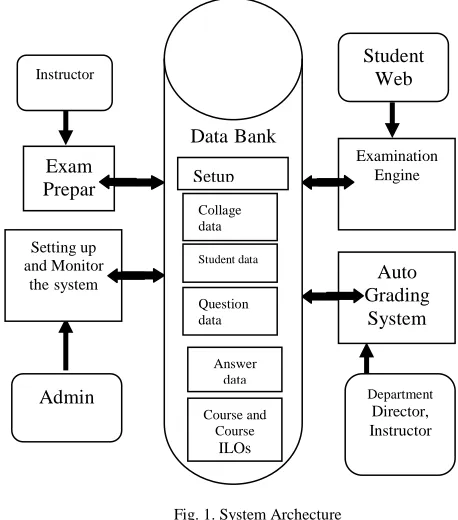
The architecture of the proposed system is shown in fig. 1.
.
Fig. 1. System Archecture
The system is composed of four main modules of that system module, Exam Preparation module, Setting up and monitoring
Instructor
Admin Exam Prepar ation
Setting up and Monitor
thesystem Auto
Grading System Examination
Engine Student
Web Browser
Department
Director, Instructor DataBank
Setup Informatio n
Answer data
Course and Course
ILOs
Collage data
Student data
the system module, Auto grading System module and
Examination engine module. The Instructor, Department
Director, and the student could access the system for a specific purpose. The main data base of the system consists of Questions and answers data, Student data, Collage data, Courses Intended Learning Outcomes (ILOs) which reflected back on the questions, also the setup information of the system.
The proposed system is based on three-tier Client/Server technology (17) , there is a server side modules and client side modules. The system tiers are described as follows:
A. Database Tier
where data are stored as records in tables on the server side daatbase. It Consists of :
Exam system data : which contains all question data, all answer data, all courses data and courses ILO'S, these data are explained as follows:
Question data : Which consists of data records about
questions such as question name, question degree , question chapter, and question type.
Answer data module: Which consists of data records about question and its answers such as question number, question type, the correct answer , and the student answer.
Course and Courses ILOS : Which consists of data about courses such as courses name, courses description , courses term and course Intended Learning Outcomes.
University data : which contains all setup information data, all student data and all collage data. These data is explained as follows:
Setup information : Which consists of data records about system setup such as university name, academic year , admin username , and password.
Student handling : Which consists of data records about students such as student Id, student name, student username , and student password.
Collage data : Which consists of data records about collage such as collage Id, and collage name.
B. Business Logic Tier
This is all the logic of the system. It consists of the following logic modules:
Exam Preparation: Is used to manage and handle the course questions, exams. It also contains the logic behind instructor-course relation, instructor-term relation, course-term relation and the report behind these relations. This logic used to handle all the information stored in the database about course-instructor relation, course-instructor-exam relation. Details of that logic is described as follows :
1. Add questions: The instructor first could insert all the questions.
2. Create exam: The instructor could create exam
by selecting the questions that added befor. 3. Update exam: The instructor could update the
exam that made before.
Setting up and monitoring the system: is used to set and handle the student information which is ddetailed as follows:
The administrator login, he can insert or update
students information. There are some scenarios for that event, if the student does not exist he can create new student record by adding student data.
But if the student already exist the administrator has two choices either drop the student or update the student data by updating the student login name or password or both and or privilege, then save the all that data in the database. The administrator login and he can insert or
update instructor information, he can check for the instructor first if the instructor does not exist the administrator can create new instructor record by adding instructor data.
But if the instructor already exist the administrator has two choices either drop the instructor or update the instructor data by updating the instructor login name or password or both, instructor department , privilege, then save the all data in the database.
I. Auto grading: with that logic system can
automatically grade students’ answers, which are collected by the examination system . The system compare the student answers with the correct answers which entered by the instructors. If the exam has essay question the system correct all the questions in the exam include the essay question but the system return only the essay question to the instructor. The instructor correct the essay question and pass it pack to the administrator.
Examination engine :
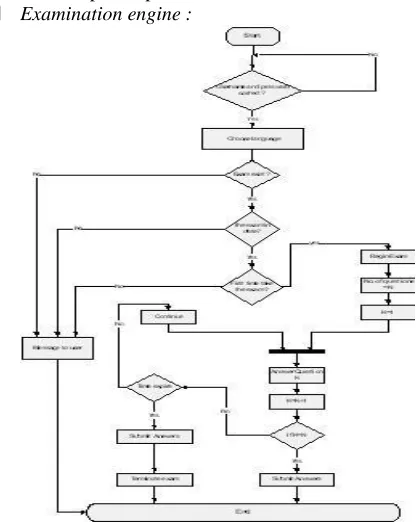
As shown in fig. 2 Examination Engine contains the logic used by the students to take exam and shows the results after they finish it. This logic is descriped as follows :
The system first check the username and password of
the studen.
If they are not correct the system starts again.
If the the username and password of the student are
correct then check if the exam does not exist the system gives warns the student that the exam not exist or not begin, but if the exam exists the student choose his exam.
The system check if it is the first time for this student to take that exam if the answer is no the system gives warning the dtudent that he can not take the exam twice. But if the answer is yes the system pups up the exam.
While the student answering the questions the system
check for the time if the exam time expire or not. The system end the exam if it is expired then save the answers in the database.
C. User interface Tier:
This component caries out the interface for all the users that access the system administrator, instructors, student affairs and students. They can access the system with a normal web browser via the internet connection. Each user has his own interfase. That layer is live on the client side. This layer is explained as follows:
Adminstrators Interface: where all the adminstrators
can manage the system.
Instructors Interface: where all the instructors can manage the examination system, adding or updating questions , and creating or updating exam.
Student Interface: where all the student can deal with.
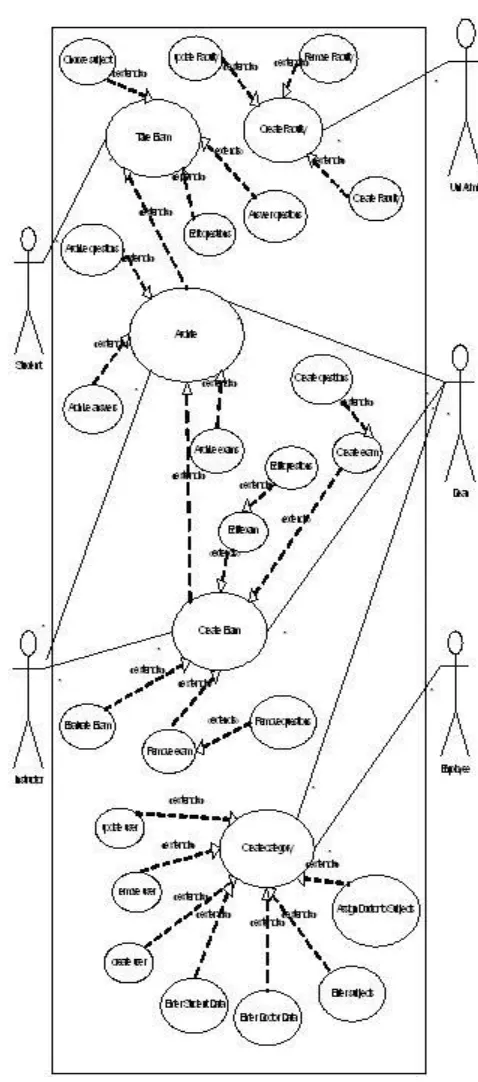
The use case of the whole system is shown in fig. 3 which describe the first step of the system analysis.
Fig. 3. Exam management system use case diagram
The Exam management system use case digram shows in Fig. 3where identify the system boundary and the external actors as we see our system has five actors (Adminstrator , System Root (faculty dean) , Student , Instructor, and Student affairs ).
IV. SYSTEM RESULTS
is use as a Web server, and the database Server is MYSQL (21). The client-side component is implemented using HTML, JavaScript, and CSS (22). These technologies guarantee the feasibility and the extension of the exam system.
Web-Based Exam Management System (EMS) is built using AJAX (25) technology, which is a group of interrelated web development techniques used for creating interactive web applications or rich Internet applications. With Ajax, web applications can retrieve data from the server asynchronously in the background without interfering with the display and behavior of the existing page. Data is retrieved using the AJAX which is implemented using remote scripting language JavaScript which is supported by all web browsers. The proposed system supports the following question types: Multiple Choices, Fill-in the blanks, Matching, Numeric, and Essay questions . Fig. 4 shows the output of creating exam process.
Fig. 4. Create exam
V. Validation and Statistical Results.
In software testing and software engineering validation is the process of checking that a software system meets specifications. And that it fulfils its intended purpose.(24) In other words, validation ensures that the product actually meets the user's needs. And that the specifications were correct. Validation ensures that ‘you built the right thing’.
To know that the product mets the user’s needs we need to get information from the user. There are six common ways to get information. These are: questionnaire , talking with people, focus groups, personal interviews, telephone surveys, and mail surveys. (26). Then uses information to make decisions. If the
information is accurate, then we have a high probability of making a good decision. But if the information is inaccurate, the ability to make a correct decision is diminished. Better information usually leads to better decisions.
According to our questionnaire on 250 students in Mansoura university faculty of engineering, programming course exam. Questionnaire arranged in deferent categories explained as follows :
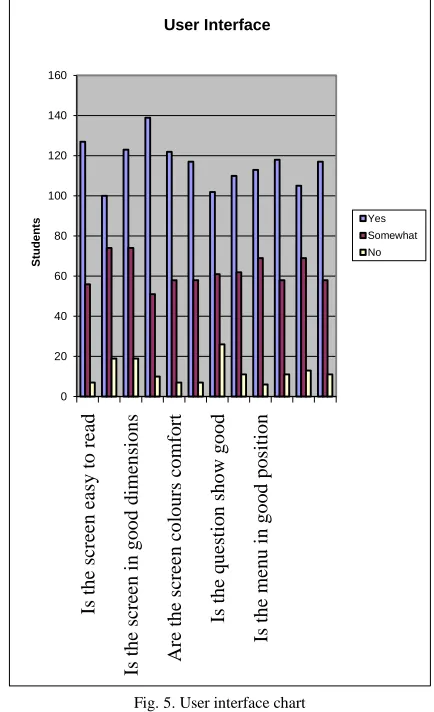
User Interface : In this category the students were asked questions to know if the windows is easy to read or how the windows comfort and understandable for the students. The results explained as shown in fig. 5 as follows:
67 % of the students found the window system is easy to read. And 29 % found that the window system is somewhat easy to read. But only 4 % found the window system is not easy to read. And 52 % found the window system pleasant to look and 38 % found the window system somewhat pleasant to look, and only 10 % did not agree for the window system pleasant to look.
As an over all conclusion 61 % like the user interface very much, 33 % like the user interface somewhat . and only 6 %
did not like the user interface.
0 20 40 60 80 100 120 140 160
Is
th
e
sc
re
en
e
as
y
to
r
ea
d
Is
th
e
scr
ee
n
i
n
g
o
o
d
d
im
en
sio
n
s
Ar
e
th
e
scr
ee
n
co
lo
u
rs
co
m
fo
rt
Is
th
e
q
u
es
tio
n
sho
w g
o
o
d
Is
th
e
m
en
u
in
g
o
o
d
p
o
sitio
n
Stu
d
e
n
ts
User Interface
Yes Somewhat No
Fig. 5. User interface chart
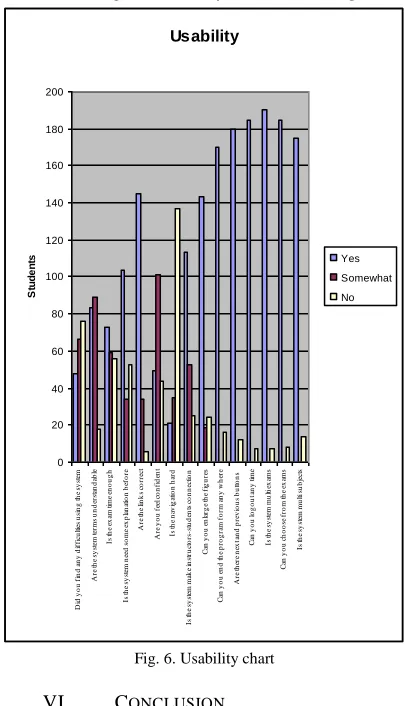
Also to know if the system terms understandable or not. The results explained as shown in fig. 6 as follows: 40 % of the students did not find any difficulties using the system, and 35 % found somewhat difficulties, and 25 % found difficulties using the system.
44 % agree that the system terms understandable, and 47 % somewhat agree the, and 9 % did not agree. As an over all conclusion 69 % agree that the system is usable, 16 % somewhat agree. and only 15 % did not agree.
Usability 0 20 40 60 80 100 120 140 160 180 200 D id y o u f in d a n y d if fi cu lti es u si n g th e sy st em A re th e sy st em te rm s u n d er st an d ab le Is th e ex am ti m e en o u g h Is th e sy st em n ee d s o m e ex p la n at io n b ef o re A re th e lin k s co rr ec t A re y o u f ee l c o n fi d en t Is th e n av ig at io n h ar d Is th e sy st em m ak e in st ru ct o rs -s tu d en ts c o n n ec tio n C an y o u e n la rg e th e fi g u re s C an y o u e n d th e p ro g ra m f o rm a n y w h er e A re th er e n ex t a n d p re v io u s b u tto n s C an y o u lo g o u t a n y ti m e Is th e sy st em m u lti e x am s C an y o u c h o o se f ro m th e ex am s Is th e sy st em m u lti s u b je ct s S tu d e n ts Yes Somewhat No Fig. 6. Usability chart
VI. CONCLUSION
In this paper a Web-Based Examination System has been presented. It looks at the features and architecture for the analysis , the design, and the implementation of the EMS. Authors conclude that the architecture and the design is working well. A little changes of the future system could be done at that paper the description of that architecture, analysis, design, and technologies has been done.
It also concludes that the presented system saves instructors from suffering and boring of grading works. And students have explored themselves and accessed a larger variety of exams than before. Taking advantage of auto-grading system, instructors may not only add new questions in question bank, but also grade students’ answers automatically.
According to proposed questionnaire results where 94 % of the students like the user interface and 85 % agree that the system is usable. Also 86 % satisfy with the system and 99 % found the system is secure. Authors concluded that the
developed system satisfy the requirements. And it is secure, useable and has a very good user interface. In the future work more question types could be implemented also a more reliable security system could be done.
REFERENCES
[1] Brooks, D. W. "Web-teaching: a guide to designing interactive teaching for the World Wide Web". 1997, New York: Plenum Press. [2] De La Beaujardiere, J. F., Cavallo, J., Hasler, A. F., Mitchell, H.,
O'Handley, C., Shiri, R., & White, R. "The GLOBE Visualization Project: Using WWW in the Classroom." , Journal of Science Education and Technology, 6(1), 15-22, 1997.
[3] Khan, B. H. (Ed.). "Web-based instruction", Englewood Cliffs, N.J.: Educational Technology Publications, 1997.
[4] I. Hernán-Losada , C. Pareja-Flores, and J. Velázquez-Iturbide, “Testing-Based Automatic Grading: A Proposal from Bloom’s Taxonomy “, Eighth IEEE International Conference on Advanced Learning Technologies, 2008.
[5] W. Huang, X. He, and Lin Qiao, “The Design and Implementation of Web-based E-learning Examination System Based on J2EE “, Proceedings of the International Conference on Information Technology, 2004 IEEE.
[6] Yuan Zhenming1, Zhang Liang2, Zhan Guohua3 , " A novel Web-Based online examination system for computer science education ", 33rd ASEE/IEEE Frontiers in Education Conference , 2003. [7] S. Bonham, A. Titus, R. Beichner and L. Martin, “ Education
research using web-based assessment systems “, Journal of Research on Computing in Education, Fall 2000.
[8] Yuan Zhenming1, Zhang Liang2, Zhan Guohua3, " A novel Web-Based online examination system for computer science education ", 33rd ASEE/IEEE Frontiers in Education Conference , 2003.
[9] Daniel Hoffman, Paul Strooper, and Peter Walsh, "Teaching and Testing", Proceedings of the 9th Conference on Software Engineering Education, Page: 248 ,1996 ISBN:0-8186-7249-8 IEEE Computer Society Washington, DC, USA.
[10] McGough, J.; Mortensen, J.; Johnson, J.; Fadali, S., "A web-based testing system with dynamic question generation", Frontiers in Education Conference, 2001. 31st Annual Volume 3, Issue, 2001 Page(s):S3C - 23-8 vol.3
[11] Ji-hoon Lee, Kurt Gramoll,. "Internet-based Exam Generator for Practice Review of the Fundamentals in Engineering Exam". A THESIS SUBMITTED TO THE GRADUATE FACULTY in partial fulfillment of the requirements for the degree of MASTER OF SCIENCE BY JI-HOON LEE Norman, Oklahoma 2000, SCHOOL OF AEROSPACE AND MECHANICAL ENGINEERING. [12] Raymond Lister, Peter Jerram, "Design forWeb-Based On-Demand
Multiple Choice Exams Using XML Proceedings of the IEEE International Conference on Advanced Learning Techniques (ICALT’01), 2001 IEEE
[13] Jelica Protice I , Dragan Bojie ', and Igor Tartalja, " test: Tools for Evaluation of Students' Tests- A Development Exprience", October 10 - 13,2001 Reno, NV 31'' ASWIEEE Frontiers in Education Conference
[14] Jordi Herrera-Joancomart´ı, Josep Prieto-Bl´azquez, Jordi Castell`a-Roca Estudis d’Inform`atica i Multim`edia, "A secure electronic examination protocol using wireless networks", Proceedings of the International Conference on Information Technology: Coding and Computing (ITCC’04).
[15] Mikel Kerejeta, Mikel Larra ٌaga, Urko Rueda, Ana Arruarte, Jon.A. Elorriaga, " TOKA: A Computer Assisted Assessment Tool Integrated in a Real Use Context", Proceedings of the Fifth IEEE International Conference on Advanced Learning Technologies (ICALT’05)
[16] Nicola Asuni, " Tcexam ", [On-Line] http://www.tcexam.com , 2007 [17] Liang Zhang, Yue-ting Zhuang1, Zhen-ming Yuan2, Guo-hua Zhan2,
[18] Li-Chun Sung, Yi-Chien Lin and Meng Chang Chen, "An Automatic Quiz Generation System for English Text Seventh IEEE International Conference on Advanced Learning Technologies (ICALT 2007). [19] Shirali-Shahreza, M., "Design and Implementation of Three Different
Methods for Announcing Exam Grades on the Web", Advanced Learning Technologies, 2008. ICALT apos;08. Eighth IEEE International Conference on Volume, Issue, 1-5 July 2008 Page(s):335 - 337
[20] Ismael Pascual-Nieto, Diana Pérez-Marín, Mick O’Donnell, Pilar Rodríguez, " Enhancing a free-text Adaptive Computer Assisted Assessment system with self-assessment features", Eighth IEEE International Conference on Advanced Learning Technologies. [21] Isidoro Hernán-Losada, Cristóbal Pareja-Flores, J. Ángel
Velázquez-Iturbide, " Testing-Based Automatic Grading: A Proposal from Bloom’s Taxonomy", Eighth IEEE International Conference on Advanced Learning Technologies.
[22] Horea Iustin NAŞCU, Lorentz JÄNTSCHI, "Multiple Choice Examination System 2. Online Quizzes for General Chemistry", Leonardo Electronic Journal of Practices and Technologies, 3(5), 26 - 36. YEAR: 2004.
[23] Wikipedia The free Encyclopedia," AJAX technology",[On-Line] http://en. wikipedia.org/wiki/ validation (Accessed in Jan.2010). [24] Wikipedia The free Encyclopedia," Implementation ",[On-Line]
http://en. wikipedia.org/wiki/ validation (Accessed in Nov.2009) [25] Wikipedia The free Encyclopedia," AJAX technology",[On-Line]
http://en. wikipedia.org/wiki/ validation (Accessed in Jan.2010). [26] David S. Walonick, “Survival Statistics “,StatPac, Inc., 8609 Lyndale