ORIGINAL ARTICLE
Genetic effects in
fl
uencing risk for major depressive disorder in
China and Europe
TB Bigdeli
1, S Ripke
2,3,4, RE Peterson
1, M Trzaskowski
5,6, S-A Bacanu
1, A Abdellaoui
7, TFM Andlauer
8,9, ATF Beekman
10, K Berger
11,
DHR Blackwood
12, DI Boomsma
7, G Breen
13,14, HN Buttenschøn
15, EM Byrne
6, S Cichon
16,17,18,19, T-K Clarke
12, B Couvy-Duchesne
6,20,21,
N Craddock
22, EJC de Geus
7,23, F Degenhardt
19,24, EC Dunn
25,26,27, AC Edwards
1, AH Fanous
28, AJ Forstner
19,24, J Frank
29, M Gill
30,
SD Gordon
20, HJ Grabe
31, SP Hamilton
32, O Hardiman
33, C Hayward
34, AC Heath
35, AK Henders
6, S Herms
19,24,36, IB Hickie
37,
P Hoffmann
19,24,38, G Homuth
39, J-J Hottenga
7, M Ising
40, R Jansen
10, S Kloiber
40, JA Knowles
41, M Lang
29, QS Li
42, S Lucae
40,
DJ MacIntyre
12, PAF Madden
43, NG Martin
20,44, PJ McGrath
45, P McGuf
fi
n
14, AM McIntosh
12,46, SE Medland
20, D Mehta
6,
CM Middeldorp
7, Y Milaneschi
10, GW Montgomery
47, O Mors
48, B Müller-Myhsok
8,9,49, M Nauck
50, DR Nyholt
51, MM Nöthen
19,24,
MJ Owen
52, BWJH Penninx
10, ML Pergadia
53, RH Perlis
54,55, WJ Peyrot
10, DJ Porteous
56, JB Potash
57, JP Rice
58, M Rietschel
29, BP Riley
1,59,
M Rivera
60,61, R Schoevers
62, TG Schulze
29,63,64,65,66, J Shi
67, SI Shyn
68, JH Smit
10, JW Smoller
25,26,27, F Streit
29, J Strohmaier
29,
A Teumer
69, J Treutlein
29, S Van der Auwera
31, G van Grootheest
10, AM van Hemert
70, H Völzke
69, BT Webb
1, MM Weissman
71,72,
J Wellmann
11, G Willemsen
7, SH Witt
29, DF Levinson
73, CM Lewis
14,74, NR Wray
5,6, J Flint
75,76, PF Sullivan
77,78,79and KS Kendler
1,59on behalf of the CONVERGE consortium and Major Depressive Disorder Working Group of the Psychiatric Genomics Consortium
1
Department of Psychiatry, Virginia Institute for Psychiatric and Behavioral Genetics, Virginia Commonwealth University School of Medicine, Richmond, VA, USA;2
Department of Psychiatry, Charite Universitatsmedizin Berlin Campus Benjamin Franklin, Berlin, Germany;3
Medical and Population Genetics, Broad Institute, Cambridge, MA, USA;4
Analytic and Translational Genetics Unit, Massachusetts General Hospital, Boston, MA, USA;5
Institute for Molecular Bioscience, The University of Queensland, Brisbane, QLD, Australia; 6
Queensland Brain Institute, The University of Queensland, Brisbane, QLD, Australia;7
Department of Biological Psychology, Vrije Universiteit Amsterdam, Amsterdam, The Netherlands;8
Department of Translational Research in Psychiatry, Max Planck Institute of Psychiatry, Munich, Germany;9
Munich Cluster for Systems Neurology (SyNergy), Munich, Germany;10
Department of Psychiatry, VU University Medical Center and GGZ inGeest, Amsterdam, The Netherlands;11
Institute of Epidemiology and Social Medicine, University of Muenster, Münster, Germany;12
Division of Psychiatry, University of Edinburgh, Edinburgh, UK;13
King's College London, NIHR BRC for Mental Health, London, UK; 14
King's College London, MRC Social Genetic and Developmental Psychiatry Centre, London, UK;15
Department of Clinical Medicine, Translational Neuropsychiatry Unit, Aarhus University, Aarhus, Denmark;16
Department of Biomedicine, University of Basel, Basel, Switzerland;17
Division of Medical Genetics, University of Basel, Basel, Switzerland; 18
Institute of Neuroscience and Medicine (INM-1), Research Center Juelich, Jülich, Germany;19
Institute of Human Genetics, University of Bonn, Bonn, Germany;20
Department of Genetics and Computational Biology, QIMR Berghofer Medical Research Institute, Brisbane, QLD, Australia;21Centre for Advanced Imaging, University of Queensland, Brisbane, QLD, Australia;22
Department of Psychological Medicine, Cardiff University, Cardiff, UK; 23
EMGO+ Institute, VU University Medical Center, Amsterdam, The Netherlands; 24
Department of Genomics, Life and Brain Center, University of Bonn, Bonn, Germany;25
Stanley Center for Psychiatric Research, Broad Institute, Cambridge, MA, USA; 26
Department of Psychiatry, Massachusetts General Hospital, Boston, MA, USA;27
Psychiatric and Neurodevelopmental Genetics Unit, Massachusetts General Hospital, Boston, MA, USA;28
Department of Psychiatry and Behavioral Sciences, State University of New York Downstate Medical Center, Brooklyn, NY, USA;29
Department of Genetic Epidemiology in Psychiatry, Central Institute of Mental Health, Medical Faculty Mannheim, Heidelberg University, Heidelberg, Germany;30
Department of Psychiatry, Trinity College Dublin, Dublin, Ireland;31
Department of Psychiatry and Psychotherapy, University Medicine Greifswald, Greifswald, Germany;32
Department of Psychiatry, Kaiser-Permanente Northern California, San Fransisco, CA, USA;33
Institute of Neuroscience, Trinity College Dublin, Dublin, Ireland;34
Medical Research Council Human Genetics Unit, Institute of Genetics and Molecular Medicine, University of Edinburgh, Edinburgh, UK;35
Department of Psychiatry, Washington University in Saint Louis School of Medicine, St Louis, MO, USA;36
Division of Medical Genetics, Department of Biomedicine, University of Basel, Basel, Switzerland;37Brain and Mind Research Institute, University of Sydney, Sydney, NSW, Australia;38Human Genomics Research Group, Department of Biomedicine, University of Basel, Basel, Switzerland;39
Department of Functional Genomics, Interfaculty Institute for Genetics and Functional Genomics, University Medicine and Ernst Moritz Arndt University Greifswald, Greifswald, Germany; 40
Max Planck Institute of Psychiatry, Munich, Germany; 41
Department of Psychiatry and The Behavioral Sciences, University of Southern California, Los Angeles, CA, USA;42
Neuroscience Therapeutic Area, Janssen Research and Development, LLC, Titusville, NJ, USA;43
Department of Psychiatry, Washington University in Saint Louis School of Medicine, St Louis, MO, USA;44
School of Psychology, University of Queensland, Brisbane, QLD, Australia;45
Department of Psychiatry, New York State Psychiatric Institute, Columbia University College of Physicians and Surgeons, New York, NY, USA;46
Centre for Cognitive Ageing and Cognitive Epidemiology, University of Edinburgh, Edinburgh, UK;47
Institute for Molecular Biology, University of Queensland, Brisbane, QLD, Australia;48
Psychosis Research Unit, Aarhus University Hospital, Risskov, Denmark;49
Department of Molecular and Clinical Pharmacology, University of Liverpool, Liverpool, UK;50
Institute of Clinical Chemistry and Laboratory Medicine, University Medicine Greifswald, Greifswald, Germany;51
Institute of Health and Biomedical Innovation, Queensland University of Technology, Brisbane, QLD, Australia;52MRC Centre for Neuropsychiatric Genetics and Genomics, Cardiff University School of Medicine, Cardiff, UK;53Charles E. Schmidt College of Medicine, Florida Atlantic University, Boca Raton, FL, USA;54
Department of Psychiatry, Harvard Medical School, Boston, MA, USA;55
Department of Psychiatry, Massachusetts General Hospital, Boston, MA, USA;56Medical Genetics Section, CGEM, IGMM, University of Edinburgh, Edinburgh, UK;57Department of Psychiatry, University of Iowa, Iowa, IA, USA; 58
Department of Psychiatry, Washington University in Saint Louis, St Louis, MO, USA; 59
Department of Human and Molecular Genetics, Virginia Commonwealth University School of Medicine, Richmond, VA, USA;60
Department of Biochemistry and Molecular Biology II, Institute of Neurosciences, Center for Biomedical Research, University of Granada, Granada, Spain;61
King’s College London, MRC Social Genetic and Developmental Psychiatry Centre, London, UK;62
Department of Psychiatry, University of Groningen, University of Medical Center Groningen, Groningen, The Netherlands;63
Institute of Psychiatric Phenomics and Genomics, Medical Center of the University of Munich, Campus Innenstadt, Munich, Germany;64
Department of Psychiatry and Psychotherapy, University Medical Center Göttingen, Göttingen, The Netherlands; 65
Department of Psychiatry and Behavioral Sciences, Johns Hopkins University, Baltimore, MD, USA;66
Human Genetics Branch, NIMH Division of Intramural Research Programs, Bethesda, MD, USA;67Division of Cancer Epidemiology and Genetics, National Cancer Institute, Bethesda, MD, USA;68Division of Psychiatry, Group Health, Seattle, WA, USA; 69
Institute for Community Medicine, University Medicine Greifswald, Greifswald, Germany; 70
Department of Psychiatry, Leiden University Medical Center, Leiden, The Netherlands;71Division of Epidemiology, New York State Psychiatric Institute, New York, NY, USA;72Department of Psychiatry, Columbia University College of Physicians and Surgeons, New York, NY, USA;73
Psychiatry and Behavioral Sciences, Stanford University, Stanford, CA, USA;74
King's College London, Department of Medical and Molecular Genetics, London, UK;75
Merton College, University of Oxford, Oxford, UK;76
Wellcome Trust Centre for Human Genetics, University of Oxford, Oxford, UK;77
Medical Epidemiology and Biostatistics, Karolinska Institutet, Solna, Sweden;78
Department of Genetics, University of North Carolina at Chapel Hill, Chapel Hill, NC, USA and79
Department of Psychiatry, University of North Carolina at Chapel Hill, Chapel Hill, NC, USA. Correspondence: Dr TB Bigdeli, Department of Psychiatry, Virginia Commonwealth University School of Medicine, Virginia Institute for Psychiatric and Behavioral Genetics, 800 E. Leigh Street, Biotech One, Suite 101, Richmond, VA 23219-1534, USA.
E-mail: [email protected]
Received 19 November 2016; accepted 27 November 2016
Major depressive disorder (MDD) is a common, complex psychiatric disorder and a leading cause of disability worldwide. Despite
twin studies indicating its modest heritability (~30
–
40%), extensive heterogeneity and a complex genetic architecture have
complicated efforts to detect associated genetic risk variants. We combined single-nucleotide polymorphism (SNP) summary
statistics from the CONVERGE and PGC studies of MDD, representing 10 502 Chinese (5282 cases and 5220 controls) and 18 663
European (9447 cases and 9215 controls) subjects. We determined the fraction of SNPs displaying consistent directions of effect,
assessed the signi
fi
cance of polygenic risk scores and estimated the genetic correlation of MDD across ancestries. Subsequent
trans-ancestry meta-analyses combined SNP-level evidence of association. Sign tests and polygenic score pro
fi
ling weakly support
an overlap of SNP effects between East Asian and European populations. We estimated the trans-ancestry genetic correlation of
lifetime MDD as 0.33; female-only and recurrent MDD yielded estimates of 0.40 and 0.41, respectively. Common variants
downstream of
GPHN
achieved genome-wide signi
fi
cance by Bayesian trans-ancestry meta-analysis (rs9323497; log
10Bayes
Factor = 8.08) but failed to replicate in an independent European sample (
P
= 0.911). Gene-set enrichment analyses indicate
enrichment of genes involved in neuronal development and axonal traf
fi
cking. We successfully demonstrate a partially shared
polygenic basis of MDD in East Asian and European populations. Taken together, these
fi
ndings support a complex etiology for
MDD and possible population differences in predisposing genetic factors, with important implications for future genetic studies.
Translational Psychiatry
(2017)
7,
e1074; doi:10.1038/tp.2016.292; published online 28 March 2017
INTRODUCTION
Major depressive disorder (MDD) is the most common psychiatric
illness and a leading cause of disability worldwide.
1,2MDD is
modestly heritable (30
–
40%), may be genetically complex and
likely heterogeneous, complicating efforts to identify replicable
risk loci.
3,4The successful detection and interpretation of genetic
associations require both increased sample sizes
5and empirically
driven efforts to reduce phenotypic heterogeneity.
6Underpinning the success of genome-wide association studies
(GWAS) of numerous traits has been the emergence of large
research consortia.
7In addition to facilitating larger sample sizes,
many consortia are increasingly ancestrally diverse, enabling
identi
fi
cation of novel associations
8–10and independent
replica-tion of reported
fi
ndings,
11,12as well as improving
fi
ne mapping of
implicated loci.
13,14Consistent associations at replicated loci have
been reported for psychiatric disorders
15and non-psychiatric
traits,
8,11,16–18and shared liabilities are often borne out by
genome-wide polygenic analyses.
19–21Whether genetic factors predisposing to MDD are shared across
ancestries is not well established, and two replicated
genome-wide signi
fi
cant associations for MDD in China had markedly lower
allele frequencies in Europeans and thus did not replicate.
22–24Allelic heterogeneity and population-speci
fi
c genetic effects
have been reported for several complex traits;
18,25,26however,
the extent of differences across ancestries remains relatively
unexplored.
We sought to clarify the extent to which liability to MDD is
shared between European and East Asian populations via
collaboration between the Psychiatric Genomics Consortium
(PGC)
22and CONVERGE
6studies of MDD. We asked whether
observed directions of allelic effects are consistent across
populations, assessed the signi
fi
cance of cross-ancestry polygenic
scores and estimated the trans-ancestry genetic correlation of
MDD. We attempted to disentangle population differences from
those arising from ascertainment or phenotypic de
fi
nition through
analyses of recurrent MDD and in female subjects. These
meta-analyses represent the largest trans-ancestry genetic study of
MDD to date.
MATERIALS AND METHODS
Ascertainment and genotyping
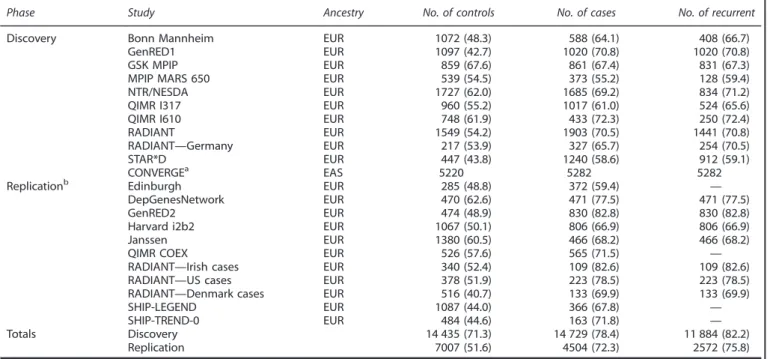
Sample ascertainment, SNP genotyping and quality-control procedures for PGC and CONVERGE have been described previously.6,22Individual sites
and sample sizes are presented in Table 1.
CONVERGE (China, Oxford and Virginia Commonwealth University
Experimental Research on Genetic Epidemiology): Briefly, all subjects were Han Chinese women and had two or more episodes of MDD meeting DSM-IV criteria. After applying quality controls modeled after the PGC study, 10 502 samples (5282 cases and 5220 controls) and 6 242 619 SNPs were retained for analysis.
PGC MDD:Samples included here comprise Stage 1 of the PGC MDD study.22 Briefly, all subjects were of European ancestry, all cases were
assessed using validated methods and met DSM-IV criteria for lifetime MDD, and the majority of controls were screened to exclude lifetime MDD. Available data on number of depressive episodes were used to identify recurrent cases (two or more episodes). Nine studies from the US, Europe and Australia were genotyped using SNP arrays. Imputation was performed with IMPUTE2 (ref. 27) using the 1000 Genomes Project data (v3; GRCh37/hg19),28 resulting in a total of 13 381 627 autosomal and
X chromosome SNPs.
Polygenic risk score pro
fi
ling and binomial sign tests
Each data set wasfiltered on the basis of statistical imputation information (INFO) greater than 0.8 and minor allele frequency greater than 0.01 in both CONVERGE and PGC overall; linkage disequilibrium (LD)-based 'clumping' was used to obtain an approximately independent set of SNPs (r2o0.1) while preferentially retaining the most significant SNP within 500-kb windows. We computed weighted polygenic scores (that is, log odds ratio of the associated allele), based on varyingP-value thresholds in the 'training set' results (that is, CONVERGE or PGC);P-value thresholds ranged between 10−5 and 0.5. We evaluated the significance of case–control differences using logistic regression and covarying ancestry-based principal components and a study indicator variable. The predictive value of these scores is reported in terms of Nagelkerke’s pseudo-R2 (fmsb
package in R).29
Using the same sets of SNPs and the same P-value thresholds, we applied a binomial sign test to determine whether the number of SNPs demonstrating consistent directions of allelic effects between CONVERGE and PGC was greater than expected by chance (that is, a one-sided test of whether this fraction is greater than 0.5).
Trans-ancestry genetic correlation
The recently developedpopcornsoftware30allows for estimation of the
trans-ancestry genetic effect correlation (ρg) using GWAS summary
statistics. Cross-ancestry reference scores, representing SNP-wise estimates of the similarity of LD (with neighboring SNPs) between populations, were calculated for East Asian (N= 286) and European (N= 379) subjects from the 1000 Genomes Project (v3).28For computational efficiency and consistency with previously reported estimates of genetic correlation, these calculations were based on ~ 1.2 M common SNPs present in HapMap3 (ref. 31) following study-wise exclusion of SNPs with INFOo0.9 or minor allele frequencyo0.01%.
We attempted to address possible heterogeneity by examining estimates of genetic correlation within- and across-ancestries, and for varying phenotypic definitions. Briefly, we divided the PGC and CONVERGE studies into approximate halves, performing association analysis in each subsample as described above, and subsequently estimating the genetic correlations between these nonoverlapping halves. Within the PGC, we randomly selected 5 of 10 studies (SEUR1), with the remainingfive studies
taken as a comparison sample (SEUR2). We selectedN= 30 of a possible 126
paired comparisons for which the sample sizes of each subset were equivalent (~1:1). We followed an analogous procedure in CONVERGE, selecting 12 of 24 sequencing batches (SASN1), with the remaining
12 batches taken as a comparison sample (SASN2). Within-ancestry
comparisons were between nonoverlapping subsets (for example,SEUR1
versusSEUR2) and utilized reference scores based on a single population,
calculated as described above. Cross-ancestry estimates were based on comparisons of the full set of CONVERGE results to each ofN= 60 subsets from the within-PGC analysis. We compared cross-ancestry estimates for lifetime MDD, recurrent MDD and females-only by paired Student’st-tests.
SNP-based meta-analyses
Within each study, we tested for association between SNPs and affection status by logistic regression with PLINK,32 using allelic dosages and
including ancestry principal components as covariates (plus a site indicator in PGC analyses). Backward-stepwise regression was used to select principal components demonstrating association (Po0.159) with each diagnosis. We excluded SNPs with minor allele frequencyo0.01 or INFOo0.5 in either CONVERGE or PGC (overall), or missing in greater than equal tofive of nine PGC samples. We analyzed the X chromosome as previously described.22
We performed Bayesian meta-analyses of PGC and CONVERGE studies using MANTRA.33 By leveraging population differences in local LD
structure, MANTRA has greater power to detect genetic effects demon-strating allelic heterogeneity than traditional approaches assuming random effects. When effects are consistent across studies, MANTRA is effectively a Bayesian implementation of fixed-effects meta-analysis. Interstudy genetic distances were calculated from the mean allele frequency differences. We adopted a threshold of log10 Bayes factor
(log10BF)47 for declaring genome-wide significance.
Gene-set enrichment analyses
We applied DEPICT34 to identify signi
ficantly enriched gene sets and pathways in specific tissues and cell types. Briefly, genes in the vicinity of associated SNPs are tested for enrichment for 'reconstituted' gene sets, comprising curated sets expanded to include co-regulated loci. Tissue and cell-type enrichment analysis is conducted by testing whether genes were highly expressed in any of 209 MeSH annotations based on microarray data for the Affymetrix U133 Plus 2.0 Array platform (Santa Clara, CA, USA).35
Because DEPICT adjusts for potential sources of confounding and multiple testing using precomputed GWAS of randomly distributed phenotypes, we elected to use as inputP-values from inverse variance weighted (that is, fixed effects) meta-analysis of PGC and CONVERGE. Recalling that MANTRA is effectively a Bayesian implementation offi xed-effects meta-analysis when allele frequencies are similar between populations, we considered this to be an appropriate strategy, if not somewhat conservative.
Replication analyses
A total of 4504 cases and 7007 controls from 10 independent, European-ancestry cohorts were available for replication (Table 1). These studies represent recent additions to the PGC that were not included in the previously published analysis.22A brief description of each study site is
given in the Supplementary Material. At the time of writing, neither comparable East Asian GWAS data sets nor subject-level data on the number of depressive episodes were readily available. For analyses of recurrent illness, we included those replication studies that specifically ascertained recurrent cases.
For each phenotype definition, we identified independent (pairwise
r2o0.1 within 500-kb windows based on European 1000 Genomes Project samples), significant autosomal SNPs (log10BF45) from the
trans-ancestry meta-analyses (10, 7 and 7 for MDD, female-only and recurrent MDD, respectively). We tested these SNPs for association using logistic regression and including ancestry principal components as covariates.
We performed inverse-variance weighted meta-analyses of the
replication samples using METAL. We also performed binomial sign tests comparing the directions of allelic effects across discovery and replication stages.
Table 1.
Sample sizes by participating study site in discovery and replication phasesPhase Study Ancestry No. of controls No. of cases No. of recurrent
Discovery Bonn Mannheim EUR 1072 (48.3) 588 (64.1) 408 (66.7)
GenRED1 EUR 1097 (42.7) 1020 (70.8) 1020 (70.8)
GSK MPIP EUR 859 (67.6) 861 (67.4) 831 (67.3)
MPIP MARS 650 EUR 539 (54.5) 373 (55.2) 128 (59.4)
NTR/NESDA EUR 1727 (62.0) 1685 (69.2) 834 (71.2)
QIMR I317 EUR 960 (55.2) 1017 (61.0) 524 (65.6)
QIMR I610 EUR 748 (61.9) 433 (72.3) 250 (72.4)
RADIANT EUR 1549 (54.2) 1903 (70.5) 1441 (70.8)
RADIANT—Germany EUR 217 (53.9) 327 (65.7) 254 (70.5)
STAR*D EUR 447 (43.8) 1240 (58.6) 912 (59.1)
CONVERGEa EAS 5220 5282 5282
Replicationb Edinburgh EUR 285 (48.8) 372 (59.4) —
DepGenesNetwork EUR 470 (62.6) 471 (77.5) 471 (77.5)
GenRED2 EUR 474 (48.9) 830 (82.8) 830 (82.8)
Harvard i2b2 EUR 1067 (50.1) 806 (66.9) 806 (66.9)
Janssen EUR 1380 (60.5) 466 (68.2) 466 (68.2)
QIMR COEX EUR 526 (57.6) 565 (71.5) —
RADIANT—Irish cases EUR 340 (52.4) 109 (82.6) 109 (82.6)
RADIANT—US cases EUR 378 (51.9) 223 (78.5) 223 (78.5)
RADIANT—Denmark cases EUR 516 (40.7) 133 (69.9) 133 (69.9)
SHIP-LEGEND EUR 1087 (44.0) 366 (67.8) —
SHIP-TREND-0 EUR 484 (44.6) 163 (71.8) —
Totals Discovery 14 435 (71.3) 14 729 (78.4) 11 884 (82.2)
Replication 7007 (51.6) 4504 (72.3) 2572 (75.8)
Abbreviations: EAS, East Asian; EUR, European. Numbers of female subjects are displayed parenthetically.aAll cases and controls were female .bSee note in
Materials and methods section.
RESULTS
Polygenic risk score pro
fi
ling and binomial sign tests
We employed polygenic risk score pro
fi
ling to determine whether
fi
ndings from CONVERGE or the PGC are, in aggregate,
signi
fi
cantly associated with the MDD status in the other study.
Scores based on PGC results were nominally associated with MDD
in CONVERGE (Figure 1; Supplementary Tables S1
–
S3), accounting
for ~ 0.1% of risk (Nagelkerke
’
s pseudo-
R
2= 7.46 × 10
−4;
P
= 0.02).
Scores based on results for female-only yielded similar results
(Nagelkerke
’
s pseudo-
R
2= 7.60 × 10
−4;
P
= 0.0141), whereas scores
for recurrent MDD were most strongly associated overall
(Nagelkerke
’
s pseudo-
R
2= 0.00201;
P
= 6.56 × 10
−5). Scores from
CONVERGE were nominally associated with MDD status in the PGC
data (Nagelkerke
’
s pseudo-
R
2= 6.08 × 10
−4;
P
= 6.66 × 10
−3); these
scores yielded similar results when considering female-only
(Nagelkerke’s pseudo-
R
2= 0.00111;
P
= 4.15 × 10
−3), and recurrent
MDD (Nagelkerke
’
s pseudo-
R
2= 9.13 × 10
−4;
P
= 2.02 × 10
−3).
How-ever, only the results based on PGC-trained polygenic scores for
recurrent MDD remained signi
fi
cant after correction for multiple
testing (Supplementary Table S2).
We evaluated whether the observed fraction of results
displaying the same direction of allelic effects across studies was
signi
fi
cantly greater than expected by chance (that is, 50%) using
binomial sign tests. Supplementary Table S4 gives the number of
LD-independent SNPs considered, fraction of these SNPs
display-ing the same direction of effect in the other study and a one-sided
binomial test
P
-value. For lifetime MDD, we observed the largest
excess of same-direction effects in PGC for SNPs signi
fi
cant at
P
o
0.2 in CONVERGE (50.7%; binomial
P
= 1 × 10
−3); this
fi
nding
remains
signi
fi
cant
after
multiple-testing
adjustment
(Supplementary Table S4). For the reverse comparison, the largest
excess of same-direction effects was observed for SNPS signi
fi
cant
at
P
o
0.2 in PGC (50.5%; binomial
P
= 0.016).
Overall, the greatest excess of same-direction effects in
CONVERGE was observed for SNPs signi
fi
cant at
P
o0.1 in the
PGC recurrent MDD analysis (51.1%; binomial
P
= 3.05 × 10
−5); the
fraction of same-direction effects in the PGC was largest in the
female-only analysis, for SNPs signi
fi
cant at
P
o
0.1 in CONVERGE
(50.9%; binomial
P
= 1.11 × 10
−3). Although statistically signi
fi
cant
after correcting for multiple tests (Supplementary Table S4), the
observed excess of same-direction effects represents only a very
small deviation from expectation under the null hypothesis.
Trans-ancestry genetic correlation
Table 2 displays the results of the trans-ancestry genetic
correlation between East Asian and European populations. For
lifetime MDD (
ρ
g= 0.332, 95% con
fi
dence interval (CI): (0.270,
0.394)),
this
was
both
signi
fi
cantly
greater
than
zero
(
P
ρg40= 7.23 × 10
−26)
and
signi
fi
cantly
less
than
one
(
P
ρgo1= 1.40 × 10
−99), indicating a partially shared polygenic
basis of MDD risk between East Asians and Europeans. These
fi
ndings remain signi
fi
cant after correction for multiple tests.
By comparison, recurrent MDD and females-only yielded slightly
higher estimates of genetic correlation (Table 2). We compared
P
=
4.04
×
10
−3P
=
6.66
×
10
−3P
=
2.02
×
10
−3P
=
1.41
×
10
−2P
=
1.92
×
10
−2P
=
6.56
×
10
−5CONVERGE−trained polygenic risk score PGC−trained polygenic risk score
0.0000 0.0002 0.0004 0.0006 0.0008 0.0010 0.0012 0.0014 0.0016 0.0018 0.0020
Lifetime MDD Females−only MDD Recurrent MDD Lifetime MDD Females−only MDD Recurrent MDD
Diagnosis
Variance explained
(
R
2
)
P−value threshold
0.00001
0.0001
0.001
0.01
0.1
0.2
0.3
0.4
0.5
Figure 1.
Trans-ancestry association of polygenic risk scores with major depressive disorder
.
For scores based on results from PGC or
CONVERGE, the variance in risk explained in the other study is shown on the
y
axis in terms of Nagelkerke
’
s pseudo-R
2; scores based on various
P-value inclusion thresholds are displayed as shaded bars. CONVERGE, China, Oxford and Virginia Commonwealth University Experimental
Research on Genetic Epidemiology; MDD, major depressive disorder; PGC, Psychiatric Genomics Consortium.
Table 2.
Trans-ancestry genetic correlations between East Asian andEuropean MDD subtypes
Traita ρgb P
ρg40 Pρgo1
Lifetime MDD 0.332 (0.270, 0.394) 7.23 × 10⁻²⁶ 1.40 × 10−99 Female-only MDD 0.402 (0.326, 0.477) 2.04 × 10⁻²⁵ 2.59 × 10−54
Recurrent MDD 0.410 (0.343, 0.477) 5.40 × 10⁻³³ 2.23 × 10−66
Abbreviation: MDD, major depressive disorder.aEuropean prevalences of lifetime, females-only and recurrent MDD were assumed to be 0.15, 0.20 and 0.105, respectively; prevalence of recurrent MDD among Chinese women was assumed to be 0.08.bEstimates of ρ
g are displayed with
these estimates by assuming an approximately normal
distribu-tion for
ρ
gand obtaining a
Z
-score for the difference in values;
these differences were found to be nominally signi
fi
cant for both
recurrent MDD (
P
one-sided= 0.023) and females-only (
P
one-sided=
0.044). We followed up these results by calculating genetic effect
correlation estimates based on comparisons of CONVERGE to
N
= 60 random subsets of the PGC data (Supplementary Figure S1).
Compared with lifetime MDD (
ρ
g=
0.309; 95% CI: (0.290 0.327)),
estimates of
ρ
gwere signi
fi
cantly higher for females-only
(
ρ
g=
0.372,
95%
CI:
(0.344,0.401);
t
(59) = 7.41,
P
one-sided=
2.69 × 10
−10) and recurrent MDD (
ρ
g=
0.375, 95% CI: (0.362,
0.389);
t
(59) = 15.29,
P
one-sided= 1.74 × 10
-22).
To aid our interpretation of the cross-ancestry results, we
derived analogous within-ancestry estimates for East Asians
(
ρ
g=
0.926, 95% CI: (0.967,0.967)) and Europeans (
ρ
g=
0.807, 95%
CI: (0.856,0.856); Supplementary Figure S2). Notably,
within-ancestry analysis of East Asians yielded signi
fi
cantly greater
estimates of
ρ
g(
t
(56.45) = 3.70,
P
two-sided= 0.0005). However, as
CONVERGE represents a single study, actual population
differ-ences are confounded here with those arising from ascertainment
or heterogeneity in assessment methods and instruments among
participating PGC studies.
SNP-based meta-analyses
We observed the strongest overall evidence of association
experiment-wide between SNPs upstream of gephyrin (
GPHN
) at
14q23.3 (rs9323497; log
10BF = 8.08) and lifetime MDD
(Supple-mentary Figures S3 and S4). Associated SNPs show marked
differences in allele frequencies between East Asian and European
populations and opposing directions of allelic effect in CONVERGE
and PGC (Supplementary Figure 4). This locus encodes a neuronal
assembly protein that anchors glycine and GABAA receptors to
the postsynaptic density in inhibitory neurons.
36Intriguingly, the
gephryin region exhibits an unusual
‘
yin-yang
’
haplotype structure
re
fl
ecting strong positive selection related to recent, rapid human
evolution,
37and has previously yielded suggestive evidence
of association with depressive symptoms in the general
population.
38A total of 10 independent associated SNPs (log
10BF
4
5) were
prioritized
for
replication
(Supplementary
Table
S5;
Supplementary Figure S4); of these, three were in or near
GPHN
,
two represent previously reported associations in CONVERGE that
did not replicate in PGC
6and one was the strongest reported
association in the original PGC study.
22No single SNP in either the
females-only or recurrent MDD analyses attained genome-wide
signi
fi
cance (Supplementary Figure S3). From each of these
analyses, seven independent associated SNPs were taken forward
to the replication stage (Supplementary Tables S6 and S7).
We attempted to replicate these single-SNP associations in a
collection of independent replication samples (4504 MDD cases
and 7007 controls). For lifetime MDD, no single SNP yielded
nominally signi
fi
cant evidence of association (
P
o
0.05) in
fi
xed-effects meta-analysis of these replication samples (Supplementary
Table S5). Replication analyses also failed to generate replication
support for SNP associations identi
fi
ed for females-only or
recurrent MDD (Supplementary Tables S6 and S7). Regional
association and forest plots for these SNPs are provided in the
Supplementary Figures S4
–
S6.
For selected SNPs from the trans-ancestry meta-analyses, we
assessed the signi
fi
cance of the observed fraction of SNPs
showing the same direction of effect across discovery and
replication phases; these fractions were 0.30 (
P
= 0.9453), 0.286
(
P
= 0.9375) and 0.571 (
P
= 0.5) for lifetime, females-only and
recurrent MDD, respectively.
Gene-set enrichment analyses
We used DEPICT to investigate whether particular pathways or
gene sets were enriched for associations with any of the
phenotypic de
fi
nitions considered. For SNPs signi
fi
cant at
P
o10
−5in meta-analyses of lifetime, females-only and recurrent
MDD (29, 24 and 27 independent loci, respectively), no single
pathway or gene set was signi
fi
cantly enriched, or contained more
signi
fi
cant genes than expected by chance, after correction for
multiple testing (
q
⩾
0.20).
When we considered a more inclusive threshold (
P
o
10
−4),
there were 167, 161 and 161 independent loci for lifetime,
females-only and recurrent MDD, respectively. Following
correc-tion for multiple testing, only central nervous system neuron
differentiation (GO:0021953) and axon cargo transport pathways
(GO:0008088) were found to be signi
fi
cantly enriched (
q
o
0.05) in
the analysis of lifetime MDD. An additional 11 gene sets were
suggestively enriched (
q
o
0.20) and included several ontology
terms related to neurodevelopmental processes (Supplementary
Table S8). Finally, no tissue or cell types were enriched for
associations with any de
fi
nition of MDD (
q
⩾
0.20), irrespective of
the signi
fi
cance threshold applied.
DISCUSSION
We have conducted a large, trans-ancestry meta-analysis
repre-senting, to our knowledge, the
fi
rst systematic effort to analyze
European and Han Chinese studies of MDD. As expected, we
identi
fi
ed a shared, common polygenic basis of MDD between
these populations, as exempli
fi
ed by an excess of same-direction
allelic effects, signi
fi
cant polygenic risk score pro
fi
ling results and
modest estimates of genetic correlation.
We initially considered the simple hypothesis that
disease-relevant SNP effects would have similar sizes and directions of
effect across European and Han Chinese studies,
39without explicit
consideration of population differences arising from genetic drift
or divergent genetic architectures. Scores constructed from either
PGC or CONVERGE results were signi
fi
cantly associated with
lifetime MDD in the other study, albeit explaining a diminutive
fraction of risk. However, it is commonly observed that polygenic
prediction is generally poorer when
‘
training
’
and
‘
testing
’
data
sets do not originate from a single ancestral population, likely
attributable to differences in allele frequencies and patterns of
LD.
20,21Next, we applied the recently developed
popcorn
method
30to
obtain estimates of the genetic effect correlation between these
populations. Brie
fl
y, the genetic correlation is the correlation
coef
fi
cient of per-allele SNP effect sizes across populations. We
found that the genetic correlation of lifetime MDD was
signi
fi
cantly different from both zero and one, suggesting that
there is substantial but incomplete overlap in common SNP effects
predisposing to MDD in Europe and China. Of particular interest,
comparisons based on females-only or recurrent MDD, which
better recapitulated the ascertainment strategy in CONVERGE,
yielded signi
fi
cantly higher estimates of genetic correlation
despite an attendant reduction in sample size.
Given the extensive heterogeneity of MDD, and an expected
and demonstrable loss of power arising from between-study
differences in ancestry and ascertainment, our limited success in
identifying novel, replicable evidence of genome-wide signi
fi
cant
association is perhaps unsurprising. It is well understood that a
trait’s heritability—and by extension, a shared polygenic liability—
is a less important determinant of successful identi
fi
cation of
relevant associations than its underlying genetic architecture.
Considering the relatively low genetic correlations reported here,
we might expect an attenuation of statistical power to detect
individual variants, that is, as compared with a similarly sized
studies of the same ancestry. A concomitant, statistically
signi
fi
cant enrichment of biologically relevant gene sets is taken
as an additional support for this interpretation.
Limitations
First, the absence of replicable associations with MDD in
ancestrally diverse populations precluded more pointed
compar-isons of speci
fi
c genetic effects.
Our attempts to reduce the heterogeneity of MDD, namely by
focusing on two particular subtypes of illness, should be regarded
as preliminary. Furthermore, questions pertaining to both
screen-ing and ascertainment of controls were not addressed in the
current study, and could have reduced our power to detect
relevant variation. We expect that with larger sample sizes, future
studies will be suf
fi
ciently powered to address these issues.
Finally, by having conducted multiple separate analyses for
females-only and recurrent MDD, we increased the
multiple-testing burden. As these do not represent completely
indepen-dent analyses, we have not corrected exhaustively for the total
number of tests performed.
CONCLUSIONS
We have demonstrated a common polygenic basis of MDD that is
partially shared between European and Han Chinese populations.
Importantly, our
fi
ndings appear to reinforce the idea that
subtyping of MDD may yield additional insight into its
etiology.
40Striking an advantageous balance between
phenoty-pically more homogeneous de
fi
nitions of illness and sample size
represents an ongoing and nuanced challenge for genetic studies
of MDD.
CONFLICT OF INTEREST
PFS is a scientific advisor to Pfizer. HJG reports receiving funding from the following: German Research Foundation; Federal Ministry of Education and Research Germany; speakers honoraria from, Eli Lilly and Servier. BM-M consulted for Affectis Pharmaceuticals. RP has received consulting fees from Proteus Biomedical, Concordant Rater Systems, Genomind and RID Ventures. The remaining author declare no conflict of interest.
ACKNOWLEDGMENTS
The CONVERGE study was funded by the Wellcome Trust (WT090532/Z/09/Z, WT083573/Z/07/Z, WT089269/Z/09/Z) and by NIH grant MH100549. All authors are part of the CONVERGE consortium (China, Oxford and VCU Experimental Research on Genetic Epidemiology) and gratefully acknowledge the support of all partners in hospitals across China. The PGC is supported by NIH grant U01 MH094421. Statistical analyses were carried out on the Genetic Cluster Computer (http://www.geneticcluster. org), which isfinancially supported by the Netherlands Scientific Organization (NWO 480-05-003 PI: Posthuma) along with a supplement from the Dutch Brain Foundation and the VU University Amsterdam. We thank TH Pers for support for the DEPICT software. Generation Scotland (GS:SFHS) was supported by a Wellcome Trust Strategic Award 'Stratifying Resilience and Depression Longitudinally' (STRaDL; Reference 104036/Z/14/Z), and received core support from the Chief Scientist Office (CSO) of the Scottish Government Health Directorates (grant number CZD/16/6) and the Scottish Funding Council (HR03006). AMM is supported by a Scottish Funding Council Senior Clinical Fellowship and by the Dame Theresa and Mortimer Sackler Foundation. The Bonn/Manheim (BoMa) study was supported by the German Federal Ministry of Education and Research(BMBF) through the Integrated Genome Research Network (IG) MooDS (Systematic Investigation of the Molecular Causes of Major Mood Disorders and Schizophrenia; grant 01GS08144 to Markus M Nöthen and Sven Cichon, grant 01GS08147 to Marcella Rietschel), under the auspices of the National Genome Research Network plus (NGFNplus), and through the Integrated Network IntegraMent (Integrated Understanding of Causes and Mechanisms in Mental Disorders, grant BMBF01ZX1314G), under the auspices of the e:Med Programme. The GenRED GWAS project was supported by NIMH R01 Grants MH061686 (DF Levinson), MH059542 (WH Coryell), MH075131 (WB Lawson), MH059552 (JB Potash), MH059541 (WA Scheftner) and MH060912 (MM Weissman). We acknowledge the contributions of Dr George S Zubenko and Dr Wendy N Zubenko, Department of Psychiatry, University of Pittsburgh School of Medicine, to the GenRED I project. The NIMH Cell Repository at Rutgers University and the NIMH Center for Collaborative Genetic Studies on Mental Disorders
made essential contributions to this project. Genotyping was carried out by the Broad Institute Center for Genotyping and Analysis with support from Grant U54 RR020278 (which partially subsidized the genotyping of the GenRED cases). Collection and quality-control analyses of the control data set were supported by grants from NIMH and the National Alliance for Research on Schizophrenia and Depression. We are grateful to Knowledge Networks (Menlo Park, CA, USA) for assistance in collecting the control data set. We express our profound appreciation to the families who participated in this project, and to the many clinicians who facilitated the referral of participants to the study. The RADIANT studies were funded by the following: a joint grant from the UK Medical Research Council and GlaxoSmithKline (G0701420); the National Institute for Health Research (NIHR) Specialist Biomedical Research Centre for Mental Health at the South London and Maudsley NHS Foundation Trust and King’s College London; and the UK Medical Research Council (G0000647). The GENDEP study was funded by a European Commission Framework 6 grant, EC Contract Ref.: LSHB-CT-2003-503428. Max Planck Institute of Psychiatry MARS study was supported by the BMBF Program Molecular Diagnostics: Validation of Biomarkers for Diagnosis and Outcome in Major Depression (01ES0811). Genotyping was supported by the Bavarian Ministry of Commerce, and the Federal Ministry of Education and Research (BMBF) in the framework of the National Genome Research Network (NGFN2 and NGFN-Plus, FKZ 01GS0481 and 01GS08145). The Netherlands Study of Depression and Anxiety (NESDA) and the Netherlands Twin Register (NTR) contributed to GAIN-MDD and to MDD2000. This study was funded by the Netherlands Organization for Scientific Research (MagW/ ZonMW Grants 904-61-090, 985-10- 002, 904-61-193, 480-04-004, 400-05-717, 912-100-20; Spinozapremie 56-464-14192; Geestkracht program Grant 10-000-1002); the Center for Medical Systems Biology (NWO Genomics), Biobanking and Biomolecular Resources Research Infrastructure, VU University’s EMGO Institute for Health and Care Research and Neuroscience Campus Amsterdam, NBIC/BioAssist/ RK (2008.024); the European Science Foundation (EU/QLRT-2001-01254); the European Community’s Seventh Framework Program (FP7/2007-2013); ENGAGE (HEALTH-F4-2007-201413); and the European Science Council (ERC, 230374). Genotyping was funded in part by the Genetic Association Information Network (GAIN) of the Foundation for the US National Institutes of Health, and analysis was supported by grants from GAIN and the NIMH (MH081802). Funding for the QIMR samples was provided by the Australian National Health and Medical Research Council (241944, 339462, 389927, 389875, 389891, 389892, 389938, 442915, 442981, 496675, 496739, 552485, 552498, 613602, 613608, 613674 and 619667), the Australian Research Council (FT0991360 and FT0991022), the FP-5 GenomEUtwin Project (QLG2-CT- 2002-01254) and the US National Institutes of Health (AA07535, AA10248, AA13320, AA13321, AA13326, AA14041, MH66206, DA12854 and DA019951) and the Center for Inherited Disease Research (Baltimore, MD, USA). We thank the twins and their families registered at the Australian Twin Registry for their participation in the many studies that have contributed to this research. Genotyping of STAR*D was supported by an NIMH Grant MH072802 (SP Hamilton). STAR*D was funded by the National Institute of Mental Health (contract N01MH90003) to the University of Texas Southwestern Medical Center at Dallas (AJ Rush, principal investigator). SHIP is part of the Community Medicine Research net of the University of Greifswald, Germany, which is funded by the Federal Ministry of Education and Research (grants no. 01ZZ9603, 01ZZ0103 and 01ZZ0403), the Ministry of Cultural Affairs as well as the Social Ministry of the Federal State of Mecklenburg-West Pomerania and the network‘Greifswald Approach to Individualized Medicine (GANI_MED)’ funded by the Federal Ministry of Education and Research (grant 03IS2061A). Genome-wide data of SHIP have been supported by the Federal Ministry of Education and Research (grant no. 03ZIK012) and a joint grant from Siemens Healthcare, Erlangen, Germany, and the Federal State of Mecklenburg- West Pomerania. The University of Greifswald is a member of the Caché Campus program of the InterSystems GmbH. SHIP LEGEND was funded by the German Research Foundation (grant GR1912/5-1). The Harvard i2b2 project was supported by Award # U54LM008748 from the National Library of Medicine (to ISK) and R01MH086026 and R01MH085542 from the National Institute of Mental Health (to RHP and JWS, respectively).
REFERENCES
1 Ustun TB, Ayuso-Mateos JL, Chatterji S, Mathers C, Murray CJ. Global burden of depressive disorders in the year 2000.Br J Psychiatry2004;184: 38q6–392. 2 Alonso J, Angermeyer MC, Bernert S, Bruffaerts R, Brugha TS, Bryson Het al.
Disability and quality of life impact of mental disorders in Europe: results from the European Study of the Epidemiology of Mental Disorders (ESEMeD) project.Acta
Psychiatr Scand Suppl2004: 38–46.
3 Sullivan PF, Neale MC, Kendler KS. Genetic epidemiology of major depression: review and meta-analysis.Am J Psychiatry2000;157: 1552–1562.
4 Flint J, Kendler KS. The genetics of major depression.Neuron2014;81: 484–503. 5 Wray NR, Pergadia ML, Blackwood DH, Penninx BW, Gordon SD, Nyholt DRet al. Genome-wide association study of major depressive disorder: new results, meta-analysis, and lessons learned.Mol Psychiatry2012;17: 36–48.
6 CONVERGE consortium. Sparse whole-genome sequencing identifies two loci for major depressive disorder.Nature2015;523: 588–591.
7 Sullivan P. Psychiatric genetics, investigators. Don’t give up on GWAS.Mol
Psy-chiatry2012;17: 2–3.
8 Wang H, Burnett T, Kono S, Haiman CA, Iwasaki M, Wilkens LRet al.Trans-ethnic genome-wide association study of colorectal cancer identifies a new susceptibility locus in VTI1A.Nat Commun2014;5: 4613.
9 EArly_Genetics_Lifecourse_Epidemiology_(EAGLE)_Eczema_Consortium, Australian Asthma Genetics, Consortium, Australian Asthma Genetics Consortium, Aagc. Multi-ancestry genome-wide association study of 21,000 cases and 95,000 controls identifies new risk loci for atopic dermatitis. Nat Genet 2015; 47: 1449–1456.
10 Coffee_and_Caffeine_Genetics_Consortium, Cornelis MC, Byrne EM, Esko T, Nalls MA, Ganna Aet al.Genome-wide meta-analysis identifies six novel loci associated with habitual coffee consumption.Mol Psychiatry2015;20: 647–656.
11 Keller MF, Reiner AP, Okada Y, van Rooij FJ, Johnson AD, Chen MHet al. Trans-ethnic meta-analysis of white blood cell phenotypes.Hum Mol Genet2014;23: 6944–6960.
12 Ng MC, Shriner D, Chen BH, Li J, Chen WM, Guo Xet al.Meta-analysis of genome-wide association studies in African Americans provides insights into the genetic architecture of type 2 diabetes.PLoS Genet2014;10: e1004517.
13 Replication DIG, Meta-analysis, Consortium, Asian Genetic Epidemiology Network Type 2 Diabetes, Consortium, South Asian Type 2 Diabetes, Consortium, Mexican American Type 2 Diabetes, Consortium, Type 2 Diabetes Genetic Exploration by Nex-generation sequencing in muylti-Ethnic Samples, Consortiumet al. Genome-wide trans-ancestry meta-analysis provides insight into the genetic architecture of type 2 diabetes susceptibility.Nat Genet2014;46: 234–244.
14 Liu CT, Buchkovich ML, Winkler TW, Heid IM, African Ancestry Anthropometry Genetics, Consortium, Consortium, GIANT Consortium. Multi-ethnicfine-mapping of 14 central adiposity loci.Hum Mol Genet2014;23: 4738–4744.
15 Schizophrenia Working Group of the Psychiatric Genomics, Consortium. Biological insights from 108 schizophrenia-associated genetic loci. Nature 2014; 511: 421–427.
16 McKenzie CA, Abecasis GR, Keavney B, Forrester T, Ratcliffe PJ, Julier Cet al. Trans-ethnic fine mapping of a quantitative trait locus for circulating angiotensin I-converting enzyme (ACE).Hum Mol Genet2001;10: 1077–1084.
17 Nishida N, Sawai H, Kashiwase K, Minami M, Sugiyama M, Seto WKet al.New susceptibility and resistance HLA-DP alleles to HBV-related diseases identified by a trans-ethnic association study in Asia.PLoS One2014;9: e86449.
18 Wu Y, Waite LL, Jackson AU, Sheu WH, Buyske S, Absher Det al.Trans-ethnic fine-mapping of lipid loci identifies population-specific signals and allelic heterogeneity that increases the trait variance explained.PLoS Genet2013;9: e1003379.
19 de Candia TR, Lee SH, Yang J, Browning BL, Gejman PV, Levinson DFet al.Additive genetic variation in schizophrenia risk is shared by populations of African and European descent.Am J Hum Genet2013;93: 463–470.
20 Ikeda M, Aleksic B, Kinoshita Y, Okochi T, Kawashima K, Kushima Iet al. Genome-wide association study of schizophrenia in a Japanese population.Biol Psychiatry 2011;69: 472–478.
21 International Schizophrenia, Consortium, Purcell SM, Wray NR, Stone JL, Visscher PM, O’Donovan MCet al.Common polygenic variation contributes to risk of schizophrenia and bipolar disorder.Nature2009;460: 748–752.
22 Major Depressive Disorder Working Group of the Psychiatric, Gwas Consortium, Ripke S, Wray NR, Lewis CM, Hamilton SP, Weissman MMet al.A mega-analysis of genome-wide association studies for major depressive disorder.Mol Psychiatry 2013;18: 497–511.
23 Consortium, Converge. Sparse whole-genome sequencing identifies two loci for major depressive disorder.Nature2015;523: 588–591.
24 Hyde CL, Nagle MW, Tian C, Chen X, Paciga SA, Wendland JRet al.Identification of 15 genetic loci associated with risk of major depression in individuals of European descent.Nat Genet2016;48: 1031–1036.
25 Yin X, Low HQ, Wang L, Li Y, Ellinghaus E, Han Jet al.Genome-wide meta-analysis identifies multiple novel associations and ethnic heterogeneity of psoriasis sus-ceptibility.Nat Commun2015;6: 6916.
26 Seyerle AA, Young AM, Jeff JM, Melton PE, Jorgensen NW, Lin Yet al.Evidence of heterogeneity by race/ethnicity in genetic determinants of QT interval.
Epide-miology2014;25: 790–798.
27 Howie BN, Donnelly P, Marchini J. Aflexible and accurate genotype imputation method for the next generation of genome-wide association studies.PLoS Genet 2009;5: e1000529.
28 Genomes Project, Consortium, Abecasis GR, Auton A, Brooks LD, DePristo MA, Durbin RMet al.An integrated map of genetic variation from 1,092 human genomes.Nature2012;491: 56–65.
29 Nakazawa M.Practices of Medical and Health Data Analysis using R. Pearson Education: Japan, 2007.
30 Brown BC, Asian Genetic Epidemiology Network Type 2 Diabetes, Consortium, Ye CJ, Price AL, Zaitlen N. Transethnic genetic-correlation estimates from summary statistics.Am J Hum Genet2016;99: 76–88.
31 International HapMap Consortium. A haplotype map of the human genome.
Nature2005;437: 1299–1320.
32 Purcell S, Neale B, Todd-Brown K, Thomas L, Ferreira MA, Bender Det al.PLINK: a tool set for whole-genome association and population-based linkage analyses.
Am J Hum Genet2007;81: 559–575.
33 Morris AP. Transethnic meta-analysis of genomewide association studies.Genet
Epidemiol2011;35: 809–822.
34 Pers TH, Karjalainen JM, Chan Y, Westra HJ, Wood AR, Yang Jet al.Biological interpretation of genome-wide association studies using predicted gene func-tions.Nat Commun2015;6: 5890.
35 Fehrmann RS, Karjalainen JM, Krajewska M, Westra HJ, Maloney D, Simeonov A
et al.Gene expression analysis identifies global gene dosage sensitivity in cancer.
Nat Genet2015;47: 115–125.
36 Tyagarajan SK, Fritschy JM. Gephyrin: a master regulator of neuronal function?Nat
Rev Neurosci2014;15: 141–156.
37 Climer S, Templeton AR, Zhang W. Human gephyrin is encompassed within giant functional noncoding yin-yang sequences.Nat Commun2015;6: 6534. 38 Hek K, Demirkan A, Lahti J, Terracciano A, Teumer A, Cornelis MCet al.A
genome-wide association study of depressive symptoms.Biol Psychiatry2013;73: 667–678. 39 Ioannidis J, Ntzani EE, Trikalinos TA. ‘Racial’differences in genetic effects for
complex diseases.Nat Genet2004;36: 1312–1318.
40 Power RA, Tansey KE, Buttenschøn HN, Cohen-Woods S, Bigdeli T, Hall LSet al. Genome-wide association for major depression through age at onset stratifi ca-tion: major depressive disorder Working Group of the Psychiatric Genomics Consortium.Biol Psychiatry2016;S0006-3223: 32386–1.
This work is licensed under a Creative Commons Attribution 4.0 International License. The images or other third party material in this article are included in the article’s Creative Commons license, unless indicated otherwise in the credit line; if the material is not included under the Creative Commons license, users will need to obtain permission from the license holder to reproduce the material. To view a copy of this license, visit http://creativecommons.org/licenses/ by/4.0/
© The Author(s) 2017