Reckoning of Pristine Signal and Meliorating Algorithm Constancy by Overcoming
Ambiguity
P.Venkateswari1 and Mrs. M. Navaneetha Velammal2
1PG Scholar, 2Associate Professor
1,2Francis Xavier Engineering College, Tirunelveli, Tamilnadu, India.
Article Received: 27 January 2018 Article Accepted: 23 February 2018 Article Published: 25 May 2018
1. INTRODUCTION
1.1 Need of Blind Source Separation
Blind Source Separation (G.D. Clifford 2008) finds application in various domain like speech signal enhancement,
speech signal processing, image denoising. The problem considered here is the cocktail party problem. It was first
defined by Colin Cherry in 1953, considering trouble of perceiving speech in a noisy environment.
1.2 Independent Component Analysis
Independent Component Analysis is one of the beneficial approaches for the cocktail party problem (Yoel
Ainhoren 2008). ICA analyzes each of the components independently toestimate independent source signals. The
idea is to separate original signal from convolutively mixed signal (Madhab Pal 2013). The pristine signal might get
convolutively mixed by noise, reverberation and interference (Ma. Guadalupe Lopez P 2011). Here it is given as
A = WS
A→ Represents mixed Signal
W→ Represents Instantaneous mixing matrix S→ Represents Pristine Signal.
The instantaneous mixing matrix is obtained by generating random matrix (Madhab Pal 2013) and multiplying it
with the transpose of each of the input signal. Using ICA the unmixing matrix (Kostas Kokkinakis, 2008) is
reckoned. It is represented as
B = ZA
B→ Represents Reckoned Signal
A B S T R A C T
Reckoning pristine signal and meliorating algorithm constancy by overcoming various ambiguities. The pristine signal is need to be reckoned because it might get convolutively mixed. Here the pristine signals are reckoned through internal measures only, without having any prior knowledge about mixing process or pristine components and hence it is called to be Blind Source Separation. Using Reproducing Kernel Hilbert Space based Independent Component Analysis (ICA) statistically independent vectors are reckoned. The existing algorithm uses Fast ICA algorithm, however it has some limitation such as lack in computation time and high computation load and there is a need of some other algorithm to limit the required matches. In order to improve the quality and computation speed of the separated speech, a permutation algorithm based on Dynamic Time Warping (DTW) with Reproducing Kernel Hilbert Space (RKHS) algorithm is proposed. Using Linear Predictive Cepstrum Coefficient, feature parameters can be extracted. The nearby frequency bins might have high similar features which leads to permutation ambiguity thereby DTW is used to compare them and generate an adjusting matrix by which algorithm‟s constancy get meliorated. The score value is used for reckoning the quality level by adapting Perceptual Estimation of Speech Quality.
Z→ Represents unmixing matrix A→ Represents mixed Signal
Here the unmixing matrix is obtained by using RKHS which makes use of canonical correlation which is used to
calculate higher order dependencies between the signals. In this, Linear Predictive Cepstrum Coefficient is
employed to find the coefficients of the autoregressive model (Madhab Pal 2013) that is used to minimize the
difference between the pristine and reckoned values of the signal. These reckoned signals will experience two types
of ambiguities such as scaling and permutation which gets overcome by performing scaling compensation and
adapting Dynamic Time Warping technology
2. PROBLEM DESCRIPTION AND PREVIOUS WORK
2.1 Second-order technique fails
In previous ICA‟s, signals are supposed to be non-Gaussian probability distribution. The modified ICA can use
either Gaussian or non-Gaussian probability distributed signals because most signals in our daily life are in
Gaussian distribution. ICA can be employed on time domain or frequency domain but in time domain high
computation and parameter adjustments are required at the deconvolutive filter that will lead to practical
limitations, so perform ICA on frequency domain. The Fast ICA (Aws Al-Qaisi 2015) algorithm has some
limitation such as lack in computation time and high computation load (Kostas Kokkinakis 2008) and there is a
need of some other algorithm to limit the required matches. BSS involves minimization of mutual information but
second order technique fails to reduce the redundancy between the mutual information, so for redundancy
reduction higher order statistics should be taken into account. The idea is estimation of cumulants and polyspectra.
But it is computationally difficult and it might result in inaccurate results when cumulants higher than fourth order
are ignored. The Taylor series expansions based on these nonlinearities yield higher-order terms. But it does not
guarantee that the higher-order statistics yielded by the nonlinearities are related to the calculation of statistical
dependency.
2.2 Methods to solve the Permutation problem
The first approach is by taking correlation between envelopes of signals from adjacent frequency bins ( Asano et
al., 2003 ), but this approach fails because in above discussed approach only some envelope information can be
extracted to match and some detailed information might be ignored. Another method is reckoning Direction of
Arrival of signals to overcome the permutation ambiguity (Ikram and Morgan, 2002), but this method requires the
sources to be far apart from the microphones. This DOA can estimate the source‟s direction from the separation
matrix, but at low frequencies the direction of sources cannot be reckoned (Sawada et al., 2004).
3. PROPOSED METHOD
3.1 Reproducing Kernel Hilbert Space
Reproducing Kernel Hilbert Space can be applied for reckoning unmixing matrix and the source signals. RKHS
removes the redundancy existing between the information. This unmixing matrix will maximize the statistical
independency of the reckoned original sources. The Inverse Short Time Fourier Transform is used with reckoned
signal to reconstruct the pristine time-domain signals.
Fig3.1 Block diagram of Proposed System
ISTFT-Inverse Short Time Fourier Transform
3.2 Frame blocking and windowing
Frame blocking method is employedto extract the feature parameters. Each of the frames is windowed to minimize
the discontinuities of the signal at both the ends of frame. The windowing process can be expressed as follows:
̂( ) ( ) ( )
Where ̂( ) denotes the windowed independent components in the frequency bin, and ω(n) denotes
Hamming window.
3.3 Linear Predictive Coding Coefficient (LPCC)
The feature extraction is used to represent speech signal into a finite number of measures of signal. Each feature
represents the spectrum of speech signal in a windowed frame. The coefficients taken from auto regressive model
minimizes the difference between reckoned and pristine value. LPC analysis is an effective method to estimate the
parameters of speech signals. Cepstral analysis is the process of finding the Cepstrum of a speech sequence.
Cepstral coefficients can be reckoned from the LPC via a set of recursive procedure. The Cepstral coefficients
obtained in this way are called Linear Predictive Cepstral Coefficients (LPCC). Thereby the resulting speech
signals are linear combination of the previous p samples. Therefore, the speech production model can also be
defined as linear prediction model or the autoregressive model.
3.4 Dynamic Time Warping (DTW)
Dynamic Time Warping is used for reckoning of distance between two time series. A time series is a list of samples
taken from a pristine signal and they are ordered by the time at which their corresponding samples were obtained.
The matching distance can be used between two time series to resample one of them followed by making
compared samples may not correspond well. The DTW algorithm removes this discrepancy by reckoning the
optimal alignments between the sample points in the two time series. The algorithm is called “time warping”
because it warps the axes of the two time series in such a way that the corresponding samples will appear at same
location on a common time axis.
3.5 Perceptual Estimation of Speech Quality (PESQ)
Quality evaluation for speech processing is important in the field of BSS when speech signal is taken into account,
which has been growing in the recent years. For convolutive BSS, the quality of algorithms is reckoned using
signal-to-interference ratio but it requires the knowledge of mixing conditions. It is found to be difficult to
determine the signal-to-interference ratio in an real time environment. So Perceptual Estimation of Speech Quality
is adapted. In PESQ, both the reference signal REF and degraded signal DEG will be sampled at Hz. It can
measure both NB-PESQ (narrowband PESQ measure) as well as WB-PESQ (wideband PESQ measure). It
supports both modes through the MODE parameter. Using the score value PESQ can be determined.
4. SIMULATED RESULTS
Step1:
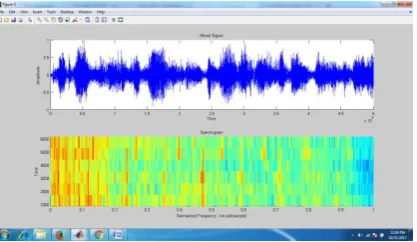
Initially three input signals were given and spectrogram representation is given in x-y axis as Time Vs Amplitude
Fig 4.1 Input signals gets read and their spectrogram representation
The input signal is taken at range <1x5121 double>, no clipping is done at this range to obtain full fidelity of the
signal. If the signal exceeds the range then audio is clipped at „-1‟ to „+1‟
Step2:
The three input signals were mixed and their spectrogram representation in x-y axis as follows
The mixing value range is at „3x50000double‟. The mixing signal obtained by generating random matrix from the
given input signal and multiplying it with the transpose of each input signal.
Step3:
Here the three mixed signal gets separated. Using RKHS the higher order feature parameters are extracted and
ambiguity gets overcome by DTW.
Fig4.3 Separation of target signal from the mixed signal
Step4:
Here the PESQ was estimated for the original and the estimated signal. The PESQ is obtained by taking the score
value. The score value is estimated for all the three signals.
Fig4.4 Perceptual Estimation of Speech Quality
5. CONCLUSION
Blind Source Separation is performed by using Reproductive Kernel Hilbert Space which makes use of contrast
function on canonical correlation, by which higher order statistics can be reckoned. The feature parameters are
extracted using Linear Predictive Cepstral Coefficient (LPCC). During estimation of pristine signal, there arises
permutation ambiguity problem which gets overcome by adapting Dynamic Time Warping. Quality of signal
estimated by PESQ which makes use of score values.
ACKNOWLEDGEMENT
This work was supported in part by Department of Science & Technology (DST), FIST Program at Francis Xavier
REFERENCES
[1] Asano F, Ikeda S, Ogawa M, 2003. Combined approach of array processing and independent component
analysis for blind separation of acoustic signals. Speech Audio Process., IEEE.
[2] N. Muthukumaran and R. Ravi, 'Hardware Implementation of Architecture Techniques for Fast Efficient loss
less Image Compression System', Wireless Personal Communications, Volume. 90, No. 3, pp. 1291-1315,
October 2016.
[3] Kattepur .A.K, Lie .J.P, Sattar F. High fidelity blind source separation of speech signals.,17th European
Signal Processing Conference (EUSIPCO 2009)
[4] N. Muthukumaran and R. Ravi, 'The Performance Analysis of Fast Efficient Lossless Satellite Image
Compression and Decompression for Wavelet Based Algorithm', Wireless Personal Communications,
Volume. 81, No. 2, pp. 839-859, March 2015.
[5] Jaun S. Calderon Piedras, Alvaro D Orjuela - Canon, David A. Sanabria – Quiroga. Blind Source Separation
from Single channel Audio Recording using ICA algorithms Image, Signal Processing and Artificial Vision
on Symposium 2014
[6] N. Muthukumaran and R. Ravi, 'VLSI Implementations of Compressive Image Acquisition using Block
Based Compression Algorithm', The International Arab Journal of Information Technology, vol. 12, no. 4,
pp. 333-339, July 2015.
[7] Clifford. G.D -Blind Source Separation: Principal & Independent Component Analysis Biomedical Signal
and Image Processing Spring 2008
[8] N. Muthukumaran and R. Ravi, 'Simulation Based VLSI Implementation of Fast Efficient Lossless Image
Compression System using Simplified Adjusted Binary Code & Golumb Rice Code', World Academy of
Science, Engineering and Technology, Volume. 8, No. 9, pp.1603-1606, 2014.
[9] M. Ruban Kingston, N. Muthukumaran, R. Ravi, 'A Novel Scheme of CMOS VCO Design with reduce
number of Transistors using 180nm CAD Tool', International Journal of Applied Engineering Research,
Volume. 10, No. 14, pp. 11934-11938, 2015.
[10] R. Sudhashree, N. Muthukumaran, 'Analysis of Low Complexity Memory Footprint Reduction for Delay
and Area Efficient Realization of 2D FIR Filter', International Journal of Applied Engineering Research,
Vol. 10, No. 20, pp. 16101-16105, 2015.
[11] N. Muthukumaran and R. Ravi, 'Design and analysis of VLSI based FELICS Algorithm for lossless Image
Compression', International Journal of Advanced Research in Technology, Vol. 2, No. 3, pp. 115-119,
March 2012.
[12] B. Manoj Kumar and N. Muthukumaran, 'Design of Low power high Speed CASCADED Double Tail
Comparator', International Journal of Advanced Research in Biology Engineering Science and Technology,
Vol. 2, No. 4, pp.18-22, June 2016.
[13] N. Muthukumaran, 'Analyzing Throughput of MANET with Reduced Packet Loss', Wireless Personal
[14] P. Venkateswari, E. Jebitha Steffy, Dr. N. Muthukumaran, 'License Plate cognizance by Ocular Character
Perception', International Research Journal of Engineering and Technology, Vol. 5, No. 2, pp. 536-542,
February 2018.
[15] N. Muthukumaran, Mrs R.Sonya, Dr. Rajashekhara and V. Chitra, 'Computation of Optimum ATC Using
Generator Participation Factor in Deregulated System', International Journal of Advanced Research Trends
in Engineering and Technology, Vol. 4, No. 1, pp. 8-11, January 2017.
[16] Ms. A. Aruna, Ms.Y.Bibisha Mol, Ms.G.Delcy, Dr. N. Muthukumaran, 'Arduino Powered Obstacles
Avoidance for Visually Impaired Person', Asian Journal of Applied Science and Technology, Vol. 2, No. 2,
pp. 101-106, April 2018.
[17] Mrs. S. Murine Sharmili, Dr. N. Muthukumaran, 'Performance Analysis of Elevation & Building Contours
Image using K-Mean Clustering with Mathematical Morphology and SVM', Asian Journal of Applied
Science and Technology, Vol. 2, No. 2, pp. 80-85, April 2018.
[18] J. Keziah, N. Muthukumaran, 'Design of K Band Transmitting Antenna for Harbor Surveillance Radar
Application', International Journal on Applications in Electrical and Electronics Engineering, Vol. 2, No. 5,
pp. 16-20, May 2016.
[19] B. Renuka, B. Sivaranjani, A. Maha Lakshmi, Dr. N. Muthukumaran, 'Automatic Enemy Detecting Defense
Robot by using Face Detection Technique', Asian Journal of Applied Science and Technology, Vol. 2, No. 2,
pp. 495-501, April 2018.
[20] Ms. Mary Varsha Peter, Ms. V. Priya, Ms. H. Petchammal, Dr. N. Muthukumaran, 'Finger Print Based Smart
Voting System', Asian Journal of Applied Science and Technology, Vol. 2, No. 2, pp. 357-361, April 2018.
[21] N. Muthukumaran and R. Ravi, 'Quad Tree Decomposition based Analysis of Compressed Image Data
Communication for Lossy and Lossless using WSN', World Academy of Science, Engineering and
Technology, Volume. 8, No. 9, pp. 1543-1549, 2014.
[22] Aws Al-Qaisi -Blind Source Separation of Mixed Noisy Audio Signals Using an Improved Fast ICA-Journal