ENHANCED NORMALIZATION APPROACH ADDRESSING
STOP-WORD COMPLEXITY IN COMPOUND-WORD
SCHEMA LABELS
1JAFREEN HOSSAIN, 2NOR FAZLIDA MOHD SANI, 3LILLY SURIANI AFFENDEY,
4
ISKANDAR ISHAK, 5KHAIRUL AZHAR KASMIRAN
Faculty of Computer Science and Information Technology, Universiti Putra Malaysia
E-mail: [email protected], [email protected], [email protected], [email protected],
5
ABSTRACT
An extensive review of the existing schema matching approaches discovered an area of improvement in the field of semantic schema matching. Normalization and lexical annotation methods using WordNet have been somewhat successful in general cases. However, in the presence of stop-words these approaches result in poor accuracy. Stop-words have previously been ignored in most studies resulting in false negative conclusions. This paper proposes NORMSTOP (NORMalizer of schemata having STOP-words) as an improved schema normalization approach that addresses the complexity of stop-words (e.g. ‘by’, ‘at’, ‘and,’ or’) in Compound Word (CW) schema labels. Using a combined set of WordNet features, NORMSTOP isolates these labels during the preprocessing stage and resets the base-form to a relevant WordNet term, or an annotable compound noun. When tested on the same real dataset used in the earlier approach - (NORMS or NORMalizer of Schemata), NORMSTOP shows up to 13% improvement in annotation recall measurement. This level of improvement takes the overall schema matching process another step closer to perfect accuracy; while its absence exposes a gap in expectation, especially in today’s databases, where stop-words are in abundance.
Keywords: Database Integration, Schema Matching, Data Heterogeneity, Semantic Schema Matching,
Schema Label Normalization, Stop-Words
1. INTRODUCTION
The advancement of information and
communication technology has opened doors for many data sources to communicate with each other in a semantic web. At the same time, it has created data heterogeneity problems in various application domains. Large amount of data is created every day by different sources in different formats. The value of data increases when it can be linked with other data, thus successful data integration is a major creator of value. Data integration and data sharing are hence getting more important for many application domains. At the same time, the semantic integration is getting crucial and complex due to this large scale of data and its heterogeneous nature. This heterogeneity can be in terms of data source
format, types, representation, or semantic
interpretation. The schema matching problem is considered by many researchers as one of the bottlenecks for semantic integration. It is not a new research area and has received increasing attention
since the 1970s [10, 11]. Numerous matching approaches, strategies and algorithms have been developed.
Currently, the schema matching process has improved from fully manual to semi-automatic after years of studies by many researchers. Automatic or semi-automatic schema matching has to deal with problems arising from the heterogeneity of data sources which can be distinguished into two main types of heterogeneity: structural and semantic heterogeneity [4, 12]. Structural heterogeneity means differences among attribute types, formats, or models whereas semantic heterogeneity means differences in the meaning or annotation of schema elements. In this paper, we have mainly focused on semantic heterogeneity and one of its aspects.
relate a “meaning” to schema labels. However, the accuracy of semi-automatic lexical annotation methods on real life schemas still suffer from the problem of non-dictionary words such as compound words (CWs), abbreviations and acronyms.
Schema normalization approaches can help to resolve this problem and increase the number of similar schema labels. But it gets even more complicated when the compound words have stop-words in them. Stop-stop-words have been mostly ignored in previous studies of schema matching and hence the schemas having stop-words have missed out any annotation.
The objective of the research work is to propose an approach for solving the problem of stop-words in schema labels and improve the lexical annotation of schema label normalization by reducing false negative (ie. missing right annotation) results. So, in this paper the NORMSTOP approach has been introduced which takes stop-words into annotation consideration, changes schema into relevant
WordNet word form and improves the
Normalization Approach of NORMS. [15]
The study concentrates on the Compound Word (CW) annotation, which includes Compound Nouns (CNs), or Compound Word formats containing stopwords and the consequent false negative (missing a right annotation) problem. Not all the stop-words used in natural language processing (NLP) has been considered in this study since only some common stop-words are used in database designing. The main focus of the research is on stop-words found in the test dataset [22, 23]. Those are “in”, “by”, “at”, “to”, "from", “on”, “since”, “upto”, “until”, “till”, “is”, “are”, “was”, “were”, “or” respectively.
In order to fulfill the above mentioned objective, we assume that a fully functional schema normalization tool is implemented and available, in which we can add and run the newly developed algorithm.
Schema matching is an important and essential process in different domains including e-commerce, data-integration, health-care and many more. By identifying the stop-word in compound word schema labels, the proposed approach would reduce the false negative results in schema normalization and annotation process which is an integral part of schema matching.
Section 2 focuses on the specific problem of stopwords in schema label which is the main focus of this research work. Section 3 of this document
discusses the relevant literature review and some previous approaches on schema and ontology matching. It also details schema normalization
approaches and NORMS (NORMalizer of
Schemata), an existing tool to perform schema label normalization to enhance the automatic result of schema matching process and some open problems of this area. Section 4 states the methodology to solve the problem mentioned in section 2 and also
discusses the new proposed approach ―
NORMSTOP and its step by step procedures. Section 5 focuses on explaining the implementation of the proposed approach. Section 6 details out the evaluation of its results in comparison with previous NORMS approach. Section 7 discussed the results using different data sets, section 8 focuses on some limitation of NORMS approach and section 9 displayed some real-life implication of NORMSTOP whereas section 10 concludes the thesis, mentioning the main contribution and discusses of NORMSTOP and some future
opportunities in the same domain.
2. PROBLEM DISCUSSION
As mentioned by Sorrentino et al. [4, 15], the weakness of a thesaurus, like WordNet, is that it does not always cover the detail information of a specific domain and domain-dependent terms or words, or non-dictionary words (such as Compound words, abbreviations, acronyms etc). So, this kind of non-dictionary words in schema labels strongly affects the automatic lexical annotation technique. To address this problem, they presented a method for schema label normalization which expands
abbreviations and automatically annotates
Compound Nouns (CNs) by enriching WordNet with new meanings.
With regards to the schema label normalization method, Sorrentino et al. [15]
mentioned some limitation and future
improvements in their work which would take into consideration the main problem during the experimental evaluation: The presence of stop-words (e.g. “to”, “at”, “and” etc.) in schema labels; and the problem of false negative (ie. missing right annotation) non-dictionary words during the identification steps of schema normalization [15].
Po and Sorrentino [2, 15] also stated the recall rate was affected by the existence of non-endocentric (non-endocentric CNs is a kind of CNs consisting of a head and modifier) CNs (such as
“InProceedings”) in the schemas for all the data sets and that their method could not identify.
So, the limitations summarized from [15] that were not considered while processing schema label normalization are:
1) Other kinds of multi-word units
(e.g. prepositional verbs such as “WrittenBy”)
2) The use of conjunctions (such as
“and” or “or”) in schema and ontology labels
3) The presence of stop-words (e.g.
“to”, “at”) in schema and ontology labels
Considering the limitations mentioned by Sorrentino et al. [15], one specific problem has been identified summarizing the three problems stated above which needs improvement:
Problem of the presence of stop-words (e.g. “to”, “at”, “and” etc.) in schema labels resulting false negative lexical annotation during schema normalization process [15]
3. LITERATURE REVIEW
The aim of recent research work on integrating web databases has been to allow uniform access to the large amount of data behind query interfaces. Source discovery, query interface extraction, schema matching are some of the tasks among the many in this integration process [7]. There are some other important tasks that are commonly ignored or assumed to be solved either manually or by other system. Finding the set of stop-words and its semantic relationship with other words within the label is one such task. It has a very important and direct impact on determining the meaning specifically the synonymy, hyponymy or any such potential relationship between labels.
Data-cleaning, within the scope of integration, is considered by previous researcher as a significant and integral part, when multiple data sources need to be integrated, e.g., in data warehouses, federated database systems or global web-based information systems [16, 17]. It was mentioned that to facilitate instance matching and integration, attribute values should be converted to a consistent and uniform format. For example, date and time entries should be brought into a specific format; names and other string data should be converted to either upper or lower case, etc. Text data may be condensed and unified by performing stemming, removing prefixes, suffixes, and stop
words. Furthermore, abbreviations and encoding schemes should consistently be resolved by consulting special synonym dictionaries or applying predefined conversion rules.
Most of the traditional schema matching techniques also considers stop-words as noise and removes them at the preprocessing step. In COMA [1, 6, 8], it was mentioned that multi-word element names are often composed of multiple words, such as DeliveryAddress, DevAddr, and AddrOfDel. Directly comparing those names unlikely yields correct similarity due to order and abbreviation of the words in the names. Hence, different pre-processing techniques, such as tokenization
(DeliveryAddress → {delivery, address}),
removing of stop-words (such as of), stemming (delivery → deliver) applied to obtain a set of the most characteristic words for comparison.
[image:3.612.312.520.411.674.2]MOMIS [3] implemented an automatic annotation algorithm which includes stemming and stop words removal functionalities in order to optimize the annotation phase and increase the annotation accuracy.
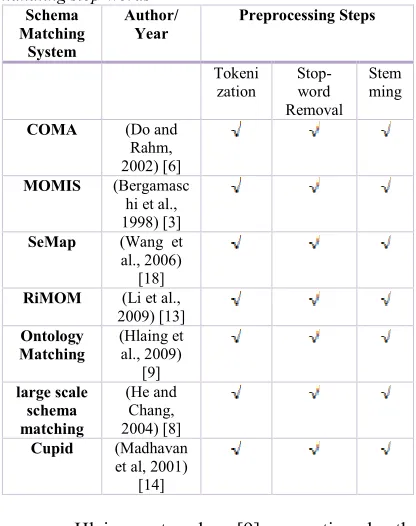
Table 1: Different Schema Matching Preprocessing steps handling stop-words
Schema Matching
System
Author/ Year
Preprocessing Steps
Tokeni zation
Stop-word Removal
Stem ming
COMA (Do and
Rahm, 2002) [6]
MOMIS (Bergamasc
hi et al., 1998) [3]
SeMap (Wang et
al., 2006) [18]
RiMOM (Li et al.,
2009) [13]
Ontology Matching
(Hlaing et al., 2009)
[9]
large scale schema matching
(He and Chang, 2004) [8]
Cupid (Madhavan
et al, 2001) [14]
abbreviations and acronyms to their full words, e.g., “dept” to “departure” (3) Stop word removal and stemming : “the model” into “model” (remove a, an, of, the, etc) and (4) Standardization of words – Irregular words are standardized to a single form, e.g., “colour” to “color”. For normalization, it exploits and uses domain specific dictionary. This dictionary consists all existing terms in a specific domain include their synonym sets.
In SeMap [18], schema matching system mentioned that it eliminates those frequently used words that can be found in a list. Li et al., [13], also mentioned tokenization, stop-word removal and stemming as the pre-processing step before performing the schema matching task.
Table 1, listed different studies where tokenization, stop-word removal and stemming process have been used before doing schema matching.
A widespread review has been conducted on several previous schema matching approaches, strategies and techniques till recent times. We ended up focusing on semantic schema matching approaches and its significance in the overall schema matching process. It can be concluded from this review that the implicit meaning or semantics of schema labels plays an important role in the exercise of discovering mappings between different data sources.
Although many strategies were developed
to solve this problem including schema
normalization approaches (Sorrentino et al., 2011) it was obvious there is still room for improvement and future work. List of such future work included finding the meaning of domain specific terms, different compound words having prepositional-verbs, conjunctions, digits, or stop-words in schema labels. Also, more work can be done to improve the number of false positive and false negative relationships. Another relevant future research could possibly be the inclusion of instance-based matching techniques to improve the automatic annotation and relationship discovery processes among schema labels.
Schema label normalization is an
imperative step in the whole process of schema matching. In absence of a proper schema normalization process, schema matching results in poor accuracy, due to abundance of false negative and false positive matching. The schema label
normalization process used in NORMS pulls off an impressive success in covering most common aspects of abbreviation expansion and CN annotation. However, the normalization in NORMS fails to cover some of the commonly used labels in database systems in recent times, due to the presence of stop-words.
After going through the problem regarding stop-words in different domains, like information retrieval, data mining, text mining in natural language processing, data integration, it has been noticed that stop-words are considered as noise and filtered out in most the cases to save processing time and to get quick result. But, while performing data integration in schema normalization process for schema labels, the stop-words need to stay, rather than being filtered out, in order to understand the actual meaning of the schema label.
4. METHODOLGY
In the first phase, this study proposes an approach called “NORMSTOP” in order to resolve the “stop-word” problem in schema normalization approach. It aims to be an improved approach compared to NORMS, the schema normalizer approach, developed by Sorrentino et al. [4, 15]. With NORMSTOP, the overlaying framework has been revised for the normalization approach, and an underlying algorithm has been developed to specifically solve the stop-word problem.
While designing NORMSTOP, two main objectives were focused – i) to improve overall success rate of NORMS lexical annotation by eliminating the false negative results generated due to the presence of stop-words in schema labels and ii) To ensure that we do not deteriorate the existing NORMS results with changes introduced by NORMSTOP.
Based on 1) the observation of limitation in the anchor paper [15], 2) careful analysis of 15 real datasets, and 3) further studies on stop-words, the following prepositions, conjunctions, and auxiliary verbs were selected to be covered in this study [5]:
Figure 1: Searching same attribute for opposing words in WordNet
Future improvement of this study can expand to other stop-words that have not been covered in this research.
With the above stop-words in
consideration, the overlaying framework of NORMS was revised (Figure 3) to include checkpoints for non-WordNet schema labels that qualify as compound words having stop-words.
These labels were then normalized, within the underlying NORMSTOP algorithm, using combination of various features available from WordNet. Some of the key features that have been used were: 1) Derivationally Related Forms, 2) Attributes, and 3) LexNames [24].
1) Derivationally Related Forms (DRF) were used to discover possible act and actor forms of a verb, post fixed by preposition for time or agent. For example, “writing” and “writer” are DRFs of the word “write”. This feature helped normalize labels like “writtenBy” to “writer”, and helped address most of the prepositional stop-word problems.
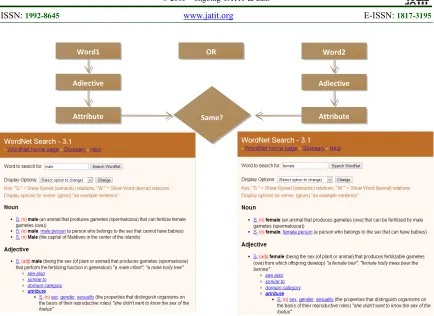
2) Attributes have been used to find out the common concept among two opposing objectives separated by an “or” stop-word. For example, “sex” is the common attribute for adjectives “male” and “female”. Figure 1 shows this procedure. And that’s how the “attributes” feature from WordNet helped address the conjunction (“or”) stop-word problems.
3) LexNames were used to identify the appropriate act and actor forms from the DRFs. LexNames for “writing” and “writer” are “noun.act” and “noun.person” respectively. Figure 2 on next page shows the procedure to find noun form of a verb from WordNet.
In case of auxiliary verbs, the main task was to identify if the schema was a table name or an attribute name – the normalization later is done accordingly.
Word1 OR
Attribute Adjective
Word2
Attribute Adjective
Figure 2: Changing verb to noun using DRF in WordNet
5. IMPLEMENTATION
NORMSTOP was implemented with relatively small modification to the existing source code of NORMS. However, the framework design of the algorithm was critical to the success of this NORMSTOP implementation.
Figure 3: NORMSTOP Framework
The figure above shows the framework of NORMSTOP. It has two main additional procedures on top of NORMS to handle the stop-
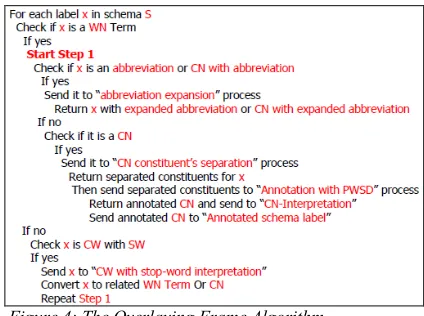
word complexity. The processes are: i) Qualify for NORMSTOP, ii) NORMSTOP. The Overlaying Frame Algorithm: The Complete Annotation Process describes all three (including NORMS) of these processes and their relationship.
Figure 4: The Overlaying Frame Algorithm
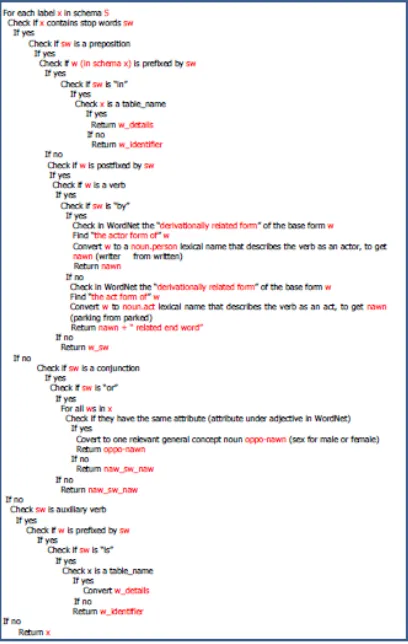
The Underlying Focal Algorithm: CW with SW Interpretation is the heart of this study. This algorithm explains how the implementation of the NORMSTOP process has been achieved. Variables used in this algorithm are the following:
Verb
Base
Form
Derivatio
nally
Synset
Lexical
Name
~noun.pe
rson
[image:6.612.92.296.485.641.2]x : Schema label S : Schema st : Stop-words
naw : Normalized and annotated word
nawn : Normalized and annotated word converted to Noun
[image:7.612.93.297.202.524.2]oppo-nawn : Two opposing words converted to one conceptual noun
Figure 5: Underlying Focal Algorithm
As seen above, the algorithms have focused a lot on re-using the NORMS functions and ensuring that the default results (true positive and true negatives) from original NORMS were not allowed to be deteriorated.
6. TEST AND EVALUATION
The main objective of the evaluation method is to measure the performance of NORMSTOP approach in comparison with NORMS (NORMalizer of Schemata) [15] and to check whether NORMSTOP approach improves the lexical annotation process and thus improve the overall schema matching process.
Precision (P), Recall (R) and F-measure are used in the research work as the performance measurement tool. To measure the effectiveness of NORMSTOP, Gold Standard lexical annotation has been manually generated with the help of a human expert.
Precision and Recall address the quality of the results automatically determined by the annotation tool. In Figure 6, the set of derived annotations is comprised of B, the true positives, and C, the false positives. False negatives (A) are annotation needed but not automatically annotated, while false positives are annotations falsely identified by the tools. True negatives, D, are annotation failures, which have also been correctly failed by the automatic annotation process. Obviously, both false negatives and false positives reduce the match accuracy.
Figure 6: Underlying Focal Algorithm
Based on the cardinality of these sets, two common measures, Precision (P) and Recall (R), which originate from the information retrieval field, can be calculated as follow:
[image:7.612.317.490.322.412.2]The results obtained in both NORMS and NORMSTOP have then been compared with respect to the corresponding Gold Standard. This study uses the same data as has been used by NORMS.
The following three data sets: (1) OAEI, (2) Mondial, and (3) Amalgam (an integration benchmark for bibliographic data) [19] have been used in the evaluation process as these have been used in the anchor paper. Each data set consists of two schemas that are to be merged. These data sets have been used by other matching systems as well
[20][21]. These data sets are particularly
appropriate to assess schema normalization as they consist of several non-dictionary words, represent various application domains; finally contains both relational, XML schemas and ontologies.
For each schema element in each dataset, the NORMS and NORMSTOP results were ranked as one of the 4 possible outcomes: false positive (FP), true positive (TP), false negative (FN)‖ or true negative (TN). In order to identify the right ranking, the annotation (both NORMS and NORMSTOP) were checked against the Gold standard annotation. Once all the schema elements NORMS annotation results are identified as one of the 4 possible outcomes, all the 4 ranking are then summed up. The summed-up quantities are then used to identify precision and recall value for NORMS annotation. F-measure is then calculated using the precision and recall values. The exact same is done based on the total count of NORMSTOP rankings and thus the precision, recall and F-measure of NORMSTOP is also retrieved.
7. RESULTS AND DISCUSSION
The performance of NORMS
complemented with NORMSTOP was measured with precision, recall and F-measures. These results were compared against the default NORMS measurement for the same. In order to measure the given KPIs (Key Performance Indicator), we had used expert opinion from database administrators to come up with the set of gold standards, which we took as the set of real lexical annotation for the 3 real data sets. We, then compared results from both
the default and improved NORMS against this golden standard and scored each of the numerous schema labels in each dataset as TP, FP, TN or FN based on true or false and positive or negative outcome. Each dataset is then scored for both NORMS and NORMSTOP and the results speak for themselves.
Amalgam dataset had a total of 189 schema labels, out of which only 6 were compound words with stop-words. So, the chances of improvement through the NORMSTOP approach was only limited to these 6 schema labels. NORMSTOP was able to improve the results on the Amalgam dataset only marginally. It reduced the total number of false negatives from 7 to 5, and converted these 2 items to true positive. This
improvement resulted in an overall 2%
improvement in recall and 1% improvement in F-measure. NORMSTOP managed to retain the original NORMS success intact, on top of achieving this new improvement. There was no deterioration seen in precision, which in turn reflects the improvement in F-measure. In fact, the precision improves a little due to the improvement in true positive results.
OAEI had 55 schema labels, which were compound word with stop-words. In other words out of the total 455 schema labels, more than 10% schema labels had stopwords in them. So, this dataset was a perfect example of a real dataset that shows the necessity of a tool like NORMSTOP, in order to do a successful lexical annotation. the result on OAEI dataset from NORMSTOP shows a staggering 13% improvement in recall and an equally impressive 7% improvement in F-measure. The new approach managed to reduce as many as 52 (60%) false negative, and converted all of them to true positive results. The new approach managed to retain the NORMS success and made sure that no successful results from NORMS (True positives and True negatives) were deteriorated with the introduction of NORMSTOP.
Mondial dataset had a total of 276 schema labels, out of which only 6 were compound words with stop-words. Similar to Amalgam, this dataset had only 6 schema labels where NORMSTOP
could contribute to improve the results.
NORMSTOP managed to make a small
however, considering the bigger total dataset size this didn’t even surpass Amalgam results. However, even in this dataset NORMSTOP managed to retain the original NORMS success harmless.
As with any other research, we have tried to isolate and identify any negative impact NORMSTOP might have contributed, while trying to improve the accuracy of lexical annotation. While we know NORMSTOP is not capable of solving all relevant problems of lexical annotation, it is also to be appreciated that NORMSTOP does a decent job in retaining the positive results of NORMS approach, without resulting in any worsening of NORMS results. The known
limitations and possible future work for
NORMSTOP has been detailed out in the next section.
As far as significance is concerned, we believe 13% improvement in accuracy of lexical annotation can be considered as an important step forward for the field of lexical annotation and hence normalization and semantic schema matching. With more focus on the listed improvement areas of this research can contribute to substantial progress to the field of this study.
In summary, it was observed that with the introduction of NORMSTOP, the overall result of NORMS lexical annotation improves by up to 13%. The other noteworthy achievement of this new approach is the successful retention of positive results from the previous effort. It is often observed that newer approach and the consequent success only comes at the cost of partial deterioration to the previous results. However, NORMSTOP manages to avoid that completely, while still resulting in a significant improvement. We believe these results can be improved even further by taking care of the limitations described in the next section.
8. LIMITATIONS OF NORMS APPROACH
Sorrentino et al. (2011), has mentioned several limitations about the NORMS tool they have developed for the schema normalization task. Some limitations are listed below:
• Other kinds of multi-word units (e.g.
prepositional verbs such as “WrittenBy”) other than endocentric compound nouns
• The use of conjunctions (such as
“and” or “or”) in schema and ontology labels
• The presence of stop words (e.g. “to”,
“at”) in schema and ontology labels
• A different kind of non-dictionary
words, i.e. words which are not present in a lexical resource as they belong to a specific application domain (e.g. medicine, architecture or biology)
• Digits in schema labels
• Problem of false negative
non-dictionary words during the identification step (e.g. “RID”, “AID”)
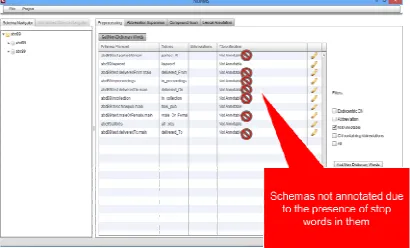
[image:9.612.313.518.362.486.2]We have developed a test data set to check the limitations of stop-words in schema label and found out that NORMS tool classifies them as not- Annotable‖. Figure 7 below shows the same limitations.
Figure 7: Limitations of NORMS, showing "Not Annotable" On Test Data
9. REAL LIFE IMPLICATION OF
NORMSTOP
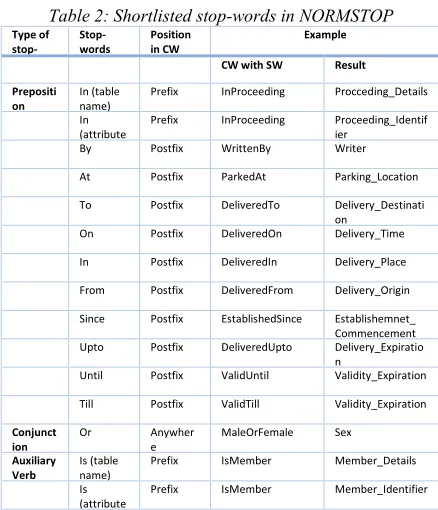
Table 2: Shortlisted stop-words in NORMSTOP
Type of
stop- Stop-words
Position in CW
Example
CW with SW Result Prepositi
on
In (table name)
Prefix InProceeding Procceding_Details In
(attribute
Prefix InProceeding Proceeding_Identif ier
By Postfix WrittenBy Writer
At Postfix ParkedAt Parking_Location To Postfix DeliveredTo Delivery_Destinati
on On Postfix DeliveredOn Delivery_Time In Postfix DeliveredIn Delivery_Place
From Postfix DeliveredFrom Delivery_Origin Since Postfix EstablishedSince Establishemnet_
Commencement Upto Postfix DeliveredUpto Delivery_Expiratio
n
Until Postfix ValidUntil Validity_Expiration Till Postfix ValidTill Validity_Expiration Conjunct
ion
Or Anywher
e
MaleOrFemale Sex
Auxiliary Verb
Is (table name)
Prefix IsMember Member_Details Is
(attribute
Prefix IsMember Member_Identifier
Figure 8 shows the snapshot from improved NORMS tool showing result. If we notice carefully, it can be seen that the tool showing a test table which is showing the attribute name
“deliveredTo” and its conversion to
“delivery_Destination” after the normalization
process through NORMSTOP in improved
NORMS.
Figure 8: Short-listed stop-word category in NORMSTOP
10. CONCLUSION AND FUTURE WORK
This study signifies the critical role of semantic schema normalization in the vastly experimented field of schema matching and discovers the necessity of addressing the issues arisen from the presence of stop-words in schema labels often used by the many database designers in today’s world of big data. With a planned strategic
algorithm that takes leverage from the existing research on NORMS, this study introduces NORMSTOP that makes a worthwhile contribution to schema normalization approaches in general and towards a future evolution of database integration.
NORMS had already successfully
accomplished the major task of semantic schema label normalization taking into consideration the complexities of compound noun and abbreviation. However, it does not cover the next level of complications in a typical schema label, which is related to compound words having stop-words. This study has focused on addressing these important limitations in NORMS and has taken it to the next level, where accuracy of schema normalization has significantly improved.
For one of the real datasets used in the study, NORMSTOP showed a significant recall improvement of 13%. OAEI had a total of 455 schema labels. NORMS had failed to annotate a total of 88 labels in that particular dataset, out of which 55 were due to stop-words. NORMSTOP managed to improve 52 of these 55 false negatives, and successfully annotated them to result in true positive outcome, matching accurately with manual
expert annotation. Moreover, NORMSTOP
managed to retain the true positives results from NORMS, resulting in no deterioration in precision, and an overall significant (7%) improvement in F-measure.
With the limitations sorted out in future, this can yield in even better results. For example, expanding from only WordNet to other auxiliary resources like – ConceptNet, Wikipedia, DBpedia, and Google search might help reduce the limitations around multi-domain complexity.
As regard to schema label normalization method, future work might include the problem of identifying digits in schema labels. Also, the problem around false negative non-dictionary words during the identification step (e.g. “RID”, “AID” etc) can be improved. In NORMSTOP method, more stop-words identifier can be added for future requirement, for example, “Of”, “With”, “How” etc.
[image:10.612.90.300.420.579.2]depending on its data type. When its data type is
text or similar, most likely it means
“parking_place”. However, when its data type is date/time it definitely means “parking_time”. In future improvement of NORMSTOP this separation can be a certain addition.
This version of NORMSTOP also fails to annotate schema label such as” MOrF”, which can mean “MaleOrFemale” or “Gender”. By integrating to NORMS‘abbreviation expansion function and with re-structuring of NORMSTOP code, this can be improved in the next release.
Inclusion of instance-based matching techniques might also improve the overall schema label normalization process. Sometimes, schema labels contain misleading elements which is difficult to normalize without considering the data type of the instances. For example, the meaning of the label “phone” is “electronic equipment” according to WordNet, but in real situation it should refer to phone numbers.
Instance based technique might also help to annotate the non-informative schema labels. It is common practice of many database designers to use code while naming the column of a table, for example, DB_FB02, which is difficult to normalize and annotate automatically even for a schema designer. So, using the instance based technique will help reduce this problem.
Gradual minimization of the gaps
identified above can definitely contribute to an evolution towards an almost perfect and fully automated normalization approach in future. NORMSTOP has taken that evolution one step closer to reality and continued efforts can only mean that the world is ready to embrace the big data explosion.
11. ACKNOWLEDGEMENT
The authors acknowledge the financial supported by the Fundamental Research Grant under
grant numberFRGS/1/2014/ICT07/UPM/02/2
received from the Ministry of Higher Education, Malaysia via Universiti Putra Malaysia (UPM).
REFRENCES:
[1] Aumueller, D., Do, H. H., Massmann, S., and
Rahm, E., (2005). Schema and ontology matching with COMA++. In Proc. of Special Interest Group on Management of Data, SIGMOD’05, New York, NY, USA, pages 906– 908. ACM.
[2] Bergamaschi, S., Po, L., and Sorrentino, S.
(2008). Automatic annotation for mapping discovery in data integration systems, in SEBD, S. Gaglio, I. Infantino, and D. Sacca`, Eds., pp. 334–341.
[3] Bergamaschi, S., Castano S, Vincini, M.
(1998). MOMIS, An Intelligent System for the Integration of Semi Structured and Structured Data, INTERDATA.
[4] Bergamaschi, S., Beneventano, D., Po, L.,
Sorrentino, S. (2011). Automatic Normalization and Annotation for Discovering Semantic Mappings, Search Computing II, LNCS 6585, pp. 85–100, Springe.
[5]
http://www.semantikoz.com/blog/free-stop-word-lists-in-23-languages/
[6] Do, H. H, Rahm E. (2002). COMA - A system
for flexible combination of schema matching approaches, Proceedings of the 28th VLDB Conference, Hong Kong, China.
[7] Dragut, E., Fang, F., Sistla, P., Yu., C., Meng,
W., (2009). Stop Word and Related Problems in Web Interface Integration, VLDB Endowment, ACM.
[8] He, B., Chang, K., C., C. (2004). A holistic
paradigm for large scale schema matching. SIGMOD Rec., 33(4):20–25.
[9] Hlaing, S. (2009). Ontology based Schema
Matching and Mapping Approach for Structured Databases.ICIS, November 24-26, Seoul, Korea.
[10] Islam, A., Inkpen, D. (2008). Semantic text
similarity using corpus-based word similarity and string similarity, ACM Transactions on Knowledge Discovery from Data, Vol.2, No.2, Article 10.
[11] Islam, A., Inkpen, D. Z., Kiringa, I.(2008).
Applications of corpus-based semantic
similarity and word segmentation to database schema matching. VLDB J., 17(5):1293–1320.
[12] Karasneh, Y., Ibrahim, H., Othman, M.,
[13] Li, J., Tang, J., Li, Y., Luo, Q. (2009). RiMOM: A Dynamic Multistrategy
[14] Ontology Alignment Framework. IEEE Trans.
Knowl. Data Eng. 21(8), 1218-1232.
[15] Madhavan, J., Bernstein, P. A., Rahm, E.
(2001). Generic Schema Matching with Cupid. In Apers, P. M. G., Atzeni, P., Ceri, S., Paraboschi, S., Ramamohanarao, K., and Snodgrass, R. T., editors.
[16] Proc. of the 27th International Conference on
Very Large Data Bases (VLDB 2001), September 11-14, 2001, Roma, Italy, pages 49– 58. Morgan Kaufmann.
[17] Po, L., Sorrentino, S. (2011). Automatic
generation of probabilistic relationships for
improving schema matching. Information
Systems Journal, Special Issue on Semantic Integration of Data, Multimedia, and Services, 36(2):192208.
[18] Rahm, E., Bernstein, P. A. (2001). A survey of
approaches to automatic schema matching, The VLDBJournal 10: 334–350.
[19] Rahm E, Do, H. H. (2000). Data Cleaning:
Problems and Current Approaches. University of Leipzig, Germany.
[20] Wang, T. (2006). SeMap: a generic schema
matching system. University of British
Columbia.
[21] Miller, R. J., Fisla, D., Huang, M., Kalmuk, D.,
Ku, F., and Lee, V. (2001). The Amalgam Schema and Data Integration Test Suite.
[22] The Clio Project. (2007, July 10), Retrieved
from
http://dblab.cs.toronto.edu/project/clio/index.ph p#testschemas
[23] Ontology Alignment Evaluation Initiative.
(2009, May 6), Retrieved from
http://oaei.ontologymatching.org/2008/results/b enchmarks/
[24] JWI 2.4.0. (2007-2013), Retrieved from