IJIRT 142603
INTERNATIONAL JOURNAL OF INNOVATIVE RESEARCH IN TECHNOLOGY155
Area-Delay Efficient Binary Adders in QCA
B.Siva krishna
1, N. Praveen kumar
2 1M.Tech student,ECE,Stanley Stephen college of Engineering and Technology,
2Associate Professor,ECE ,Stanley Stephen college of Engineering and Technology,
Kurnool,Andhra Pradesh, India
Abstract- As transistors decrease in size more and more of them can be accommodated in a single die, thus increasing chip computational capabilities. However, transistors cannot get much smaller than their current size. The quantum-dot cellular automata (QCA) approach represents one of the possible solutions in overcoming this physical limit, even though the design of logic modules in QCA is not always straightforward. In this brief, we propose a new adder that outperforms all state-of-the art competitors and achieves the best area-delay tradeoff.
Index Terms- Adders, nanocomputing, quantum-dot cellular automata (QCA).
I. INTRODUCTION
In this paper, a new QCA adder design is implemented thatreduces the number of QCA cells when compared toexistingreported designs. We demonstrate that it is possible to design aCLA QCA one-bit adder, with the same reducedhardware asthe bit-serial adder, as retaining the simpler clockingscheme and parallel structure of the novel CLAapproach.The proposed design is based on a new algorithm thatrequires only three majority gates and two inverters fortheQCA addition. It is noted that the bit-serial QCA adder uses avariant of the proposed one-bit QCA adder. Byconnectnproposed one-bit QCA adders.
Quantum-dot cellular automata (QCA) is an attractiveemerging technology suitable for the development ofultra dense low-power high-performance digitalcircuits. For this reason, in the last few years, thedesign of efficient logic circuits in QCA has receiveda great deal of attention. Special efforts are directedto arithmetic circuits, with the main interest focusedon the binary addition that is the basic operation ofany digital system. Of course, the architecturescommonly employed in traditional CMOS designs areconsidered a first reference for the
new designenvironment. Ripple-carry (RCA), carry look-ahead(CLA), and conditional sum adders were presented.
Theoreticalformulations demonstrated for CLA and parallel-prefixadders are here exploited for the realization of a novel 2-bitaddition slice as shown in Fig.1. The latter allows the carry tobe propagated through two subsequent bit-positions with thedelay of just one majority gate (MG).In addition, the clever top level architecture leads to verycompact layouts, thus avoiding unnecessary clock phases dueto long interconnections. An adder designed as proposed runsin the RCA fashion, but it exhibits a computational delaylower than all state-of the-art competitors and achieves thelowest area-delay product (ADP).
Fig 1 Novel 2-bit basic module
IJIRT 142603
INTERNATIONAL JOURNAL OF INNOVATIVE RESEARCH IN TECHNOLOGY156
addition slice. The latter allows the carry to bepropagated through two subsequent bit-positions with the delay ofjust one majority gate (MG). In addition, the clever top level architecture leads to very compact layouts, thus avoidingunnecessary clock phases due to lengthy interconnections.
II. RELATED WORKS
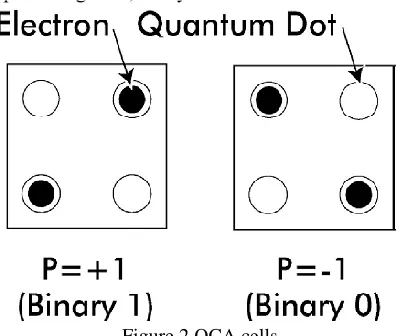
QCA is based on the interface of bi-stable QCA cellsconstructed from four quantum-dots. A high-level design of two polarized QCA cells is shown in Fig. 2. Each cell isconstructed from four quantum dots arranged in a squarepattern. The cell is charged with two electrons, which are free of chargeto tunnel between adjacent dots. These electrons tend totake up antipodal sites as a result of their mutual electrostaticrepulsion. Thus, there exist two equalenergeticallyminimal arrangements of the two electrons in the QCA cell asshown in Fig. 2. These two arrangements are denoted as cellpolarization P = +1 and P = -1 correspondingly. By using cellpolarization P = +1 to represent logic “1” and P = -1 torepresent logic “0”, binary information can be encoded.
Figure 2 QCA cells
Arrays of QCA cells can be set to perform all logicfunctions. This is owed to the Columbic interactions,whichinfluences the polarization of neighboring cells. QCAdesigns have been proposed with potential barriersbetweenthe dots that can be controlled and used to clock QCAdesigns. The fundamental QCA logic devices are the QCA wire,majority gate and inverter.
QCA wire: In a QCA wire, the binary signal propagatesfrom input to output because of theColumbicconnectionsbetween cells. This is a
result of the system attempting to settleto a ground state. Any cells alongthe wire that are anti-polarizedto the input would be at a high energy level, andwould soon settle to the correct groundstate. The propagationin a 90-degree QCA wire is shown in Fig. 4. Other than the 90-degree QCA wire, a 45-dgreeQCA wire can also be used. Inthis case, the propagation of the binary signal alternatesbetween the two polarizations.
Advance, there exists a so-callednon-linear QCA wire, in which cells with 90-degree orientationcan be placed next toone more, but off center.
Figure 3 A QCA wire (90-degree)
Structure of Majority gate:Themajoritygate performs a three-input logic function. Assumingthe inputs are A, B and C, the logic function of the majoritygate is
m(A, B,C) = A|B + B|C + A|C ……….(1) By fixing the polarization of one input as logic “1” or “0”, wecan get an OR gate and an AND gate respectively.Morecomplex logic circuits can then be designed from OR andAND gates.
Fig: Structure of Majority gate
IJIRT 142603
INTERNATIONAL JOURNAL OF INNOVATIVE RESEARCH IN TECHNOLOGY157
Several designs of adders in QCA exist inliterature.The RCA [11], [13] and the CFA [12] process n-bitoperands by cascading n full-adders (FAs).
(a)
(b)
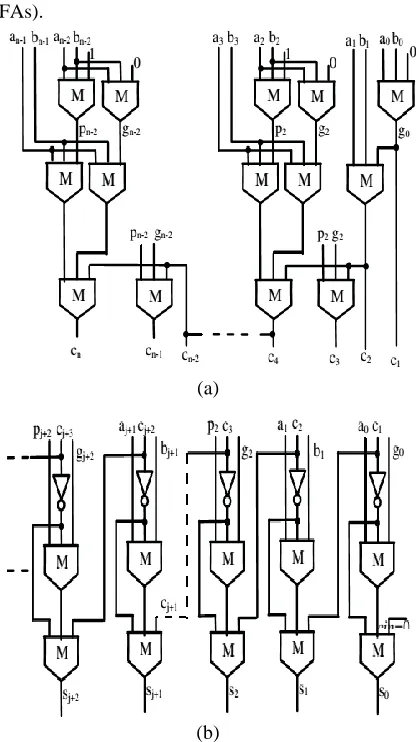
Fig. 2. Novel n-bit adder (a) carry chain and (b) sum block.
Even thoughthese addition circuits use different topologies of the genericFA, they have a carry-in to carry-out path consistingof one MG, and a carry-in to sum bit path containing two MGs plus one inverter. As a consequence, theworst case computational paths of the n-bit RCA and then-bit CFA consist of (n+2) MGs and one inverter.
III. PROPOSED SYSTEM STRUCTURE
To introduce the novel design proposed for implementing ripple adders in QCA, let consider two n-bit addends and suppose that for the i th bit position (with i = n − 1, . . . , 0) the auxiliarypropagate and generate signals, namely and
are computed ci being the carry produced at the
generic (i−1)th bit position, the carry signal ci+2, furnished atthe (i+1)th bit location, can be computed using the conventional CLA logic reported in (2). The latter canbe rewritten as given in (3), by exploiting Theorems 1 and 2demonstrated in [15]. In this way, the RCA action, neededto propagate the carry ci through the two subsequent bitpositions, requires only one MG. Conversely, conventionalcircuits operating in the RCA fashion, namely the RCA andthe CFA, require two cascaded MGs to perform the sameoperation.
ci+2 = gi+1 + pi+1 · gi + pi+1 · pi · ci………… (2) ci+2 = M(M (ai+1, bi+1, gi) M (ai+1, bi+1, pi) ci). ………(3)
Novel 32-bit adder
It must be noted that the time critical addition is performed when a carry is generated at the least significant bit positionand then it is propagated through the subsequent bit positions to the most significant one. In this case, the first 2-bitmodule computes c2, causal to the worst case computational
IJIRT 142603
INTERNATIONAL JOURNAL OF INNOVATIVE RESEARCH IN TECHNOLOGY158
Novel 64-bit adderIV. SIMULATION RESULTS
The proposed addition design is implemented for several operands word lengths using the QCA Designer tooladopting the same rules and simulation settings used.
Block diagram
RTL schematic
Simulation output
V. CONCLUSION
IJIRT 142603
INTERNATIONAL JOURNAL OF INNOVATIVE RESEARCH IN TECHNOLOGY159
thanconventional RCA adders. In addition, becauseof theadopted basic logic and layout strategy, the number of clockcycles required for completing the elaboration was limited.
REFERENCES
[1] C. S. Lent, P. D. Tougaw, W. Porod, and G. H. Bernestein, “Quantum cellular automata,” Nanotechnology, vol. 4, no. 1, pp. 49–57, 1993.
[2] M. T. Niemer and P. M. Kogge, “Problems in designing with QCAs: Layout = Timing,” Int. J. Circuit Theory Appl., vol. 29, no. 1, pp. 49–62, 2001.
[3] J. Huang and F. Lombardi, Design and Test of Digital Circuits by Quantum-Dot Cellular Automata. Norwood, MA, USA: Artech House, 2007.
[4] W. Liu, L. Lu, M. O’Neill, and E. E. Swartzlander, Jr., “Design rules for quantum-dot cellular automata,” in Proc. IEEE Int. Symp. CircuitsSyst., May 2011, pp. 2361–2364. [5] K. Kim, K. Wu, and R. Karri, “Toward designing robust QCA architectures in the presence of sneak noise paths,” in Proc. IEEE Design,Autom. Test Eur. Conf. Exhibit., Mar. 2005, pp. 1214–1219.
[6] K. Kong, Y. Shang, and R. Lu, “An optimized majority logic synthesis methology for quantum-dot cellular automata,” IEEE Trans. Nanotechnol., vol. 9, no. 2, pp. 170–183, Mar. 2010.
[7] K. Walus, G. A. Jullien, and V. S. Dimitrov, “Computer arithmetic structures for quantum cellular automata,” in Proc. AsilomarConf.Sygnals, Syst. Comput., Nov. 2003, pp. 1435–1439.
[8] J. D. Wood and D. Tougaw, “Matrix multiplication using quantumdot cellular automata to implement conventional microelectronics,” IEEETrans. Nanotechnol., vol. 10, no. 5, pp. 1036–1042, Sep. 2011.
[9] K. Navi, M. H. Moaiyeri, R. F. Mirzaee, O. Hashemipour, and B. M. Nezhad, “Two new low-power full adders based on majority-not gates,” Microelectron. J., vol. 40, pp. 126–130, Jan. 2009.
[10] L. Lu, W. Liu, M. O’Neill, and E. E. Swartzlander, Jr., “QCA systolic array design,” IEEE Trans. Comput., vol. 62, no. 3, pp. 548–560, Mar. 2013.
[11] H. Cho and E. E. Swartzlander, “Adder design and analyses for quantum-dot cellular automata,” IEEE Trans. Nanotechnol., vol. 6, no. 3, pp. 374–383, May 2007. [12] H. Cho and E. E. Swartzlander, “Adder and multiplier design in quantum-dot cellular automata,” IEEE Trans. Comput., vol. 58, no. 6,pp. 721–727, Jun. 2009.
[13] V. Pudi and K. Sridharan, “Low complexity design of ripple carry and Brent–Kung adders in QCA,” IEEE Trans. Nanotechnol., vol. 11, no. 1, pp. 105–119, Jan. 2012. [14] V. Pudi and K. Sridharan, “Efficient design of a hybrid adder in quantumdot cellular automata,” IEEE Trans. Very Large Scale Integr. (VLSI) Syst., vol. 19, no. 9, pp. 1535– 1548, Sep. 2011.
[15] S. Perri and P. Corsonello, “New methodology for the design of efficient binary addition in QCA,” IEEE Trans. Nanotechnol., vol. 11, no. 6, pp. 1192–1200, Nov. 2012.
BIODATA Author
B.Siva krishna presently pursuing his M.Tech in VLSID from Stanley Stephen college of Engineering and Technology,Kurnool,Andhra Pradesh, India. CoAuthor