R E S E A R C H A R T I C L E
Open Access
The association between circulating
adiponectin levels, lung function and
adiposity in subjects from the general
population; data from the Akershus Sleep
Apnea Project
Nina F. Caspersen
1,2, Helge Røsjø
1,2, Allan Flyvbjerg
3, Mette Bjerre
4, Anna Randby
1, Harald Hrubos-Strøm
5,
Torbjørn Omland
1,2and Gunnar Einvik
1,2*Abstract
Background:Circulating adiponectin (ADPN) levels are inversely associated with disease severity in patients with chronic obstructive pulmonary disease (COPD), while studies assessing the relationship between ADPN and lung function in subjects from the general population have shown diverging results. Accordingly, we hypothesized that ADPN would be associated with lung function in a population-based sample and tested how abdominal adiposity, metabolic syndrome, and systemic inflammation influenced this association.
Methods:We measured total ADPN in serum, forced vital capacity (FVC) and forced expiratory volume during the 1st second (FEV1) in 529 participants (median 50 years, 54.6% males) recruited from the general population. We assessed the association between ADPN and lung function by multivariate linear regression analyses and adjusted for age, gender, height, smoking habits, weight, body mass index, waist-hip ratio, metabolic syndrome, obstructive sleep apnoea (OSA) and C-reactive protein.
Results:The median (interquartile range) level of serum ADPN was 7.6 (5.4–10.4) mg/L. ADPN levels were positively associated with FVC % of predicted (beta 3.4 per SD adiponectin,p< 0.001)) in univariate linear regression analysis, but the association was attenuated in multivariate analysis (standardized beta 0.03,p= 0.573)). Among co-variates only WHR significantly attenuated the relationship. ADPN levels were also associated with FEV1% of predicted in bivariate analysis that adjusted for smoking (beta 1.4,p= 0.042)), but this association was attenuated and no longer significant in multivariate analysis (standardized beta -0.06,p= 0.254)).
Conclusion:In this population-based sample no association between ADPN and lung function was evident after adjustment for covariates related to adiposity.
Keywords:Adiponectin, Chronic obstructive pulmonary disease, Adiposity, Lung function
* Correspondence:[email protected]
1Division of Medicine, Akershus University Hospital, Lørenskog, Norway 2Institute of Clinical Medicine, University of Oslo, Oslo, Norway
Full list of author information is available at the end of the article
Background
Chronic obstructive pulmonary disease (COPD) is a heterogeneous disease characterized by chronic airway inflammation and reduced lung function [1]. The effects of current treatment options are modest, and COPD is one of the leading causes of morbidity and mortality worldwide [2]. Few serologic biomarkers are currently available for guiding diagnosis, providing prognostic information or evaluating treatment response in COPD [3].
Among proposed serologic biomarkers is adiponectin (ADPN); a protein abundant in serum, which is produced in adipocytes, but also in other tissues including macro-phages and airway epithelium [4]. ADPN levels have been found to vary with age, gender, smoking, adiposity and the presence of metabolic syndrome [5–7], some of which may also influence pulmonary function [8]. ADPN is involved in several physiological processes and predominantly exerts anti-inflammatory effects [9, 10]. Previous observations in COPD patients indicate that elevated ADPN levels are associated with accelerated lung function impairment and respiratory mortality [11–13]. In contrast, only limited and contrasting results are currently available regarding the association between ADPN levels and indices of lung func-tion in subjects from the general populafunc-tion [14, 15]. Accordingly, we aimed to assess the association between adiponectin and lung function in a general population sam-ple. We hypothesized that we would find an inverse associ-ation between ADPN levels and lung function. We also aimed to assess the impact of adiposity, metabolic syn-drome and systemic inflammation on the association between ADPN levels and indices of lung function.
Methods
Study design and participants
This is a substudy of the Akershus Sleep Apnea Project (ASAP), a two-phased clinical epidemiological study designed to examine sleep apnea in a general population. The recruitment protocol and inclusion/exclusion cri-teria have previously been reported [16]. In brief, 30,000 subjects between 30 and 65 years, randomly drawn from the Norwegian Personal Registry, received the Berlin Questionnaire by mail in the first phase of the study (Fig. 1). Among the 16,302 respondents, a clinical sam-ple of 535 persons was drawn from pre-specified strata based on equilibrium of age and gender, as well as 2/3 of persons with at least 2 positive risk categories of the Berlin Questionnaire [17].
The study was conducted in accordance with the amended Declaration of Helsinki, and the Regional Committee for Medical Research Ethics in Eastern Norway approved the protocol (1.2005.839). We ob-tained written informed consent from all participants prior to study commencement.
Data collection
During an overnight hospital stay, the participants underwent standardized data collection that included medical history, clinical examination, venous blood sam-pling, polysomnography and spirometry. Tobacco use was categorized as current, former and never. Height, weight, waist and hip circumference were recorded as the mean of three measurements with less than 10% variation, and were used to calculate the body mass index (BMI; weight (kg)/ height [cm]2) and the waist-hip-ratio (WHR). Lung function was assessed by Spirosoft spirometry and CardioSoft software (GE HealthCare, Munich, Germany) and recorded as the best performance for forced vital capacity (FVC) and forced expiratory volume during 1st second (FEV1) from at least 3 attempts with < 15% variation. FEV1 and FVC in percent of predicted [18] were calcu-lated and used as lung function variables in the ana-lyses. Metabolic syndrome was defined according to the National Cholesterol Educational Program cri-teria [19], based on measurements of systolic blood pressure, total cholesterol, low-density lipoprotein cholesterol, glucose and WHR. Polysomnography was performed and analyzed by two US board-certified polysomnography technicians (Somnologica 3.2 soft-ware package (Flaga-Medcare, Buffalo, NY, USA)). Obstructive sleep apnoea (OSA) was defined as an apnoea-hypopnoea index (AHI) equal to or higher than five.
Biochemical analysis
Venous blood samples were collected in the fasting state in the morning, immediately prepared by centrifugation
and separation into plasma and serum samples that were frozen at−20 °C for a maximum of 1 week before stored at −80 °C pending analyses, as previously reported [20]. Serum ADPN was determined by a validated in-house time-resolved immunofluorometric assay as previously described [21]. All samples were analyzed in duplicate, with a detection limit of 1.5μg/L and intra- and interas-say coefficients of variation < 5% and < 7%, respectively. C-reactive protein (CRP) was analyzed by a highly sensi-tive latex immunoassay-kit on a COBAS INTEGRA400 (Roche), with a lower detection limit of 0.1 mg/L.
Statistical analysis
Data are presented as mean ± standard deviation (SD) or median (quartile [Q] 1–3) for data with a non-normal distribution. We grouped the participants into tertiles of serum ADPN levels and used one-way analysis of vari-ance, Kruskal-Wallis test or chi-square tests to compare clinical data between the groups. We applied multivari-ate linear regression to explore the association between ADPN and chosen covariates. Linear regression was also used to examine the univariate association between lung function and ADPN, as well as the covariates smoking status, weight, BMI, WHR, metabolic syndrome and CRP. We used FEV1and FVC in percent of predicted as dependent variables, thus, additional adjustment for the covariates age, gender, ethnicity and height were not considered. The multivariate analyses were performed in two stages; we first added adiposity variables, metabolic syndrome and CRP one-by-one to separately evaluate the impact of these features on the association between ADPN and lung function. In the final multivariate linear regression analysis all covariates were first entered sim-ultaneously followed by a stepwise removal of the covar-iate with the highest p-value until all covariates were significantly associated with lung function. Adiponectin was kept in all steps independently of p-value. All re-gression models were assessed for collinearity. The stat-istical analyses were performed with Statstat-istical Package for Social Sciences 22, and ap-value < 0.05 was regarded as statistical significant.
Results
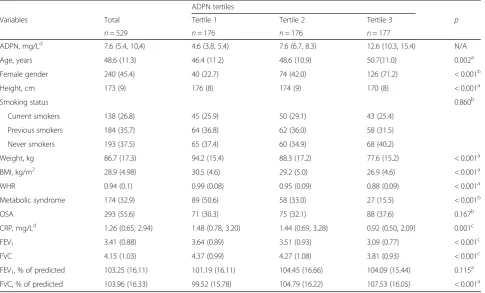
The median (Q 1-3) ADPN level in the total population was 7.6 (5.4–10.4) mg/L. Indices of lung function, demo-graphic and clinical characteristics, and laboratory data of the participants are presented stratified according to tertiles of serum ADPN concentrations in Table1.
The absolute values of FEV1 and FVC decreased by increasing ADPN tertiles. For FEV1% of predicted, there was no significant difference between ADPN tertiles, while FVC% of predicted increased by increasing ADPN levels (Fig. 2). Age and proportion of females increased across tertiles of serum ADPN, while height, weight,
BMI, WHR, CRP and the proportion of participants with metabolic syndrome decreased. Smoking status and prevalence of OSA did not differ significantly between the groups. Univariate and multivariate analysis of the association between ADPN and selected covariates are shown in Additional file1: Table S1. All variables except smoking were significantly correlated with ADPN in uni-variate analysis, while age, gender, WHR and metabolic syndrome remained significantly associated with ADPN in multivariate analyses.
The crude associations between FEV1 or FVC % of predicted and ADPN, smoking status, anthropometric parameters, metabolic syndrome, OSA and CRP are shown in Table2.
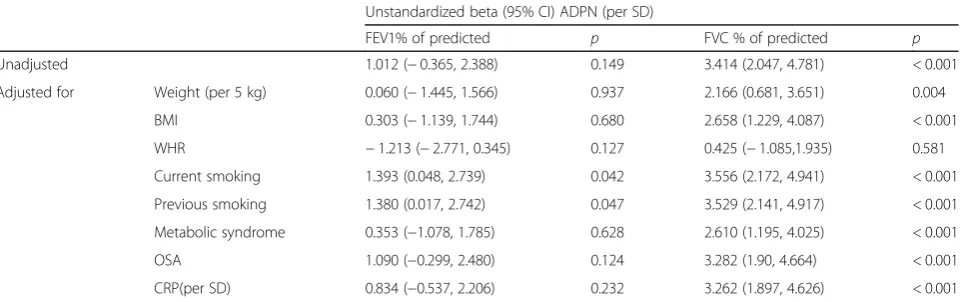
There was no significant association between FEV1% of predicted and ADPN. A positive association with ADPN was found after adjustment for smoking, while the models including each of the other co-variates found no associations between FEV1% of predicted and ADPN. In contrast, FVC% of predicted was significantly associ-ated with ADPN, measures of adiposity, metabolic syn-drome, OSA and CRP, but not with smoking. The association between ADPN and FVC in % of predicted remained positive after adjusting for smoking status, weight, BMI, metabolic syndrome, OSA and CRP one by one in separate linear regression models. However, the association was attenuated and no longer significant when adjusting for WHR (Table3).
In the final multivariate models that included smoking status, BMI, WHR, metabolic syndrome, OSA and CRP, ADPN was not associated with any of the lung function variables (Table4).
Discussion
In the present population-based sample, we found that ADPN was positively associated with lung function after adjustment for age, gender, height and smoking, but this association was attenuated and not significant when adjusting also for indices of adiposity, metabolic syn-drome, CRP and OSA. This result reflects the negative impact of adiposity on both lung function and serum ADPN levels.
association between ADPN and FEV1/FVC in unadjusted analyses, as well as accelerated decline in FEV1 with higher ADPN levels after adjustment for age, gender, height, smoking and BMI. In contrast, the CARDIA
study, like the present study, observed an inverse associ-ation between ADPN and lung function in unadjusted analyses, but this association was attenuated and no lon-ger significant in analysis that adjusted also for insulin resistance and systemic inflammation [14]. Thus, we find it plausible that circulating ADPN levels are primarily associated with indices of adiposity, and that univariate associations between ADPN levels and pulmonary func-tion reflect an inverse associafunc-tion between adiposity and pulmonary function.
A novel finding in the present study is the important role of WHR as a confounder in the association between ADPN and lung function. While previous studies and the present study found that BMI alone did not attenu-ate the association between ADPN and lung function, WHR alone attenuated the association between ADPN and FVC in the present study. WHR also remained sig-nificantly associated with both FEV1% of predicted and FVC % of predicted in multivariate analysis. Abdominal adiposity is a surrogate marker of visceral adiposity and is associated with serum levels of adiponectin, metabolic disease and systemic inflammation, but also results in mechanical restriction that may affect lung function and
Fig. 2Lung function in % of predicted according to tertiles of adiponectin
Table 1Characteristics of the participants according to tertiles of serum adiponectin levels
ADPN tertiles
Variables Total Tertile 1 Tertile 2 Tertile 3 p
n= 529 n= 176 n= 176 n= 177
ADPN, mg/Ld 7.6 (5.4, 10,4) 4.6 (3.8, 5.4) 7.6 (6.7, 8.3) 12.6 (10.3, 15.4) N/A
Age, years 48.6 (11.3) 46.4 (11.2) 48.6 (10.9) 50.7(11.0) 0.002a
Female gender 240 (45.4) 40 (22.7) 74 (42.0) 126 (71.2) < 0.001b
Height, cm 173 (9) 176 (8) 174 (9) 170 (8) < 0.001a
Smoking status 0.860b
Current smokers 138 (26.8) 45 (25.9) 50 (29.1) 43 (25.4)
Previous smokers 184 (35.7) 64 (36.8) 62 (36.0) 58 (31.5)
Never smokers 193 (37.5) 65 (37.4) 60 (34.9) 68 (40.2)
Weight, kg 86.7 (17.3) 94.2 (15.4) 88.3 (17.2) 77.6 (15.2) < 0.001a
BMI, kg/m2 28.9 (4.98) 30.5 (4.6) 29.2 (5.0) 26.9 (4.6) < 0.001a
WHR 0.94 (0.1) 0.99 (0.08) 0.95 (0.09) 0.88 (0.09) < 0.001a
Metabolic syndrome 174 (32.9) 89 (50.6) 58 (33.0) 27 (15.5) < 0.001b
OSA 293 (55.6) 71 (30.3) 75 (32.1) 88 (37.6) 0.167b
CRP, mg/Ld 1.26 (0.65, 2.94) 1.48 (0.78, 3.20) 1.44 (0.69, 3.28) 0.92 (0.50, 2.09) 0.001c
FEV1 3.41 (0.88) 3.64 (0.89) 3.51 (0.93) 3.09 (0.77) < 0.001
c
FVC 4.15 (1.03) 4.37 (0.99) 4.27 (1.08) 3.81 (0.93) < 0.001c
FEV1, % of predicted 103.25 (16.11) 101.19 (16.11) 104.45 (16.66) 104.09 (15.44) 0.115 a
FVC, % of predicted 103.96 (16.33) 99.52 (15.78) 104.79 (16.22) 107.53 (16.05) < 0.001a ADPNadiponectin,FEV1forced expiratory volume during 1st second,FVCforced vital capacity,BMIbody mass index,WHRwaist-hip ratio,OSAobstructive sleep apnoea,CRPC-reactive protein
a
analyses of variance,b
chi-square tests,c
Kruskal-Wallis
Continuous variables are expressed as mean (standard deviation) ord
FVC in particular. The results from the present study indicate that the role of mechanic restriction from ab-dominal obesity contributes more to lung function than the changes in ADPN secretion and metabolic disease associated with this condition,
Interestingly, there were differences between FEV1and FVC in % of predicted as dependent variables. While FVC is a measure of lung volume, FEV1is also an indi-cator of airway obstruction. In our study, ADPN was only associated with FVC % of predicted in univariate analyses. Also, while all types of adiposity-related factors further attenuated the association between ADPN and FEV1% of predicted, only WHR attenuated the positive association between FVC % of expected and ADPN. This might reflect that CRP and metabolic syndrome, as indi-cators of inflammatory and metabolic consequences of adiposity, are more important for FEV1 than for FVC. This is in accordance with results in the CARDIA-study, which found metabolic syndrome and insulin resistance as well as systemic inflammation to attenuate the
relationship between FEV1 and adiponectin. These fac-tors will be important to include in multivariate analysis when evaluating the relationship between ADPN and lung function.
There are several differences in the three presented population-based studies, besides the choice of covari-ates, which could explain the discrepant conclusions. One factor that could impact the result is ethnic varia-tions with our study including primarily Caucasian sub-jects, the CARDIA study including a mixed American population while the third study examined a Japanese population. The CARDIA study also included younger individuals (mean age 40 years), the present study sub-jects with mean age of 50 years, and the Japanese study subjects with mean age of ~ 60 years. As ADPN levels are known to increase with age [22], different age groups could potentially also contribute to the diverging results between these three general population-based cohorts.
A limitation compared to previous studies is the cross-sectional design that makes us unable to
Table 3The associations between adiponectin (ADPN) and lung function in percent of predicted adjusting for different covariates one by one
Unstandardized beta (95% CI) ADPN (per SD)
FEV1% of predicted p FVC % of predicted p
Unadjusted 1.012 (−0.365, 2.388) 0.149 3.414 (2.047, 4.781) < 0.001
Adjusted for Weight (per 5 kg) 0.060 (−1.445, 1.566) 0.937 2.166 (0.681, 3.651) 0.004
BMI 0.303 (−1.139, 1.744) 0.680 2.658 (1.229, 4.087) < 0.001
WHR −1.213 (−2.771, 0.345) 0.127 0.425 (−1.085,1.935) 0.581
Current smoking 1.393 (0.048, 2.739) 0.042 3.556 (2.172, 4.941) < 0.001
Previous smoking 1.380 (0.017, 2.742) 0.047 3.529 (2.141, 4.917) < 0.001
Metabolic syndrome 0.353 (−1.078, 1.785) 0.628 2.610 (1.195, 4.025) < 0.001
OSA 1.090 (−0.299, 2.480) 0.124 3.282 (1.90, 4.664) < 0.001
CRP(per SD) 0.834 (−0.537, 2.206) 0.232 3.262 (1.897, 4.626) < 0.001
FEV1forced expiratory volume during 1st second,FVCforced vital capacity,CIconfidence interval,ADPNadiponectin,BMIbody mass index,WHRwaist-hip ratio, OSAobstructive sleep apnoea,CRPc-reactive protein
Table 2Univariate associations between lung function expressed as FEV1and FVC in percent of predicted, adiponectin, smoking
status, indices of adiposity, metabolic syndrome, obstructive sleep apnoea and C-reactive protein
FEV1% predicted FVC % predicted
Unstandardized beta (CI) p Unstandardized beta (CI) p
ADPN (per SD) 1.012 (−0.365, 2.388) 0.149 3.414 (2.047, 4.781) < 0.001
Current smoking −5.444 (−8.483,−2.406) < 0.001 −2.219 (−5.410, 0.972) 0.173
Previous smoking 0.645 (−2.197, 3.487) 0.656 −1.143 (−4.096, 1.811) 0.448
Weight (per 5 kg) −0.661 (−1.055,−0.268) 0.001 −1.119 (−1.510,−0.728) < 0.001
BMI kg/m2 −0.466 (−0.740,−0.192) 0.001 −0.647 (−0.922,−0.371) < 0.001
WHR −38.297 (−52.041,−24.553) < 0.001 −62.199 (−75.488,−48.909) < 0.001
Metabolic syndrome −4.905 (−7.808,−2.001) 0.001 −7.375 -10.289,−4.471) < 0.001
OSA −2.143 (−4.911, 0.625) 0.129 −3.923 (−6.725,−1.120) 0.006
CRP (per SD) −2.157 (−3.524,−0.791) 0.002 −2.071 (−3.457,−0.685) 0.003
evaluate changes in lung function and causal path-ways. On the other hand, compared to CARDIA, we were able to analyze ADPN samples obtained at the same time point as the spirometry. The ASAP cohort consisted of individuals with more risk factors for ob-structive sleep apnoea than a strict general population sample and were as a group more obese, more sleepy and had a higher rate of diabetes and prior myocar-dial infarction than the general population sample responding to the Berlin questionnaire in the first part of the study. OSA is associated with lower ADPN levels and is a possible confounder in the ex-amined relationship between ADPN and lung func-tion. However, the prevalence of OSA did not differ between the tertiles of ADPN and the association be-tween FVC% of predicted and ADPN remained sig-nificant after adjustment for OSA and metabolic syndrome. Also mean ADPN levels and measures of lung function in the study sample were comparable to those observed in previous general population studies [15, 23]. Based on this we believe our results are valid also for subjects from the general popula-tion. Finally, only total ADPN levels were measured and therefore information regarding different isoforms is not available.
Conclusions
In this population-based study, we found a positive as-sociation between ADPN and FEV1and FVC after ad-justment for age, gender, height and smoking that was attenuated after additional adjustment for indices of abdominal adiposity. Accordingly, future assessment of the association between ADPN and lung function should take both multiple indices of adiposity and its metabolic consequences into consideration.
Additional files
Additional file 1:Supplementary table 1.Univariate and multivariate adjusted associations between ln Adiponectin and chosen covariates. (DOCX 15 kb)
Additional file 2:Dataset. (XLSX 59 kb)
Abbreviations
ADPN:Adiponectin; ASAP: Akershus Sleep Apnea Project; BMI: Body mass index; CARDIA: Coronary artery risk development in young adults; COPD: Chronic obstructive pulmonary disease; CRP: C-reactive protein; FEV1: Forced expiratory volume in 1 second; FVC: Forced vital capacity;
SD: Standard deviation; WHR: Waist-hip ratio
Acknowledgements
We thank the staff at Stensby Hospital and the Clinical Trial Unit, Division of Medicine, Akershus University Hospital for performing the spirometry. We also thank Silje Kjeka Namtvedt for contributing to data collection and Fredrik A. Dahl for statistical advice.
Funding
The Akershus Sleep Apnea Project was supported by the South-Eastern Norway Regional Health Authority (grant number 2004219, 2007048) and the University of Oslo. The study was conducted at Akershus University Hospital. NFC has received a grant (2015/FO7781) from Extrastiftelsen initiated in collaboration with the Norwegian Heart and Lung Association (LHL).
Availability of data and materials
All data generated and analysed in the current study are included in this published article and its Additional file2.
Authors’contributions
TO had the original idea of ASAP, while the concept of the current study was conceived by NFC and GE. HHS and AR contibuted to the study design and performed the data collection. AF and MB were responsible for the biomarker substudy of adiponectin including laboratory analyses. HR contributed with critical revision of the manuscript and data interpretation. NFC and GE had the full responsibility for the statistical analyses. NFC performed the drafting of the manuscript, while all authors contributed significantly and approved the final version.
Ethics approval and consent to participate
The study was conducted in accordance with the amended Declaration of Helsinki, and the Regional Committee for Medical Research Ethics in Eastern Norway approved the protocol (1.2005.839). We obtained written informed consent from all participants prior to study commencement.
Consent for publication Not applicable
Competing interests
TO has received speaker and/or consultancy honoraria from Abbott Diagnostics, Roche Diagnostics, Novartis and research support from Abbott Diagnostics, AstraZeneca, Thermo Fisher Scientific, and Biomedica. GE has received research grants from Astra Zeneca and speaker honorarium from Takeda. The other authors declare no reported conflicts of interest.
Publisher’s Note
Springer Nature remains neutral with regard to jurisdictional claims in published maps and institutional affiliations.
Table 4The association between lung function and serum adiponectin levels adjusted for multiple covariates
FEV1% of predicted p FVC % of predicted p
Standardized B (CI) Standardized B (CI)
Adiponectin/SD −0.056 (−2.390, 0.632) 0.254 0.027 (−1.083, 1.956) 0.573
WHR −0.264 (−58.269,−27.208) < 0.001 −0.360 (−76.027,−44.799) < 0.001
Current smoking −0.170 (−8.940,−3.075) < 0.001 −0.083 (−6.010,−0.113) 0.042
CRP/SD −0.125 (−3.235,−0.660) 0.003 −0.103 (−2.957,−0.368) 0.012
Author details
1Division of Medicine, Akershus University Hospital, Lørenskog, Norway. 2Institute of Clinical Medicine, University of Oslo, Oslo, Norway.3Steno
Diabetes Center Copenhagen (SDCC), the Capital Region of Denmark and University of Copenhagen, Copenhagen, Denmark.4Medical Research
Laboratory, Department of Clinical Medicine, Aarhus University, Aarhus, Denmark.5Department of Otorhinolaryngology, Division of Surgery, Akershus
University Hospital, Lørenskog, Norway.
Received: 16 October 2017 Accepted: 20 March 2018
References
1. Global Strategy for the Diagnosis, Management and Prevention of COPD. Global Initiative for Chronic Obstructive Lung Disease (GOLD). 2017. http:// www.goldcopd.org.
2. Murray CJ, Lopez AD. Alternative projections of mortality and disability by cause 1990-2020: Global Burden of Disease Study. Lancet. 1997;349(9064): 1498–504.
3. Agusti A, Sin DD. Biomarkers in COPD. Clin Chest Med. 2014;35(1):131–41. 4. Miller M, Cho JY, Pham A, Ramsdell J, Broide DH. Adiponectin and
functional adiponectin receptor 1 are expressed by airway epithelial cells in chronic obstructive pulmonary disease. J Immunol. 2009;182(1):684–91. 5. Obata Y, Yamada Y, Takahi Y, Baden MY, Saisho K, Tamba S, et al.
Relationship between serum adiponectin levels and age in healthy subjects and patients with type 2 diabetes. Clin Endocrinol. 2013;79(2):204–10. 6. Tilg H, Moschen AR. Adipocytokines: mediators linking adipose tissue,
inflammation and immunity. Nat Rev Immunol. 2006;6(10):772–83. 7. Kotani K, Hazama A, Hagimoto A, Saika K, Shigeta M, Katanoda K, et al.
Adiponectin and smoking status: a systematic review. J Atheroscler Thromb. 2012;19(9):787–94.
8. Chen WL, Wang CC, Wu LW, Kao TW, Chan JY, Chen YJ, et al. Relationship between lung function and metabolic syndrome. PLoS One. 2014;9(10): e108989.
9. Xu A, Vanhoutte PM. Adiponectin and adipocyte fatty acid binding protein in the pathogenesis of cardiovascular disease. Am J Physiol Heart Circ Physiol. 2012;302(6):H1231–H40.
10. Yamauchi T, Kamon J, Waki H, Terauchi Y, Kubota N, Hara K, et al. The fat-derived hormone adiponectin reverses insulin resistance associated with both lipoatrophy and obesity. Nat Med. 2001;7(8):941–6.
11. Tomoda K, Yoshikawa M, Itoh T, Tamaki S, Fukuoka A, Komeda K, et al. Elevated circulating plasma adiponectin in underweight patients with COPD. Chest. 2007;132(1):135–40.
12. Yoon HI, Li Y, Man SF, Tashkin D, Wise RA, Connett JE, et al. The complex relationship of serum adiponectin to COPD outcomes COPD and adiponectin. Chest. 2012;142(4):893–9.
13. Carolan BJ, Kim YI, Williams AA, Kechris K, Lutz S, Reisdorph N, et al. The association of adiponectin with computed tomography phenotypes in chronic obstructive pulmonary disease. Am J Respir Crit Care Med. 2013; 188(5):561–6.
14. Thyagarajan B, Jacobs DR Jr, Smith LJ, Kalhan R, Gross MD, Sood A. Serum adiponectin is positively associated with lung function in young adults, independent of obesity: the CARDIA study. Respir Res. 2010;11:176. 15. Sato K, Shibata Y, Abe S, Inoue S, Igarashi A, Yamauchi K, et al. Association
between plasma adiponectin levels and decline in forced expiratory volume in 1 s in a general Japanese population: the Takahata study. Int J Med Sci. 2014;11(8):758–64.
16. Hrubos-Strom H, Randby A, Namtvedt SK, Kristiansen HA, Einvik G, Benth J, et al. A Norwegian population-based study on the risk and prevalence of obstructive sleep apnea. The Akershus Sleep Apnea Project (ASAP). J Sleep Res. 2011;20(1 Pt 2):162–70.
17. Netzer NC, Stoohs RA, Netzer CM, Clark K, Strohl KP. Using the Berlin Questionnaire to identify patients at risk for the sleep apnea syndrome. Ann Intern Med. 1999;131(7):485–91.
18. Quanjer PH, Tammeling GJ, Cotes JE, Pedersen OF, Peslin R, Yernault JC. Lung volumes and forced ventilatory flows. Report working party standardization of lung function tests, European Community for steel and coal. Official statement of the European Respiratory Society. Eur Respir J Suppl. 1993;16:5–40.
19. Executive summary of the third report of the National Cholesterol Education Program (NCEP) expert panel on detection, evaluation, and
treatment of high blood cholesterol in adults (Adult Treatment Panel III). JAMA. 2001;285(19):2486–97.
20. Einvik G, Rosjo H, Randby A, Namtvedt SK, Hrubos-Strom H, Brynildsen J, et al. Severity of obstructive sleep apnea is associated with cardiac troponin I concentrations in a community-based sample: data from the Akershus sleep apnea project. Sleep. 2014;37(6):1111–6.
21. Frystyk J, Tarnow L, Hansen TK, Parving HH, Flyvbjerg A. Increased serum adiponectin levels in type 1 diabetic patients with microvascular complications. Diabetologia. 2005;48(9):1911–8.
22. Marques-Vidal P, Bochud M, Paccaud F, Mooser V, Waeber G, Vollenweider P. Distribution of plasma levels of adiponectin and leptin in an adult Caucasian population. Clin Endocrinol. 2010;72(1):38–46.
23. Hayashikawa Y, Iwata M, Inomata M, Kawagishi Y, Tokui K, Taka C, et al. Association of serum adiponectin with asthma and pulmonary function in the Japanese population. Endocr J. 2015;62(8):695–709.
• We accept pre-submission inquiries
• Our selector tool helps you to find the most relevant journal
• We provide round the clock customer support
• Convenient online submission
• Thorough peer review
• Inclusion in PubMed and all major indexing services
• Maximum visibility for your research
Submit your manuscript at www.biomedcentral.com/submit