Exploring the use of knowledge management practices in an
academic library in a changing information environment
Judith Mavodza
1and Patrick Ngulube
2University of South Africa, Department of Information Science [email protected]; [email protected]
Received: 10 July 2010 Accepted: 8 May 2011
Some academic libraries have significantly developed and are applying some knowledge management (KM) principles and practices in the provision of library services. KM has been implemented in commercial and business environments towards achieving operational advantages. Its principles and tools can help libraries to improve performance and fulfil their mandate. By using a case study approach, the objective of this research was to find out how knowledge is identified, captured, shared and retained in order to enhance performance and improve the quality of service in the Metropolitan College of New York (MCNY) library. A web-based questionnaire, some institutional documents, observation and face-to-face interviews were used to collect data. Data was analysed both quantitatively and qualitatively. The findings indicate that the MCNY library practices are not deliberately informed by KM principles, but are amenable to KM principles. It is recommended that KM, with its potential to turn individual knowledge into organisational knowledge, should be used in positioning the MCNY library in a changing information environment.
Key words: Academic library; knowledge management; knowledge assets; improving performance of library services
1 Introduction
Educational colleges and their libraries are social organisations where workers transform resources for use by consumers through the functions of teaching, research and service (Townley 2001). This research was based on a case study of the Metropolitan College of New York (MCNY). All the teaching and learning at MCNY is highly dependent on library support.
In a fast-changing information environment, academic libraries have significantly developed and are applying some knowledge management (KM) principles in order to enhance the provision of library services (Gandhi 2004; Pantry & Griffiths 2003; Singh 2007). According to KM theory and practice, knowledge is embedded in the processes and documentation as explicit knowledge and in the heads of the workers as implicit knowledge (Jashapara 2005; Nonaka & Takeuchi 1995). Singh (2005:144) defines KM in libraries as follows:
… not managing or organizing books or journals, searching the internet for clients or arranging the circulation of materials. However, each of the activities can in some way be part of the knowledge management spectrum and process. Knowledge management is about enhancing the use of organizational knowledge through sound practices of knowledge management and organizational learning.
The theory behind KM is that knowledge is not an end in itself. According to Williams, Giuse, Koonce, Kou and Giuse (2004:99), “when information and knowledge flow can be captured, organised and made accessible for reuse, there exists the potential for subsequent creation of new knowledge”. New knowledge has a possibility of enhancing performance and improving services provided to clients.
The reason why KM theory is becoming increasingly significant in libraries is that rapid technological changes alter the way in which library services are provided. The concept of ownership of items has become more fluid because of the prevalence of new communication technologies that include social software such as blogs, wikis and MySpace. The collec-tion development funccollec-tion of librarians now consists of deciding which items to provide straightforward access to besides the traditional services of issuing print publications to users. One can say that libraries are now expected to build and maintain “knowledge gateways” (Ravi 2008) and in the process pull together a range of information resources and sourc-es that addrsourc-ess the rsourc-esearch needs of their user communitisourc-es.
Library support at the MCNY is in the form of print and online resources, reference services and information literacy classes for all library users. The library is currently unable to provide every resource and service students and faculty require. This is confirmed by the MCNY’s self-study review (2009:51), which states that there is consensus among students and staff that “library resources and services are not adequate”. The reasons are financial as well as practical.
1. Judith Mavodza is a PhD candidate (Department of Information Science, University of South Africa, Pretoria).
Firstly, the library cannot survive in isolation and provide 100% of what the college library users need. Because the cost of books and other information resources has become prohibitive, networking with other librarians and libraries for interlibrary lending and discounts when purchasing material has become essential; however, this is still not sufficient. Secondly, if money was available to buy every book and every update and new edition that is available, space and storage limitations would be a problem. The floor and shelf space at the MCNY library cannot accommodate limitless numbers of books. Thirdly, so many resources are now provided online that the library has to find a balance between what is available in print and what is available through online access only. Fourthly, with staff cuts that have taken place due to a shrinking budget, it is not possible to have a robust library staff complement to give sufficient attention to individual library user needs. In addition to the above challenges, a new information environment driven by rapid technological changes has brought additional demands. Despite the above circumstances, the library is still expected to provide a consistently efficient and effective service of good quality.
2 Statement of the problem
Following the question raised by Creswell (2007:102) (“why is this study needed?”) and the suggestions of Hernon and Schwartz (2007:307) that the statement of the problem should “withstand a reviewer raising the ‘so what?’ question”, the problem statement for this study is that the MCNY library is providing a service that needs quality improvement since it does not adequately address the challenges posed by a fast-changing information environment.
KM practices – with their emphasis on harnessing knowledge assets in order to foster collaboration, innovation and social networks – are one of the strategies that can be used to improve the quality of performance in organisations. KM has been implemented in commercial and business environments towards achieving operational advantages and financial gains. It might be possible that the KM principles and tools can help the MCNY library to improve its performance and ful-fil its mandate. However, there is uncertainty about whether the use of KM principles and tools can partly help the MCNY library to improve the quality of its service to its community in the modern information environment.
In order to find out if indeed the answer to the shortcomings lies in embracing KM practices, the following research questions were formulated:
• What do librarians, faculty and administrators understand KM to mean? • What knowledge management practices are in existence at the MCNY library?
• What modern information technologies are used at the MCNY library to enhance the environment for KM practice?
3 Literature review
In the changing information environment of the 21st century, library research and practice are moving from a library-centred approach to an information-library-centred approach (Carpenter & Steiner 2005). Based on this fact, it was important to consider what library and information science (LIS) theory exist that could form a basis for the generation of new ideas on current library practice. The literature review revealed that there were library science theories that have not comprehensively articulated the impact of the current information environment on libraries. Examples include the probability theory (Bensman 2007), the grounded theory (Glaser & Strauss 1967), the grand unified theory (McGrath 2002), the critical realism theory (Wikgren 2005) and the fuzzy set theory (Zadeh 1965).
In addition to this weakness, l
ibrary science scholars do not seem to share a single understanding or view about what library science theory comprises and how it should be used in research. McKechnie and Pettigrew (2002:406) explain that “broad differences exist in the use of theory in LIS that are associated with the broad disciplinary content of the research”. However, Grover and Greer (1991) are of the opinion that interdisciplinary work has the potential to answer the field’s complex research questions. Taking this view, KM concepts were examined for their relevance to library practice. KM has its own definition problems, but Rowley (2003:433) comments:To argue that there is no clearly defined and generally accepted definition of KM, or even to argue that it has nothing special or different to add to more traditional disciplines such as librarianship, and information management, or even to dispute the appropriateness of the word knowledge, as opposed to information, misses the point. None of these things matter if the world out there is in pursuit of solutions that help them to survive and flourish effectively in a knowledge-based society.
Some studies where KM principles were considered for application to library situations were looked at to find out if any of the findings were relevant to the current study. Examples included Hamid and Nayan (2007) (who performed a preliminary study of KM in a public library) and Hamid, Nayan, Bakar and Norman (2007) (who did a KM adoption and implementation readiness case study of the National Library of Malaysia [NLM]). The latter study investigated the status of KM at the NLM, with the objective of discovering how the organisation went about creating, disseminating and applying knowledge internally. It revealed the importance of capturing tacit knowledge that resides in employees’ heads. The recommendations that resulted from the study included the need to define and document the organisation’s policy for KM, documenting best practices and the expertise required for KM practice, and a system that allows for the easy location of specific knowledge and expertise.
Another example came from a study by White (2004) in an academic library at the Oxford University Library Service (OULS), which was based on the premise that KM practices can enhance the quality of library service. The study was intended to show the need to include KM in a library strategy to retain expertise for the benefit of staff and users and to “provide an additional tool in assessing staff’s perception of change, knowledge creation and sharing at OULS” (White 2004). The categories of staff that were included in the study were librarians, administrators, IT personnel, front-line and staff workers – thus the study provided a working guideline of what categories of people to include in studying the MCNY case.
4 Research methods
The context of this study was a single case, the MCNY library, both as a unit of analysis and as a research method. While Creswell (2007:73) and Tellis (1997) see a case study as a research methodology, Stake (2005:438) views it as “a choice of what is to be studied”. To add to this discussion, Grünbaum (2007:79) makes the distinction between a case study as a “unit of analysis and the case”, since many researchers leave it unclear. “One of the hallmarks of a case study is the combination of several different sources of information …” (O’Sullivan, Rassel & Berner 2008:40). As such, a web-based questionnaire, some institutional documents, observation and face-to-face interviews were used to collect data. The triangulation of data collection methods can overcome personal biases that are more likely in the use of a single method, including bringing out conflicting evidence that a researcher might be unwilling to highlight (especially with research done in one’s place of work as was the case in this instance).
A sample was studied instead of the whole population. According to Ngulube (2005:132), “by studying the sample it is possible to draw valid conclusions about the larger group”.
This study used both purposive sampling and
random sampling. To determine who should actually participate in the quantitative study, a frame originating from the list of personnel in the MCNY Microsoft Access database was used.Usually social science researchers assume that if the population is large, the sample also has to be large – but that is not necessarily accurate
(
Ngulube 2005; O’Sullivan et al. 2008). Another “misconception about sample size is that a sample must include some minimum proportion of the population” (O’Sullivan et al. 2008:155). While researchers such as Leedy and Ormrod (2005) propose a sample size of 50% of the population, Grinnell (1997) suggests 10%. Thus, perspectives on the ideal sample size vary.In fact, the main factors that determine the sample size are the desired degree of accuracy and the confidence level. The decision in selecting the stratified random sample for quantitative data collection was therefore to have a confidence level of 95% and a 10% (.10) sampling error, because the statistical phenomena that came out of the research were not an end in themselves, but a part of results to be compared with those from other data collection methods. The result was a sample of 79 individuals that was calculated with the use of the Sample Size Calculator (Corsini 2010; Pezzullo 2010). The 79 randomly selected individuals constituted 17,5% of the total employee population of the MCNY. The sample size of 79 constituted 17,5% of each category of the 448 employees of the MCNY.
Institutional documents were part of the qualitative information that was gathered and were important because they gave the researchers insight into the thinking within the MCNY. Yin (1984:80) points out that “the most important use of documents is to corroborate and augment evidence from other sources”. Another source of data was interviews. They gave the researchers the opportunity to investigate further, to solve problems and to gather data which could not have been obtained in other ways (Cunningham 1993). A structured interview with open-ended questions was used in this study.
In line with the University of South Africa’s (2007) policy on research ethics, it was important to notify the identified sample population of the aims, methods, and anticipated benefits of the research; their right to abstain from participation in the research; their right to terminate their participation at any time; the confidential nature of their replies; and respecting their privacy and autonomy.
Following the coding, the collected questionnaires were first checked for errors in responses as well as identifying unanswered questions before entering into the SPSS® software. Within the survey, the open ended questions involving qualitative data were content analysed and categorized. Data analysis was carried out after data entry for both closed and open ended questions was complete. The Microsoft Word® computer package was used to transcribe the interview sessions. Content analysis was then applied where the researchers read all the transcripts and checked the observation protocols in order to identify themes as suggested by Hancock (1998).
5 Discussion and results
The results that are reported in the subsequent paragraphs emanated from the whole college and the library, and reflect questionnaire, interview, observation and document review findings. A total of 41 questionnaires out of 79 were completed. This was 51,9% of the total sample. The response rate was consistent with the findings of Greenlaw and Brown-Welty (2009), who found that a response rate of 51,58% from a web-based survey tool was higher than many response rates of this type of survey as reported in the literature. However, one of the weaknesses of a low response rate is that it is difficult to confirm the validity of the conclusions beyond the current study (Leysen & Boydston 2009). Although the response rate was relatively low, this deficiency was compensated for by the triangulation of data collection methods. All usable responses to the questionnaires were analysed using SurveyMonkey® and Microsoft Excel®. Content analysis was used to analyse and categorise data from other data collection techniques.
The questionnaire respondents’ years of working experience at the MCNY varied from less than one year, which accounted for nine (23%) respondents, to more than five years (11 respondents (27%)). Thus the data reflects a wide range of experience at the MCNY. In the “more than five years” category were some who had been at the MCNY for more than 15 years, who were therefore assumed to have a thorough knowledge of the way MCNY and its library function. In reporting the findings, the date in a sequence that answers the research questions rather than the order in which the responses were given. A summary of the findings from all the data collection tools is provided below.
5.1 Librarians’, faculty’s and administrators’ understanding of KM
It is important that an organisation has a clear understanding of what KM means to its operations if it has to consider using KM practices that enhance efficiency and lend value to organisational knowledge. To find out what MCNY employees understand KM to mean, questions involving the relationship between knowledge and information were posed. All four (100%) administrative staff members and five (100%) full-time faculty respondents were aware of the fact that knowledge and information do not have the same meaning. Of all the questionnaire respondents, 32 (78%) disagreed that they meant the same thing, while five (12%) opted not to give an opinion and four (10%) agreed. Another 36 (88%) respondents agreed that knowledge depends on information, while one (2%) was ambivalent and four (10%) disagreed. The question whether KM includes information management had 33 (80%) respondents agreeing, five (12%) not giving an opinion and three (8%) disagreeing. As to whether KM is the same as information management, 31 (75%) disagreed, six (15%) gave a non-committal response and four (10%) agreed. Admittedly, the concept of knowledge was viewed by 20 (49%) respondents as difficult to clearly articulate, while 13 (32%) were ambivalent about making a choice concerning this subject and eight (20%) disagreed.
The questionnaire responses, college documents and interviews revealed that the higher the administrative position of an individual, the clearer his/her understanding of KM was. One individual at managerial level demonstrated this understanding by saying:
KM has the undertones of censorship, control of knowledge and information, and knowledge is used for competitive advantage. As such, it would benefit MCNY to practice KM because it is important to be ahead of competing colleges, particularly in relation to the student enrolment and retention questions.
According to Broadbent (1998), just being aware of the meaning of knowledge does not result in organisational knowledge, but rather:
It becomes organisational knowledge when there are management processes in place which capture that often personal, tacit, front-line information from which others in the organisation learn and make decisions.
Management support and resource allocation is one of the principles that enables the adoption of KM (Davenport & Prusak 1998; Singh & Kant 2008).
5.2 Knowledge management practices at the MCNY
Kidwell, Vander Linde and Johnson (2000:31) suggest that in an academic institution, knowledge management practices “can lead to better decision-making capabilities, reduced ‘product’ development cycle time (for example, curriculum de-velopment and research), improved academic and administrative services, and reduced costs”. The use of knowledge management principles can provide academic librarians with capabilities to survive in the current knowledge society and give them an opportunity to remain relevant in a changing information environment.
KM practices include knowledge generation, knowledge acquisition, knowledge organisation, knowledge storage, knowledge transfer, knowledge sharing and knowledge retention (Davenport & Prusak 1998; Jashapara 2005; Rowley 2003). The knowledge management practices that were investigated include knowledge creation, knowledge sharing and knowledge retention. The aim was not to be encyclopaedic, but to get a snapshot view of the knowledge management scenario in order to position the library’s role in that environment.
What emerged from all the interviews was that if knowledge is to be consciously managed in an organisation, it is very important to have a KM policy that will be well understood by all the employees. Having a well-defined college-wide KM policy was suggested as a possible solution to help the college to store and access the right information and knowledge for the benefit of staff and students and to create new knowledge.
5.2.1 Knowledge creation
The creation of new knowledge and effectively exploiting the existing knowledge are an important process in KM practice (Nonaka & Takeuchi 1995; Ngulube & Lwoga 2007). One of the ways to achieve this is through information use. From all the questionnaire responses, two (5%) did not agree that information usage could lead to knowledge creation, while 39 (95%) respondents agreed.
Weddell (2008) suggests that the existence or absence of a reward and/ or incentives system can encourage individuals to contribute towards knowledge creation. The questionnaire therefore included questions targeted at finding out what MCNY employees’ perceptions of the use of incentives and/or rewards for encouraging the creation of knowledge were. When asked if there should be a reward system for creating reusable knowledge resources 28 (68%) respondents agreed, while six (15%) did not give an opinion and seven (17%) disagreed.
5.2.2 Knowledge sharing
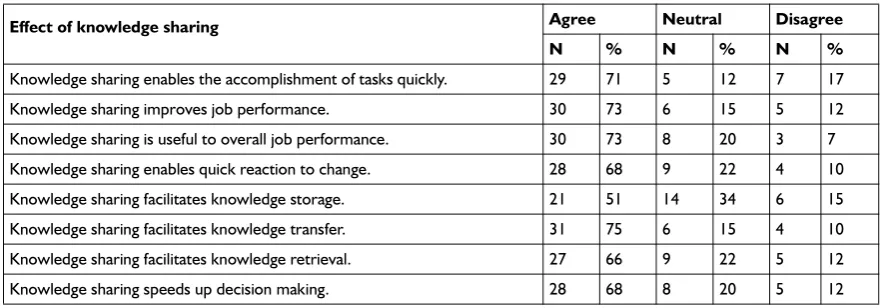
According to Davenport and Prusak (1998), knowledge sharing must be encouraged and rewarded. In fact, Lee (2005) and Lloria (2008) suggest that sharing facilitates KM practice. In order to have an idea of the extent of knowledge sharing at MCNY, questions were directed at finding out if an environment for knowledge sharing existed and what impact individuals felt it had on their departmental effectiveness. The respondents indicated ways in which they thought knowledge sharing can have an impact on an individual. These results are depicted in table 1.
Rating averages of 2.27 and 2.17 reflect that most of the questionnaire respondents agreed that the environment for sharing knowledge enabled individuals to accomplish tasks quickly and improved individual job performance. A similar pattern is reflected by rating averages of 2.05 and 2.24, which indicates that a large number of the respondents agreed that the environment for knowledge sharing was important to people’s jobs and that it enabled individuals to react more quickly when necessary. Rating averages of 2.54, 2.39, 2.24 and 2.27 show that many respondents agreed that a
Table 1 Effect of knowledge sharing on the individual
Effect of knowledge sharing Agree Neutral Disagree
N % N % N %
Knowledge sharing enables the accomplishment of tasks quickly. 29 71 5 12 7 17
Knowledge sharing improves job performance. 30 73 6 15 5 12
Knowledge sharing is useful to overall job performance. 30 73 8 20 3 7
Knowledge sharing enables quick reaction to change. 28 68 9 22 4 10
Knowledge sharing facilitates knowledge storage. 21 51 14 34 6 15
Knowledge sharing facilitates knowledge transfer. 31 75 6 15 4 10
Knowledge sharing facilitates knowledge retrieval. 27 66 9 22 5 12
departmental environment for sharing knowledge facilitates knowledge storage, retrieval and transfer, and speeds up decision making. Rating averages (or the weighted average) were calculated on SurveyMonkey® to indicate tendencies towards “agree”, “neutral” or “disagree”.
As is illustrated in figure 1, a culture of sharing knowledge was not prevalent at the MCNY.
An above-average number of respondents (that is 21 [54%] felt that there were no proper organisational guidelines on the sharing of information at the MCNY, while four (10%) disagreed with this and 14 (36%) gave no opinion. The view that the bureaucratic procedures involved in sharing were complicated was expressed by 15 (39%) respondents who agreed, 17 (44%) gave a non-committal response and seven (18%) disagreed. The lack of a proper IT platform for sharing information was seen as a hindrance by 16 (41%) respondents, while 14 (36%) did not give an opinion and nine (23%) disagreed with the notion.
5.2.3 Knowledge retention
Policy that is aimed at creating an inventory of organisational intellectual assets and avoiding their loss can be a part of best practices in an organisation. These assets include both tacit and explicit knowledge (Nonaka & Takeuchi 1995). The fact that the MCNY had a larger percentage of part-time staff than full-time staff had a lot of implications for the need to create information and knowledge retention systems for the sake of consistency and continuity.
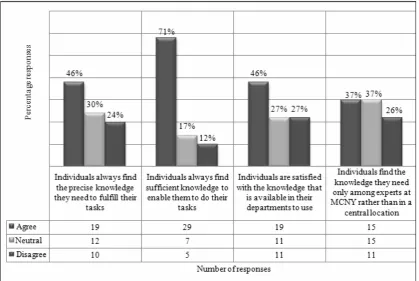
At the MCNY, knowledge existed in procedures manuals and job descriptions. This was confirmed by 29 (71%) respondents who felt that they always found sufficient knowledge to enable them to do their tasks, while seven (17%) opted not to give an opinion and five (12%) disagreed. At the same time, 19 (46%) respondents found the precise knowledge which they needed to fulfil their tasks, while 12 (30%) did not express an opinion and 10 (24%) disagreed. Another 19 (46%) respondents were satisfied with the knowledge that was available in their departments for their use, while 11 (27%) disagreed and 11 (27%) remained ambivalent. Some individuals felt that the knowledge they needed was found only among experts at the MCNY rather than in a central location: 15 (37%) of the respondents agreed, 15 (37%) chose not to give an opinion and 11 (26%) disagreed. These results are demonstrated in figure 2.
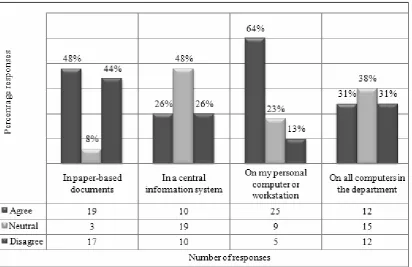
There appeared to be several places at the MCNY where one could access knowledge, but they were not necessarily in a central location. These ranged from paper-based sources, the heads of departments, a central information system, personal computers and departmental computers. While 19 (48%) respondents agreed that knowledge was found in paper-based documents, three (8%) did not commit to an opinion and 17 (44%) did not agree. 17 (44%) of the respondents disagreed that knowledge was in the heads of departmental members, while 16 (41%) were ambivalent about this perception and six (14%) agreed with it. However, 25 (64%) of the respondents were of the opinion that the knowledge they needed to perform their job functions was on their personal computers or workstations, while nine (23%) opted not to give an opinion and five (13%) disagreed.
A significant number of 19 (48%) respondents did not give an opinion about knowledge being kept in a central storage space, although 10 (26%) agreed and another 10 (26%) disagreed with this perception. 12 (31%) agreed, while 12 (31%) disagreed that knowledge was stored on all computers in the departments where they worked and 15 (38%) gave no opinion. A non-committal response seemed the most popular concerning the availability of knowledge in a central information system: 19 (48%) of the respondents chose not to commit to an opinion, while 10 (26%) agreed and 10 (26%) disagreed.
A system that follows a consistent approach is likely to be dependent on documented sources (Weddell 2008; Zhang, Tian & Qi 2006). As the responses to the questionnaire indicate, there was documented knowledge at the MCNY. This was corroborated by observations which revealed that records and documents that were important to the MCNY were stored at several locations with no record of which records were located where. The respondents’ perceptions on the storage and location of documented knowledge are shown in figure 3.
Knowledge becomes manageable, shareable and reusable only if it is recorded and made available. The interviewees said that they recorded their experiences, but for their own benefit or for the benefit of the educational or work-related programmes in which they were involved. However, one sentiment was:
The library could play a major part in the knowledge retention processes since that is one of the most central departments of the college, and it already has staff members who have the capabilities to organise and manage knowledge.
Other knowledge retention activities most probably existed in the college that the interviews failed to capture; however, all the information showed that there was knowledge retention and a use climate existed, but these had to be developed further. Knowledge retention policies and practices at the MCNY seemed vague: 21 (54%) questionnaire respondents felt that there were no proper organisational guidelines on the sharing of information, while 15 (39%) believed that the bureaucratic procedures involved in sharing were complicated and 16 (41%) viewed a lack of a proper IT platform for sharing information as a problem.
5.4 Modern information technologies in use at the MCNY that enhance the environment for KM practice
Modern information technologies enable new knowledge behaviours (Davenport & Prusak 1998). To a large extent, technology is the tool of choice to make KM easier (Abell 2000; Ngulube & Lwoga 2007; Singh 2007) because it is convenient when maintaining explicit knowledge. It is “a key enabler in KM, but is not KM in itself. It is a facilitator to provide faster access to knowledge or to share/transfer it among individuals” (Singh 2007:175). These technologies make it possible to use information and knowledge management tools such as Google books, Google mail, Google notebook, Google docs, Lotus Notes, Microsoft Exchange, Business Objects, Twitter, Facebook, MySpace, blogs and wikis.
A certain degree of knowledge-handling expertise was required in order to be competent in the environment driven by information technologies. The results from the questionnaire revealed that 35 (90%) of the respondents were confident that they were able to assess and evaluate information, while three (8%) gave no opinion and one (2%) disagreed with this perception. 33 (87%) respondents were confident that they could create, record and store information, while three (8%) were ambivalent and two (5%) disagreed. These respondents also indicated that they were able to use information retrieval tools such as library databases: 25 (64%) respondents agreed that they could, while nine (23%) gave no opinion and five (13%) disagreed.
All the employees had a mail account for business communication; the interviews, observations and questionnaire administration confirmed the existence of computers in all departments. The findings of the study indicate that computers in offices were used to create records. MCNY Employees shared their knowledge/know-how with their colleagues and others in limited ways through Web 2.0 platforms. The knowledge in the college was sometimes distributed in informal ways through social networking, but normally in formal ways through email. Institutional
documents and observations revealed that MCNY employees had accounts in iTunes, Facebook, Twitter and YouTube (that appeared on the MCNY home page).
Blogs and wikis were used at the MCNY. The readily identifiable ones included the MCNY Admissions blog, the MCNY Emergency and Disaster Management blog, the MCNY Title V Learning Enhancement Centre blog and the MCNY Library wiki. According to Fichter (2005:49), “wikis work best in organisational cultures in which there is a high level of trust and control can be delegated to the users of the system”. One therefore had to think about how frequently people needed to communicate, what technology people preferred, how often groups wanted to share information and how many potential users would be involved.
According to Anderson (2007), collaborative, interactive work spaces (such as the wikis that are available) have become relevant and librarians have to find ways to use new technologies to their best advantage. The observation results showed that there had been only one visit to the library wiki during the times that observation sessions took place. The library faced competition from resources like the Open Access Initiative (Suber 2007), Wikipedia, Google and other internet resources, which library users regarded as alternative sources of information, potentially relegating the importance of the library to insignificance and making the investment in library resources a waste.
6 Conclusions and recommendations
The field of KM was fairly new at the MCNY and this partly explains why it did not appear to feature in practice. From the questionnaire responses and interviews, the managers at the various managerial levels clearly understood KM concepts; here were “neutral” responses that indicated that some employees were not sure about the differences in meanings. Knowledge sharing was not prevalent. Many respondents were not satisfied with the knowledge in their departments. Confirming the case study findings in the literature review of this article, this study established that the effective implementation of KM depends largely on many factors, the most important of which are sharing and developing an enabling institutional culture and understanding what it entails.
Many of the participants in the study expressed the view that the absence of a central place for storing institutional documents and student projects could inhibit knowledge sharing or transfer and knowledge retention. The interviewees indicated that the library was the place, where knowledge presentation or transfer had the potential to effectively take place because all members of the MCNY visited it at some time or another. Collaboratively, interactive work spaces such as the wikis and social media were available, although they were not extensively used. This might be partially explained by the respondents’ limited skills in the use of communication technologies.
The ground is partially fertile for the use of KM principles to strategically position the library in a changing information environment. KM theory, with its emphasis on enhancing performance, is suited for current library practice that focuses on providing user-oriented services. The library should champion and strengthen the existing KM environment and information technologies to maximise the use of information and knowledge at the MCNY. Stated differently, the library should enhance the value and use of organisational knowledge. Recognising knowledge and information as organisational assets requires the involvement of the library; in this way, the service value of the latter will be enhanced.
Librarians have to find ways to use new technologies to their best advantage as advised by Anderson (2007). The library should use collaborative and interactive work spaces such as the wikis that are available to locate and share specific knowledge and expertise. Internet communication technologies can provide a collaborative learning environment that can encourage the MCNY teaching and learning community to make more robust use of the library. The library should exploit this capability and offer information technology in a formal way in order to promote the usage of the facilities by the MCNY community. While KM practice is a viable way of enhancing the value of the library, it is suggested that a strategically coherent organisational culture and environment for it is essential because the library can hardly be successful in efforts that are made in solitude. Some of the ways in which library users can use the Web 2.0 functionality include the capability for tagging the online public access catalogue (OPAC) (so that they have a set of records that they prefer to use readily accessible to them in a tag cloud) or having a social networking account like Twitter, Facebook, MySpace or delicious.com or any of the numerous social networking platforms that are currently in use to reach out to those who are comfortable with using these facilities.
The library should centrally store and give access to information and knowledge for the benefit of the college. At the same time, it should build knowledge gateways. The use of these gateways will lead to innovation and the creation of new knowledge. This has the potential to leave even senior management turning to the library for all information and knowledge needs. It might also be worthwhile to look into the establishment of a programme for creating an institutional repository or repositories to collect the MCNY knowledge assets. A knowledge portal should be a platform that enables linkages to the said repositories in a unified, seamless way. In fact, since the library functions as a cost centre of the college, librarians have to create value to justify receiving continued institutional support in the face of other competing sources of information.
References
Abell, A. 2000. Skills for knowledge environments. The Information Management Journal, 34(3):33–41.
Addleson, M. 2000. Organizing to know and to learn: reflections on organization and knowledge management. In: Srikantaiah, TK & Koenig, M (eds), Knowledge management for the information professional. Medford, NJ: American Society for Information Science, 137–160.
Anderson, P. 2007. “All that glisters in not gold”: web 2.0 and the librarian. Journal of Librarianship and Information Science, 39(4):195-198.
Association of College and Research Libraries (ACRL). 2010. Charting our future: ACRL Strategic Plan 2020. Chicago, Il: ACRL. [Online]. http://www.ala.org/ala/mgrps/divs/acrl/about/whatisacrl/strategicplan/index.cfm. (Accessed on 13 January 2010). Bensman, S.J. 2007. Donald J. Urquhart and the integration of science with librarianship: Part 1. Interlending and Document
Supply, 35(2):74–84.
Broadbent, M. 1998. The phenomenon of knowledge management: what does it mean to the information profession? Knowledge management: an emerging concern. [Online]. http://www.sla.org/pubs/serial/io/1998/may98/broadben.html. (Accessed on 24 January 2008).
Carpenter, C. & Steiner, S. 2005. Using Web 2.0 technologies to push e-resources. [Online]. http://smartech.gatech.edu/ bitstream/1853/13640/2/236-fri-11_05.pdf. (Accessed on 1 February 2008).
Corsini, A. 2010. Free statistics. [Online]. http://en.freestatistics.info/about.php. Accessed on 19 May 2010.
Creswell, J.W. 2007. Qualitative inquiry and research design: choosing among five approaches. Thousand Oaks, CA: Sage. Cunningham, J.B. 1993. Action research and organisational development. London: Praeger.
Davenport, T.H. & Prusak, L. 1998. Working knowledge: how organizations manage what they know. Boston, Mass.: Harvard Business School Press.
Fichter, D. 2005. Intranets, wikis, bikis and collaborative working. Online, 29(5): 47–50.
Gandhi, S. 2004. Knowledge management and reference services. The Journal of Academic Librarianship, 30(5):368–381. Glaser, B.G. & Strauss, A. 1967. Discovery of grounded theory. Strategies for qualitative research. Mill Valley, CA: Sociology Press. Green, P. 2008. Social libraries: the next generation of knowledge management. Information Outlook, 12(12):10–15.
Greenlaw, C. & Brown-Welty, S. 2009. A comparison of web-based and paper-based survey methods: testing assumptions of survey mode and response cost. Evaluation Review, 33(5):464–480.
Grinnell, R.M. 1997. Social work research and evaluation: quantitative and qualitative approaches. Ithaca, Ill.: Peacock.
Grover, R. & Greer, R.C. 1991. The crossdisciplinary imperative of LIS research. In: McClure, CR & Hernon, P. (eds), Library and information science research: perspectives and strategies for improvement. Norwood, NJ: Ablex, 101–113.
Grünbaum, N.N. 2007. Identification of ambiguity in the case study research typology: what is a unit of analysis? Qualitative Market Research, 10(1): 78-97.
Hamid, S. & Nayan, J.M. 2007. Preliminary study of knowledge management in a library: a case study of the National Library of Malaysia. Malaysia: Kuala Lumpur.
Hamid, S., Nayan, J.M., Bakar, Z.A. & Norman, A.N. 2007. Knowledge management adoption and implementation readiness: a case study of the National Library of Malaysia. In: Building an information society for all: proceedings of the International Conference on Libraries, Information and Society, ICOLIS 2007, Armada Hotel, Petaling Jaya, 26–27 June 2007.
Hancock, B. 1998. Trent focus for research and development in primary health care: an introduction to qualitative research. Nottingham: Trent Focus.
Hernon, P. & Schwartz, C. 2007. What is a problem statement? Library and Information Science Research, 29:307–309.
Jashapara, A. 2005. The emerging discourse of knowledge management: a new dawn for information science research? Journal of Information Science, 31(2):136–148.
Kidwell, J.J., Vander Linde, K.M. & Johnson, S.L. (2000). Applying corporate KM practices in higher education. Educause Quarterly, 4:28–33
Lee, H-W. (2005). Knowledge management and the role of libraries. Chinese Librarianship: an International Electronic Journal, 19. [Online]. http://www.white-clouds.com/iclc/cliej/cl19.htm. (Accessed 4 December 2009).
Leedy, P.D. & Ormrod, J.E. 2005. Practical research: planning and design. Upper Saddle River, NJ: Pearson.
Leysen, J.M. & Boydston, J.M.K. 2009. Job satisfaction among academic cataloger librarians. College and Research Libraries, 70(3):273–297.
Lloria, M.B. 2008. A review of the main approaches to knowledge management. Knowledge Management Research and Practice, 6(1):77–89.
Macgregor, G. & McCulloch, E. 2006. Digital directions: collaborative tagging as a knowledge organisation and resource discovery tool. Library Review, 55(5):291-300.
McKechnie, L. & Pettigrew, K.E. 2002. Surveying the use of theory in library and information science research: a disciplinary perspective. Library Trends, 50(3):406–417.
MCNY. 2009. Self-study for Middle States Commission on Higher Education: comprehensive accreditation review. New York: MCNY. Ngulube, P. 2005. Research procedures used by Master of Information Studies students at the University of Natal in the period 1982–2002 with special reference to their sampling techniques and survey response rates: a methodological discourse. The International Information and Library Review, 37(2):127–143.
Ngulube, P. & Lwoga, E. 2007. Knowledge management models and their utility to the effective management and integration of indigenous knowledge with other knowledge systems. Indilinga – African Journal of Indigenous Knowledge Systems, 6(2):117– 131.
Nonaka, I. & Takeuchi, H. 1995. The knowledge-creating company: how Japanese companies create the dynamics of innovation. New York, N.Y.: Oxford University Press.
O’Sullivan, E., Rassel, G.R. & Berner, M. 2008. Research methods for public administrators. New York: Pearson.
Pantry, S. & Griffiths, P. 2003. Librarians or knowledge managers? What's in a name, or is there a real difference? Business Information Review, 20(2):102–109.
Pezzullo, J.C. 2010. Free statistical software. [Online]. http://statpages.org/javasta2.html. (Accessed on 19 May 2010).
Ravi, L. 2008. Library futures – from information gateways to knowledge gateways. In: Beyond the hype: web 2.0 symposium of the Australian Library and Information Association, 1–2 February 2008, Brisbane, Australia.
Rowley, J. 2003. Knowledge management – the new librarianship? From custodians of history to gatekeepers to the future. Library Management, 24(8/9):433–440.
Ruggles, R.L. 1997. Tools for knowledge management: an introduction. In: Ruggles, R. (ed.) Knowledge management tools. Boston, MA: Butterworth-Heinemann, 1–8.
Singh, S.P. 2005. Knowledge management and its use in library. 3rd Convention PLANNER -2005, Assam Univ., Silchar, 10-11 November, 2005, 144-147. [Online]. http://shodhganga.inflibnet.ac.in/dxml/bitstream/handle/1944/1382/21.pdf?sequence=1. (Accessed on 9 April 2011).
Singh, S.P. 2007. What are we managing – knowledge or information? VINE: The Journal of Information and Knowledge Management Systems, 37(2):169–179.
Singh, M.D. & Kant, R. 2008. Knowledge management barriers: an interpretive structural modelling approach. International Journal of Management Science and Engineering Management, 3(2):141–150.
Stake, R.E. 2005. Qualitative case studies. In: Denzin, N.K. & Lincoln, Y.S. (eds). The Sage handbook of qualitative research. 3rd ed. Thousand Oaks, CA: Sage, 433–466.
Suber, P. 2007. Open access overview: focussing on open access to peer-reviewed research articles and their pre-prints. [Online]. http://www.earlham.edu/~peters/fos/overview.htm. (Accessed on 9 September 2009).
Tellis, W. 1997. Application of a case study methodology. The Qualitative Report, 3(3). [Online]. http://www.nova.edu/ssss/QR/ QR3-3/tellis2.html. (Accessed on 3 February 2008).
Townley, C.T. 2001. Knowledge management and academic libraries. College and Research Libraries, 62(1):44–55.
University of South Africa. 2007. Policy on research ethics. Pretoria: UNISA. [Online]. http://www.unisa.ac.za/contents/research/ docs/ResearchEthicsPolicy_apprvCounc_21Sept07.pdf. (Accessed on 9 January 2009).
Waxman, H.C. & Padrón, Y.N. 2004. The uses of the classroom observation schedule to improve classroom instruction. In: Waxman, H.C. (ed.) Observational research in U. S. classrooms: new approaches for understanding cultural and linguistic diversity. West Nyack, NY.: Cambridge University Press, 266–277.
Weddell, S. 2008. Transforming reference into a proactive knowledge advisory service: a case study. Reference Services Review, 36(2):147–155.
White, T. 2004. Knowledge management in an academic library: based on the case study “KM within OULS”. Paper presented at the 70th IFLA General Conference and Council, Buenos Aires. [Online]. http://www.ifla.org/IV/ifla70/papers/089e-White.pdf. (Accessed on 26 April 2009).
Wikgren, M. 2005. Critical realism as a philosophy and social theory in information science? Journal of Documentation, 61(1):11– 22.
Williams, A., Giuse N., Koonce, T., Kou, Q. & Giuse, D. 2004. Using knowledge management practices to develop a state-of-the-art digital library. MedInfo, 11(1): 99-103.
Yin, R.K. 1984. Case study research: design and methods. Thousand Oaks, CA: Sage. Zadeh, L.A. 1965. Fuzzy sets. Information and Control, 8:338–353.